



If your home workout keeps turning into a half-hearted wander between the dumbbells and the couch, the problem usually isn’t motivation. It’s structure.
The best dumbbell workouts for women at home are the ones that make a few simple moves do a lot of work: squat, hinge, push, pull, carry, and brace. That’s it. You do not need a fancy bench, a cable machine, or a room full of gadgets. You need a pair of dumbbells that feel honest in your hands and a plan that doesn’t waste your time.
I’ve always liked home dumbbell training because it rewards the basics. A goblet squat with a pair of medium weights can wake up more of your body than a dozen tiny leg lifts. A slow row can fix the kind of rounded-shoulder posture that comes from too much desk time and too much phone time. And a good carry? That one teaches your core to behave under load, which sounds boring until you realize how useful it is in real life.
So here are 28 dumbbell workouts that actually belong in a home routine — not cute filler, not fluff, and not the kind of move you do once and forget. Some are single exercises you can build into a set. Some are small circuits. A few are finishers that leave your legs a little wobbly in the best way.
1. Goblet Squat Starter for Dumbbell Workouts at Home
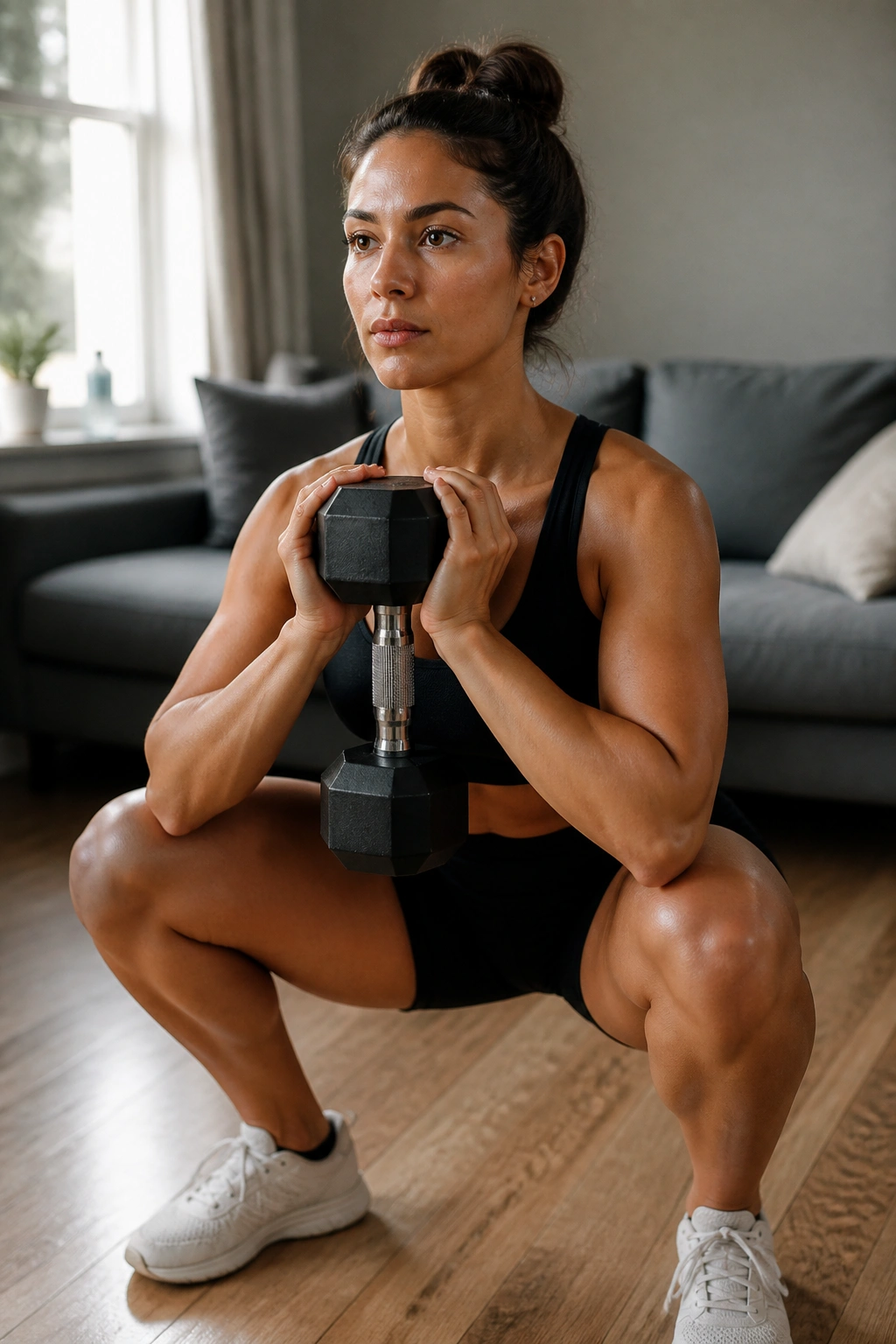
Heavy is relative. A single dumbbell held tight to your chest can make a squat feel serious fast.
Why It Works
The front-loaded position keeps your torso more upright, which shifts the load into your quads, glutes, and core instead of letting your lower back do the sloppy work. If you only have one weight, this is one of the smartest dumbbell workouts at home because it gives you a lot of return for very little setup.
Quick Setup
- 3 sets of 8 to 12 reps
- Hold one dumbbell vertically at chest height
- Lower until your thighs are at least parallel, or as deep as your hips allow without your heels peeling up
- Pause for 1 second at the bottom
- Drive up through the whole foot, not just your toes
Pro tip: If your knees cave inward, think about spreading the floor with your feet instead of forcing your knees out hard.
2. Romanian Deadlift for Glutes and Hamstrings
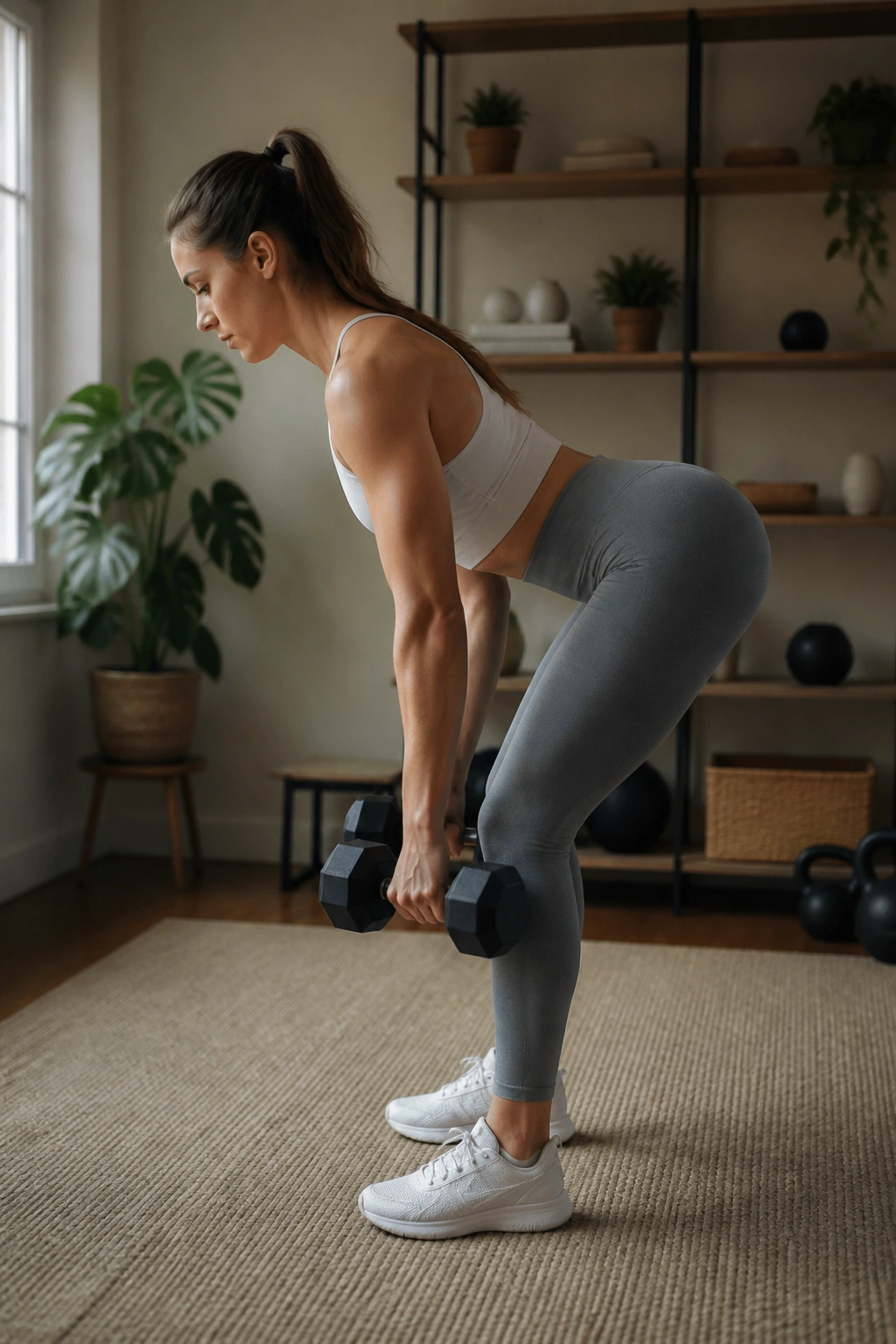
This is the move that teaches your hips how to hinge without turning your back into a question mark.
A Romanian deadlift looks simple, and that’s exactly why people rush it. Don’t. Keep a soft bend in your knees, send your hips back, and let the dumbbells slide close to your thighs and shins. The stretch you feel in the backs of your legs is the point. If you feel it mostly in your lower back, the dumbbells are probably drifting too far away from your body or you’re lowering too much.
Use 2 dumbbells for 3 sets of 10 to 12 reps, or one heavier dumbbell if that’s what you’ve got. A slow 3-second lower makes the workout sting in a good way. Pick a weight you can control all the way down, because once the back rounds, the set is over.
3. Reverse Lunge for Strong Legs and Better Balance
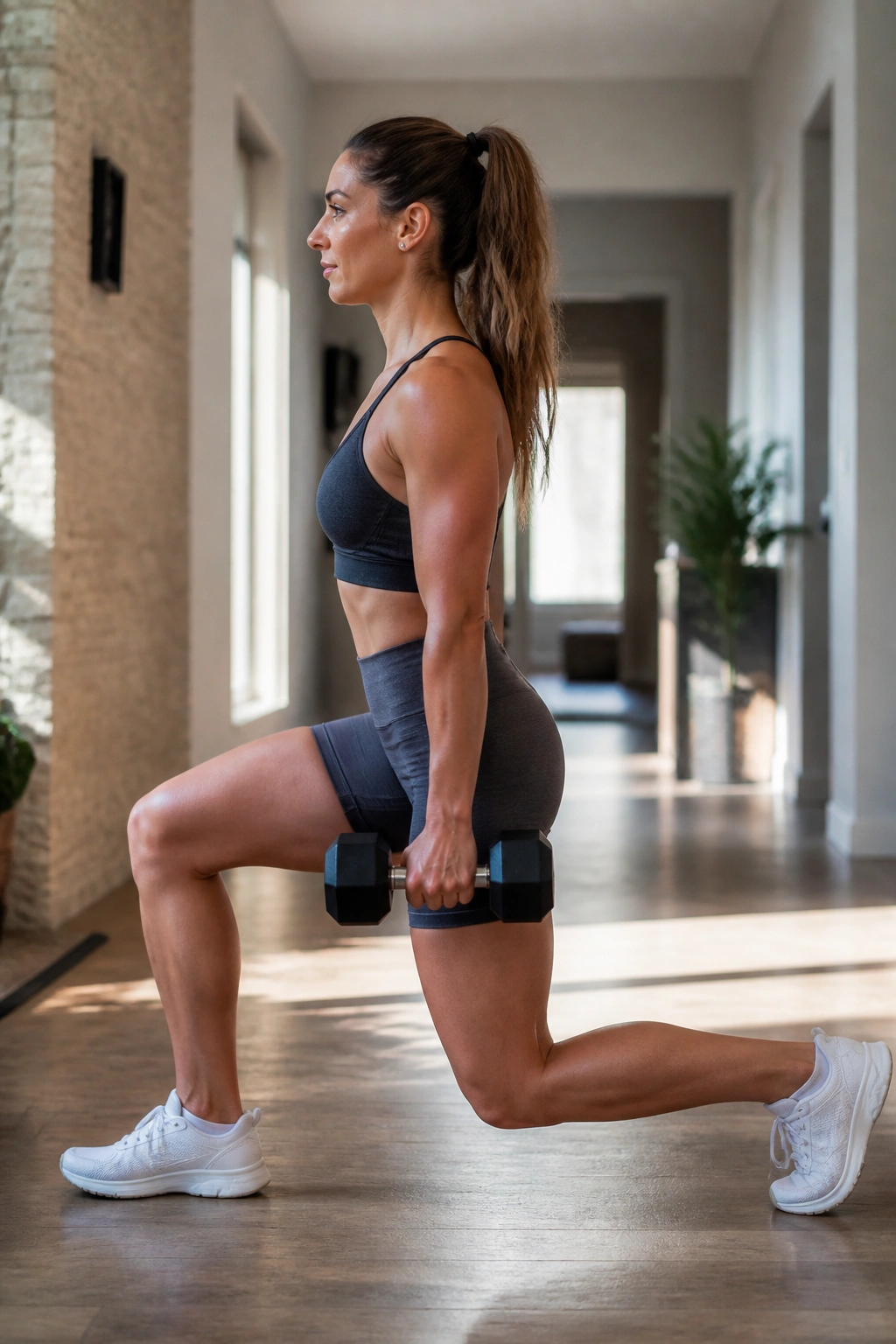
Why does stepping backward feel friendlier than stepping forward? Because your front leg gets to stay more planted, and your balance doesn’t have to recover from a big forward drop.
That small difference matters. Reverse lunges are one of the better dumbbell workouts for women at home when the goal is strong legs without a ton of equipment or impact. They hit the glutes, quads, and inner thighs while quietly testing balance and knee control. The trick is to keep your torso tall and let the back knee travel down, not forward and chaotic.
How to Use It
- 3 sets of 8 reps per side
- Hold one dumbbell at your chest or 2 dumbbells at your sides
- Step back about 24 to 30 inches, depending on your height
- Keep the front foot flat and the front shin close to vertical
- Stand up by pressing through the front heel
If your legs feel uneven from side to side, this move will tell the truth quickly.
4. Dumbbell Floor Press for Chest and Triceps
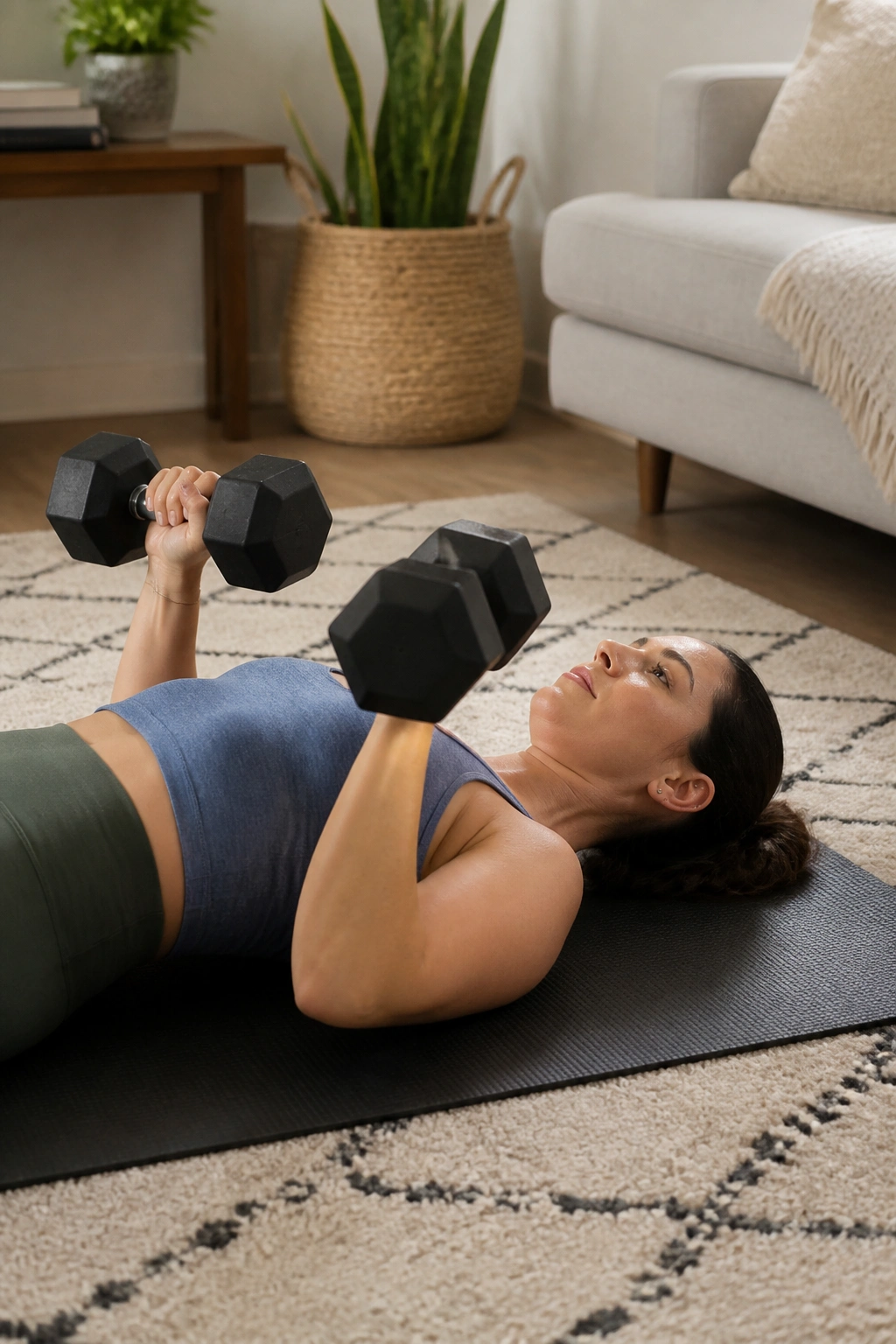
Lie down. Press. Repeat. Sometimes the simplest setup is the smartest one.
The floor press is one of my favorite home upper-body moves because the floor cuts off the bottom half of the rep and saves your shoulders from going too deep. That shortens the range just enough to make the press feel cleaner, especially if you’re still building chest strength or working around cranky shoulders. You’ll feel the triceps kick in hard near the top.
Use a pair of dumbbells, bend your knees, and plant your feet. Lower your elbows until they lightly touch the floor, then press up until your arms are straight without locking them aggressively. A neutral grip — palms facing each other — often feels nicer on the shoulders than a wide grip. Stick with 3 sets of 8 to 12 reps.
One good rep here beats ten rushed ones.
5. One-Arm Row for a Stronger Back
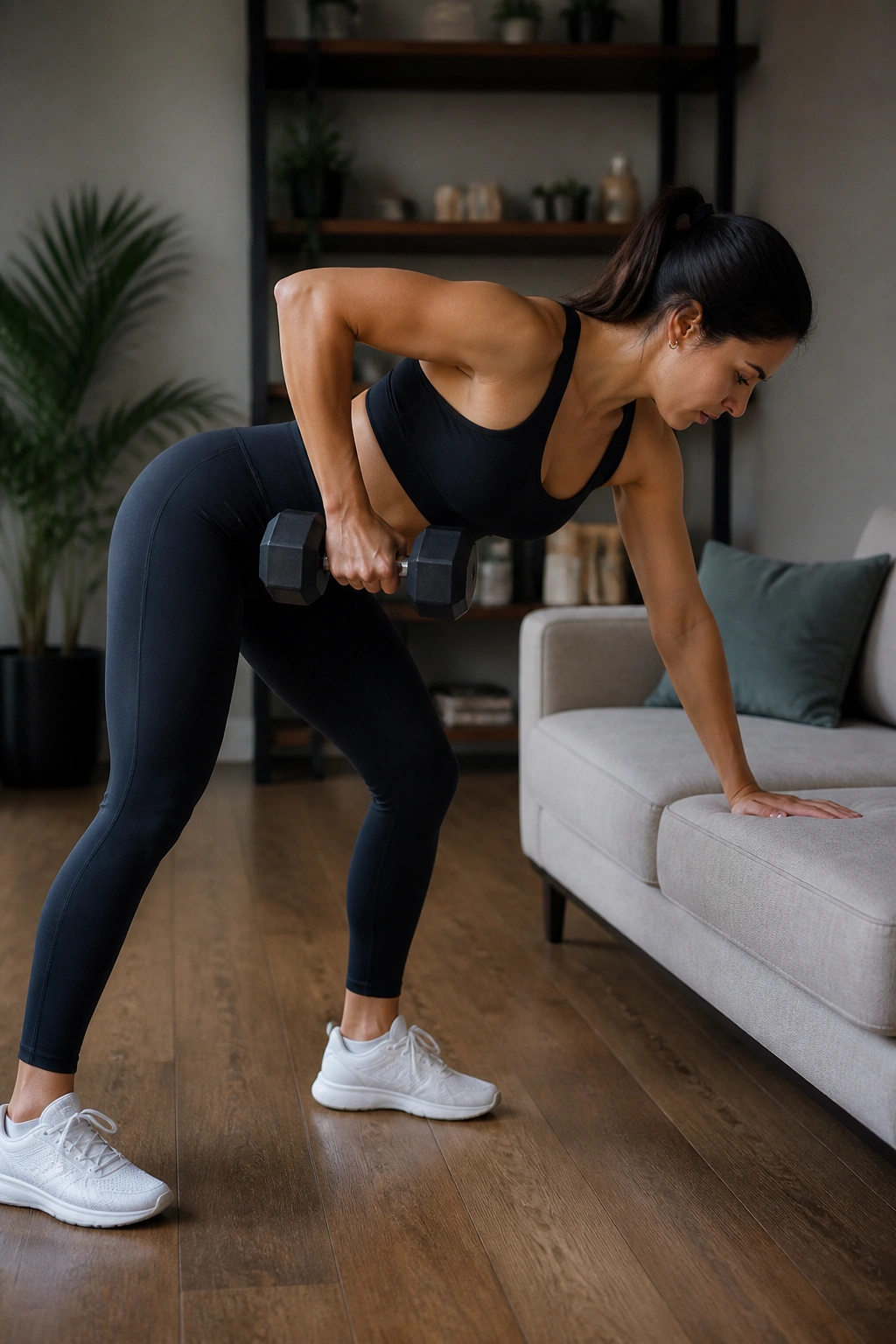
I keep coming back to this one because it fixes so much with so little drama.
A one-arm row works the lats, rear delts, and the middle of your back while also teaching you not to twist like a wet towel. Support your free hand on a couch, chair, or sturdy table, and keep your torso flat and quiet. Then pull the dumbbell toward your hip, not your shoulder. That small change shifts the work into the back where it belongs.
Use 3 sets of 10 to 12 reps per side. Pause for a second at the top and let the shoulder blade slide back before lowering. If you yank the weight with your biceps, you’ll feel the difference fast — and not in a good way. Keep your neck long, your ribs tucked, and your focus on the elbow path.
Rows make posture feel less optional.
6. Shoulder Press and Lateral Raise Combo
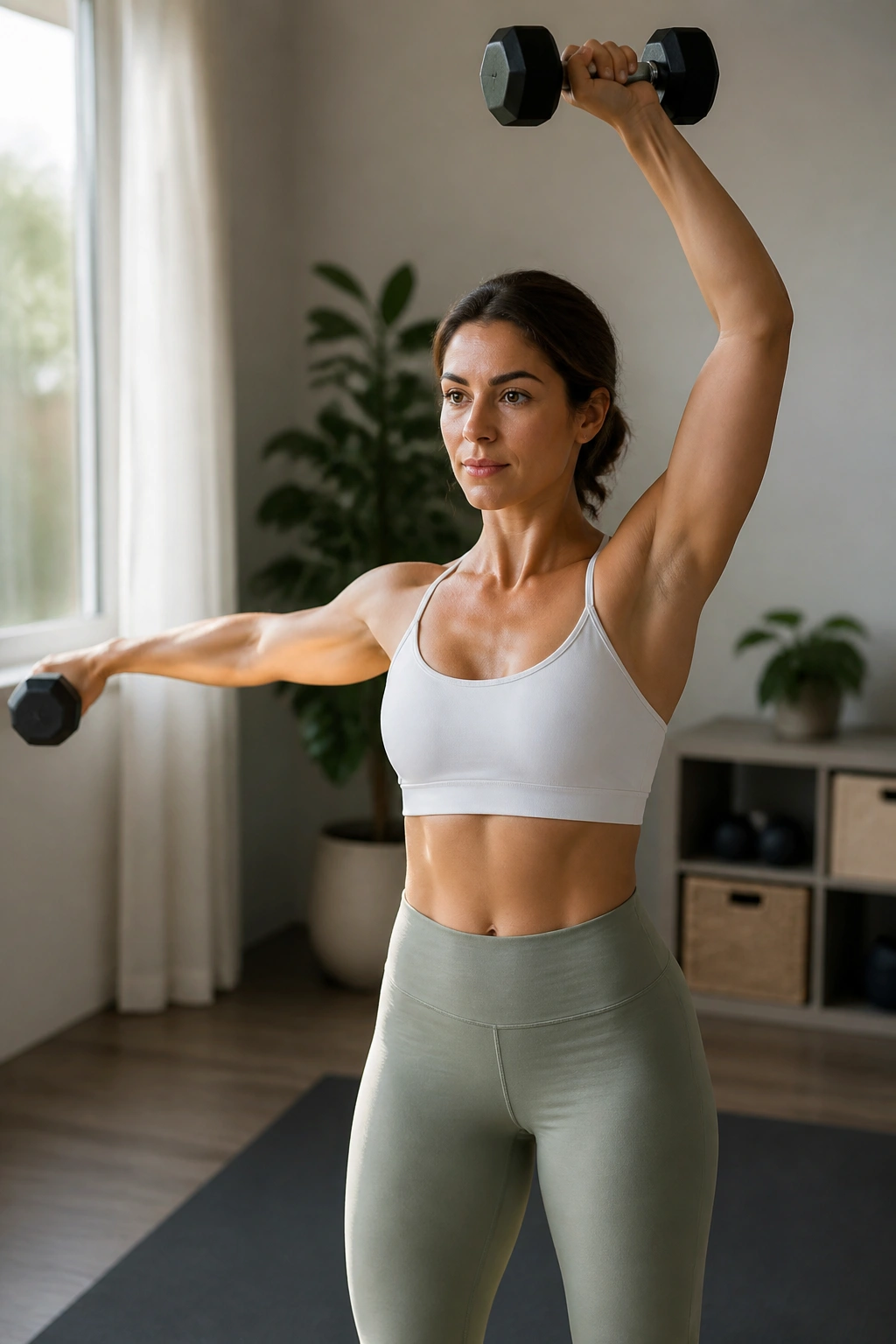
A straight overhead press is one thing. A press plus a lateral raise is a better shoulder day in a small space.
The press builds strength through the front of the shoulders and triceps. The lateral raise wakes up the side delts, which are the part most people notice when they want that rounder shoulder shape. Together, they make a compact upper-body workout that doesn’t need machines or endless volume. It also keeps the dumbbells in play for longer without turning the session into a full cardio circus.
Try 2 to 3 rounds of 8 presses and 10 to 12 raises. Use lighter weights for the raises than for the press — trying to side-raise a weight that belongs in a row usually ends with shrugging and swinging. Keep the wrists stacked and stop the raise around shoulder height. Higher is not better here.
Your shoulders will feel it by round two.
7. Glute Bridge Press for Dumbbell Workouts at Home
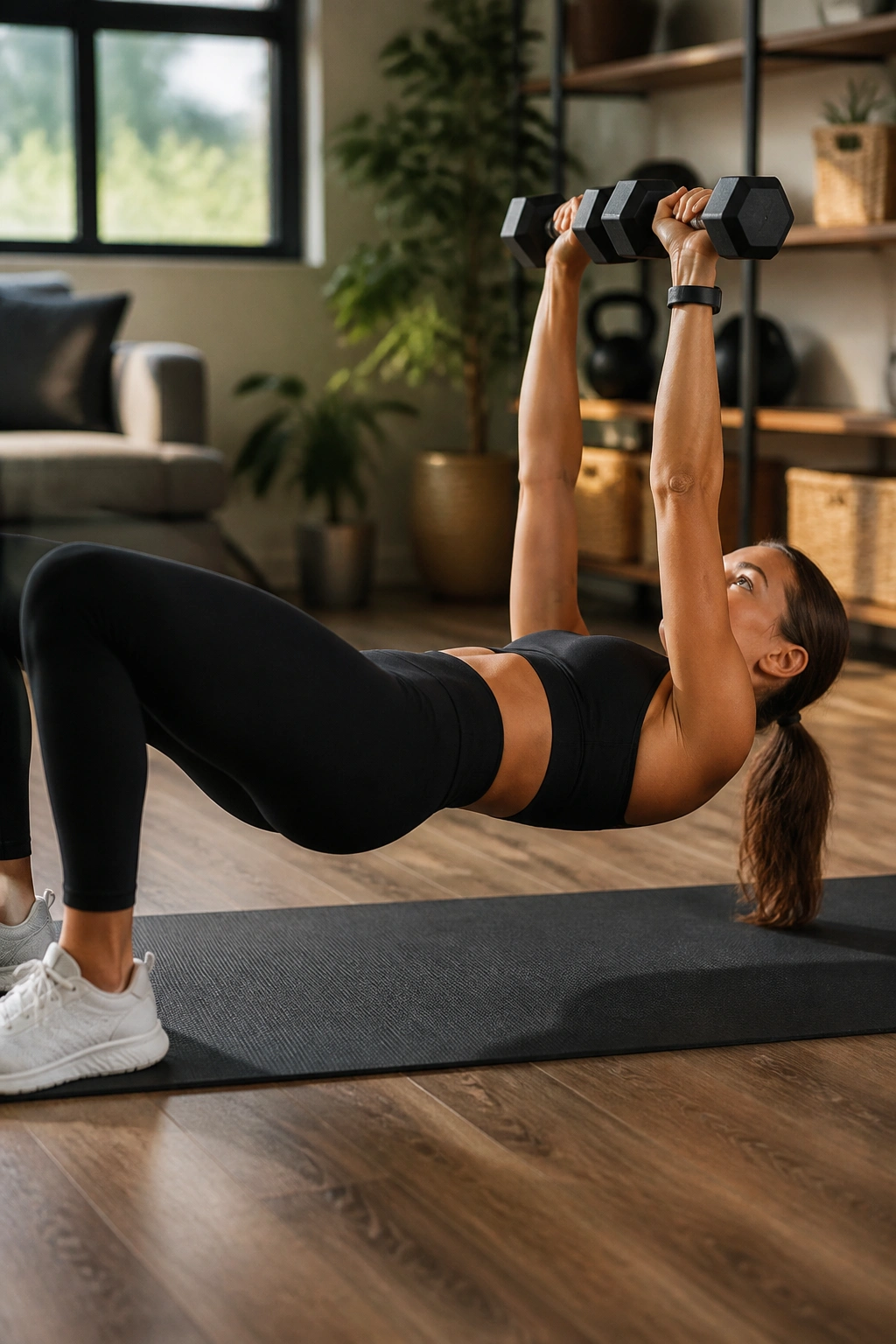
This one looks almost too simple until you try to keep your hips up and your arms steady at the same time.
How It Feels
You’re pressing from the floor while your glutes stay switched on in a bridge. That combination turns a basic chest press into a full-body tension drill, which is why it earns a place in dumbbell workouts at home where space is tight and time is shorter than you’d like. The hips stay lifted, the core has to brace, and the dumbbells don’t get to wander.
Set It Up
- 3 rounds of 8 to 10 presses
- Hold the bridge the entire time
- Keep feet hip-width apart and heels near your glutes
- Press the dumbbells straight up over the chest
- Lower with control until the elbows skim the floor
Watch this: If your lower back starts arching, lower the hips a little and reset. A smaller bridge done cleanly is better than a dramatic one done badly.
8. Renegade Row for Core and Back Control
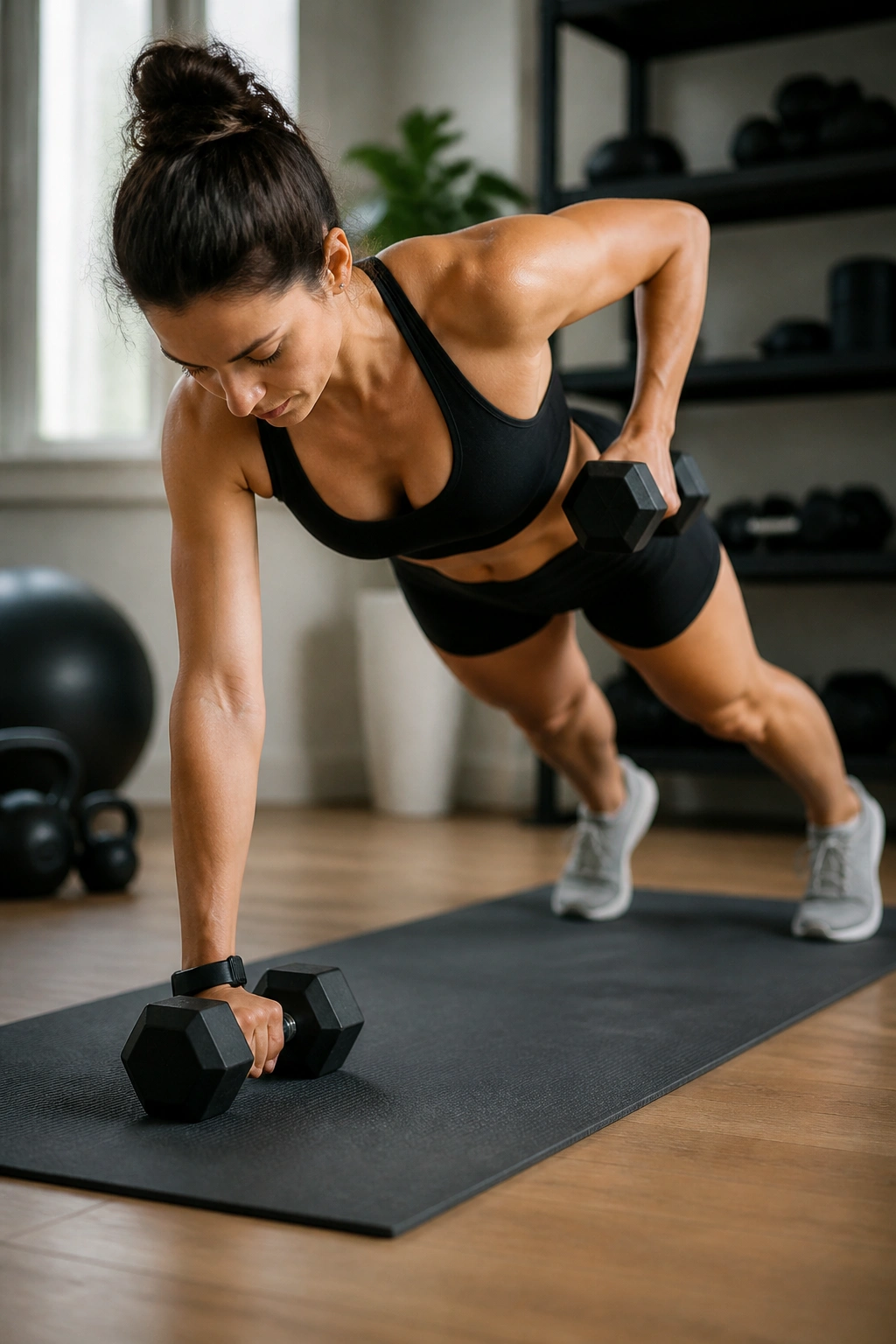
This is not a back exercise pretending to be core work. It’s both, and it exposes sloppy form fast.
A renegade row asks you to hold a plank while pulling one dumbbell at a time. That means your abs, glutes, shoulders, and back all have to cooperate while the floor tries to make you rotate. Keep the feet wider than hip-width if you need more stability. Narrow stance, on the other hand, is where things get spicy in a hurry.
Use lighter dumbbells than you think. Do 6 to 8 rows per side for 3 rounds, and keep the hips as square as possible. If the body shifts a lot, the weight is too heavy or the feet are too close together. Drop to your knees if needed and keep the row strict. That version still works.
A clean renegade row beats a shaky one every time.
9. Sumo Squat for Inner Thighs and Glutes
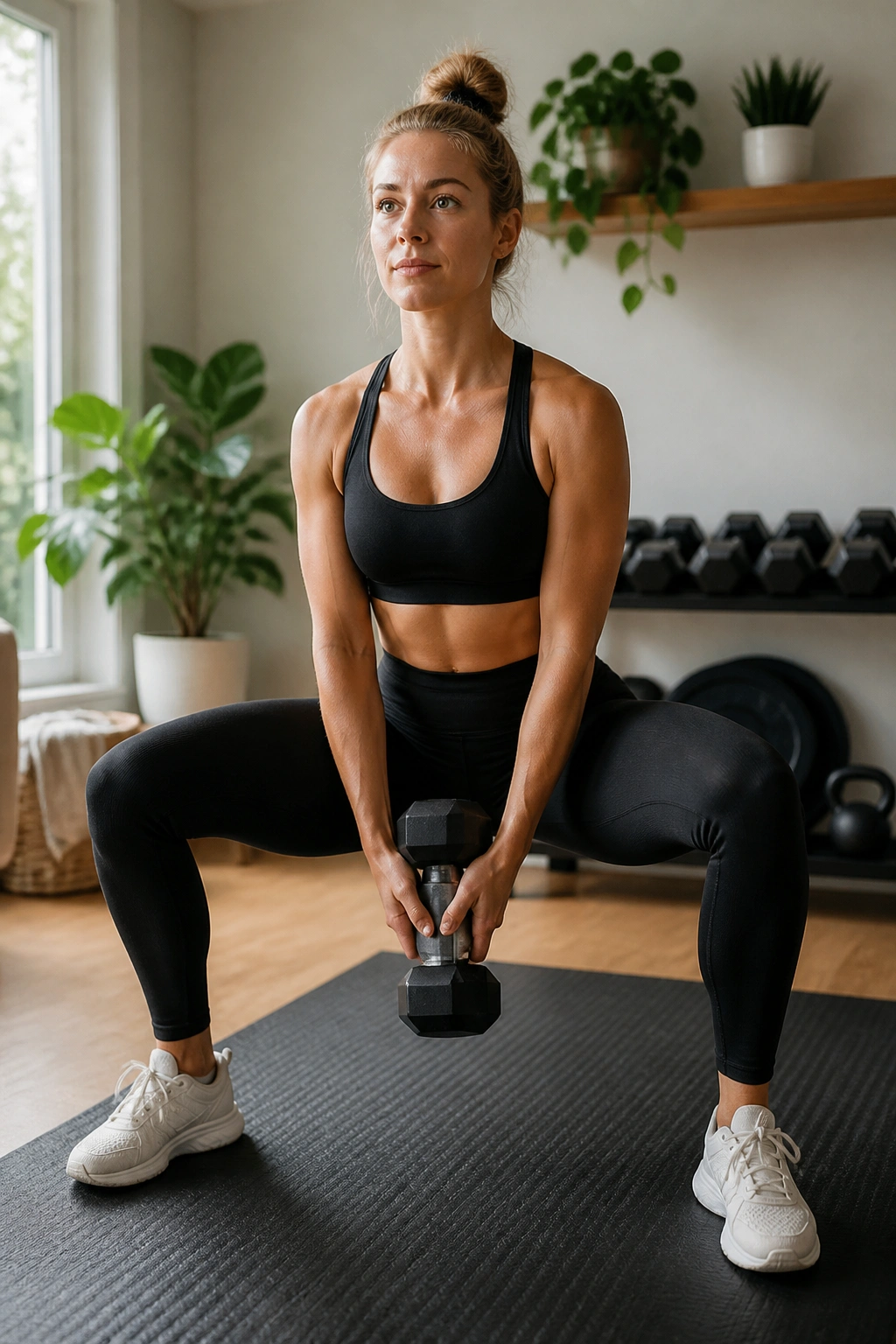
Why does a wider stance feel different? Because it changes where the work goes.
The sumo squat opens the hips, turns the toes slightly out, and asks more from the inner thighs and glutes than a narrow squat does. It’s a useful change of pace when regular squats start feeling too familiar. Keep the dumbbell hanging between your legs, chest lifted, and knees tracking over the toes.
How to Get the Most From It
- 3 sets of 10 to 15 reps
- Hold one heavy dumbbell with both hands
- Descend until the dumbbell almost brushes the floor
- Pause for 1 second at the bottom
- Drive up with pressure through the whole foot
The lower you go, the more your hips and groin have to open — but only go as deep as you can without losing control.
10. Curl to Press for Arms and Shoulders
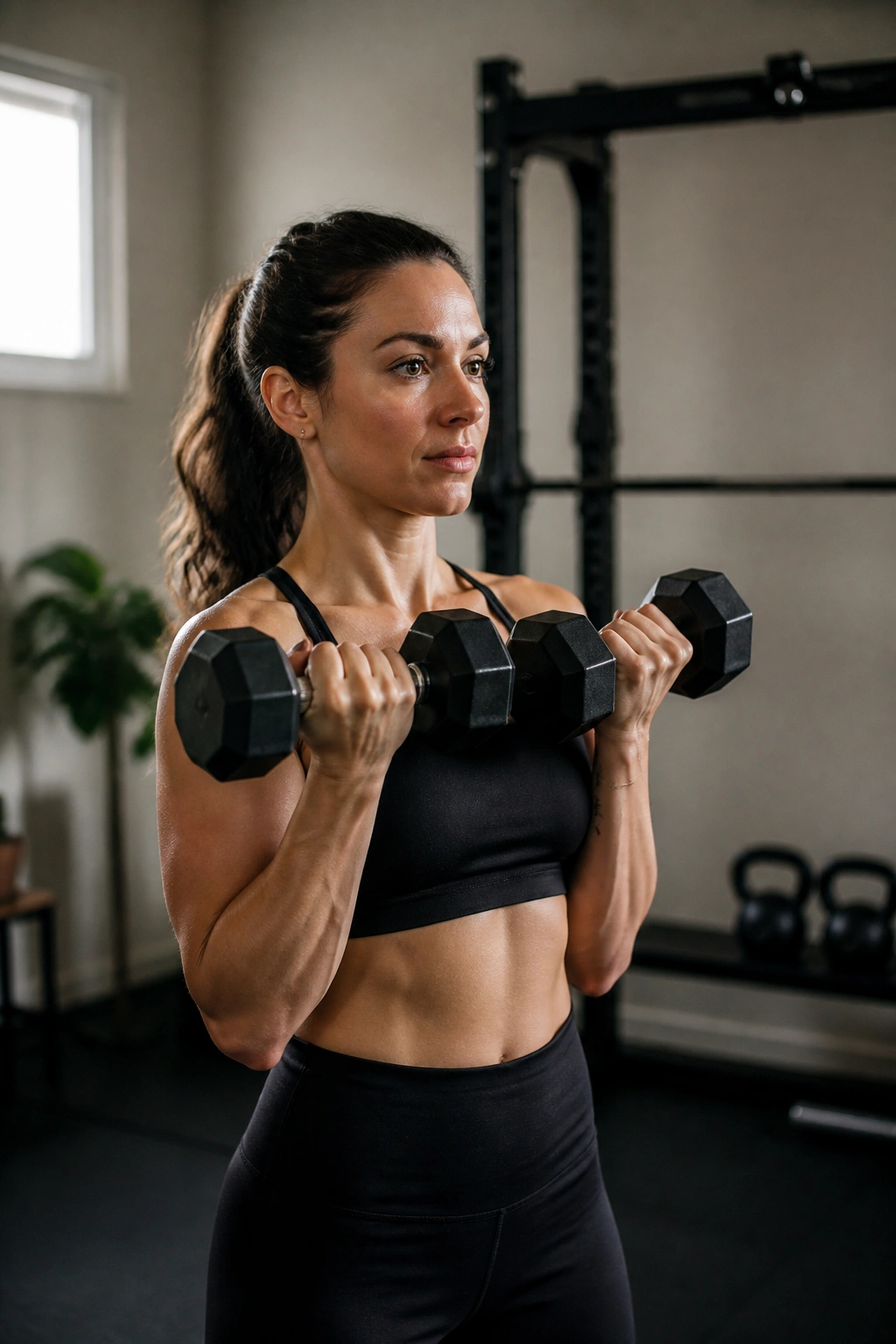
If you only have one pair of dumbbells and ten minutes, this combo is a smart place to spend them.
The curl to press starts with biceps and finishes with shoulders and triceps, which makes it a tidy upper-body sequence for home training. It also cuts down on equipment switching, which I appreciate more than I probably should. Keep the curl strict, then rotate the palms and press overhead without throwing your lower back into the party.
Do 3 sets of 8 to 10 reps. Use a weight you can curl without leaning back, because the press will already ask for enough. If your elbows drift too far forward during the curl, the dumbbells become more of a swing than a lift. Stop at shoulder height, reset, and press with your ribs tucked.
Simple. Effective. A little humbling.
11. Curtsy Lunge for Glutes and Hip Stability
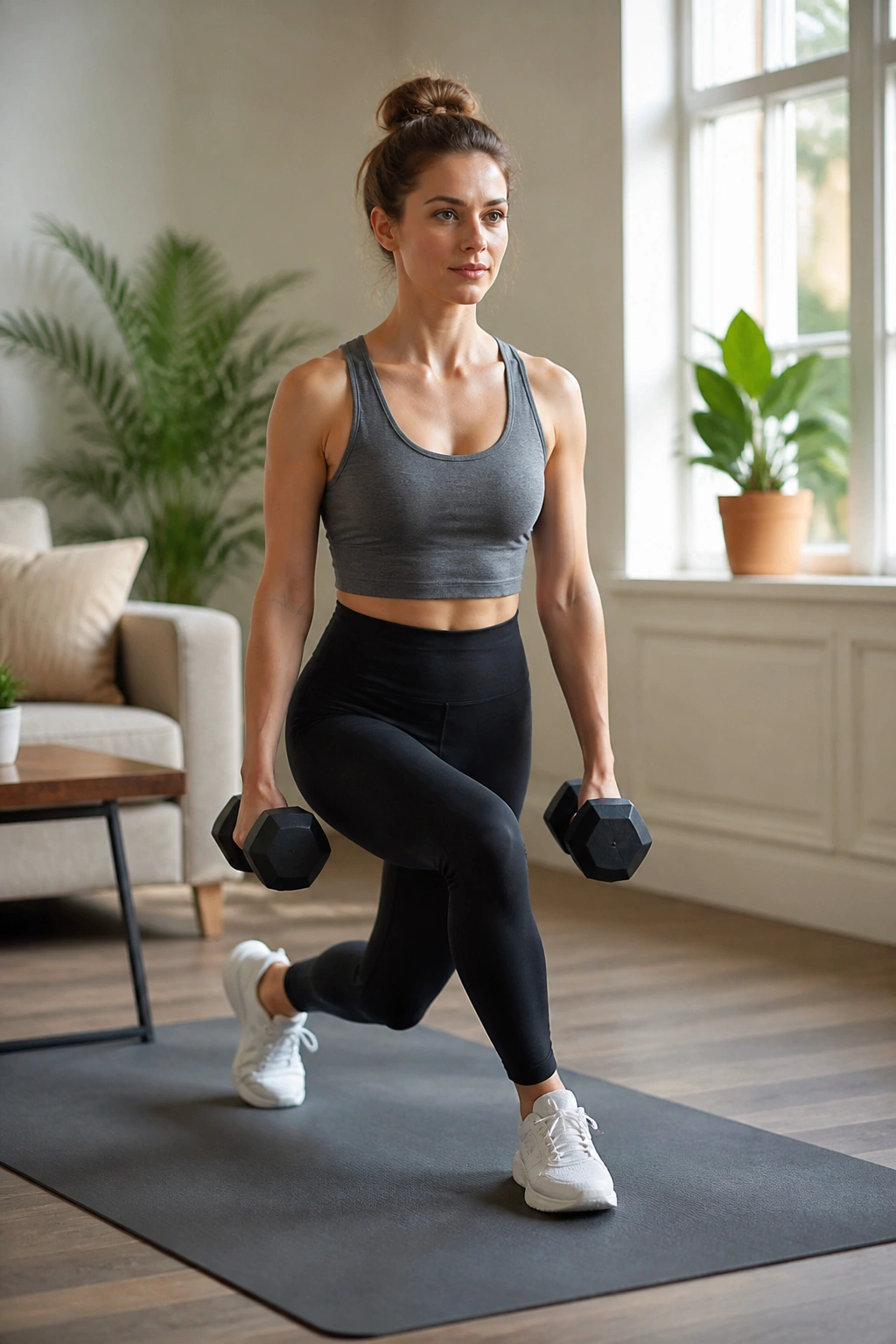
This is one of those moves that looks graceful until your side glutes start lighting up.
Curtsy lunges cross one leg behind the other, which shifts some of the work into the glute medius and outer hip. That makes them useful when you want leg work that feels a little different from straight squats and lunges. Keep the step small if your knees complain. Big crossover steps can feel rough on the hips if your mobility isn’t there yet.
Use 2 dumbbells at your sides or one goblet-style weight at your chest. Aim for 8 to 10 reps per side, and keep your torso mostly upright. The front foot should stay planted, with the front knee tracking over the middle toes. If you feel your balance wavering, slow the descent and pause for half a second before standing.
Not every lower-body move has to look tidy. This one just has to feel controlled.
12. Dead Bug Pullover for Core Control
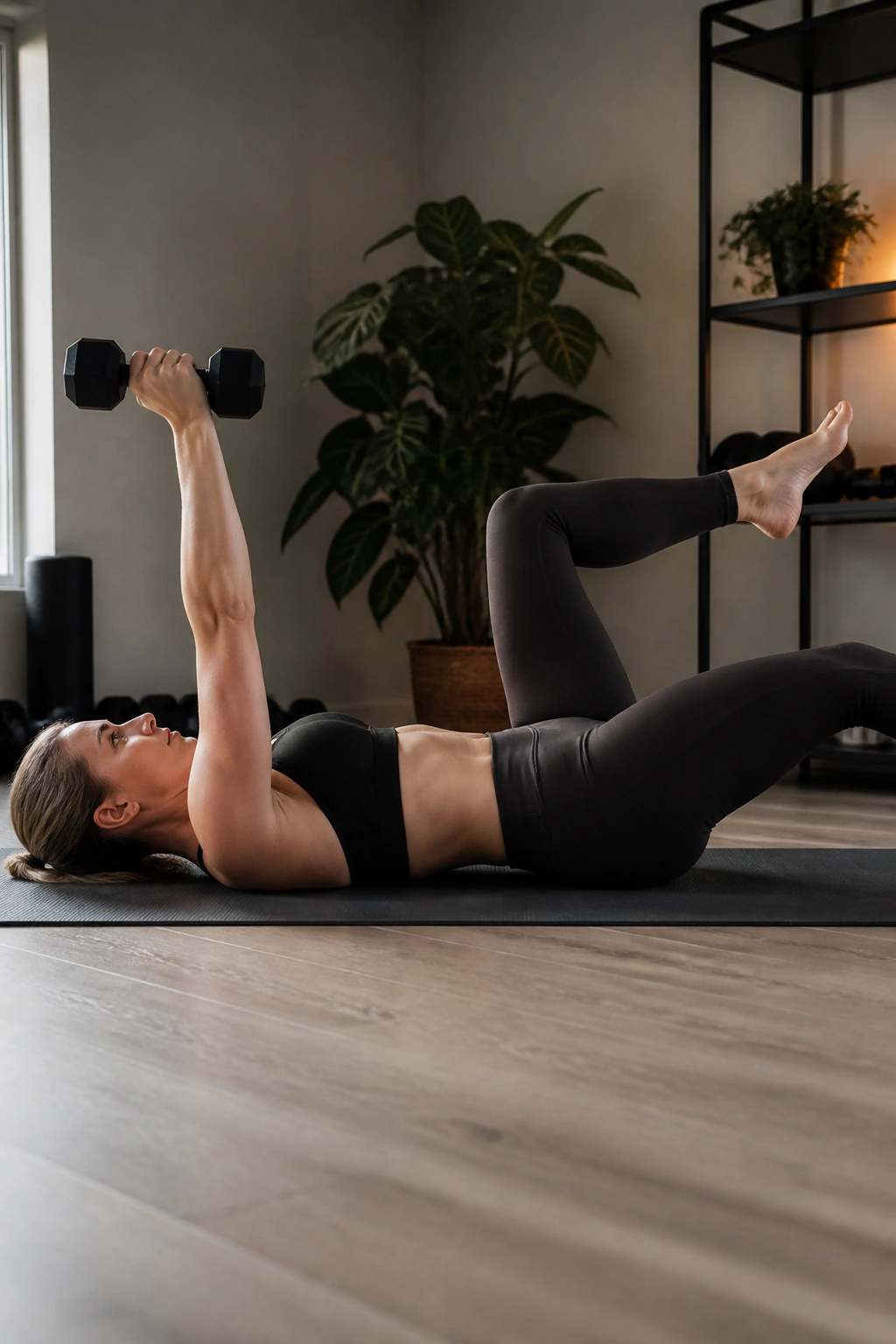
Why It’s Better Than Crunches
A dead bug pullover asks your core to keep the ribcage from popping open while your arms move overhead. That makes it more useful than a basic crunch for people who want better trunk control and a flatter, stronger-feeling midsection under load. The dumbbell adds resistance, but the real work happens in the way your abs stop your back from arching.
How to Use It
- Lie on your back with knees bent at 90 degrees
- Hold one light dumbbell above your chest
- Lower opposite arm and leg slowly while the other side stays still
- Bring them back with control, then switch sides
- Do 8 to 10 reps per side for 2 to 3 rounds
Keep the dumbbell light. Five to 15 pounds is plenty for most people here. If your lower back starts lifting off the floor, shorten the range and slow down.
13. Dumbbell Thruster for Full-Body Power
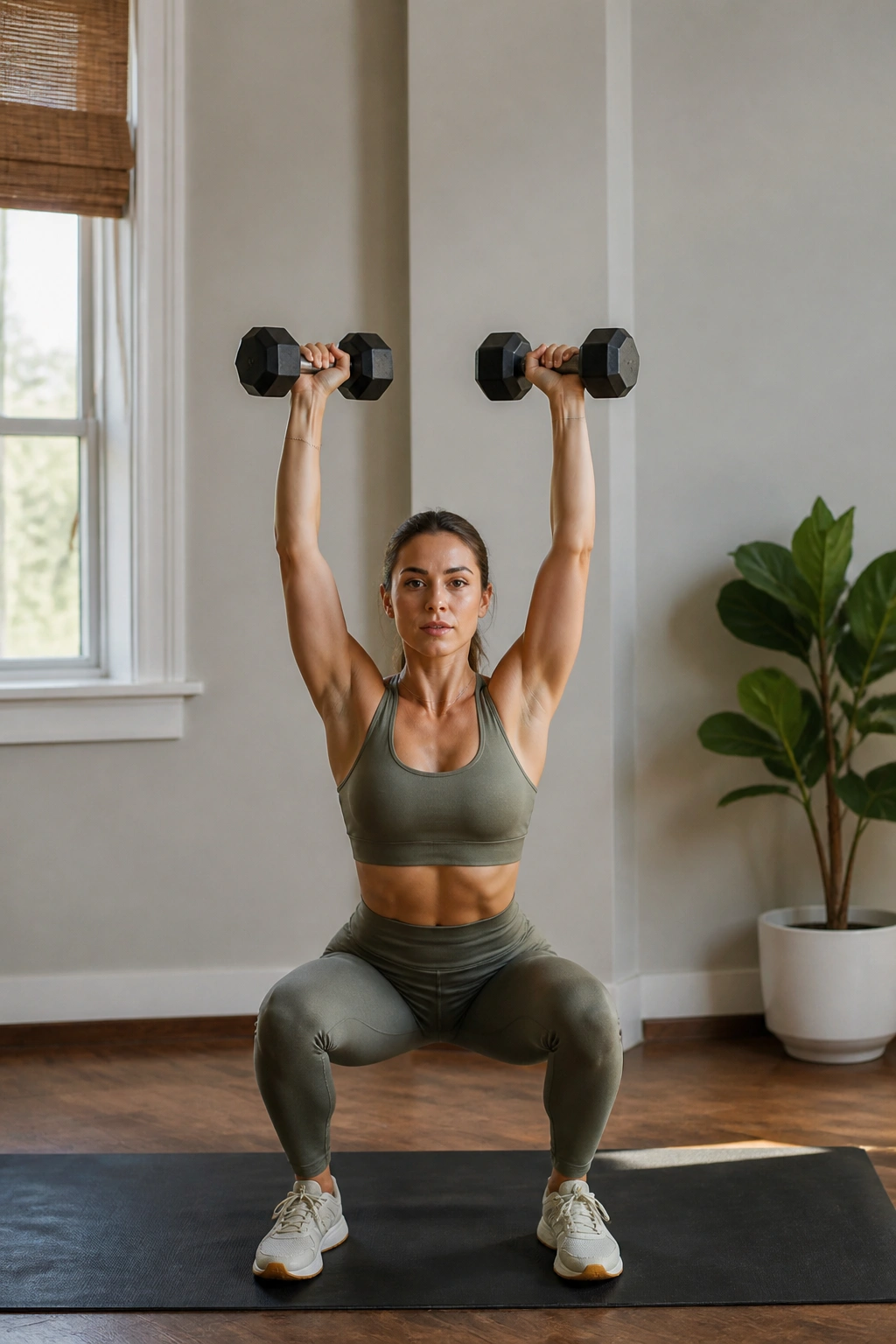
A thruster is a squat and a press welded together, which means your legs and shoulders don’t get to hide from each other.
That’s the appeal. One moment you’re in a front squat, the next you’re driving the dumbbells overhead in one smooth motion. It’s one of the best dumbbell workouts at home when you want strength and a little breathlessness in the same package. Use moderate weights, not max-out weights, because the transition from squat to press gets messy if the load is too much.
How to Pace It
- 4 rounds of 6 to 10 reps
- Hold the dumbbells at shoulder height
- Squat first, then press as you stand
- Keep the dumbbells close to your body on the way down
- Rest 45 to 60 seconds between rounds
If your lower back arches at the top, lower the weights and clean up the timing before you try to go heavier.
14. Dumbbell Chest Fly on the Floor
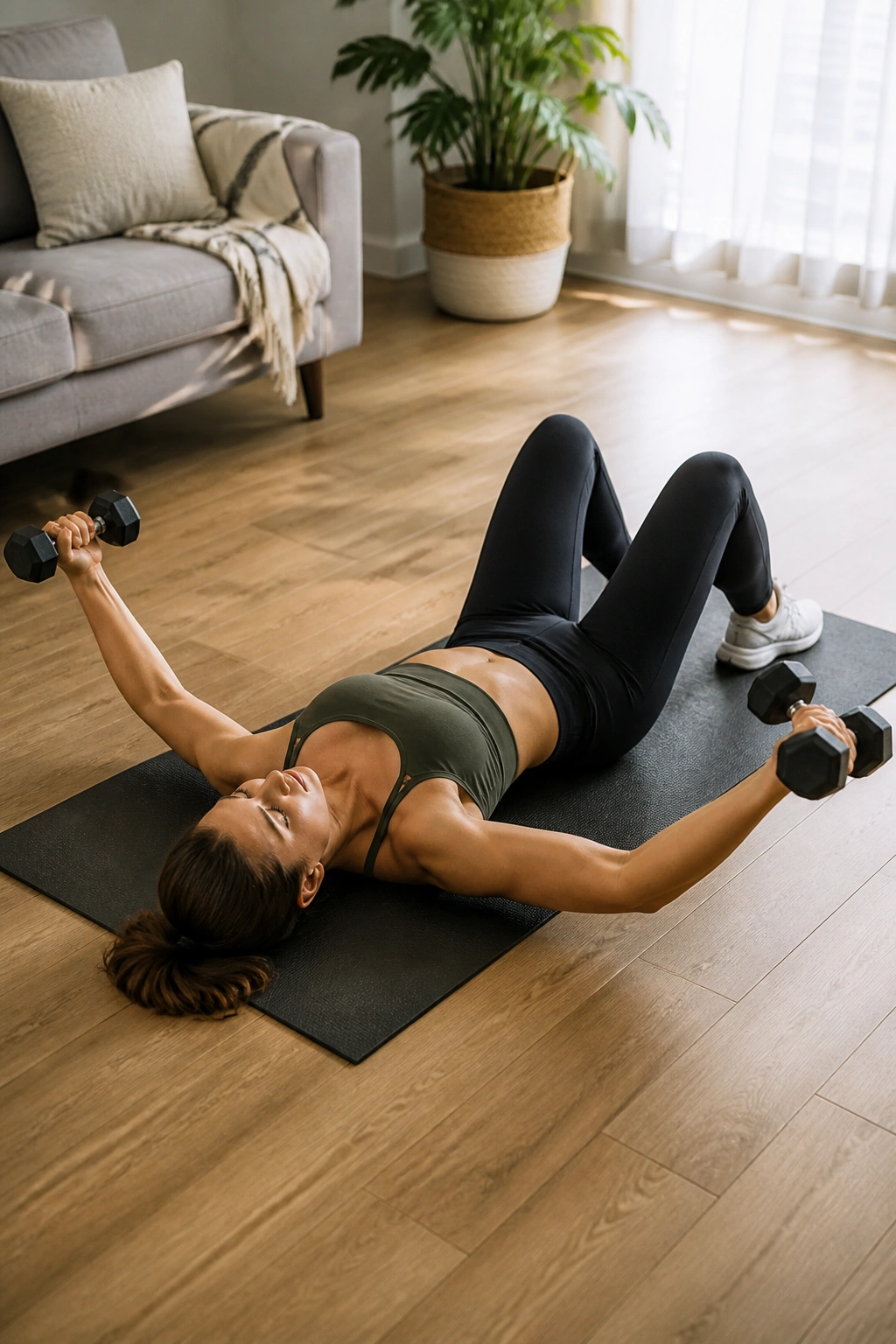
This one is sneaky. It looks smooth, then your chest starts complaining halfway through.
The floor fly stretches the chest through a controlled arc while the floor protects your shoulders from dropping too low. That makes it a useful variation if you want chest work but don’t have a bench. Keep a soft bend in the elbows the entire time, as if you’re hugging a big barrel.
Do 3 sets of 10 to 12 reps with light to moderate dumbbells. The lower you take the weights, the more strain you put on the shoulders, so stop when your upper arms touch the floor or just above it. Don’t turn it into a press. The movement should feel like a controlled open-and-close motion, not a push-up from the ground.
Slow down the lowering phase. That’s where the money is.
15. Single-Leg Romanian Deadlift for Balance and Hamstrings
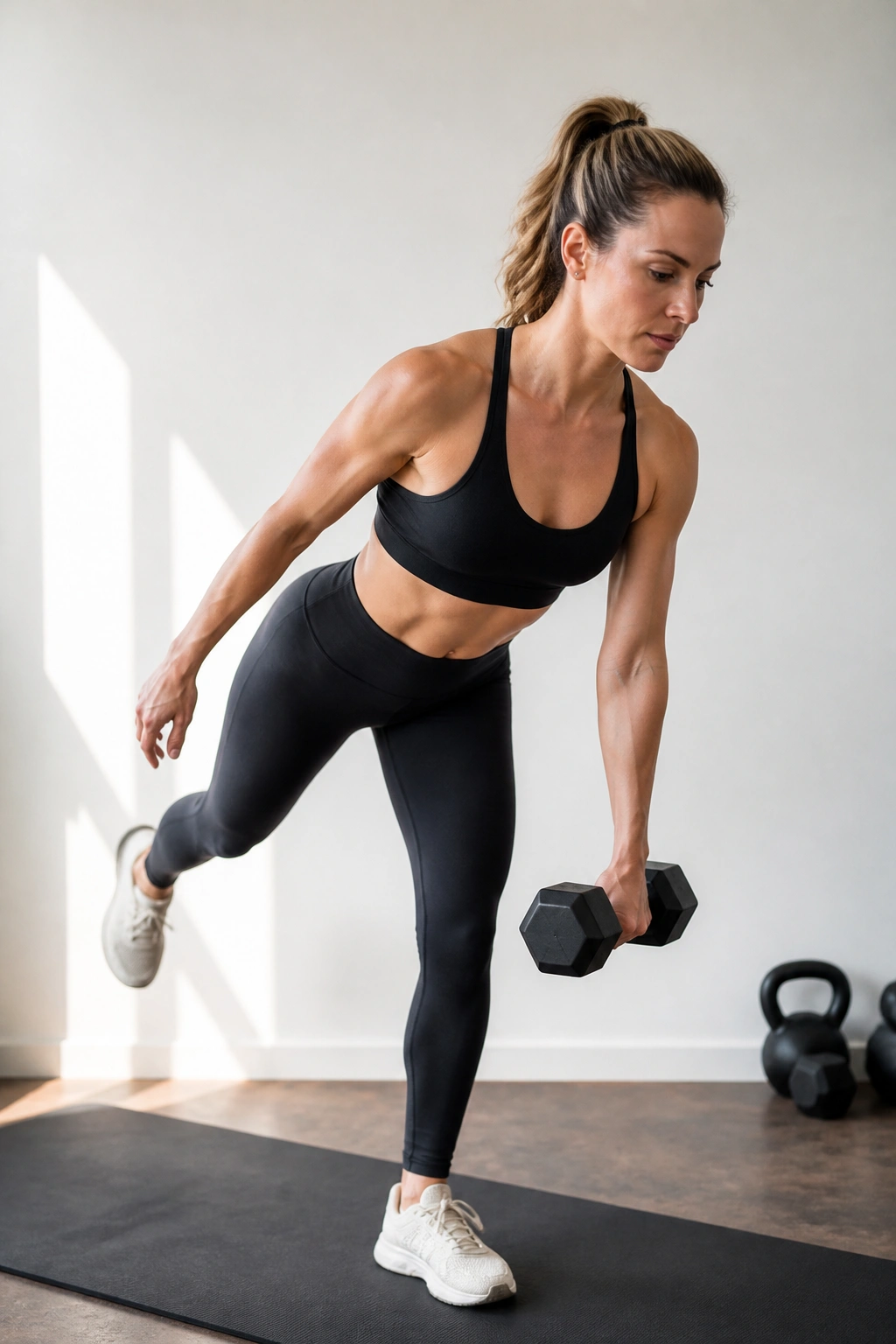
Why does one leg make everything harder? Because it removes the little cheats your body normally uses.
A single-leg Romanian deadlift hits the glute and hamstring on the standing side while forcing the hips to stay square. That’s gold for balance, and it teaches you to control your body without wobbling through the room. Use one dumbbell in the hand opposite the standing leg for an added challenge, or hold 2 if that feels steadier.
How to Get the Most From It
- 3 sets of 6 to 8 reps per side
- Keep a small bend in the standing knee
- Reach the free leg straight back like a counterweight
- Keep the dumbbell close to the front shin
- Stop when your back wants to round or your hips open
A small range done well beats a dramatic reach done badly. Every time.
16. Triceps Kickback Burner for the Back of the Arms
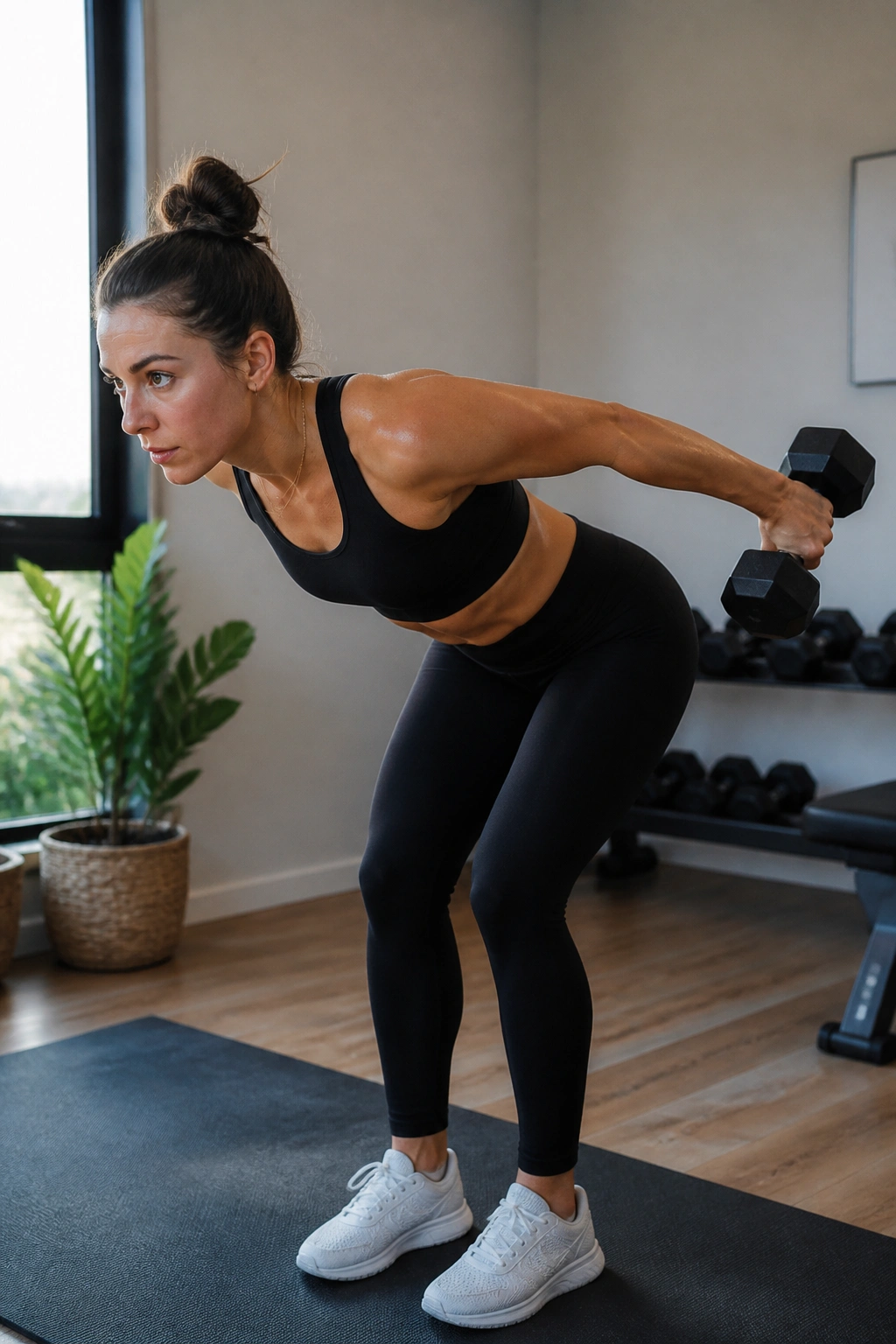
Your arms are done after presses? Good. That’s the point.
Triceps kickbacks finish the job by isolating the back of the arm with a small, controlled motion. They’re not flashy, and they absolutely should not be. Keep your upper arm pinned close to your side, hinge slightly at the hips, and straighten the elbow until the dumbbell reaches a clean line behind you. The movement should come from the elbow, not from swinging the shoulder around.
Use lighter weights than you think. 2 to 3 sets of 12 to 15 reps is plenty, and a 2-second squeeze at the top makes a small dumbbell feel much heavier. If the upper arm starts drifting, stop and reset. That elbow position matters more than the size of the weight.
This is a polish move, not a hero move.
17. Farmer’s Carry for Grip, Core, and Posture
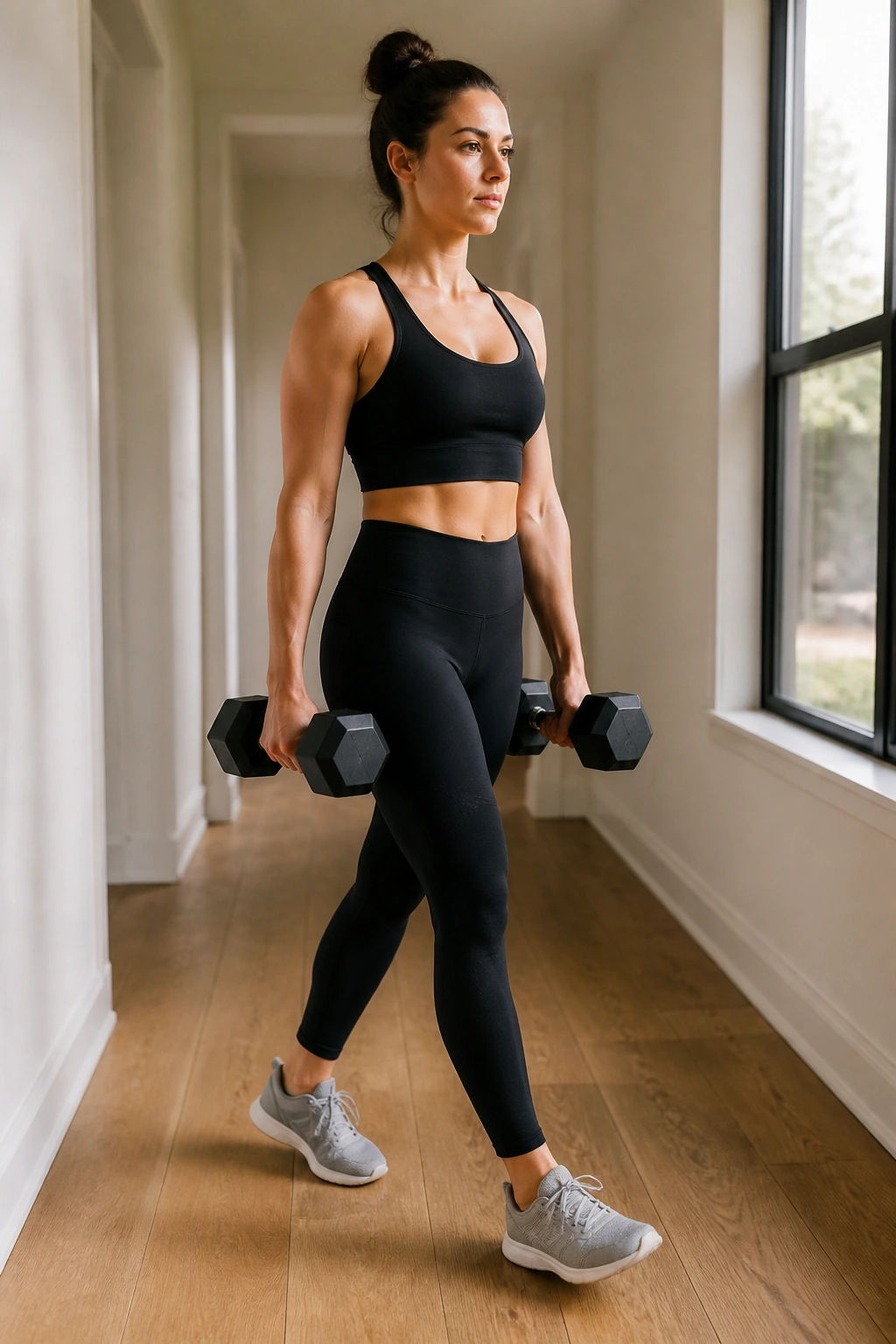
I like carries because they’re honest. You pick up weight, walk, and find out what falls apart.
The farmer’s carry looks simple, but it teaches your grip, core, shoulders, and breathing to stay organized under load. Walk around your home, down a hallway, or in a tight loop near the couch. Keep your ribs stacked over your pelvis and your shoulders down instead of hiked up near your ears. If you’ve got slippery floors, good shoes help more than you’d think.
Use the heaviest dumbbells you can hold with good posture for 30 to 60 seconds. Try 3 to 5 rounds. A suitcase carry — one dumbbell in one hand — makes your side core work even harder, so that’s a nice variation if you want more challenge without more equipment. Do not rush it. Good carries look calm.
18. Dumbbell Wood Chop for Rotation
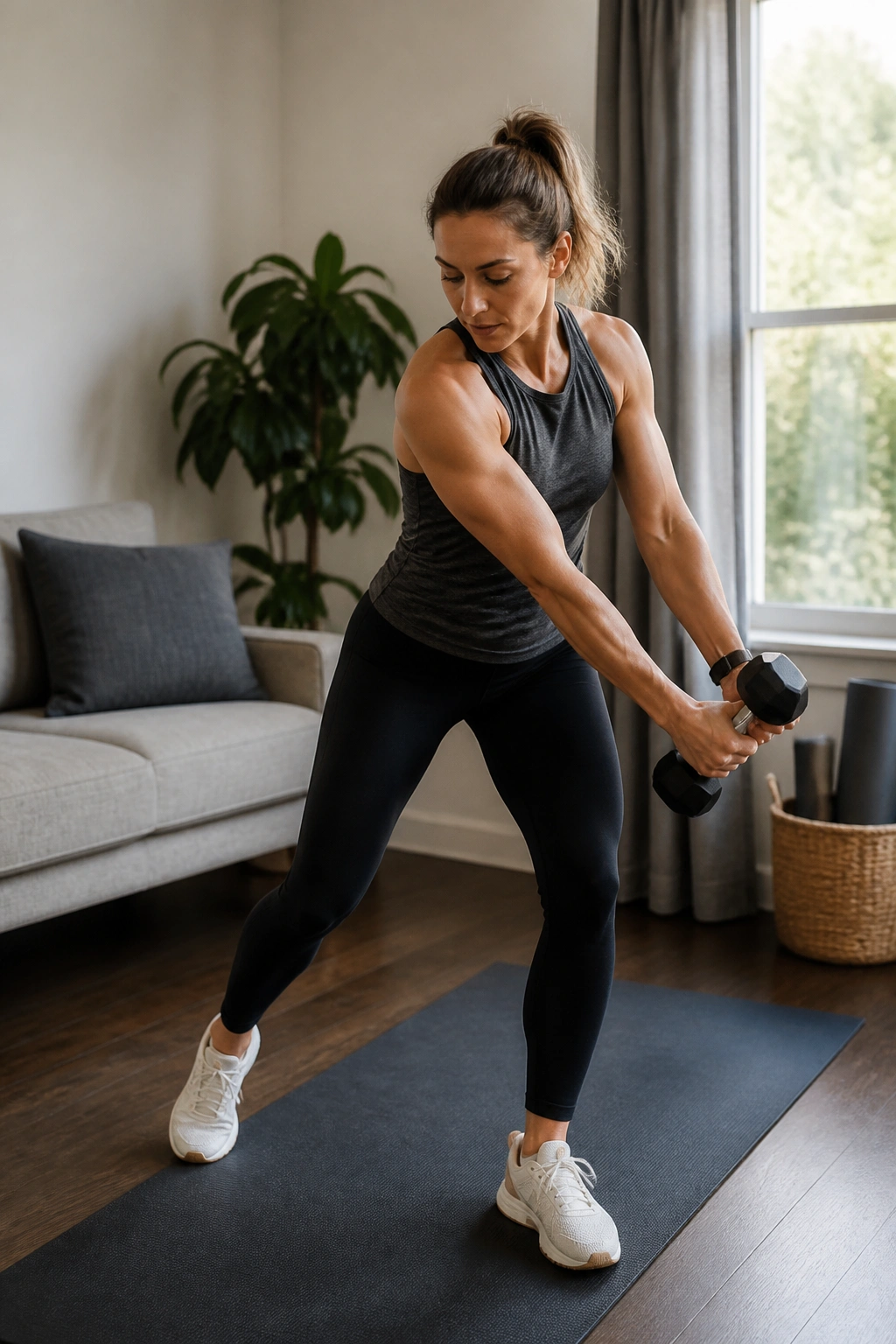
Unlike Crunches, This Trains Twist and Control
The wood chop works the torso through rotation, but the real goal is control, not wild swinging. That matters because everyday life includes turning, reaching, and picking things up while your body stays partly braced. A dumbbell wood chop trains that pattern far better than repeating straight-up crunches over and over.
How to Use It
- 3 sets of 8 to 10 reps per side
- Hold one dumbbell with both hands
- Start high on one side and cut down across the body toward the opposite hip
- Keep the hips mostly stable
- Move slowly enough that you can feel your obliques doing the work
This is best with a moderate weight and a deliberate tempo. If it turns into a flailing arm throw, lower the load and clean it up. The torso should rotate like a controlled hinge, not a loose door on bad hinges.
19. Plank Dumbbell Drag for Anti-Rotation Strength
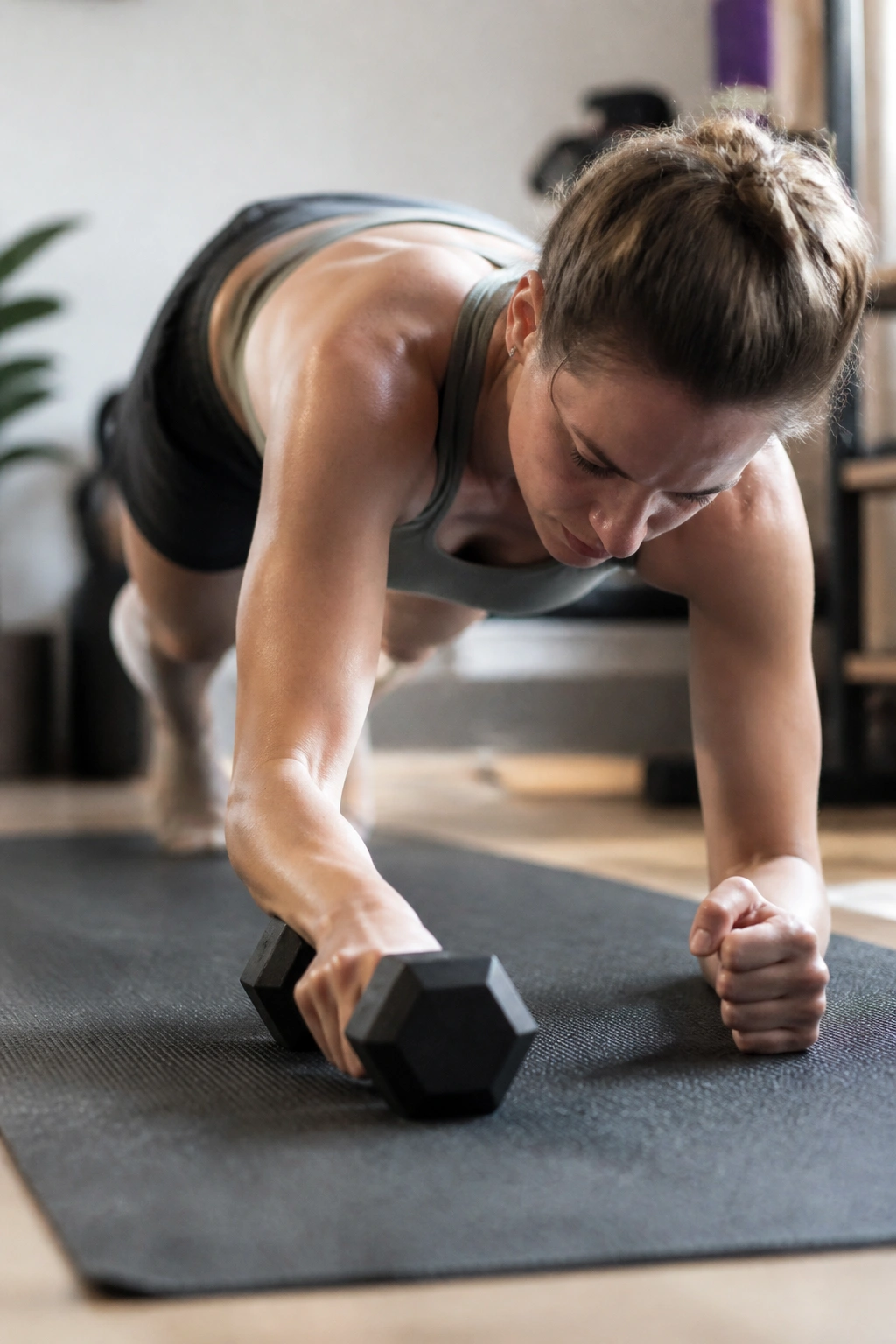
A plank drag is what happens when a plain plank gets bored and wants consequences.
You set a dumbbell on one side of your body, get into a strong plank, and drag the weight across to the other side with one hand. The challenge is keeping the hips from rocking every time the dumbbell moves. That makes it a sharp little test of shoulder stability, core control, and coordination. Wide feet help. Narrow feet make it meaner.
Quick Setup
- 2 to 3 rounds of 6 drags per side
- Use one dumbbell that slides easily on your floor or mat
- Keep your feet slightly wider than shoulder-width
- Pull the dumbbell under your chest without twisting hard
- Rest 30 to 45 seconds between rounds
If your low back sags, shorten the time in plank before you chase more reps.
20. Split Squat Iso Hold for Leg Burn
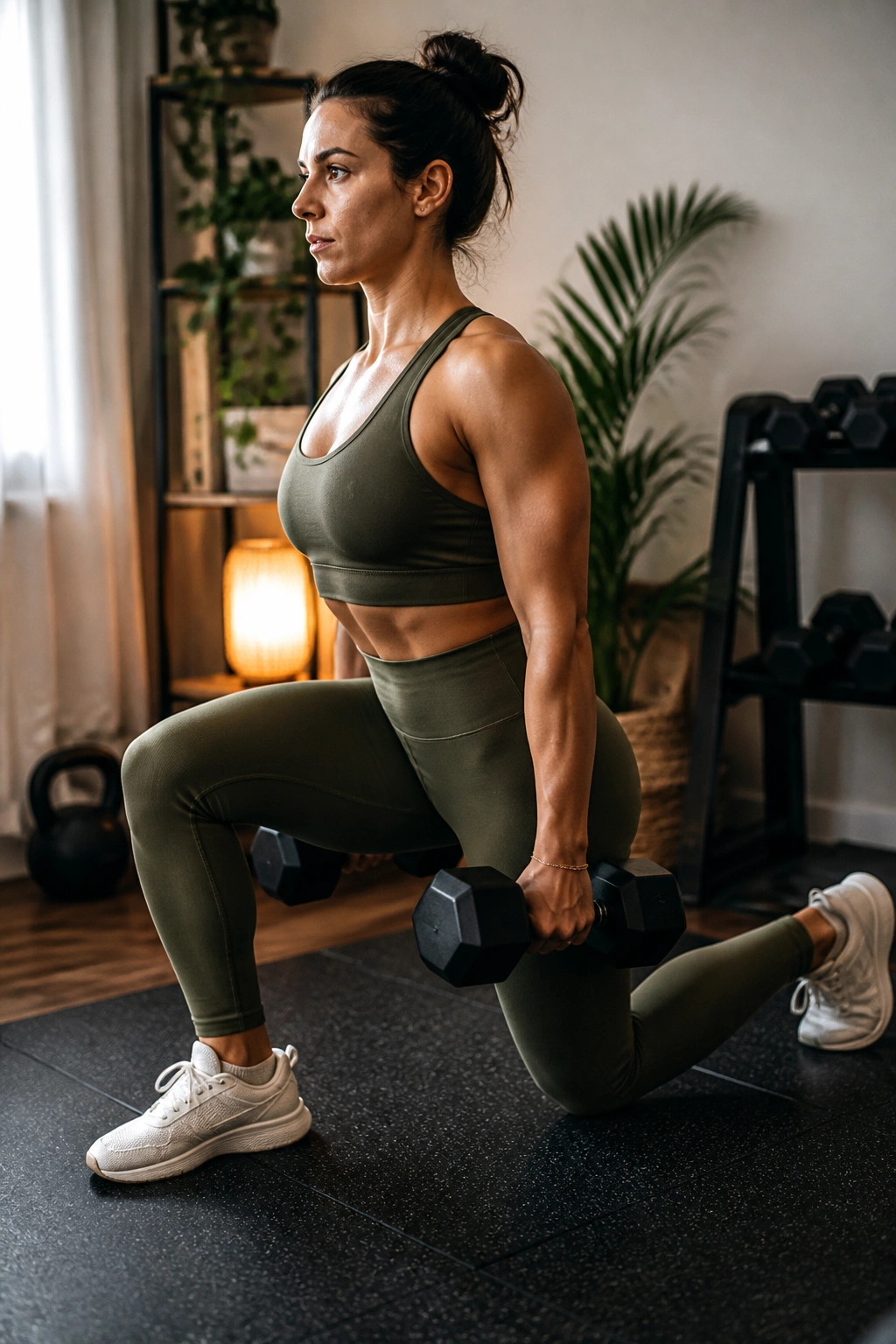
Boring for 20 seconds. Brutal by 30.
An isometric split squat hold keeps you frozen in the bottom position while your quads and glutes burn from holding tension instead of moving through reps. That stillness is what makes it nasty in the right way. It’s also useful if you want leg work without a lot of impact or bounce. Hold dumbbells at your sides or in a goblet position and settle into a strong lunge stance.
Use 20 to 30 second holds for 3 rounds per side. Keep the front heel down, the torso tall, and the back knee hovering just above the floor. If you want to make it harder, add 5 short pulses at the bottom after the hold. If your front knee drifts too far forward, shorten the stance a little.
There’s no hiding in an isometric hold.
21. Dumbbell Complex for Cardio and Strength
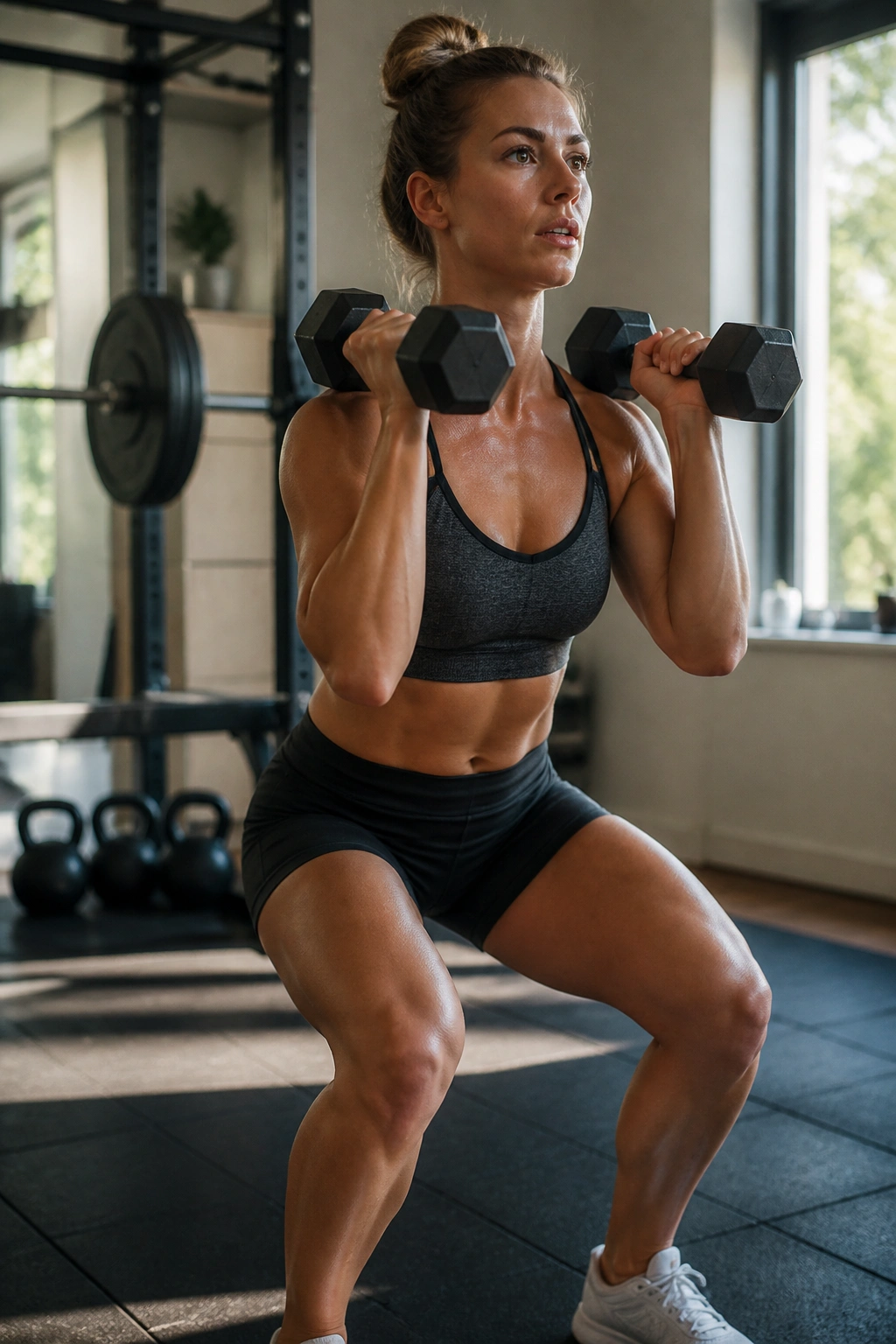
Why do complexes feel so much harder than they look? Because you never put the dumbbells down.
A dumbbell complex strings several moves together using the same pair of weights, which keeps your heart rate up while the muscles stay under tension. It’s a smart choice when you want conditioning without jogging in place or doing a million jumps. One simple sequence is a deadlift, row, clean, squat, and press. Five reps each. No rest until the round ends.
How to Run It
- Choose one moderate pair of dumbbells
- Do 5 reps of each move in a row
- Complete 3 to 4 rounds
- Rest 90 seconds between rounds
- Keep the weights light enough to survive the press after the squat
If your form gets sloppy by move three, the dumbbells are too heavy. Drop the load and finish clean.
22. Upper-Body Push-Pull Circuit for Dumbbell Workouts at Home
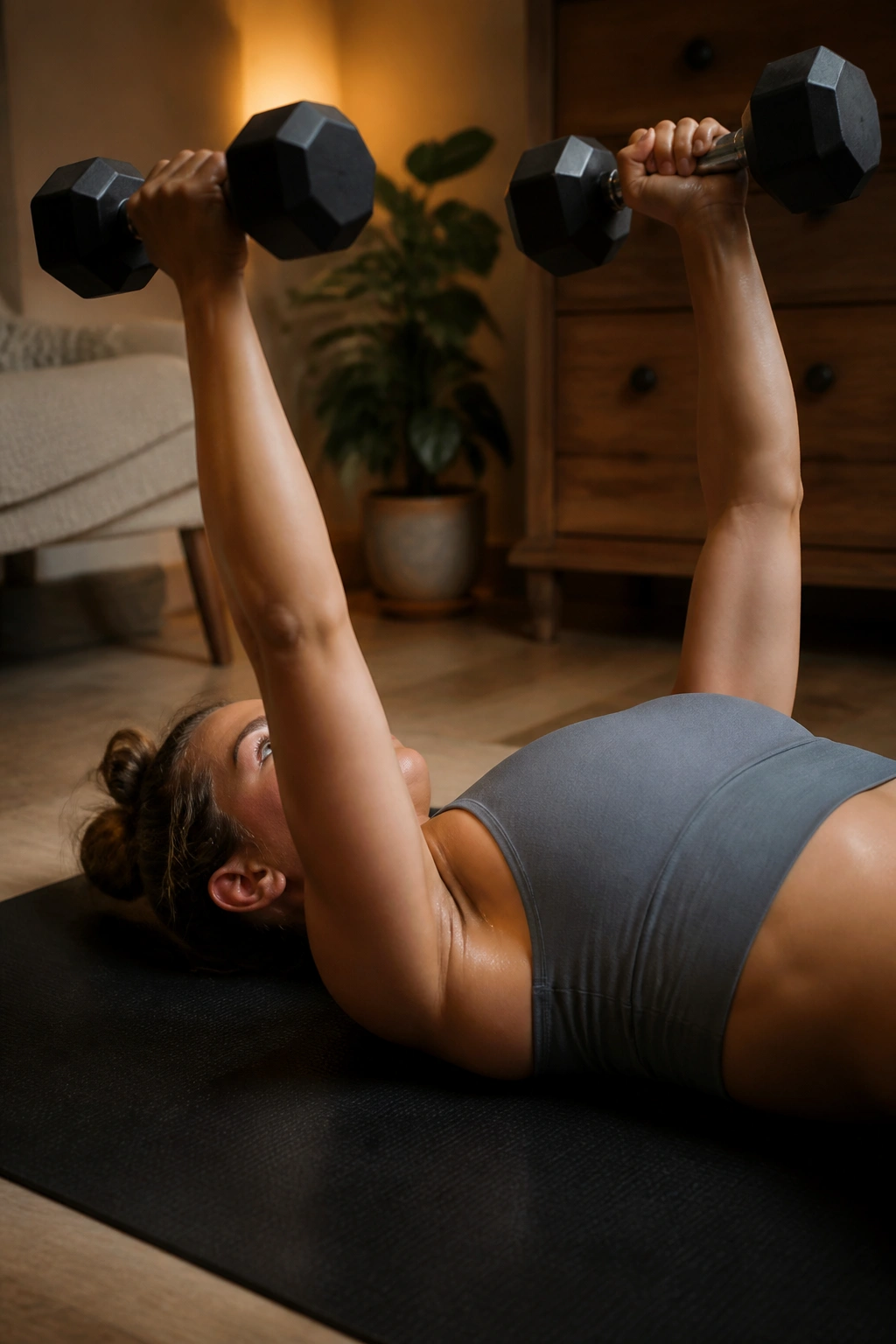
A push-pull day makes sense even in a living room.
Your shoulders and upper back need balance, especially if your week includes a lot of sitting, typing, holding a phone, or carrying grocery bags on one side. Pair a press with a row, then a chest move with a rear-delt move, and the body starts to feel more organized. That’s why this is one of my favorite dumbbell workouts at home when the goal is stronger posture and less shrugging.
Sample Circuit
- Dumbbell floor press: 10 reps
- One-arm row: 10 reps per side
- Lateral raise: 12 reps
- Reverse fly: 12 reps
- Repeat for 3 rounds
Move steadily, but don’t race. The push muscles and pull muscles each get a turn, and the contrast helps you feel where you’re weak. If your neck gets tight, lower the weights and slow the reps down.
23. Lower-Body Strength Circuit for Glutes, Quads, and Hips
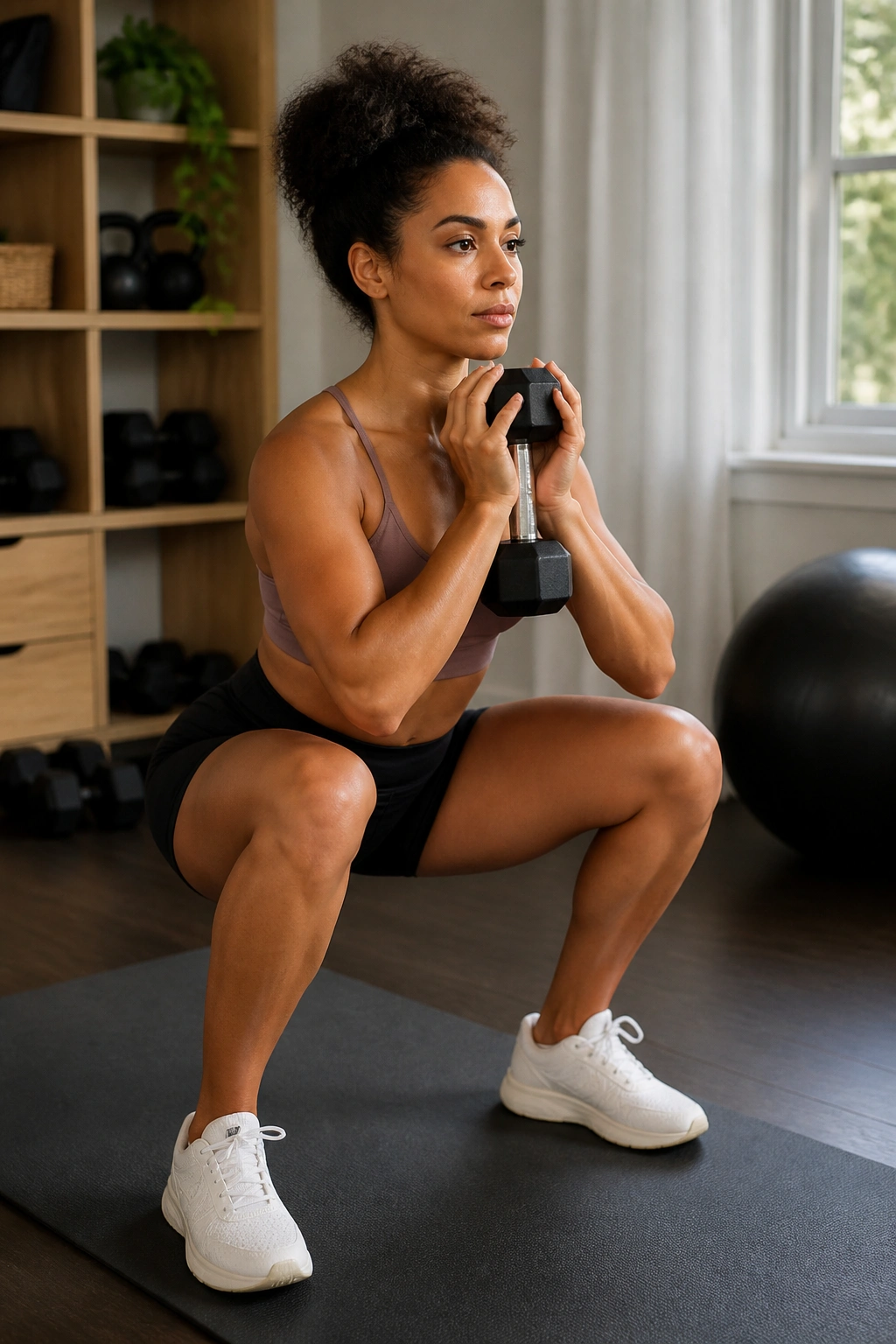
This is the lower-body day that covers the big stuff without making you live on one machine.
A strong leg circuit usually needs three movement patterns: a squat, a hinge, and a single-leg move. Put those together and you get a session that works the glutes, quads, hamstrings, and stabilizers without feeling random. Keep the weights moderate to heavy, and give each rep enough control that you can actually feel the muscles working.
Try 3 rounds of goblet squats for 10 reps, Romanian deadlifts for 10 reps, and reverse lunges for 8 reps per side. Rest 45 to 60 seconds after each round. If you want more intensity, slow the lowering phase on every move to 3 seconds. That makes a pair of average dumbbells act a lot heavier than they look.
Your legs will know the difference by round two.
24. Core and Carry Finisher
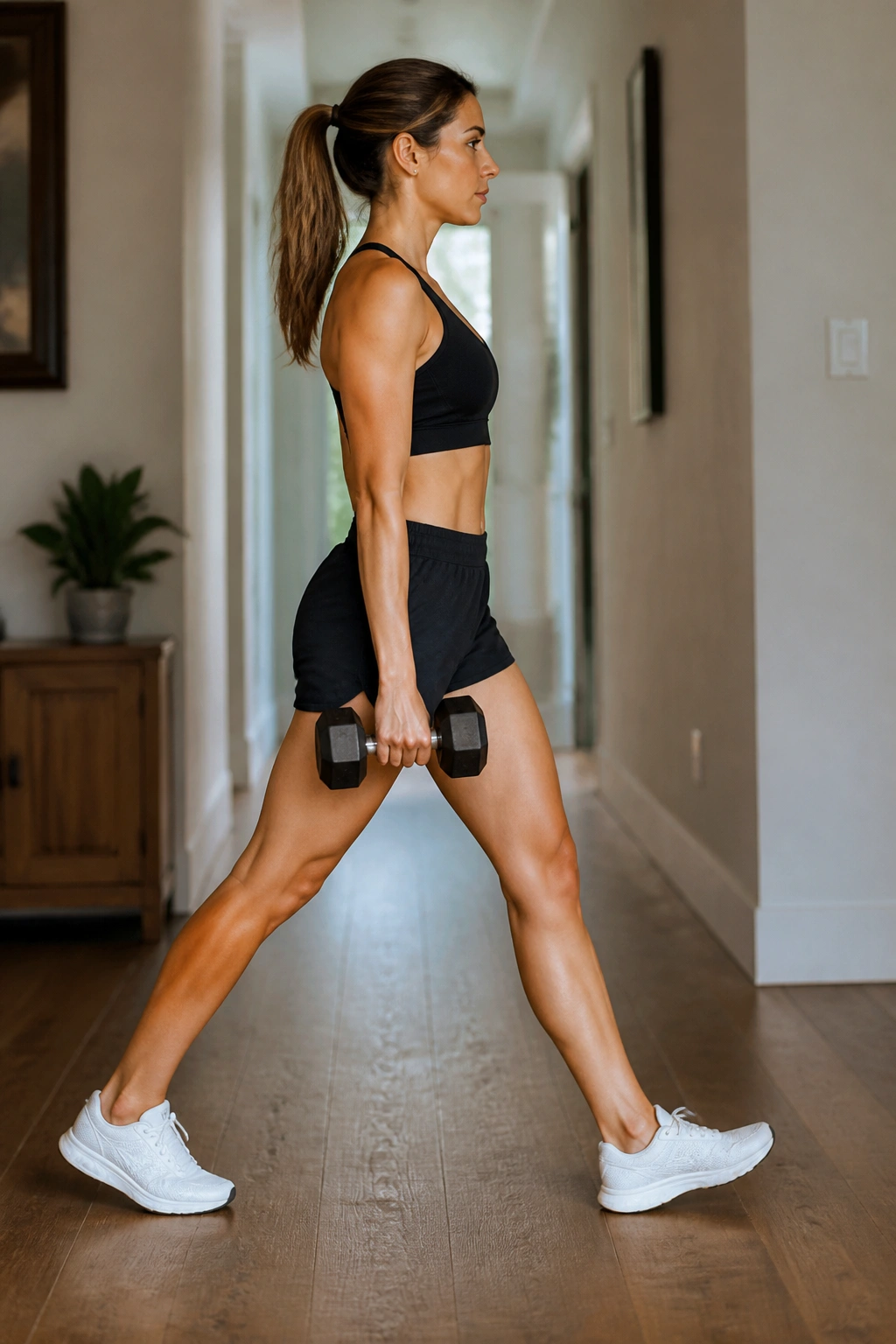
Unlike endless crunches, this finisher asks your torso to stay useful while you move.
That’s a big deal. A strong midsection is not just about flexing forward; it’s about resisting sway, twist, and collapse when weight gets awkward. Pair a suitcase carry with a plank drag or a dead bug, and your core has to handle a real-world load. That makes this a smart way to finish a workout without needing a pile of extra equipment.
Quick Finisher
- Suitcase carry: 30 seconds each side
- Dead bug: 8 reps per side
- Plank drag: 6 drags per side
- Do 2 to 3 rounds
- Rest 30 seconds between movements
Keep the dumbbell heavy enough that your obliques have to work, but not so heavy that you start leaning like a broken shopping cart.
25. Posture Back Workout for Rounded Shoulders
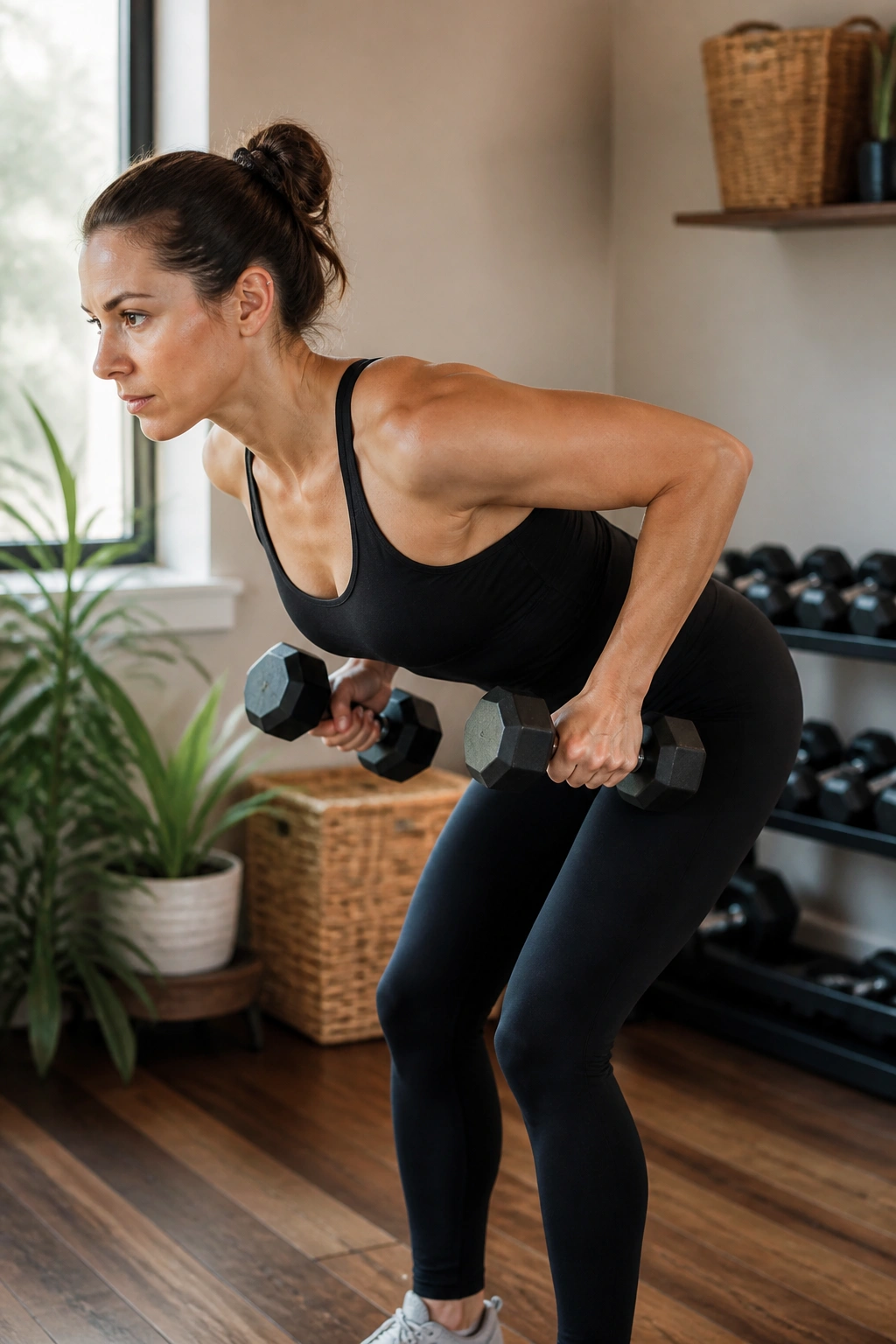
If your upper back feels sleepy, this is the session that wakes it up.
A posture-focused back workout usually needs rows, reverse flys, and pullovers — not because those are trendy, but because they hit the muscles that keep your shoulders from collapsing forward. Keep the dumbbells light enough that the shoulder blades can move cleanly. Jamming heavy weight into this kind of work usually turns it into a shrug contest, and nobody needs that.
Why It Works
- Bent-over row: 10 to 12 reps
- Reverse fly: 12 reps
- Dumbbell pullover: 10 reps
- Rest 30 to 45 seconds between moves
- Repeat for 3 rounds
The goal is a back that feels awake, not smoked. Slow down the lowering phase and think about pulling your shoulder blades into your back pockets.
26. Arm Day Ladder for Biceps and Triceps
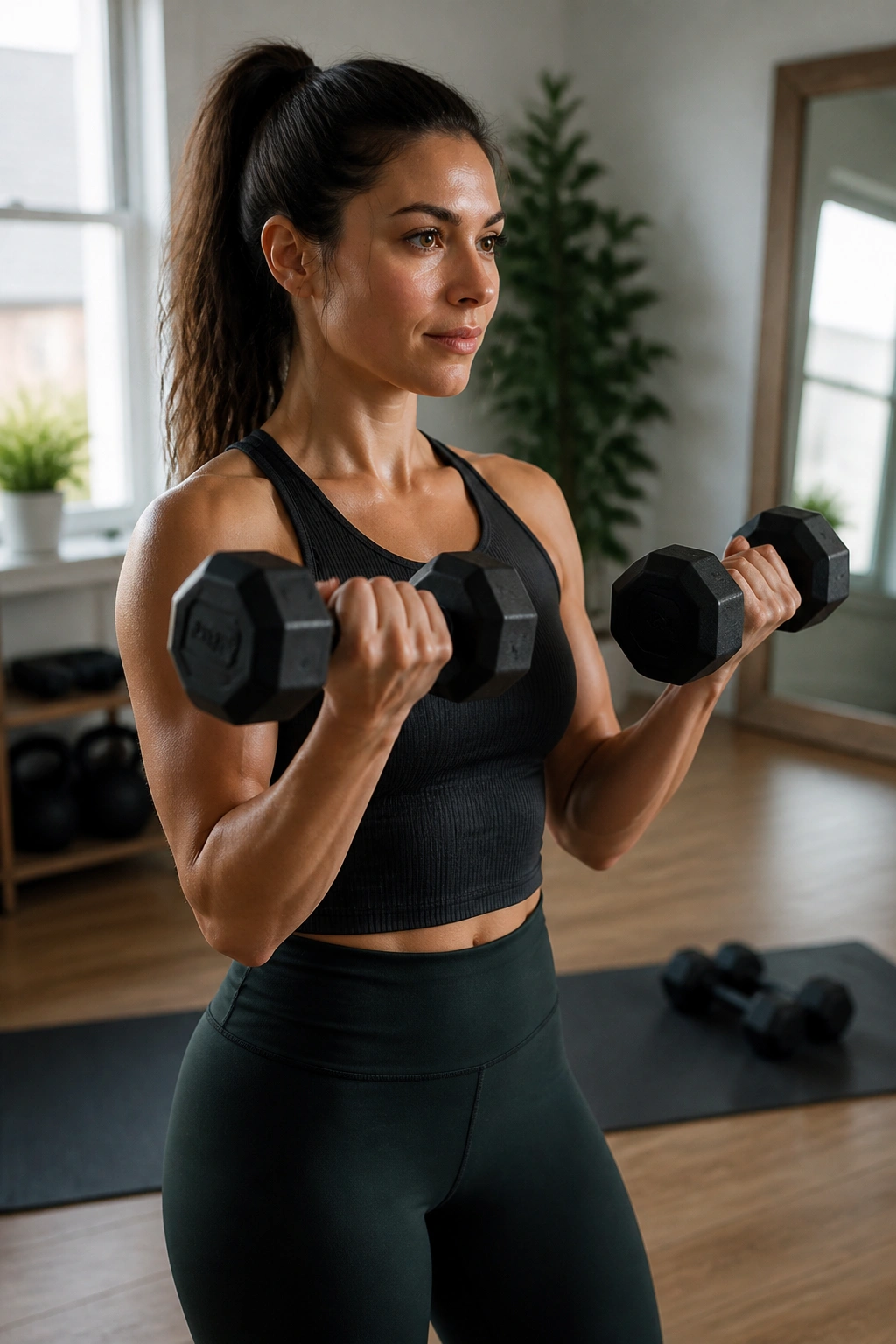
Arm training gets better when you stop treating every set like a test of how badly you can cheat.
A ladder keeps the reps changing, which makes it easier to stay strict while still piling on volume. Start with 12 reps of a biceps curl, then 10, then 8, then 6. Do the same with an overhead triceps extension or a skull-crusher variation on the floor. The changing rep count keeps the session moving without forcing the same load on every set.
Use a weight that feels solid on the first set and challenging on the last. That usually means your first set should feel almost too easy. It won’t stay that way. Keep your elbows steady, your ribs down, and your wrists straight. If momentum starts taking over, drop the weight or cut the ladder short.
Small muscles still deserve strict work.
27. Full-Body Metabolic Circuit
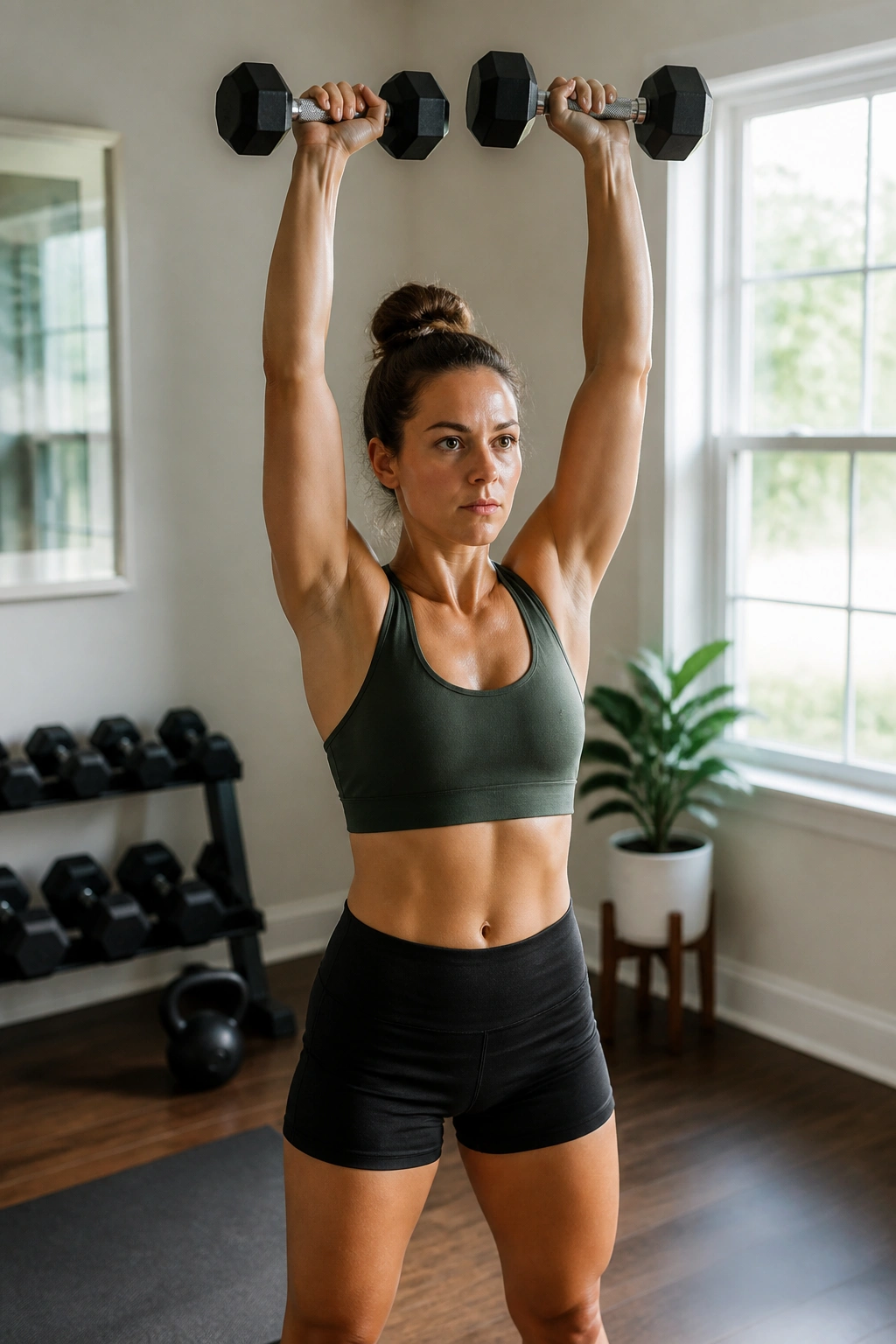
A full-body circuit is useful only if the movements still look like actual lifting.
That’s the part people miss. You can absolutely train hard at home without turning every round into a sloppy sweat dump. Pick moves that hit different patterns — a squat, a press, a pull, a hinge — and keep the transitions short. The heart rate will climb on its own.
How to Run It
- Dumbbell thruster: 8 reps
- One-arm row: 8 reps per side
- Romanian deadlift: 10 reps
- Farmer’s carry: 30 seconds
- Repeat for 3 to 4 rounds
Rest 60 seconds between rounds. If your form breaks by the second round, the dumbbells are too heavy for this style of workout. Use a moderate load and keep the pace steady. That’s where the payoff lives.
28. No-Repetition 20-Minute Dumbbell Ladder
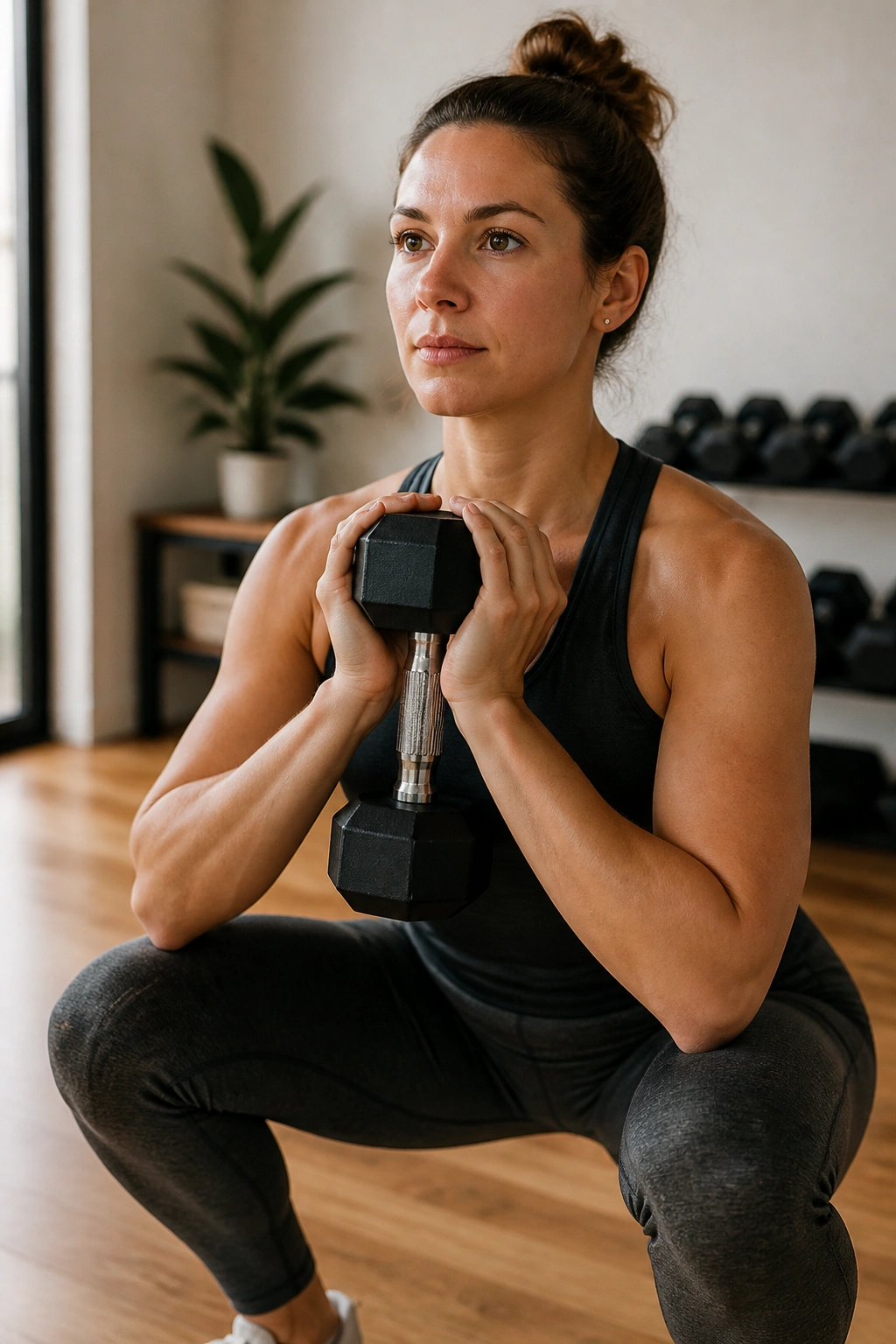
This is the one I’d hand to someone who wants a hard workout without overthinking the whole thing.
Set a timer for 20 minutes and move through a ladder of 1 exercise at a time, no repeats back-to-back, no wandering, no pointless downtime. Start with 6 goblet squats, then 6 rows per side, then 6 floor presses, then 6 Romanian deadlifts, then 6 reverse lunges per side, then 6 shoulder presses. After the first round, go down by 1 rep each move until you hit 2 or 3 reps, or repeat the ladder twice if the weights are lighter.
A ladder like this works because it keeps the brain busy and the muscles honest. It also gives you a clean way to progress: use the same dumbbells next time and try to get through one more round, or keep the same round count and slow the reps down. If you only pick one home routine from this list, pick the one that makes you come back next week. That’s the real win.
