



Upper body routines for real strength gains usually fail for one boring reason: the work gets messy before it gets heavy.
A lot of people chase burn, sweat, or a good-looking pump. Fine, but that does not build a stronger bench, a tighter overhead press, or a pull-up that stops wobbling halfway up. Real strength comes from clean reps, enough load, enough rest, and a plan that treats pulling as seriously as pressing. Skip that balance and your shoulders will tell on you before your numbers do.
The routines below lean on the lifts and methods that actually carry over: heavy barbell work, smart dumbbell work, bodyweight strength, cable and machine options for cranky joints, and a few density methods that make the whole session more useful. Some are blunt and heavy. Some are quieter and more controlled. All of them have one job: make your upper body stronger without wasting time on junk volume.
Pick the routines that fit your equipment, your joints, and your current ceiling. A home gym lifter doesn’t need the same setup as someone with a full rack and rings. That sounds obvious, but people ignore it and wonder why their program feels clumsy. Keep the load honest, keep the form tidy, and don’t let every session turn into a shoulder circus.
1. Heavy Bench Press and Barbell Row Pairing

This is the plainest routine in the bunch, and it still works because it refuses to be cute.
Start with a heavy barbell bench press, then match it with a barbell row that’s strict enough to count and hard enough to matter. A good pairing looks like 5 sets of 3 on the bench and 5 sets of 5 on the row, with 2 to 3 minutes between sets. If your third rep on the bench turns into a grind-fest, the load is too high for a strength day. That’s not grit. That’s noise.
- Bench press: 5 x 3 at about 80-87% of your max
- Barbell row: 5 x 5 with a flat back and a hard pause at the top
- Optional incline dumbbell press: 2 to 3 x 6
- Optional face pulls: 2 x 15
Do not let the row become a deadlift with your ego attached. Keep your torso set, squeeze the lats, and pull to the same point every rep. The whole point is to build a strong push-pull base, not to win a sloppy set in the mirror.
2. Standing Overhead Press and Chin-Up Ladder

Want stronger shoulders without living on the bench? This is the cleaner route.
The standing overhead press teaches you to drive weight while your whole body stays honest. Pair it with a chin-up ladder and you get a session that hits the delts, triceps, lats, and upper back in one shot. A solid version is 6 sets of 2 to 4 presses and a 1-2-3-4-3-2-1 chin-up ladder. Rest about 90 seconds between ladder rungs and 2 minutes between press sets.
How to run the ladder
Begin with one chin-up, then two, then three, then four. After that, come back down. If four reps is too easy, add a small plate or a dumbbell between your feet. If four reps is a stretch, stop at three and keep every rep crisp. No swinging. No half-reps. Those just eat the pattern you’re trying to build.
Why it pays off
The press gets stronger when your upper back is stable and your lats can lock the rib cage down. Chin-ups help with that better than endless band work ever will. And the ladder format keeps volume high without forcing ugly grinding reps early in the session.
3. Incline Dumbbell Press With Chest-Supported Rows

If flat benching beats up your shoulders, this is the smarter move.
A low incline, usually around 30 degrees, shifts the press just enough to spare the front of the shoulder while still loading the chest and triceps hard. Match it with chest-supported rows so your lower back can stay out of the fight. That means 4 sets of 6 to 8 incline dumbbell presses and 4 sets of 8 rows on a bench or machine. Keep the elbows at a natural angle, not tucked so hard that the press turns into a triceps puzzle.
- Incline dumbbell press: 4 x 6-8
- Chest-supported row: 4 x 8
- Rear-delt fly: 3 x 12-15
- Hammer curl: 2 x 10, if you want the extra elbow armor
One thing most people miss: dumbbells expose weak sides fast. That’s a good thing. Set both bells under control, lower them evenly, and resist the urge to heave the last rep with your neck. The lift should feel heavy. It should not feel desperate.
4. Close-Grip Bench and Neutral-Grip Pull-Up Day
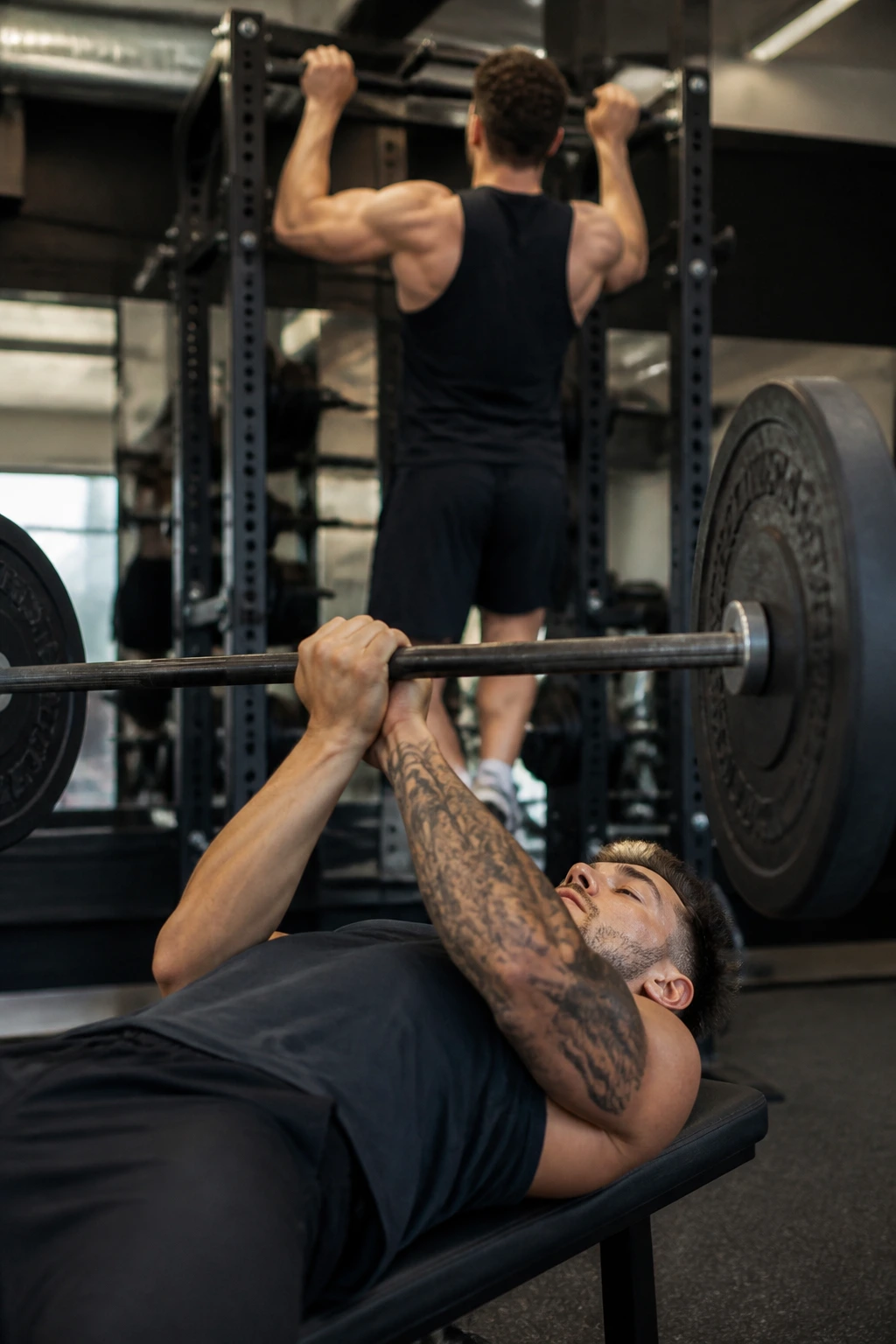
The triceps lockout is where a lot of pressing strength gets stuck.
Close-grip bench press fixes that better than random triceps fluff because it asks the triceps to do their real job under load. Use a grip just inside shoulder width, pause the bar on the chest for a clean beat, and press for 4 to 5 sets of 4 reps. Follow it with weighted neutral-grip pull-ups for 5 sets of 3 if you can, or bodyweight triples if you can’t yet add load.
A neutral grip is easier on the elbows and shoulders than a hard overhand grip for many lifters, and it tends to let you pull harder without the hands giving up early. That matters when you want strength, not just a tired forearm pump.
If you want a third piece, add 2 sets of 10 cable pressdowns. Not because pressdowns are magic. Because your elbows usually like a little extra work after heavy close-grip pressing, and joints tend to vote in favor of boring consistency.
5. Push-Up Density Circuit With Weighted Rows

This one looks too simple until you do it honestly.
Instead of chasing a giant barbell number, you pack more quality work into a set window. Set a timer for 10 minutes and do push-ups every minute on the minute. Five reps is enough if they’re slow and clean. Twelve reps is fine if you can keep the body straight and the chest touching the same spot each time. Then move to a heavy row pattern and do 5 sets of 6.
The setup
- 10-minute push-up EMOM
- 5 x 6 one-arm dumbbell rows or machine rows
- 3 x 8 incline dumbbell presses
- 2 x 15 band pull-aparts
This routine is useful when your joints are beat up from barbell work but you still want to train hard. The density part builds work capacity, and the rows keep the shoulders from rolling forward like tired office posture. No one gets stronger with rounded shoulders and a soft mid-back.
6. Dip and Inverted Row Strength Session

Dips are old-school for a reason. They load the chest, shoulders, and triceps in a way that feels direct and a little rude.
Weighted dips work best when you can control the bottom position. That means no shoulder dive-bombing and no bouncing out of the hole. Aim for 5 sets of 4 to 6 with a smooth descent and a strong lockout. Pair them with inverted rows for 5 sets of 8 to 10. If the rows are too easy, elevate the feet. If they’re too hard, raise the bar and earn the angle.
The catch is obvious. Dips can irritate the front of the shoulder if you sink too deep or lose tension at the bottom. Don’t chase depth just to look brave. Stop where the shoulder still feels packed and the chest still feels in the work.
This routine is especially good for lifters who like bodyweight strength but want more load than plain push-ups can give. It’s simple. Also, it’s unforgiving. That’s part of the appeal.
7. Landmine Press and Seal Row Combo

A landmine press gives you pressing strength without the same shoulder strain that a hard vertical barbell press can bring.
Half-kneeling is the cleanest way to do it. Set up with one knee down, brace the glute on the kneeling side, and press the bar along the angled path for 4 sets of 6 each side. The half-kneeling position keeps your rib cage from flaring, which is where a lot of pressing gets sloppy. Match it with seal rows for 4 sets of 8 so the upper back gets a real job.
Half-kneeling press
The half-kneeling stance makes you earn each rep. If your torso twists, the set is too heavy. That feedback is useful, not annoying.
Chest-supported row
Seal rows remove momentum. They force the lats and mid-back to finish the pull instead of the lower back.
Small stabilizers
Add 2 sets of 12 band external rotations if your shoulders need a little extra work. Keep the movement light. You’re waking things up, not trying to impress the tendon police.
8. Dumbbell Floor Press and One-Arm Row Split
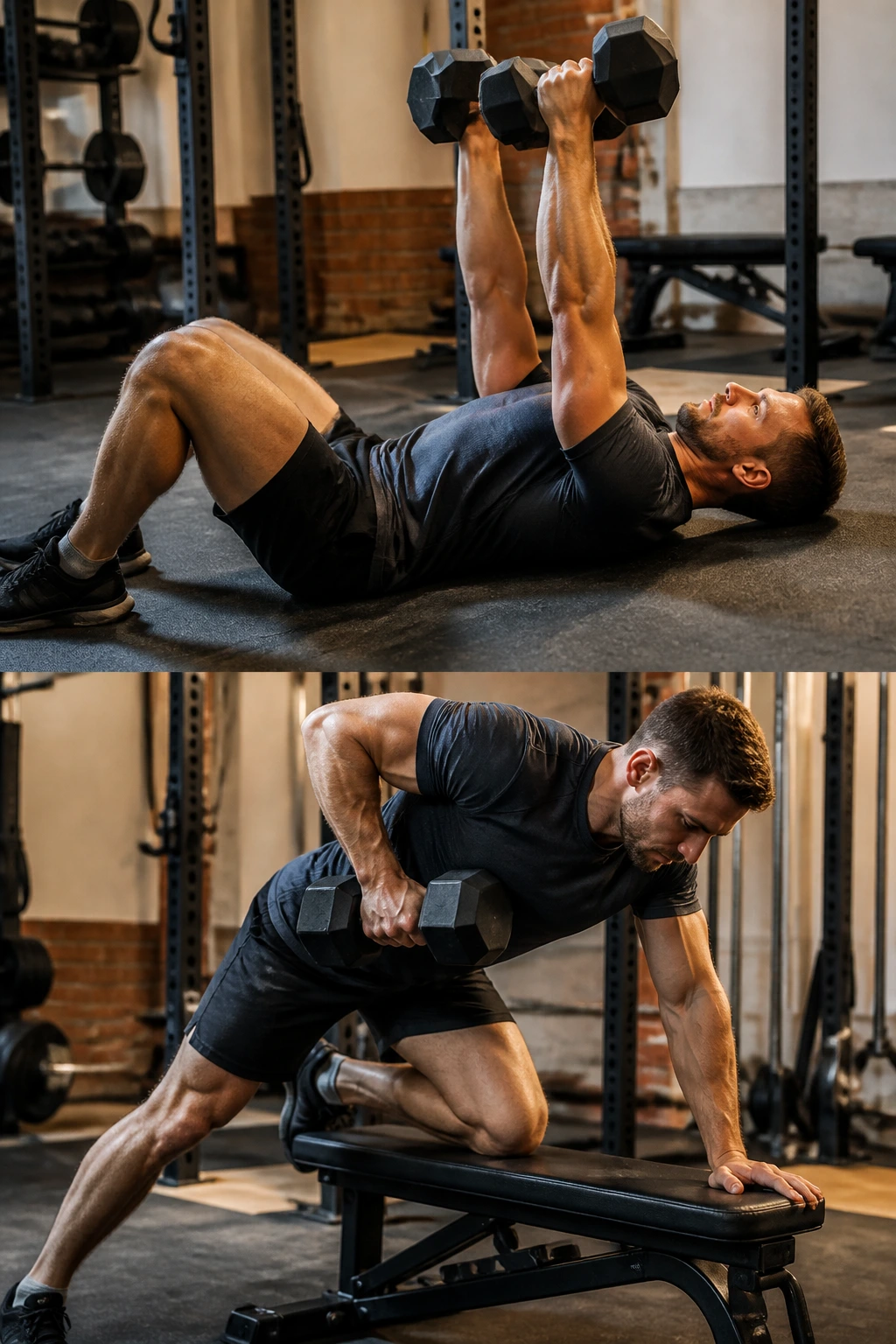
The floor press is one of those lifts people ignore until they realize how useful it is.
Because the triceps and shoulders stop at the floor, the bottom stretch is shorter and the shoulder usually feels safer. That makes it a solid choice for heavy dumbbell work when you want pressing strength without a deep barbell arch or a long range that pisses off the front of the joint. Use 6 sets of 4 on the floor press, then do 5 sets of 6 one-arm rows on each side.
- Dumbbell floor press: 6 x 4
- One-arm dumbbell row: 5 x 6 each side
- Reverse fly: 3 x 12
- Farmer’s carry: 3 short walks
A one-arm row also teaches you not to rotate like a broken gate hinge. Brace hard, pull the elbow toward the hip, and keep the shoulder blade from jumping around. If your gym is short on equipment or your home setup is basic, this routine punches above its weight.
9. Cluster Set Bench Press Workout

Cluster sets are a neat trick when you want heavy work without turning every rep into a struggle.
Instead of doing a straight set of 6 and watching the bar slow into sludge, you break the work into mini-bursts. Try 4 clusters of 2 + 2 + 2 reps at a load you could normally handle for about 5 reps, with 15 to 20 seconds between mini-bursts and 2 to 3 minutes between full clusters. Pair that with rows and a bit of pushing accessory work.
Why clusters feel different
You stay closer to high-quality force output. The bar moves faster, your technique stays cleaner, and your nervous system gets to practice heavy reps without the ugly breakdown that usually comes at the tail end of a long set.
How to use it
- Bench press: 4 clusters of 2 + 2 + 2
- Chest-supported row: 4 x 6
- Push-up: 2 x 12
- Face pull: 2 x 15
If the second mini-burst becomes a grind, lower the load. Cluster work only pays off when the reps stay crisp. Otherwise it’s just fancy fatigue with a better name.
10. Tempo Eccentric Press and Pause Row Routine

Why does a lighter bar sometimes build stronger pressing than a heavy one?
Because control matters. A 5-second lowering phase teaches you where your shoulders, elbows, and wrists need to be, and a 1- to 2-second pause removes the bounce that hides weak spots. Run 3 to 4 sets of 5 on the press and match them with 4 sets of 6 paused rows.
The tempo rule
Lower the weight under control. Hold the bottom briefly. Press hard on the way up. That’s the whole game. If the bar shakes on the descent, the load is too high.
What gets better
Tempo work builds position, not just muscle. It helps lifters who collapse at the bottom of the bench, pop the chest up too early, or lose tension during the first inch of the press. Rows with a pause at the top teach the shoulder blades to finish the pull instead of drifting off into space.
Use this routine for a block, not forever. Tempo lifts are excellent teachers. They can also be exhausting if you pretend every day should be slow.
11. Barbell Ladder Upper Body Day

Ladders are old, cheap, and effective. That is a nice combination.
The idea is to climb reps in a controlled pattern instead of smashing straight sets. On the bench, do 1-2-3-4, rest, then repeat the ladder for 3 to 4 rounds. On the row, use the same structure or a slight variation like 2-3-4-5 if your back is the limiting factor. Finish with a lighter overhead press for a few sets of 5.
- Bench press ladder: 1-2-3-4 x 3 rounds
- Barbell row ladder: 2-3-4-5 x 3 rounds
- Standing press: 3 x 5
- Rear-delt fly: 2 x 15
The beauty of ladders is that they spread the work around without making any single set so ugly that your form falls apart. They’re also easier to recover from than a pile of hard straight sets, which matters if you train upper body more than once a week. Keep the rests honest. A ladder is not a race.
12. EMOM Upper Body Strength Builder

An EMOM session can be a sneaky strength tool if you keep the reps low enough.
Every minute on the minute, do a set, rest the remaining seconds, then repeat. Alternate between a press and a pull so the same muscles don’t get battered from one angle for 20 straight minutes. A clean version is 16 minutes total, with 3 push presses on odd minutes and 4 chin-ups or 6 ring rows on even minutes.
How to run it
The reps should finish with something left in the tank. If minute 7 already feels ugly, cut the reps by one. That is not failure. That is coaching.
Why this works
EMOMs build pace and discipline. You learn to set up fast, brace fast, and move the bar without wasting time. They also keep the total session compact, which is handy when you want quality work but don’t have a full hour to burn. Keep the effort sharp. Once the bar path starts drifting, the point has slipped away.
13. Weighted Carries and Pressing Routine

Carries don’t look glamorous. They help anyway.
A heavy front-rack carry or farmer’s carry teaches your torso to stay stacked while your shoulders hold tension. That matters more for pressing than people like to admit. Try 3 to 4 carries of 20 to 40 meters, then move into 4 sets of 5 strict presses and a row movement for 3 sets of 8.
What to carry
- Farmer’s carry with heavy dumbbells
- Front-rack carry with kettlebells or a barbell
- Overhead carry if your shoulders already tolerate it
The front-rack version is my favorite for upper body work because it asks the upper back to stay on, not just the grip. Keep the ribs down and the steps short. If you wobble side to side, the load is too heavy or the distance is too long.
A carry will not replace bench press day. It will make bench press day feel more solid.
14. Unilateral Strength Fixer for Left-Right Imbalances

One side always finishes first. Annoying, yes. Useful, also yes.
Unilateral work exposes the truth without hiding it behind a barbell. Use single-arm dumbbell bench presses, one-arm landmine presses, and one-arm cable rows. Keep the weaker side first, match the stronger side to the weaker side’s reps, and stop stealing extra reps on the easy side just because it feels better.
- Single-arm dumbbell bench: 4 x 6 each side
- One-arm landmine press: 3 x 8 each side
- One-arm cable row: 4 x 8 each side
- Suitcase carry: 3 x 20 meters each side
The pause matters here. Hold the bottom for a second when the weight is stretched and the core wants to rotate. That’s where a lot of hidden weakness lives. This routine is boring in the best way. It fixes the stuff you can’t fake.
15. Ring Dip and Pull-Up Bodyweight Routine

Rings do not forgive sloppy shoulders.
A ring dip forces you to control the path of the press, because the handles can move whether you want them to or not. That instability is the point. Pair it with weighted pull-ups or strict bodyweight pull-ups and you have a brutally honest upper-body routine. A solid target is 5 sets of 3 to 5 ring dips and 5 sets of 3 to 5 pull-ups.
Rings first
Set the rings low enough to get into position without a circus act. Lock the shoulders down, keep the rings close, and do not chase depth so hard that the front of the shoulder yells at you.
Loading it
Add a small plate only when your bodyweight version looks tidy. A 5-pound jump on rings can feel much bigger than the same jump on a machine. That’s normal.
What to watch for
Kipping ruins the point. So does cutting the bottom short and calling it strength. Clean reps on rings build a kind of control that transfers well to presses, dips, and even barbell stability.
16. Kettlebell Press and Renegade Row Session

Kettlebells make you honest in a different way.
The offset handle changes how your wrist and shoulder line up, and that often reveals weak spots a barbell can hide. A single-arm clean and press for 5 sets of 4 each side pairs well with renegade rows for 4 sets of 6 each side. If you want a little extra shoulder control, finish with a bottoms-up carry or hold.
This routine feels smaller than a big bench day, but it is not soft. The grip works hard, the core works hard, and the shoulder has to stabilize through a path that is a little odd at first. That oddness is the point.
Keep the press tight from the rack position. If the bell flops backward or bangs the forearm on the way up, the load is too heavy. Clean movement beats macho movement every time.
17. Cable and Machine Joint-Friendly Strength Day
When shoulders or elbows are cranky, this is the day that lets you keep training hard without being dumb about it.
Cables and machines let you push and pull under load while smoothing out the rough edges that free weights can have. Use a machine chest press for 4 sets of 6, a seated cable row for 4 sets of 8, and a lat pulldown for 3 sets of 8. Add a reverse pec deck or cable rear-delt fly for 2 sets of 15.
A clean setup
- Machine chest press: 4 x 6
- Seated cable row: 4 x 8
- Lat pulldown: 3 x 8
- Reverse pec deck: 2 x 15
The path should feel smooth, not locked into one ugly line that pinches your joint at the bottom. The nice part about machines is that you can usually keep the effort high while the strain feels lower. That’s a solid trade when you still want productive work but need to spare irritated tissues a bit.
18. Dumbbell-Only Home Strength Routine
A pair of dumbbells can carry a lot farther than people give them credit for.
If that’s all you have, use them hard and use them well. A good home routine is 4 sets of 6 neutral-grip dumbbell presses, 4 sets of 8 one-arm rows, and 3 sets of 6 to 8 seated or standing overhead presses. If your dumbbells are light, slow the lowering phase to 3 seconds and pause for a beat at the bottom.
Unlike a full gym day, this routine asks for less setup and less noise. That can be an advantage. You’re more likely to train often when the barbell math and rack waiting game are gone.
Add a bottom-position pause on the presses if the dumbbells are too light to challenge you straight away. That little pause makes the lift feel much heavier than it looks. Home training works best when you stop pretending light weight should feel heavy by magic and start making it hard on purpose.
19. Push-Pull Contrast Training Day
This is the day for lifters who like speed as much as load.
Contrast training pairs a heavy strength move with a quick explosive move that uses the same pattern. Do a heavy bench set, then a fast push-up variation. Do a heavy row, then a snappy band row or explosive chest-supported pull. A clean version is 3 sets of 3 bench reps at a heavy but clean load, followed by 3 sets of 5 plyo push-ups, then 4 sets of 4 rows and 3 sets of 8 banded pulls.
The contrast keeps the nervous system sharp. You feel the difference between force production and speed, which matters when the real goal is moving more weight with cleaner intent. If the explosive rep starts looking slow, it stops being power work.
Rest enough. Two to three minutes between the heavy and explosive pair is fine. Rushing this setup turns it into random fatigue, and random fatigue is not a plan.
20. Upper Back Dominant Support Routine
A stronger press usually sits on top of a stronger upper back.
That sounds almost too simple, but it keeps proving true in the gym. Rows, rear delts, and chin-ups help the shoulder blade stay where it belongs during pressing, which keeps the bar path cleaner and the chest position sturdier. Use 5 sets of 5 chest-supported rows, 4 sets of 8 chin-ups or pulldowns, and 3 sets of 15 rear-delt flys.
What to emphasize
- Hold the top of the row for a beat
- Pull the elbows toward the hips on chin-ups
- Keep rear-delt work light and strict
- Stop before momentum takes over
This routine is not flashy. Good. It does the unglamorous work that makes the flashy stuff possible. If your bench has stalled or your overhead press feels loose, spend a block on this before blaming your technique or buying another specialty bar.
21. Shoulder-Friendly Neutral-Grip Press Day

Neutral grips save more shoulders than people want to admit.
A neutral-grip dumbbell press, with palms facing each other, often feels better than a wide barbell grip because the shoulder sits in a friendlier line. Pair that with a landmine press and a little scapular control work, and you’ve got a pressing session that usually behaves. Try 4 sets of 6 neutral-grip dumbbell presses, 4 sets of 8 landmine presses, and 3 sets of 12 scap push-ups or serratus wall slides.
The trick is to avoid forcing a huge stretch at the bottom. A moderate range with clean tension beats a deeper range that makes the joint feel jammed. That is a trade worth making if your goal is long-term training, not winning one dramatic rep.
- Neutral-grip press: 4 x 6
- Landmine press: 4 x 8
- Scap push-up: 3 x 12
If your shoulders like pressing but hate being cranked, this one belongs in the rotation.
22. Strength-Endurance Upper Body Finisher Day

This is not the main event. It’s the workhorse.
A strength-endurance finisher supports the heavy days by making your upper body tolerate more clean work before it starts falling apart. That usually means short rests, modest reps, and exercises that don’t need perfect numbers to still matter. Run 3 rounds of 10 push-ups, 10 inverted rows, and 12 band pull-aparts, with only 30 to 45 seconds between movements.
Unlike the heavy days, this one should leave you a little tired, not buried. You want the chest, shoulders, and upper back to feel awake, but not wrecked for the next session. Use it after a lower-volume strength day or on a separate light day when you want to keep blood moving and skill sharp.
If you turn it into a breathing contest, you missed the point. Quality first. Sweat second.
23. Explosive Upper Body Power Primer

Power matters when the bar is supposed to move fast.
A power primer wakes up the nervous system before your heavy work. Start with medicine ball chest passes for 5 sets of 3, then do plyo push-ups for 4 sets of 3, then move to speed bench for 6 sets of 2 at about 50 to 60% of max. Rest enough that every rep pops.
Keep every rep snappy
If the ball toss gets sloppy or the push-up turns into a slow hand drill, stop there. Power work is small on purpose. Too many reps dilute the speed, and speed is the whole reason this routine exists.
Where it fits
Use it before a pressing day when you want the nervous system turned on without piling on fatigue. It’s also useful for lifters whose bench moves fine once it gets going but feels dead off the chest. The primer helps with intent. It does not replace the heavy sets that come after.
24. Deload and Recovery Upper Body Routine

The week you back off is often the week your numbers stop being stuck.
That sounds backward until you’ve trained long enough to see it happen a few times. A deload upper-body session uses 50 to 60% of your usual load, keeps the reps smooth, and cuts the total work way down. Try 2 to 3 sets of 5 to 8 on your main press, 2 to 3 sets of 8 on a row, and a little rear-delt or band work if the shoulders want it.
- Light bench or dumbbell press: 2-3 x 5-8
- Light row or pulldown: 2-3 x 8
- Band pull-apart: 2 x 20
- Easy carry or plank: 2 short rounds
Keep the pace calm. No grinding. No proving anything. If a joint feels irritated, don’t kill the movement entirely—reduce the load and trim the sets first. That small shift often helps more than taking a week off and doing nothing.
25. Four-Week Upper Body Strength Wave

This is the part that makes the other routines pay rent.
Without some kind of progression, even the best workout turns into a nice habit with no real direction. A simple four-week wave keeps the load moving up while giving your body enough time to adapt. Use the same core lifts for the block, then nudge the weight or reps in a controlled way.
Week 1: Build the base
Use 4 sets of 5 on your main press and 4 sets of 6 on your main row. Keep the effort around a hard-but-clean level. You should finish the last rep with a little room left.
Week 2: Add load, trim reps
Move to 5 sets of 4 on the press and 5 sets of 5 on the row. Add a small jump, usually 2.5 to 5 pounds on upper-body lifts if the first week moved well.
Week 3: Push the heavy work
Use 6 sets of 3 on the press and 4 to 5 sets of 4 on the row. This is the week to stay disciplined. Heavy does not mean sloppy.
Week 4: Consolidate and test
Drop to 3 sets of 3 at a moderate load, then check a top set that feels fast and clean. If the bar speed is there, repeat the block with a small increase.
The real trick: keep one note about how the bar moved. Heavy and fast are not the same thing, and your log should tell you which one showed up.
Final Thoughts
The best upper-body work is rarely the flashiest. It’s the session where the weights are chosen well, the rests are long enough, and the last rep still looks like a rep you’d be willing to repeat next week.
Pick one heavy press-pull day, one shoulder-friendly option, and one routine that fixes the weak link you keep pretending not to have. That’s enough to get moving in the right direction without turning your week into a mess of random effort.
And keep a log. Load, reps, and one short note about bar speed is plenty. That little habit tells you more than hype ever will.
