



Pregnancy brings profound changes to your body, shifting your center of gravity and putting new, unfamiliar demands on your lower body and pelvic floor. You might feel like you are carrying a bowling ball on the front of your torso, and your joints—thanks to the hormone relaxin—may feel a bit looser than usual. This is exactly why building leg strength isn’t just about looking good; it is about functional preparation for labor, delivery, and the physical endurance required for early parenthood. When your quads, hamstrings, and glutes are strong, they act as a support system for your spine, potentially alleviating that nagging lower back pain that plagues so many expectant mothers.
There is a misconception that pregnancy requires you to sit on the sidelines, avoiding any real intensity. While you should certainly listen to your body and scale back if you feel dizzy or strained, staying active is generally encouraged, provided you have the green light from your healthcare provider. The exercises below are designed to be safe, scalable, and effective. You do not need a gym membership or heavy iron to reap the benefits. Most of these movements rely on your own body weight, making them perfect for your living room, where you can modify the range of motion as your bump grows.
The key to these workouts is consistency rather than intensity. Even fifteen minutes of mindful movement can make a massive difference in how you feel throughout the day. Remember, your goal is maintenance and stability. If something causes pain—specifically sharp, shooting pain in your pelvis or hips—stop immediately. Modify the movement or skip it for the day. Your body is doing enough hard work already; your workout should leave you feeling energized, not depleted.
1. Basic Bodyweight Squats
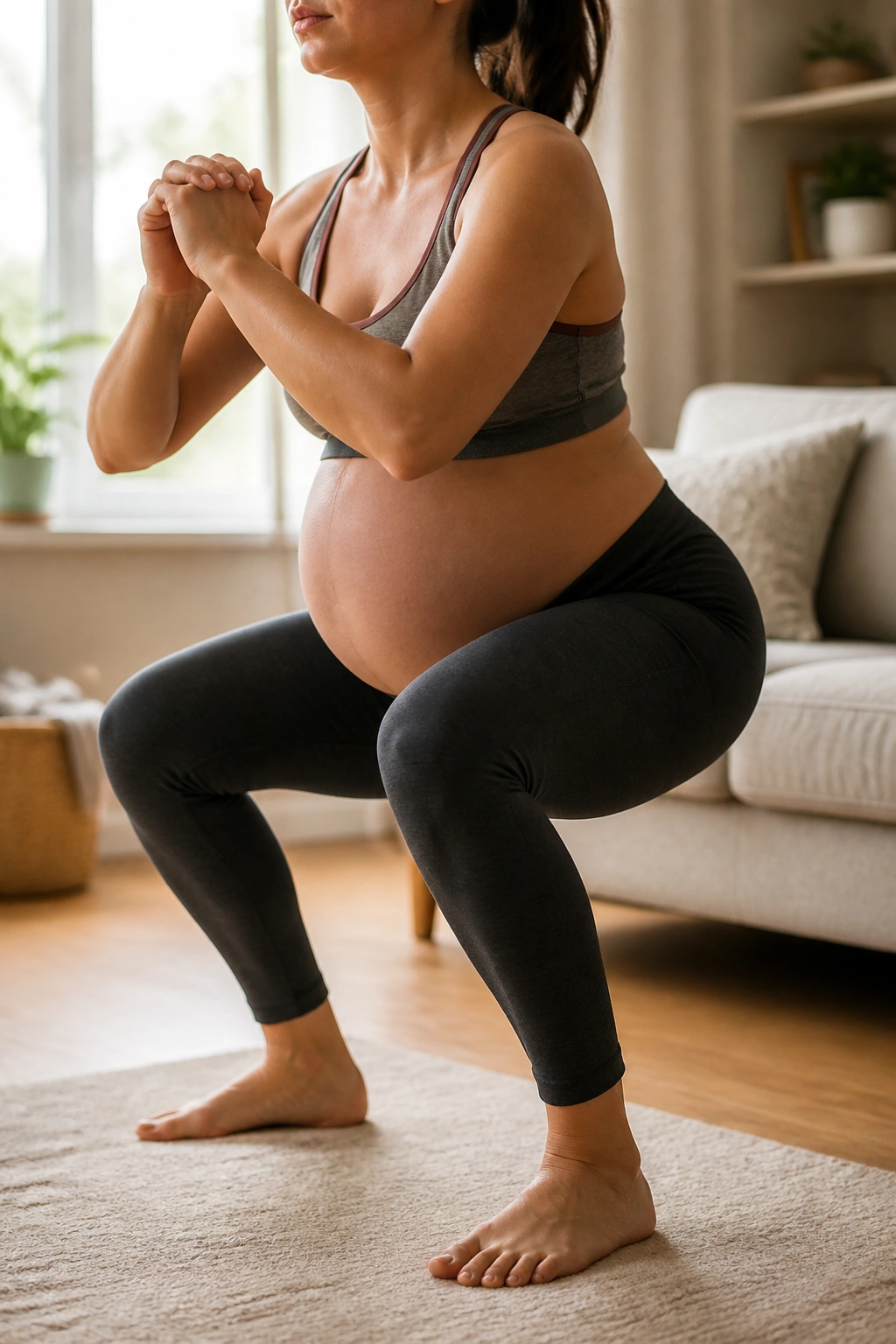
Squats are the foundation of lower body strength for a reason. They mimic the functional movement of sitting and standing, which you will do hundreds of times once the baby arrives. During pregnancy, squats help open the hips and maintain glute strength, which is vital for supporting your shifting pelvic alignment.
How to Master the Form
Start with your feet slightly wider than hip-width apart to accommodate your growing midsection. Keep your chest up and your weight in your heels as you slowly lower your hips back and down, as if sitting into an invisible chair. Stop when your thighs are parallel to the floor, or go as low as feels comfortable for your range of motion. Keep your knees tracking over your toes—avoid letting them cave inward.
Pro Tips for Pregnancy
- Keep your core engaged by gently pulling your belly button toward your spine on the way up.
- If balance becomes an issue later in the pregnancy, position yourself in front of a sturdy couch. You can use it as a safety net to sit back onto if you feel unstable.
- Focus on the exhale as you stand up; holding your breath can increase intra-abdominal pressure.
2. Wall Sits
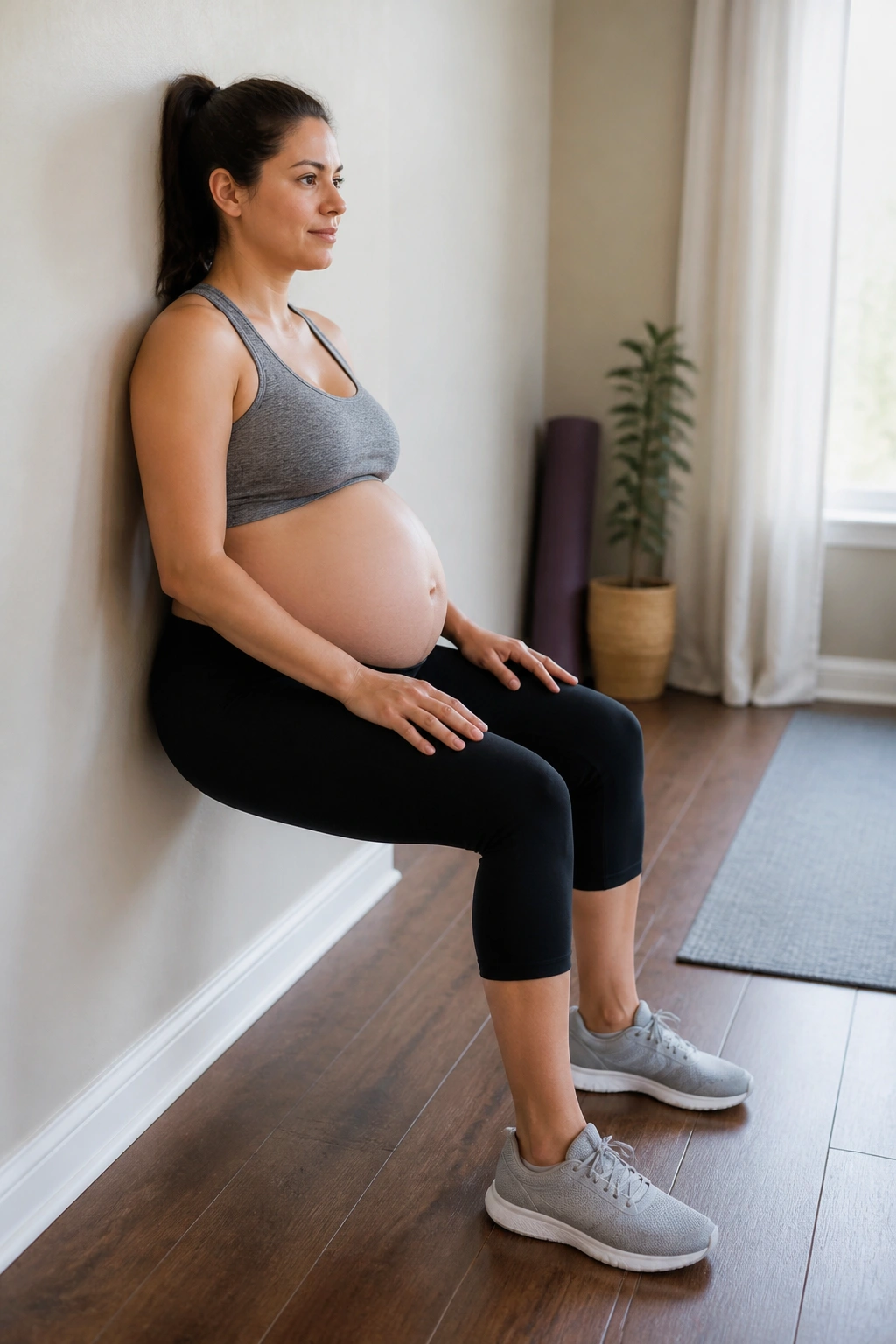
Sometimes, you need a move that keeps your feet firmly planted on the floor while isolating the quadriceps. Wall sits are fantastic for this. They are isometric, meaning you hold a position without moving, which is generally safer and less taxing on the joints as you move into the third trimester.
Start by standing with your back flat against a smooth wall. Step your feet out about two feet in front of you. Slide down until your knees are bent at a ninety-degree angle, or a shallower angle if your knees feel sensitive. Hold this position for thirty seconds to start, breathing steadily the entire time.
The beauty of the wall sit is that it is infinitely adjustable. If you are struggling with pelvic girdle pain, widen your stance slightly. If you feel strong, hold for a longer duration. Just watch out for “quiver legs”—if your muscles start shaking uncontrollably, stand up and rest. It is better to do multiple shorter holds than to push to the point of complete muscle failure.
3. Glute Bridges
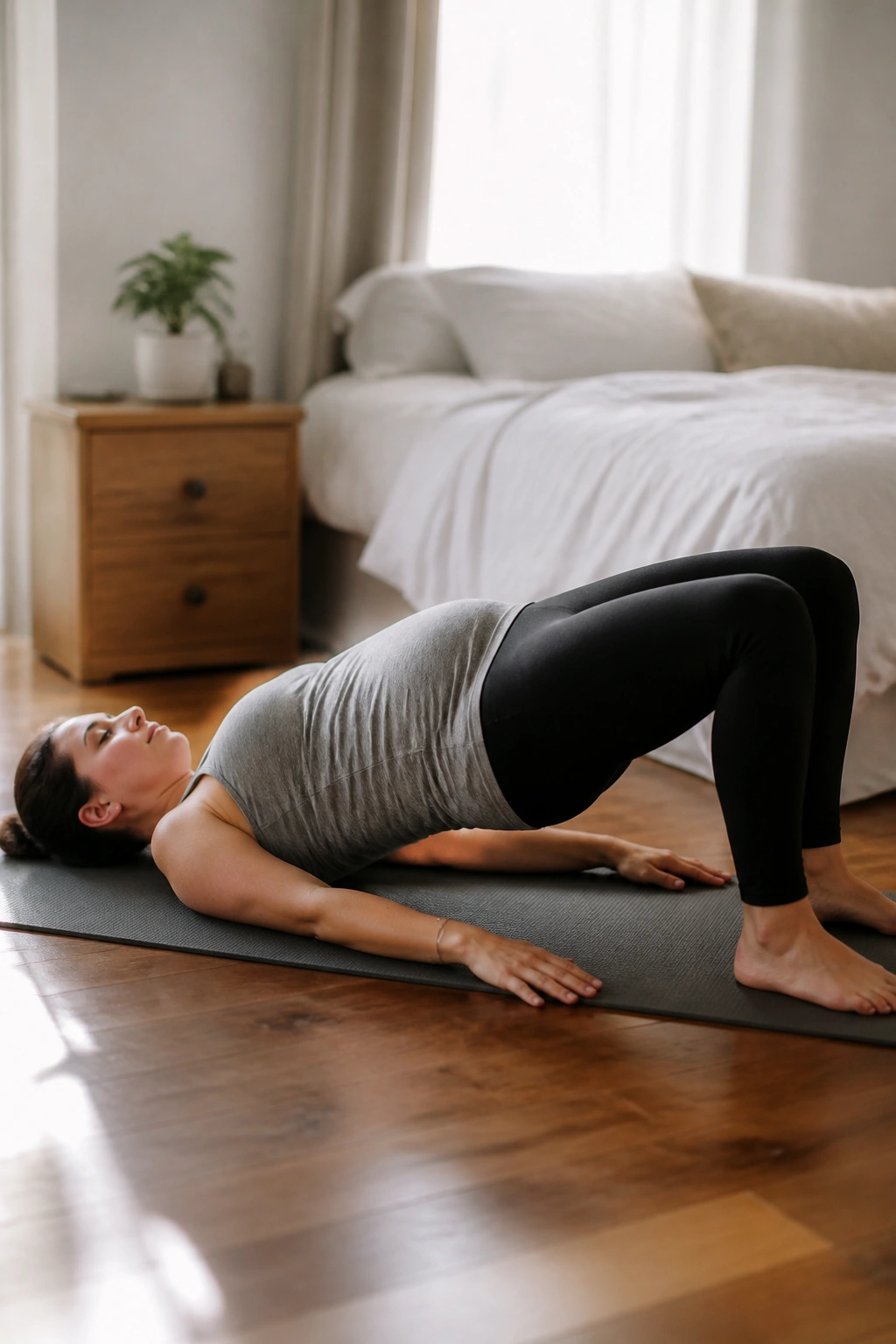
Back pain is often caused by weak glutes and tight hip flexors. Glute bridges are the antidote to this. By strengthening the posterior chain—the muscles along the back of your body—you create a natural corset of muscle that supports your lumbar spine.
Why They Work
When you lie on your back, you are working against gravity to lift your hips. This movement is incredibly effective for isolating the glutes without putting extra pressure on your knees or ankles. It is one of the few exercises you can do well into your final weeks, provided you feel comfortable lying flat.
Safety Note
If you feel lightheaded when lying on your back, immediately roll to your side. You can modify this movement by performing it with your back propped up against a sofa or exercise step, keeping your torso at a forty-five-degree angle rather than lying flat. Always focus on squeezing your glutes at the top of the movement, not arching your back.
4. Side-Lying Leg Lifts
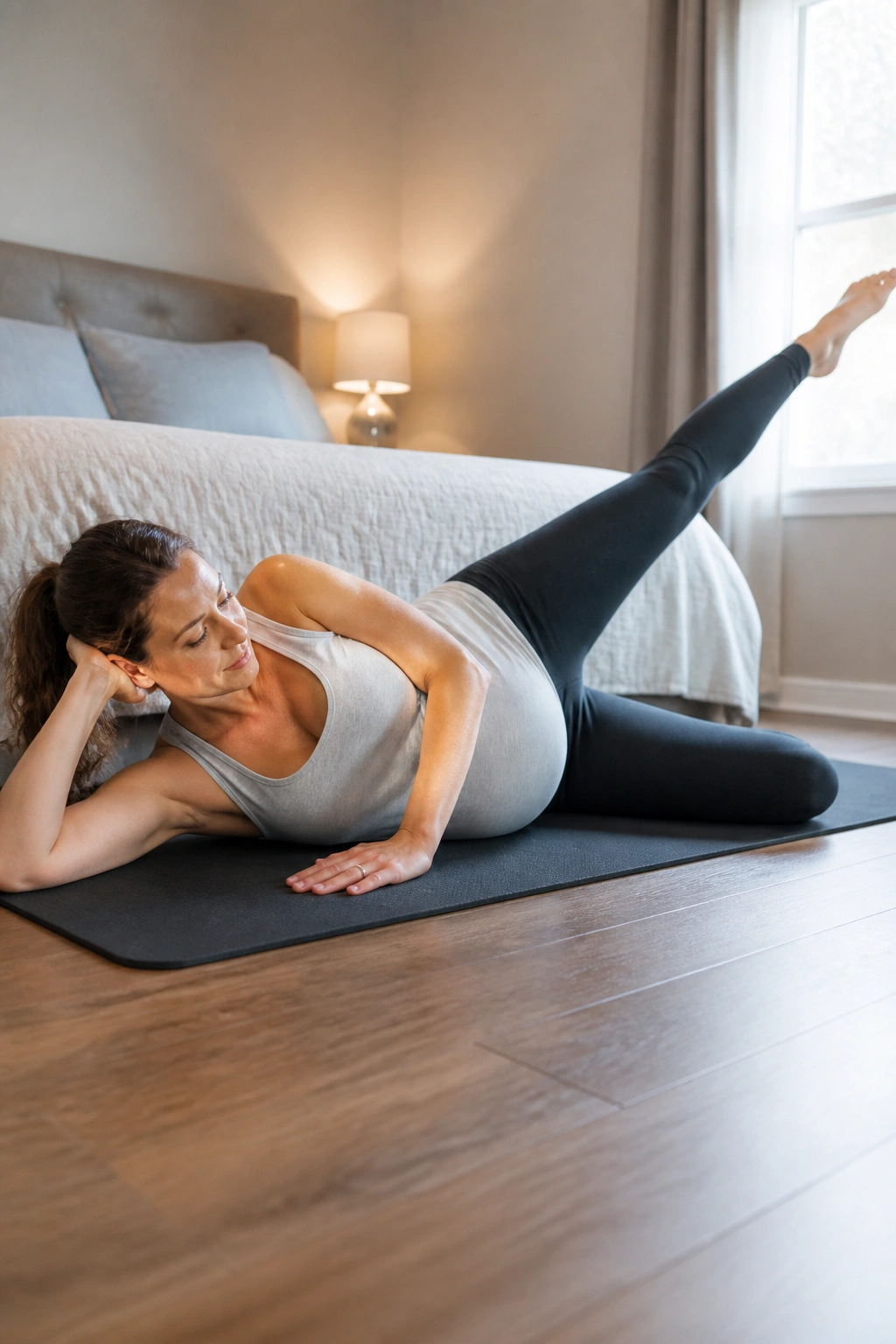
When your balance starts to waver, getting down on the floor is the smartest way to train. Side-lying leg lifts target the abductors—the muscles on the outside of your hip and thigh—which are crucial for hip stability as your gait changes to accommodate your bump.
Lie on your side with your legs stacked. You can bend the bottom leg for extra stability. Keep your top leg straight and lift it toward the ceiling, then lower it slowly with control. It is not about how high you lift; it is about the squeeze in the hip.
Try to complete twelve to fifteen reps on one side before flipping over. You will likely feel a burn in the side of your hip—that is exactly what you are looking for. Avoid letting your torso rock forward or backward. Keep your core tight and your spine neutral throughout the entire range of motion.
5. Clamshells
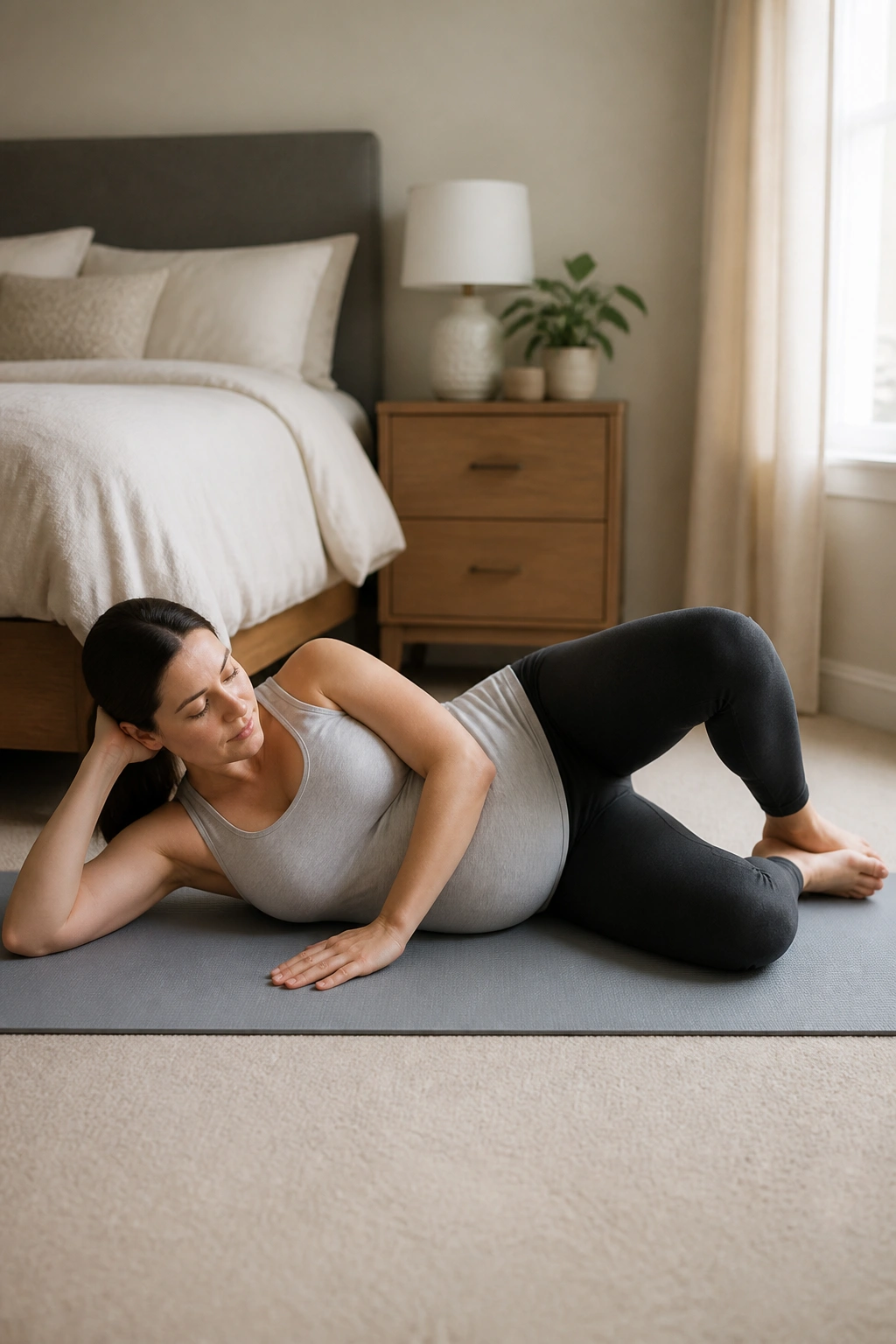
Clamshells are the gold standard for targeting the gluteus medius, a smaller but essential hip stabilizer. During pregnancy, as your pelvis shifts, this muscle often becomes inactive or weak, leading to hip pain and waddling.
To perform these, lie on your side with your knees bent at a ninety-degree angle, hips stacked on top of each other. Keep your feet touching. Open your top knee toward the ceiling, like a clam opening its shell, while keeping your feet together. Lower the knee back down with control.
Do not rush the movement. The slower you go, the more you will feel the activation in your glute. If you want to increase the intensity without heavy weights, use a light resistance band just above your knees. This forces your muscles to work harder to overcome the tension, which can be very effective in just a few minutes.
6. Reverse Lunges
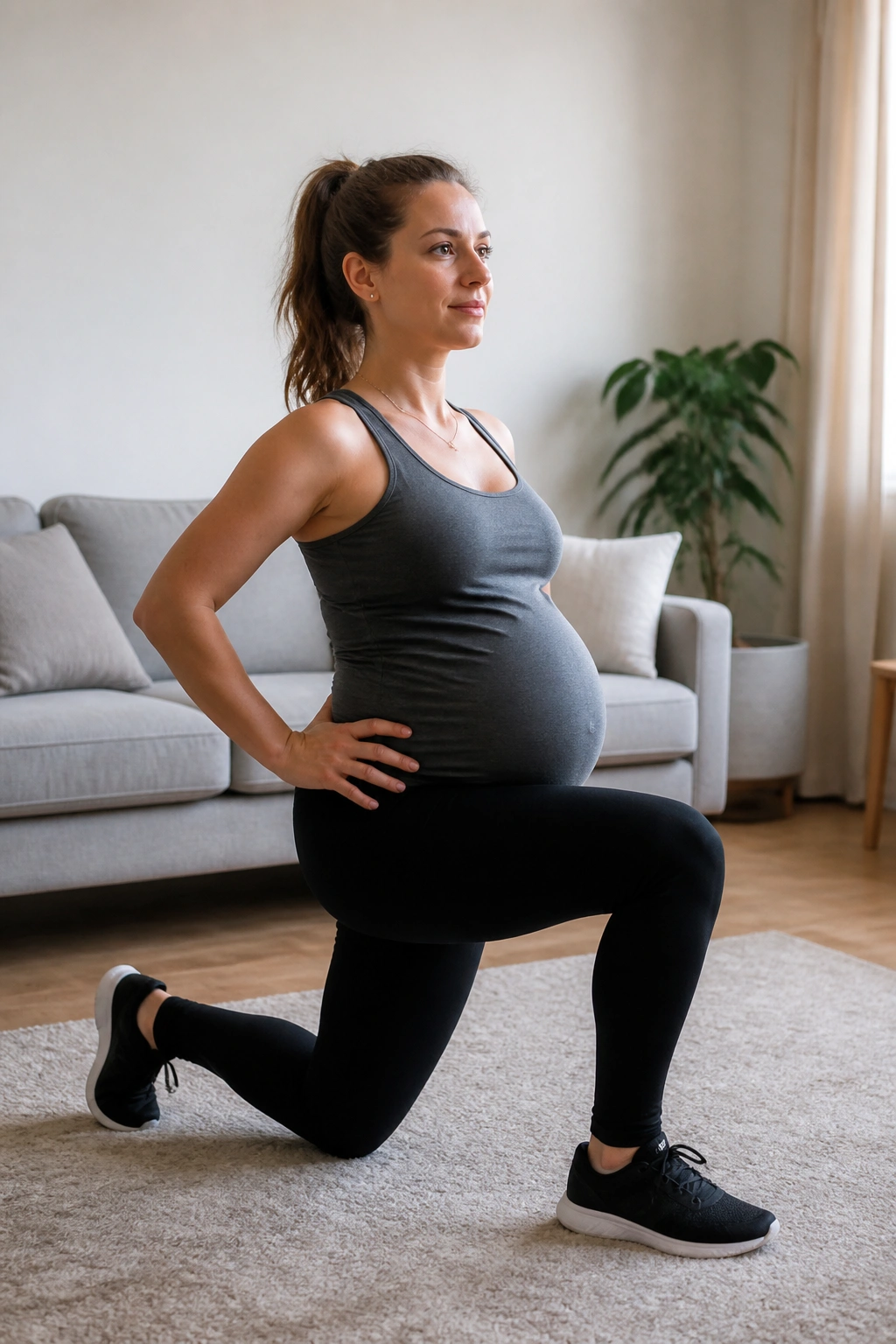
Forward lunges can put a lot of pressure on the patellar tendon and the knee joint, which might be feeling sensitive during pregnancy. Reverse lunges are a much kinder alternative, as they keep your front knee stacked over your ankle and place less sheer force on the joint.
Step backward with one foot, dropping your back knee toward the floor. Make sure your front foot stays flat and your weight remains centered. Push through your front heel to return to the starting position.
Why does this feel better? Because the weight distribution is shifted slightly backward, it is much easier to keep your chest upright and avoid leaning forward, which is a common form error that strains the lower back. If you struggle with balance, perform these while holding onto the back of a sturdy chair for support.
7. Sumo Squats
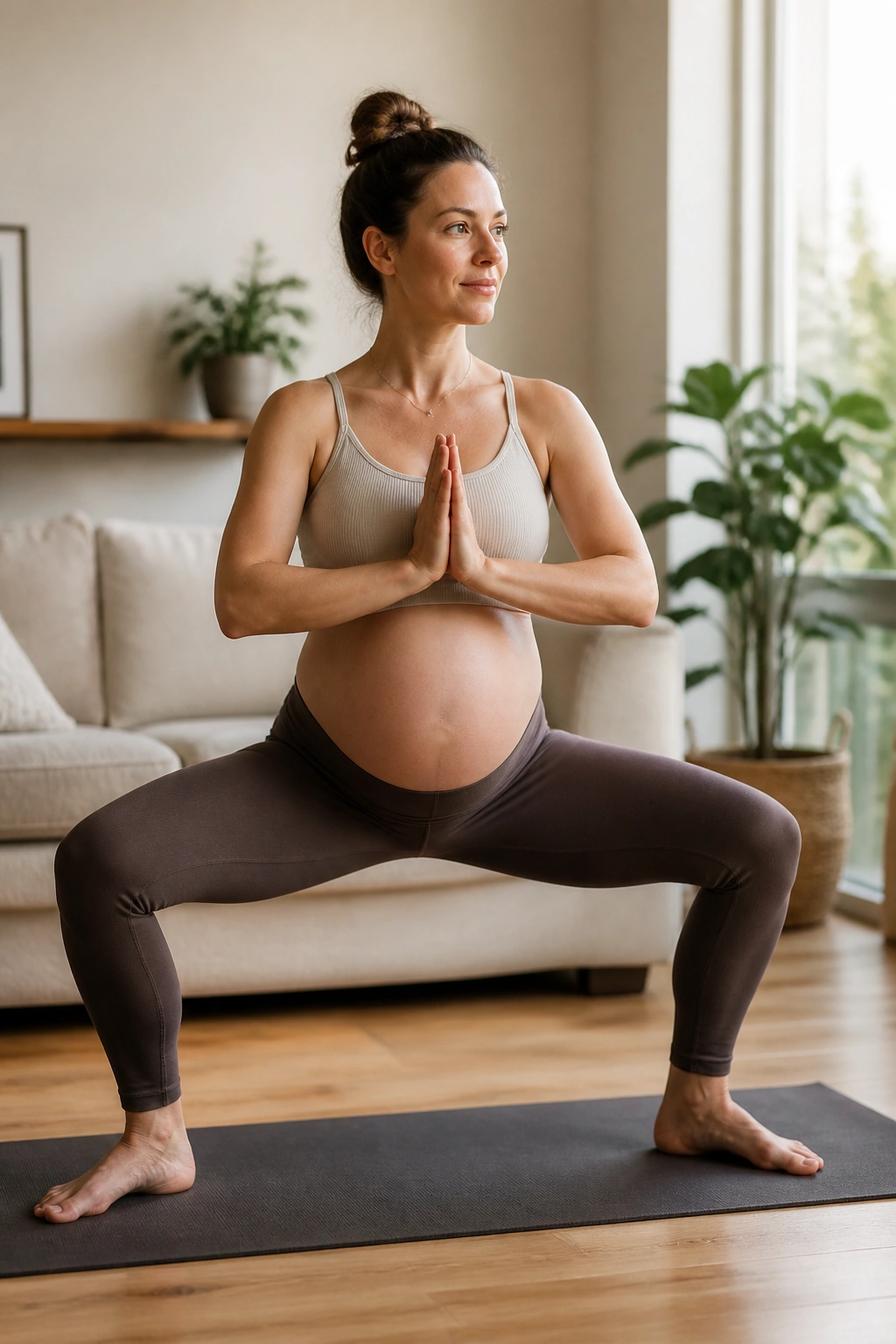
If your belly is getting in the way of a traditional narrow squat, it is time to go wide. Sumo squats involve a wider stance with your toes pointed outward. This stance shifts the focus slightly more toward the inner thighs and adductors, while also being much friendlier on your growing midsection.
The Technique
Stand with your feet wider than shoulder-width, toes turned out about forty-five degrees. Keep your torso tall—imagine a string pulling the crown of your head toward the ceiling. Lower your hips down, feeling the stretch in your inner thighs.
Why It’s Great for Pregnancy
The wide stance creates extra room for your belly, allowing you to achieve a deeper range of motion without feeling compressed. It also helps with pelvic floor engagement. As you stand up from the squat, focus on gently drawing your pelvic floor muscles upward, which is a great way to integrate strengthening those hidden, essential muscles.
8. Curtsy Lunges
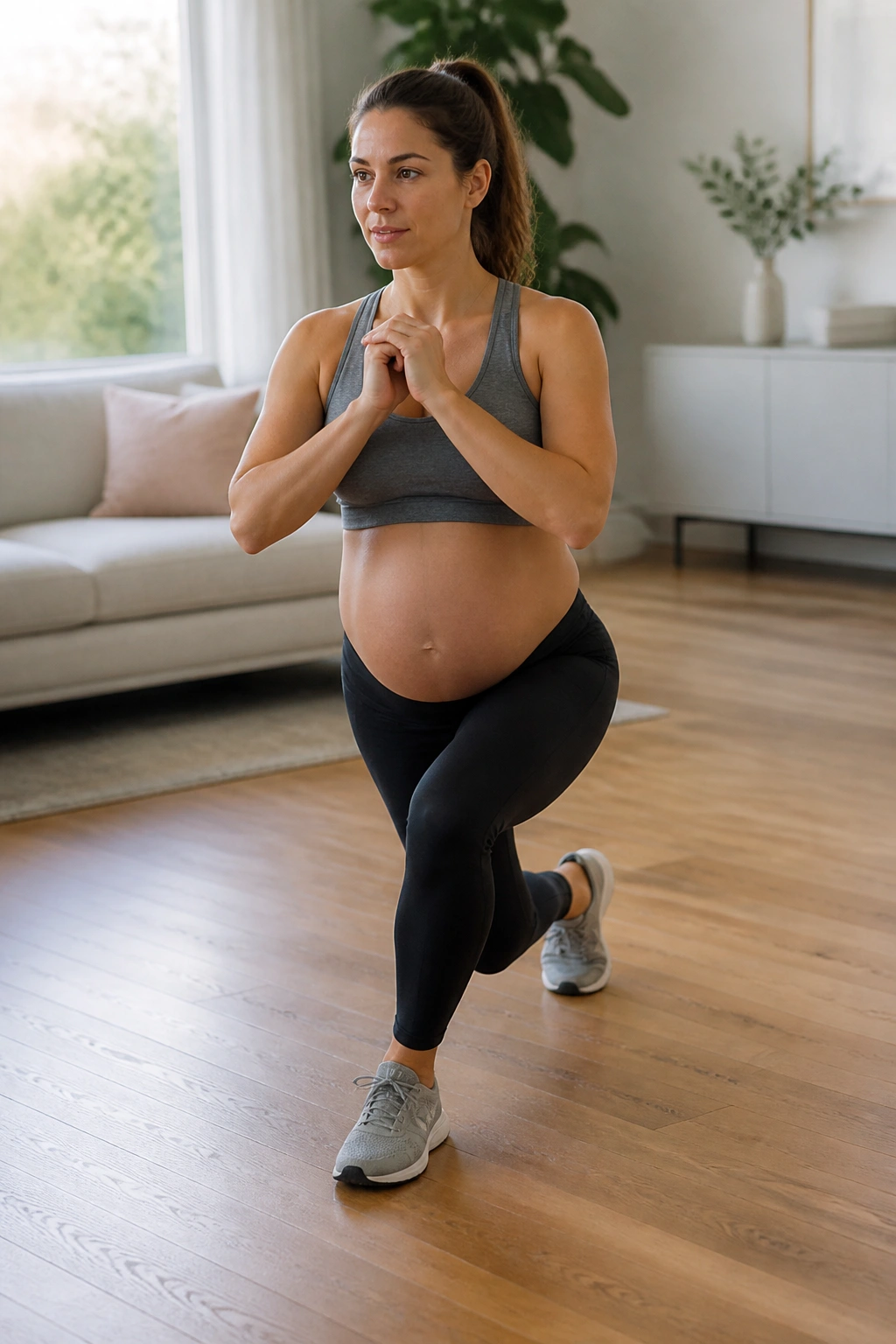
Curtsy lunges are an excellent way to work the glutes from a different angle. By stepping your foot diagonally behind the other, you change the line of tension on the gluteus medius. This exercise improves hip mobility and lateral stability, which is vital for preventing the “waddle” that can occur in the third trimester.
Start in a standing position. Step your right foot back and behind your left leg, as if you are doing a polite curtsy. Bend both knees, aiming to keep your front knee over your front ankle. Return to center and repeat on the other side.
Do not worry about stepping too far behind. A shallow angle is perfectly fine, especially if you are feeling less stable. If this feels too complex for your balance, just focus on a standard reverse lunge instead. Consistency is more important than variation here.
9. Step-Ups
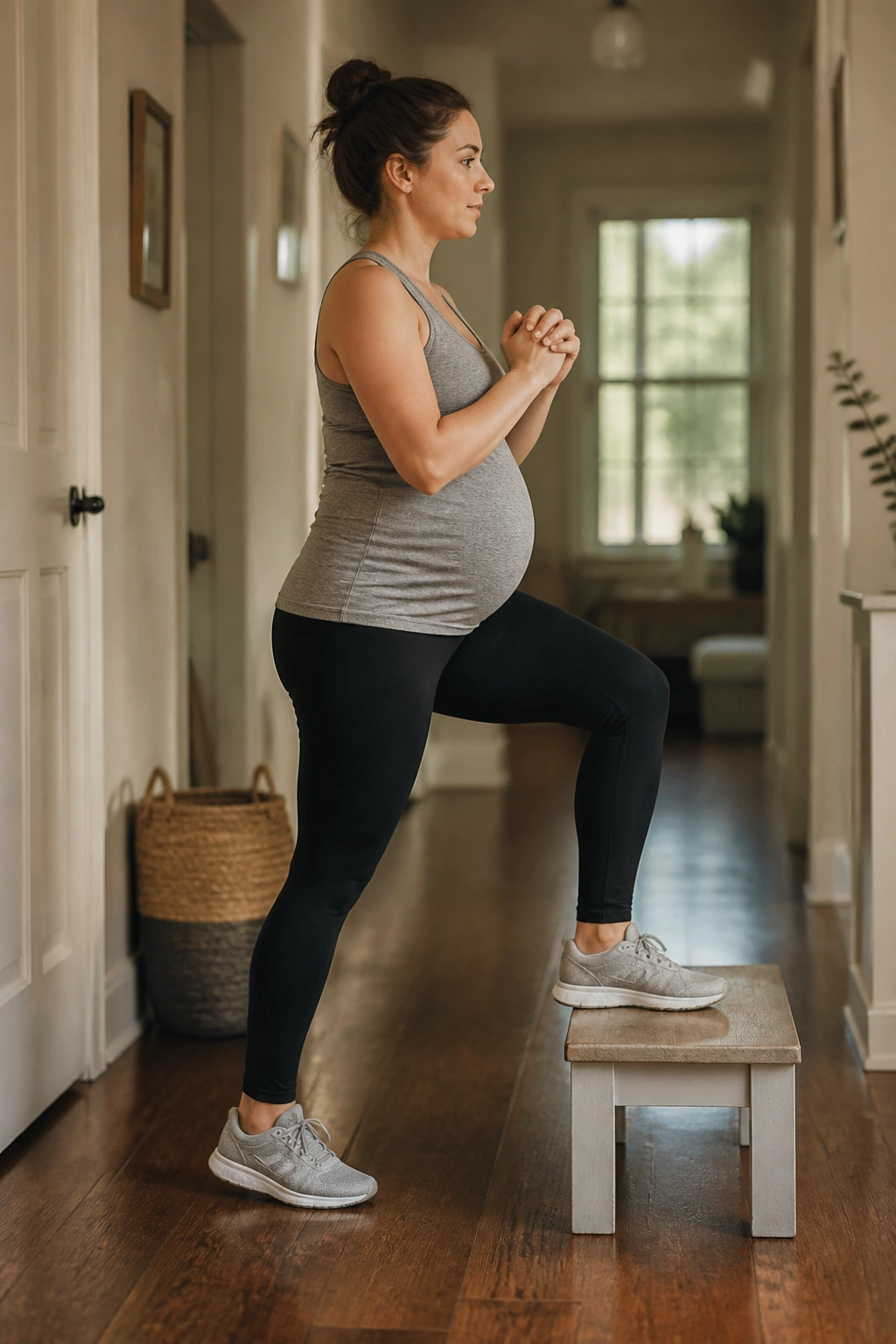
You likely use stairs every day. Why not turn them into a workout? Step-ups are a simple, functional exercise that builds unilateral leg strength—meaning each leg works independently. This is crucial for correcting any muscle imbalances that might develop during pregnancy.
Find a sturdy chair, a low bench, or the bottom step of a staircase. Step up with your right foot, pressing through your heel to lift your entire body weight. Tap your left toe on the step, then lower yourself back down with control. Do not jump; use the muscles.
Focus on the lowering phase. The eccentric (downward) movement is where much of the muscle-building happens. If the step is too high, it puts extra strain on the hips. Opt for a lower height. If you feel like you are using momentum to “pop” up to the step, you need a lower surface.
10. Calf Raises
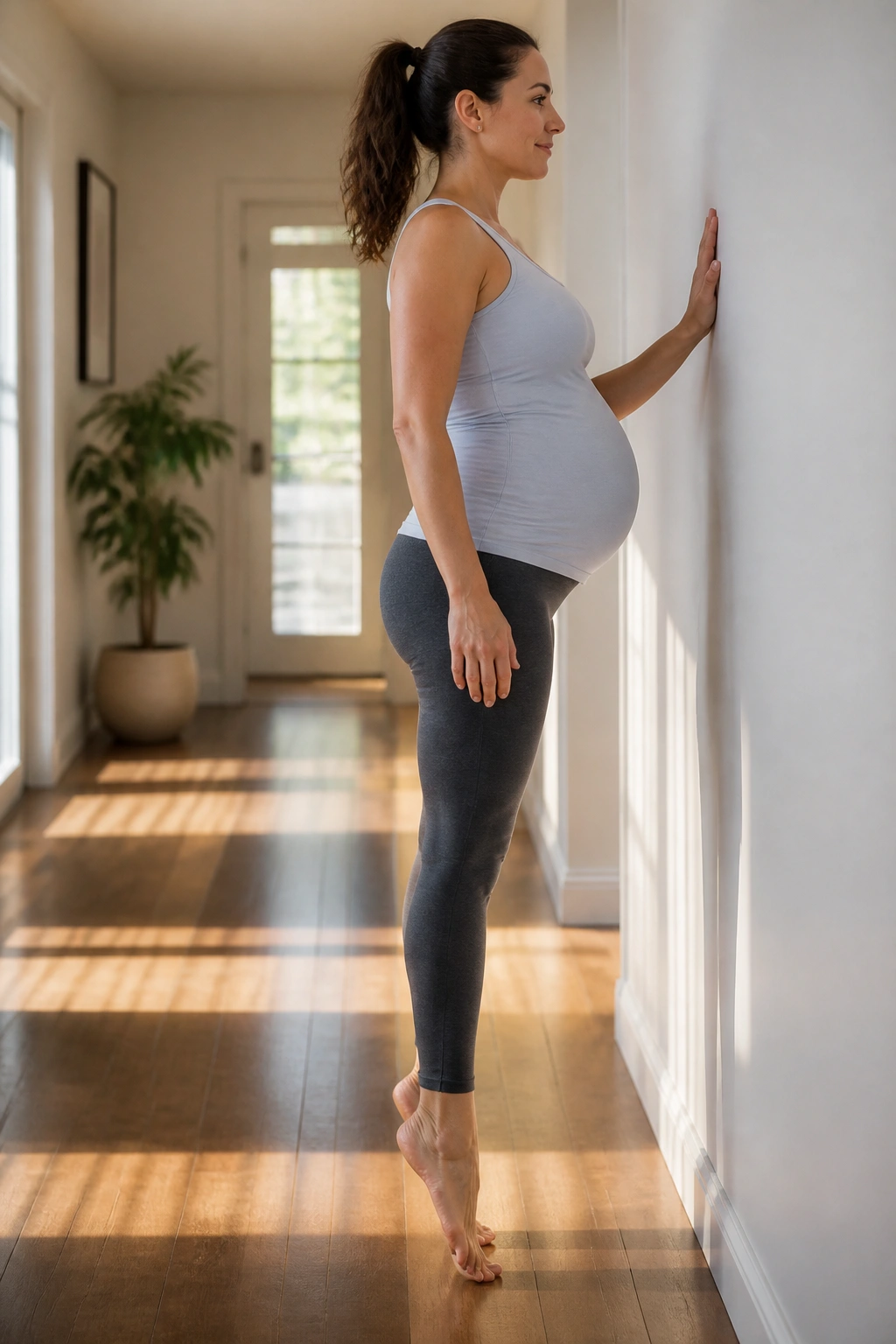
Swelling in the feet and ankles, also known as edema, is a common reality for many expectant mothers. While calf raises won’t fix everything, they help improve circulation in the lower legs and ankles by engaging the calf muscles, which act as a pump for blood and lymph.
Stand near a wall or chair for balance. Rise up onto your toes, lifting your heels as high as possible. Pause at the top for a second, then lower back down slowly. You can do these while brushing your teeth or waiting for the kettle to boil.
The key here is a full range of motion. Do not just bob up and down; go all the way up and all the way down. If you want to make it harder, do them one leg at a time. This also tests your core stability, which is a nice bonus.
11. Bird-Dog
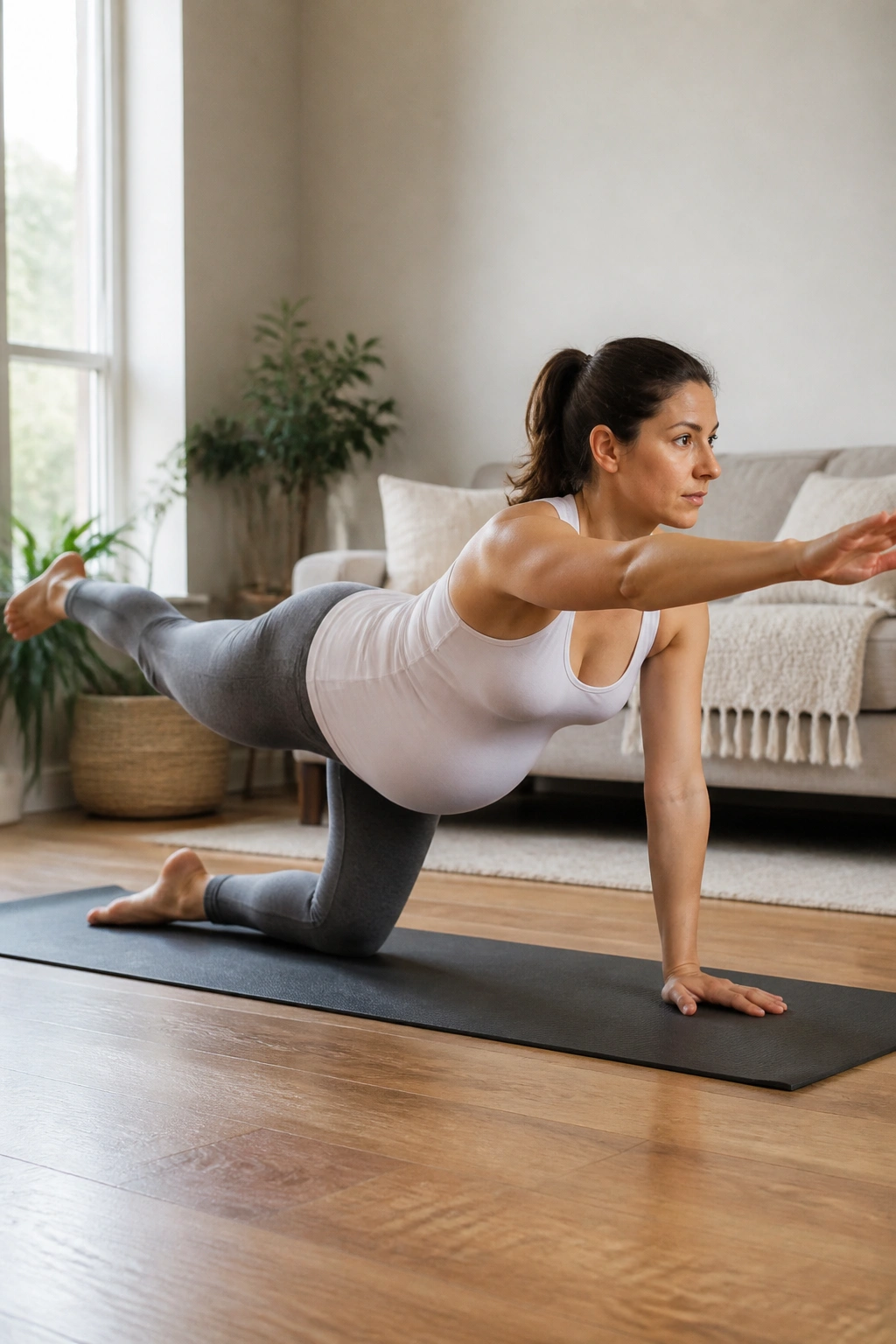
While this is often classified as a core exercise, the bird-dog is incredibly effective for stabilizing the hips and glutes. It requires you to maintain a flat back while moving opposite limbs, which is excellent for counteracting the forward pull of your bump on your spine.
Get on your hands and knees in a tabletop position. Keep your back neutral—do not let it sag toward the floor. Extend your right arm forward and your left leg backward simultaneously. Hold for a few seconds, keeping your hips square to the floor. Return to the start and switch sides.
The main mistake people make is lifting their leg too high and arching their back. Imagine you are lengthening your limb away from your body, not just lifting it toward the ceiling. Your goal is a straight line from your fingertip to your heel.
12. Fire Hydrants
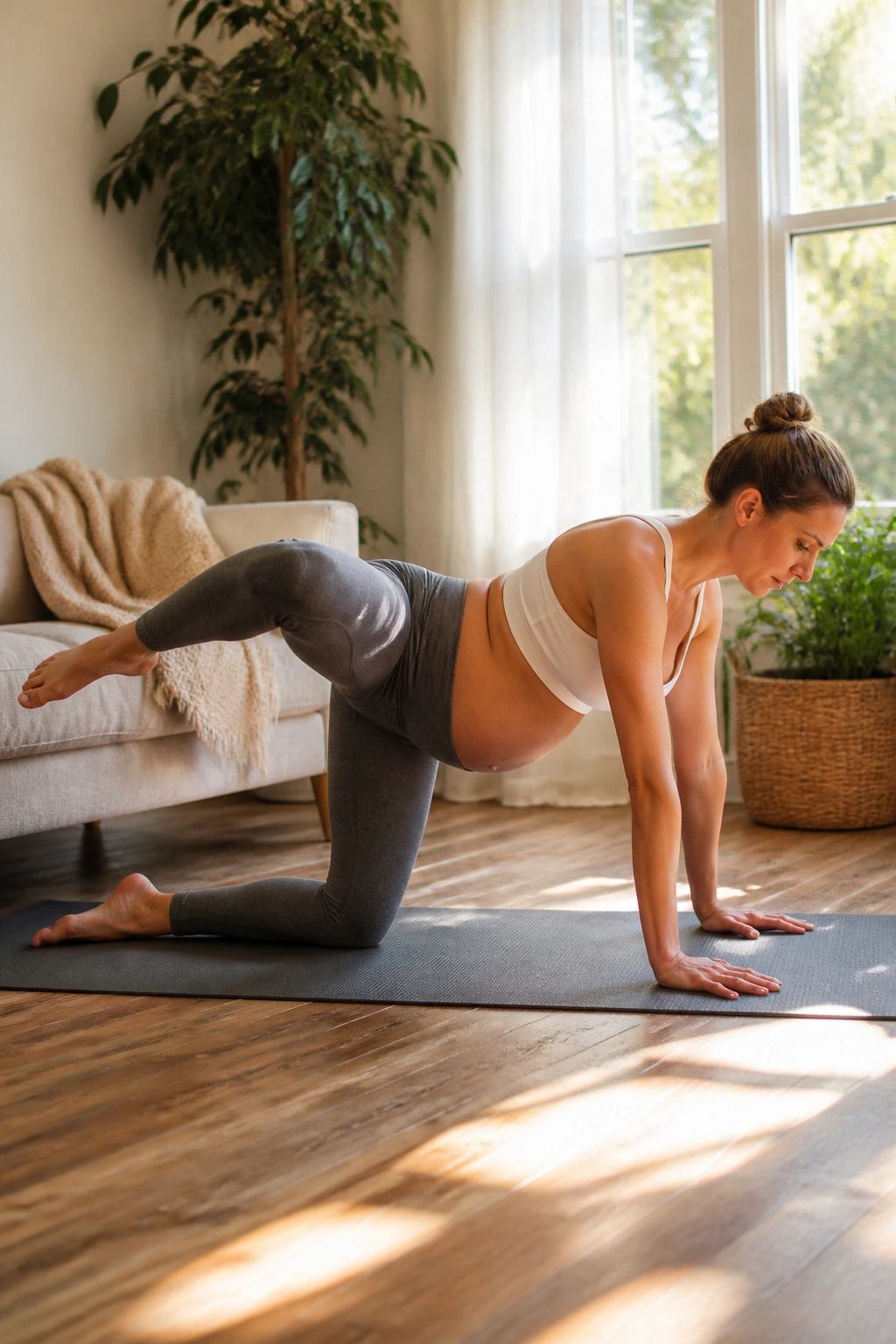
This is a hip mobility and glute isolation exercise that is very popular for a reason. It hits the hip abductors hard. By strengthening these muscles, you are effectively “gluing” your pelvis together, which helps mitigate that loose-jointed feeling many pregnant women experience.
On your hands and knees, keep your knee bent at ninety degrees. Keeping your back flat, lift one knee out to the side like a dog at a fire hydrant. Return to the center without letting your knee touch the floor.
It sounds simple, but your hips will be burning after twelve reps. Make sure your hips stay level. If you find yourself leaning way over to the side to lift the leg higher, decrease your range of motion. Quality of movement is far more important than the height of the lift.
13. Donkey Kicks
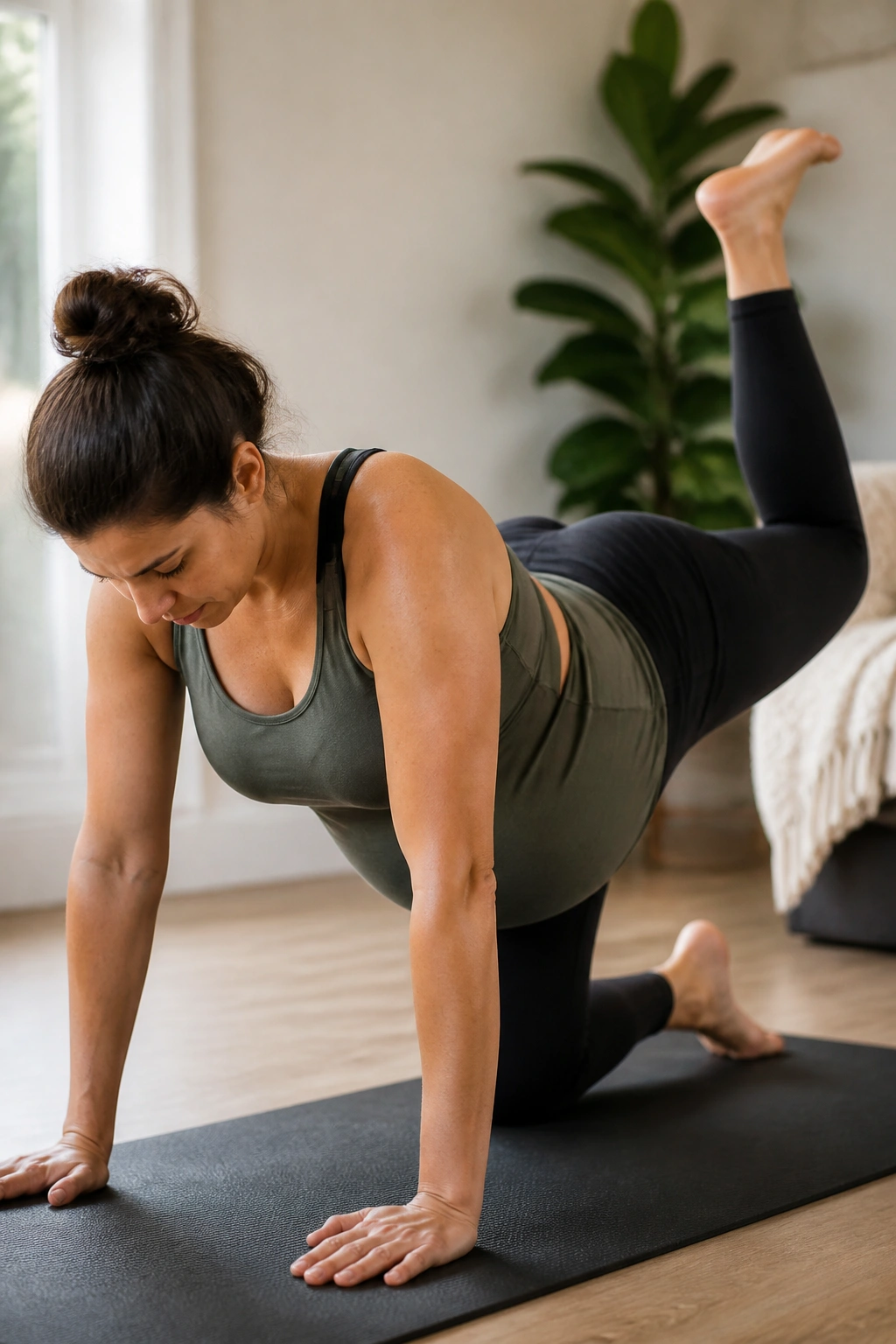
Donkey kicks are fantastic for targeting the gluteus maximus—the largest muscle in the buttocks. Strong glutes are your best friend during pregnancy for lower back support.
Get into a tabletop position. Keeping your knee bent at ninety degrees, kick your foot toward the ceiling as if you are stamping a footprint on the sky. Squeeze your glute at the very top of the movement. Lower your knee back to the starting position.
Watch your lower back. If you feel your spine sagging when you kick up, your core isn’t engaged enough. Imagine keeping a glass of water balanced on your lower back. If you spill the water, your form has slipped.
14. Stability Ball Squats
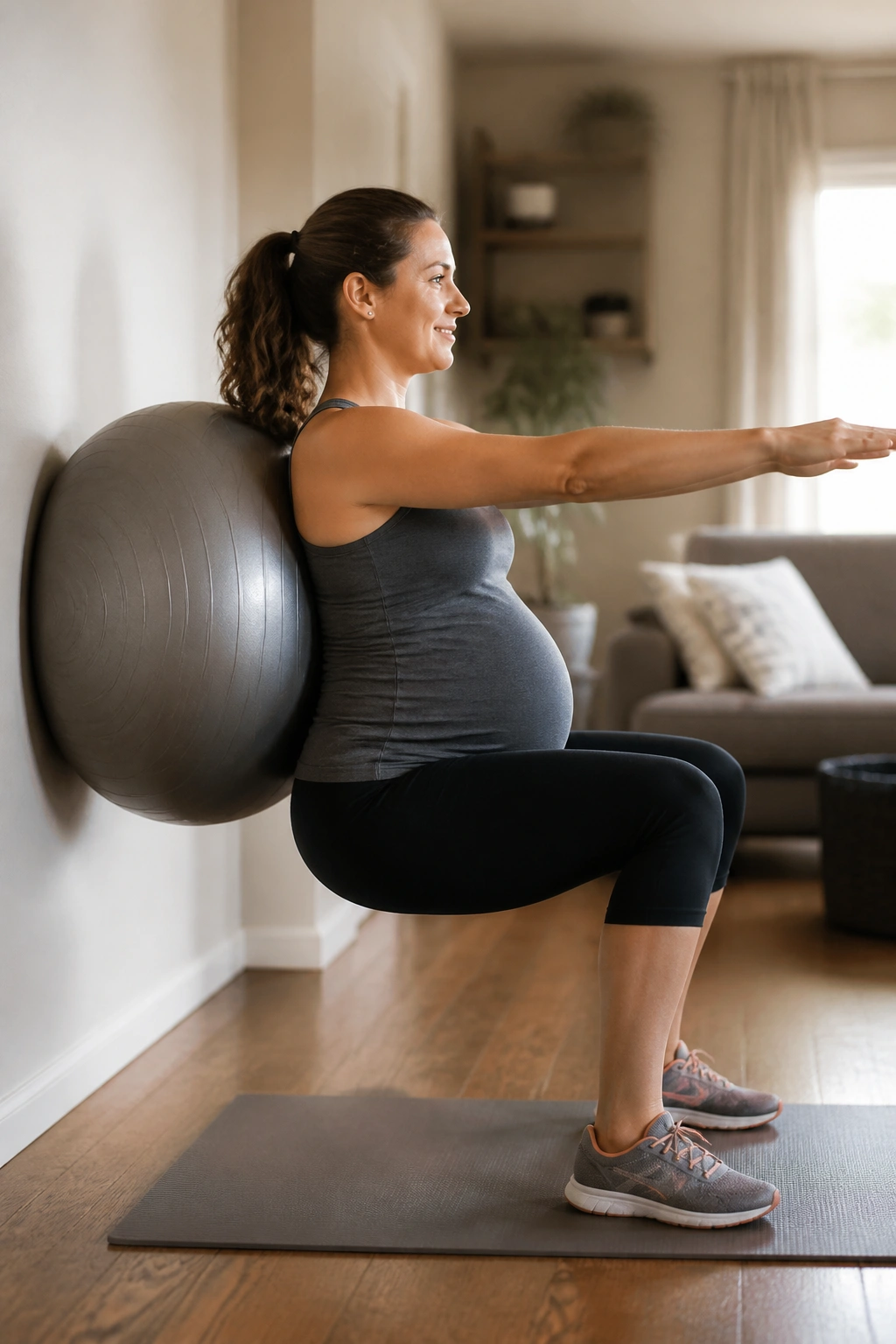
If you have a yoga ball or stability ball at home, use it. It is a game-changer for pregnancy squats. It provides support for your back while allowing you to move through a full range of motion without worrying about losing your balance.
Place the ball between your lower back and a wall. Lean your weight into the ball and walk your feet out. Lower yourself into a squat, letting the ball roll up your back as you descend. Stand back up, letting the ball roll back down.
This exercise is incredibly comforting because you can lean back into the ball, taking the pressure off your knees. It also forces you to engage your quads more than a standard squat, as the ball introduces an unstable surface you have to manage.
15. Supported Single-Leg Deadlifts
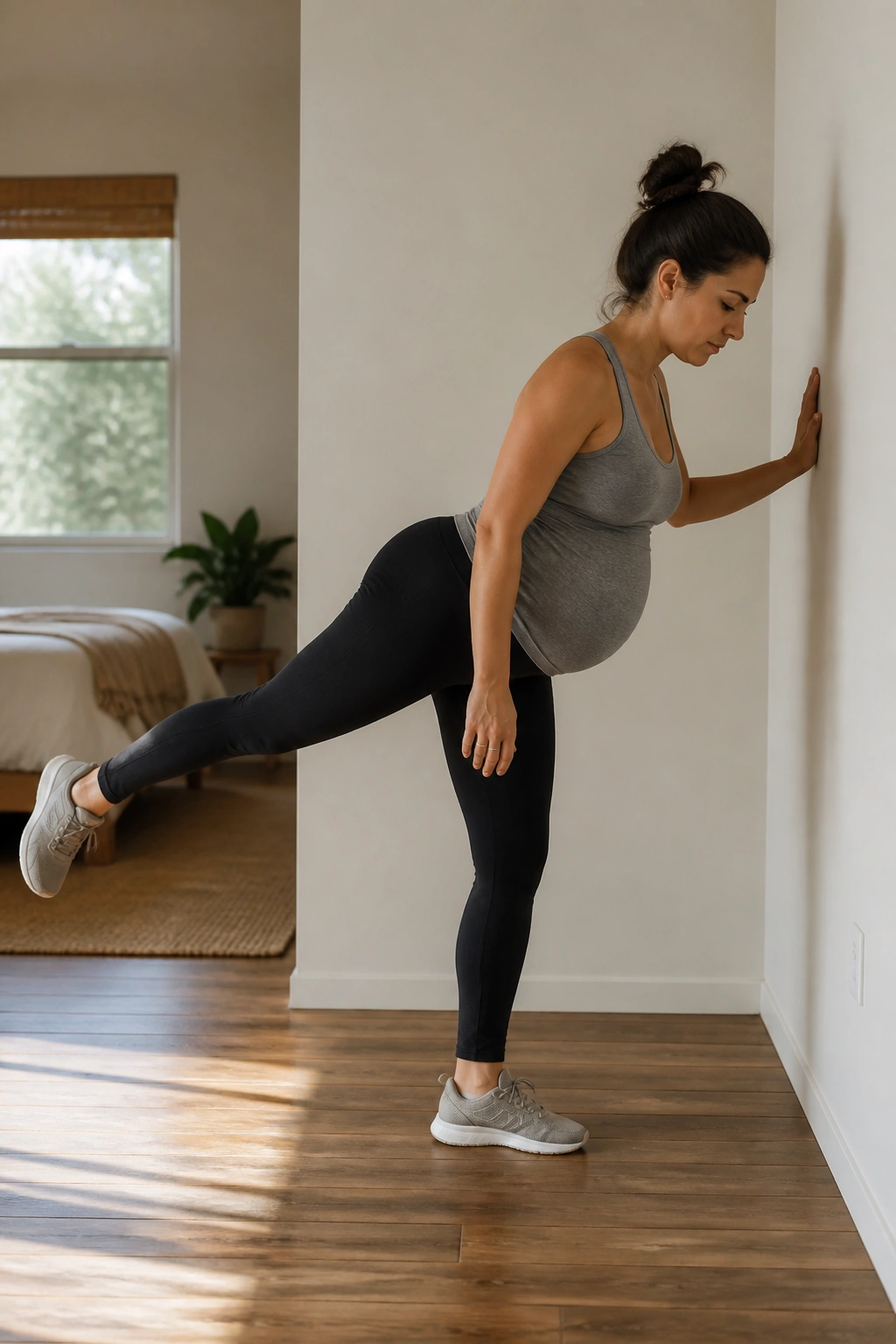
Deadlifts are usually thought of as “gym bro” exercises, but the single-leg version is the king of functional, pregnancy-safe stability training. It teaches you how to hinge at the hips rather than the lower back.
Stand next to a wall or hold onto a sturdy chair with one hand. Shift your weight onto your right leg. Keeping a slight bend in your right knee, hinge forward at your hips, sending your left leg straight back behind you. Your torso should lower as your leg rises. Return to standing by squeezing your right glute.
Use the support. You are not trying to test your balance; you are trying to isolate your hamstring and glute. If you feel this in your lower back, you are probably rounding your shoulders. Keep your chest open and your spine long.
16. Lateral Lunges
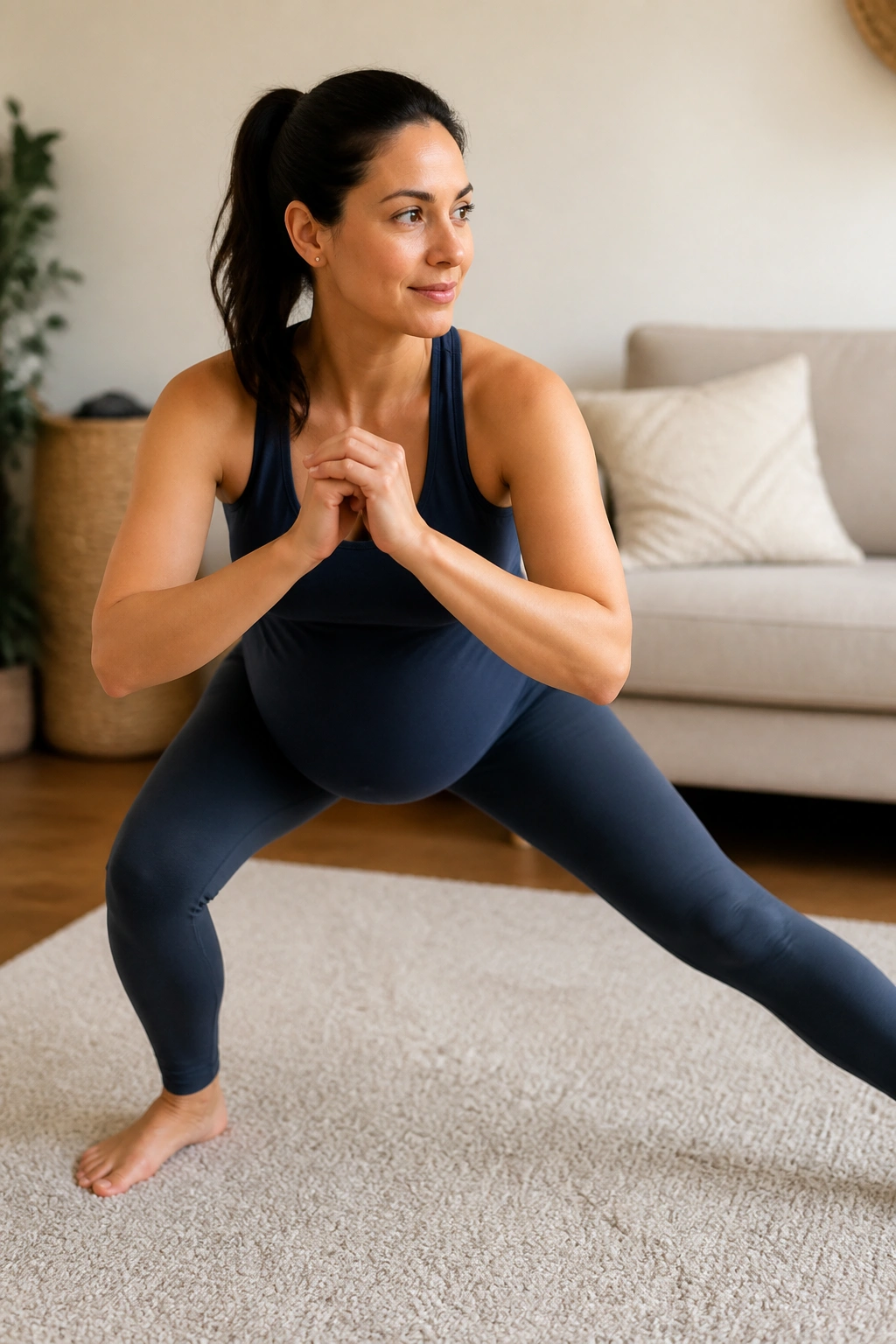
Pregnancy often limits our movement to the “sagittal plane”—moving forward and backward. But life happens in multiple directions. Lateral lunges (side lunges) train your legs to handle force from the side, which is vital for overall hip health.
Stand with your feet together. Take a wide step to the right. Keep your left leg straight, bend your right knee, and push your hips back as if you are sitting into a one-legged squat on the right side. Push off your right foot to return to standing.
Do not worry if your range of motion is limited. Pregnancy naturally shifts the pelvic structure, and some days you might feel tighter than others. Just ensure your heels stay on the floor throughout the movement. If your heels lift, take a smaller step.
17. Chair Pose
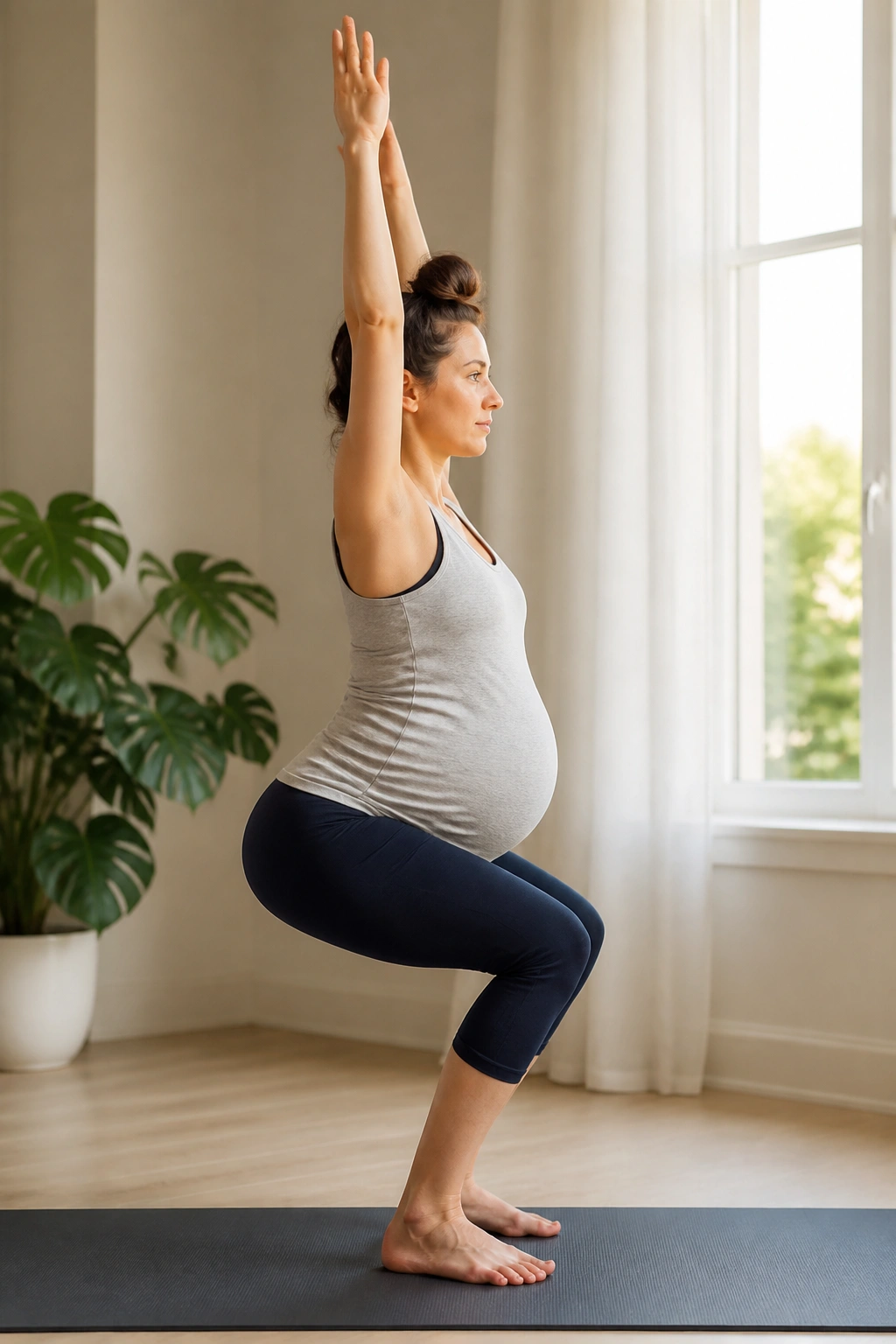
Borrowing from yoga, Chair Pose is an excellent way to build endurance in the legs and core. It is a held squat, but the position of the arms and the focus on posture make it a different kind of challenge.
Stand with your feet hip-width apart. Raise your arms alongside your ears. Sit back into a squat, keeping your weight in your heels. Hold the position. Imagine you are being pulled slightly forward from your fingertips while simultaneously being pulled down into the chair.
It is a fantastic exercise for strengthening the quads, but also for encouraging good posture. As your bump grows, your shoulders tend to roll forward. Reaching your arms up helps counteract that slouch, keeping your chest open and your breathing easier.
18. Kneeling Leg Extensions
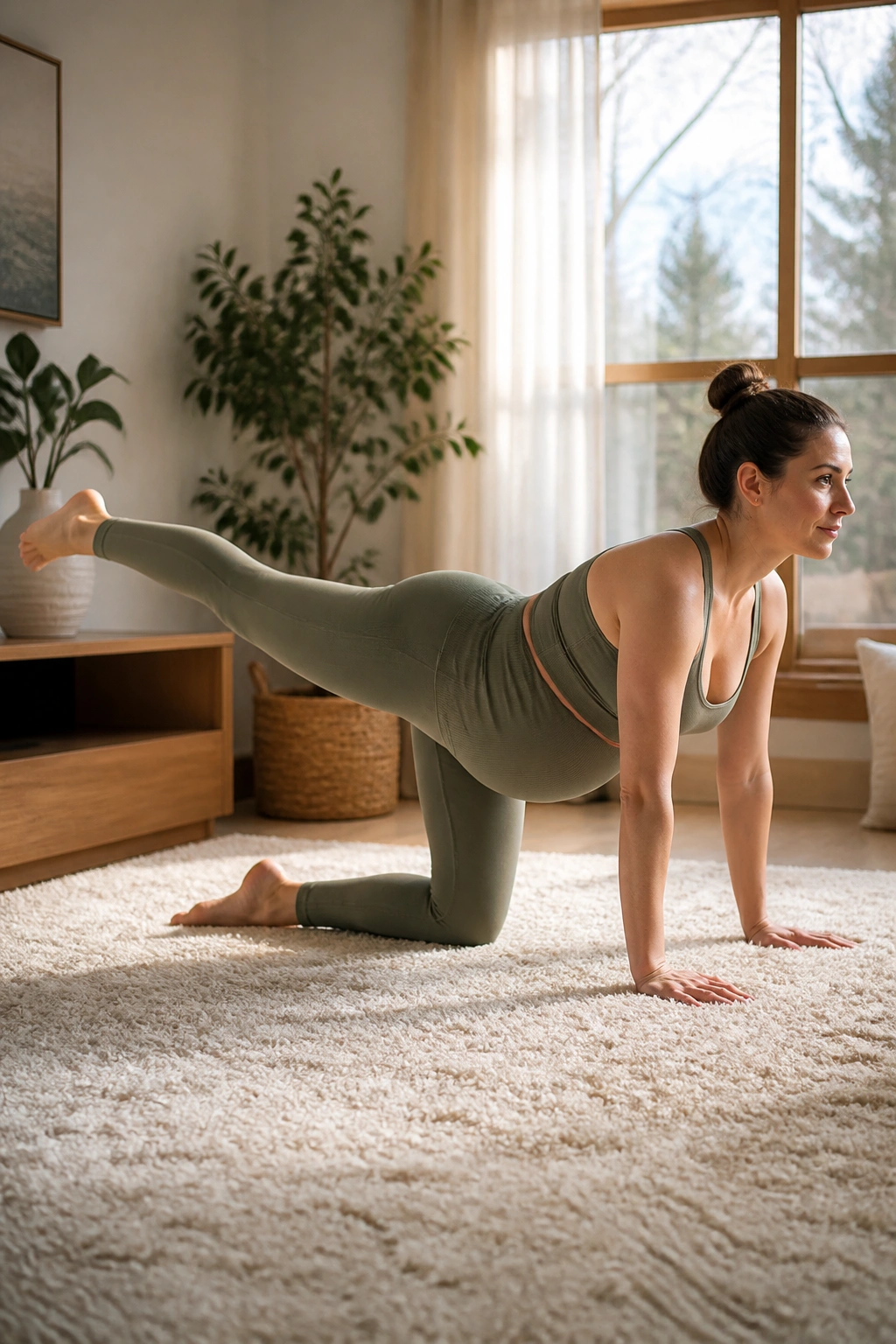
Sometimes you need an exercise that doesn’t involve bearing your full body weight on your joints. Kneeling leg extensions are low-impact and very focused on the quadriceps.
Start on your hands and knees. Extend one leg straight back behind you, tapping your toe on the floor. Lift that leg until it is parallel to the floor, then bend your knee to bring your heel toward your glute. Extend it back out. Repeat for all reps before switching legs.
You will feel this in the hamstring and the glute, but you’ll also feel it in the quad of the leg you are straightening. Keep your core locked tight. This is a very safe move for all trimesters as it keeps you close to the ground.
19. Standing Leg Abduction
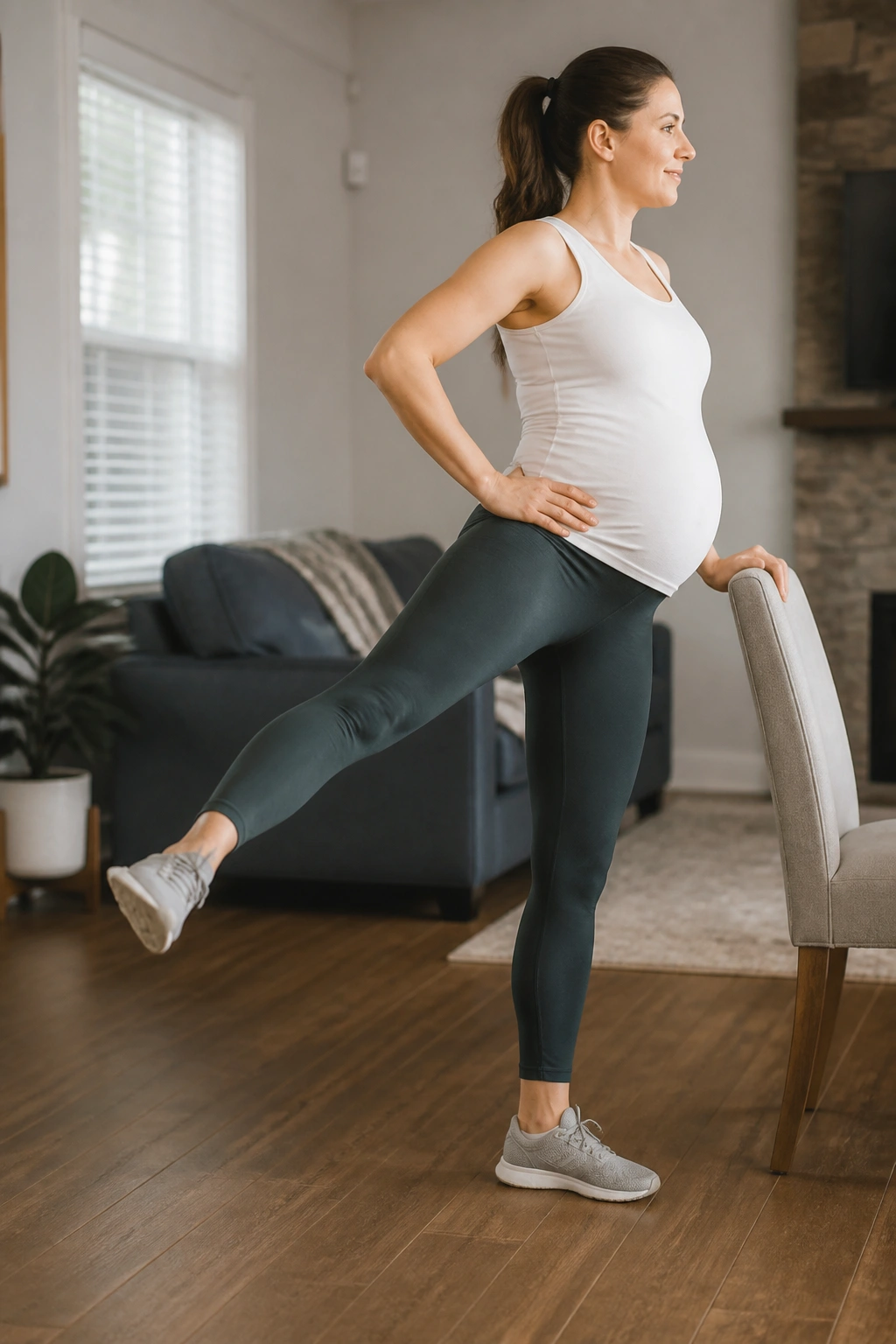
Abduction is just a fancy way of saying “moving away from the midline.” This is the best move for those who are struggling with pelvic instability or pain during walking.
Stand with your feet together, holding a chair for balance. Keep your right leg straight and lift it out to the side, away from your body. Keep your torso completely upright—do not lean to the left to compensate. Lower your leg slowly.
The tendency is to lean your body to the side so you can lift your leg higher. Fight that urge. A small, controlled lift that keeps your torso tall is infinitely more effective than a giant swing that compromises your posture.
20. Plie Squats
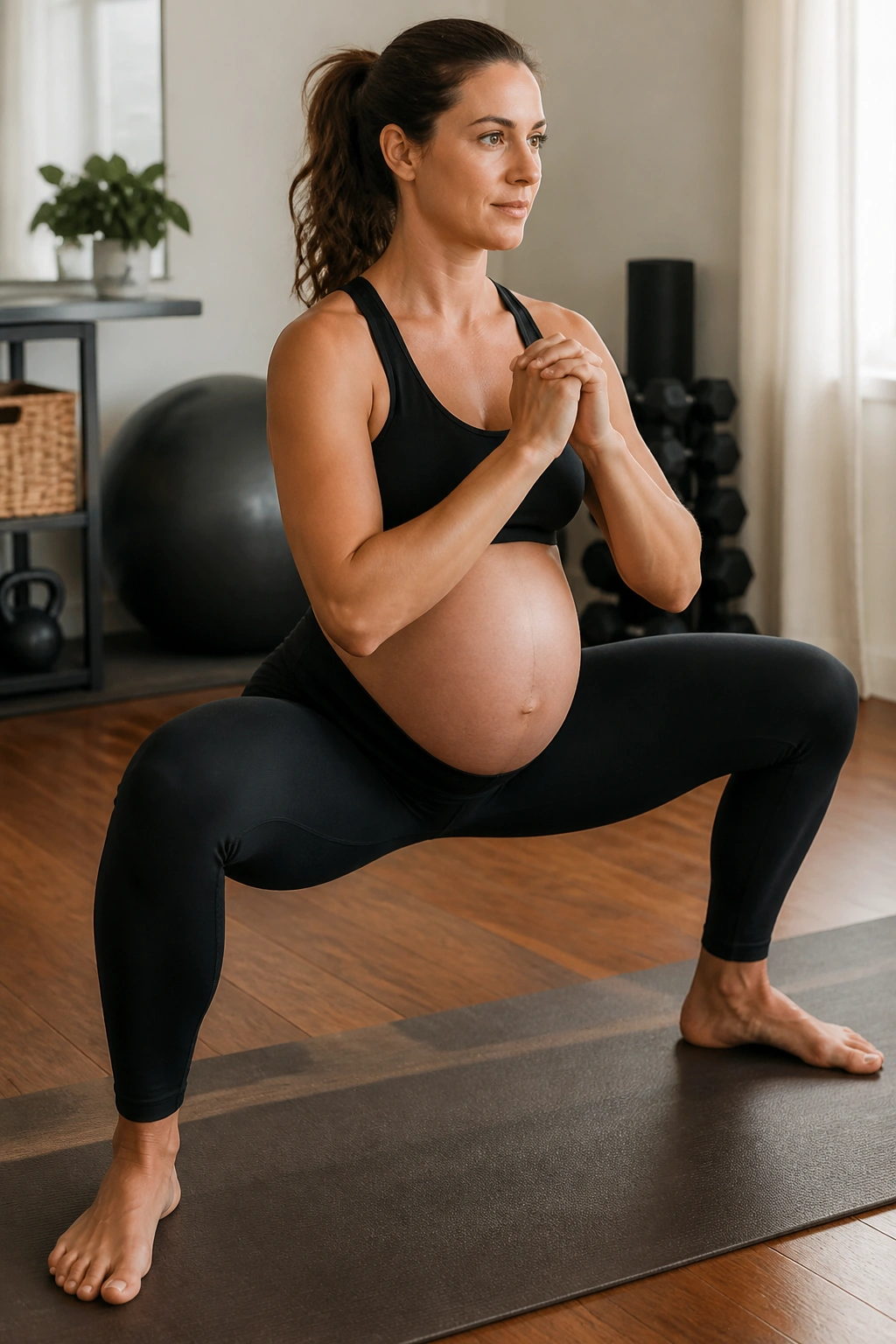
Similar to sumo squats, plie squats focus on a very wide stance with extreme external rotation of the hips. This is a favorite in prenatal fitness because it targets the inner thighs, which can get weak and tight during pregnancy.
Stand wide, feet turned out, and lower into a deep squat. As you rise, imagine you are drawing your inner thighs together. You can perform these with a “pulse”—stay in the bottom of the squat and move up and down just a few inches.
The pulsing action increases the time under tension for your muscles. Be careful, though; if your joints are feeling particularly loose due to relaxin, skip the pulse and stick to full range-of-motion repetitions to keep your joints stable.
21. Box Squats
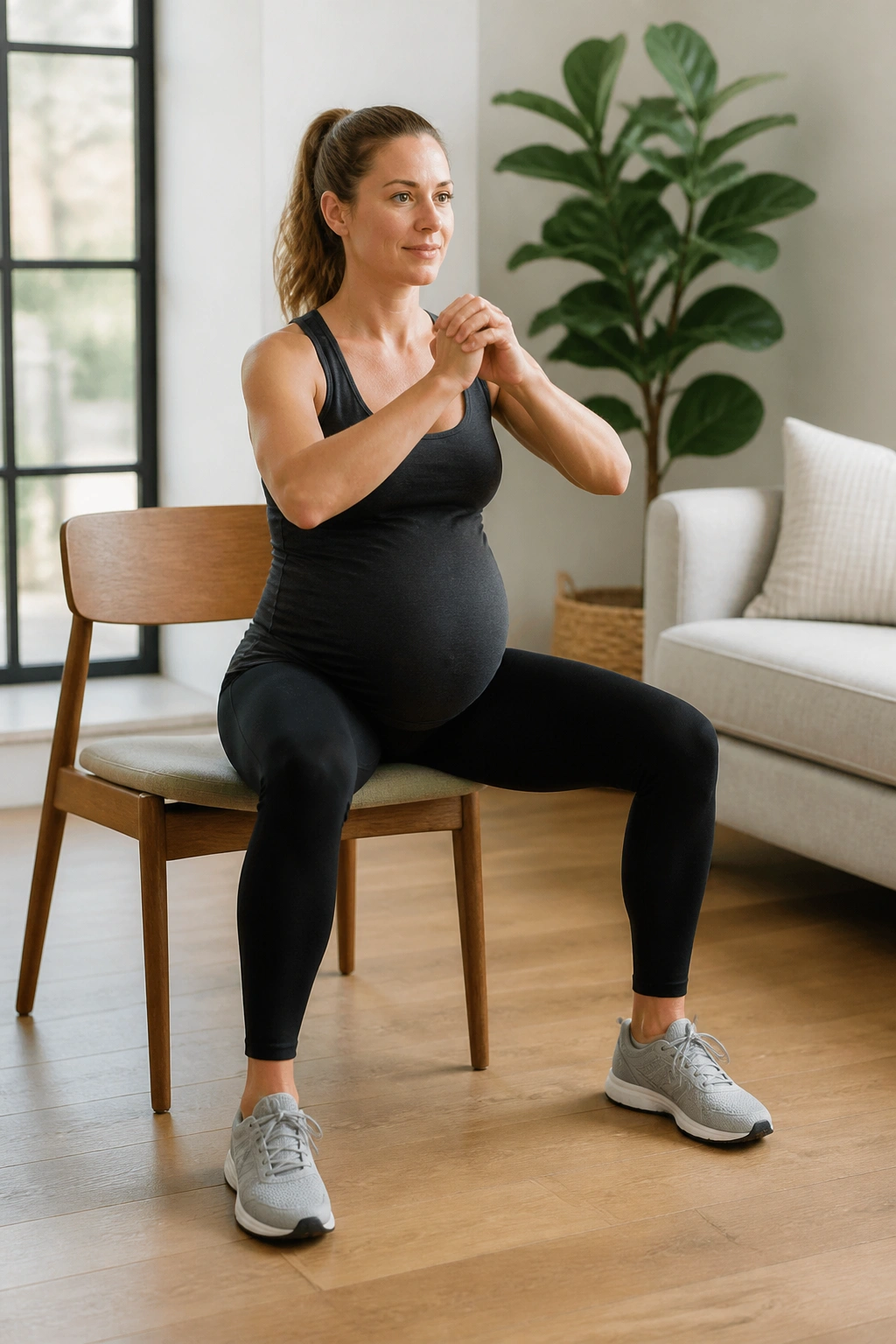
If you have a chair or a low table, you have the perfect tool for a box squat. This takes the guesswork out of how deep you should go and ensures you are sitting back into your heels rather than dumping weight into your knees.
Stand in front of a chair. Perform a squat, but instead of stopping in mid-air, actually sit down on the chair for a split second. Then, stand back up. You are not “resting”—you are using the chair as a tactile cue for your depth.
This is brilliant for late pregnancy. It builds confidence. When you know you have a seat behind you, you are more likely to perform a better-quality squat with proper form. It removes the fear of falling backward.
22. Quadruped Hip Extensions
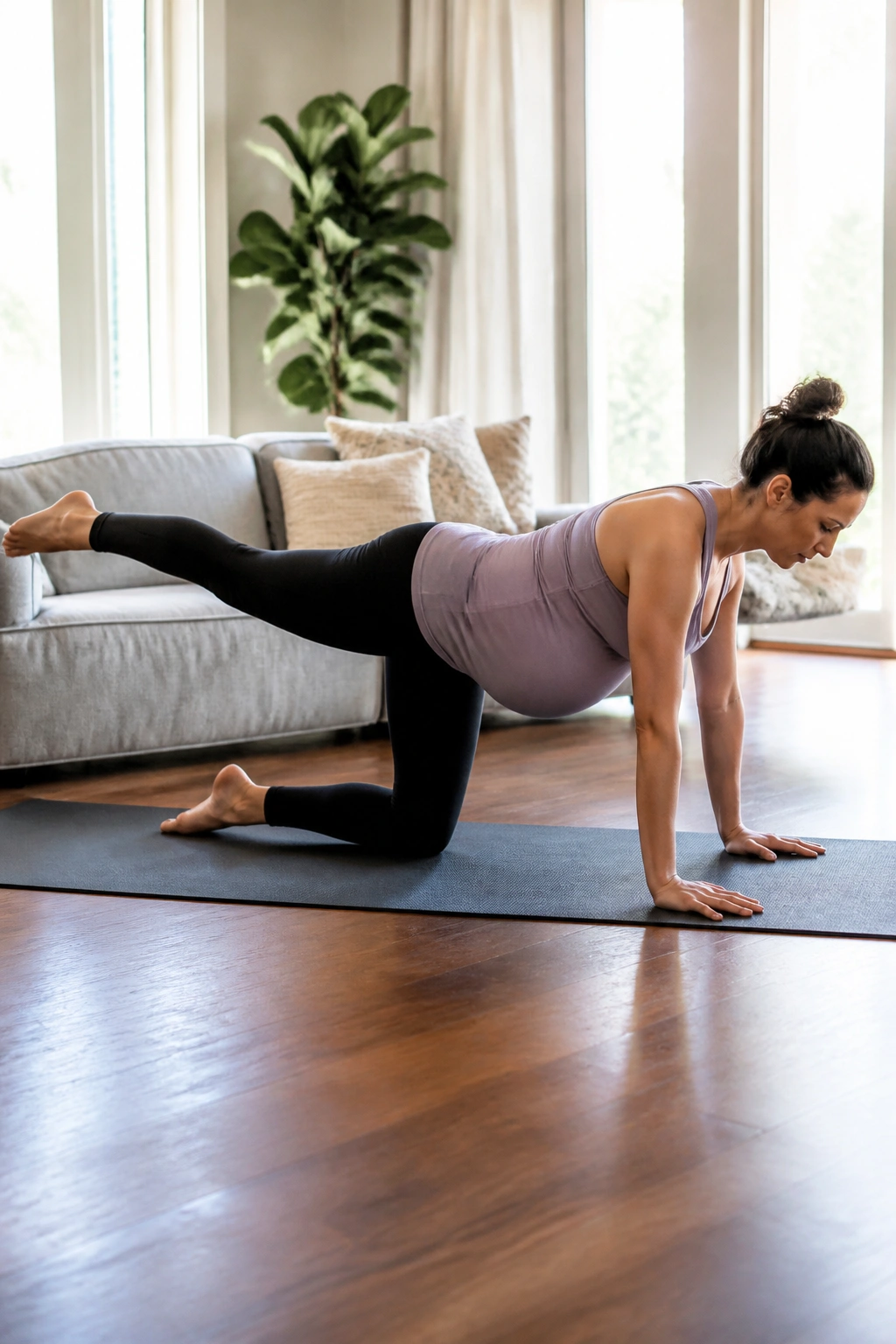
This is a subtle, high-reward movement. It is almost identical to a donkey kick but with a straight leg. This focuses more on the hamstring-glute tie-in, which is essential for stabilizing the pelvis.
From your hands and knees, extend one leg straight back, toe on the floor. Lift that straight leg until it is level with your hips. Pause, then lower. The key is to keep the leg perfectly straight, like a lever.
Do not worry about lifting higher than your hip. If you lift higher, your lower back will arch, and you will lose the effectiveness of the exercise. Visualize pushing your heel through a wall behind you.
23. Glute Kickbacks
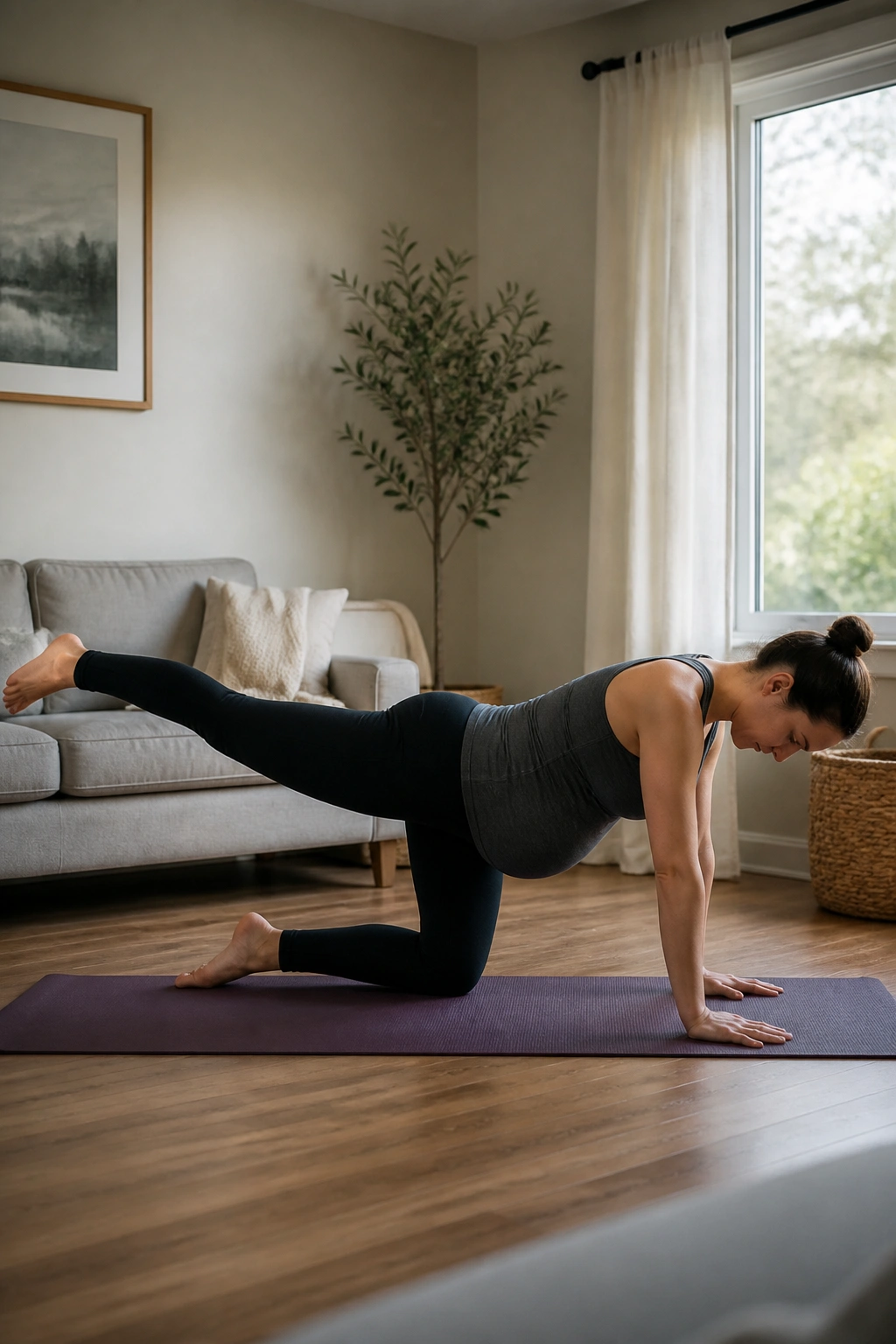
Unlike the donkey kick (bent knee), the glute kickback is about isolating the glute with a straight leg, but the focus is on a small, pumping motion rather than a full extension.
Start on your hands and knees. Extend one leg straight back. Now, pulse that leg up and down about three to four inches. You are not trying to touch the ceiling; you are trying to fatigue the glute muscle in its shortened position.
This is a great burnout exercise to do at the end of a session. It is safe, requires zero equipment, and you can do it anywhere. Just remember to breathe; it is easy to hold your breath when you are focusing on a small, repetitive movement.
24. Wide-Stance Squats
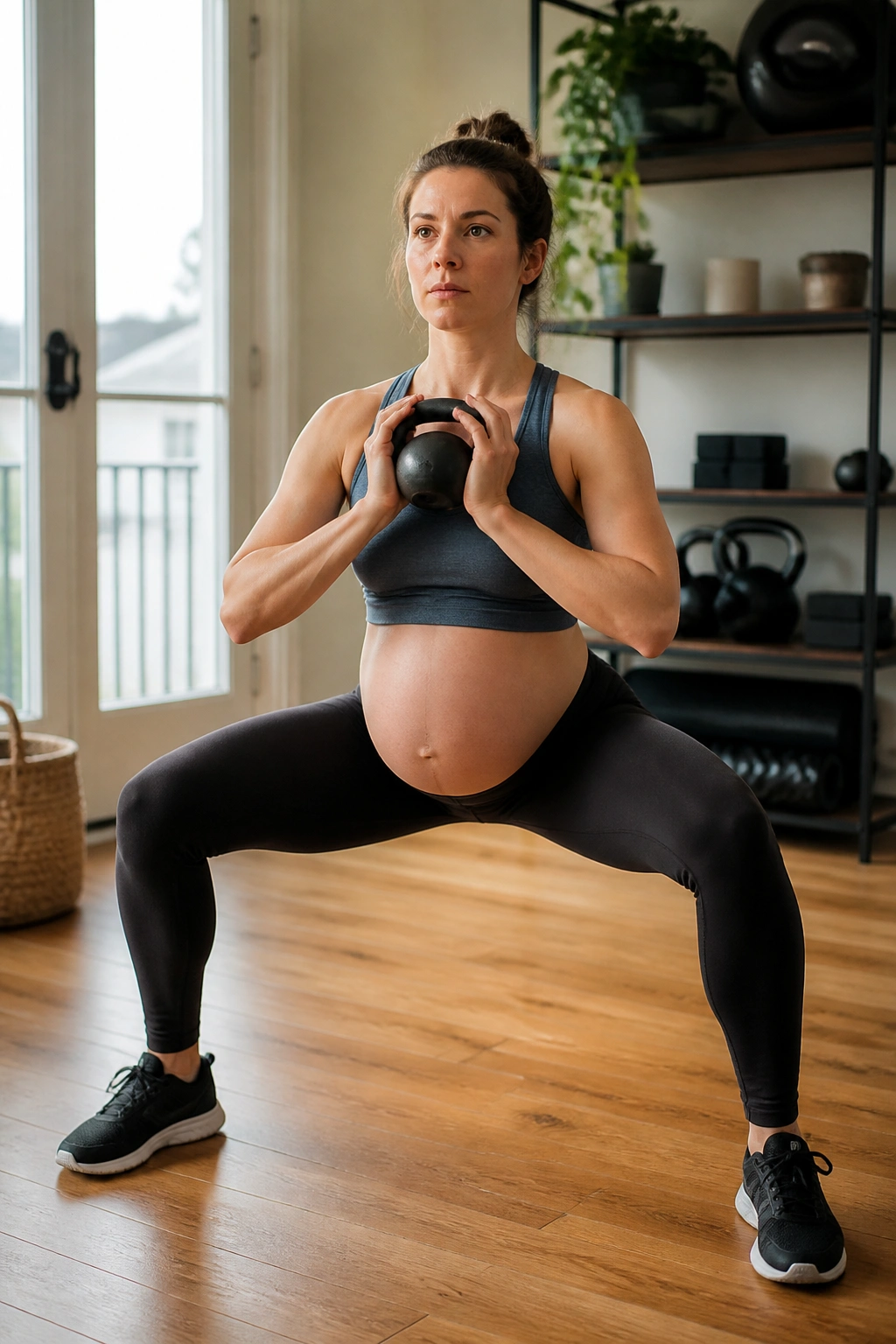
Sometimes simplicity is best. A wide-stance squat is just a slightly wider-than-shoulder-width squat. It is the Goldilocks of squats: not as extreme as a sumo squat, but more comfortable than a narrow squat.
Focus on pushing your knees outward as you descend. A common mistake in squats is allowing the knees to cave inward toward each other. This puts undue stress on the ligaments. Use your glutes to actively push your knees out, tracking over your second or third toe.
You can hold a water bottle or a small weight at your chest to add a counterbalance. This helps you sit back more easily. Since your belly is pulling you forward, having a weight in your hands can actually help you maintain a more upright, safer posture.
25. Modified Goblet Squats
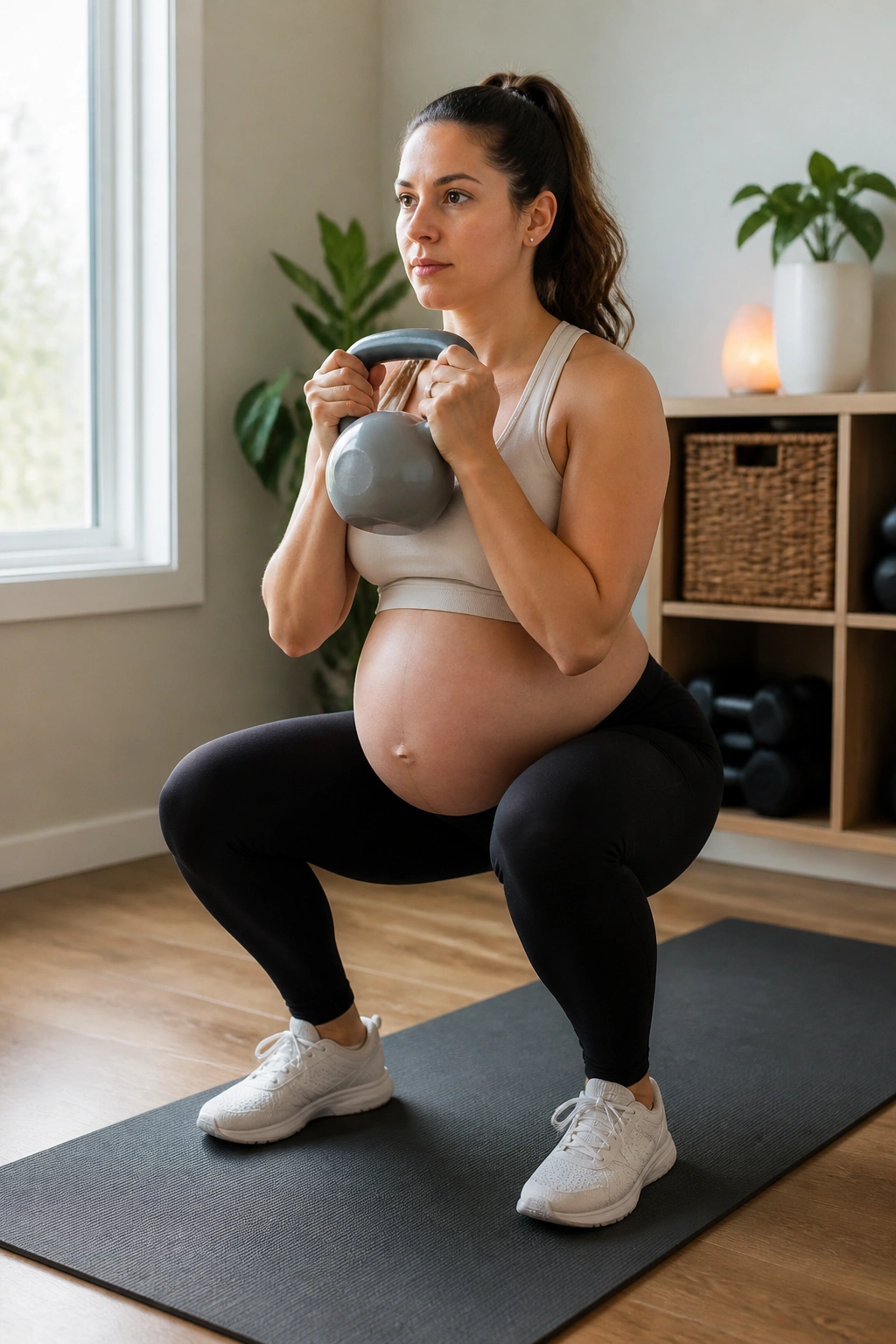
The goblet squat is named for holding a weight at your chest like a goblet. During pregnancy, this is perhaps the most effective way to learn how to squat properly with weight.
Hold a light dumbbell, a kettlebell, or even a heavy water bottle against your chest. Keep your elbows in. Perform your squat. The weight acts as a counterbalance to your growing belly, helping you sit back further and deeper with better form than you could manage without it.
Start with something light. You are not trying to build max strength here; you are trying to maintain movement patterns. If you feel any strain in your core or back, drop the weight immediately. Your body weight is often resistance enough as your pregnancy progresses.
Wrapping Up
Consistency is your superpower during pregnancy. You do not need to turn into an athlete overnight or push yourself to exhaustion. The goal of these leg workouts is to keep you mobile, strong, and prepared for the physical demands of birth and recovery. Listen to your body every single day—some days you will feel strong and capable, and other days you might just need a light walk. Both are perfectly fine.
Focus on your form before you focus on how many repetitions you can do. A perfect squat with zero weight is infinitely more beneficial than a sloppy squat with a heavy dumbbell. If you ever feel dizzy, short of breath, or experience any discomfort in your pelvic floor, take a break. You are doing the hard work of growing a human, and that alone is worthy of respect. Take it slow, stay hydrated, and enjoy the feeling of moving your body for both you and your baby.
