



If your neck takes over every arm class, your arms are not the problem. Your setup is.
That is why Pilates arm workouts feel so different from the usual high-rep flailing with light weights. Done well, they do not just hit the biceps and triceps. They train your shoulder blades to glide, your ribs to stay stacked over your hips, and your upper back to stop acting like a sleepy bystander. When those pieces start working together, your arms look firmer, your posture changes, and shirts fit a little better across the shoulders.
One quick reality check matters here: “toned arms” usually means more visible muscle shape, better posture, and enough resistance work done often enough to build endurance and strength. You cannot pick one patch of body fat and order it to leave. What you can do is train the muscles that give the arm its shape — triceps, deltoids, biceps, chest, and the upper-back muscles that hold the whole frame together — and Pilates is excellent at that.
And Pilates has one sneaky advantage people underestimate: light resistance gets hard fast when the lever is long and the form is honest. Hold your arms straight out to the side for 45 seconds with your ribs down and your collarbones wide, and suddenly that 2-pound dumbbell feels like a brick. Start there.
How Pilates Arm Workouts Build Shoulder and Triceps Endurance
Before you jump into the 25 moves, get one thing straight: heavier is not always better here. In Pilates, 1- to 3-pound weights, a resistance band, or a Pilates ring can be more than enough when your arms stay long, your core stays braced, and you move with control instead of momentum.
The American College of Sports Medicine keeps returning to the same big idea in its strength guidance: muscles adapt when you challenge them on a steady basis. Pilates does that through time under tension, clean joint positioning, and repetition without sloppy compensation. Different path, same principle.
A few form rules will save you a lot of neck tension:
- Keep your ribs stacked over your pelvis. If your chest pops up, your low back and neck will do work your arms should be doing.
- Let the shoulder blades move, but do not shrug. Think wide collarbones, heavy shoulders.
- Use your exhale on the hardest part. Press, pull, lift, then breathe out.
- Pick a range you can own. A smaller movement with clean form beats a big one done with swinging elbows every time.
One more thing. If you want to turn these moves into a session, choose 6 to 8 exercises, do 8 to 15 reps or 30 to 45 seconds each, rest for 15 to 25 seconds, then repeat for 2 to 3 rounds. That is enough to leave your triceps trembling in a deeply respectful way.
1. Standing Pilates Arm Circles
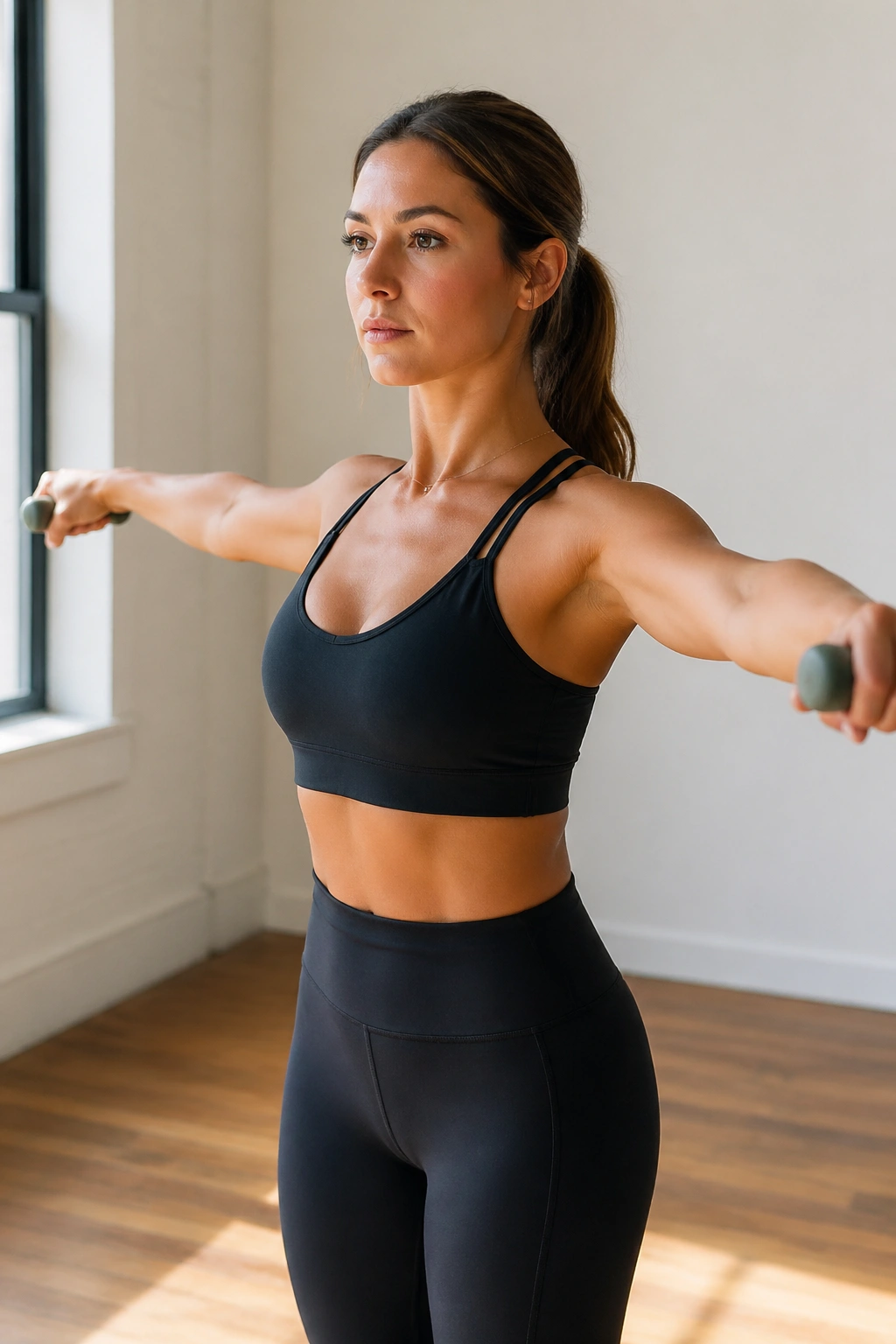
Start with the move that looks easy and has humbled almost everyone at least once.
Stand tall with your heels together or hip-width apart, arms lifted just below shoulder height, palms facing down. Make tiny circles — about the size of a small orange, not a dinner plate — for 20 to 30 seconds forward, then reverse. If you want more challenge, hold 1-pound weights.
What makes it work
The burn comes from the long lever. Your deltoids stay on, your triceps help keep the elbows straight, and your upper back has to organize the shoulder blades so your neck does not jump in.
Quick form cues
- Reach through your fingertips as if someone is gently pulling your hands apart.
- Keep a soft bend in the elbows instead of locking them out.
- Circle from the shoulder joint, not the wrists.
Best use: put this near the start of your session for 2 to 3 rounds of 20 to 30 seconds each direction. If your shoulders creep upward after 10 seconds, drop the weights and keep the posture.
2. Pilates Boxing Punches
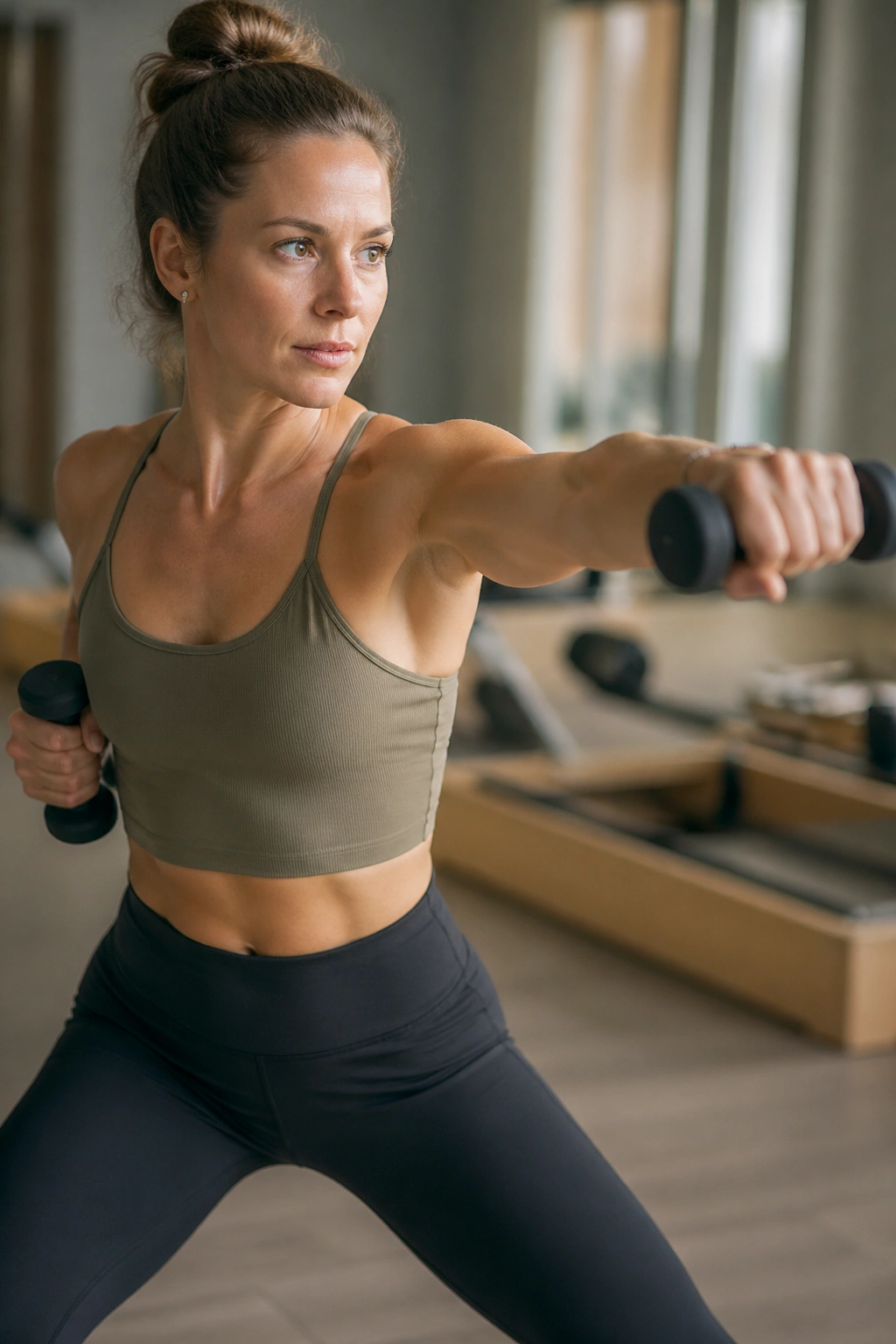
This one adds pace without turning into sloppy cardio.
Stand in a split stance or a narrow Pilates stance, hold light weights near your ribs, and punch one arm forward at shoulder height while the other retracts. Alternate at a smooth, brisk rhythm for 30 to 45 seconds. The trick is not the punch. It is the return. Pulling the arm back with control lights up the back of the shoulder and upper back far more than most people expect.
Your torso should stay quiet. No twisting, no bobbing, no chest jutting forward. Think of the arms moving around a steady trunk, like pistons sliding from a stable frame. When it is done well, you feel the front of the shoulders, triceps, and the muscles between the shoulder blades all at once.
Go lighter than you think. 1- or 2-pound weights are enough for most people here. If your wrists buckle or the elbows snap straight with force, slow it down and shorten the reach by an inch.
3. Hug-a-Tree
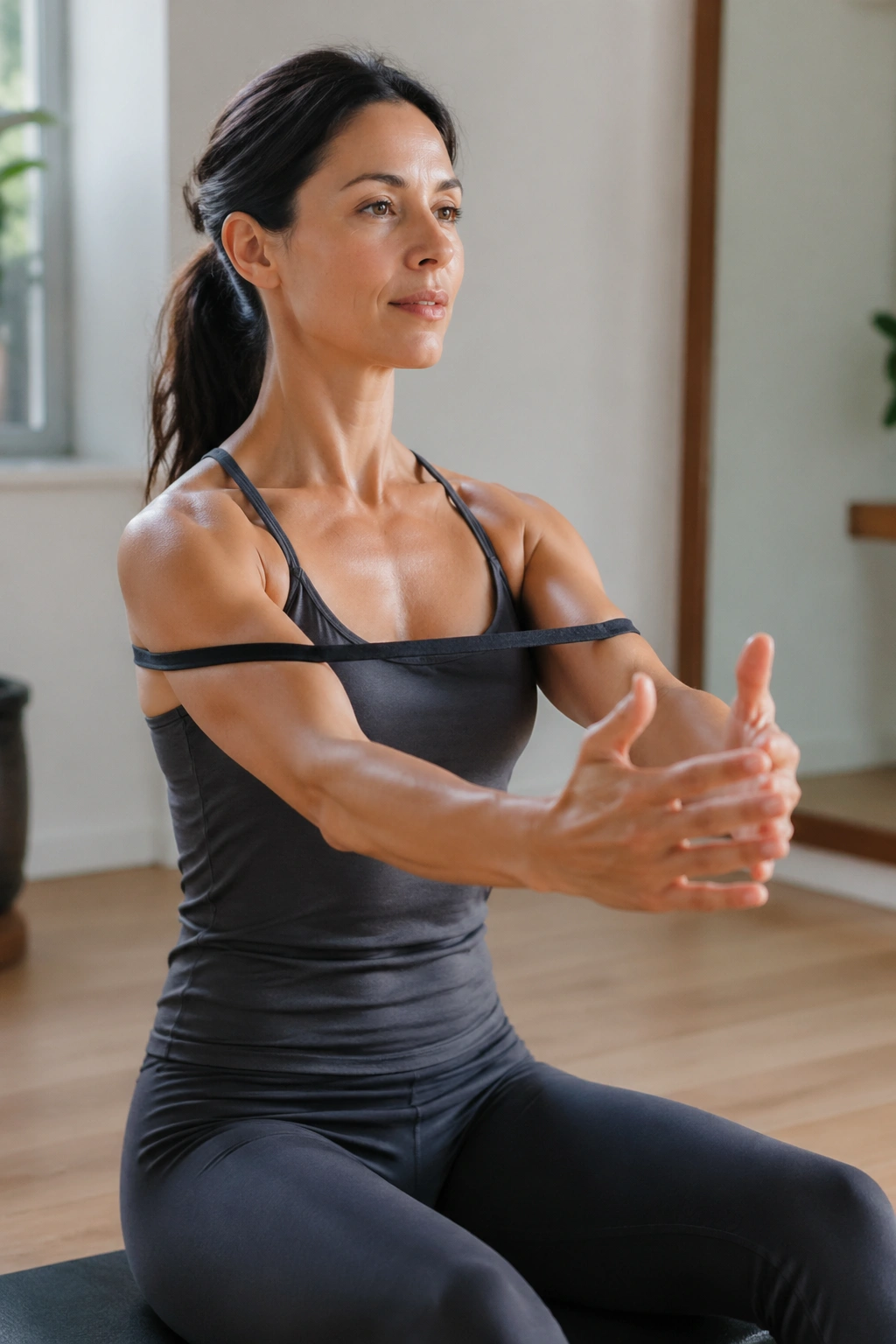
Why does this old-school Pilates studio move still hold up? Because it teaches the chest and front shoulders to work without letting the shoulders roll forward.
Sit tall or stand with a band looped behind your back, or hold light dumbbells with your arms open in a wide arc. Bring your arms forward as though you are wrapping them around a big barrel, then reopen with control. Aim for 10 to 15 reps.
The shape matters. Your elbows stay slightly rounded. Your hands stay in your side vision. If the hands drift too close together or the shoulders tip forward, you lose the clean chest work and start feeding that hunched posture many of us are already fighting.
How to get more from it
Exhale as the arms come forward. Pause for 1 second before reopening. That tiny hold removes the temptation to swing.
If you feel it more in your neck than your chest and shoulders, lower your arms an inch. Small change. Big difference.
4. Serving Tray
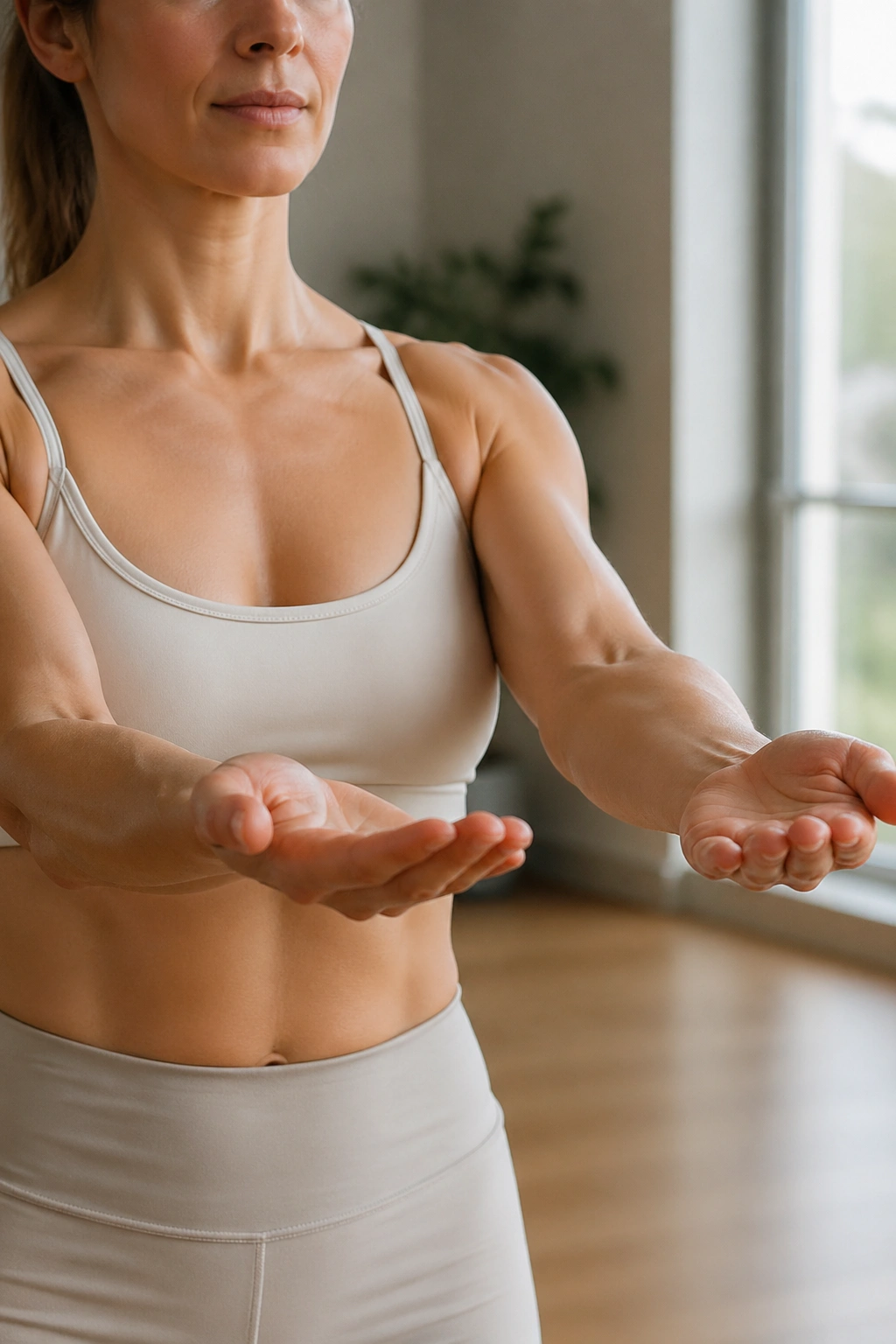
This is one of the best Pilates arm workouts for the front of the shoulders and biceps without a lot of joint stress.
Stand or sit tall with your elbows bent at your sides, palms facing up as if you are carrying a tray. Press the forearms forward, then open the arms wide without dropping the elbows, and return to the start. Do 8 to 12 slow reps.
A few details make or break it:
- Keep the elbows close to rib height instead of letting them sag.
- Move at a count of 2 seconds out, 2 seconds open, 2 seconds in.
- Use 1- to 2-pound weights or no weights at all the first round.
The move looks tidy when it is done right, but it feels demanding fast. You will notice the front delts, biceps, and deep postural muscles working to stop the ribs from flaring. If that rib flare shows up, it is your cue to lighten the load or trim the range.
5. Biceps Curls in Pilates V
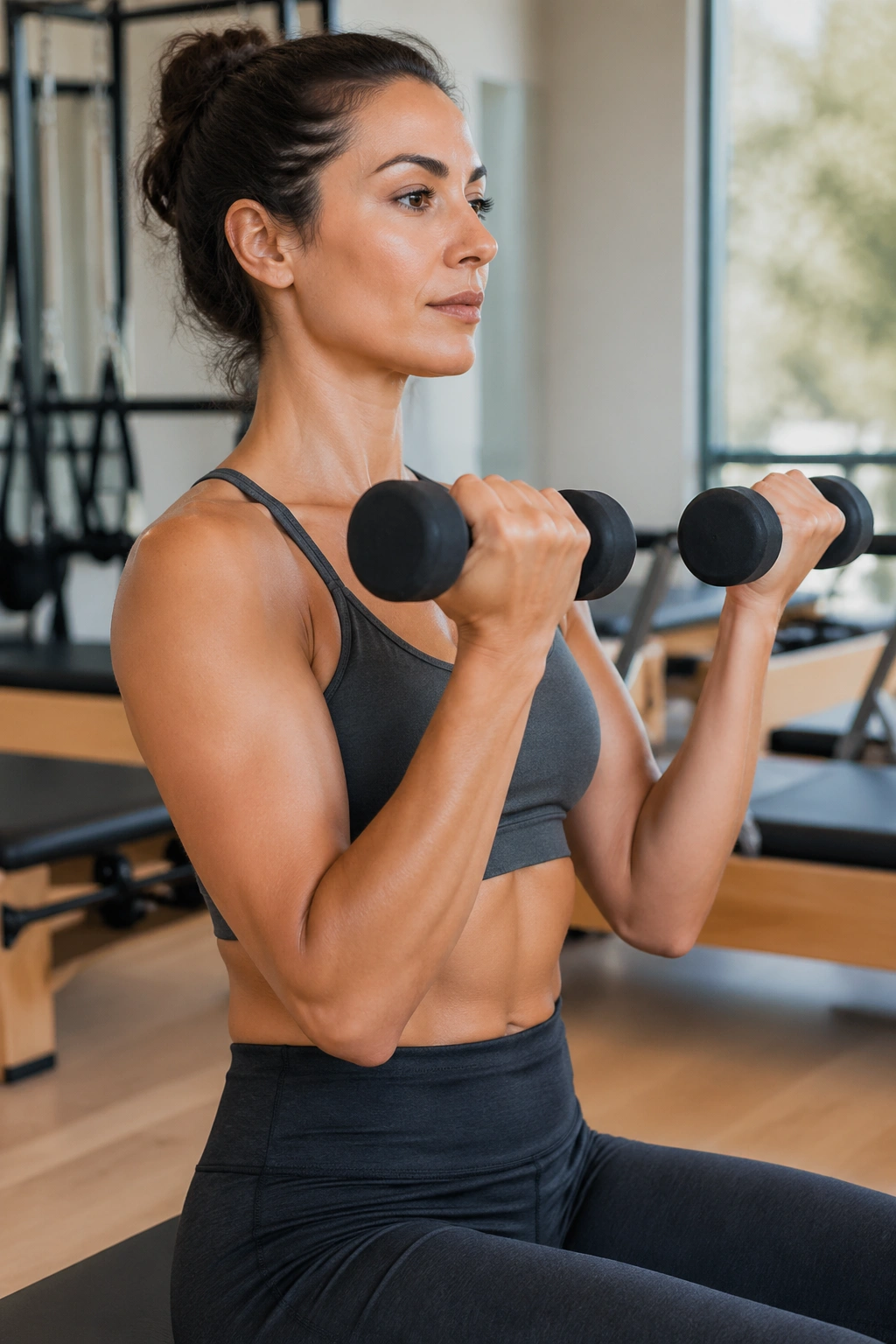
A classic curl becomes more useful when the rest of the body has to behave.
Stand in Pilates V — heels together, toes slightly apart — with light weights by your sides. Zip up through the legs, lift through the crown of the head, and curl the weights toward the shoulders for 10 to 15 reps. Lower for a slow count of 3.
What changes here is the chain above and below the curl. Your inner thighs stay active, your glutes are awake, and your trunk stays tall instead of swaying backward when the weights come up. That makes the biceps do the work instead of stealing help from the low back.
Skip the urge to go heavy. Pilates-style biceps work is often better with 2 to 5 pounds, not 10, because the slower lowering phase matters more than brute load. If your elbows drift forward, pin them lightly toward your ribs and keep going.
6. Triceps Press Back
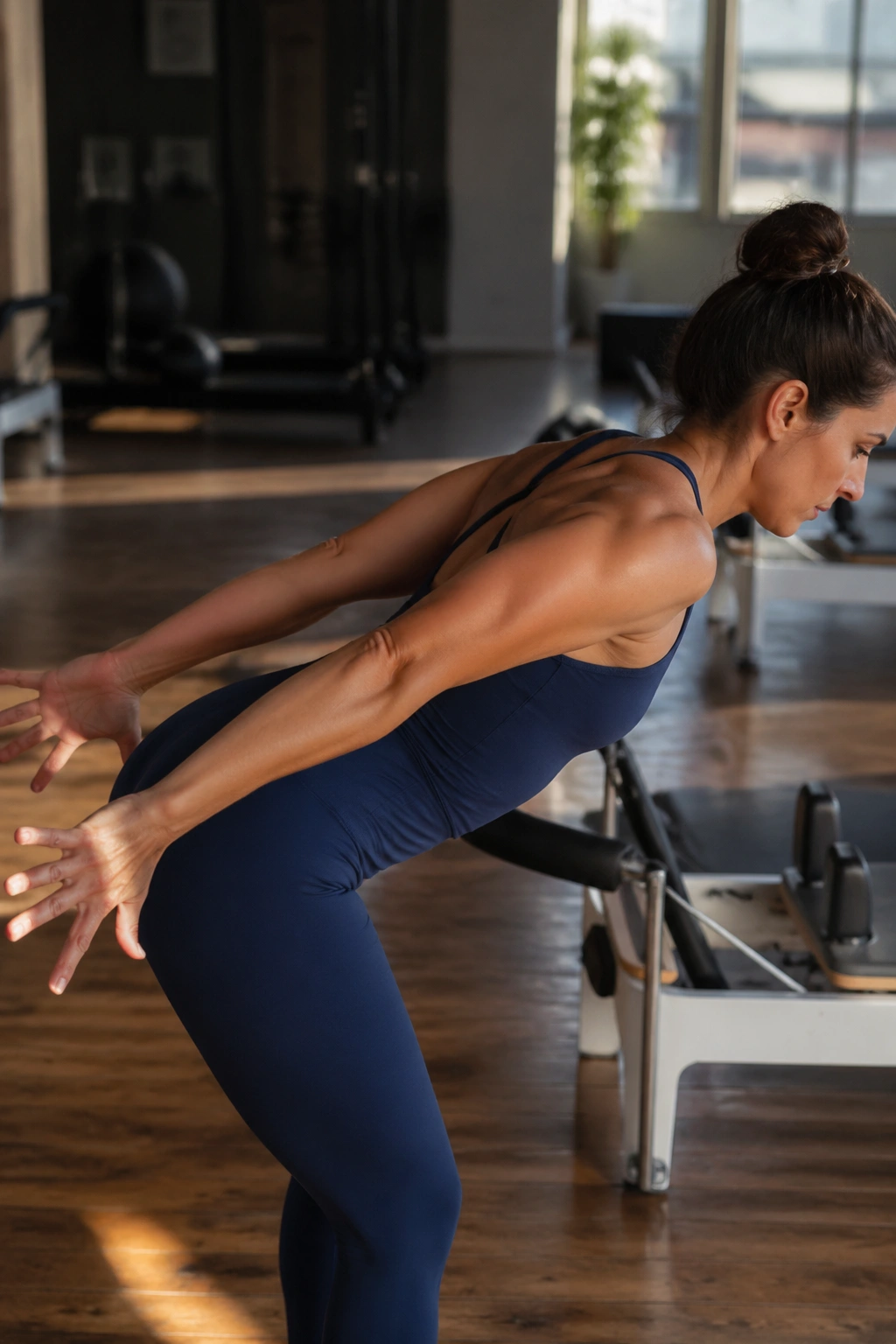
This one has saved many sleeveless tops.
Hinge forward from the hips with a flat back, knees soft, elbows bent tight to your sides, and palms facing in. Press the forearms straight back, pause, then bend the elbows again. Work for 12 to 20 reps with light weights or 30 seconds without them.
What people get wrong is the shoulder. They swing the whole upper arm backward and turn it into a shruggy mess. Keep the upper arm mostly still. The movement comes from the elbow joint, and the squeeze happens across the back of the arm.
Check these three things
- Your neck should feel long, not pinched.
- Your palms should face each other or the floor.
- The pause at full extension should last 1 second.
Do not rush this one. The triceps respond well to that tiny hold at the back, and momentum ruins it fast.
7. Chest Expansion with a Band
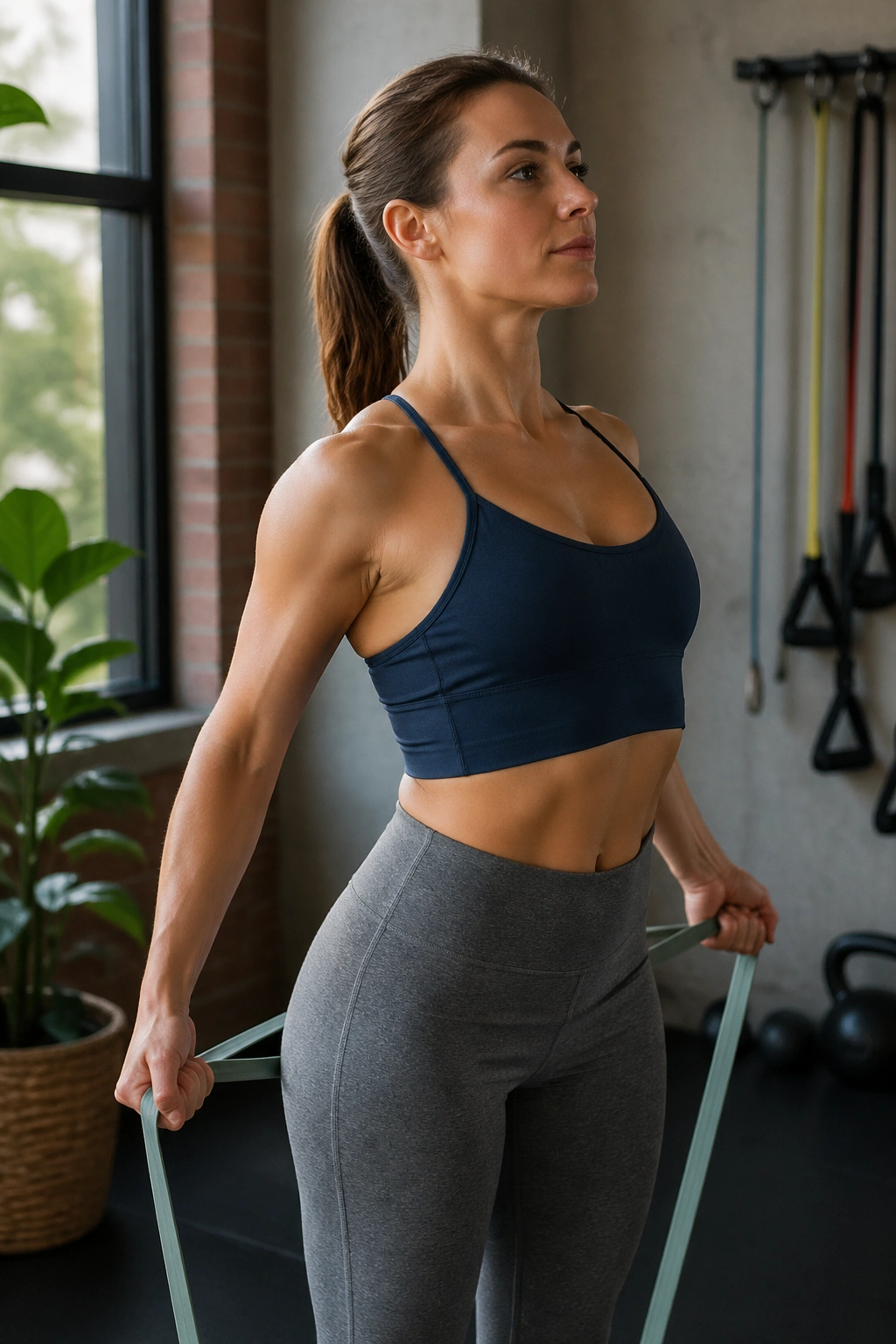
If your posture collapses by lunch, put this move in your rotation.
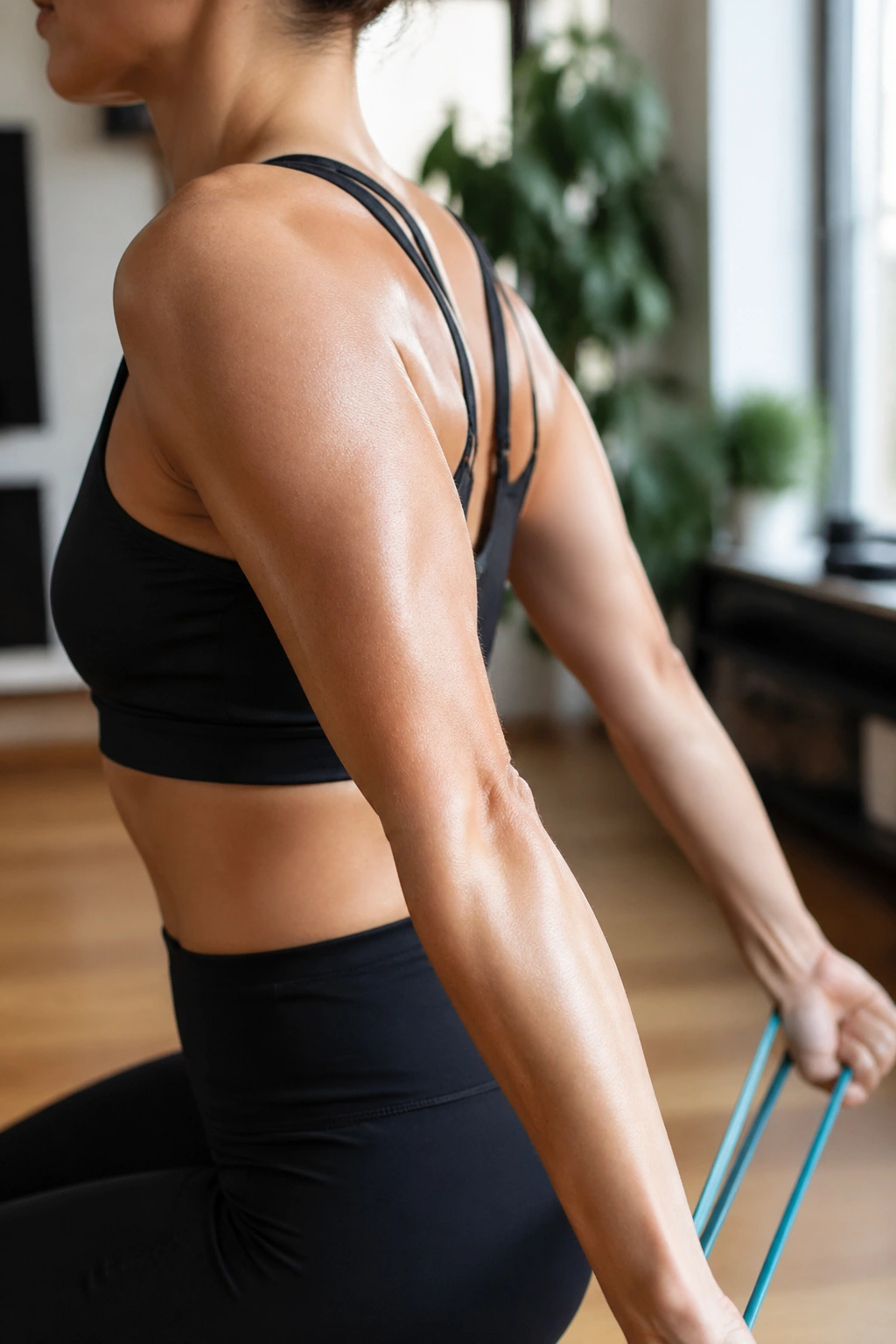
Stand tall with a light resistance band under your feet or held in both hands. Arms are straight by your sides, palms facing back. Pull the arms a few inches behind you without leaning forward, then release with control. Add the traditional Pilates version if you like: hold the pull and turn your head right, center, left, center before releasing. Do 8 to 12 reps.
Why it matters for toned arms
The back of the shoulders and triceps do work here, but the upper back is the hidden star. Better scapular control changes the way the arms hang and move. That alone can make the upper arm look firmer because you are not living in a rounded, shoulder-forward shape.
Band tension should feel clean, not jerky. Use a lighter band than your ego wants. A strong pull with a flared rib cage is not a win.
8. Salute
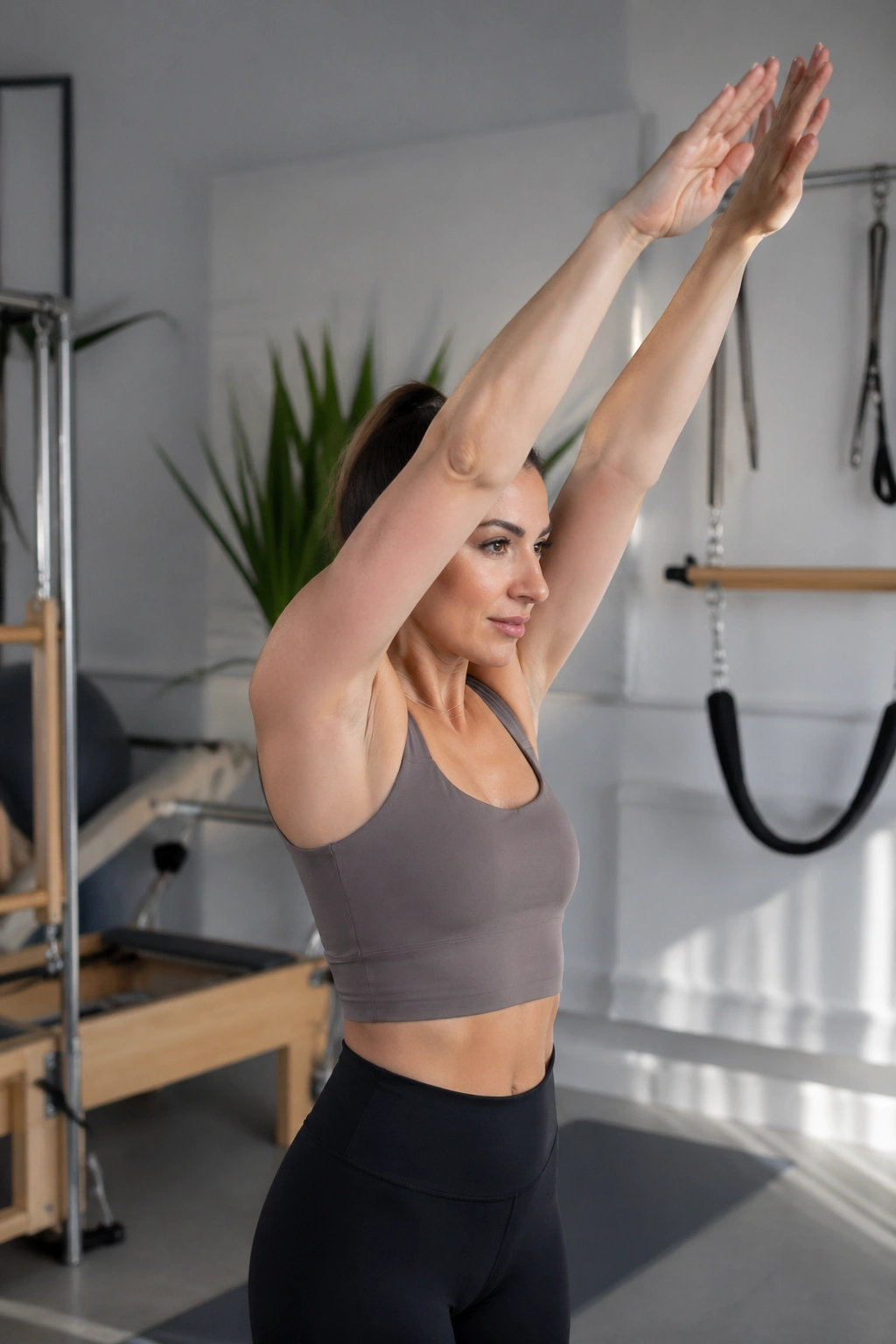
Salute is all triceps, and it does not hide your weak spots.
Bring both hands behind your head with the elbows bent and lifted in front of you, holding one light weight in each hand or no weight at all. From there, press the arms up and forward on a diagonal until they are almost straight, then bend back to the start. Aim for 10 to 15 reps.
The common mistake is letting the elbows fly wide. Keep them in your peripheral vision, more narrow than a standard overhead triceps extension. Your ribs must stay down too. If the front of your rib cage jumps forward, lower the elbows a little and shorten the press.
Expect a deep burn in the triceps after 8 reps. That is normal. Expect sharp pinching in the shoulder joint. That is not. If you get that pinch, try the same action seated against a wall so your trunk stays honest, or switch to lighter weights.
9. Shaving
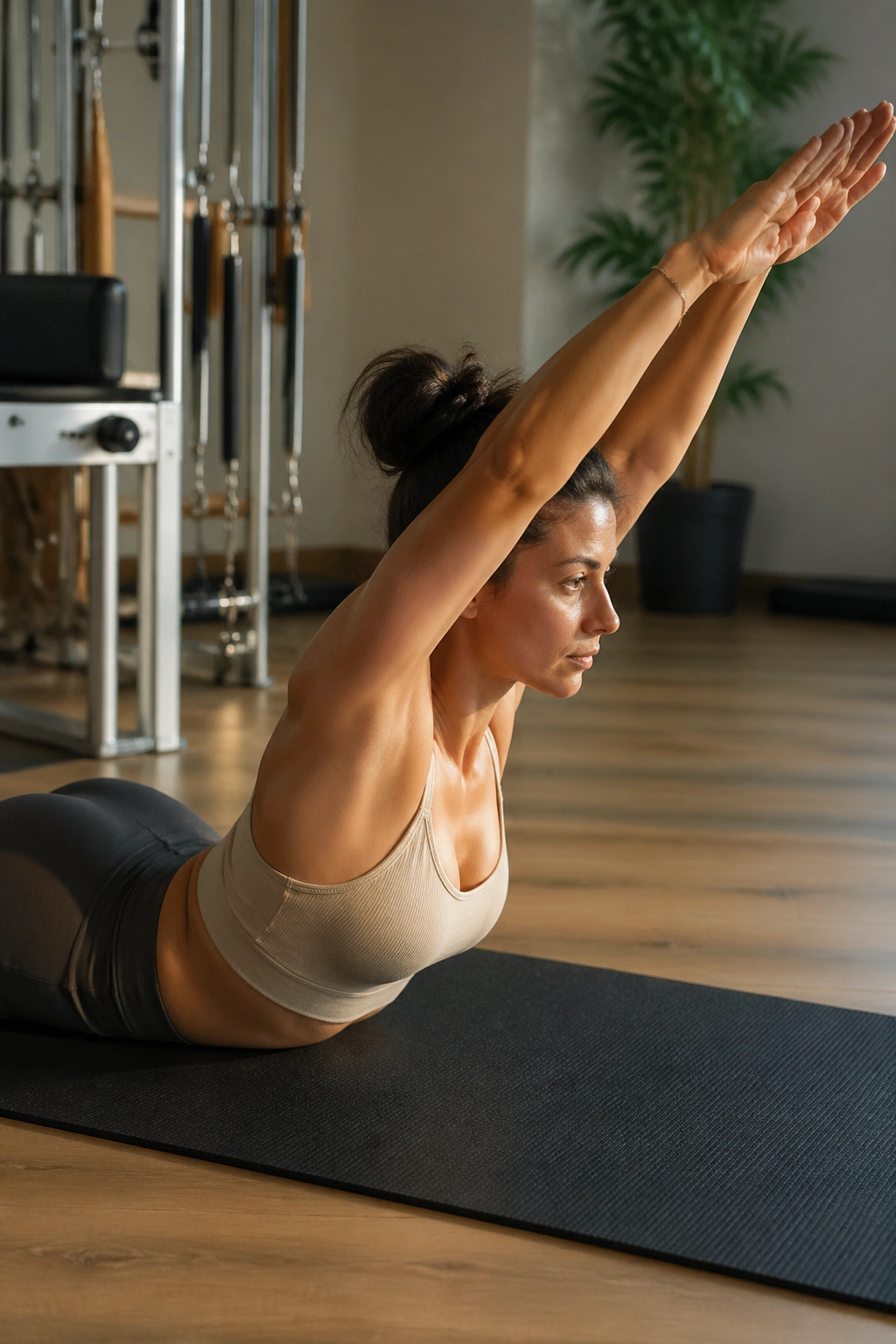
The name sounds odd. The triceps burn does not.
Start with your hands behind your head, elbows bent, then reach the arms up and slightly forward on a diagonal as though you are pushing something away from your forehead. Return with control. Use 1- to 3-pound weights if your shoulders tolerate overhead work well, or go bodyweight only for 12 reps.
Shaving hits the long head of the triceps in a slightly different angle than Salute. That matters, because small changes in shoulder position can expose where you are cheating. Plenty of people can press overhead when the elbows are wide, then discover the narrow diagonal path is far tougher.
Think “lift the back of the arms” rather than “throw the weights up.” If your neck starts to grip, lower the elbows between reps for a breath or two and then continue. No medal for muscling through bad form.
10. Zip-Up
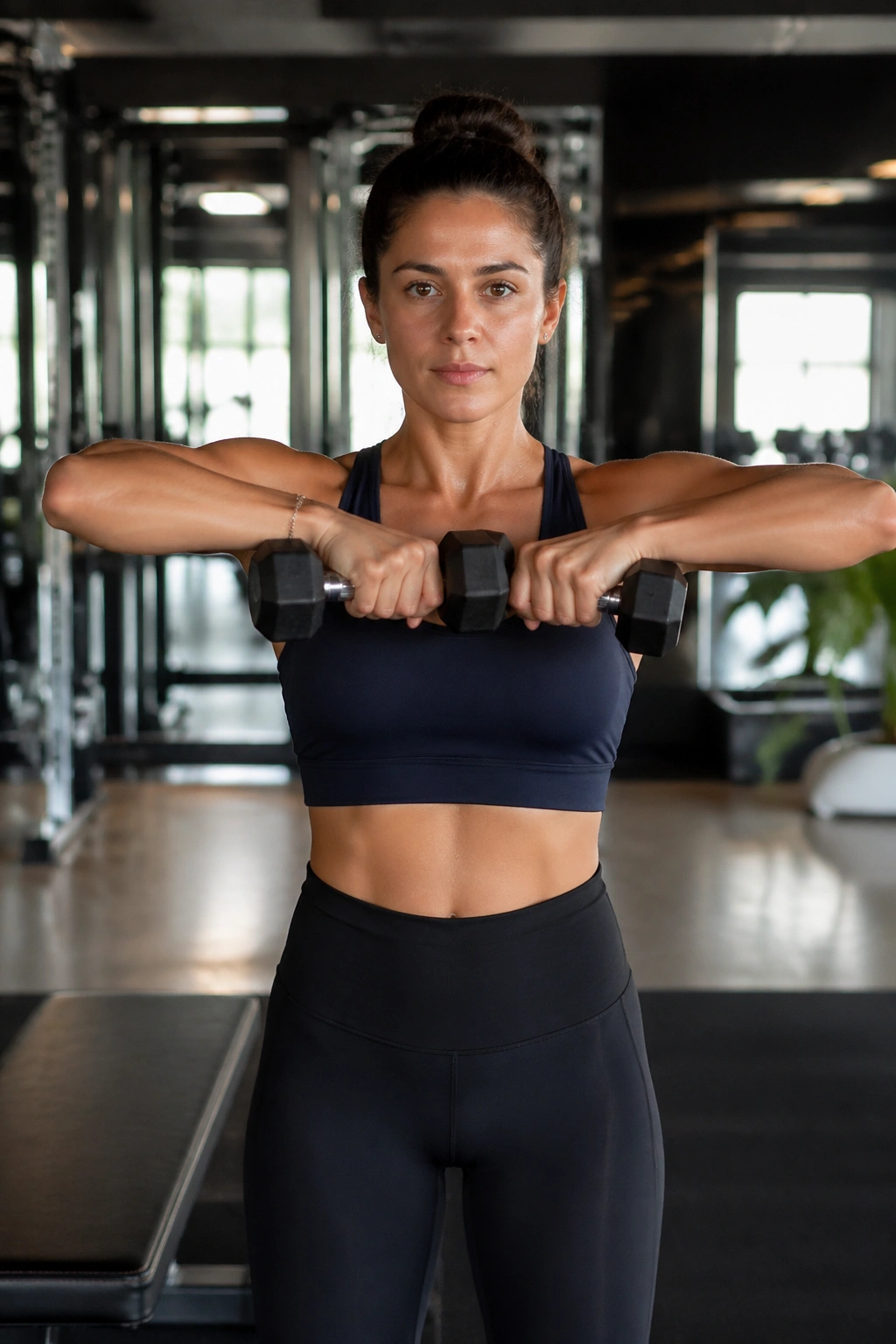
Zip-Up is one of those Pilates arm moves that looks polished and feels far tougher than it appears.
Stand tall with weights in front of your thighs, palms facing your body. Draw the weights up the midline to chest height with elbows leading outward, then lower slowly. Keep it to 8 to 10 reps and use a modest load — 2 pounds is enough for many people.
The lift is short and controlled. The shoulders should not jam toward your ears. Think of the collarbones widening while the elbows float up. That odd combination — upward movement without neck tension — is the whole point.
You will feel the side delts, upper back, and forearms. If your wrists fold or your elbows crank far above shoulder height, cut the range. More height does not buy you more benefit here.
11. Swan Arms Lift
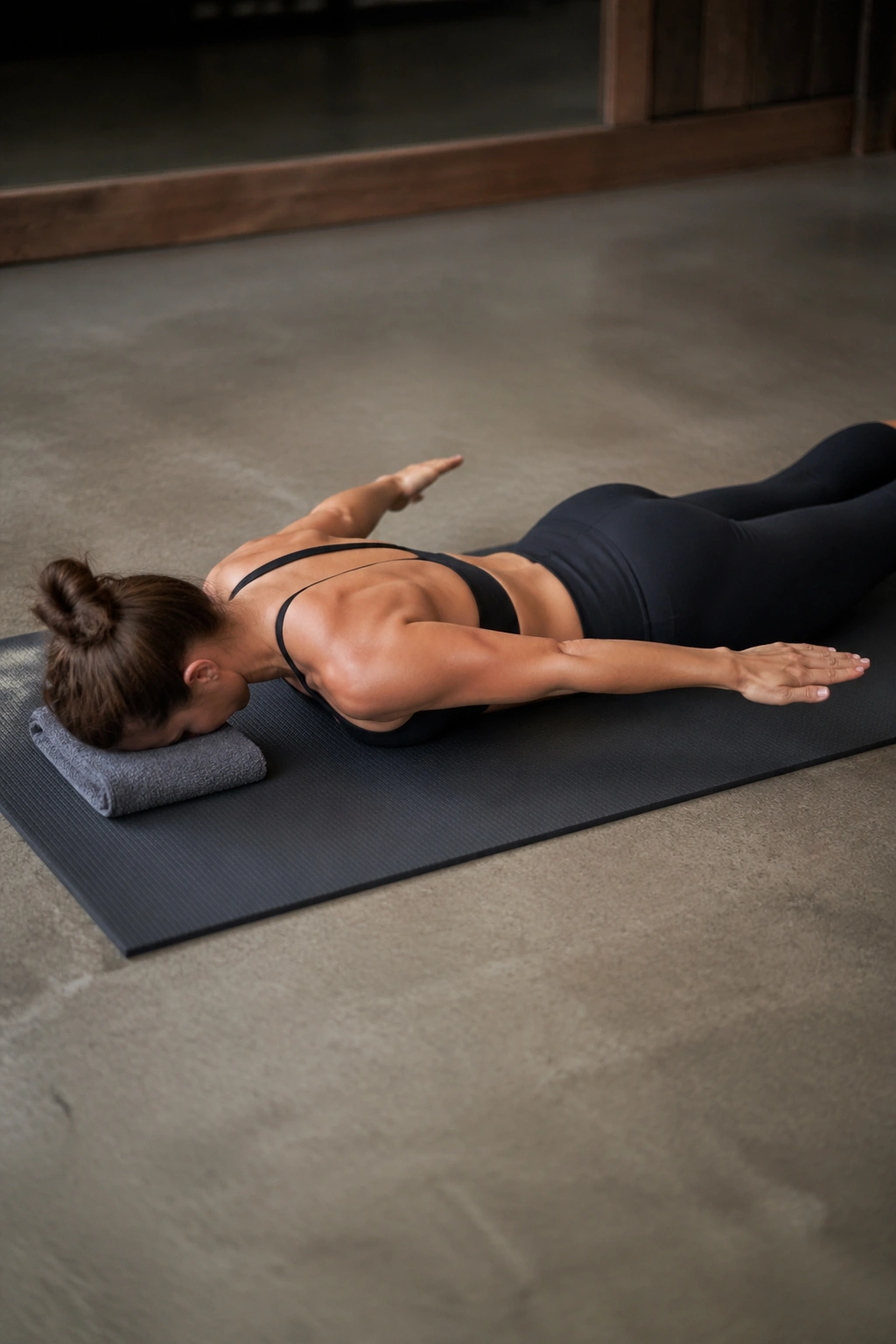
Try this when standing arm work starts feeling stale.
Lie on your stomach with your forehead hovering or resting lightly on a folded towel, arms by your sides, palms facing the floor or your thighs. Lift the chest into a small Swan, then float the straight arms a few inches off the mat and pulse them back for 8 to 12 pulses. Lower and repeat for 2 to 3 rounds.
The back line of the body joins the party here. Triceps work, yes, but so do the rear delts, mid-back, and the muscles along the spine. When people talk about toned arms, they often forget that the back view matters just as much as the side view. Swan Arms Lift helps there.
A few cues help:
- Keep the back of the neck long.
- Lift the sternum a little, not a mile.
- Reach the knuckles toward your heels.
If you feel compression in the low back, lower the chest and keep the arm lift smaller. You should feel effort between the shoulder blades, not a jammed lumbar spine.
12. Side-Lying Triceps Press
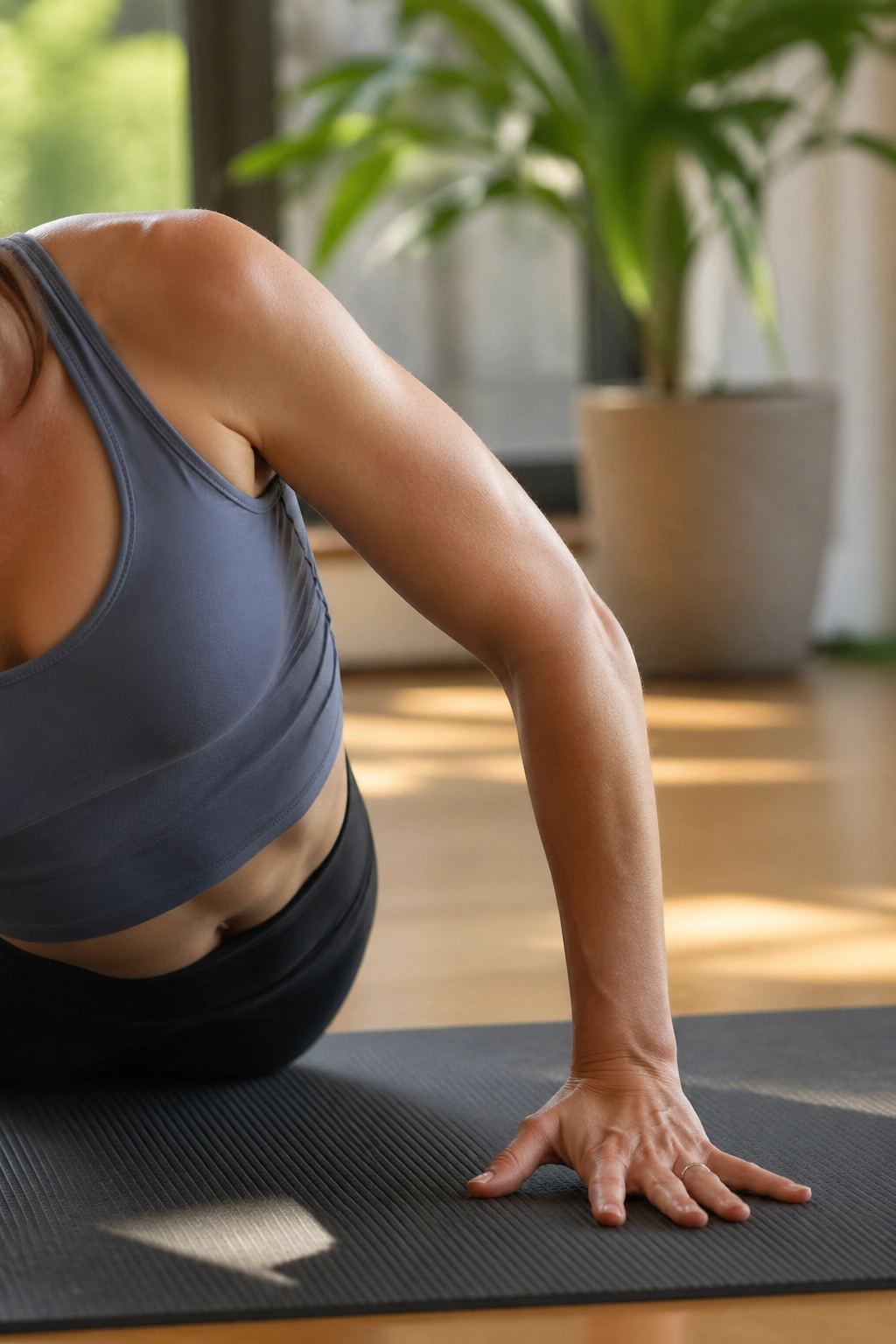
This is a sleeper hit.
Lie on one side with your bottom arm wrapped around your waist. Place the top hand on the mat in front of your chest, fingers facing forward or slightly out. Press the floor away until the elbow straightens, then lower halfway or all the way down for 10 to 15 reps before switching sides.
Because the hand is close to the chest and the body is side-lying, the top triceps does a surprising amount of work without demanding a full push-up. That makes it useful for people building toward stronger floor pressing.
A few things to watch:
- Keep the shoulder away from the ear.
- Do not let the ribs roll backward.
- Press from the palm and fingertips together, not the heel of the hand alone.
If your wrist complains, make a fist or place the hand on a folded towel.
13. Kneeling Push-Up Prep
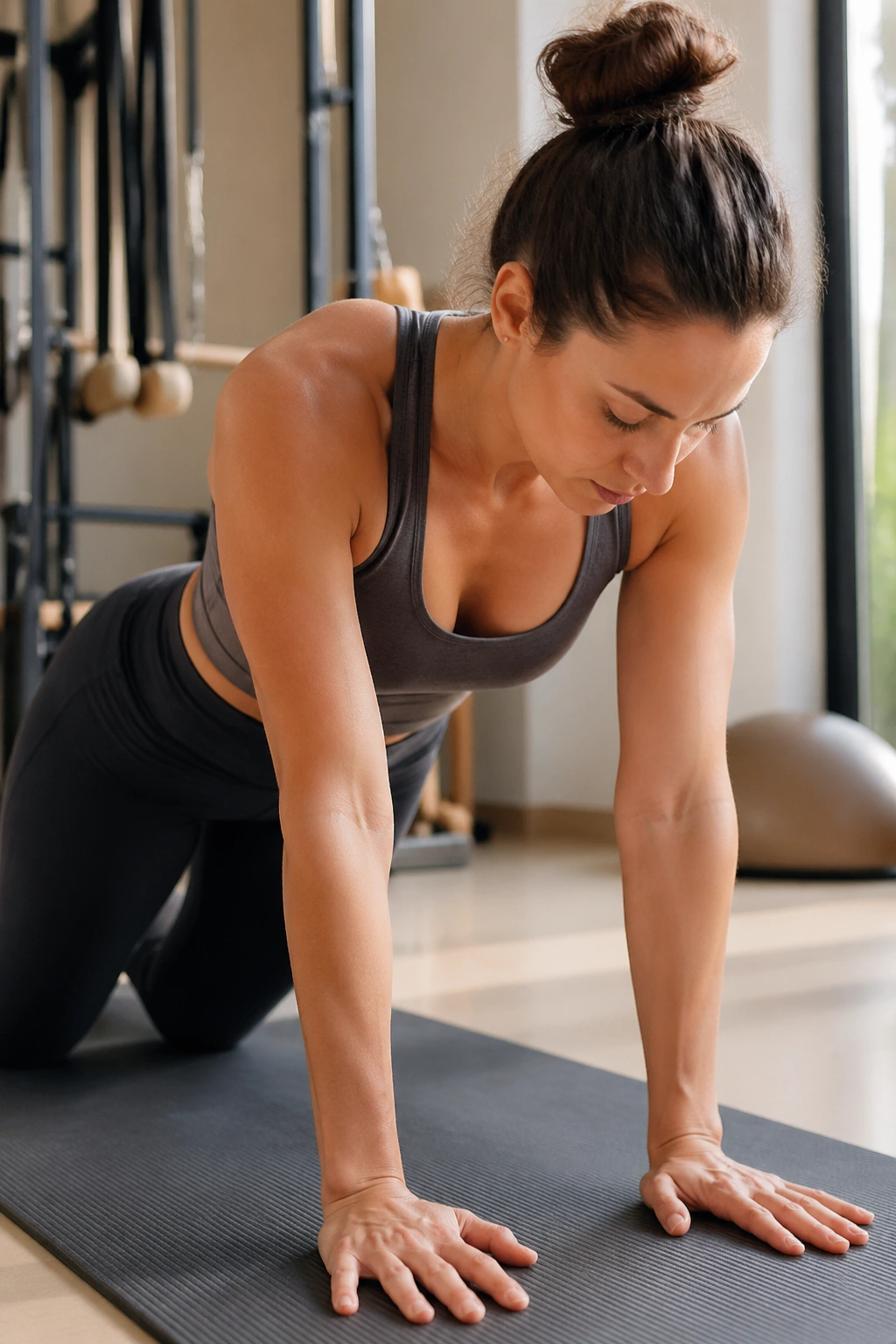
Most people need this more than they need more reps.
Set up on all fours, walk the hands slightly forward, then bring the knees back so your body forms a straight line from knees to head. Bend the elbows close to your sides for a small push-up, then press back up. Work in a range you can own for 6 to 10 reps.
Here is the ugly truth: if the elbows flare wide and the head dives toward the floor, the chest and shoulders take over while the triceps lose their clean line of work. Pilates push-up prep teaches the narrow-arm path that makes the back of the arm light up.
Practice this sequence
- Inhale to bend halfway.
- Exhale to press up.
- Pause in plank-on-knees for 1 second before the next rep.
Small range is fine. Better than fine, actually. Half a rep with a stable trunk beats ten collapsing ones.
14. Pilates Push-Up
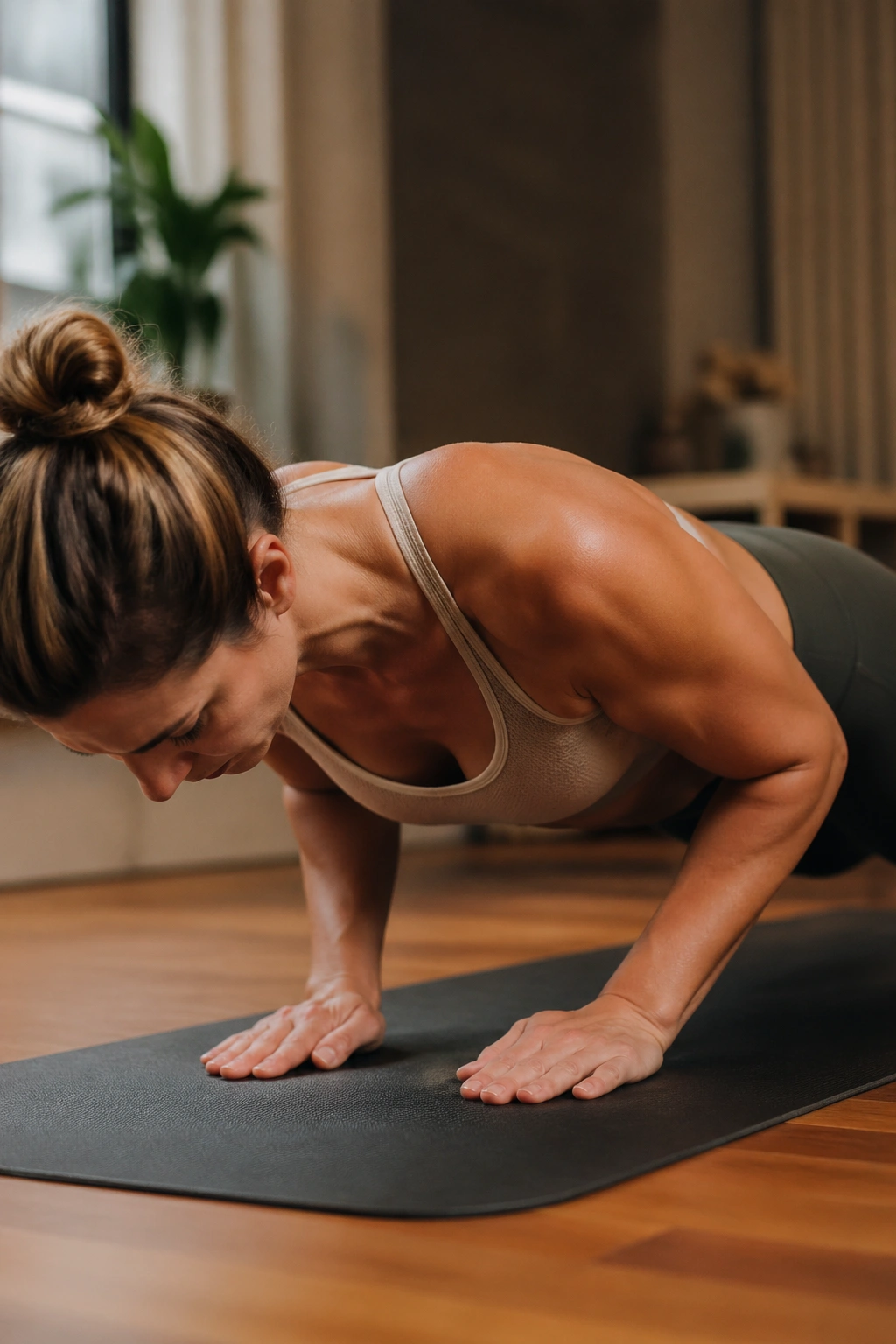
The full Pilates push-up is part arm exercise, part whole-body honesty test.
Stand tall, roll down to the mat, walk out to plank, perform 3 to 5 narrow-arm push-ups, then walk back and roll up. If the full version is too much, drop the knees for the push-up portion and keep the rest of the sequence.
Where the arm work shows up
The triceps work hard during the press, the shoulders stabilize the plank, and the chest helps drive you away from the floor. Yet the move only feels clean if your abdominals and glutes are doing their part. That is what makes it so Pilates.
Keep the elbows brushing back at about a 30- to 45-degree angle from your ribs, not winging straight out. Lower as one piece. If the hips sag or pike, stop the set. Quality drops fast on this move, and once it goes, it goes.
Use 2 to 4 push-ups per round at first. No shame in that.
15. Plank Shoulder Taps
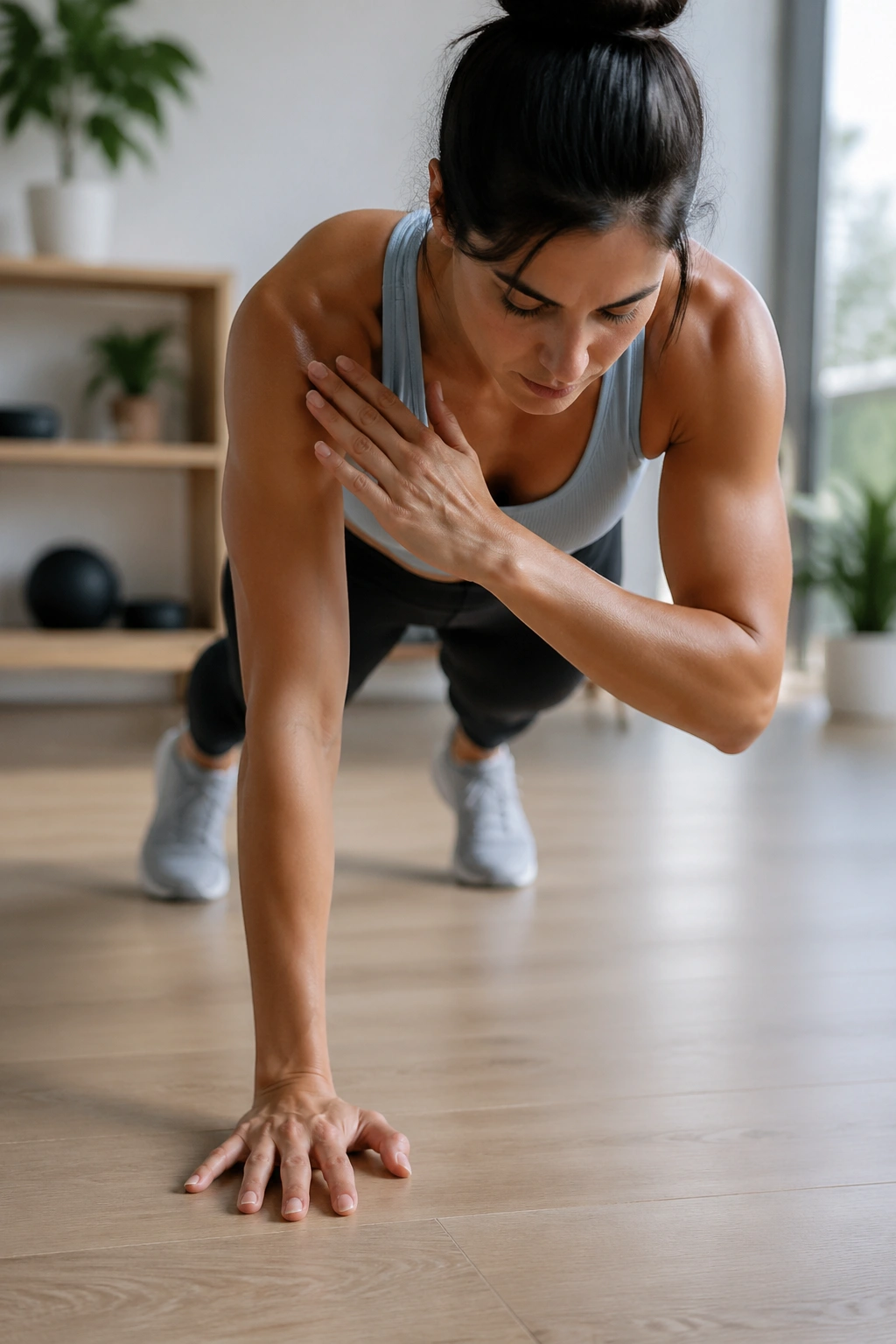
Need anti-rotation work with your arm training? This will do it.
Come into a high plank with your hands under your shoulders and feet set a bit wider than hip-width. Tap one hand to the opposite shoulder, place it down, then alternate. Move for 20 to 40 seconds.
The tapping arm gets attention, but the supporting arm does the harder job. It stabilizes the shoulder, triceps, and wrist while your trunk fights the urge to sway side to side. You also learn fast whether your hands are too far forward. If they are, your shoulders will tell you in about five seconds.
Keep the hips as still as you can, though a small shift is normal. A wider foot stance makes it easier. A narrower stance is tougher. Pick the version that lets you keep the ribs from seesawing.
16. Bear Hover Weight Shifts
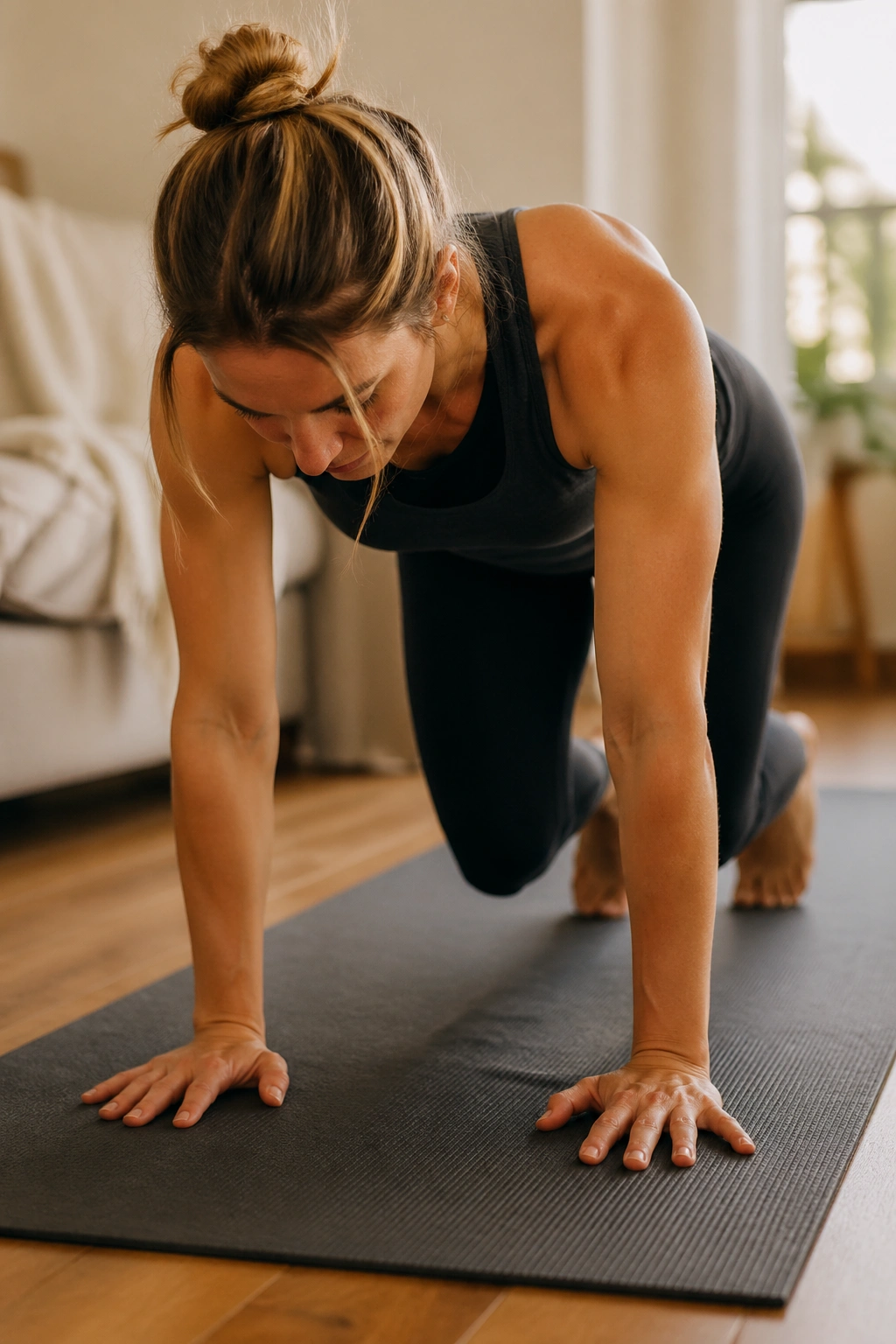
This one is mean in the best way.
Start on all fours, toes tucked, knees hovering 1 to 2 inches above the mat. Without changing the back shape, shift your body slightly forward so the shoulders move ahead of the wrists, then shift back. You can also hold the hover and bend the elbows a tiny amount for added triceps work. Stay there for 15 to 25 seconds.
Bear Hover Weight Shifts train the shoulders and arms under load without a full push-up. The front of the shoulders works, the triceps brace hard, and your core has to lock in so the whole thing does not collapse into the wrists.
Do not make the hover high. Low is the point. If the knees rise too far, the move turns into a crouch and loses the clean demand through the arms. Short hold. Strong payoff.
17. Reverse Table Triceps Bends
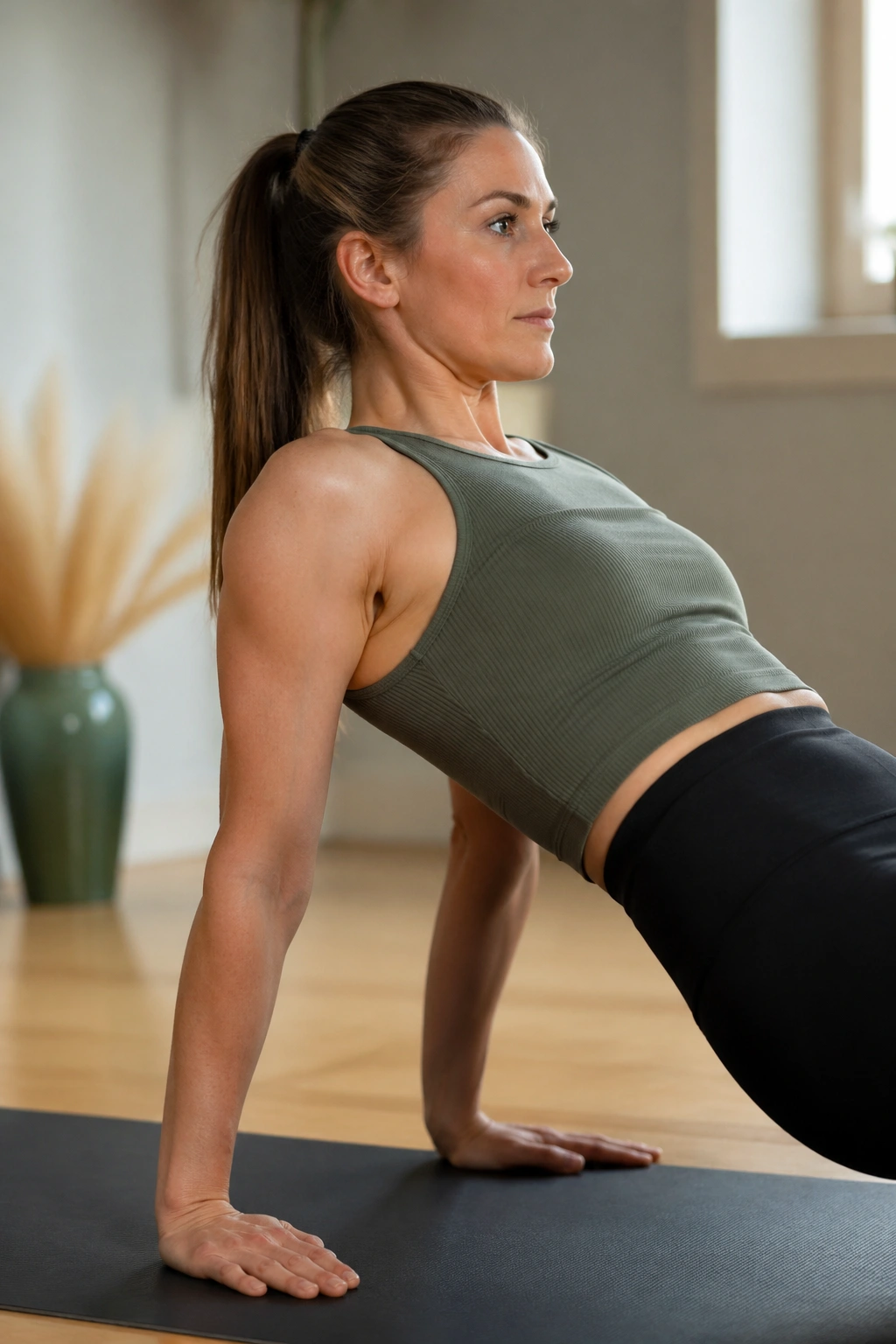
Flip the usual arm work over and you get a different challenge altogether.
Sit with your knees bent, feet flat, hands behind you with fingers pointing toward your heels or slightly out. Lift into a reverse tabletop or a small back support, then bend and straighten the elbows for 8 to 12 reps. If lifting the hips is too much, keep the seat lightly hovering or even down on the mat and work the elbow bend first.
You will feel the triceps right away, but the rear shoulders and chest opening are part of the deal too. That makes this move useful if you spend long stretches leaning over a desk.
Two cautions matter. Wrist angle can feel intense, so rotate the fingers out a little if needed. Also, do not dump the head back. Keep your gaze forward or slightly up and let the sternum lift without crunching the neck.
18. Side Plank Thread-and-Press
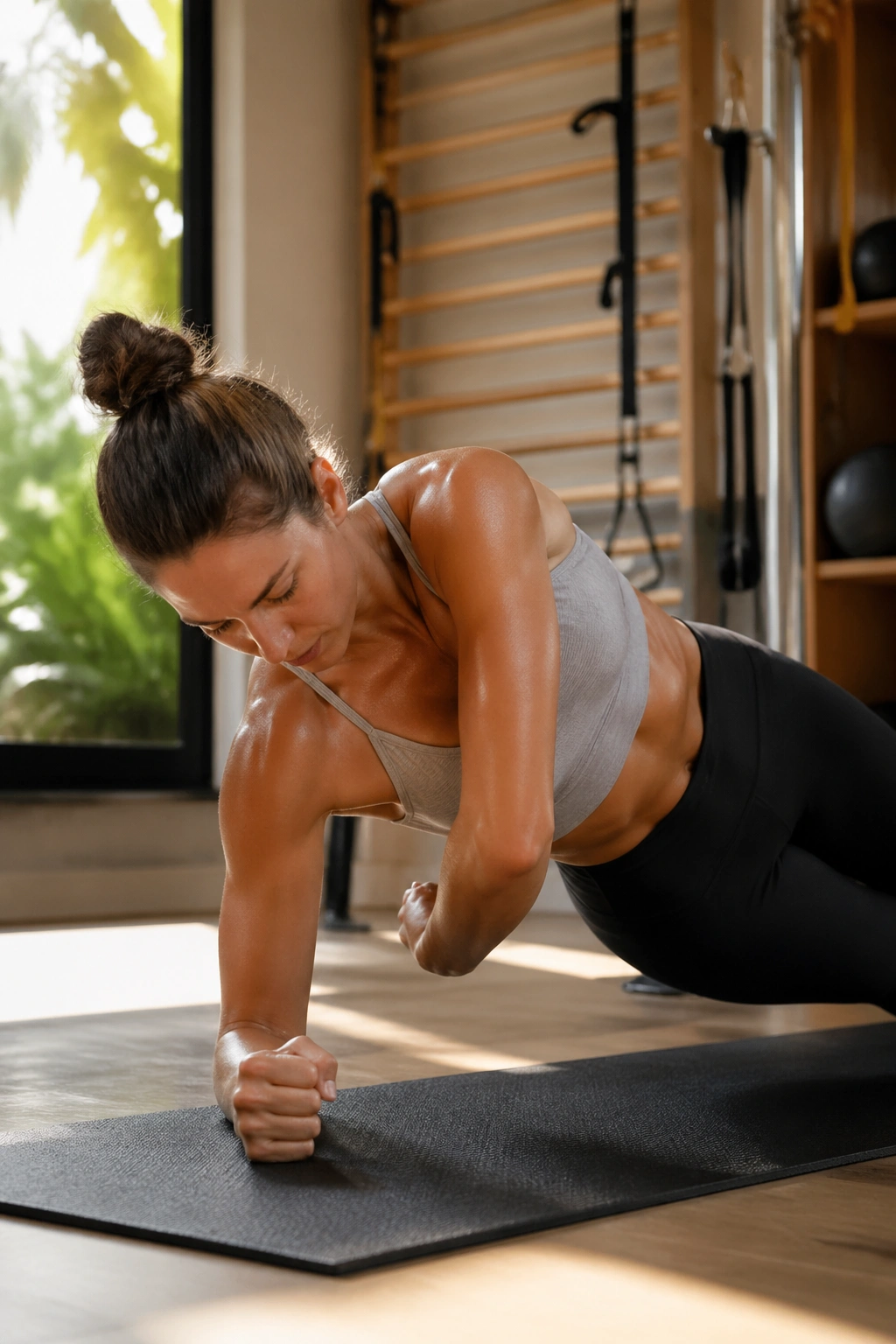
Need one move that trains shoulder stability, triceps, and obliques at the same time? Here it is.
Set up in side plank on your bottom hand or forearm. Reach the top arm to the ceiling, then thread it under your rib cage in a small rotation. Return to the open position, then add a mini press from the bottom arm to lift and lengthen away from the floor. Do 6 to 10 reps per side.
This is not a huge arm-builder in the bodybuilding sense. It is better than that for Pilates purposes. The bottom shoulder has to stabilize cleanly, the supporting triceps works through the press, and the upper back learns how to hold the shoulder blade in place under load.
If the full side plank is too much, lower the bottom knee. The arm work stays useful, and you can focus on alignment instead of survival.
19. Pilates Ring Chest Squeeze
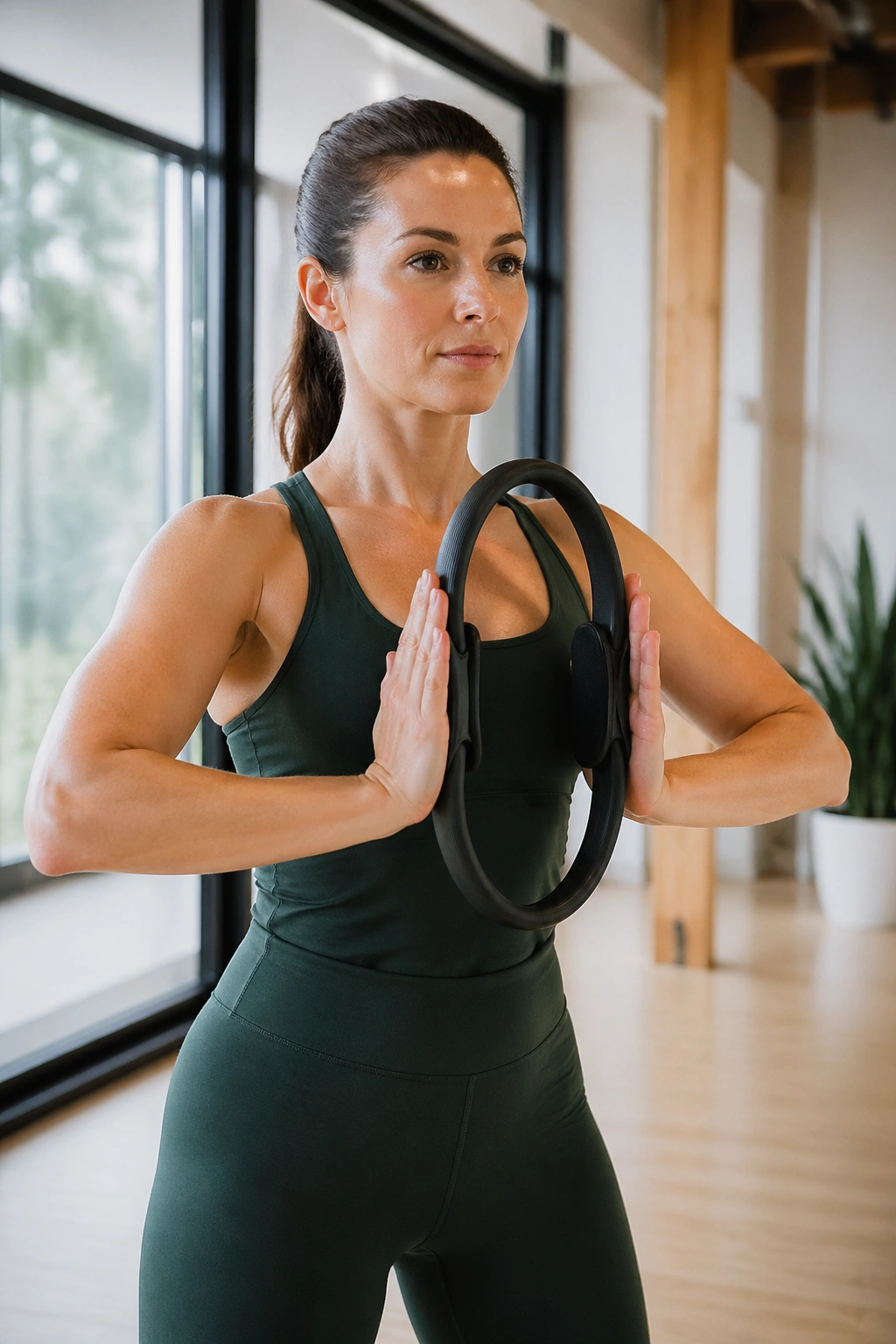
Bring in a ring and the chest-to-arm connection becomes obvious.
Hold the Pilates ring between your palms at chest height with the elbows wide but soft. Squeeze the ring for 2 seconds, release halfway, then repeat for 12 to 15 reps. You can also press it straight forward and keep the squeeze as the arms extend.
The ring gives instant feedback. If one shoulder hikes up or one wrist folds, you feel it right away. That feedback is why small props work so well in Pilates. They make compensation harder to ignore.
Try this progression:
- Round 1: squeeze at chest height.
- Round 2: squeeze with arms extended halfway forward.
- Round 3: squeeze while pulsing the ring up and down 2 inches.
Your chest, front shoulders, and triceps will all clock in.
20. Resistance Band Pull-Aparts
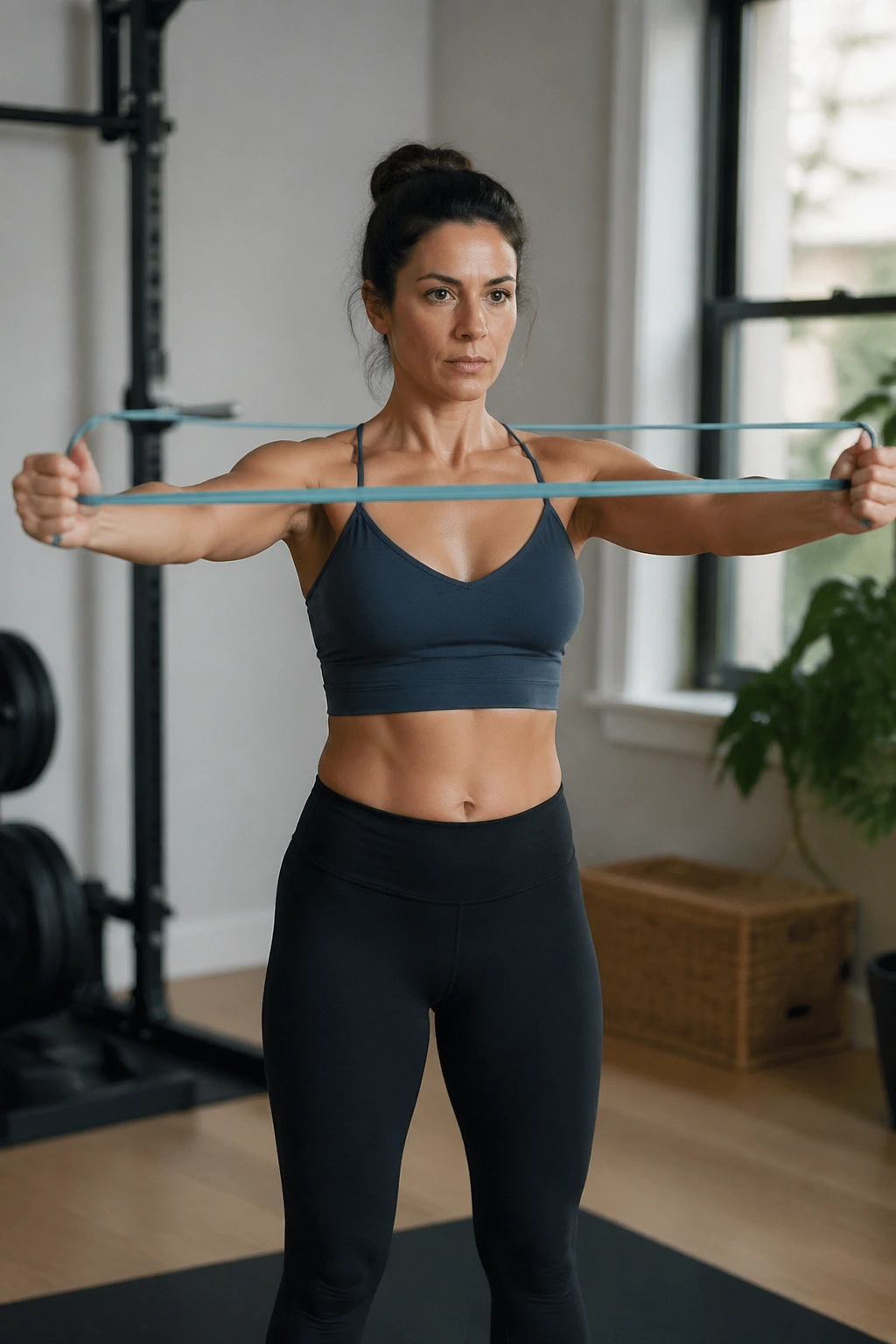
Sometimes the best thing for arm definition is more upper-back work.
Hold a light band at shoulder height with straight or softly bent arms. Pull the band apart until the hands move wide, pause, then return with control. Work for 12 to 20 reps.
This targets the rear delts, rhomboids, and the muscles that help keep the shoulder joint centered. Why does that matter for toned arms? Because the back of the shoulder and the line where the arm meets the upper back shape the whole silhouette of the arm. Rounded shoulders flatten that shape. Better posture sharpens it.
Keep the shoulders down and the ribs quiet. If the band snaps back on the return, it is too heavy or you are moving too fast. Slow return. Always.
21. Resistance Band Overhead Press
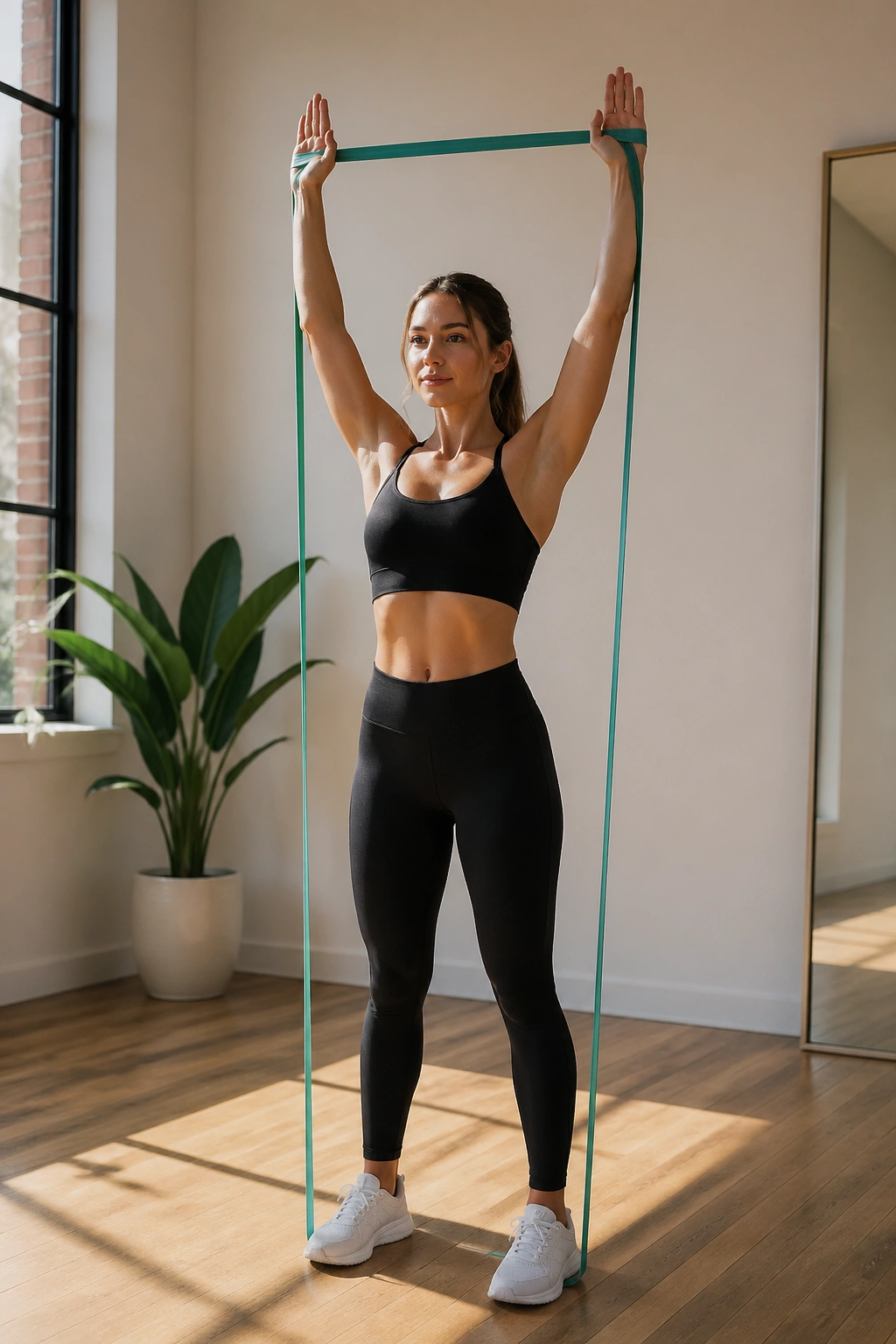
Overhead work in Pilates should feel stacked, not jammed.
Stand on a light band or hold one across the palms at shoulder height. Press the arms overhead while keeping the ribs knitted down, then lower for a count of 3. Perform 8 to 12 reps.
The slow lowering phase is where the shoulders and triceps earn their pay. Plenty of people can shove something overhead. Fewer can bring it back down without arching the low back and pushing the head forward.
Choose a tension that allows your biceps to finish near your ears without pain. If that shoulder range is not there, press on a diagonal instead of straight overhead. Same muscles, friendlier path.
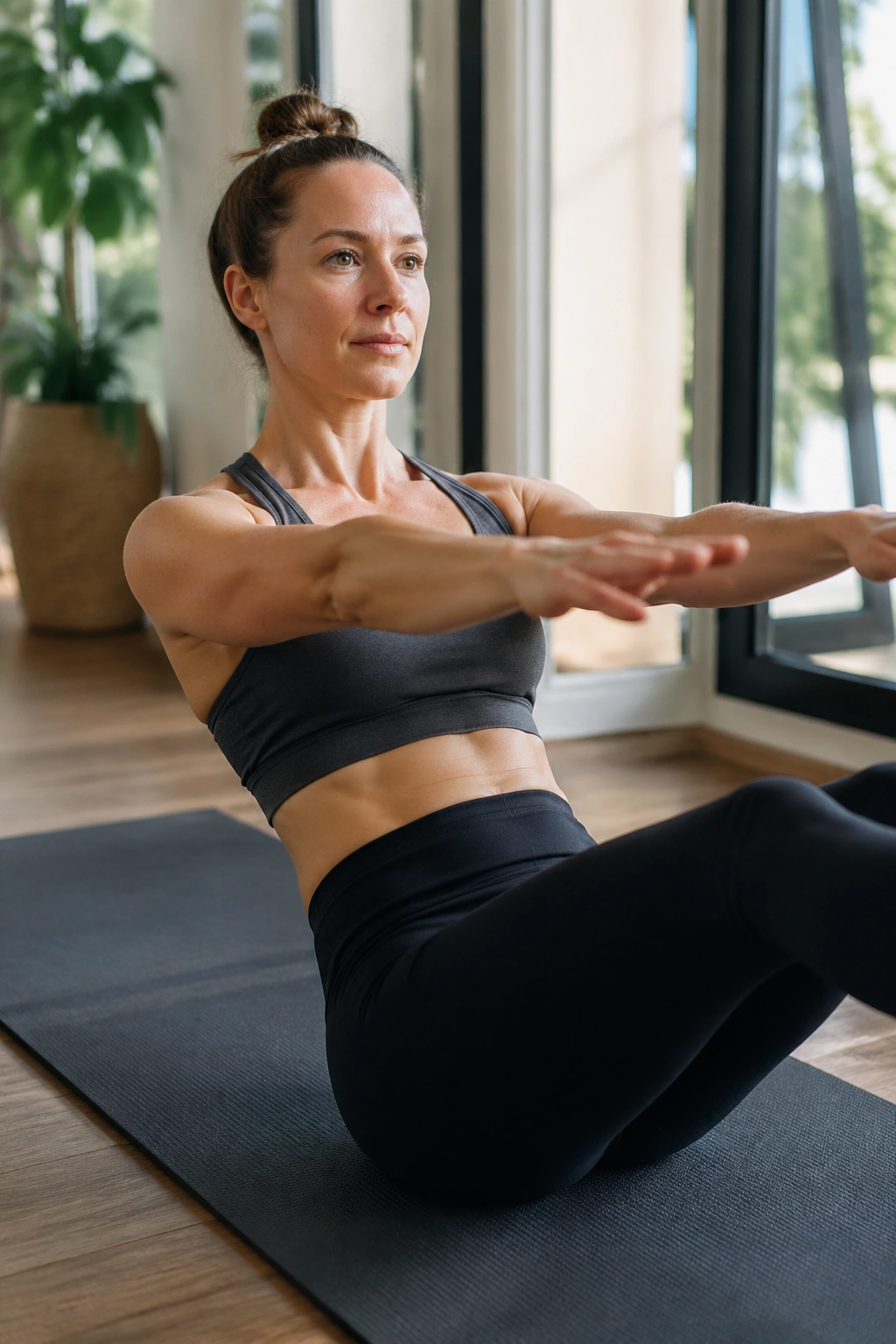
22. Teaser with Arm Pulses
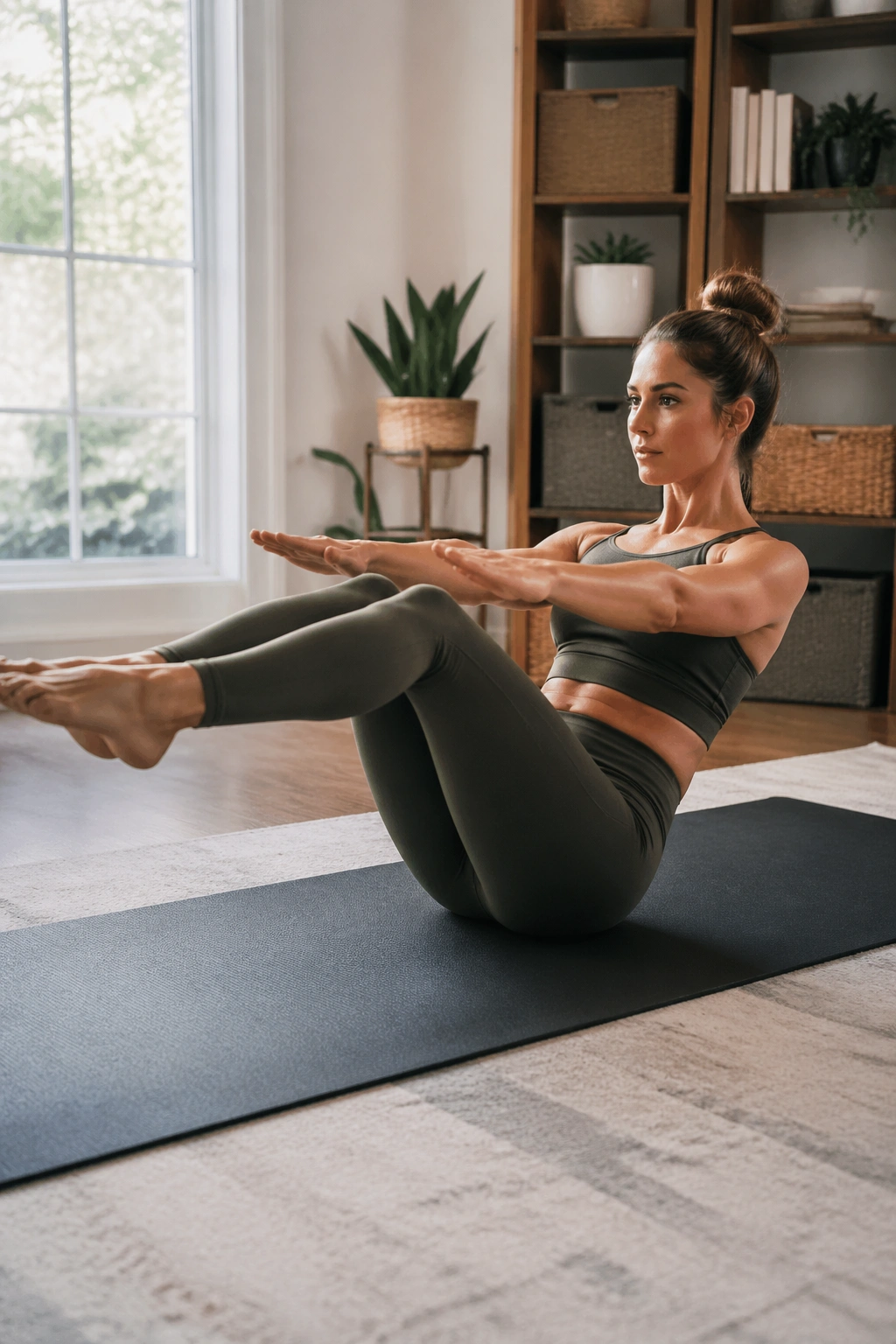
This is the move for people who want the arms to work while the core is already yelling.
Balance in Teaser with your knees bent or legs straight, arms reaching forward or slightly up. Hold light weights if you want more challenge, then pulse the arms up and down 1 to 2 inches for 20 to 30 pulses.
Teaser with Arm Pulses is less about big pressing strength and more about endurance. The shoulders and triceps stay active while the trunk fights to hold the lifted position. If your chest collapses or your low back rounds hard, bend the knees and grab behind the thighs first, then release one hand at a time.
No need to make the pulses dramatic. Tiny is better. Tiny keeps the load where it belongs.
23. Hundred with Light Weights
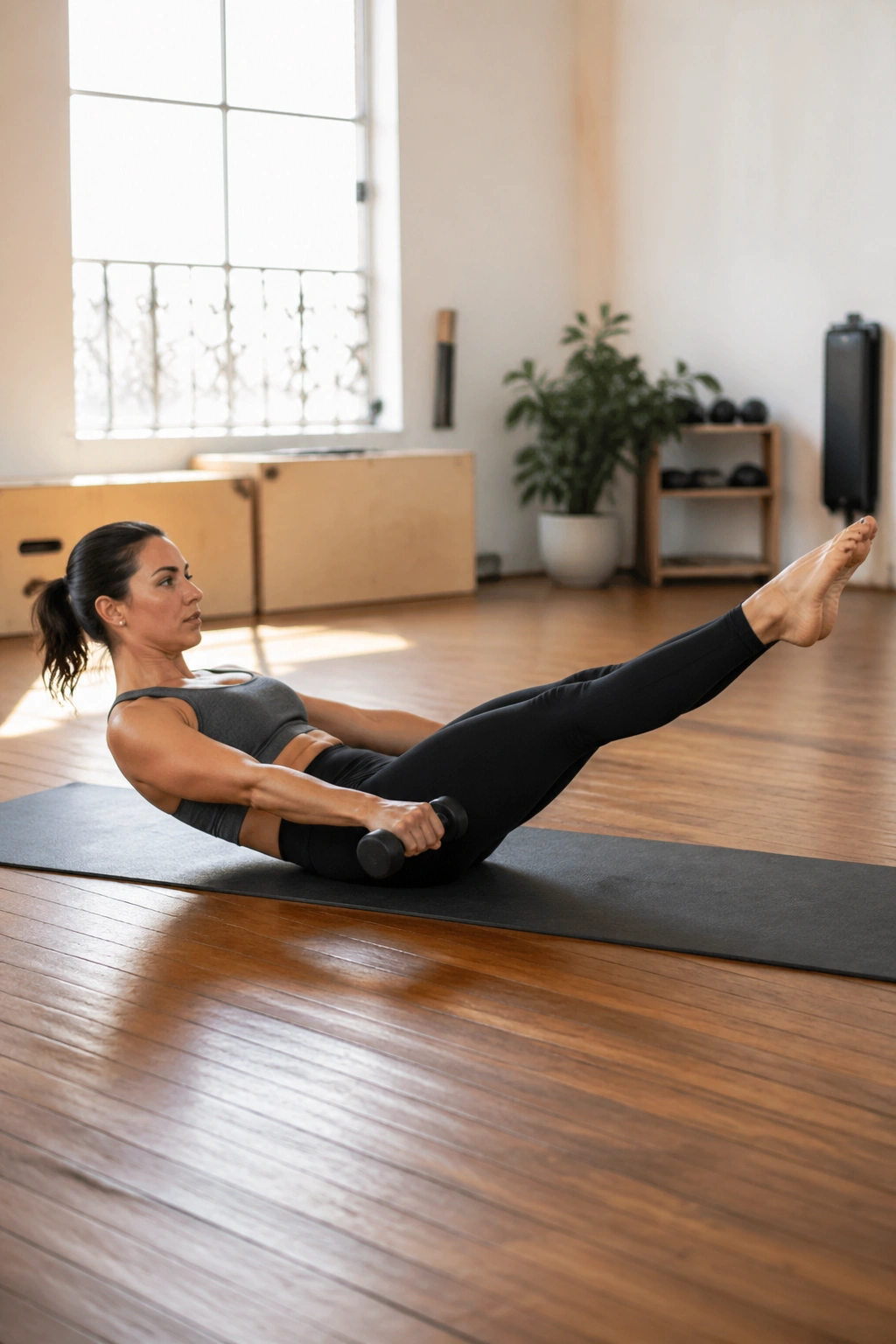
The Hundred already has arm pumps. Add weights and it becomes an arm finisher with teeth.
Lie on your back, lift into the Hundred position, and pump the arms beside your hips while holding 1-pound weights. Inhale for 5 pumps, exhale for 5 pumps, up to 50 to 100 pumps depending on your level.
The pump should come from the shoulder joint with firm, narrow-arm movement. If the weights swing wildly or the elbows bend and straighten, lighten the load or ditch it. The whole idea is sustained shoulder and triceps endurance layered over deep abdominal support.
This is also a nice reality check. If your neck grips hard, the legs may be too low or the chest too lifted. Support the head or keep one foot down. The arm work still counts.
24. Roll-Up to Front Raise
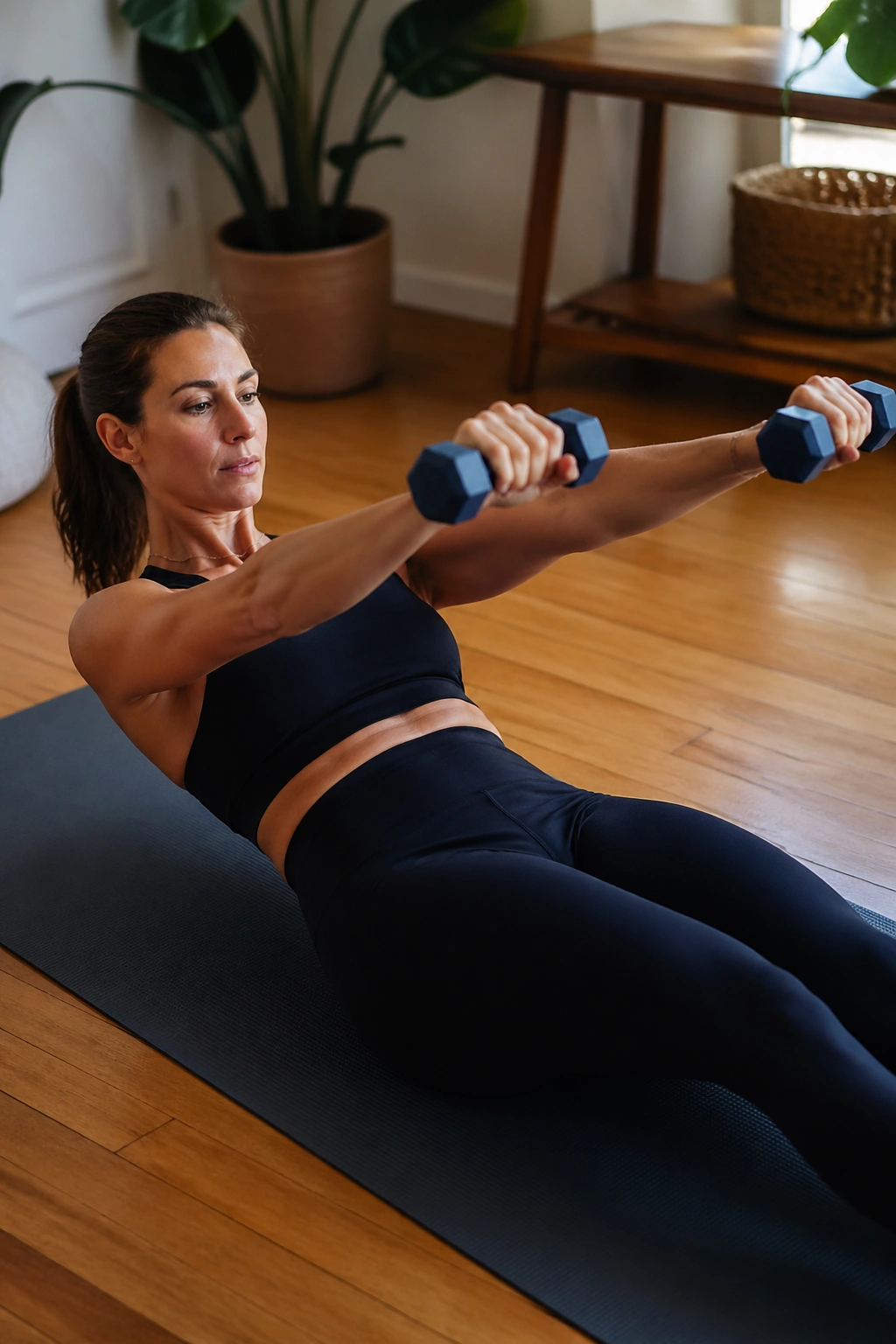
This one ties mobility and arm control together in a way I like a lot.
Lie on your back holding light weights above your thighs. As you roll up, raise the arms to shoulder height without letting them yank you forward. Roll back down slowly while lowering the arms with control. Perform 6 to 8 reps.
The front raise is modest, but paired with the roll-up it becomes a challenge for the shoulders, upper abs, and grip on the ribs. If you use momentum to sit up, you lose half the benefit. Move slowly enough that the weights do not become a swinging anchor.
A good cue: think of the arms floating because the trunk is organized, not because you are flinging them. That distinction changes the whole feel of the exercise.
25. Wall Triceps Press
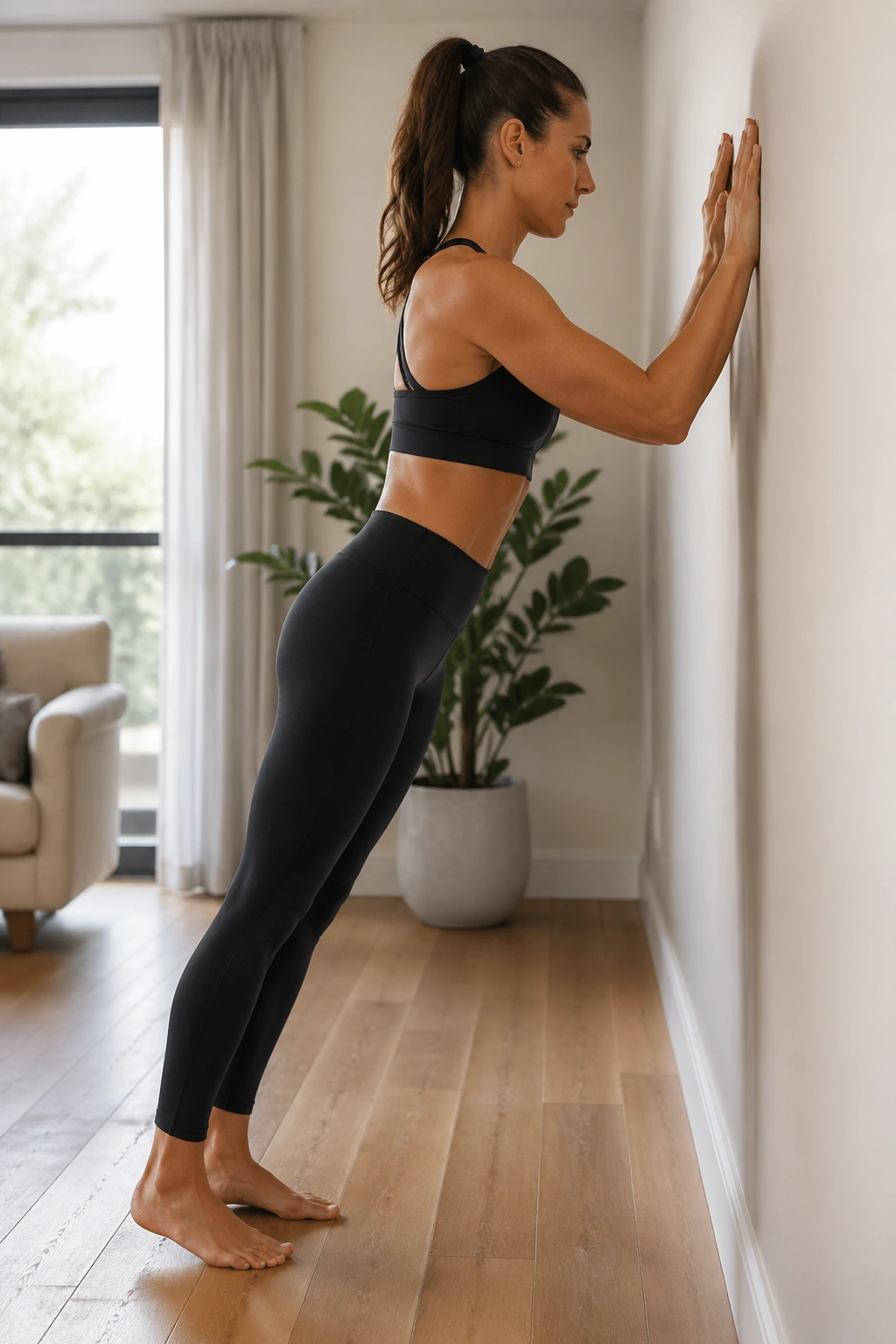
Not every strong arm move needs the floor.
Stand facing a wall, place your forearms or palms on it at shoulder height, then bend and straighten the elbows while keeping your body in a straight line. The farther your feet are from the wall, the tougher it gets. Aim for 12 to 20 reps.
Wall Triceps Press is a smart pick for beginners, for people rebuilding pressing strength, or for days when wrists are cranky and a floor push-up sounds like bad news. You still get a clean triceps challenge, plus shoulder stability, without putting your full body weight through the arms.
Keep the elbows narrow. Lean from the ankles, not the hips. If your chest reaches the wall before the elbows have bent much, step the feet farther back and try again.
A 15-Minute Pilates Arm Workout Using These 25 Moves
You do not need all 25 moves in one marathon session. In fact, that would be a fast way to make your form unravel.
Pick one move from each group below and you have a balanced arm workout that feels like Pilates instead of random upper-body burn:
Start with posture and activation
Choose 1 to 2 moves:
- Standing Pilates Arm Circles
- Chest Expansion with a Band
- Resistance Band Pull-Aparts
- Hug-a-Tree
Add pressing and triceps work
Choose 2 to 3 moves:
- Triceps Press Back
- Salute
- Shaving
- Kneeling Push-Up Prep
- Wall Triceps Press
- Pilates Push-Up
Finish with stability or endurance
Choose 2 moves:
- Plank Shoulder Taps
- Bear Hover Weight Shifts
- Hundred with Light Weights
- Teaser with Arm Pulses
- Reverse Table Triceps Bends
A quick structure that works well: 40 seconds of work, 20 seconds of rest, 2 rounds. If you prefer rep counts, use 10 to 15 reps per move and rest only long enough to reset your form. Your arms should feel worked, your shoulders should feel more organized, and your neck should not feel like it ran the session by itself.
Final Thoughts
The best Pilates arm workouts do not chase a burn at any cost. They build clean shoulder mechanics, stronger triceps, better upper-back support, and enough time under tension to change how your arms look and feel.
If I had to narrow this list down for most people, I would start with Arm Circles, Triceps Press Back, Chest Expansion, Kneeling Push-Up Prep, and Resistance Band Pull-Aparts. That mix covers posture, triceps, shoulder endurance, and pressing strength without a lot of equipment or floor drama.
Go lighter than your ego wants. Move slower than you think you need to. Keep the neck out of it. That is where Pilates arm training starts paying off.
