



Pregnancy does not ask for a new personality in the gym. It asks for judgment, patience, and a little humility. The best training choices are usually the plain ones: walking, supported strength work, pool sessions, and mobility moves that leave you feeling better when you stand up than when you sat down.
Chest pain, bleeding, dizziness, fluid leakage, regular contractions, or shortness of breath before effort are stop signs. So are any instructions from your clinician about placenta issues, blood pressure, preterm labor risk, or pelvic pain. That part is non-negotiable.
A solid prenatal workout tends to look boring from the outside. That is a compliment. The body is already juggling posture changes, ligament laxity, a shifting center of gravity, and a belly that changes how you brace, twist, and breathe. Jumps, hard landings, deep twisting, and breath-holding usually stop being clever pretty fast.
The 22 pregnancy workouts below are the ones I trust because they stay useful across trimesters with smart tweaks. Some are cardio, some build strength, some calm the back and hips, and a few are the kind of gentle work you do on days when energy is low but you still want to keep the habit alive.
1. Brisk Walking on Flat Ground
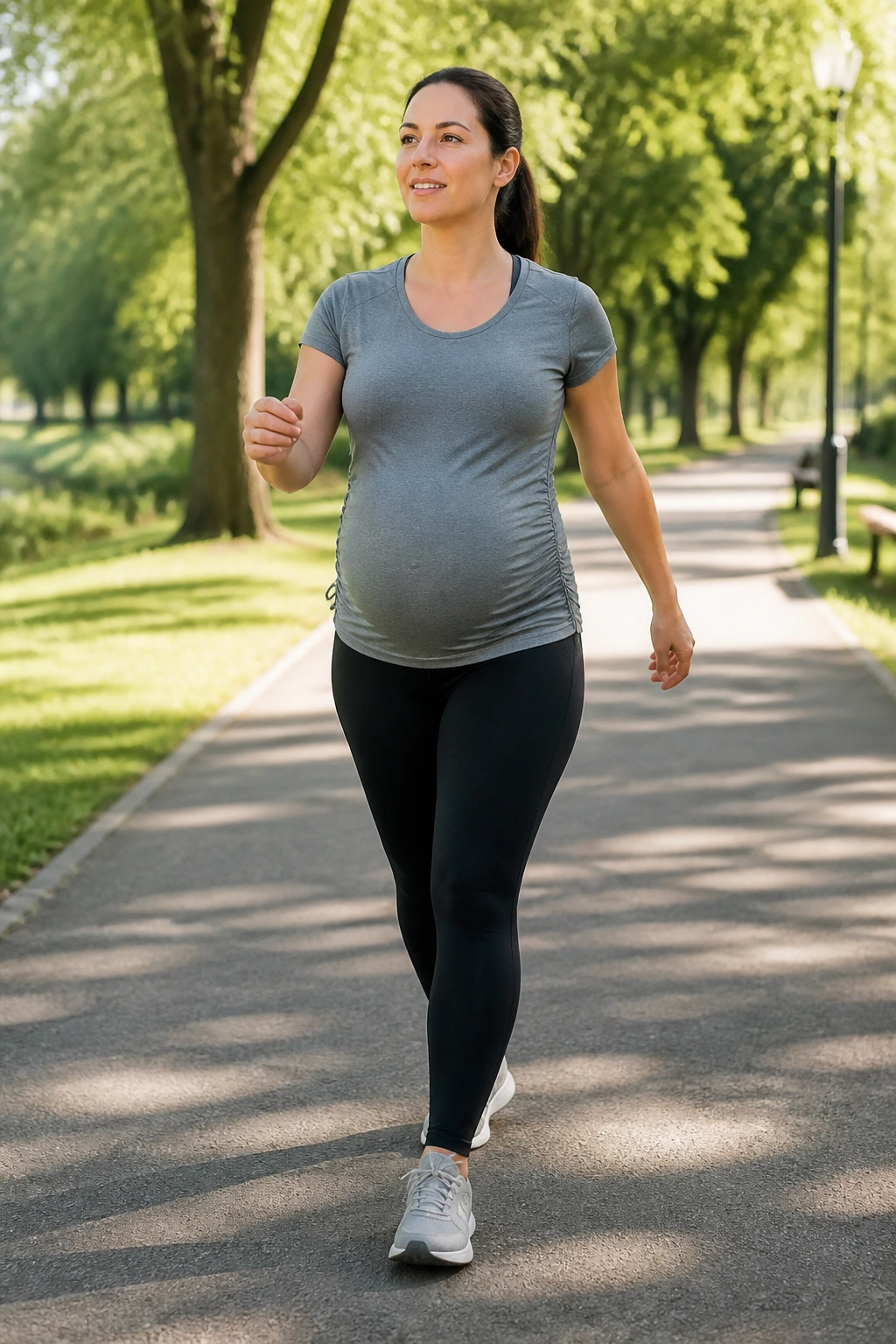
Walking earns its place because it works without making a scene. No equipment, no weird setup, no learning curve. Put on decent shoes, keep the route flat, and you’ve got a prenatal workout that can last 10 minutes or 40, depending on how you feel.
The trick is to walk with purpose, not drift. Let your arms swing naturally, keep your ribs stacked over your hips, and aim for a pace where you can still talk in full sentences without gasping. That simple talk test matters more than people think. It keeps the session in a useful range without turning it into a slog.
Quick ways to make it count
- Use a 10-minute walk after meals if a full workout feels like too much.
- Keep the stride a touch shorter if your pelvis feels loose.
- Pick supportive shoes with a stable heel, not floppy soles.
- Stop if you notice tugging pain in the groin, sharp pelvic pressure, or dizziness.
One honest tip: if you only do one thing on a low-energy day, make it this one. Walking is the fallback that still feels like training.
2. Incline Treadmill Walking
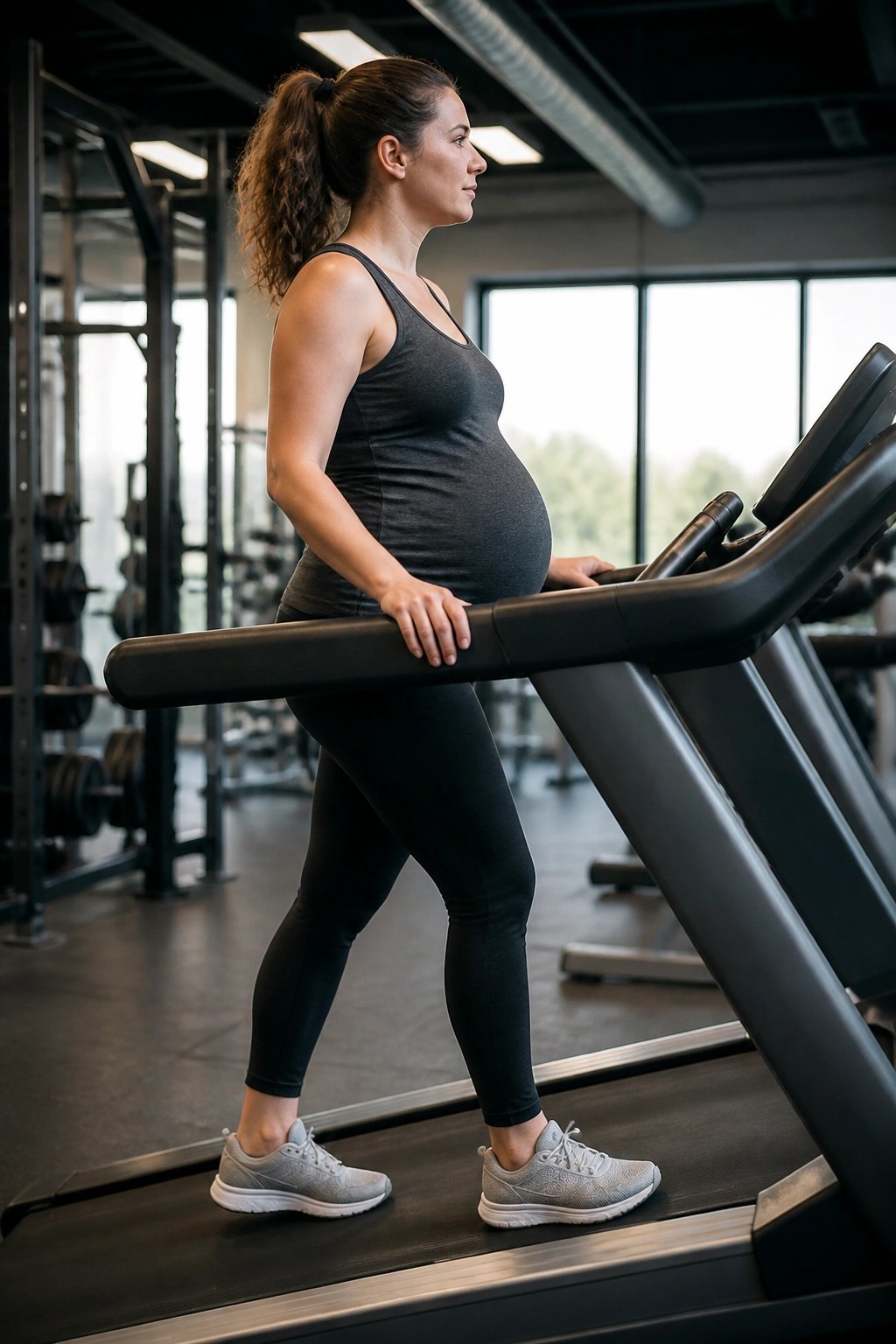
Want more challenge without the bounce? Incline walking is the clean answer. You get more work from your glutes, calves, and heart without asking your joints to absorb impact with every step.
Keep the incline modest. A slope around 1% to 5% is enough for most people, and there is no prize for cranking it higher just because the machine allows it. Lightly rest your fingers on the rails if you need balance, but do not lean your weight into them. That turns the whole thing into an awkward posture drill.
A treadmill also gives you something pregnancy likes: predictability. No surprises underfoot. No need to worry about uneven pavement or a dog that cuts across your path. If you feel your balance getting weird, shorten the session and use intervals instead — two minutes at incline, two minutes flat, repeat.
Nope, this is not the place to prove toughness. It’s the place to get a clean cardio dose and walk away feeling steadier.
3. Stationary Cycling
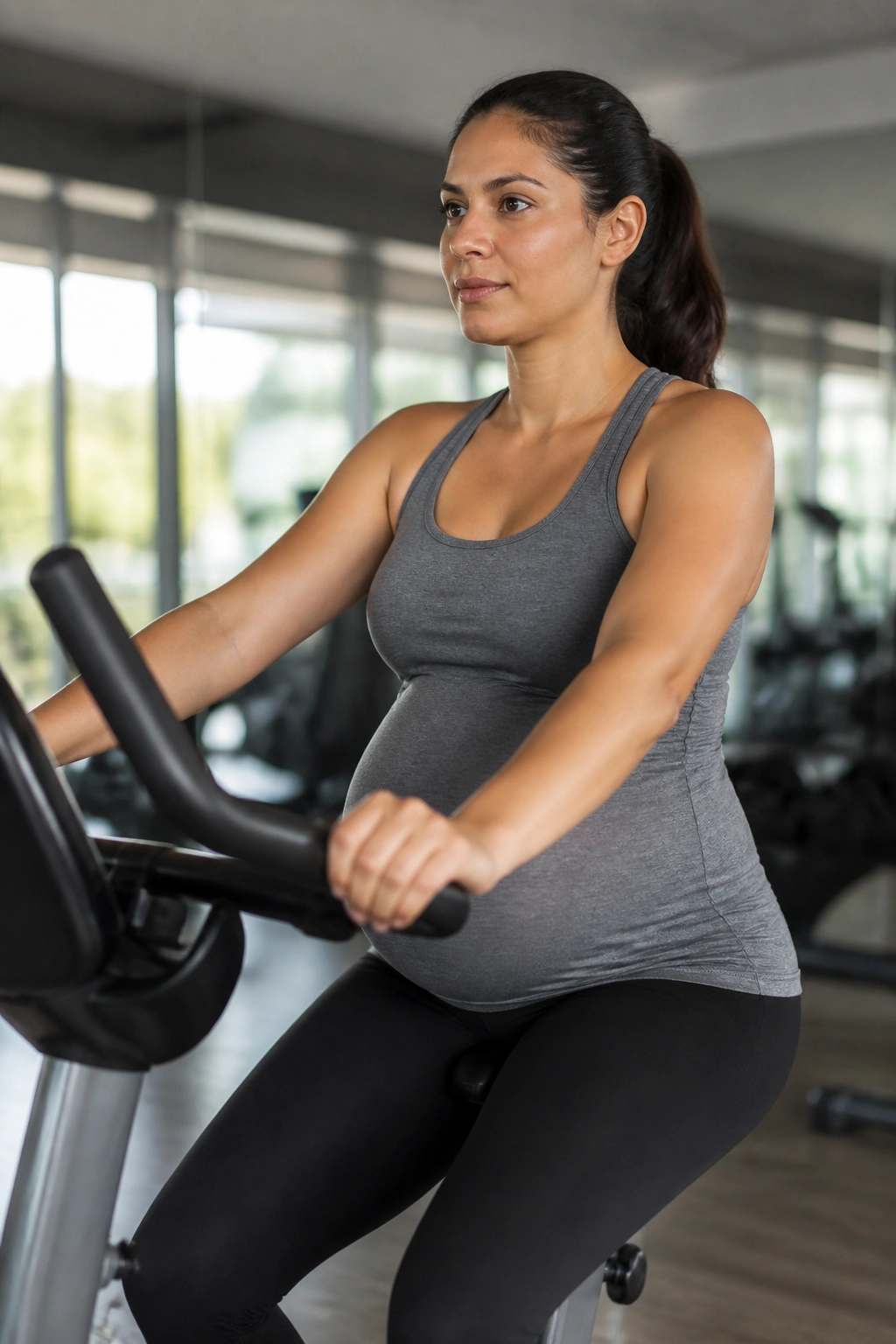
A stationary bike is what I recommend when walking starts to feel too weight-bearing and the weather or terrain makes outdoor cardio annoying. Sit, pedal, breathe. Done. That simplicity is part of why it holds up so well across pregnancy.
The fit matters more than people expect. Set the seat high enough that your knee stays slightly bent at the bottom of the pedal stroke, and keep your handlebars close enough that you are not curling into your belly. An upright bike works well for many people, while a recumbent bike can be friendlier if the low back is cranky or balance feels off.
Try short intervals if a steady ride makes you stiff. Five rounds of 3 minutes easy, 1 minute moderate is plenty for a solid session. I like a fan nearby, too. Pregnancy heat can sneak up fast, and a cool face makes a long ride feel easier than it should.
One thing to watch: if your knees track outward or your hips rock side to side, the resistance is too high. Drop it. Smooth pedaling beats grinding every time.
4. Swimming Laps
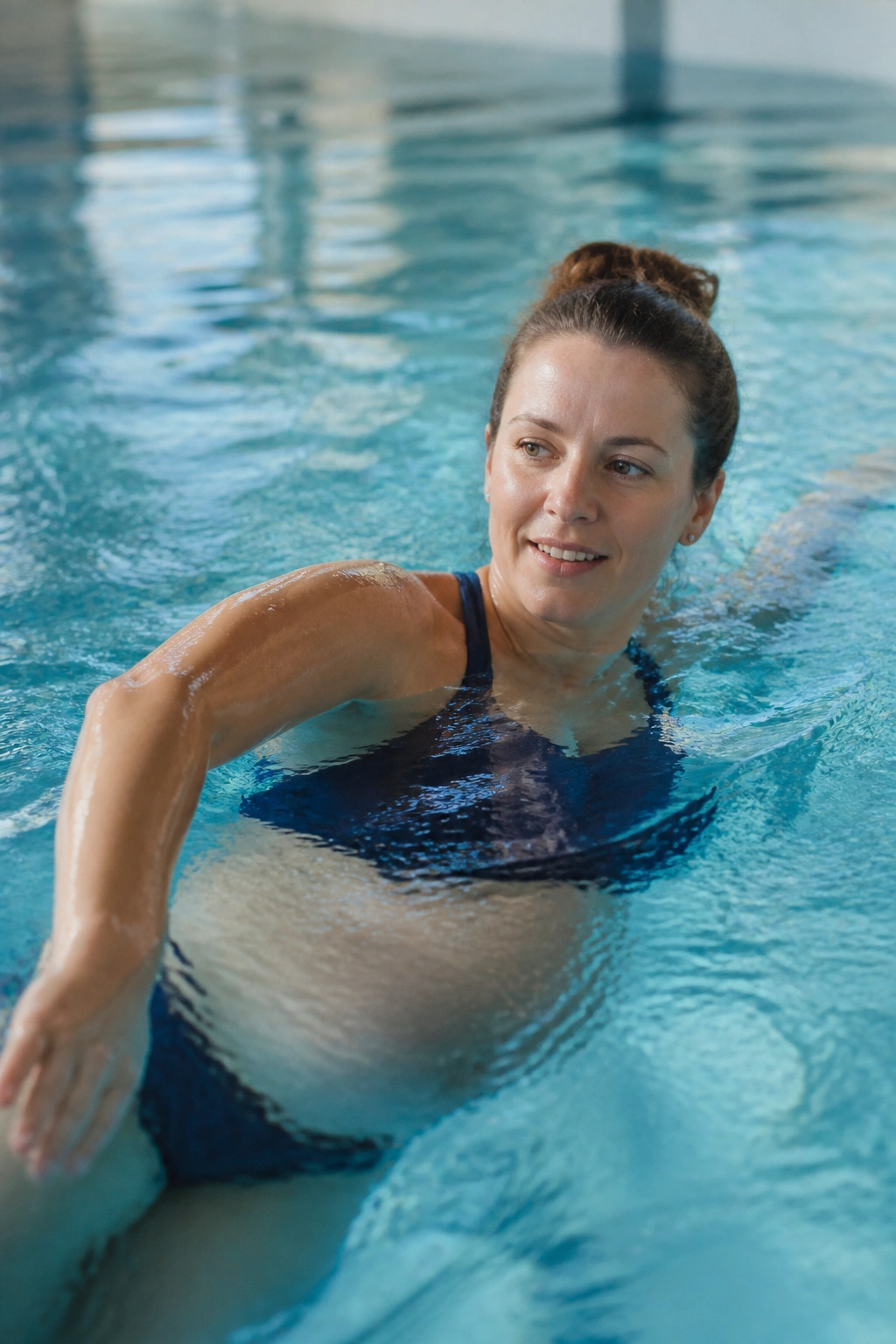
Water takes the edge off almost everything. Joints feel lighter. The back gets a break. Swelling often eases a bit because you are moving against gentle pressure instead of carrying your whole weight on dry land.
That is why swimming stays high on my list. Freestyle, backstroke, and easy breaststroke can all work if they feel good in your body. You do not need fast laps or perfect conditioning. A few steady rounds with rests at the wall can be enough, especially if your breathing changes as the pregnancy grows.
The pool temperature matters. Cooler water feels refreshing; hot water can be a bad trade, especially if you already run warm. And the deck can be slick, so take the slow lane with your feet. I’ve seen more goofy slips at the pool edge than I care to count.
A swim session can be short and still count. Ten to twenty minutes is useful. Thirty is great if you enjoy it. More than that is optional, not obligatory.
5. Water Walking
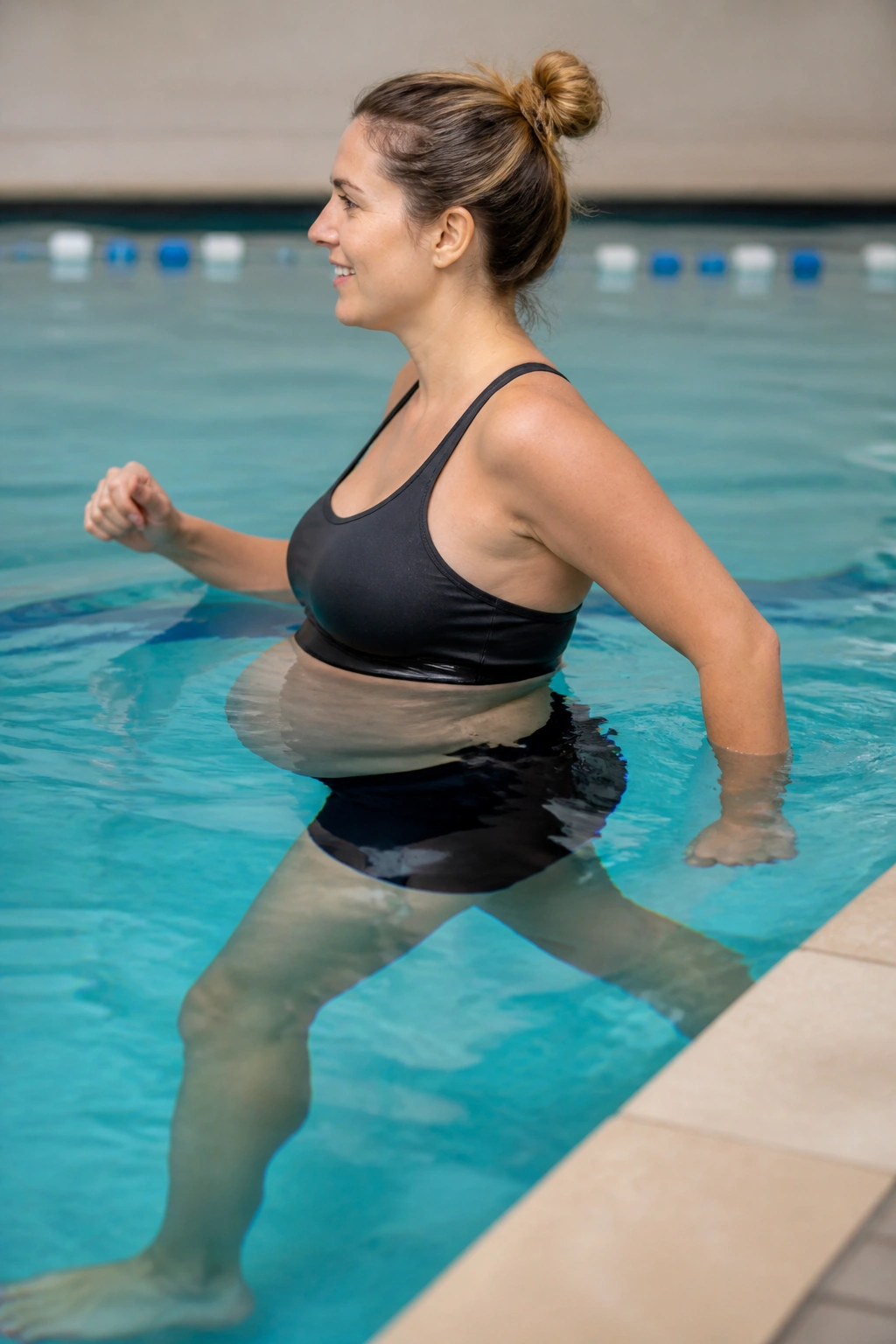
If laps feel like a project, water walking is the pragmatic version. It gives you the buoyancy and resistance of the pool without needing a stroke pattern or steady lap count.
Chest-deep water makes the legs feel lighter; waist-deep water gives a bit more load. Both work. Walk forward, backward, and sideways for a few minutes each, and your hips, legs, and core will notice the change. The sideways steps are especially nice when the outer hips get lazy from all the sitting and belly-balance changes.
How to set it up
- Pick a lane or open section where you can move without dodging people.
- Keep steps controlled, not splashy.
- Add arm sweeps under the water to increase resistance.
- Use the wall for balance if you feel wobbly after a turn.
Best use: late-day sessions when standing on land feels like too much but you still want movement. Water walking is gentle, but it is not pointless. That distinction matters.
6. Prenatal Yoga Flow
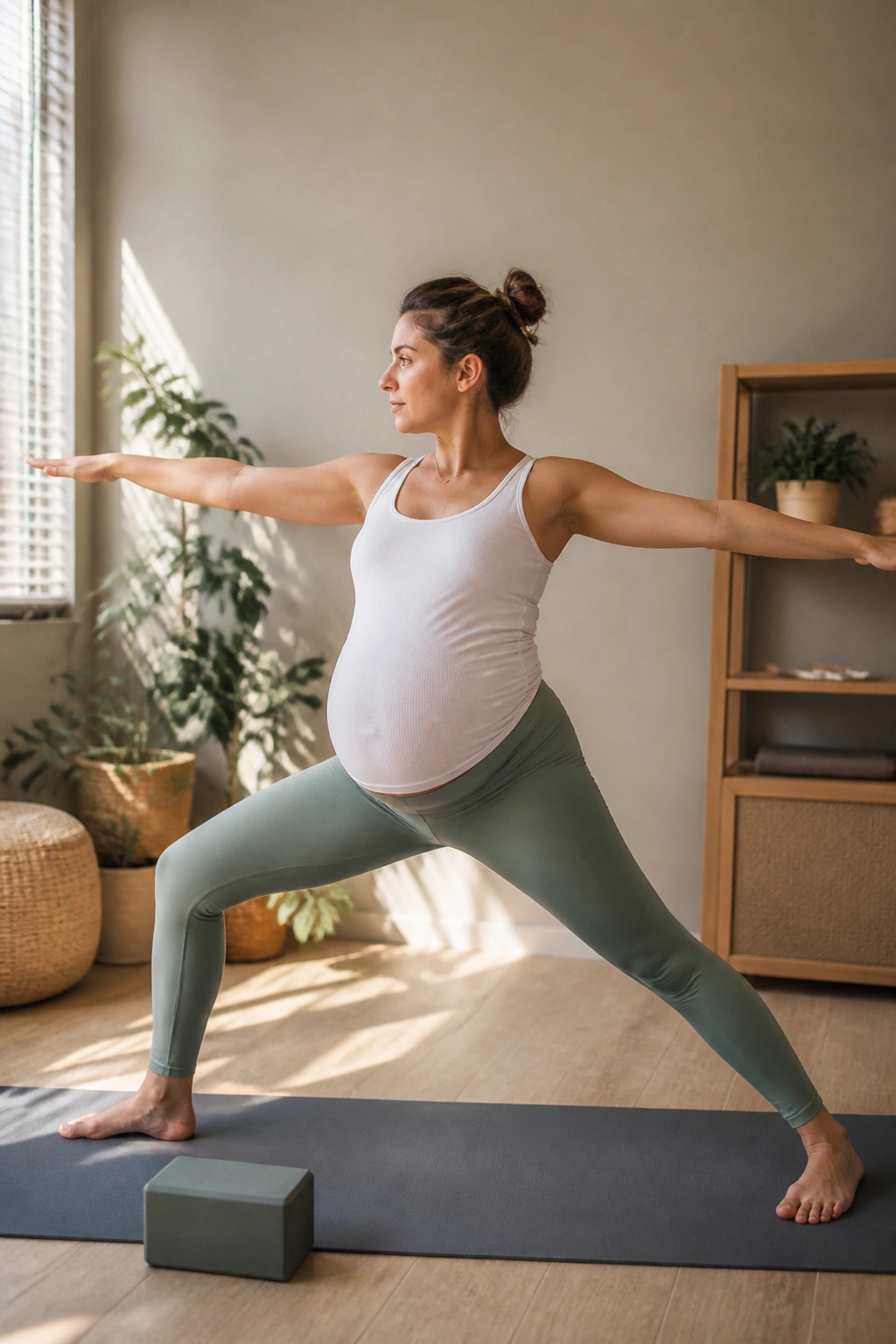
Prenatal yoga works because it respects the body instead of trying to outsmart it. You are not chasing deep stretches here. You are looking for breathing room, hip space, and a steadier back.
A good flow might include cat-cow, supported warrior II, wide-knee child’s pose, side angle with a forearm on a thigh, and a seated forward fold with plenty of bend in the knees. Nothing flashy. Nothing extreme. The magic is in the small adjustments — a block under one hand, a wider stance, a shorter hold.
What to favor
- Open shapes that give the belly room.
- Slow transitions so balance never gets rushed.
- Breath-led movement instead of forcing the pose.
- Support tools like blocks, bolsters, and folded towels.
Avoid hot rooms and any instructor cue that asks you to “sink deeper” when your body is already saying no. The stretch should feel like relief, not strain.
And yes, the calm part counts. A quiet 20-minute yoga flow can leave your back less angry and your head less noisy. Both matter.
7. Prenatal Pilates
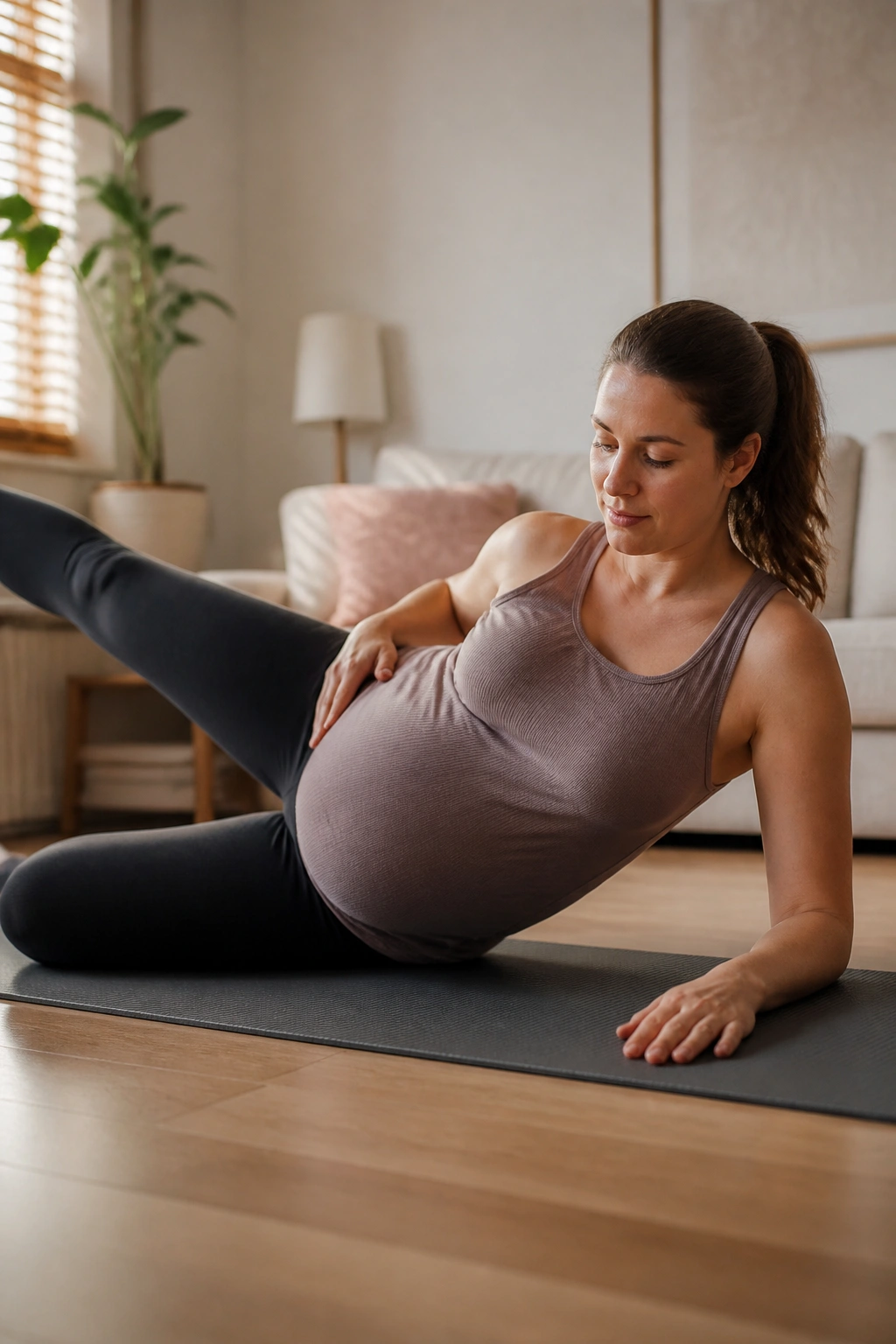
Is prenatal Pilates just fancy core work? Not really. The good version is more about control, alignment, and keeping the trunk strong enough to support the changing load in front of you.
Mat Pilates works well when it stays off the back for long stretches and leans into side-lying, hands-and-knees, seated, or standing work. Think heel slides, side-lying leg lifts, modified dead bugs with a raised torso, and gentle arm patterns paired with exhale control. Reformer Pilates can be excellent too, provided the instructor knows pregnancy modifications and doesn’t insist on positions that feel cramped.
The point is not a six-pack. The point is a trunk that can brace without gripping. That usually means exhaling on effort, keeping the ribs from flaring, and stopping before fatigue turns the whole session into a neck-and-shoulders workout.
If your abs start doming down the middle, the move is too much for the moment. Reduce the range, raise the torso, or switch to a different position. Your core will tell you. Loudly, sometimes.
8. Wall Push-Ups
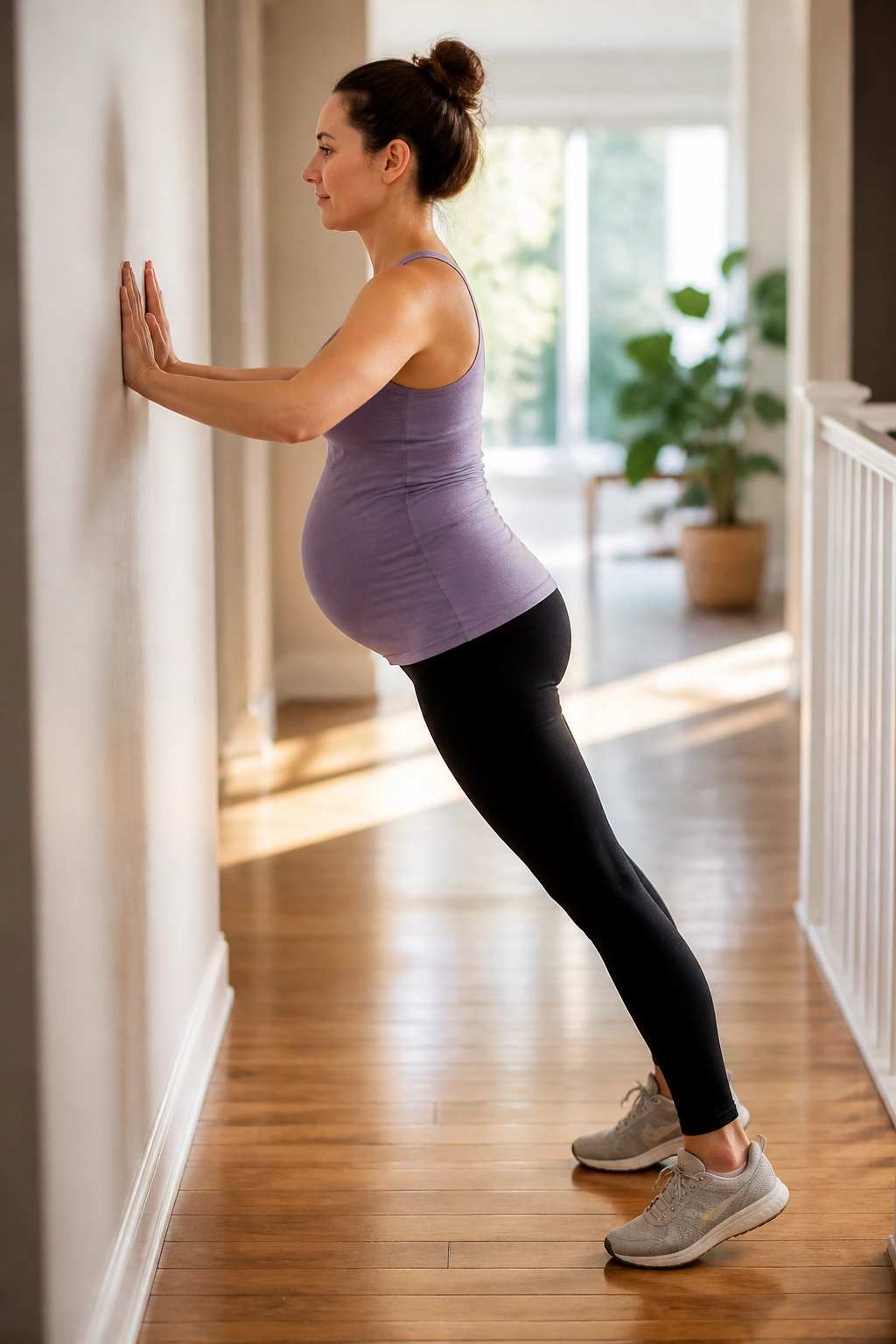
Simple. And sneaky-hard. Wall push-ups train the chest, shoulders, triceps, and the bracing muscles around the ribs without putting you flat on the floor or loading the wrists as much as a full push-up.
Stand an arm’s length from a wall, place your hands at chest height, and walk your feet back until your body forms a straight line. Bend the elbows, bring your chest toward the wall, then press back. The closer your feet are to the wall, the easier it gets. The farther back you go, the more work you create.
Form cues that matter
- Keep your heels grounded.
- Let your elbows angle about 30 to 45 degrees from your sides.
- Exhale as you press away from the wall.
- Stop before your lower back arches.
Wall push-ups are one of those rare moves that still feel civilized even when the third trimester makes floor work awkward. They belong in the “why didn’t I do this sooner” category.
9. Resistance-Band Rows
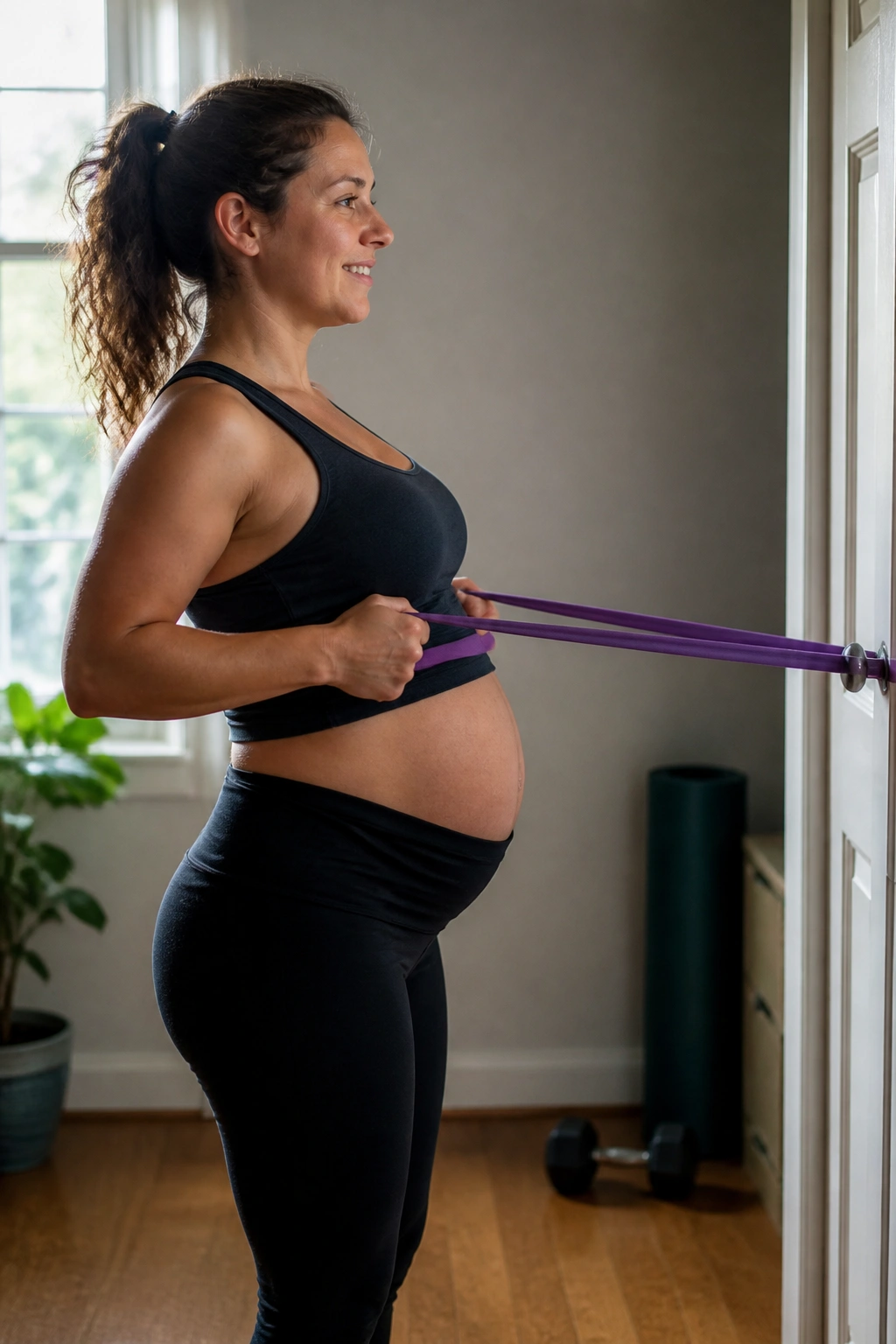
A band row is the posture reset pregnancy keeps asking for. As the chest opens and the shoulders drift forward under the pull of daily life, rowing gives the upper back a chance to do its job again.
Anchor a band around a sturdy post or use a closed-door anchor, then pull the handles toward your ribs with elbows close to your sides. Think about sliding the shoulder blades down and back, not yanking with the arms. That tiny difference changes the whole exercise. You want your upper back to do the work, not your neck.
I like rows because they pair nicely with all the front-side loading pregnancy creates. Carrying groceries, reaching, hugging a pillow, feeding a toddler — life keeps asking the front of the body to work. Rows answer that with a little balance.
A light band can still be enough if you move slowly and pause for a second at the end of each pull. No jerking. No snapping the band back. Control is the point.
10. Chair Squats
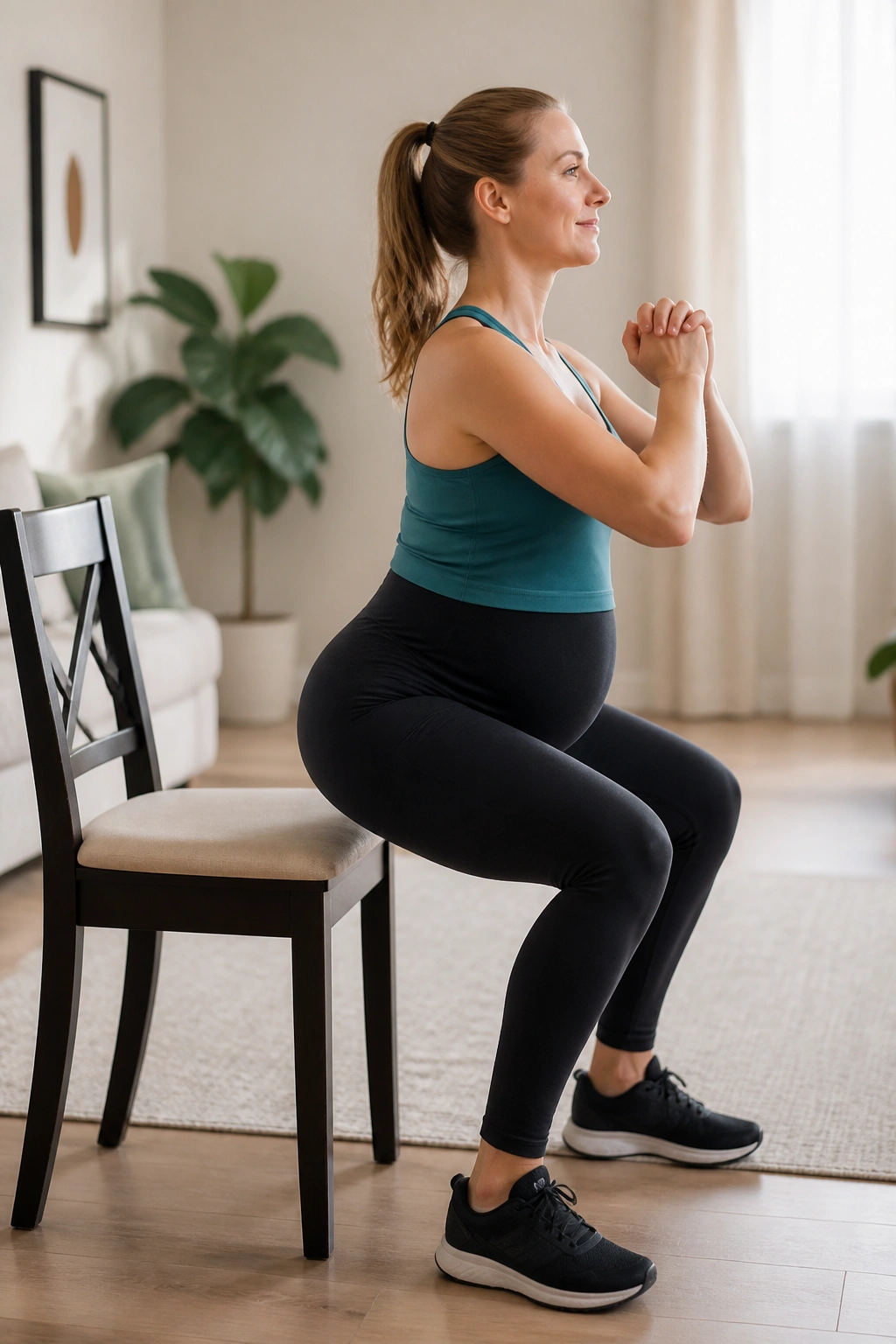
You do not need to squat low to get real value. In pregnancy, a chair squat is often smarter than a deep bodyweight squat because it gives you depth control and a clear stopping point.
Stand in front of a firm chair with feet about hip-width apart, sit back until you lightly tap the seat, then stand again. Keep your chest lifted and your weight through the whole foot. If balance feels shaky, hold a countertop or the back of another chair. That is not cheating. That is smart setup.
The best part is the carryover. Standing up from a chair, a couch, a car seat, or the toilet all use the same pattern. Stronger quads and glutes make those daily transitions less clumsy.
One clean set looks like this: 8 to 12 reps, slow on the way down, steady on the way up, no collapsing into the chair. If you can’t control the descent, shorten the range and try again.
11. Step-Ups on a Low Platform
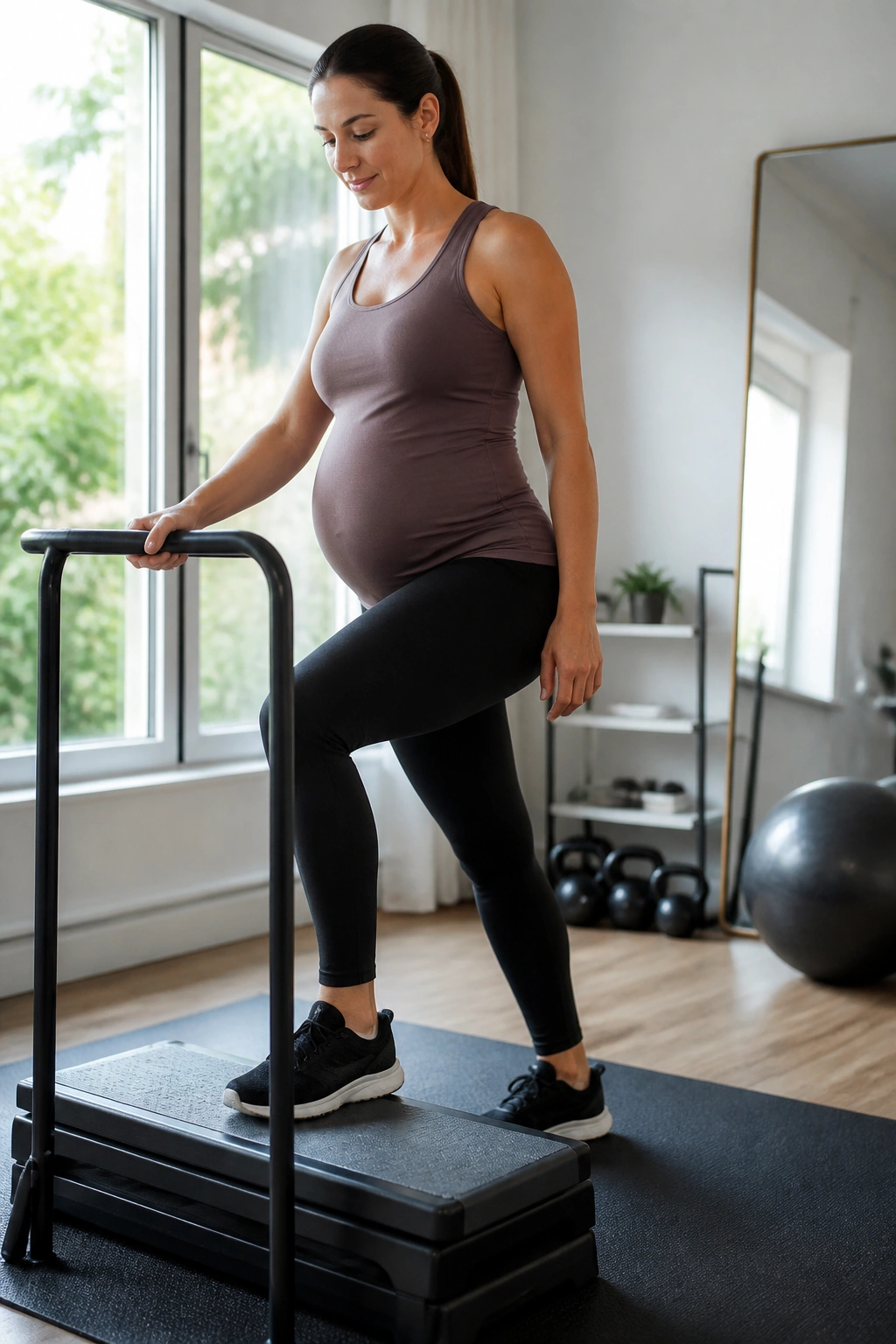
The right step-up should feel like a climb, not a hike. A low platform — around 4 to 6 inches — is enough for most pregnancy workouts and keeps the move safe when balance changes.
Hold a railing or wall, place one foot fully on the step, and press through that heel to rise. Bring the other foot up with control, then step down one foot at a time. Alternate the lead leg each set. If you feel the pelvis wobble, lower the step height or slow the pace.
What you should feel
- Front leg glute and quad working.
- Standing foot doing the push, not the lower back.
- A controlled rise, not a hop.
- Breathing that stays smooth.
This one is excellent for stair confidence. It also shows you, fast, if one side is doing more work than the other. Pregnancy has a way of exposing those little asymmetries.
12. Side-Lying Clamshells
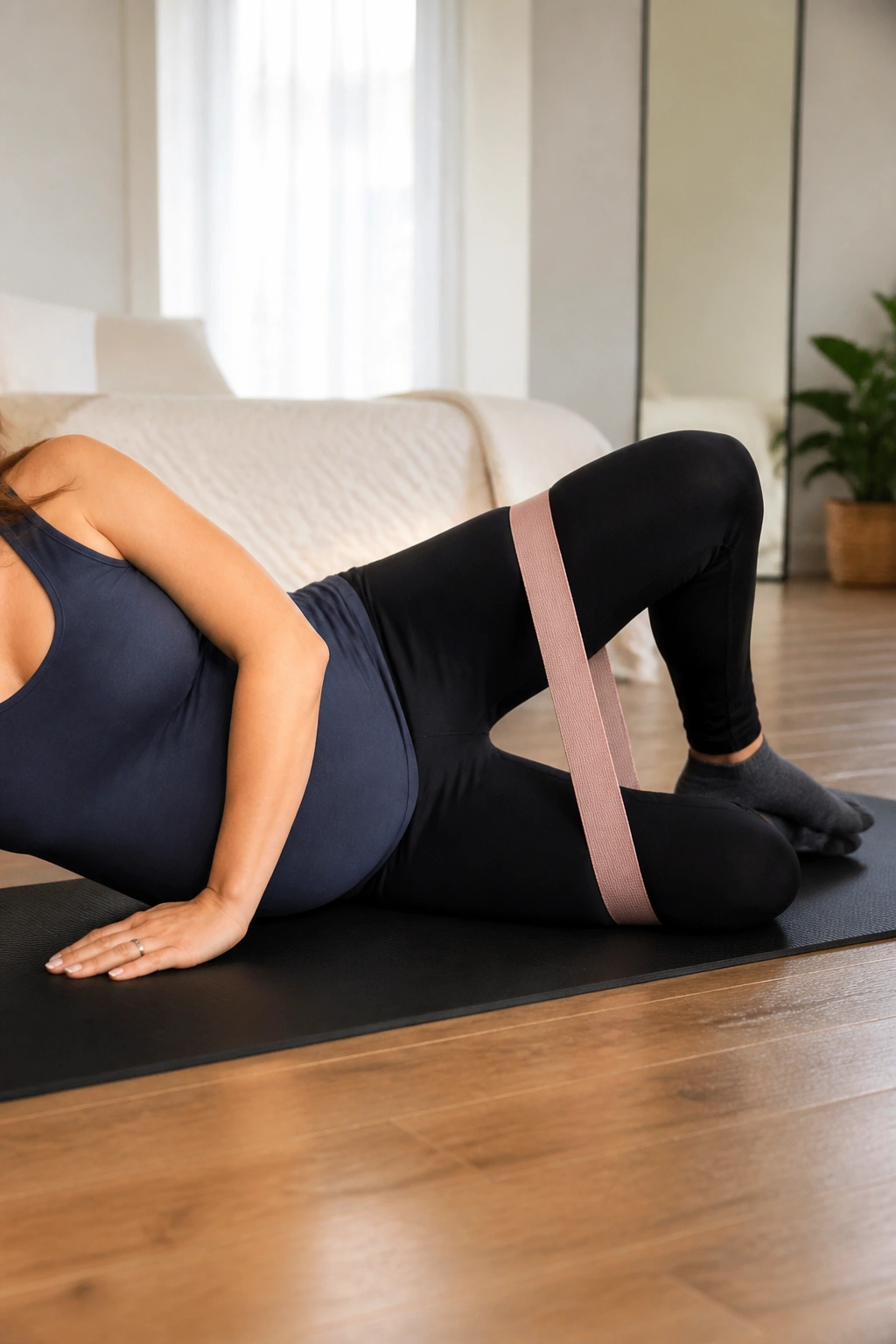
Compared with crunches or floor twists, side-lying clamshells are the calm, practical choice. They train the outer hips, which matter more than people admit when the pelvis starts feeling loose or uneven.
Lie on your side with knees bent, feet together, and hips stacked. Keeping the pelvis still, lift the top knee a few inches like a clamshell opening, then lower it slowly. A light loop band above the knees can add resistance, but bodyweight is enough to start. Ten to fifteen reps per side is usually plenty.
The goal is not height. The goal is clean motion. If the top hip rolls backward, you have gone too far. If the lower back starts helping, the range is too big. Small movements done well beat big sloppy ones.
Clamshells are quiet work. They do not look dramatic, and that is exactly why they keep showing up in good prenatal routines. Hips like this kind of attention.
13. Cat-Cow Spine Flow
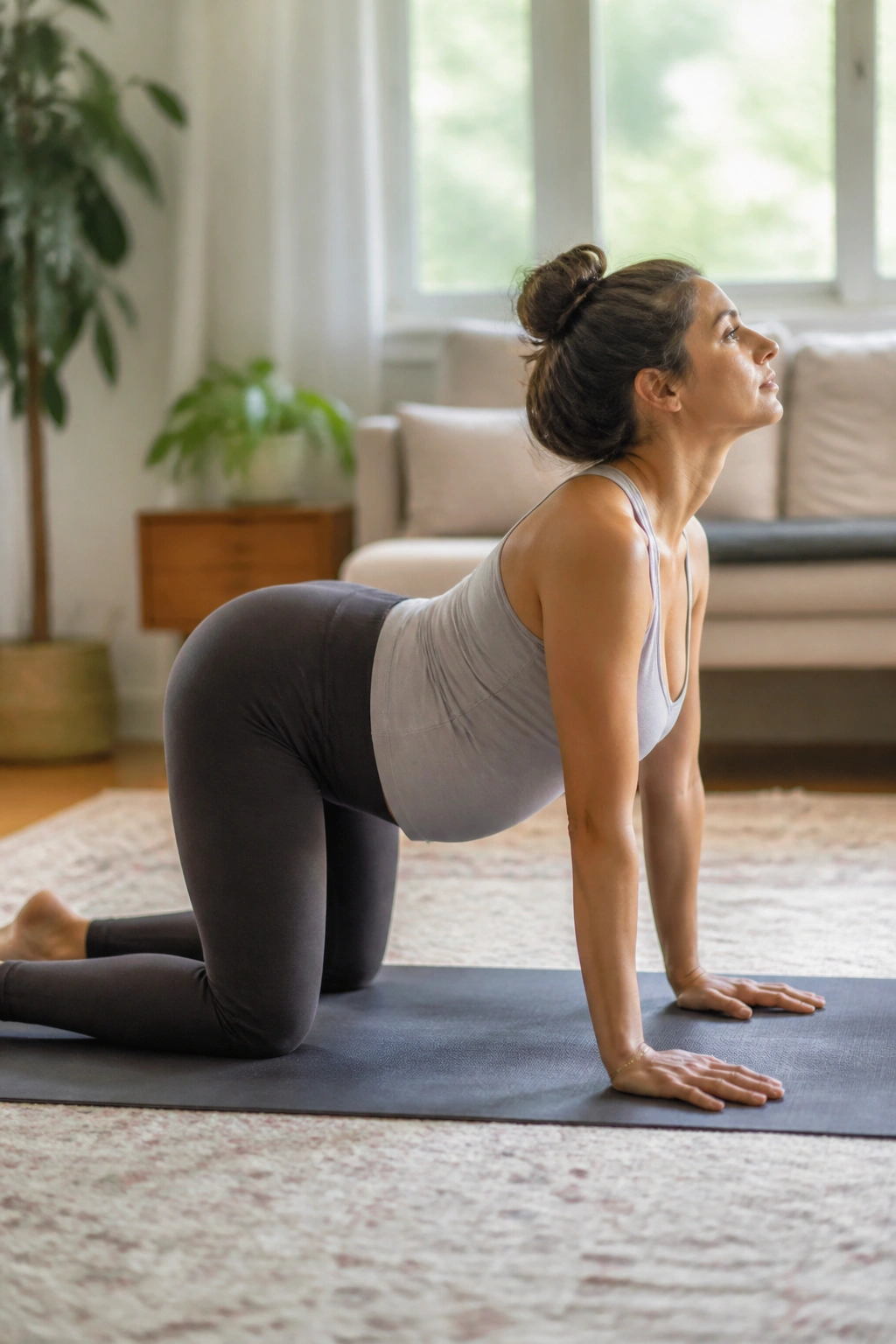
Why does a move this gentle show up so often? Because it solves a real problem: the back gets stiff, the rib cage feels crowded, and the pelvis wants some motion that does not involve a deep stretch.
Cat-cow works on hands and knees, or with hands on the thighs if getting down to the floor is a nuisance. Inhale as you let the belly soften and the tailbone tilt back; exhale as you round the spine and draw the ribs in. The range can be tiny. It still counts.
How to make it kinder in later pregnancy
- Widen the knees for more belly room.
- Put a folded blanket under the knees.
- Keep the neck long instead of dropping the head hard.
- Use the exhale to keep movement smooth.
I like cat-cow because it gives the back a chance to move in both directions without force. If the lower back feels pinchy, make the motion smaller. If the wrists complain, use forearms on a bolster or a counter.
14. Bird Dog Holds
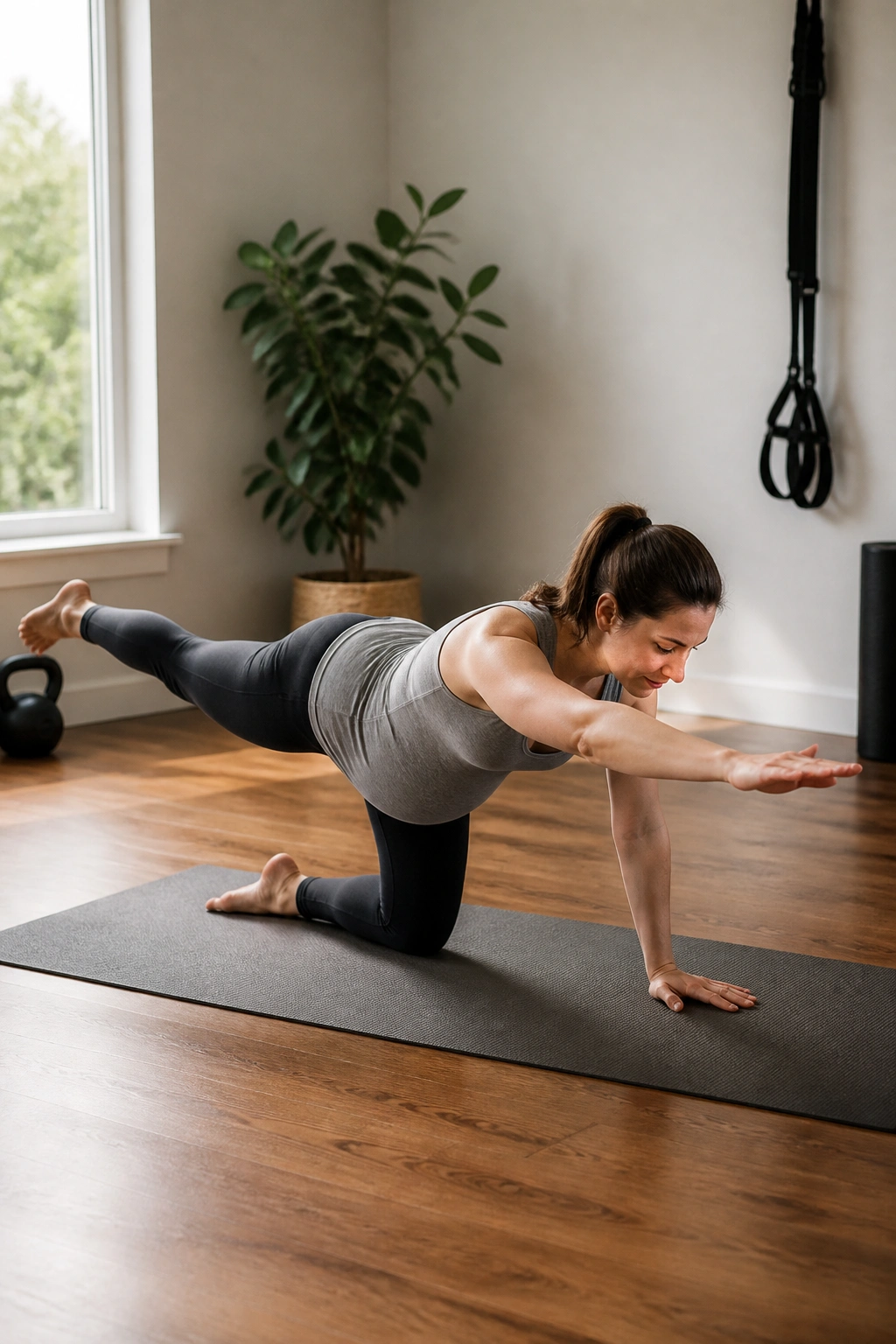
Bird dog is one of the best core moves in pregnancy because it asks for stability, not crunching. That matters. A lot.
Start on hands and knees. Extend one leg back, then the opposite arm forward, keeping the hips as level as you can. Hold for two to five slow breaths, then switch sides. If the full version feels wobbly, begin with leg only or arm only. Either option still trains coordination and trunk control.
Key things to watch
- Do not let the low back sag.
- Keep the neck long and relaxed.
- Reach long, not high.
- Breathe through the hold instead of freezing.
I like this move because it teaches the body to resist sway. That’s useful when carrying a growing belly, but it also helps with everyday balance. And no, you do not need a long hold to get the benefit. Five clean reps on each side is plenty if the form stays tidy.
15. Standing Side Leg Lifts
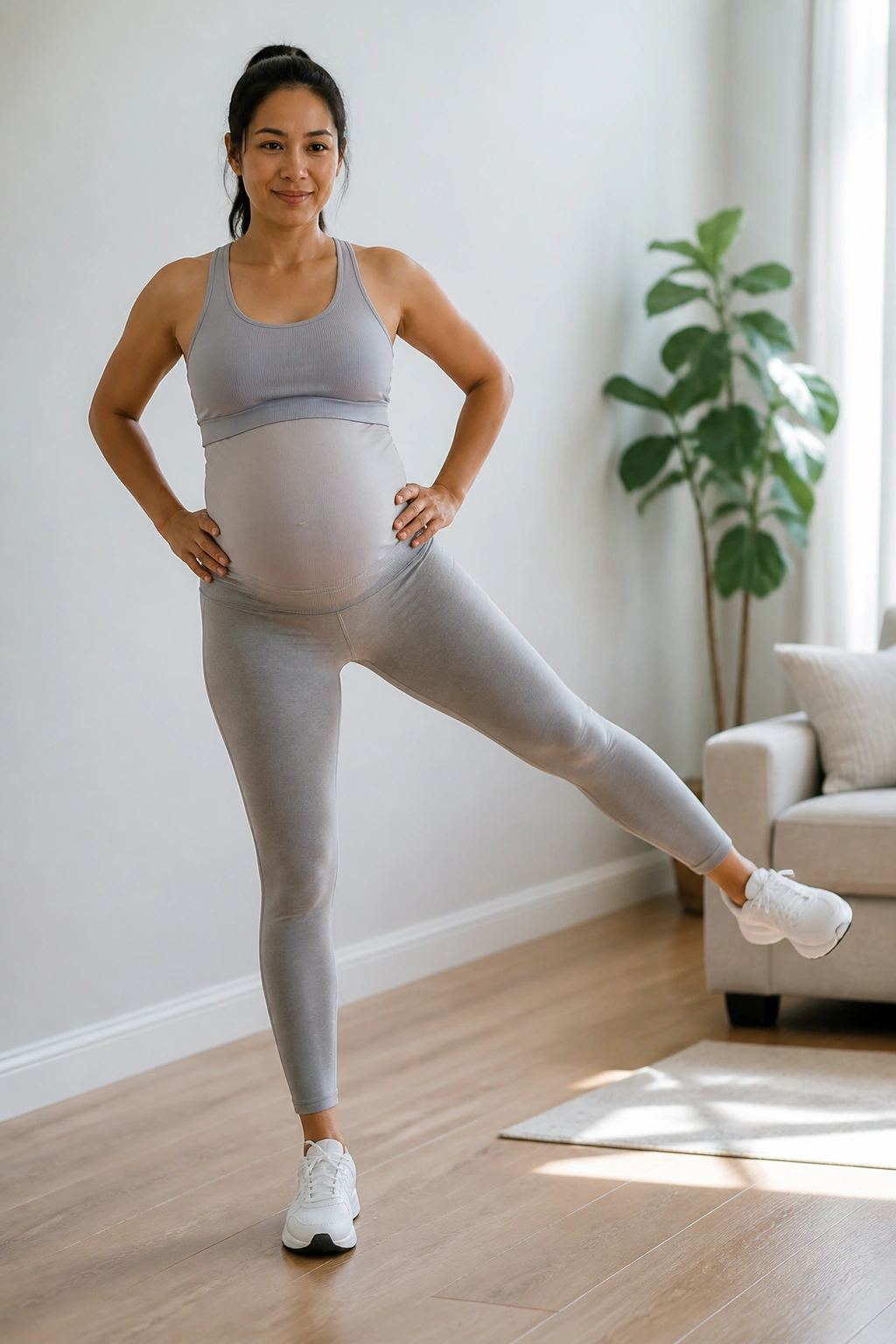
If one hip feels tighter than the other, side leg lifts are the boring fix that helps. They target the glute medius, a small but important muscle that keeps the pelvis steadier when you walk, climb, or stand on one leg.
Stand near a wall or chair, shift your weight onto one leg, and lift the other leg out to the side without tilting your torso. The foot can point forward or slightly down. Keep the movement small. A giant swing usually means the hip is cheating.
This move is a lot more useful than it looks. Strong side hips can make walking feel smoother and reduce the side-to-side wobble that creeps in as pregnancy changes your center of gravity. You will not feel dramatic burn right away. You may feel a dull work deep in the outer hip, which is exactly the point.
Try 2 sets of 10 to 15 reps per side. Slow on the way down. No swinging. No leaning away from the lifted leg.
16. Heel Raises and Calf Pumps
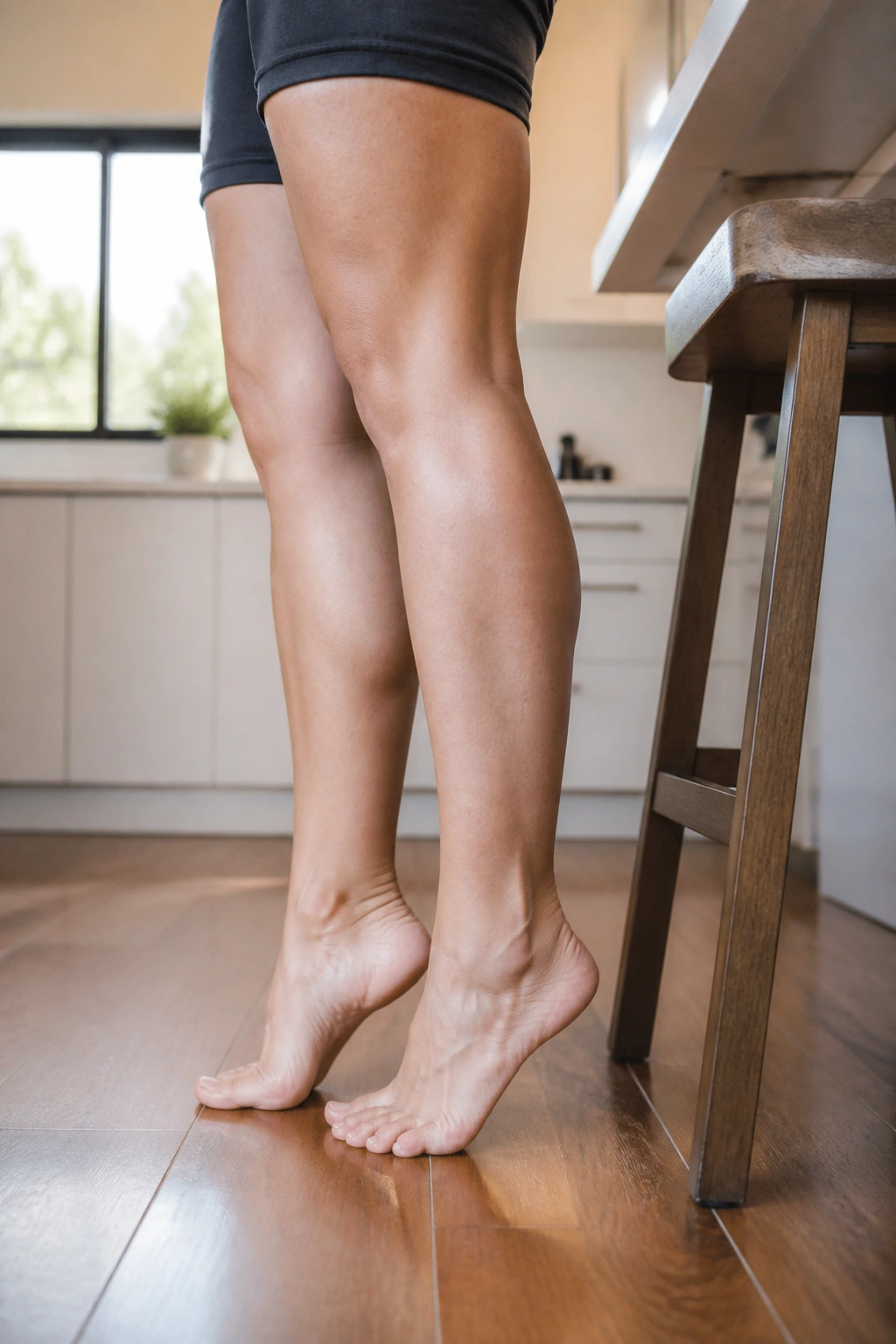
Some of the best pregnancy work is unglamorous. Heel raises and calf pumps help with ankle strength, circulation, and the heavy-leg feeling that shows up after too much standing.
Stand behind a chair or countertop and rise onto the balls of your feet, then lower slowly until the heels settle all the way down. That slow lower matters. It gives the calves more work than a quick bounce does. If standing feels unstable, do the same motion seated and focus on the ankle joint.
Calf pumps are the little sibling of heel raises. Instead of full raises, you alternately point and flex the feet, either seated or lying on your side. They are useful on days when swelling is part of the deal or you simply need a few minutes of movement without full exercise gear.
A set of 15 to 20 reps is enough. Slow, steady, unshowy. That is the whole charm.
17. Seated Dumbbell Shoulder Press
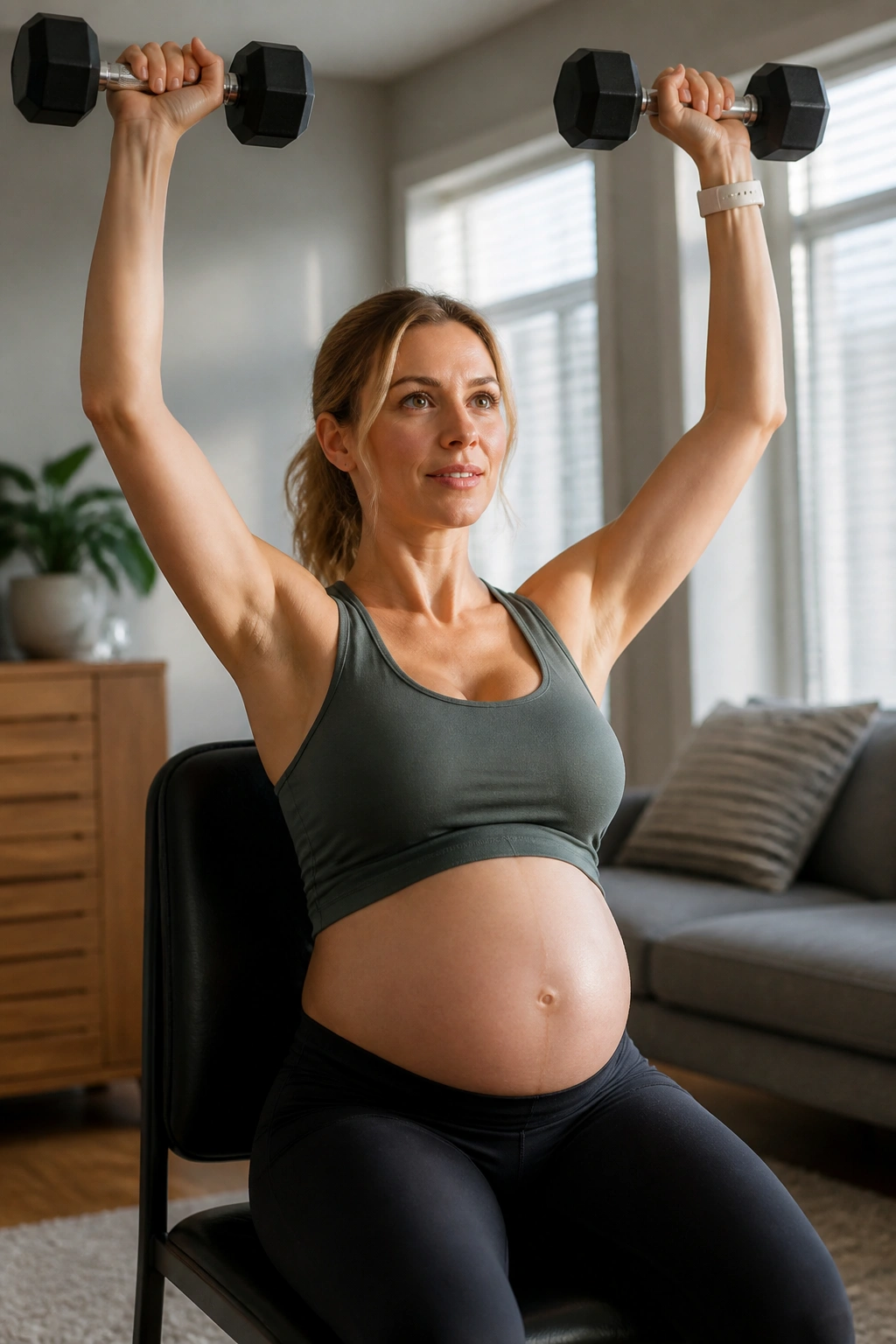
Seated overhead pressing is better than standing for many pregnant bodies because the seat removes some balance demands and keeps the effort where it belongs: in the shoulders, triceps, and upper back.
Use light dumbbells — often 2 to 8 pounds is plenty, depending on your training background. Sit tall with feet grounded, press the weights up without arching the lower back, then lower them under control. A neutral grip, with palms facing each other, often feels kinder on the shoulders and wrists.
What makes it work
- The seat keeps the torso honest.
- Light weight keeps the ribs from flaring.
- Controlled lowering trains the shoulder stabilizers.
- Breathing on the press helps avoid bracing too hard.
If overhead work makes your neck tight or your ribs pop forward, lower the load or switch to a seated front raise. No one needs a cranky rib cage just to say they trained shoulders.
18. Supported Split Squats
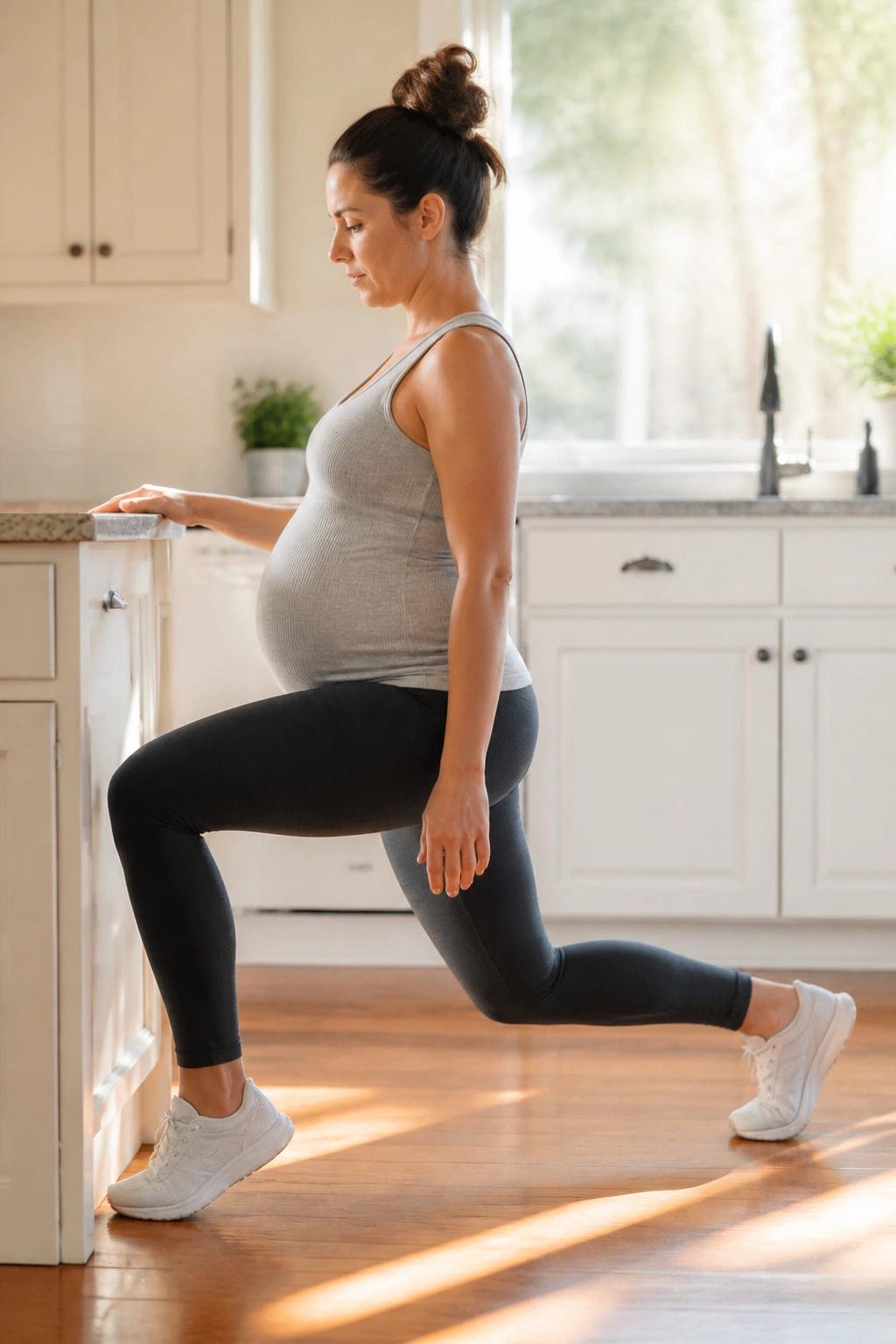
The first time you hold a countertop and lower into a split squat, you realize how much one-sided balance the body has been hiding. Good. That’s the point.
Place one foot forward and one back, keep the stance short, and hold onto support with one hand. Lower a few inches, then press back up through the front heel. You do not need a deep lunge. You need control, steady breathing, and enough range to feel the front leg work without pulling at the pelvis.
This move is excellent when regular squats feel too symmetrical and not enough like real life. One leg is carrying more weight than the other. Pregnancy makes that obvious. Split squats train that reality instead of pretending it is not happening.
Use a shallow depth at first. If the back hip feels pinched, shorten the stance. If the front knee wanders inward, slow down and reset. Clean reps beat heroic ones.
19. Low-Impact Dance Cardio
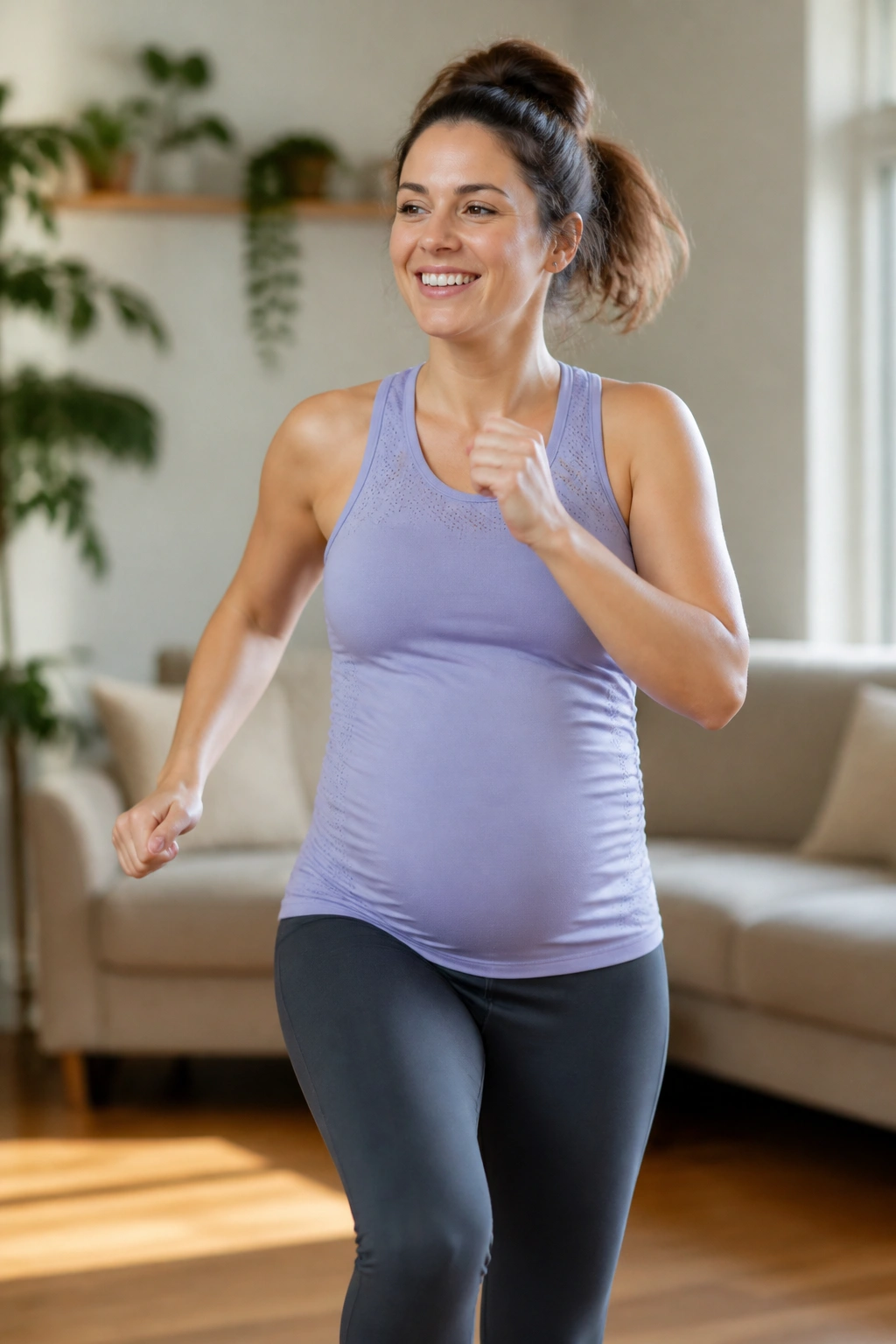
A good dance session is less about choreography and more about rhythm. Marches, side steps, toe taps, knee lifts, and gentle arm patterns can give you a real heart-rate bump without jumps or hard landings.
I like dance cardio because it solves the boredom problem. Some pregnancy workouts need to be practical. This one gets to be fun, which helps more than people admit. Put together a playlist, keep the moves low to the ground, and avoid fast spins or anything that throws off balance. The step pattern can be simple: march for 8 counts, side-step for 8, tap back for 8, repeat.
Moves worth keeping
- March in place with arm swings.
- Step-touch side to side.
- Knee lifts below hip height.
- Small grapevines, only if balance feels solid.
If your pelvis feels unstable, shrink the steps. If your breath gets ragged, keep the same moves but cut the range of motion. That way the workout stays lively without turning sloppy.
20. Pelvic Floor Breathing
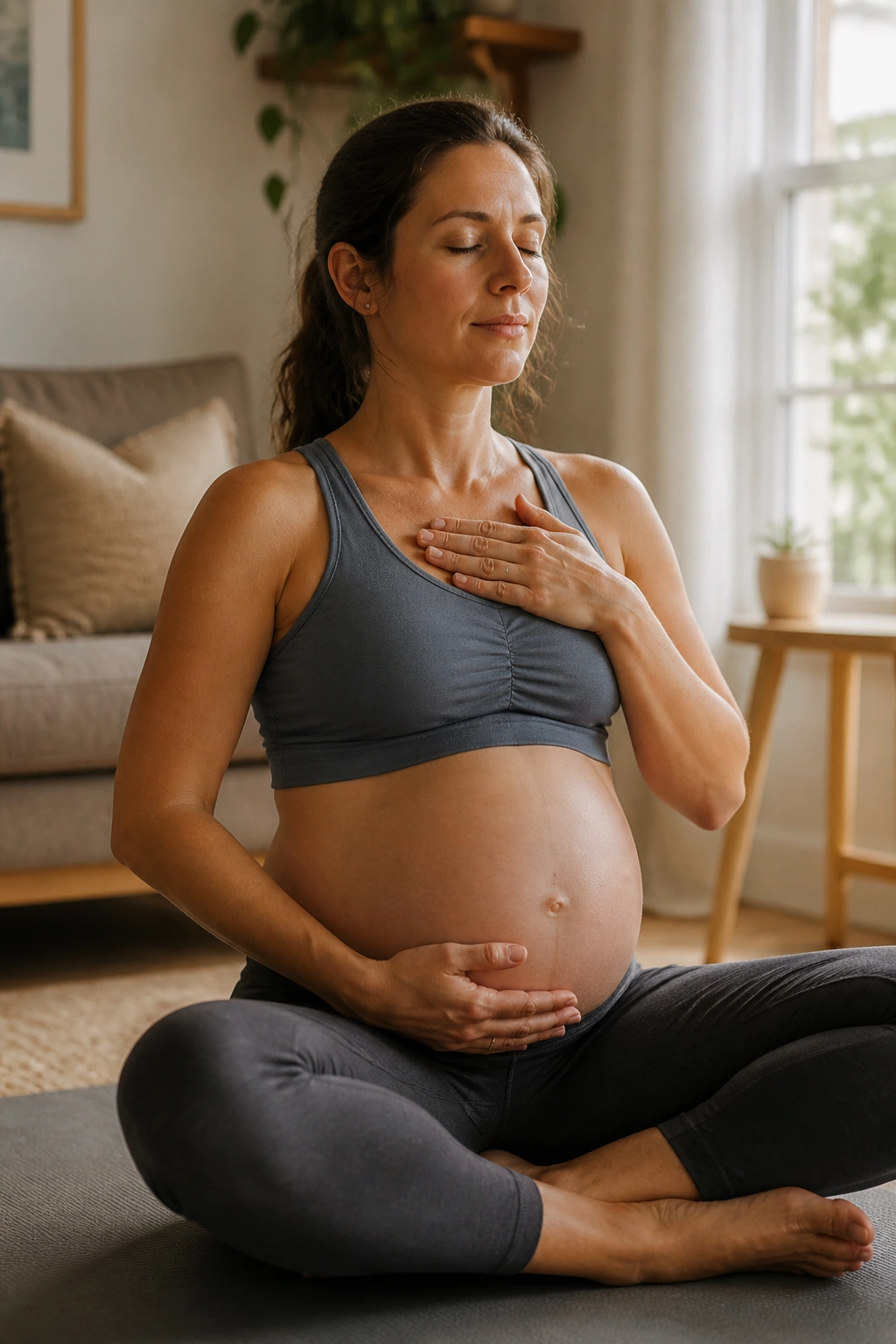
Is this really a workout? Yes, if you treat it like one. The pelvic floor is part of the system that keeps pressure, posture, and breath working together, and pregnancy changes all three at once.
Start seated, side-lying, or on hands and knees. Inhale and let the pelvic floor soften. Exhale and gently lift the muscles as if you were stopping gas and urine at the same time, then release fully on the next inhale. The lift should feel subtle, not clenched. Hard squeezing all day is not the goal.
This is where a lot of people go wrong. They hear “Kegels” and start gripping. That can be a problem if the pelvic floor is already tense. The better cue is balance: relax on the inhale, gently activate on the exhale, then stop thinking about it for a bit.
A few slow breaths before or after a walk is enough. That small habit can help you connect breath, core, and pelvic support without making the whole thing feel clinical.
21. Wall Plank Holds
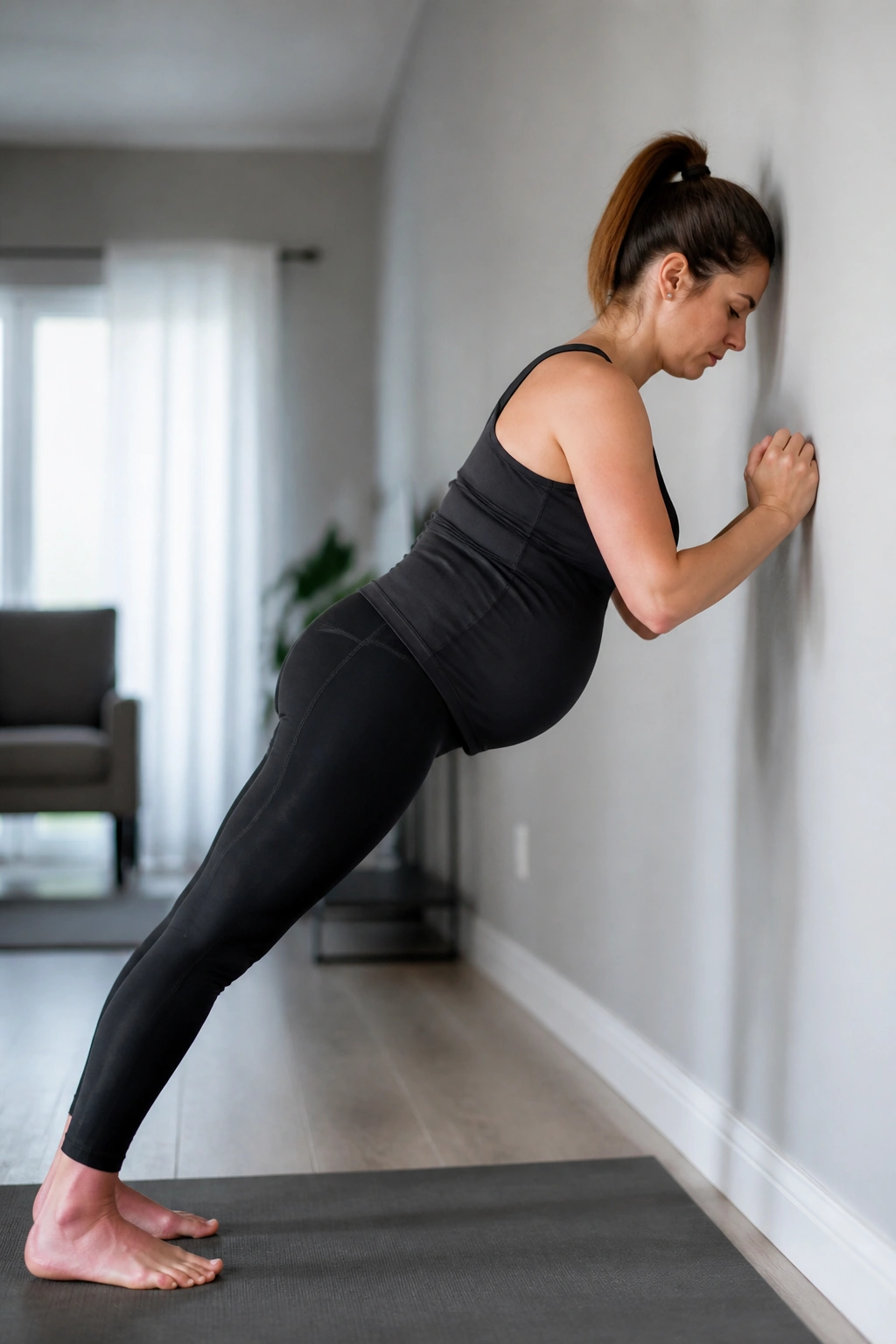
Floor planks get too much credit. Wall planks do the same job with less pressure, less hassle, and far less chance of turning your belly into a strained guessing game.
Stand facing a wall, place your forearms or hands on it, and walk your feet back until your body makes one long line. Keep the ribs from flaring, squeeze the glutes lightly, and breathe. Hold for 15 to 30 seconds, rest, then repeat. If that feels easy, step farther away from the wall or use a countertop instead.
The real value here is trunk control. You’re teaching the core to stay organized while the shoulders and upper back support body weight. That carryover matters in pregnancy because everything from getting out of bed to lifting laundry asks for some version of the same stability.
One detail makes a big difference: do not hold your breath. The second the breath locks up, the plank has gone from helpful to annoying.
22. Seated Marching Intervals
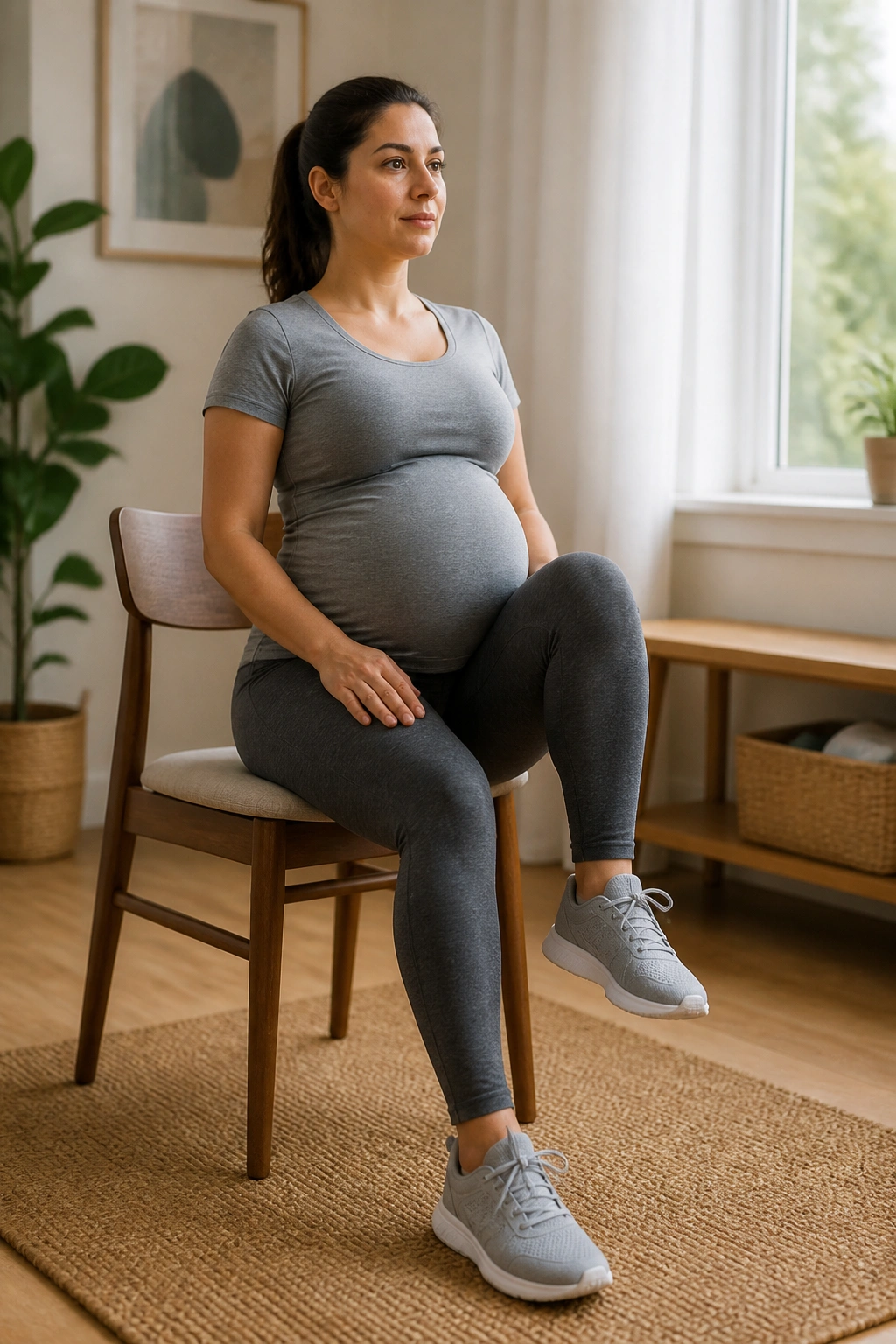
A chair workout still counts. Some days, that’s the smartest option on the table, especially when fatigue, pelvic pressure, or a rough night makes standing exercise feel like too much.
Sit tall near the front of a sturdy chair and march one knee up at a time. Add arm swings, light dumbbells, or overhead reaches if that feels good. Keep the pace brisk enough to raise your heart rate but smooth enough that the torso does not rock from side to side. Ten rounds of 30 seconds on, 30 seconds off can give you a tidy little cardio session without asking for much setup.
This move is useful for two reasons. First, it keeps the habit alive on low-energy days. Second, it gives you a place to add movement when balance or back pain says no to standing work. Some sessions will be full workouts. Others will be ten minutes of seated marching, calf raises, and a few deep breaths. That still counts.
And honestly, that flexibility is what makes prenatal fitness sustainable. Not heroics. Not perfection. Just enough movement to support the body you’re living in right now.
