



You do not need a heavy barbell rack, a collection of iron plates, or a gym membership to build strong, functional legs. The truth is, gravity is the only weight you truly need to fatigue your muscles. Most people overlook bodyweight training because they assume it lacks the “intensity” of lifting heavy steel, but they are missing the most critical variable: mechanical disadvantage. When you manipulate leverage and tempo using just your own body, you can create a level of muscular tension that is just as effective as any weight machine.
Building leg strength at home is entirely about controlling the descent, finding the right angles, and focusing on the mind-muscle connection. If you have been struggling to make progress with standard movements, it is likely because you are rushing through the repetitions rather than feeling the muscles work. The following exercises are designed to target every angle of your lower body, from the glutes and hamstrings to the quads and calves. You will not find any filler here—just movements that have stood the test of time and biomechanical scrutiny.
1. Air Squats
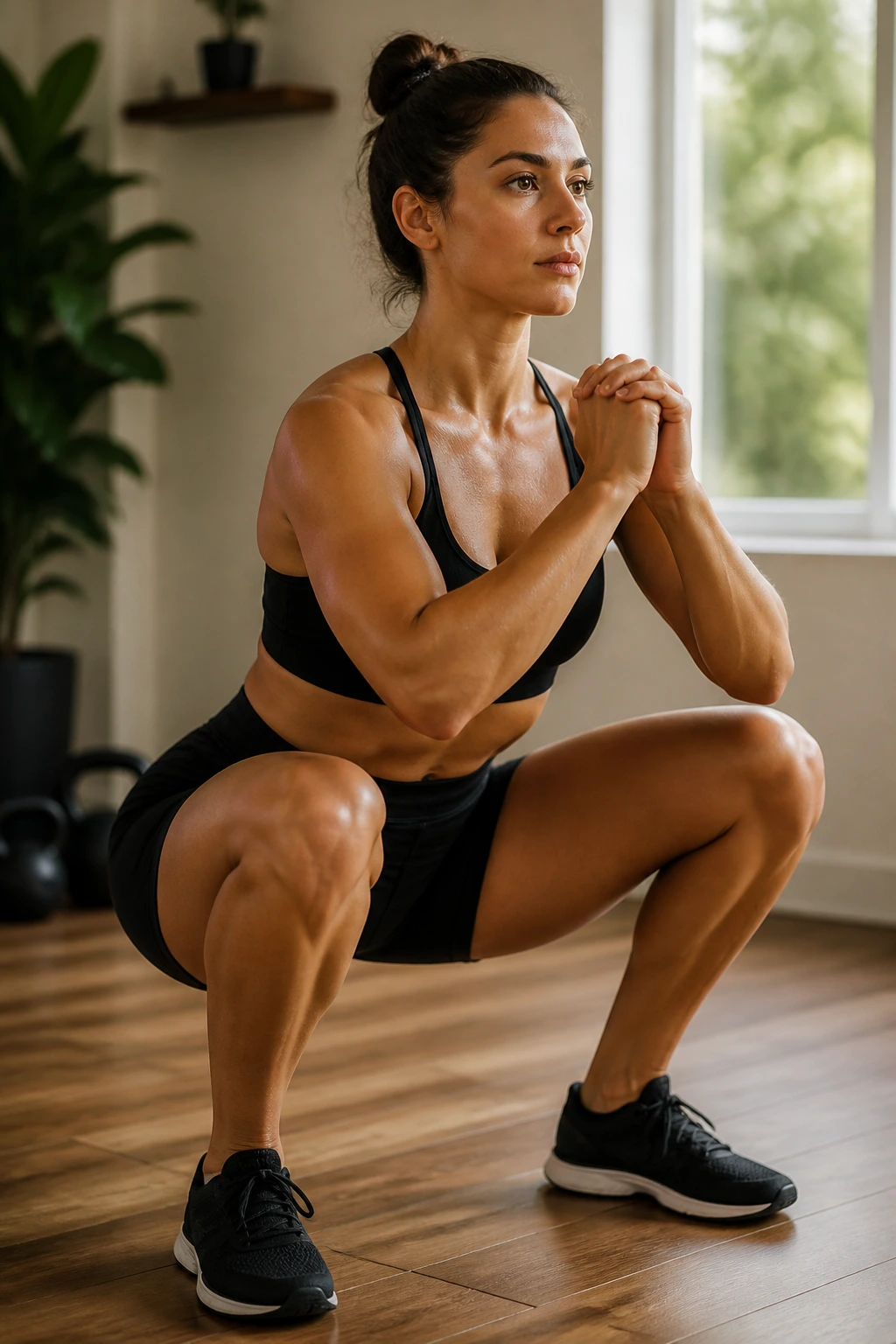
The air squat is the foundation of all leg training. If you cannot perform a proper air squat with perfect form, you have no business loading a barbell onto your back. To do this right, stand with your feet shoulder-width apart, toes pointed slightly outward. As you lower your hips, keep your chest upright and your heels firmly planted on the floor.
The Mechanics of Depth
Many people stop halfway down, essentially performing a “half-rep” that keeps the tension in the knees rather than the hips. Aim to get your thighs at least parallel to the floor, or slightly lower if your mobility allows. Think about pushing your knees outward as you descend—this engages the glutes immediately and prevents the knees from collapsing inward, which is the most common cause of joint pain.
Why This Is Essential
- It builds foundational range of motion in the hips and ankles.
- It teaches you how to brace your core while your lower body moves independently.
- It provides immediate feedback on your flexibility; if your heels lift, your calves are likely too tight.
Pro tip: Pretend you are sitting back into a chair that is just an inch further away than you think. This forces your hips to hinge properly rather than letting your knees drift over your toes excessively.
2. Reverse Lunges
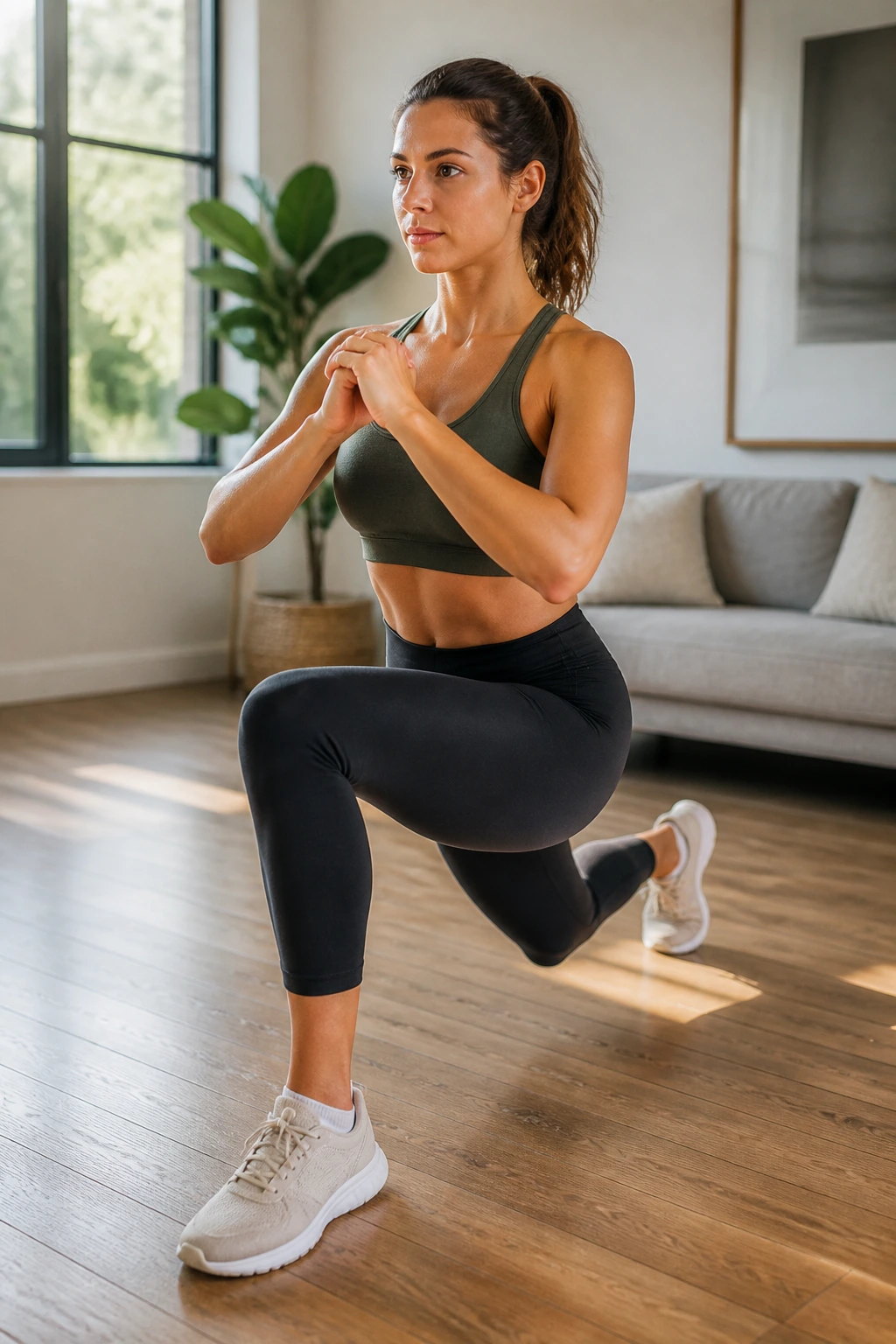
While forward lunges can sometimes put unnecessary pressure on the patellar tendon, the reverse lunge is much kinder to the knees. Stepping backward forces your body to stabilize the weight on the front leg, which is precisely the limb you want to be working.
When you take that step back, focus on landing on the ball of your foot rather than slamming your heel down. Your front shin should remain vertical, and your back knee should hover just an inch or two above the floor. If you find yourself wobbling, shorten your stride slightly. It is better to have a shorter, stable stride than a wide, shaky one that compromises your balance. You should feel the load deep in the glute and hamstring of the front leg.
3. Glute Bridges
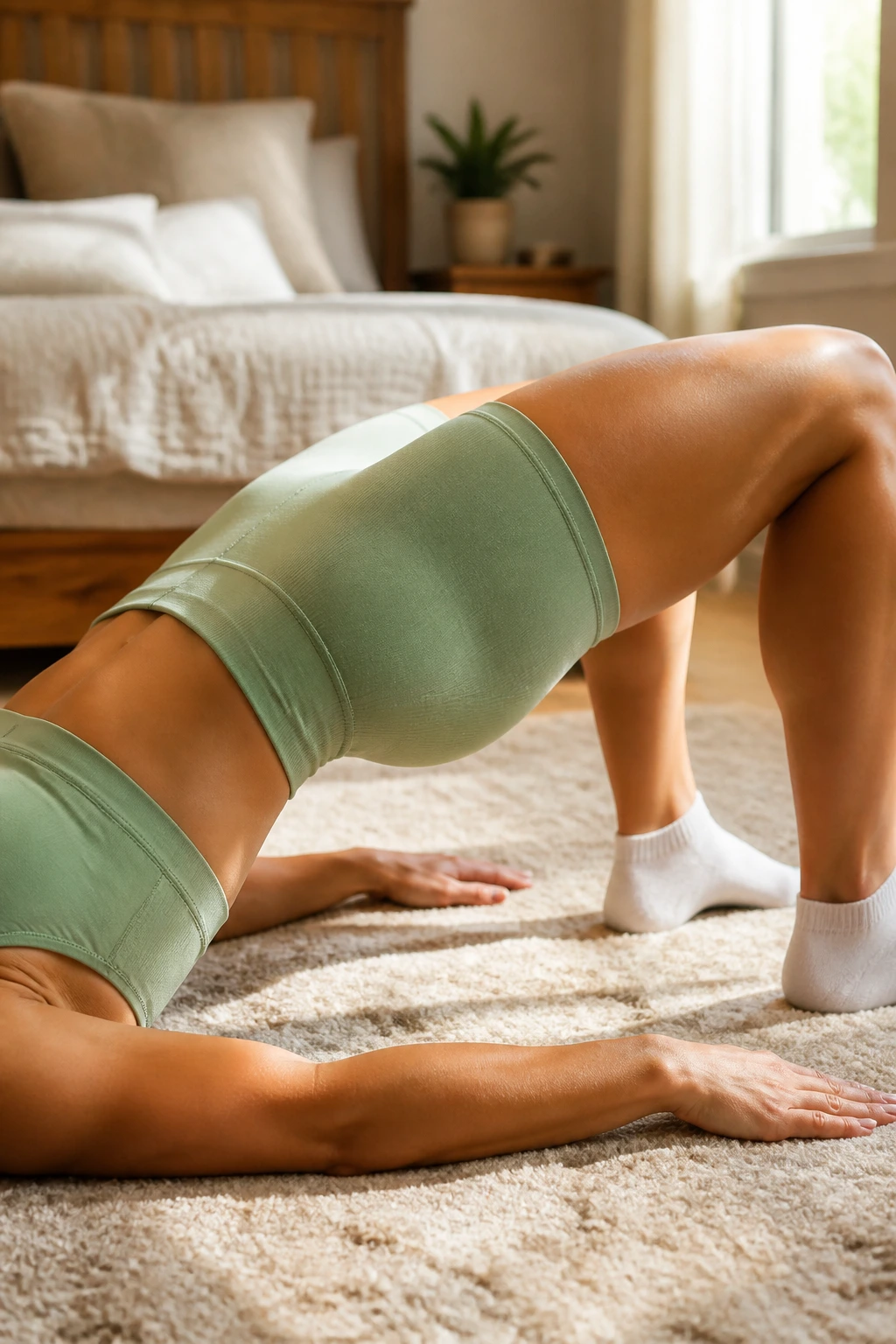
If you spend all day sitting in a chair, your glutes are likely “asleep.” The glute bridge is the single best way to wake them up. Lie on your back, knees bent, feet flat on the floor about hip-width apart. Push through your heels to drive your hips toward the ceiling.
Getting the Contraction
At the top of the movement, squeeze your glutes as hard as you can. Do not just lift until your hips are straight; pull your ribs down to prevent your lower back from arching excessively. If you arch your back, you are using your lumbar spine to do the work instead of your glutes. Hold that squeeze at the top for a solid two seconds before slowly lowering back down.
Key Variations
- Feet elevated: Place your feet on a sturdy chair or couch to increase the range of motion.
- Pause reps: Hold the top position for five seconds on every single repetition.
- Slow eccentric: Take three full seconds to lower your hips back to the floor.
4. Side Lunges
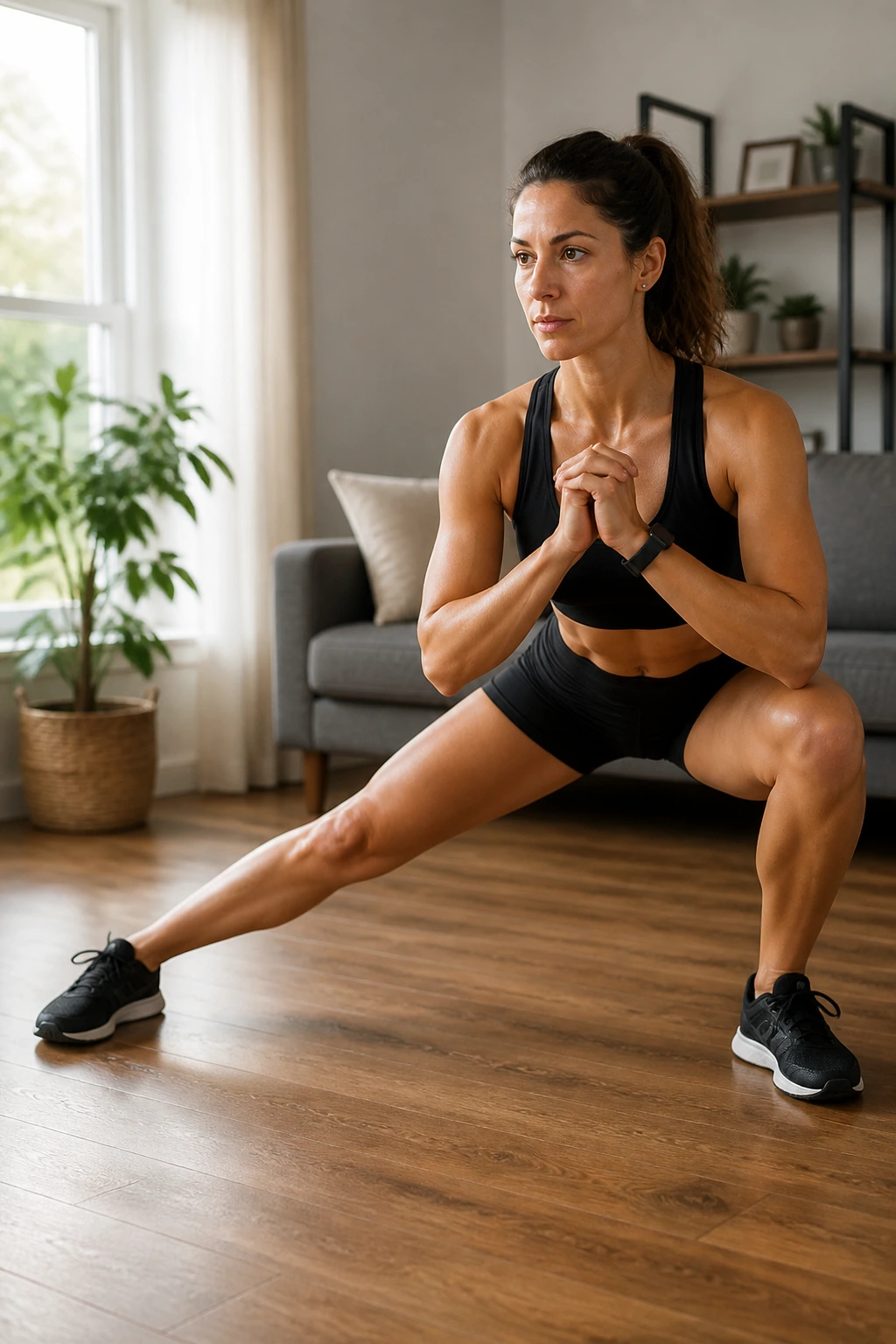
Most of our daily movement is forward and backward. We rarely move laterally, which is why the side lunge (or lateral lunge) often leaves people feeling sore in muscles they forgot they had. This exercise targets the inner thighs and the glute medius, the muscle responsible for hip stability.
Take a wide stance, much wider than shoulder-width. Shift your weight to one side, bending that knee while keeping the other leg perfectly straight. You should feel a deep stretch in the inner thigh of the straight leg. Keep your chest up—do not let your torso collapse toward the floor. If you feel like you are tipping over, reach your arms out in front of you to counterbalance your weight.
5. Sumo Squats
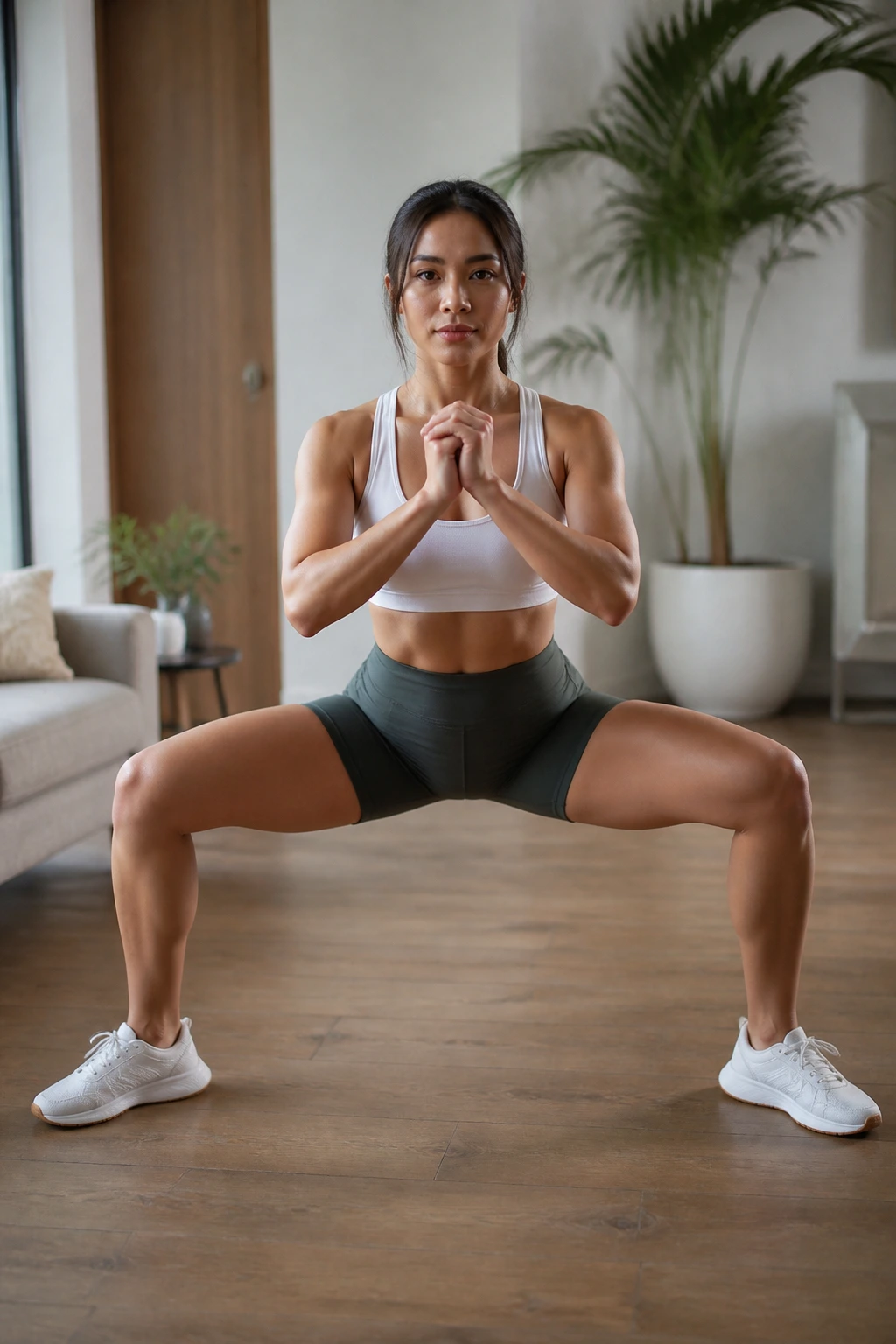
Take your feet out wide—wider than your normal squat stance—and point your toes outward at about a 45-degree angle. This setup shifts the focus dramatically toward your inner thighs (adductors) and glutes. Because of the wide stance, you do not need to squat as deep to feel a massive amount of tension.
Focus on pushing your knees in the same direction as your toes. If your toes are pointed out, but your knees are caving inward, you are putting your joints in a compromised position. Lower yourself with control, and as you stand back up, think about trying to “spread the floor” with your feet. This simple mental cue activates your outer glutes and keeps your hips aligned.
6. Calf Raises
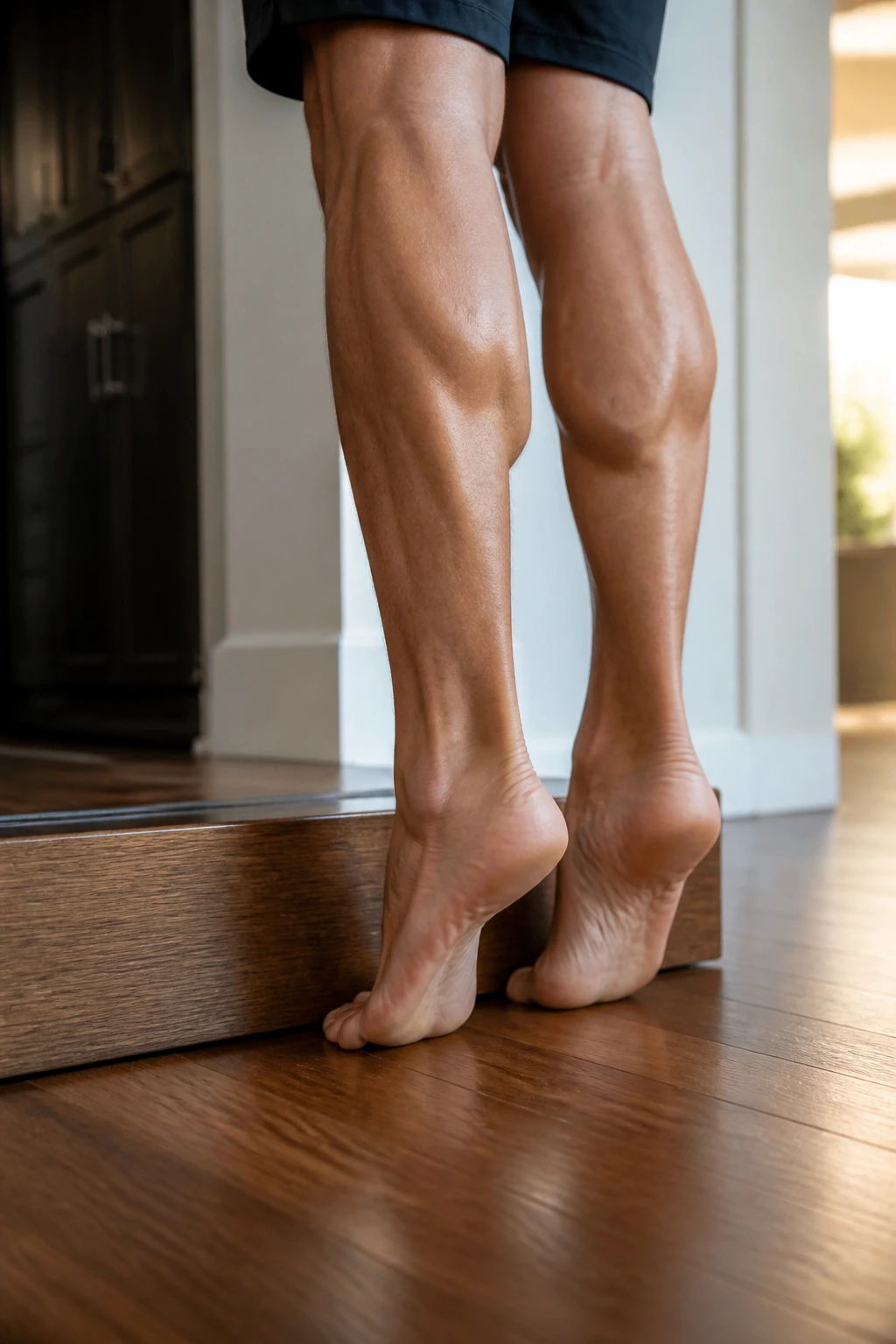
You do not need a machine to train your calves. In fact, doing them with no gear allows for a better range of motion. Find a step, a curb, or a thick book. Stand with the balls of your feet on the edge, allowing your heels to hang off the back.
Lower your heels as far as they will go, feeling a deep stretch in your Achilles tendon and calf muscle. Then, drive up onto your big toe. Do not bounce. The calf is a powerful muscle designed for endurance, so it responds well to higher repetitions. If you can easily do 30 reps, slow down the tempo. A three-second hold at the top—where the burn is most intense—will make a set of 15 feel like a set of 50.
7. Step-Ups
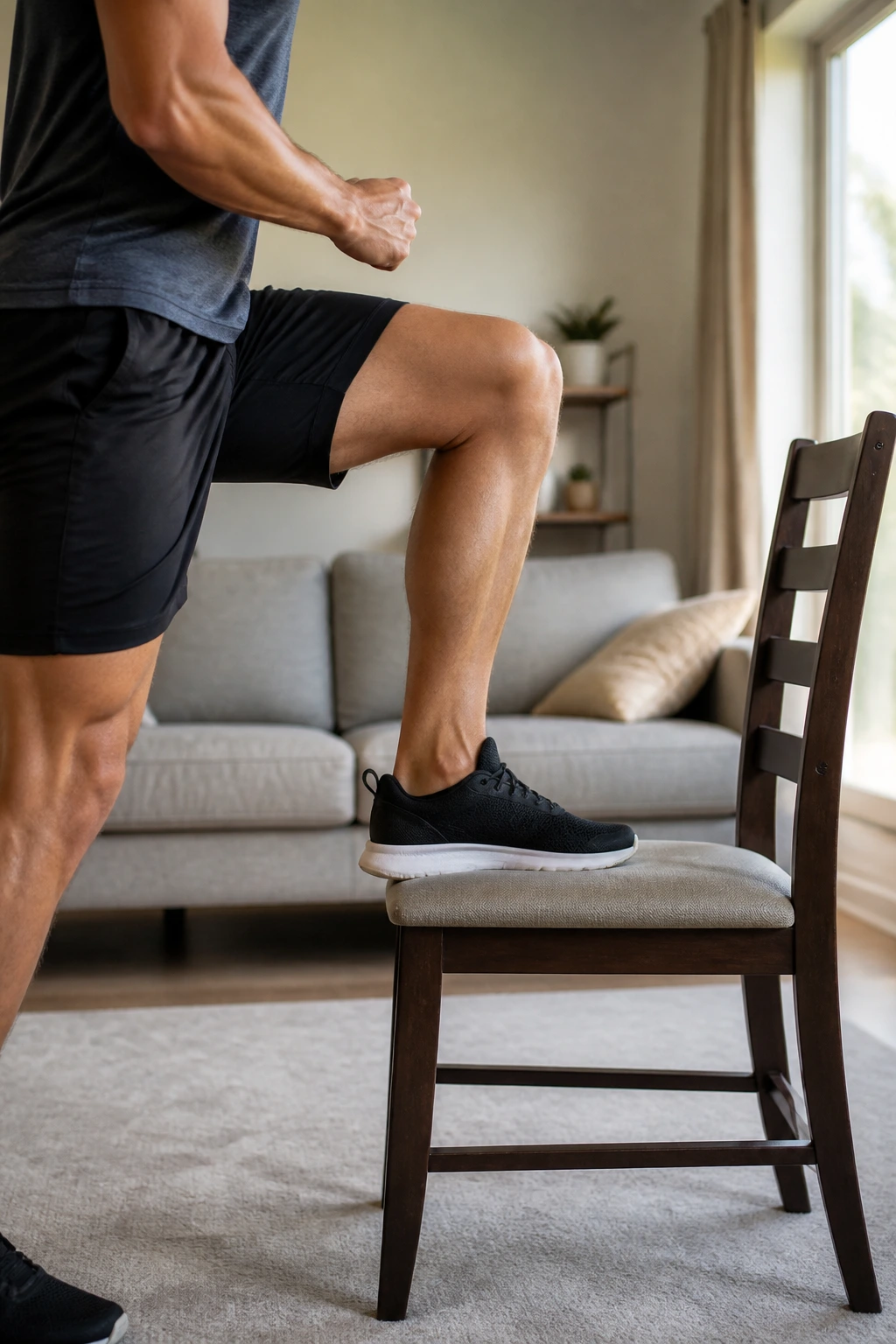
This is a functional movement that builds true leg strength. Find a sturdy chair, a couch, or even a bottom step of a staircase. Place one foot firmly on the surface. Press down through that heel to lift your entire body weight up.
The secret to a good step-up is to resist the urge to push off with the bottom foot. The leg on the chair should do 99% of the work. If you find yourself jumping or using the back leg to “spring” up, you are cheating yourself. Focus on bringing your knee up toward your chest at the top of the movement to really engage the core and hip flexor. Step down slowly—the eccentric (lowering) part of the movement is where much of the muscle growth happens.
8. Bulgarian Split Squats
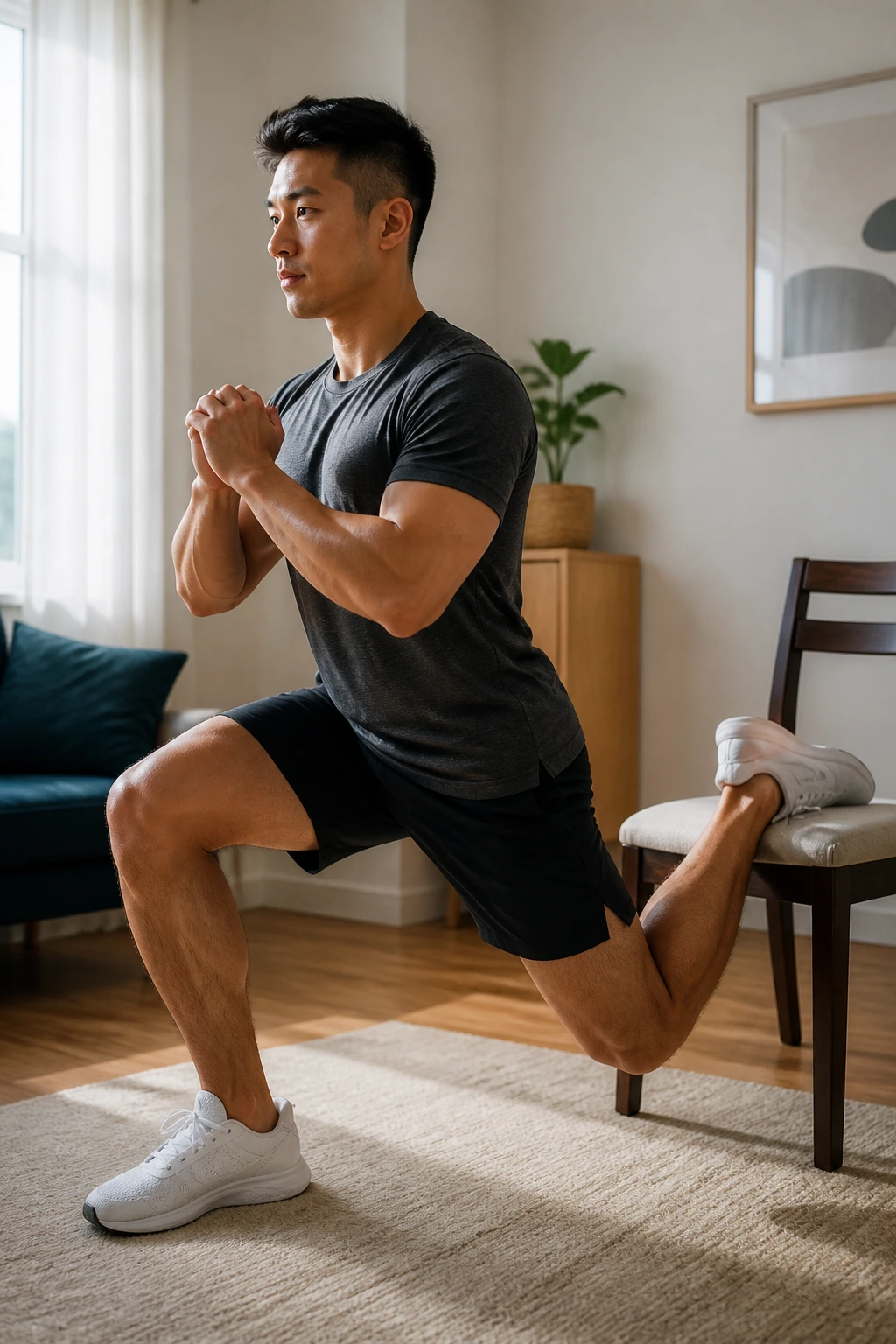
If there is one exercise on this list that will make you regret your life choices, it is this one. It is brutal, it is effective, and it is arguably the best leg builder you can do without a single pound of extra weight. Place one foot behind you on a chair or couch. Take a hop forward with your front leg.
Squat down until your back knee is just off the ground. Your front thigh should be parallel to the floor. The weight should be almost entirely on your front leg. Keep your torso upright—if you lean too far forward, you turn this into a glute-focused movement, which is fine, but keeping it upright hits the quads harder. Be prepared for your legs to shake. That shaking is not a sign to stop; it is a sign that your muscles are reaching true failure.
9. Curtsy Lunges
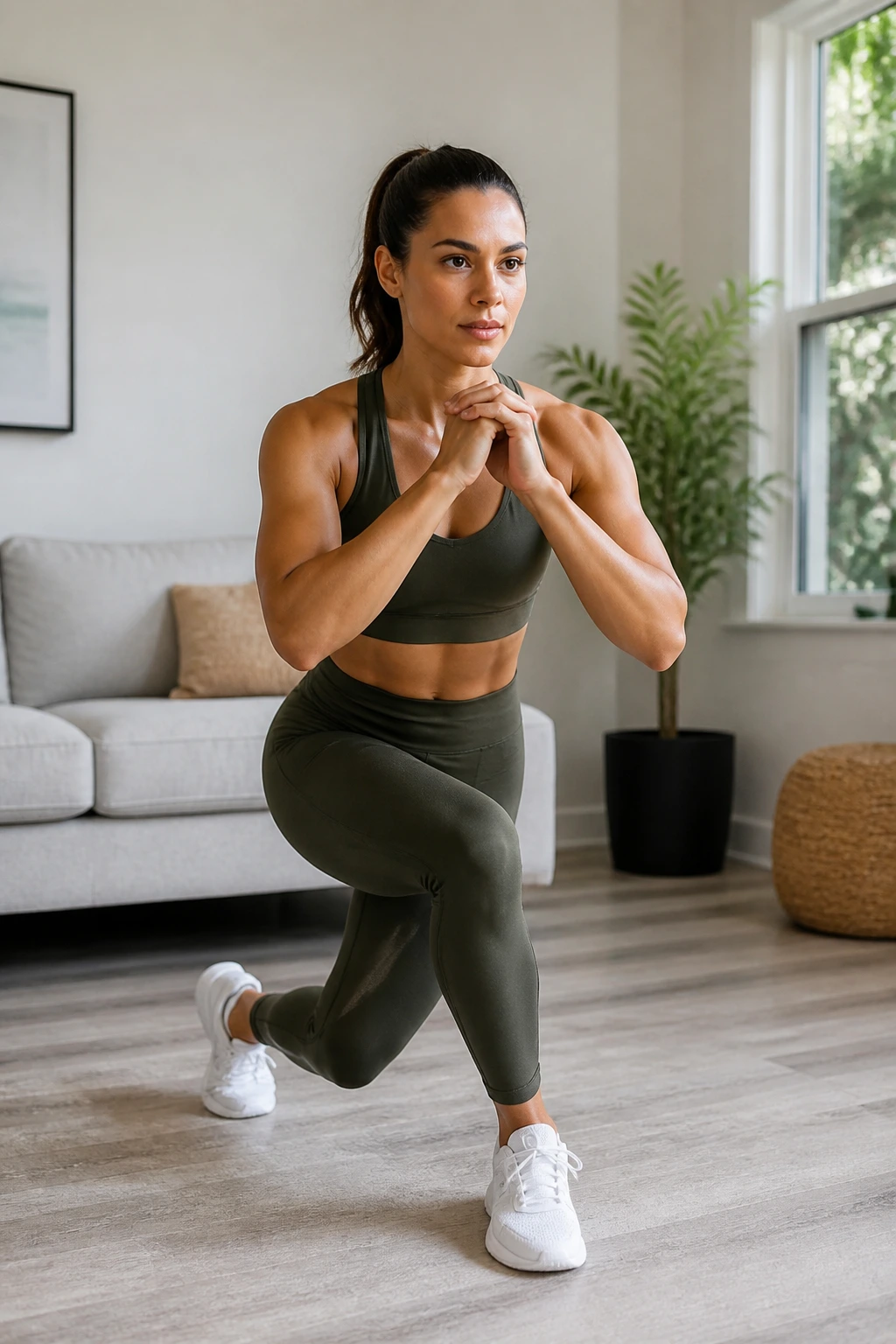
The curtsy lunge is a variation of the reverse lunge that adds a twist, quite literally. Instead of stepping straight back, you step diagonally behind your front leg, as if you are performing a curtsy. This movement hits the glute medius and minimus, the smaller muscles on the side of your hip that give the glutes their shape.
Because this is a more complex movement, start slow. Do not worry about speed. Focus on keeping your hips square to the front. You will notice that one side feels significantly more coordinated than the other—this is normal. Use this exercise to identify and correct your left-to-right muscle imbalances.
10. Wall Sits
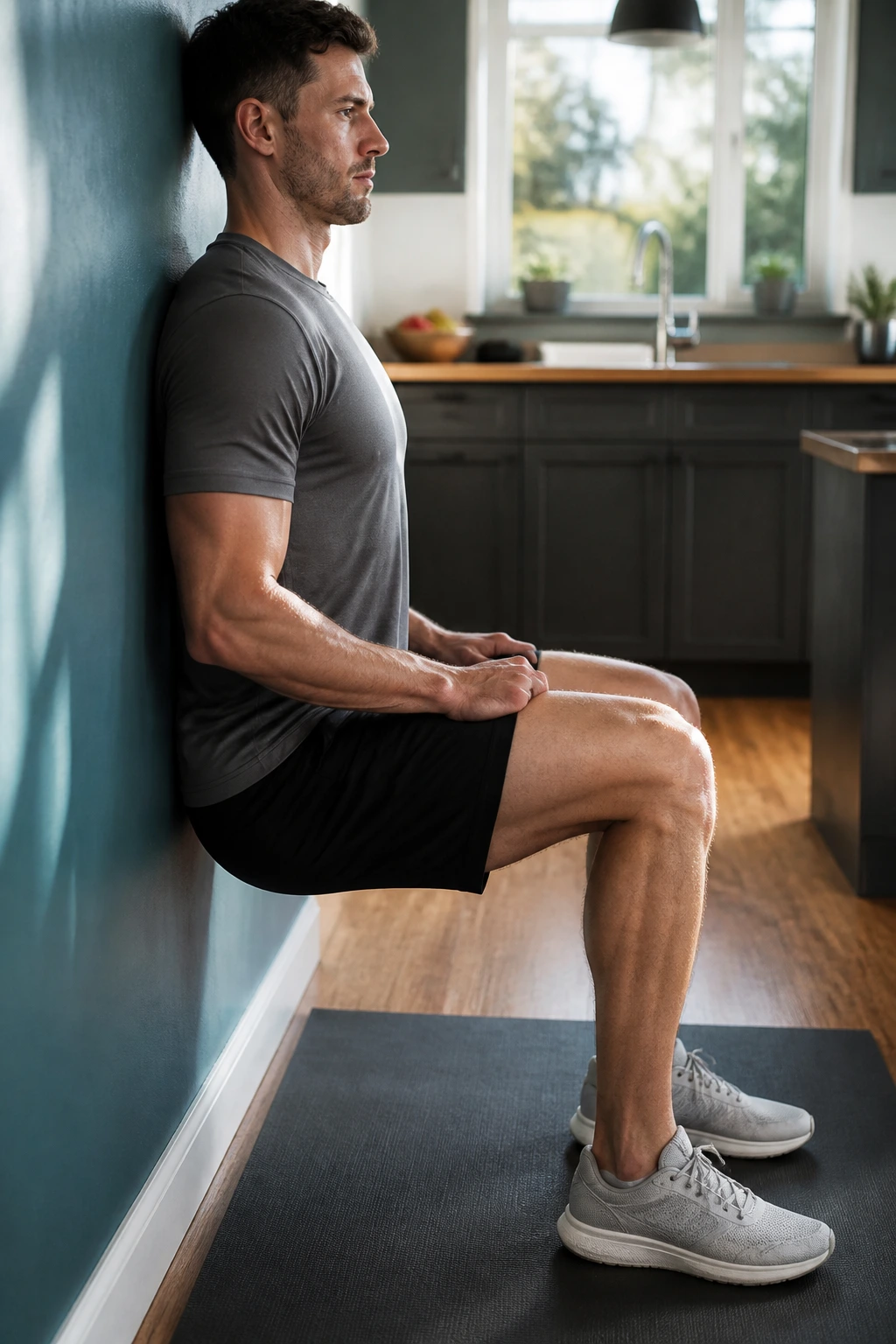
Wall sits are pure, agonizing isometric endurance. They do not build “size” in the traditional sense, but they build incredible knee stability and quadriceps endurance. Lean your back flat against a wall and slide down until your knees are bent at a 90-degree angle.
Your knees should be directly over your ankles, not pulled back or pushed too far forward. If you feel like your legs are slipping, make sure you are wearing shoes with grip or that you are on a mat. Start by holding for 30 seconds. If that is easy, go for 45, then 60. The challenge is in the stillness; your legs will want to shake, and your brain will want to stand up. Resist both urges.
11. Pistol Squat Progressions
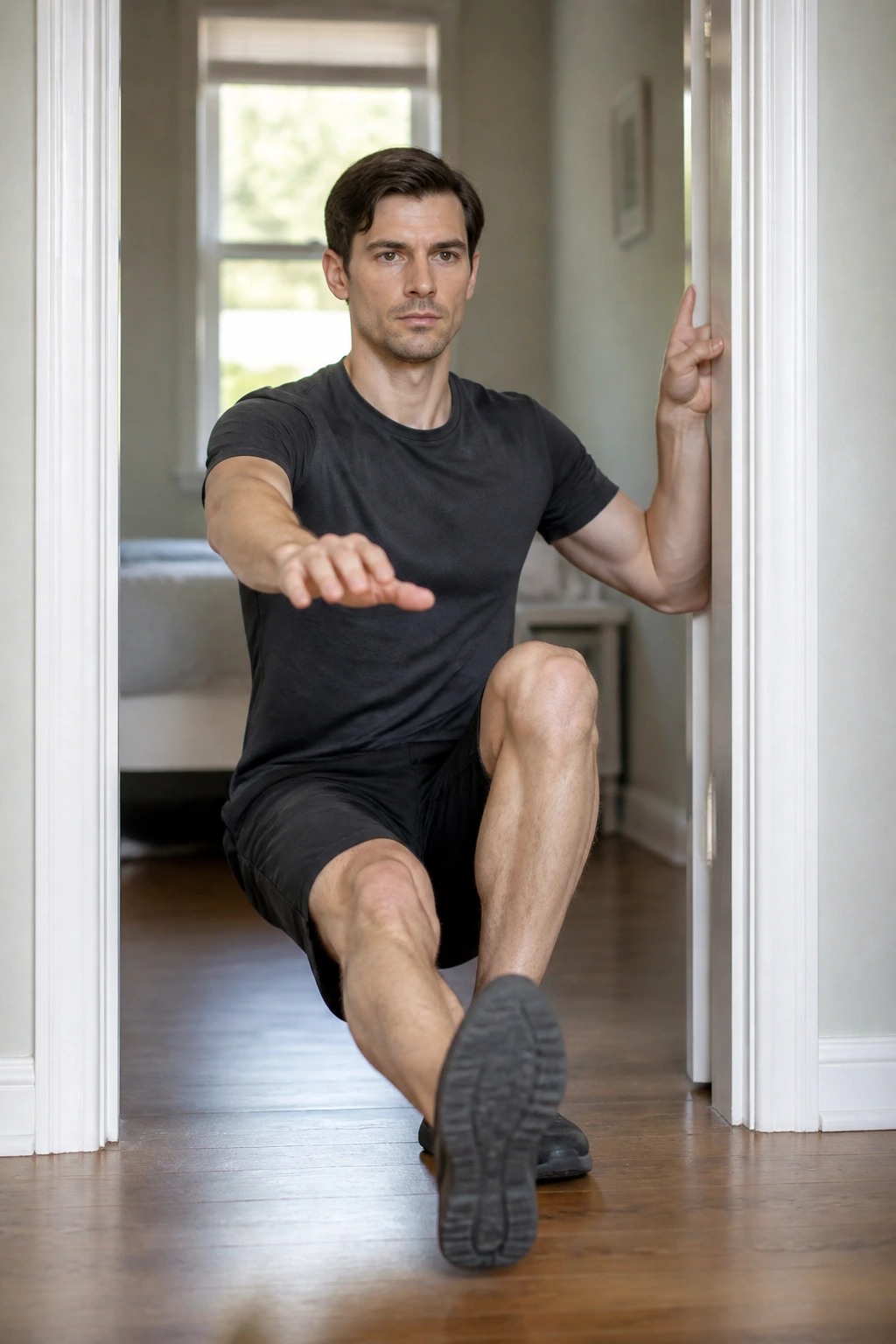
The pistol squat, or single-leg squat, is the gold standard of bodyweight leg strength. It requires not just strength, but balance, ankle mobility, and core control. Do not attempt a full pistol squat on day one. Start by holding onto a doorframe or a sturdy pillar for support.
Extend one leg straight out in front of you while squatting on the other. Use the support to help you get back up, but use as little of it as possible. As you get stronger, reduce your grip from your whole hand to just a few fingers, then eventually to just one finger. This progression allows you to master the mechanics before you rely on raw strength.
12. Skater Hops
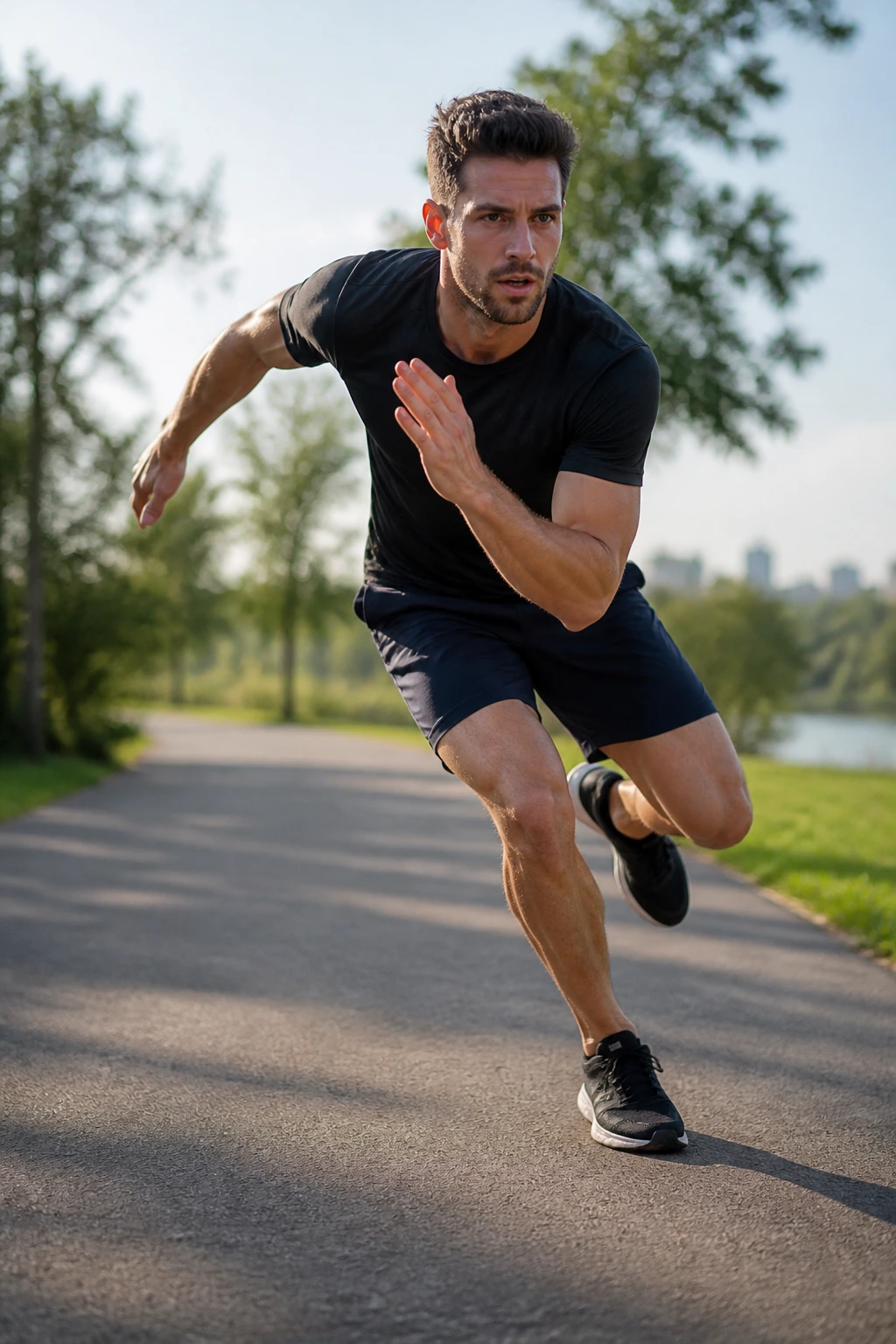
Skater hops bring an element of power and explosiveness to your leg training. From a standing position, leap sideways to the right, landing on your right foot while sweeping your left leg behind you. Then, immediately leap to the left, landing on your left foot.
The goal is to cover as much distance as you can while maintaining a soft, quiet landing. If your landing sounds like a heavy stomp, you are not absorbing the shock correctly. Use your glutes and quads to act as shock absorbers. This exercise is fantastic for athletic conditioning and firing up the stabilizing muscles around your ankles.
13. Donkey Kicks
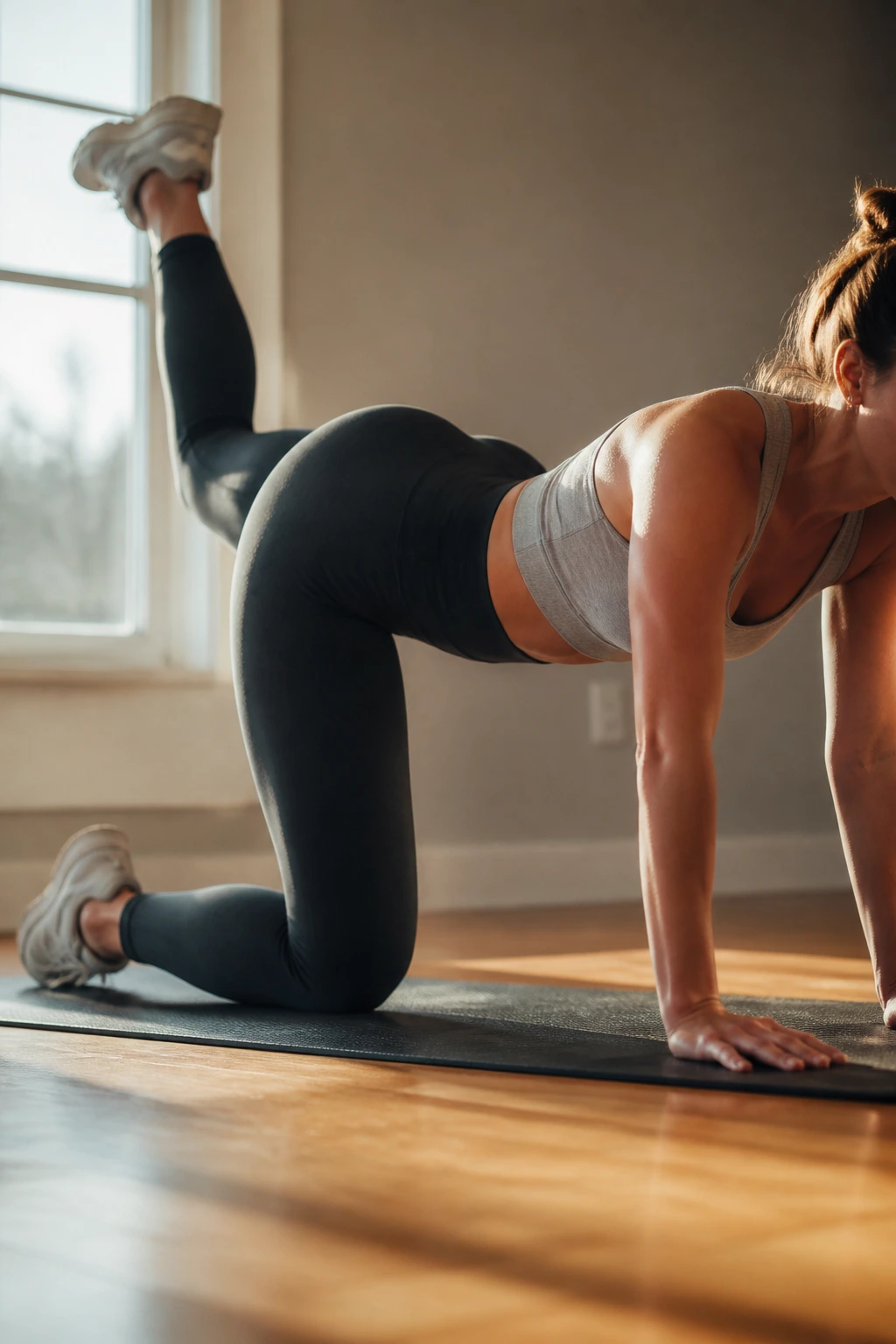
Donkey kicks are a direct, focused glute exercise. Get on your hands and knees in a tabletop position. Keeping your knee bent at 90 degrees, kick one leg straight up toward the ceiling as if you are trying to stomp a footprint on the sky.
The movement should come from your hip, not your lower back. If you kick too high and your back arches, you have gone too far. Focus on the squeeze at the top of the movement. You can hold a small weight (like a water bottle) behind your knee if you need more resistance, but for most people, the tempo is what makes this hard. Do not just swing your leg; control it.
14. Fire Hydrants
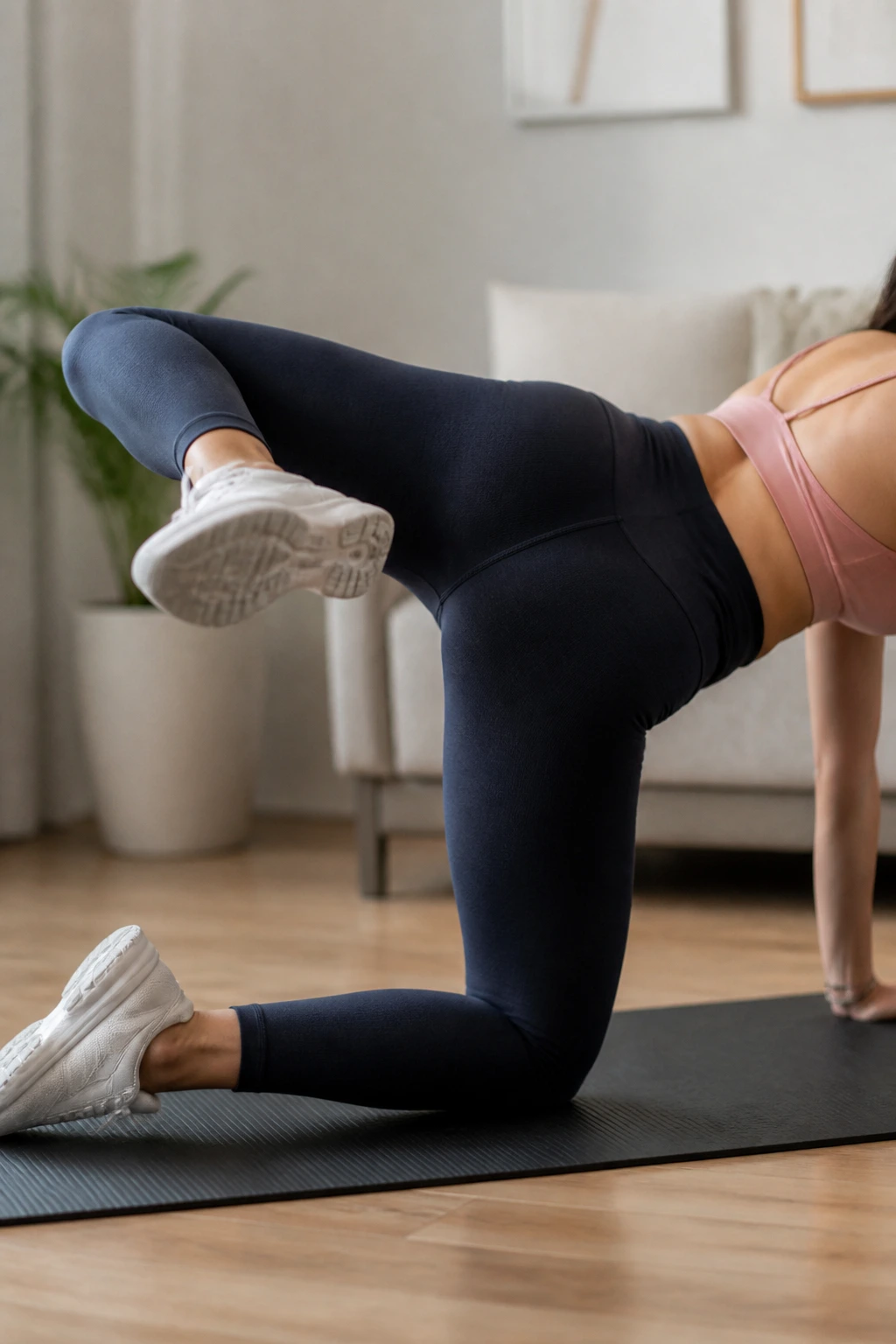
This exercise is not glamorous, but it is one of the most effective ways to isolate the glute medius. From the same tabletop position as the donkey kick, lift one leg out to the side while keeping the knee bent. Think about lifting your knee toward the ceiling, keeping your back flat.
Do not let your hips rotate toward the floor as you lift. Your pelvis should remain square to the ground throughout the movement. If you find yourself leaning heavily to the opposite side to get your leg higher, try to stay centered. This exercise is less about range of motion and more about the isolation of the hip abduction.
15. Jump Squats
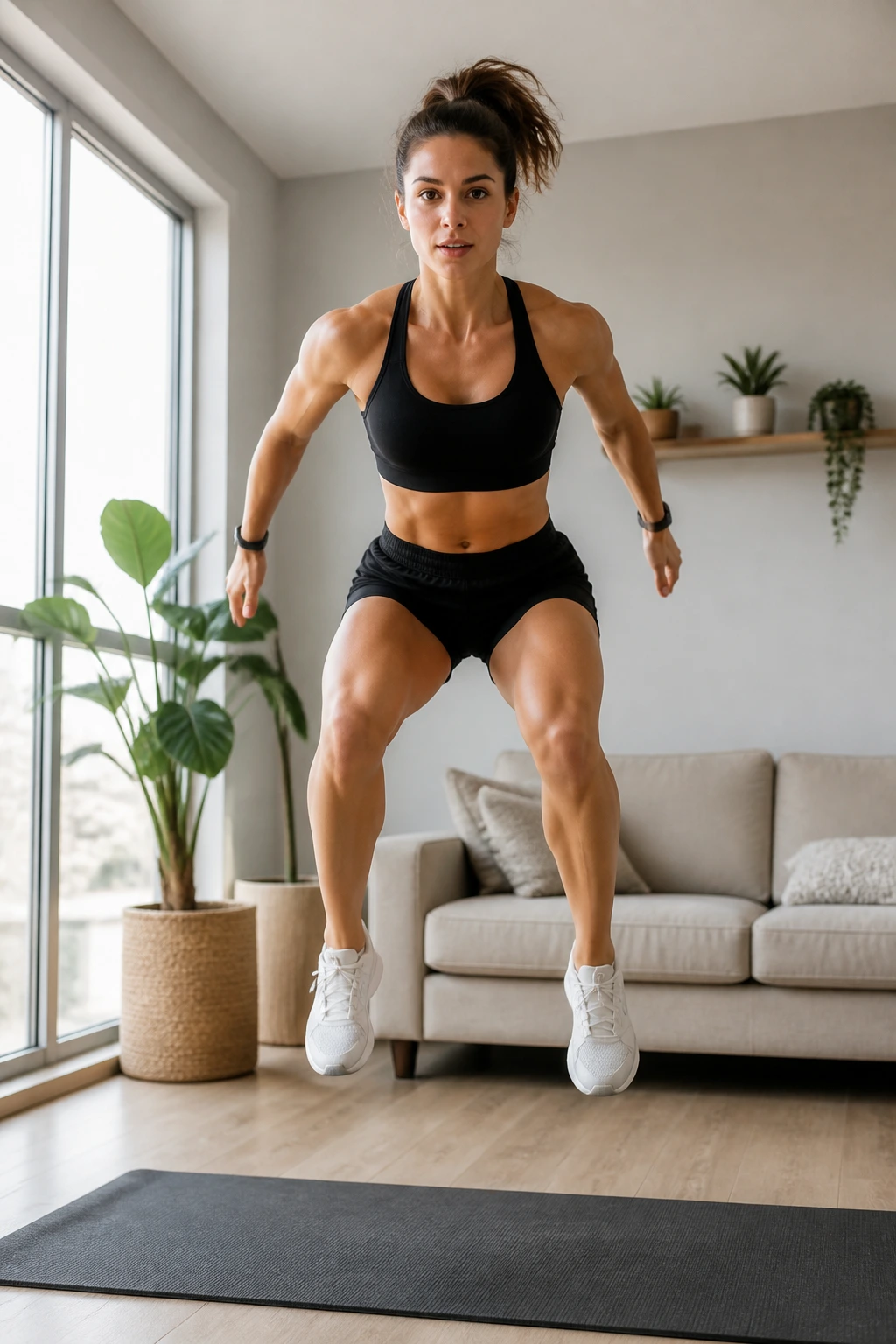
If you want to build power and athletic legs, you need to add explosive movements. The jump squat is the most accessible plyometric exercise. Perform a standard air squat, but as you reach the bottom, explode upward and leave the ground.
Land softly. The landing is more important than the jump. Your knees should never be locked on impact; they should bend immediately to absorb the force. If you struggle with joint pain, focus on the descent of the squat and a fast, controlled stand-up rather than a full jump. You still get the leg-burning benefits without the impact.
16. Cossack Squats
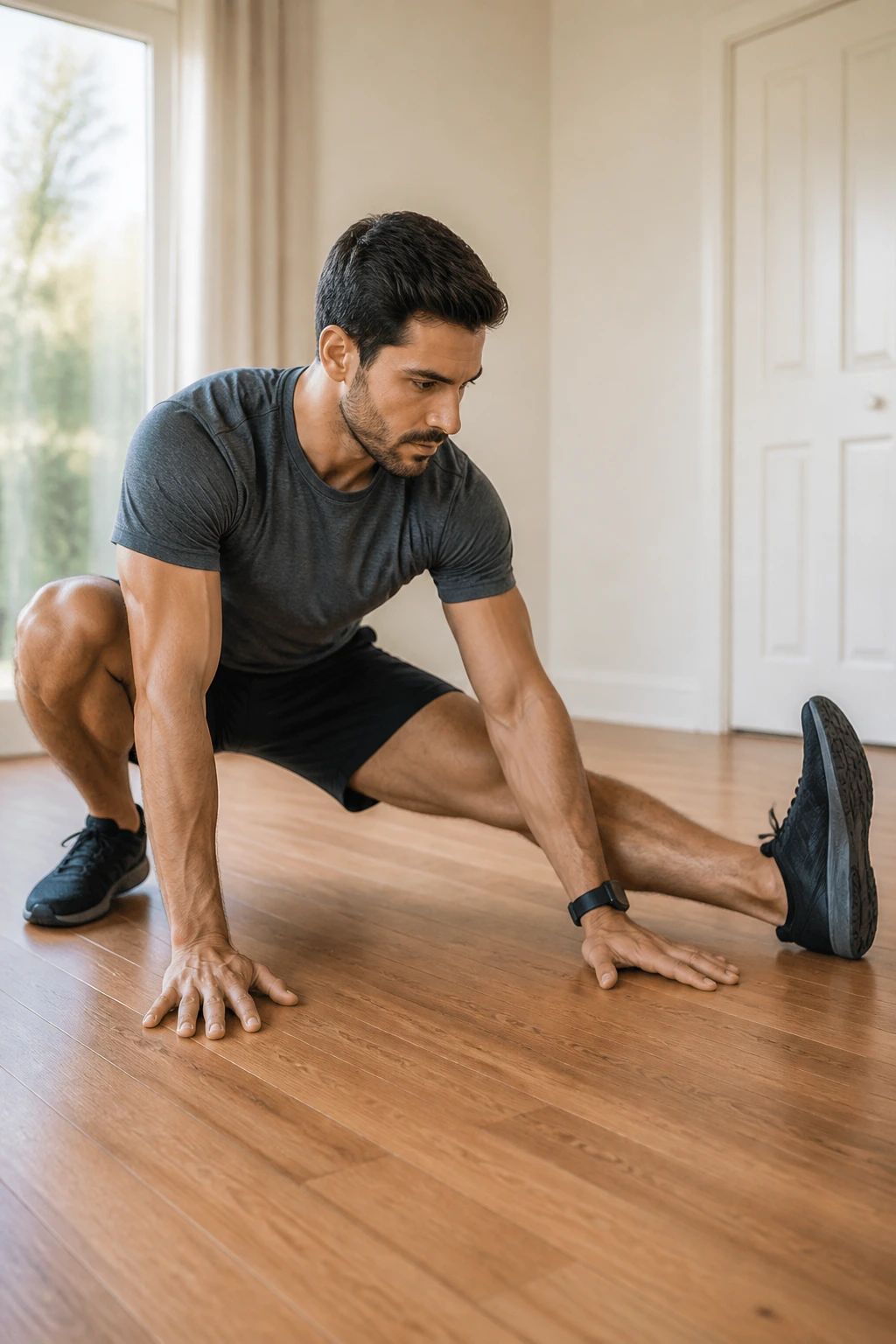
The Cossack squat is a deeper, more demanding version of the side lunge. From a wide stance, shift your weight to one side, squatting down as deep as you can. While doing this, turn the toes of your straight leg up toward the ceiling, resting on your heel.
This exercise forces incredible ankle mobility and adductor flexibility. Most people cannot get very deep on their first try, and that is okay. Use your hands on the floor for balance if you need to. Over time, you will find you can sit lower and lower, eventually performing the movement without touching the ground at all. It is a fantastic tool for bulletproofing the hips.
17. Single-Leg Glute Bridges
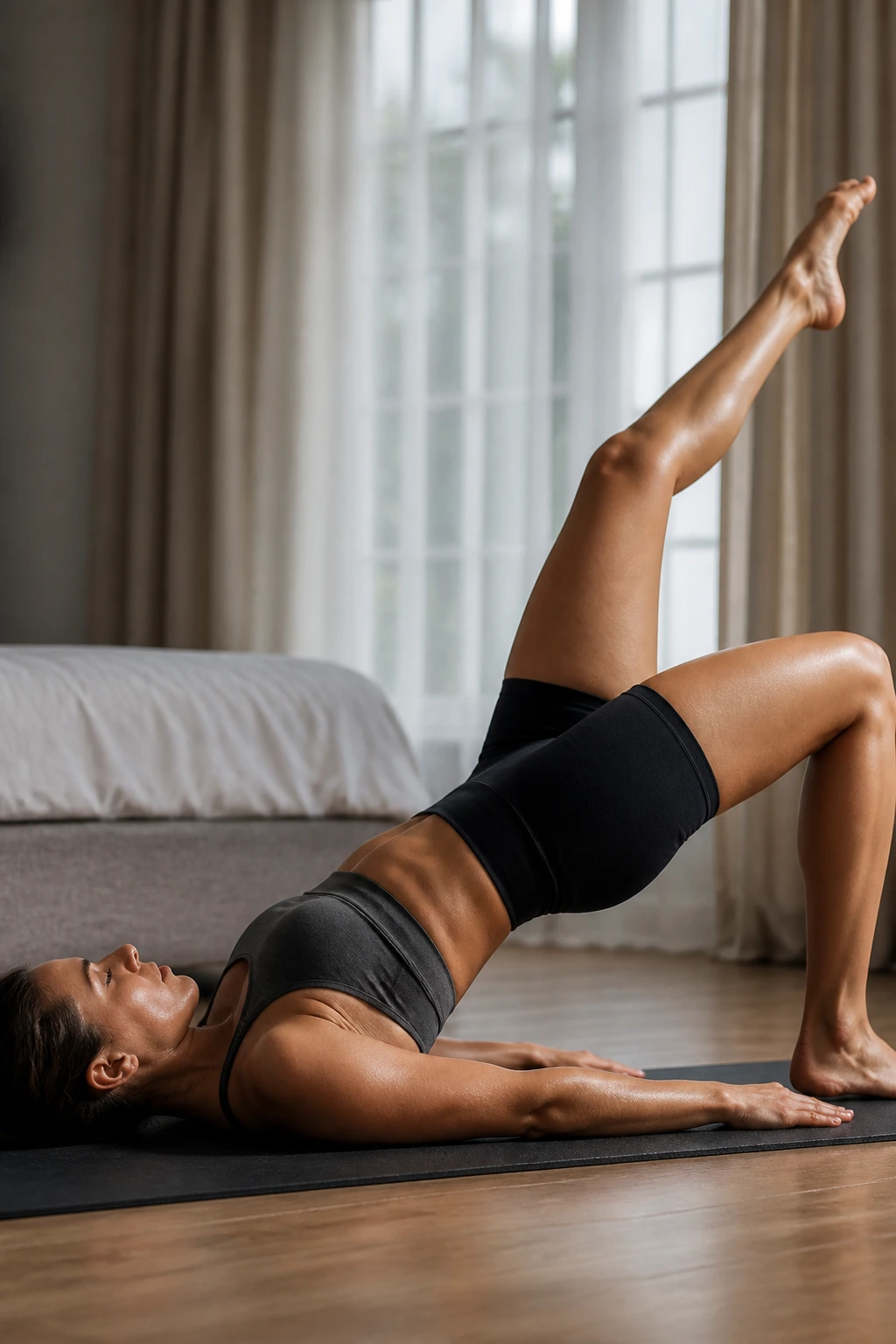
Once you master the standard glute bridge, the two-legged version will eventually feel too easy. That is when you switch to single-leg glute bridges. Lie on your back, knees bent. Extend one leg straight out in front of you—do not let it touch the floor.
Drive your hips up using only the leg that is on the ground. You will immediately feel the increased load on your hamstring and glute. Because you only have one foot on the floor, your body will try to tilt or rotate. Keep your hips level! If your pelvis drops on the side of the extended leg, you are not engaging your core enough.
18. Broad Jumps
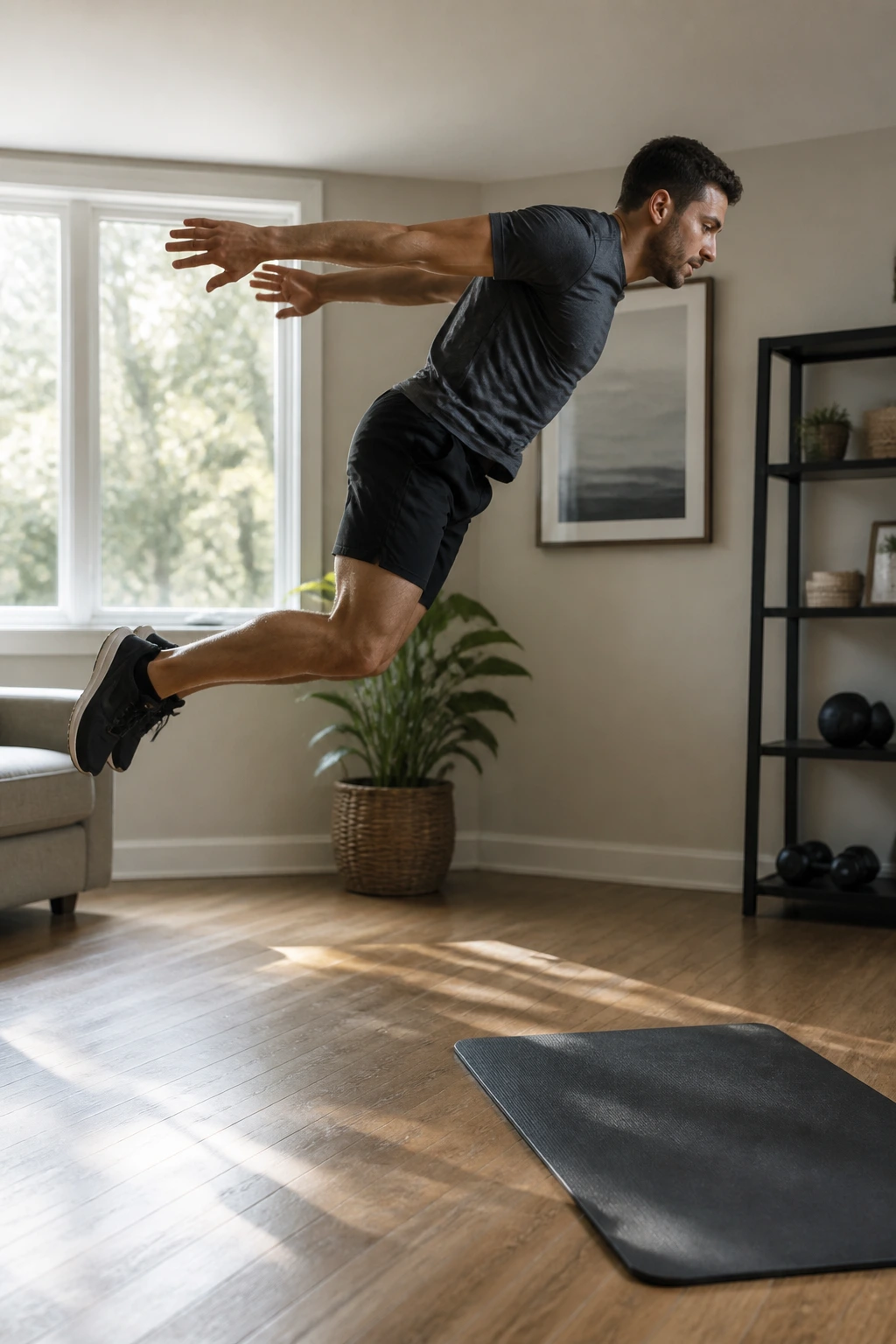
Broad jumps are about horizontal power rather than vertical. Stand with feet shoulder-width apart, swing your arms back, and leap forward as far as you can. Stick the landing. Do not worry about speed; focus on distance and control.
To make this harder, try to turn around and jump back to your starting point immediately after landing. Because you are doing this at home, ensure your floor is not slippery. If you are on a hardwood floor, do this with shoes on or on a yoga mat to prevent sliding. The effort to stabilize your body after a big forward jump creates a massive amount of tension in the quads.
19. Lunge Pulses
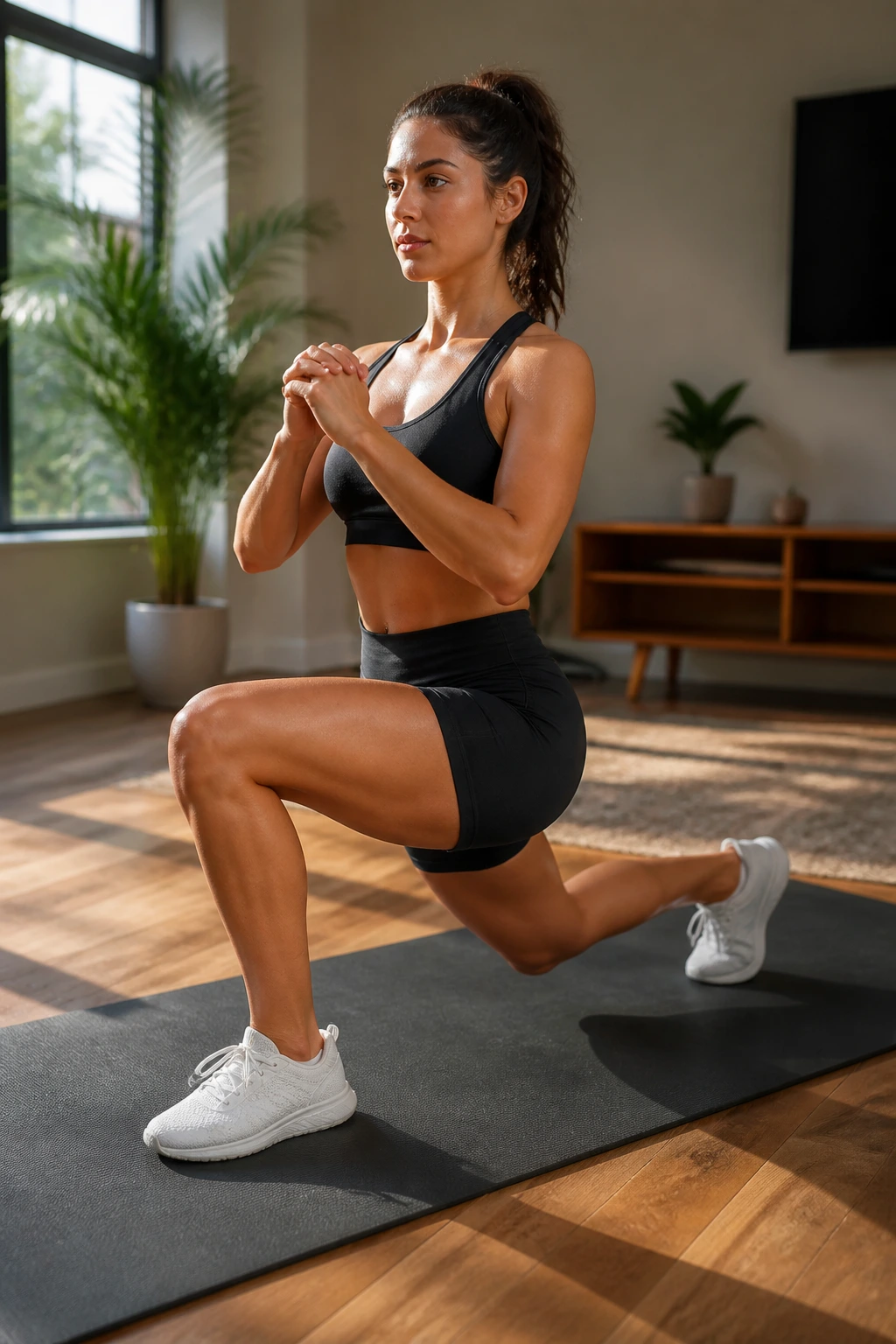
Static lunges are great, but pulses take the discomfort to a new level. Get into a lunge position with one leg forward and one back. Lower yourself halfway down. Now, instead of coming all the way up, stay in that bottom range and move up and down just an inch or two.
The “burn” you feel is the accumulation of metabolic waste in the muscle—it is a sign that you are training the muscle to function under fatigue. Keep your chest up and your core tight. If you start to lean forward, you are moving the tension from your quads to your lower back. Stay vertical.
20. Side-Lying Leg Lifts
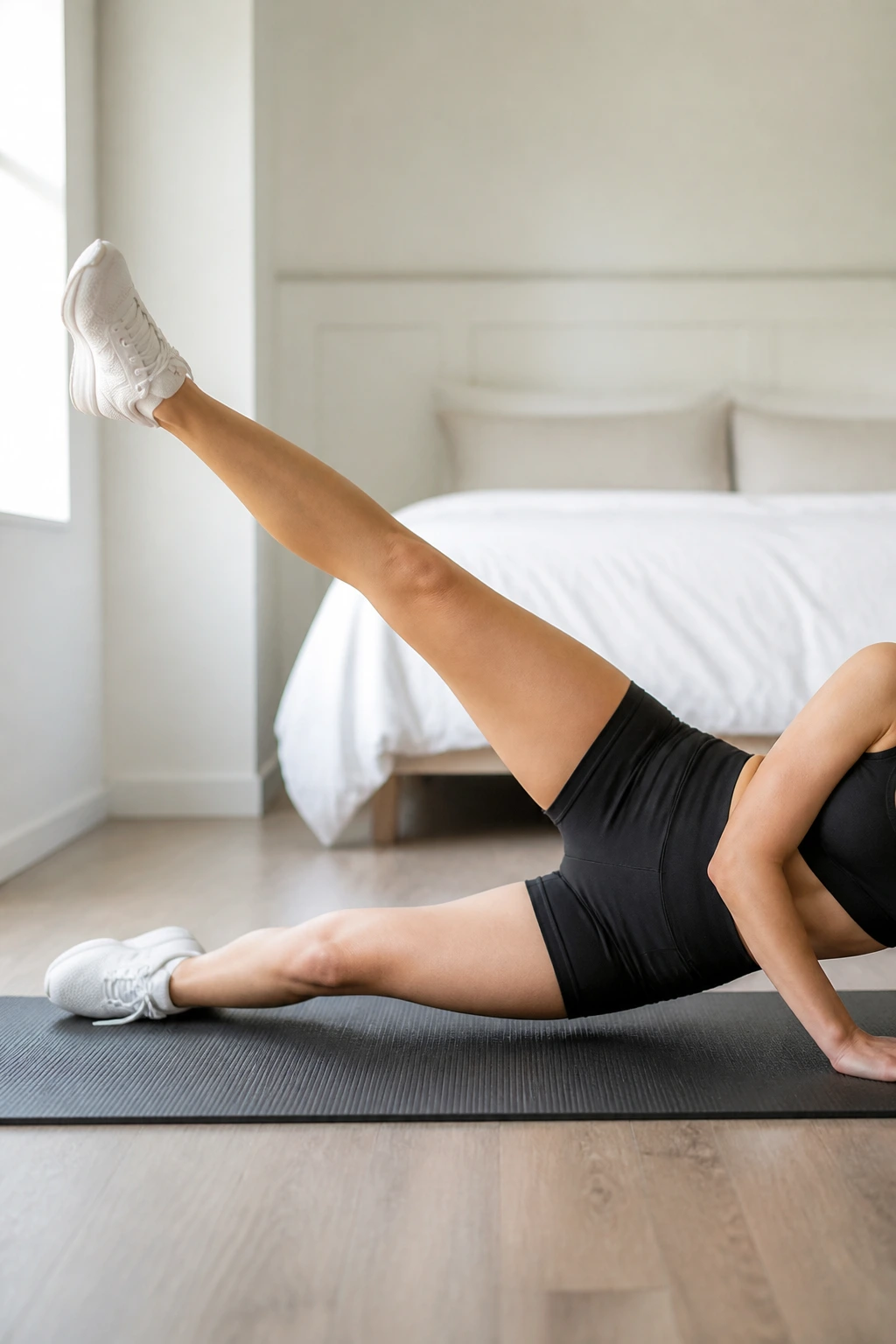
This is a subtle movement that targets the muscles on the outside of your hip and the top of your glutes. Lie on your side, legs stacked. Keep your top leg straight and lift it toward the ceiling, then lower it back down without touching the bottom leg.
The key here is to keep your toe pointed forward, not toward the ceiling. If your toe rotates up, you are using your hip flexors more than your glutes. Move slowly. If you move too fast, momentum does all the work for you. Do 20 reps on one side, then immediately switch to the other side. You will feel this by the end.
21. Box Jumps (or Sturdy Chair Jumps)
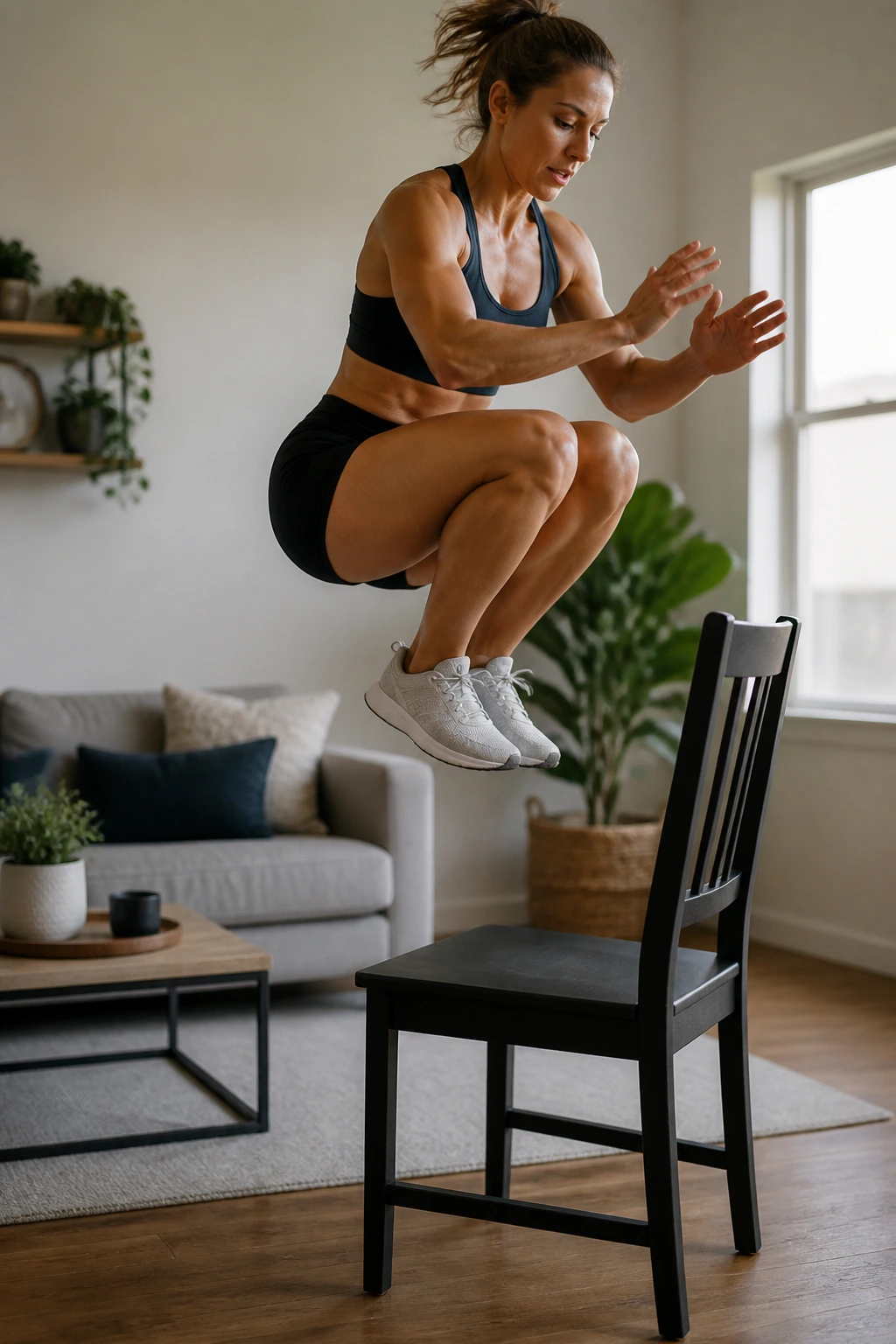
If you have a sturdy chair or a couch, you can perform box jumps. Stand facing the surface. Using your arms to generate momentum, jump with both feet, landing softly on the chair. Stand up straight at the top, then step—do not jump—back down.
Stepping down is a crucial safety rule. Jumping off a box repeatedly puts immense stress on your knees and Achilles tendons. By stepping down, you focus the effort on the jump itself, which is where the power development happens. If you are nervous about the height, start by jumping onto a low ottoman or even just a stack of sturdy cushions.
22. Bear Crawls
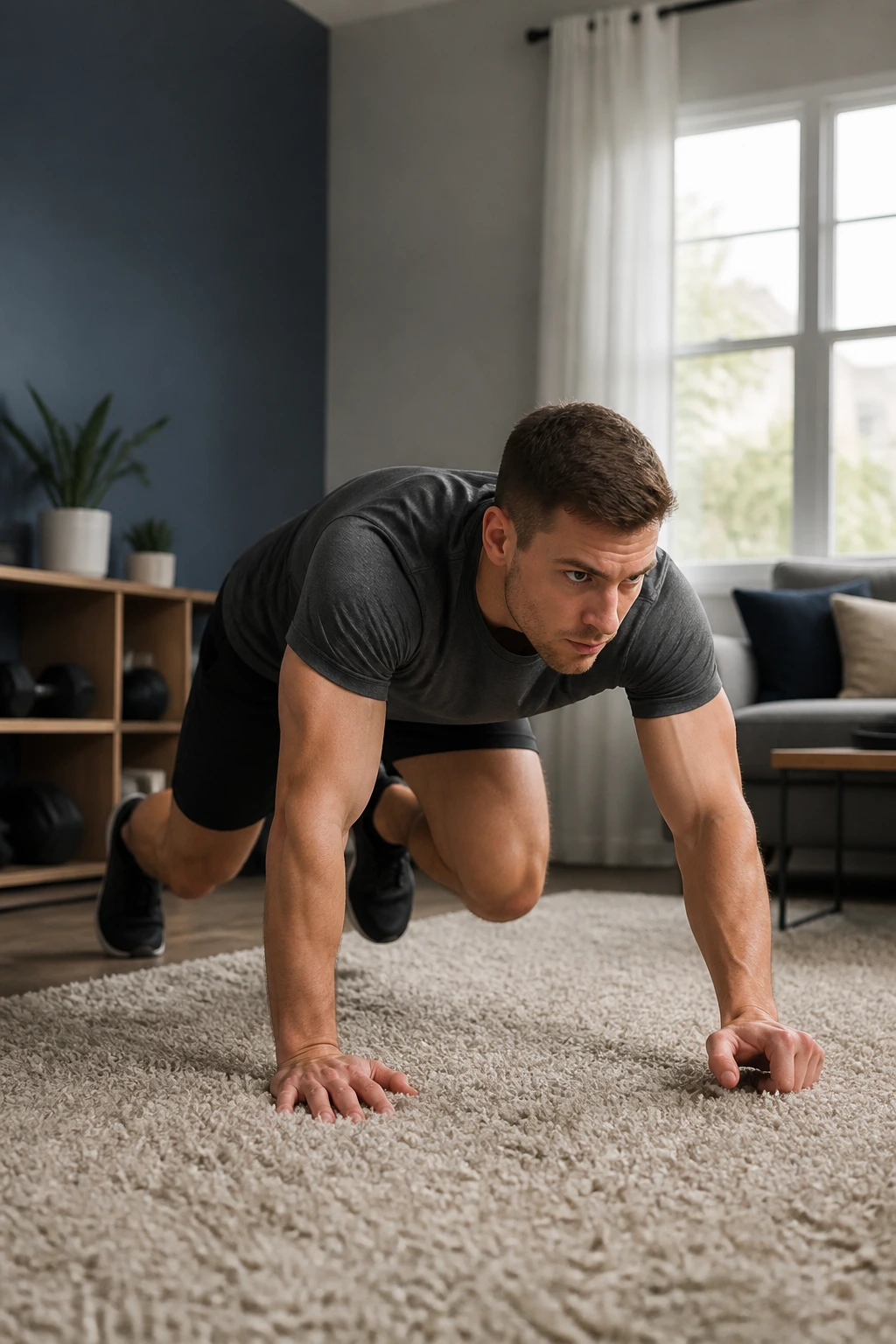
Bear crawls are a full-body conditioning tool that, surprisingly, destroy your legs. Get on all fours, but lift your knees just an inch off the ground. Your back should be flat. Crawl forward, moving opposite hand and opposite leg in unison.
Keep your butt low. If your hips are high in the air, you are just walking on your hands and feet. The goal is to keep your core engaged and your knees close to the floor, forcing your quads to stay in a constant state of tension. Crawling for 30 seconds straight will make your legs burn more than many traditional squats. It is a humble move, but it is a finisher that works.
Final Thoughts
There is a misconception that without external weights, you are destined for “maintenance” rather than “growth.” That is demonstrably false. The human body is incredibly adaptive; if you increase the difficulty of the movement through tempo, range of motion, or shorter rest periods, your legs will respond. You do not need to hunt for gear. You need to hunt for the intensity within these movements.
Pay attention to your form above all else. A perfect air squat is worth infinitely more than ten sloppy ones. If you are just starting, prioritize completing the set with good control before you try to chase a high number of repetitions. Your legs are the largest muscle group in your body—treat them with the respect they deserve by pushing them safely to their limit.
