



Getting to a gym isn’t always possible, and frankly, sometimes it isn’t even necessary. The idea that you need a room full of expensive, clanking iron to lose weight or get in shape is a myth that has kept people from starting for years. Your own bodyweight is one of the most effective tools in existence. When you manipulate that weight with speed and intensity, you create a metabolic demand that rivals any treadmill run or weightlifting session.
You are not looking for a complex, machine-dependent routine that requires a personal assistant just to manage your plates. You want efficiency. You want to walk into your living room, sweat for twenty minutes, and get on with your day, knowing you pushed your heart rate high enough to trigger real physiological change. That is where high-intensity interval training, or HIIT, becomes your best friend.
It is uncomfortable. It is supposed to be. If you aren’t fighting for your breath by the end of a round, you probably aren’t hitting the intensity required to make HIIT the fat-burning engine it’s known to be. But the payoff is undeniable. By cycling between short bursts of near-maximal effort and even shorter rest periods, you force your body to adapt. This is about working smarter, not just longer.
The Mechanics of Home HIIT
At its core, the goal of these workouts is to tap into the excess post-exercise oxygen consumption (EPOC) effect. When you perform steady-state cardio, like a slow jog, your body consumes oxygen at a relatively consistent rate. You burn calories while you are moving, and that’s about it. HIIT flips the script.
By spiking your heart rate, you create an “oxygen debt.” Your body has to work overtime in the hours following your workout to return your systems to a resting state. It has to regulate your body temperature, replenish ATP stores, and repair the muscle fibers you just challenged. That process requires energy. You aren’t just burning calories while you work; you’re burning them while you sit on the couch afterward.
Why No Gear is Actually an Advantage
There is a strange freedom that comes with bodyweight-only training. When you remove the need for dumbbells, kettlebells, or bands, you remove the barrier to entry. There is no setup time. You don’t have to wait for someone else to finish using the equipment. You can do these workouts in a hotel room, a garage, or your own bedroom.
Beyond convenience, there is the factor of functional movement. Machines often lock you into a single plane of motion. Bodyweight movements, especially the ones included in this list, require you to stabilize yourself, engage your core, and move through multiple planes. You aren’t just burning fat; you are teaching your body how to control its own weight in space. That builds a different kind of strength—one that carries over into your actual life.
Essential Safety and Warming Up
Before you dive into these, let’s be clear about one thing: HIIT is taxing. If your joints are screaming or you feel dizzy, stop. There is a difference between the “good hurt” of muscle fatigue and the “bad hurt” of an injury. If you have been sedentary for a long time, take the first few workouts at 70% of your maximum effort. You will still get the benefits.
Never skip the warm-up. Five minutes of dynamic movement is non-negotiable. Get your joints lubricated with arm circles, torso twists, and leg swings. Do some light jogging in place or jumping jacks to get your blood flowing and your internal temperature up. Your muscles are like rubber bands; they snap when they are cold, but they stretch when they are warm. Do not pull a muscle because you were impatient to start.
1. The Classic Tabata Circuit

This is the gold standard of high-intensity training. The protocol is simple but brutal: 20 seconds of work, followed by 10 seconds of rest. You repeat that cycle eight times for a total of four minutes per round. It sounds short, but four minutes of true Tabata intensity will leave you gasping.
Why This Works
The short rest period is the key. You don’t get enough time to fully recover, which means your heart rate stays elevated throughout the entire four minutes. It forces your body to shuttle oxygen into the muscles while they are already screaming for a break.
How to Run It
- Jump Squats: 20 seconds hard, 10 seconds off.
- Mountain Climbers: 20 seconds hard, 10 seconds off.
- Push-ups: 20 seconds hard, 10 seconds off.
- High Knees: 20 seconds hard, 10 seconds off.
- Repeat the full cycle twice.
Pro tip: Do not cheat the 10-second rest. It is there to force you to explode back into the work phase with maximum intensity. If you go slow to pace yourself, you kill the metabolic benefit.
2. The EMOM Challenge

EMOM stands for “Every Minute on the Minute.” You start a timer. At the beginning of the first minute, you perform a specific set of movements. Once you finish those reps, the remainder of that minute is your rest. As soon as the second minute starts, you go again.
The Mechanics of the Clock
The faster you work, the more rest you get. It sounds like a great deal, but it creates a psychological game. If you loaf through the movements, your rest time shrinks. You quickly learn to be efficient and explosive to “buy” yourself more recovery time.
A Solid 20-Minute Routine
- Odd Minutes: 15 Burpees.
- Even Minutes: 20 Air Squats and 10 Hand-Release Push-ups.
- If you finish in 40 seconds, you get 20 seconds of rest. If you take 55 seconds, you only get 5 seconds.
3. The Pyramid Ladder

Ladders are fantastic for mental toughness. You start with a low number of reps, increase them by a set amount each round, and then work your way back down. This prevents you from burning out in the first two minutes because you know the volume is going to climb.
- Round 1: 2 reps of each movement.
- Round 2: 4 reps of each movement.
- Round 3: 6 reps of each movement.
- Round 4: 8 reps of each movement.
- Round 5: 10 reps of each movement.
- Round 6: 8 reps… down to 2.
Movements: Lunge jumps (total reps), V-ups, and Inchworms.
This structure allows you to build momentum. The middle rounds are where the real work happens. Keep your form tight even when your heart is pounding. When you get to the descent, the countdown will give you a second wind.
4. The Deck of Cards Randomizer

Grab a standard deck of cards. Assign a movement to each suit. Hearts might be push-ups, Spades are squats, Diamonds are lunges, and Clubs are sit-ups. Flip a card, do the number of reps on the card, and keep moving until the deck is gone.
Why This Works
The randomness is the secret sauce. You don’t know what is coming next. You might flip a King (count it as 10) for push-ups, then another King immediately after. It forces you to adapt your energy output in real-time. It turns a boring workout into a game, which is often the only way to get through a 20-minute slog when motivation is low.
The Rules
- Number cards = face value.
- Jacks/Queens/Kings = 10 reps.
- Aces = 15 reps (or 1 minute of plank).
- Jokers = 30 seconds of burpees (the “penalty” card).
5. The Upper Body Burnout

Think you can’t hit your chest, shoulders, and triceps without a bench press? Think again. This routine focuses on varying the angles and hand placements to target different heads of the shoulder and pectoral muscles.
The Breakdown
- Diamond Push-ups: 45 seconds.
- Pike Push-ups (for shoulders): 45 seconds.
- Wide-Grip Push-ups: 45 seconds.
- Plank Taps (shoulder taps): 45 seconds.
- Rest: 60 seconds.
Total Rounds: 5.
Keep your core braced the entire time. In a pike push-up, your hips should be high in the air, creating an inverted V shape with your body. Lower your head toward the floor, not your chest. This is the only way to get the shoulder isolation you need without an overhead press machine.
6. The Leg-Dominant Blast

Legs are big muscles. They take a lot of fuel to move. If you want to maximize calorie burn, you have to hit your quads, hamstrings, and glutes hard. This routine is purely for the lower body.
- Jump Lunges: 40 seconds on, 20 seconds off.
- Air Squats: 40 seconds on, 20 seconds off.
- Lateral Skater Hops: 40 seconds on, 20 seconds off.
- Wall Sit (hold): 60 seconds (no movement, just burn).
Repeat this 4 times. By the time you get to the wall sit, your legs will be shaking. That shake is exactly what you are looking for—it’s the muscle fibers firing as hard as they can before they give out. Stay in the squat position as long as you can manage.
7. The Core-Centric HIIT

A strong core isn’t just about aesthetics; it’s about stability. This routine combines dynamic movement with isometric holds to hit your abs from every angle.
Why It Matters
Most people do crunches until their necks hurt. That’s inefficient. To get a strong core, you need to resist rotation, support your spine, and engage your lower abdominals.
- Bicycle Crunches: 60 seconds.
- Plank: 60 seconds.
- Mountain Climbers: 60 seconds.
- Leg Raises: 60 seconds.
- Russian Twists: 60 seconds.
Complete this circuit 3 times. The secret to bicycle crunches is not speed—it is the twist. Bring your elbow to the opposite knee, and make sure your shoulder blade actually leaves the floor. If you aren’t rotating your torso, you are missing the obliques entirely.
8. The 30-Second Sprint Protocol

Sprinting is arguably the most effective way to drop body fat. You don’t need a track for this. You can sprint in place, focusing on driving your knees up and using your arms.
The Methodology
Perform 30 seconds of absolute, 100% effort sprinting. If you aren’t winded at the end, you didn’t give it your all. Follow this immediately with 30 seconds of complete, passive rest.
- Sprint: 30 seconds.
- Rest: 30 seconds.
- Repeat: 15 times.
It sounds simple, but 15 minutes of 1:1 work-to-rest ratio is grueling. The first five rounds will feel easy. Rounds 8 through 12 will be a mental struggle. Round 15 will be a test of character. Don’t slow down on the final set. That is where the adaptation happens.
9. The Animal Flow Inspired Circuit

If you are bored of standard push-ups and squats, move like an animal. Animal movements like bear crawls and crab walks force you to engage muscles you usually ignore. They are incredibly taxing and great for joint mobility.
- Bear Crawl: 45 seconds forward and back.
- Crab Walk: 45 seconds.
- Frog Jumps: 45 seconds.
- Plank to Downward Dog: 45 seconds.
Repeat 4 times. These movements require coordination. You have to think about where your limbs are in space. That extra cognitive load burns more energy and builds functional strength that carries over into everyday life. It’s also significantly more fun than counting reps in a mirror.
10. The No-Repeat Marathon

This is a mental game. You perform 20 different exercises, one after another, with only 10 seconds of transition time between each. You do not repeat a single exercise.
How to Stay Focused
The key here is to have your list written down or memorized beforehand. If you have to stop to think about what comes next, you lose the intensity.
- Movements to include: Jumping jacks, squats, push-ups, lunges, burpees, high knees, skaters, planks, crunches, mountain climbers, squat jumps, shoulder taps, inchworms, jumping lunges, bicycle crunches, glute bridges, wall sits, plank jacks, flutter kicks, and seal jacks.
This is a 20-minute endurance test. Because you are constantly switching muscle groups, you can maintain a higher level of intensity for longer. It keeps your brain engaged and prevents the boredom that often sets in during a repetitive circuit.
11. The Partner-Style Solo Swap

Usually, partner workouts involve one person working while the other rests. You can mimic this alone by alternating between “work” moves and “rest” moves that are still active.
- Work Set: 45 seconds of Burpees.
- Rest Set: 45 seconds of slow, controlled walk-in-place or side-stepping.
By not sitting down during your “rest” periods, you keep your heart rate in the target zone. You are doing 20 minutes of non-stop movement, but the intensity varies. This is excellent for building a massive aerobic base without the monotony of running on a treadmill.
12. Active Recovery-Heavy Intervals
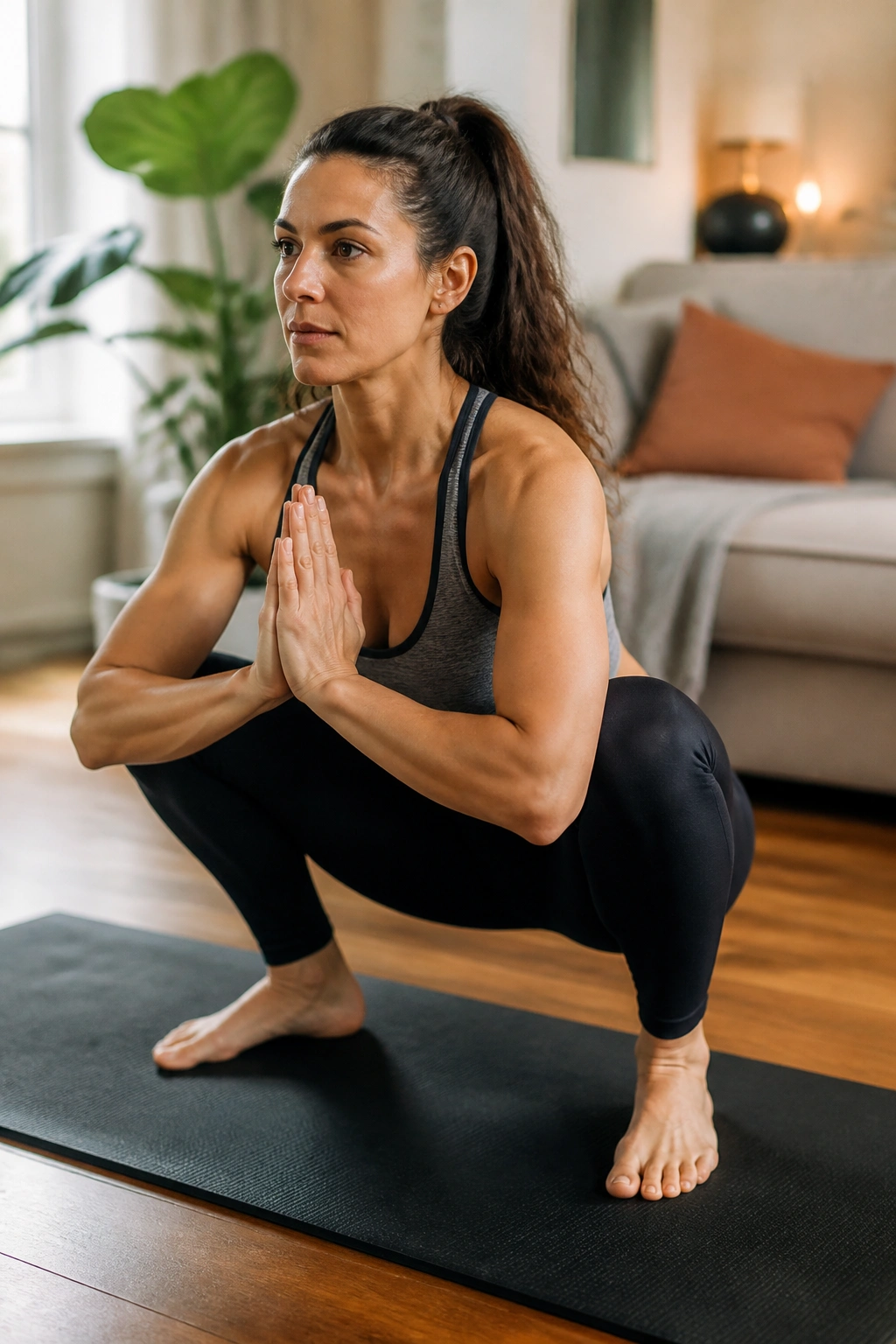
Sometimes your body is tired, but you still want to move. This isn’t a “rest day,” but it is a “lower impact day.” We are going to prioritize mobility and core stability over raw explosive power.
- Deep Squat Holds: 45 seconds.
- Slow-Motion Mountain Climbers: 45 seconds.
- Cat-Cow Stretch: 45 seconds.
- Bird-Dog Holds: 45 seconds (alternating sides).
Repeat 4 times. Even though this isn’t high-impact, you will find that holding these positions creates immense tension. Your core will be burning, and your heart rate will stay elevated just enough to keep the metabolic fires lit.
13. The Burpee Pyramid
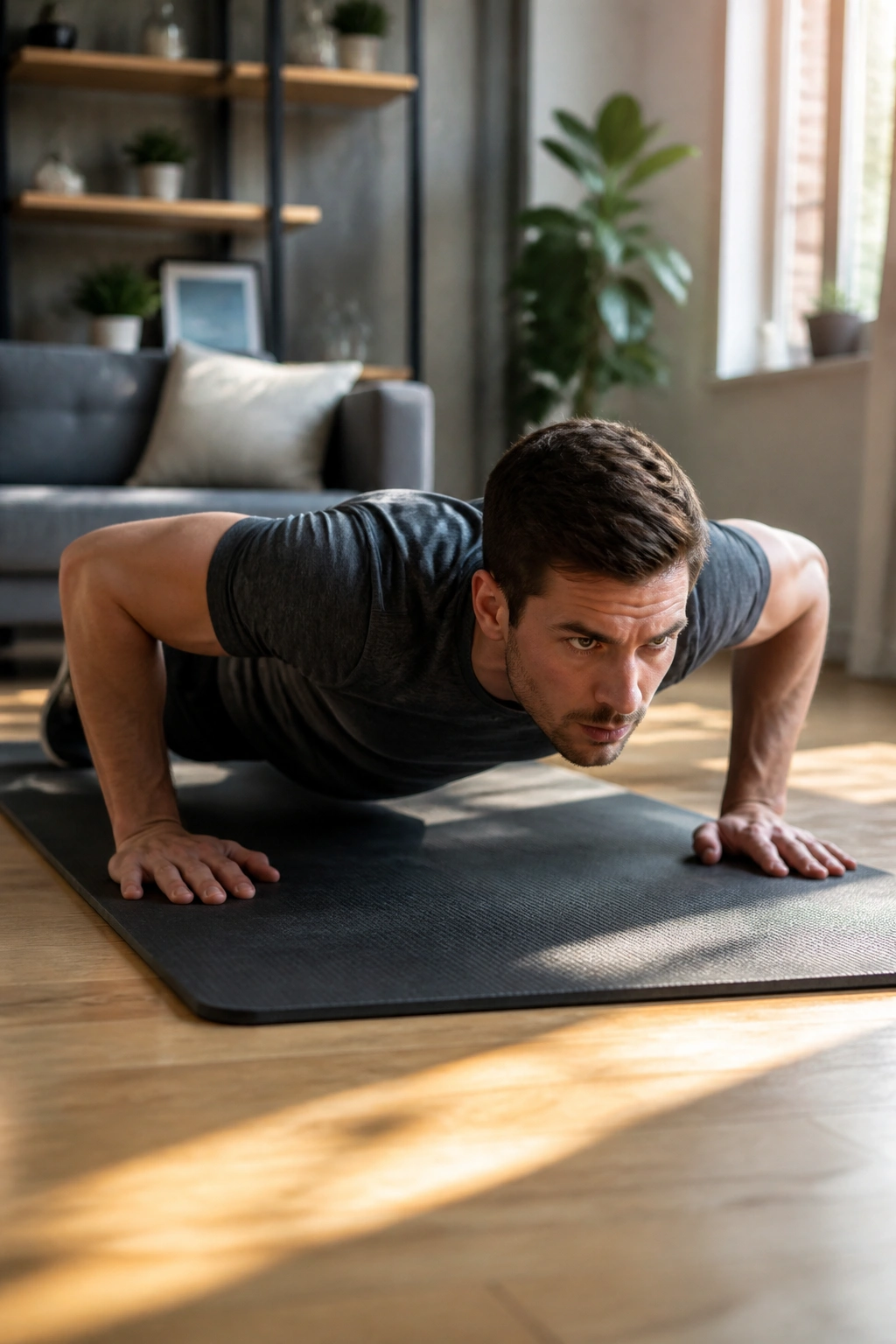
The burpee is the most polarizing exercise in the fitness world. Some love them, most hate them. Regardless, they are unbeatable for fat loss.
- Round 1: 1 Burpee.
- Round 2: 2 Burpees.
- Round 3: 3 Burpees…
- Continue up to 10.
- Then go back down to 1.
The rest is simply the time it takes you to do the reps. In the beginning, this is easy. By the time you reach the 8th or 9th round, your lungs will be burning, and the time between sets will feel nonexistent. This is a mental grind. Focus on your breathing. Inhale on the way down, exhale as you jump up.
14. The Shadow Boxing Special

You don’t need a punching bag to get a boxer’s workout. Shadow boxing is an incredible way to burn calories because it involves constant movement of the feet and torso rotation.
How to Shadow Box
Keep your feet moving. Bounce lightly. Throw combinations: Jab-Cross-Hook-Uppercut. Keep your hands up. If you drop your hands, you aren’t training your core.
- Round 1-3: 3 minutes on, 1 minute off.
- Focus: Constant movement, snapping the punches out, and rotating the core behind every strike.
The intensity comes from your intent. If you throw “lazy” punches, you get lazy results. Pretend you are fighting a mirror. Throw with speed and power. You will be surprised at how exhausted you are after just two rounds.
15. The 10-to-1 Countdown
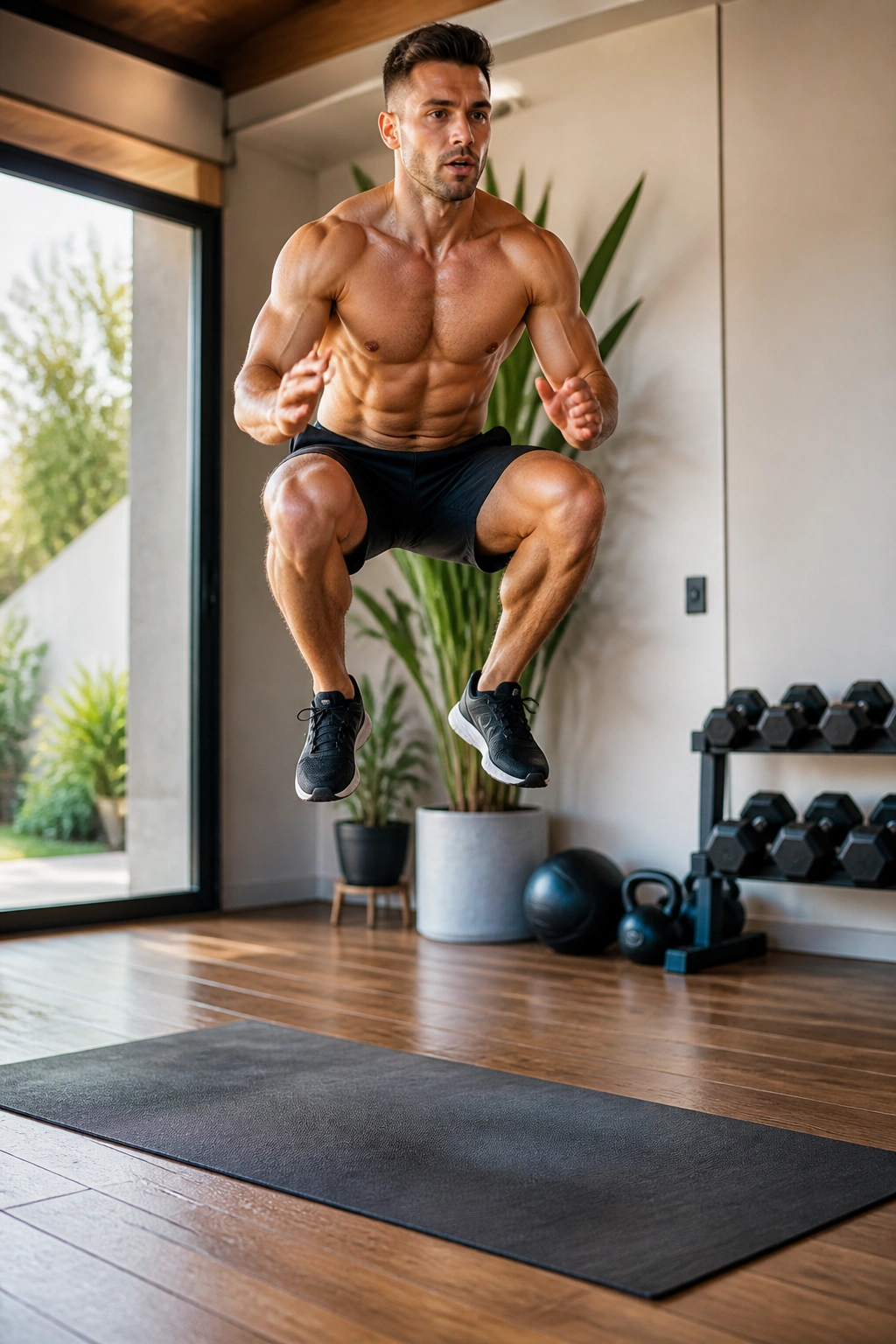
This is a classic finisher. You pick two exercises. One is a high-effort movement, the other is a core-stability movement. You perform 10 reps of each, then 9 of each, down to 1.
- Exercise A: Squat Jumps.
- Exercise B: Plank Jacks.
There is no rest. The only rest you get is the transition between the two movements. This is a sprint. Try to finish the whole countdown in under 10 minutes. If it takes longer, you need to pick up the pace.
16. Isometric Hold Circuit

Isometrics are about tension. Instead of moving, you hold a position. It sounds easy. It is not. The amount of muscular tension required to hold a wall sit or a plank for a minute is staggering.
- Wall Sit: 60 seconds.
- Push-up Position Hold (halfway down): 45 seconds.
- Squat Hold (bottom of squat): 60 seconds.
- Plank: 60 seconds.
Repeat 3 times. You will find that your muscles start to tremor. That is a good sign. It means you are recruiting motor units that you usually skip over when you do fast, repetitive movements.
17. Lateral Movement Focus
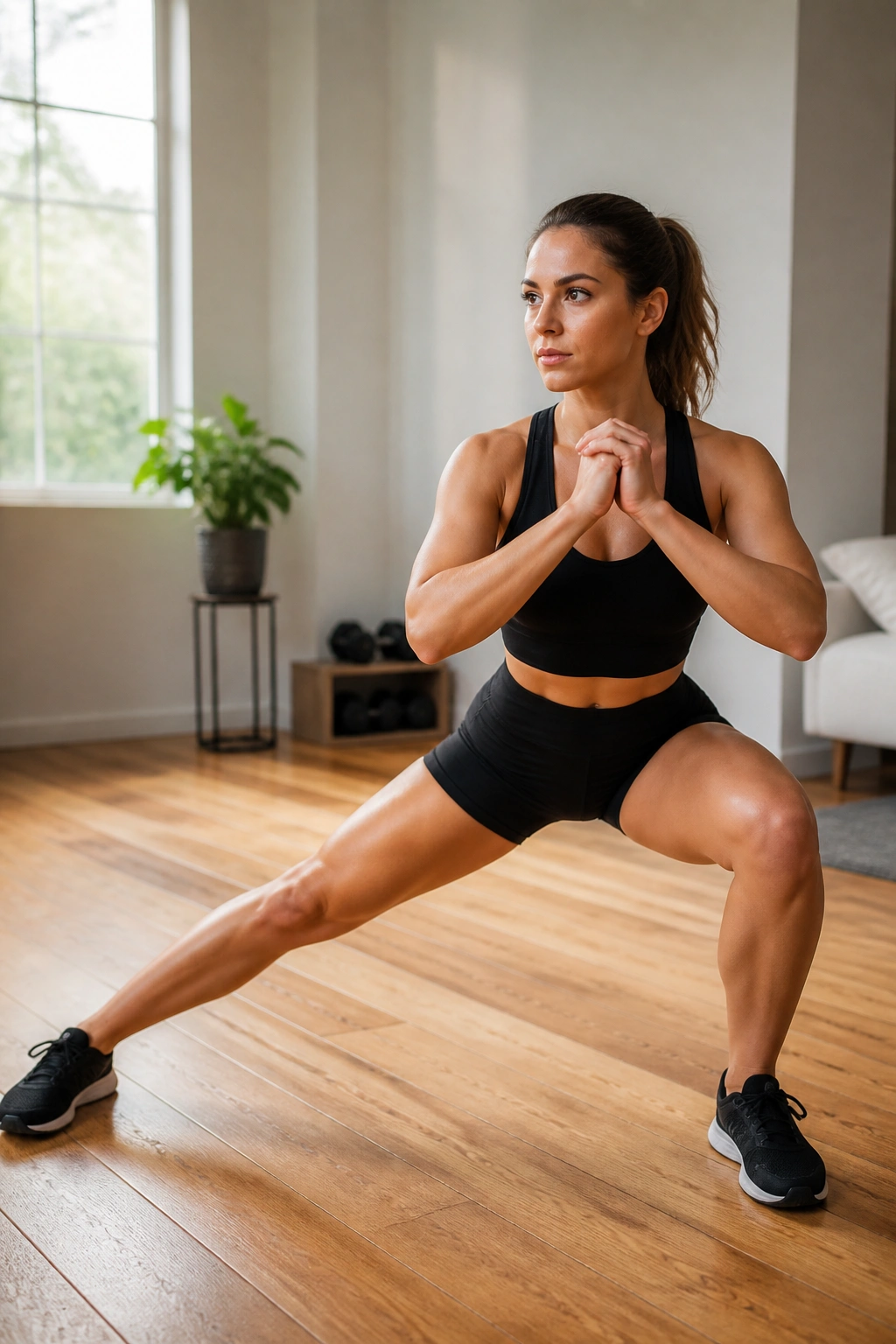
Most exercises are forward and backward (sagittal plane). Real life, and real athletics, happen side-to-side (frontal plane). This workout fixes those imbalances.
- Lateral Lunges: 45 seconds.
- Skater Hops: 45 seconds.
- Lateral Crawl: 45 seconds.
- Side Plank (switch sides halfway): 45 seconds.
Repeat 4 times. Lateral lunges are deceptively hard on the glutes. Ensure your trailing leg stays straight and you push through your heel to return to standing. This will target the inner and outer thighs in a way that standard squats never will.
18. High-Impact Cardio Burst

This one is about explosive power. If you have bad knees or ankles, skip this one. If you are healthy, this will skyrocket your heart rate.
- Jump Squats: 30 seconds.
- Tuck Jumps: 30 seconds.
- Burpees: 30 seconds.
- Rest: 60 seconds.
Repeat 5 times. Tuck jumps—where you jump up and bring your knees to your chest—are incredibly demanding. Land softly. If you are slamming your heels into the floor, you are doing it wrong. Use the balls of your feet to absorb the landing.
19. The “Minute-Man” Circuit

This is a volume-based approach. You have 60 seconds to perform as many reps as possible. Then, you rest for 30 seconds.
- Minute 1: Push-ups.
- Minute 2: Lunges.
- Minute 3: Sit-ups.
- Minute 4: Jumping Jacks.
Repeat 4 times. Because you have a full minute to work, you will be tempted to pace yourself. Don’t. Treat the first 30 seconds like an all-out sprint, then hang on for the second 30. Your score is your total reps. Try to beat it next time.
20. Strength-Cardio Hybrid

We combine a strength movement with a cardio movement to keep the heart rate up while challenging the muscles.
- Slow-Tempo Squats (3 seconds down, 1 second up): 45 seconds.
- Speed Skaters: 45 seconds.
- Slow-Tempo Push-ups (3 seconds down, 1 second up): 45 seconds.
- Mountain Climbers: 45 seconds.
Repeat 4 times. The slow tempo forces you to control the weight of your body. It eliminates momentum, making the movement much harder. When you switch to the explosive cardio move immediately after, your muscles will feel confused and exhausted.
21. The “Finish Strong” Routine
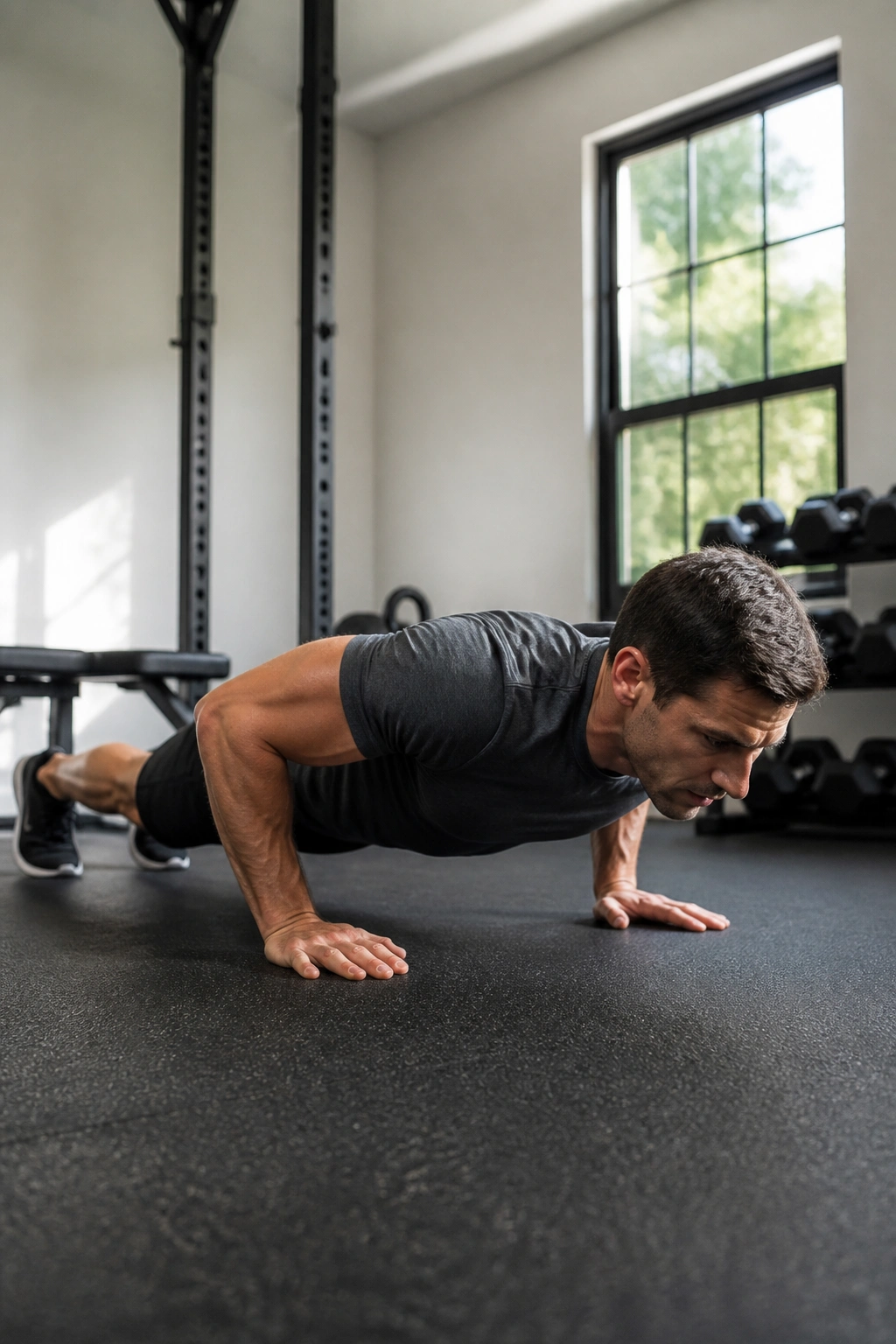
This is a short, 5-minute finisher to be added to the end of a longer workout or used on a day when you are very short on time.
- Burpees: 1 minute.
- Mountain Climbers: 1 minute.
- Jump Squats: 1 minute.
- Plank: 1 minute.
- Burpees: 1 minute.
No rest. Just go. It is only 5 minutes. You can do anything for 5 minutes. If you find yourself wanting to quit at the 3-minute mark, remember that is just your brain trying to conserve energy. Push through it.
22. The 5-Minute Emergency HIIT

Sometimes life gets in the way. You have five minutes before a meeting, or you have five minutes before you have to leave for dinner. Don’t skip the workout; do this.
- Exercise: 30 seconds work / 10 seconds rest.
- Order: Burpees, Squat Jumps, Mountain Climbers, Push-ups, High Knees.
- Repeat: 1.5 times.
It is short. It is intense. It is better than doing nothing. The goal here is to get your heart rate up, get a sweat going, and prove to yourself that you can make time for your health, no matter how busy the schedule looks.
Recovery and Avoiding Burnout

The mistake people make with high-intensity training is thinking that “more is better.” It isn’t. HIIT is stressful on your central nervous system. If you do these every single day, you will burn out, your performance will drop, and you will eventually stop altogether.
Listen to your body. If you feel lethargic, or if your resting heart rate is consistently higher than normal, take a day off. Recovery is not laziness; it is a critical part of the training cycle. It is when the muscles actually repair themselves and get stronger. Aim for 3 to 4 HIIT sessions per week, and fill the other days with light activity like walking, yoga, or stretching.
The Bottom Line

You have the tools. You have the workouts. Now, the only variable left is your willingness to step onto the floor and start moving. There will be days when you don’t want to do it—when the couch looks more inviting than a set of burpees. Do it anyway.
You don’t need fancy equipment to change your body composition. You just need consistency and a willingness to be uncomfortable for twenty minutes a few times a week. Pick one of the routines above, set a timer, and go. The hardest part of the entire workout is always the first thirty seconds. Once you are in it, you’ll find the rhythm, the sweat will start to break, and you will be done before you know it.
