



Most beginner runners try to get faster by running harder on every run. That usually backfires. Your breathing turns ugly, your calves complain, and the next day’s jog feels like a shuffle.
Speed for a new runner is not magic. It’s a mix of quicker turnover, cleaner posture, and learning how to stay relaxed when the pace gets a little sharper. The body picks that up best in short doses, not through wild all-out efforts that leave you flattened for three days.
A good speed session should leave you feeling awake, not wrecked. You want springy legs, a little sweat, and enough control that you could do one more rep if you had to. That’s the sweet spot.
The 20 workouts below build that skill in layers, starting with the safest options and moving toward sessions that feel more like real speed training. Pick one or two each week, keep the rest of your running easy, and let the fast work sharpen your stride instead of smashing it.
1. Relaxed Strides for Beginners Who Want to Run Faster

Strides are the cleanest way to wake up your legs without making the whole run hard. They look simple, and that’s exactly why they work. A beginner can use them to learn fast feet, upright posture, and smooth arm swing without the panic that comes with full sprints.
The best place for strides is after an easy run, when you’re already warm. Run 15 to 20 seconds at a quick but relaxed pace, then walk or stand until your breathing is back under control. Four reps is enough for a first try. Six to eight is plenty once the motion feels natural.
What to Focus On
- Stay tall from the hips up, with your chest open and your chin level.
- Keep the effort around 85 to 90 percent, not a flat-out sprint.
- Take full recovery, usually 45 to 90 seconds of walking.
- Stop the set if your shoulders tighten or your footstrike starts sounding loud and heavy.
A stride should feel snappy, not desperate. If you finish thinking, “That was quick,” you did it right.
2. Short Hill Sprints on a Gentle Slope

Why do hills help speed so much? Because they force power without the reckless top-end pace that flat sprints can tempt you into. A short uphill run naturally shortens your stride, keeps your feet landing under your body, and asks your hips and glutes to do more of the work.
Use a hill that takes 6 to 8 seconds to climb hard. A mild grade works best — steep enough to feel effort, gentle enough that your form stays tidy. Walk back down slowly and recover fully before the next rep. Four reps is a solid start. Six is enough for most beginners.
How to Keep It Safe
- Choose a smooth surface with no loose gravel or slick paint.
- Drive the arms forward and back, not across your chest.
- Lean slightly from the ankles, not by folding at the waist.
- Do not chase speed on the descent. Walk down.
Short hill sprints build power in a way beginners can actually handle. They’re hard, yes. They’re also honest. The hill tells on your form immediately.
3. 30-Second Fartlek Pickups

A fartlek workout is gloriously low-stress because you don’t need a track, a watch full of splits, or a complicated plan. You just run easy, pick a point ahead, and quicken the pace for 30 seconds. Then you back off and breathe.
That makes this one perfect for beginners who get anxious looking at pace numbers. Do 8 to 12 rounds of 30 seconds quicker and 30 seconds easy. The faster part should feel lively, not frantic. You should still be able to relax your jaw and keep your shoulders down.
This workout teaches your body how to switch gears. That matters more than people think. Running faster is not only about top speed; it’s about changing pace without wasting energy every time the road tilts up or your mind starts to wander.
If 30 seconds feels too long, start with 20. If it feels too easy, don’t turn it into a race. The goal is clean, repeatable effort.
4. 200-Meter Repeats for Beginner Speed

Two-hundred-meter repeats are the bridge between casual running and real interval work. They’re short enough to stay controlled, but long enough to teach you how to hold a pace instead of just launching into it. Beginners usually handle these better than longer repeats because the distance ends before form falls apart.
A simple version looks like this: 4 to 6 reps of 200 meters on a track or measured flat path, with a full 200-meter jog or 90 seconds of easy recovery between reps. Run each one around current 5K effort, or a touch faster if you can stay smooth. The last rep should look almost the same as the first.
A Good 200-Meter Session
- Warm up for 10 to 15 minutes with easy jogging.
- Add 2 strides before the first rep.
- Run each 200 at controlled effort, not sprint effort.
- Recover long enough that your breathing settles before the next rep.
If the first rep feels blazing and the third one feels messy, you started too hot. That’s a common beginner mistake. You want even, tidy reps.
5. Treadmill Incline Repeats

A treadmill can feel dull, sure. It can also be one of the most useful places to learn speed without dodging traffic, weather, or uneven sidewalks. A slight incline makes the work more honest, because it nudges you into a stronger push-off and keeps the pace from getting sloppy.
Set the treadmill to a 1 percent incline, or maybe 1.5 percent if the belt feels too flat. Run 45 seconds at a quick pace, then recover for 75 to 90 seconds at an easy jog or walk. Repeat 6 to 10 times. You should finish breathing hard but still in control, without that desperate lung-burn that ruins the rest of the week.
The nice thing about treadmill intervals is how consistent they are. No traffic lights. No surprise headwind. No excuses. If you keep the pace stable, you learn what a true fast rhythm feels like.
One caution: don’t grip the rails. That changes your posture and takes work away from your legs.
6. Progression Runs That Finish Faster Than They Start

Can you get faster inside a single run without turning it into a race? Yes. That’s what a progression run does. You start easy, settle in, then nudge the pace up in steps until the final segment feels steady and purposeful.
A beginner version can be 25 to 35 minutes total. Run the first 10 to 15 minutes at easy conversational pace. Then pick it up a little every 5 minutes. The last 5 minutes should feel like “working, but not straining.” You’re not gasping. You’re just more awake.
The Pacing Ladder
- Easy warm-up pace.
- Slightly quicker, but still relaxed.
- Steady and controlled.
- Finish with a firm last few minutes.
This workout teaches restraint, which sounds boring until you realize how many runners blow up because they have none. It also teaches you to change gears smoothly. That skill shows up on race day and on random hills, which is where most beginners lose time.
7. Cadence Ladder Sessions

You don’t always need longer strides. Sometimes you need faster feet. Cadence, which is your step rate, is one of those quiet details that can make a real difference once you start running a little more seriously. If your feet are pounding the ground out in front of you, cadence work can clean that up.
Try a simple ladder: 1 minute at your normal cadence, 1 minute slightly quicker, repeated 6 times. You can use a metronome app if you want, or just focus on a quicker rhythm. Don’t jack up your speed wildly. Think 5 to 8 extra steps per minute, not a new personality.
What Not to Do
- Don’t overstride to chase a number.
- Don’t bounce upward. Keep the motion forward.
- Don’t tense your hands while your feet speed up.
- Don’t run this workout tired. Fresh legs make the rhythm easier to feel.
This is a sneaky workout. It looks mild, but it teaches the nervous system how to move quicker without extra pounding. That matters.
8. A-Skips, High Knees, and Butt-Kick Drills

These drills look a little awkward in a parking lot. Fine. They work anyway.
A-skip, high-knee, and butt-kick drills are not glamorous, but they teach coordination, leg lift, and timing. Put them near the start of a workout or after a warm-up jog. Do 2 rounds of each drill over 15 to 20 meters, then walk back for recovery. The point is clean rhythm, not speed for its own sake.
A Simple Drill Circuit
- A-skips: 15 to 20 meters, keeping the knee lift active and the foot dorsiflexed.
- High knees: 15 to 20 meters, with a quick ground contact.
- Butt kicks: 15 to 20 meters, staying tall and light.
- Walk back fully between each rep.
These drills help you feel where your feet should land and how your body should stay stacked. That sounds technical, but the feel is simple: less flailing, more control. Once that starts to click, your running pace often gets better without forcing it.
9. Long Runs With Short Surges

A long run does not have to be sleepy. If you insert short surges into an otherwise easy run, you teach your legs to respond when they’re already a little tired. That matters because the end of many races, and many real-life runs, happens on tired legs.
Take your normal long easy run and add 6 surges of 20 seconds. Space them out every 8 to 10 minutes, or tuck them into the second half of the run. Each surge should feel quicker than easy running, but nowhere near sprinting. Think smooth and strong. Then settle right back into your normal pace.
One nice thing about this workout: it doesn’t require extra warm-up drama. You are already warm because you are already running. The surges just wake things up.
If you get greedy and turn every surge into a mini race, the whole session gets too hard. Keep it tidy. The goal is quickness under control, not a heroic meltdown.
10. 400-Meter Repeats to Run Faster Without Sprinting

Four-hundred-meter repeats are where beginners often overreach. The distance looks short on paper, then the first rep bites back. Keep the effort controlled, and this workout becomes one of the best ways to learn pace, breathing, and recovery.
A good starting point is 4 reps of 400 meters with 200 meters of easy jogging between them. If that feels manageable, work up to 6 or even 8 reps over time. Run them around current 5K effort, or a hair slower if you can’t keep the shape of the run intact. Even splits matter here.
Signs You’re Doing It Right
- Your first and last rep look similar.
- Your breathing is heavy, but not panicked.
- You can jog the recovery without bending over.
- Your form stays compact, not wild.
Beginners often think the workout failed if they didn’t destroy themselves. Wrong. The goal is to finish with enough quality that the next session still feels possible. That is how faster running starts to stick.
11. Controlled Hill Repeats for Leg Strength

Unlike the short hill sprints earlier, these repeats are longer and a little less explosive. That makes them useful for building strength endurance. You’re still running uphill, but now the workout asks you to hold effort for 30 to 45 seconds at a time.
Pick a moderate hill and run 4 to 6 repeats. Jog or walk back down for recovery, making sure your breathing settles before the next rep. The effort should feel strong, almost like a hard uphill tempo, but not a blast-furnace sprint. If your calves are seizing by rep three, the hill is too steep or the pace is too hot.
A few cues help a lot here:
- Keep the stride short and quick.
- Drive the knees forward, not upward in a high, bouncing way.
- Relax the hands.
- Keep the chest open.
This workout often teaches more than it announces. Beginners feel stronger on flats after a few weeks of good hill repeats, even if the hill itself never feels easy.
12. Tempo Blocks at Comfortable Hard Pace

Can you hold a pace that feels firm without turning it into a survival run? That’s tempo work. For beginners, the best tempo sessions are short blocks, not long suffer-fests.
Try 2 x 8 minutes at a comfortably hard effort, with 3 minutes of easy jogging between blocks. If 8 minutes feels like too much, use 3 x 5 minutes instead. The target feeling is simple: you can say a short phrase, but you wouldn’t want to hold a long conversation. That’s your tempo zone.
A Beginner-Friendly Tempo Check
- Breathing is deep but controlled.
- Stride feels rhythmic, not frantic.
- Pace is steady from start to finish.
- Recovery jog feels genuinely easy.
Tempo work teaches you to sit near a faster pace without breaking down. That skill matters because beginners often know how to sprint and how to jog, but not how to live in the middle. The middle is where a lot of speed gains hide.
13. One-Minute On, Two-Minute Off Intervals

If 400s still feel intimidating, this is your friend. One-minute intervals give you enough time to push the pace, but not so much time that you get lost in the effort. The two-minute recovery keeps the session friendly.
Do 6 to 10 rounds of 1 minute quick and 2 minutes easy. Use the quick minute to run with purpose, not panic. You should be working, but the form should stay neat. On the recovery, jog lightly or walk if you need to reset your breathing.
This is a nice workout for roads, treadmills, and tracks alike. It also gives beginners a clean sense of effort because the clock, not the distance, controls the session. That’s handy when you’re still learning what different speeds feel like.
One honest note: the pace will feel too easy on the first rep if you’re amped up. Ignore that urge. The workout gets better when you keep the same effort across all the reps.
14. Fast-Finish Easy Runs

This one is sneaky.
Start with an easy run of 30 to 40 minutes. Keep the first 20 to 30 minutes truly relaxed. Then, for the last 8 to 10 minutes, shift into a stronger but still controlled pace. You’re not racing. You’re just finishing with more purpose than you started.
Fast-finish runs teach a beginner how to change rhythm late in a run, when the legs are a bit sleepy. That matters because speed is not just about fresh legs. It’s also about what happens when you’re slightly tired and need to keep moving well.
A lot of runners go too hard here and turn the last stretch into a sloppy time trial. Don’t. If your form starts to bounce around, if your shoulders climb, or if your breathing turns ragged, back off. You want the finish to feel crisp.
This is a good workout to use once a week if you like the idea of speed but hate the harshness of full intervals.
15. Stair Intervals for Power and Pacing

Stairs are useful and annoying, which is probably why they work so well. They force a clean push-off, keep the stride short, and get the heart rate up fast without asking for much space.
Find a stable stairwell or outdoor set with dry, even steps. Run up for 20 to 30 seconds at a strong effort, then walk down carefully. Eight to 12 repeats is enough for a beginner. Do not descend fast; the recovery is the walk down, not a second workout.
Safety First, Because Stairs Bite
- Use shoes with decent grip.
- Stay off crowded stairs.
- Keep your eyes a few steps ahead.
- Stop if your knees feel sketchy on the descent.
This session hits the calves, glutes, and lungs in one shot. It also teaches pacing because stairs punish wasted motion. If you go too hard too early, the later reps get ugly in a hurry.
16. Trail Fartlek on Rolling Ground

A dirt path with little rises changes everything. The surface asks for more balance, the hills ask for more force, and the rough rhythm keeps you from locking into a stale pace. That makes trail fartlek a good choice for beginners who want speed work that feels less like a lab test.
Pick a rolling trail or park loop and run 10 to 15 short pickups of 20 to 40 seconds. Use landmarks — the next tree, the next bend, the next rise — as your speed cues. Recover on the downhill or on the flat. Keep the effort lively, not reckless, because trail footing can get slippery in a hurry.
What makes this session useful is the changing terrain. Your body has to adjust stride length, foot placement, and balance on the fly. That teaches a kind of speed you do not get from a flat track.
If the trail is muddy, rooty, or crowded, skip it. Fast feet are useful. Twisted ankles are not.
17. Split 400s That Feel Less Scary

A full 400 can spook beginners. Split reps make the same amount of work feel more manageable. You run 200 meters, rest briefly, then run another 200 meters to complete the rep.
Try 4 to 6 split 400s with 30 seconds of rest between the halves, and 2 to 3 minutes of easy jogging between full reps. The first 200 should feel controlled. The second 200 should ask for focus, not panic. This setup works well for runners who can handle short fast efforts but lose form when the distance gets longer.
Why Split Reps Help
- They reduce the mental drag of one long hard effort.
- They let you practice pacing without blowing up.
- They keep the speed a little cleaner late in the rep.
- They’re easier to repeat week after week.
If the second half falls apart every time, shorten the pace a touch before you shorten the rest. That is the better fix for most beginners. The workout should build confidence, not create a new fear of 400s.
18. Power Skips for Distance
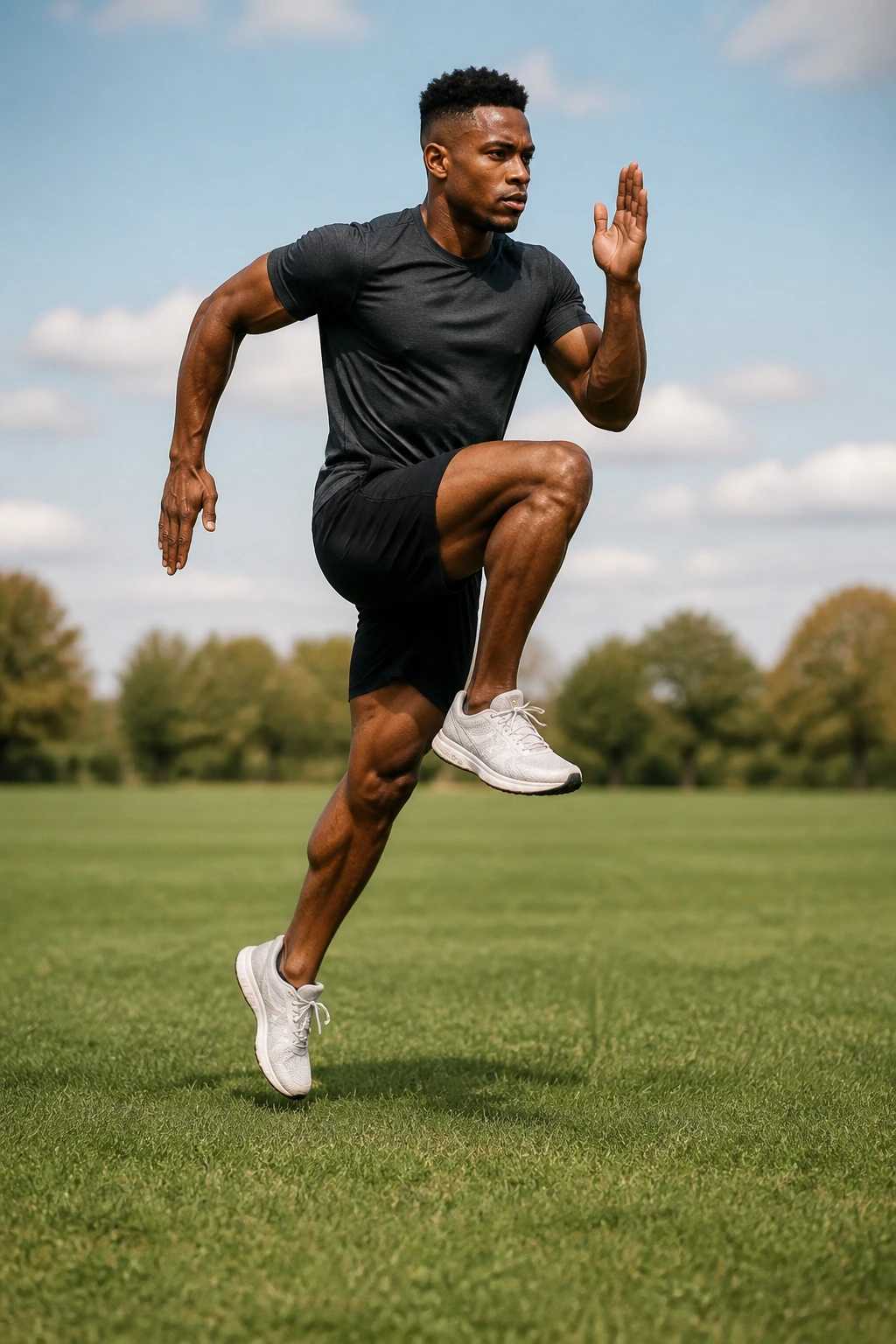
Power skips look playful, but they’re doing serious work underneath. They build spring through the ankles and calves, teach you to use the arms, and encourage a stronger knee drive. All of that helps with faster running, especially if your stride still feels a little flat.
Do 4 sets of 20 to 30 meters, or 4 sets of about 20 seconds if you’re on a field. Skip with force, but keep the motion smooth and rhythmic. You want height and distance, not giant floppy jumps. Walk back between sets and let the body reset.
A good power skip feels elastic. You land, absorb, and pop right back up without grinding. If your shins start barking or your feet feel clumsy, stop and cut the set short. That is usually your body asking for less drama.
This is a nice drill before strides or a short interval workout. It wakes up the legs in a way that makes the later running feel cleaner.
19. Treadmill Pickups With a Slight Incline

Flat treadmill running can feel a little too easy if you let the belt do all the work. A slight incline changes that. It nudges your posture upright, asks for a stronger push, and makes the pace feel more like outdoor running.
Set the treadmill to 0.5 to 1 percent incline and do 6 rounds of 1 minute quick with 90 seconds easy. Keep the quick minute sharp but controlled. The pace should feel a touch faster than easy running, not like a sprint trap. If you want, add 1 or 2 extra reps once the pattern feels smooth.
This workout is useful when the weather is bad, the roads are busy, or you simply want a more repeatable session. A treadmill removes a lot of the little variables that make speed work messy. That can be a relief.
One thing: don’t stare at the console like it’s the enemy. Pick the pace, settle in, and let the minutes pass. The session works best when you stop fiddling.
20. Mock Race Repeats for Beginner Speed Practice

A beginner does not need to test fitness all the time. But once in a while, a mock race session helps you learn what strong, repeatable effort feels like when the reps are a little longer and the rest is a little shorter.
Try 3 rounds of 4 minutes at a hard-but-controlled pace, with 3 minutes of easy jogging between rounds. Finish with 4 relaxed strides. If you prefer distance, swap the 4-minute blocks for 800-meter repeats at a pace you can keep steady across all three rounds. The point is not to blow the doors off. The point is to practice holding speed with a calm head.
This kind of workout teaches pacing discipline, and beginners need that badly. Most new runners either go too hard at the start or back off too much when the effort starts to bite. Repeats like these show you the middle ground.
If you only remember one thing from the whole list, make it this: fast running for beginners works best when the reps stay short enough to stay neat. Clean form beats ugly heroics every time. And if a workout leaves you feeling a little sharper for the next run, that’s the sign you picked the right one.
