



Strength and conditioning workouts at home work best when they feel a little unfair.
A backpack, a timer, and a patch of floor can do more than people expect, especially when you stop chasing random sweat and start pairing hard strength moves with short conditioning bursts. That mix is the whole trick: squat, push, hinge, pull, breathe hard, repeat.
No fancy setup is required. A pair of dumbbells helps. So does a resistance band, a sturdy chair, a stairwell, or even a loaded tote bag that looks like it belongs in a grocery run and not a training plan. The point is to keep the work dense enough that your legs notice it, your lungs notice it, and your form still holds together.
Pick a session. Run it clean. Then run it again a week later and see what changed. That’s where this gets useful.
1. The No-Equipment Full-Body Circuit
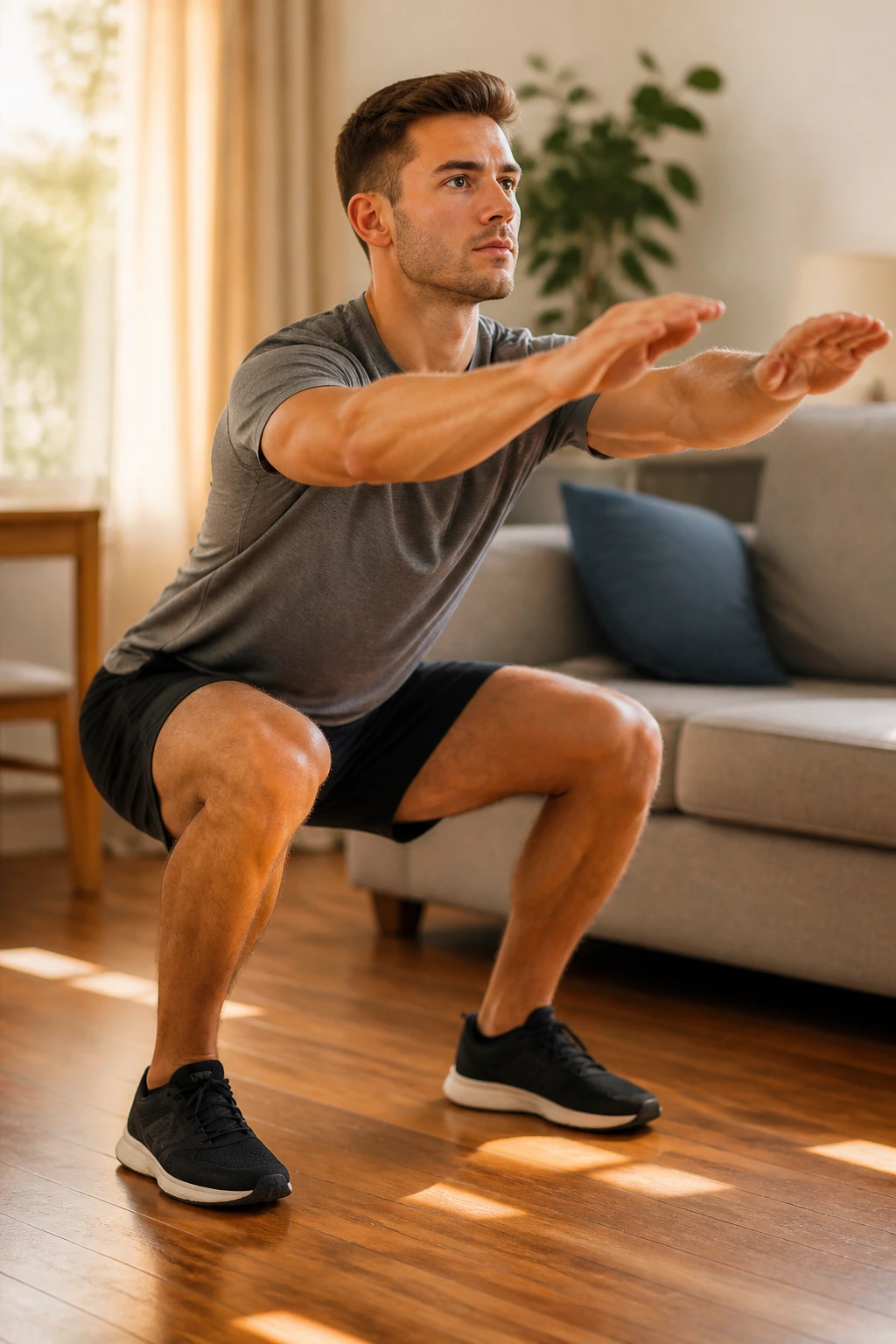
Start with the plain one.
No equipment, no tricks, no wasted motion. This is the workout I’d hand to someone who wants a real session before they worry about gear. You move through a squat, a push, a lunge, a hinge, and a core hold, and you keep the pace honest. That’s enough to make the whole body work.
How it looks on the floor
- 12 air squats
- 8 incline push-ups on a couch, bench, or sturdy table
- 10 reverse lunges per leg
- 15 glute bridges
- 20 shoulder taps from a plank
Run 4 rounds. Rest 60 seconds between rounds, or 30 seconds if you want the conditioning side to bite a little harder. If full push-ups are shaky, use a higher surface. If lunges wobble, shorten the range and keep the front foot flat.
The best part is the timing. You’re not hunting exhaustion with one move; you’re letting each exercise support the next one. By round three, your breathing changes, your thighs feel warmer, and your arms start negotiating. Good. That’s the point.
2. The Backpack Strength Ladder
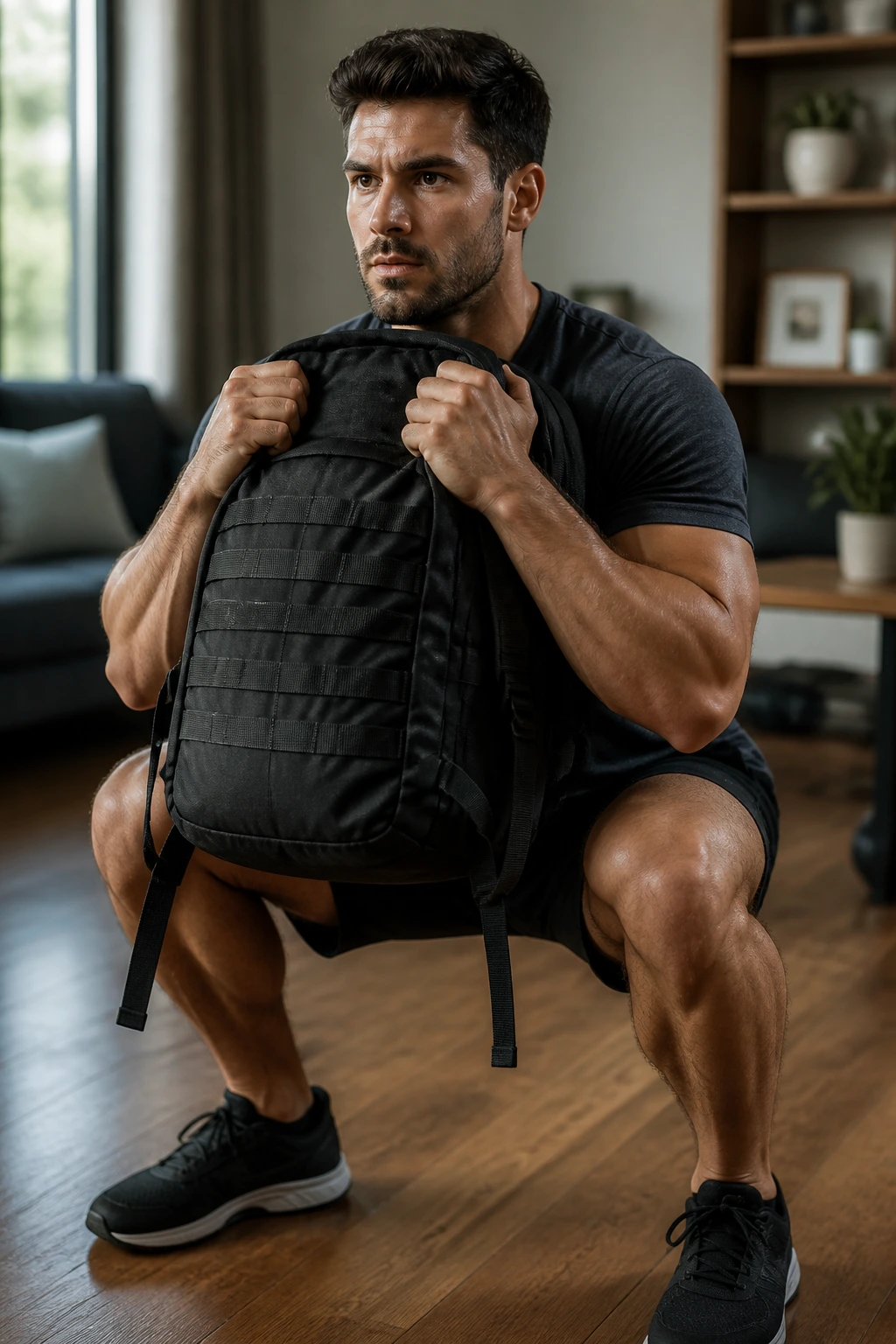
A backpack loaded with books is ugly and effective.
That sounds flippant, but I mean it. If you want real resistance at home and you do not have dumbbells, a backpack gives you enough load to make squats, rows, and hinges honest. Keep the weight tight, pack it low, and zip everything down so it does not swing around like a grocery bag on a bad road.
Use a simple ladder: 4 reps, then 6, then 8, then 10. Do each of these in order before moving to the next round.
- Backpack goblet squat
- Bent-over backpack row
- Backpack Romanian deadlift
- Backpack floor press
Rest 45 to 75 seconds between rounds. The first set should feel manageable. The last set should force you to slow down and stay sharp. If the backpack starts pulling you forward in the row, reduce the load and keep your spine neutral. I’d rather see a cleaner 8 than a sloppy 12.
This one works especially well when you want strength without jumping. Quiet. Heavy. Straight to the point.
3. The 30/30 Push-Pull Engine

Want a session that feels like lifting and gasping in the same minute?
This is the one. You spend 30 seconds on a push, then 30 seconds on a pull, then legs, then core, and you keep moving for 16 to 20 minutes. The work is short enough to stay crisp, but not short enough to let you coast. That balance is hard to fake.
How to pace the rounds
Set a timer for 30 seconds of work and 15 seconds to switch. Rotate through these four moves:
- Push-ups
- Band rows or backpack rows
- Bodyweight squats
- Dead bugs or hollow holds
Complete 4 to 5 full rounds. Keep the first two rounds at a pace you could hold again, because that’s the whole trap with this style: people sprint early, then turn the rest of the workout into survival. Don’t do that. Leave a little in the tank.
How to use it: stop each set one or two reps before form starts to slip. That tiny buffer keeps the shoulders happy and the tempo fast enough to count as conditioning. If you need more challenge, shorten the rest between stations to 10 seconds.
4. The Lower-Body EMOM
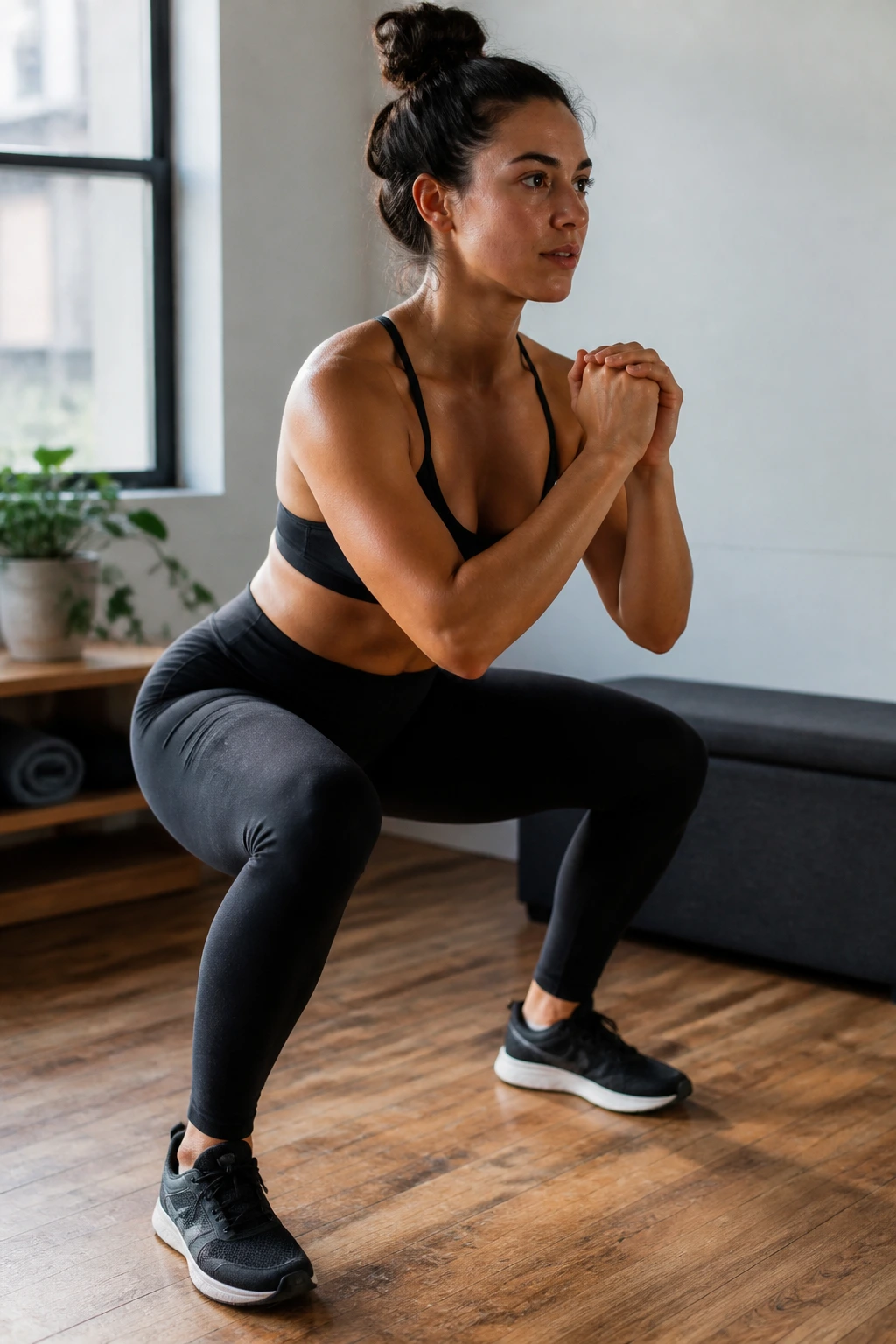
Leg day does not need an hour.
Every minute on the minute, hit a new lower-body task, then rest with whatever time is left. It sounds simple because it is simple, and that’s exactly why it works. The clock does the pacing for you, which means you can stop arguing with yourself and start moving.
The four-minute loop
For 16 minutes, cycle through this block:
- 10 split squats per leg
- 12 goblet squats or bodyweight squats
- 12 glute bridges with a 2-second squeeze at the top
- 10 squat jumps or 20 fast calf raises
Repeat the block 4 times. If you’re new to jump work, use fast squats or calf raises and keep the landings out of it. If you already train regularly, load the split squats with a backpack or dumbbells and make the second half of the workout mean something.
The appeal here is the rhythm. You get a strength dose from the split squats and squats, then a conditioning hit from the jumps or quick feet. By round three, your legs are awake in the annoying way. That’s useful information.
5. Stair Drives and Step-Ups
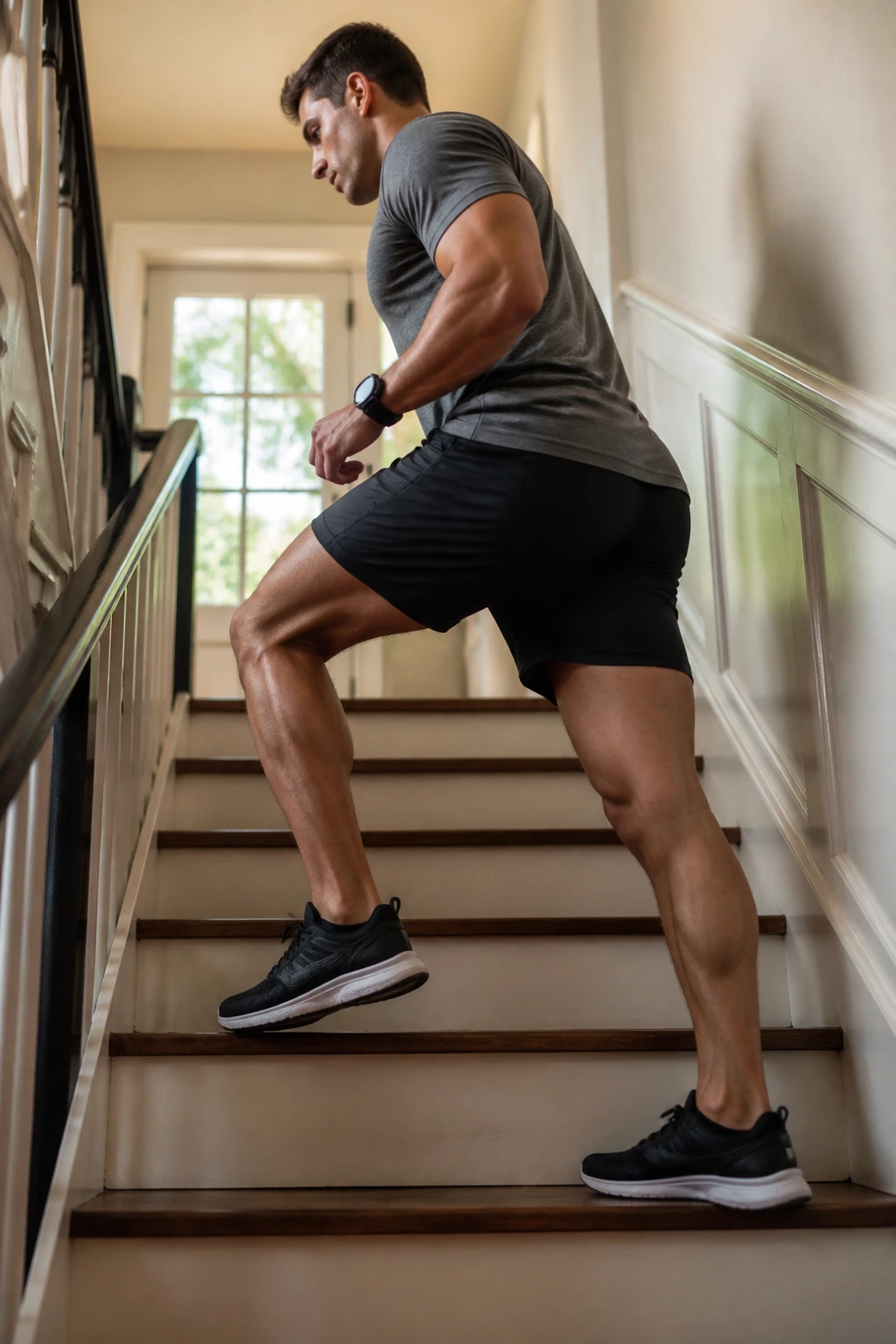
Stairs change the whole game.
Your breathing gets louder fast, your quads warm up almost immediately, and the work feels a little old-school in the best way. A staircase turns a normal house into a training space, and you do not need much else. One solid trip up and down can make a set of step-ups feel twice as hard as it looks on paper.
Use this structure:
- 10 step-ups per leg
- 1 hard climb up the stairs
- 8 incline push-ups on a step or landing
- 20 mountain climbers
- Walk back down slowly and rest 30 to 45 seconds
Run 5 rounds. Keep your whole foot on the step during the step-up, and push through the heel instead of bouncing off the toes. On the climb, don’t race the descent. Coming down too fast is where people get sloppy.
If your stairs are short, do the climbs for time instead of counting steps. Twenty to thirty seconds is enough. And wear shoes with grip. Socks on wood stairs are a dumb idea, no matter how confident you feel.
6. The Upper-Body Density Session
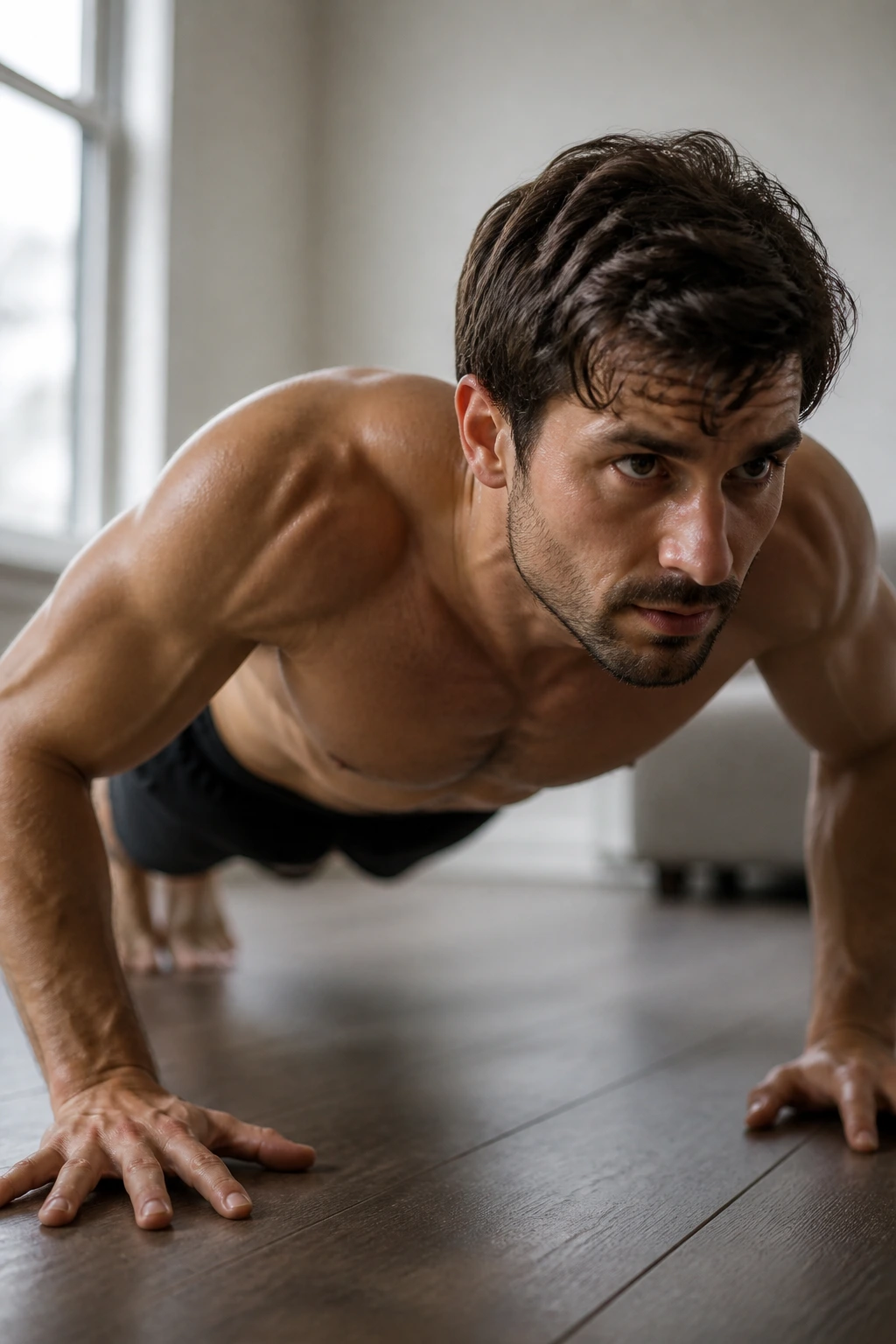
Counting total reps is blunt, and that’s why I like it.
Instead of trying to “feel” upper-body work, you collect a number. The session is simple: accumulate a target amount of push and pull volume in 20 minutes. You’ll know when you were honest because the score tells the story.
The scorecard
Try to hit these totals:
- 60 push-ups
- 60 band rows or backpack rows
- 30 pike push-ups
- 20 chair dips
- 40 shoulder taps from plank
Break the totals into as many sets as needed. Ten push-ups here, twelve rows there, a short pause, then back in. The goal is steady work, not heroic sets that collapse halfway through. If your shoulders get cranky on dips, skip them and add another row set.
Why density matters
Unlike a straight strength session, this style rewards consistency. You don’t need a huge load. You need enough rest control to keep the work moving. That makes it a strong option for people who want home workouts to feel productive instead of random.
7. The Single-Leg Strength Builder
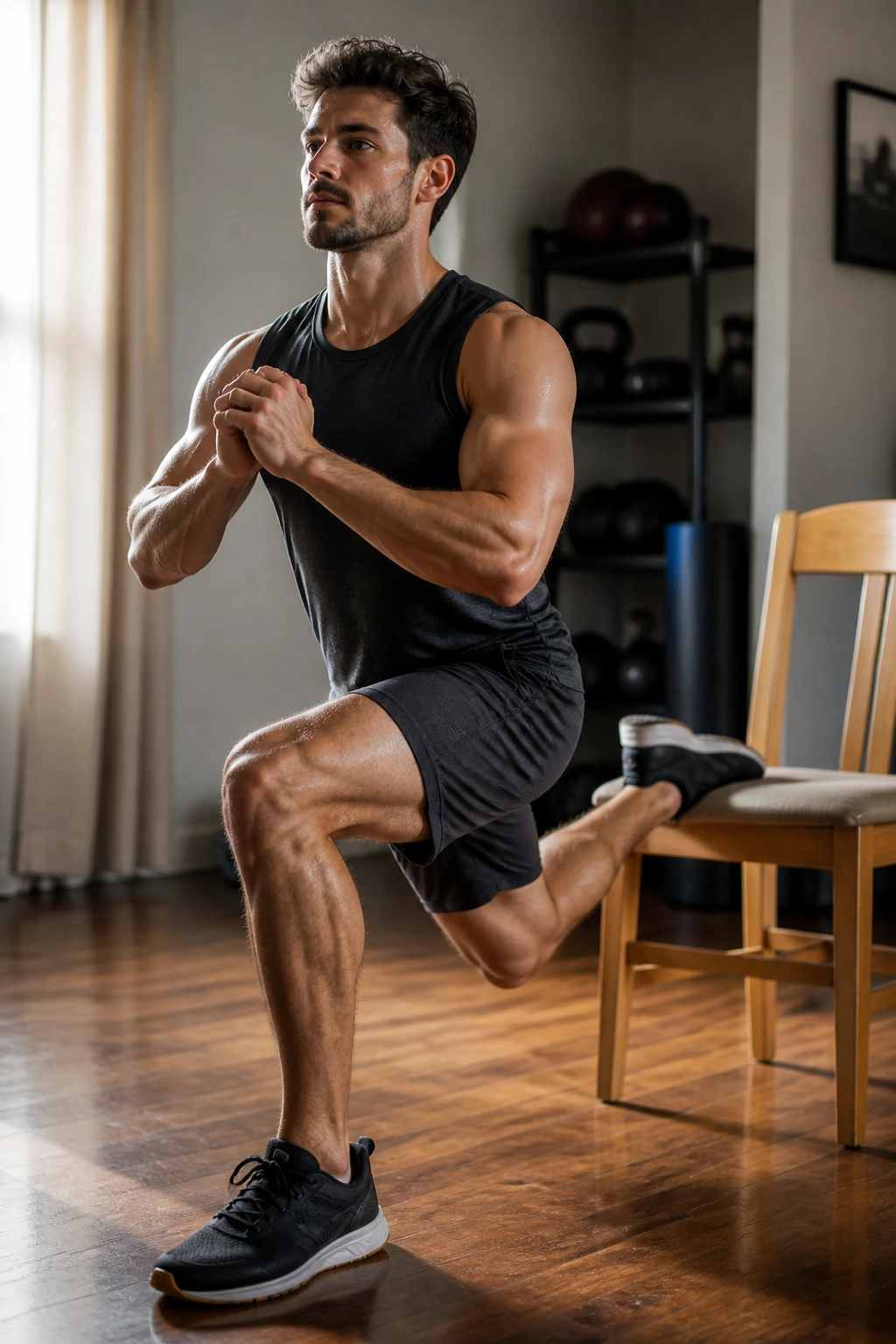
One leg always exposes the truth.
The right side may be steadier. The left side may burn faster. Maybe one hip drops when you squat, or one knee caves a little on the way down. Single-leg work shows all of that, and it fixes more than it flatters. I’m a fan of it because it quietly makes everything else better.
Fixing the wobble
Use this three-round circuit:
- 8 Bulgarian split squats per leg
- 8 single-leg Romanian deadlifts per leg
- 10 lateral lunges per side
- 30-second wall sit
Rest 60 seconds between rounds. Use a chair or couch for the rear foot on split squats, but keep the back foot light. The front foot does the real work. On the single-leg hinge, keep your hips square and reach the free leg long behind you so you don’t twist.
If you can balance while breathing through your nose, the set is probably in the right place. If not, slow down. The awkward first round usually turns into a cleaner third round, and that’s the whole point. Not prettier. Cleaner.
8. Shadow Boxing and Bodyweight Rounds
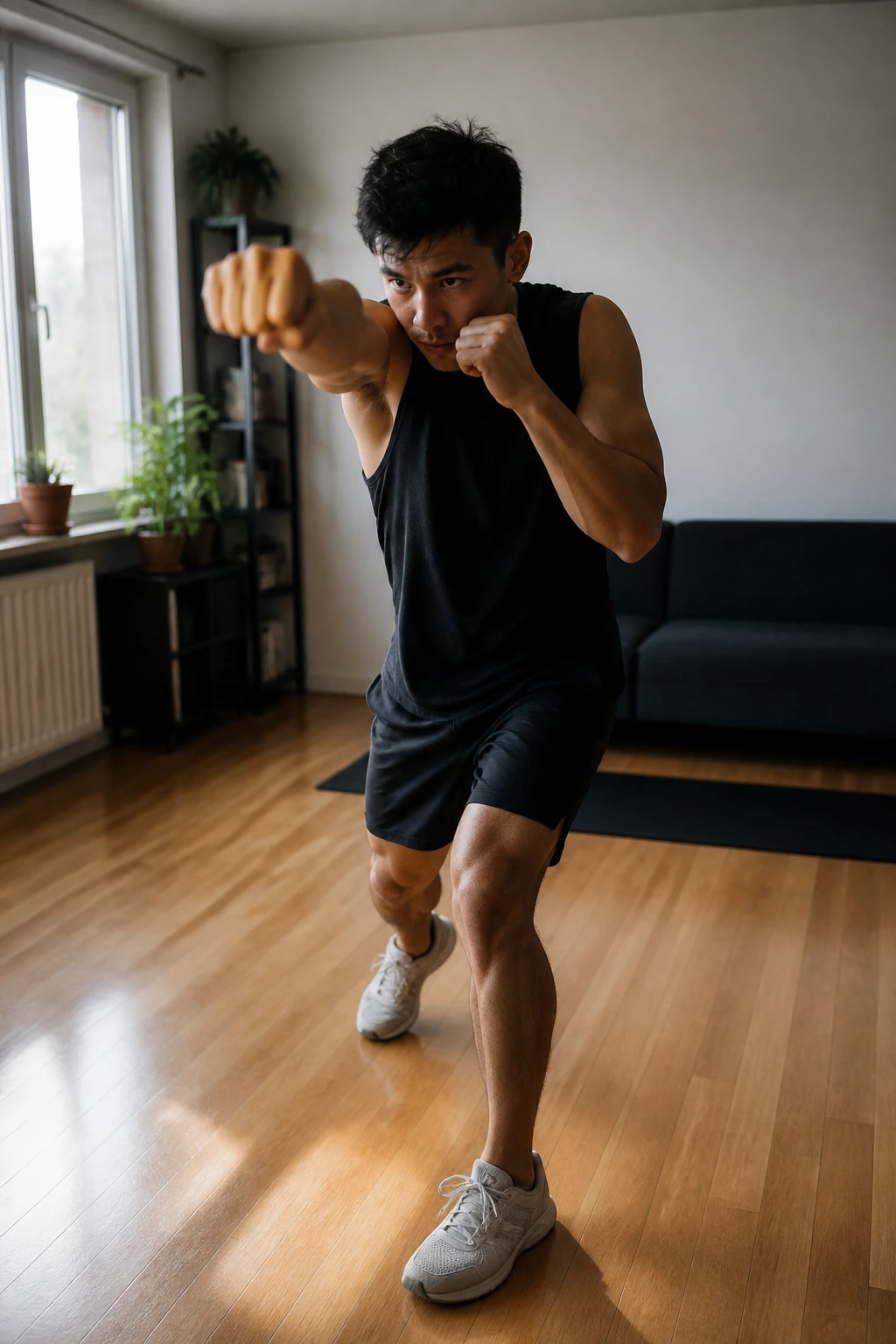
Shadow boxing is underrated.
It gives you footwork, shoulder endurance, core rotation, and a real conditioning hit without turning the room into a construction zone. And because your hands have to stay up, your upper body starts working in a way push-ups never quite mimic. I like it for days when I want sweat without the thud of a hundred jumps.
Run 5 rounds of 3 minutes:
- 60 seconds of fast boxing combinations
- 30 seconds of squat thrusts
- 30 seconds of high knees
- 60 seconds of moving footwork and light punches
Rest 60 seconds between rounds. Keep your chin tucked and your ribs down when you punch. People flare their elbows and overreach fast, which turns clean work into sloppy air-flailing. Don’t chase power. Chase snap and rhythm.
If you want more difficulty, hold a light water bottle in each hand for the first minute only. Not the whole round. Just the first minute. After that, drop them and feel how much lighter your hands get.
9. The Core-First Conditioning Flow
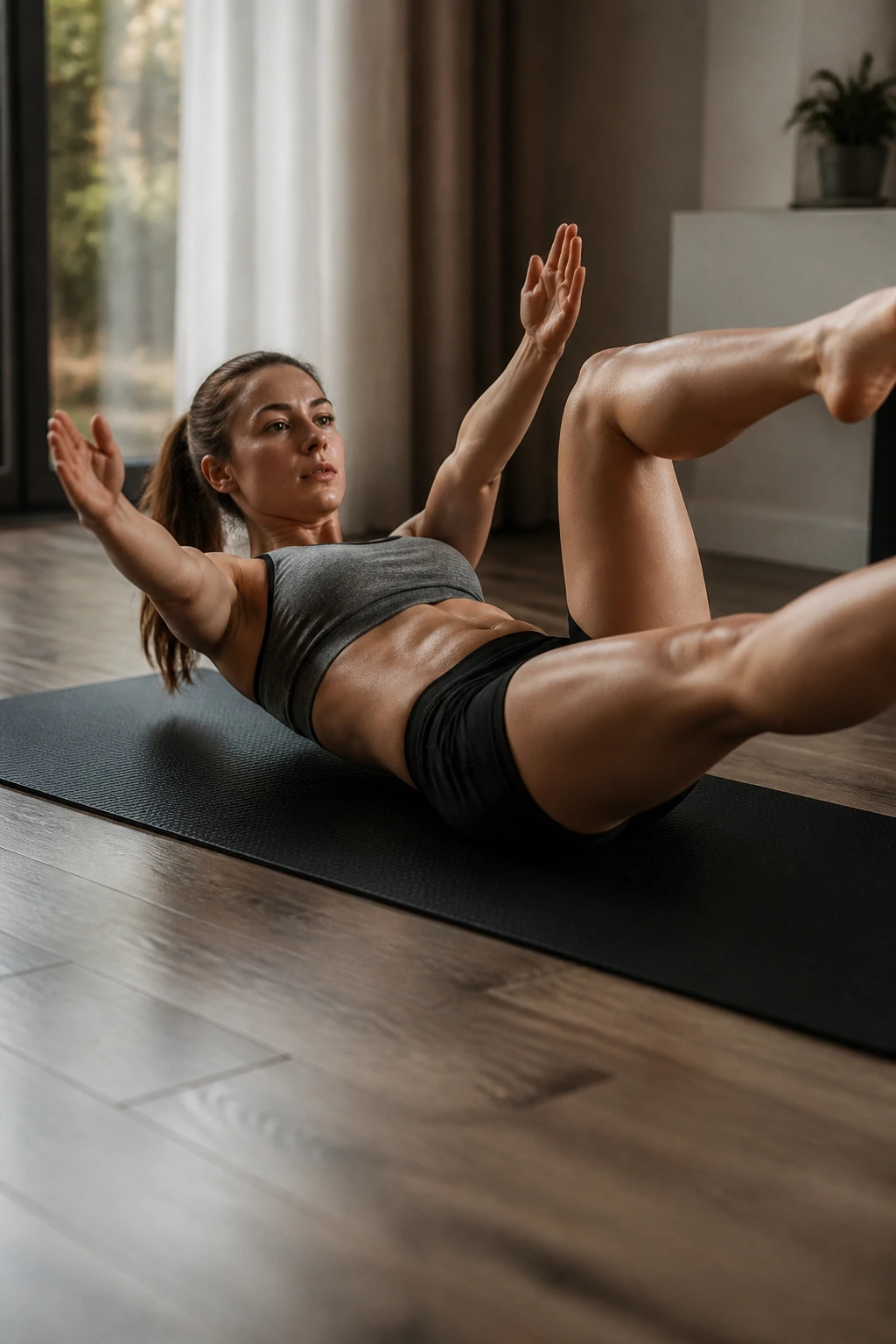
Why do core workouts so often feel either too easy or strangely miserable?
Because a lot of them skip the part where the trunk actually has to stabilize while you breathe and move. The midsection is not a place to fling random crunches at. It’s a brace. It’s a transfer point. Treat it that way and the session gets much better.
What the flow looks like
Cycle through these movements for 4 rounds:
- 20 seconds dead bug
- 20 seconds hollow hold
- 20 seconds bear crawl forward and back
- 20 seconds side plank, left
- 20 seconds side plank, right
- 20 seconds mountain climbers
Rest 40 seconds after each round. Keep your lower back from arching on dead bugs and hollow holds. If it does, bend the knees more and shorten the lever. That small adjustment matters more than trying to “push through.”
How to make it hard without wrecking your back: slow the exhale. If you can hear your breathing steady out, the brace usually improves too. This one is less flashy than a burpee pileup, but it teaches control under fatigue, which carries into every other workout on this list.
10. The Dumbbell Complex
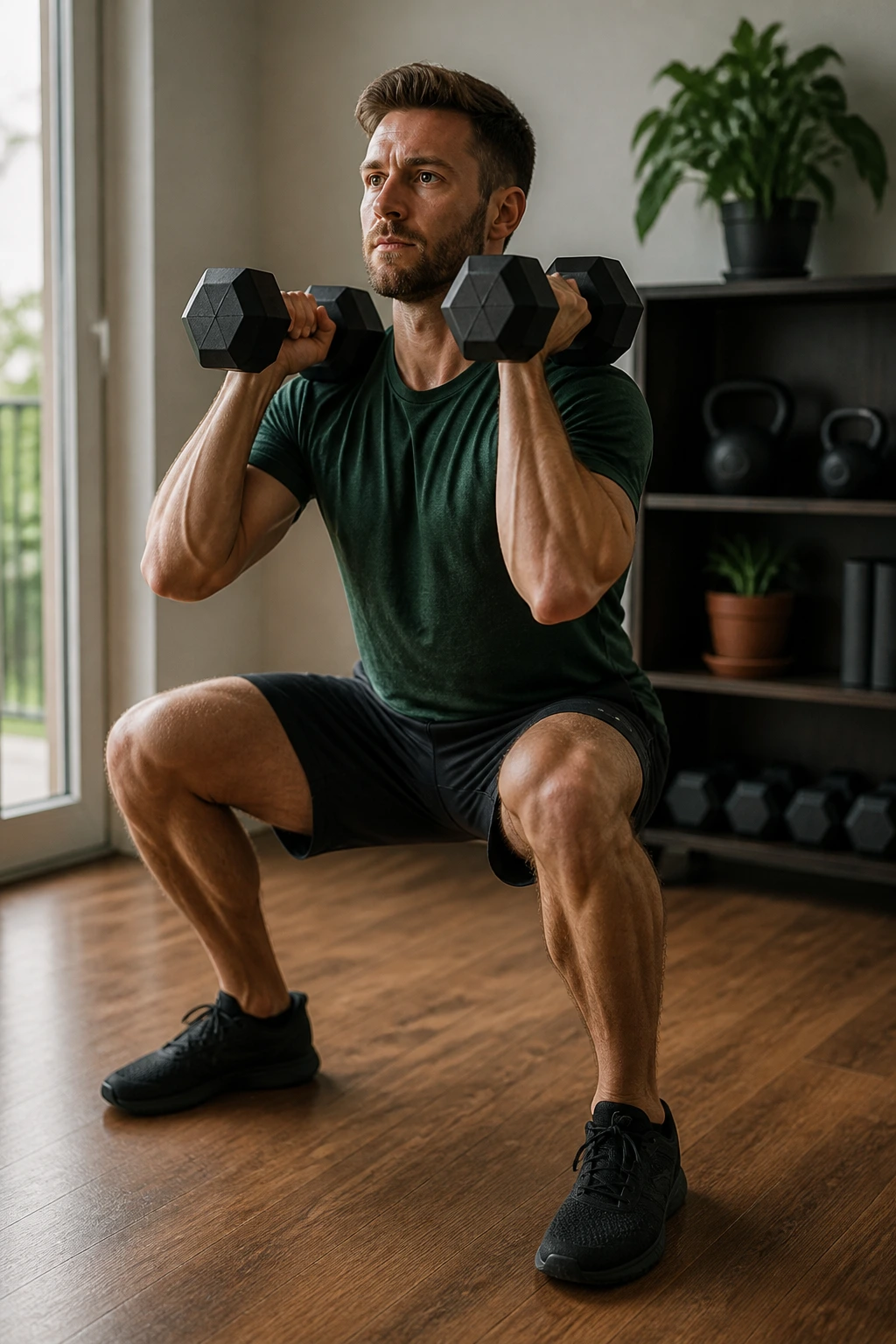
A pair of dumbbells on the floor can carry a whole workout.
The best complex sessions never let the weights leave your hands, or at least not for long. That keeps the heart rate up while the muscles keep working, and the shift from one move to the next makes the whole thing feel more demanding than the rep count suggests.
The exact order
Use a load you could normally press for 8 clean reps. Then run this without setting the dumbbells down:
- 6 dumbbell deadlifts
- 6 bent-over rows
- 6 hang cleans or power cleans
- 6 front squats
- 6 push presses
- 6 reverse lunges per leg
Rest 90 seconds after each round. Do 4 rounds. If the clean or push press is new to you, swap in strict presses and keep the movement tidy. The dumbbells should feel challenging by the final round, but not so heavy that your form gets ragged halfway through the sequence.
This is one of those home workouts that gives you both pieces at once. Strength from the loaded pattern. Conditioning from the continuous work. There’s no dead time to hide in.
11. Band Rows and Chair Dips
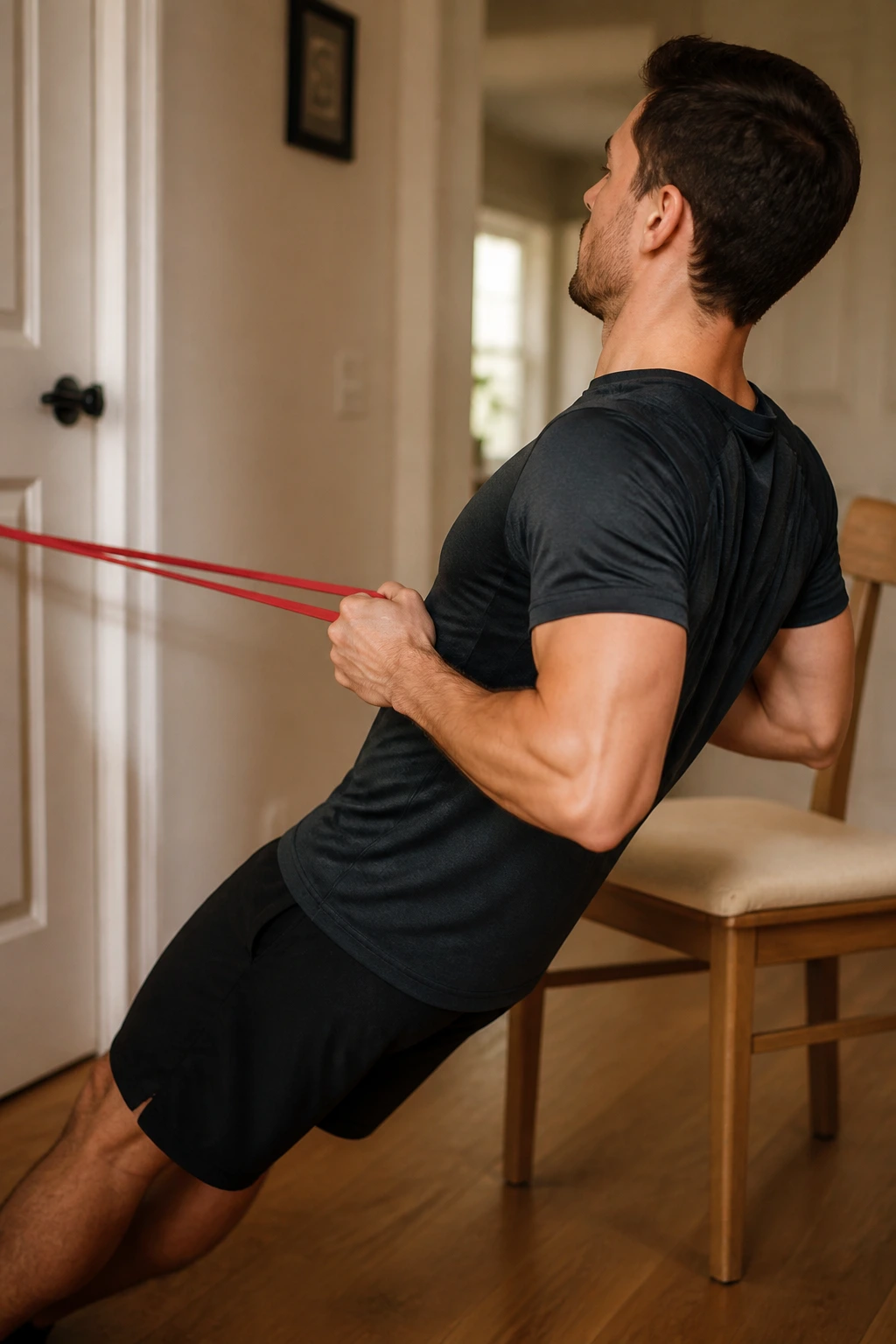
Not every home session needs jumping.
That may sound boring, but it’s a useful correction. Bands, a sturdy chair, and a little patience can build a hard upper-body workout without beating up your knees or making your apartment sound like a gym class. When shoulders feel beat up, I reach for this kind of session more often than people expect.
A small warning about chairs
Check the chair first. Push it against a wall. Test it with your body weight before you trust it with a set of dips. Slipping halfway through a dip is not a cute home-fitness moment.
Run 4 rounds of:
- 15 band rows
- 8 to 12 chair dips
- 15 band face pulls
- 10 split squats per leg
Rest 45 to 60 seconds. Keep the rows tight to your ribs and pause for one second when the band is pulled back. On the face pulls, keep your elbows high and don’t shrug up into your neck. The split squats are there to keep the lower body involved so the workout still feels like a full session.
This is a good choice when you want posture work, triceps, and a bit of leg burn without noise.
12. The Squat, Lunge, and Jump Session
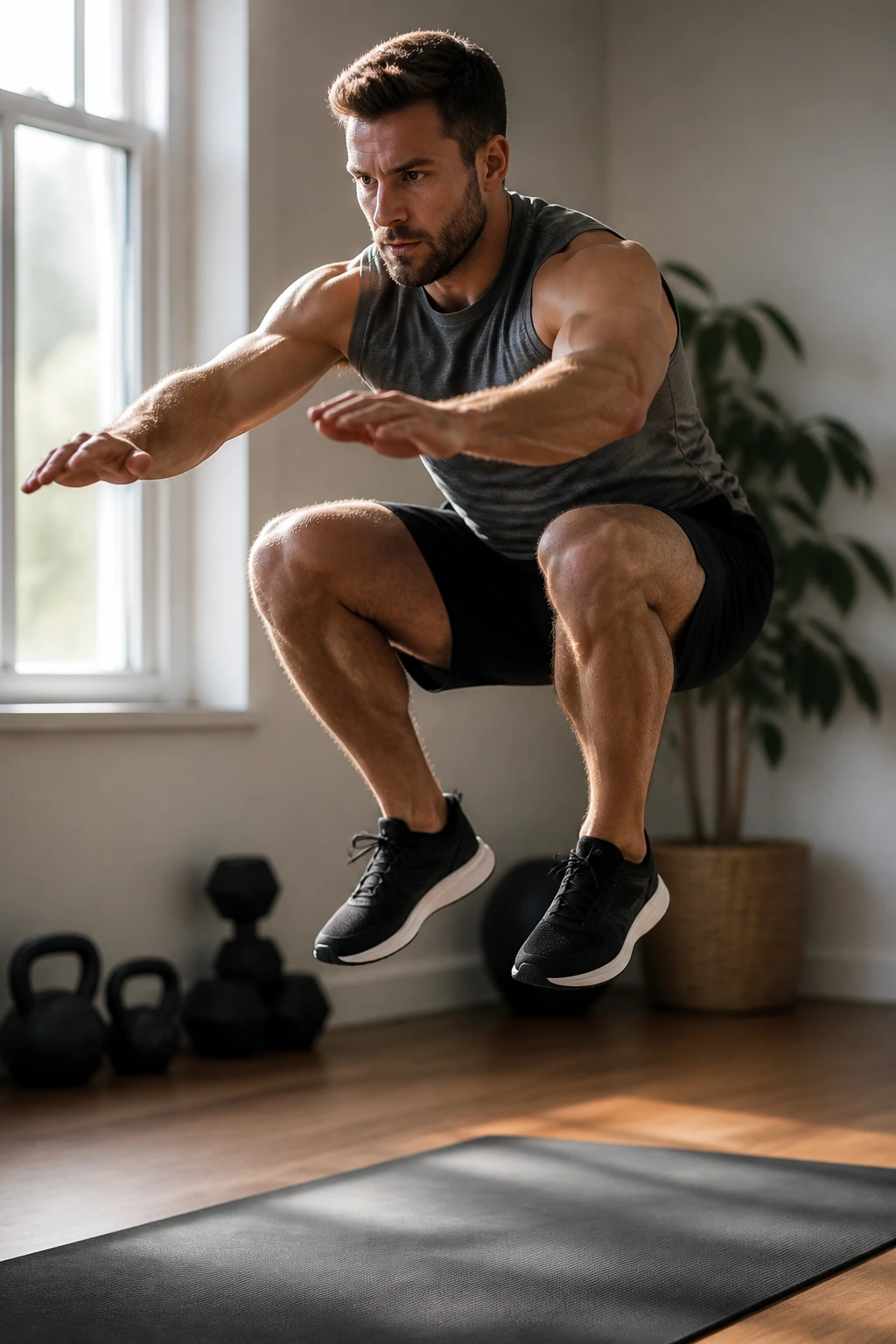
Your thighs will feel hot before the timer looks generous.
That’s the mood of this workout. It is direct, fast, and a little rude. Squats and lunges do the heavy lifting, then a small dose of jumps or fast feet keeps the conditioning side from getting sleepy.
Run this for 4 to 5 rounds:
- 15 air squats
- 10 reverse lunges per leg
- 8 jump squats
- 20 jumping jacks
- Rest 45 seconds
If jumps bother your knees, replace the jump squats with fast bodyweight squats and make the last five reps a little quicker. Land softly if you keep the jumps. Think quiet feet, knees tracking over toes, torso steady. That landing detail matters more than people think.
This session is simple enough to remember without checking your phone every minute, which I appreciate. It also has a nice honest quality: if you rush the first round, the later rounds punish you for it. Clean pace wins.
13. The Hinge Day for Glutes and Hamstrings
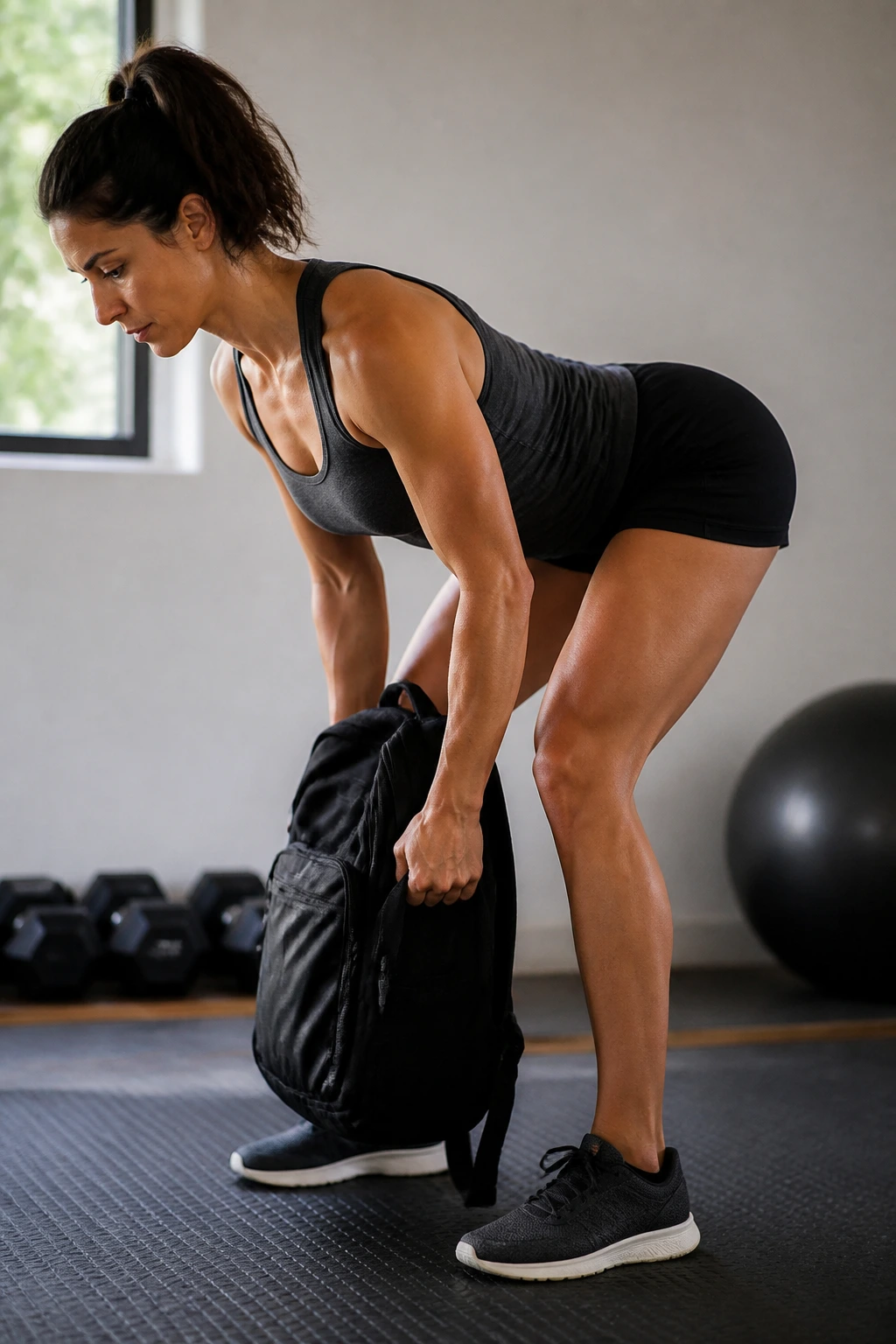
Most home leg workouts lean hard on squats.
That leaves the back side of the body underworked, and you feel it sooner or later. Hamstrings and glutes need actual hinge work, not just a few lazy bridges after a pile of lunges. This session keeps the spine neutral, the hips loaded, and the posterior chain awake.
What people miss
Use a backpack, a tote bag, or a pair of dumbbells if you have them. Then run 3 to 4 rounds of:
- 12 Romanian deadlifts
- 15 glute bridges with a 2-second squeeze
- 12 good mornings
- 8 hamstring walkouts
Rest 60 seconds between rounds. Keep the load close to the body on deadlifts and good mornings, and stop the descent when your back wants to round. You do not need to touch the floor. You need tension in the hamstrings and glutes.
If you only remember one thing from this section, make it this: hinge work should feel long through the back of the legs, not crushed in the knees. That small difference changes the whole session. It’s the sort of thing people only notice after they’ve done a few rounds the wrong way.
14. The Plyometric Power and Landing Control Session
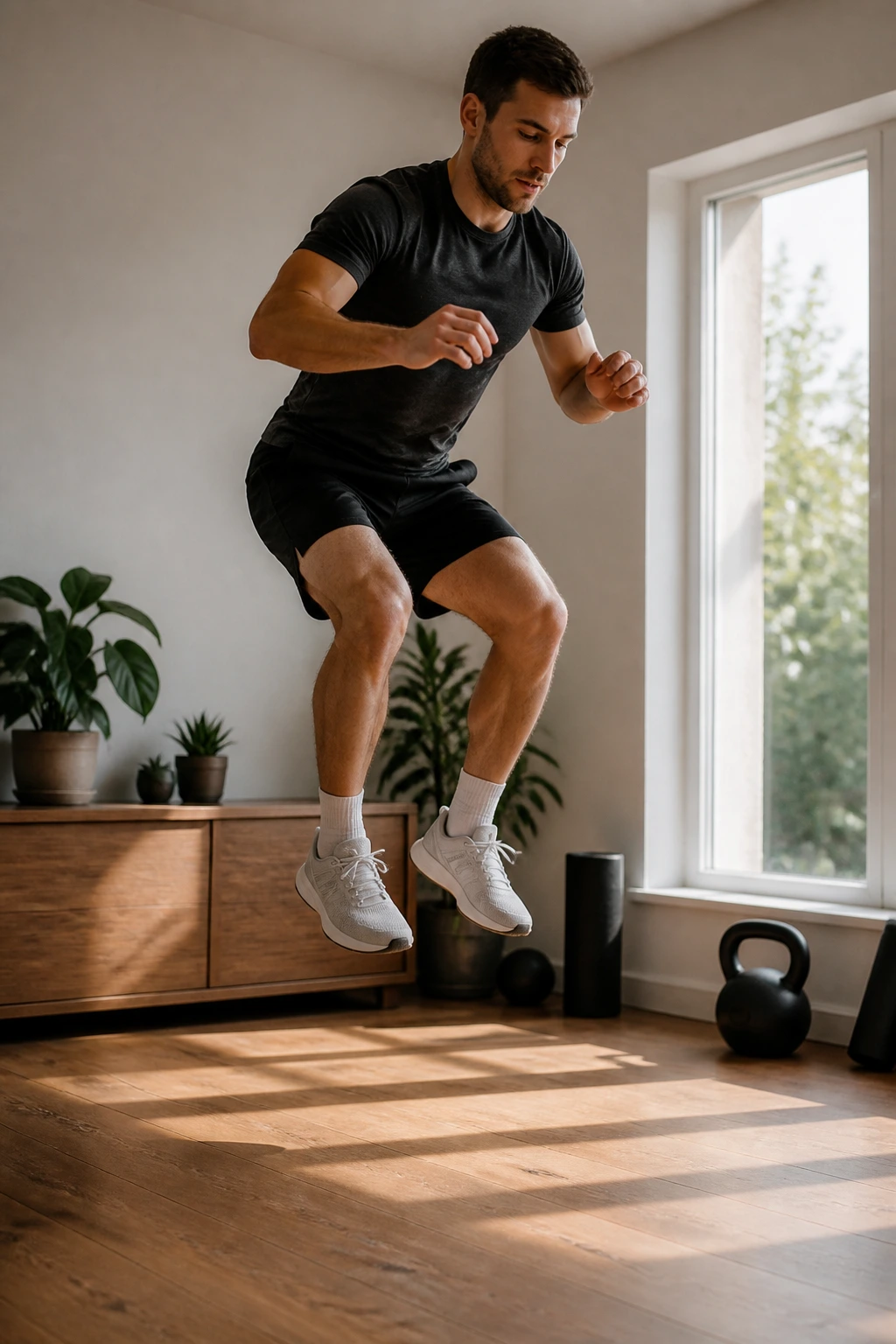
The first clean landing feels different.
Not dramatic. Just better. The feet hit, the knees absorb, the torso stays stacked, and you don’t hear a crash from the floor. That’s what good plyometric work looks like at home. It’s not about jumping as high as possible every time. It’s about fast contact, control, and enough rest that each rep still looks sharp.
Landing rules
Do 4 rounds of:
- 5 snap-downs
- 20 pogo hops
- 8 skater jumps per side
- 5 broad jumps
- Rest 60 to 90 seconds
Snap-downs teach you how to load and land. Pogos keep the ankles lively. Skater jumps add side-to-side force. Broad jumps bring it together. If you can’t land quietly, lower the intensity and fix that first.
A few rules help here:
- Land with soft knees, not stiff legs.
- Stop the set when jump height drops.
- Use more rest than you think you need.
- Skip this on slick floors.
This is a better power session than people give it credit for. Short, crisp, and not as chaotic as it looks.
15. The AMRAP Grinder
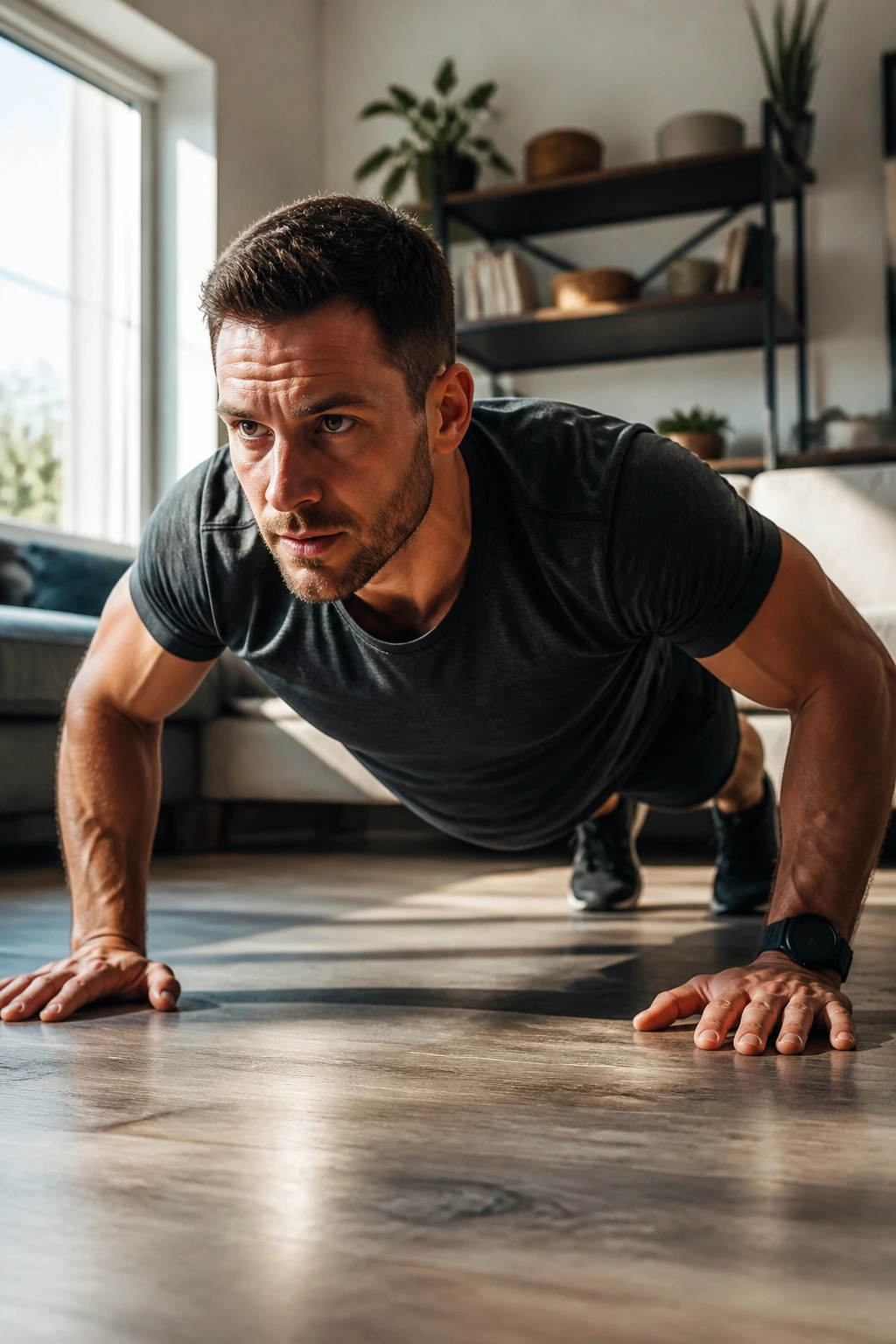
AMRAP is honest.
As many rounds as possible means the clock never lies to you, and the score is hard to fake. You pick a reasonable pace, you keep moving, and you find out where your conditioning actually sits on that day. No drama. No fluff.
Where most people go wrong
Set a 20-minute timer and cycle through:
- 8 push-ups
- 12 squats
- 10 backpack rows or band rows
- 8 burpees
- 20 bicycle crunches
Keep the first 5 minutes calm. That’s the whole trick. People see the clock and attack it like a sprint, then spend the middle of the workout staring at the floor and bargaining with themselves. Stay smooth. If your burpees turn ugly, cut them to squat-thrusts and keep the work moving.
This is a strong benchmark because it forces pacing, and pacing is part of conditioning whether people want to admit it or not. If you want to beat your last score, the answer is usually cleaner reps and steadier breathing, not some dramatic new move.
16. The Tempo Strength Session
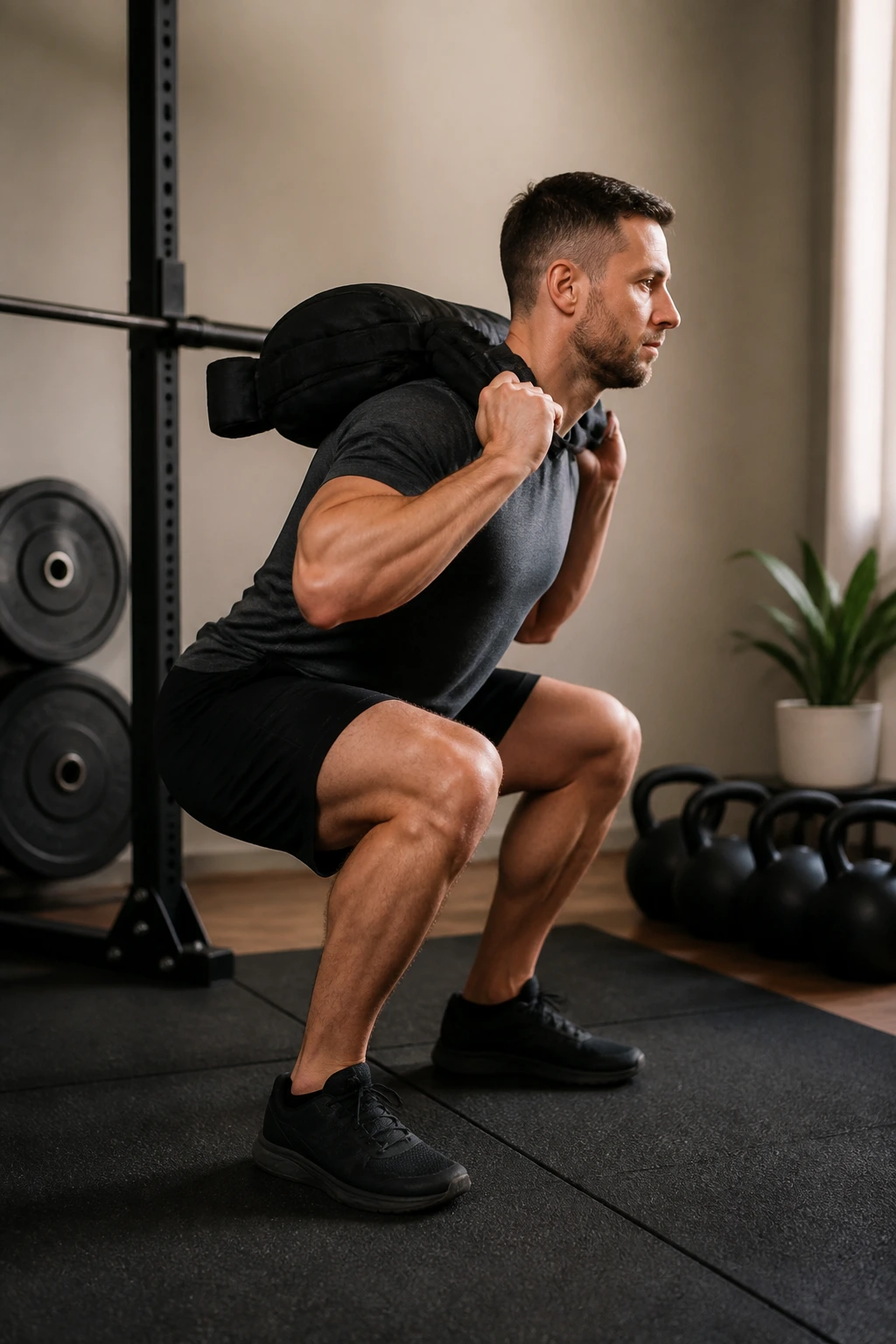
Why do slow reps still feel brutal?
Because time under tension piles up fast. A five-second lower on a squat is not flashy, but it makes every rep count. Add a pause at the bottom and a controlled return, and suddenly light equipment stops feeling light.
Use this tempo on the whole workout: 5 seconds down, 2 seconds pause, 1 second up.
How to count it
Run 3 rounds of:
- 8 tempo squats
- 8 tempo push-ups
- 8 tempo split squats per leg
- 12 tempo glute bridges
Rest 60 to 75 seconds between rounds. Count out loud if you have to. The moment people stop counting, they speed up, and the whole point disappears. On push-ups, use an incline if the tempo breaks your position. On squats, keep the chest tall and the feet planted.
I like this session on days when energy is low but focus is decent. It doesn’t rely on jumping or huge loads. It just asks you to respect the rep. That’s a different kind of hard, and it sneaks up on you.
17. The Mixed-Modal Cardio-Strength Circuit

A hallway, a living room, and a stair landing can become a decent training loop.
That sounds almost too casual, but mixed-modal work is often the most practical thing to do at home. You move one way with a load, another way with your bodyweight, then you switch patterns before anything gets stale. The change of station keeps one muscle group from frying too early.
Why the change of stations helps
Try this 4-round circuit:
- 40 seconds backpack carry march in place
- 40 seconds step-ups
- 40 seconds plank shoulder taps
- 40 seconds squat to overhead reach
- 20 seconds rest
If you have a towel and a smooth floor, swap the shoulder taps for towel slides or mountain climbers. If the carry is too easy, squeeze the backpack handles and keep the ribs down. The goal is not speed for its own sake. It’s steady work with enough load to keep the session honest.
This workout is a good fit for people who get bored fast. It’s also a nice option when you want sweat, but you don’t want a wall of jumping. The alternating pattern keeps it from feeling like punishment.
18. The Isometric Hold Ladder
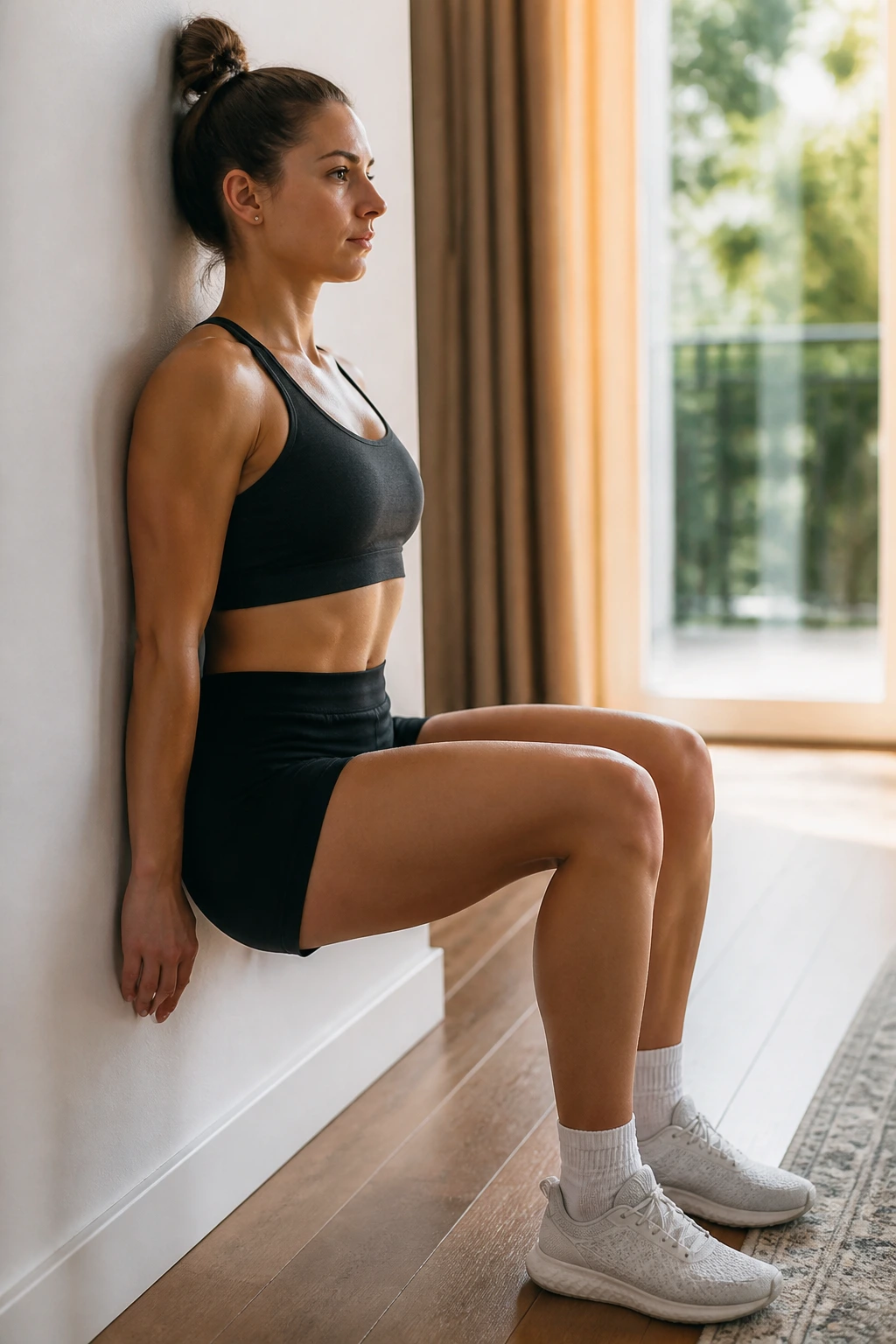
Squeezing harder beats moving faster on some days.
Isometric work does not look exciting on paper, which may be why people skip it. Bad move. Holds can expose weak positions, build raw tension, and calm down noisy joints when used well. I reach for them when I want a session that feels controlled instead of frantic.
What to hold and for how long
Run this ladder twice:
- Wall sit for 20, 30, then 40 seconds
- Push-up bottom hold for 10, 15, then 20 seconds
- Split squat hold for 20 seconds each leg
- Plank hold for 30, 40, then 50 seconds
Rest 30 to 45 seconds between holds. Stay deliberate. The knees should track, the core should stay braced, and the shoulders should not creep up toward your ears. Trembling is normal. Sharp pain is not.
This style is especially useful when you need quiet training or when you want strength without a lot of joint pounding. It’s also a nice reset after a few noisier sessions. No jumping. No rushing. Just tension.
19. The Quiet Apartment Workout
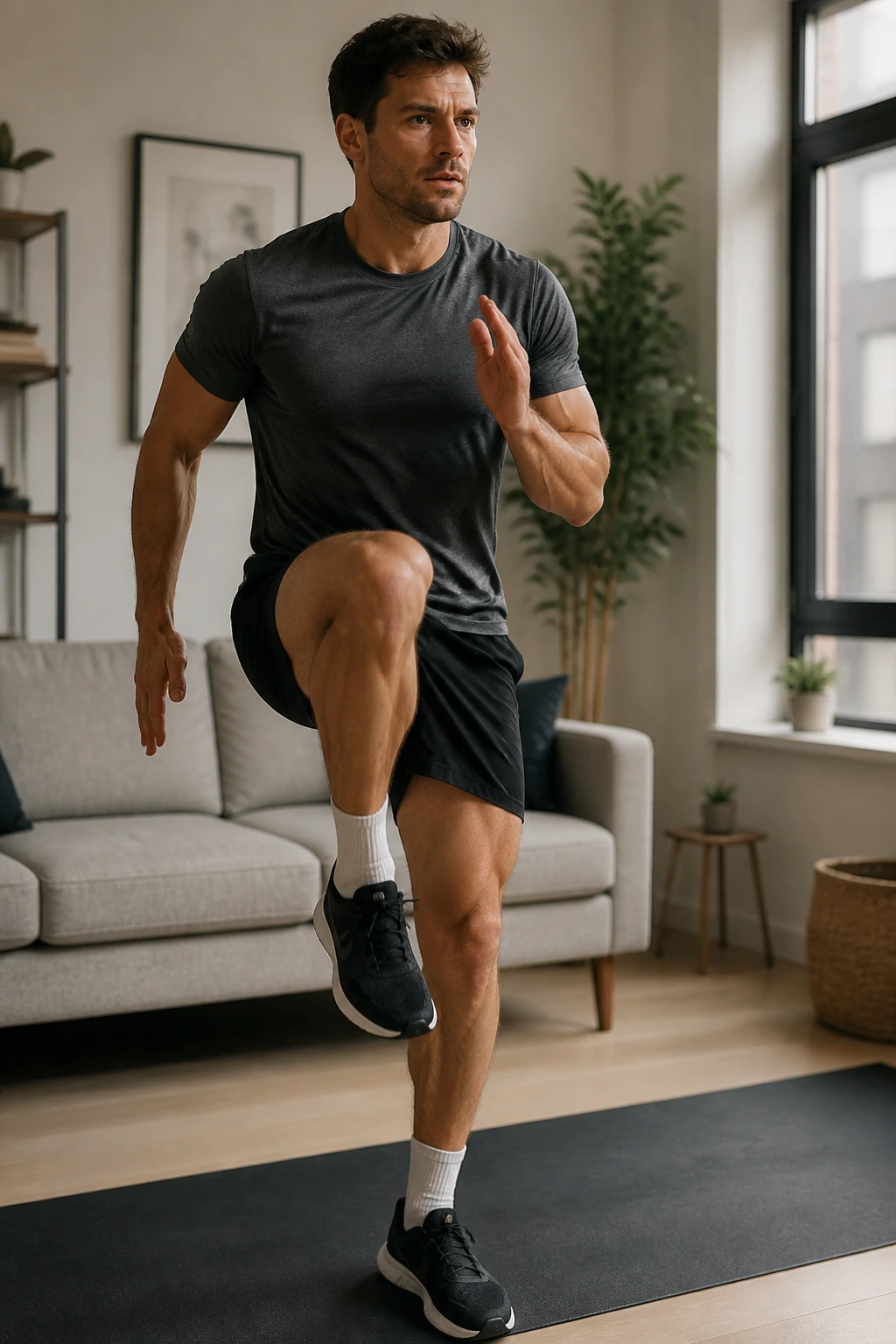
If you live upstairs, this is the session that doesn’t sound like a stampede.
Quiet training has a place. A good one, actually. You can keep the heart rate up, challenge the legs, and hit the upper body without dropping onto the floor or bouncing off the furniture. It’s a smart choice for late evenings, early mornings, or any time the walls feel thin.
Noise-friendly swaps
Do 4 rounds of:
- 30 seconds marching high knees
- 12 slow squats
- 8 incline push-ups on a counter or couch
- 15 glute bridges
- 12 band rows
- 20-second side plank per side
Rest 45 seconds between rounds. Replace jumping jacks with step jacks. Replace burpees with squat-to-plank walks. Replace running in place with a brisk march and active arms. Those swaps sound small, but they matter when sound carries through the floor.
This workout is not glamorous. It does work. And sometimes that’s the whole point. You finish breathing hard, but the room still looks like a room, which is a nice outcome if you share space with other humans.
20. The Repeatable Benchmark Test
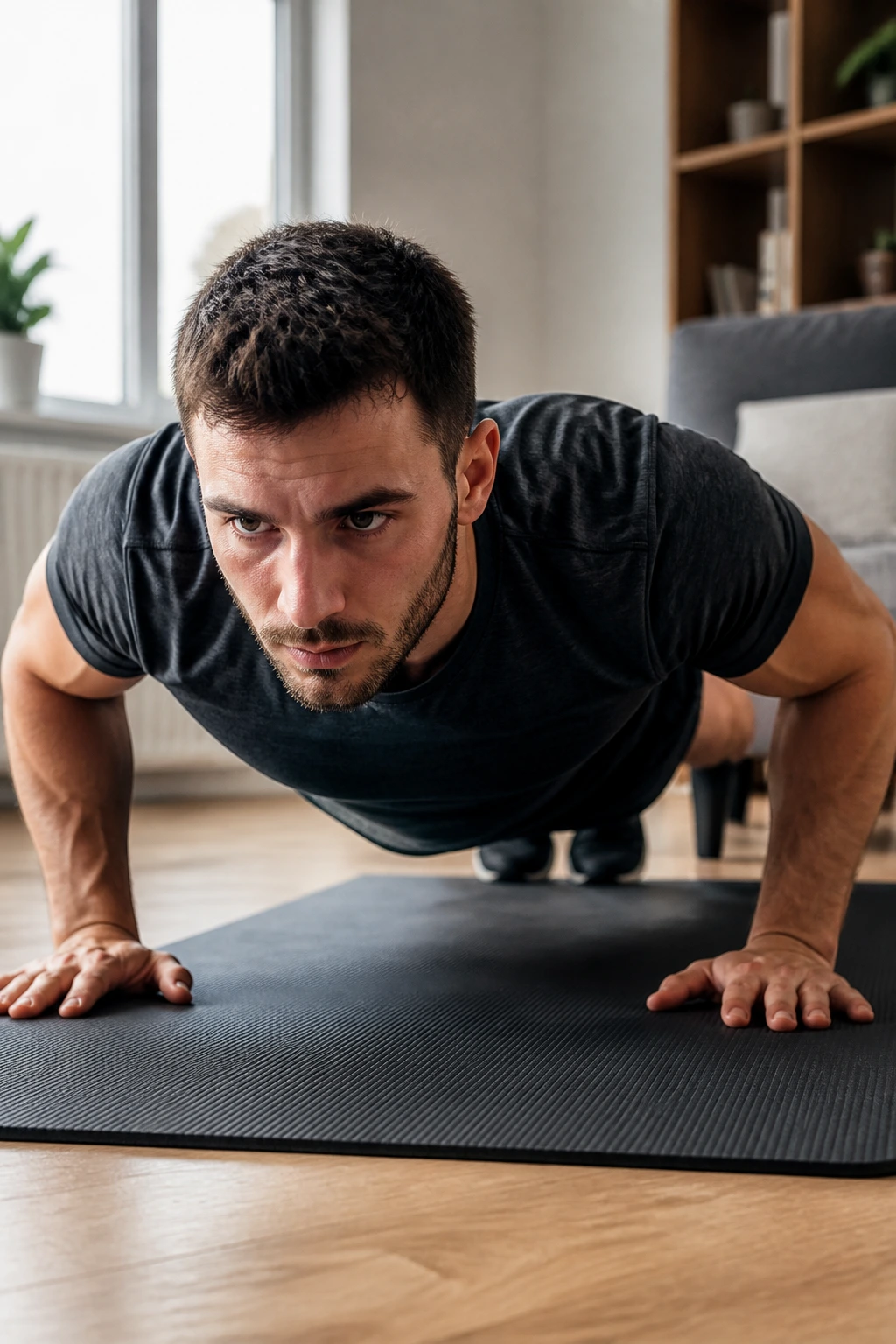
Unlike the more playful sessions, this one tells you whether your fitness has moved.
That’s why I like a repeatable benchmark. Pick one simple format, keep the same warm-up, and test it again later under the same conditions. The point is not to impress yourself on the first try. The point is to have something honest to compare against later.
How to retest yourself
Set a 12-minute timer and repeat this circuit for as many quality rounds as you can:
- 8 push-ups
- 12 air squats
- 10 alternating reverse lunges per leg
- 20 mountain climbers
- 20-second plank
Write the score down. If you use a backpack or dumbbells, keep the load the same every time. Same floor. Same order. Same rest rules. If your score goes up and your form stays clean, you’re getting fitter. If the score stays flat, the fix is usually one of three things: better pacing, less wasted rest, or slightly cleaner reps.
That’s the cleanest way I know to make home training feel real. Not random. Not noisy. Real.
