



The morning alarm is a universal friction point. You want to move your body, but you also want ten more minutes of sleep, and the looming reality of a busy day makes the gym feel like an impossible logistical hurdle. Yet, the legs are the biggest muscle groups in your body. When you work them, you trigger a metabolic response that wakes up your entire system faster than any caffeine hit. You do not need an hour-long session or a rack of heavy barbells to make progress. You just need enough structure to force your muscles to work harder than they want to.
Building a consistent routine is not about finding the perfect hour; it is about finding ten minutes that you can actually commit to while the coffee brews. These quick leg workouts are designed to be done in your bedroom, living room, or hallway. They prioritize intensity over duration, ensuring that even if you only have a short window, you can create a significant training stimulus.
1. The Bodyweight Squat Tabata
Tabata is an interval protocol that uses 20 seconds of maximum effort followed by 10 seconds of rest. It is arguably the most efficient way to spike your heart rate and fatigue your quads without needing a single piece of equipment.
Why It Works for Legs
By keeping the rest periods extremely short, you prevent the muscle fibers from fully recovering between sets. This creates a buildup of metabolic byproducts—what people often call “the burn”—which signals your body to adapt by strengthening and toning the targeted tissues. You are effectively performing a high-volume set of squats in a very compressed timeframe.
The Protocol
- Perform 20 seconds of air squats as fast as you can while maintaining perfect form.
- Rest for 10 seconds.
- Repeat this for 8 total rounds.
Pro tip: Do not lock your knees at the top of the squat. Keeping a soft bend ensures constant tension on the quadriceps throughout the entire four-minute duration.
2. Stationary Lunge Burner
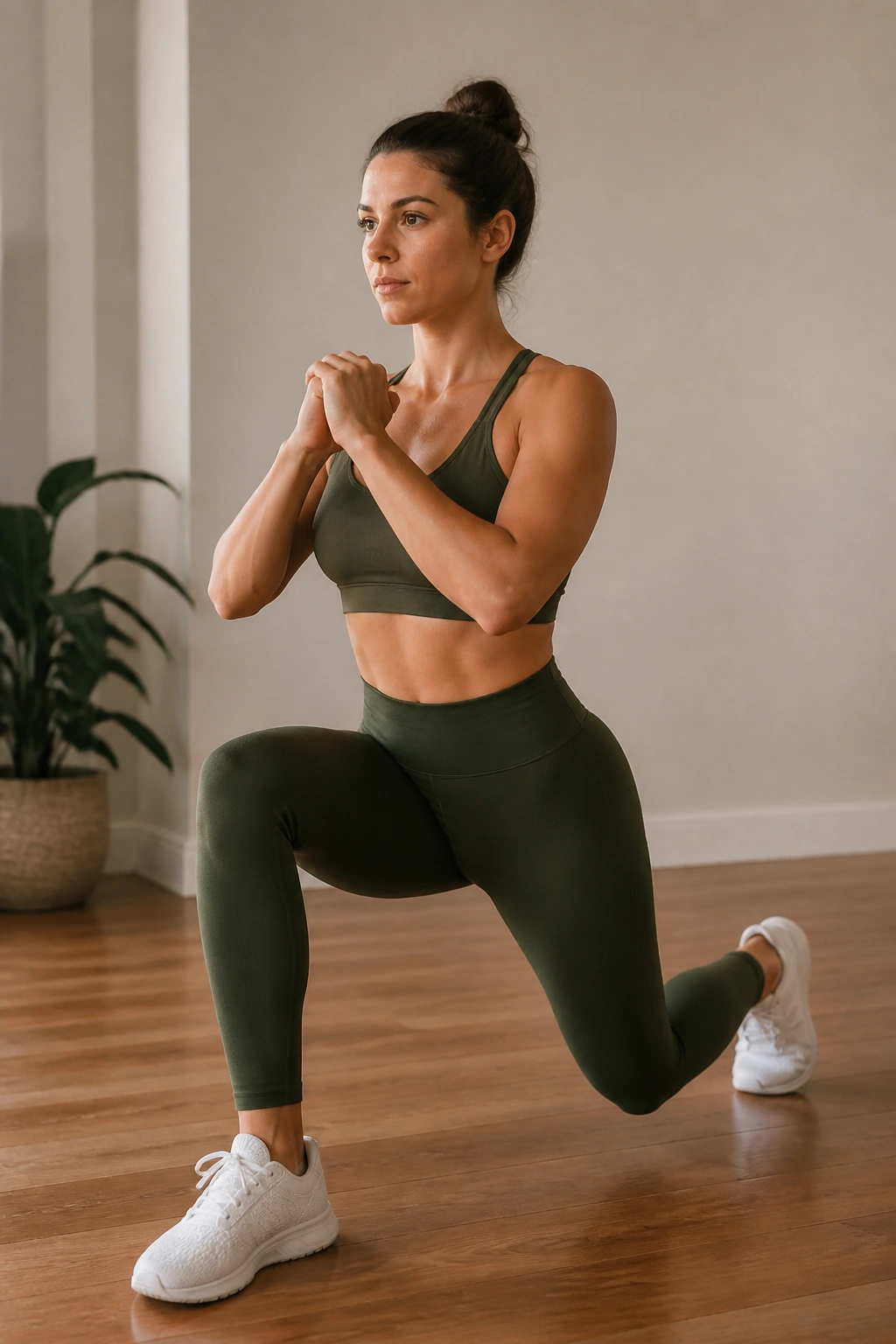
This workout focuses on time under tension, which is a major driver of muscle hypertrophy. By keeping your feet planted, you eliminate the momentum that often makes lunges feel “easy” or purely aerobic.
You will stand in a split stance with one foot forward and one back. Lower your hips until both knees form roughly 90-degree angles. Instead of pushing back to standing, you will pulse at the bottom. The key is to keep your torso upright and your weight distributed mostly through the front heel. Do 45 seconds on the right leg, then switch immediately to the left. Take 15 seconds to breathe, then repeat for four rounds.
This approach is deceptively difficult. Because you are stuck in the bottom, loaded position, your quads and glutes have to fire continuously to stabilize your body. If you feel shaky, that is the point. That trembling is your central nervous system recruiting more muscle fibers to help you stay upright.
3. Glute Bridge Endurance
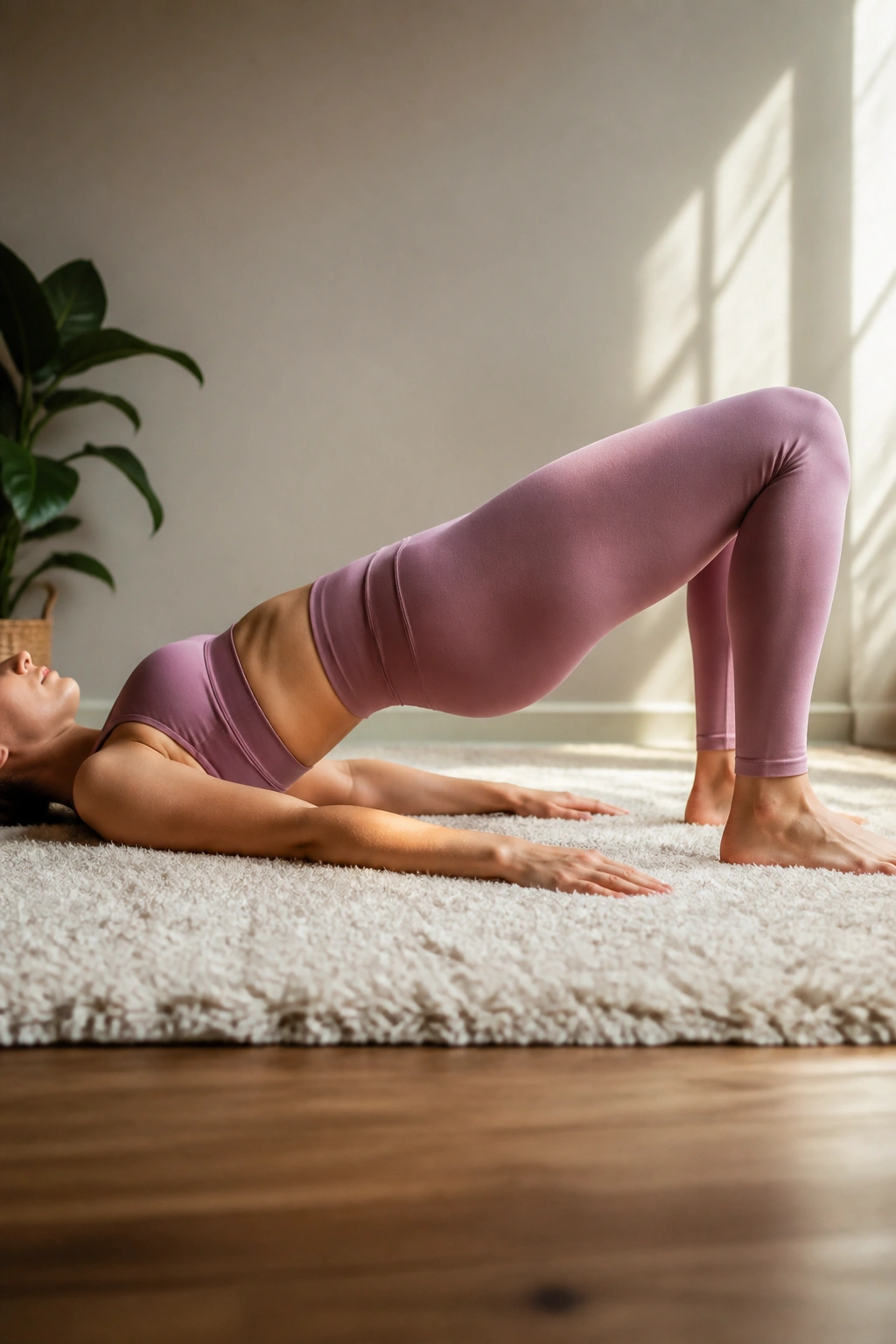
While squats and lunges are quad-dominant, your glutes need attention too. Glute bridges are the gold standard for floor-based leg work because they isolate the posterior chain without putting any strain on your lower back or knees.
How to Execute the Movement
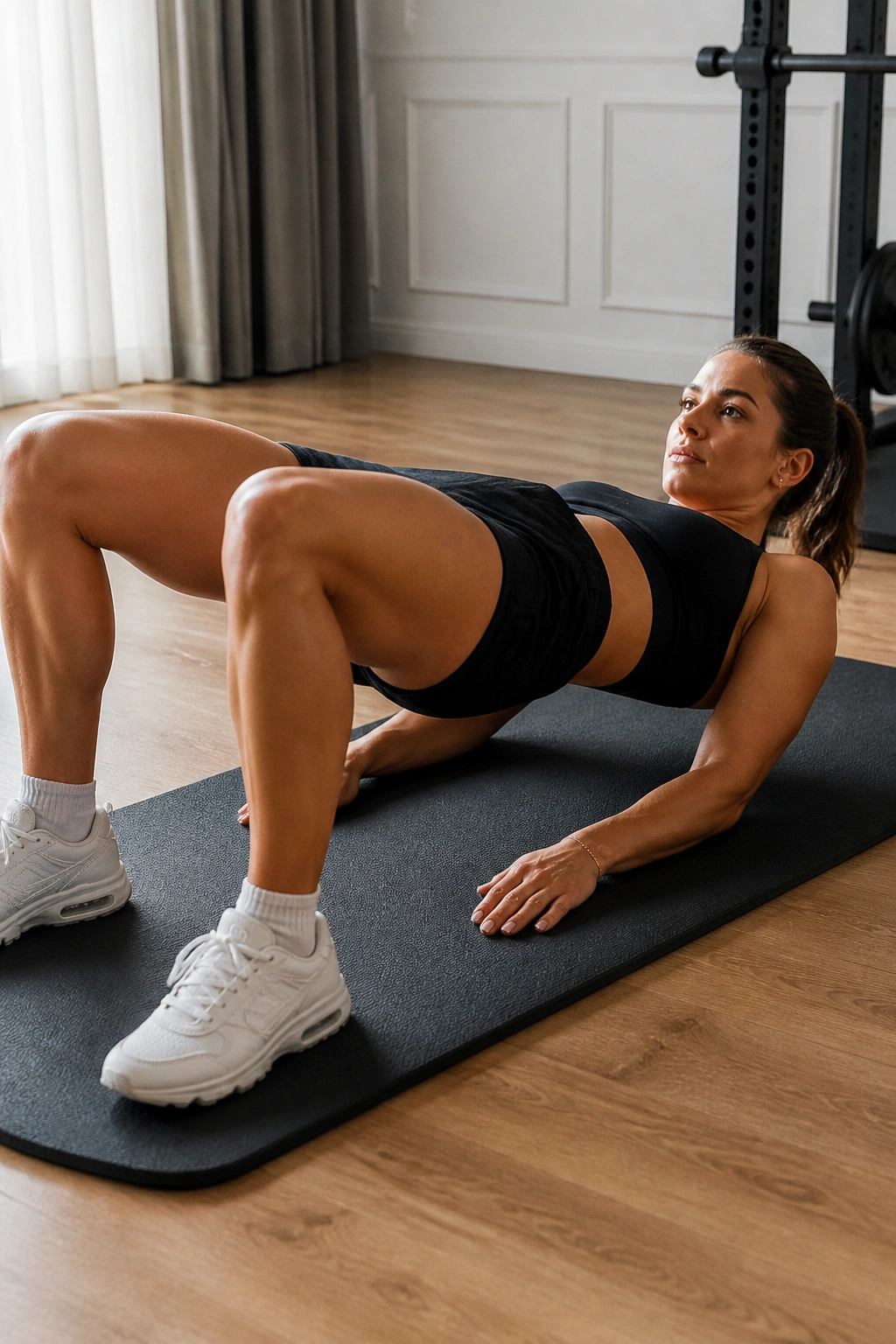
Lie on your back with your knees bent and feet flat on the floor, about hip-width apart. Drive through your heels to lift your hips toward the ceiling. Squeeze your glutes at the top as hard as you can for two seconds. Lower slowly, stopping just an inch before your tailbone touches the floor.
The Workout Structure
- Set 1: 20 reps (standard tempo)
- Set 2: 20 reps (hold the top position for 3 seconds on every rep)
- Set 3: 20 reps (as fast as possible while maintaining a full squeeze)
Warning: If you feel this in your hamstrings rather than your glutes, move your feet closer to your glutes or slightly further away. Small adjustments in foot placement change which muscle group takes the load.
4. Plyometric Explosive Jumps
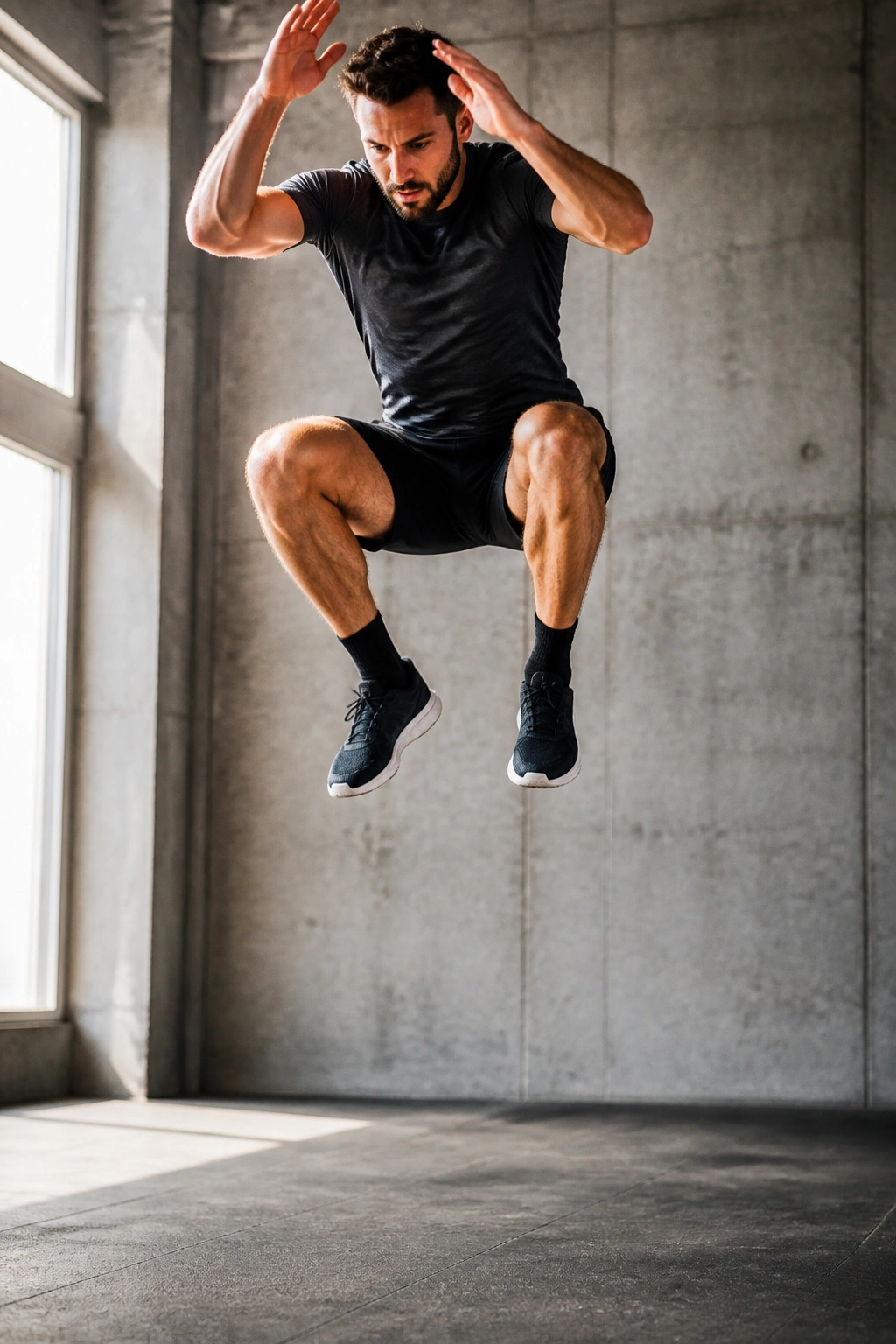
Explosive power is not just for athletes; it is a vital component of functional fitness as you age. Plyometrics—or jump training—force your muscles to react quickly and powerfully, which is great for building speed and resilience.
Start in a standard squat position. Lower yourself into a quarter squat, then jump vertically as high as you can. Land softly—this is the most important part—and immediately sink back into the next squat. Do not pause at the bottom. If you land with a “thud,” you are not absorbing the impact correctly. Aim for silence upon landing.
Perform 30 seconds of jumping, followed by 30 seconds of rest. Repeat this 5 times. It is a simple, brutal way to get your heart rate soaring. By the fifth round, your calves and quads will feel heavy. That is the feeling of fast-twitch muscle fibers being pushed to their limit.
5. Lateral Motion Circuit
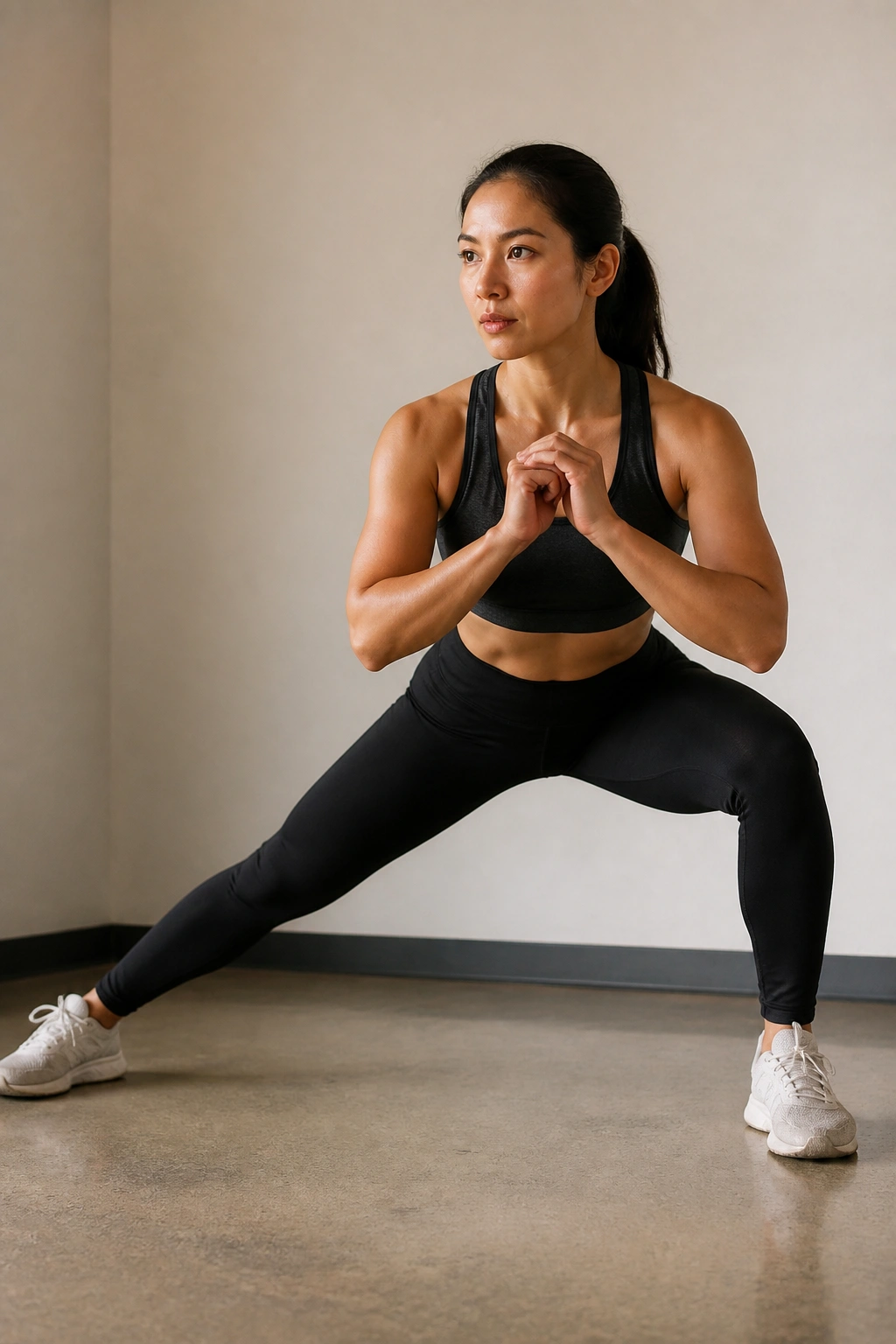
Most people only move in the sagittal plane—meaning front to back. But your hips and thighs operate in three dimensions. Lateral lunges train the inner and outer thighs, which helps prevent knee pain and strengthens the stabilizing muscles around your hips.
Stand with your feet together. Take a wide step to the right, keeping your left leg straight and pushing your hips back as if sitting into a chair with just your right leg. Push off the right foot to return to center. Then, switch to the left.
- 10 lateral lunges per side (slow and controlled)
- 10 lateral lunges per side (slightly faster tempo)
- Hold the bottom of the last lunge for 10 seconds per side
This routine hits the adductors, which are often neglected in standard leg training. By adding this to your morning rotation, you improve your balance and protect your joints from the wear and tear of repetitive front-to-back movement.
6. The Step-Up Stamina Challenge
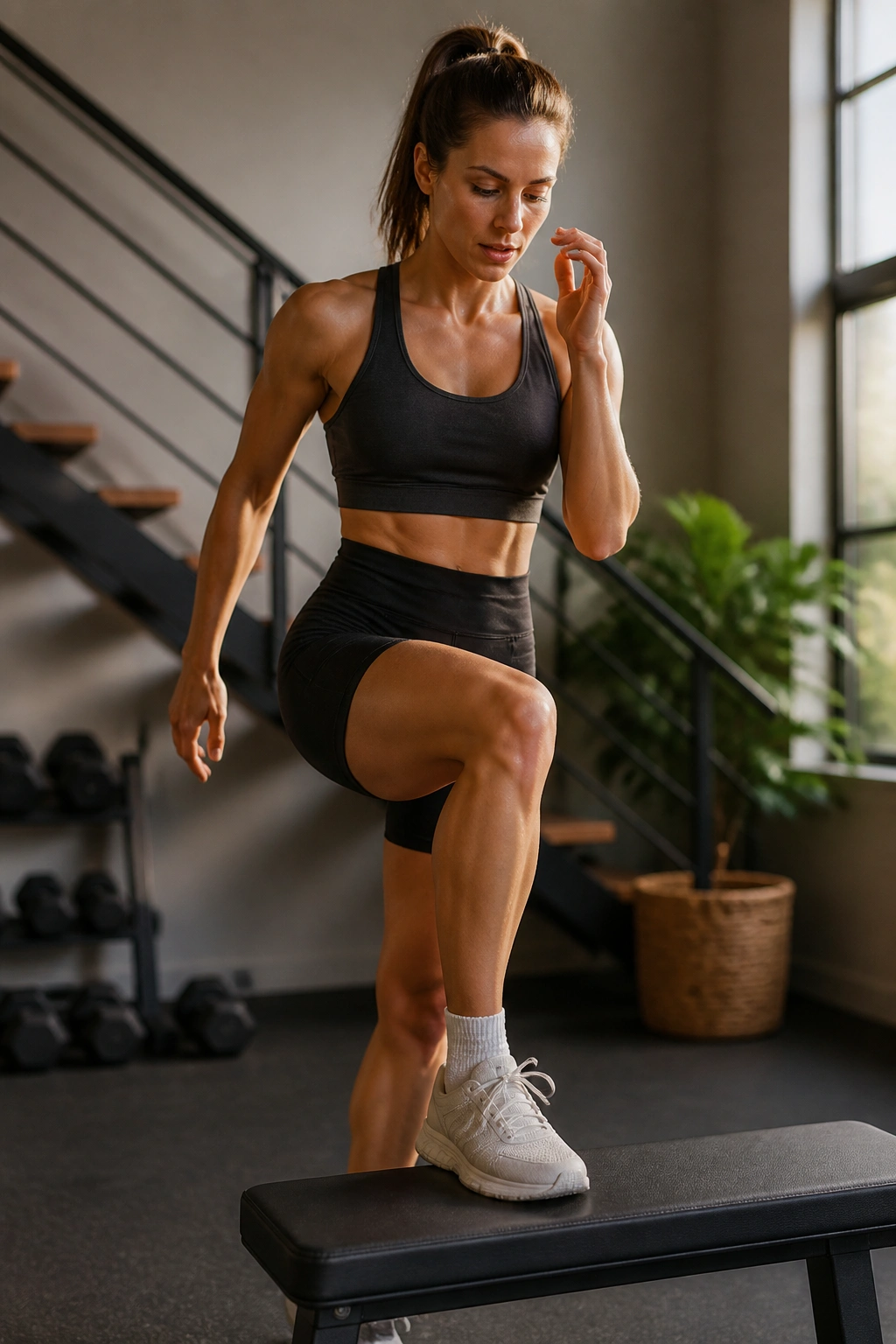
Find a sturdy chair, a low bench, or even the bottom step of your staircase. Step-ups are one of the most underrated leg exercises because they require total concentration on the lead leg.
Place your right foot fully on the bench. Drive your body upward, bringing your left knee toward your chest. Lower yourself back down slowly—control the descent. If you drop down quickly, you are cheating yourself out of the eccentric (lengthening) portion of the rep, which is where the muscle growth actually happens.
Do 15 reps on the right leg, then immediately switch to 15 on the left. Do not switch feet between reps. Keep the focus on one leg until it is fully fatigued. This “unilateral” approach forces your stabilizer muscles to work overtime to keep you from wobbling. It is a test of core strength as much as it is a leg workout.
7. The Sumo Stance Burnout
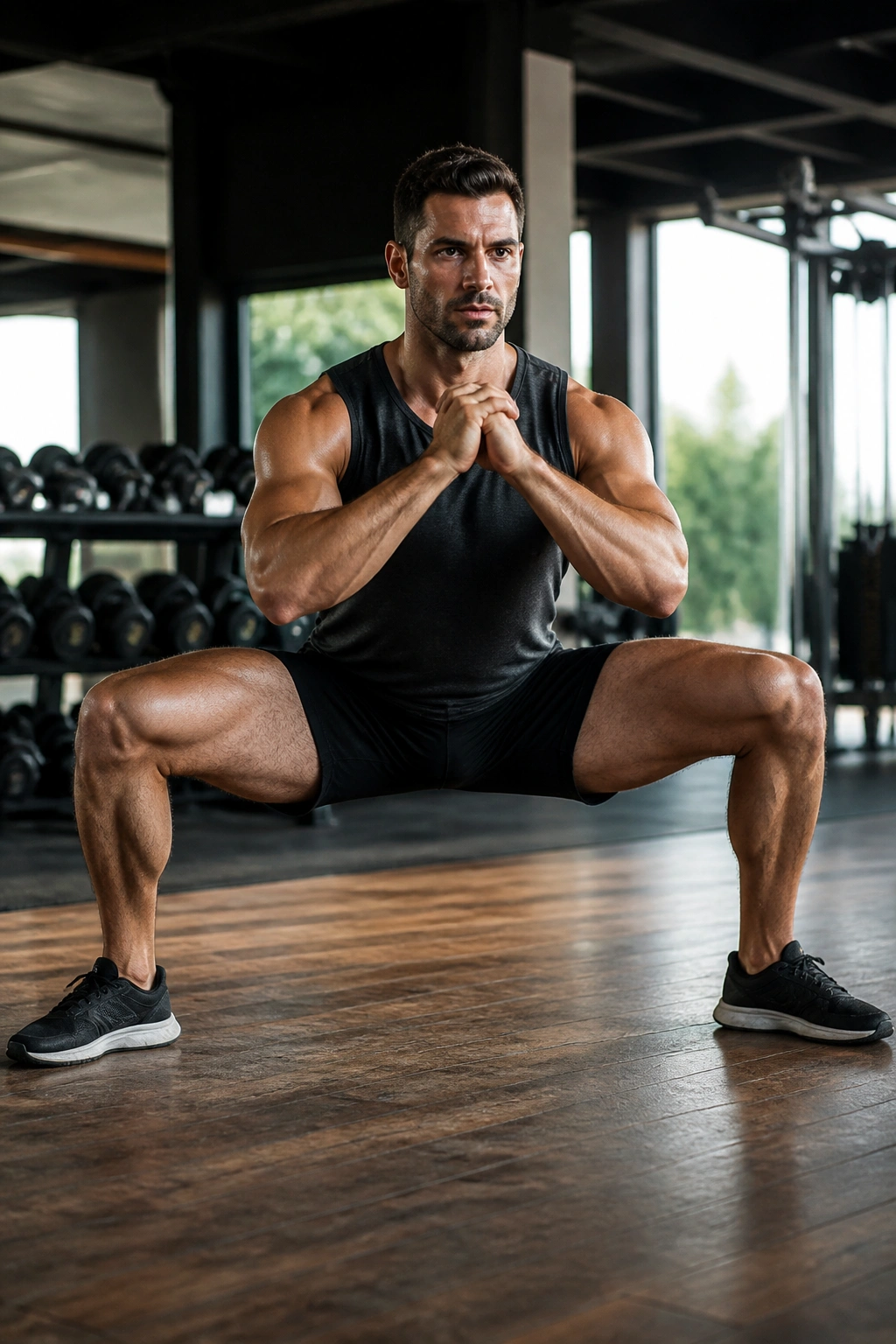
The sumo squat—where your feet are significantly wider than shoulder-width and toes are pointed out—shifts the emphasis to the inner thighs and glutes. This is a great variation to include when you are bored of standard squats.
Stand with a very wide stance, toes angled outward at 45 degrees. Drop your hips straight down, keeping your chest tall. As you come up, imagine you are trying to tear the floor apart with your feet. This cue—”tearing the floor”—activates the glutes more intensely than just standing up.
The Ladder Routine
- Perform 10 reps.
- Immediately perform 10 pulses at the bottom of the movement.
- Perform 8 reps.
- 8 pulses.
- 6 reps.
- 6 pulses.
You continue this countdown until you reach zero. It is a mental game as much as a physical one. By the time you get to the 2-rep mark, your inner thighs will likely feel like they are vibrating.
8. Single-Leg Stability Drill
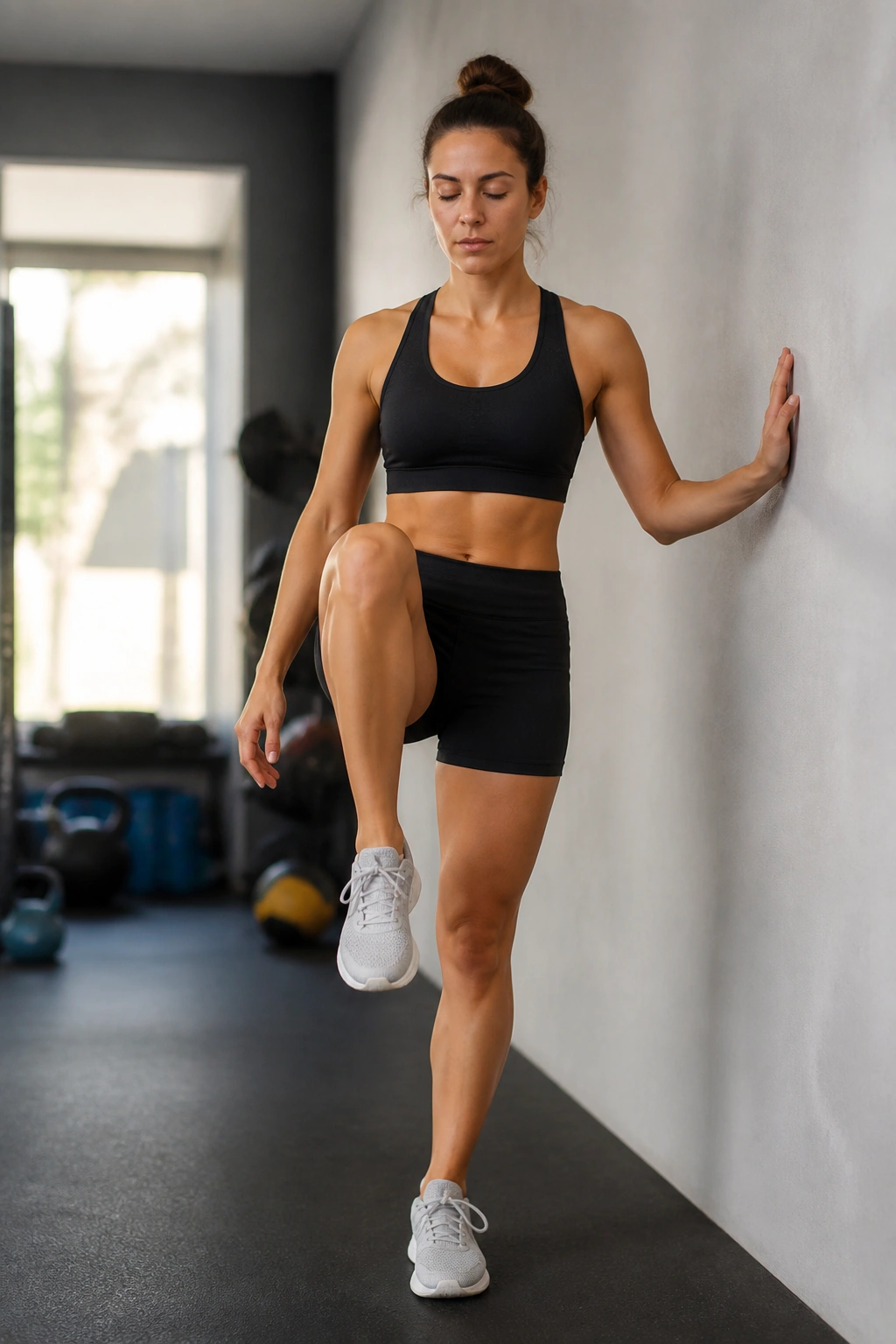
Balance is a skill that deteriorates quickly if you do not use it. This workout combines strengthening with proprioception—your body’s ability to sense its position in space.
Stand on your right leg and lift your left knee to hip height. Close your eyes for three seconds. Open them and perform a small single-leg squat. Try to keep your hips level; if your pelvis tilts, you are losing stability.
Do 10 reps on the right, then 10 on the left. If you cannot do this without putting your foot down, find a wall to lightly touch with one hand. As you get better, pull that support away. This is not about getting a massive “pump” in your muscles; it is about building the coordination that makes every other movement in your life easier and safer.
9. Dynamic Walking Lunges
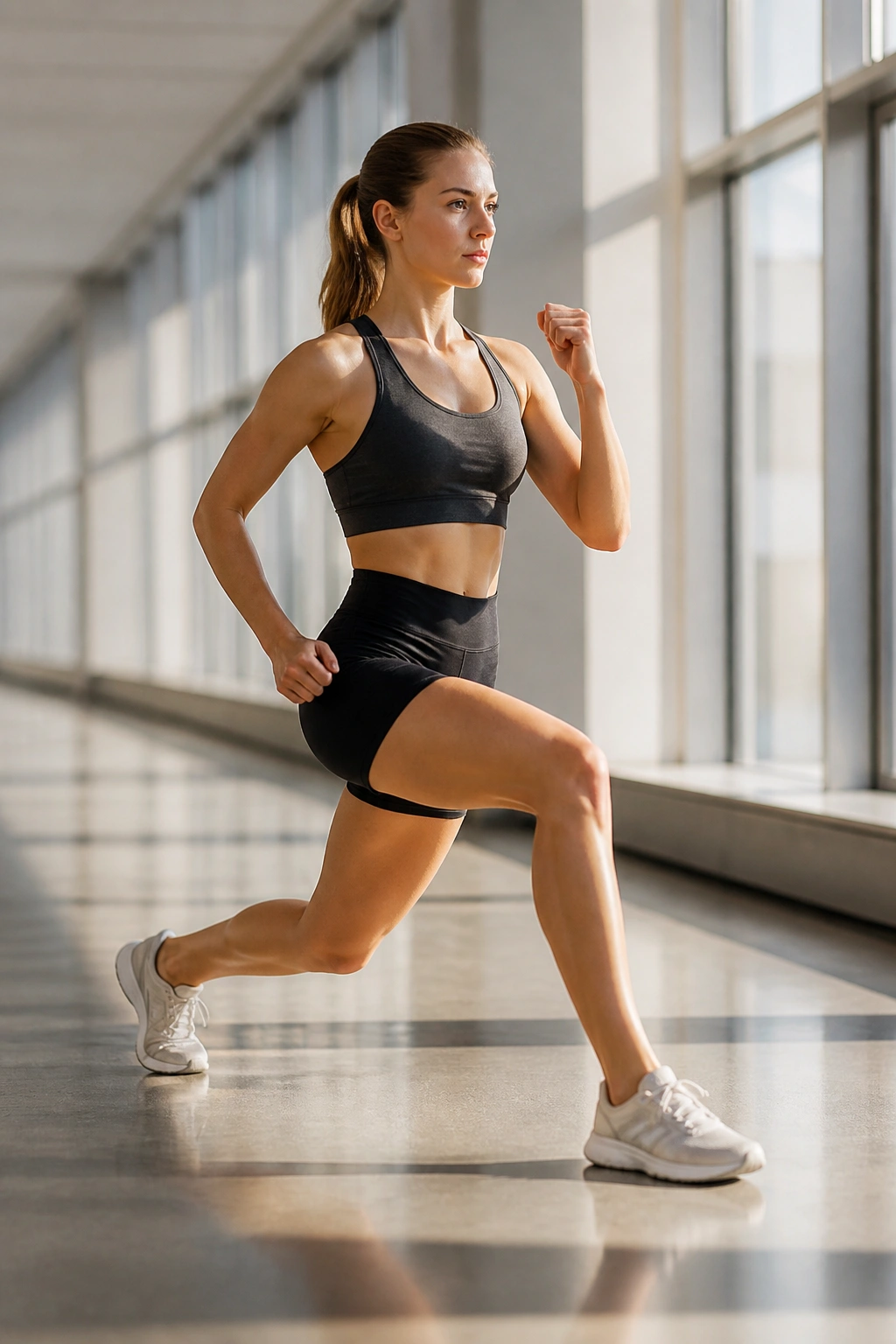
Walking lunges are excellent for building cardiovascular endurance while working the legs. If you have a long hallway, use it. If you are in a small room, walk in a circle.
Take a large step forward and lower your back knee until it almost touches the ground. As you stand up, drive through the front heel and immediately bring the back leg forward into the next lunge. Do not stop in the middle. The continuous motion is what turns this from a strength move into a metabolic conditioning drill.
Shoot for 20 total steps (10 per leg). If you feel like your form is breaking down, stop for a breath, reset your shoulders, and continue. It is better to do 10 perfect lunges than 20 sloppy ones where your knees are caving inward. Keep your hips square; do not let them rotate as you step.
10. Standing Calf Pump
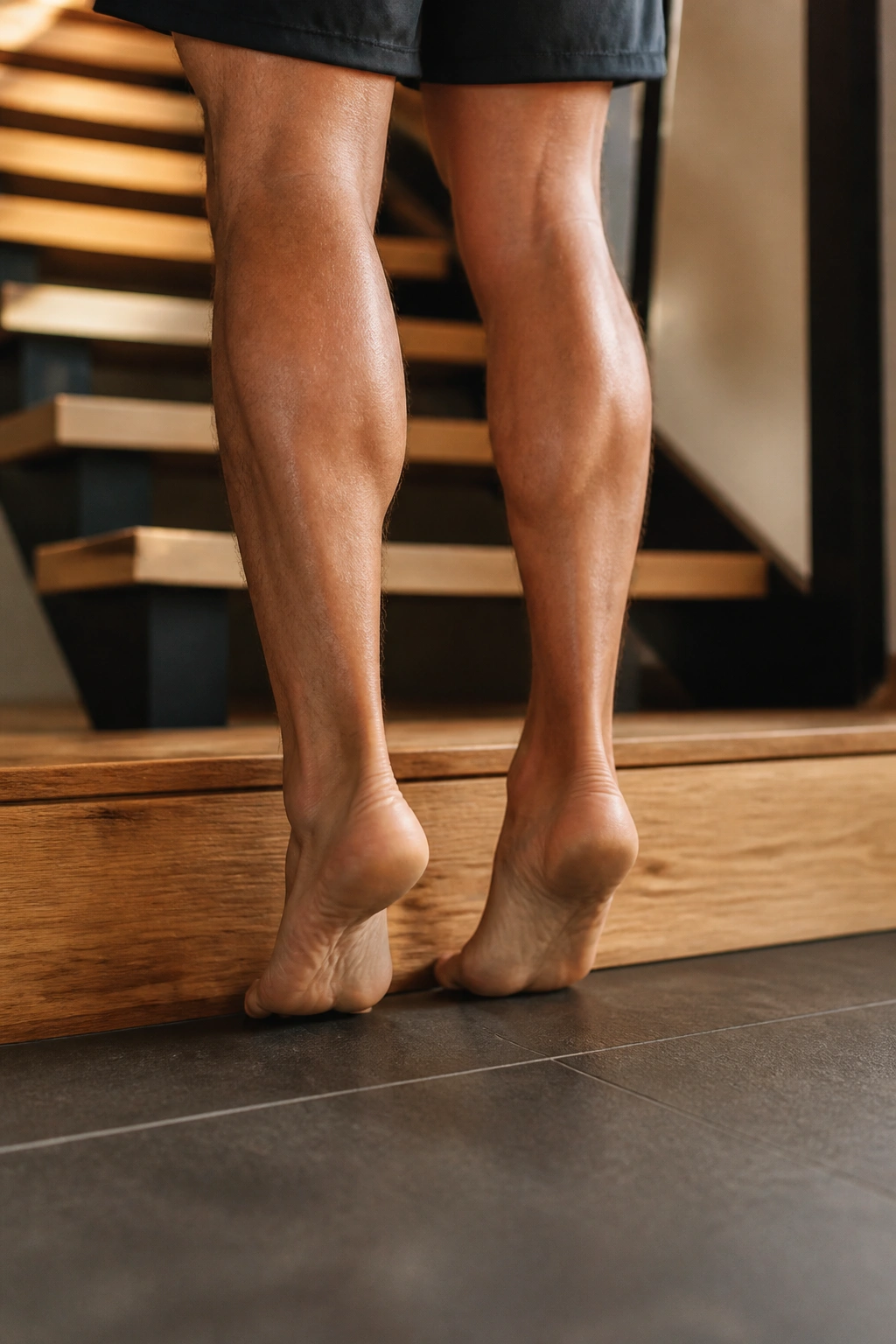
Do not ignore your lower legs. Your calves are responsible for propelling you forward and stabilizing your ankles. If you are a runner or walker, weak calves can lead to a host of issues, including shin splints and Achilles irritation.
Stand on the edge of a step (or flat on the floor if you do not have a step). Rise up onto your toes as high as you can. Squeeze the calves at the top. Lower your heels until you feel a deep stretch in the back of the leg.
- Set 1: 20 reps (normal pace)
- Set 2: 15 reps (slow tempo, 3 seconds up, 3 seconds down)
- Set 3: 30 reps (short, fast pulses at the top of the range of motion)
This routine will leave your calves feeling tight and strong. It is the perfect finisher for a busy morning because it takes almost no space and can be done while you are waiting for the shower to warm up.
11. Floor-Based Abduction Series
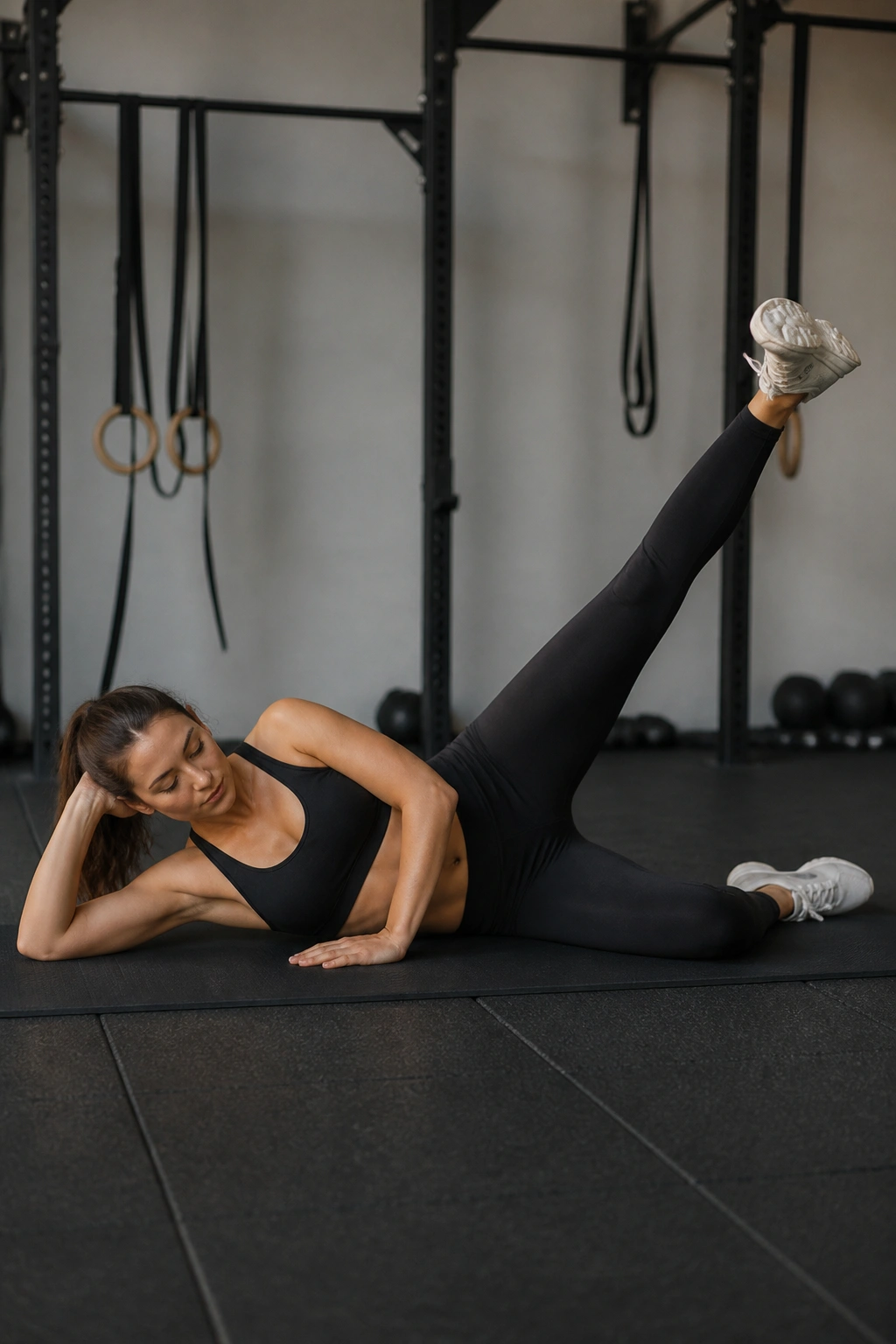
Abduction means moving your leg away from the midline of your body. This targets the glute medius—a muscle crucial for hip stability that most people completely ignore.
Lie on your side. Keep your legs straight, stacked on top of each other. Lift the top leg toward the ceiling. Do not let your torso roll backward; keep your hips stacked directly over one another.
The Volume Plan
- 20 leg lifts on the right side.
- 15 small circles (clockwise).
- 15 small circles (counter-clockwise).
- Switch to the left side and repeat.
You will feel a deep burn in the side of your hip. This is where you want to feel it. If you feel it in your lower back, you are likely lifting the leg too high or rolling your hips. Focus on controlled, moderate-range movement.
12. Isometric Wall Hold
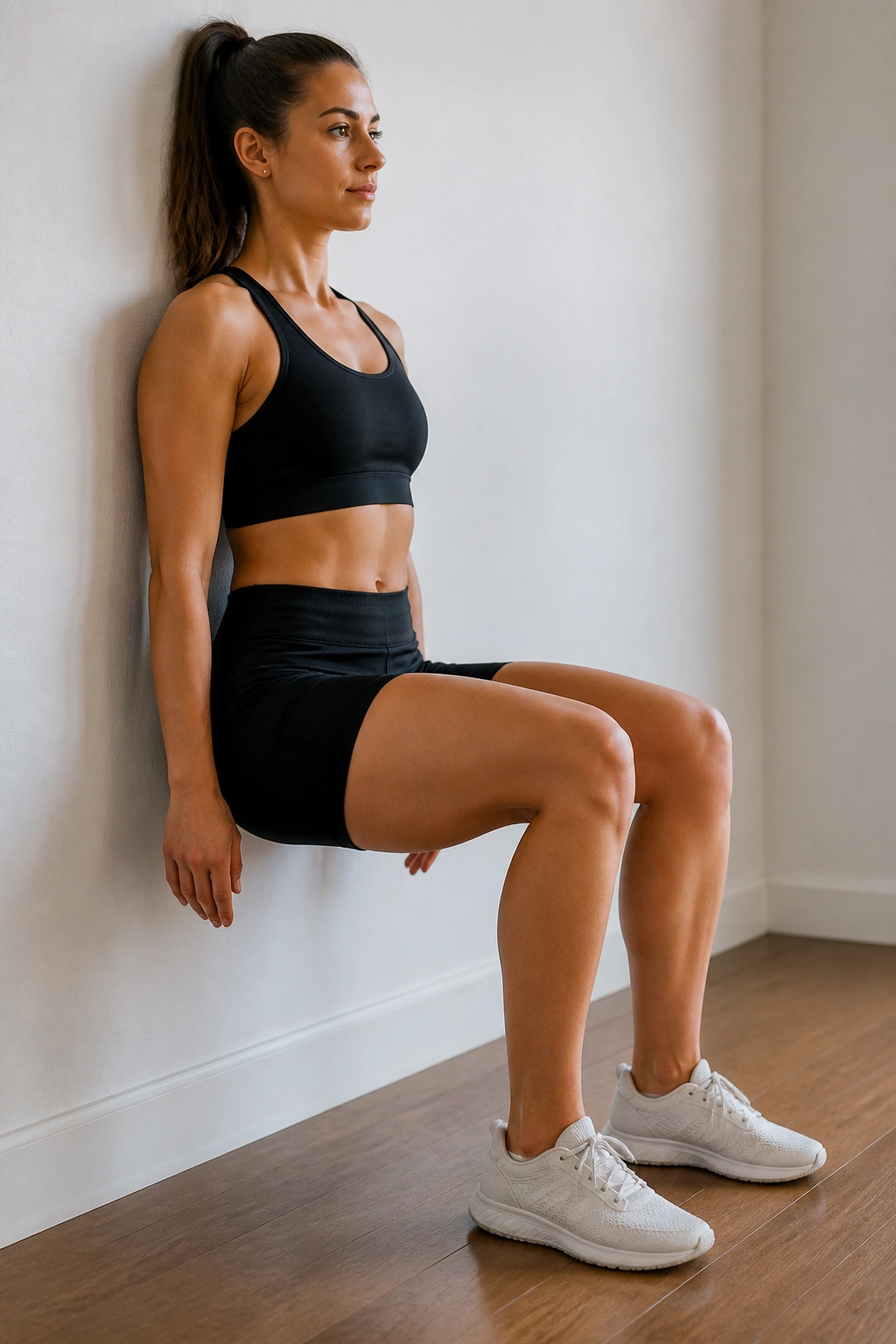
Isometric exercises involve holding a position without moving. They are incredible for building tendon strength and increasing muscular endurance. There is no easier way to test your resolve than a wall sit.
Find a clear section of wall. Press your back flat against it and slide down until your thighs are parallel to the floor. Your knees should be at 90 degrees. Keep your feet hip-width apart.
Hold for as long as you can. When you start shaking, that is the halfway point. Try to last another 20 seconds. If you can reach 60 seconds, you are doing well. If you can reach 90, you are elite. This is a simple, humble exercise that works the quads harder than almost anything else. It is a mental challenge; you have to choose to stay in the discomfort.
13. Bench Step-Up Variations
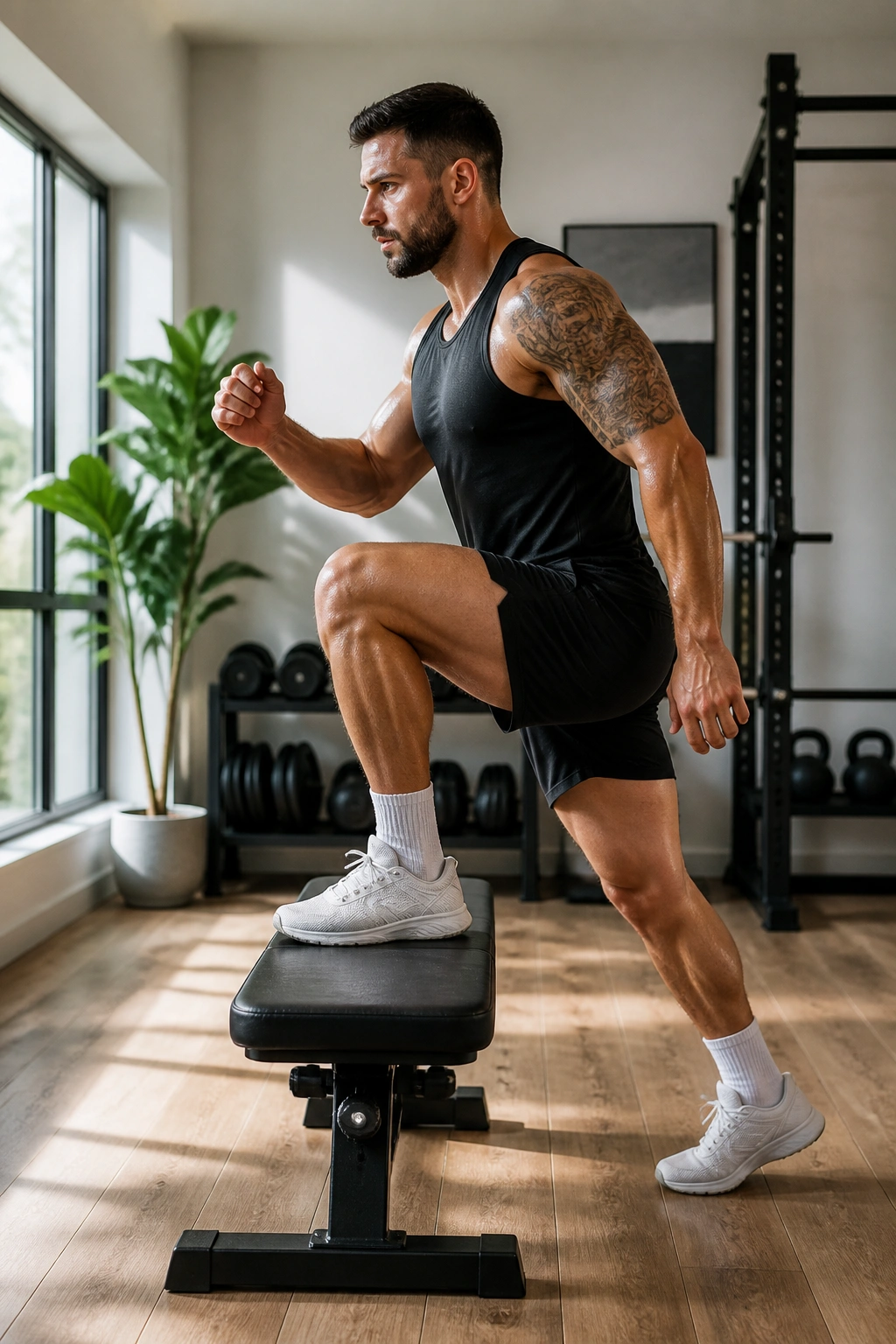
Using a chair or bench, you can vary the intensity of your step-ups to target different muscle groups. This routine uses three different techniques in one sequence.
- Standard Step-Up: Focus on using only your lead leg to drive up. Do 10 reps.
- Lateral Step-Up: Stand to the side of the bench and step up sideways. This hits the inner thighs. Do 10 reps.
- Explosive Knee Drive: Step up and drive the opposite knee into the air quickly. Do 10 reps.
By mixing the direction of the step, you ensure that you are strengthening the hip from multiple angles. This creates more robust, injury-resistant hips, which is essential if you spend a lot of your day sitting.
14. Prisoner Squat Intensity
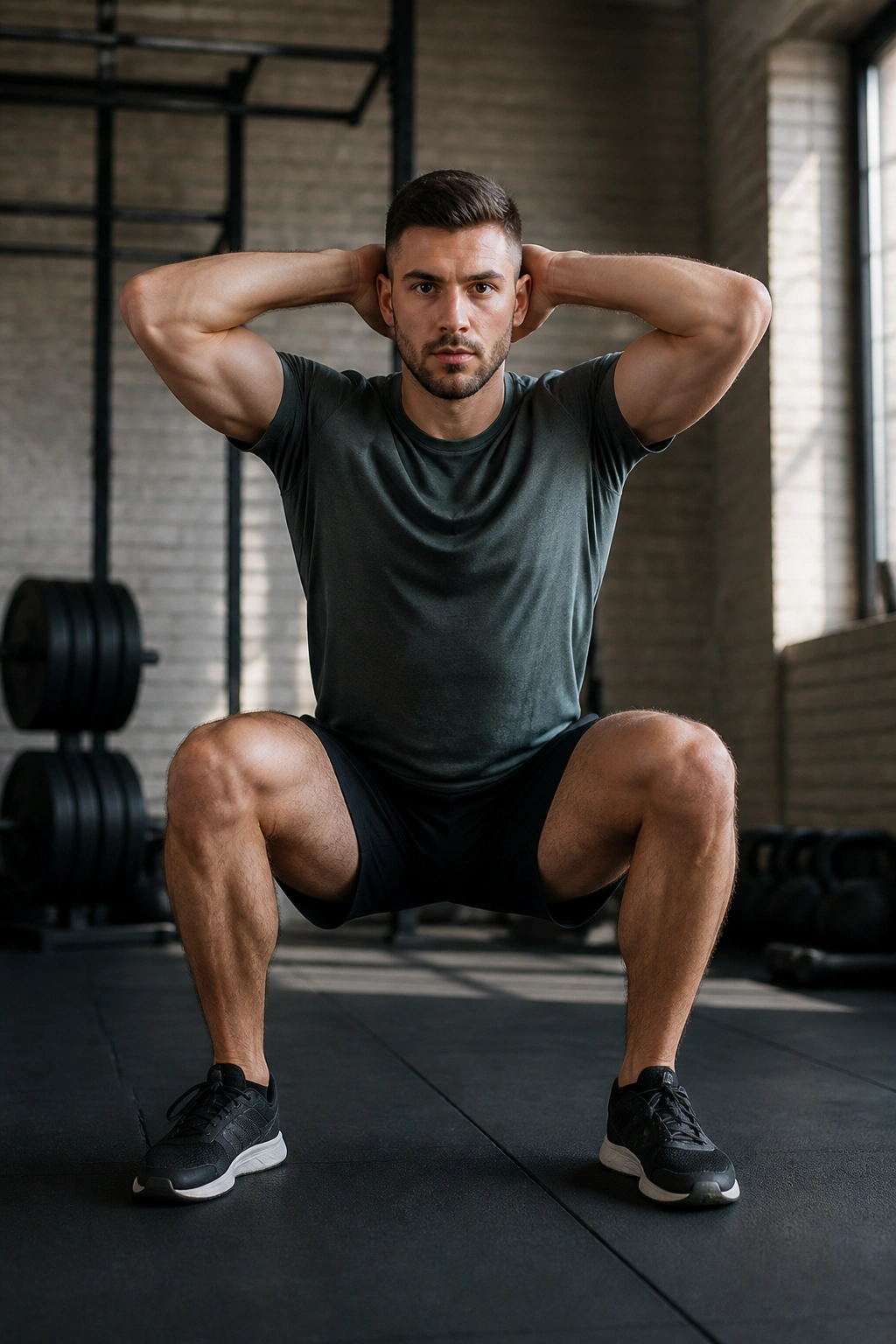
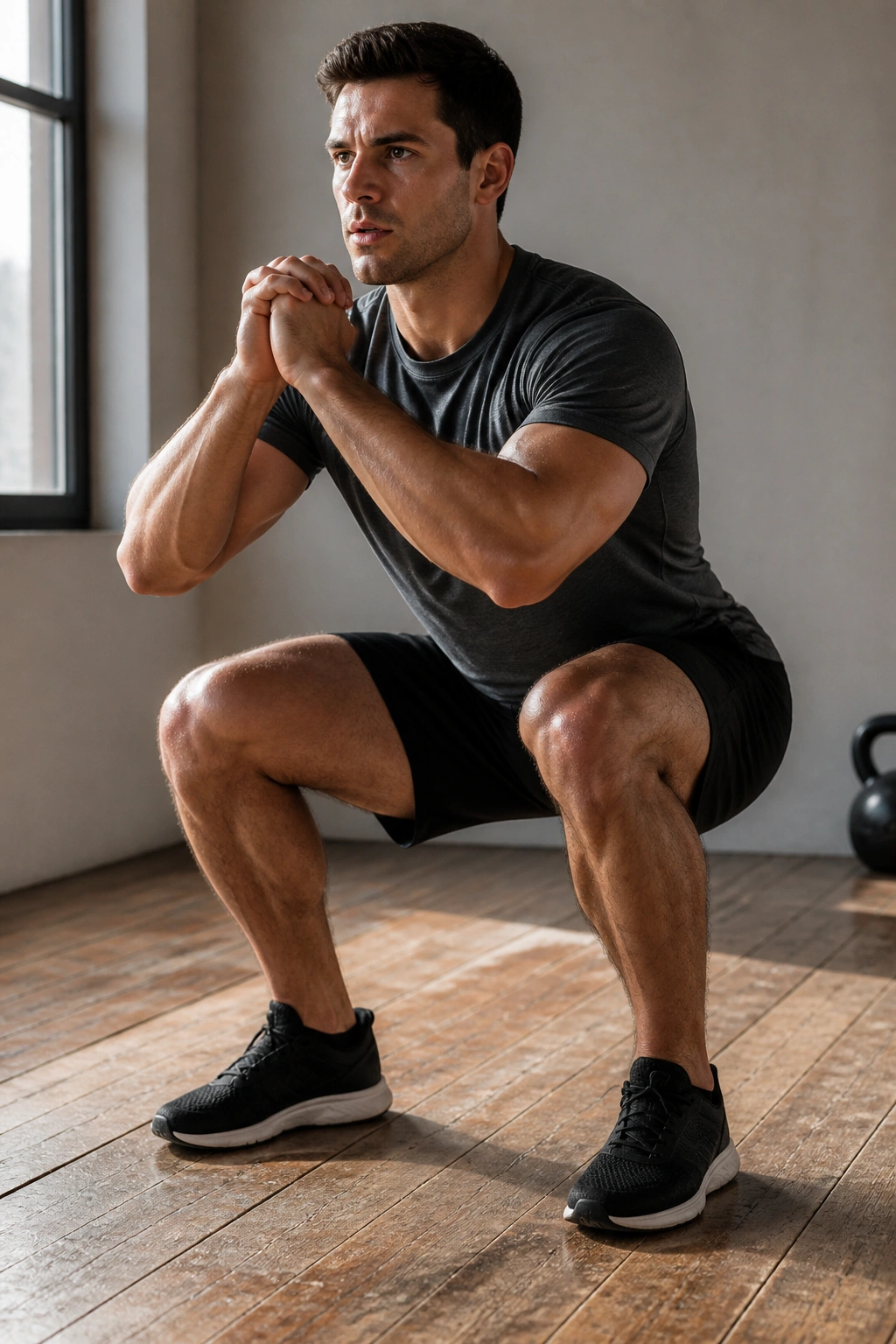
The “prisoner” variation—hands clasped behind your head—forces you to keep your chest open and your posture upright. It prevents the common mistake of leaning forward too much, which shifts the load away from the legs and onto the lower back.
Interlace your fingers behind your head, elbows wide. Perform a squat while maintaining that upright, “proud” chest position. If your elbows start to droop or your chest collapses, you are moving too fast.
Do 3 rounds of 20 reps. Because your hands are locked behind your head, you cannot use them to balance, which forces your core to engage more to keep you centered. It is a subtle change, but it makes the squat significantly harder and more effective.
15. Split Squat Deep Burn
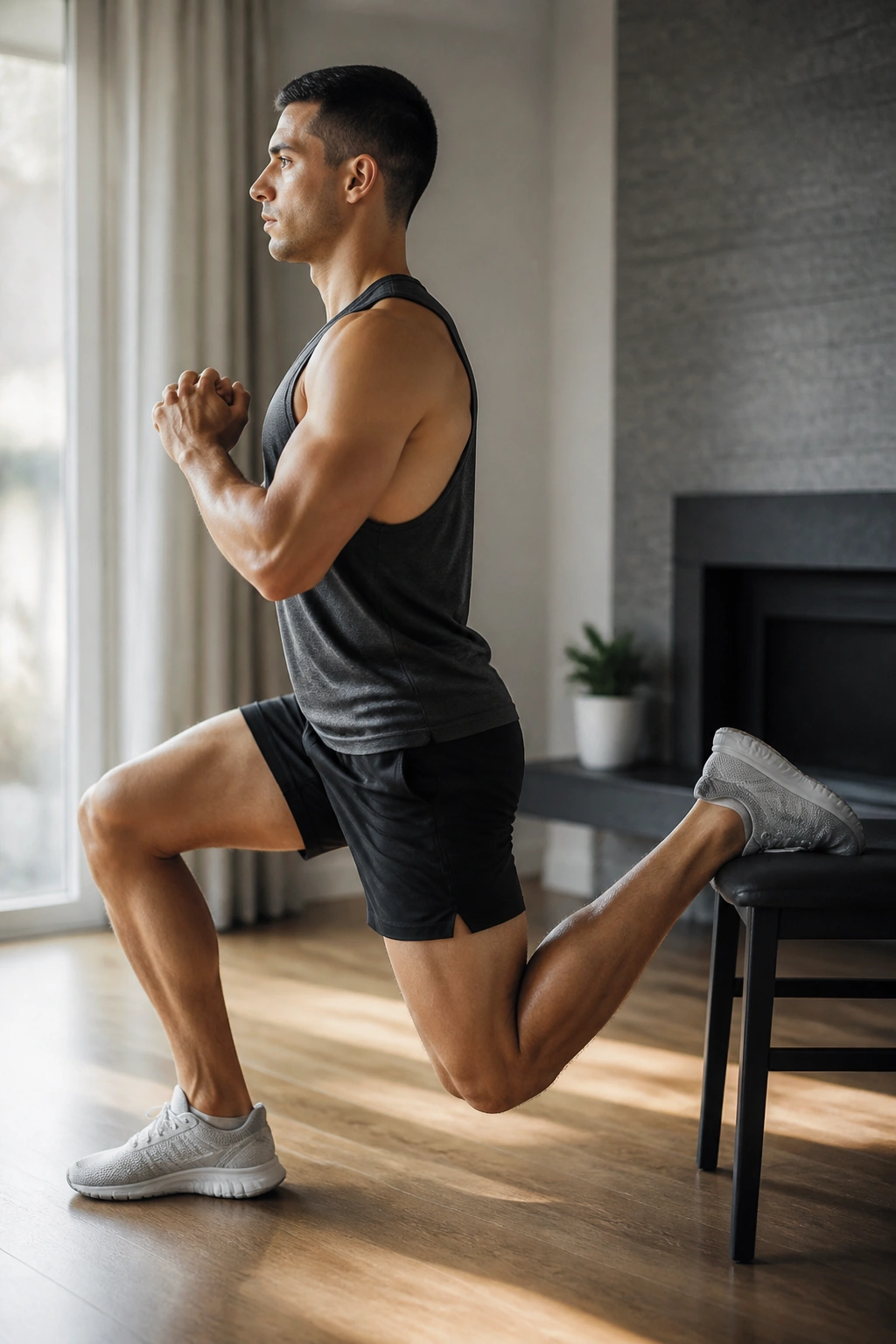
The split squat is often confused with the lunge, but there is a key difference: in a split squat, your feet do not move. You stay in the lunge position for the entire set. This makes it a pure strength builder.
Elevate your rear foot on a low chair or couch if you want to make it a Bulgarian split squat, or keep it on the floor for a standard split squat. Lower until your back knee is an inch from the floor, then press back up.
Try to complete 12 reps on the right leg, then 12 on the left. Then, immediately do 12 more on the right, and 12 on the left. No rest. This high-volume approach forces blood into the legs, creating that heavy, “pumped” feeling. It is a fantastic way to wake up your nervous system in the morning.
16. Mountain Climber Power
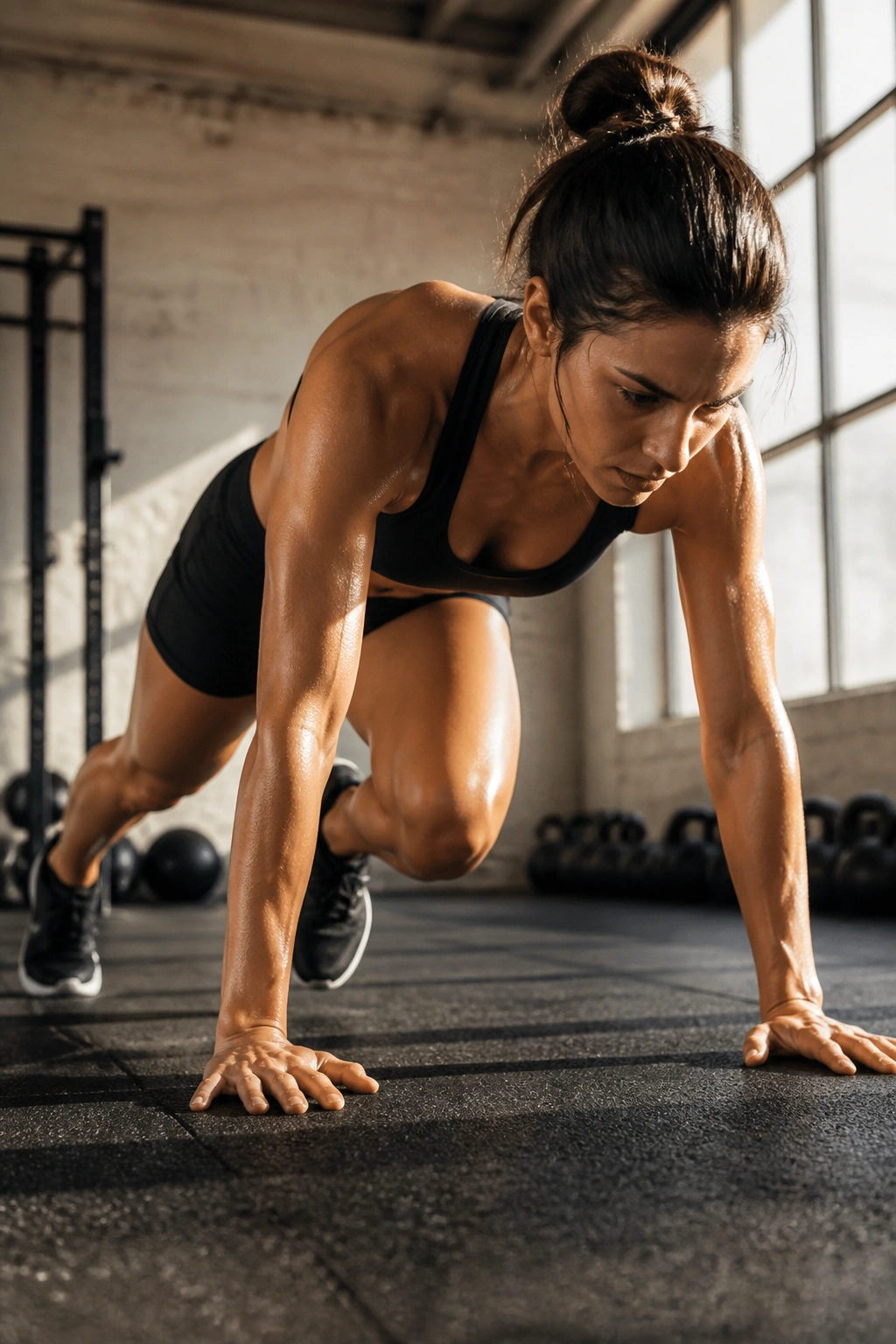
While often considered a core exercise, mountain climbers are a high-octane leg workout if you do them with intention. The key is to drive the knee toward your chest with force, using your hip flexors and quads to power the movement.
Start in a high plank position. Drive one knee toward your chest, then switch legs explosively. Do not just move your legs—drive them. Think about pulling your knee into your chest using your abs while pushing through the ball of the foot with your quad.
Do 45 seconds of continuous movement. The speed, combined with the isometric hold of your upper body, makes this a full-body burner. By the end, your legs should feel tired from the rapid-fire engagement, and your heart rate will be high.
17. Curtsey Lunge Flow
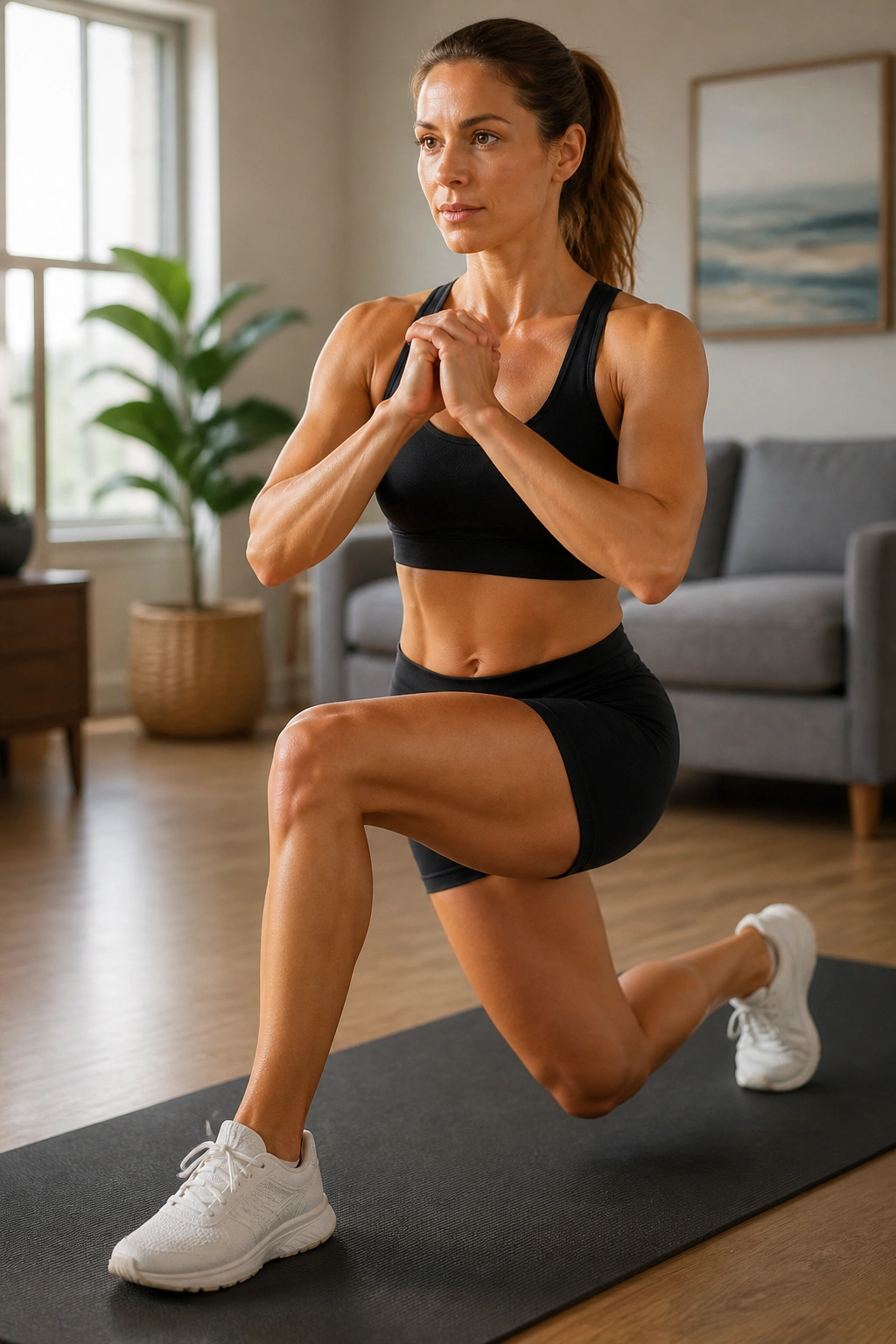
Curtsey lunges—where you step one foot behind and across the other—specifically target the gluteus medius and the outer hips. They are awkward at first, but that is exactly why they are effective.
Stand tall. Step your right leg behind your left at an angle, sinking into a lunge. Ensure your front knee is not collapsing inward; keep it aligned over your ankle. Return to center and switch to the left.
Aim for 20 total reps. Because of the rotational component, these lunges challenge your balance more than any other variation. They also teach your body to handle load in a non-linear fashion, which is how we actually move in the real world—changing direction, stepping over things, and navigating uneven surfaces.
18. Light Load Tempo Squat
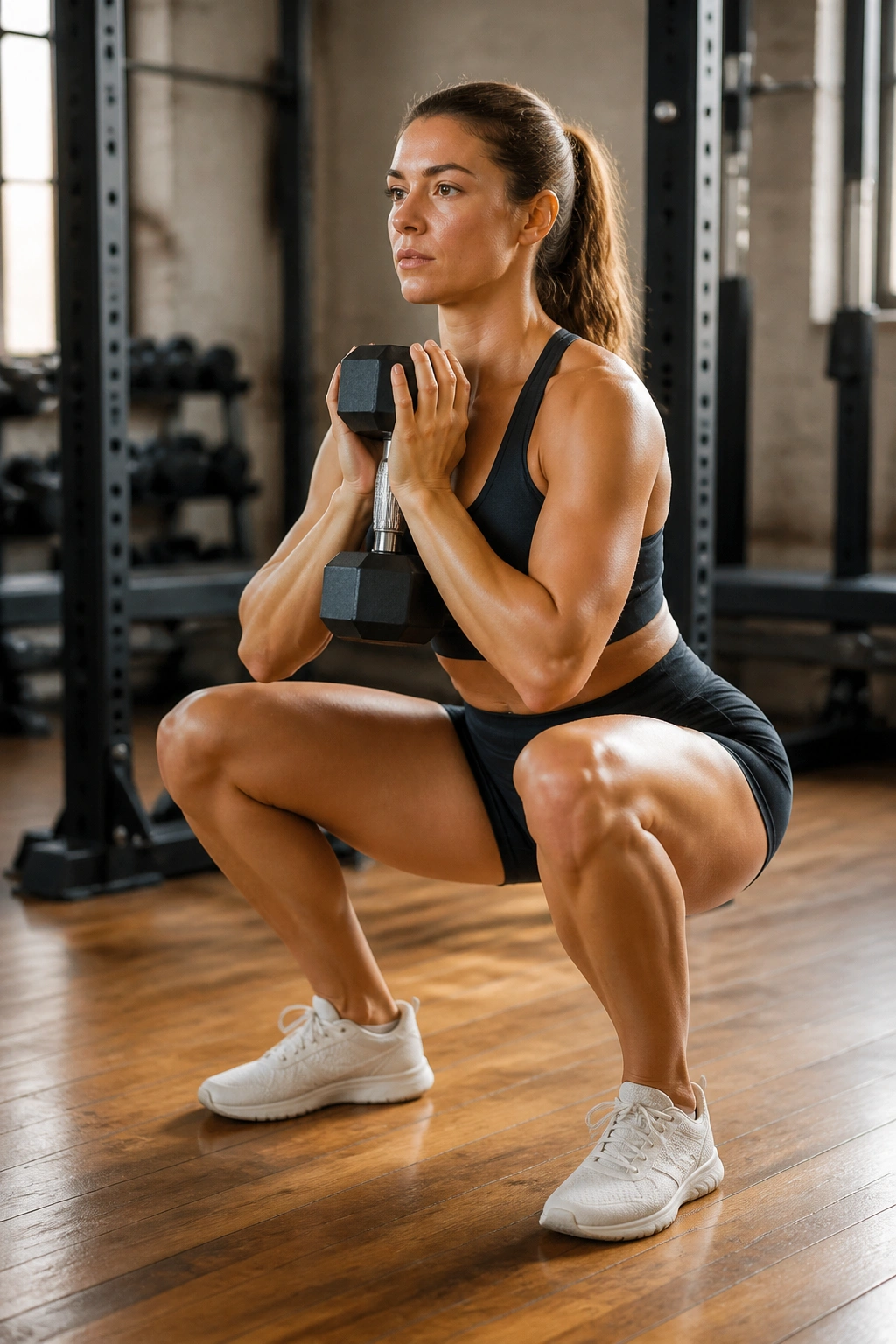
If you have a heavy backpack or even a gallon jug of water, you can add a small amount of resistance to your morning routine. This is not about building massive bulk; it is about adding enough tension to improve your form and stability.
Hold the weight against your chest (this is called a goblet squat). The weight forces you to keep your torso upright, preventing you from hunching over. Use a slow “4-2-1” tempo: 4 seconds to lower, 2 seconds to pause at the bottom, and 1 second to stand up.
Do 10 reps. The slow descent builds incredible control. It forces you to stay tight in your core and keeps your legs under constant tension for the entire set. It is a surprisingly intense way to use very little equipment.
19. Quadruped Kickback Series
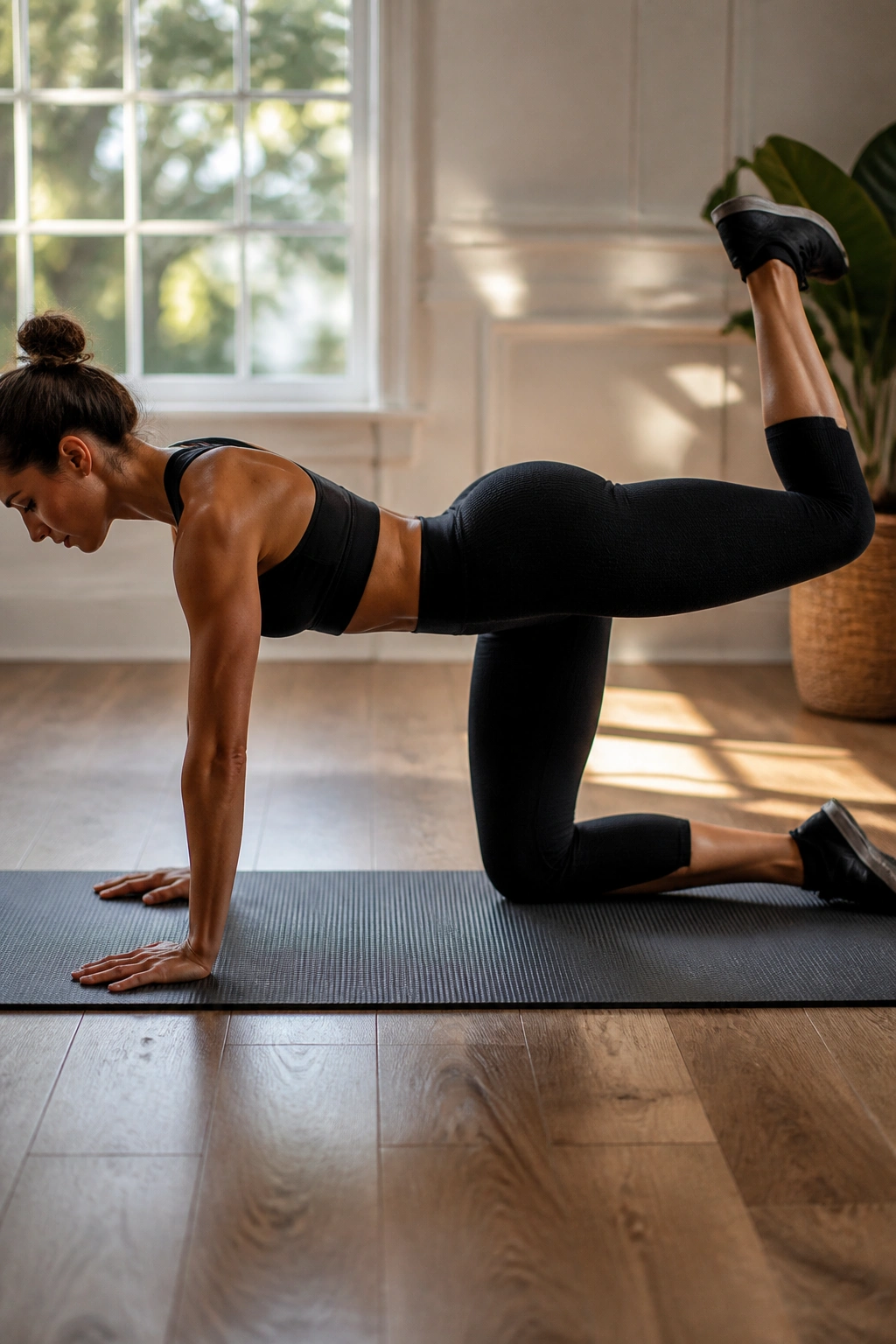
Sometimes the best leg workouts happen on the floor. The quadruped kickback targets the gluteus maximus—the primary muscle responsible for hip extension.
Get on your hands and knees. Keep your back flat—imagine a glass of water resting on your lower back. Kick one leg backward, pushing your heel toward the ceiling. Squeeze your glute at the top for one second.
- 15 reps per leg (focusing on height).
- 15 reps per leg (focusing on a pulse at the top).
- 10 reps per leg (straight leg kicks).
If you feel your back arching, you are lifting too high. Focus on using only the glute to drive the movement. This is a slow, methodical burn that leaves the glutes feeling tight and activated.
20. The EMOM Leg Finisher
EMOM stands for “Every Minute on the Minute.” It is a classic CrossFit-style structure that keeps you honest with your time. You set a timer for 10 minutes.
- Minute 1: 15 air squats
- Minute 2: 10 lunges (total)
- Minute 3: 20 glute bridges
- Minute 4: 15 calf raises
- Minute 5: 10 jump squats
Repeat this sequence twice for a 10-minute total workout. The catch is that you must finish all the reps before the minute is up. The remaining time in that minute is your rest. If you are slow, you get less rest. This forces you to work at a brisk, consistent pace. It is the perfect way to cap off your morning fitness routine.
Final Thoughts
You do not need a gym membership or a massive block of time to see results in your lower body. Consistency is the primary factor that dictates progress, and a ten-minute session you actually perform is infinitely better than an hour-long dream workout you skip.
Choose one of these routines based on how you feel that morning. If you are sluggish, go for the high-intensity Tabata or jump squats. If you are feeling sore or tight, focus on the glute bridges or the stability drills. The goal is to move, to challenge your muscles, and to wake up your body so you can tackle the rest of your day with a clear head and a steady foundation. Keep the equipment simple, keep your form strict, and keep showing up. Your legs—and your future self—will thank you for it.
