



If your knees drift apart the moment a bridge gets hard, your inner thighs are probably off the clock. That is where Pilates ring exercises for inner thighs earn their keep. A magic circle looks harmless leaning against the wall. Put it between your legs and ask it to stay there while you move, though, and it turns into a blunt little truth teller.
The inner thighs — the adductors — do more than pull your legs together. They help steady the pelvis, guide the thigh bone in the hip socket, and share work with the deep abdominals during leg lifts, roll-downs, and balance work. When they are sleepy, you tend to feel it somewhere else first: grippy hip flexors, knees that wobble inward and then out, a low back that tries to help with every core move.
Most people make one mistake right away. They try to flatten the ring like they are crushing a soda can. You do not need that much force. A light-to-moderate squeeze, held with control, works better than a frantic max effort because it lets you keep your ribs quiet, your jaw relaxed, and your breathing steady.
I keep coming back to the same point because it matters: the ring is not there to make the move look harder. It is there to make your body tell the truth. Start with that mindset, and these 20 exercises stop feeling like random Pilates props and start feeling like targeted, smart inner-thigh work.
Small Setup Changes That Make the Ring Work Harder
Tiny adjustments change everything here.
Place the ring where you can feel the inner thighs without your knees or hip flexors taking over. For bent-knee work, that usually means just above the knees or at the mid-thigh. For straight-leg drills, moving the ring to the inner ankles or lower calves often lights up the full inner leg line more clearly.
Go for 20 to 30 percent pressure on the ring. That is enough. If the circle shakes like crazy, your breathing disappears, or your shoulders creep toward your ears, you went too far and the rest of the body is trying to rescue the rep.
A few form notes make these Pilates ring exercises cleaner from the first set:
- Keep your feet parallel unless the move calls for turnout.
- Breathe out on the hard part — the squeeze, lift, reach, or press.
- Stop before your low back lifts off the mat in supine core work.
- Think “zip up the inner legs” rather than “smash the ring.”
- Move slow on the release. The eccentric part counts.
One more thing. If you feel the ring mostly in the knees, move it a bit higher on the thighs. If you feel only the quads, back off the squeeze and tuck your ribs down. The right setup often fixes what brute force cannot.
1. Supine Bent-Knee Pilates Ring Squeeze
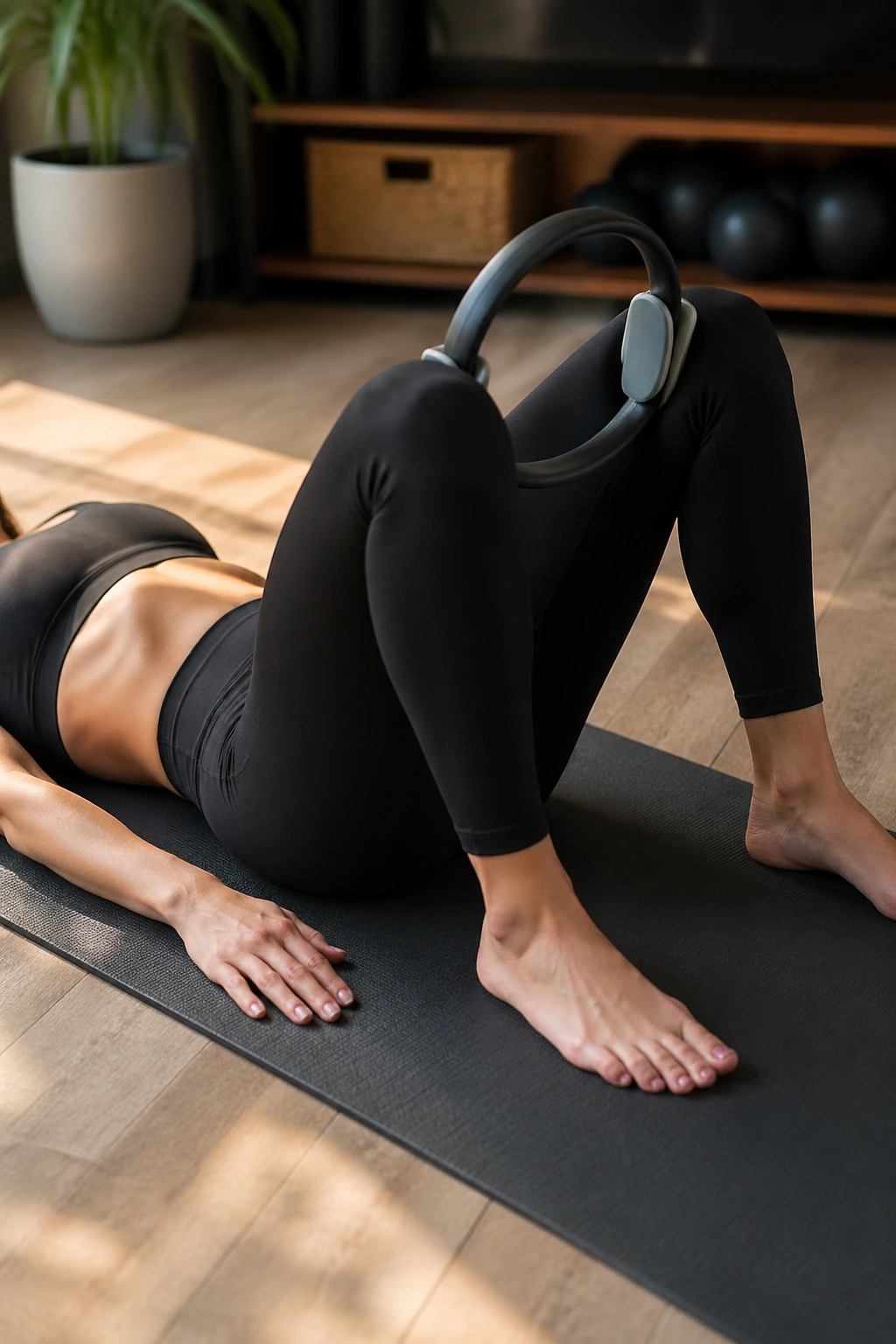
If you are new to the ring, start here. This is the cleanest way to learn what a true adductor squeeze feels like without fighting balance, neck tension, or complicated choreography.
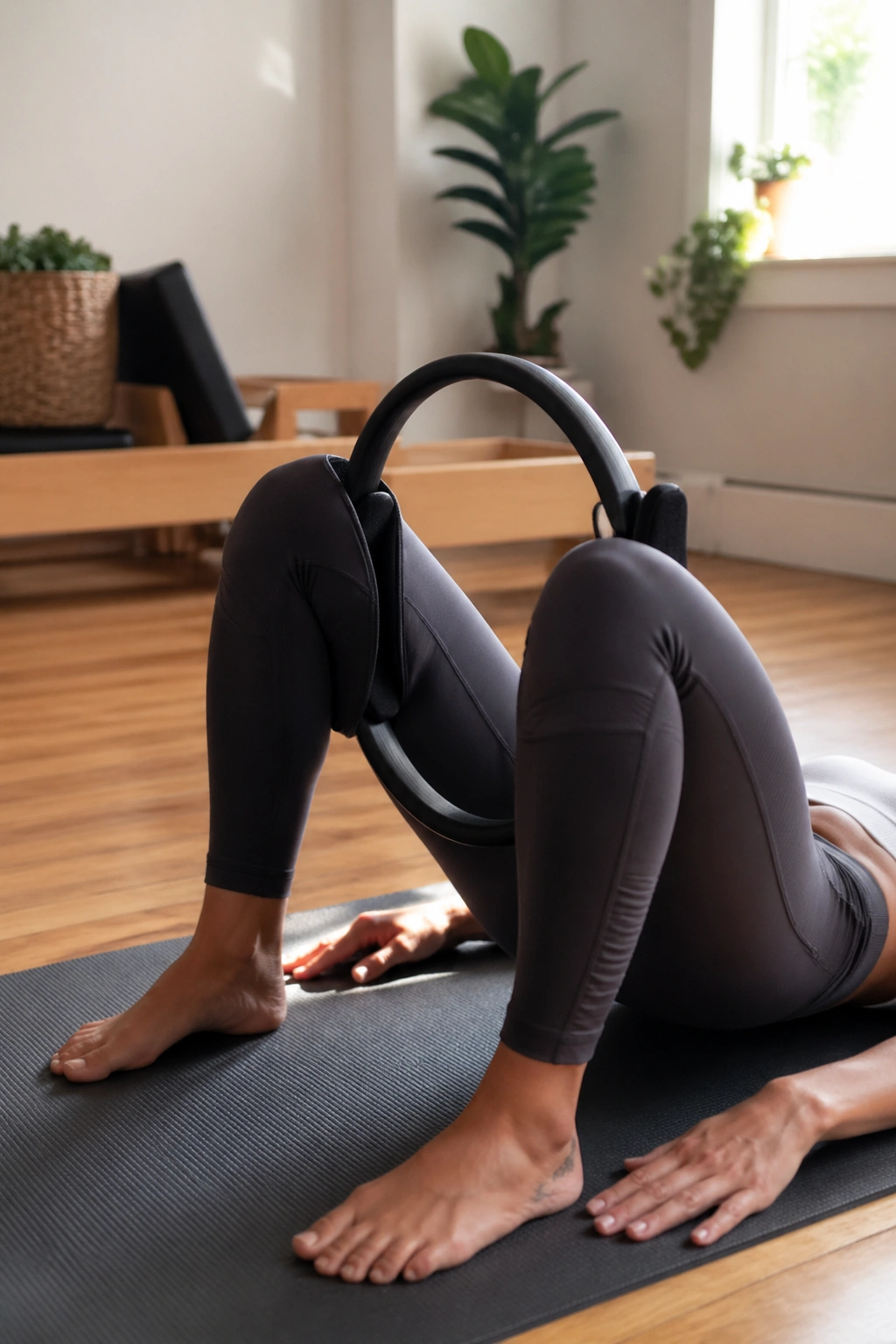
Lie on your back with your knees bent and your feet flat, about hip-width apart. Slide the ring between your inner thighs, a few inches above the knees. Rest your arms by your sides. On an exhale, press the thighs inward for a slow count of 3. Inhale and ease off halfway, not all the way, so the muscles stay awake. Do 10 to 15 reps.
You should feel a firm line of work along the upper inner thighs, with a quiet little assist from the lower abs. Your glutes will join in a bit. That is fine. What you do not want is your feet rolling out or your lower back arching as you squeeze.
Quick form checks
- Knees point straight ahead, not inward.
- Toes stay soft instead of clawing the mat.
- The ring changes shape only a little.
- Your neck and jaw stay loose.
Best use: put this first in the session as a warm-up and nervous-system wake-up call. It teaches the pressure you will use in the harder drills later.
2. Bridge With Ring Pulses
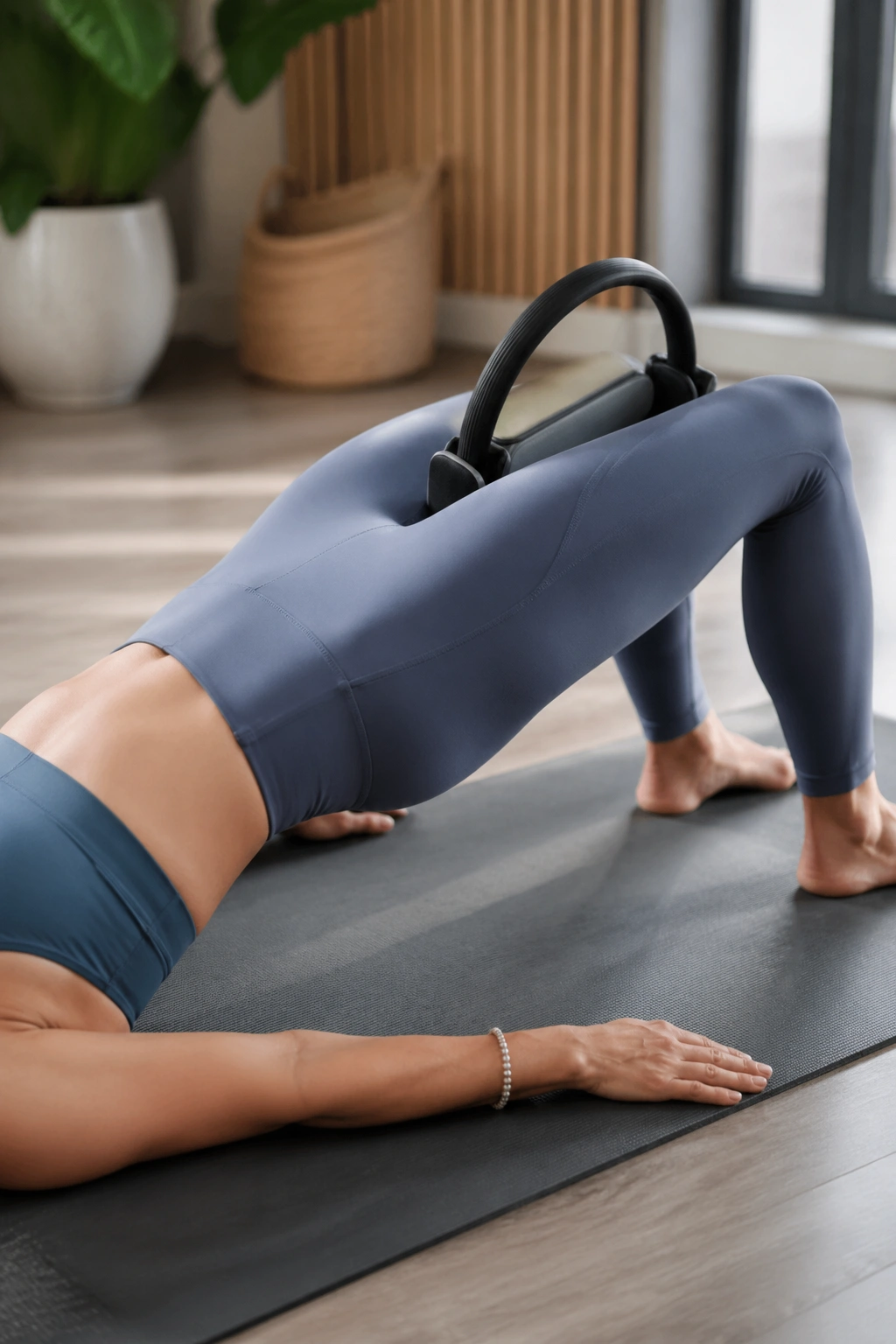
Why does a bridge with a ring feel so much tougher than a plain bridge? Because the adductors are no longer passive passengers. They are helping keep the pelvis level while the glutes and hamstrings lift the hips.
Set up the same way as the first move, with the ring at mid-thigh. Press lightly into it, then peel the spine off the mat into a bridge until your hips line up with your knees and shoulders. Hold there. Add 12 to 20 tiny pulses into the ring, then lower the spine down one bone at a time. Do 2 or 3 rounds.
The pulse is small — think half an inch, not a dramatic crush. Bigger is not better here. The work gets stolen fast by the quads when the ring starts bouncing around.
A detail I like in this one: keep a little weight through the inner edge of each foot. Not the big toe knuckle alone, and not the outer heels. That inner-foot connection tends to wake the adductors faster than “squeeze harder” ever does.
If your hamstrings cramp, walk the feet a touch farther from the hips and lower the lift by an inch. If your ribs pop up, you went too high.
3. Single-Heel Slide While Holding the Ring
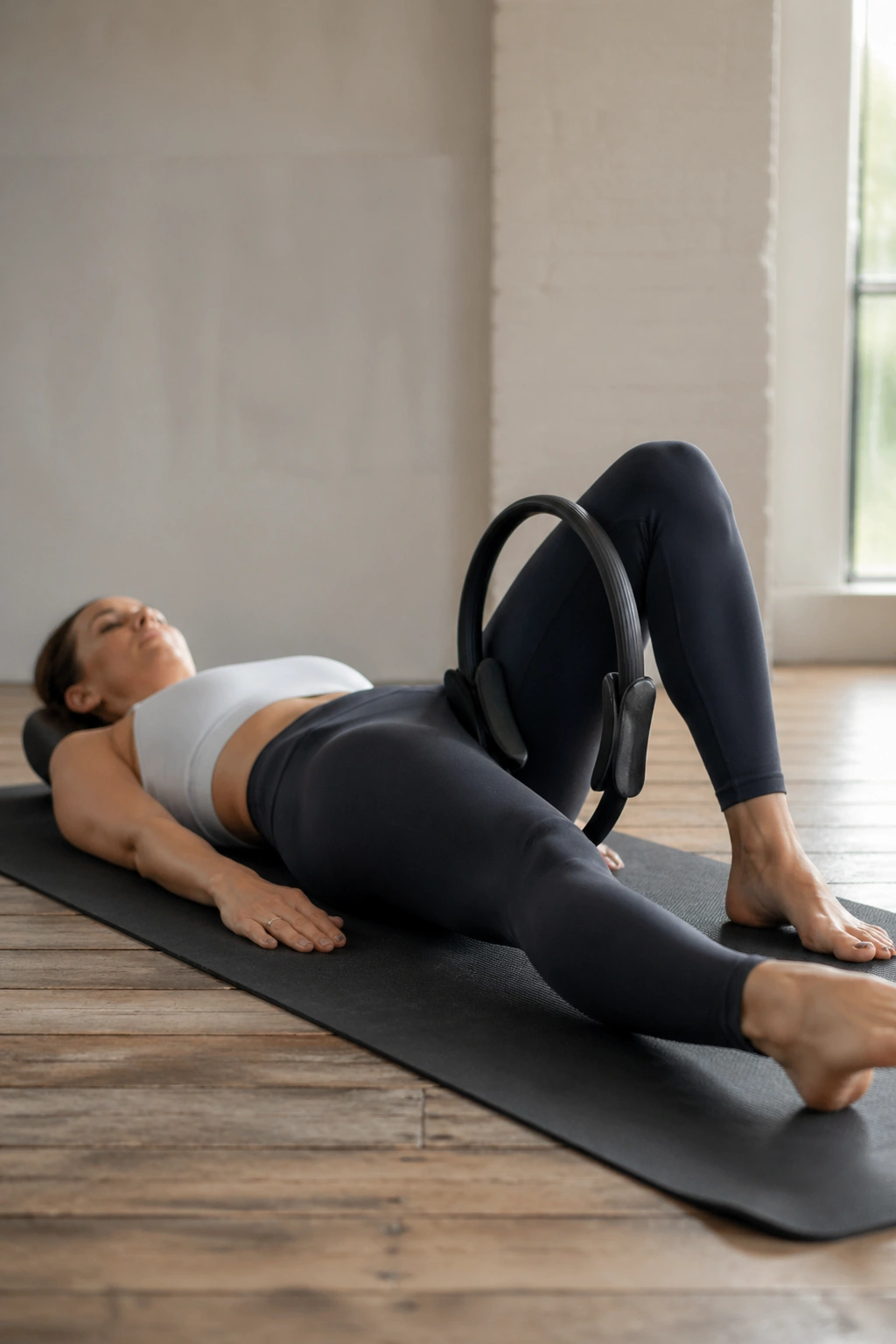
This one looks almost too mild. It is not.
Start on your back with the ring between the inner thighs, feet flat, knees bent. Find a steady squeeze. Without changing your pelvis, slide your right heel along the mat until the leg is almost straight. Draw it back in. Repeat on the left. That is one round. Aim for 6 to 8 slides per side.
The challenge is not the sliding leg. It is the leg that stays bent. While one heel glides away, the ring wants to shift, your hips want to tip, and the low back wants to jump in. Your job is to keep the front of the pelvis level, like there is a glass of water resting on it.
What to watch for
Your squeeze should stay even while the leg moves away. If the ring loses pressure the second the heel slides, shrink the range. Slide only halfway out and own that distance first.
I like this move for people who struggle with marching, dead bugs, or standing balance work because it teaches anti-rotation in a quiet position. You are training the inner thighs to stabilize, not only squeeze.
4. Tabletop Toe Taps With Ring Pressure
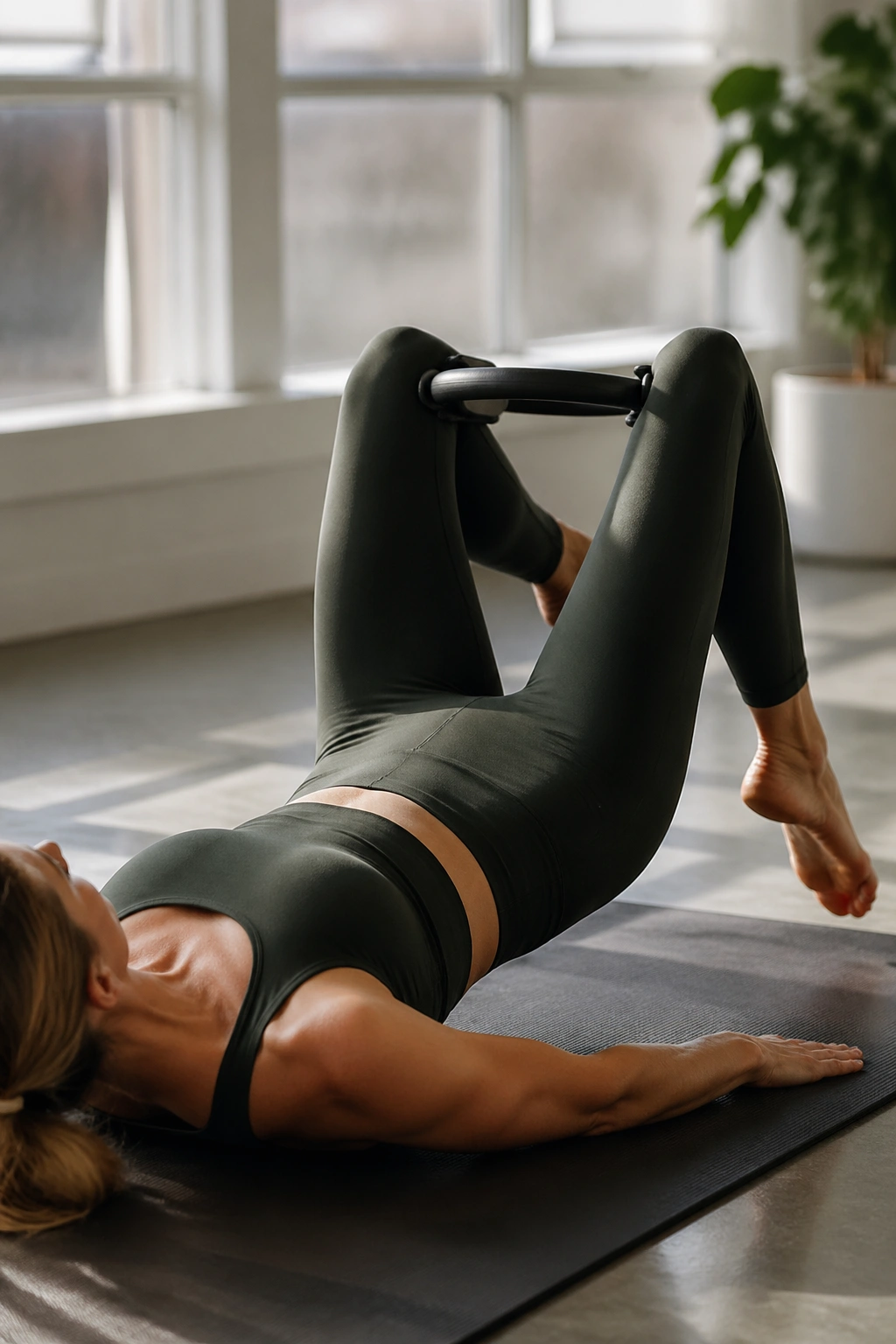
A harder rep is not always the one with the strongest squeeze. Sometimes the harder rep is the one where the ring barely moves because your midline is holding steady while the legs travel.
Lie on your back and place the ring between the inner thighs, again a few inches above the knees. Bring both legs into tabletop — knees over hips, shins parallel to the floor. Press lightly into the ring. Lower one set of toes to tap the mat, then return to tabletop and switch sides. Go for 8 to 10 taps per leg.
Keep the motion small enough that the lower ribs stay heavy. The minute the belly domes or the back peels up, the move changed on you. Cut the tap height in half. No shame in that. A 4-inch tap with a steady pelvis beats a dramatic toe drop with a flared rib cage every time.
What I like about this drill is how quickly it shows side-to-side differences. One leg usually taps with no drama. The other side feels like a negotiation. That asymmetry is useful information, and the ring makes it hard to ignore.
5. Hundred Hold With a Pilates Ring Between the Thighs
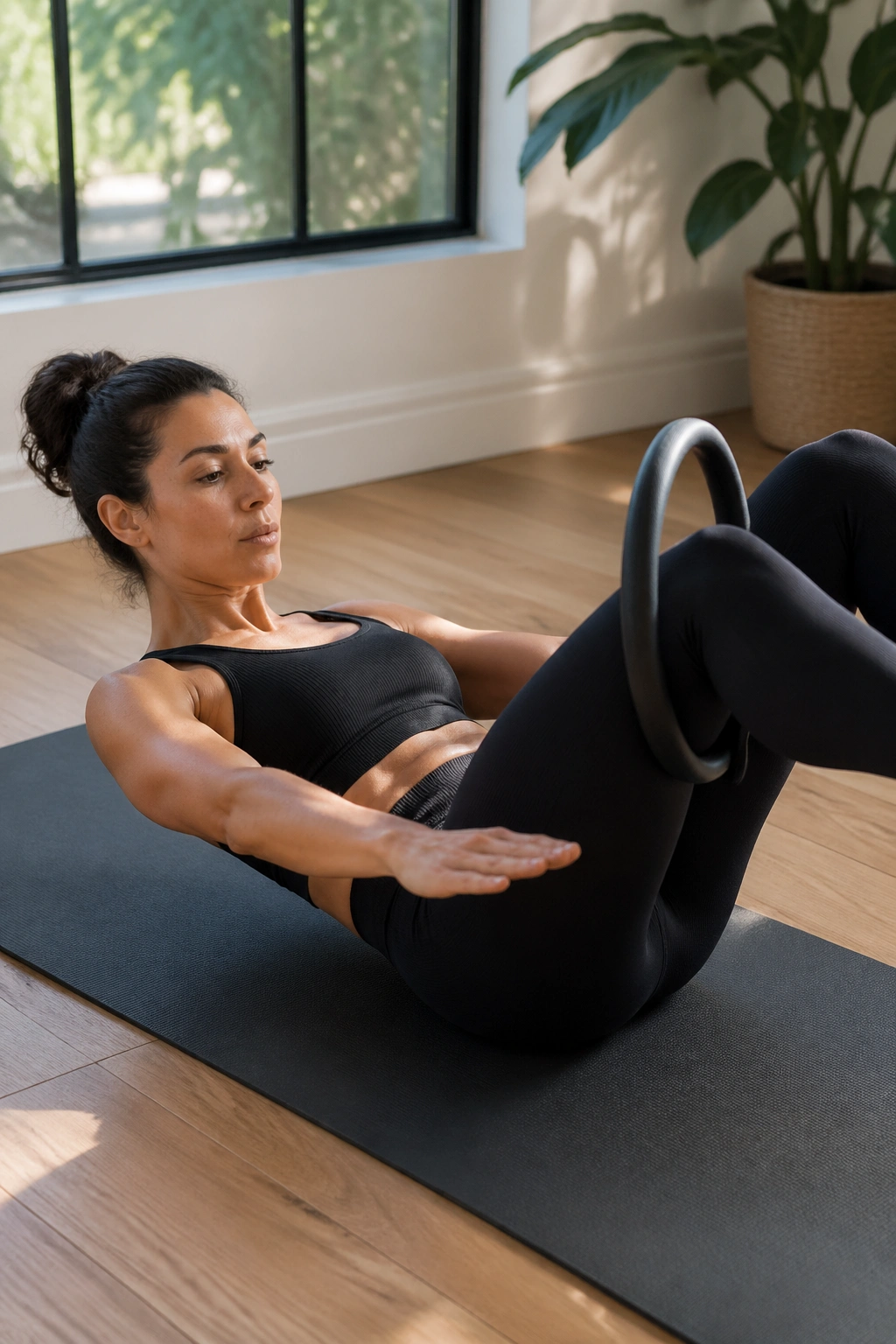
The Hundred gets a different personality with a ring. Instead of letting the legs float out as background scenery, you turn the inner thighs into an active part of the whole pattern.
Set the ring at the mid-thigh. Lift into your Hundred position: head and shoulders curled up, arms long by your sides, legs in tabletop or extended to about 45 degrees if your back stays quiet. Squeeze the ring lightly and pump the arms for 5 counts in, 5 counts out. Do 50 to 100 pumps.
Make the position fit your body
- Keep the knees in tabletop if your neck tires fast.
- Put the head down and pump the arms anyway if curling up strains you.
- Extend one leg at a time if both legs out make your back arch.
- Reduce the squeeze before you reduce the breath.
The breath matters here. Big, wide inhales into the ribs. Long exhales without clenching the throat. When this move is done well, you feel the inner thighs, lower abs, and deep front body all talking to each other. When it is done poorly, you feel hip flexors and neck. That contrast is sharp.
6. Single-Leg Stretch With Adductor Press
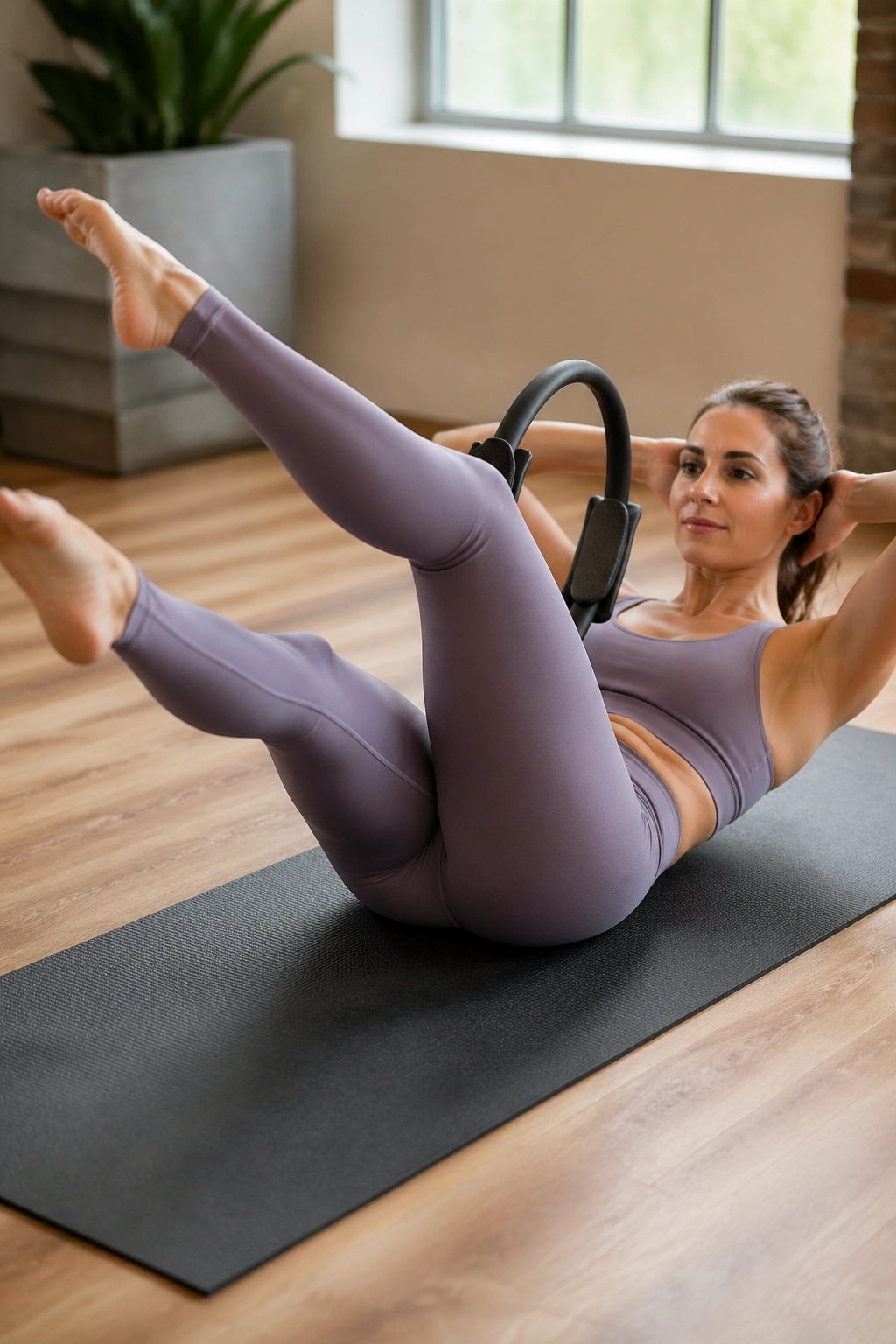
Short version? This one exposes fake core control fast.
Place the ring between the inner thighs above the knees and come into a curl-up position. Pull one knee toward your chest while the other leg reaches long on a diagonal. Switch legs with control, all while keeping a light, constant press into the ring. Do 8 to 10 switches per side.
Because the legs alternate, the temptation is to grip harder on every change. Try the opposite. Keep the squeeze quiet and steady, almost boring, and let the switch happen around that stable center. Your pelvis should stay still enough that the ring does not wag side to side.
If the head-lift turns this into a neck workout, lower your head and keep the leg pattern. The inner-thigh challenge does not disappear. It usually gets cleaner, actually, because you stop spending energy on survival.
One cue I like: think of the standing leg in a squat. Even though you are on your back, one leg is reaching out while the other folds in, and the ring gives you that same sense of midline support under movement. It is sneaky training for upright life.
7. Double-Leg Lowers With Ring at the Ankles
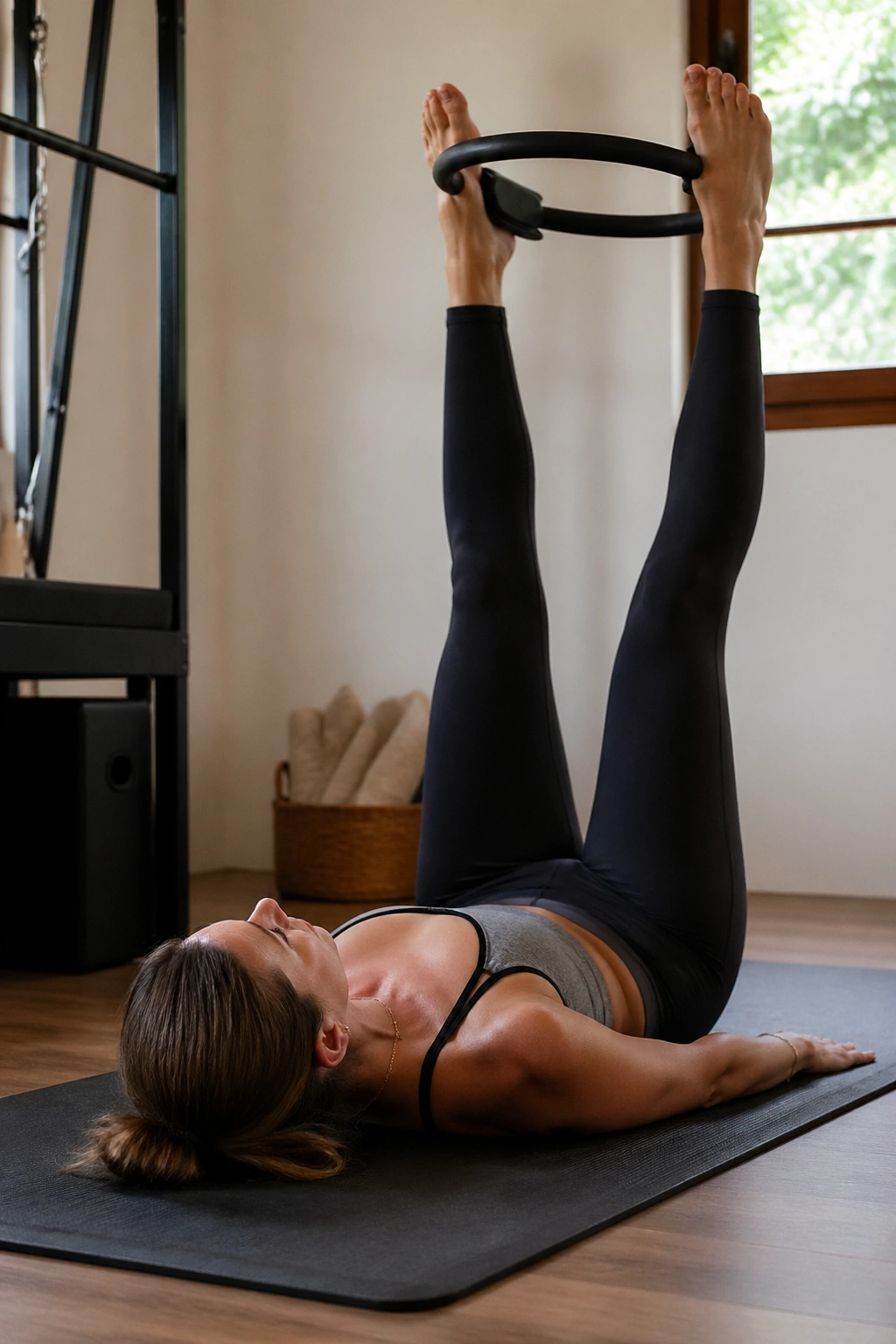
Unlike ring work at the thighs, placing the circle at the ankles asks the whole inner leg to stay awake, from the groin down toward the calves. That longer lever makes the move sharper — and less forgiving.
Lie on your back with both legs straight up to the ceiling. Put the ring between the inner ankles or low calves, whichever gives you the cleanest line without locking the knees. Press inward enough to keep the ring steady. Lower both legs together to the point where your low back still feels anchored, then lift back up. Try 6 to 10 reps.
This is not a race. On the way down, move for a count of 3. Pause. Lift for a count of 2. That slower lower is where the inner thighs and lower abs tend to light up.
Who this suits best
This one is better for an intermediate mover who can keep the pelvis neutral during leg lowers. If your back arches or your hamstrings pull you into a bent-knee shape, switch back to tabletop toe taps or keep the knees softly bent.
The ring should stay quiet. If it starts bobbling around, lower the legs less. Ten clean inches beat a messy trip to the floor.
8. Frog Press With the Magic Circle
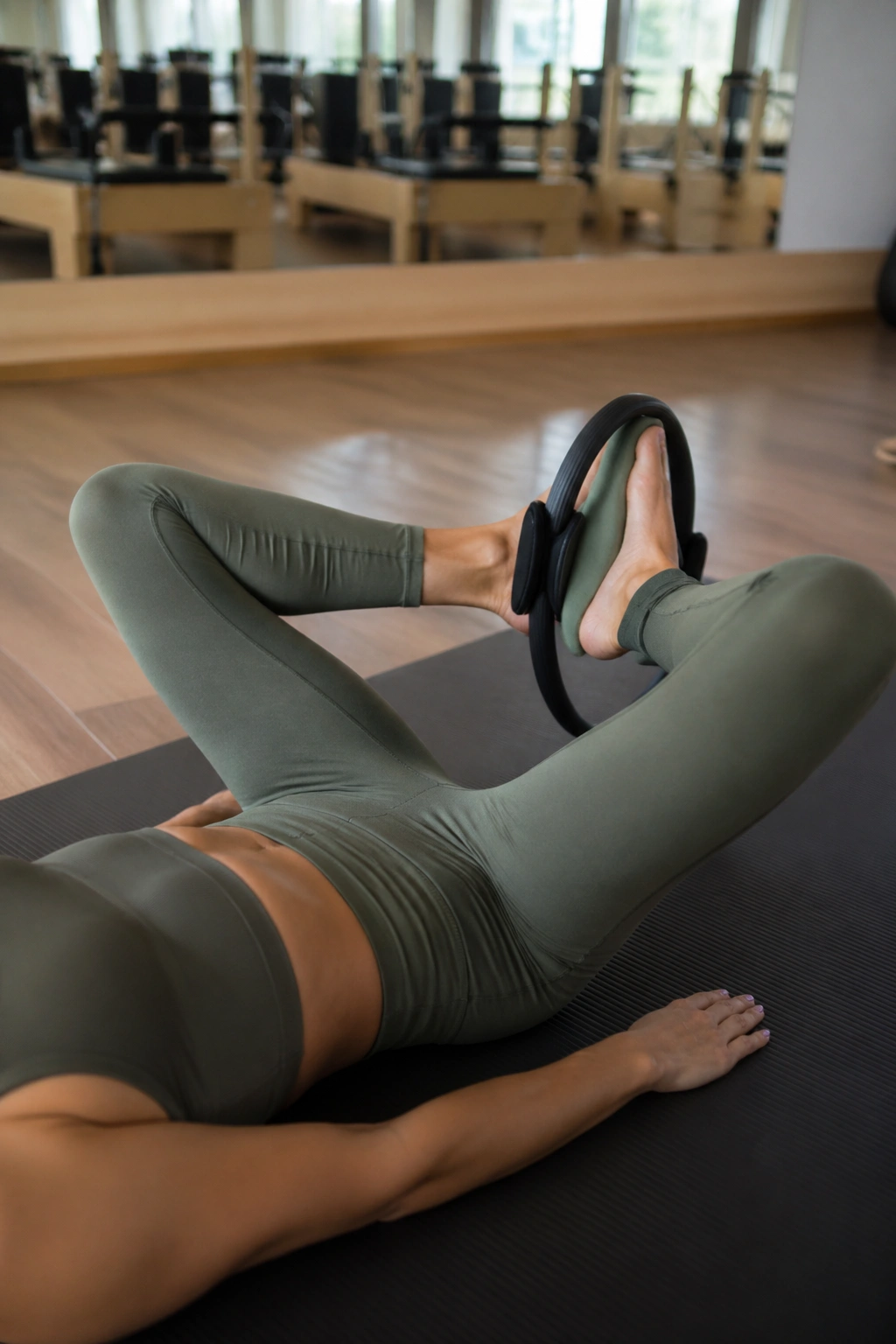
You will feel this high in the inner thighs almost right away.
Lie on your back and place the ring between the inner ankles. Bend the knees outward into a frog shape, heels drawing toward the sit bones, knees slightly wider than the shoulders. Keep a light inward press on the ring as you extend the legs out on a low diagonal. Bend back in with control. Do 8 to 12 reps.
Why this one hits differently
The frog shape changes the line of pull. Instead of a plain parallel squeeze, you are asking the adductors to stay connected while the hips move through a turned-out pattern. That tends to find fibers people miss in straight-leg work, especially near the upper inner thigh.
A trap here: forcing turnout from the feet while the knees complain. Let the rotation come from the hips, and keep it modest. This is Pilates, not a ballet audition.
If your hip flexors try to hijack the rep, send the legs a little higher toward the ceiling and make the reach shorter. The exercise still works, and it feels cleaner.
9. Dead Bug Opposite Reach With Ring Hold
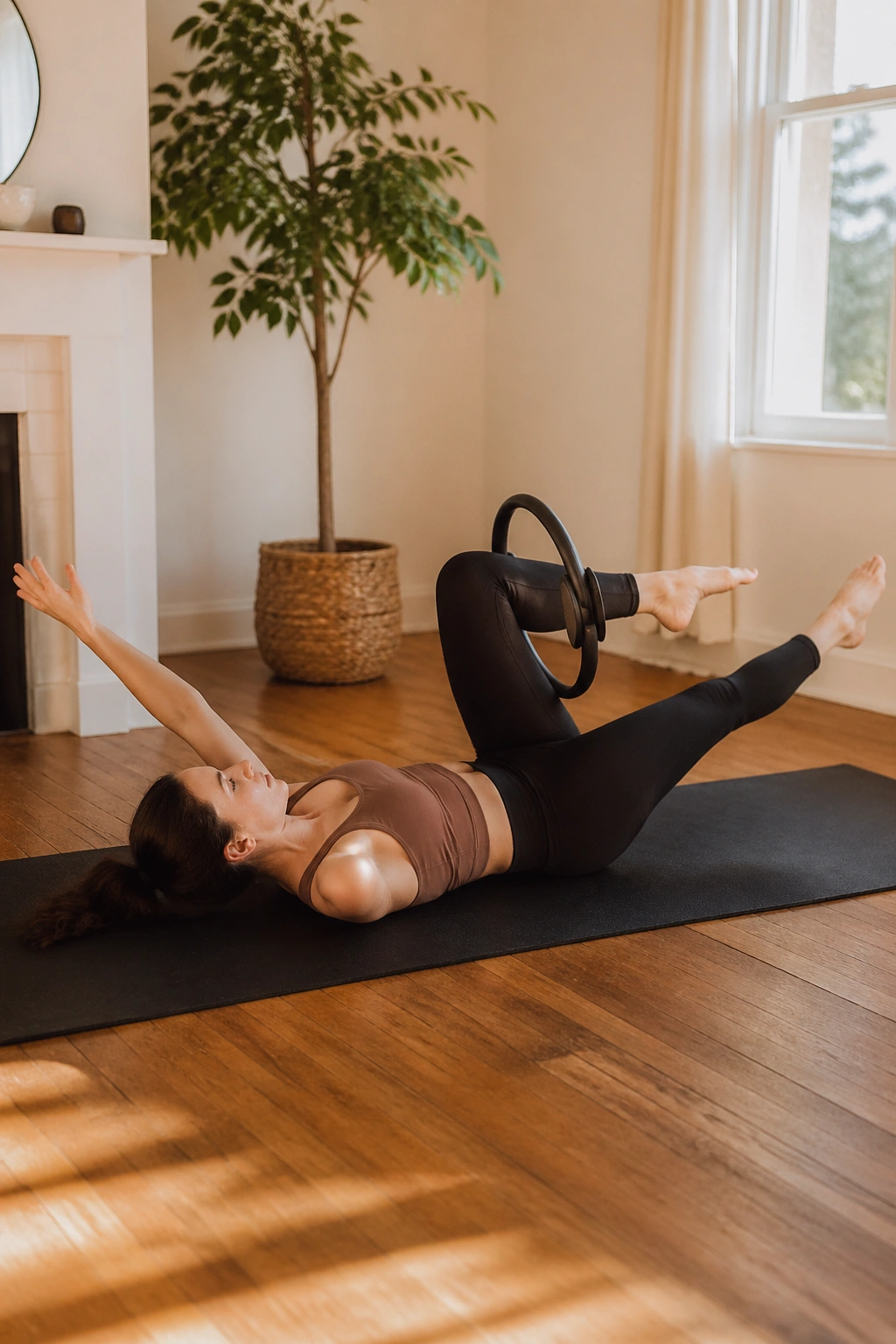
Here is where the ring stops being “an inner-thigh thing” and starts acting like a pelvic stability tool.
Lie on your back with the ring between the inner thighs above the knees. Bring both legs to tabletop and both arms to the ceiling. Press inward on the ring. Reach your right arm overhead as the left leg extends forward; return to center and switch sides. Move slow. Do 6 to 8 reps per side.
The opposite arm-and-leg pattern wants to twist your trunk. The adductors help resist that twist by giving the pelvis a firm midline anchor. You can feel the whole center of the body get more organized when the ring pressure stays even.
No bullets here because the move is cleaner if you keep one thought in your head: do not let the ring tell you which side is weaker. If the circle tips on one reach, shorten that reach by 3 or 4 inches. Meet your actual control level. Build from there.
And yes, this one can be humbling.
10. Seated Bent-Knee Squeeze and Leg Reach
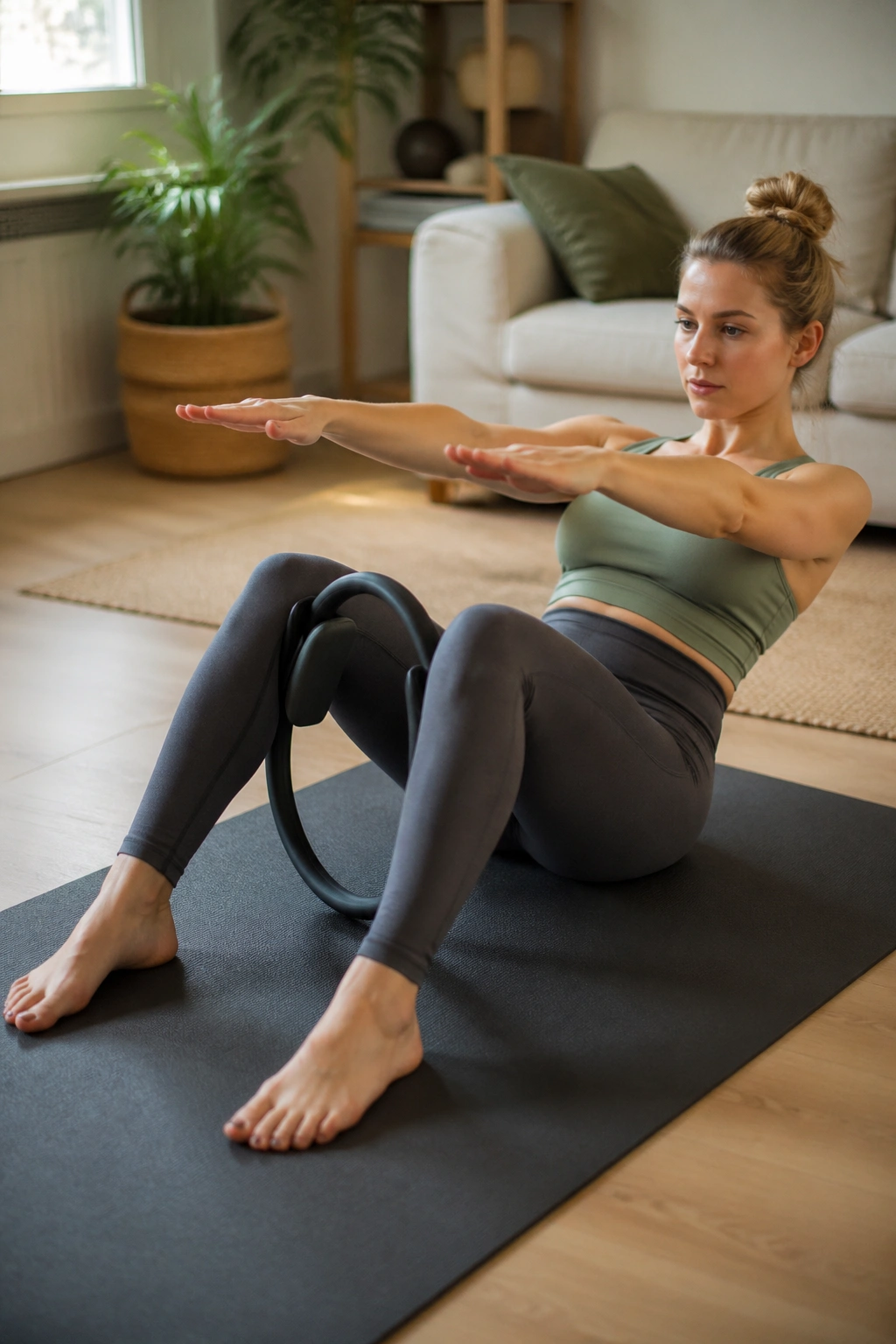
A seated C-curve changes the flavor of inner-thigh work. You are no longer lying on the mat with gravity helping you find position. You have to hold your own trunk up while the legs ask for more.
Sit near the middle of your mat with your knees bent and feet flat. Place the ring between the inner thighs. Hold behind the backs of the thighs, roll halfway back into a C-curve, and hover there. Press into the ring, then reach one leg forward to a long diagonal and bring it back. Alternate sides for 8 reaches each.
The torso stays almost still. That is the hard part. If you start rocking or collapsing through the chest, come a little higher out of the roll-back. A smaller lean with a stable pelvis gives you more real work than a dramatic low hold with wobbly legs.
A small tweak that helps
Think of lifting the back of the waist away from the mat, even though you are not touching the mat. That cue tends to stop the chest from sinking and helps the squeeze travel upward into the lower abdominals.
This one is an excellent bridge move between beginner ring squeezes and the standing work later on.
11. Seated V-Position Ring Press
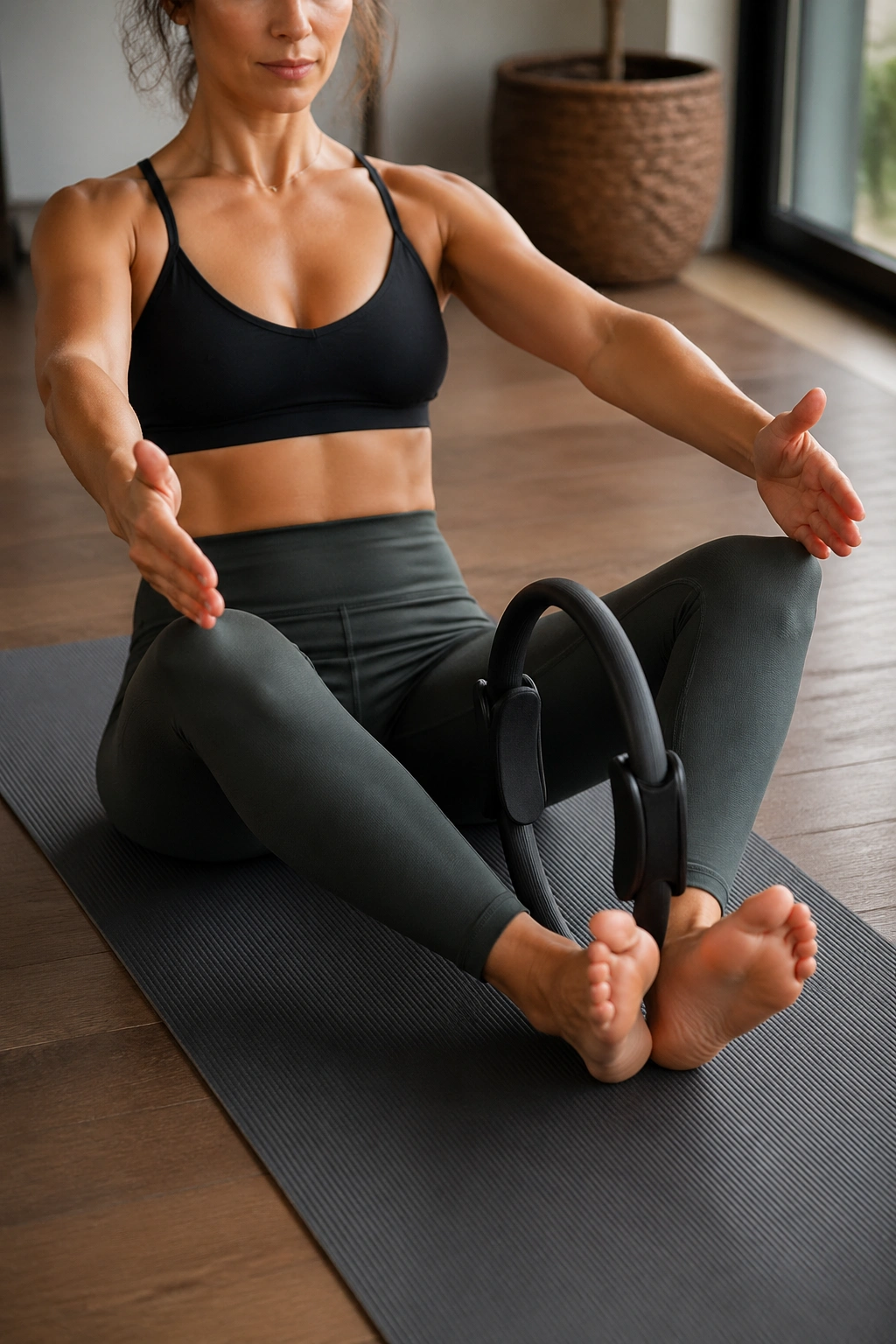
Not every inner-thigh exercise needs a curled spine or a flashy leg pattern. Some of the best ones look stripped down, almost stern.
Sit tall with both legs extended in a narrow V, wider than hip-width but nowhere near a full straddle. Place the ring upright between the inner ankles or lower calves. Rest your hands on the floor beside your hips or behind you if your hamstrings pull. Press inward on the ring for 12 slow reps, then hold the squeeze for 15 seconds.
What makes this move useful is the long, open leg position. The adductors have to work from length, not from a tucked-up bent-knee angle. That often reveals tightness and weakness at the same time — a lovely combo, if you enjoy honest feedback from your workouts.
A note on posture: sit on a folded towel or yoga blanket if your pelvis keeps rolling backward. The exercise is about the inner thighs, not about proving you can sit bolt upright with stubborn hamstrings dragging you into a slump.
Good sign: a steady inner-thigh tremble.
Bad sign: numb feet, pinchy groins, or locked knees.
12. Side-Lying Bottom-Leg Lift Into the Ring
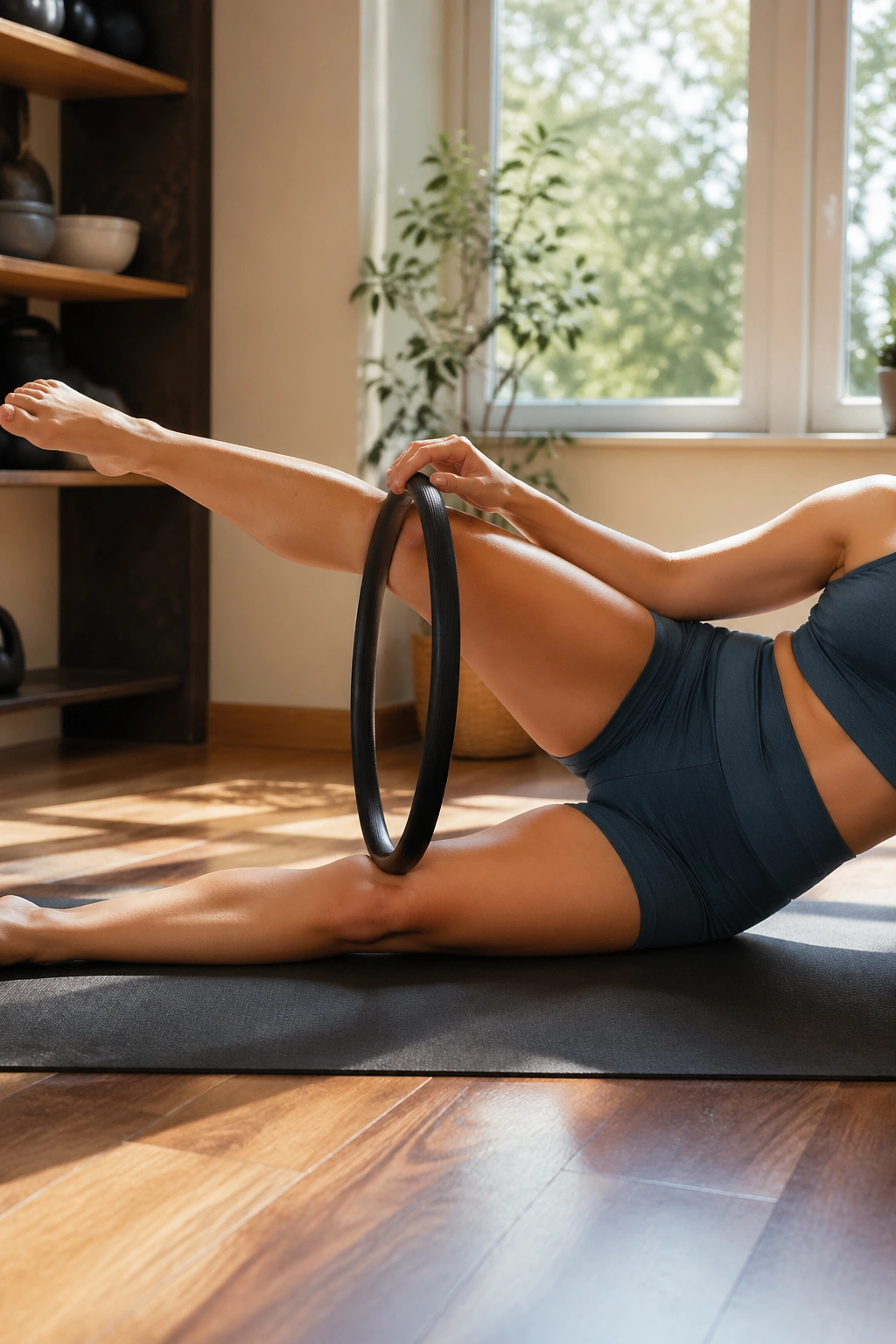
This is one of my favorite adductor drills because it trains one inner thigh at a time. No dominant side hiding. No stronger leg taking over.
Lie on your right side. Bend your left knee and place the left foot on the floor in front of your right thigh. Position the lower handle of the ring against the inside of your right ankle. Hold the upper handle lightly with your left hand so the ring stands upright. Lift the straight bottom leg up into the ring, then lower with control. Do 10 to 15 lifts, then switch sides.
Why it works
The bottom leg is doing pure adduction against spring resistance. You are not guessing where the inner thigh is. You know. The line of work runs from the inner knee right up toward the groin.
Keep these details clean
- The top shoulder stays stacked over the bottom one.
- The waist does not collapse into the mat.
- The bottom foot stays long, not sickled.
- Lift only as high as the ring allows without twisting the pelvis.
The range is tiny. Good. Tiny is where this move earns its keep.
13. Side-Lying Top-Leg Press Into the Ring
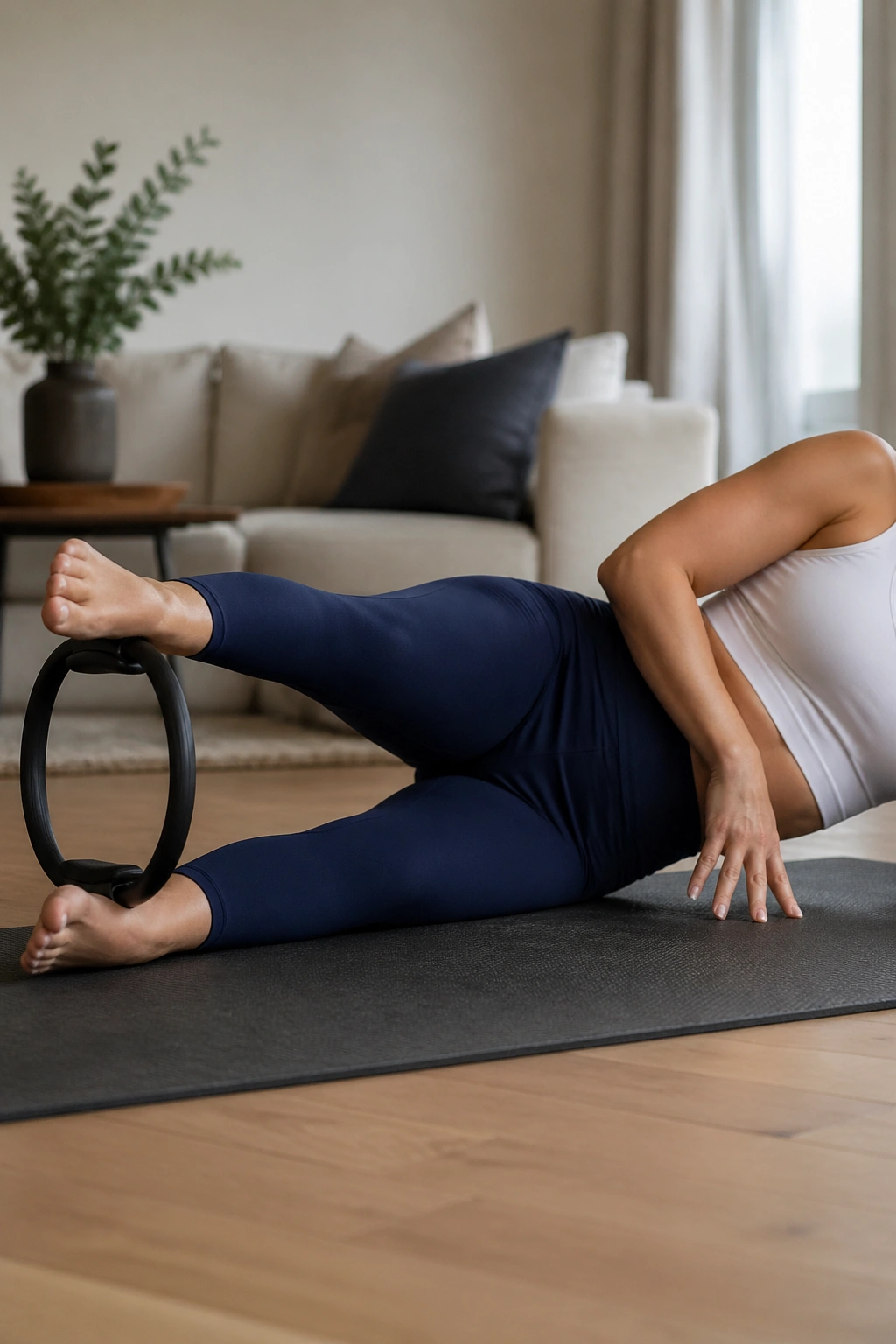
Flip the challenge. Instead of lifting the lower leg, let the top leg press the ring downward while the rest of the body stays quiet.
Lie on your side with both legs long. Place the ring between the ankles so the lower handle touches the inside of the bottom ankle and the upper handle rests against the inside of the top ankle. Press the top leg down into the ring, then release slowly. Aim for 12 presses per side.
This one feels different from the bottom-leg version because the top leg has more room to cheat with the hip flexors and front thigh. To shut that down, lengthen the leg away from the hip before you press. Reach first. Press second.
I also like a 5-second hold on the last rep. That is often where the true inner-thigh burn appears, after the nervous system has stopped pretending the move is easy.
If the ring slides, move it a little closer to the calves. If your waist starts rolling backward, prop your head higher and narrow the range.
14. Side-Lying Double-Leg Lift With Ring Tension
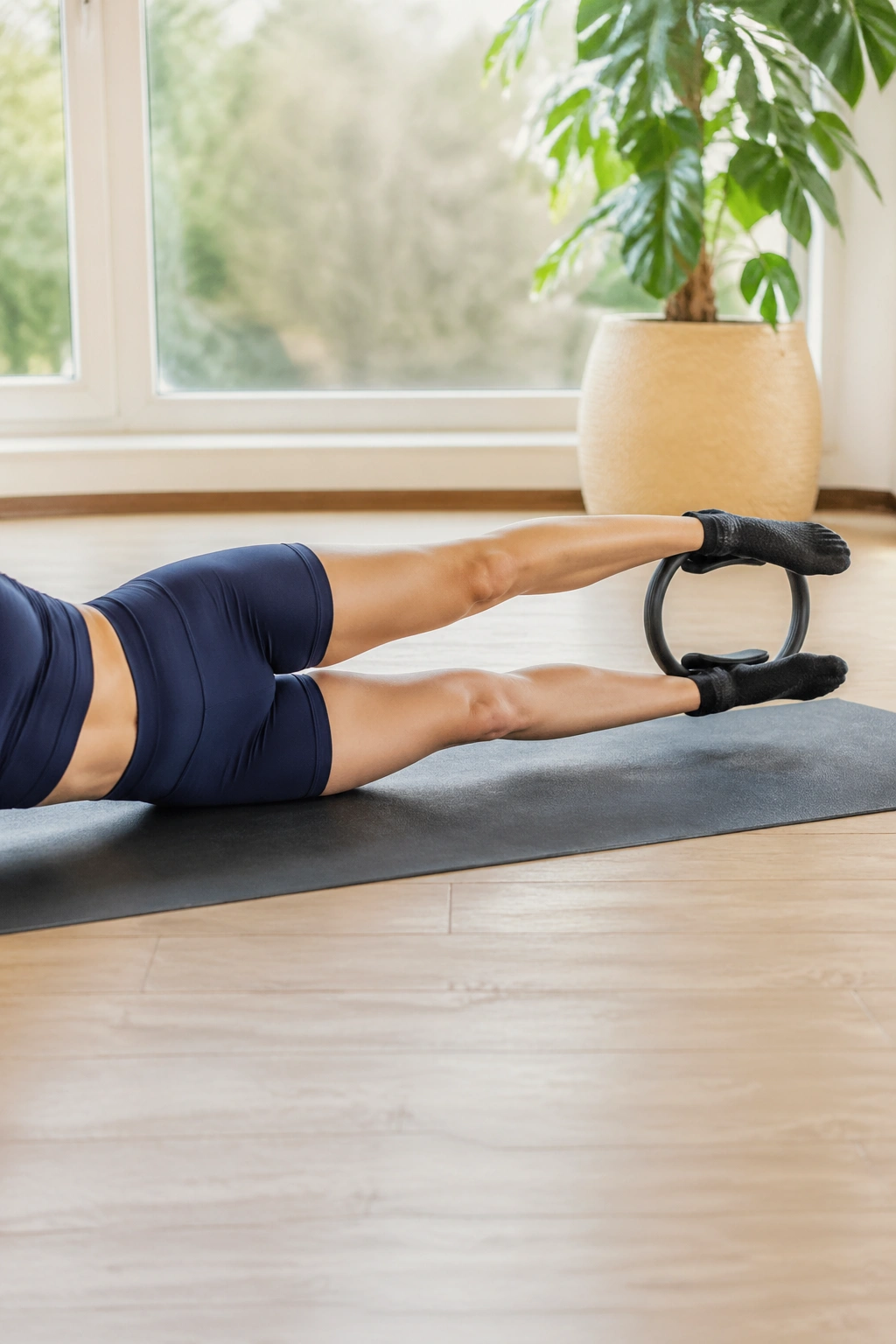
This one asks for teamwork.
Lie on your side with the ring between the inner ankles. Stack the hips, lengthen both legs, and rest your head on your lower arm or a small pillow. Press inward on the ring and lift both legs together about 4 to 6 inches. Lower slowly. Do 8 to 12 reps.
At first glance it looks like a side-body move — and it is — but the ring changes the demand. The legs cannot just float up as one block. They have to stay zipped together with active adductor tension, which makes the lift more honest and much less swingy.
A lot of people haul the legs too high and roll backward. Keep the lift low. If the underside waist is screaming but the inner thighs are silent, reset the ring pressure before the next rep and think of drawing the top leg down into the bottom leg even while both are lifting.
Try this progression
Start with 6 reps. Rest. Then do 6 more with a 2-second pause at the top. That pause is where control either shows up or falls apart.
15. Wall Sit Pilates Ring Pulses
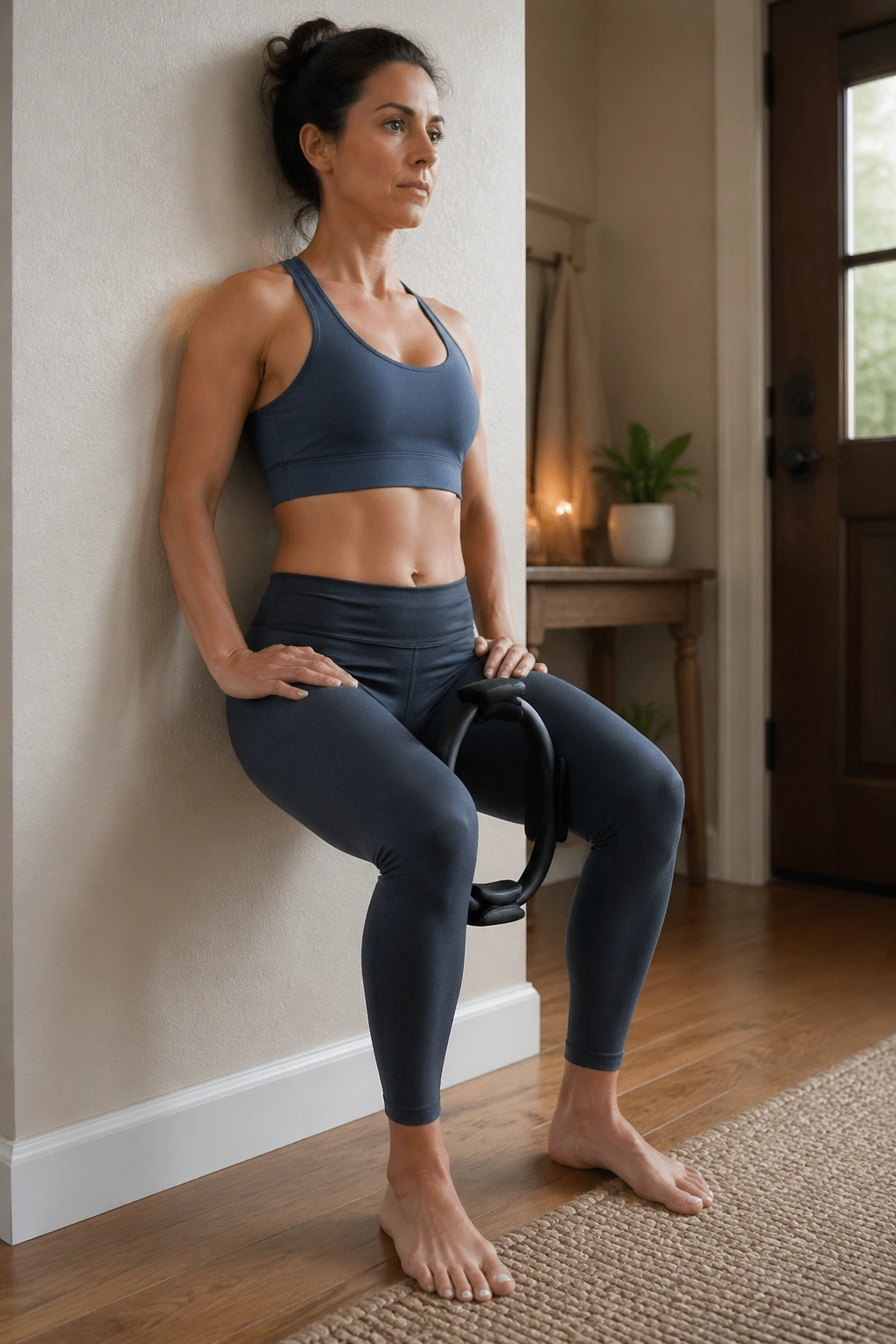
Take the ring off the mat and things change fast.
Stand with your back against a wall and slide down until your knees are bent around 90 degrees — or a little higher if that angle bothers your knees. Place the ring between the inner thighs above the knees. Hold the sit and add 15 to 25 small pulses inward on the ring. Stand up, shake the legs out, and repeat for 2 or 3 sets.
The wall gives you feedback. If your low back arches away or your pelvis tucks hard under, you will feel it right away. Aim for the back of the ribs and sacrum to stay in contact without flattening yourself into the wall like a pancake.
Fast checklist
- Knees track over the middle toes.
- Weight stays through whole feet, not just the heels.
- Pulse small.
- Stand up before your form turns ragged.
This one has a different bite than the supine work. The inner thighs are still working, yet the demand is more functional because you are dealing with body weight and an upright torso. It carries over well to squats, stairs, and long walks.
16. Standing Mini Squat With Midline Squeeze
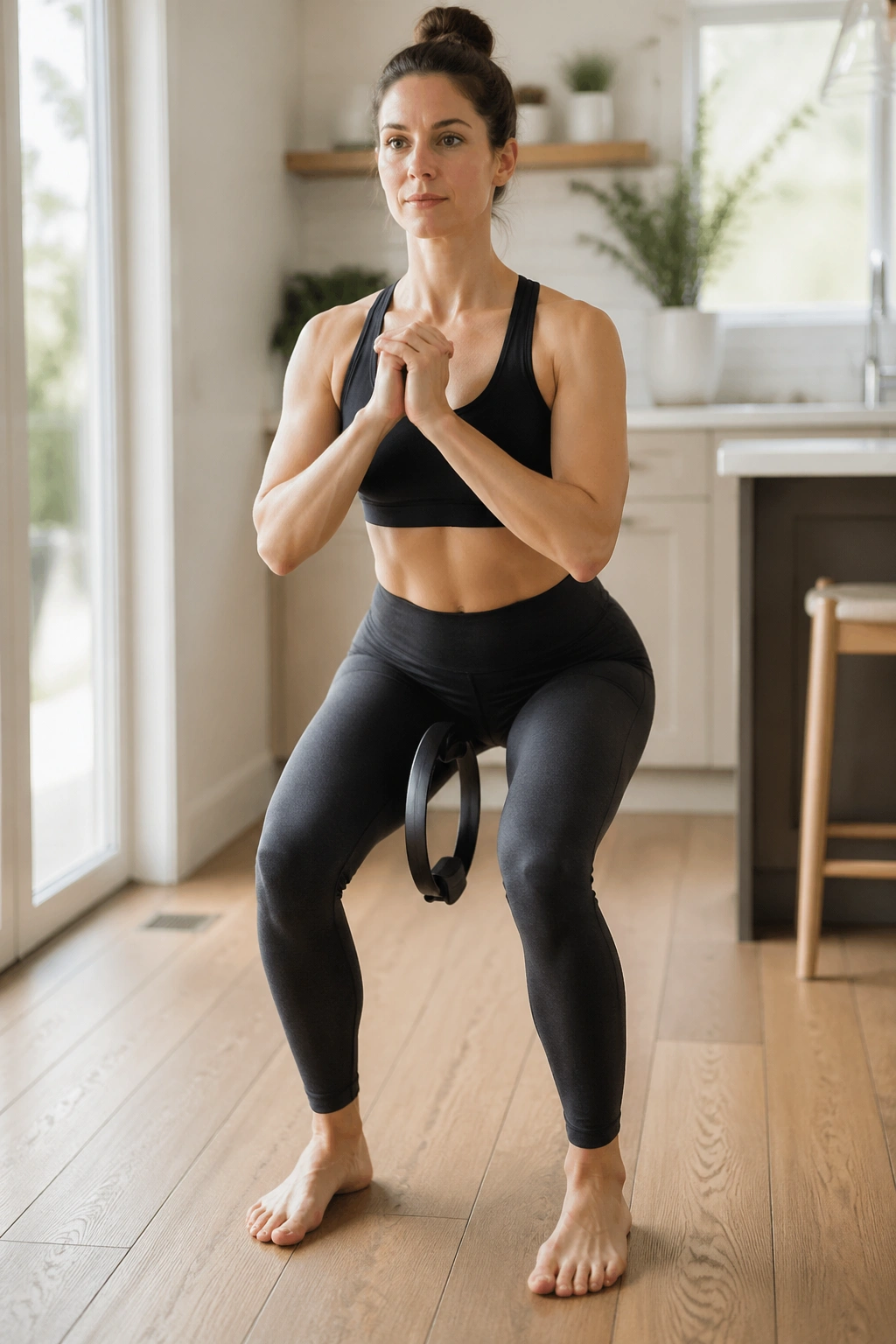
No wall this time. That missing support makes the ring feel twice as alive.
Stand tall with feet parallel, about hip-width apart. Place the ring between the inner thighs above the knees. Find that light inward press. Hinge the hips back into a small squat — 6 to 8 inches down, not a deep chair pose — then stand. Do 12 to 15 reps.
What you are after is clean tracking. The pelvis stays level, the knees bend straight ahead, and the ring pressure remains steady from start to finish. If the ring falls or spins, your legs are shifting around more than you thought.
A cue I use often here: imagine you are spreading the floor with your feet while also drawing the inner thighs toward the center. Those two actions sound opposite. They are not. One gives hip stability; the other keeps the adductors in the game.
This move is less flashy than lunges or jumps. I do not care. It teaches the inner thighs to work inside a squat pattern, and that pays off in almost every lower-body program.
17. Standing Side Adduction Press
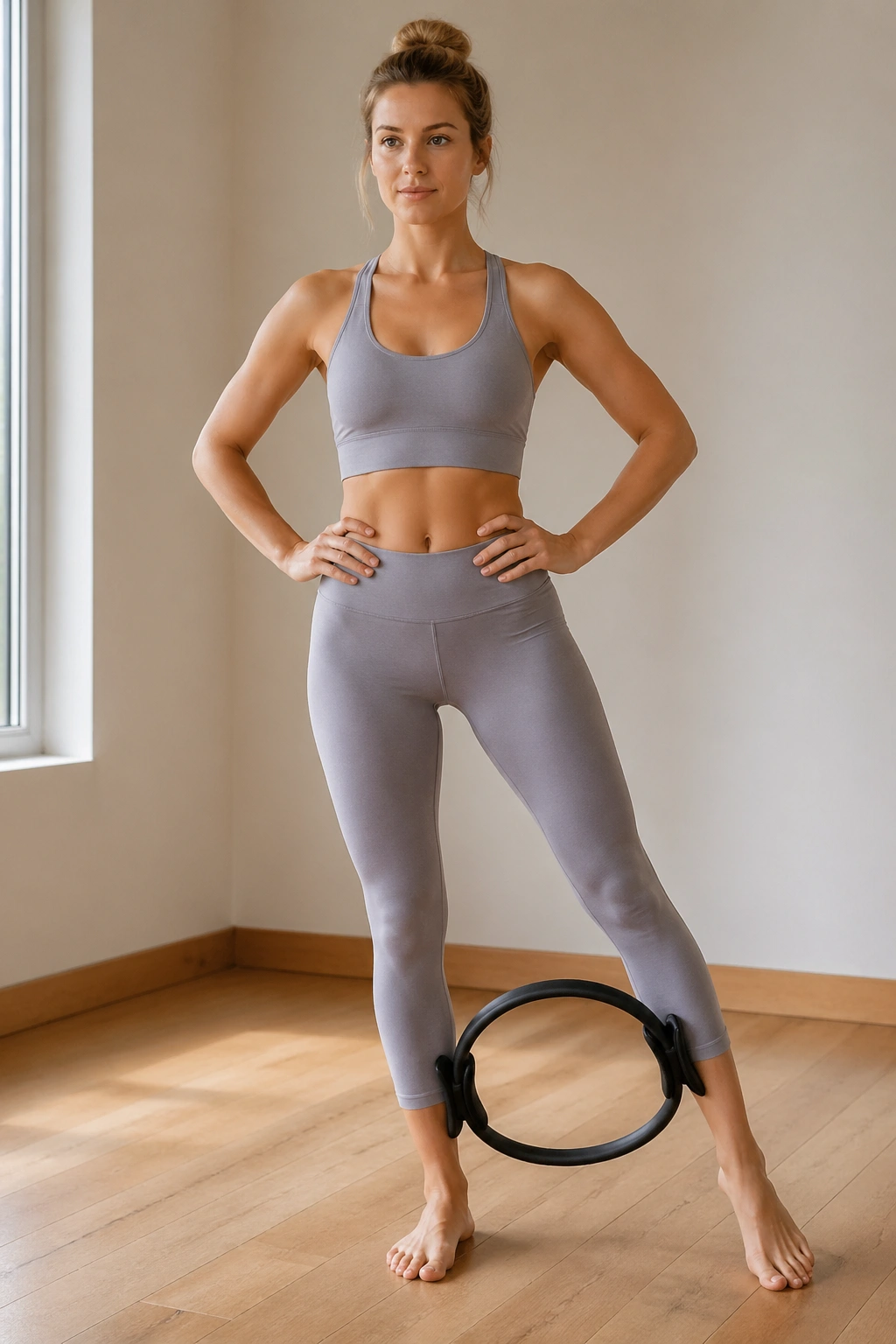
Here the ring becomes a single-leg tool.
Stand next to a wall or chair with your left hand lightly resting on it. Put the ring on its side between the inner ankles, then shift your weight onto the outside leg. Press the inside leg toward the standing leg to compress the ring, release slowly, and repeat for 12 to 15 reps. Turn around and do the other side.
What makes this one different
You are no longer squeezing both thighs together evenly. One leg is moving toward the midline against resistance while the standing side manages balance. That makes the working inner thigh more isolated and the standing hip more honest.
The motion is small. A few inches. If you swing the leg in, you miss the point. Think press, pause, and return.
Use your support hand more than your ego wants to. Balance should not be the limit here. If you are wobbling all over the room, the adductors never get the clean loading they came for.
18. Wide-Stance Squat and Heel Raise With the Ring
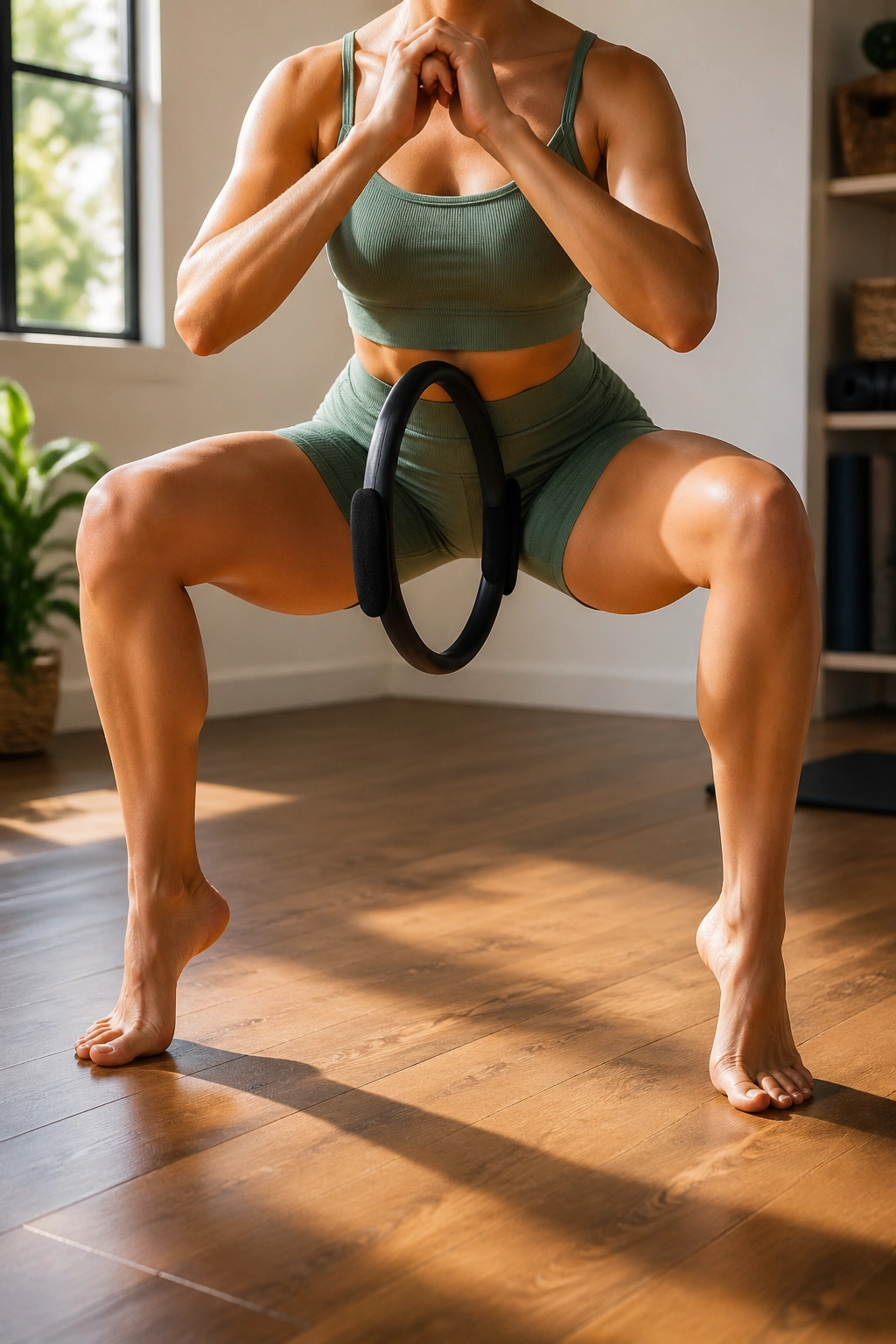
This one feels old-school Pilates in the best way: precise, a little awkward at first, then oddly addictive once the shape clicks.
Stand in a wide stance with the toes turned out a little, not cranked open. Place the ring between the inner thighs high enough that it will stay put as you bend the knees. Lower into a shallow wide squat, squeeze the ring, then lift both heels for a calf raise. Lower the heels, straighten the legs. That is one rep. Do 8 to 12.
The ring keeps the legs from drifting into a floppy turnout pattern. Your job is to keep the squeeze alive while the heels rise and the knees stay lined up over the toes. The lift onto the balls of the feet adds a balance challenge and makes the inner thighs work harder to steady the pelvis.
A warning, because this move can get messy fast: if your knees cave or your ankles wobble, ditch the heel raise and keep the squat only. Add the rise later.
When it is clean, this is a sharp combo for inner thighs, calves, and pelvic control.
19. Prone Heel Press With Ring Between the Ankles
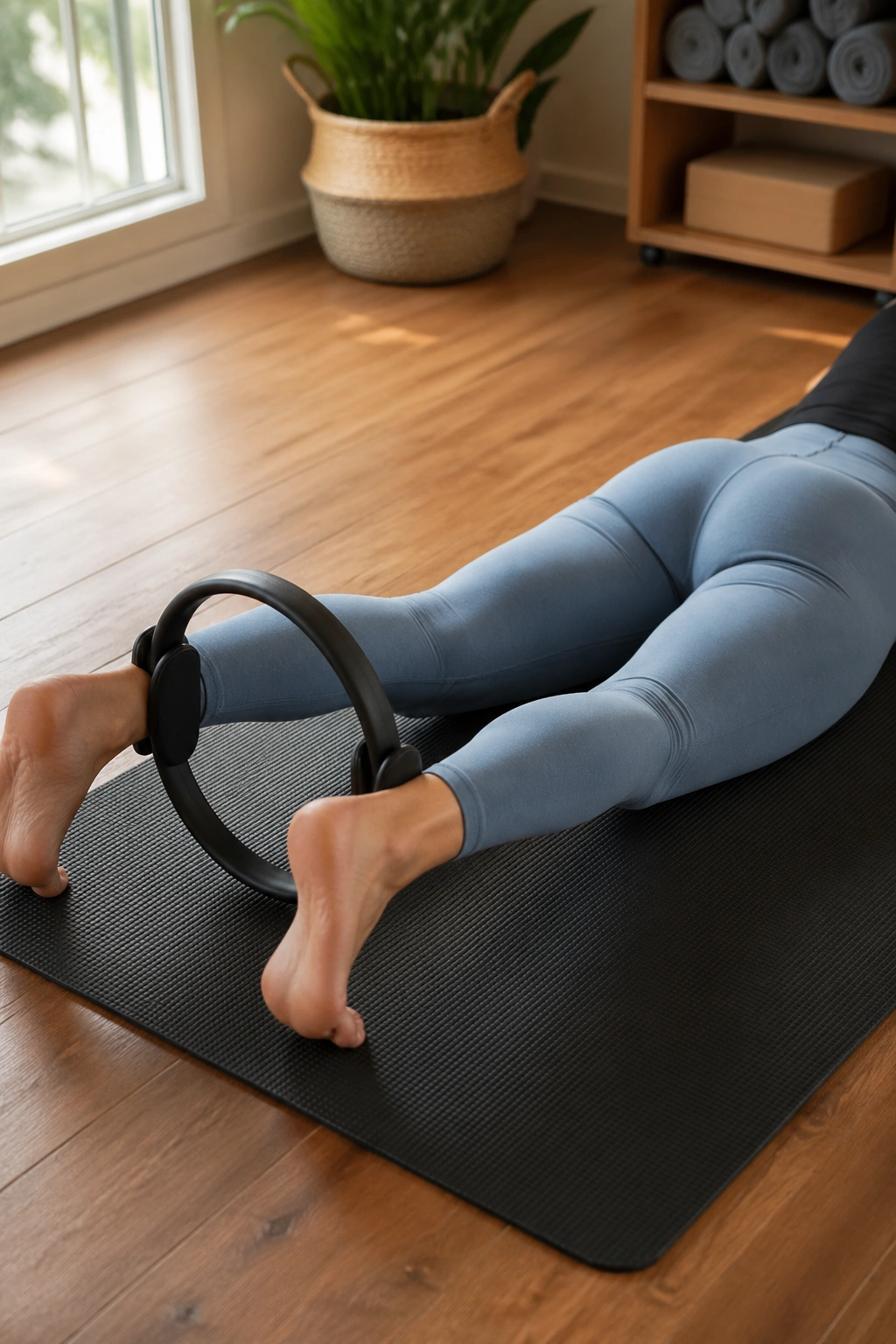
Face-down ring work does not get enough love.
Lie on your stomach with your forehead on stacked hands. Bend both knees to about 90 degrees and place the ring between the inner ankles. Keep the thighs hip-width apart or a touch narrower. Press the ankles inward on the ring, hold for 3 seconds, then release halfway. Do 12 reps.
This position changes the conversation because the hips are extended, not flexed. You are asking the adductors to work with the back body instead of the front body. A lot of people feel the connection more clearly here, especially if supine drills make the hip flexors too bossy.
A couple of cues
- Let the pubic bone stay heavy on the mat.
- Do not kick the feet up and down.
- Think of drawing the inner ankles together from high in the groin.
You may feel the hamstrings jump in. That is normal. The trick is not to let them dominate the whole rep.
20. Forearm Plank Adductor Squeeze
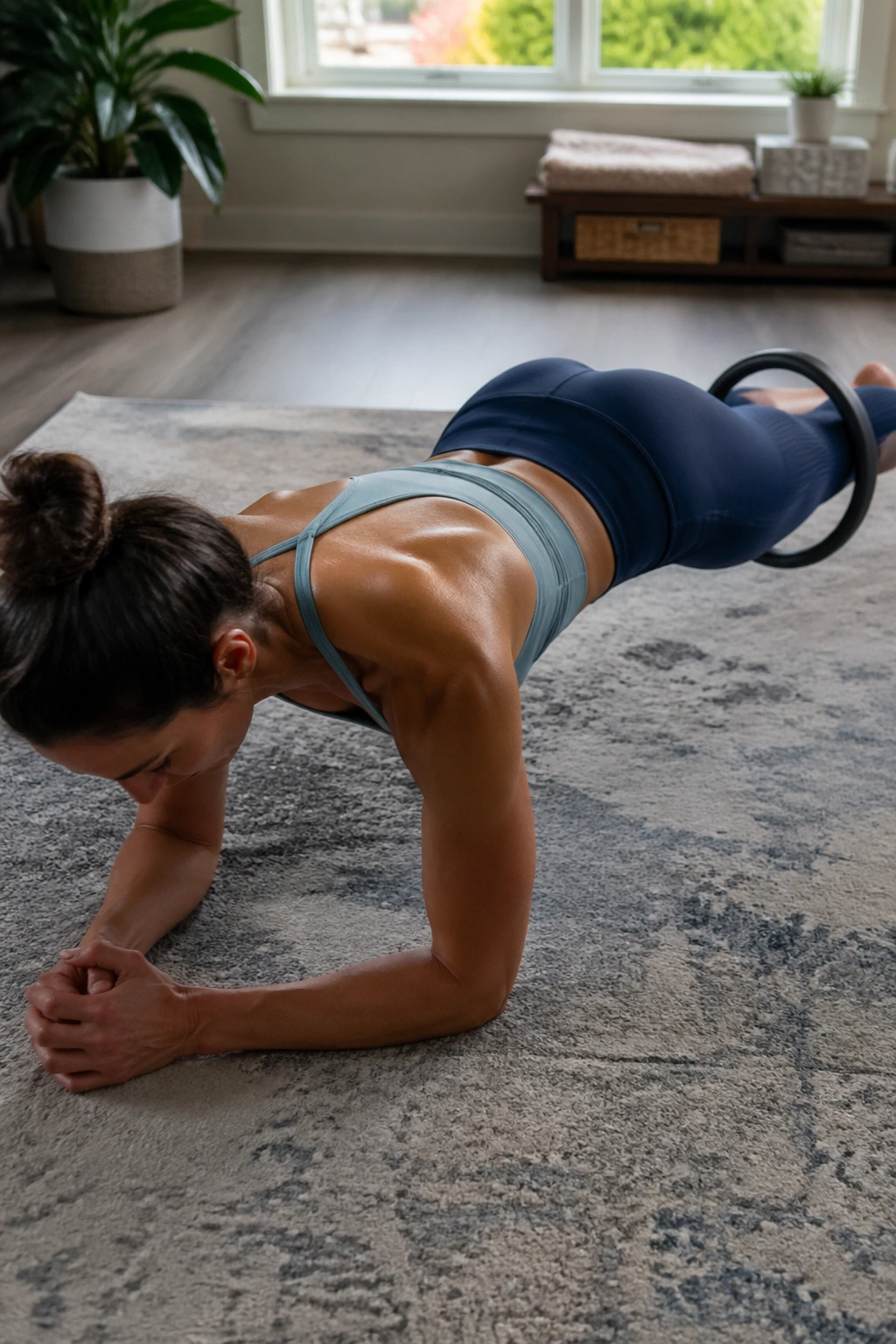
This is the toughest one on the list for most people, not because the squeeze is huge, but because plank leaves no place to hide.
Set up in a forearm plank with the ring between the inner thighs above the knees. Elbows under shoulders, legs long, heels reaching back. Find a light press into the ring and hold for 20 to 30 seconds. If that feels steady, add 6 to 10 tiny pulses without letting the hips hike or sag.
You will want to clench everything. Try not to. The better version of this exercise is almost calm from the ribs up, with steady breath and a firm line from chest to heels. The ring should make the center of the body feel more connected, not panicked.
Scale it without losing the point
- Drop the knees to the mat.
- Shorten the hold to 10 seconds.
- Place the ring a little higher on the thighs.
- Skip the pulses and keep one still hold.
When this move is working, the inner thighs, low abs, glutes, and shoulder girdle all share the load. It is a full-body plank, yes, but the adductor demand is what keeps the whole shape from falling apart.
Final Thoughts
If you want these exercises to work, do not cram all 20 into one session. Pick 5 to 7 moves, cover a few positions — supine, side-lying, standing, maybe one plank — and give each rep enough attention that the ring stays honest.
The ring rewards restraint. A smaller squeeze, a steadier breath, a shorter range you can control — those choices usually build more inner-thigh strength than a dramatic effort ever does. I know that sounds less exciting. It is still true.
One last practical tip: if you feel sore high near the groin after your first session, that is common with adductor work. If you feel sharp knee pain, pinching at the front of the hip, or low-back strain that lingers, change the setup and cut the range before trying to push through.
Done well, a magic circle gives your inner thighs a job they can no longer dodge. And once those muscles start showing up, a lot of other Pilates work gets cleaner right along with them.
