



The feeling of a true Pilates workout is difficult to describe until you have experienced it firsthand. It is rarely the gasping-for-air, high-intensity exhaustion of a heavy cardio session; instead, it is a localized, vibrating heat that starts deep in your abdomen and radiates outward. You might walk into the studio or clear a space in your living room feeling slightly disjointed or tight from a long day at a desk, but by the end of the session, your spine feels elongated, and your shoulders have dropped inches away from your ears. That sensation of being “put back together” is why millions of people return to the mat, again and again.
Pilates is often misunderstood as merely a gentle stretching routine, but it is actually a precise method of conditioning that emphasizes spinal alignment, breath control, and core stabilization. When you perform these movements correctly, you are not just working the muscles you can see in the mirror; you are engaging the deep transverse abdominis, the pelvic floor, and the multifidus muscles along your spine. These are the muscles that support your body throughout every single waking moment, yet they are notoriously difficult to target with standard gym equipment.
If you are just starting, the sheer volume of information can be overwhelming. There are endless variations of the hundred, hundreds of potential modifications for a simple side-kick series, and conflicting advice about whether your spine should be imprinted or neutral. The truth is much simpler: you need consistency, clear cues, and a logical progression of difficulty. The following routines are structured to help you build that foundation. They are designed to be safe for beginners, requiring little to no equipment beyond a mat, yet they are demanding enough to challenge your control, coordination, and strength from head to toe.
1. Core-Focused Stability Mat Series
This routine centers on the idea of the “powerhouse”—the area between your rib cage and your hips. Beginners often make the mistake of pulling their stomach out when they exert effort, but effective Pilates requires pulling your belly button toward your spine throughout the entire range of motion. We start here because if your core isn’t stable, no other movement in the system will yield the benefits you are looking for.
Why This Sequence Works
The exercises in this series are selected to challenge your stability while your limbs are moving. This forces your core to act as a stabilizer, which is the primary function of your abdominals in real-world movement. By minimizing momentum, you increase the time your muscles spend under tension, leading to better tone and improved body awareness.
Key Exercises to Include
- The Pelvic Tilt: Begin lying on your back, knees bent, feet flat. Rock your pelvis to flatten your lower back against the mat.
- Single Leg Lifts: Maintain the pelvic tilt while lifting one leg to a tabletop position. Keep the torso perfectly still.
- Toe Taps: Lower the foot toward the mat and lift it back without letting your lower back arch.
- Chest Lift: Curl your upper body forward, looking toward your belly button, while keeping the pelvis anchored.
Pro tip: Imagine there is a grape under your lower back; your goal is to hold it in place by pressing gently, but do not crush it by tensing your glutes.
2. Full-Body Flow with a Pilates Ring
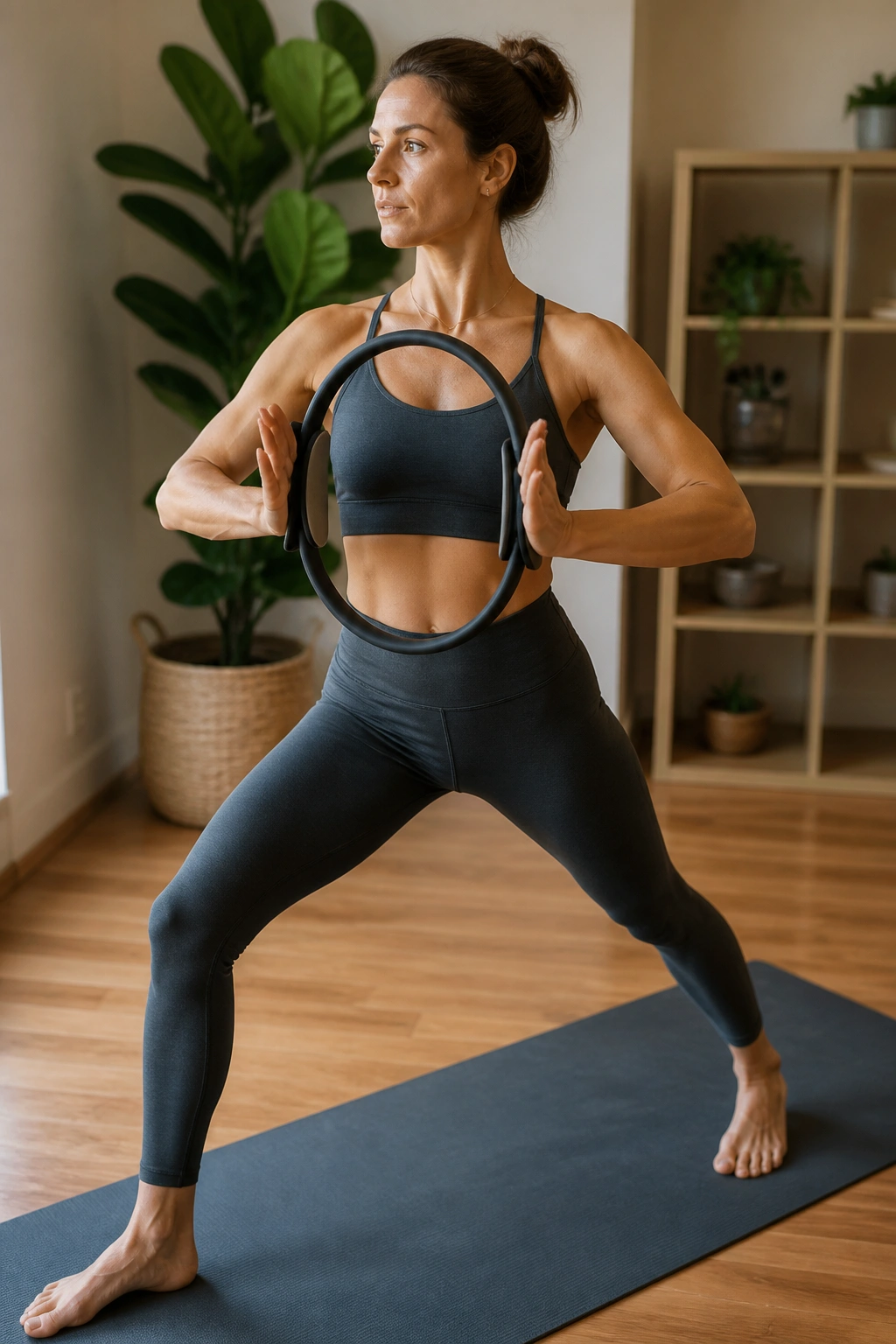
The Pilates ring, or “magic circle,” is a deceptively simple tool. It provides immediate feedback to your muscles, acting as an external resistance that helps you engage muscles you might otherwise ignore. When you press into the ring, you naturally recruit your chest and back muscles, which can help stabilize your frame during even the most basic mat exercises.
This workout is all about connection. As you move through the series, the ring acts as a connector between your hands or between your ankles, requiring your limbs to work in unison rather than isolation. You will notice that by simply holding the ring and applying a light, consistent squeeze, your entire posture improves.
There is a rhythm to this routine that helps quiet the mind. Start with the ring between your ankles for leg work, then move it to your hands for upper body sequences. Focus on the energy you are putting into the ring. If your elbows are locked out, you are using the joint rather than the muscle. Keep a slight, soft bend in the elbows, and feel the work deep in your pectorals and lats.
3. Low-Impact Standing Pilates Balance Routine
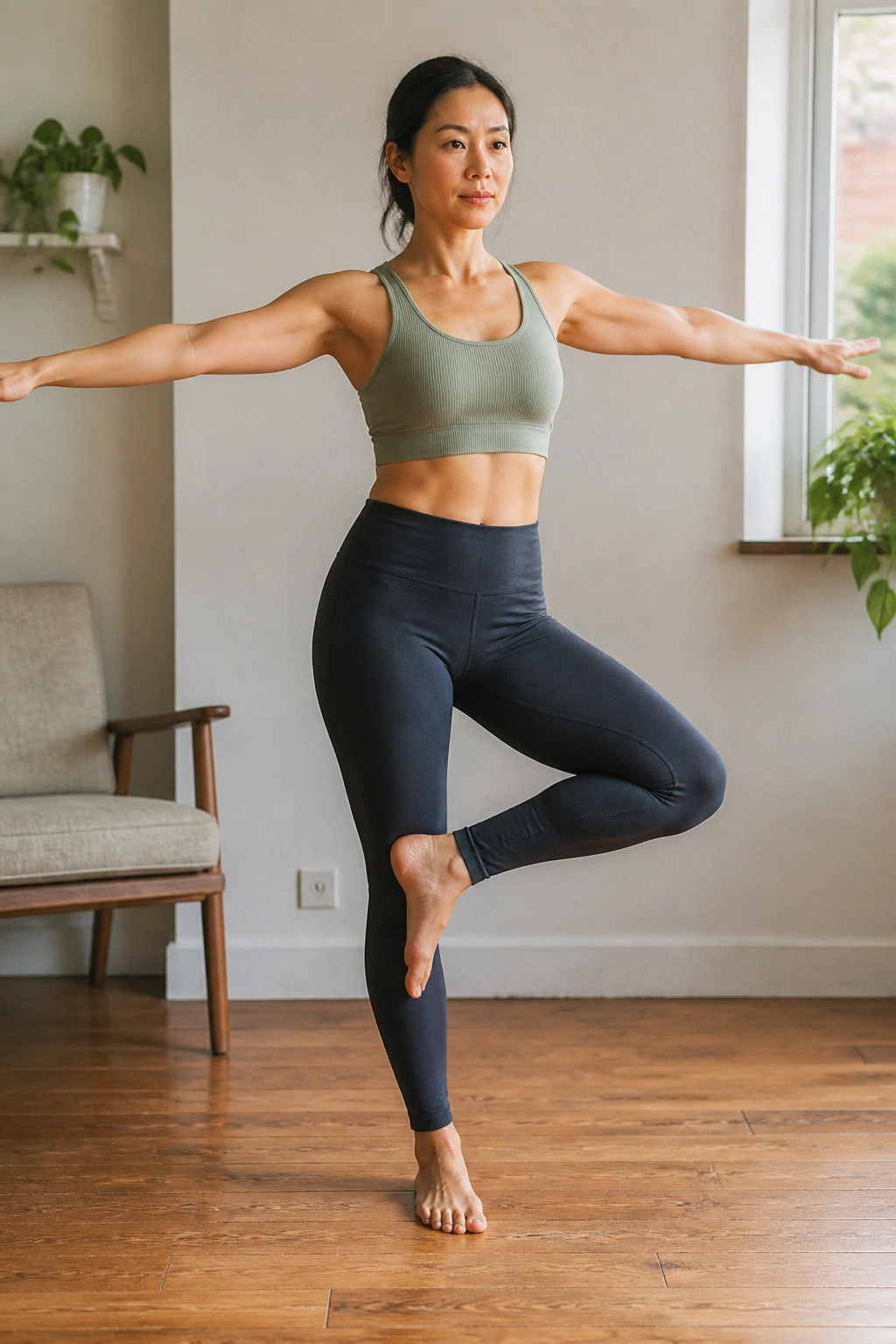
Standing Pilates is a fantastic way to translate the strength you build on the mat into your daily life. We spend most of our time upright, yet traditional gym exercises often have us sitting or lying down. This routine focuses on proprioception—the body’s ability to sense its position in space—by incorporating balance work that challenges the small stabilizing muscles around your ankles, knees, and hips.
The Science of Balance
When you stand on one leg, your brain works overtime to coordinate the muscles in your foot, calf, and hip. This is not just about not falling over; it is about building the type of strength that prevents injury. Research suggests that consistent balance training improves ankle stability and knee alignment, both of which are critical for long-term joint health.
How to Use This Sequence
- Start with a simple weight shift, moving your center of gravity from one foot to the other without moving your torso.
- Incorporate leg circles while balancing on one leg, ensuring your hips stay square to the wall in front of you.
- Add small pulses or toe taps to fire up the standing glute medius, the muscle responsible for pelvic stability.
4. Wall Pilates for Posture and Alignment
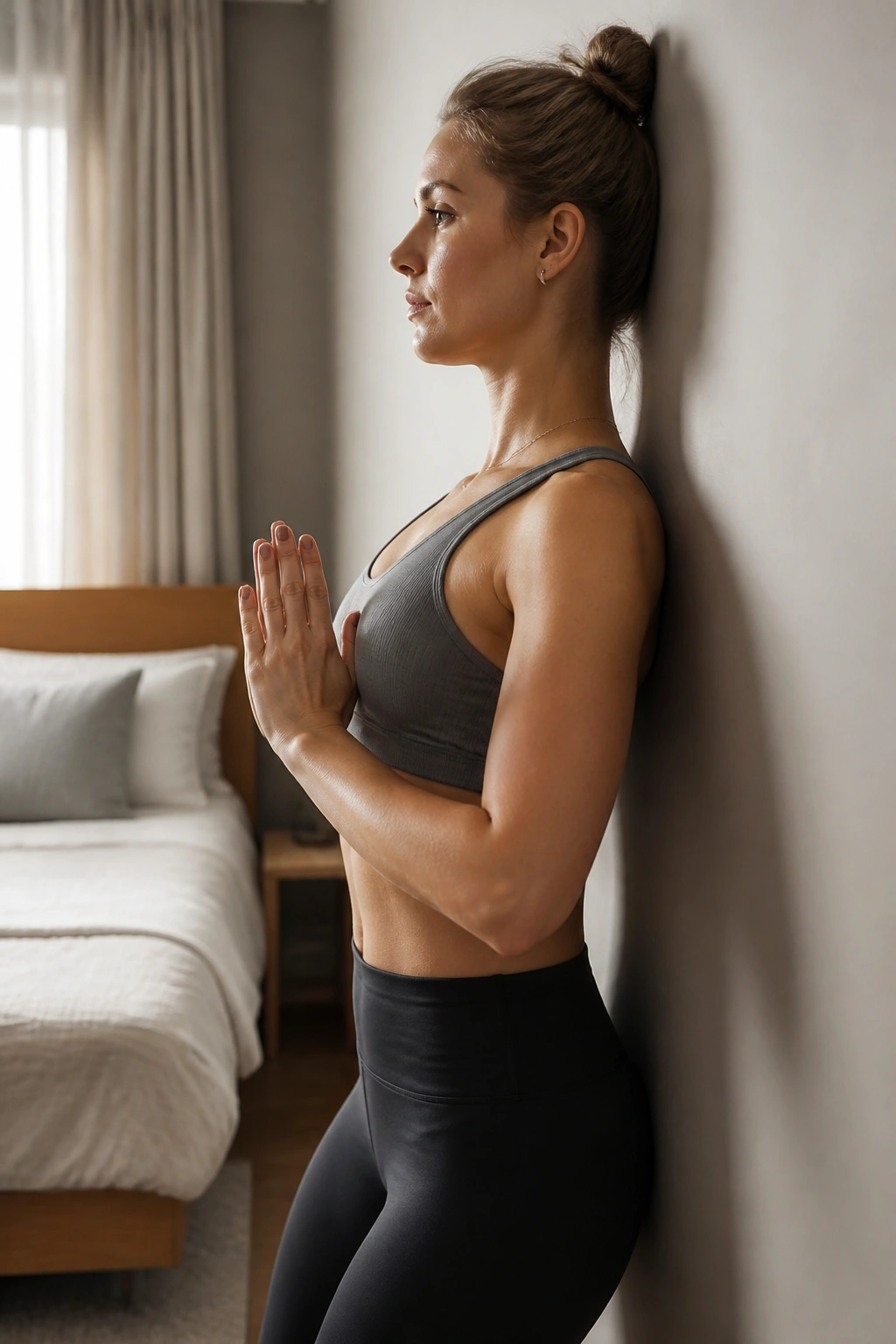
Wall Pilates is a hidden gem for beginners. Using the wall provides a tactile reference point that helps you understand where your body is in space, which can be difficult to gauge when you are floating on a mat. It is essentially an “open-chain” exercise turned into a “closed-chain” one, offering external support so you can focus entirely on form.
Imagine standing with your back against the wall. Can you touch your shoulder blades to the surface without arching your neck? Can you get your lower back to touch without tucking your pelvis too severely? These small, almost imperceptible adjustments are the foundation of good posture. During this workout, you will perform bridges, leg slides, and even push-ups against the wall.
The wall doesn’t just support you; it also forces honesty. If you try to cheat a movement, you will feel the gap between your back and the wall open up. Use that sensation as your feedback mechanism. Whenever you feel your back leave the wall, stop, reset, and re-engage your abdominals before continuing. You are literally training your body to inhabit a straighter, more aligned space.
5. Glute and Leg Sculpting Sequence
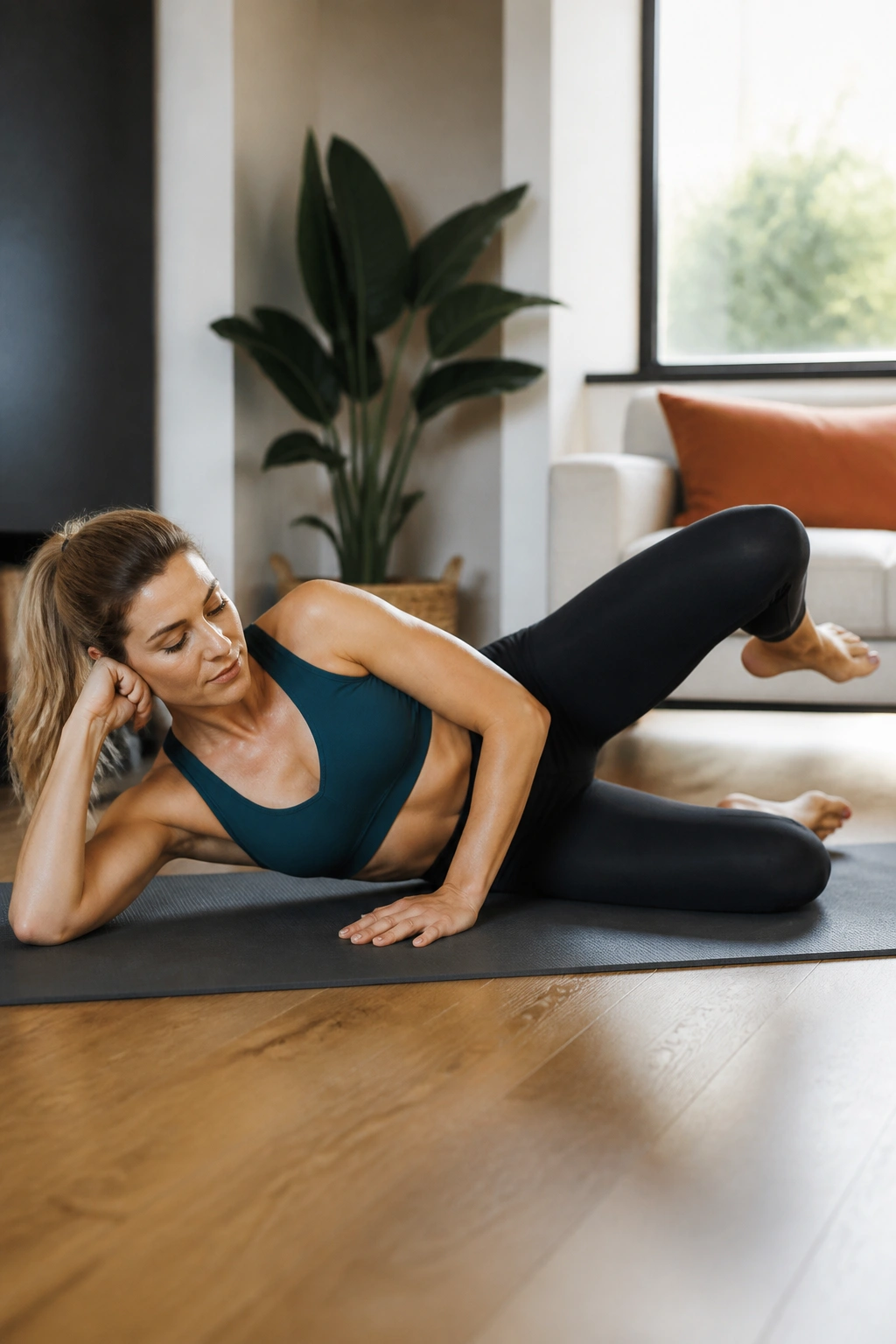
If you want to strengthen your posterior chain without the heavy impact of squats or lunges, this sequence is your best friend. The focus here is on the gluteus medius and maximus. These muscles are responsible for everything from walking and running to simply standing up from a chair. Weak glutes often force the lower back to compensate, which is a leading cause of lumbar pain.
This workout uses the side-lying position. You will work through leg lifts, circles, and “clamshells.” The beauty of side-lying Pilates is that it removes gravity’s direct resistance, allowing you to focus on the precision of the muscle contraction. You are not trying to move the largest weight possible; you are trying to fatigue the muscle through controlled, repetitive action.
Watch your top hip. The most common mistake is letting the hip hike up toward your ribs as your leg lifts. Keep your pelvis stacked, with your top hip directly over the bottom one, almost as if you are trying to lengthen that top leg out of your socket. That extra length is where the magic happens. You should feel the burn deep in the side of your hip, not in your lower back.
6. The “Hundred” and Breathwork Masterclass
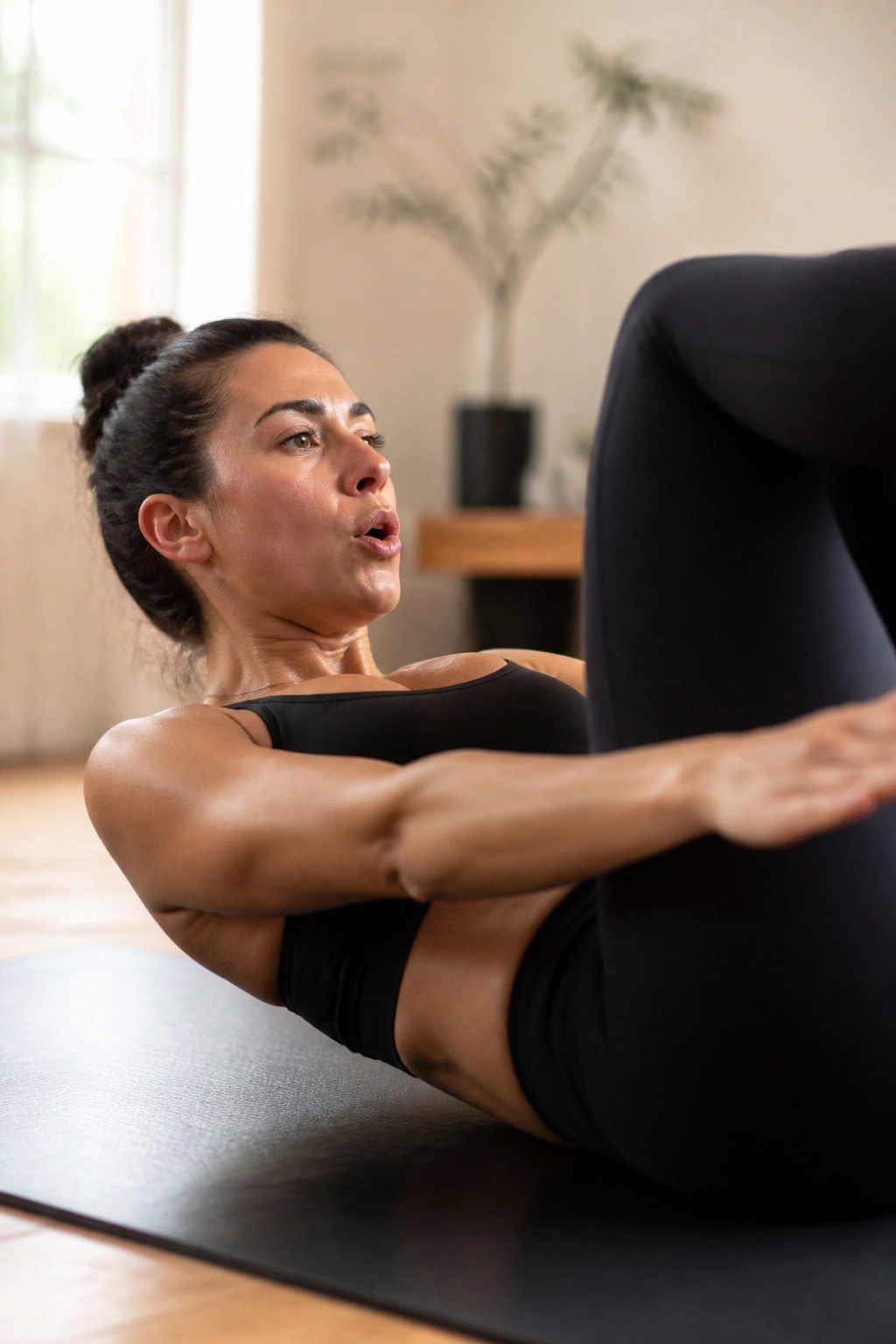
The “Hundred” is the quintessential Pilates exercise. It looks simple—pumping your arms while holding a crunch—but it is a brutal test of endurance and breath control. If you have never done it, the secret is not the movement itself but the breathing pattern. You inhale for five counts and exhale for five counts, repeating this until you reach one hundred.
Why Breathwork Matters
In Pilates, breath is not an afterthought. It is a tool for engagement. When you exhale deeply, you force the air out of your lungs, which naturally recruits the deepest layers of your abdominal wall. This is a physiological reflex you can use to your advantage. By timing your hardest movements with your deepest exhalations, you make the exercise more effective.
Master the Technique
- Lie on your back, legs in tabletop, head and shoulders curled forward.
- Keep your arms active, reaching long toward your feet.
- Pump the arms vigorously, maintaining a steady pace.
- If your neck starts to hurt, it is a sign that your abdominals are tired. Lower your head to the mat, continue the breathing, and keep the legs moving.
Pro tip: Focus on the exhalation. Emptying the lungs completely is what sets the core on fire.
7. Gentle Spine Mobilization for Desk Workers
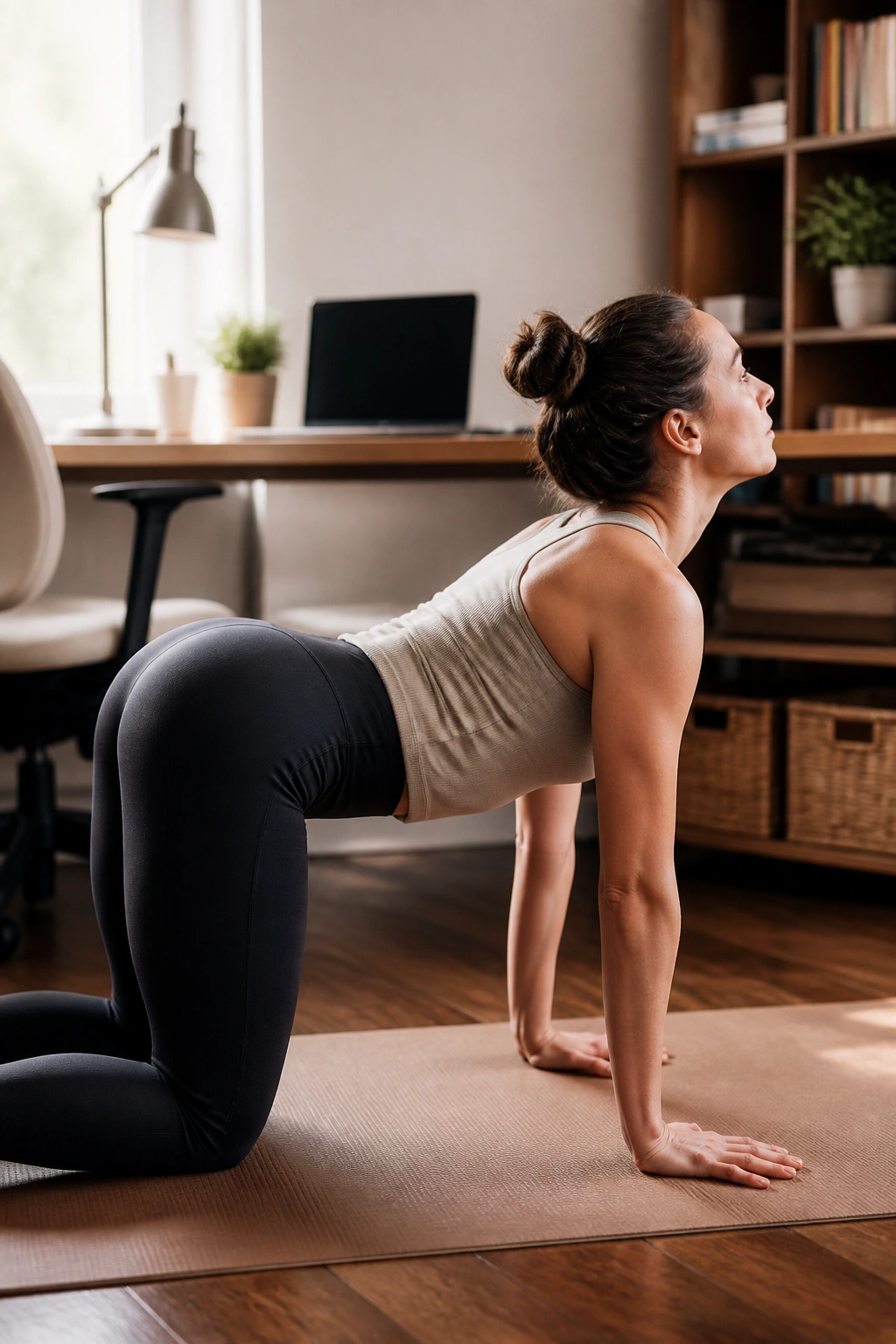
We are often told to “sit up straight,” but our spines were designed for movement, not static uprightness. This routine focuses on the four primary movements of the spine: flexion, extension, lateral flexion, and rotation. If you spend eight hours a day in a chair, these movements will feel like a long-overdue relief.
Start in a quadruped position (on hands and knees). Move through “cat-cow” stretches, but focus on segmenting the movement. Don’t just arch your back; try to move one vertebra at a time, starting from the tailbone and moving up to the neck. It is harder than it looks, and that is exactly the point. You are waking up the tiny muscles that surround the spine.
Next, move to seated lateral flexion. Imagine you are trapped between two sheets of glass; you can only lean directly to the side, not forward or backward. Reach one arm up and over, feeling the space between your ribs open up. This isn’t just a stretch; it is a way to lubricate the joints and improve the range of motion that we lose when we hunch over keyboards.
8. Seated Resistance Band Upper Body Tone
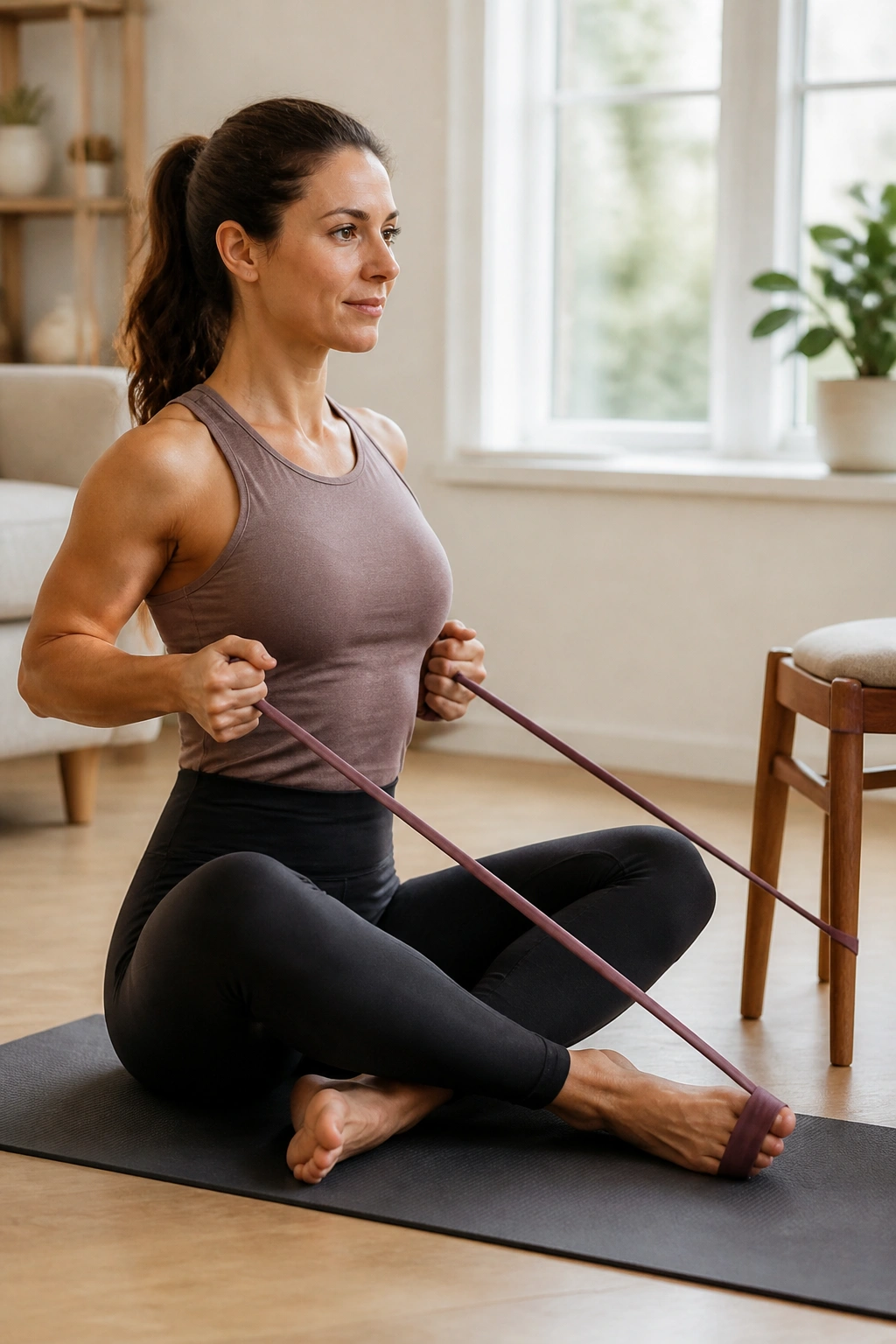
Using a resistance band while seated is a brilliant way to isolate the upper body without needing to balance. Because your base of support is stable, you can really dial in on the muscles of the back—the rhomboids, traps, and lats. These are the muscles that pull your shoulders back and give you an upright, confident appearance.
Sit tall on your mat with your legs crossed or extended, depending on what is comfortable. Wrap the band around your feet or anchor it to a sturdy piece of furniture. Perform seated rows, bringing your elbows back toward your rib cage. The key here is not to just pull the band, but to squeeze your shoulder blades together as if you are trying to hold a pencil between them.
Do not let the band snap back. The “eccentric” phase—where you are resisting the band as it returns to the start position—is where the strengthening happens. Control the movement for three counts on the way back. This level of control requires focus, and you will find your heart rate elevates even though you aren’t moving your legs at all.
9. Lateral Movement and Side-Body Conditioning
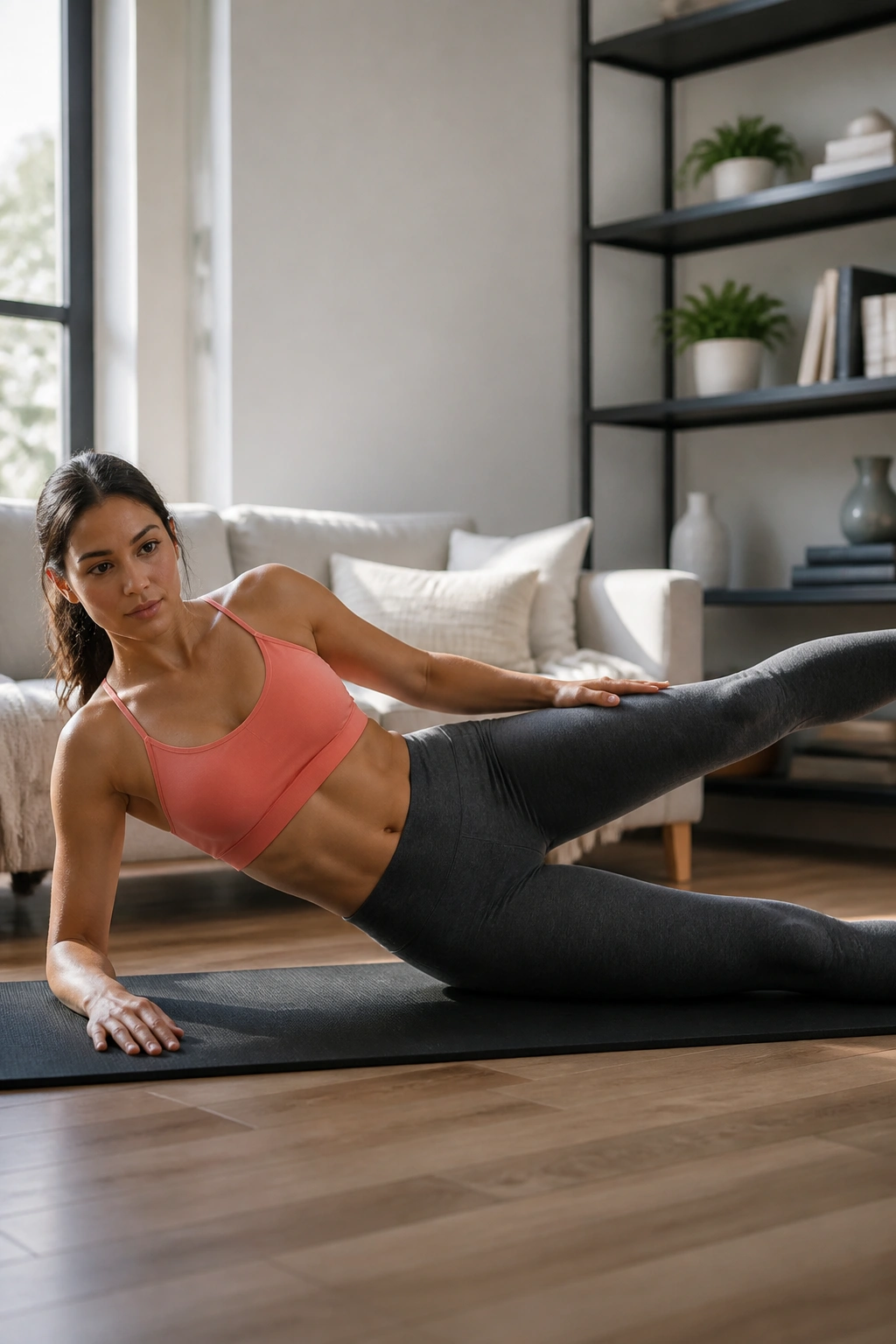
Most of our daily movement happens in the “sagittal plane”—moving forward and backward. Pilates is unique because it forces us to move laterally, or side-to-side. This is crucial for agility and for supporting the spine from the sides. This workout sequence involves side planks (with knee modifications), side-lying leg series, and seated side-bends.
When you train your body to move sideways, you work the obliques in a way that traditional crunches cannot touch. Think about your body as a corset. The obliques are the laces on the side. When they are strong, they pull everything in and up. This provides that narrow, toned look that many people associate with a Pilates physique.
Watch out for collapsing into the floor. If you are doing a side-lying sequence, do not let your rib cage sink into the mat. Keep a tiny lift under your waist, as if you are trying to hover that bottom rib just a millimeter off the floor. This active engagement keeps the muscles firing throughout the entire set rather than letting them relax during the transitions.
10. Floor Pilates for Deep Pelvic Floor Activation
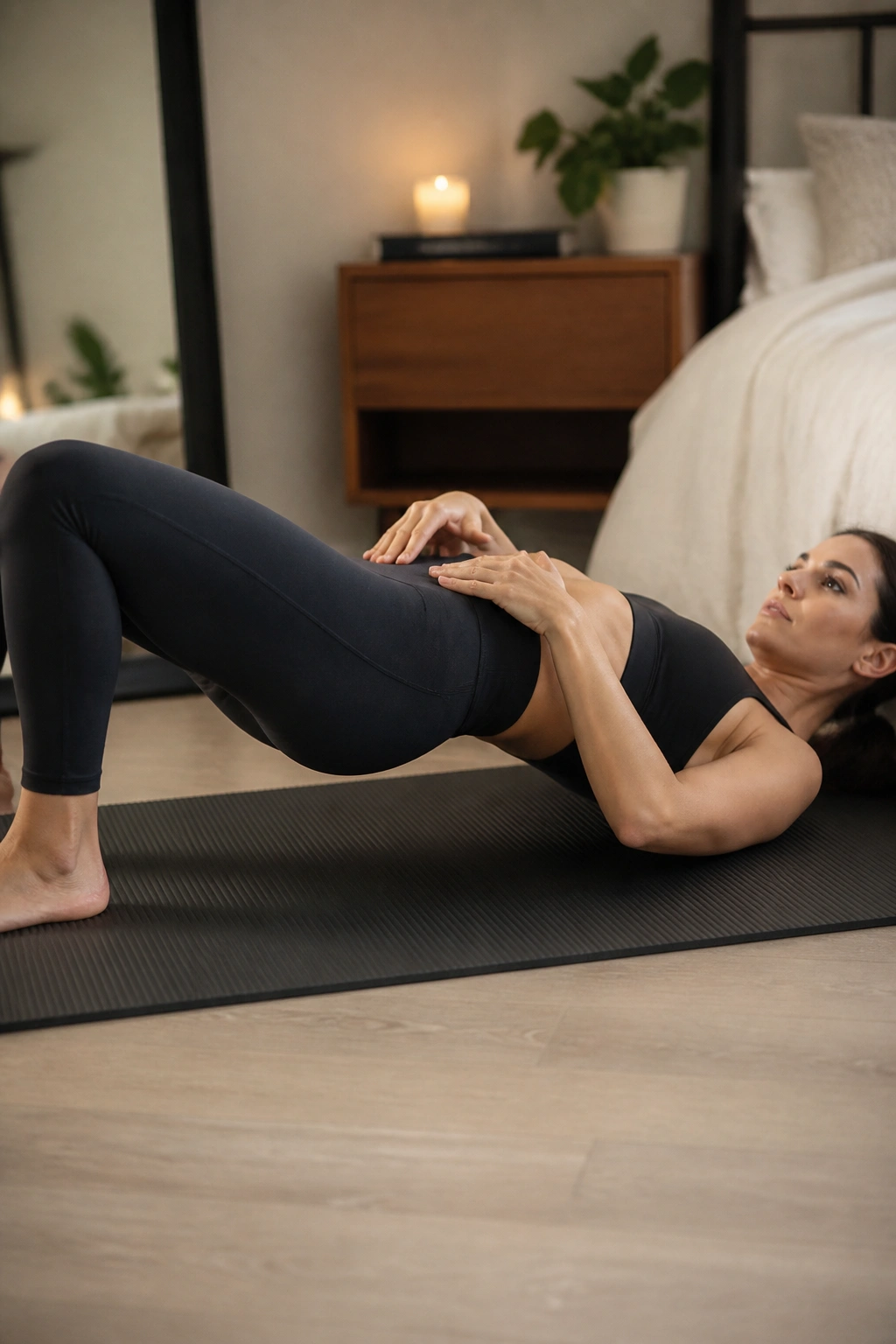
The pelvic floor is the base of your “core cylinder.” It is the muscle group that supports your organs and helps stabilize your pelvis. While it is often an overlooked area, learning to engage it properly changes the entire feel of your Pilates practice. It is not about gripping or clenching; it is about a gentle, upward lift, like an elevator moving up to the first floor.
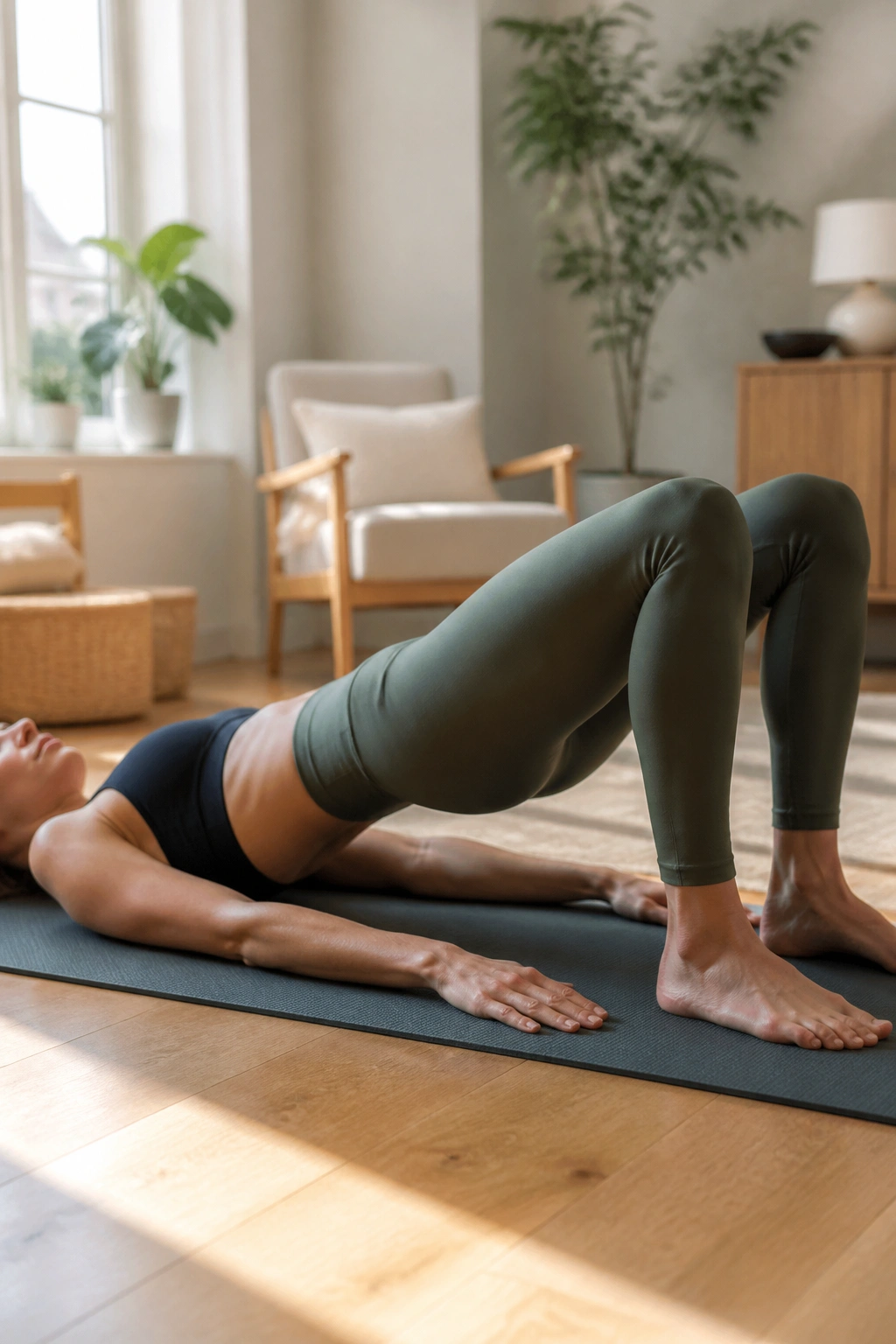
This workout focuses on very small, internal movements. You will work on bridges, but with an emphasis on the “imprint”—the act of slightly rounding the lower back before lifting. As you lift your hips, focus on the sensation of zipping your core closed from the bottom up.
It can be difficult to feel these muscles at first. That is normal. Take your time. Place your hands on your lower abdomen and see if you can feel a slight tightening or pulling inward when you exhale. Do not force it. The pelvic floor responds better to gentle, persistent focus than to aggressive, hard-muscle gripping.
11. Total Body Stretch and Lengthening Routine
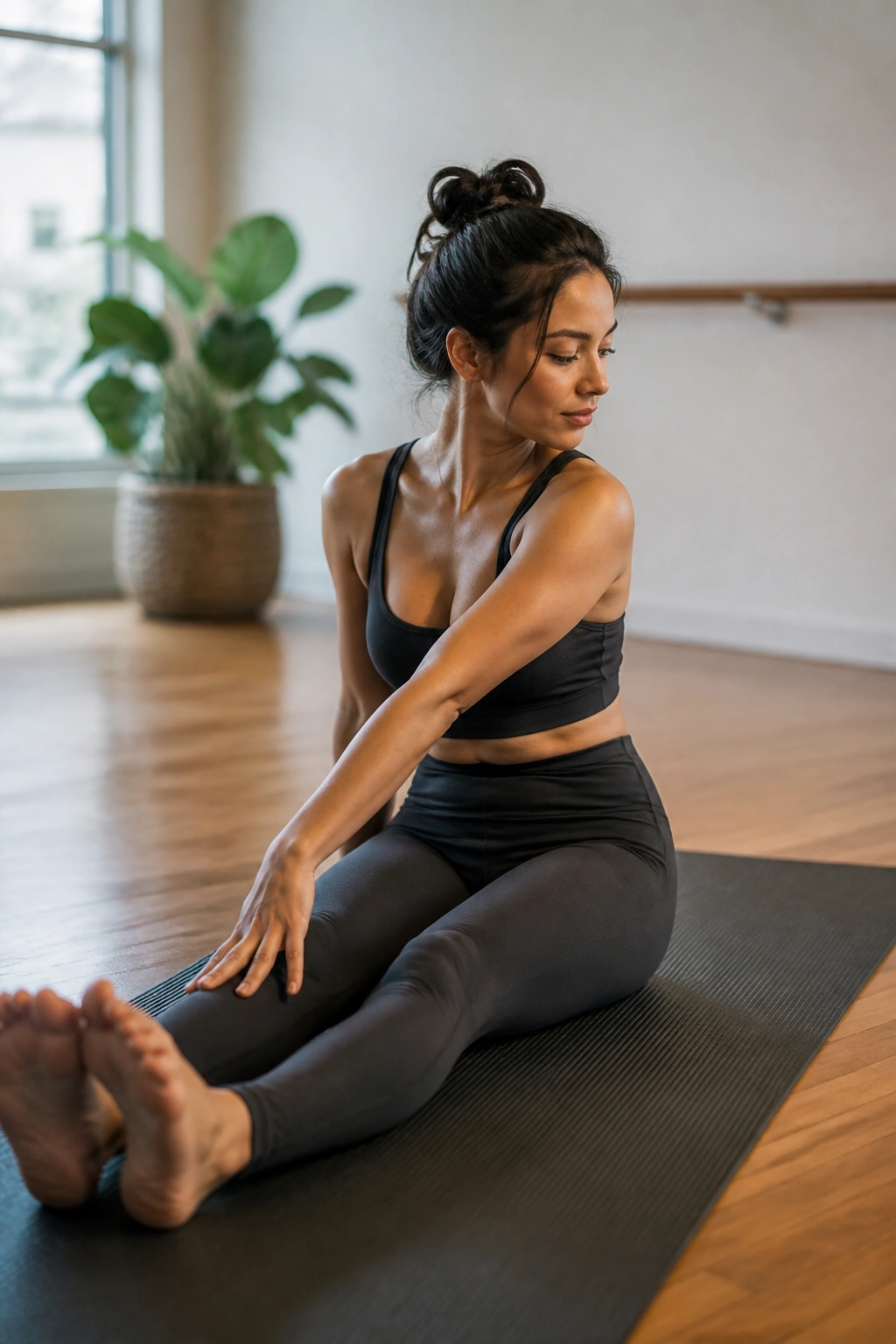
Not every Pilates session needs to be about muscle fatigue. Sometimes, the most productive workout is one that prioritizes length and release. This routine is designed for days when you feel stiff or fatigued. It is about “decompressing” the body. You will perform classic Pilates movements like the “spine stretch” and “saw,” but with a slower, deeper approach.
In the “saw” exercise, sit with legs wide and reach one hand toward the opposite foot. The goal is not just to touch your toes; it is to rotate your torso and lengthen your spine. Imagine your head is being pulled toward the ceiling while your sit bones are anchored into the mat. That opposition is the hallmark of a great Pilates stretch.
Take three deep, full breaths in every held position. When you feel a stretch, do not push into pain. Go to the point of resistance, exhale, and then see if your body naturally softens a bit further into the position. You are teaching your nervous system that it is safe to let go of that chronic tension.
12. Pilates-Inspired Strength for Beginners
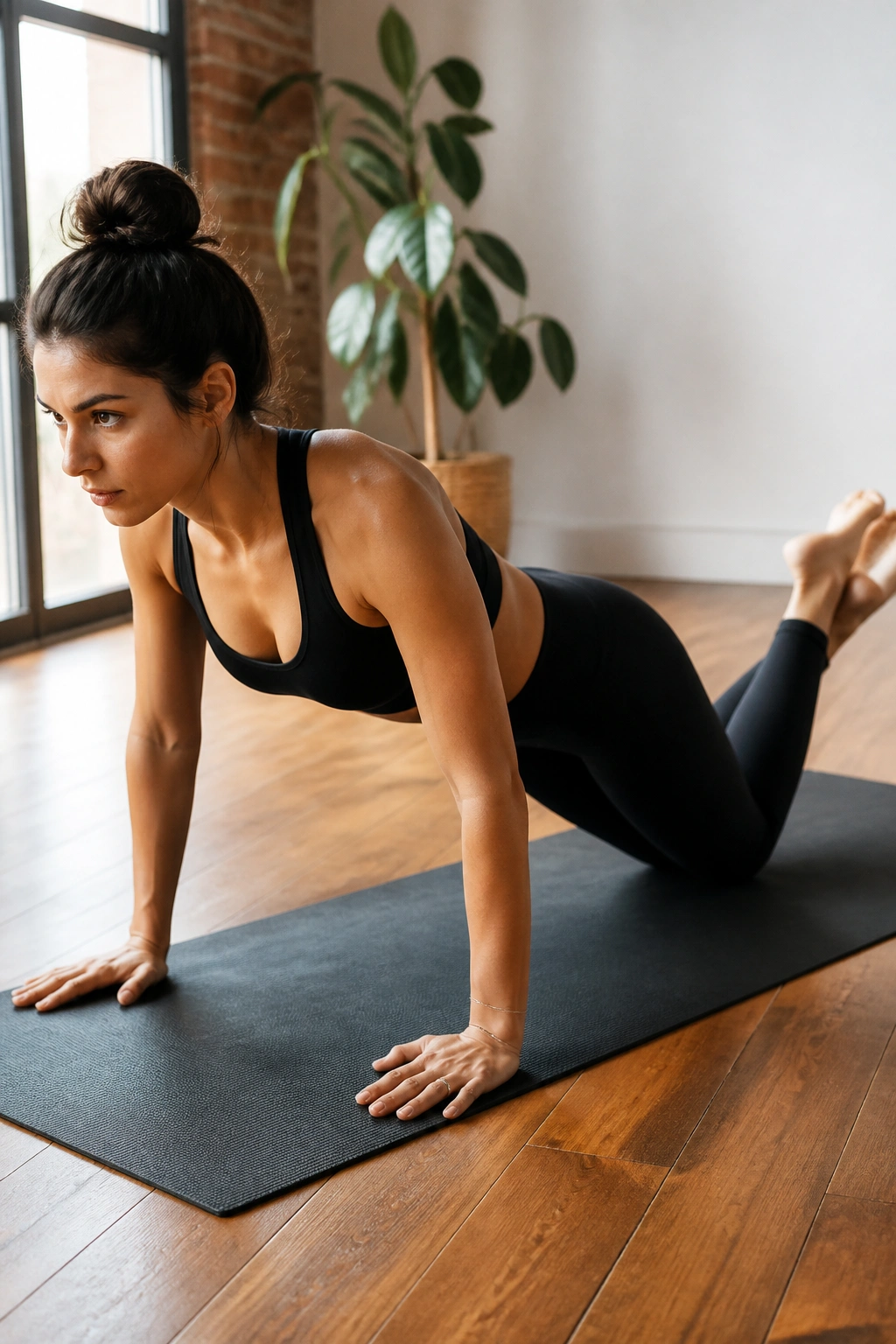
You might wonder if Pilates can actually build strength. The answer is a resounding yes, but it is a different kind of strength than what you get from a barbell. This workout incorporates movements that require you to lift your own body weight against gravity, such as modified push-ups, planks, and leg extensions from a tabletop position.
Defining Pilates Strength
It is the strength of control. When you perform a plank, you are holding your entire body straight against the pull of gravity. When you perform a push-up with perfect form, you are training your chest, shoulders, and triceps to move in harmony with your core. There is no cheating with momentum here.
How to Build Your Foundation
- Modify Early: There is no shame in doing push-ups on your knees. Doing them well on your knees is infinitely better than doing them poorly on your toes.
- Focus on Tension: Make every move intentional. If you are lifting a leg, imagine it is made of lead. The resistance comes from your own mind, pushing and pulling against the air.
13. Coordination and Flow: The Leg Circle Series
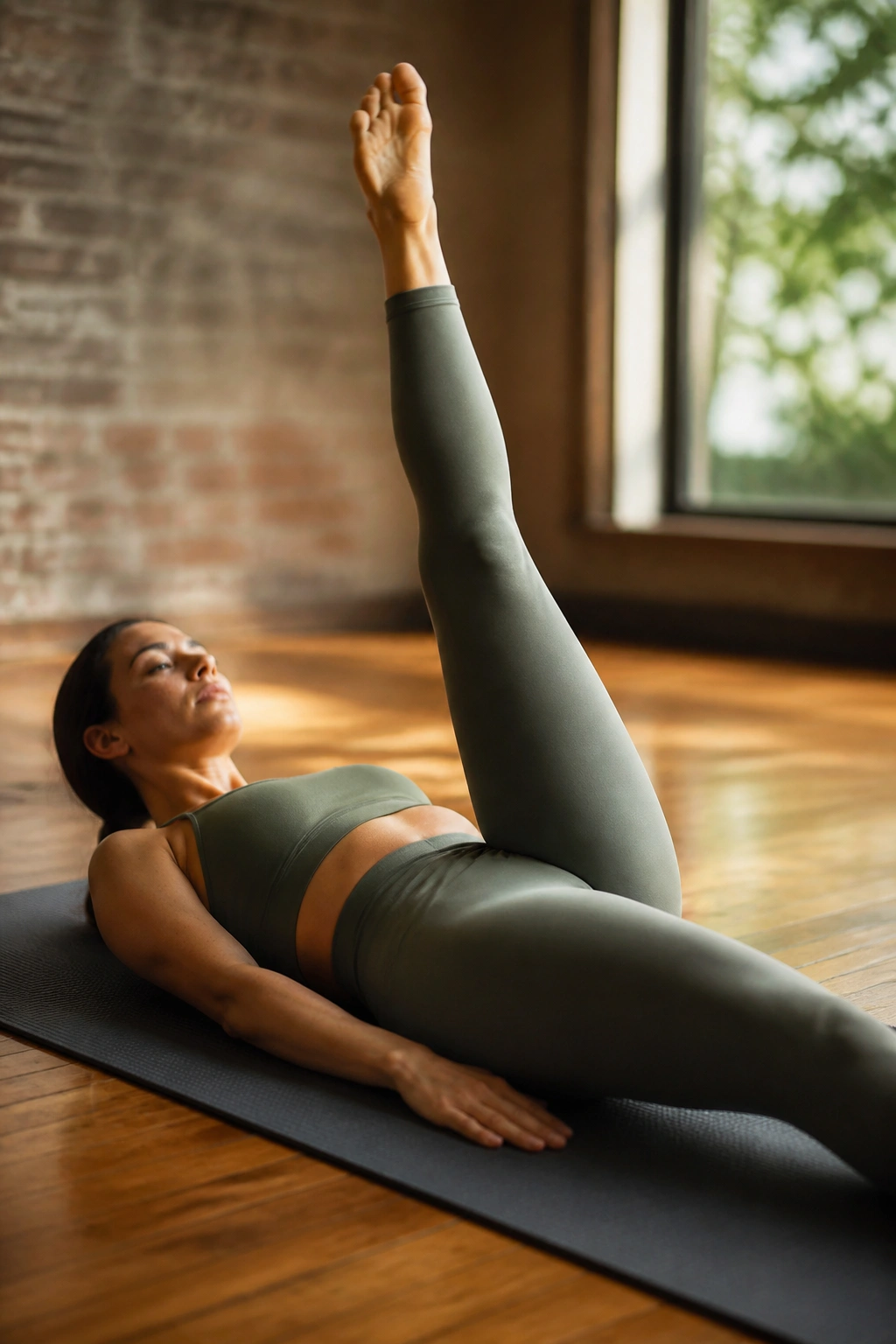
The leg circle is one of the classic Pilates moves for a reason: it requires absolute stillness in the torso while the legs are moving in a wide, circular path. It is the ultimate test of “dissociation”—the ability to move your limbs independently of your trunk. This workout focuses entirely on the leg circle series, varying the speed and the size of the circles.
When you do this, your hip joints will naturally want to roll or rock. Don’t let them. Think of your pelvis as a heavy stone anchor that cannot be moved. If you find your hips rocking, make the circles smaller. Quality always beats quantity in Pilates. A small, perfect circle that keeps your core absolutely still is much better than a large, sloppy circle that wobbles your entire body.
Once you have mastered the basic circle, add a variation: cross the leg over the body first, then circle around. This targets the inner thighs and the lower obliques. It feels strange at first, but once you find the rhythm, it creates a deep, burning sensation in the muscles that stabilize the pelvis.
14. Stability Ball Beginner Intro Sequence
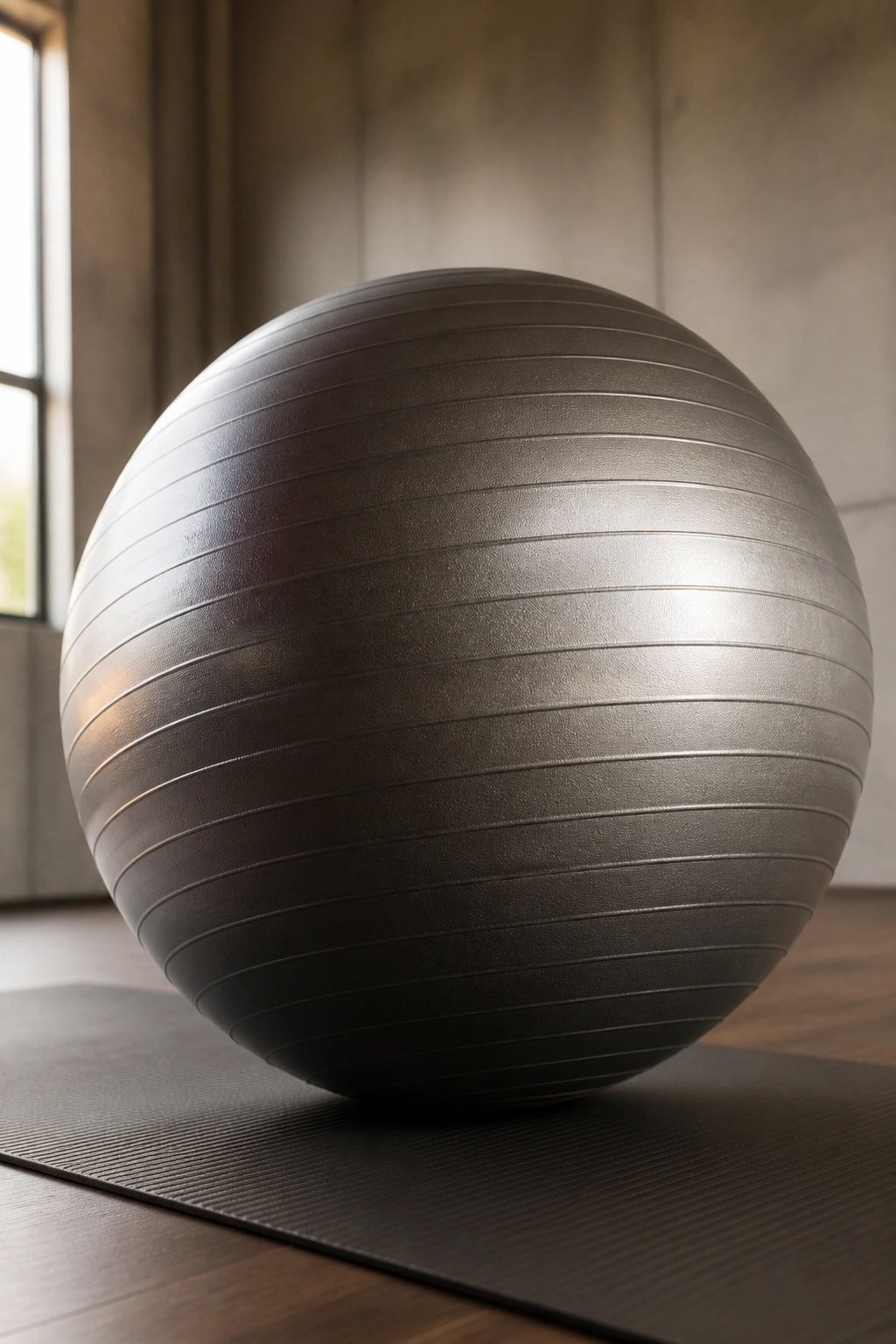
The stability ball is a fantastic prop for beginners because it introduces an element of instability that forces you to engage your core constantly. You don’t need to do complex tricks; simply sitting on the ball requires balance. This routine uses the ball for supported crunches, leg lifts, and a modified version of the “hundred.”
Be careful not to lean too far back when doing exercises on the ball. If you lose your balance, the ball will roll away. Keep your feet planted firmly on the floor, about hip-width apart. This gives you a stable tripod of support. If you feel shaky, that is good—that shakiness is your stabilizer muscles working to keep you upright.
The ball is also excellent for glute bridges. With your feet on the ball and your back on the floor, you create an unstable surface that forces your hamstrings and glutes to fire aggressively just to keep you steady. It is a simple modification that makes a basic exercise twice as effective.
15. Neck and Shoulder Release Flow
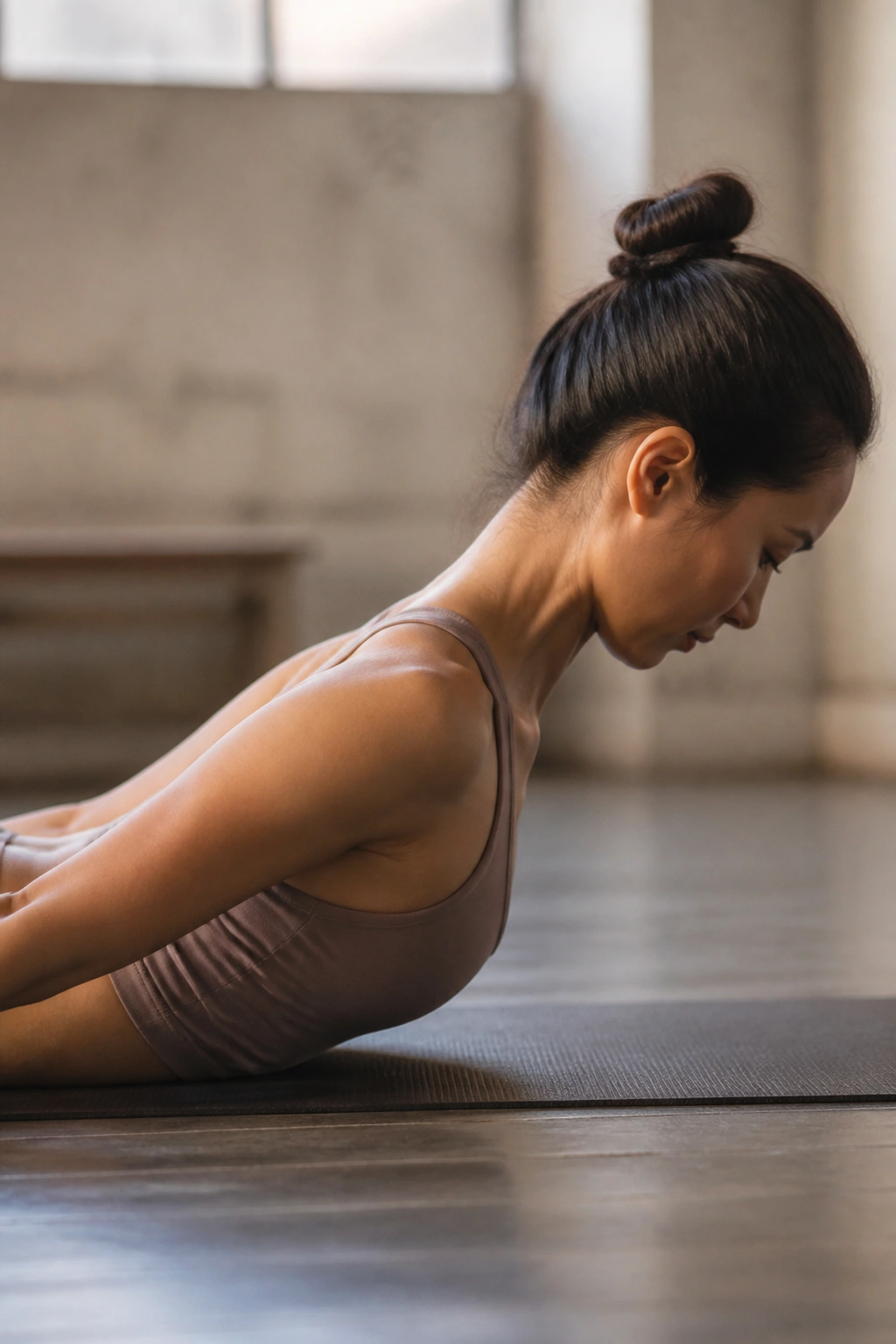
Most beginners hold their tension in their neck and shoulders, especially during core work. This leads to the infamous “Pilates neck pain.” This routine is designed specifically to counteract that. It focuses on shoulder rolls, gentle neck stretches, and thoracic extension work to open up the chest.
One of the best moves here is the “swan prep.” Lying on your stomach, you gently lift your chest using your back muscles, not by pushing into your hands. As you lift, roll your shoulders back and down, away from your ears. Think of your neck as being long and elegant, a natural extension of your spine.
If you feel like you are crunching your neck during these movements, you are likely looking too high. Keep your gaze directed toward the mat in front of you. This keeps the cervical spine (the neck) in a neutral, safe position. If you feel tension, stop, shake your shoulders out, and reset. The goal is to feel taller, not tighter.
16. Hip Opener and Psoas Release Series
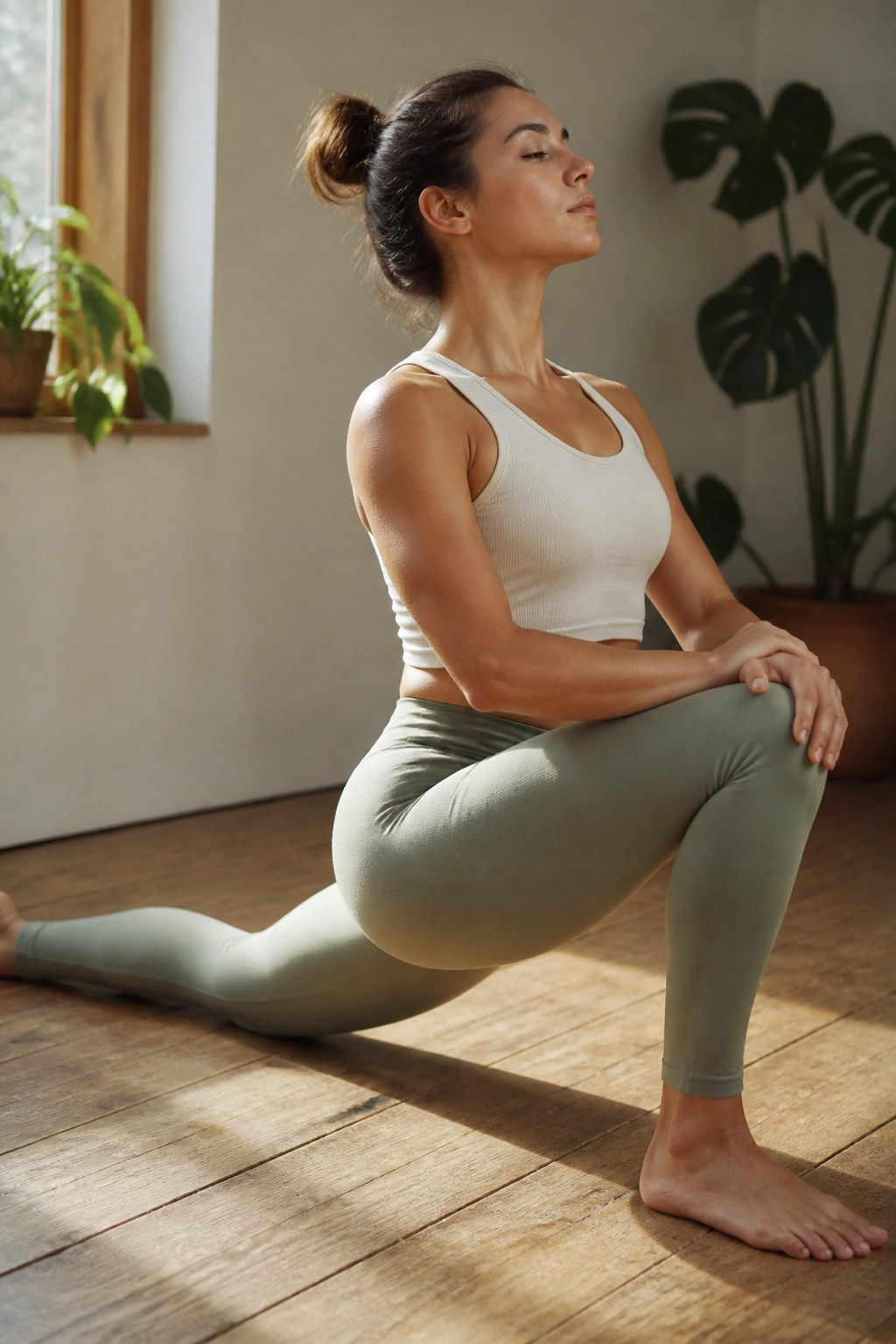
The psoas is a deep hip flexor that connects your spine to your legs. It is often tight in people who sit all day, leading to a feeling of “stuckness” in the hips. This routine is all about finding space in the front of the hips. You will use lunge variations and reclining stretches to gently lengthen this powerful muscle.
When you stretch the hip flexors, you must be careful not to arch your back. This is the most common mistake. People try to push their hips forward, but they end up just compressing their lower lumbar vertebrae. Instead, tuck your tailbone slightly—think about pulling your belly button toward your spine—before you push the hips forward.
This small adjustment keeps the stretch in the hip flexor, where it belongs, and protects the back. You will feel a deep, intense stretch in the crease of your hip. Hold it, breathe into it, and let the muscle surrender. It is uncomfortable, but it is one of the most freeing sensations you can give your body after a day of being hunched over.
17. Prone Extension Series for Back Strength
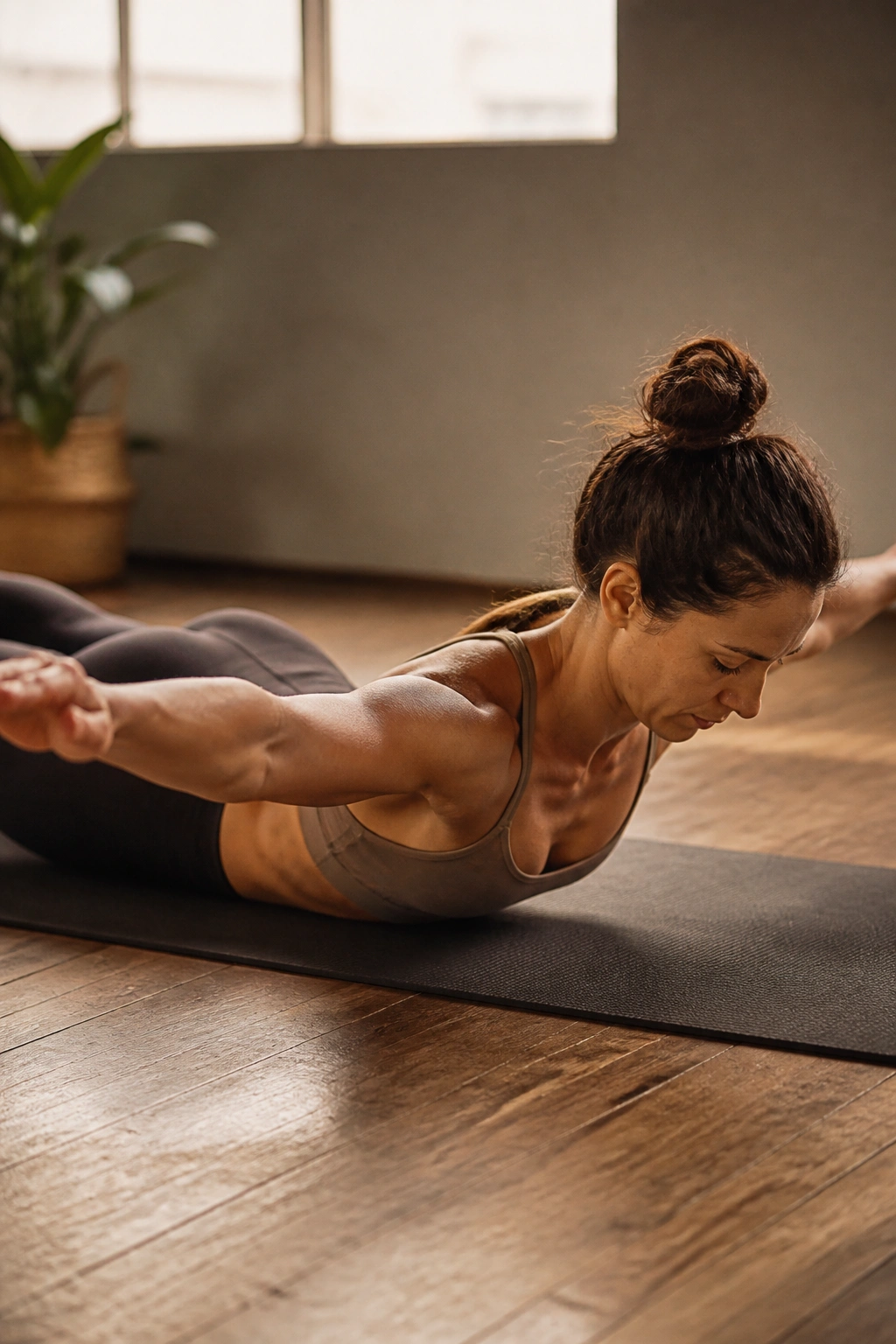
When we think of core strength, we usually think of the front (the abs). But the “posterior chain”—the muscles of the back—is just as important. These are the muscles that keep you standing tall. This series is done entirely on your stomach, focusing on lifting the chest, arms, and legs against gravity.
Start with “darts.” Lying on your stomach, reach your arms back toward your feet, palms facing in. As you inhale, lift your chest and your arms, keeping your gaze down. You should feel the muscles along your spine—the erector spinae—contracting. This is not about how high you can lift; it is about reaching your fingers toward your heels as if you are trying to touch them.
Do not lift your chin. If you lift your chin, you are just straining your neck. Keep the back of the neck long. The goal is to strengthen the muscles that counteract our “tech-neck” posture. After a few repetitions of this, your back will feel warm, energized, and ready to hold you upright for the rest of the day.
18. Dynamic Pilates Warm-up Routine
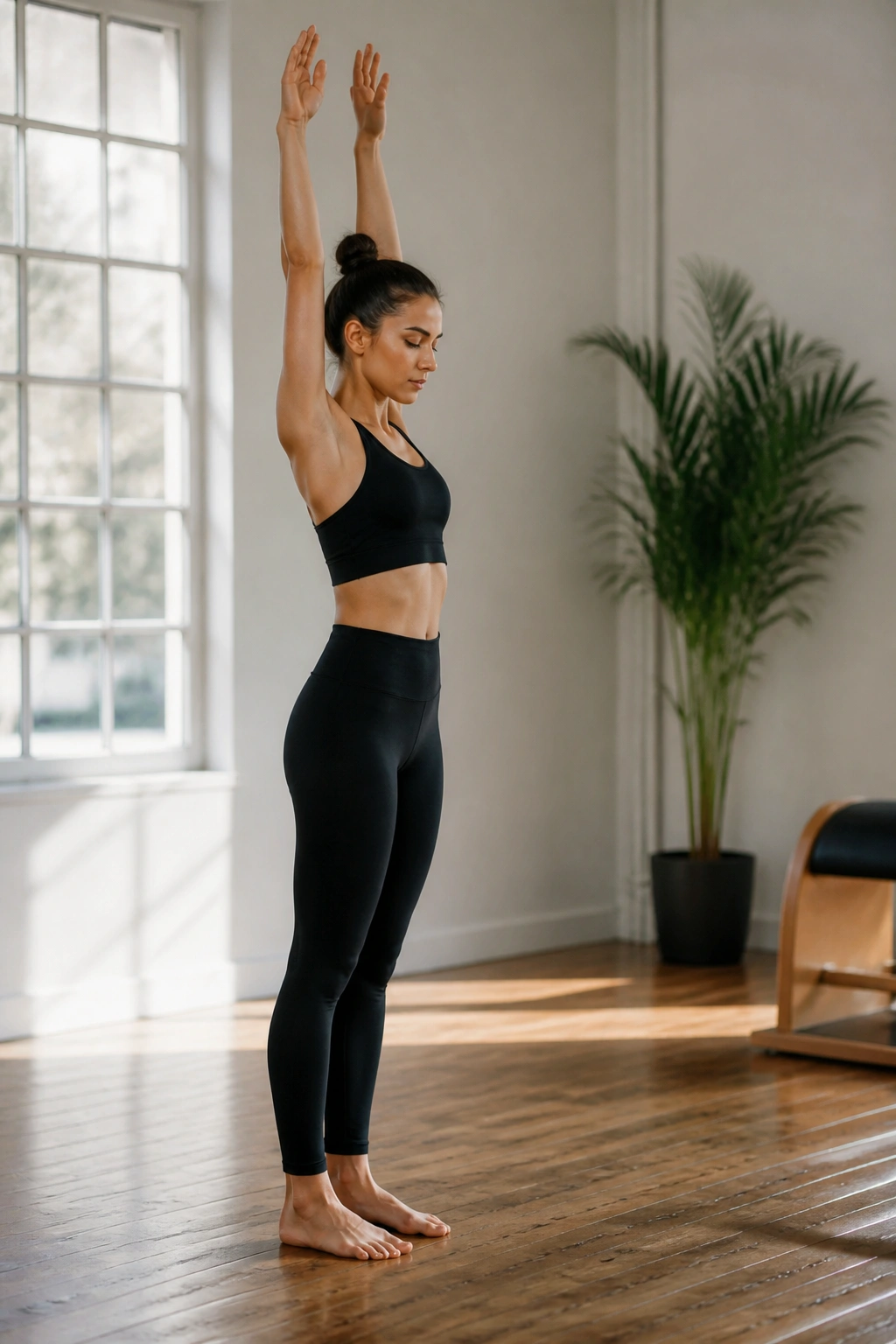
A good warm-up is essential, but it doesn’t need to be long. This dynamic sequence is about waking up the nervous system and getting the blood flowing to the joints. It involves gentle rotations, small bounces, and arm circles that move through a full range of motion.
Begin standing. Take a deep breath, reaching your arms overhead. As you exhale, roll down slowly, vertebrae by vertebrae, until your fingers touch the floor—or as close as you can get. Hang for a second to let the spine decompress. Then, walk your hands out to a plank, perform one slow push-up, and walk them back.
This sequence combines stretching with activation. It signals to your body that it is time to move. You don’t need to be perfect; you just need to move with intention. By the time you get back to a standing position, you should feel a little warmer, a little more awake, and ready for the main part of your workout.
19. Full-Body Cooldown and Reset
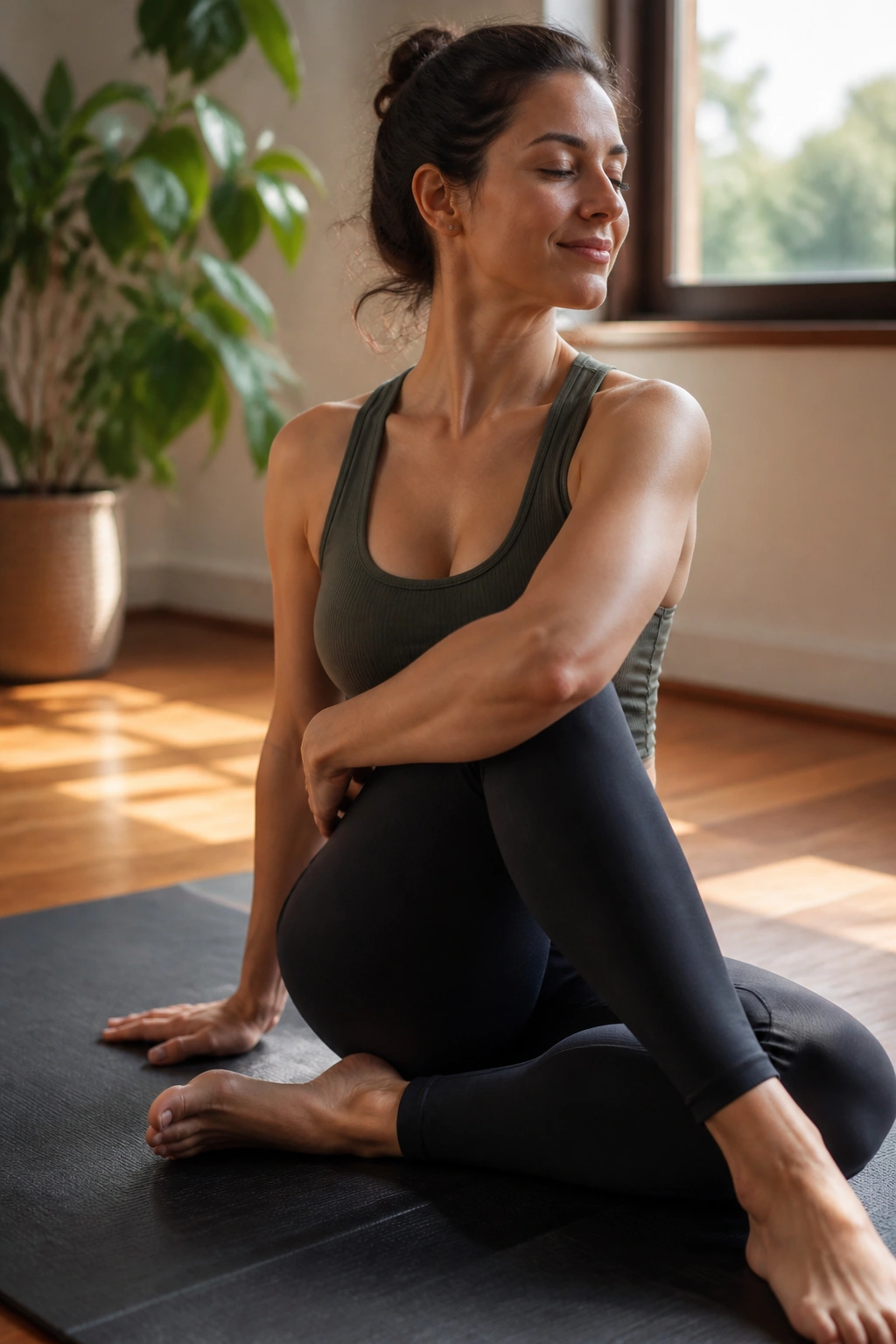
Never skip the cooldown. Pilates can be surprisingly taxing on the central nervous system, and a dedicated cooldown helps transition your body back into a parasympathetic (rest and digest) state. This routine focuses on slow, rhythmic movements and deep, intentional breathing.
Use this time to “scan” your body. Are you holding tension in your jaw? Are your shoulders creeping back up toward your ears? consciously release those areas. Perform a few gentle spinal twists, letting your knees fall to one side while your chest stays grounded. Feel the rotation moving through your torso, releasing the last bits of holding.
This is also a great time for gratitude. You just gave your body a significant amount of focus and effort. Let the work settle in. By the time you finish this cooldown, you should feel physically calm and mentally clear. This “reset” is often the reason people say they feel better after a Pilates class than they did before it.
20. Precision Control: The Swan Prep Focus
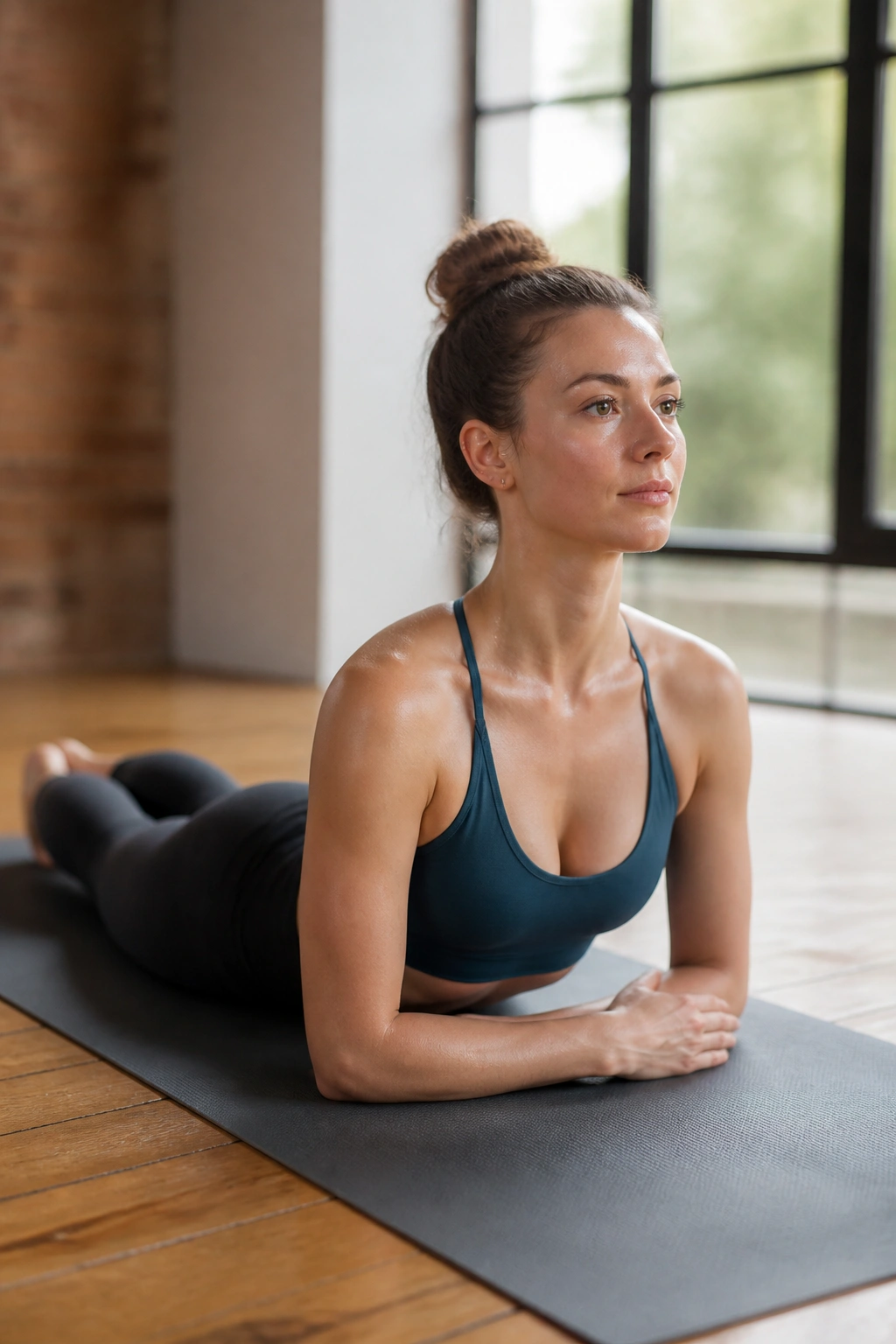
We end on the “Swan.” This is a foundational move that encompasses everything Pilates is about: extension, spinal strength, breath, and focus. It is the perfect exercise to master as a beginner because it teaches you how to articulate your spine—moving one bone at a time.
The Mechanism of the Swan
The Swan is about lifting from the upper back, not the lower back. If you feel it in your lower back, you are likely pushing with your arms too early. Start with your hands under your shoulders, elbows hugged into your sides. Begin to lift your chest by lengthening your spine forward and up, like a wave.
How to Practice
- Inhale to prepare.
- Exhale to lift, starting with the nose, then the eyes, then the chest.
- Keep the legs anchored to the mat; do not let them lift or squeeze too hard.
- Only lift as high as you can while keeping your shoulders down away from your ears.
- If you feel pinching, go lower. The goal is length, not height.
Pro tip: Think about shining your chest forward like a lighthouse beam as you lift.
Final Thoughts
Starting a Pilates practice can feel like learning a new language. At first, the cues might seem abstract, and the movements might feel awkward. You might wonder if you are doing it “right” because you don’t feel the massive exhaustion of a weightlifting session. Stick with it. The true beauty of this method lies in the subtlety.
Once you start to feel that deep connection to your core, and once your spine begins to feel as mobile and strong as it was designed to be, you will realize that you are building something that lasts. You aren’t just training for the day; you are training your body to be resilient for the long haul. Take these workouts, go at your own pace, and enjoy the process of becoming more in tune with your own physical structure. Consistency will always outperform intensity in the long run.
