



You do not need a garage full of equipment to get sweaty, stronger, and a little humbled. A living room floor, a timer, and your own body can do plenty when the workout is built with a bit of thought instead of random jumping around.
The best bodyweight workouts at home usually do the same thing every good gym session does: they hit your legs, push muscles, core, and lungs in one sweep. Squat. Push. Hinge. Brace. Crawl. If a workout touches those patterns in a clean order, it tends to feel tougher than it looks on paper.
I like these kinds of sessions because they respect real life. Some days you’ve got 12 minutes and a bit of space beside the couch. Other days you want something that leaves your shirt stuck to your back and your legs buzzing while still being quiet enough for apartment walls.
The 20 workouts below all do a slightly different job. Some are low-impact and sneaky-hard. Some are short and nasty. A few are slower and strength-focused, which matters more than people admit when they only chase speed. Start with the one that fits the room you’re in and the energy you’ve got.
1. The 10-Minute Squat-Pushup Ladder
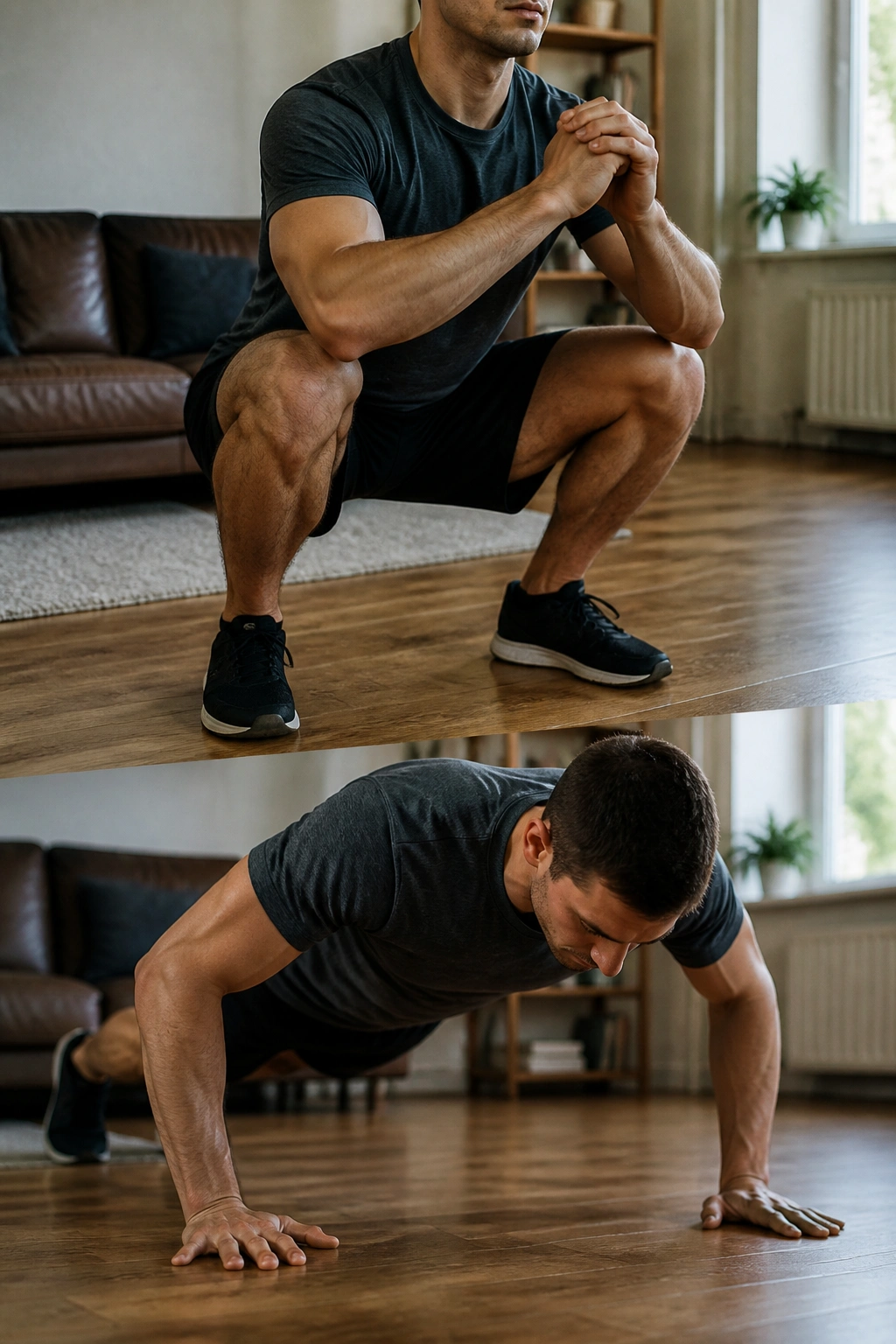
This is the kind of full body bodyweight workout I reach for when I want something plain, honest, and effective. No setup. No gear. Just a ladder that makes your legs, chest, shoulders, and core all earn their keep.
How it works
Do 10 squats, 10 pushups, then 9 and 9, then 8 and 8, all the way down to 1. If you move with purpose and keep your rest short, the whole thing fits into about 10 minutes. If your pushups break down halfway through, elevate your hands on a couch or sturdy table and keep the reps clean.
A clean rep beats a sloppy one. That matters here more than people think. Fast squats are fine, but they should still hit depth you can control. Pushups should touch the floor only if your body stays in one straight line from shoulders to heels.
- Start with bodyweight squats and land softly through the whole foot.
- Use incline pushups if your chest collapses or your lower back sags.
- Rest 15 to 30 seconds between rungs if needed.
- Add a 20-second plank after each pair if you want more core work.
The beauty of this ladder is the way it sneaks up on you. The first few rounds feel generous. The last few feel personal.
2. The No-Jump Cardio Circuit
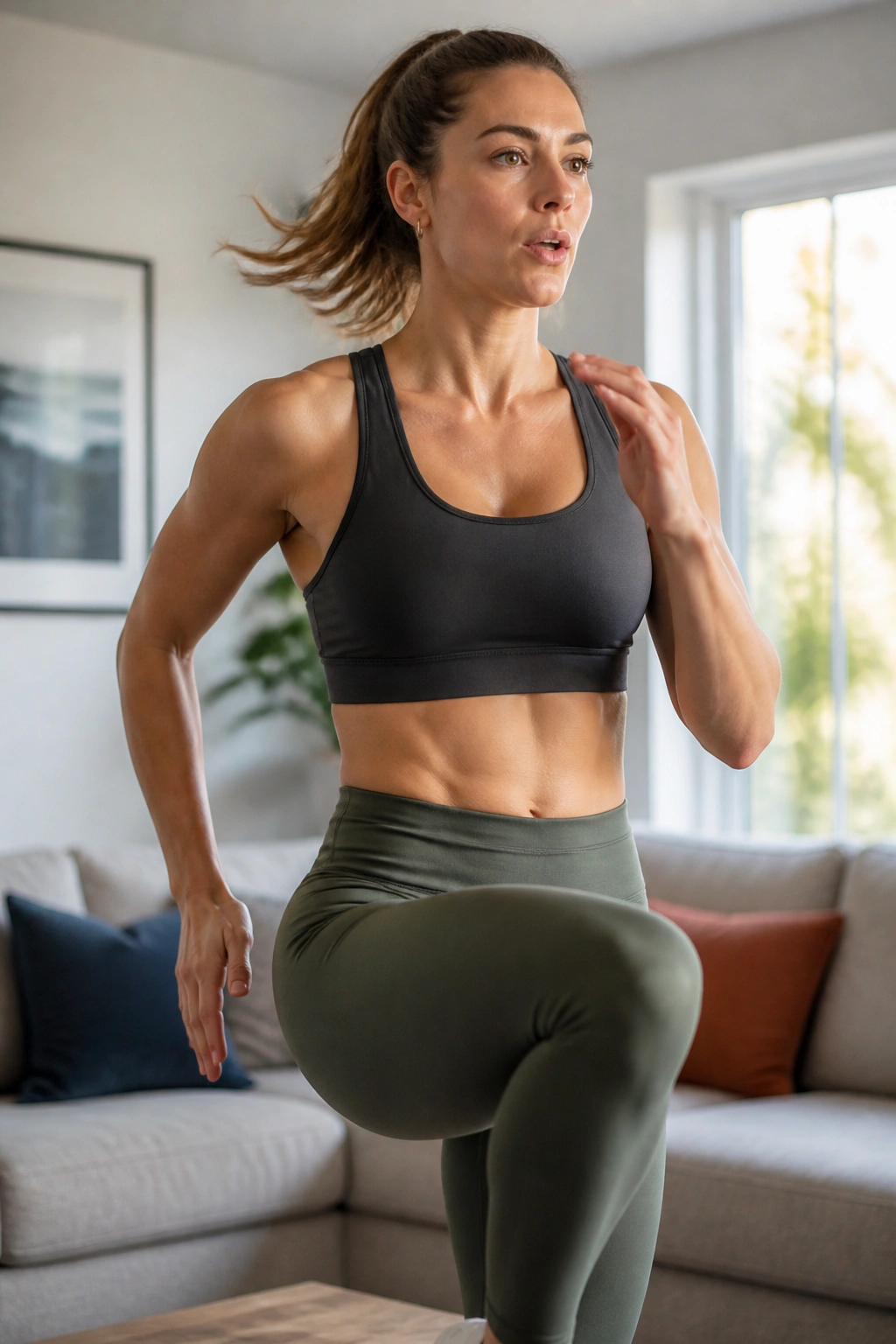
Can a workout feel hard without a single jump? Absolutely. In fact, some of the best home workout sessions I’ve used are the ones that stay quiet but still spike your breathing.
Do 40 seconds on, 20 seconds off for each move below, then repeat the circuit 4 times:
- Fast march with high knee drives
- Step-back mountain climbers
- Squat to overhead reach
- Shadow boxing with a light bounce
- Alternating reverse lunges
The trick is pace, not drama. Your shoulders should stay loose during the boxing, your knees should track over your toes on lunges, and your core should stay tight when your hands are on the floor. If you drift into sloppy movement, the workout gets noisy in the wrong way.
Use this one when you want to sweat without waking the whole house. It’s also a smart choice if your knees dislike jumping but you still want your heart rate up. Quiet does not mean easy.
3. Bear Crawl Strength Round
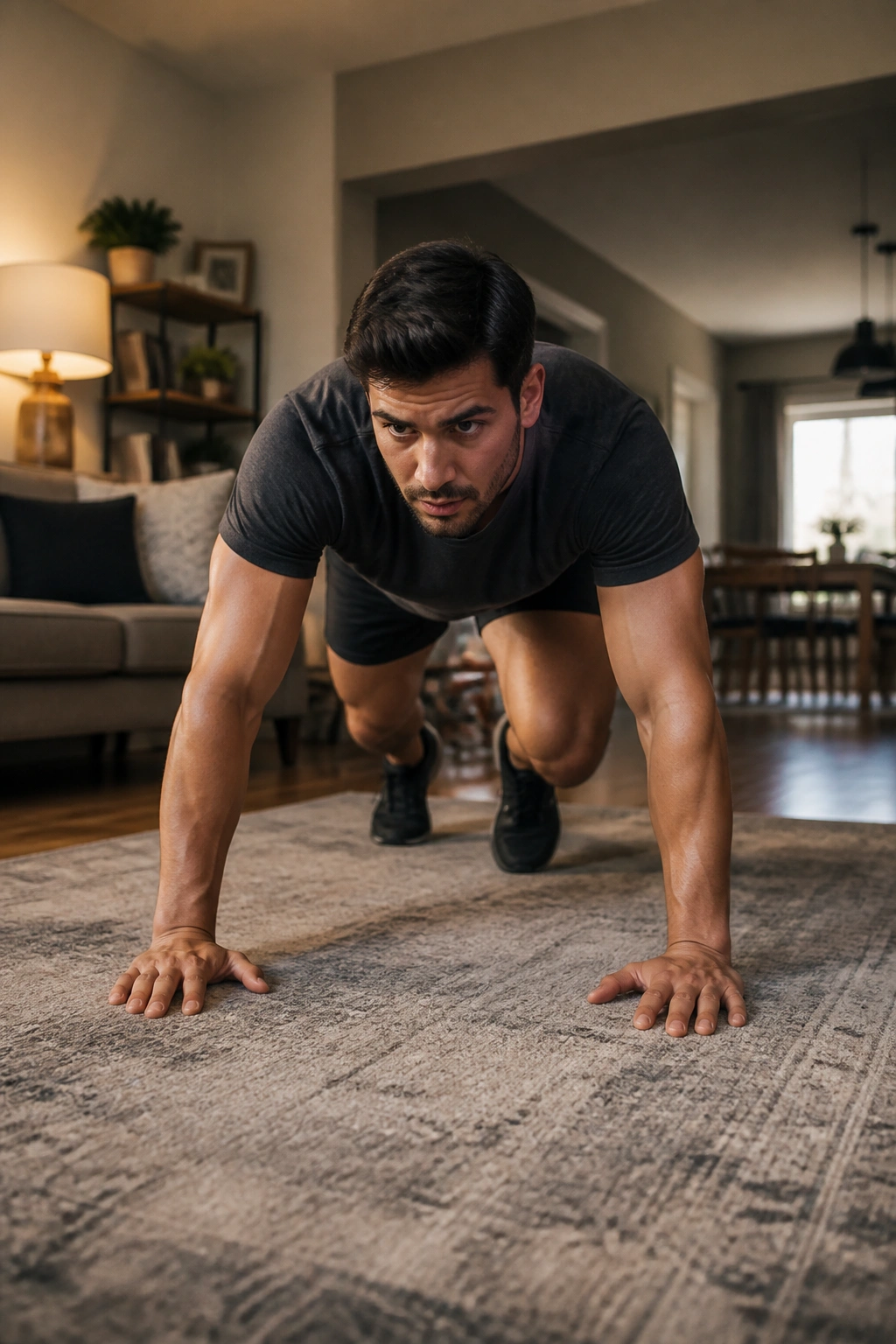
Bear crawls make people grin for about ten seconds. Then the shoulders start talking.
I like this workout for the same reason I like a heavy farmer’s carry, even without the weights: it makes your trunk work when your limbs are moving in awkward directions. That’s a fancy way of saying your core has to keep you from folding in half.
Run 3 to 5 rounds of this sequence:
- 20 seconds bear crawl forward or in place
- 8 reverse lunges per side
- 10 glute bridges
- 6 slow pushups
- 20 seconds dead bug hold or slow dead bug reps
The crawl can be tiny. If you only have a rug and a coffee table’s worth of space, crawl in place. Knees hover an inch off the floor, back flat, eyes down. That little hovering position is sneaky. It lights up shoulders, abs, and hips all at once.
One small warning: don’t rush the crawl just because it looks like cardio. The best version feels controlled and slightly awkward. That awkwardness is part of the point.
4. The Reverse Lunge and Pike Pushup EMOM
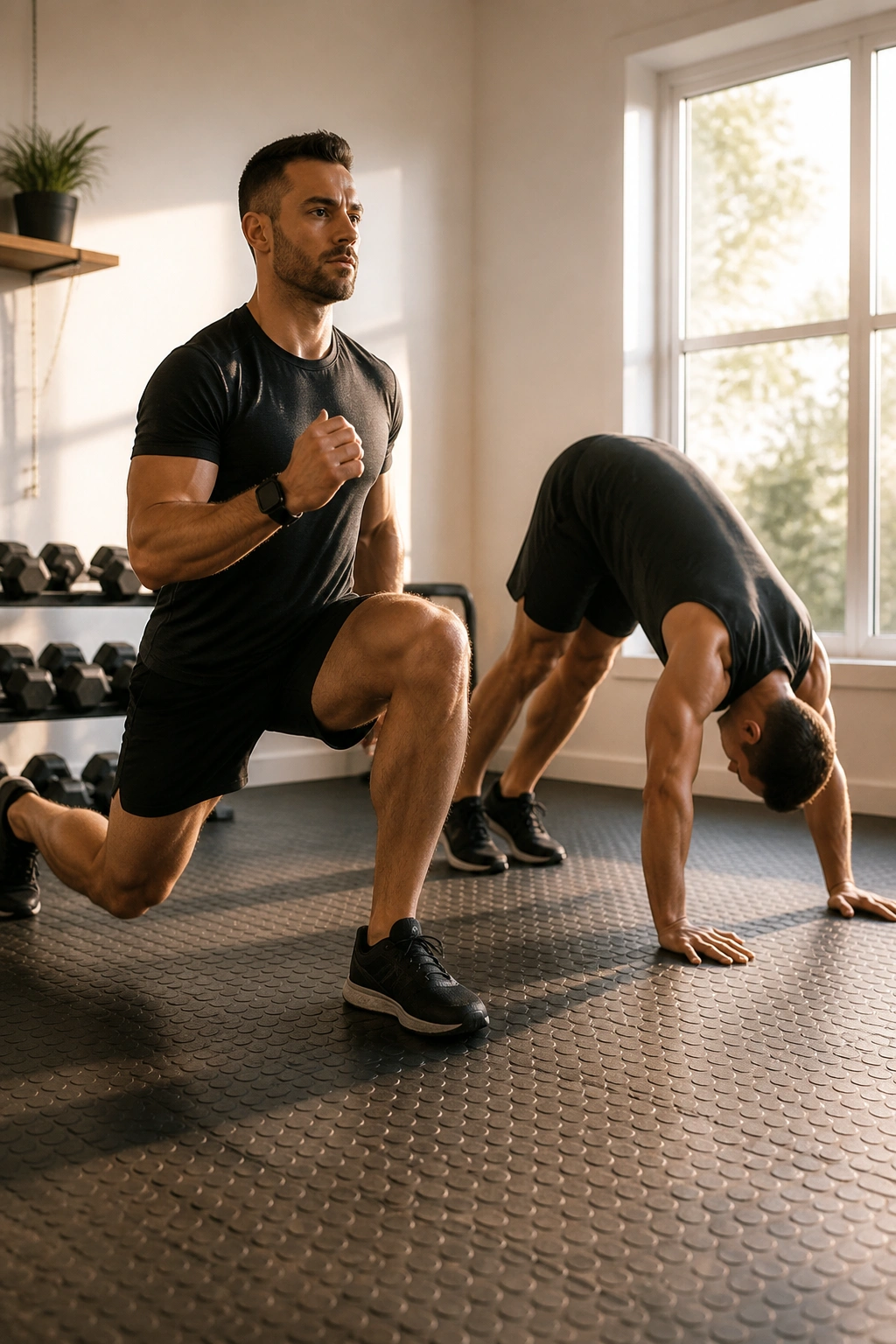
This is not a leg day with a little cardio attached. It’s a full body session that puts your lower body and shoulders under pressure in a pretty direct way.
EMOM means “every minute on the minute.” You start the work at the top of the minute, finish before the next minute begins, then breathe until the clock turns again. Run this for 12 minutes:
- Minute 1: 12 alternating reverse lunges
- Minute 2: 6 to 10 pike pushups
- Minute 3: 30-second hollow hold
- Minute 4: Rest or march in place
- Repeat three times
Reverse lunges are kinder to the knees than forward lunges for a lot of people, and pike pushups hit the shoulders in a way regular pushups don’t. The hollow hold ties the whole thing together by forcing your ribs down and your midsection to do actual work instead of pretending.
If pike pushups feel brutal, shorten the range and keep your hips high. You should feel pressure in the shoulders, not a crunch in the lower back. That’s the line.
5. Glute Bridge, Dead Bug, and Side Plank Circuit
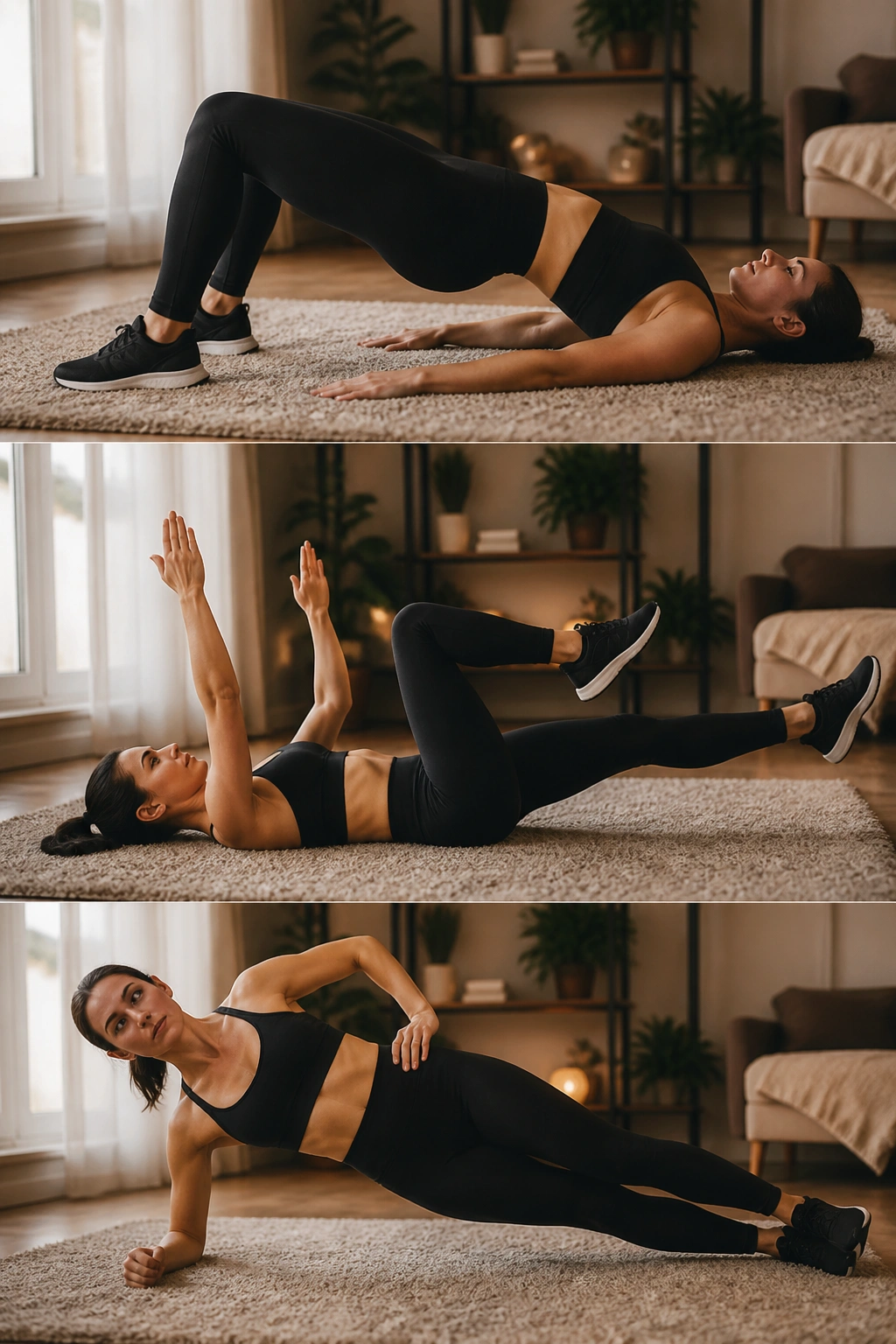
Gentle does not mean easy.
This is the workout I’d give someone who wants to train at home but doesn’t want their knees, back, or wrists to pay the price. It’s quiet, controlled, and much harder than it sounds once you slow down and actually hold the positions.
Do 3 rounds of:
- 15 glute bridges with a 2-second squeeze at the top
- 8 dead bugs per side
- 20 to 30 seconds side plank per side
- 10 squat pulses
- 8 slow bird dogs per side
The glute bridge should feel like your hamstrings and glutes are doing the lifting, not your lower back. On the dead bug, press your lower back gently into the floor; if your back arches, cut the range. Side planks teach you to resist twisting, which sounds dull until you realize how much every other exercise depends on that ability.
I like this one on days when you want to move well more than you want to chase sweat. It still counts. Probably more than a lot of flashy stuff does.
6. The Burpee-Lite Density Set
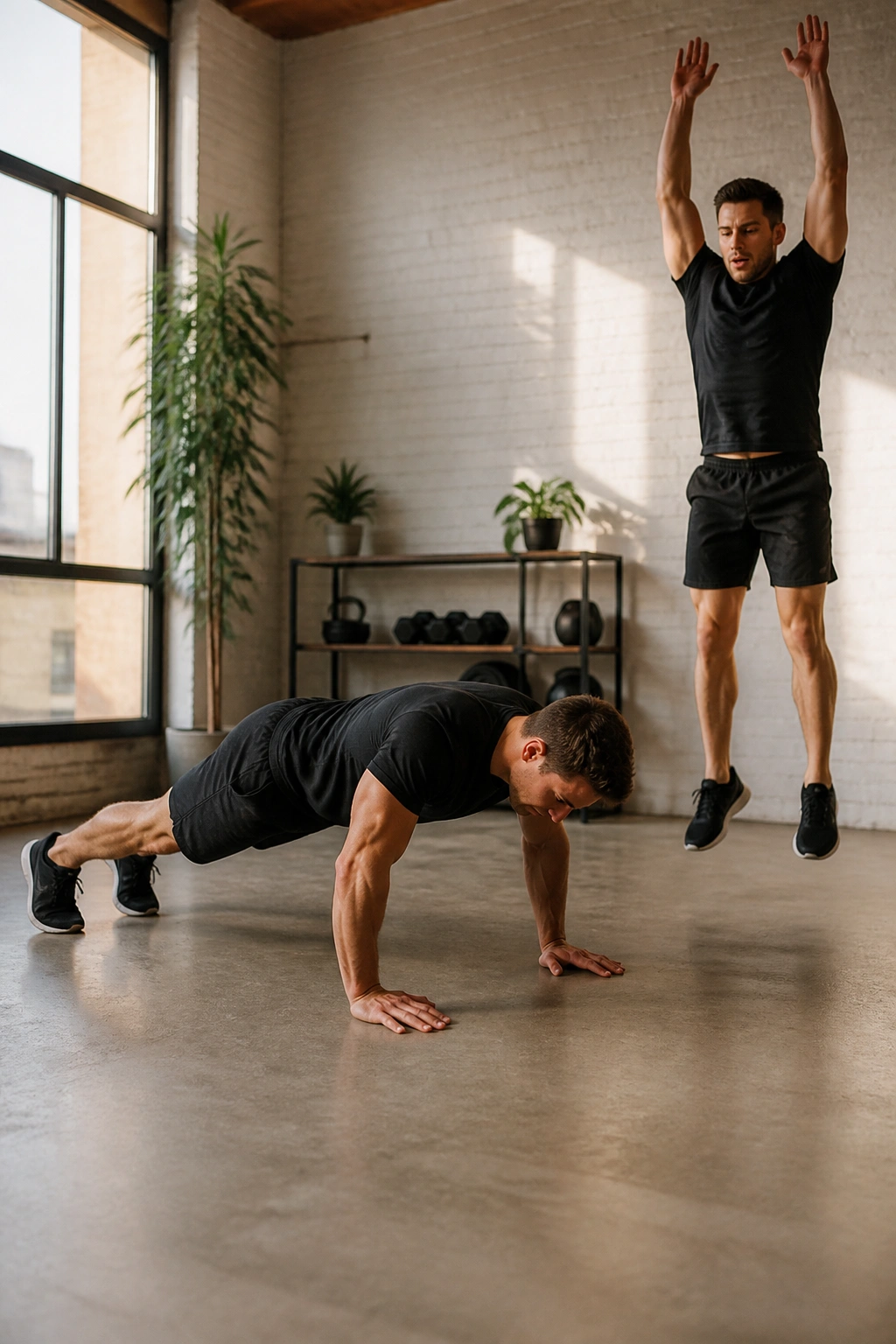
Burpees get a bad reputation because people often do them like they’re trying to escape the room. There’s a better version.
Set a timer for 8 minutes and cycle through this pattern as many times as you can with clean form:
- 5 squat-thrusts or step-back burpees
- 10 air squats
- 5 pushups
- 20 mountain climbers
Step back instead of jumping if you want to keep the workout quieter or easier on your joints. Even without the jump, the combination of floor-to-stand transitions, squats, and pushups drives your heart rate up fast. The floor work also forces your core to fire every time you move your hands down and back up.
I like density sets because they remove the temptation to stand around forever. You do the work, you breathe, you do more work. Simple. Slightly rude. Very useful.
If your form starts to fray, stop the round early and reset. Chasing extra reps with a bent lower back is a pointless trade.
7. Wall Sit, Incline Pushup, and Hollow Hold
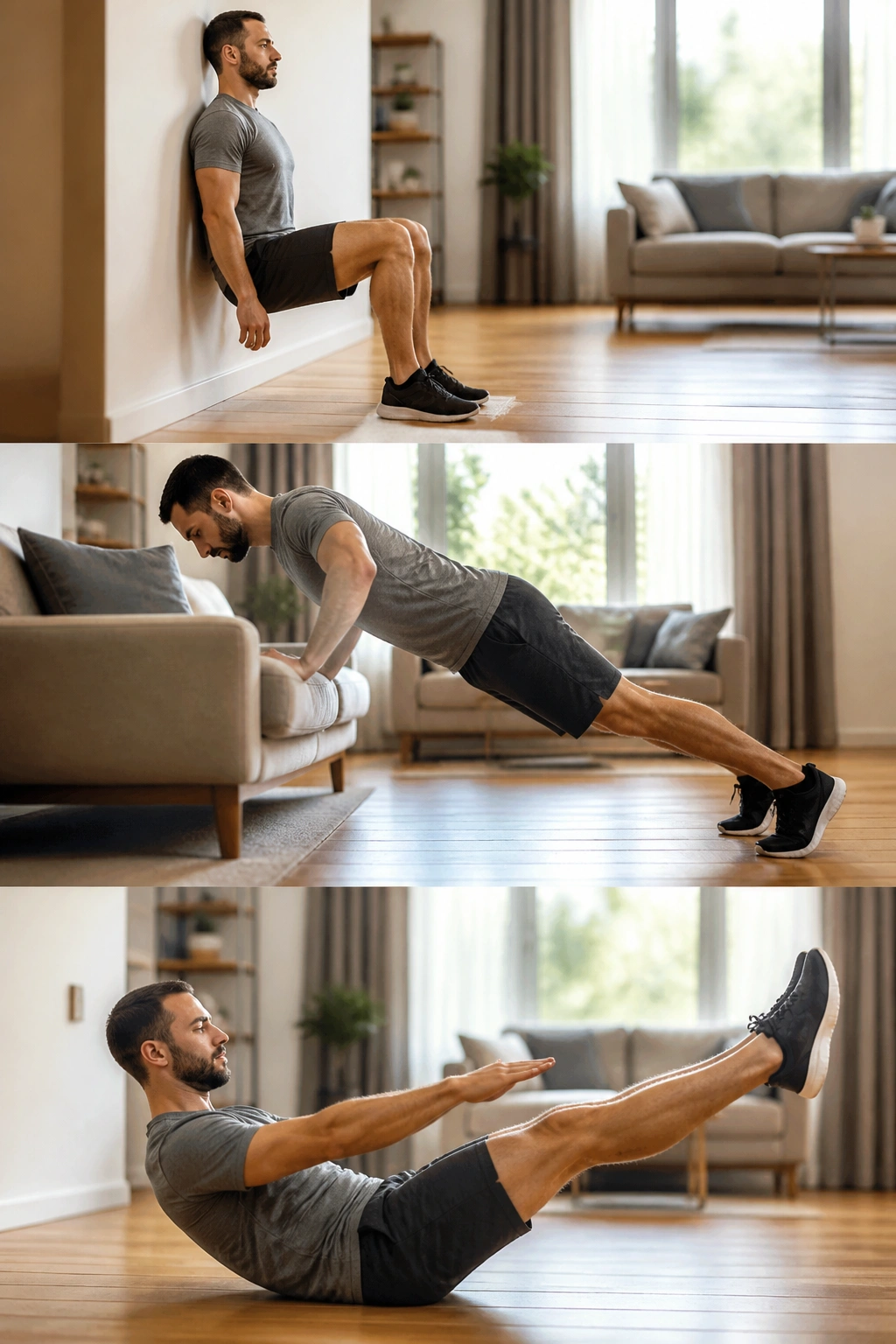
What if you want a workout that feels like strength work but still leaves you breathing hard? This one sits in that middle space nicely.
How to make it fit your space
Use a wall, a couch, or the edge of a sturdy chair. Then move through 4 rounds of:
- 45-second wall sit
- 8 to 12 incline pushups
- 20-second hollow hold
- 10 hip hinges with slow hands-on-hips control
The wall sit takes a boring-looking move and turns it into a leg burn that creeps up the thighs. Incline pushups let you keep your chest and shoulders working even if floor pushups aren’t there yet. The hollow hold is the sneaky part; it teaches your torso not to flare open when things get tiring.
How to scale it
- Raise your hands higher for the pushups.
- Sit higher on the wall if your knees complain.
- Bend one knee slightly on the hollow hold if your lower back arches.
This workout is a nice reminder that you do not need speed to create fatigue. A hard hold can be just as honest as a fast circuit.
8. The Single-Leg Balance and Reach Series
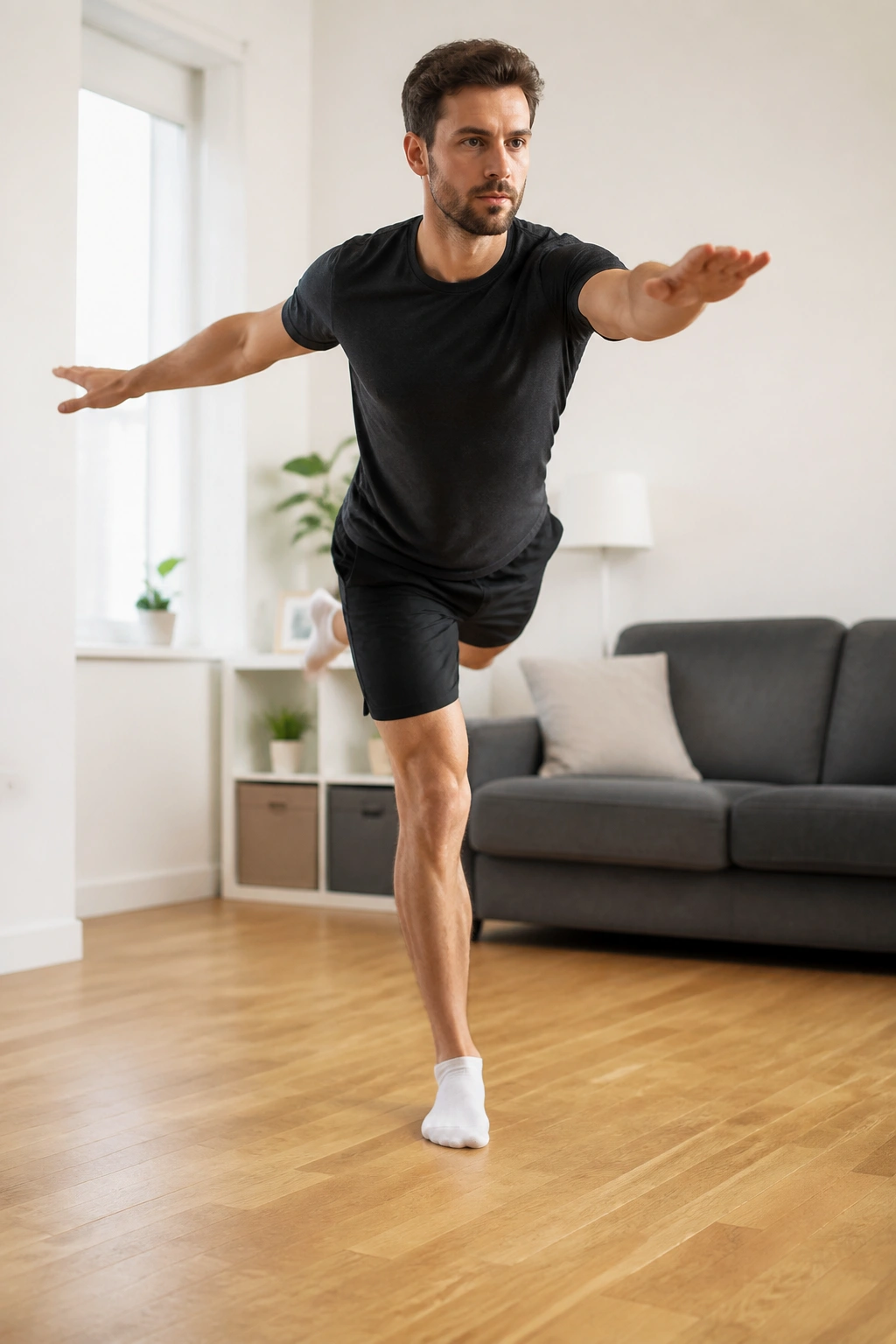
If one side of your body always feels a little less steady than the other, that’s not a mystery. It’s a balance problem, and this workout is a clean way to poke at it.
Picture yourself standing in socks on a floor that’s a little too slick. Every tiny wobble in the ankle shows up. That’s exactly why single-leg work matters so much at home, where you don’t have machines guiding the movement for you.
Run 3 rounds of:
- 6 single-leg reaches per side
- 8 split squats per side
- 10 calf raises per side
- 20-second single-leg stand per side
- 8 glute bridges
The reach is simple: hinge forward from the hips while one leg extends behind you, then return to standing without letting the pelvis twist. It looks easy. It usually isn’t. Split squats build the meat of the work; calf raises keep the lower leg honest; the single-leg stand shows you whether one ankle is wobblier than the other.
Slow down here. If you rush, the balance challenge disappears and the workout turns into a jumble. Controlled reps make the legs work harder anyway.
9. The Crawl, Step-Back, and Mountain Climber Loop
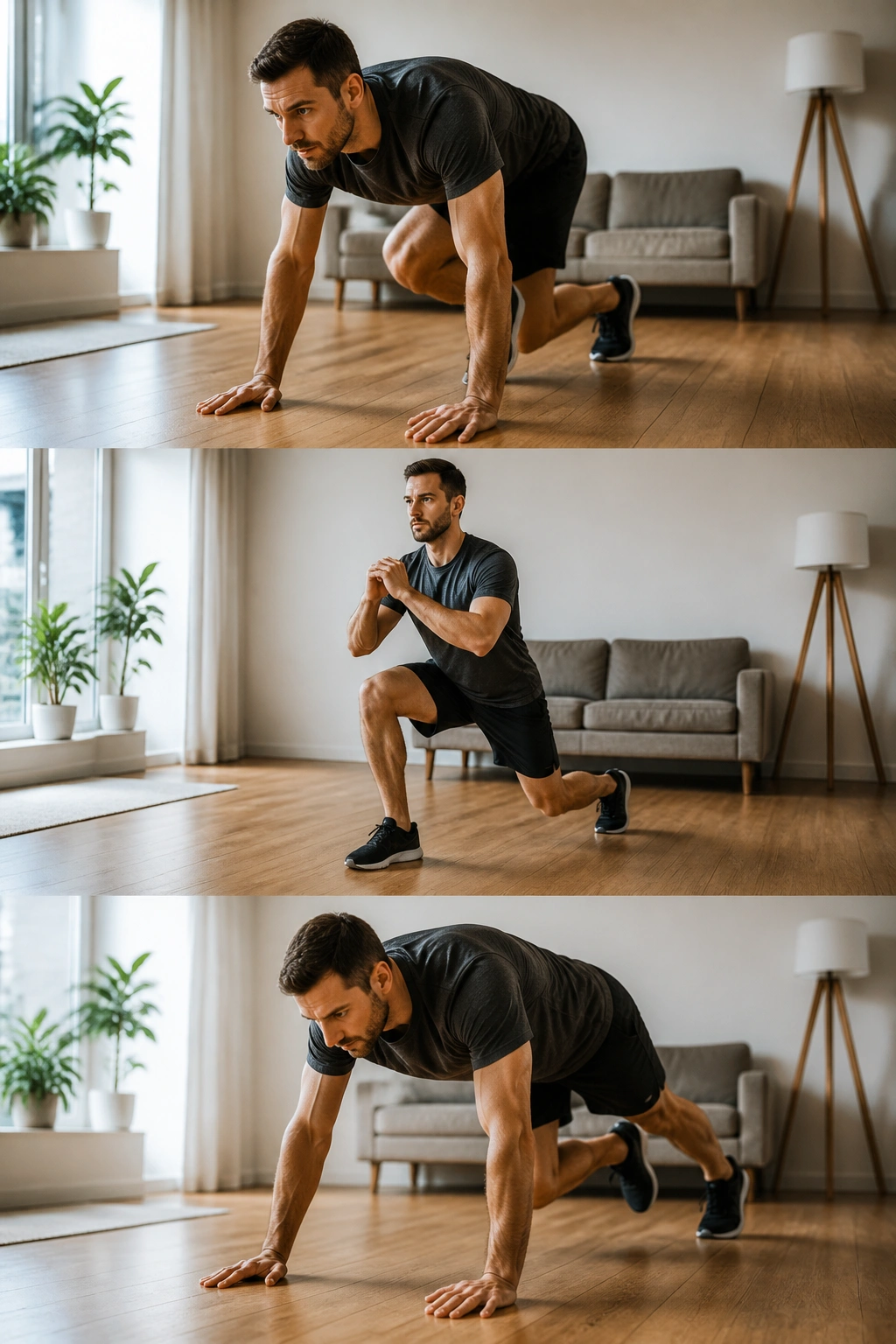
This is one of those bodyweight workouts that works because every move leads neatly into the next. No dead time. No standing around to check your phone.
Do 5 rounds of:
- 30 seconds bear crawl
- 8 step-back squats
- 20 mountain climbers per side
- 8 hand-release pushups
The bear crawl wakes up the shoulders and core. Step-back squats load the legs without the pounding that comes from jumping. Mountain climbers shift the pace upward, and hand-release pushups force a clean bottom position before you press back up.
There’s a nice rhythm to this workout once you settle into it. Crawl, stand, brace, push, breathe. Repeat. It feels athletic without needing a big open space or any gear beyond a floor you trust.
One small detail matters a lot: on the hand-release pushup, let your chest settle fully onto the floor before you lift your hands. That tiny pause keeps the reps honest. No half-reps. They sneak in fast.
10. The Shadow Boxing and Strength Combo
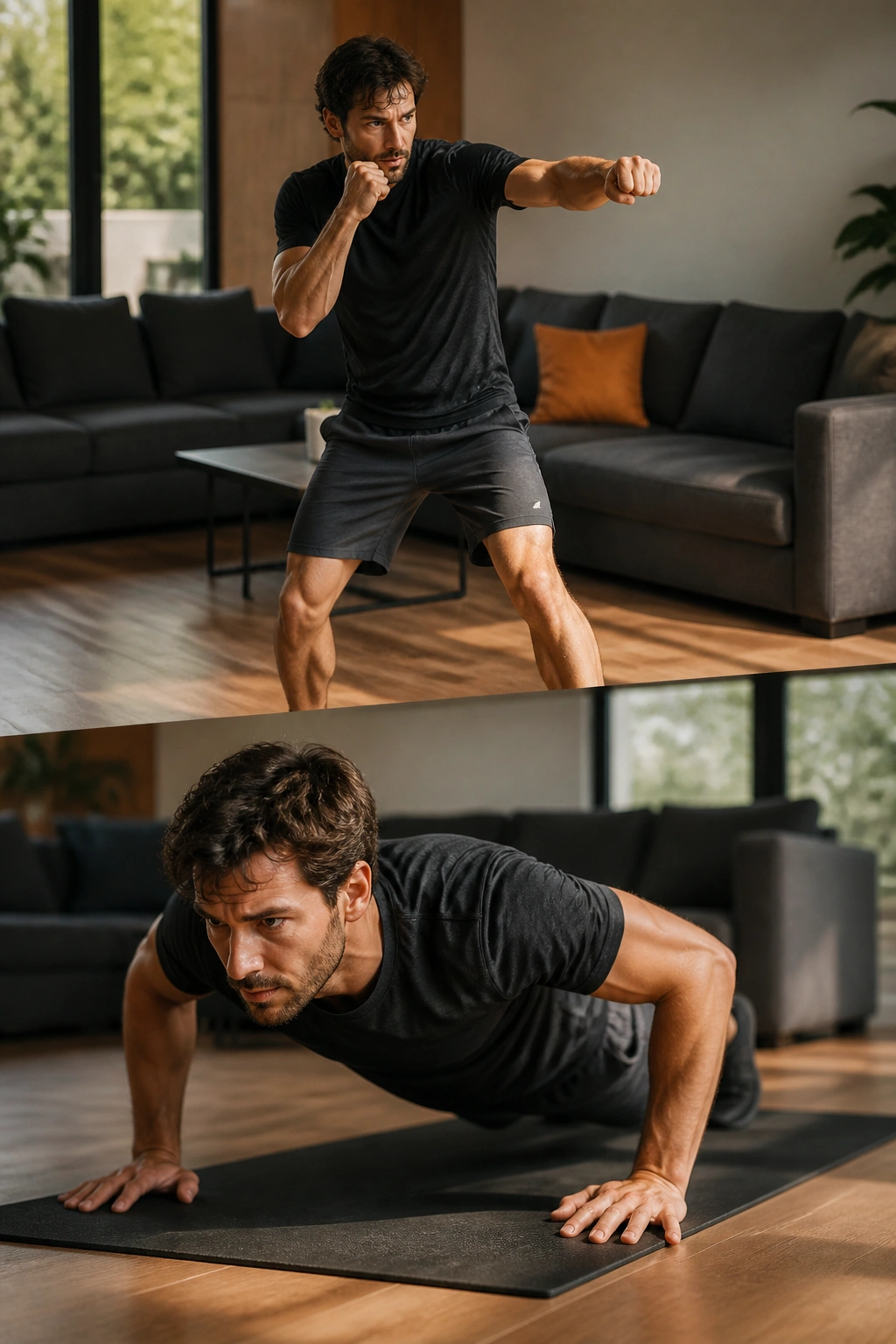
Shadow boxing belongs in more home workouts than it gets credit for. It raises your heart rate, loosens your shoulders, and gives your upper body a break from doing only pushups and planks.
Run 3 rounds of:
- 2 minutes shadow boxing
- 12 alternating reverse lunges
- 10 pushups
- 20-second squat hold
- 30 seconds rest
Throw straight punches, hooks, and uppercuts with your ribs tucked and your feet light. The work is more than arm waving. Your trunk should rotate a little, your hips should stay under you, and your feet should keep you balanced instead of sliding all over the floor.
The strength pieces after the boxing matter because they stop the session from becoming pure cardio. Lunges keep the legs loaded, pushups keep the upper body honest, and the squat hold burns the quads in a very plain, memorable way.
If you have a small room, this is one of the easiest workouts to make fit. A couple of steps in each direction is enough. Good technique beats fancy footwork.
11. The Pushup, Squat, and Plank Walkout Pyramid
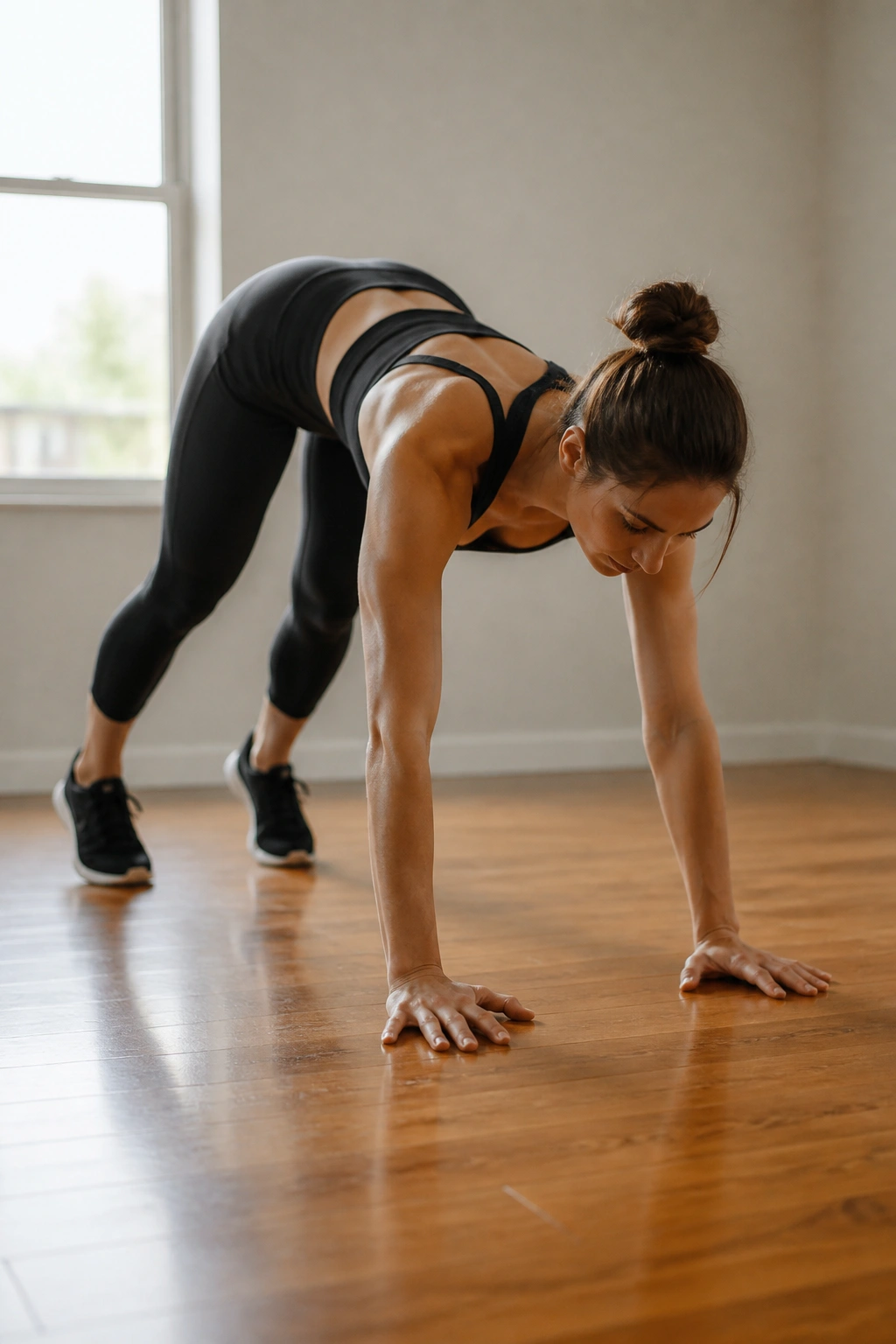
This one looks tidy on paper and mildly rude in practice.
How the pyramid runs
Start at 2 reps, move to 4, then 6, 8, and 10, then come back down if you still have gas. Each round includes:
- Pushups
- Air squats
- Plank walkouts
That means 2 pushups, 2 squats, 2 walkouts; then 4 of each; then 6, and so on. Plank walkouts are the awkward, excellent part: stand tall, hinge down, walk your hands out to a plank, then walk them back and stand up again. Your hamstrings, shoulders, and core all get pulled into the same job.
What makes it different
The rising-and-falling rep count changes the feel. Early rounds are a warm start. Middle rounds force you to pace yourself. The top end tests your breathing and your patience, which is not the same thing, but close enough here.
- Use incline pushups if your form slips.
- Keep squats smooth, not bouncy.
- Walk your hands out slowly on the plank reps.
If you want one move that makes you feel like you trained your whole body, this is a solid pick.
12. The Lower-Body Power Session Without Jumping
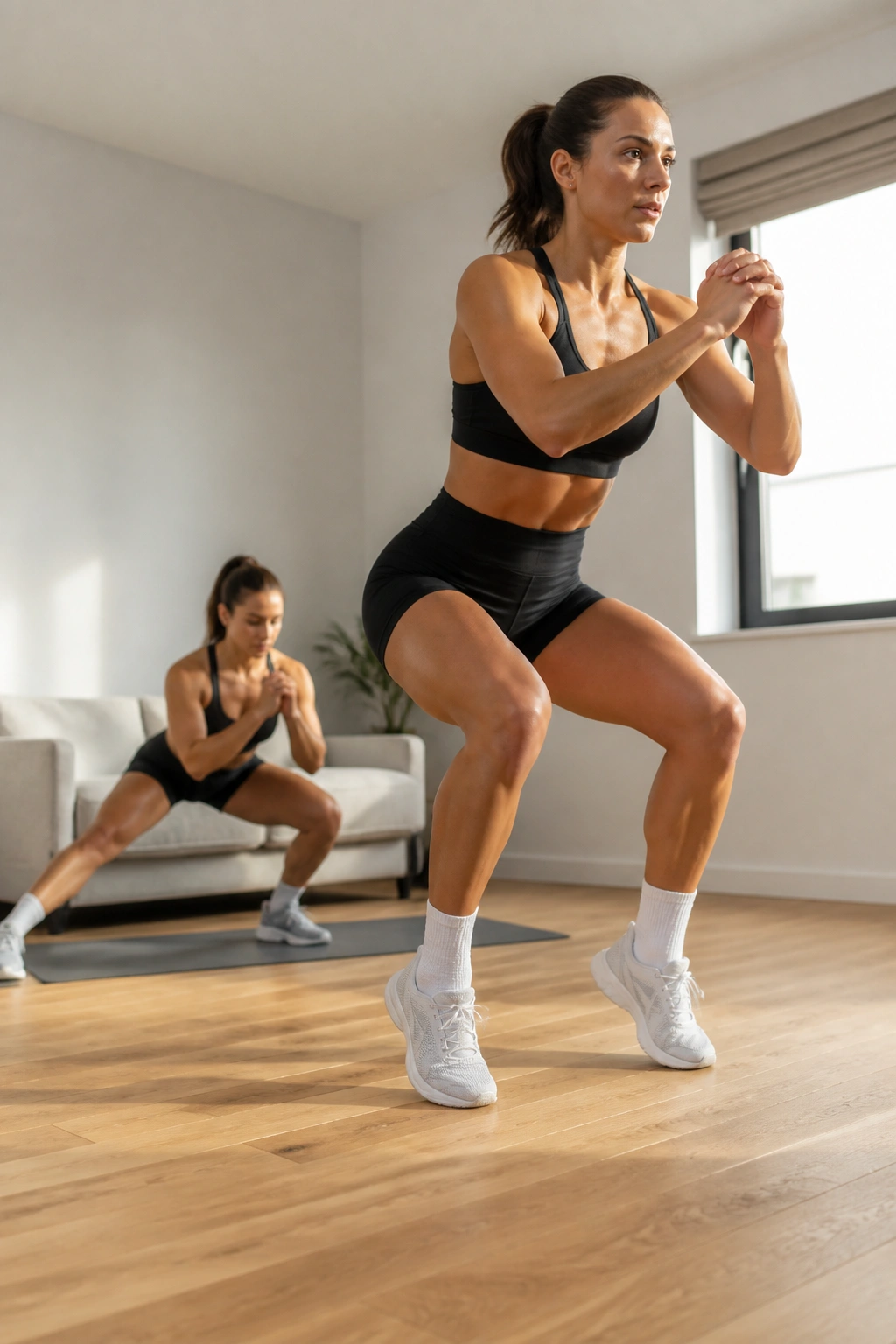
Power does not have to mean jumping all over the floor. It can mean moving fast with control, which is friendlier on the knees and still gives your legs a proper job.
Do 4 to 5 rounds of:
- 10 squat-to-calf-raise reps
- 8 lateral lunges per side
- 12 glute bridge marches
- 20 seconds skater steps
- 30 seconds rest
The squat-to-calf raise is a good example of quiet power: descend into a squat, stand fast, and rise onto the balls of your feet at the top. Lateral lunges train the side-to-side pattern most people neglect. Glute bridge marches build hip stability, and skater steps give you the feel of athletic movement without the impact of full jumps.
Your goal is not to sprint through this workout like you’re late for a train. Fast enough to feel sharp. Controlled enough that your knees do not wobble inward. That balance matters more than it sounds.
If you live in an upstairs apartment, this is a strong choice. Your floor will thank you.
13. The Floor-to-Stand Conditioning Circuit
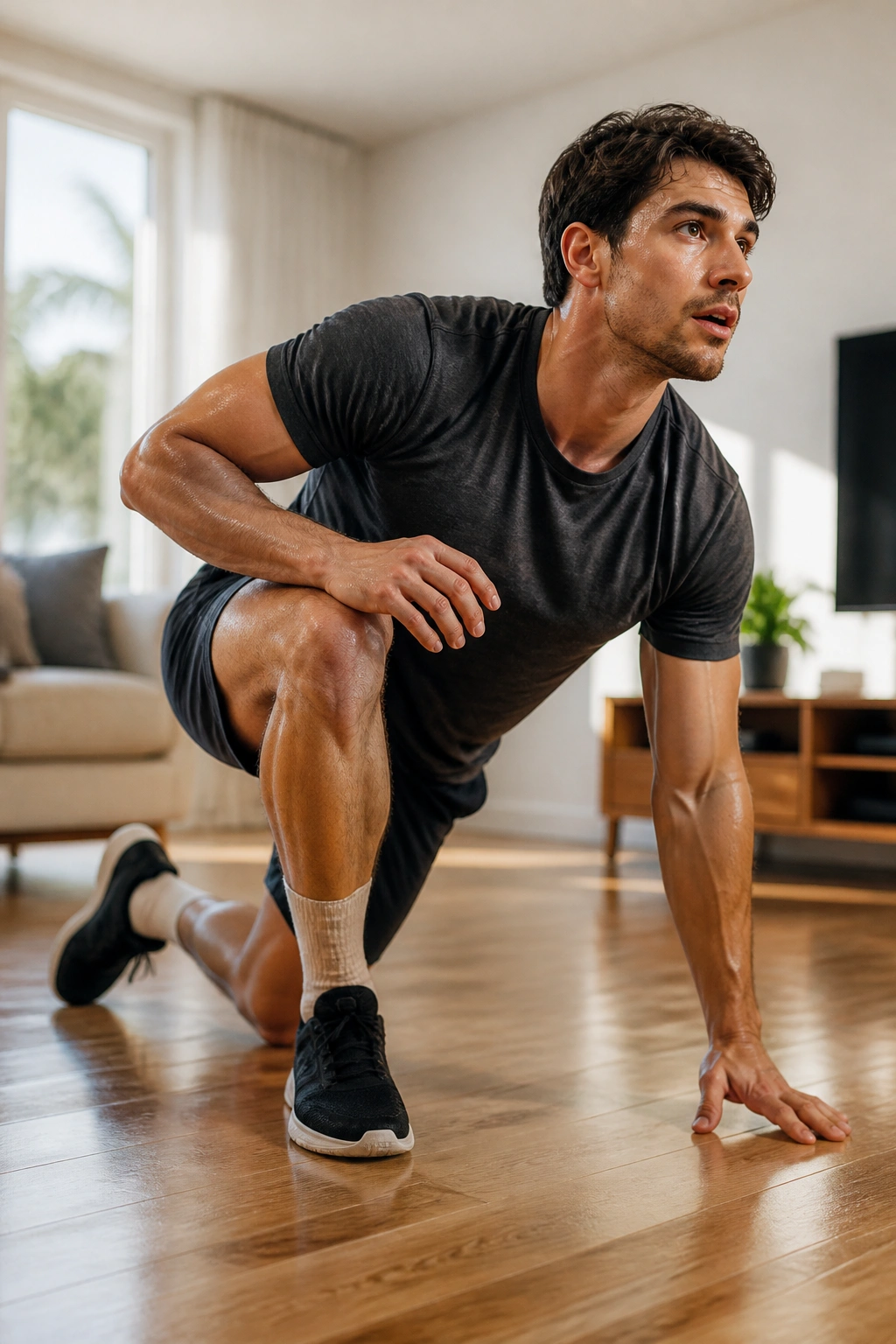
Ever notice how tiring it gets when a workout makes you keep getting down to the floor and back up again? There’s a reason for that. Transitions cost energy.
Why it works
You’re not only moving muscles. You’re teaching your body to change levels, brace, and recover while your heart rate stays up. That’s a useful skill, and it carries over to almost anything that asks you to move under fatigue.
Run 6 rounds of:
- 1 squat
- 1 plank walkout
- 1 pushup
- 1 reverse lunge per side
- 1 stand-up from the floor
That’s the basic loop. It sounds almost too small, which is why it catches people off guard. The work is in the transitions, not just the count. The move from the floor to standing over and over is where the gas starts to leave the tank.
If you want more load, add a second pushup and a second reverse lunge each round. If you want less, skip the pushup and keep the transitions crisp. Either way, keep your chest lifted when you stand up. Slouching through the top position wastes the lesson.
14. The Tempo Strength Session
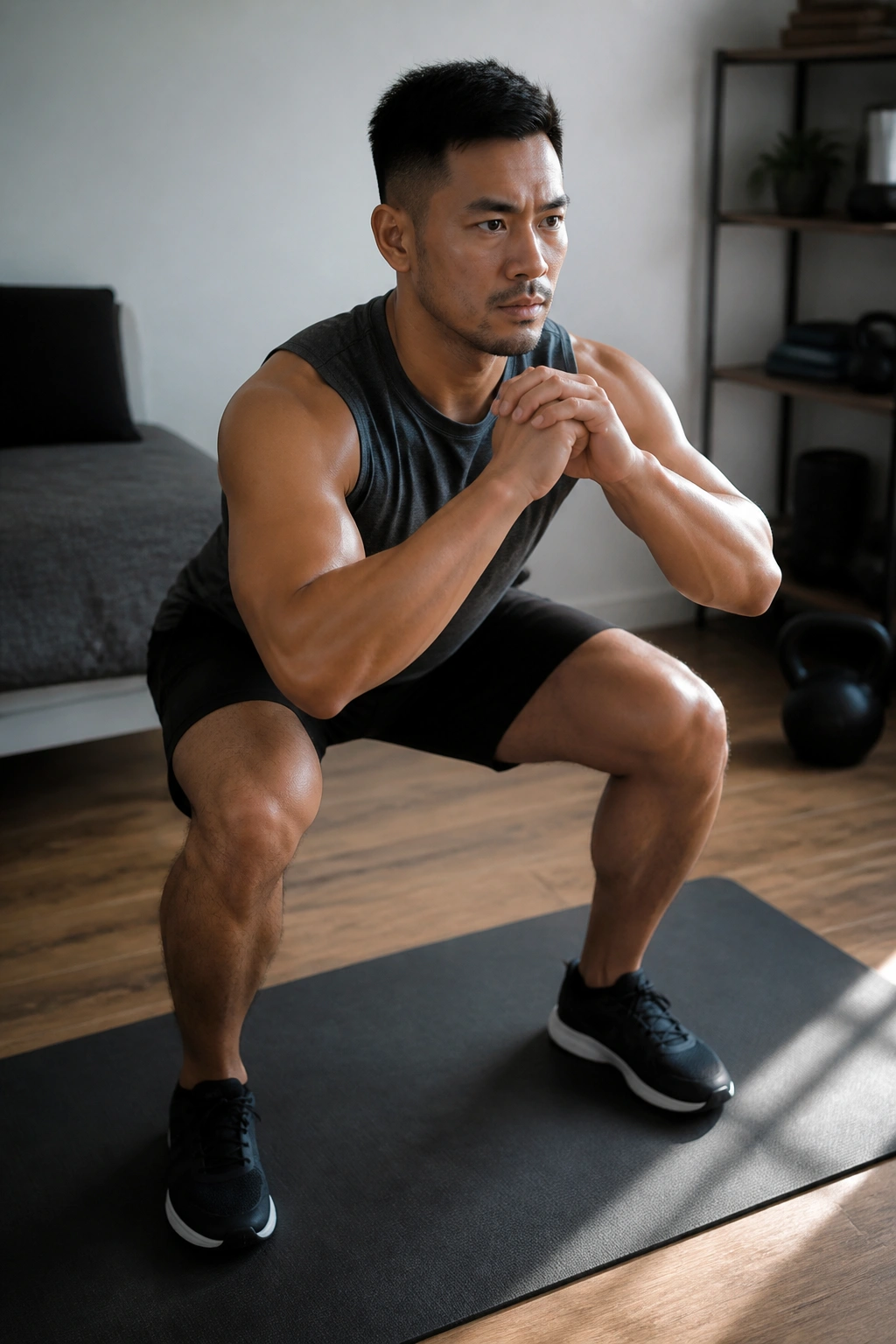
Slow reps bite.
They also build a kind of strength that many fast circuits miss. When you slow the lowering phase, your muscles stay under tension longer, and you get a much clearer sense of where your form breaks down.
Do 3 rounds of:
- 6 squats with a 3-second lower
- 6 pushups with a 3-second lower
- 8 split squats per side with a brief pause at the bottom
- 10 glute bridges with a 2-second squeeze
You should feel this in the thighs, chest, and shoulders long before your lungs are gasping. That’s the point. Tempo work exposes weak spots. If one knee caves or your back arches, the slow count makes it obvious.
I like to use this session when I want strength without a bunch of jumping or sprinting. It’s quieter than a HIIT workout, but not easier. In some ways, it’s harsher because there’s nowhere to hide.
If you’re new to tempo training, cut the reps in half the first time. Slow work has a way of making honest people out of everyone.
15. The Seven-Move Apartment Circuit
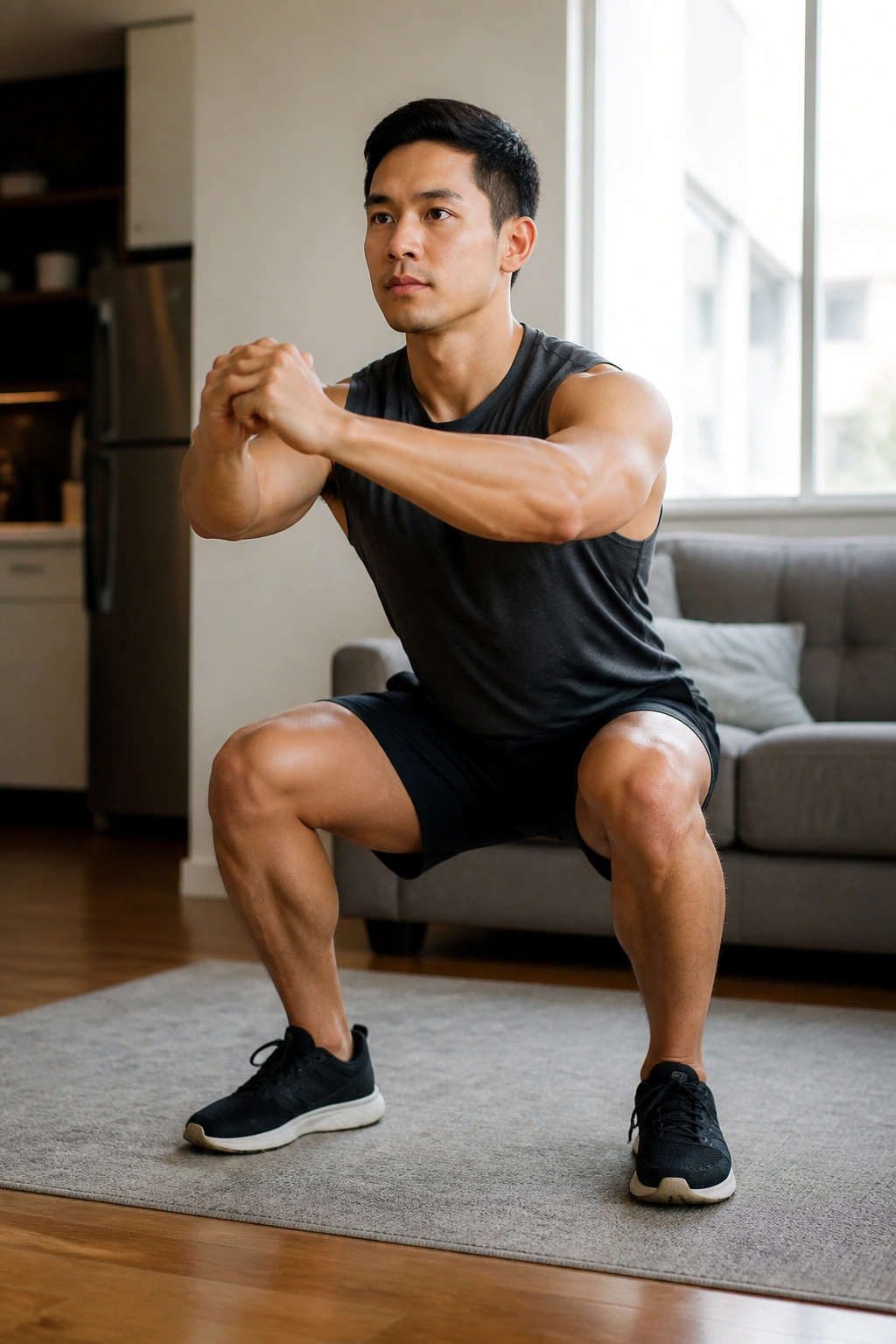
Some workouts need a timer and a map. This one needs a small patch of floor and a willingness to keep moving.
Do 40 seconds on, 20 seconds off for each of these 7 moves, then repeat the full circuit twice:
- March in place with strong arm swings
- Air squats
- Incline pushups
- Bear crawl steps
- Glute bridges
- Plank shoulder taps
- Side lunges
That gives you a balanced mix of lower body, upper body, core, and a little coordination. The incline pushups help you stay clean when fatigue creeps in. Shoulder taps force your core to fight rotation, which is one of the quiet themes in good bodyweight training. Side lunges wake up the hips in a way straight squats do not.
The layout is simple on purpose. Apartment workouts usually fail when they become too clever and too noisy. This one does not need clever. It needs repeatable movements and honest effort.
If you want more difficulty, make the rest 15 seconds. If you want less, use 30 seconds. Easy to tune. That’s a nice quality in a home session.
16. The Athletic Agility Shuffle Series
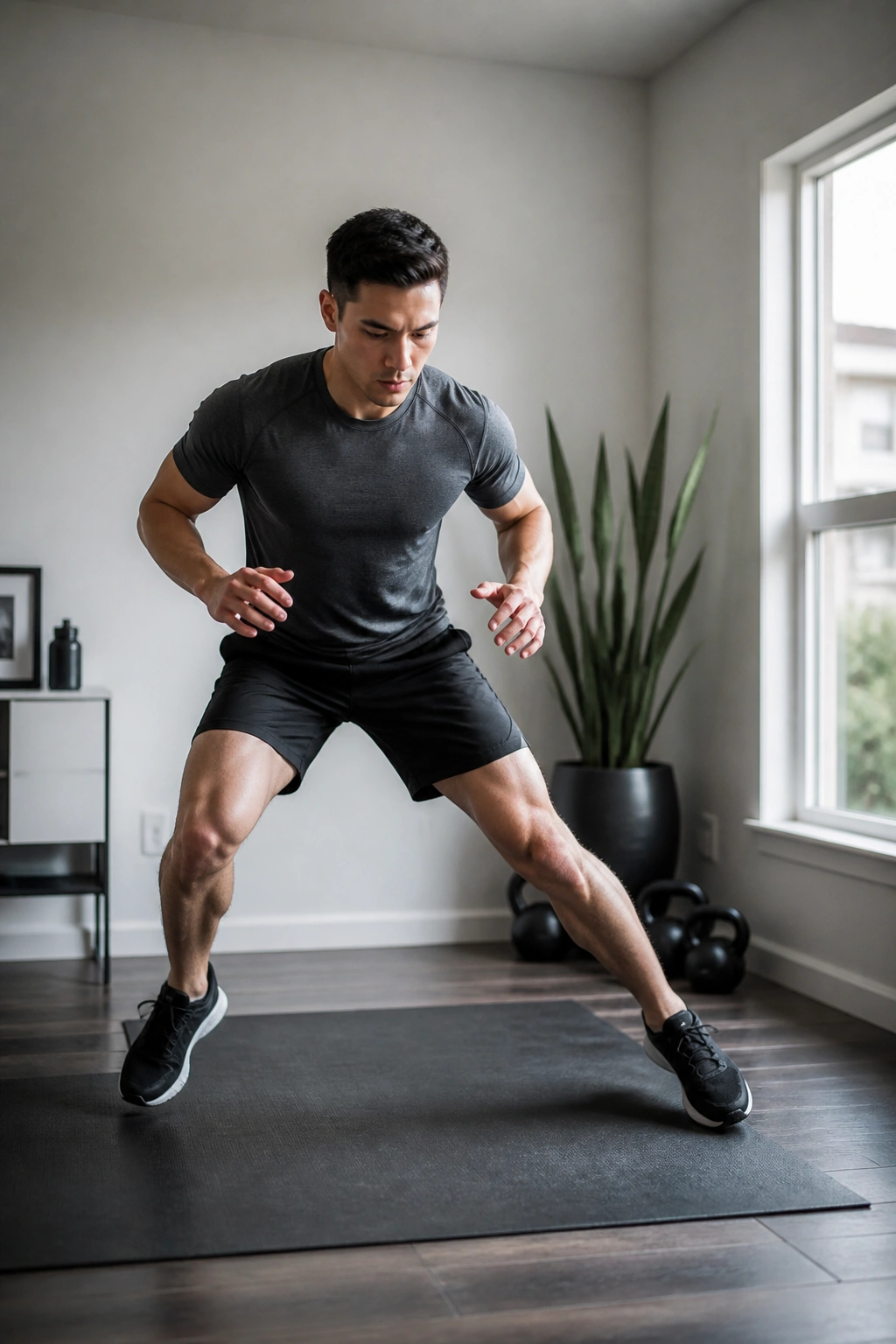
Unlike straight-ahead circuits, this one makes you move sideways, pivot, and recover your balance a bit faster. That matters. Daily life is not a perfect forward march.
Run 4 rounds of:
- 20 seconds lateral shuffle
- 20 seconds skater steps
- 20 seconds quick feet
- 20 seconds crossover reach
- 30 seconds rest
Keep the space small if you need to. Two or three steps to the side is enough. The goal is not speed for speed’s sake; it’s clean footwork and quick weight shifts. Your knees should stay soft, and your torso should stay controlled rather than flopping around like a shopping cart with one bad wheel.
I like to finish each round with a shallow squat before resting. That tiny hold keeps the legs engaged and gives the workout a stronger lower-body feel. It also stops you from turning the whole thing into a bunch of disconnected cardio drills.
This is a good pick when you want movement that feels athletic without needing a treadmill, cones, or a big open room.
17. The Core Stability Reset
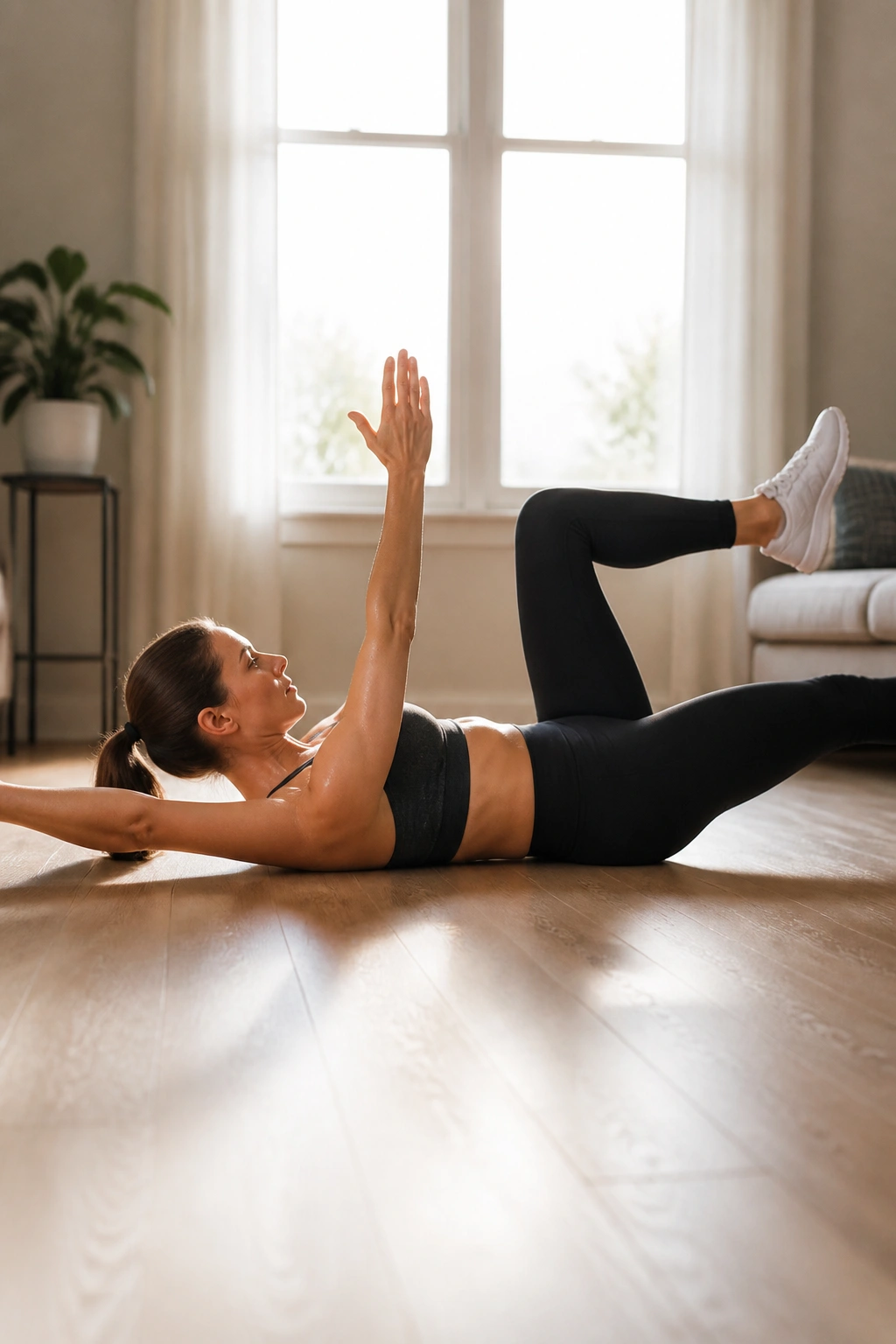
Is a core workout still a full body workout? If the moves are chosen well, yes. The trunk is what connects everything else, and ignoring it makes every squat, pushup, and lunge a little less solid.
Do 3 rounds of:
- 8 dead bugs per side
- 8 bird dogs per side
- 20 to 30 seconds plank
- 8 squat-to-stands
- 20-second hollow hold
The dead bug and bird dog are not flashy, but they teach your ribs, pelvis, and shoulders to stay organized. The squat-to-stand brings the legs into the session, and the plank plus hollow hold make your midsection do more than crunch and hope.
How to get more from it
Press your lower back lightly into the floor during the dead bug. Reach long, not fast, on the bird dog. On the hollow hold, keep your chin tucked and your ribs down so your back does not arch off the floor. Small fixes. Big difference.
This session works well on days when your lower back feels a little cranky or your energy is low. It still trains. It just does it with a calmer voice.
18. The Upper-Body Endurance Circuit Without Weights
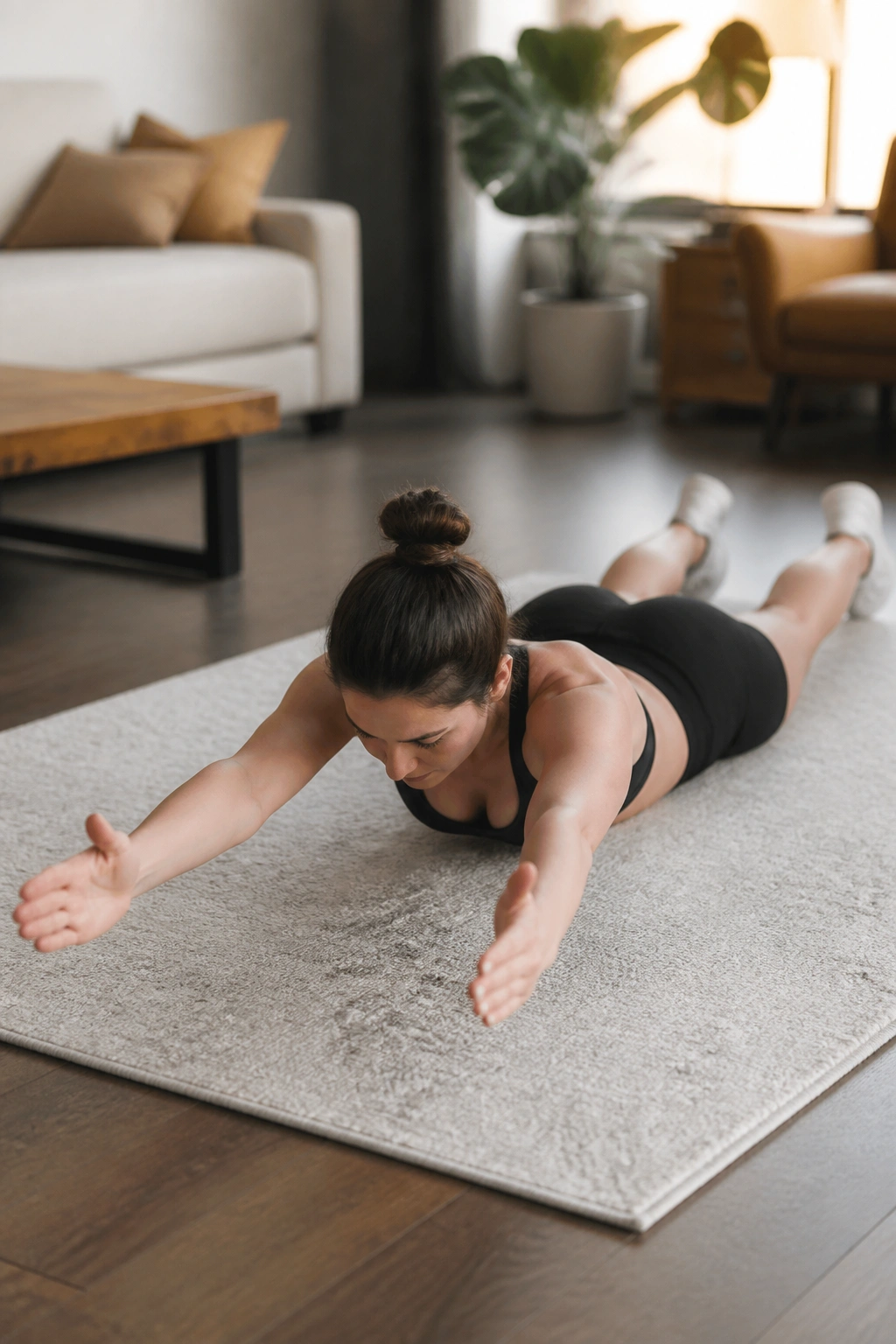
Your shoulders can do a lot with no equipment. They just need the right mix of pressing, support, and floor-based work so the session does not turn into endless standard pushups.
Run 4 rounds of:
- 8 pushups
- 10 shoulder taps per side
- 6 pike pushups
- 8 prone Y-T-W raises
- 20-second high plank hold
The prone Y-T-W sequence is the quiet hero here. Lie face down, lift your arms into a Y shape, then a T, then a W. Each position wakes up the upper back in a way people skip when they only think about chest work. That matters for posture, shoulder balance, and general durability.
If the pike pushups are too intense, keep your hips a little higher and shorten the range. If regular pushups are still a stretch, put your hands on a couch or step. The point is to keep quality high enough that the shoulders are doing real work, not just surviving the set.
This one pairs well with a lower-body day if you’re splitting the week up, but it also stands fine on its own.
19. The Recovery-Friendly Full Body Flow
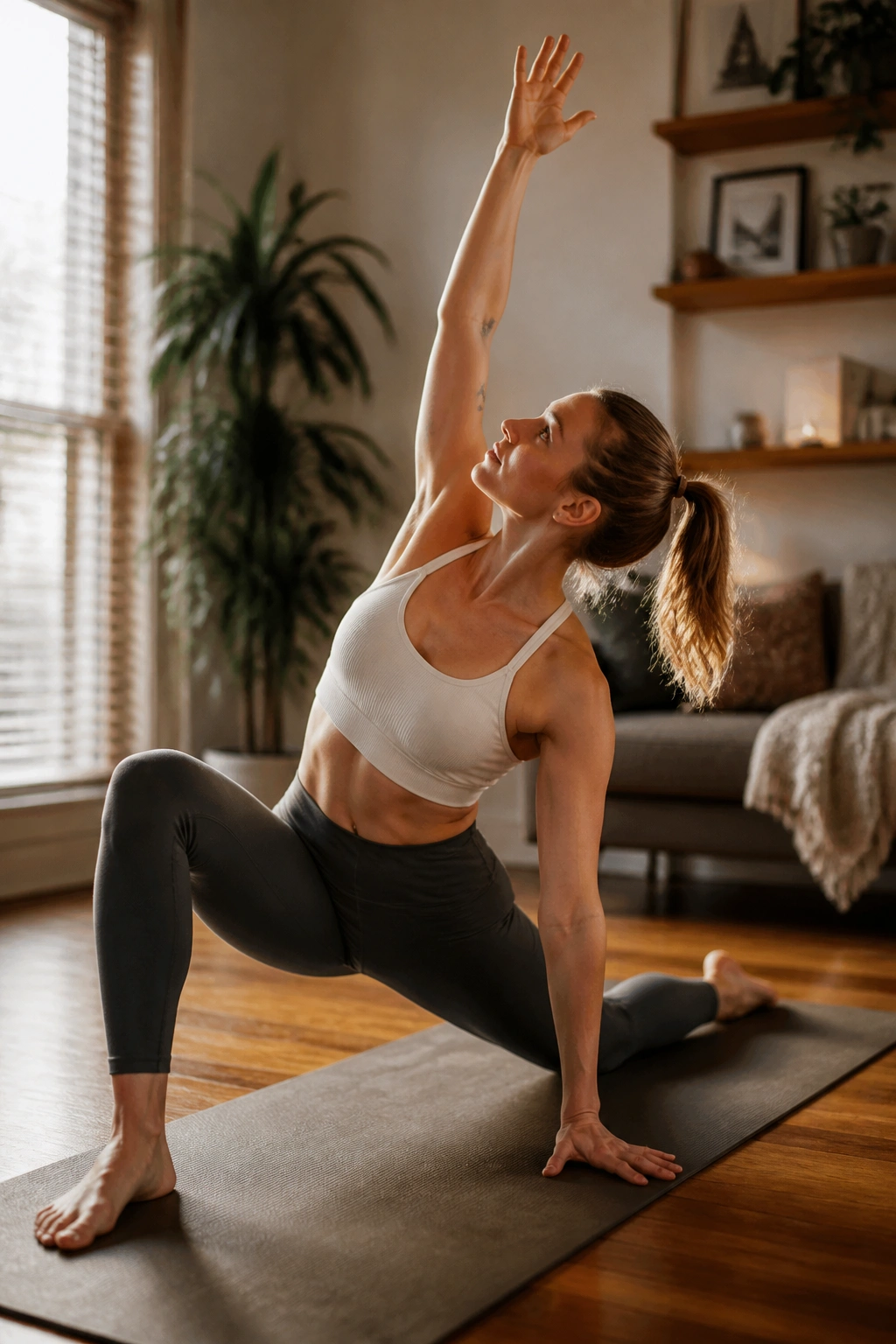
Not every workout at home has to leave you flattened. Some days you want to move through a whole-body session that opens up the hips, wakes up the shoulders, and leaves you looser when you finish than when you started.
What the flow looks like
Move through 2 to 4 rounds of:
- Squat to stand
- Low lunge with reach
- Pushup to downward dog
- Glute bridge
- Bird dog
- Standing side bend
Take your time. A round might last 4 to 6 minutes, which is the point. You’re not racing. You’re smoothing out the body, feeding the joints a little motion, and keeping enough muscle tension in the session that it still counts as training.
This is the workout I’d pick after a long day of sitting or after a tougher session the day before. The squat to stand opens the ankles and hamstrings. The low lunge wakes up the hip flexors. Pushup to downward dog gives the shoulders a good stretch without turning the whole thing into yoga theater.
Slow work gets dismissed too fast. It shouldn’t.
20. The Five-Move, Five-Round Finisher
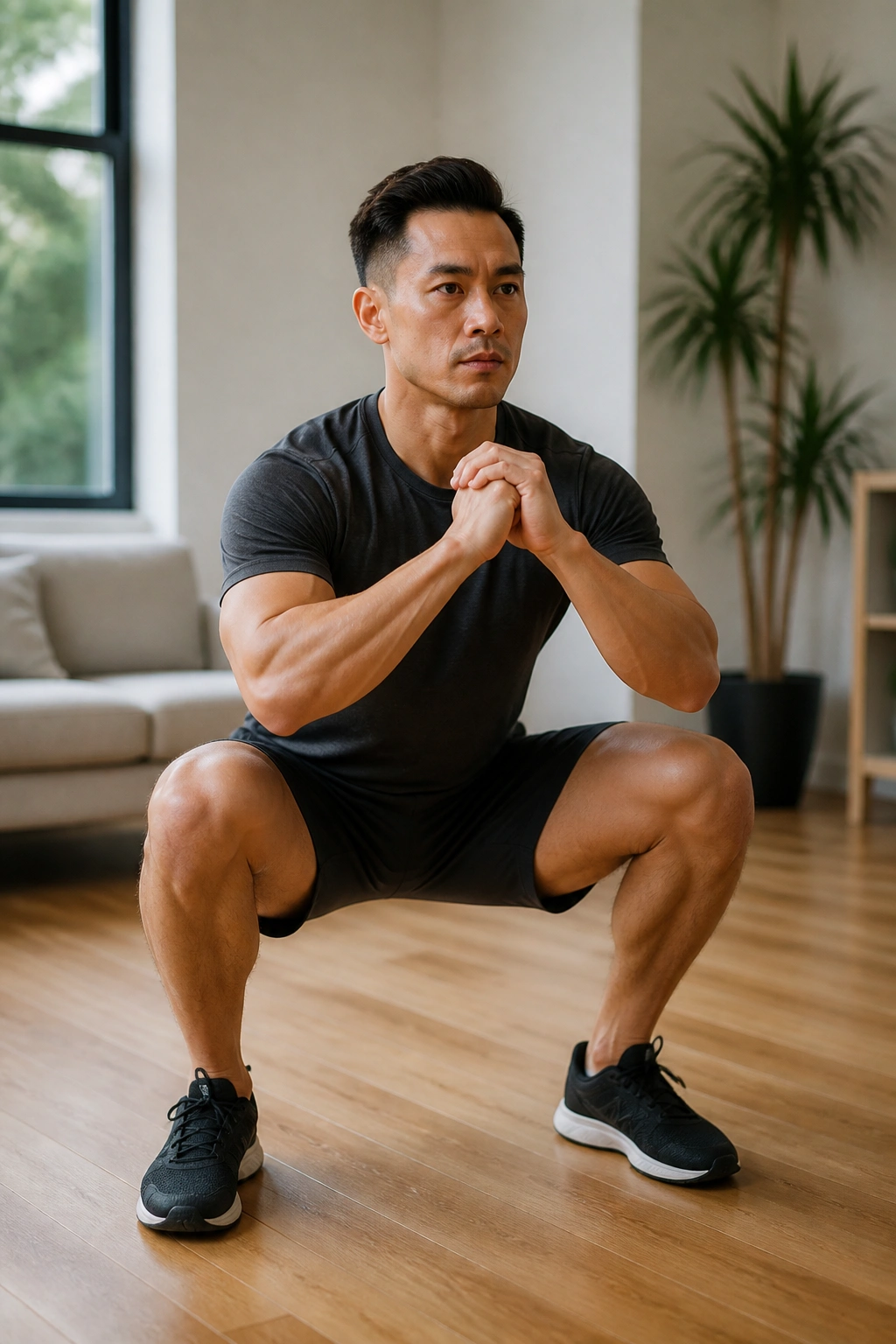
If you want one at-home bodyweight workout that can live on repeat, this is the one I’d keep in my back pocket. It covers the basics, fits almost anywhere, and can be scaled up or down without much thinking.
Do 5 rounds of:
- 12 air squats
- 8 pushups
- 10 reverse lunges per side
- 12 glute bridges
- 20-second plank
That’s the whole thing. Clean, direct, and easy to remember. If you want to make it harder, shorten the rest to 15 seconds and keep the plank strict. If you want to make it easier, cut the squats to 8, raise your hands for the pushups, or hold the plank for 10 seconds instead of 20.
What I like most here is the balance. Legs, chest, hips, and core all get touched without any weird gymnastics. It works as a stand-alone workout, a quick finisher after a walk, or a fallback session when your brain is tired and you do not want to overthink anything.
That’s the whole game, really. Good home training is often just this: enough structure to make the work honest, enough flexibility to fit the day, and enough variety that your body does not get bored.
