



A stroller can do more than move a kid from point A to point B. At the park, it turns into a pace marker, a balance aid, and—if you use it well—a piece of workout gear that never needs charging, reassembling, or a subscription.
Stroller workouts are honest in a way treadmills aren’t. They tell you when your stride gets sloppy, when your shoulders creep up to your ears, and when you’re relying on momentum instead of muscle. They also happen to fit real life, which is probably why they work so well for parents, grandparents, caregivers, and anyone who wants to get moving without locking themselves into a gym schedule.
The park is a good setting because it gives you options. Flat paths for intervals. Benches for strength work. A curb for calves. A hill if you want the session to bite back a little. The one thing that matters is control: keep the child strapped in, lock the brake for any stationary move, and skip any exercise that makes the stroller wobble or the handlebar feel sketchy. Heavy bags hanging from the handle are a bad idea too. Keep the setup simple. Safe first, sweaty second.
These 15 stroller workouts are built for that kind of day: the kind where you have 10 minutes, 20 minutes, maybe half an hour if the nap gods are kind. Some are pure cardio. Some lean strength. A few are sneaky little recovery moves that keep your body from stiffening up after a long push around the loop. Start with the easiest one and build from there. The park does the rest.
1. The Brisk Loop Power Walk
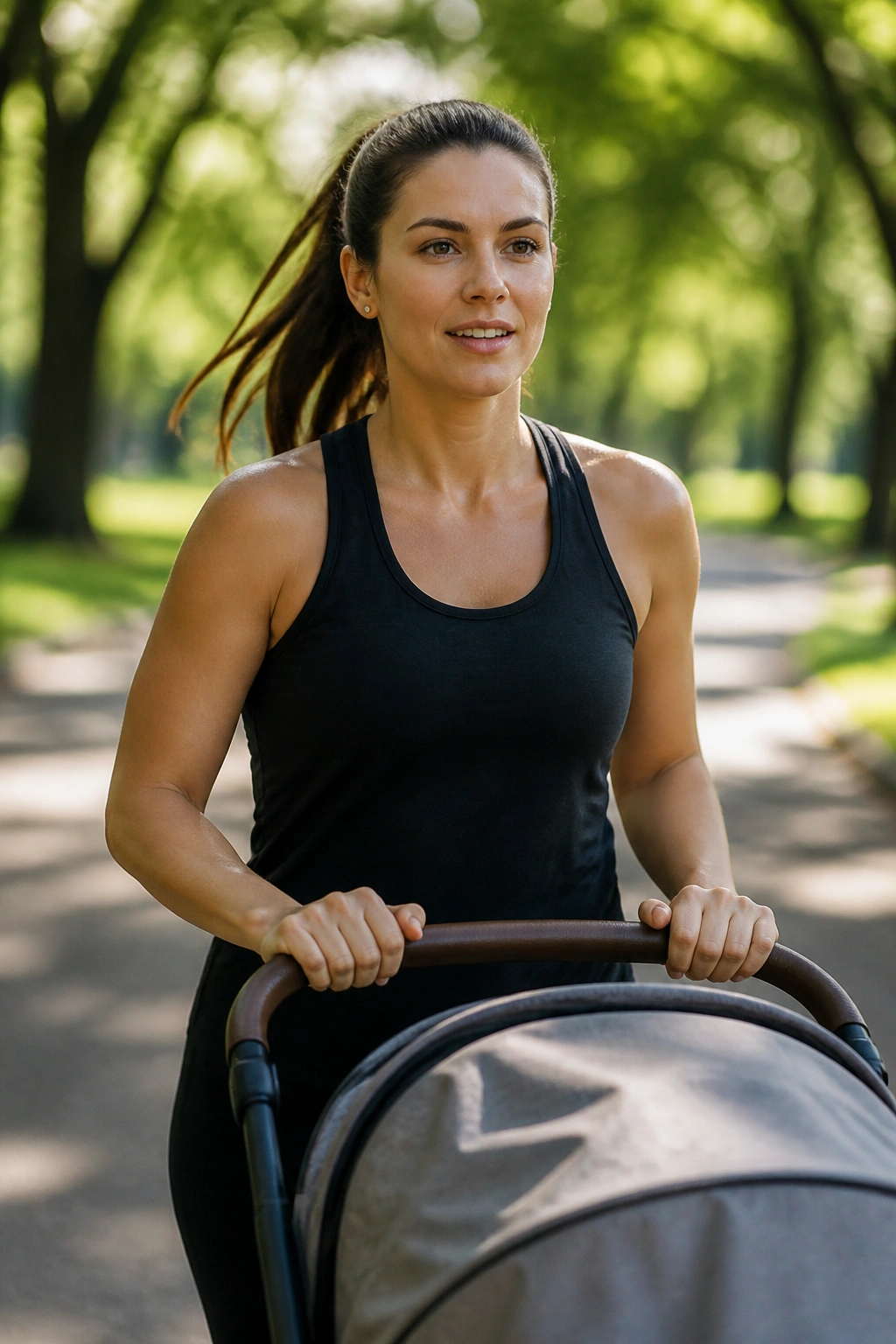
The simplest stroller workout is still a workout. Push the stroller around a park loop at a pace where you can talk, but you don’t want to sing. That’s the sweet spot.
I like this one as a baseline because it shows you what a normal hard walk feels like before you start adding hills, intervals, or strength stops. Ten to 15 minutes is enough to wake up your legs. Twenty minutes starts to feel like a real session.
How to pace it
Begin with 3 minutes of easy walking. Let your shoulders drop. Keep your hands light on the handlebar. Then pick up the pace for 2 to 4 minutes at a time, breathing a little harder but still staying smooth.
- Stride shorter than usual on cracked or uneven paths.
- Elbows bent softly, not locked straight.
- Eyes up, not down at your feet.
- Push from the back leg so your hips do some work.
One lap easy, one lap fast works well if you like simple structure. So does 2 minutes brisk, 1 minute relaxed, repeated five times.
A lot of people rush the walk and turn it into a shuffling push. Don’t. A clean stride with steady arm drive does more for your legs than a frantic half-jog that makes the stroller feel twitchy.
2. Push-Pace Intervals on a Flat Path
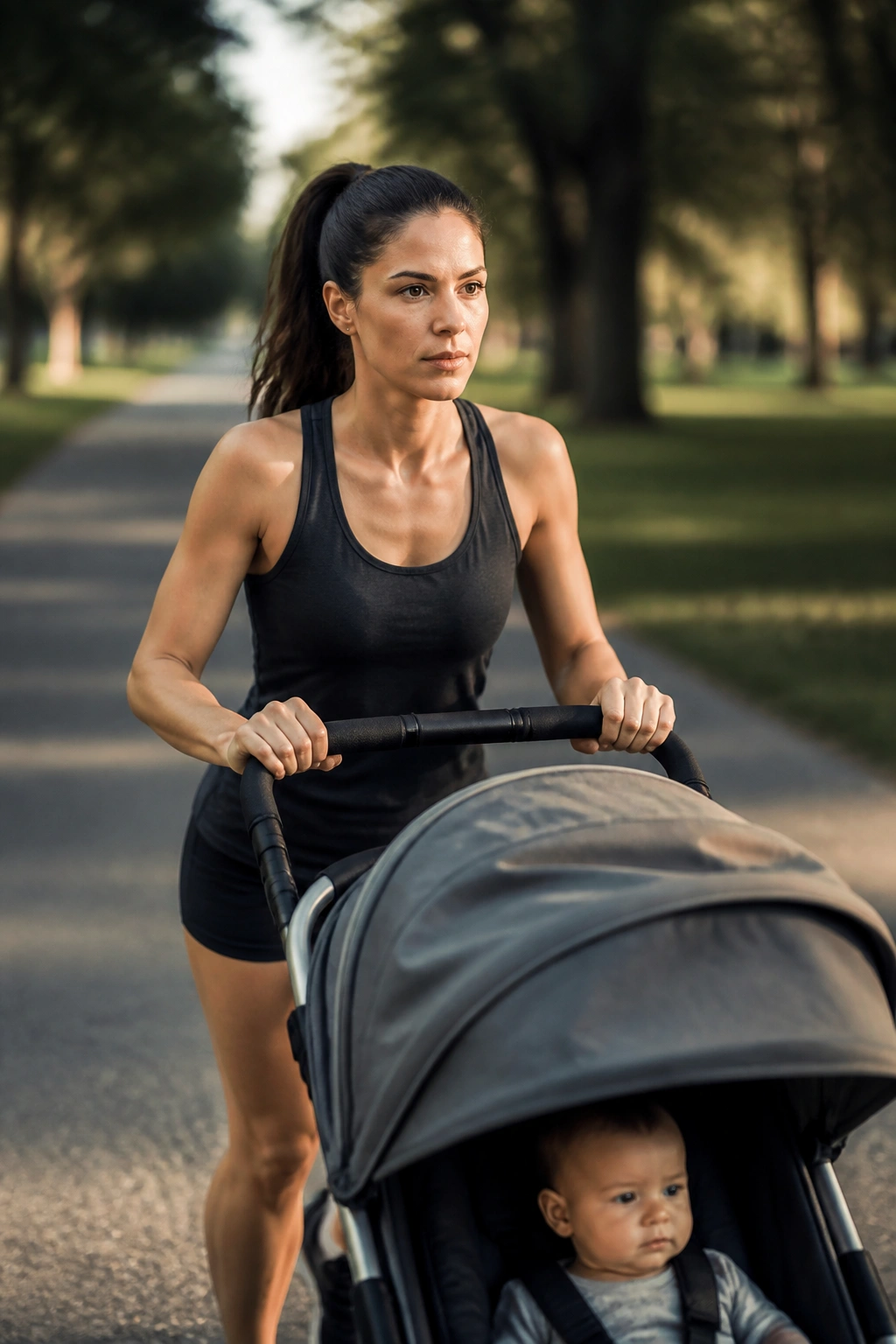
Why does a short burst feel harder than a long steady walk? Because your body has less time to settle. That’s the whole point here.
Use a flat section of the park path and alternate hard pushes with recovery strolls. If your stroller is a jogging model, you can push the pace a little more. If it isn’t, keep this to a fast walk. No heroics. A stroller that bounces or pulls to one side is telling you to back off.
How to set the interval
Try 30 seconds hard, 90 seconds easy for 8 rounds. That gives you 16 minutes with warm-up and cool-down. If that feels too spicy, make the hard part 20 seconds and the recovery 100 seconds.
During the hard push, lean slightly from the ankles, not the waist. Keep your chest tall. Think “quick feet” rather than “big reach.” Your breathing should sharpen, but you should still be able to regain it during recovery.
What makes this useful
- It keeps the session short.
- It raises heart rate without pounding your joints.
- It works well on days when you’re tired but still want real effort.
This one is especially good if your park loop is flat and predictable. The more even the surface, the easier it is to focus on pace instead of dodging roots and gravel.
3. Hill Climbs That Make the Stroller Feel Heavy
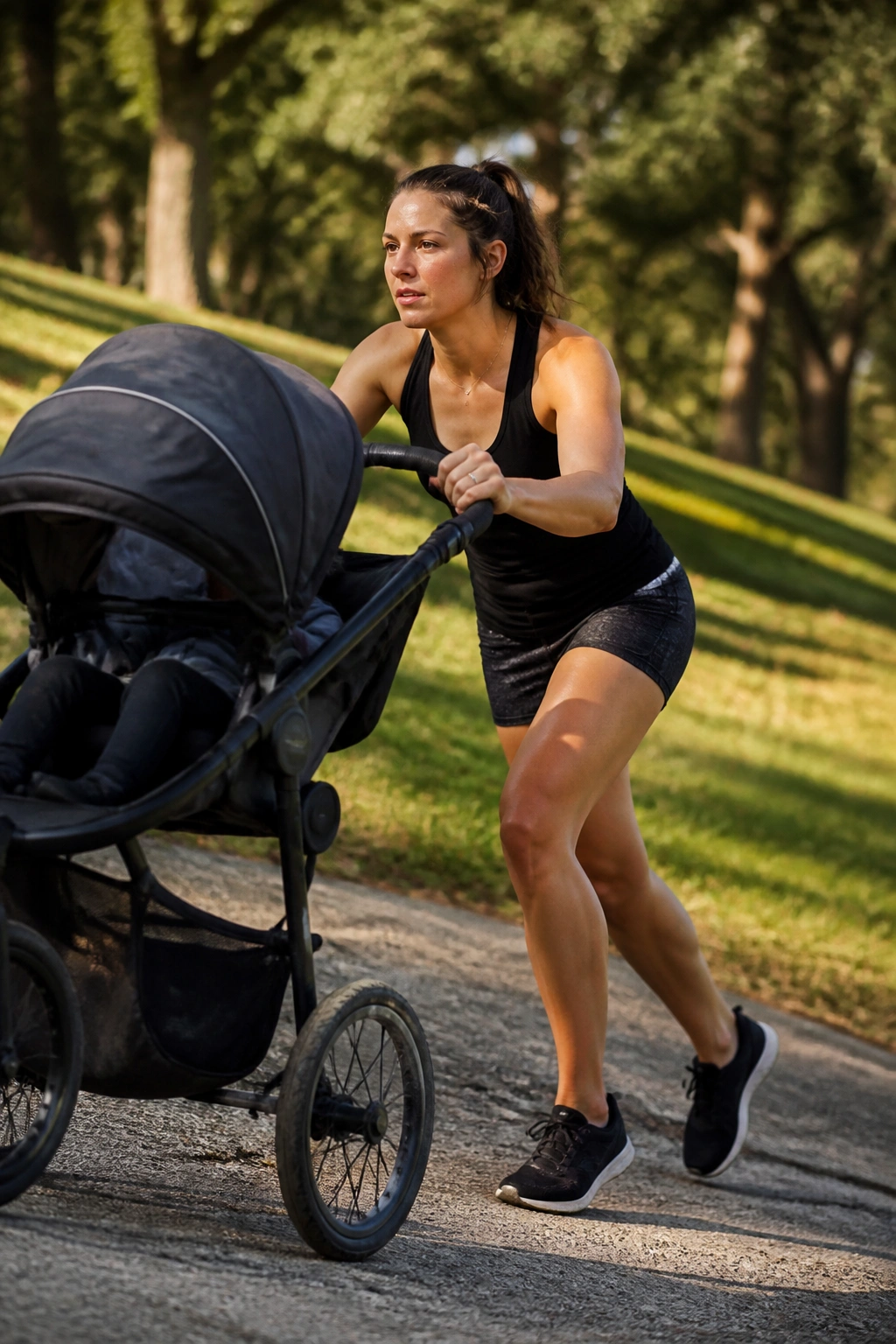
Hills do the hard work for you. That’s the charm and the curse.
Find the gentlest incline in the park and push uphill for 20 to 45 seconds at a time. You do not need a steep hill to feel this. A mild rise can light up your glutes and calves fast, especially if the stroller and child together make the load feel a little heavier than expected.
Keep your steps short on the climb. Long strides usually lead to overreaching, and overreaching on a hill is how your lower back starts trying to help when your legs should be doing the job.
A good pattern is 6 climbs with a slow walk back down or across flat ground between efforts. If the hill is long, stop before you completely lose form. A messy hill push is worse than a shorter clean one.
The best cue here is simple: push the ground away. That sounds basic, but it keeps your mind off the stroller and on the leg that’s actually doing the work. You’ll feel the back side of your legs engage almost immediately. And yes, your breathing will get sharp. That’s normal.
4. Bench Squats Beside the Playground
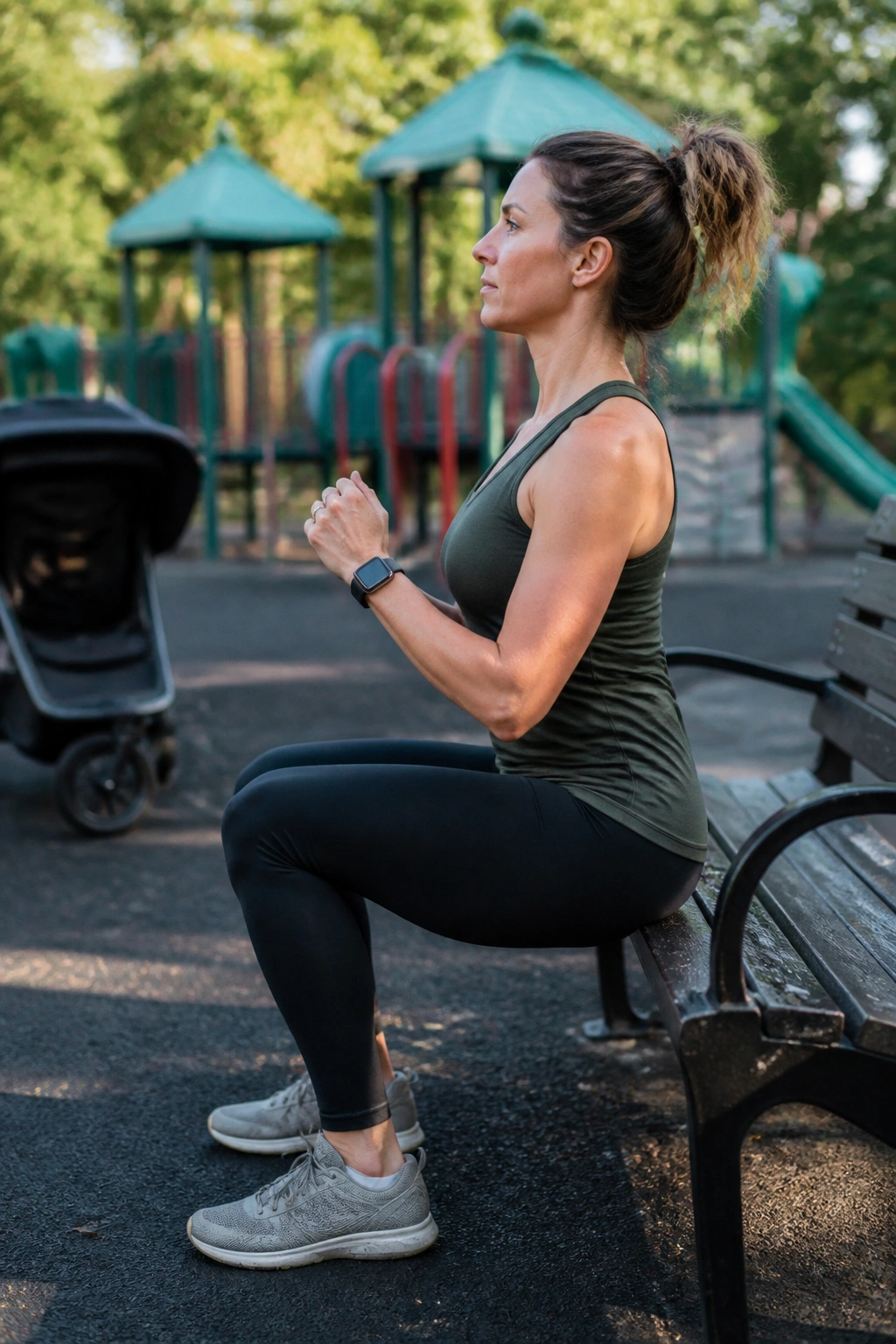
A park bench is a better squat partner than most people think. It gives you a target, keeps your depth honest, and helps you avoid the sloppy half-squat that never really trains anything.
Park the stroller on level ground and lock the brake. Step away from it before you start. Then stand in front of a bench with your feet about shoulder-width apart and squat back until your hips lightly touch the seat. Stand up by driving through your heels.
Set the station
- Put the stroller out of your range of motion.
- Pick a bench that doesn’t wobble.
- Make sure the ground is dry and flat.
- Keep your chest open and your knees tracking over your toes.
Reps and rhythm
Do 2 to 4 sets of 10 to 15 reps. If you’re new to squats, use the bench as a touch point, not a full sit. If you’re stronger, hover just above the seat for a harder version.
A clean bench squat should feel like your thighs and glutes are doing the lifting, not your lower back. If your knees cave inward, slow down and reset. Quality beats speed every time here.
This one is sneaky. It looks calm. It’s not.
5. Reverse Lunges With the Brake Locked
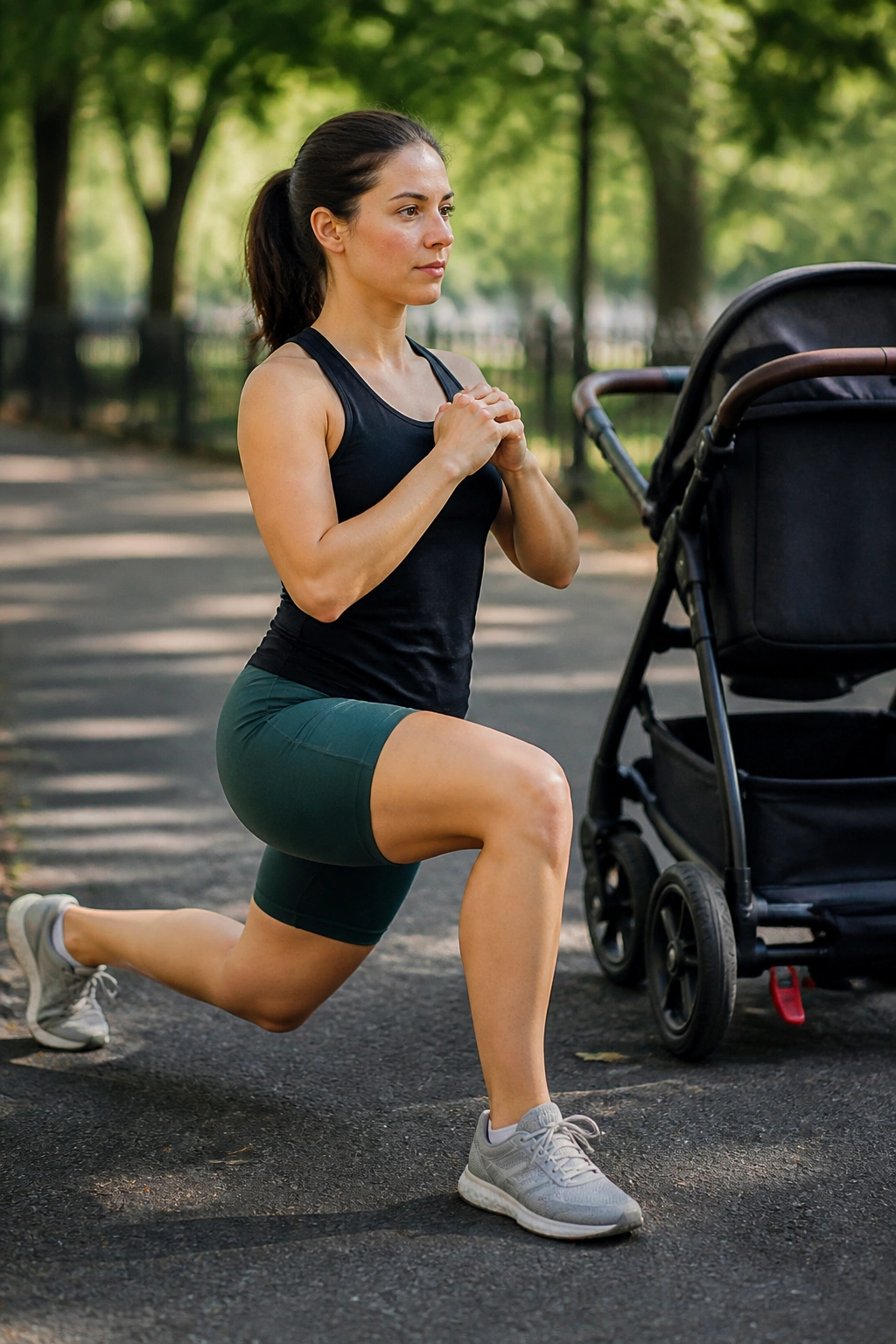
Reverse lunges are kinder to balance than forward lunges, and that matters when you’ve got a stroller nearby. The backward step gives you a little more control, which makes the whole move feel steadier and a lot less clumsy.
I’d pick this over forward lunges for most park sessions. Your front knee usually feels better. Your torso stays more upright. And because the step is backward, you’re less likely to lurch around and crowd the stroller space.
Stand tall beside the stroller, not leaning on it. Step one leg back about 2 to 3 feet, drop straight down, then press through the front heel to stand. Do 8 to 12 reps per side.
A few details matter:
- Keep your front foot flat.
- Lower until both knees are bent around 90 degrees, or as close as your mobility allows.
- Don’t let the back knee slam into the ground.
- Hold your ribs down so the torso doesn’t flare open.
If you want a clean lower-body burn without needing much room, this is a good one. It’s also easy to pair with walking. One round of lunges, one lap around the path, repeat.
6. Incline Push-Ups on a Park Bench
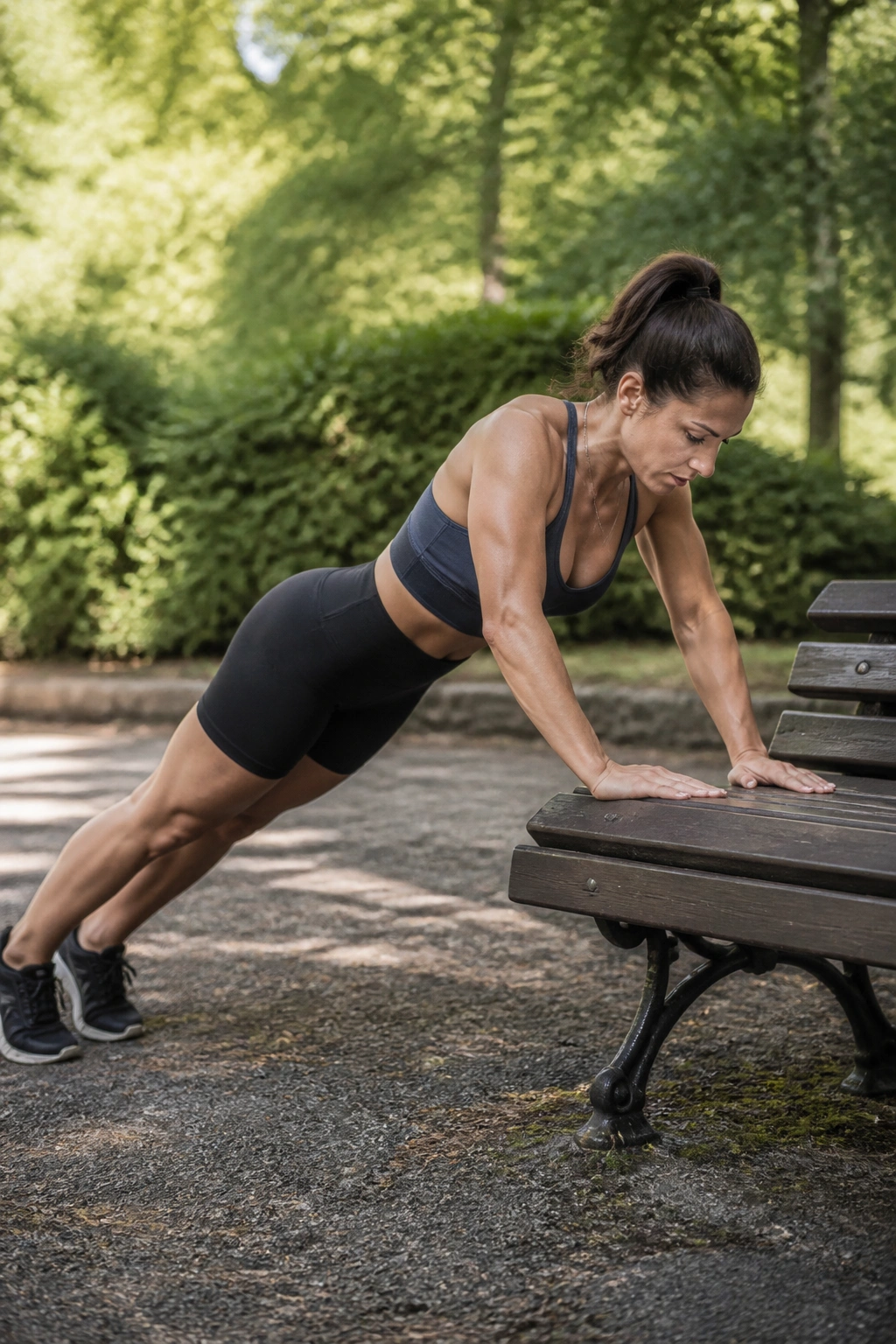
The bench push-up is a gift. It saves your wrists, respects your shoulders, and lets you work your chest and triceps without needing a mat or a clean patch of grass.
Place your hands on a bench, high picnic table, or solid low wall. The higher the surface, the easier the move. The lower the surface, the harder it gets. That’s the entire scaling trick, and it’s a useful one.
Walk your feet back until your body forms a straight line from head to heels. Lower your chest toward the edge of the bench, keeping your elbows at about a 30- to 45-degree angle from your sides. Press back up until your arms are straight again.
A couple of details make this exercise worth doing instead of rushing through it. First, keep your head in line with your spine; don’t crane your neck. Second, lower under control for 2 seconds if you can. Third, stop before your hips sag.
If your wrists are annoyed by the angle, use a bench with a slightly softer edge or do the move on a higher surface. The right version should feel challenging but clean, not wobbly and strained.
7. Curb Calf Raises Between Walk Segments
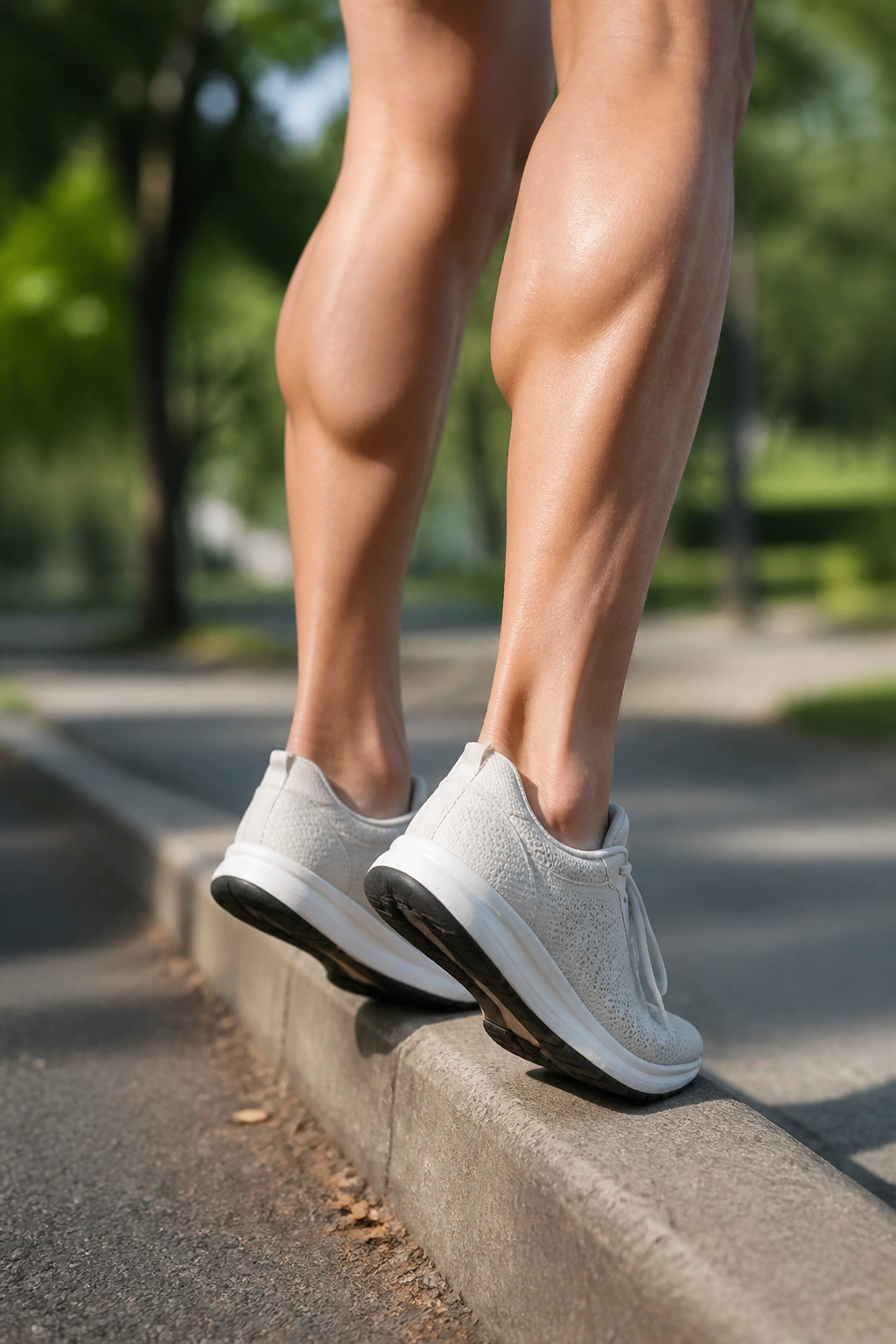
Calf raises are the kind of exercise people ignore until a hill reminds them they shouldn’t. They also fit perfectly into a park workout because you can do them almost anywhere with a curb or a low step.
Find a safe, dry curb and stand with the balls of your feet on the edge and your heels hanging slightly off. Rise onto your toes, pause for a beat at the top, then lower your heels below the level of the curb if the edge allows it. That lower position gives your calves a fuller range of motion.
Do 15 to 25 reps for 2 or 3 rounds. If you want to make them harder, do one leg at a time. If your balance feels shaky, keep one hand light on the stroller handle—not gripping hard, just enough to steady yourself.
What to watch for
- No bouncing.
- No rushed reps.
- Slow lowering on every rep.
- Heels travel fully down if the curb height allows it.
These are tiny movements, but they add up fast. You’ll feel them in the lower leg, and maybe a little in the arches too. Good. That means they’re doing something useful.
8. Side Steps Along the Edge of the Path
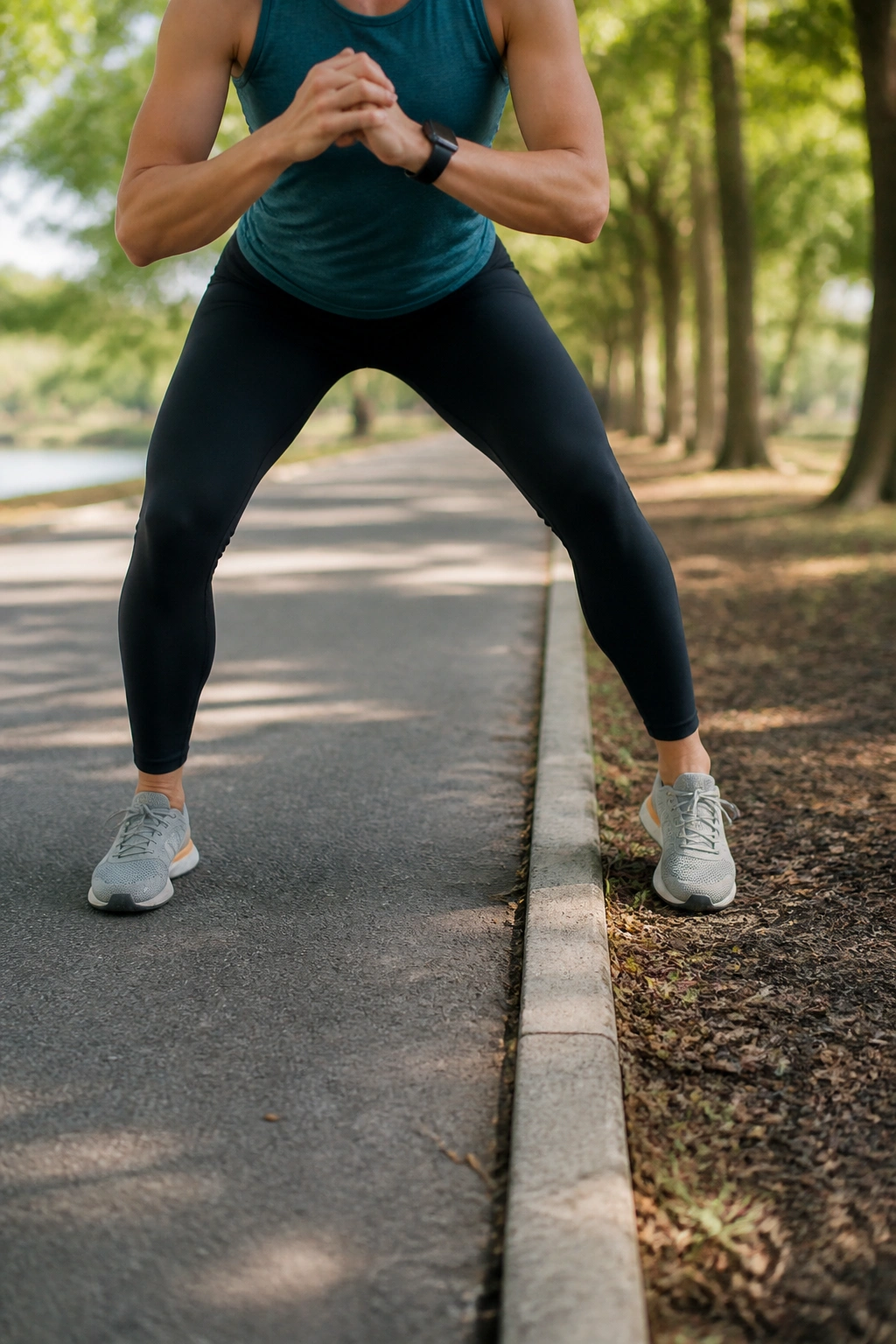
Can a sideways walk actually count as a workout? Yes, if you keep it low, controlled, and deliberate.
Stand with the stroller parked and locked, or keep it nearby if you want a balance reference. Lower into a shallow athletic stance—knees soft, hips back a little, chest tall—and step sideways for 10 to 15 steps in one direction, then return the other way.
How to keep it clean
The movement should feel smooth, not jumpy. You want tension in the outer hips and thighs, not a bunch of wobbling in the knees. If your feet cross over, the stance is probably too narrow or the steps are too fast.
How to use it
- Do 2 to 4 round trips.
- Stay low enough to feel your hips working.
- Keep your toes pointed mostly forward.
- Move slowly if the ground is uneven.
This is one of the best stroller workout moves for glute medius work, which is the side part of the hip that helps with stability. That sounds technical, but the result is simple: better balance, steadier knees, and less wobbly walking after a long session.
Short version? Don’t rush the sideways stuff. It pays off when it looks almost too easy.
9. Marching High Knees at the Shaded Stop
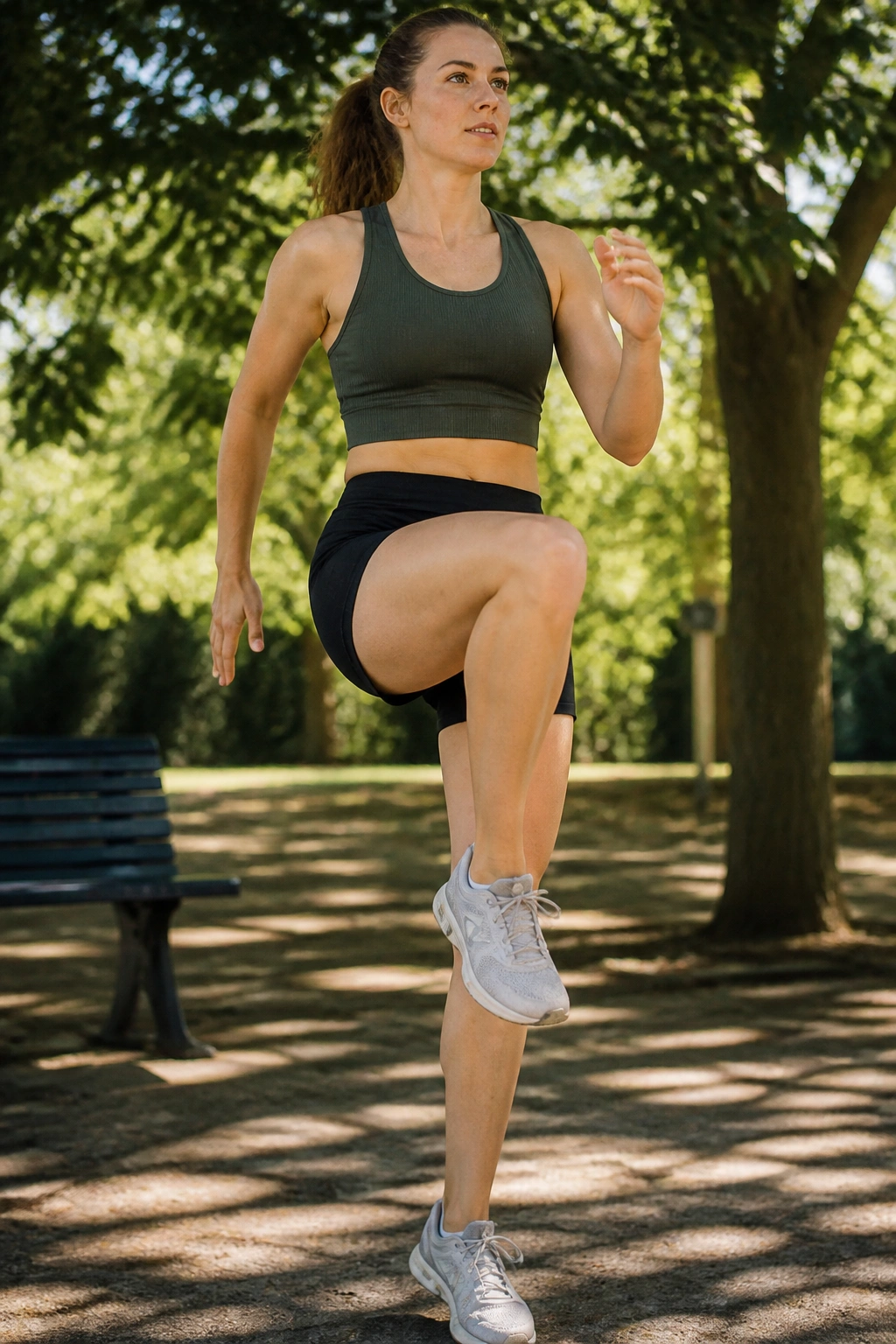
Marching sounds gentle. It isn’t, once you start doing it with intention.
Use a shaded patch of the park, stop the stroller, lock the brake, and march in place with your knees lifting to about hip height if that feels comfortable. If hip height is too much, bring the knees up only as far as you can keep the torso tall. The point is control, not theatrics.
This move works because it asks your core, hip flexors, and balance muscles to wake up all at once. It also raises your heart rate without needing much space, which is handy when the park is crowded or the path is too narrow for anything fancier.
Try 3 rounds of 20 to 30 seconds. Rest for 30 to 45 seconds between rounds. Swing your arms naturally. Keep the standing leg steady, and avoid leaning back to “help” the knee come up.
One good cue: lift, pause, set down. That tiny pause at the top keeps the move honest. If you just fling your legs around, it turns into noise.
10. Glute Kickbacks Beside the Picnic Table
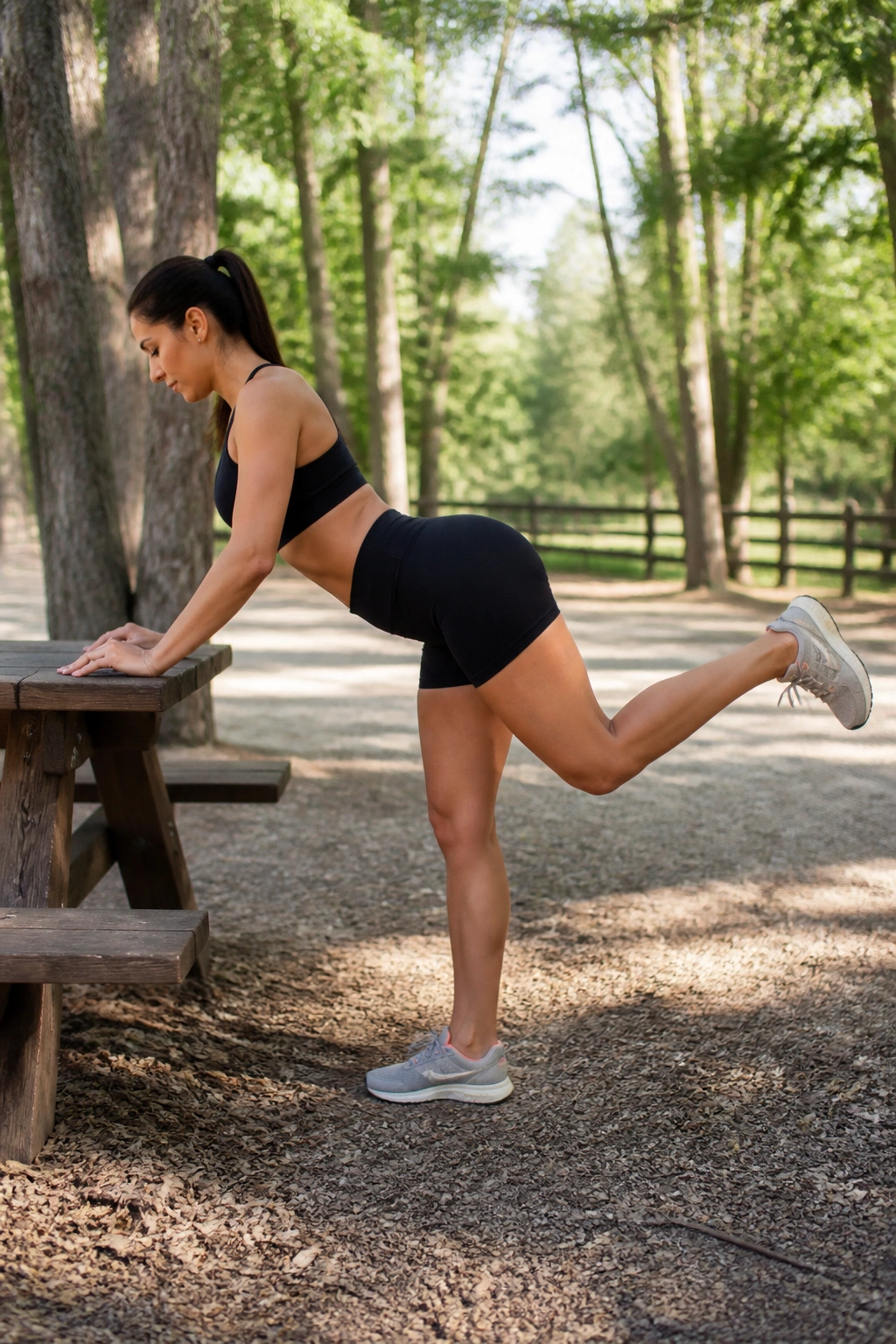
A picnic table gives you a sturdy place to work without getting in the stroller’s way. That’s useful, because glute kickbacks need a stable upper body to work well.
Stand facing the table or bench, hands lightly on the surface, then shift your weight to one leg. Extend the other leg back with a bent knee, squeezing the glute as you lift the heel away from the ground. Return with control. Do 12 to 15 reps on each side.
Form cues that matter
- Keep your hips square to the table.
- Don’t arch your lower back to get height.
- Use a small, controlled kick rather than a wild swing.
- Pause for 1 second at the top if you want more glute engagement.
If you feel this in your lower back, the kick is probably too big. Shrink it down. The glute doesn’t need drama; it needs tension and consistency.
This move works nicely after walking intervals because it flips your body from forward motion to backward extension. That little change wakes up muscles you may have been ignoring for the first half of the session.
11. Standing Core Holds at the Handlebar
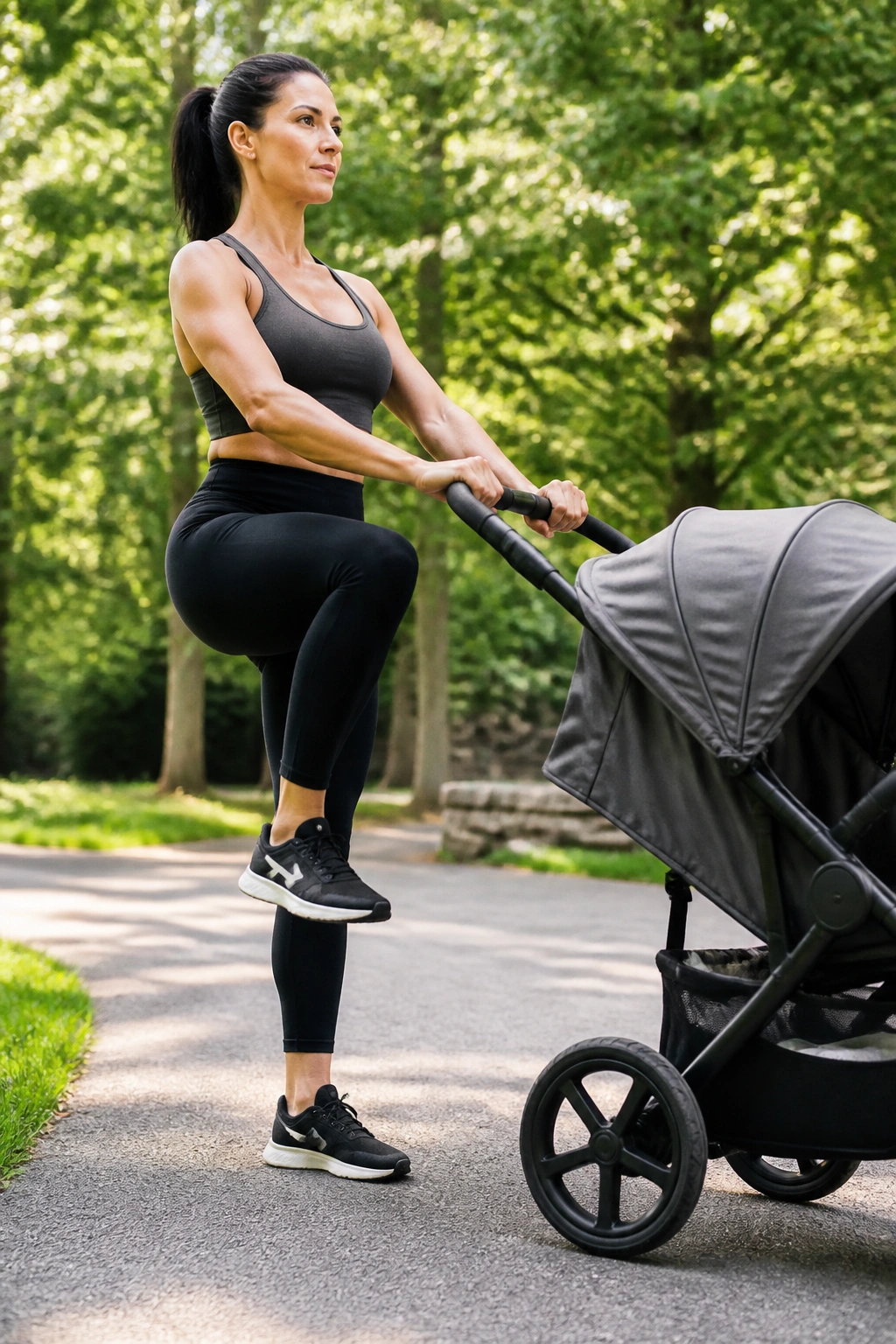
Unlike floor crunches, standing core work doesn’t require a blanket, a clean patch of grass, or the patience to lie down while life keeps happening around you.
With the stroller parked and the brake locked, stand tall beside the handlebar or a bench edge and bring one knee up slowly. Hold for 2 seconds, set it down, then switch sides. If you want more challenge, add a slow exhale every time the knee lifts. That’s not flashy, but it forces your trunk to stay steady.
The real goal here is anti-wobble. Your ribs stay stacked over your pelvis. Your shoulders stay quiet. Your standing leg does the balancing while the lifted leg challenges your center.
A few ways to do it:
- 10 knee lifts per side.
- 20 seconds of alternating holds.
- 3 rounds with 30 seconds of walking between rounds.
If you want the move to feel harder, close your eyes for one or two reps. Not the whole set. Just a rep or two. That tiny shift makes balance work much more honest.
This is one of those stroller workouts that looks easy from a distance and feels surprisingly serious once you stop cheating with momentum.
12. Quick Feet Bursts on a Flat Patch
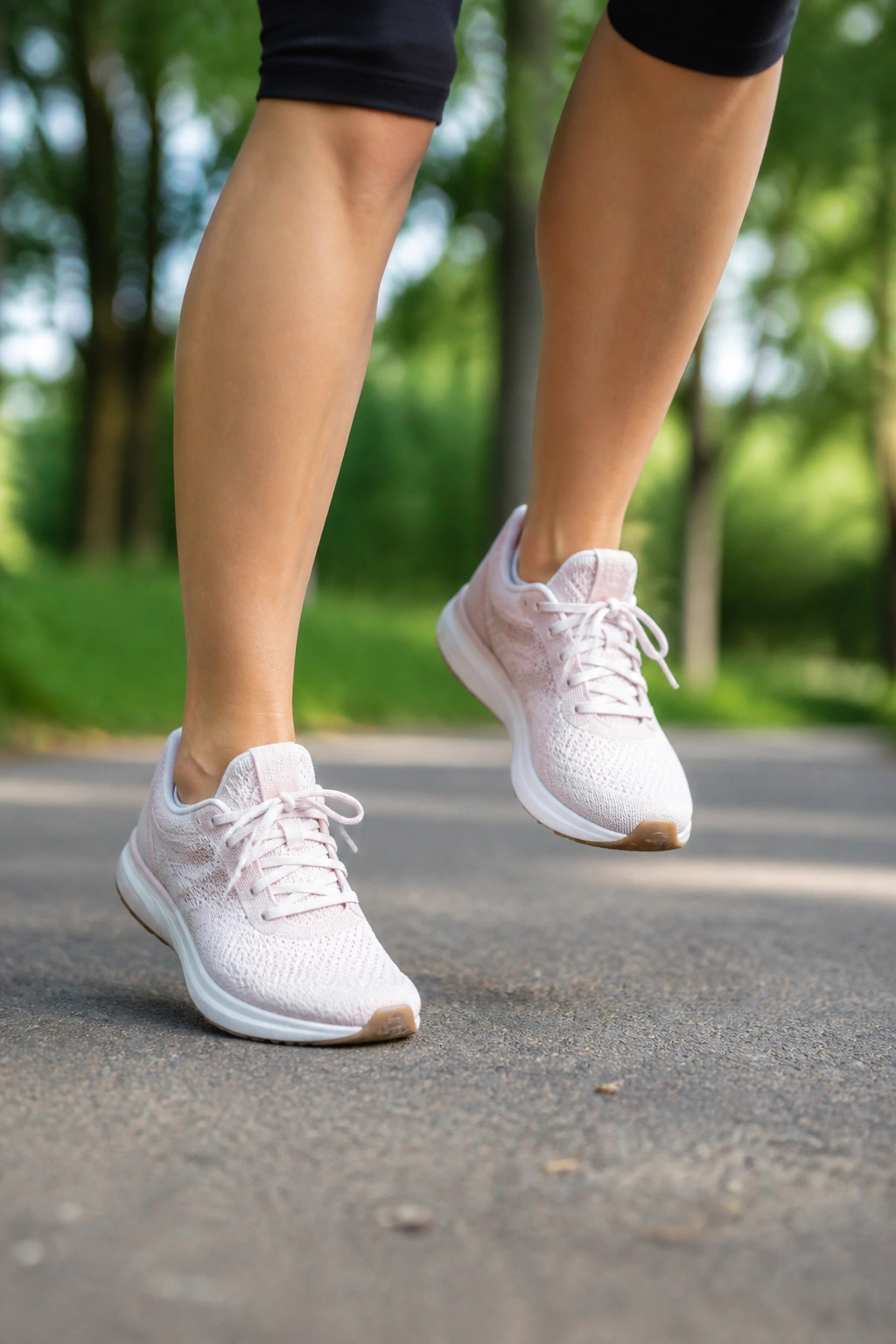
A flat patch of park pavement can turn into a tiny speed drill. You don’t need a track for this. You need 2 feet of space and enough coordination to move without tripping over yourself.
Park the stroller, lock it, and stand beside it. Then do quick, light steps in place for 10 to 20 seconds. Think fast feet, soft knees, quiet landings. After that, walk for 40 to 60 seconds and repeat.
This is not a sprint. It’s a foot-speed burst. The difference matters. You want fast turnover without slamming the ground or bouncing so hard that your breathing gets messy.
What to aim for
- 4 to 8 rounds total.
- Short, springy steps.
- Chest up, shoulders loose.
- Feet landing under your hips, not way out in front.
This one is useful on days when you feel a little cooped up. The legs move fast, the brain wakes up, and the session gets a fresh jolt without needing a complicated setup. It’s also a nice change of pace after all the pushing and lunging.
13. Recovery Walks That Keep You Moving
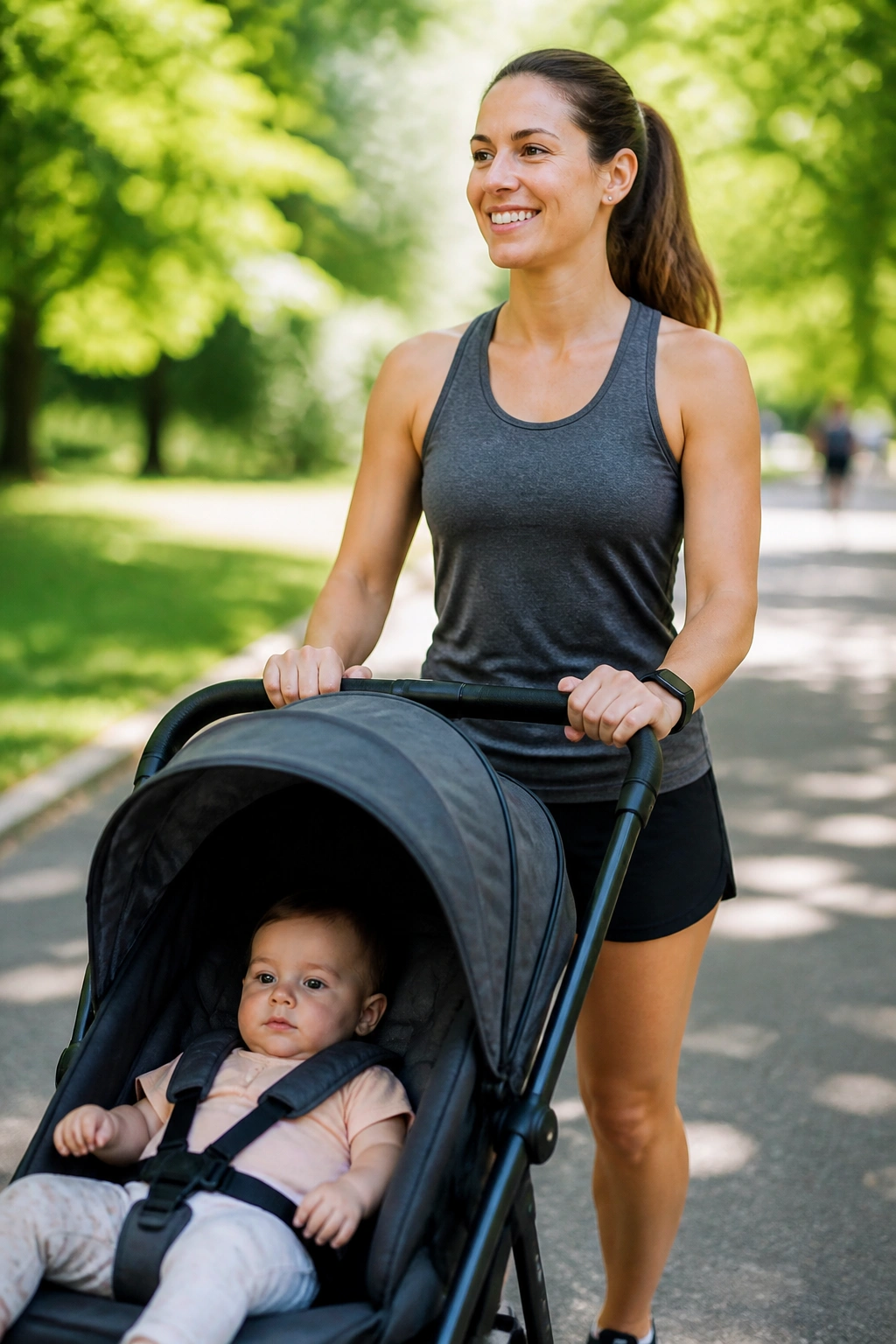
Stopping dead between hard efforts sounds restful. Often, it’s not. Your legs tighten up, your breathing settles too fast, and the next effort feels clunky.
A recovery walk is the fix. After a hard hill climb, a push interval, or a set of bench squats, keep the stroller moving at a very easy pace for 1 to 3 minutes. The goal is to lower intensity without cooling off completely.
This works especially well on longer park loops. Instead of standing around and letting your body go stiff, you stay loose. Your hips keep opening. Your calves stop grabbing. Your heart rate comes down in a controlled way.
If you want a simple rule, use this:
- Hard effort for 30 to 45 seconds.
- Easy walk for 90 seconds to 3 minutes.
- Repeat for 6 to 10 rounds.
This is not lazy time. It is part of the workout. And if you ever finish a stroller session feeling less wrecked the next day, the recovery walks probably had something to do with it.
14. A 12-Minute Playground Circuit
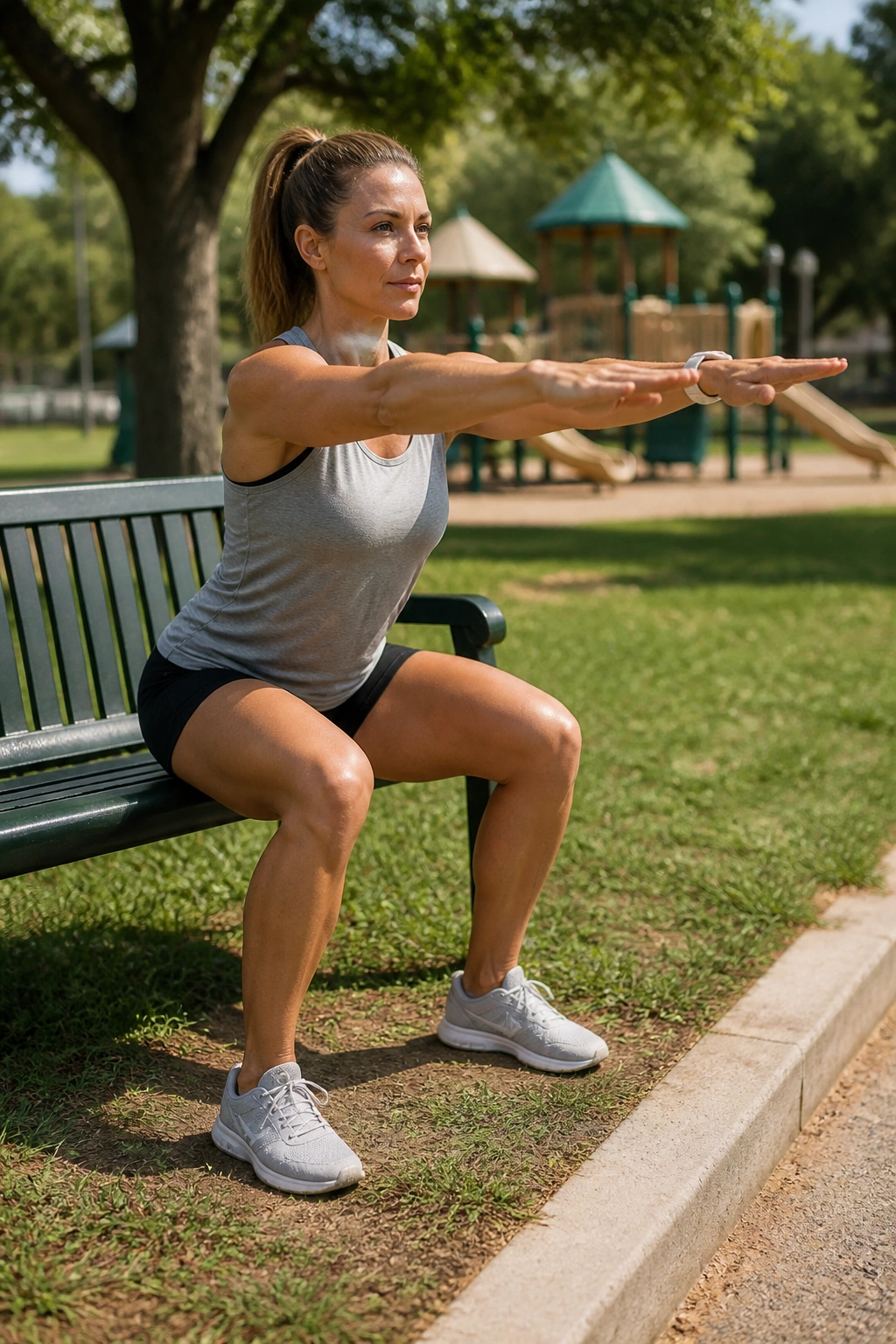
When the park has a bench, a curb, and a bit of flat ground, you can build a whole circuit without wandering far from the stroller. That’s why this one earns a spot near the end. It pulls several of the earlier moves into one compact session.
Park the stroller somewhere safe and locked. Then move through a sequence like this: 12 bench squats, 8 incline push-ups, 10 reverse lunges per side, 20 calf raises, and 20 seconds of marching high knees. Rest for 60 seconds. Repeat for 3 rounds.
A simple three-round plan
- Round 1: Keep everything moderate and smooth.
- Round 2: Slow the lowering phase on squats and push-ups.
- Round 3: Shorten the rest a little if you feel good.
That’s enough to make the session feel complete without dragging on forever. If your park has a shady spot nearby, use it for your rest breaks. If the ground is crowded, shorten the circuit and keep moving.
This style works because it keeps your brain from getting bored. You’re not stuck doing the same motion for half an hour. You’re changing positions, using different muscles, and giving your stroller walk a real training shape.
15. Cooldown Stretches Around the Park Loop
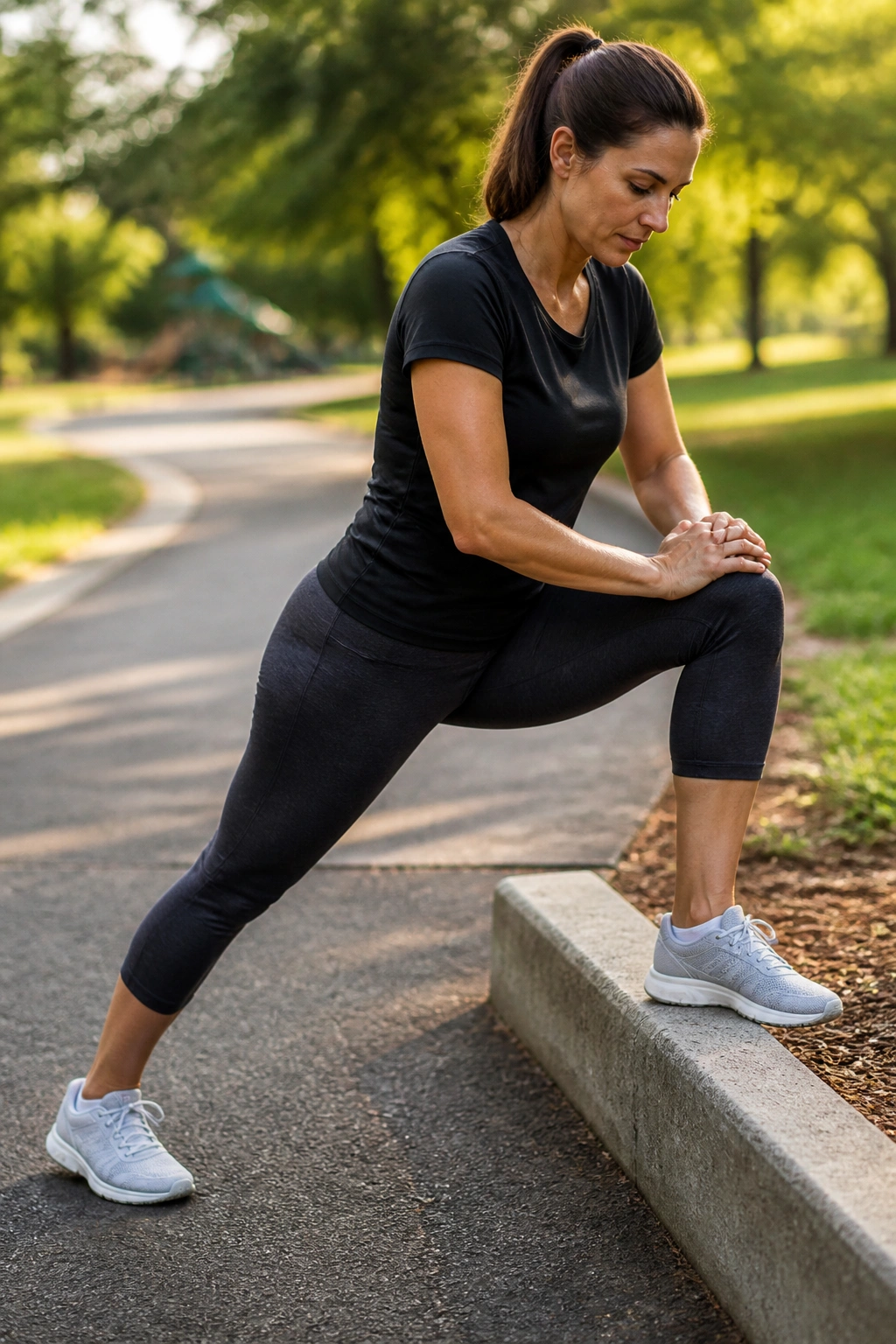
The last lap should feel like the brakes coming off, not like you slammed into the driveway and quit.
Walk slowly for 3 to 5 minutes, then stop somewhere flat and quiet for a few simple stretches. Use a curb for a calf stretch, hold the stroller with one hand while stepping one leg back for a gentle hip flexor stretch, and open the chest by clasping your hands behind you for a few breaths. If your neck feels tight, turn your head slowly side to side instead of yanking on it.
A clean closing sequence
- Calf stretch: 20 to 30 seconds per side.
- Hip flexor stretch: 20 to 30 seconds per side.
- Chest opener: 3 slow breaths.
- Shoulder rolls: 5 backward circles, then 5 forward.
Keep the stretches mild. You should feel a pull, not pain. If you’re sore from hills or lunges, this part matters more than it seems to. It helps the next park session feel less stiff and a lot more doable.
I’d argue this is the most underrated stroller workout of the bunch, mostly because it doesn’t look like much. But a calm finish leaves you walking away feeling loose instead of folded in half, and that’s a better way to come back tomorrow.
