



By midafternoon, a desk can feel like a trap. Your hips get stiff, your lower back starts grumbling, your shoulders drift forward, and your waist somehow feels more noticeable than it did in the morning. If you’re hunting for belly fat workouts for sitting all day, that feeling matters more than most people realize, because long stretches in a chair tend to cut down the small bursts of movement that usually keep daily calorie burn from falling off a cliff.
Crunches alone will not fix that. You cannot strip fat from one spot with one exercise, and anyone promising otherwise is selling fantasy. What does work is a mix of short, repeatable movements that wake up big muscles, push your heart rate up, train your core the way it actually functions, and break the sitting cycle before one workday turns into five straight sedentary days stitched together.
Public-health guidance has long aimed adults toward at least 150 minutes of moderate weekly activity plus strength work on two days. That number sounds tidy on paper and impossible at a desk. But short movement breaks count, and controlled research on post-meal walking and brief exercise bouts has shown something useful: even small pockets of movement can help blood sugar, energy, and waistline goals more than staying planted in a chair.
One more detail, because it changes which exercises help most: after hours of sitting, your hip flexors shorten, glutes switch off, and your ribs tend to lift when you try to “work your abs.” That’s why some of the best belly-fat-friendly workouts start with glutes, legs, and posture instead of floor ab burners. Pick a few from the list below, do them for 20 to 45 seconds each, and your body will feel less chair-shaped by the end of the day.
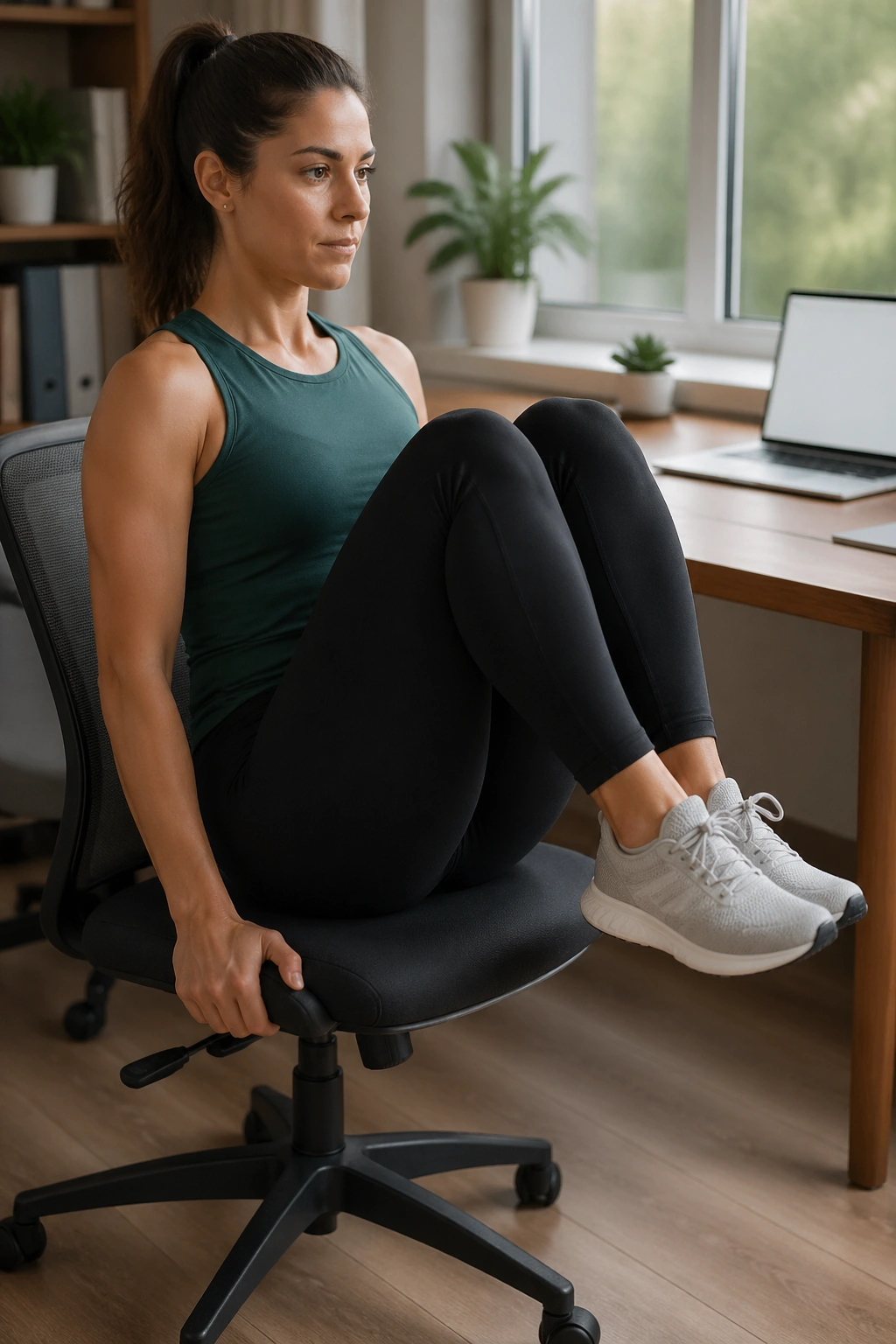
1. Seated Knee Tucks for a Belly Fat Workout at Your Desk
If you sit for eight hours, seated knee tucks earn their keep fast. They train the lower abs and hip flexors, yes, but the bigger win is that they force you to brace your trunk while your legs move. That’s closer to what your core is supposed to do in real life than flopping through loose crunches.
Sit on the front third of a sturdy chair with your hands gripping the sides. Lean back a touch—about 15 to 20 degrees—lift your feet, then pull both knees toward your chest. Exhale as they come in. Extend the legs out without collapsing your chest or rounding your lower back into the chair.
Why this one works at a desk
The chair supports part of your body, so you can focus on good abdominal tension instead of neck strain. That makes this move friendlier for people who have not trained their core in a while, and it fits in tiny work breaks without needing floor space.
Quick setup notes
- Use a chair without wheels if you can. Rolling backward mid-set is funny once.
- Aim for 12 to 20 reps or 30 seconds of steady work.
- Keep the motion small if your lower back feels pinchy.
- Think ribs down, chest open, not curled into a ball.
Best cue: breathe out hard as the knees come in; that exhale helps your abs switch on instead of letting your hip flexors steal the whole exercise.
2. Fast Chair Marches With Arm Swings
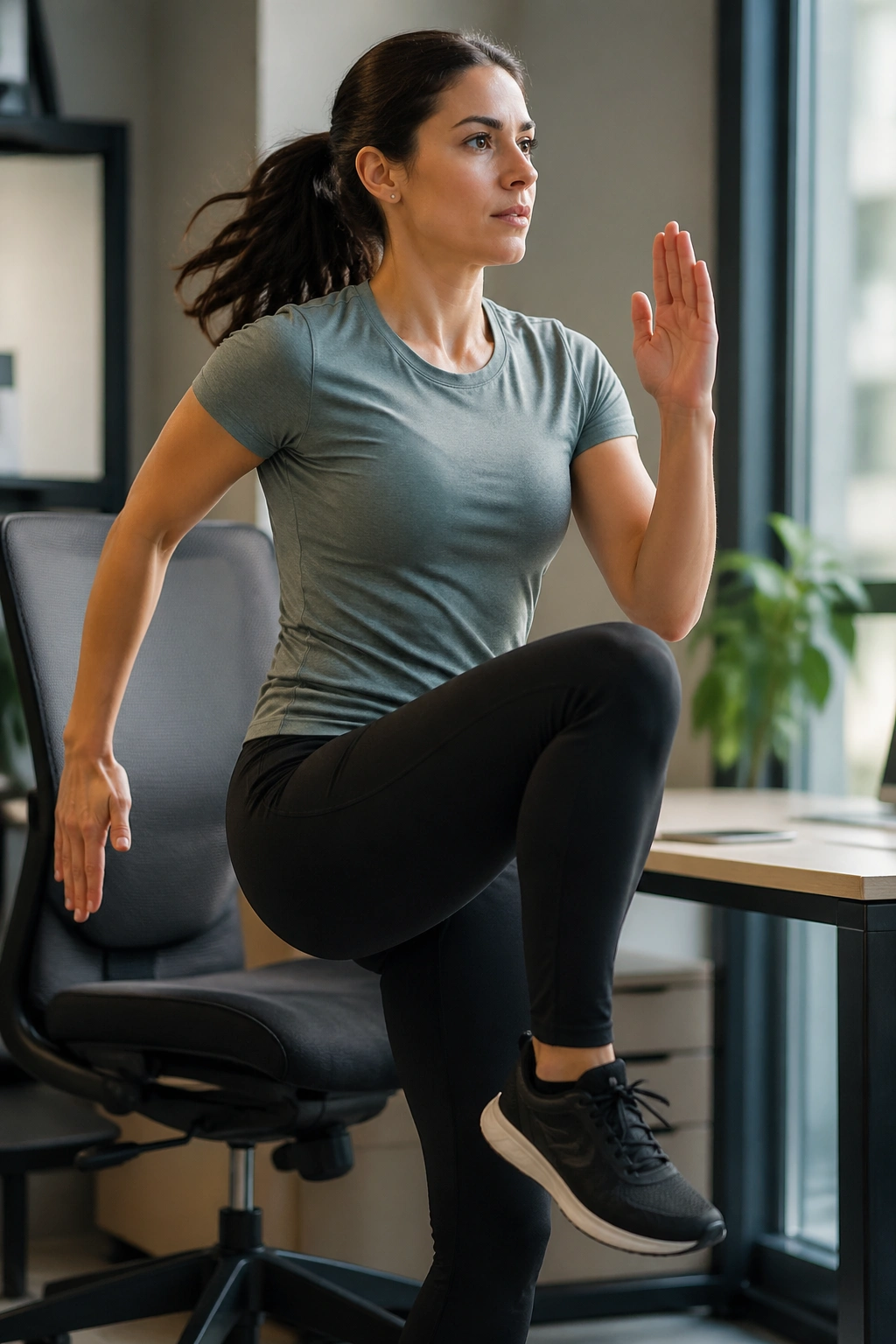
Can a seated move raise your heart rate enough to matter? Yes—if you stop treating it like rehab and start driving the pace.
Fast chair marches look almost too plain to count, which is part of why people skip them. That’s a mistake. Sit tall near the edge of the chair, plant your core, and pump one knee up at a time while your arms swing hard, almost like a sprint drill. After 20 seconds, you should feel your breathing change. After 40, you will know whether you were coasting.
This works well after lunch, when blood sugar and energy tend to swing in opposite directions. A brisk seated march can nudge circulation up, get your torso working, and break the sleepy slump that sends people reaching for snacks they were not planning to eat. Food is not the enemy here; staying frozen for three hours is.
Go with 40 seconds fast, 20 seconds easy, for 4 to 6 rounds. Keep your knees lifting to at least mid-thigh height if you can do that without leaning backward. Arms matter more than people think. Once you pump them with intent, the move shifts from “mild desk fidget” to legit cardio snack.
If your hip flexors cramp, slow down for one round and sit taller. That usually fixes it.
3. Standing Desk Mountain Climbers
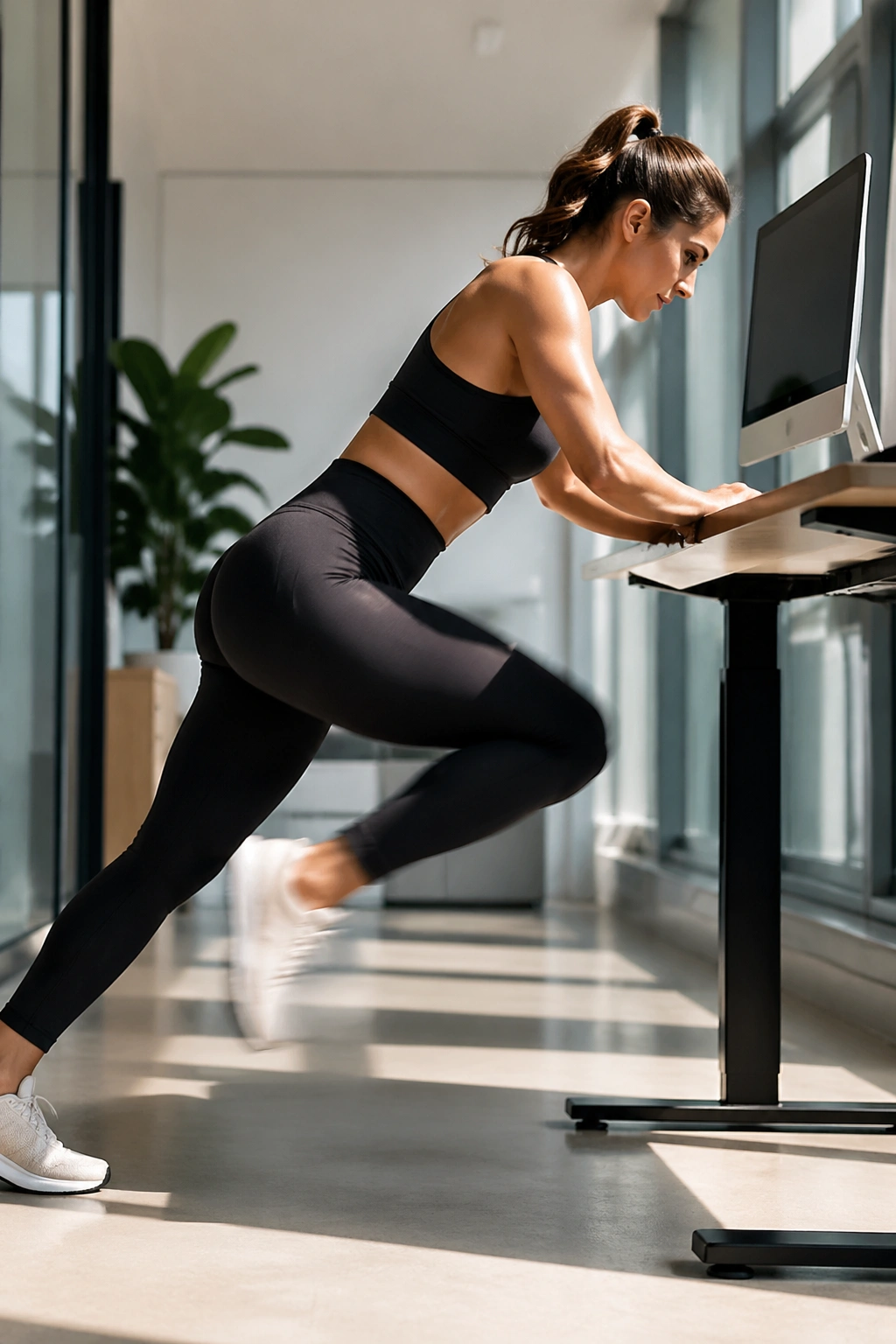
Picture the kind of afternoon where your focus is gone, your inbox is ugly, and your legs feel like borrowed furniture. That is a good time for standing desk mountain climbers.
Place both hands on the front edge of a sturdy desk, kitchen counter, or heavy table. Walk your feet back until your body forms a straight line from head to heels. From there, drive one knee toward your chest, switch, and keep alternating. You are not trying to sprint with sloppy hips. You are trying to move fast without your torso twisting all over the place.
Why use a desk instead of the floor? The incline cuts the load enough that more people can keep clean form, especially if wrists, shoulders, or low-back control are weak. You still get a mix of core bracing, shoulder stability, and light cardio, which is a strong combination for desk workers.
How to make the desk version count
Set the desk high enough that you can keep your spine long and your heels pressing back between knee drives. Start with 20 seconds on, 20 seconds off, for 6 rounds. Once that feels solid, move to 30 seconds on, 15 seconds off.
A quiet rule helps here: if your hips bounce higher than your shoulders, slow down. Speed without control turns this into noise.
4. Chair Squats From a Full Sit
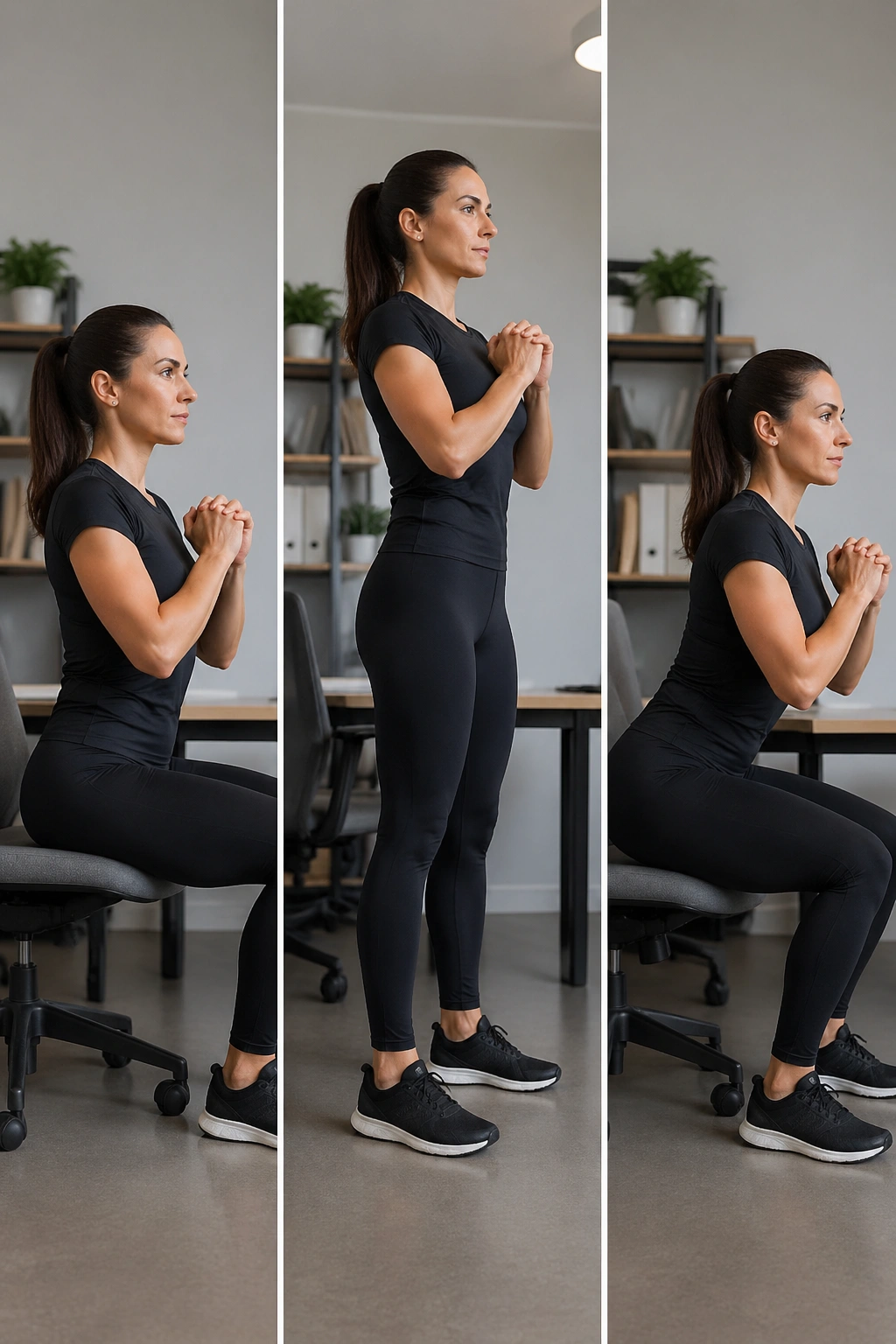
Here’s the contrarian take: one of the best belly-fat workouts for sitting all day starts by standing up and sitting back down on purpose. Chair squats are not glamorous. They are useful.
Sit fully in your chair with your feet about hip-width apart. Lean your torso forward a little, press through your heels, and stand up without using your hands. Lower back down under control until you lightly touch the chair, then stand again. That touch matters. It gives you a target and keeps the reps honest.
Why do they help a waistline goal? Because your legs and glutes burn more fuel than your abs do. Training them in short bursts gives you more muscle involvement per minute, and that’s a better deal than tiny isolation moves when you spend most of the day parked.
A few details make the move better:
- Keep your knees tracking over your middle toes, not caving inward.
- Let your chest lean forward a bit; staying bolt upright makes the rep clunky.
- Use 10 to 15 reps for 2 or 3 rounds.
- Hold a backpack to your chest once bodyweight stops feeling challenging.
Stand up fast. Sit down slower. That rhythm turns an easy sit-to-stand into honest work.
5. Seated Russian Twists With a Water Bottle
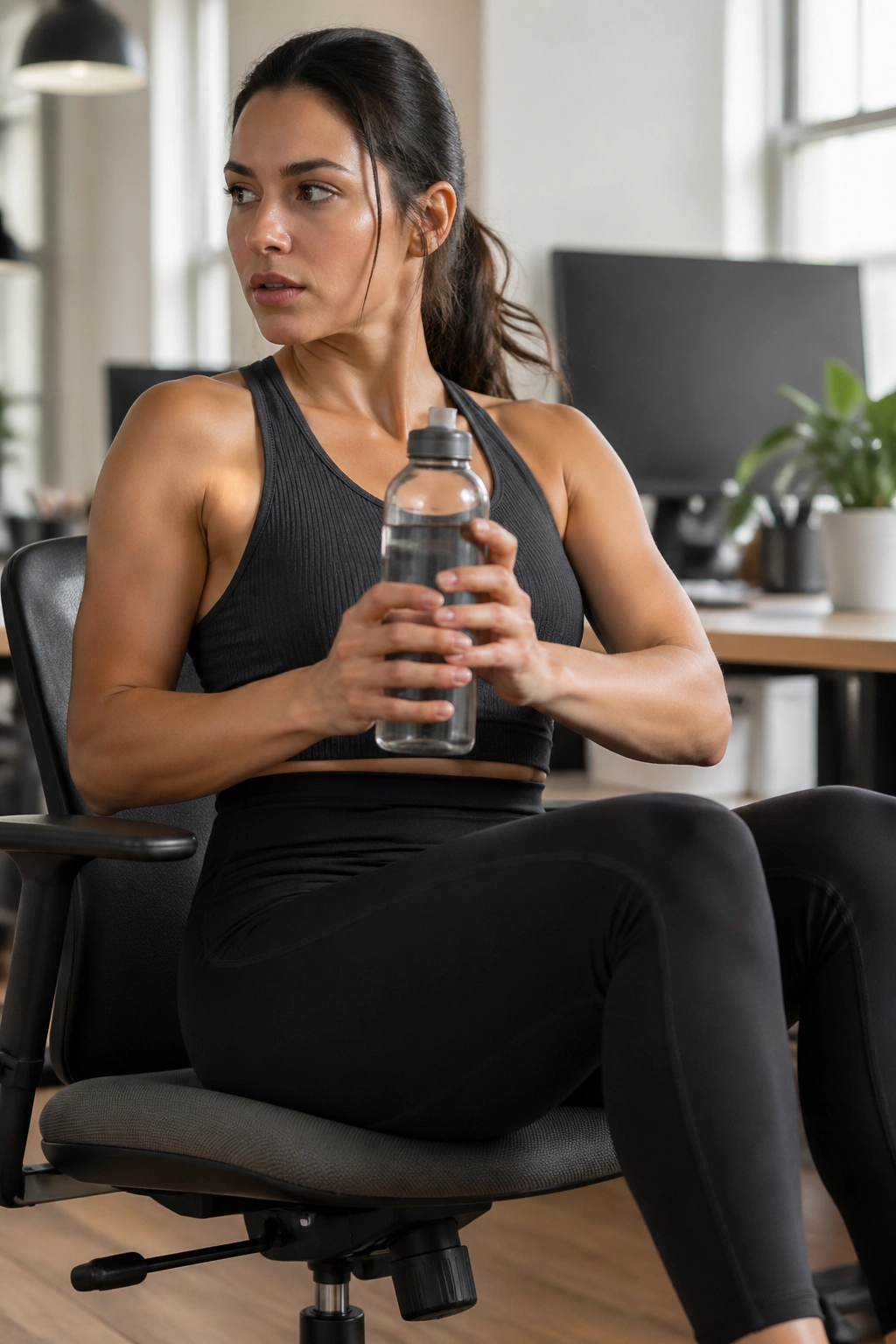
You can feel a bad Russian twist the second it starts. The shoulders yank, the hands fling side to side, and the low back takes the hit while the abs barely join in. A good one feels different. Your ribs rotate over a braced pelvis, the motion is sharp but controlled, and your obliques start warming up within a few reps.
Sit on the edge of a chair and lean back slightly. Hold a filled water bottle, coffee thermos, or small bag at chest height. Twist to one side, come through center, then twist to the other. If lifting your feet turns the move into a balance circus, keep your heels down. No prize for wobbling.
Range matters less than control. Most people go too far and lose tension. A twist of 30 to 45 degrees each way is enough when your trunk stays tight. Exhale on each turn. That breath cue does more for abdominal engagement than adding another five pounds ever will.
Use 16 to 24 total twists. Move slowly enough that you could pause at either side without falling apart.
Low back feeling cranky? Shrink the range and sit taller. If it still feels rough, skip this one and use dead bugs or standing oblique crunches instead.
6. Wall Push-Ups With a Knee Drive
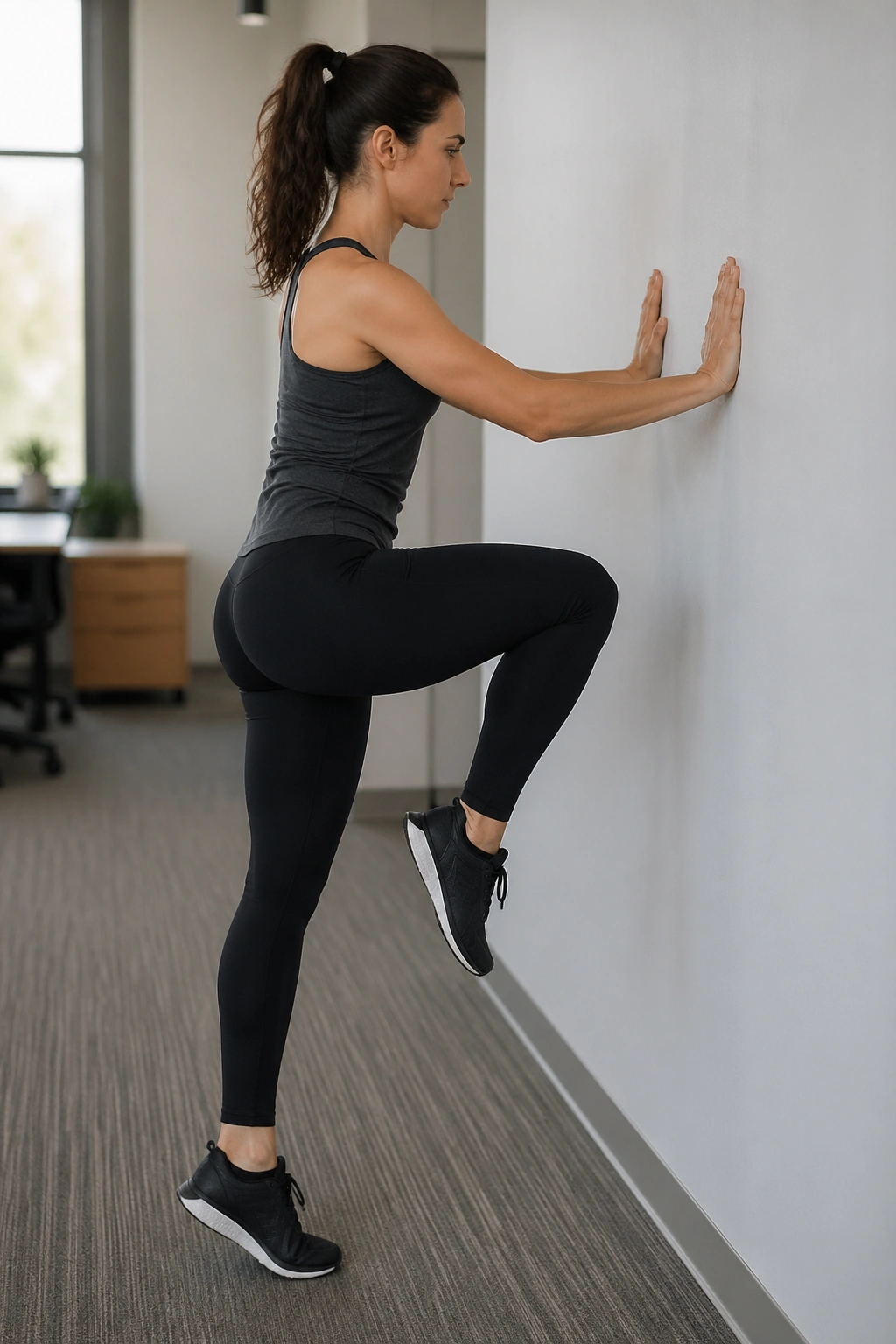
Unlike plain wall push-ups, adding a knee drive turns an upper-body move into a full-body pattern. You get chest, shoulders, triceps, a bit of cardio, and a core brace that feels much closer to running than to traditional ab work.
Stand facing a wall, hands a little wider than shoulder width. Walk your feet back until your body sits on a slight angle. Lower your chest toward the wall, press away, then drive one knee up toward your chest as the opposite arm stays strong. Reset and repeat, alternating knees each rep.
This works well for beginners, for people with wrist issues on the floor, and for anyone squeezed into a small office. The move is easier than a plank series but harder than it looks, especially if you pause the knee at the top for one count.
Go with 8 to 12 push-up reps per side. If that feels mild, stand farther from the wall. If balance is shaky, widen your stance and keep the knee drive lower.
Who gets the most from it? People who need one exercise that wakes up the upper body after typing, raises breathing a notch, and does not require changing clothes or finding floor space.
7. Glute Bridges to Undo Hours of Sitting
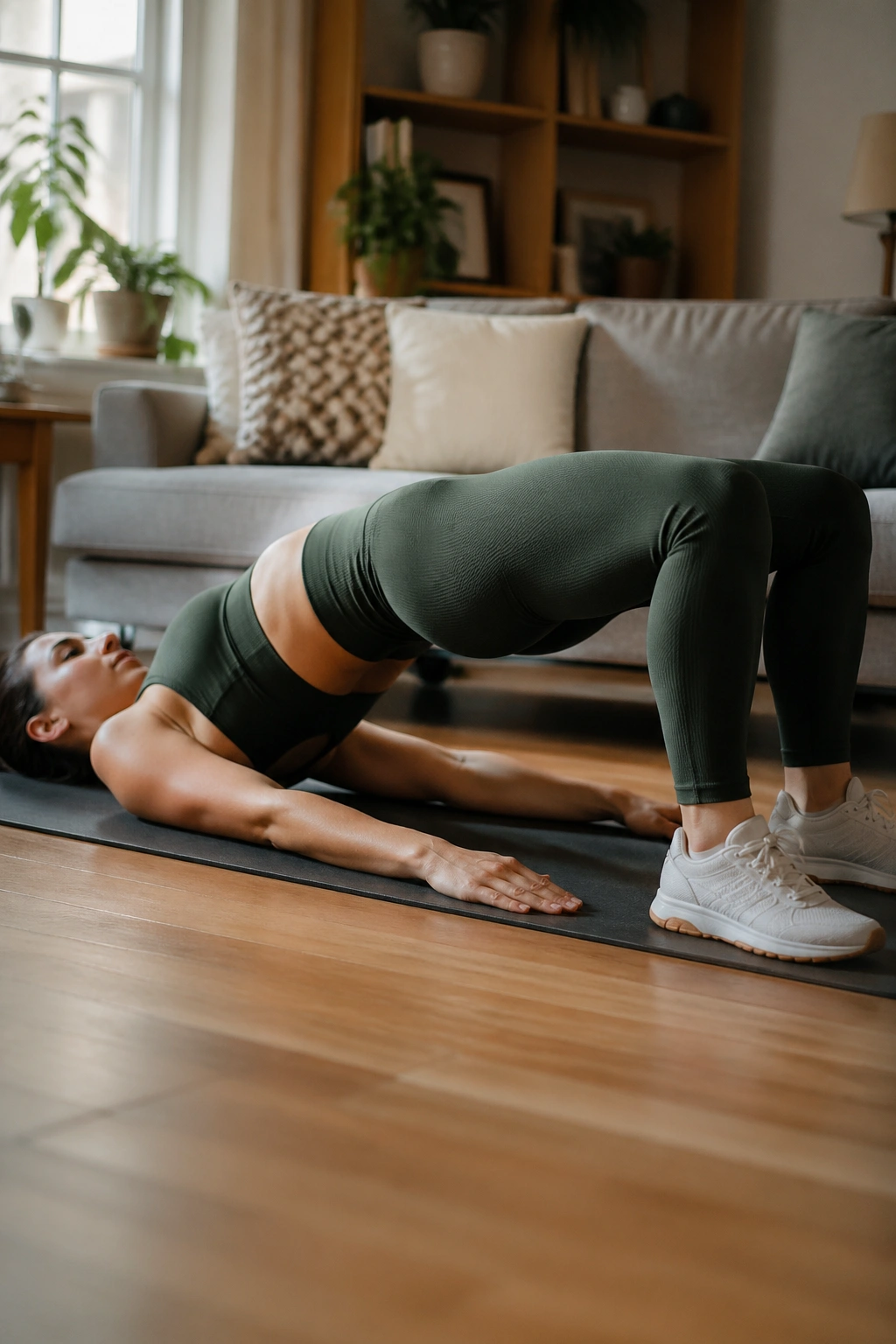
After a long block in a chair, your backside goes quiet. Not medically dead—let’s not get dramatic—but your glutes stop contributing as much as they should, and your low back or hamstrings often jump in to cover the job. Glute bridges are the reset button.
Lie on your back with knees bent, feet flat, and heels about a hand’s length from your hips. Press through your heels and lift your hips until your body forms a line from shoulders to knees. Pause for two seconds at the top. Lower slowly.
Why this one matters more than it looks
A bridge is not only a butt exercise. It teaches your pelvis and ribs to stack better, which helps your abs work from a stronger position. When that alignment improves, other belly fat workouts—planks, climbers, march intervals—feel cleaner and often harder in the right way.
Use these cues
- Push through the whole foot, with extra pressure through the heel.
- Stop the lift when your glutes squeeze hard. Higher is not always better.
- Try 12 to 15 reps, or hold the top for 20 to 30 seconds.
- Want more challenge? March one knee up at a time while staying bridged.
Small tweak, big payoff: tuck your chin lightly and keep your ribs from flaring upward at the top.
8. Standing Oblique Crunches for a Fast Belly Fat Workout Break
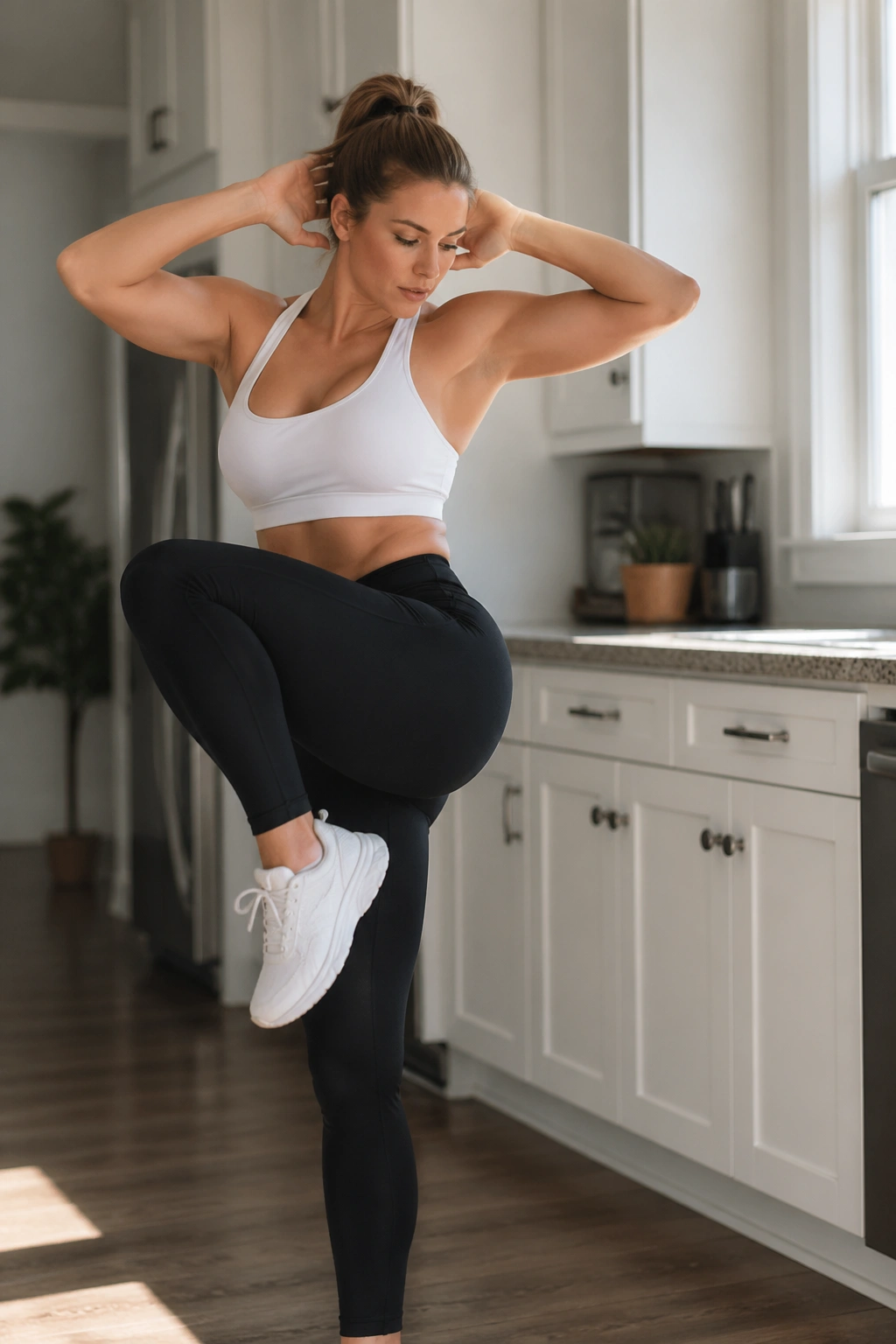
Your obliques like standing work more than most people think. Done well, standing oblique crunches hit the side wall of the trunk, train balance, and let you move with some speed without dropping to the floor.
Stand tall with both hands lightly behind your head. Shift your weight into your left foot, lift your right knee, and bring your right elbow down toward it. Return to standing with control, then repeat before switching sides. A lot of people pull on the neck here. Don’t. The elbow is traveling because your side abs shorten, not because your hand yanks your head down.
This move shines during short breaks between calls because setup takes three seconds and the learning curve is low. Push the pace and it becomes a cardio-core blend. Slow it down and it becomes a balance drill with a nice oblique burn.
Try 15 to 20 reps per side. On the last five reps, pause for half a second when elbow and knee get close. That pause strips out momentum and makes the work land where it should.
Short people, tall people, cramped office, no mat—none of that matters much here. You only need enough room to stand and move one knee.
9. Reverse Lunges Behind Your Chair
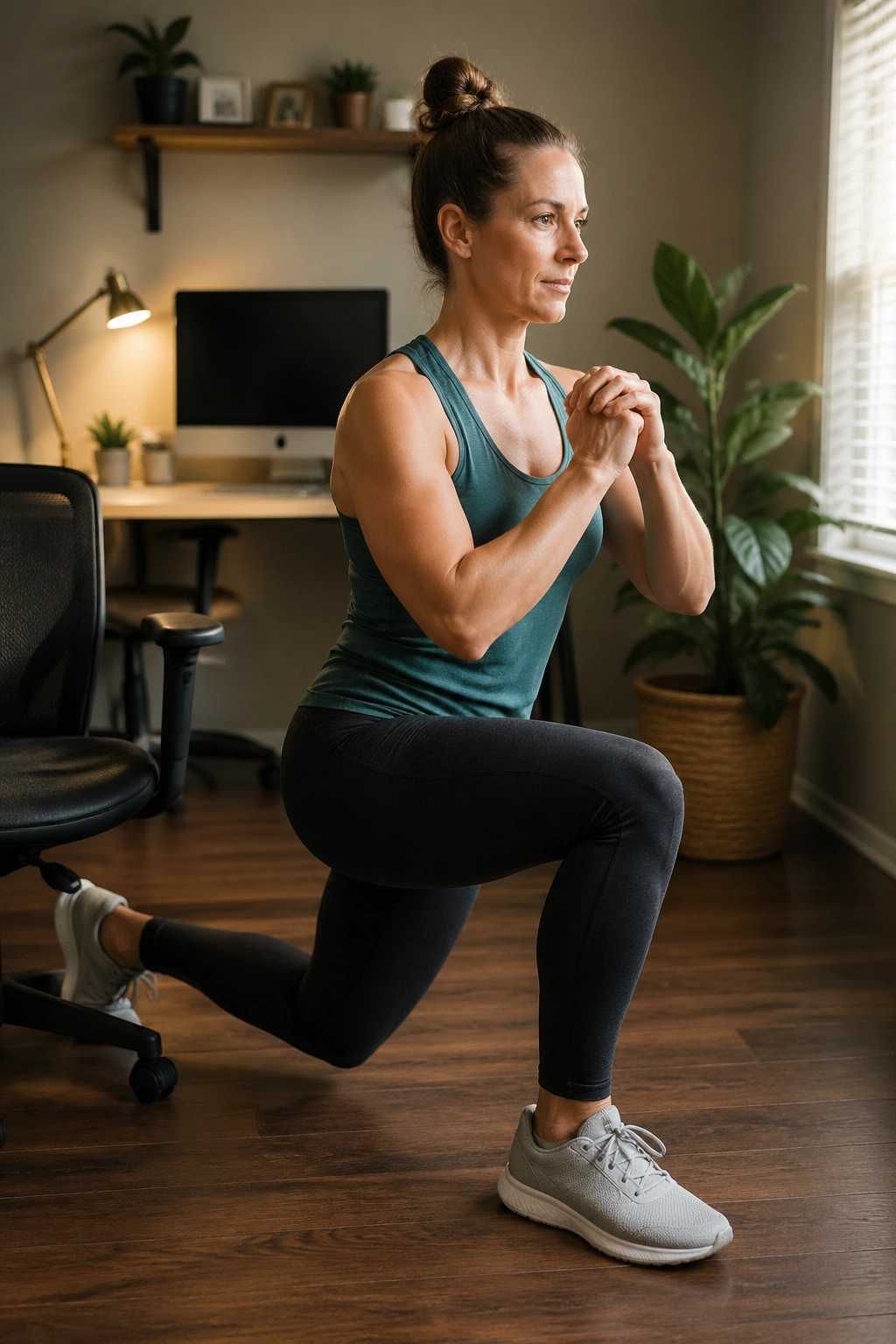
Why go backward instead of forward? Reverse lunges usually feel kinder on the knees and easier to control, which matters when you are squeezing exercise into a work break instead of a full warm-up.
Stand behind your chair and hold the backrest lightly if balance is iffy. Step one foot backward, lower until both knees bend, then drive through the front foot to come back up. Alternate sides or finish one side before switching. A slight forward torso lean is good here; it helps the glutes join the party.
Reverse lunges matter for more than legs. They open the hip of the trailing leg, which is useful after long sitting, and they ask your trunk to stabilize while your lower body moves under it. That brace is where the “belly fat workout” angle comes in. No, the lunge does not melt stomach fat on contact. It does recruit a lot of muscle, which makes it a better calorie burner than most seated ab moves.
How to push the challenge
Use 8 to 10 reps per side. Hold the bottom for one second, or add a knee drive as you stand back up. If the floor is slippery, shorten the step and move slower.
Front knee barking? Take a longer step back and sit your hips down instead of jamming the knee forward.
10. High-Knee March Intervals in Place
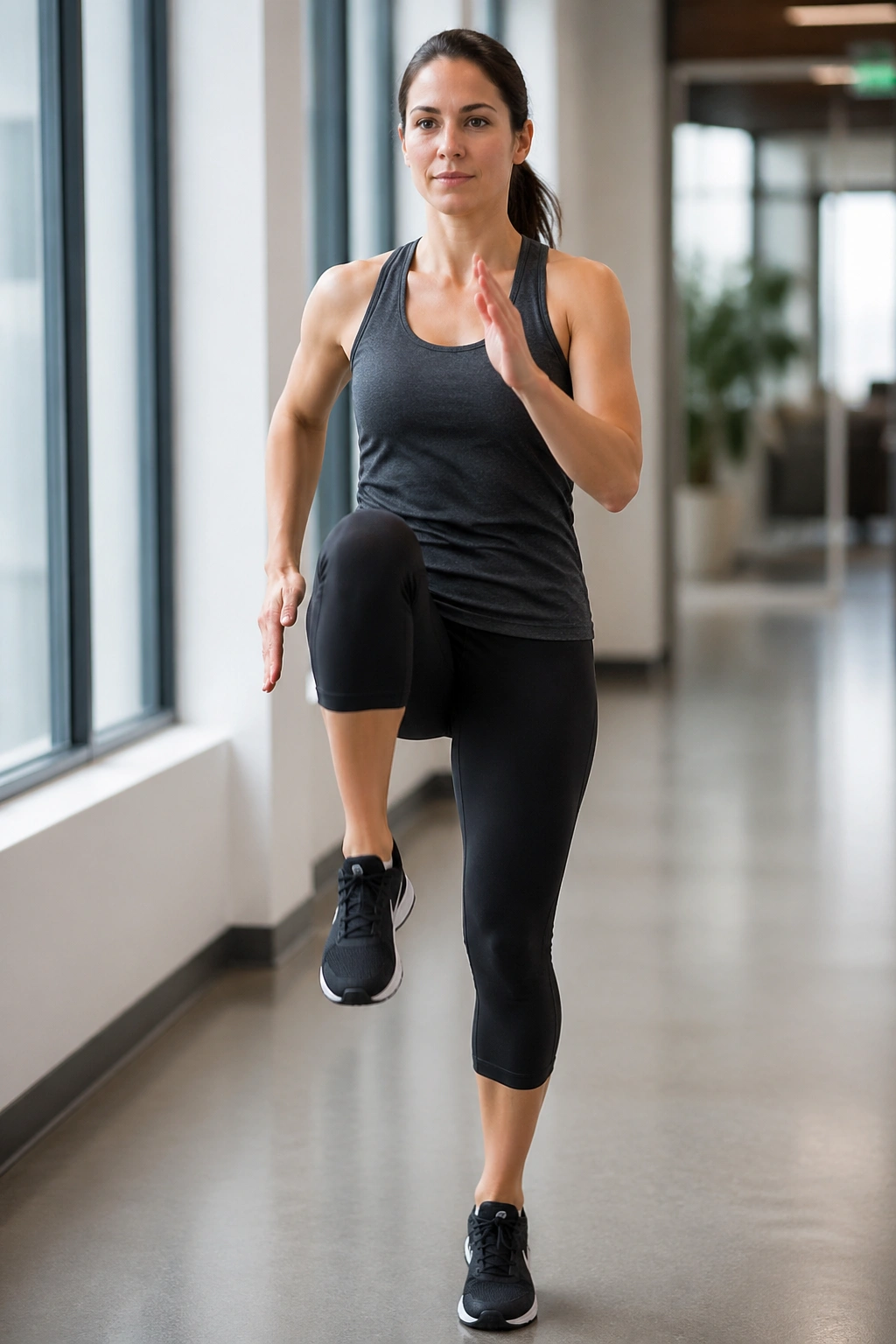
A classic 4 p.m. scene: your brain is fried, your posture is gone, and you do not have the appetite for burpees. High-knee march intervals are the answer on days like that because they land right in the middle—harder than a walk, easier on the joints than running in place.
Stand tall and drive one knee up to hip height while the opposite arm swings forward. Alternate fast, but keep the move crisp. This is a march, not a bounce. Your foot should return under your hips, not kick way out in front.
The magic is in the arms and timing. Once you start pumping your elbows back with intent and land softly, the move starts feeling athletic instead of awkward. Your heart rate rises, your abs brace to stop you from tipping, and your hip flexors get a controlled range of motion that beats being stuck at 90 degrees all day.
Use intervals like these:
- 45 seconds brisk work
- 15 seconds easy march
- Repeat for 5 to 8 rounds
- Raise the knees to hip height or a little lower if your back stays neutral
Done before a meeting, this can sharpen focus more reliably than another mug of coffee.
11. Dead Bugs for a Flat-Back Core Drill
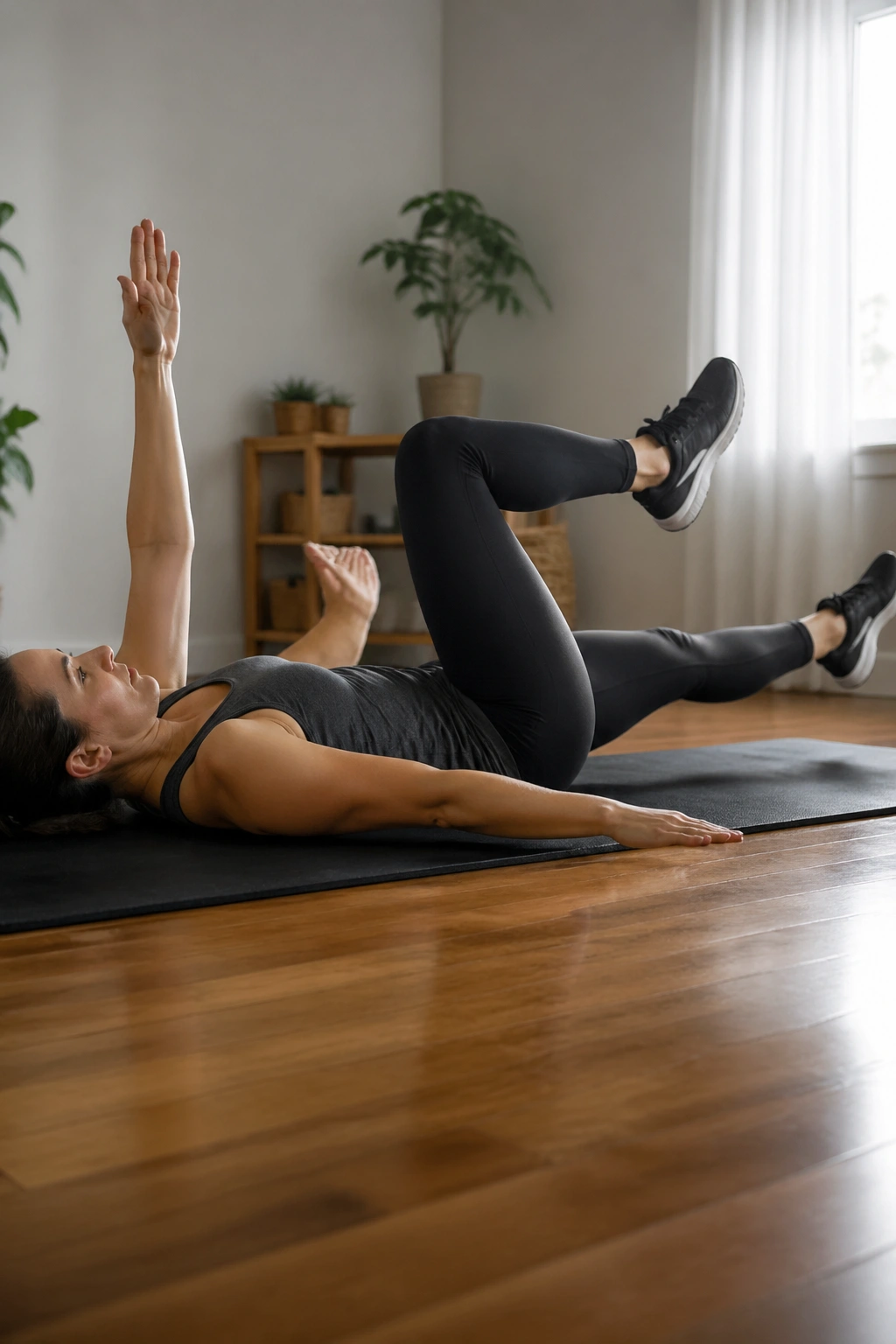
Dead bugs are boring. Good. Boring exercises tend to survive because they work.
Lie on your back with arms pointed toward the ceiling and knees bent over your hips. Flatten your lower back gently into the floor—not by crushing it, but by pulling your ribs down. Extend your right leg and left arm away from each other. Return, switch sides, and keep going with slow control.
This drill teaches something most desk workers need: how to move arms and legs without letting the torso spill into extension. That matters because sitting all day often leaves people with a rib flare and an arched low back when they try to “brace.” Dead bugs clean that up. They make planks better. They make mountain climbers cleaner. They even make walking feel less sloppy once you notice the difference.
Go slow enough that each rep takes 3 to 4 seconds out and 2 seconds back. Start with 5 to 8 reps per side. If the low back lifts, shorten the leg reach. If hip flexors cramp, keep the knee more bent.
No neck strain. No flailing. No ego. That’s the appeal.
12. Plank Shoulder Taps Without Hip Rocking
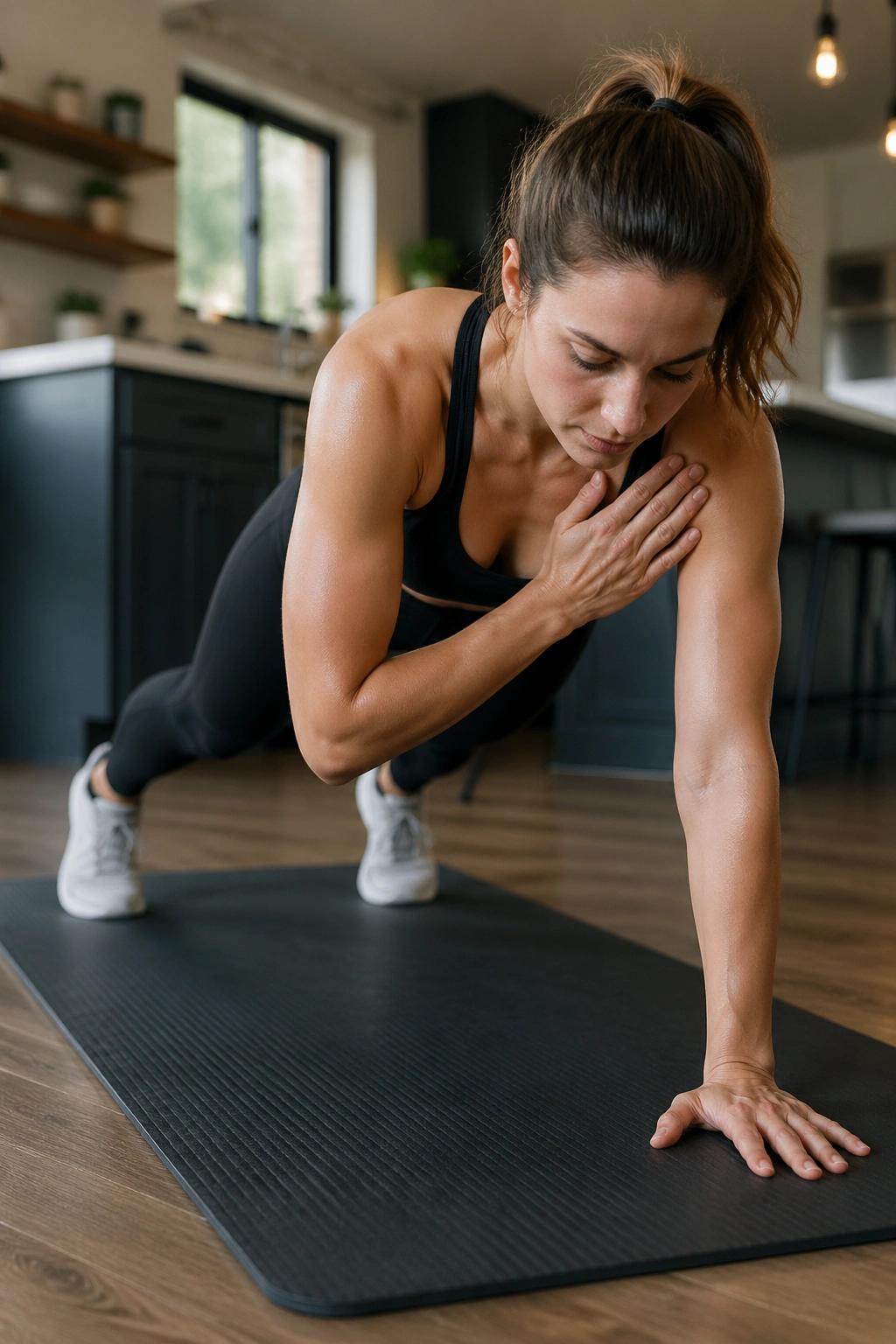
Unlike a standard plank, shoulder taps punish any wobble you cannot control. That makes them a sharp test of core stiffness, shoulder stability, and patience.
Set up in a high plank with hands under shoulders and feet wider than hip width. Squeeze your glutes, brace your abs, and tap one hand to the opposite shoulder. Set it back down quietly. Repeat on the other side. The challenge is not the tap. The challenge is keeping your hips from swaying like a metronome.
People who sit all day often rush this one and miss the point. A slower tap with a wide foot stance will light up your midsection far more than rapid slaps with a twisting torso. Each time you remove one hand from the floor, your trunk has to resist rotation. That anti-rotation demand is gold for building a stronger, firmer core.
This move suits intermediate exercisers well. Beginners can use a countertop or desk and do the same pattern on an incline.
Start with 10 to 20 total taps per side. If your lower back sinks, stop the set there. Quality fades fast on planks.
13. Stair Intervals for a Harder Belly Fat Workout Between Meetings
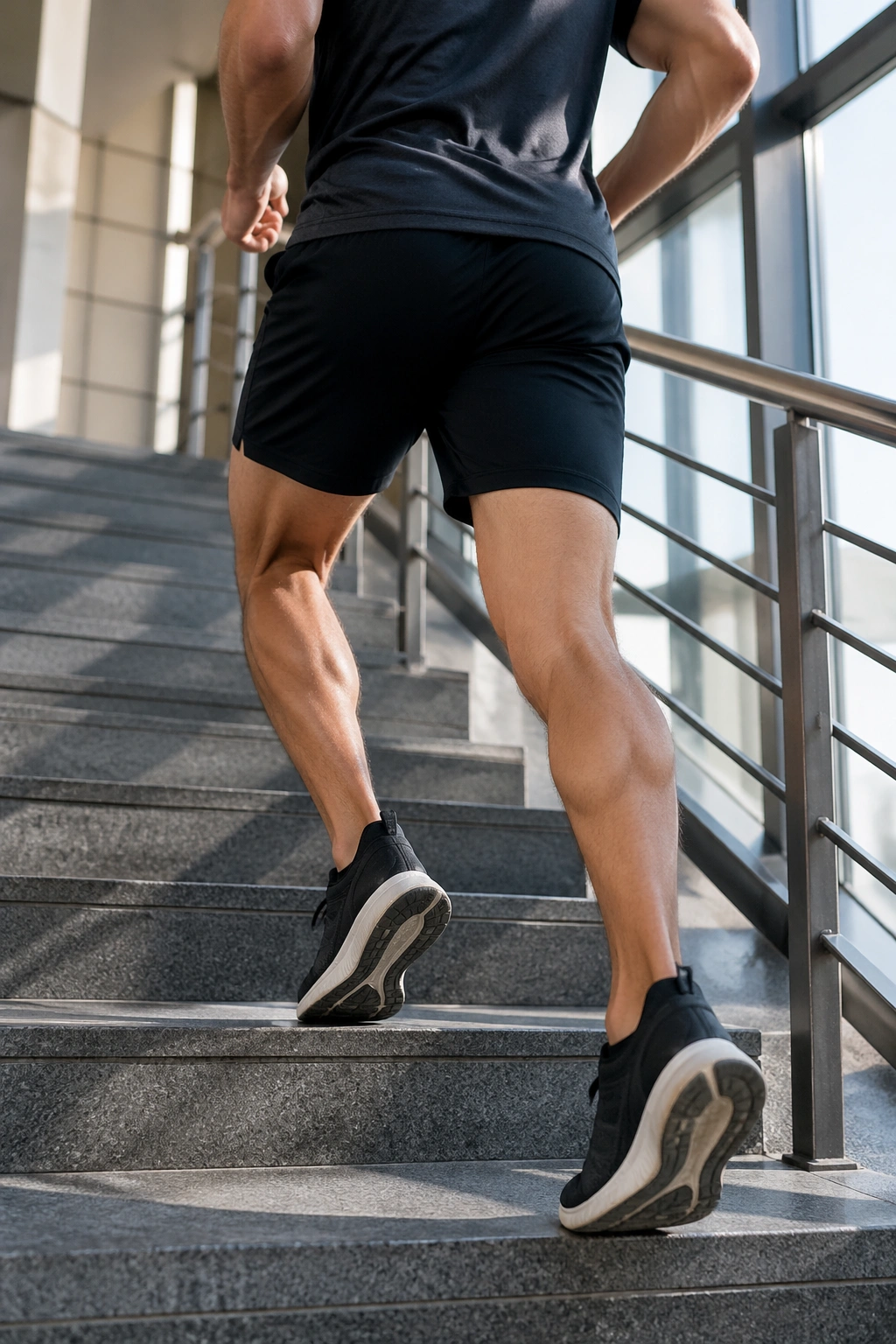
Your breathing changes fast on stairs. That is the whole point.
If you have access to one flight, you have a solid conditioning tool. Walk up briskly, or climb at a strong pace without sprinting. Walk back down under control. Repeat. The climb hits glutes, quads, calves, and lungs all at once, which is hard to match with desk exercises alone.
Why stairs work so well for sedentary days
A stair climb piles a lot of muscular work into a short window. You lift your whole body against gravity with every step, and that makes the effort feel honest within 20 or 30 seconds. More muscle working means higher energy demand, which is why stairs are such a useful choice for people trying to chip away at body fat while stuck at a desk for most of the day.
A clean way to structure it
- Climb for 20 to 30 seconds
- Walk down and recover for 40 to 60 seconds
- Repeat for 6 to 10 rounds
- Use the handrail lightly; do not drag yourself up with it
One rule: stop the set before your form turns heavy and stompy. Quiet feet usually mean you are still in control.
14. Bear Crawl Holds and Two-Step Crawls
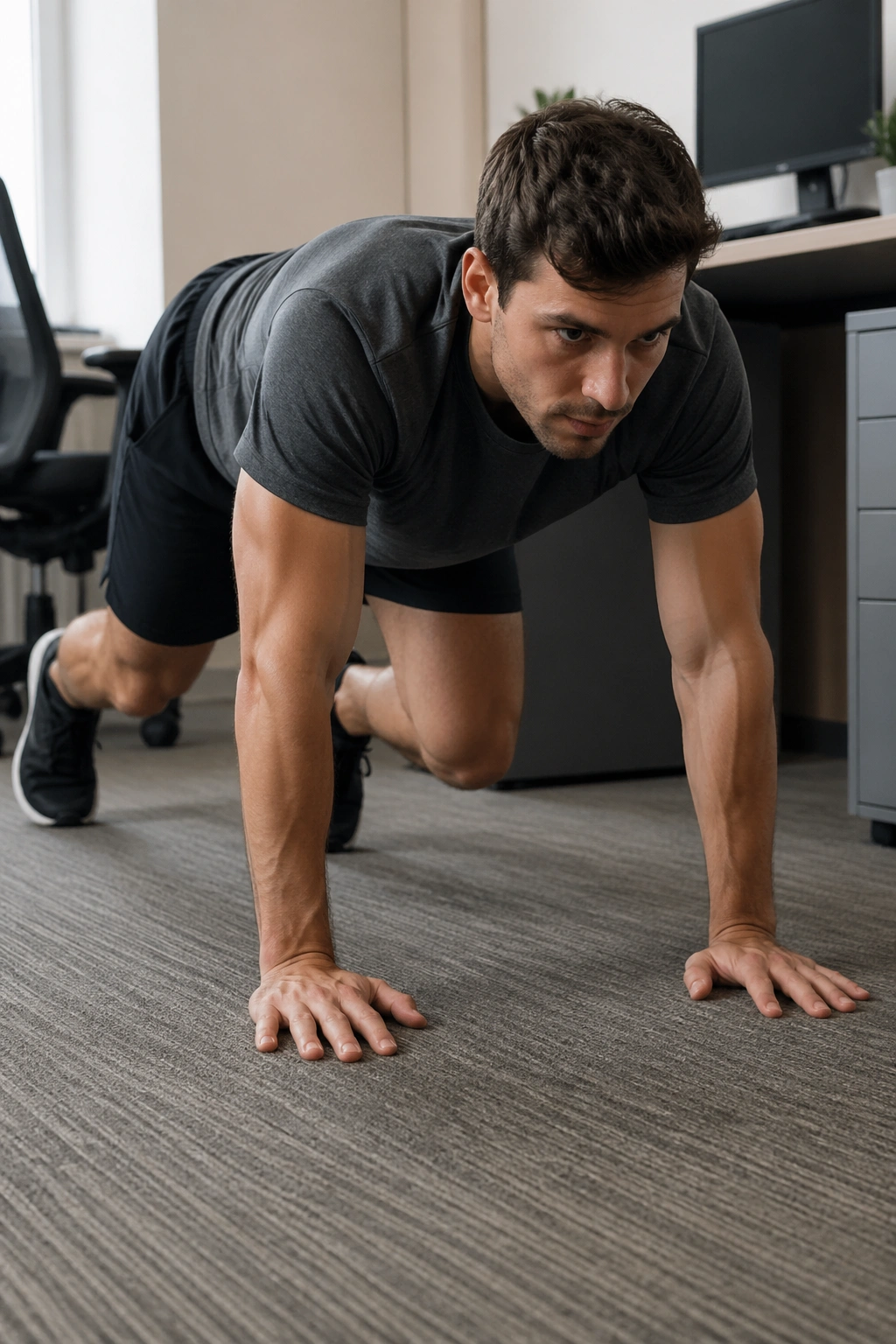
Bear crawl holds look a little odd in office clothes, but they hit the exact muscles sitting tends to mute. Shoulders. Deep abs. Quads. Glutes. Even the feet have to wake up.
Start on all fours, then lift your knees one or two inches off the floor. Hands sit under shoulders, knees under hips, spine long. Hold that position for 15 to 20 seconds. If it feels solid, crawl forward for two small steps, then back for two. Small is the key word here. The best bear crawls are compact and controlled, not sprawling.
This move does something desk workers need badly: it links the upper and lower body while the trunk resists collapse. You will feel your abs, but you will also notice your shoulders and thighs doing hard work. That wider muscle involvement is what makes it useful for fat-loss training rather than treating the core like a tiny isolated target.
Use 3 to 5 rounds. Rest 20 to 30 seconds between efforts. If your knees feel too loaded, stay with the hold and skip the crawl.
Close the office door if you want privacy. The exercise is worth the mild loss of dignity.
15. Seated Leg Extensions With Quad Pulses
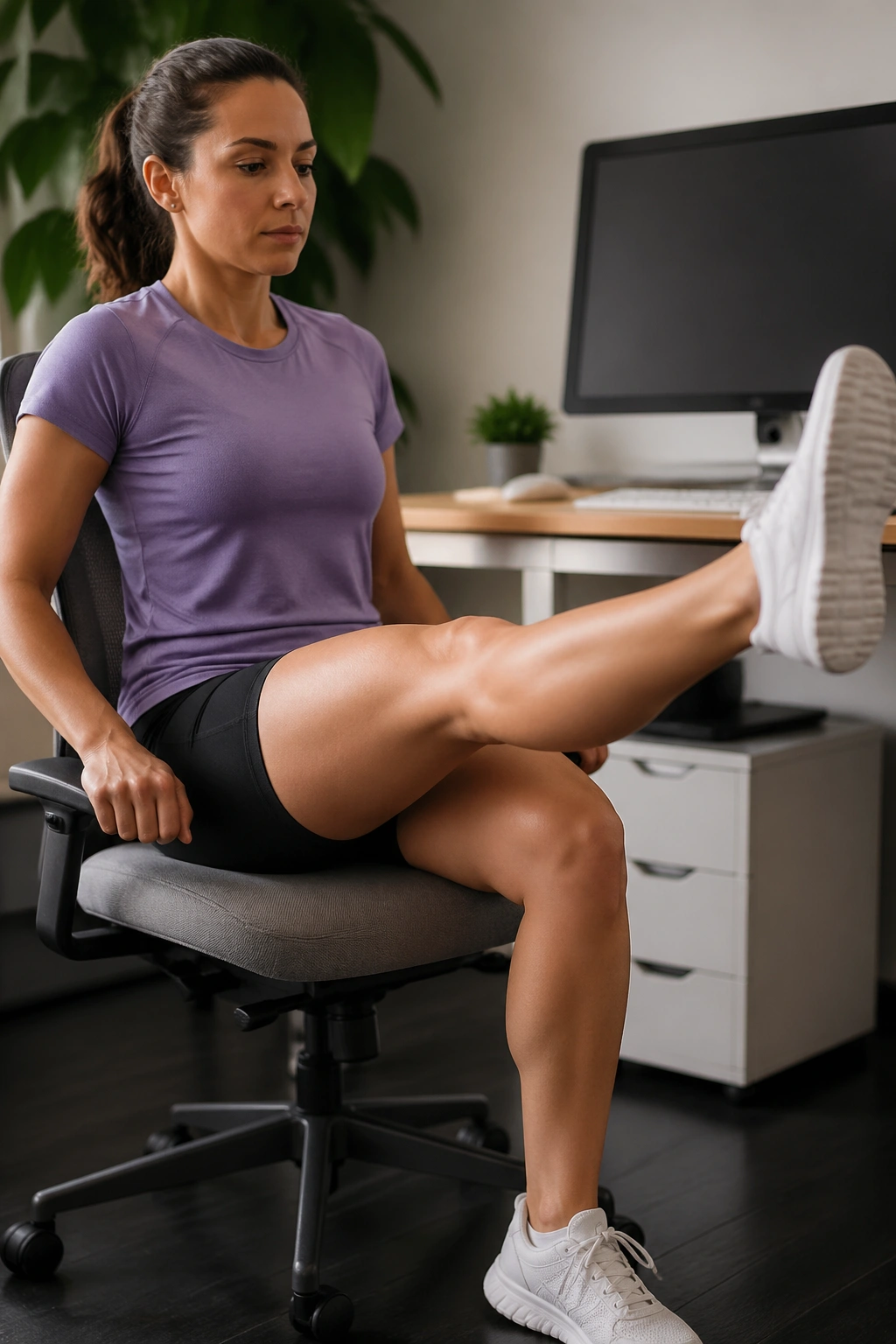
Can a seated leg exercise help when the goal is less belly fat? It can, especially during days when standing breaks are hard to come by and your knees feel stiff from being bent for hours.
Sit tall with your back away from the chair backrest so your trunk has to hold you upright. Extend one leg until it is straight or close to straight, squeeze the thigh hard, then pulse it up one inch for three small beats before lowering. Switch sides and repeat. The pulses make the rep bite without needing ankle weights.
This is not a huge calorie-burn move. That is not the point. It keeps the quads active, improves knee comfort for many people, and sneaks in postural core work because staying tall on the chair takes more abdominal control than slumping back and swinging the leg.
Make the last part of each set count
Use 12 reps per side, with 3 pulses at the top of each rep. Move slowly on the lowering phase. If you have a resistance band, loop it around the ankles for extra tension.
Pair this with chair marches or squats and it becomes more useful than it looks on its own.
16. Fast Step-Ups on One Stair
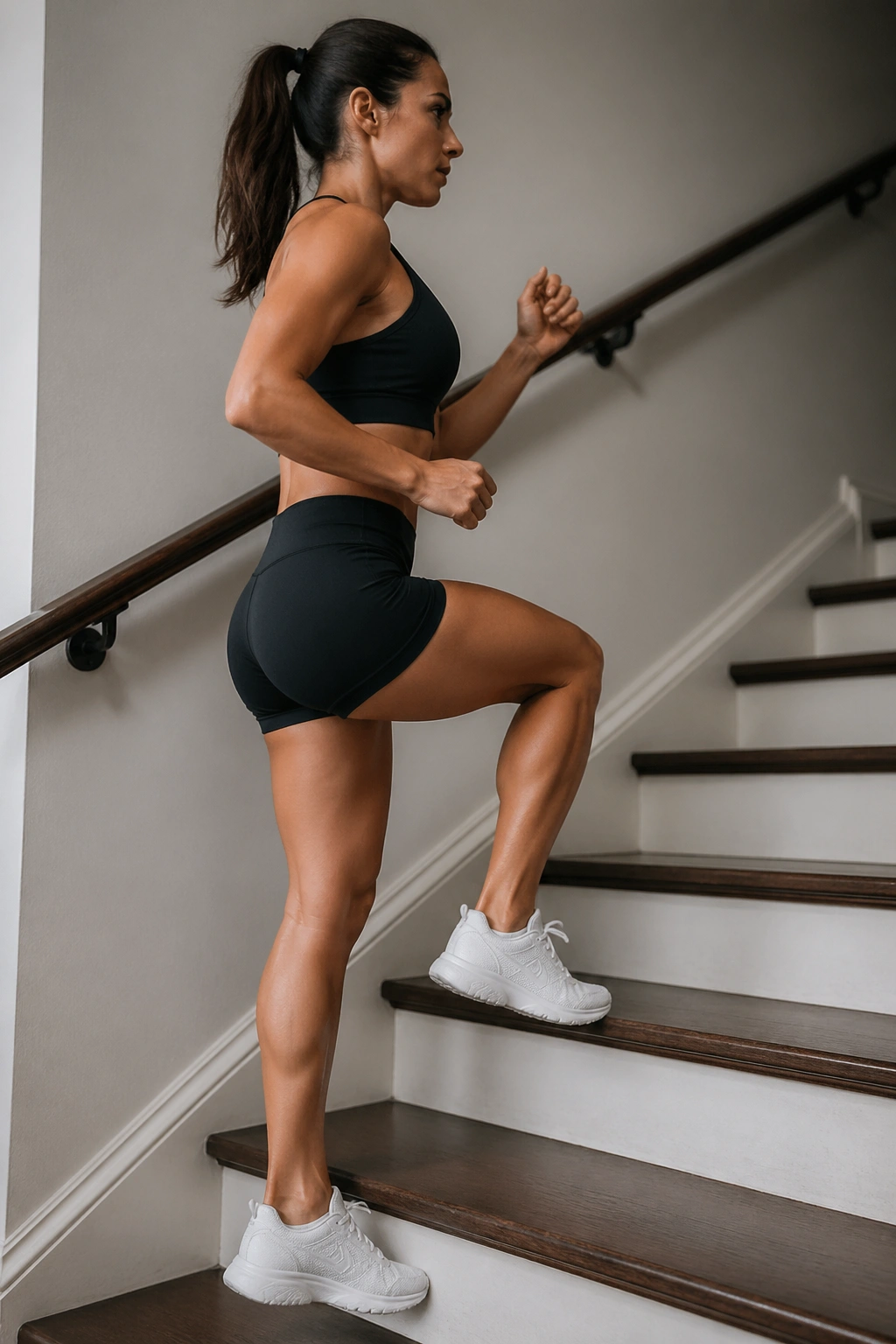
A single stair can carry more of the workload than people expect. Fast step-ups turn that one step into legs, lungs, balance, and core inside a short burst.
Place your whole right foot on the stair. Drive through that foot and step up, bringing the left knee high if you want more challenge. Step back down with control and repeat for time before switching lead legs. The full-foot setup matters. If your heel hangs off, you lose force and the rep gets wobbly.
This is one of those exercises that tells the truth quickly. Thirty seconds in, you know whether you are working or pretending to work. The pace can be brisk, but the torso should stay stacked instead of folding over the thigh.
A few useful details:
- Work for 30 seconds with the right leg leading
- Rest 15 to 20 seconds
- Work for 30 seconds with the left leg leading
- Repeat for 3 to 5 rounds
- Use a rail or wall for a fingertip assist if balance drifts
Tall step? Slow the tempo. Joint comfort beats speed every time.
17. Bicycle Crunch Sets Done Slowly
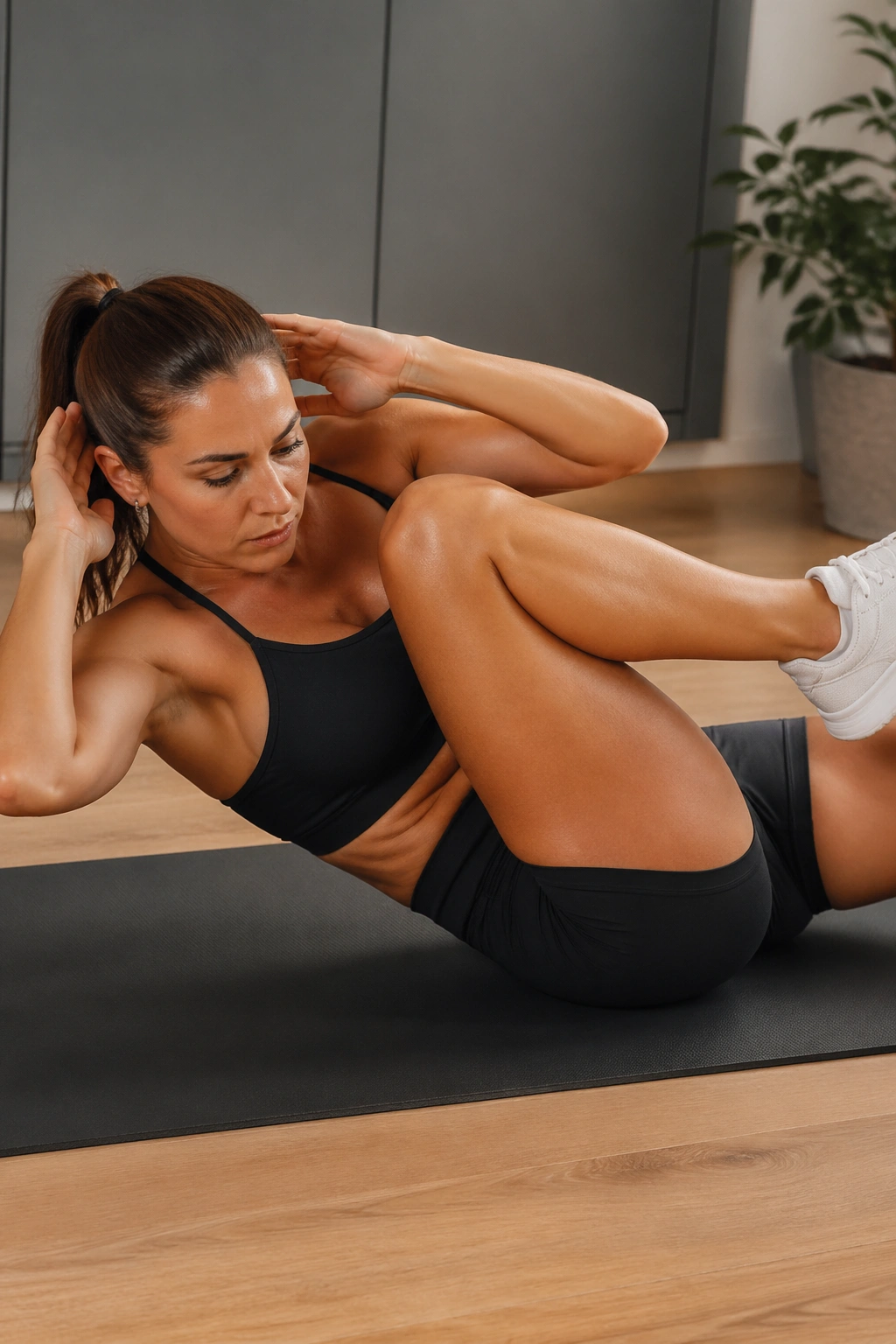
The frantic gym version of bicycle crunches is not worth much. Knees flying, elbows yanking, low back arching—no thanks. The slow version, though, earns a place here.
Lie on your back, hands resting lightly at the sides of your head, not clasped and pulling. Lift your shoulder blades off the floor, bring one knee toward your chest, and rotate your torso so the opposite rib cage moves toward that knee. Then switch with control. Think about moving your chest, not smashing your elbow into your leg.
Why go slow? Because a controlled bicycle turns into an anti-extension and rotational core drill, while a rushed one becomes a neck exercise. The pause between sides forces your abs to hold tension longer, which is where the training effect shows up. You do not need many reps if they are honest.
Aim for 10 to 16 reps per side. Exhale each time you rotate. Keep the nonworking leg higher if your lower back arches when it gets too low.
If your neck gets tired first, support your head more with your hands and make the twist smaller. Done right, your stomach and obliques should fail before your neck does.
18. Desk-Side Side Lunges for Tight Hips
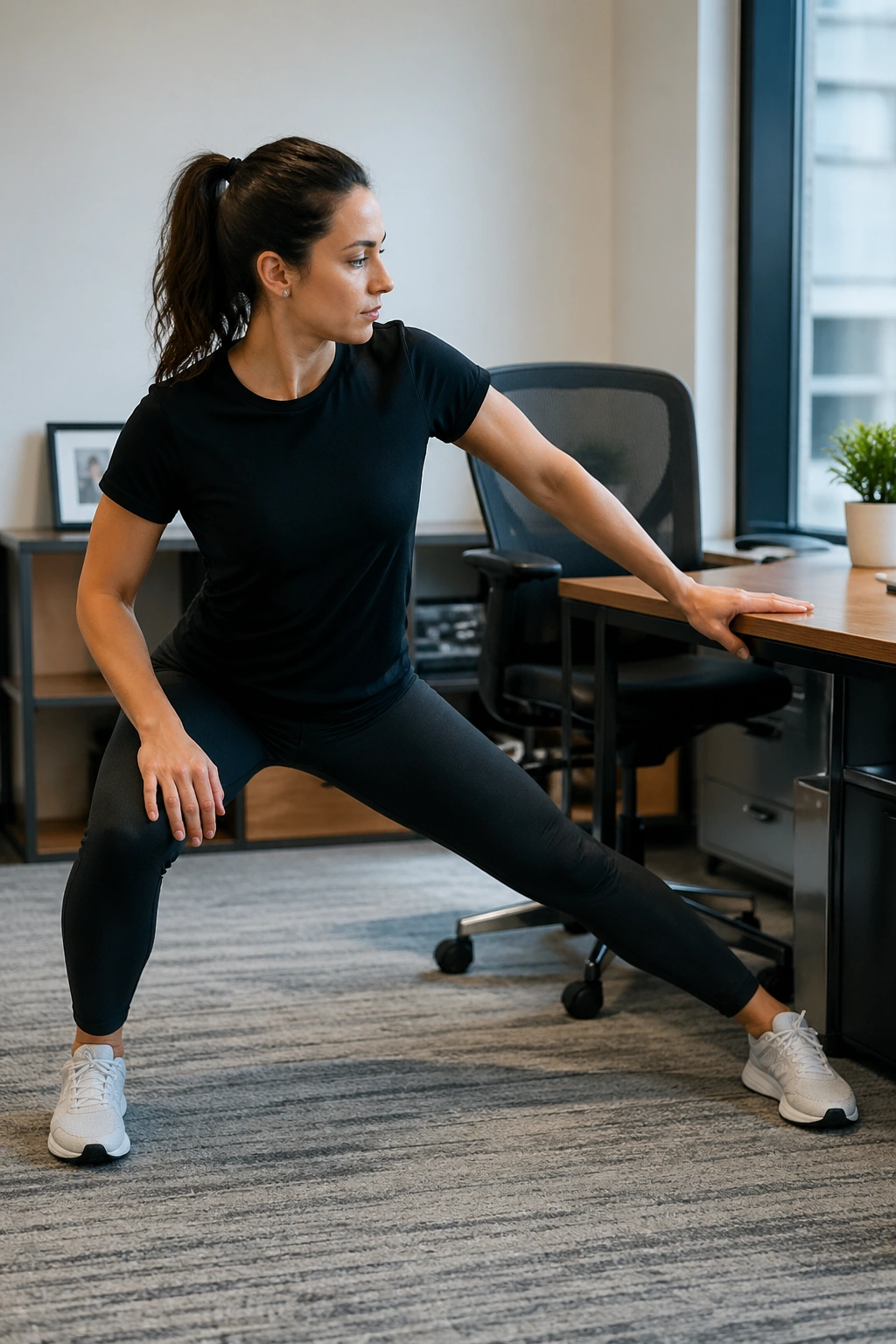
Unlike reverse lunges, side lunges open the inner thigh and adductors while loading the glutes in a different angle. That makes them a strong pick for people whose hips feel glued together after long sitting.
Stand with your feet wider than shoulder width beside your desk. Step or shift to the right, bend that knee, and push your hips back as the left leg stays straighter. Drive back to center and repeat to the other side. Your chest stays proud, and the working foot stays planted.
This move helps more than it first appears. Side-to-side motion often disappears in chair-heavy routines, and your body notices. Add it back and you get a stretch-like effect for the groin, strength for the outer hips, and a trunk challenge because your torso has to stay organized over a changing base.
Who should use it most? Anyone with stiff hips, anyone who feels knee discomfort from endless forward-backward moves, and anyone who needs a break from straight-ahead patterns.
Start with 8 to 12 reps per side. If depth feels rough, make the lunge shorter and sit back more. The rep should feel like a loaded hip hinge, not a knee shove.
19. Forearm Plank Hip Dips
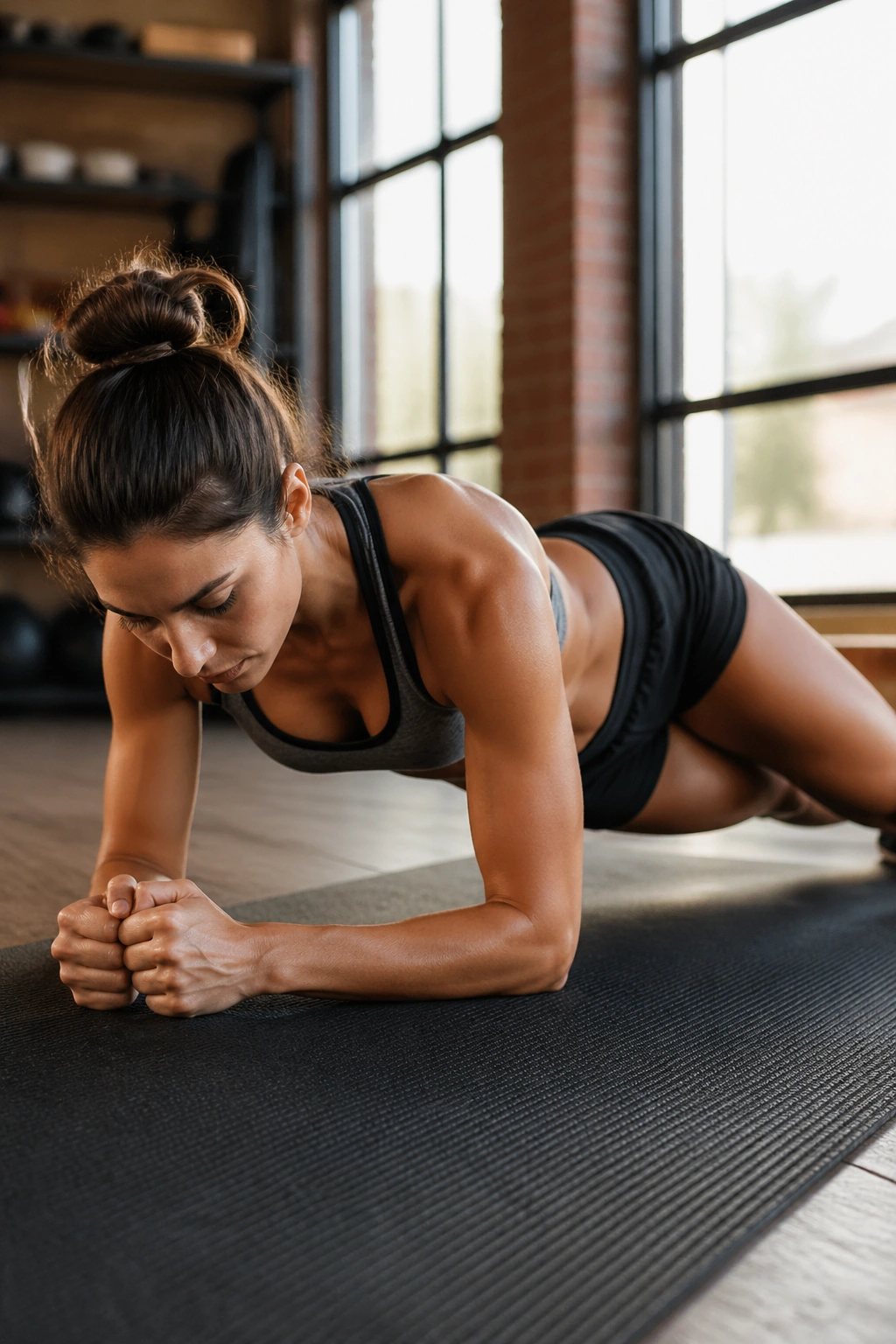
Short range. Big payoff.
Set up in a forearm plank with elbows under shoulders and feet about hip width apart. From there, rotate your pelvis a few inches to one side, return through center, then rotate to the other. The dip is small. You are turning the trunk under control, not flopping your whole body side to side.
What to watch for
Forearm plank hip dips hit the obliques well, but only if you stay long through the spine. Once the low back sags or the shoulders shrug toward the ears, the set has gone off course. Smaller dips often work better than dramatic ones.
Quick dose guide
- Start with 20 to 30 seconds
- Rest 20 seconds
- Repeat for 3 or 4 rounds
- Keep your glutes squeezed the whole time
- If your back feels compressed, switch to a plain forearm plank
Sharp cue: imagine your belt buckle drawing a small arc from side to side while your ribs stay pulled in.
20. Brisk Walking Sprints in the Hallway or Outside
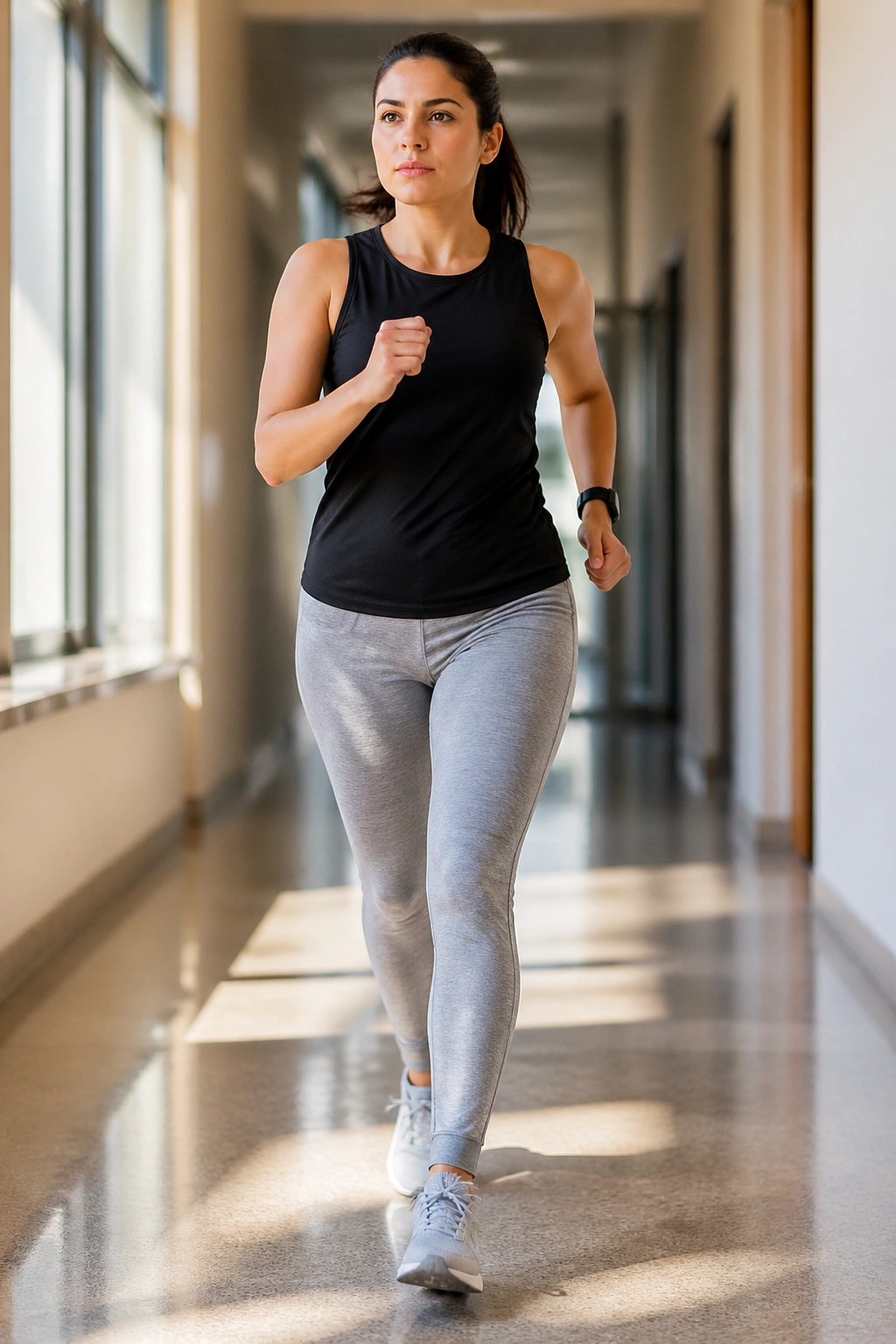
I keep coming back to walking because people underrate it, and that is a shame. Brisk walking sprints are one of the most practical belly fat workouts for sitting all day because they ask for almost nothing and deliver more than most desk exercises can.
Walk hard for one minute—hard enough that talking in full sentences gets annoying—then walk easy for one minute. Repeat for 10 to 20 minutes if you have the time. If you only have five minutes, go after a meal. Short post-meal walks have been shown to help bring blood sugar down compared with planting yourself back in a chair, and that matters when abdominal fat is part of the problem.
No floor. No mat. No change of clothes. No need to psych yourself up for a “workout.” That low barrier is a feature, not a compromise.
Push the pace with your arms, land under your body instead of reaching way out in front, and keep the head tall. If there is a slight hill or a set of long hallways, use it. The move is still walking, but the intent changes the training effect.
When people ask which exercise they can stick with for months, this is often my first answer.
Final Thoughts
The best plan for a desk-bound day is rarely the hardest one. It is the one you will repeat at 10 a.m., again after lunch, and once more before work ends. Consistency beats drama, especially when your main problem is not laziness but too many hours in a chair.
Pick four or five moves that fit your space and joints. A strong mix looks like this: one standing cardio drill, one leg move, one core stability exercise, and one walking or stair finisher. That combination does more for belly-fat goals than piling up endless ab reps while the rest of your body stays sleepy.
And yes, food, sleep, and stress still count. Belly fat tends to hang on when those parts are a mess. Even so, these workouts can change the shape of your day fast—less stiffness, better energy, more movement, and a waistline strategy that lives in the real world instead of a fantasy schedule.
