



Ballet is often misunderstood as gentle, ethereal movement performed by dancers who seem to float across the stage. If you have ever spent time at the barre, you know the reality is pure, isometric torture in the best way possible. It is less about floating and more about holding your bodyweight in positions that defy comfort for minutes at a time. The legendary strength of a professional dancer comes from a specific type of training: repetitive, high-volume, low-impact movements that target the smaller, supporting muscles just as much as the quads and glutes.
You do not need a studio, a professional dance partner, or even a pair of pointe shoes to get these results. Your living room works perfectly fine. All you really need is a sturdy chair back to hold onto for balance and a bit of floor space to move. By focusing on the mechanics of turnout, ankle stability, and hip engagement, you can build lean muscle without ever touching a heavy weight.
We are going to break down twenty specific movements that provide the backbone of ballet-inspired conditioning. These are not flashy; they are technical. When you practice them, prioritize precision over range of motion. The goal is to feel the shake in your muscles, that distinctive “dancer burn” that signals your legs are working in their longest, most active range.
1. The Classic Grand Plié
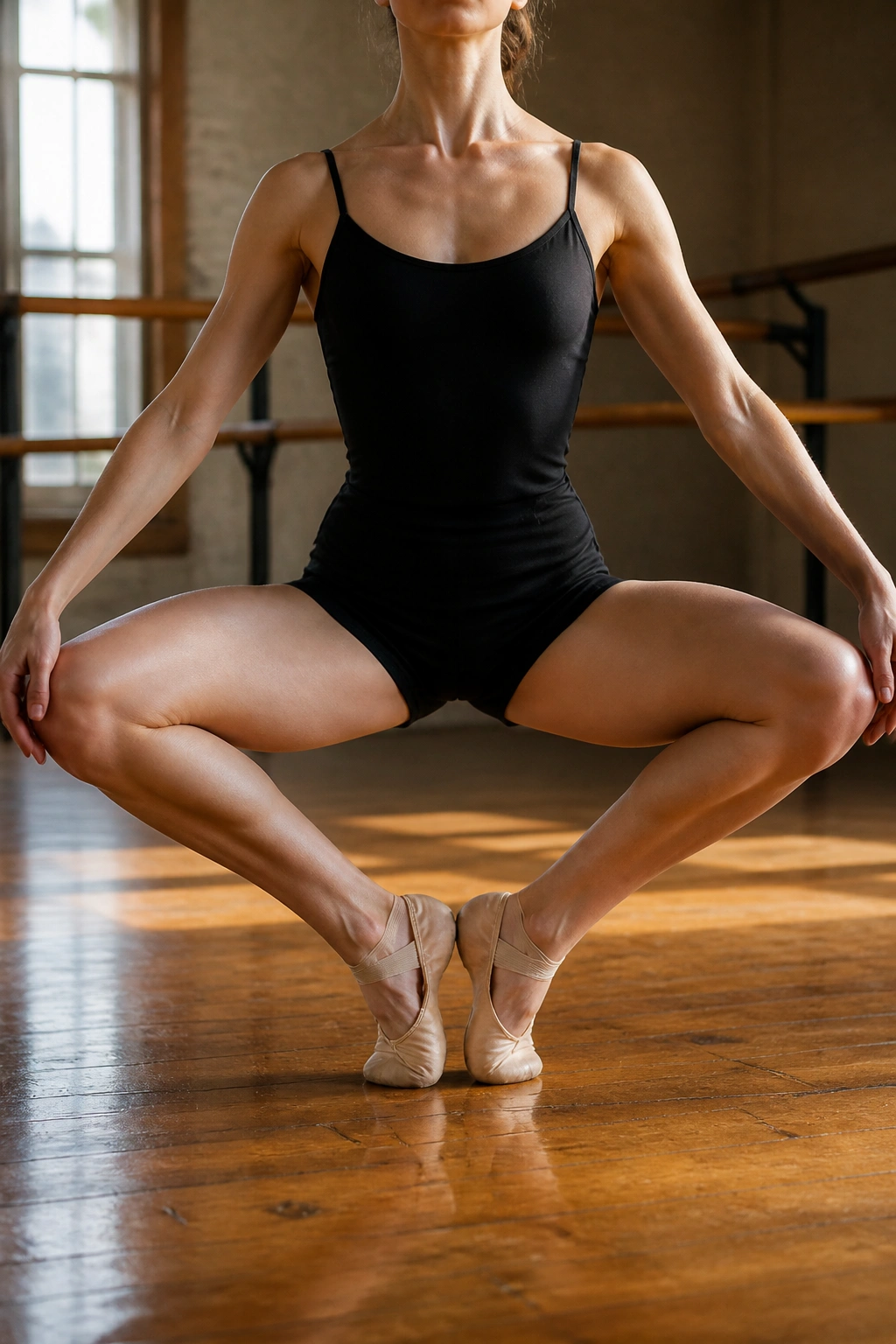
The plié is the bread and butter of the ballet world. It is a deep, controlled knee bend that forces your adductors—those elusive inner thigh muscles—to do the heavy lifting. Start by standing with your heels together and toes turned out, creating a “V” shape with your feet.
Keep your spine perfectly upright. Do not lean forward or stick your tailbone out. As you bend your knees, imagine sliding your back down a smooth, flat wall. Your heels will eventually lift off the ground, but keep them connected to each other as long as possible.
The Secret to Depth
The true magic happens at the very bottom of the movement. Hold the deepest point of your plié for two seconds before pushing back up. Use your inner thighs to pull your knees back, rather than just standing up using your quads. This engagement transforms a simple squat into a sculpting powerhouse.
2. Tendus for Ankle Definition
A tendu looks simple: you slide your foot along the floor until only the tip of your big toe touches. However, if done correctly, it is a demanding exercise for your calf muscles and your arches. It helps refine the line of your leg by forcing you to fully extend through the foot.
Start in first position. Slide your right foot forward, keeping your heel on the floor as long as possible until you reach the point where you must peel the foot off the ground. Your toes should be the last thing to leave the floor. Squeeze your thigh muscles tight.
Why This Matters
Most people never fully extend their feet in daily life, leading to weak arches. When you perform a tendu, you are forcing every muscle in your lower leg to fire in sequence. If you want legs that look polished and defined from the ankle up, this is the movement that gets you there. Make sure your weight stays centered over your standing leg, not shifted onto the working one.
3. Relevé in First Position
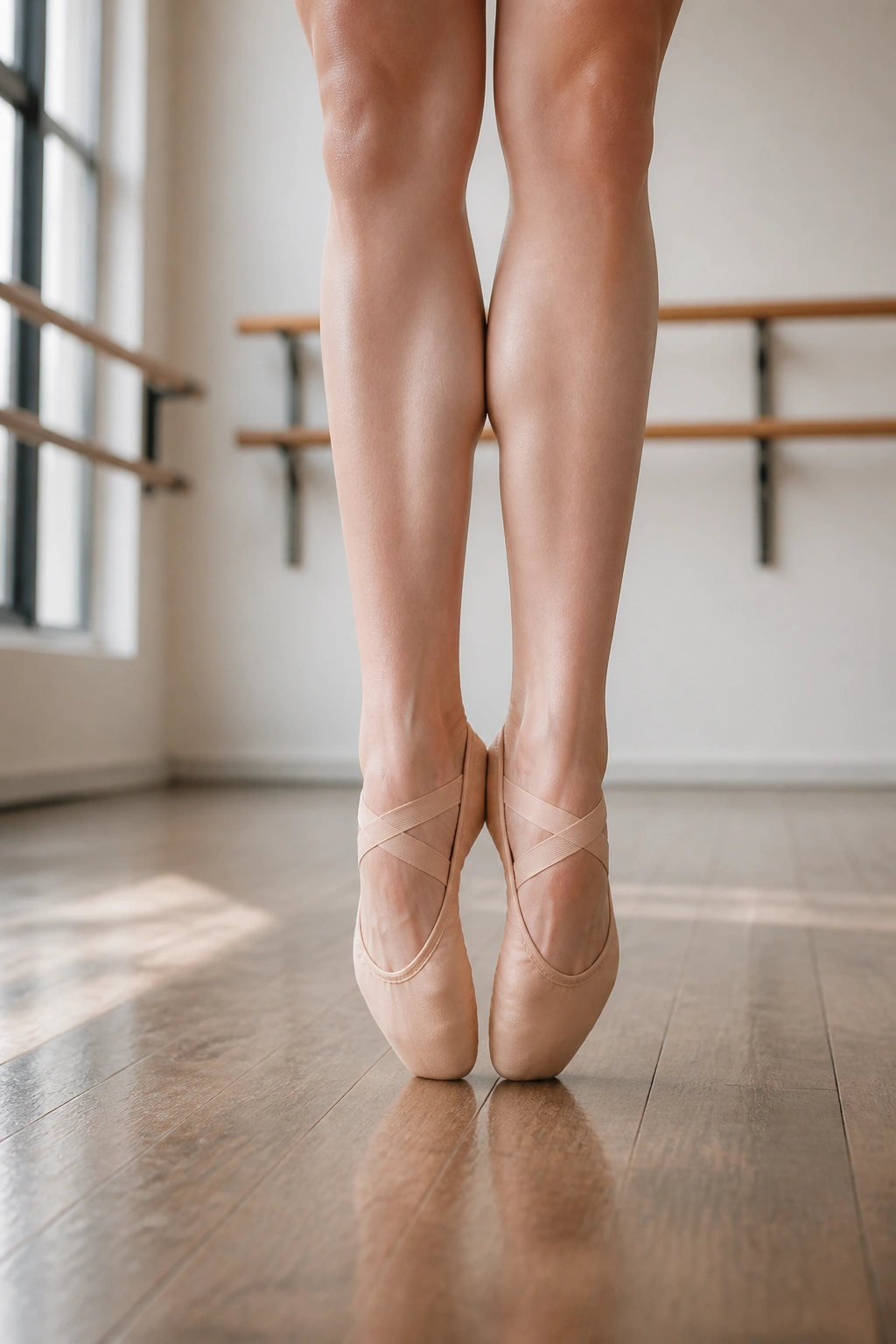
Relevé is a rise. It is the movement that gives ballerinas their deceptively powerful calves. Standing in your first position, press down through the balls of your feet to lift your heels off the ground. You are not jumping; you are peeling your feet up while maintaining your turnout.
The key here is stability. Your heels should stay glued together. If you find your ankles rolling outward, you are not using your muscles correctly. You must squeeze your inner thighs and glutes to keep your legs locked in that external rotation as you rise.
Pro tip: Do not let your heels drop quickly on the way down. Lower yourself with resistance, controlling the descent to the floor. It should take twice as long to go down as it took to go up. That eccentric loading is where the muscle toning happens.
4. Battement Dégagé
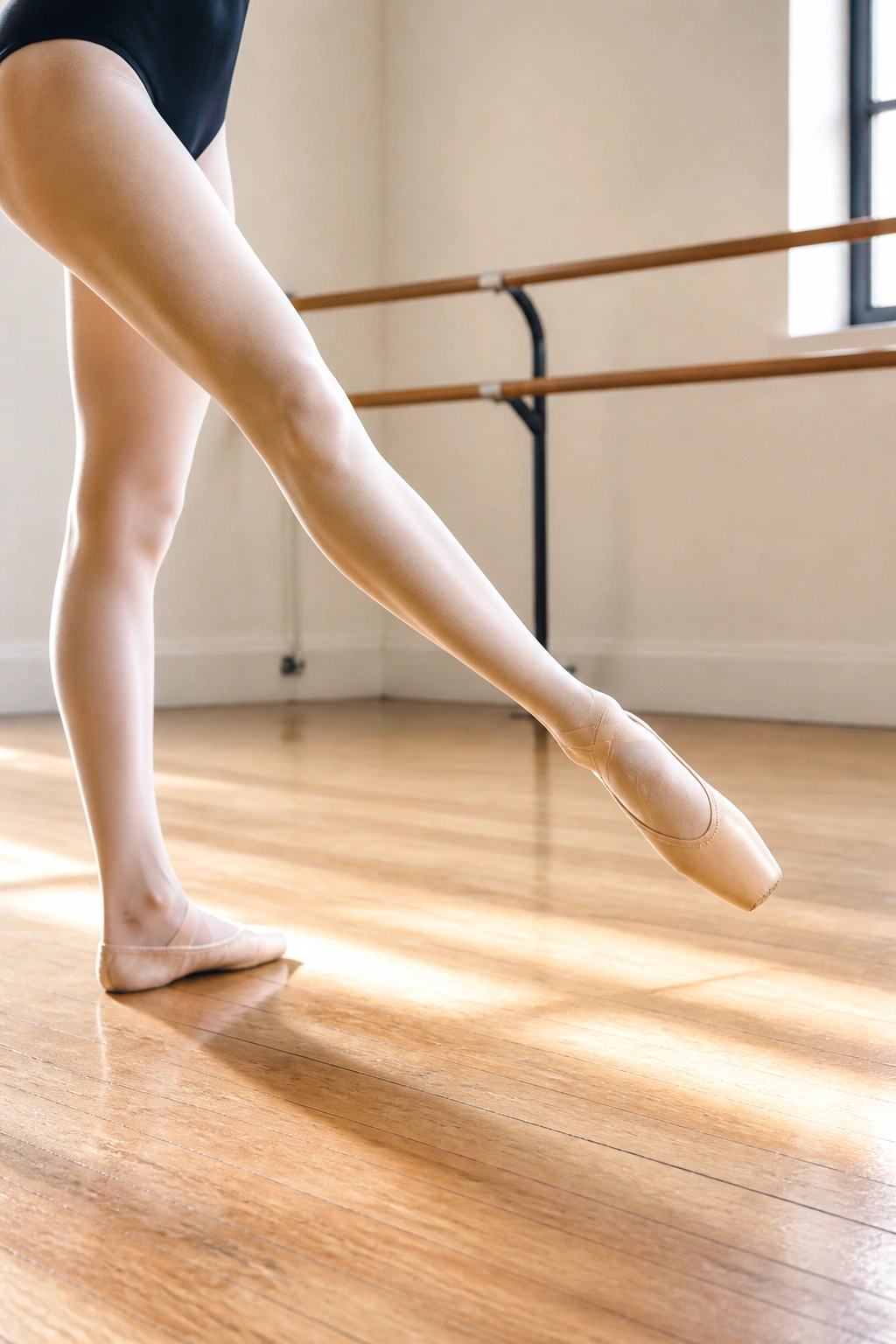
Think of a dégagé as a tendu that has decided to leave the ground. It involves brushing your foot off the floor with a bit of energy. It is fantastic for agility and developing the quick-twitch muscle fibers in your thighs.
Stand in first position. Brush your foot forward, quickly popping it about three inches off the floor. The movement should be sharp, precise, and controlled. Your leg needs to be completely straight, like a steel rod.
The Anatomy of the Move
Do not swing your leg using your back. The power must come from your hip and the top of your thigh. Keep your hips square to the front. If you find yourself tilting your pelvis to get the leg higher, you are cheating the movement and reducing the effectiveness. Three inches off the floor is plenty if your form is impeccable.
5. Passé Balance
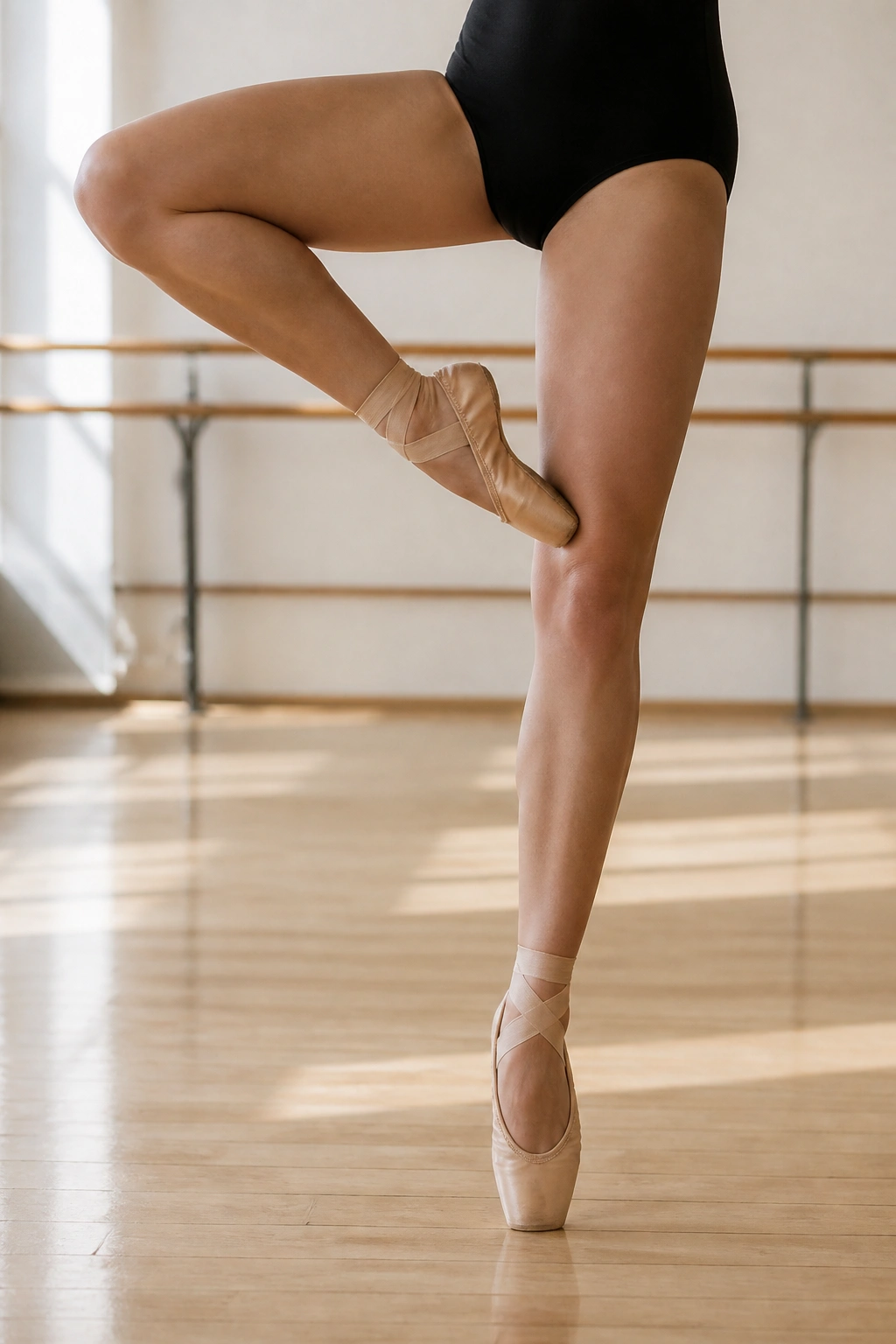
Passé is the position where one leg is bent, with the toe of the working foot resting near the knee of the standing leg. It is the gold standard for testing your balance and activating your core, but it is also a killer for the standing leg’s thigh muscles.
Hold your chair for support if needed. Bring your right foot up, toe touching just below the left knee. Your right knee should point directly to the side, not forward. This requires significant strength in the outer hip muscles.
Hold it. Don’t just get into the position and drop out. Stay there for thirty seconds. Your standing leg will start to tremble. That trembling is exactly what you are looking for. It means those small, stabilizing muscles are finally waking up.
6. Rond de Jambe
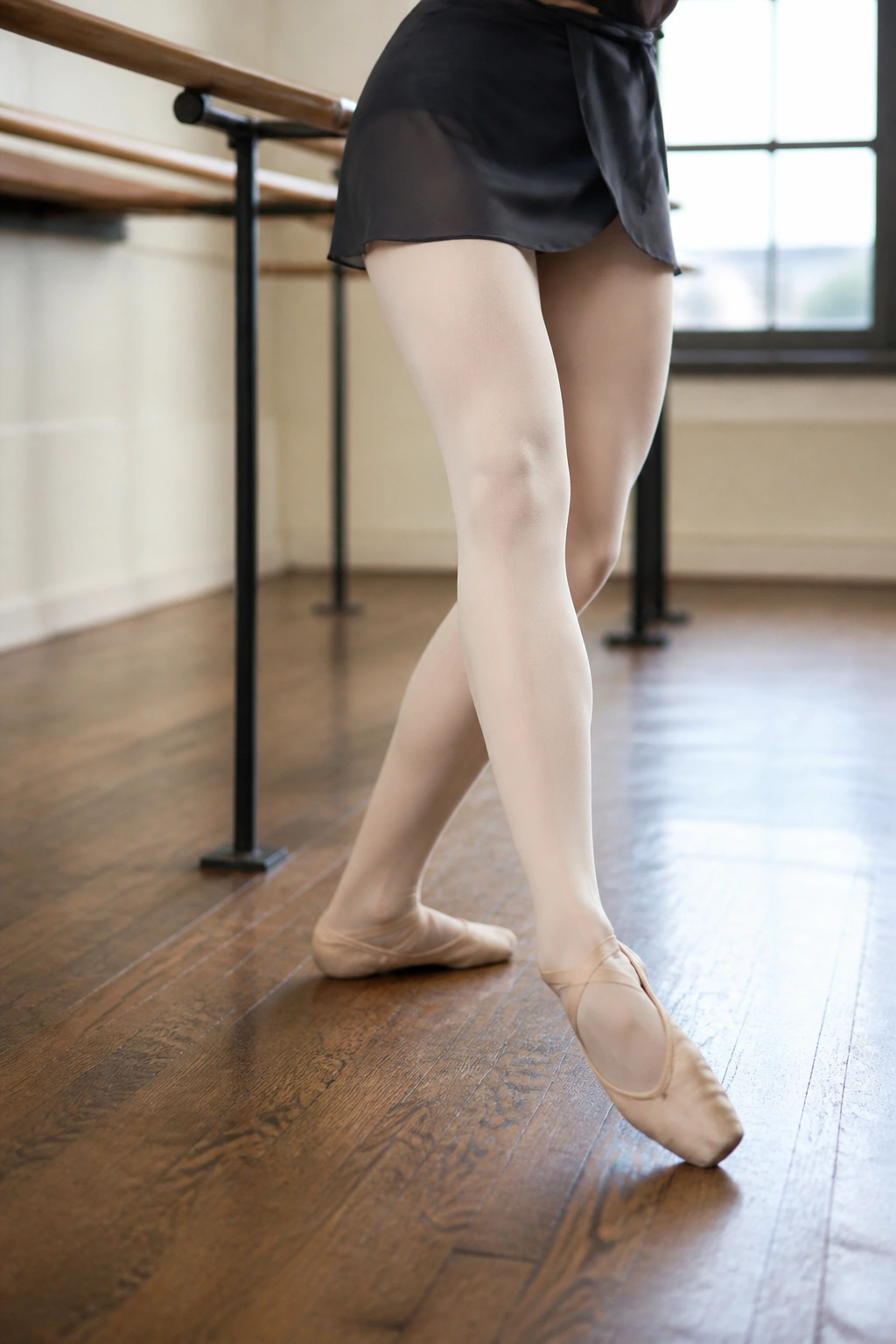
Rond de jambe translates to “round of the leg.” It is a circular movement that hits every angle of the hip joint. You are essentially tracing a half-circle on the floor with your toe, starting from the front, moving to the side, and finishing in the back.
Keep your standing leg rock solid. Do not let your hips sway as your working leg circles around. The movement should feel fluid and continuous, not jagged. You are training your legs to move independently of your torso.
The Visual Cue
Imagine your leg is a compass drawing a circle on the floor. If you rush the circle, you miss the benefit. Move slowly, dragging your toe through the imaginary paint on the floor. This forces your glutes to stay engaged for the entire duration of the circle.
7. Grand Battement
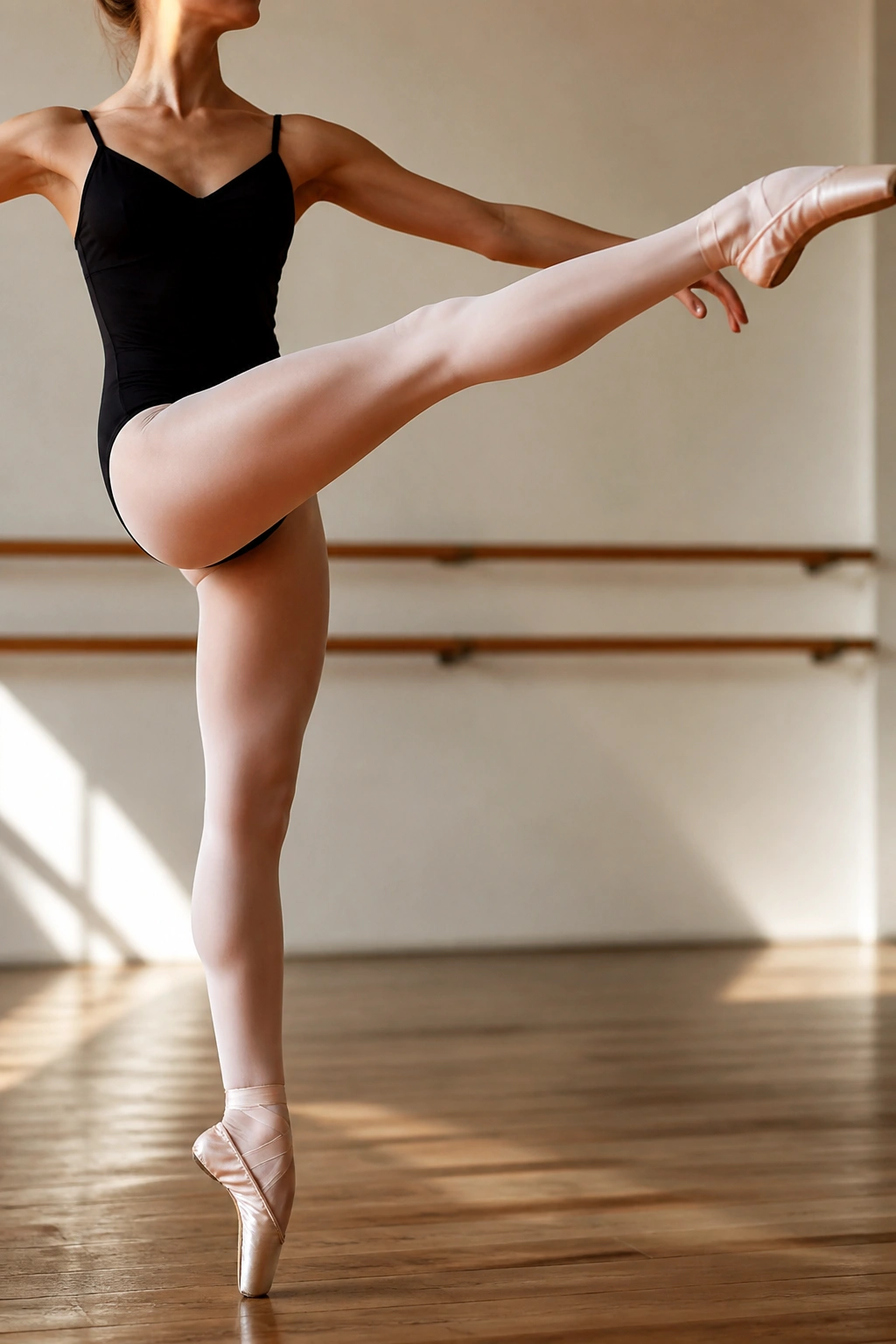
This is your high kick. It is the most explosive move in the bunch. A grand battement requires a massive amount of power from the hip flexors and deep abdominal muscles. It is not just about height; it is about keeping the standing leg perfectly straight while the other flies up.
Swing your leg forward with energy, but maintain control on the way down. Do not let gravity do the work. You should be able to stop your leg at any point in the air if you had to.
Common Mistake: People often hunch their shoulders to lift the leg. Keep your chest open and your posture tall. If your leg only goes to waist height but your form is perfect, that is a successful rep. Height will come later.
8. Fondu
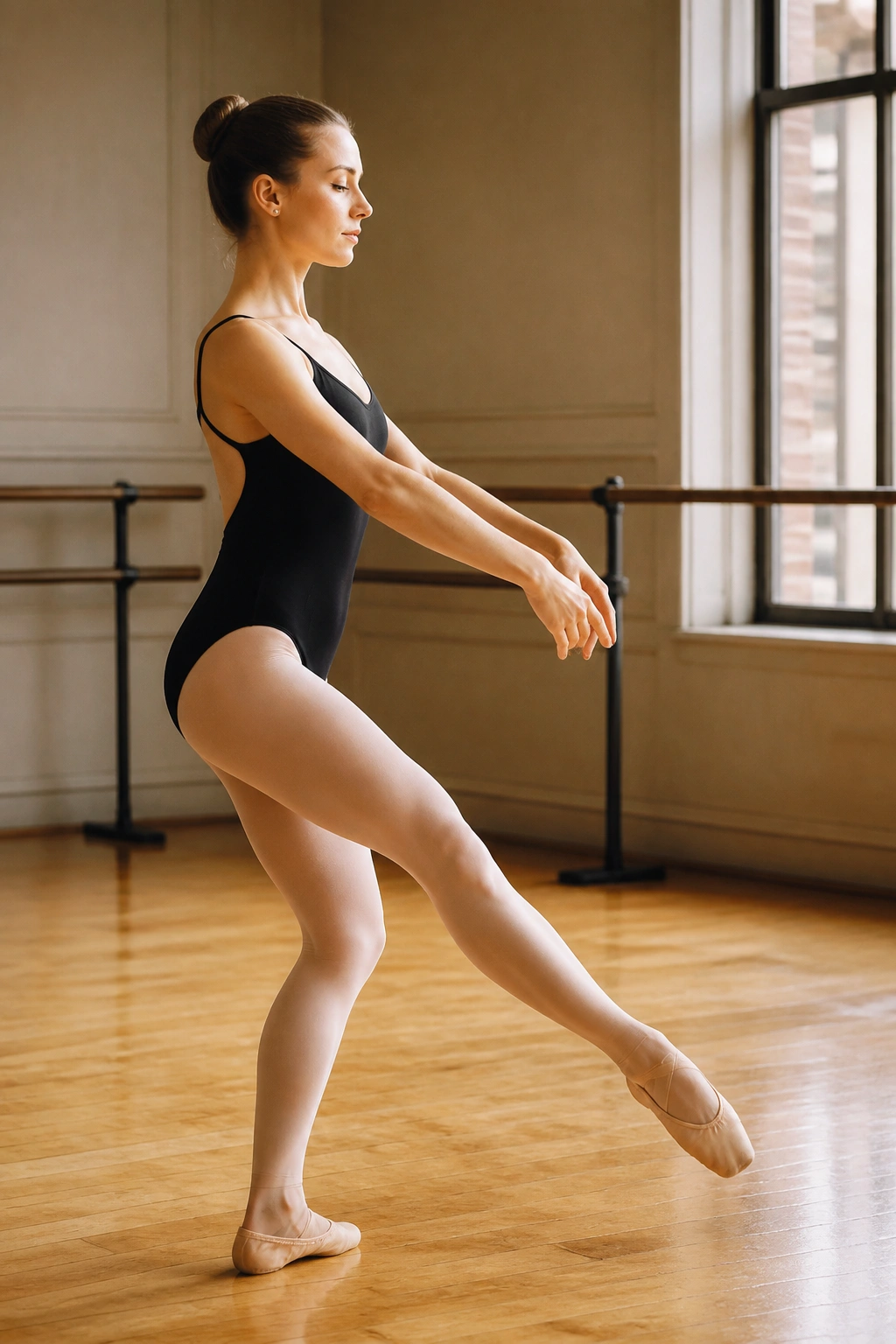
Fondu means “to melt.” It is a squat-like movement, but performed on one leg while the other is in the air. You bend your standing knee (melting) while simultaneously straightening your working leg, then push both to a straight position at the same time.
This is arguably one of the most effective exercises for sculpting a dancer’s thigh. Because you are doing all the work on a single leg, you are doubling the load. It builds massive stability and power in the quad and the glutes.
How to Practice
Start with your working foot in a position called “cou-de-pied,” wrapped around your ankle. As you bend your standing leg, extend the working leg out. As you straighten the standing leg, bring the working foot back to the ankle. It is a slow, methodical melt and stretch.
9. Frappé
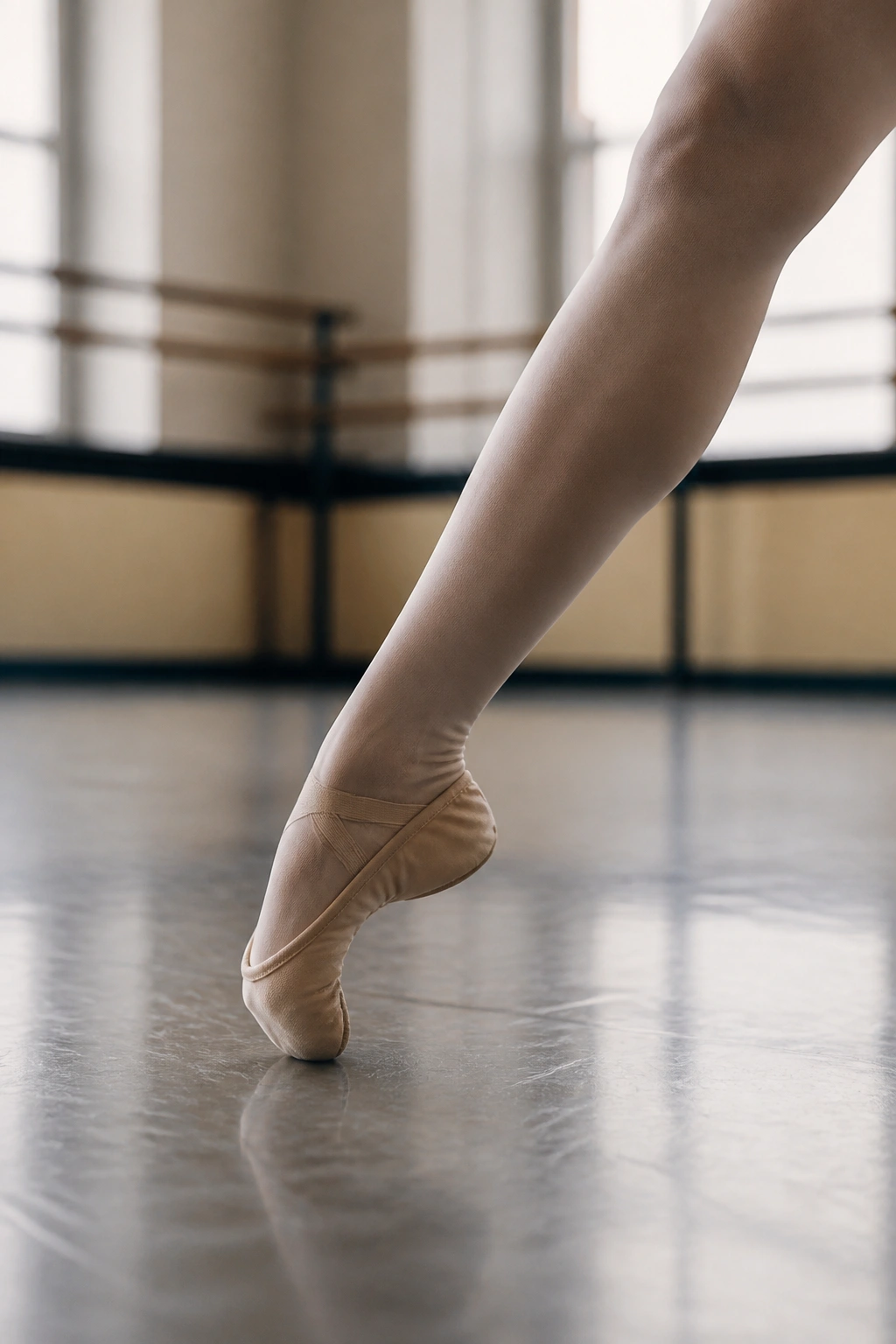
Frappé means “to strike.” This move trains speed and precision in the lower leg. You start with your foot wrapped around your ankle, then extend it quickly, tapping the floor with the ball of the foot before pulling it back in.
It mimics the action of a quick kick or strike. The extending motion should be fast, like a whip. This builds power in the quadriceps without requiring heavy weights.
Focus Point: The tension should be in your thighs. Do not let your foot flop around. It must remain pointed and energized the entire time. If your foot looks lazy, your muscles aren’t working hard enough.
10. Petite Allegro Jumps
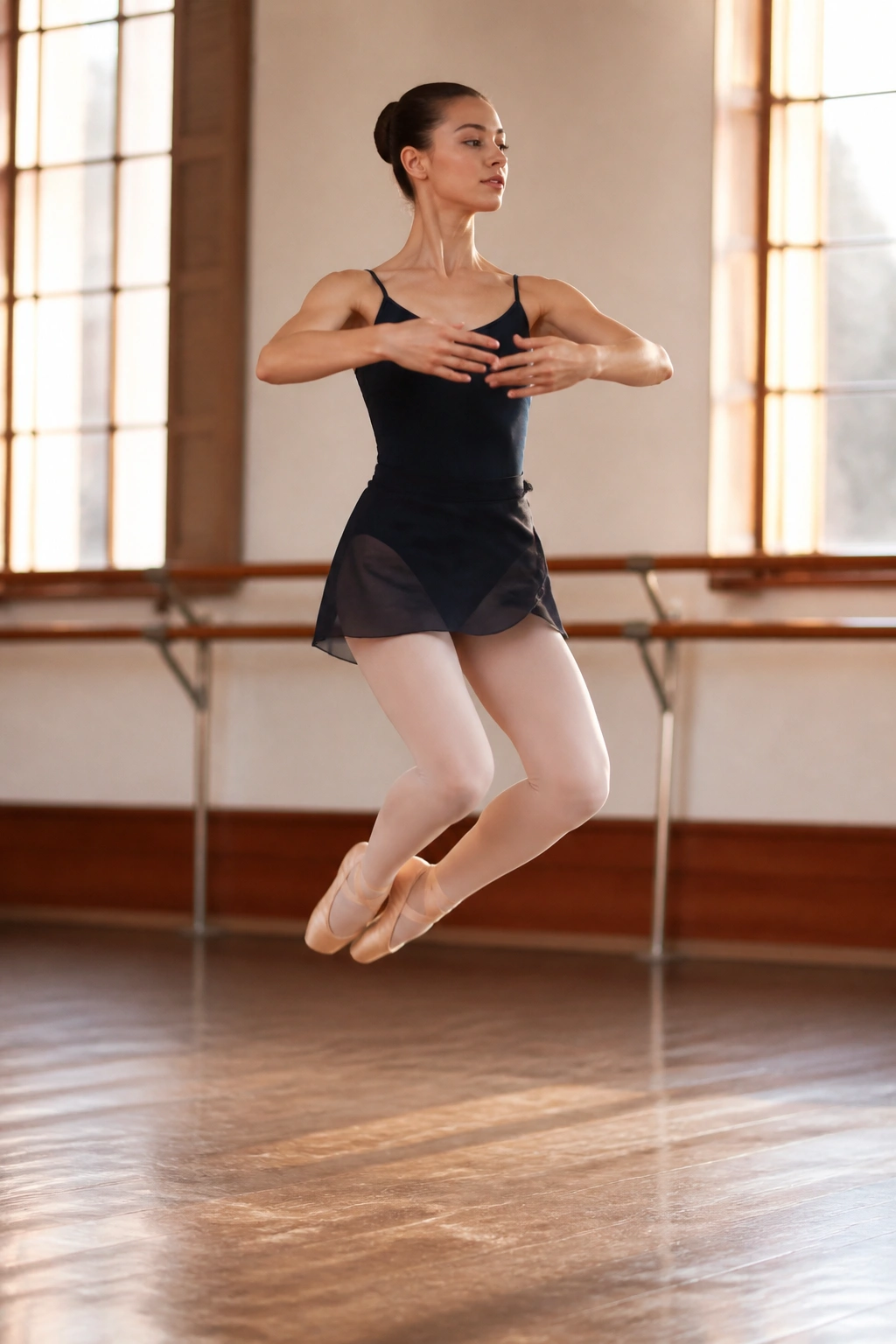
If you want to burn fat while toning your legs, you need to jump. Petite allegro refers to small, quick jumps. A simple one is the “sauté”—a small jump from first position where you land deep in a plié.
The landing is more important than the jump. You must land heel-first, then roll through the foot, absorbing the shock into your muscles rather than your joints. This landing phase is where the eccentric strength is built.
The Cardio Factor
Do these in sets of sixteen. The constant firing of the calf and quad muscles, combined with the aerobic effort, will leave your legs feeling heavy and worked. Always remember: soft, quiet landings. If you sound like an elephant, you are putting too much impact on your knees.
11. Soussus
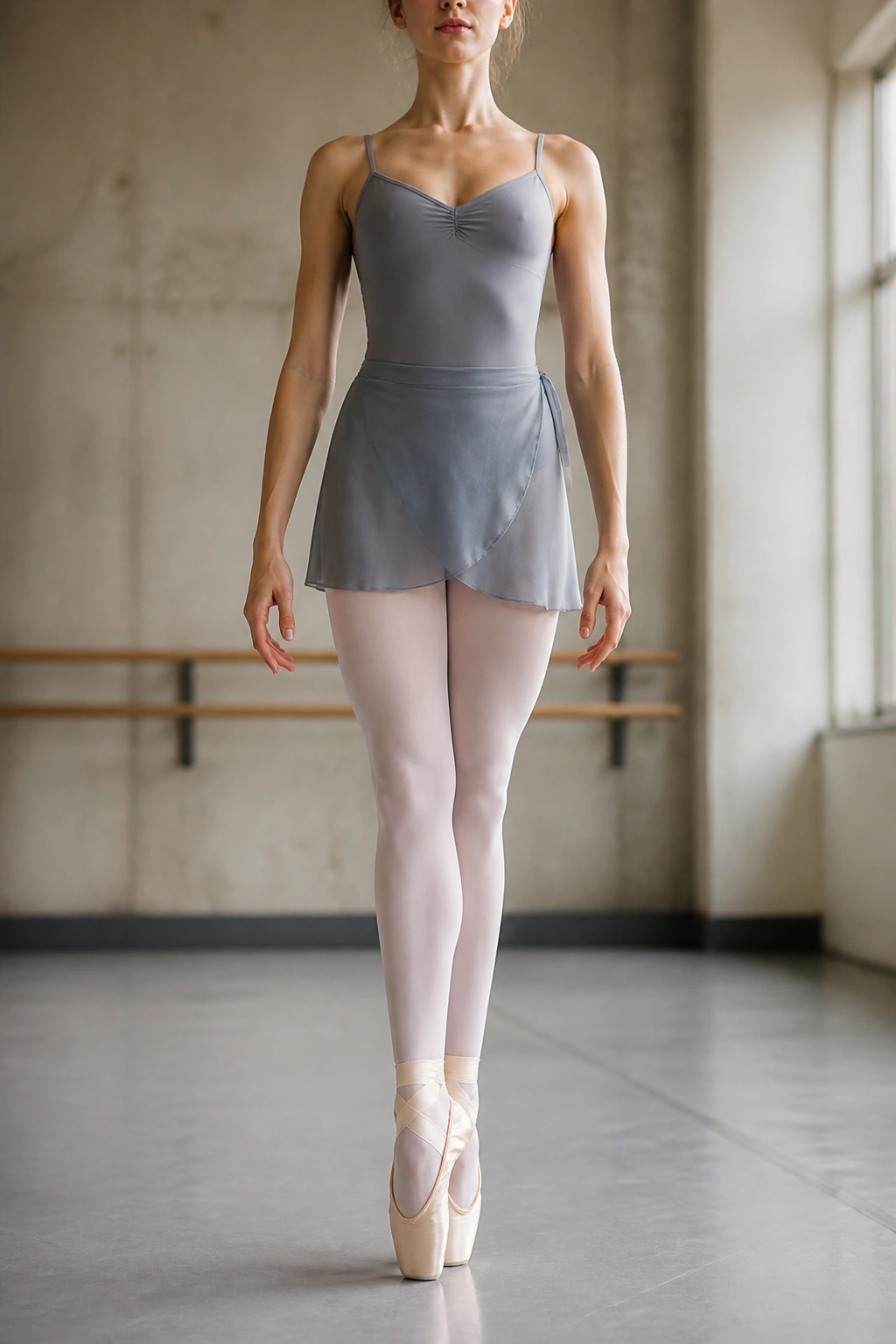
Soussus is a simple, beautiful move that involves rising up onto the balls of your feet and squeezing your legs so tightly together that they look like one solid pillar. It is an isometric hold that targets the inner thighs intensely.
Stand in third or fifth position. Rise up. Now, imagine you are trying to crush a piece of paper between your thighs and calves. Hold this squeeze for as long as you can breathe comfortably.
The Benefit: This is not a dynamic movement, so you might think it is doing nothing. Keep holding it. The shaking will start in your inner thighs within fifteen seconds. This is excellent for closing the gap between the upper thighs and creating that long, lean look.
12. Attitude
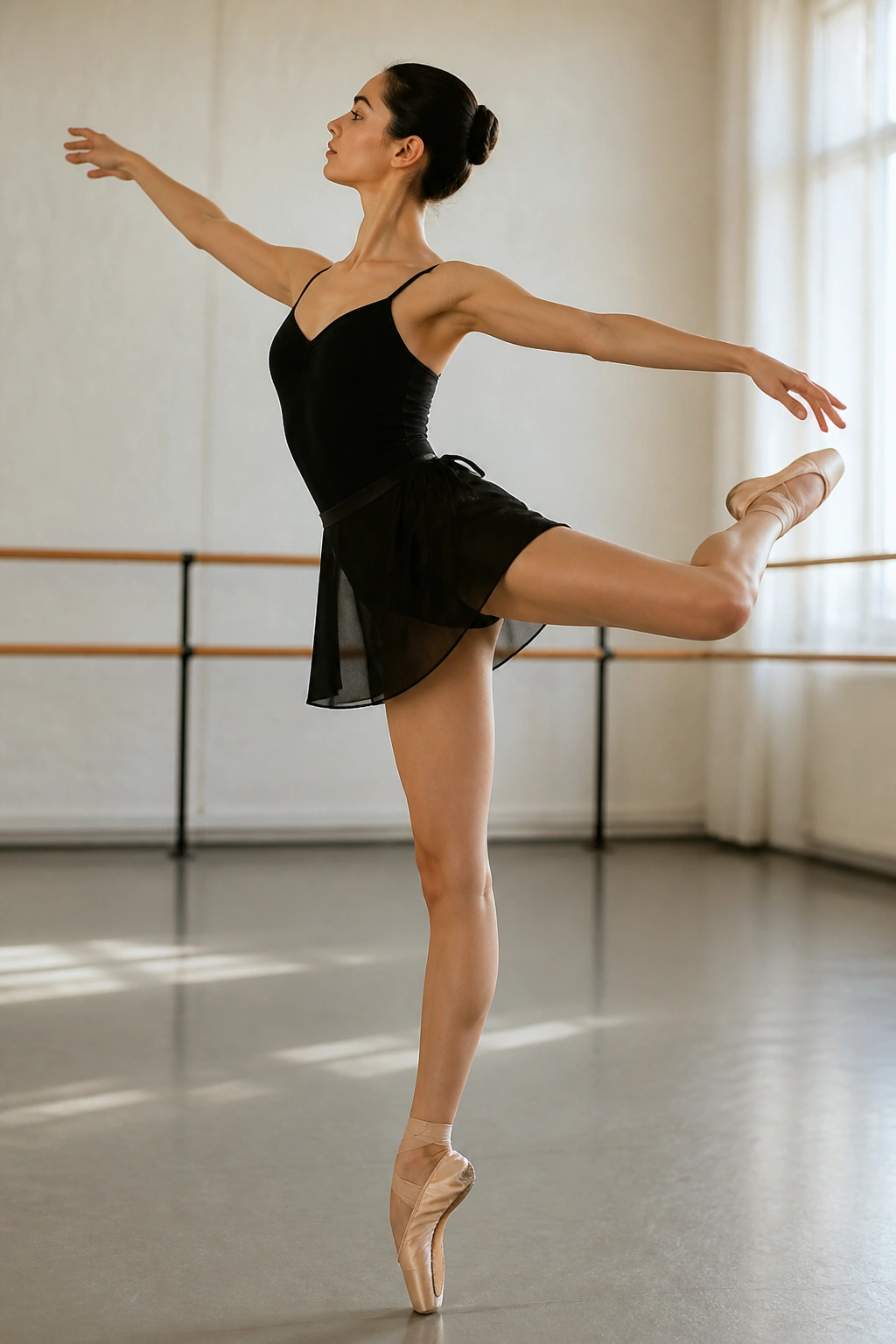
An attitude is a lift with a bent knee. It is slightly easier on the hip flexors than a straight-legged lift but puts a massive demand on the glutes and hamstrings. It targets the “seat” area effectively.
Lift your leg behind you, keeping the knee bent. Your foot should be slightly higher than your knee. Focus on the muscle right where your hamstring meets your glute. That is the area you want to fire.
Watch Your Alignment
It is extremely common for the working hip to hike up toward your ribs. Keep your hips level. Imagine a spirit level resting across your pelvis; it should stay perfectly flat while you lift the leg.
13. Développé
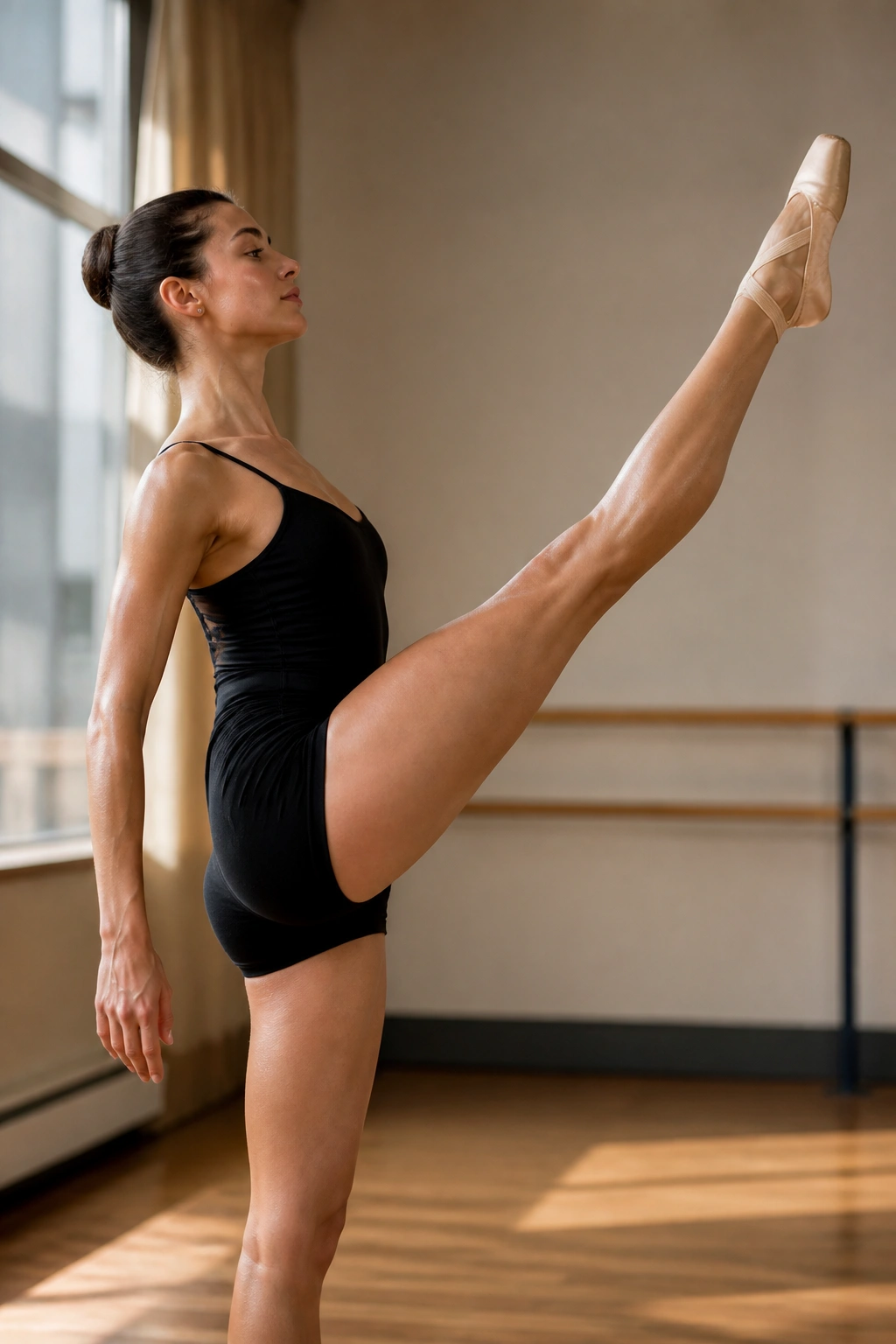
Développé means “to unfold.” It is the process of bringing your foot up the standing leg and then extending it into the air. It is a slow-motion lift that requires incredible core strength and quad control.
Draw your toe up the inside of your standing leg. When you reach the knee, extend the leg out slowly to its maximum height. Hold it there for a moment, then lower it with control.
Why it works: This is pure resistance training. You are fighting your own gravity to unfold the leg. The muscle control required to keep the leg extended at the end is what makes this move so effective for long-term toning.
14. Echappé
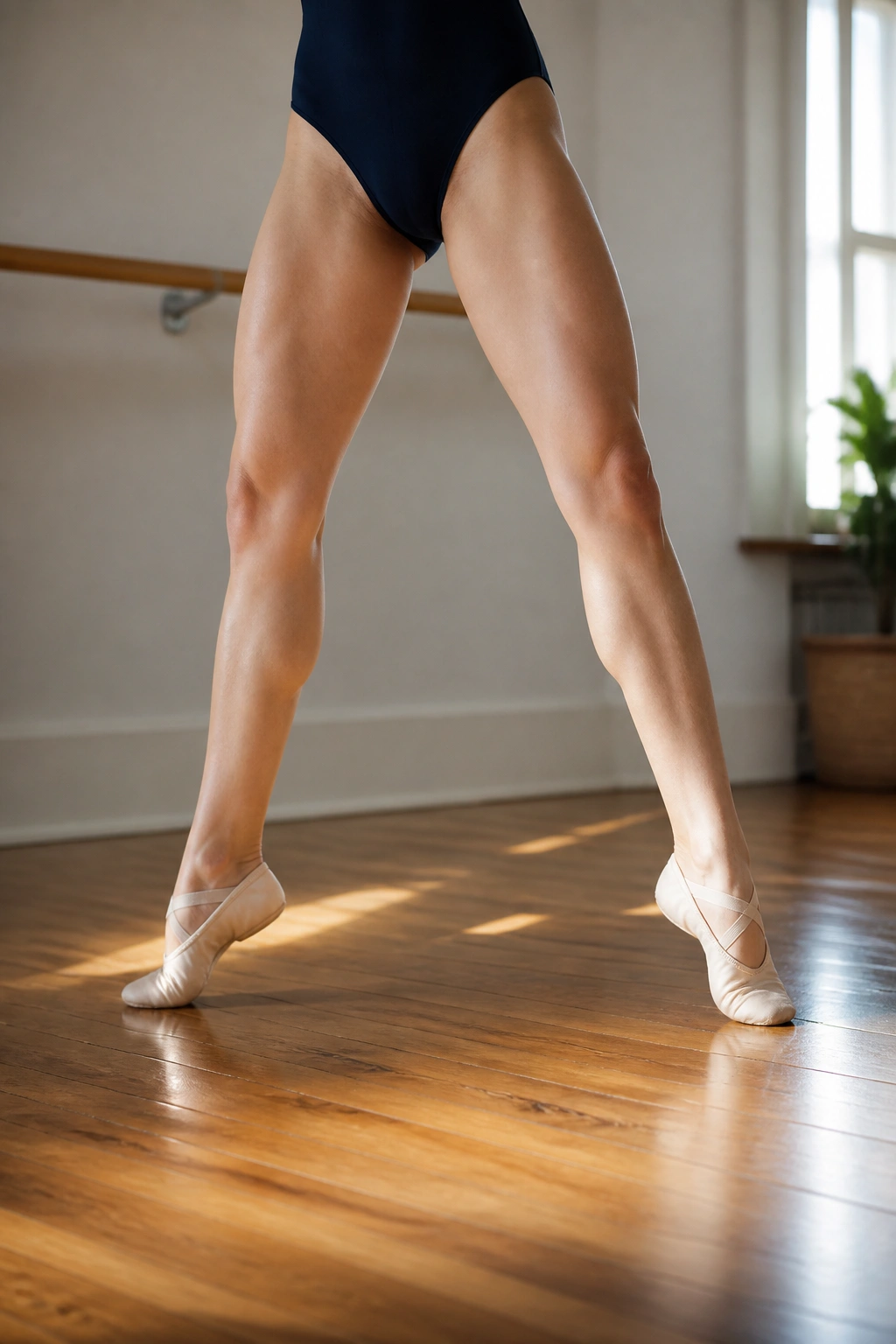
Echappé means “to escape.” You are escaping from a closed position (first position) to an open position (second position) and back again. Usually, this is done with a small jump, but you can do it as a slow, controlled slide for a more intense muscular burn.
Start in first position. Slide both feet out to second position. Slide them back to first. Do not just move your feet; think about squeezing your legs together as they close.
The Engagement
The hardest part is the close. Use your inner thighs to snap the legs together. If you just let them flop shut, you lose the toning potential. Treat the floor as if it is made of resistant material that you have to push through.
15. Glissade
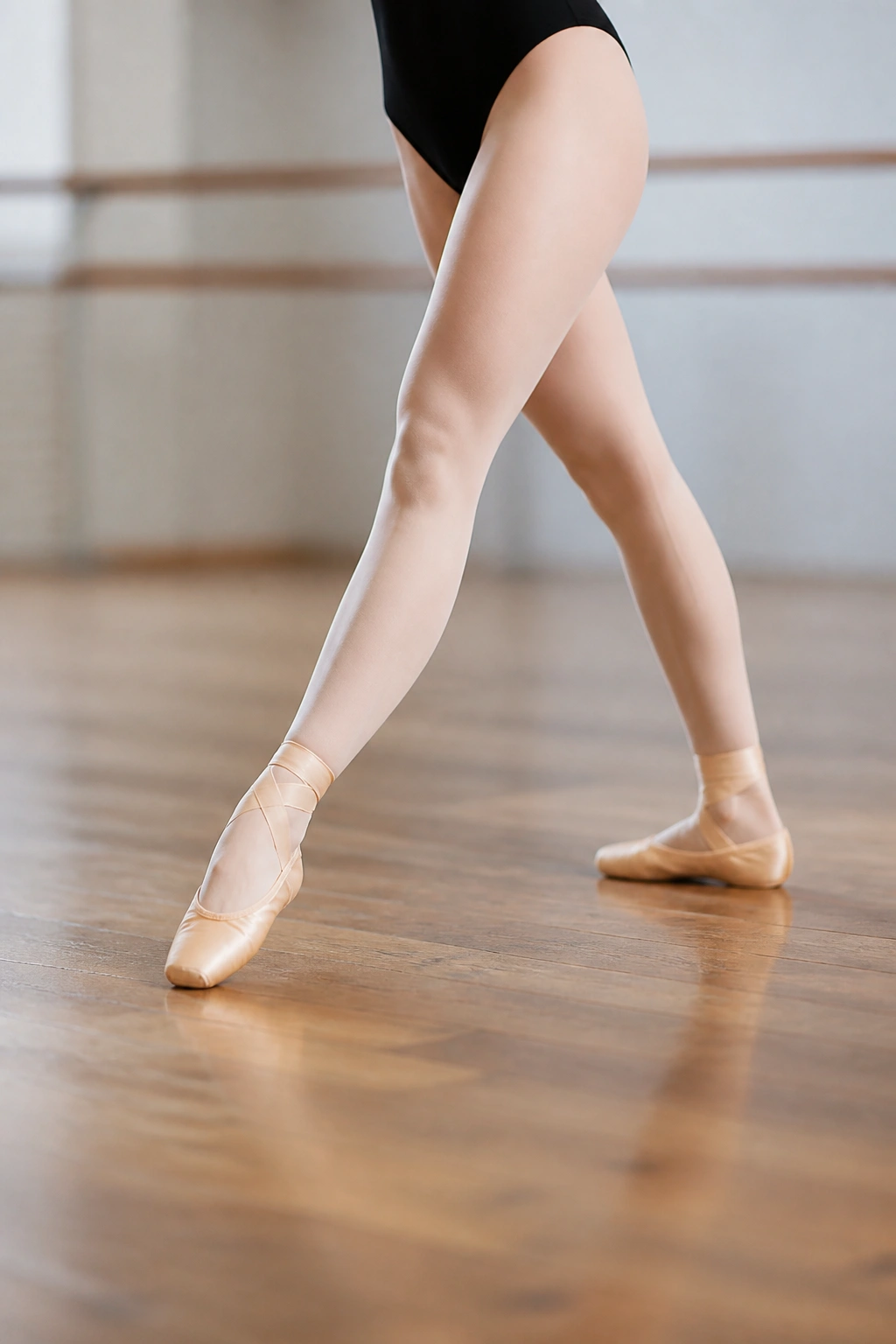
A glissade is a gliding step. It involves a small, lateral jump where one foot extends and the other follows. It is great for lateral stability and working the muscles on the outside of your hips—the ones often missed by standard squats and lunges.
Keep the move small and close to the floor. It should look like you are sliding across ice. The muscles in your outer hip and glute medius will have to work overtime to stabilize your pelvis during the lateral shift.
Key Detail: Keep your upper body still. Your legs should be doing all the traveling. If your shoulders are rocking back and forth, you are missing the abdominal engagement that makes this exercise so good for your entire lower body.
16. Grand Jeté
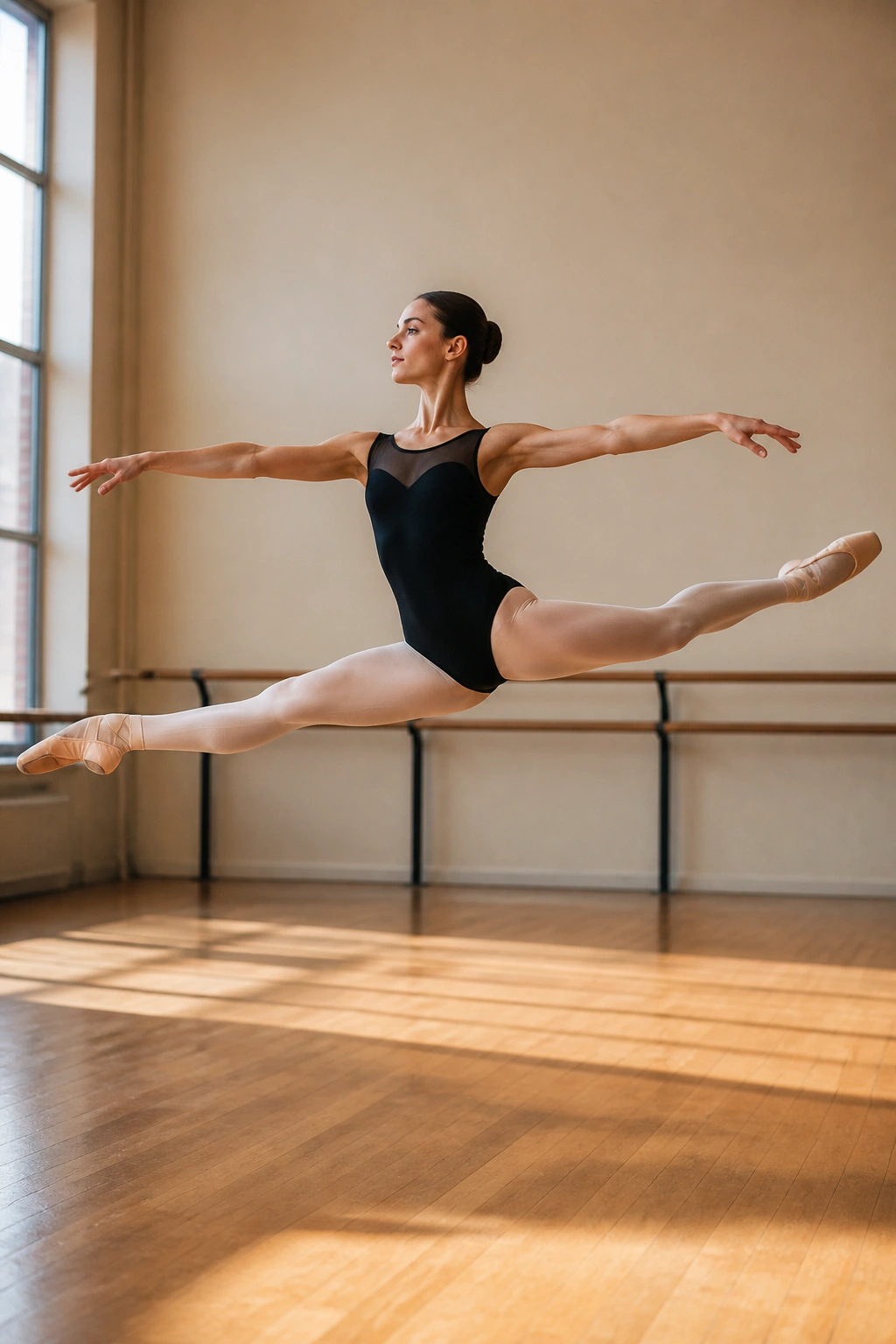
Yes, this is the big leap. You do not need to leap across the entire room. You can perform a small version of this to work on explosive power and endurance. Take a small step, brush the leg, and leap into the air, splitting your legs.
The key here is the stretch in the air. Your legs should be reaching in opposite directions. Even if your jump is only two inches off the ground, the effort to reach and split creates a massive demand on your hamstrings and quads.
Endurance Warning
Do these in sets of eight. By the end, your heart rate will be up, and your legs will feel the cumulative fatigue of the effort. This is the move that turns a “ballet workout” into a “ballet fitness” session.
17. Soutenu Turns
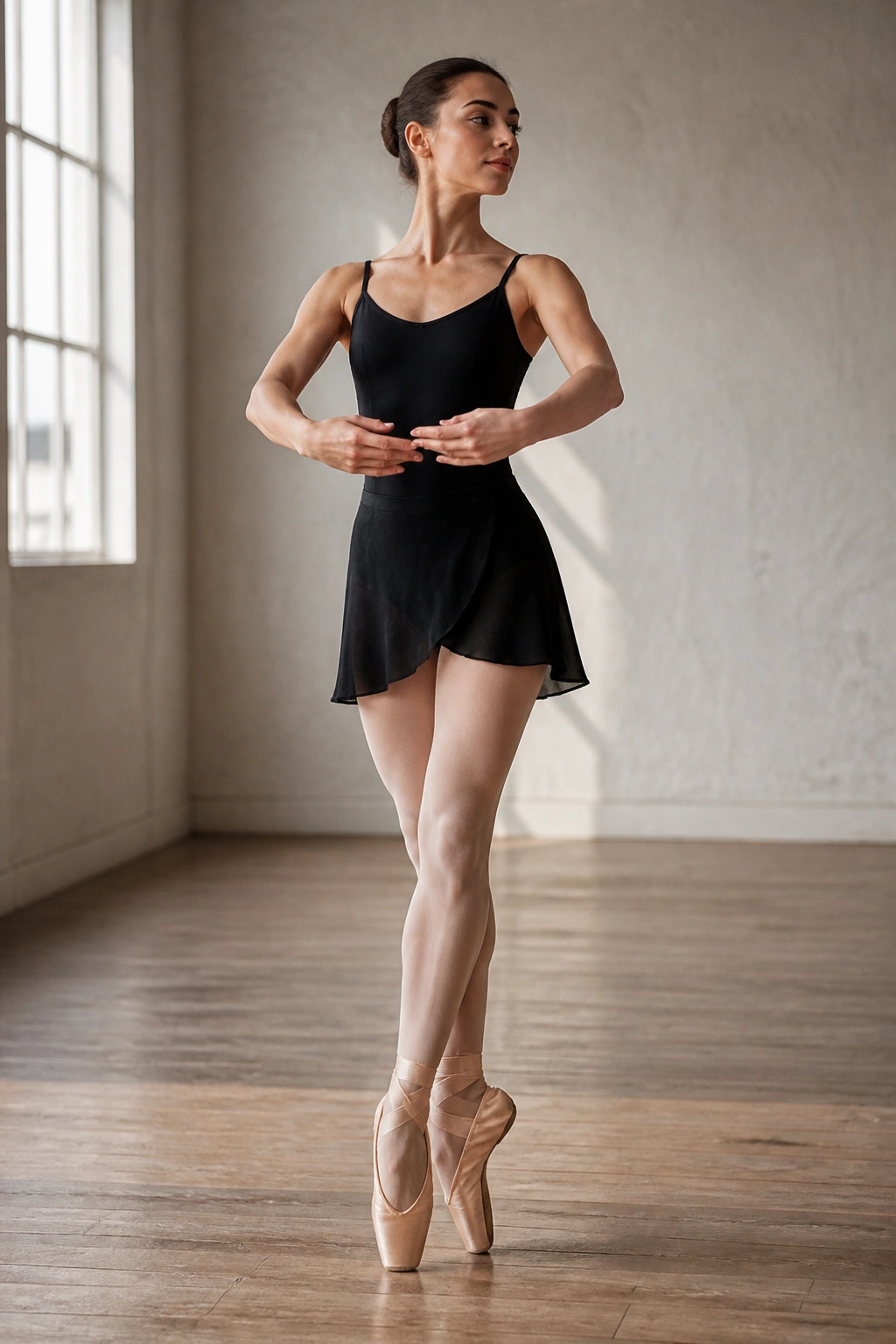
A soutenu turn is a pivot turn where your legs cross, you rise onto your toes, and turn around. It is a fantastic exercise for the lower calves and the inner thighs, as you are squeezed tight during the entire turn.
Cross your legs. Rise up on your toes. Squeeze your legs together like they are velcroed. Pivot. Your weight should be centered directly over your feet.
The Balance: If you find yourself falling out of the turn, your core is likely loose. Keep your belly button pulled toward your spine. Your legs are the powerhouse, but your core is the anchor that keeps you spinning on a single axis.
18. Port de Bras with Plié
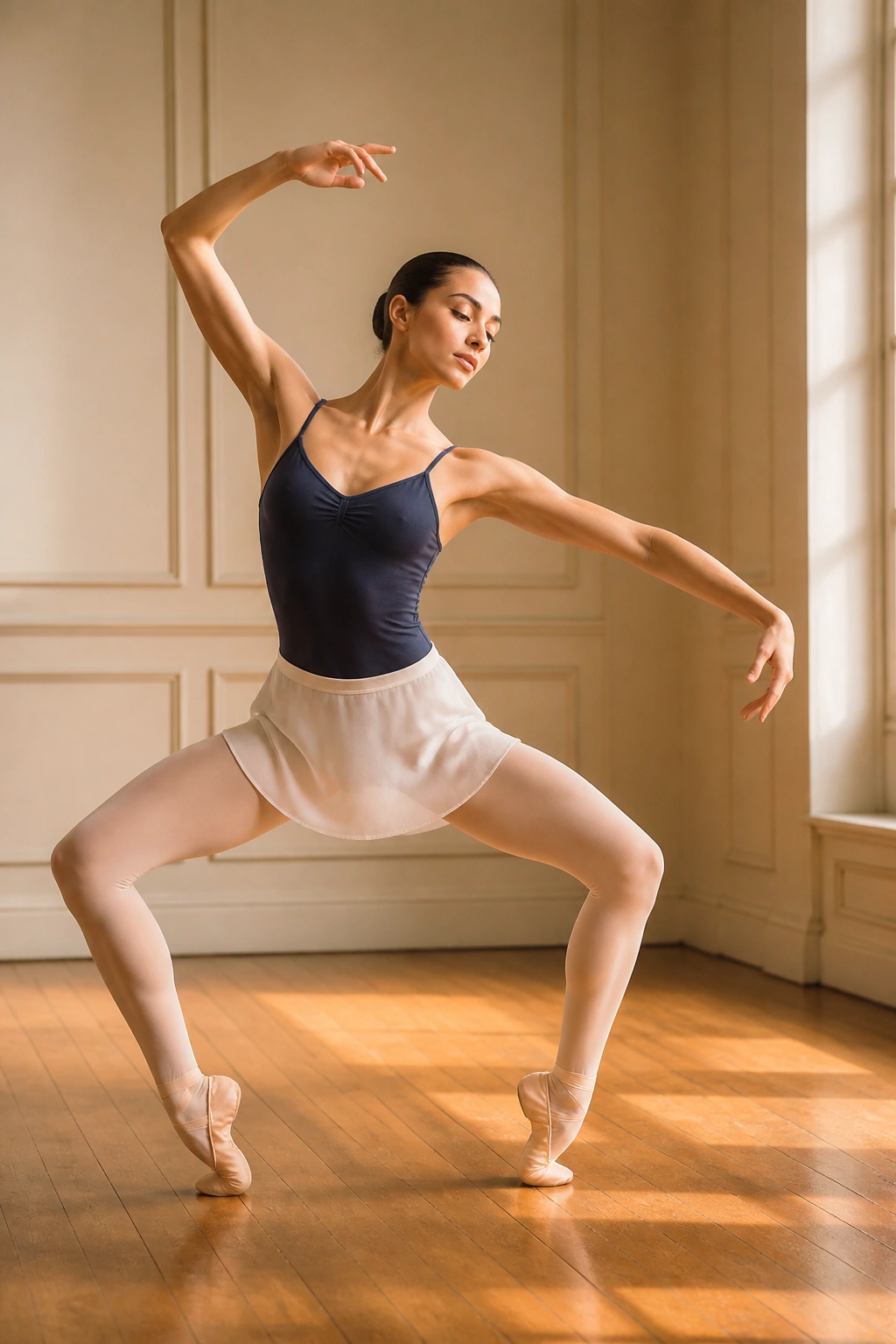
Port de bras refers to the movement of your arms. It might seem strange to include arm movements in a leg workout, but in ballet, the arms and legs are inseparable. When you move your arms, you must maintain a strong, engaged base in your legs.
Stand in second position—feet wide apart, toes turned out. As you plié down, sweep your arms through a big circle. As you straighten your legs, lift your arms above your head.
The Coordination
This teaches your body to maintain lower-body tension while the upper body is dynamic. It is a great way to cool down while still keeping the quads firing. Focus on the transition—the point where you are at the bottom of the plié and about to rise. That is where you should feel the most resistance.
19. Attitude Derriére (Pulsing)
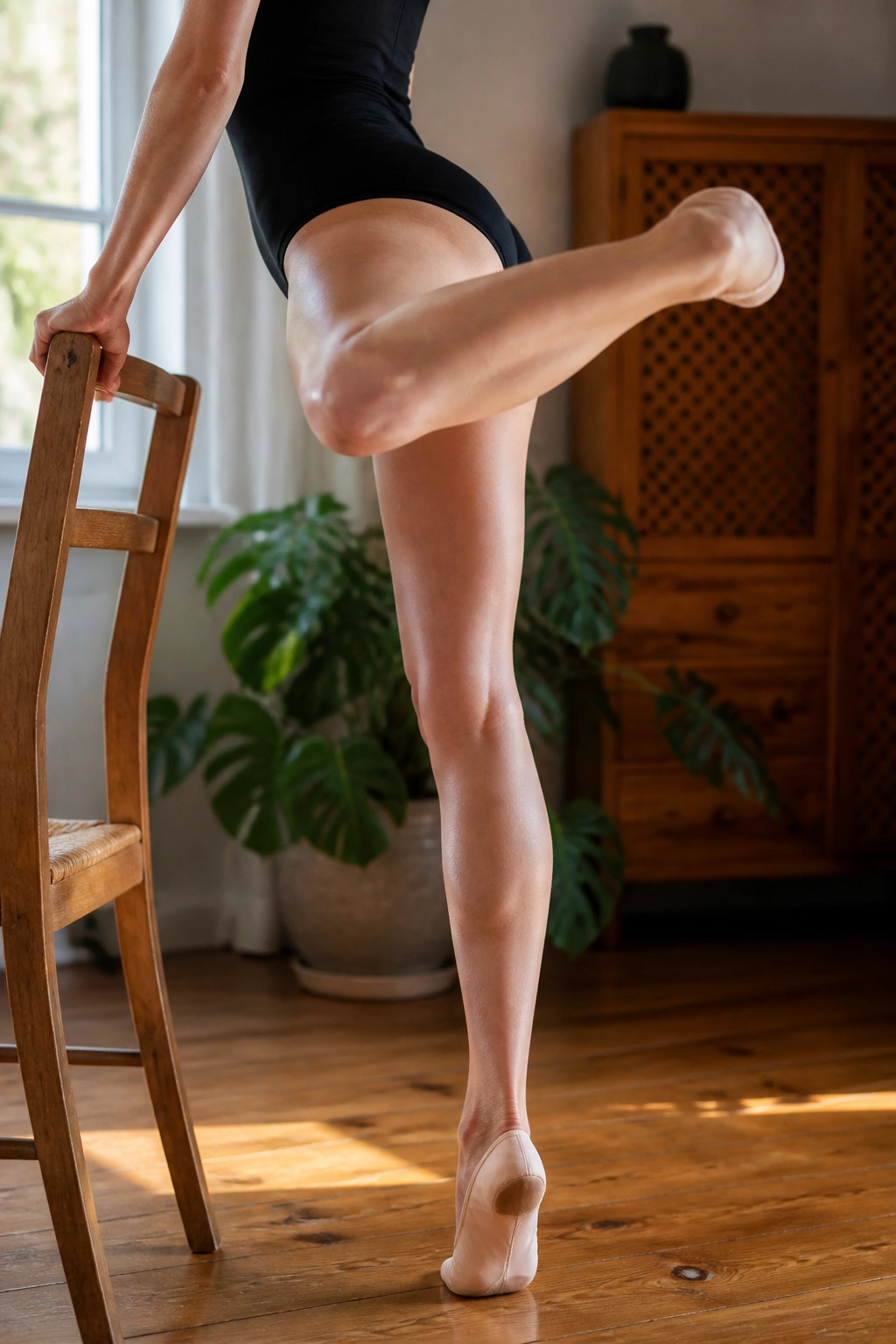
We already touched on the attitude, but this is a specific variation for the glutes. Stand facing your chair. Lift your leg into attitude position behind you. Now, instead of holding it, pulse the leg upward by one inch, rapidly.
Do twenty pulses. Then switch legs. Do not let your knee drop during the pulses. It stays at that same, elevated height.
The Burn: This is a classic barre class finisher. It targets the exact spot where the glute meets the hamstring. You will feel a deep, intense burn that lingers. That is exactly what you want. Embrace it.
20. The Full Rotation Series
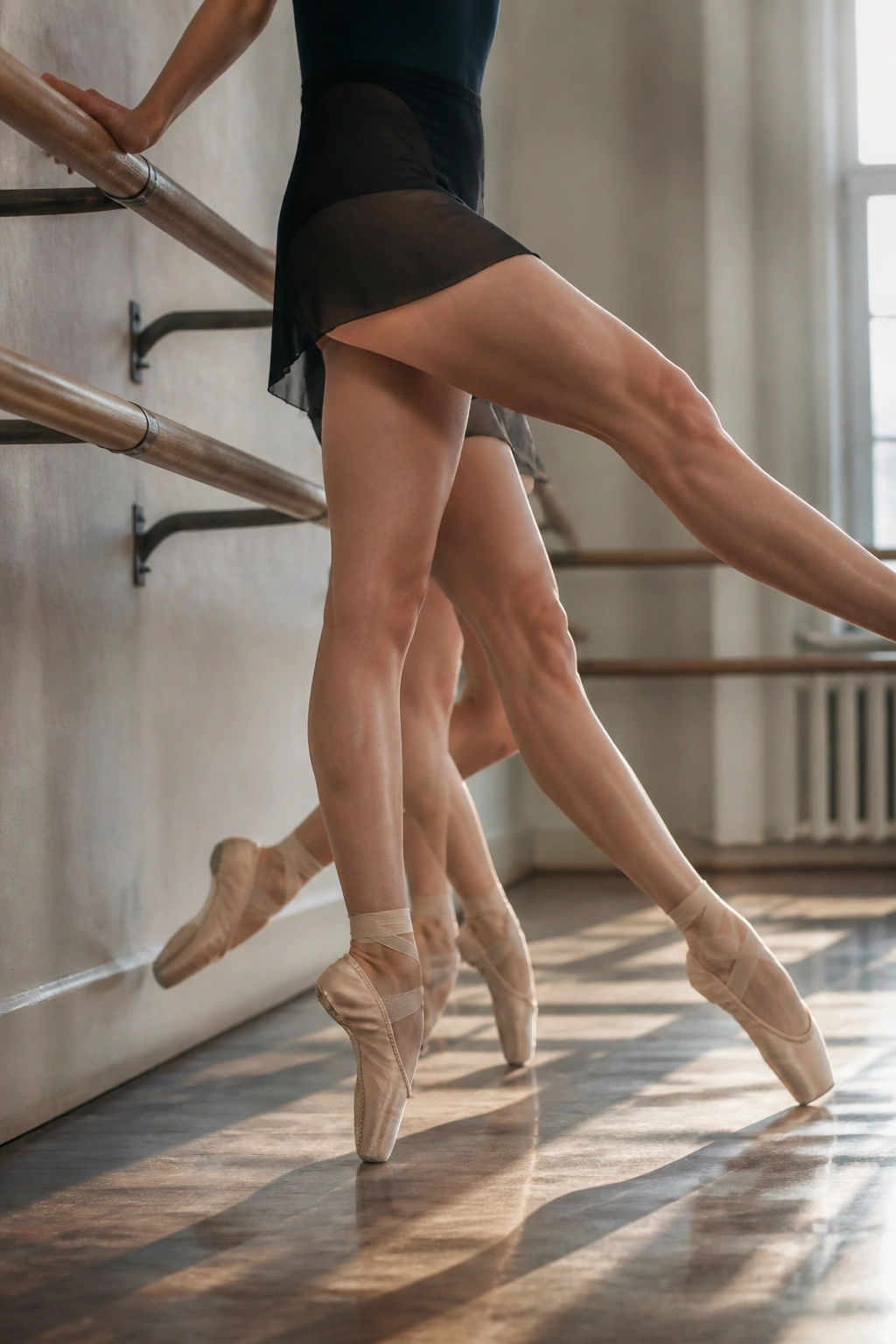
This is not a single move, but a combination of moves that creates a “flow.” Combine a Tendu, a Dégagé, and a Grand Battement all in one sequence, going forward, then side, then back.
This sequence trains your brain as much as your muscles. By changing the intensity and height of the move in one continuous sequence, you force your legs to adapt instantly. You go from the controlled slide of the Tendu to the explosive power of the Grand Battement.
Why This is Essential
You are teaching your legs to be versatile. Professional dancers need strength for slow, controlled movements and speed for fast, explosive ones. By combining these, you are getting the best of both worlds, ensuring your legs are not just strong, but also responsive and agile.
Final Thoughts
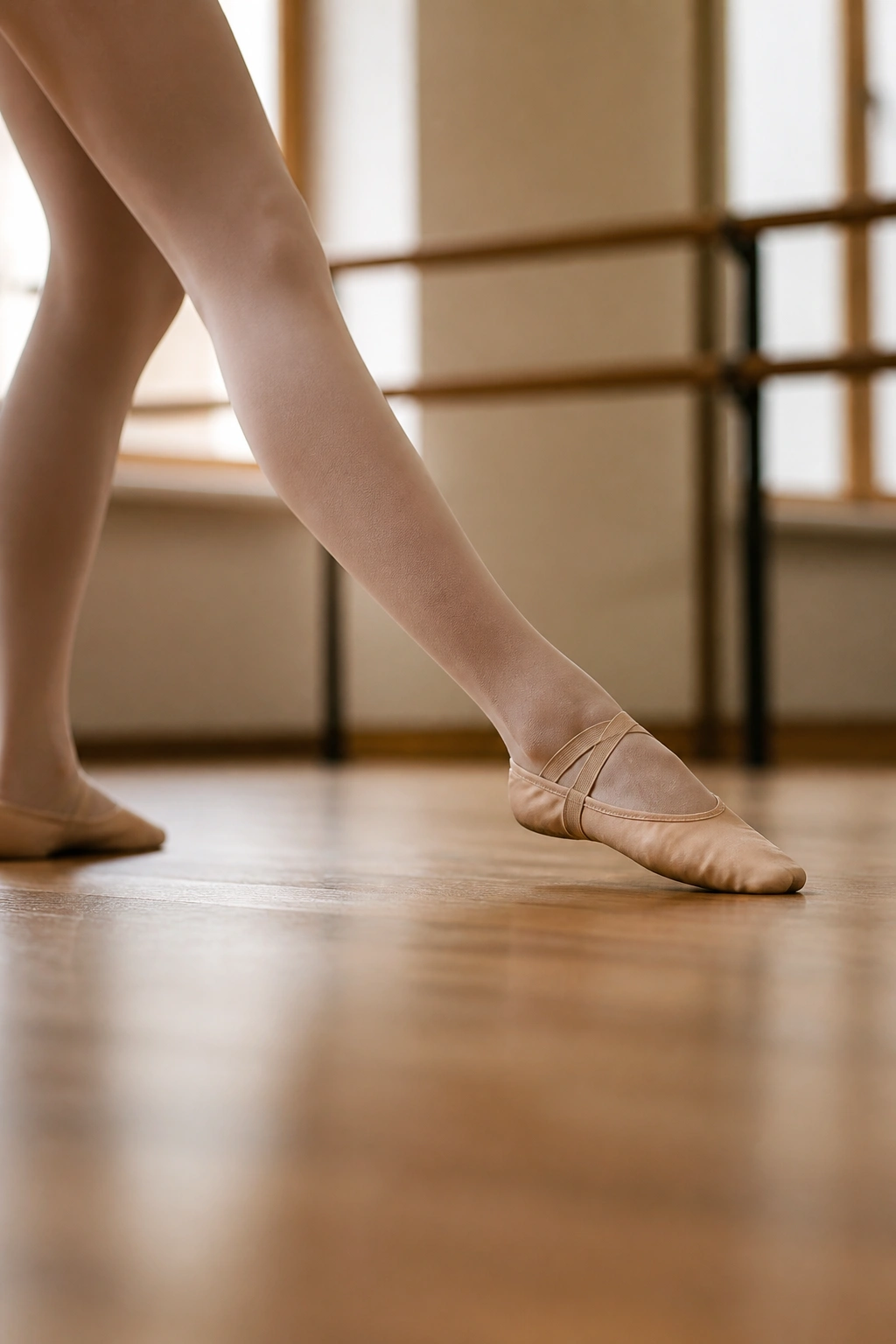
Consistency is the silent engine behind the dancer’s physique. You do not need to do all twenty of these every single day. In fact, that would likely lead to burnout or injury. Ballet training is about quality, not just accumulation. Pick four or five movements that target your weak points and practice them with absolute focus for fifteen minutes.
It is easy to get caught up in how high you can kick or how deep you can bend, but those are just metrics. The real work happens in the small, controlled movements—the ones where you feel the shake. When your leg starts to tremble, that is the moment your body is changing. If you embrace that discomfort rather than rushing through it, you will start to see the changes you are looking for in your own legs.
Treat your home practice as a sanctuary for your own mechanics. There is no one watching you, no mirror to judge your turnout, and no teacher to correct your arm position. Use that freedom to really feel what your muscles are doing. Pay attention to how your weight shifts and how your feet grip the floor. The more you listen to your body, the more effective these ballet-inspired movements will become.
