



A spare corner of a room can do more than most people think. With the right workouts for getting lean and fit at home, a mat, a chair, a step, or a pair of dumbbells can turn into a decent training setup without much fuss.
The trick is not chasing random sweat. It’s building sessions that ask for enough effort to matter, then repeating them often enough that your body has to adapt. Squats, push-ups, intervals, carries, and crawling patterns all do that job in different ways, and they each bring a slightly different feel to the room. Some days you want your lungs burning. Other days you want your legs to shake a little on the last rep.
A lot of people make home training too easy, then wonder why nothing changes. Others go full throttle every day, which is just a fast way to annoy your knees, shoulders, and lower back. The sweet spot sits in the middle: hard enough to drive change, simple enough that you’ll actually stick with it.
Some of the best sessions below need no equipment at all. Others use a band, a kettlebell, or a pair of dumbbells because, frankly, those tools make home training feel less like improvisation and more like a plan. Start where you are, pick the style that fits your space, and let the numbers do the work.
What Makes a Home Workout Actually Change Your Shape
Home training works when it gives you a reason to get stronger, not just tired. That sounds obvious, but it’s the part people skip. If you do the same 20-minute circuit forever, your body gets efficient, the effort drops, and the results go flat.
Muscle matters here. A body that holds onto muscle usually looks firmer, even when body fat comes down, and that’s why strength work belongs in any leaner-fitter plan. You do not need to lift like a powerlifter. You do need sets that feel hard in the last third, where the reps slow down and your form starts asking for attention.
Cardio still earns its place. Short intervals, stair work, boxing rounds, and low-impact flow sessions burn energy and train your heart and lungs without taking forever. The best mix is usually a few hard sessions, a few moderate ones, and at least one easier day where you move but do not hammer yourself into dust.
Sweat is not the scorecard.
Track reps, rounds, rest times, or load. If you can repeat a workout exactly the same way for weeks and never nudge one number upward, it’s not a program anymore. It’s a habit. Good habits are nice. Progress needs a little more pressure than that.
How to Pick the Right Workout for Your Day
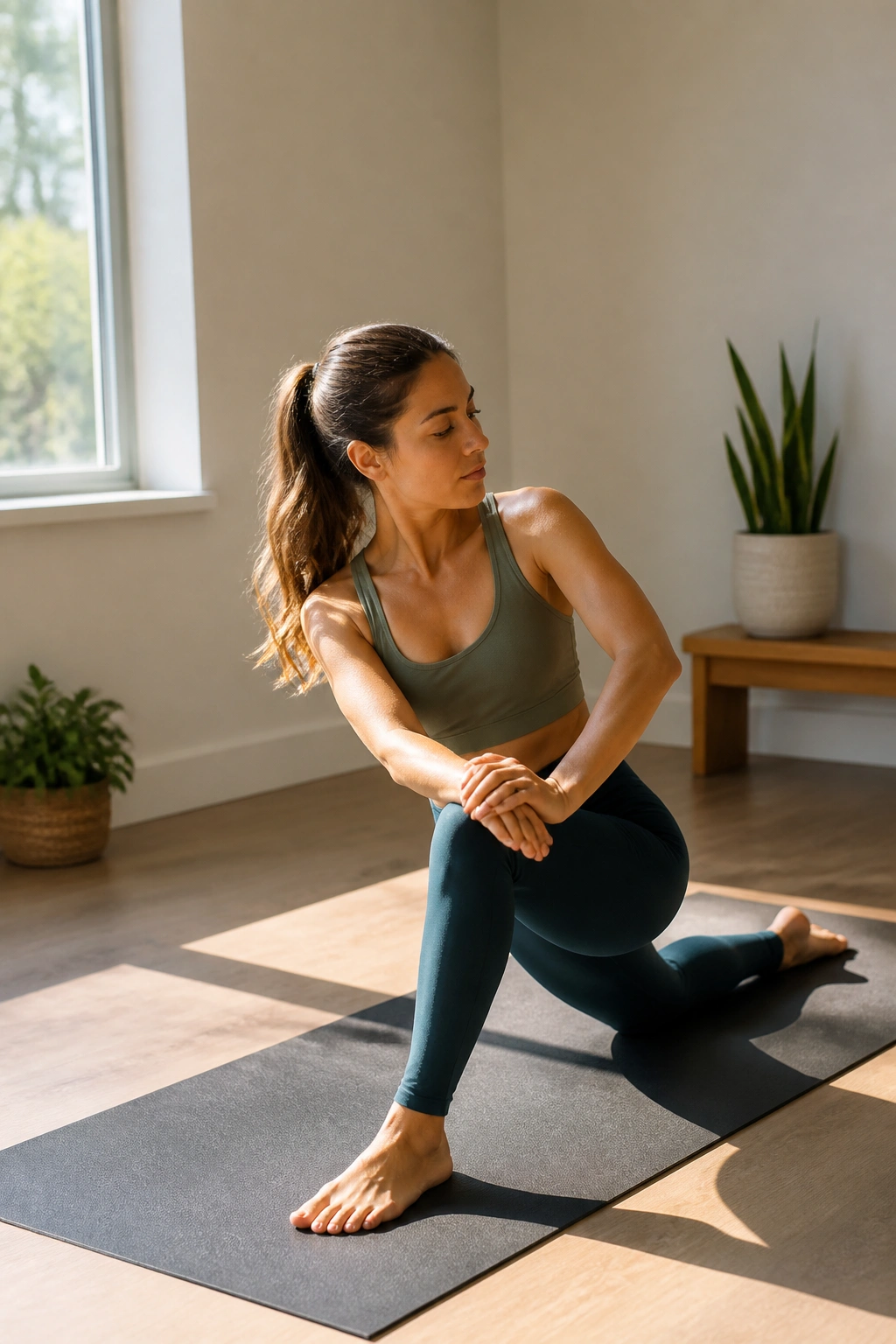
Start with the room, then the mood, then the goal. If you have 10 minutes and a bad back from sitting all day, a floor-based core or mobility session makes more sense than burpees. If your legs feel springy and your neighbors are not asleep under you, stairs, squat circuits, or a Tabata block are fair game.
One simple rule helps: match the stress to the day you actually have, not the day you wish you had. Fresh and focused? Go for strength density or a dumbbell complex. Tired but willing? Shadow boxing, walking intervals, or a band circuit will still move the needle without burying you.
A decent weekly rhythm looks like this:
- 2 hard strength sessions with squats, hinges, presses, or loaded carries.
- 2 conditioning sessions with intervals, boxing, stairs, or step work.
- 1 mixed session that hits both muscle and lungs.
- 1 lighter day with yoga, core work, or an easy march circuit.
- 1 rest day if your joints or sleep start complaining.
A lot of people also ignore recovery until it gets loud. Bad move. If your shoulders feel cranky, skip the crawling workout for a day. If your knees feel tender, use shadow boxing or band work instead of jump-heavy intervals. That small bit of judgment keeps home training useful for months instead of exciting for two weeks.
1. The Squat and Reverse Lunge Burner
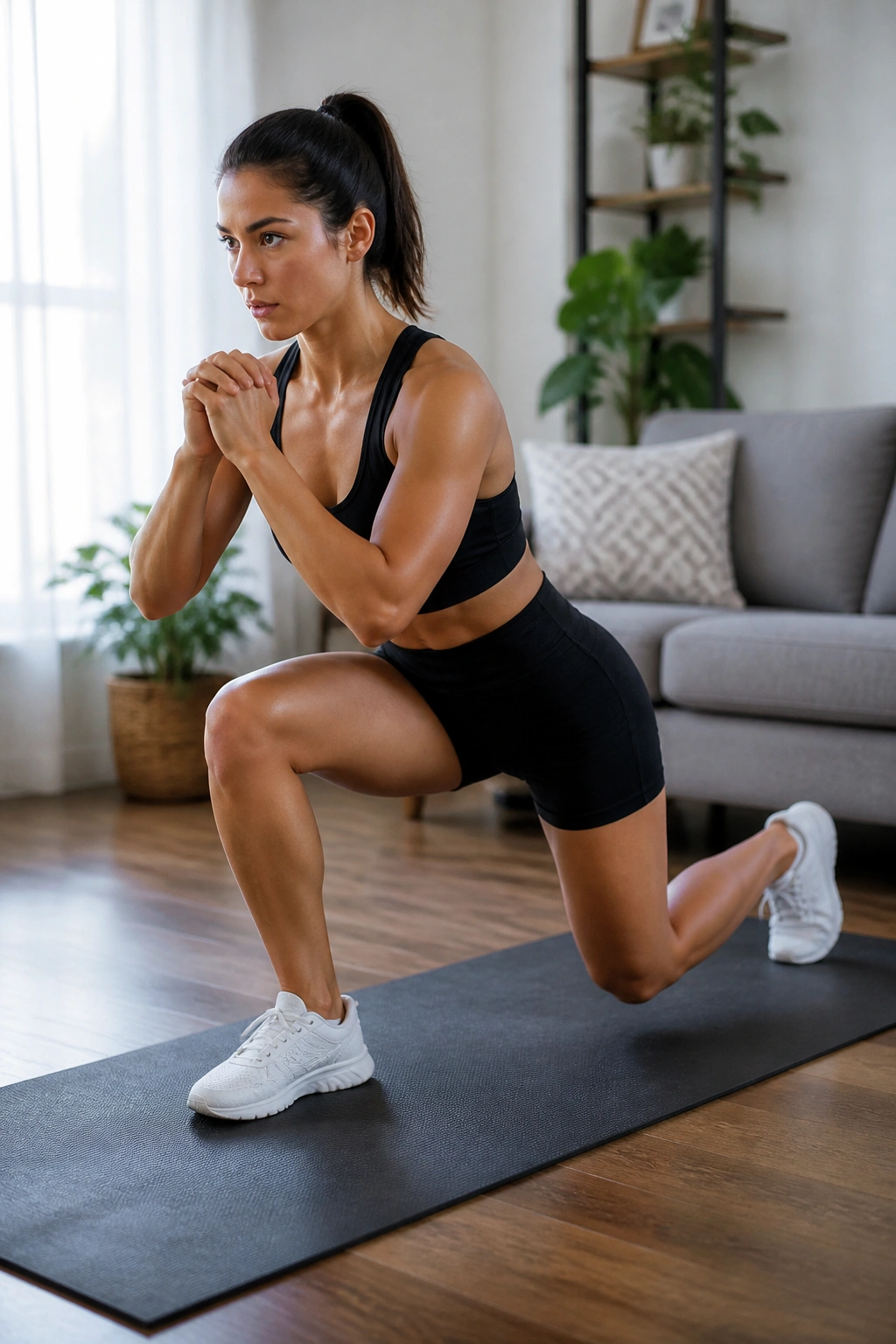
Leg day at home does not have to mean endless air squats. A squat-and-lunge circuit can smoke your thighs, glutes, and lungs in under 20 minutes if you keep the rest short and the tempo honest.
Try 4 rounds of 12 squats, 10 reverse lunges per leg, 20 calf raises, and a 30-second wall sit. Rest 45 to 60 seconds between rounds. If bodyweight feels too easy, slow the lowering phase to 3 seconds and pause for 1 second at the bottom of each squat.
Why It Works
Squats and reverse lunges hit the big muscles that help you look tighter through the hips and legs. Reverse lunges are kinder to most knees than forward lunges, which makes them a smart choice when you train at home on less-than-perfect flooring.
The wall sit matters more than people think. It strips away momentum and forces your legs to hold tension while your heart rate climbs. That’s the good stuff.
One clean rep beats three sloppy ones.
Keep your chest tall, let your front foot stay flat, and stop the squat before your lower back starts rounding. If you rush these, the workout turns into a balance drill with bad form.
2. Push-Ups, Shoulder Taps, and Plank Reaches
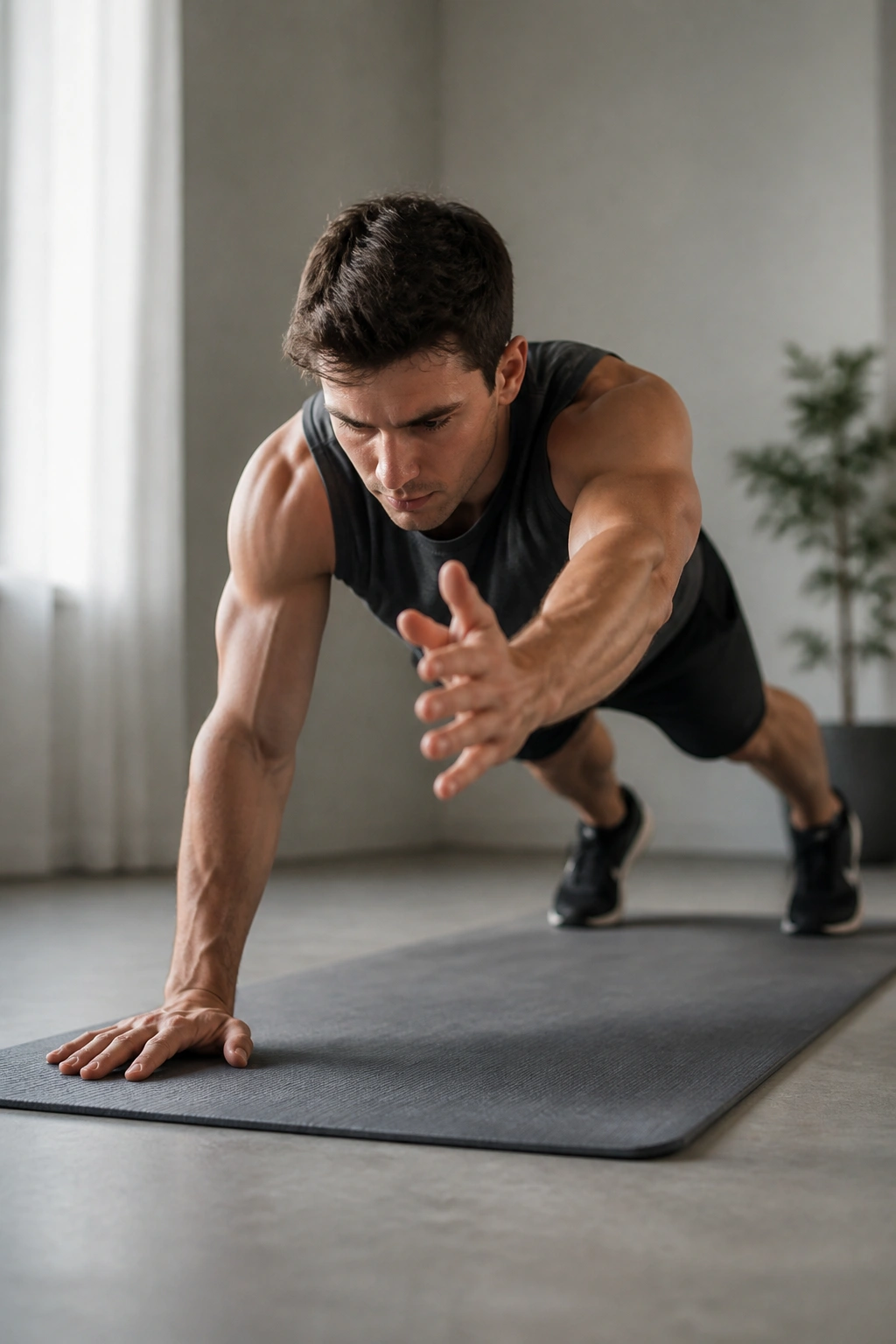
Do you need a full gym to train your upper body hard? No. A push-up ladder paired with plank work can hit chest, shoulders, triceps, and core in a way that still feels like real training.
Start with 5 rounds of 6 push-ups, 12 shoulder taps, and 20 seconds of plank reaches. Rest 30 to 45 seconds between rounds. If full push-ups are a stretch, put your hands on a couch, a sturdy table, or a bench so you can keep the same range of motion without collapsing at the waist.
How to Scale It
- Easier: incline push-ups, knees down, or shorter plank holds.
- Harder: feet elevated push-ups, slower lowering, or a 5-second hold at the bottom.
- Best cue: keep your ribs tucked so your lower back doesn’t sag.
The shoulder taps are sneaky. They force your core to resist side-to-side movement, which is one reason the whole sequence feels tougher than the rep count suggests. That little wobble is the point.
Finish with a hard plank hold if you still have gas. Ten extra seconds done well can tell you a lot about your trunk strength.
3. The Every-Minute-On-the-Minute Full-Body Set
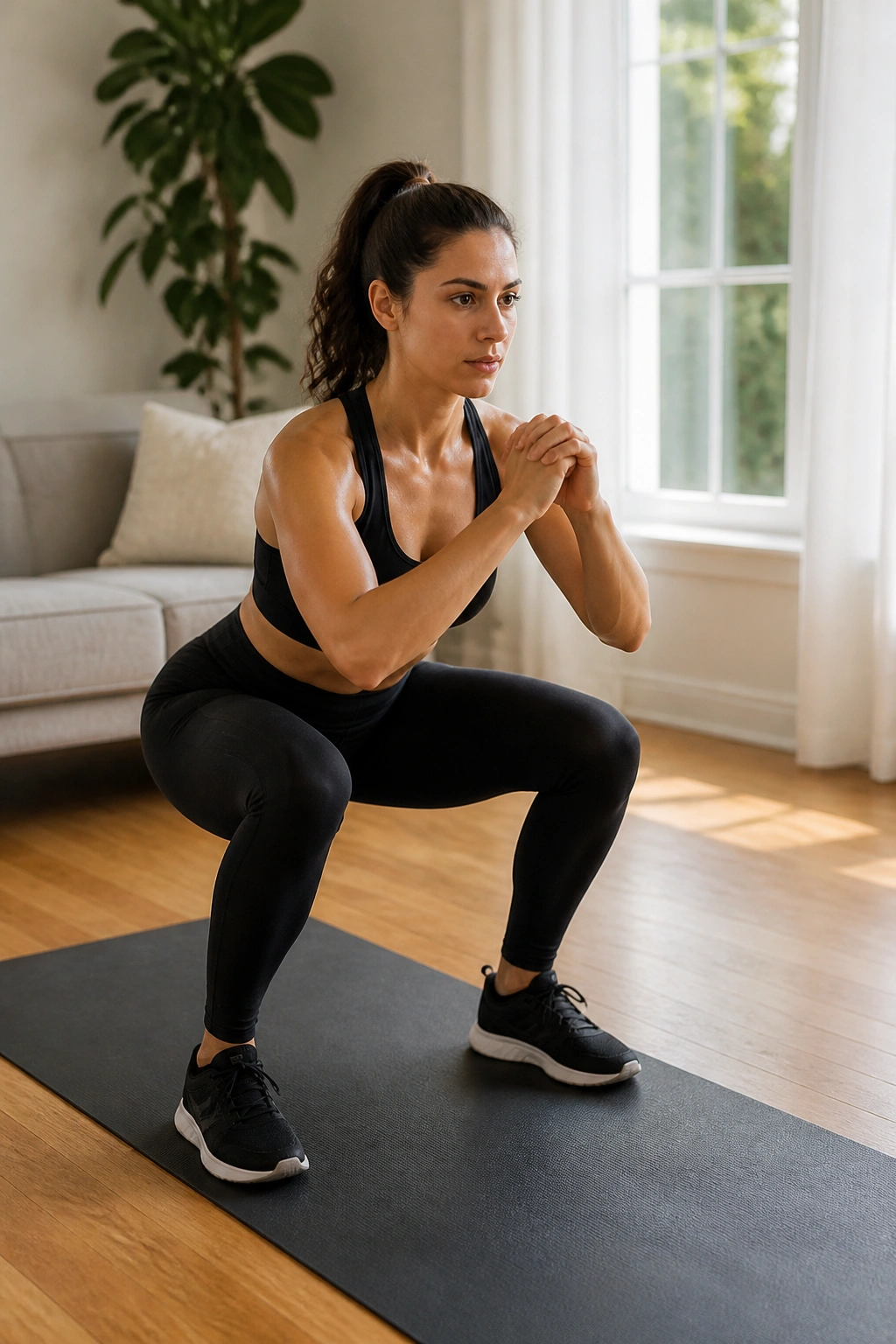
An EMOM is one of the cleanest ways to get sweaty without drifting into sloppy reps. Every minute on the minute, you do a set, then rest for whatever time is left in that minute.
Try a 20-minute EMOM with this rotation: minute 1, 12 air squats; minute 2, 10 push-ups; minute 3, 12 alternating mountain climbers per side; minute 4, 12 hip hinges or good mornings. Repeat that 5 times. If you finish early, breathe and recover. If you run past the minute, the load is too high or the reps are too many.
A good EMOM teaches pacing. You cannot blast the first round and hope for the best. You need to choose a rep number you can repeat with clean form in every round, even when the room starts feeling hot and your shirt is sticking to your back.
That restraint pays off. It keeps the workout honest instead of chaotic.
4. Shadow Boxing for Fast Feet and a Faster Pulse

Put on a timer, clear a square of floor, and pretend you’re working a tiny ring. Shadow boxing is one of the best home conditioning tools because it asks for footwork, coordination, and rhythm at the same time.
Do 6 to 10 rounds of 2 minutes on, 30 seconds off. Round 1 can be basic jab-cross. Round 2 adds jab-cross-hook. Round 3 brings in slips, pivots, and side steps. By round 4, you should care less about looking polished and more about staying light on your feet.
A few things matter here:
- Keep your fists coming back to your face.
- Exhale on punches.
- Pivot your back foot when you throw the cross.
- Stay on the balls of your feet, not tiptoes.
Shadow boxing looks easy until minute three arrives. Then the shoulders start to burn, the calves wake up, and your breathing gets choppy in a hurry. That’s what makes it useful.
If you want a low-impact version, keep the punches sharp and the feet quiet. Same work, less bounce.
5. Stair Step-Up Intervals
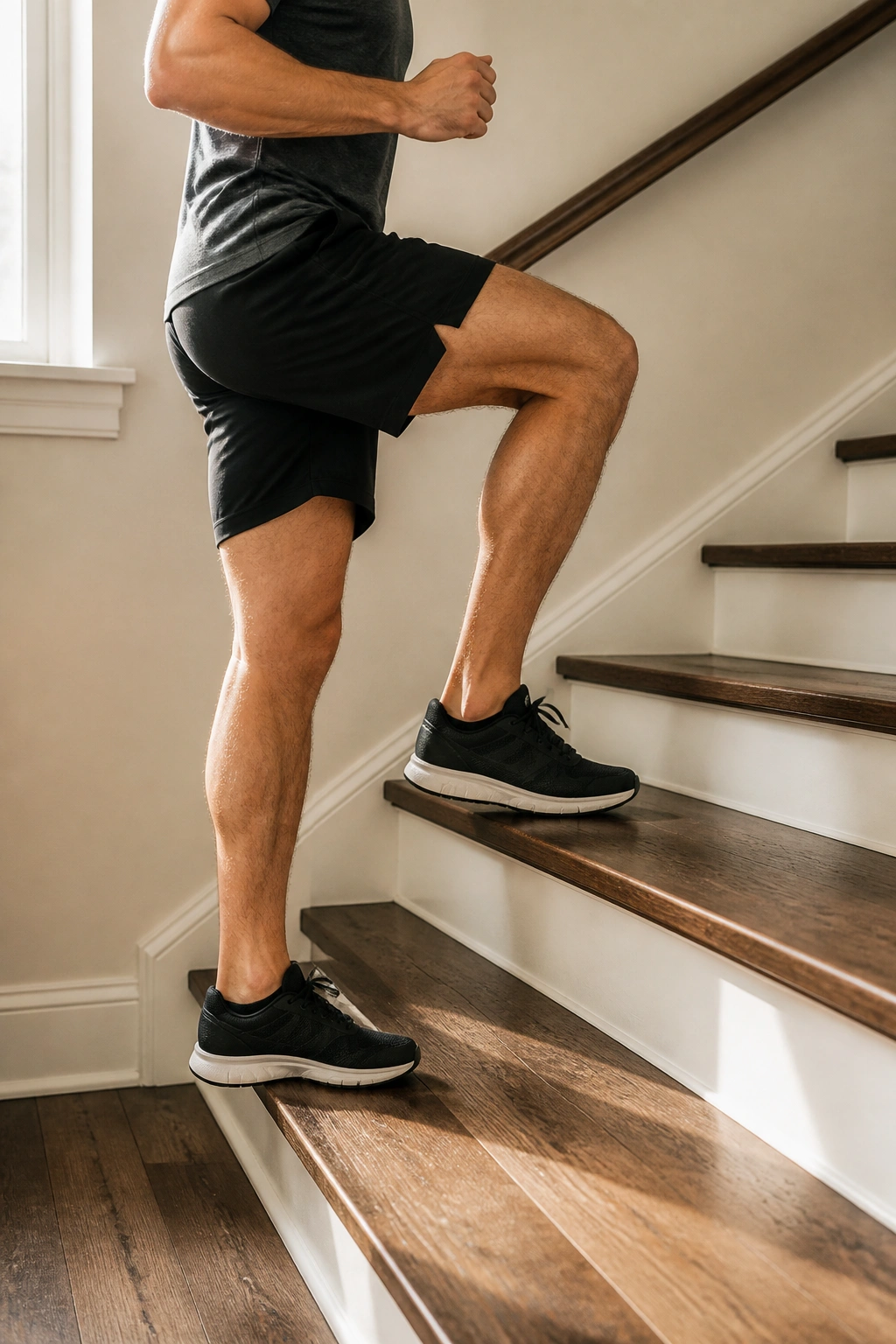
Stairs are rude. That’s also why they work.
Find a stable step or a short flight of stairs and do 10 to 15 minutes of intervals: 45 seconds of step-ups, 45 seconds of easy marching in place, repeated until the timer ends. Use the whole foot on the step, drive through the heel, and bring the opposite knee up at the top for a little extra work.
The temptation is to rush. Don’t. Fast feet on a shaky step are a bad trade. Controlled reps with a clean push through the standing leg will tax your glutes and lungs without turning the workout into a slip hazard.
If you want more leg work, carry light dumbbells at your sides. If your knees are touchy, keep the step low and stay smooth. The same pattern can be mild or brutal depending on how hard you push and how long you stay on task.
Simple. Effective. Unfair in the best way.
6. Tabata Without the Fancy Equipment
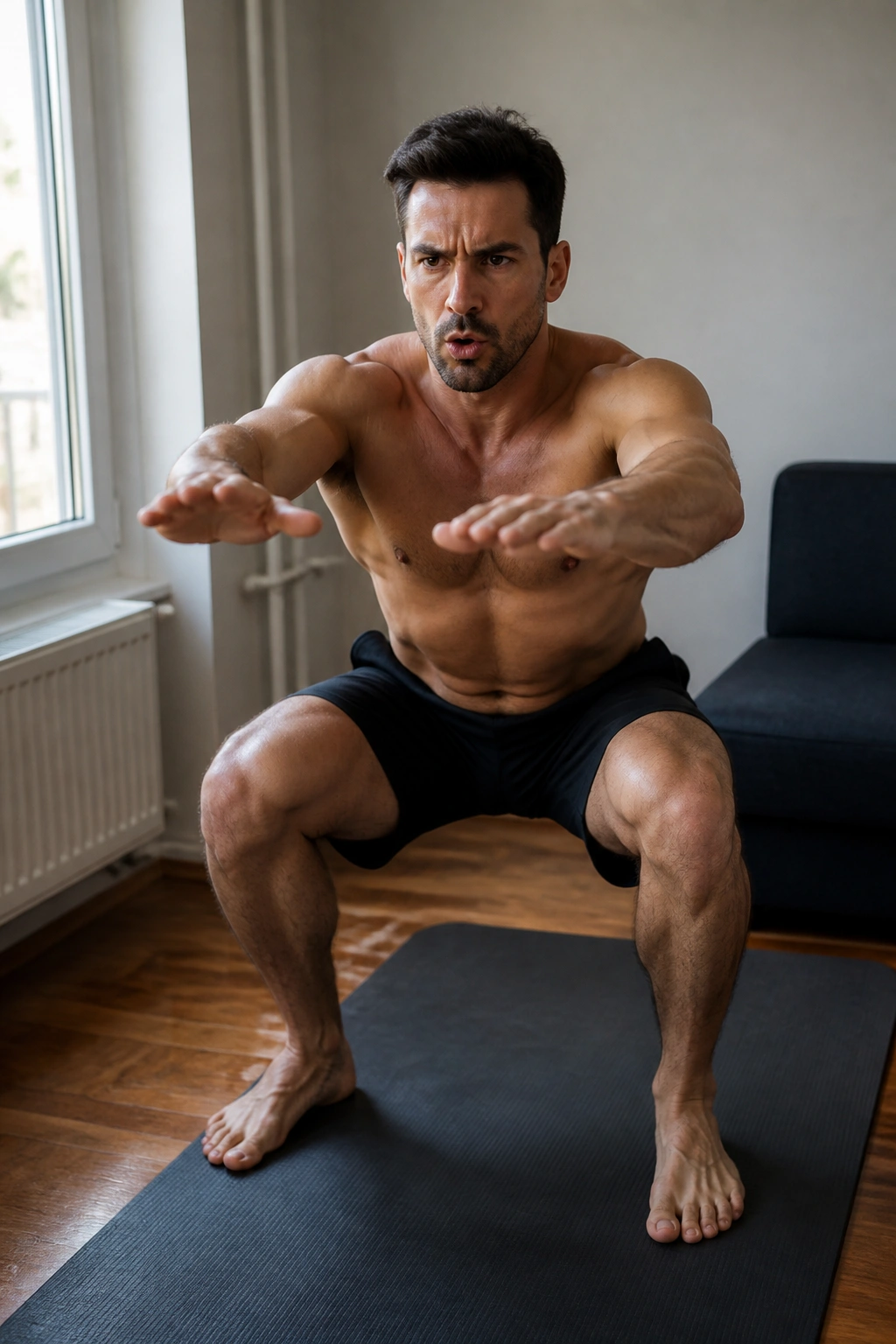
Tabata sounds glamorous until you actually do it. Then it feels like 20 seconds is either nothing or forever, depending on where you are in the round.
Use 20 seconds of hard work and 10 seconds of rest for 8 rounds. Pick one movement for the first block, then another for the second block. Air squats and mountain climbers work well. So do skaters and push-ups. Total work time is only 4 minutes per block, but if you do it honestly, it lands hard.
Pacing Matters More Than Speed
Tabata is not a race to the fastest first set. It’s a test of whether you can keep the effort high across all 8 rounds. If your reps fall off a cliff by round 3, scale the movement or choose a lower-impact option.
That could mean:
- squat to chair instead of squat jumps
- incline push-ups instead of floor push-ups
- step-back climbers instead of running climbers
The whole point is to stay aggressive without turning the pattern into mess. A clean, repeatable Tabata block leaves you breathing hard and moving better. A sloppy one just leaves you annoyed.
7. Resistance Band Rows, Presses, and Squats
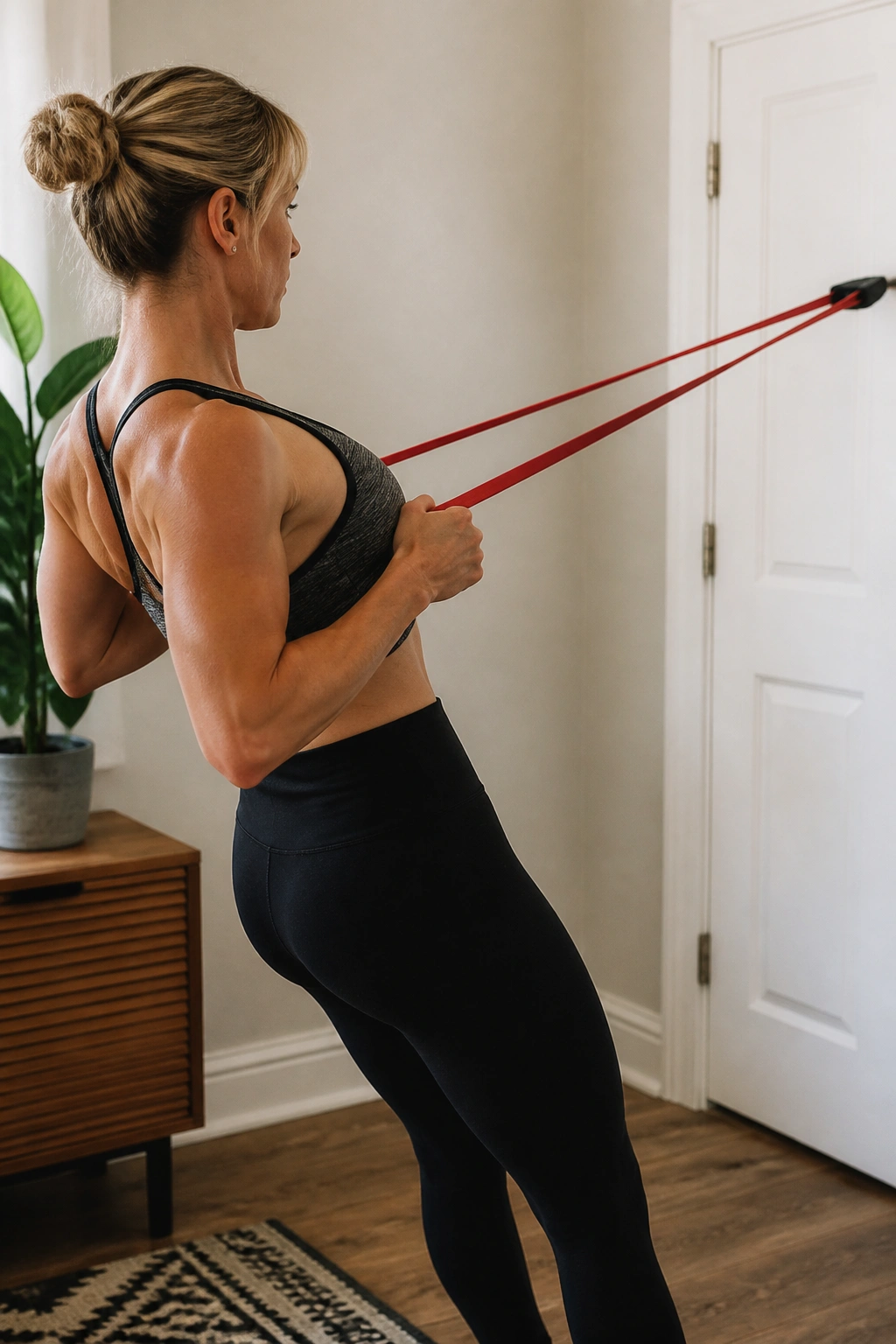
Bands are ugly in the best way: cheap, light, and way harder than they look at the end of a set. They shine at home because you can train your back, chest, shoulders, and legs without needing much room or much noise.
Run 3 to 5 rounds of 12 band rows, 12 band squats, 10 band chest presses, and 15 band pull-aparts. Rest about 45 seconds between rounds. If you have a door anchor, use it carefully and test it before you pull hard on anything.
The nice thing about bands is the smooth tension. They get harder as you extend them, which means the top of each rep matters. That’s where a lot of people rush and lose the work.
A good band session should leave your upper back feeling awake and your legs a little cooked. Not smashed. Awake. There’s a difference.
Use a heavier band when you can keep your shoulders down and your ribs from flaring. If your neck starts doing the work, the band is too much.
8. The Dumbbell Complex That Does Not Waste Time
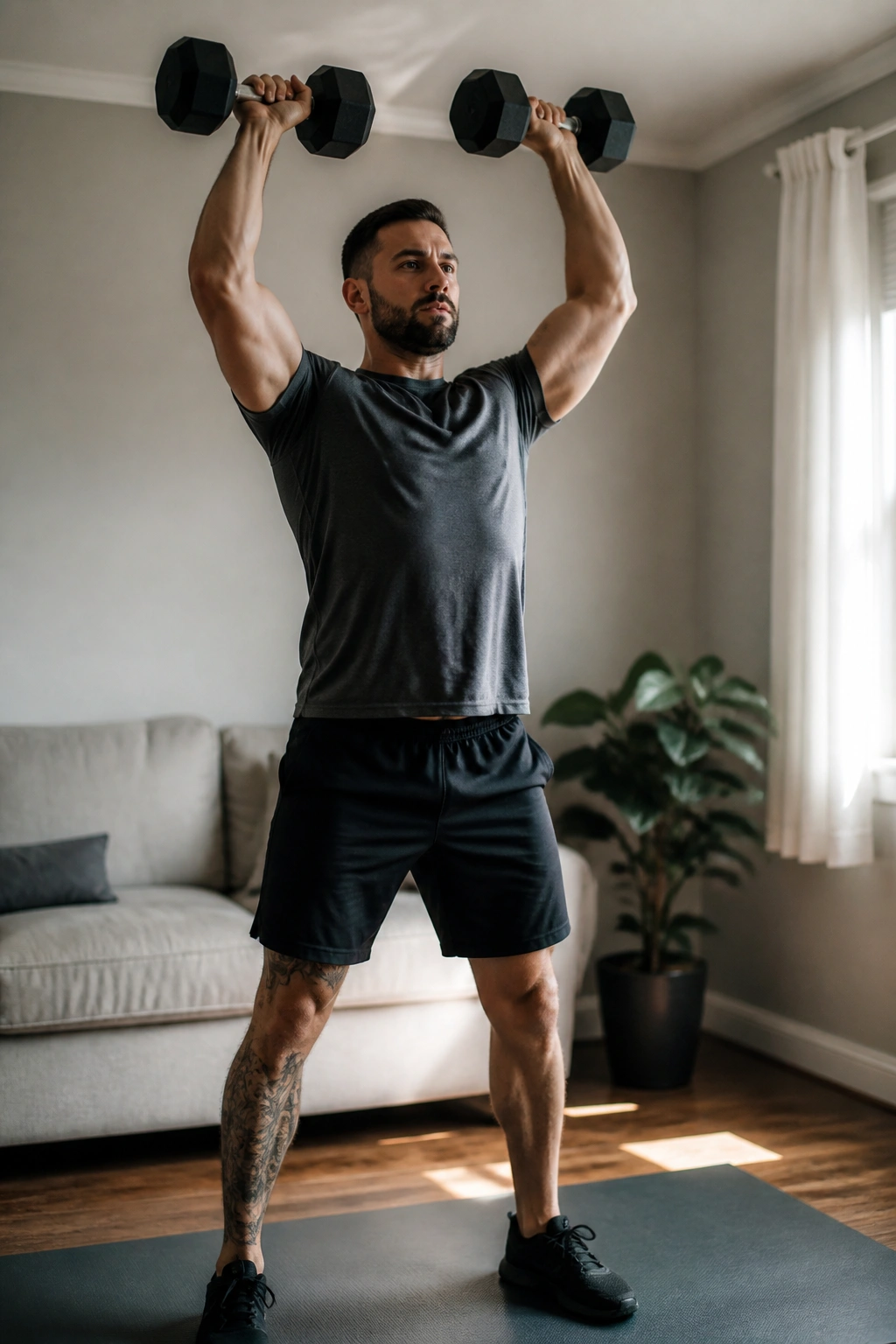
One pair of dumbbells can humble you fast when you stop setting them down. A complex ties several moves together, so your heart rate climbs while your muscles stay under load.
Try 4 rounds of 6 dumbbell deadlifts, 6 bent-over rows, 6 front squats, 6 push presses, and 6 reverse lunges per leg. Rest 90 seconds between rounds. Pick a weight you could press overhead with clean form for all 6 reps. That number matters more than ego.
How to Pick the Load
If the last rep of the push press turns into a back bend, the dumbbells are too heavy. If the whole sequence feels easy enough to chat through, go up next time. The sweet spot is the weight that makes the rows honest and the lunges slow, not the one that makes your hands ache for the wrong reasons.
Complexes are brilliant for home training because they compress a lot of work into a small space. No extra setup. No need to wander around the room between stations.
And they teach efficiency. That matters.
9. Glute Bridges and Hamstring Walkouts
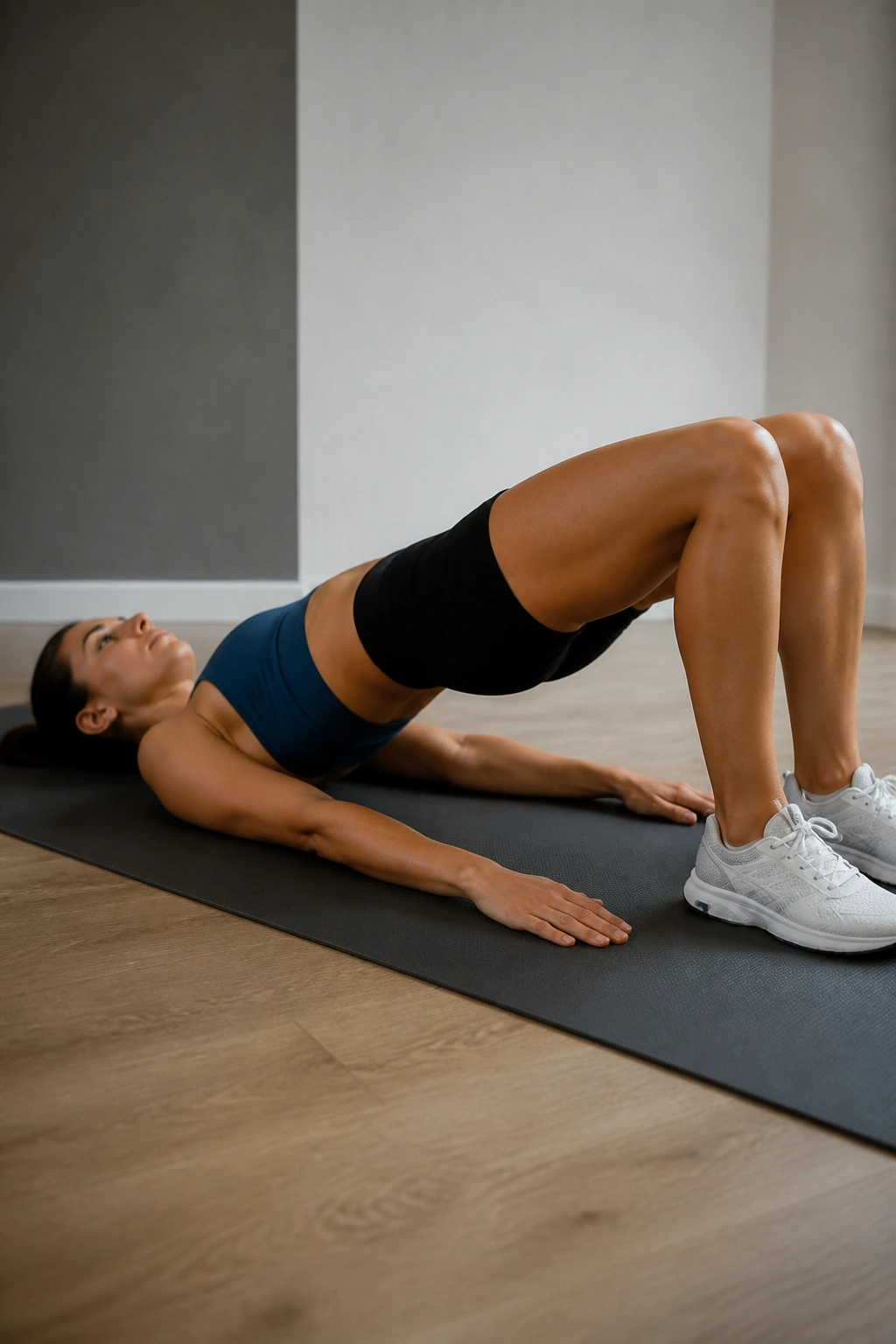
The back side gets ignored in a lot of home plans, which is a mistake. Glute bridges, single-leg bridges, and hamstring walkouts build the muscles that help your hips stay strong and your posture less slumped.
Start with 3 rounds of 15 glute bridges, 8 single-leg glute bridges per side, 10 hamstring walkouts, and a 20-second top hold at the end of each round. Keep your feet planted firmly, tuck your pelvis slightly at the top, and squeeze your glutes hard enough that your lower back stays quiet.
Hamstring walkouts are sneaky. You lift into a bridge, then walk your heels out one small step at a time until your legs almost straighten, and walk them back in. That slow control makes the hamstrings work much harder than a casual bridge ever will.
If you only have a floor and a towel, you can still do this workout. Put your heels on a smooth surface, slide them out under control, and keep your hips lifted as long as you can.
10. Mountain Climbers and Bear Crawls
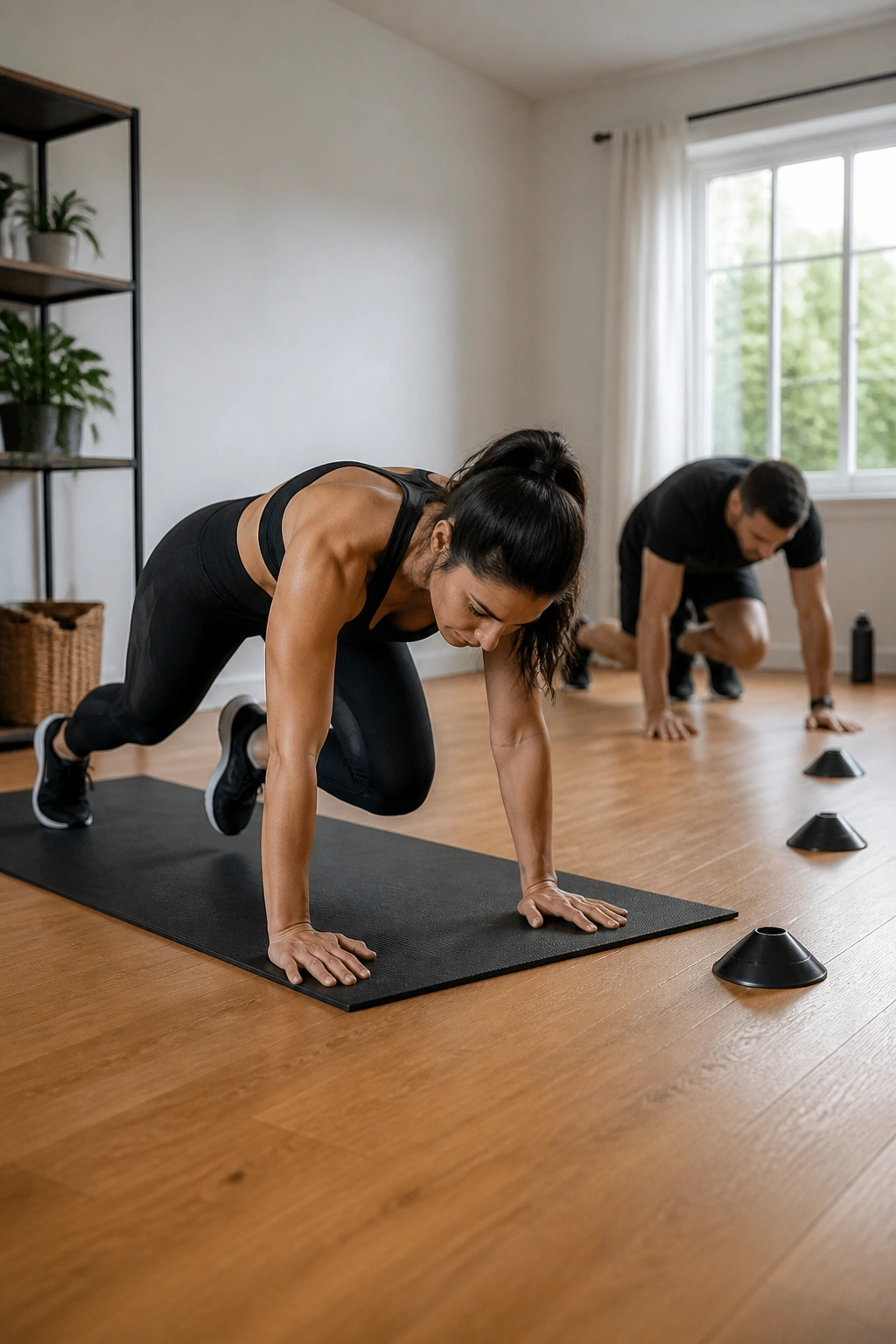
Why crawl when you could run in place? Because crawling asks your core, shoulders, hips, and lungs to work together, and that combination hits differently.
Do 8 to 10 rounds of 30 seconds of mountain climbers, 20 seconds of bear crawl forward and back, and 30 seconds of rest. If your wrists complain, put your hands on a bench, use fists, or skip the crawl and add a dead bug hold instead.
Mountain climbers are easy to rush. That’s the trap. Fast knees look exciting, but controlled climbers with a strong plank position do more for your trunk and hip flexors. Bear crawls add shoulder stability and a little humbling reality check for anyone who thinks core training has to happen on the floor with crunches.
If you have a small space, crawl in a short square or even forward and back by one body length. The point is the tension, not the distance.
Messy on purpose. That’s part of the charm.
11. Single-Leg Strength That Exposes Weak Spots
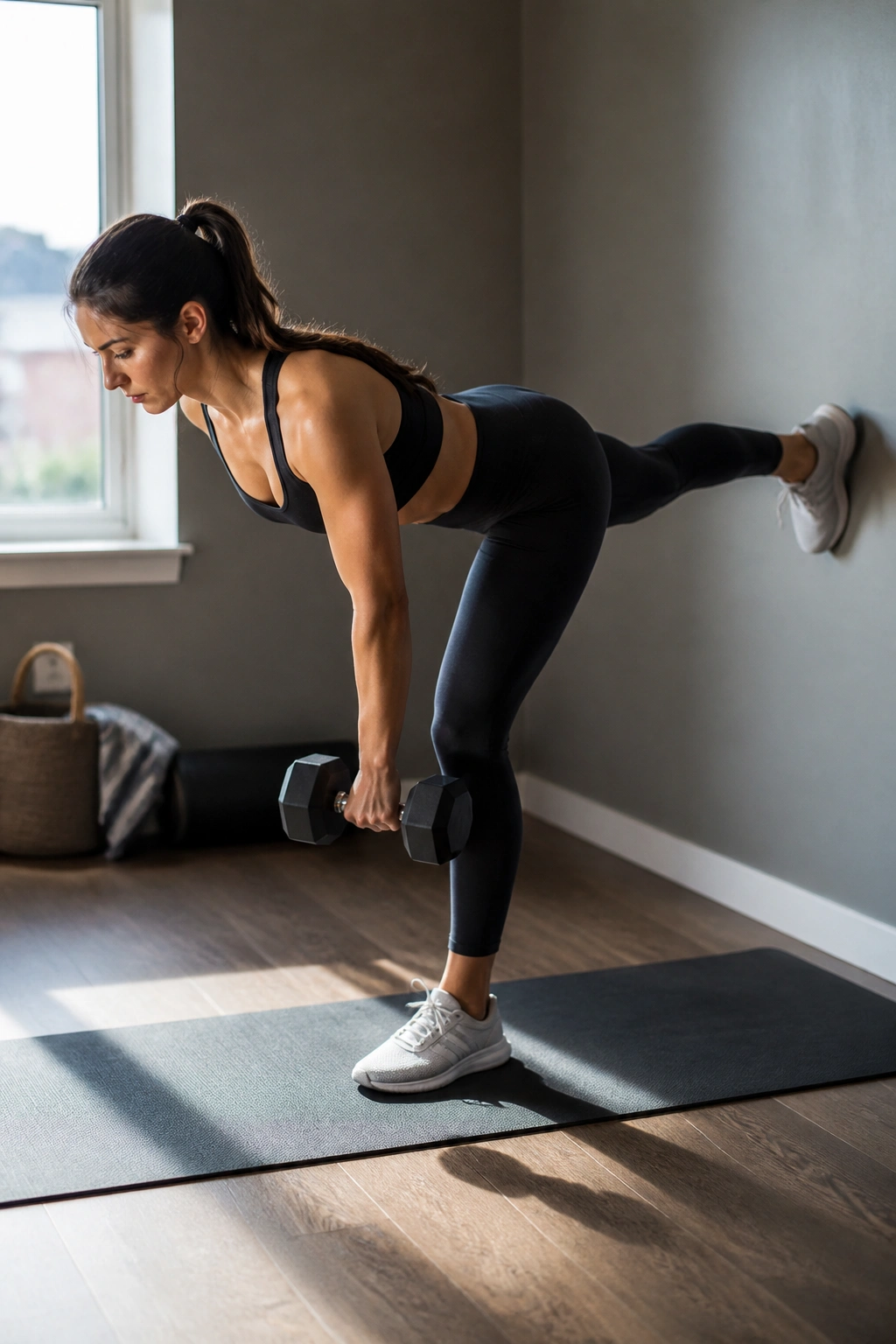
Two-legged work hides a lot. Single-leg training does not. Split squats, step-backs, and single-leg hinges tell the truth about balance, strength, and side-to-side differences.
Try 3 rounds of 10 split squats per side, 8 single-leg Romanian deadlifts per side, and 12 step-backs per side. Rest 60 seconds between rounds. If balance is shaky, keep one hand lightly on a wall or chair. That is not cheating. That is smart training.
The single-leg RDL is the move most people undersell. It teaches the hips to hinge while the standing leg stabilizes the whole body, and that carries over to better posture and cleaner movement in daily life. The first few reps may feel awkward. Fine. Awkward is part of the process.
One clean leg at a time also lets you train harder with less load, which is useful when your home setup is limited. Less equipment, more honesty.
12. The Core Circuit That Trains Bracing, Not Crunches
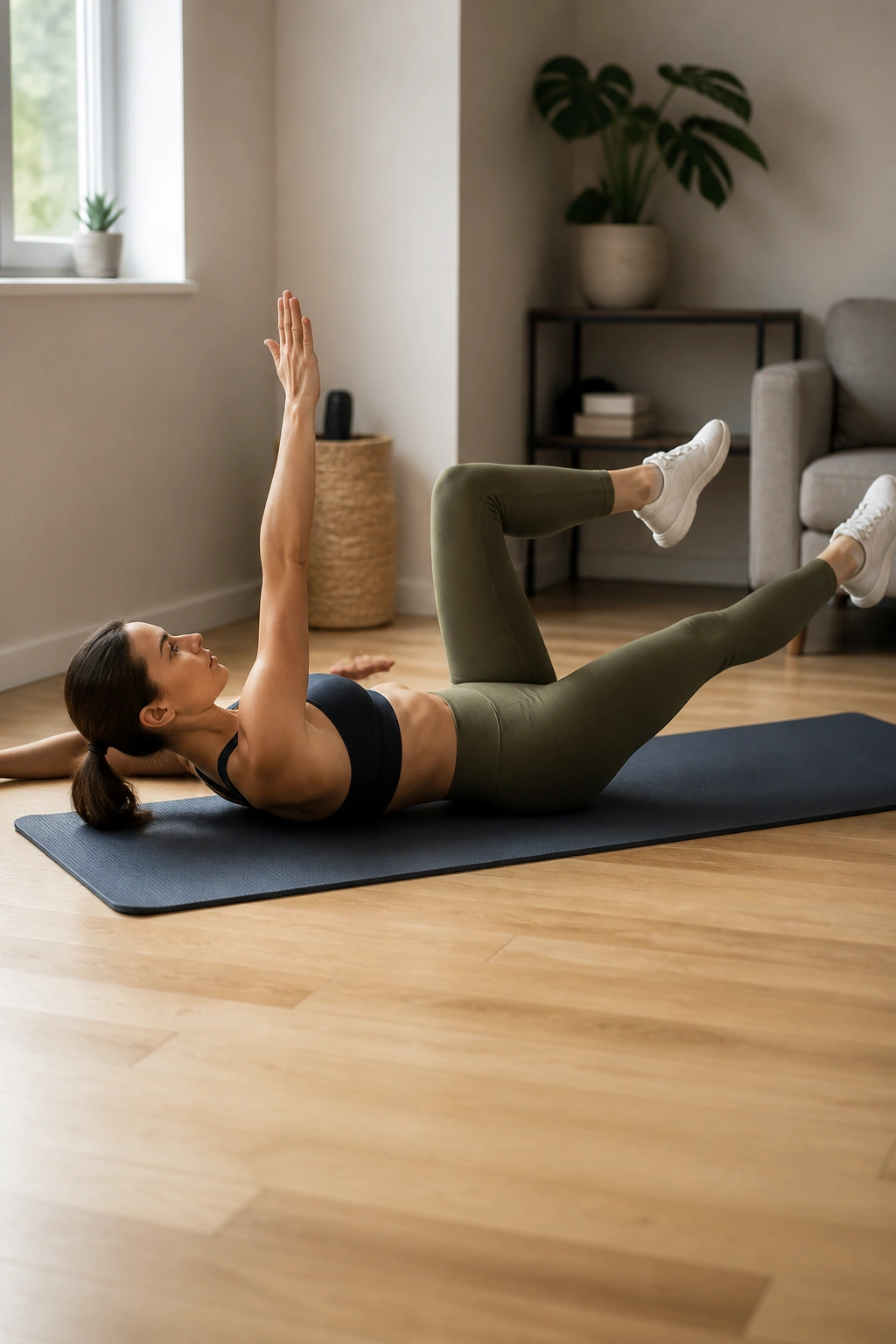
Crunches are cheap. Bracing is useful.
A strong midsection keeps your ribs, pelvis, and spine from drifting all over the place when you squat, press, hinge, or carry groceries. Try a 10-minute core circuit: 30 seconds dead bug, 30 seconds side plank left, 30 seconds side plank right, 30 seconds hollow hold, 30 seconds bird dog, then repeat until the timer ends.
What to Feel
You should feel pressure around the front and sides of your trunk, not a yank in your neck. If your lower back arches hard in the hollow hold, shorten the lever by bending your knees. If your hips twist in the bird dog, slow down and reach less far.
A decent core session does not leave you panting like a sprint, but it should leave your trunk feeling worked. That difference matters. You can be calm and still train hard.
A lot of people chase visible abs and forget that a stable core makes every other workout cleaner. That is the less glamorous truth, and it pays off every time you move a weight.
13. Low-Impact Cardio for Small Spaces
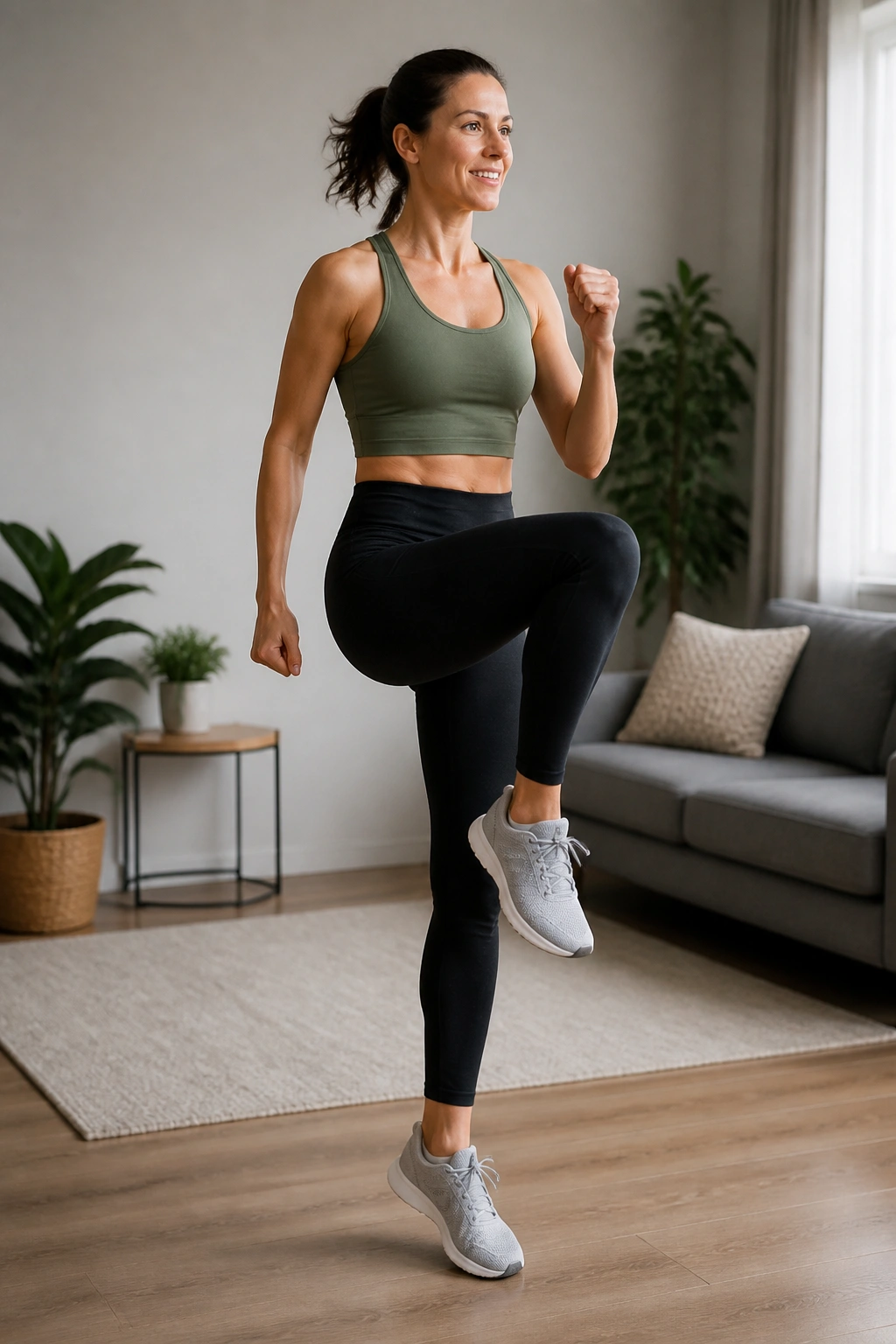
Apartment floors, cranky knees, or a house where the downstairs neighbor has opinions — low-impact cardio earns its keep in all of those settings.
Set a timer for 20 to 25 minutes and cycle through marching high knees, step jacks, skater steps without the jump, fast feet, and squat-to-reach patterns. Spend 40 seconds on each move, then take 20 seconds to breathe before the next one. Keep the pace brisk enough that talking gets a little annoying.
This style of work should feel athletic, not sleepy. You are not trying to bounce around like a cartoon. You are building a steady output that lets your heart rate rise without the pounding that comes with jump-heavy work.
A small space changes the game, but it does not ruin it. Even a 6-foot-by-6-foot patch of floor is enough if you stay honest about tempo and keep transitions short.
Quiet can still be hard. That’s the part people miss.
14. Kettlebell Swings and Loaded Carries
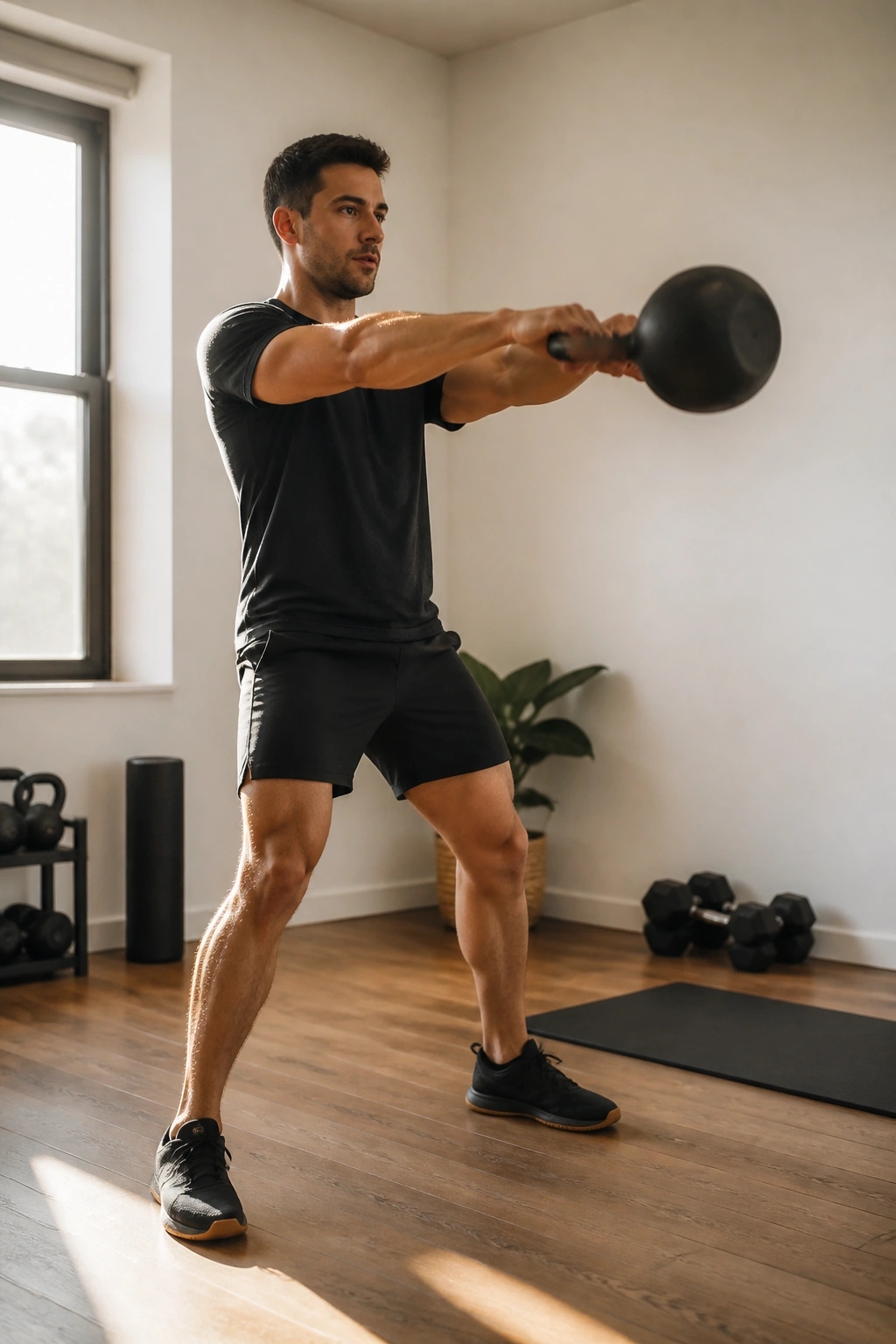
If you have one kettlebell, you have a lot more options than you think. Swings train the hinge. Carries train the grip, core, and posture. Put them together and you get a compact session that feels far bigger than the room it happens in.
Do 5 rounds of 15 kettlebell swings, 30 seconds of suitcase carry on the right, 30 seconds on the left, and 8 goblet squats. Rest 60 to 90 seconds between rounds. If you do not have a kettlebell, a single dumbbell can handle the carries and goblet squats, and a dumbbell deadlift can stand in for the swing if you want to keep it safer.
The swing is only helpful if your hinge is clean. Hips back, chest proud, arms relaxed. If your lower back is doing the work, stop and fix the pattern before you go any further.
Loaded carries are underrated. They make you brace hard while walking, which is one of the most useful home strength skills you can build. Not flashy. Very effective.
15. Yoga-Strength Flow for Active Recovery
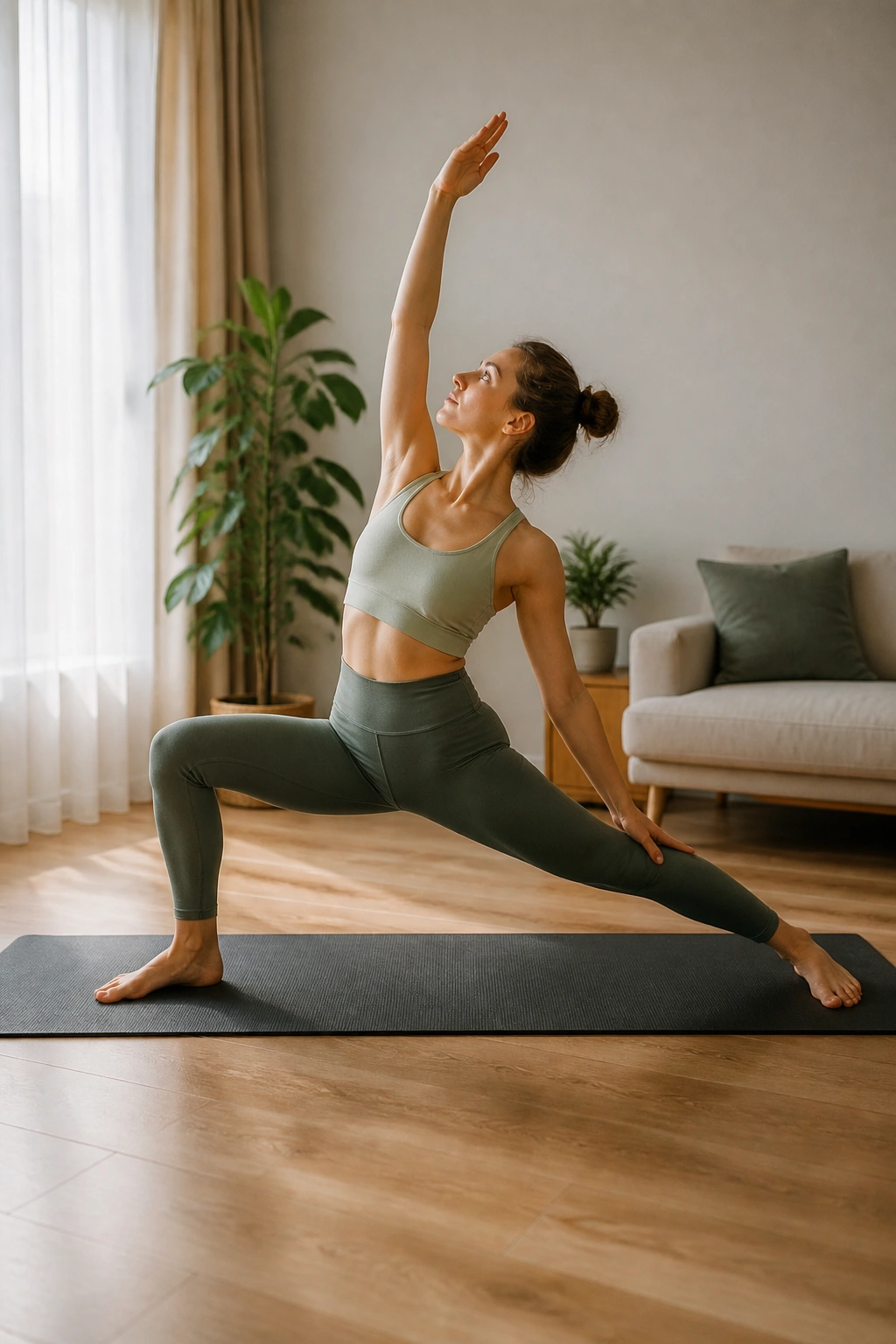
Not every workout has to leave you flattened. Some sessions should make you feel longer, looser, and still a little sweaty.
A yoga-strength flow works best when it mixes movement and holds: 3 to 5 rounds of sun salutations, chair pose for 20 seconds, a low lunge hold, plank to downward dog, and side plank on each side. Spend 20 to 30 minutes on it at a steady pace, breathing through the nose when you can.
This is not fluff.
Done with enough control, this kind of work wakes up the shoulders, hips, and upper back while still giving your heart a bit of a challenge. It’s a smart day-two option after hard legs or a better choice than forcing another brutal interval session when your body wants something quieter.
I like this style because it keeps momentum without the usual joint drama. It has a place. A real one.
16. Ladder Reps That Keep You Honest
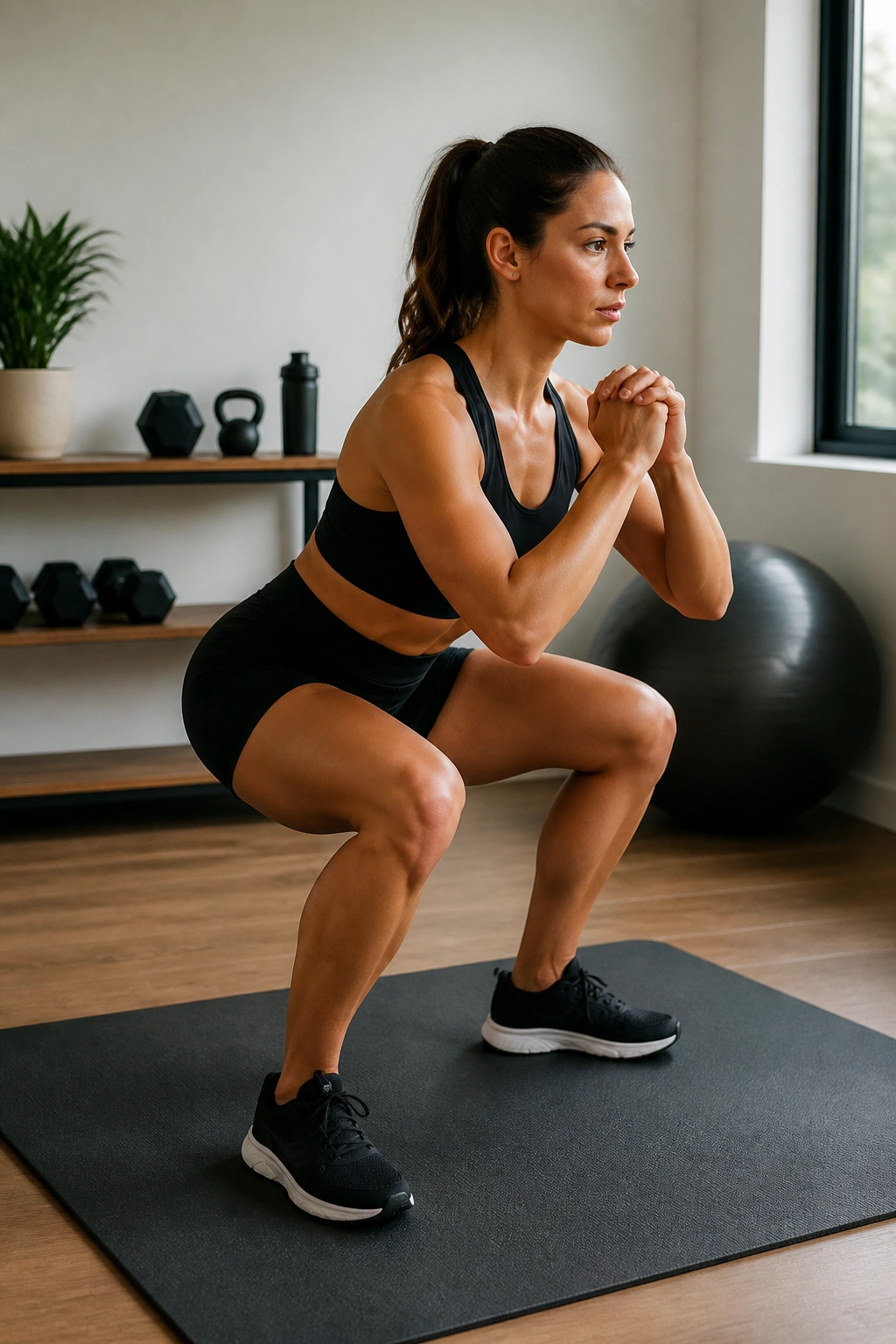
Ladders are sneaky. The early rungs feel easy, and then the numbers climb just enough to expose whether your pace is sensible or silly.
Pick 4 exercises and run a 2-4-6-8-10 ladder, then come back down if you still have fuel. Good choices are squats, push-ups, rows or band pulls, and mountain climbers counted per side. Rest 20 to 40 seconds between rungs, depending on how hard your breathing is getting.
The temptation is to sprint the first two rungs. Don’t. If you blow yourself up at 4 reps, the 8 and 10 rep sets become ugly, and the ladder stops being useful. Smooth early reps keep the later reps clean.
A Simple Ladder Template
- 2 squats, 2 push-ups, 2 rows
- 4 squats, 4 push-ups, 4 rows
- 6 squats, 6 push-ups, 6 rows
- 8 squats, 8 push-ups, 8 rows
- 10 squats, 10 push-ups, 10 rows
You can swap the movements based on equipment, but keep the idea intact: climb, breathe, and don’t waste the first half of the workout.
17. Carry and March Work for the Core and Grip
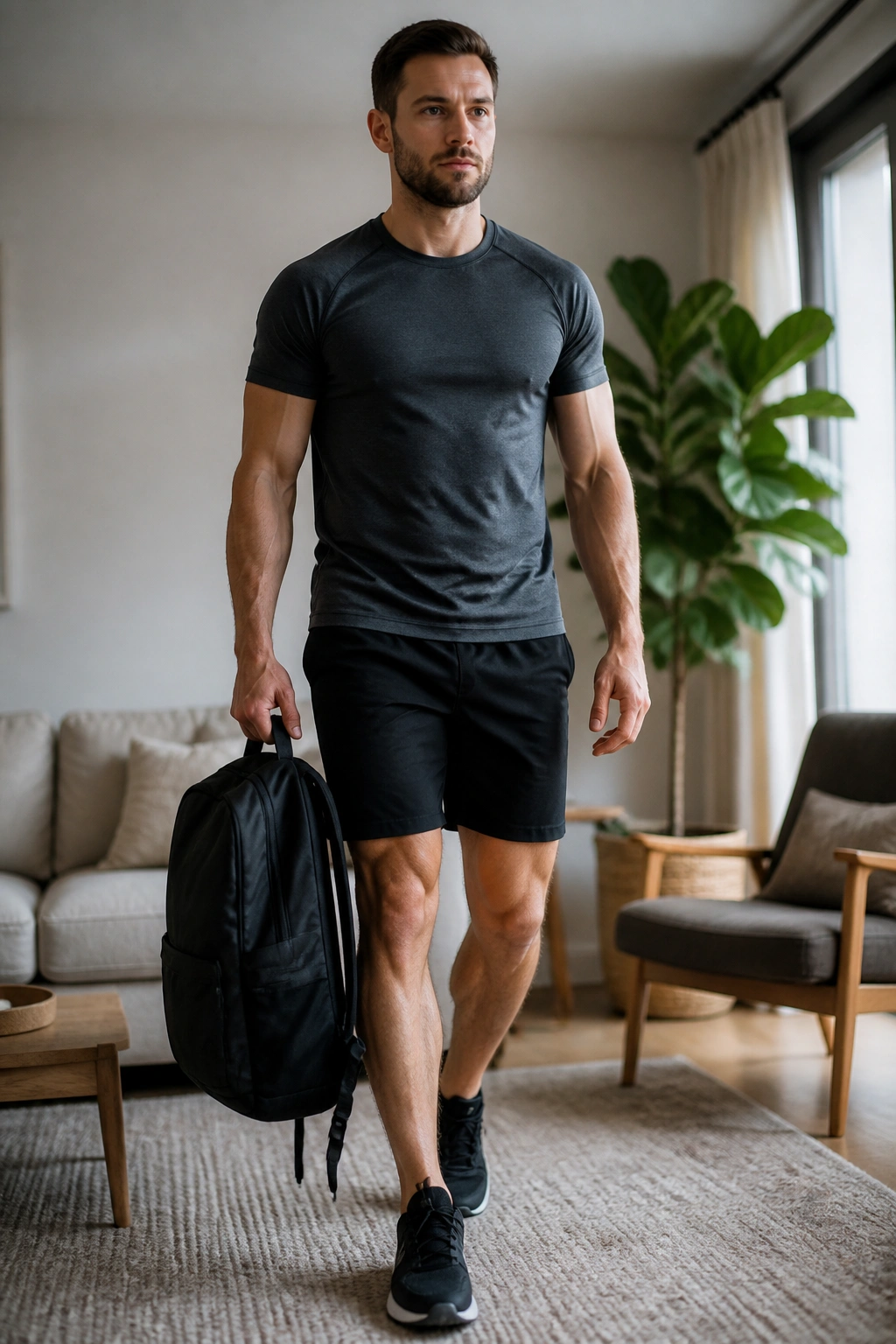
Carry work looks almost too plain to matter. Then you pick up something heavy and walk slowly for 30 seconds, and suddenly your core, shoulders, and grip all start negotiating.
Use 4 rounds of 30 seconds suitcase carry on the right, 30 seconds suitcase carry on the left, 30 seconds front rack march, and 30 seconds overhead hold or march. Rest 45 seconds between rounds. A loaded backpack can replace a dumbbell if that’s what you have. Hold it close, keep your ribs down, and walk like you mean it.
The suitcase carry is my favorite here because it exposes side-to-side weakness fast. If one side makes you lean, the weight is either too heavy or your trunk needs the practice. Either answer helps.
This workout is quiet enough for most homes and hard enough to count as real work. That combination is hard to beat.
Also, it makes you stand taller. That is not a small thing.
18. The Mixed-Modality Finisher for Busy Days
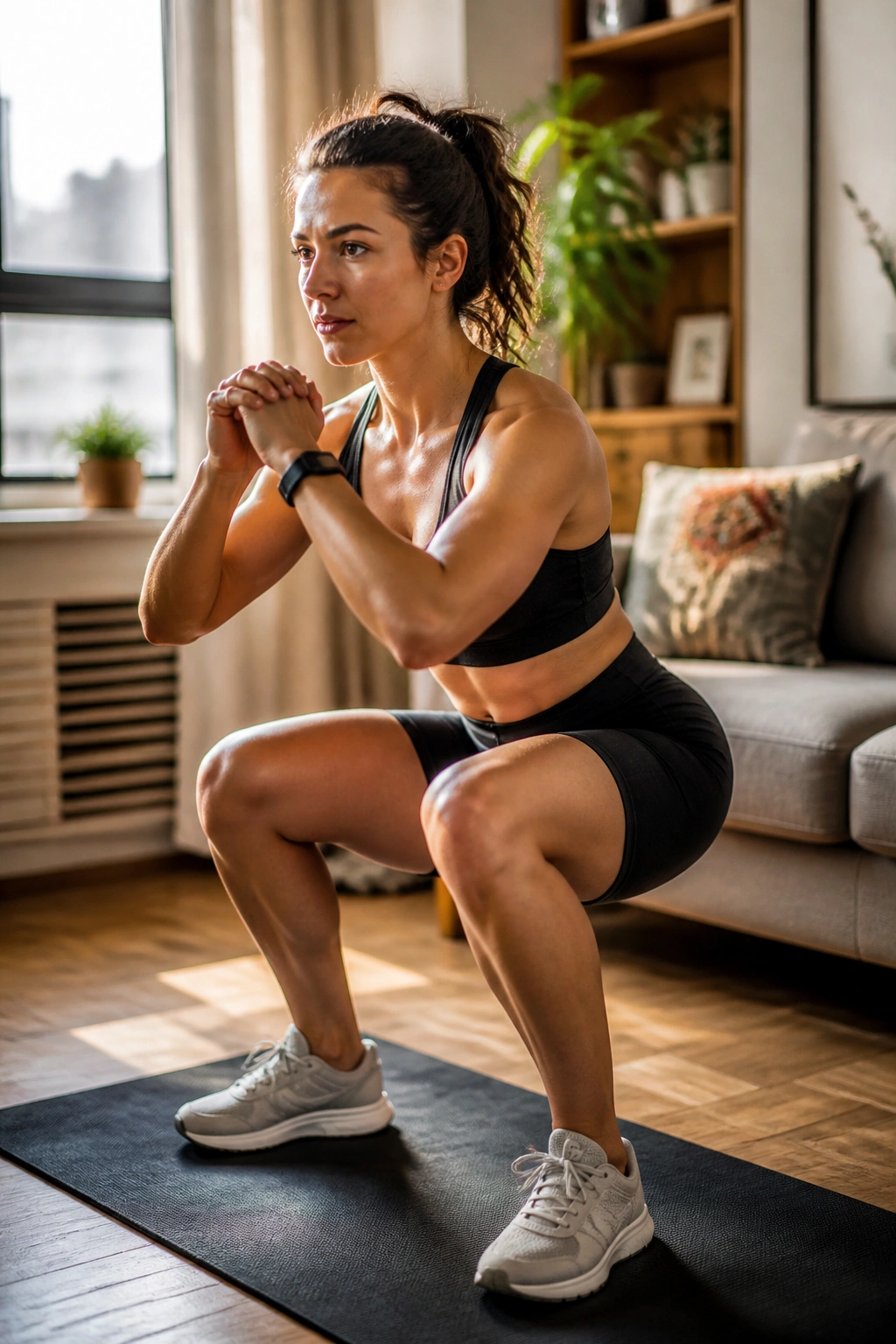
Some days need a workout that does a little bit of everything and does not waste a minute. A mixed-modality finisher is the clean answer: short strength, short cardio, short core, done with purpose.
Try a 24-minute session built like this: 6 minutes of squats and push-ups, 6 minutes of shadow boxing or step-ups, 6 minutes of plank work and dead bugs, then 6 minutes of glute bridges, band rows, or carries. Work in 40-second bursts with 20 seconds to breathe, or set a timer and cycle through 3 moves until the block ends.
A Practical Way to Run It
If your day has a lot of noise already, keep the choices simple:
- Strength block: squats, push-ups, rows
- Cardio block: shadow boxing, step-ups, marching
- Core block: dead bugs, side planks, mountain climbers
- Finish block: glute bridges, carries, band pull-aparts
This kind of session is useful because it keeps the whole body honest without asking for a long commitment. It works well on busy days, but it also works as a bridge between heavier workouts.
No fancy setup. No wasted motion. Just enough variety to keep the room from getting stale.
Final Thoughts
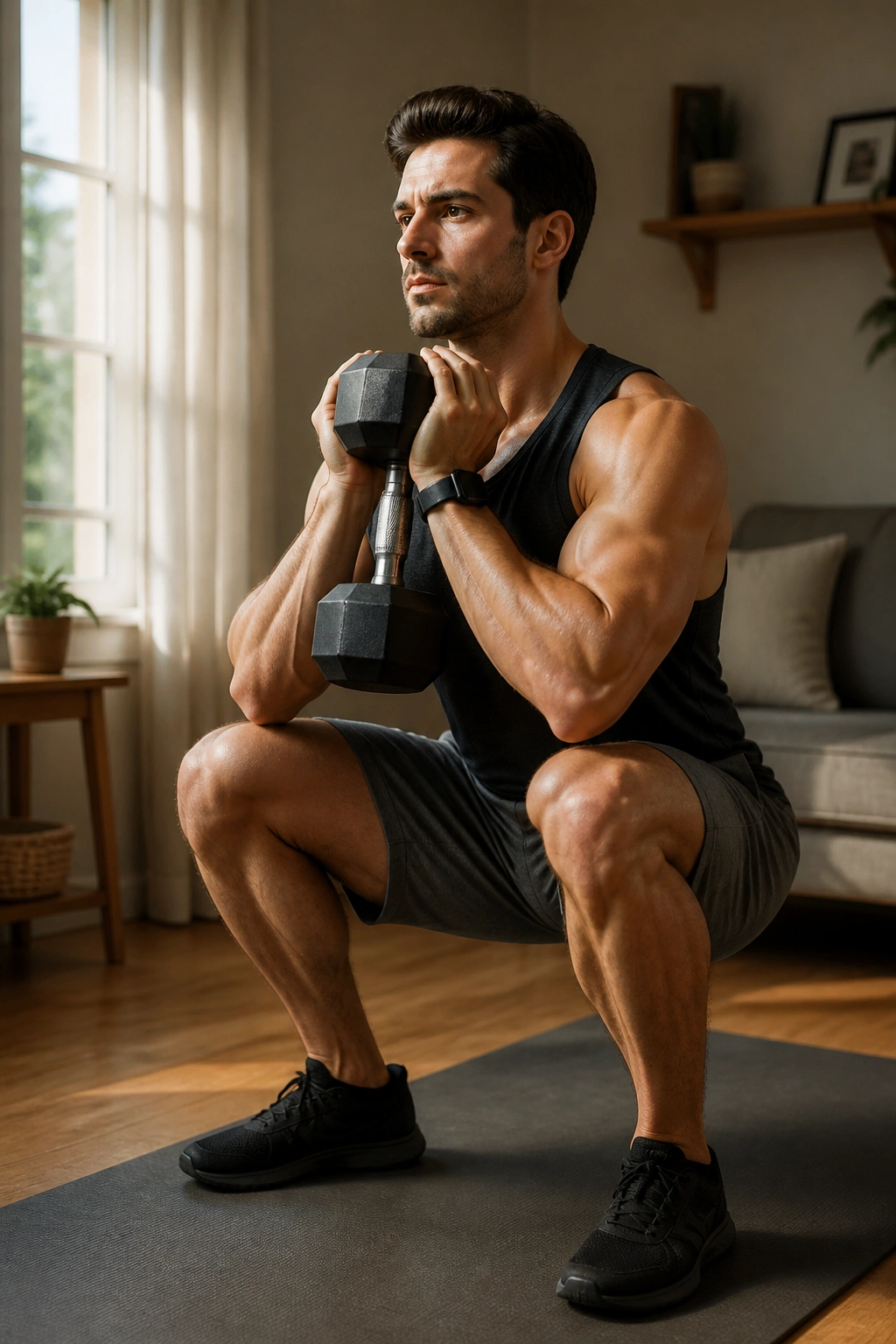
The best home plan is the one that keeps asking your body for a little more than last week. One extra rep. One shorter rest break. One heavier backpack. That’s how leaner, fitter changes show up without needing a gym membership or a complicated spreadsheet.
Mix the hard days with the quieter ones. Keep the stair work, carries, squats, and push-up patterns in rotation, and do not let every session become a breathless scramble. The people who make progress at home are usually the ones who stay boring in the right way: repeatable, measured, and hard enough to matter.
If you want one rule to keep handy, use this: write down what you did. Reps, rounds, load, timer. The next session starts there, and that tiny bit of record-keeping beats guessing every time.
