



Travel can mess with a training routine faster than almost anything else. You land late, the room is small, your legs feel stiff from sitting, and the idea of finding a proper gym starts to look ridiculous by the time you’ve dropped your bag on the bed. That’s exactly where travel workouts earn their keep: they’re short, quiet, low-fuss, and built for the kind of space you actually have, not the space you wish you had.
The best ones are the sessions you can still do when you’re tired, a little hungry, and not in the mood for a grand production. A corner of carpet, a hallway, a stairwell, a towel, a backpack, or a band tucked into your carry-on can be enough. Honestly, that’s the point. If a workout needs perfect lighting and a full rack of equipment, it’s not much help when you’re away from home.
I’ve always thought the smartest travel fitness move is to stop acting like you need a full training day and start using whatever the trip gives you. Stairs become cardio. A backpack becomes a weight. A hotel floor becomes a mat. Even a five-minute walk after a long day can save your hips from feeling welded shut the next morning. Tiny things. They add up.
The 18 workouts below cover strength, cardio, mobility, and recovery, so you can pick one that matches the day you’re having instead of forcing the same session over and over.
1. The 12-Minute Hotel Room Bodyweight Circuit
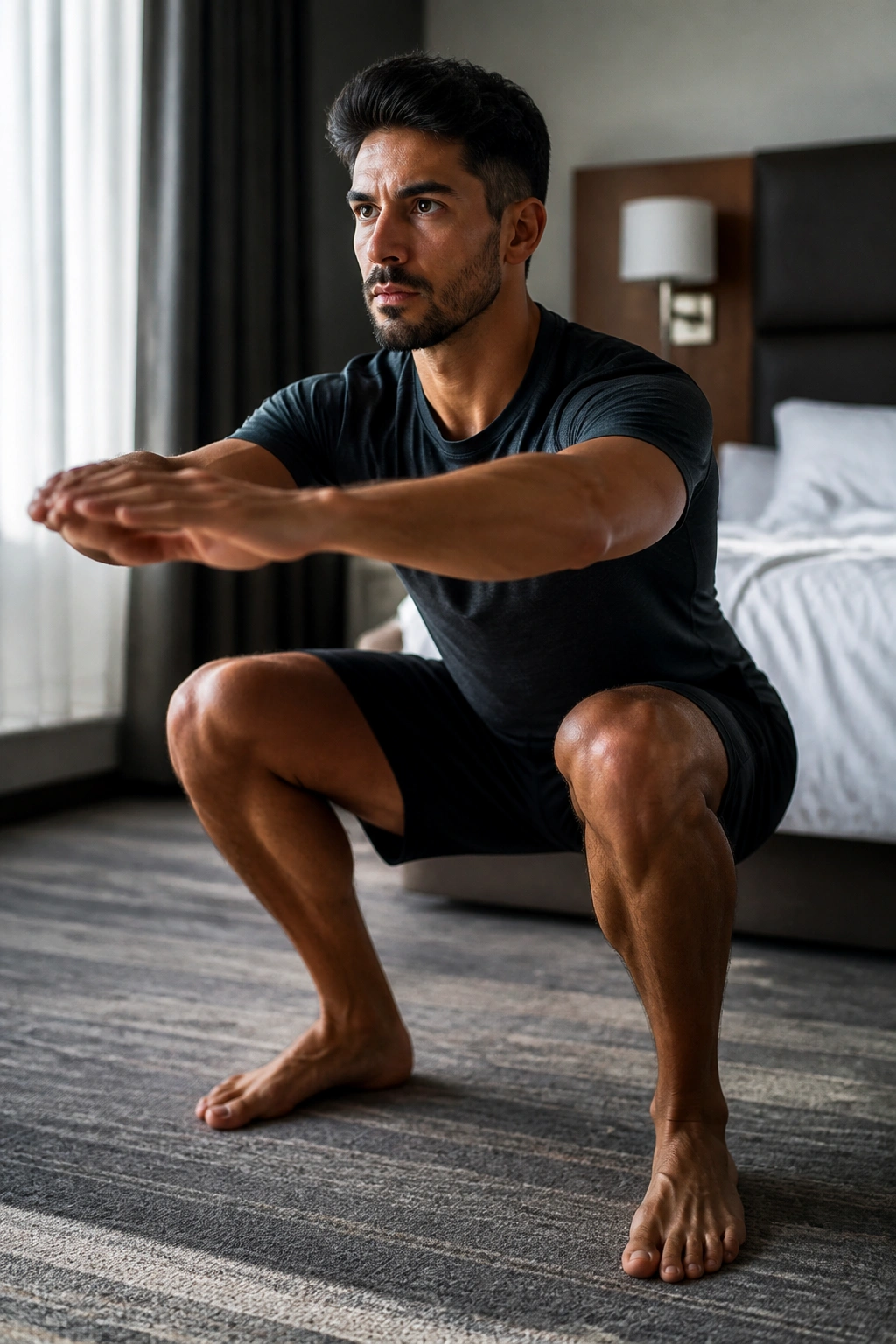
A hotel room can be enough if you stop waiting for ideal conditions. Give yourself one timer, one floor space, and a little patience, and you can get a surprisingly solid session done before the shower even runs hot.
How to run it
Do 3 to 4 rounds of this circuit:
- 10 air squats
- 8 pushups
- 10 reverse lunges per leg
- 20-second plank
- 20 mountain climbers per side
- 30 seconds of rest
Move with control. Quick does not mean sloppy. If the floor is thin or the room is cramped, take the jumps out and keep everything grounded. A slow squat and a clean plank beat flailing through a fast round every time.
If your knees hate jumping, don’t jump. Replace the mountain climbers with dead bugs or marching in place, and keep the whole circuit quiet enough that nobody in the next room gives you a look in the elevator.
The nice part here is the pace. You can finish this in a quarter of an hour, break a light sweat, and still have energy for dinner. That makes it one of the easiest travel workouts to repeat without needing a pep talk first.
2. Stairwell Intervals That Turn Steps Into Cardio
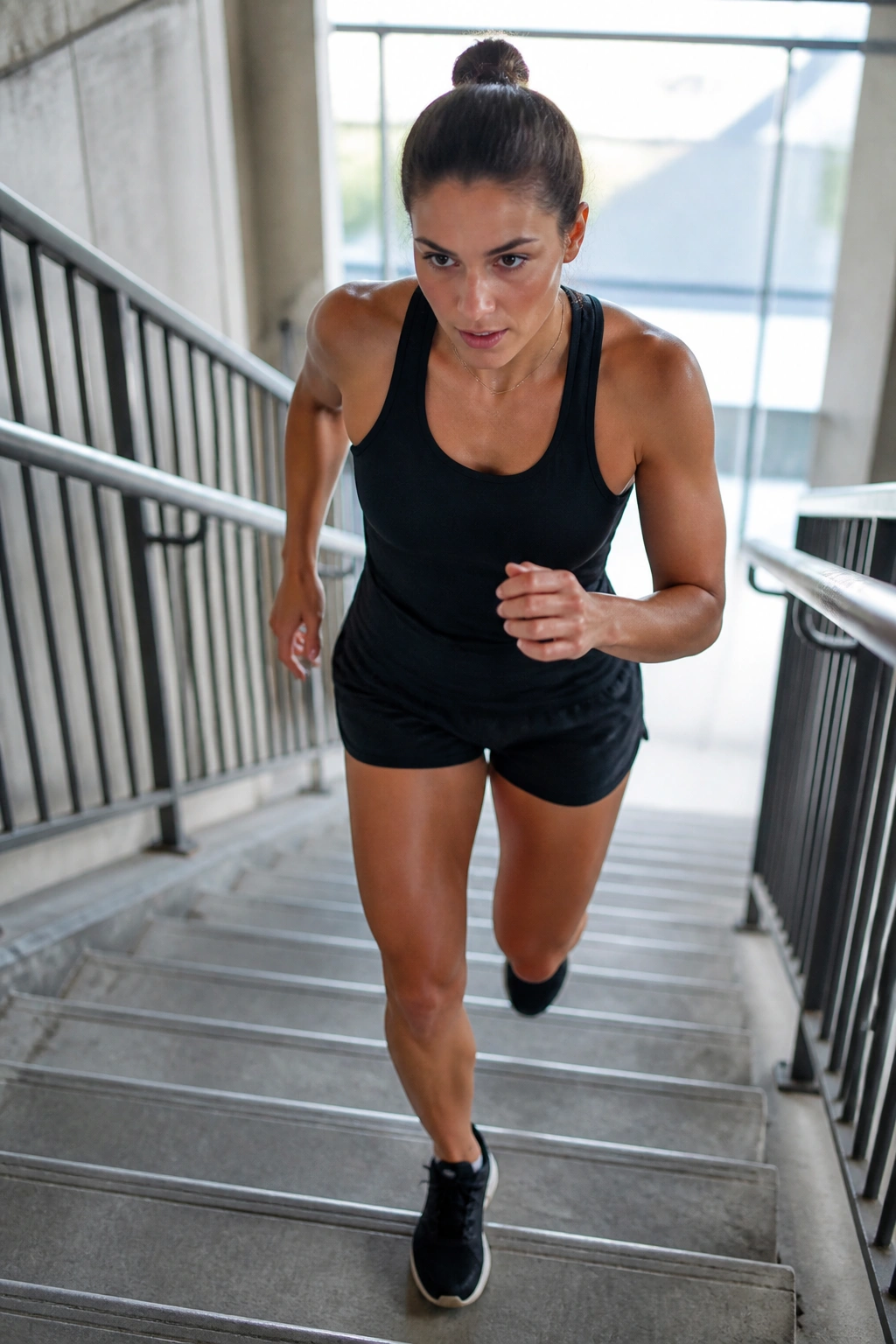
Stairs are brutally honest. They don’t care how long your usual gym routine is or how polished your running shoes look. If you want a quick burst of conditioning, a stairwell gives you a hard answer in about thirty seconds.
Start with 30 seconds up, 60 to 90 seconds down or walk-flat recovery, and repeat 6 to 10 rounds. Keep your torso tall, drive through the whole foot, and avoid hammering down the steps. Downward sprinting is where people get sloppy and irritated knees show up.
A few ways to scale it
- Beginner version: walk up one flight at a steady pace, then take your recovery walk slowly.
- Harder version: take two steps at a time on the way up, but only if your balance stays clean.
- Quiet version: use the last stair like a step-up platform and stay in place.
A handrail is fine. Use it. There’s no prize for wobbling. And if you’re in a building where stairs are shared, this is also one of those rare workouts that doesn’t demand a bunch of floor space or weird equipment.
It’s fast, it hits the legs, and it gets the heart rate up without a complicated setup. Simple. Brutal. Effective.
3. The Resistance Band Session That Fits in a Carry-On
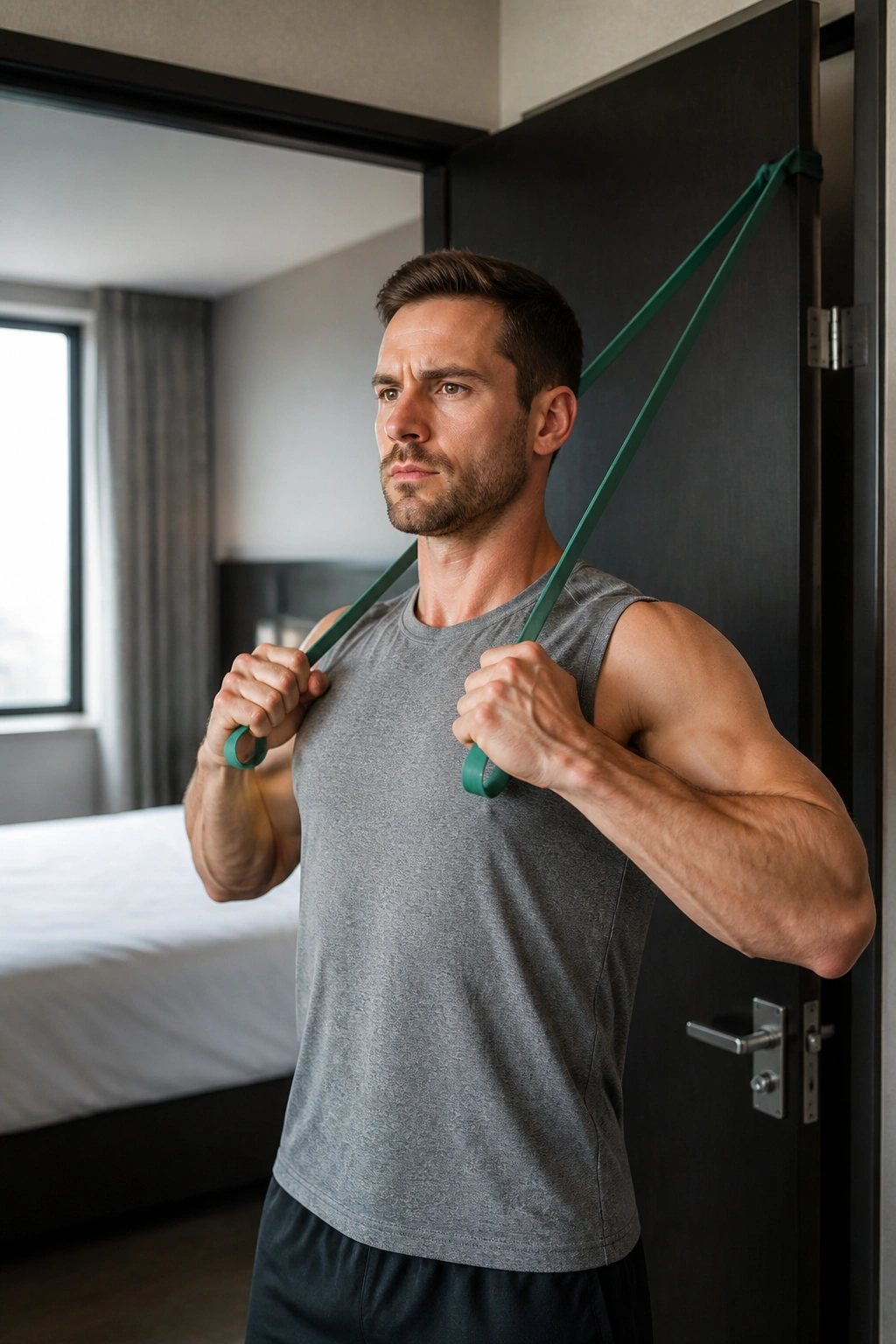
A band is the kind of thing you forget about until you need it, and then you wonder why you ever traveled without one. It weighs almost nothing, folds flat, and turns a plain room into a place where you can actually train the upper body and hips with some real tension.
Band moves to pack
Use a mini loop band or a long loop band and work through 2 to 4 rounds of the following:
- 12 banded squats
- 12 band rows
- 10 overhead presses
- 12 lateral band walks each way
- 10 Pallof presses per side
- 15 glute bridges with the band above the knees
Keep the reps smooth. You want tension, not chaos. If you’re using a long loop and anchoring it in a door, test the door first and make sure it opens away from you. A loose door anchor can turn a simple session into a bad story fast.
The rows and Pallof presses are the sneaky winners here. They wake up the back and trunk after a day of sitting, which is exactly what travel tends to punish. The lateral walks are worth keeping too; they light up the outer hips in a way bodyweight work often misses.
This is one of the best travel workouts for people who want more than sweaty cardio but less than a full gym mission.
4. Brisk Walk Intervals in a New City
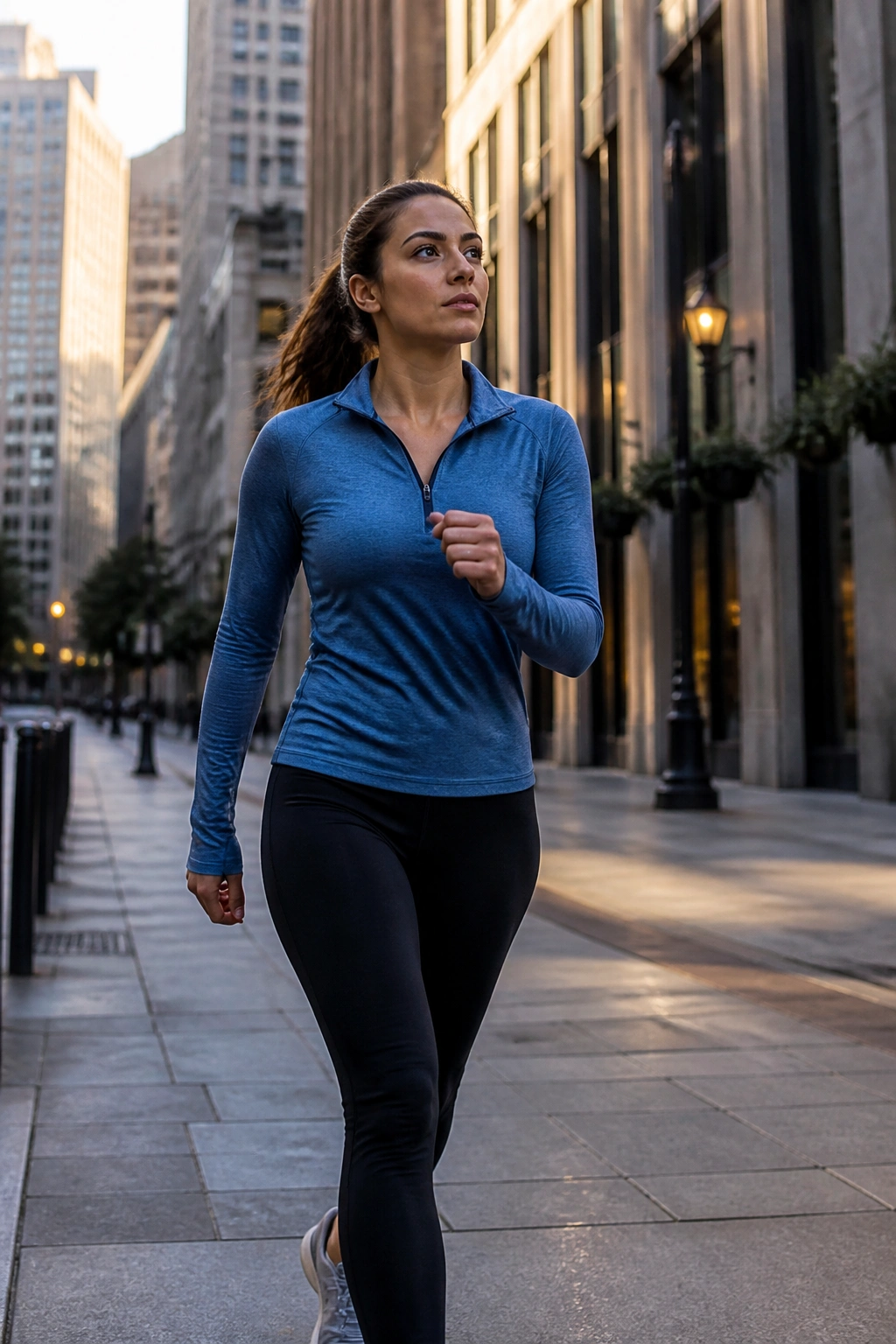
Sometimes the smartest session is the one that doesn’t look like exercise at all. A brisk walk can be recovery, conditioning, and sanity all at once, especially when your body feels compressed from a long ride or flight.
Try 5 minutes easy, then 2 minutes fast, and repeat that pattern 5 times. If you want a longer session, do 10 minutes steady followed by 6 short pickups of 20 to 30 seconds each. The goal is a pace where you can still talk in short bursts, but you know you’re working.
How to make it count without turning it into a chore
- Swing your arms.
- Keep your chest open.
- Shorten your stride when you speed up.
- Walk with purpose on hills and ramps.
- Use landmarks instead of staring at your watch every thirty seconds.
A city walk is better than a treadmill slog when you need your head to clear. Airports work too, if you’re stuck in a terminal and willing to keep moving between gates. The point is steady effort, not perfection.
And yes, it still counts if you wore normal clothes. That’s part of why walking remains one of the most useful travel workouts around.
5. EMOM Strength Blocks When Time Is Tight
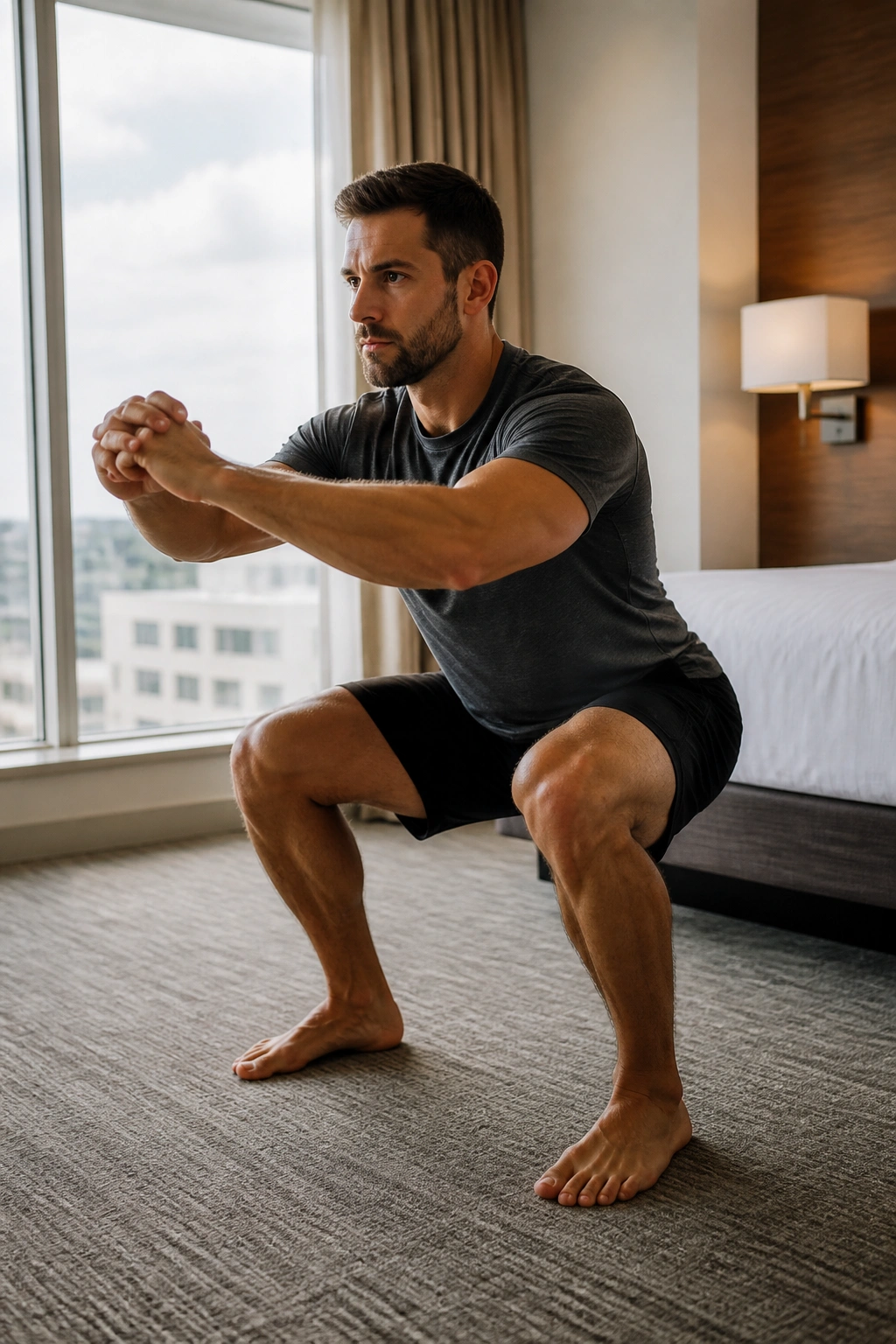
EMOM means every minute on the minute, and it’s a clean way to train when your schedule is chopped into tiny pieces. You get a fixed structure, a clear finish line, and no excuse to wander around a room wondering what to do next.
Set a timer for 16 minutes and rotate through this 4-minute sequence four times:
- 10 squats
- 8 pushups
- 12 glute bridges
- 20-second plank
If you finish a move early, rest for the remainder of the minute. If a move starts eating the whole minute, cut the reps a bit. That’s not failure. It’s smart pacing.
A good EMOM should feel tidy. You should finish the reps, breathe hard for a moment, and reset. No mess. No drifting. If you’re staying in a shared room, this is also a quiet option that avoids stomp-heavy cardio.
I like EMOM work on travel days because it feels decisive. You get in, do the work, and leave. No wandering, no overthinking, no scrolling through three workout videos before giving up.
6. Floor-Based Glute Bridge and Core Work
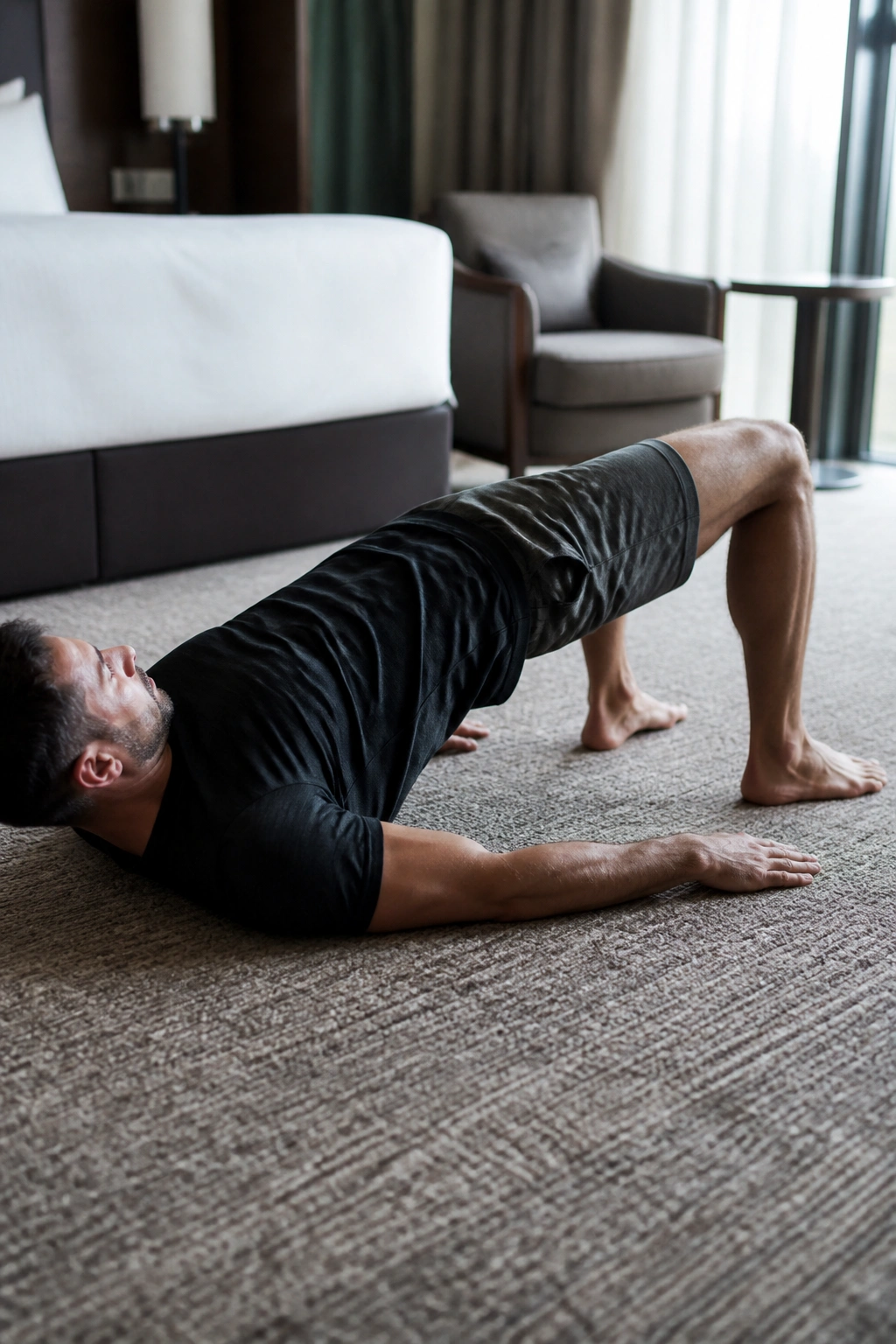
After a lot of sitting, your hips can feel like they’ve forgotten what moving is supposed to feel like. Floor work fixes that faster than people expect, and it doesn’t need much space or noise.
Try 3 rounds of this sequence:
- 15 glute bridges
- 10 single-leg bridges per side
- 8 bird-dogs per side
- 20-second side plank per side
- 8 dead bugs per side
Three moves that carry their weight
The glute bridge is the anchor. Squeeze at the top for one full second, not three sloppy half-reps. The bird-dog teaches you to keep the trunk steady while the limbs move, which matters more than it sounds. The dead bug is the one that looks easy and then quietly humbles people.
If your lower back tends to grab during travel, keep the ribs down and the movement small. You don’t need to chase a big arch. You need control.
This is one of those workouts that feels almost too easy until you finish it and realize your hips are moving better. That’s a good trade. Especially after a flight.
7. Shadow Boxing Rounds in a Small Space
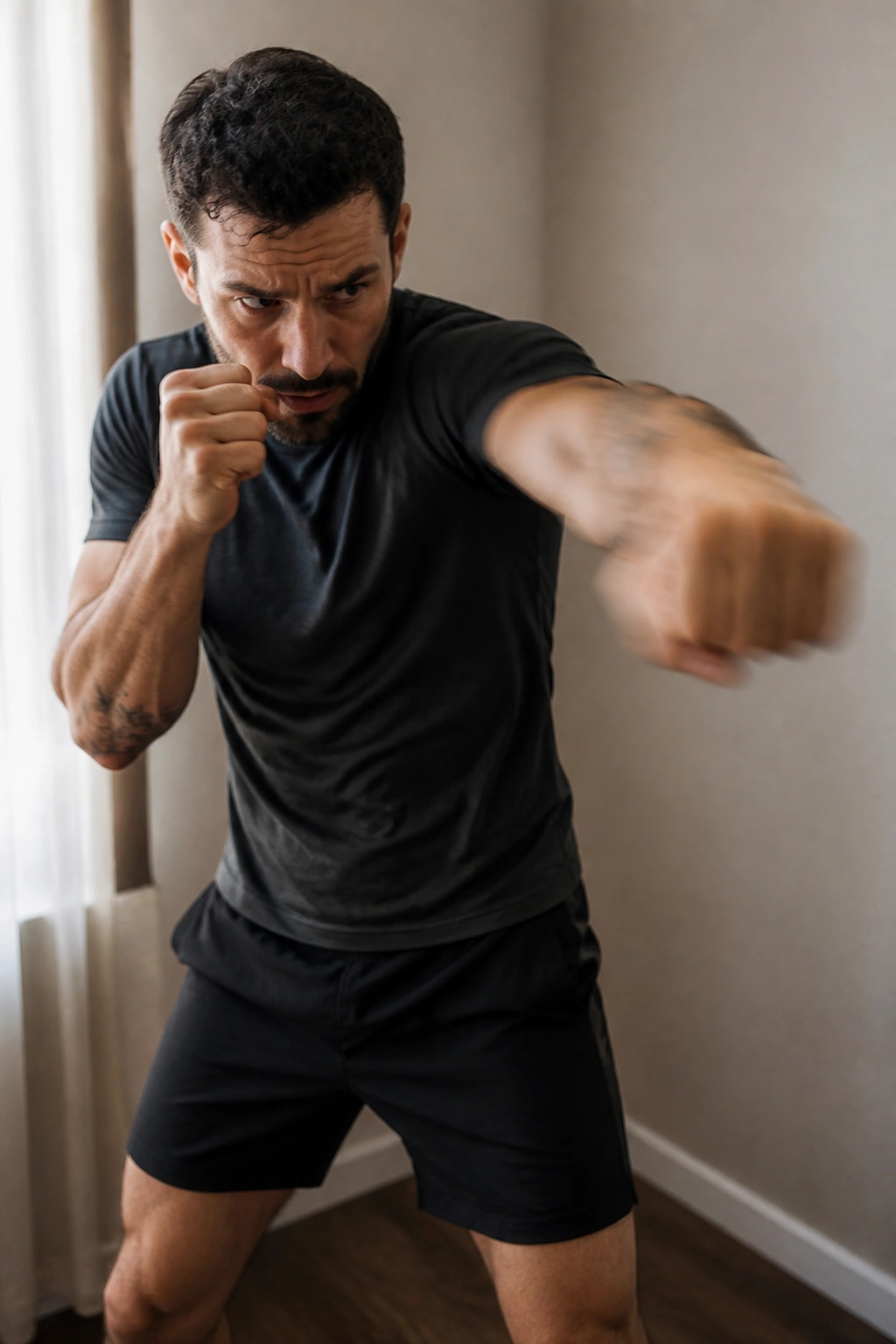
You do not need a ring to box. You need a little room, a timer, and enough control to keep your wrists straight while you move.
Set up 6 rounds of 3 minutes with 30 seconds of rest between rounds. Round one can be all jabs. Round two can add the cross. Round three can bring in hooks. Round four should focus on footwork. Round five can be defense slips and rolls. Round six is the free round where you stitch it together.
A clean round structure
- Round 1: jab only
- Round 2: jab-cross
- Round 3: jab-cross-hook
- Round 4: step forward, step back, pivot
- Round 5: slip left, slip right, weave under
- Round 6: mix everything at a smooth pace
Keep your guard up between punches. Breathe through your nose if you can, or at least avoid the frantic open-mouth gasp that makes you feel wrecked too early. Shadow boxing is sneaky because it looks light from the outside and feels much harder once the rounds stack up.
It’s also a useful travel workout when you need to vent a little energy without pounding the floor or needing gear. A small room is enough.
8. Backpack Strength Work With Real Load
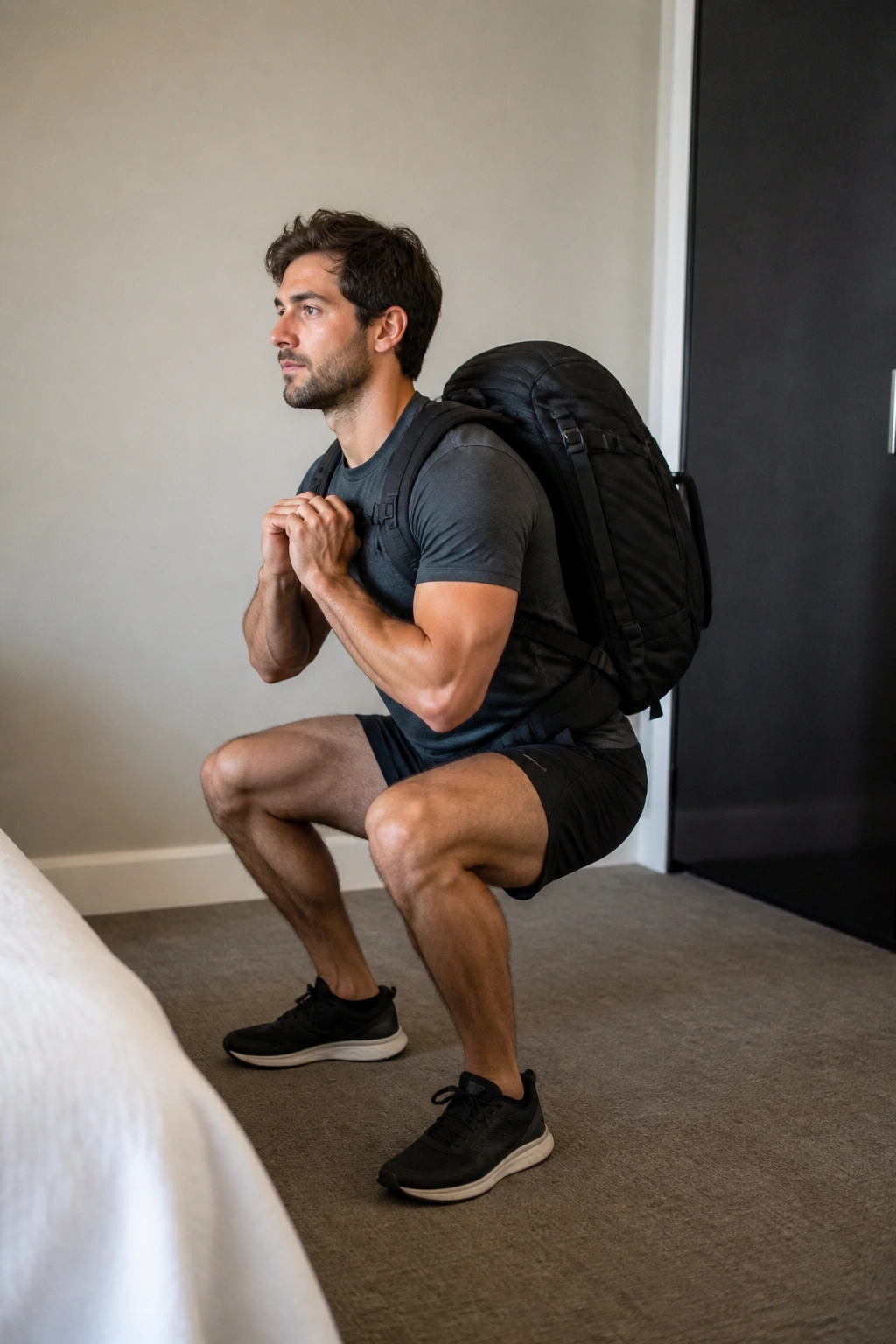
A backpack full of books, a water bottle, and maybe a pair of shoes can do more than most people give it credit for. It’s not elegant. That’s fine. It works.
Use a bag that sits close to your back and doesn’t swing around. Then run 3 sets of these moves:
- 12 backpack squats
- 10 bent-over rows
- 10 Romanian deadlifts
- 8 reverse lunges per leg
- 30-second suitcase carry on one side, then switch
How to load it safely
- Put the heaviest items low and close to the center.
- Zip every pocket.
- Shake the bag once before you start.
- Test the weight with five slow reps before you go harder.
A backpack squat hits differently from air squats because you’re carrying a real load. The rows matter too; they open up the upper back after a day with a laptop bag or a carry-on hanging from one shoulder. The suitcase carry is the piece most people skip, and I’d keep it. It teaches the trunk to resist tilting, which is one of those boring strengths that pays off everywhere.
Do not use a loose, bouncing bag. That gets awkward fast and can throw off your lower back.
9. The Mobility Reset for Stiff Hips, Back, and Ankles
A flight does strange things to the body. Hips get tight, ankles get sleepy, and the lower back starts complaining in ways that don’t feel dramatic but still ruin your mood.
A short mobility reset can fix a lot of that. Work through 8 to 12 minutes of:
- Cat-cow, 6 to 8 slow reps
- 90/90 hip switches, 6 per side
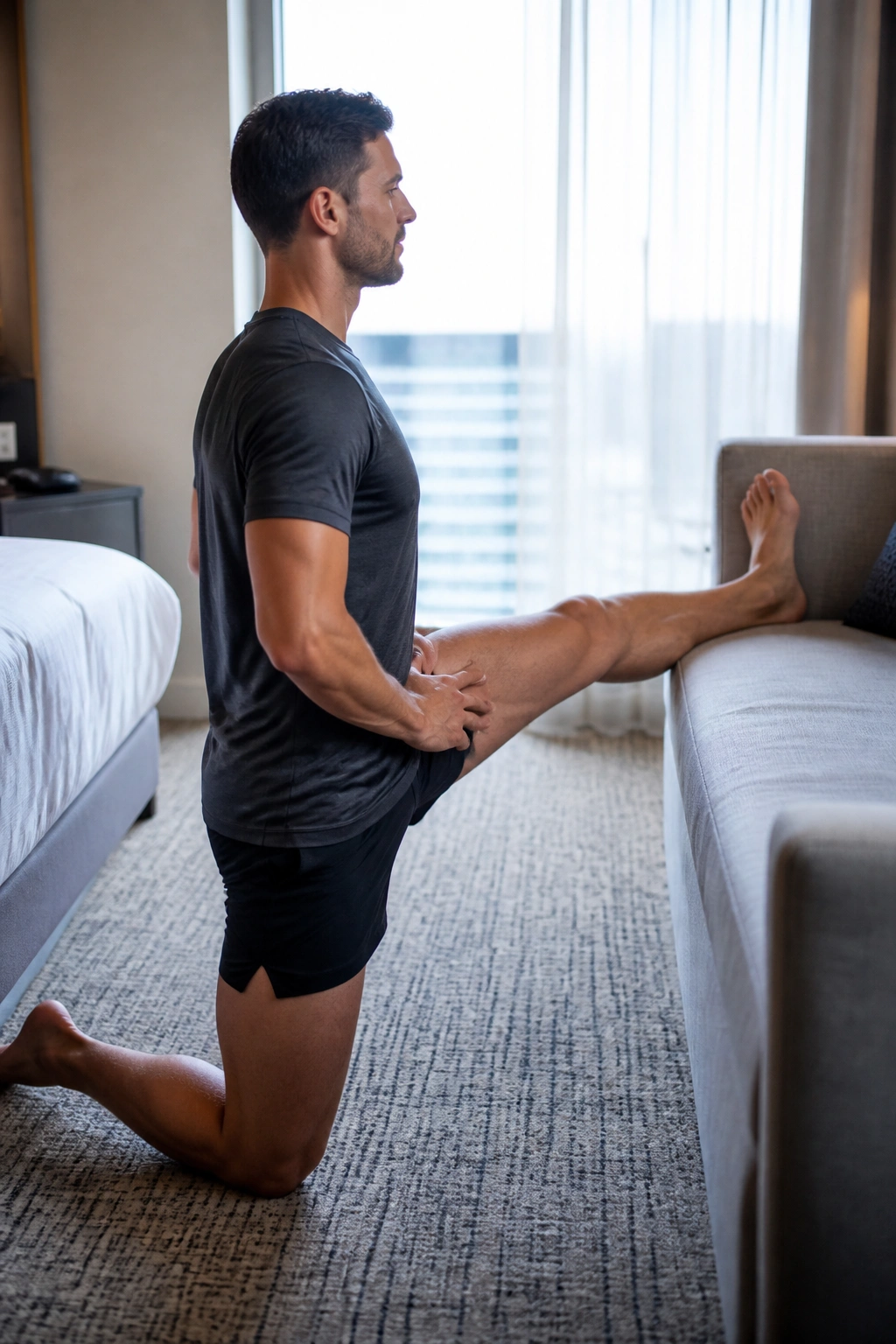
- Couch stretch, 30 to 45 seconds per side
- Ankle rocks, 10 per side
- Thoracic rotations, 6 per side
- Low lunge with reach, 5 breaths per side
Joint-by-joint reset
Start from the floor if you can. It gives your nervous system a reason to slow down, and after travel, that matters. Keep the movements smooth and small at first. The goal is to feel the joint move, not to force a dramatic stretch that makes you brace harder.
The couch stretch can get spicy, so don’t jam into it. Ease in, breathe, and back off a little if your front thigh starts cramping. The 90/90 work is worth the effort because it opens the hips from two angles instead of one. That tends to feel more useful than a single long hold.
This isn’t flashy. It’s the kind of session that makes tomorrow’s workout feel better.
10. Tabata Bursts for Days You Need Sweat Fast
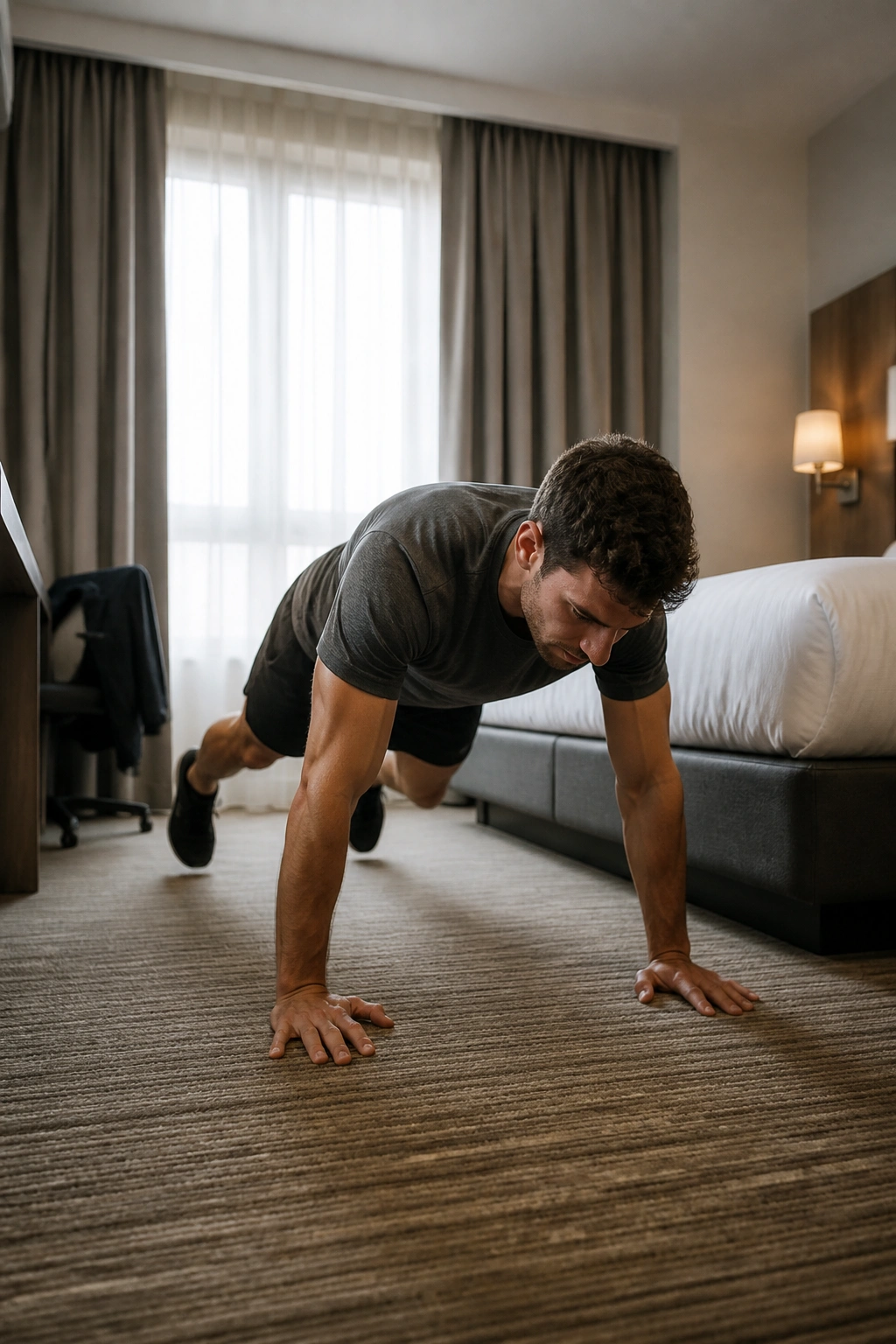
Tabata is short, sharp, and a little rude. Four minutes can sound harmless until you’re inside it, staring at the timer and realizing you still have six rounds left.
Use 20 seconds of work and 10 seconds of rest for 8 rounds total. Pick one move, or alternate two moves. Good travel choices are squat thrusts, high knees, skater steps, pushups, or fast bodyweight squats.
How to scale it
- Beginners: march in place hard instead of jumping.
- Knees cranky? Use step-outs instead of skaters.
- Shared room? Keep the feet quiet and skip burpees.
- Tired from a flight? Cut it to 4 rounds and stop there.
The trick is not to sprint the first interval like a maniac. You want repeatable hard effort. If the first round is a hero move and the next seven are garbage, the setup was wrong.
Tabata works well in hotels because it’s fast enough to fit before a shower, and the time pressure keeps you honest. No meandering. No unnecessary length. Just work, rest, repeat, done.
11. Single-Leg Lower-Body Ladder for Balance and Strength
One leg always gets a free ride if you never check it. Travel is a good time to fix that, because single-leg work doesn’t need much space and it exposes weak spots fast.
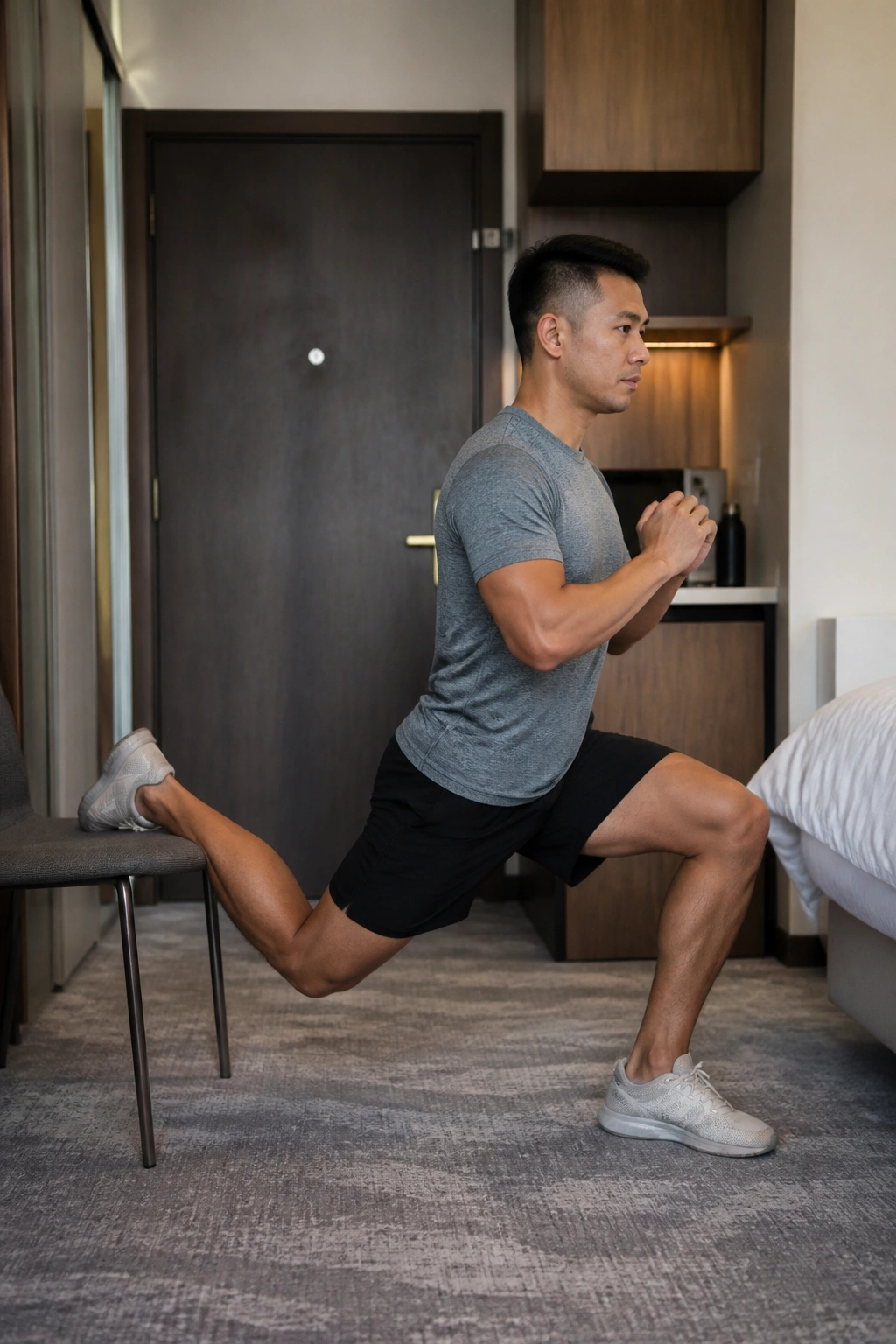
Run a ladder of 6, 8, and 10 reps per side for each of these:
- Split squats
- Single-leg Romanian deadlifts
- Calf raises
- Side lunges
Rest 30 to 45 seconds between sides if you need it, or longer if your balance starts wobbling. Use a wall or a chair for a light finger touch if the room is slick and your stance feels shaky.
The split squat is probably the hardest of the bunch, which is why I like it first. The single-leg RDL teaches the hip to hinge without twisting. Calf raises sound small until you realize travel days can leave your lower legs feeling flat and sleepy.
This workout is a little unforgiving, and that’s why it’s useful. Symmetry matters more when you spend a lot of time walking on unfamiliar ground.
12. Towel Slider Workouts on Hard Floors
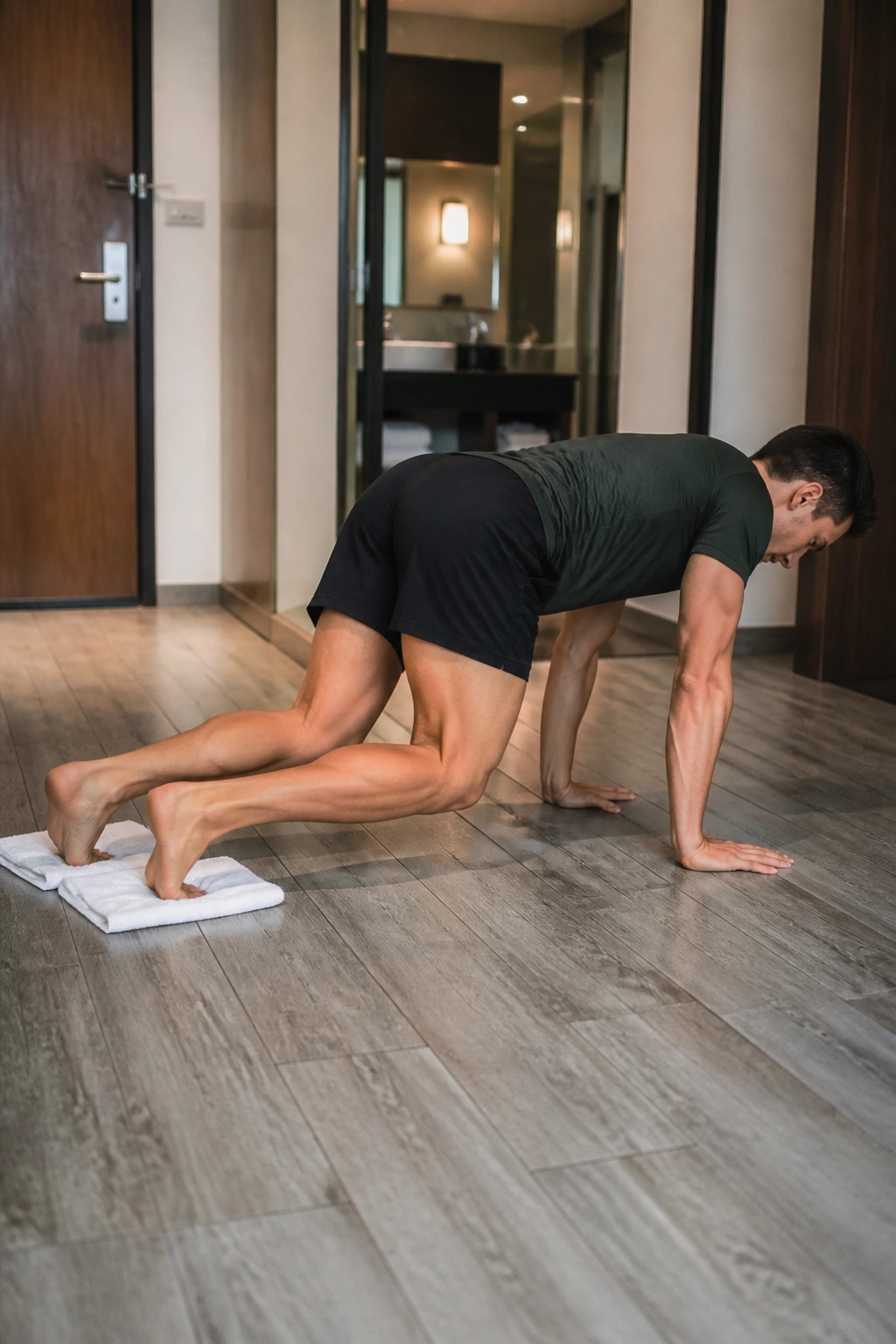
A towel can do more than dry your hands. On tile or smooth wood, it becomes a slider, and that opens up a whole set of hard, low-tech exercises.
Try 3 rounds of:
- 10 towel hamstring curls
- 8 slider reverse lunges per leg
- 10 mountain climbers per side
- 8 body saws
- 20-second plank hold
Where sliders shine
- Smooth hotel bathroom floors
- Hardwood
- Polished tile
- Any clean surface where the towel can move without bunching
The hamstring curls are the star here. Lie on your back, heels on the towel, and slowly slide your feet out and back in. If your hamstrings cramp, shorten the range and slow the pace down. That cramp means the movement is doing its job, not that you need to panic.
Slider lunges are another good one, but they demand control. Keep the working foot planted enough that you’re not falling sideways. The body saw makes the core work harder than a basic plank because your shoulders are moving while your trunk tries to stay steady.
It’s a clever little workout, and it uses a thing you probably already packed.
13. The Yoga-Style Recovery Flow That Helps You Sleep Better
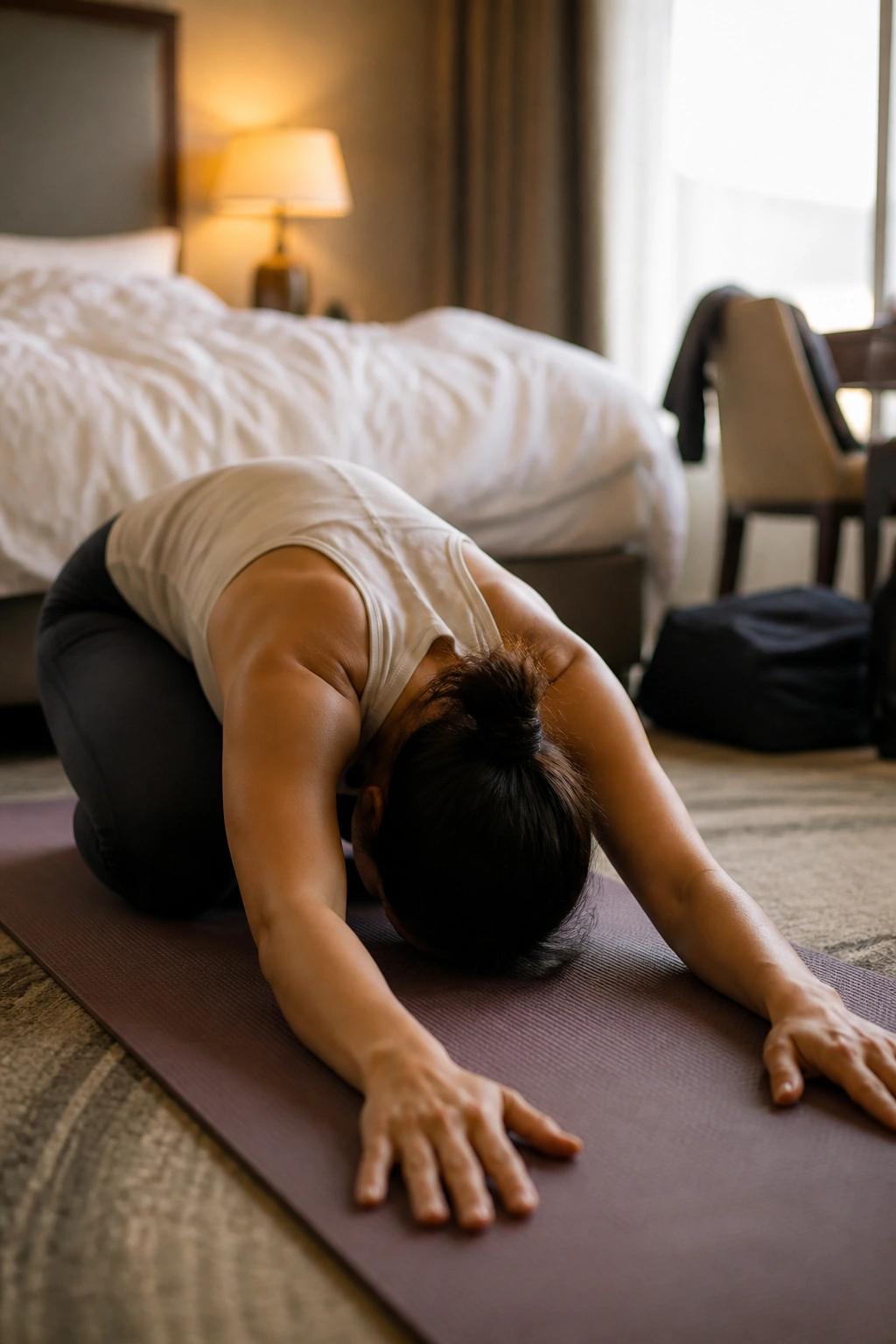
Some travel workouts are about effort. This one is about turning the volume down. After a long day of sitting, walking, hauling bags, and eating at odd hours, a slow floor flow can feel like a pressure valve.
Spend 15 to 20 minutes moving through:
- Child’s pose for 5 breaths
- Cat-cow for 6 reps
- Low lunge for 5 breaths per side
- Half split fold for 5 breaths per side
- Thread-the-needle for 5 breaths per side
- Supine twist for 5 breaths per side
- Legs up the wall for 1 to 3 minutes
Keep the exhales longer than the inhales. Not by a dramatic amount. Just enough to let the shoulders soften and the jaw unclench. That little change matters more than most people expect.
No rush here. If a stretch feels good, stay for another breath. If it feels sharp, back off. Recovery work should leave you looser, not irritated. I like this sort of flow after dinner, especially when the bed is still a little too tempting to crawl into too early.
14. Pool Workouts That Use Water Instead of Impact
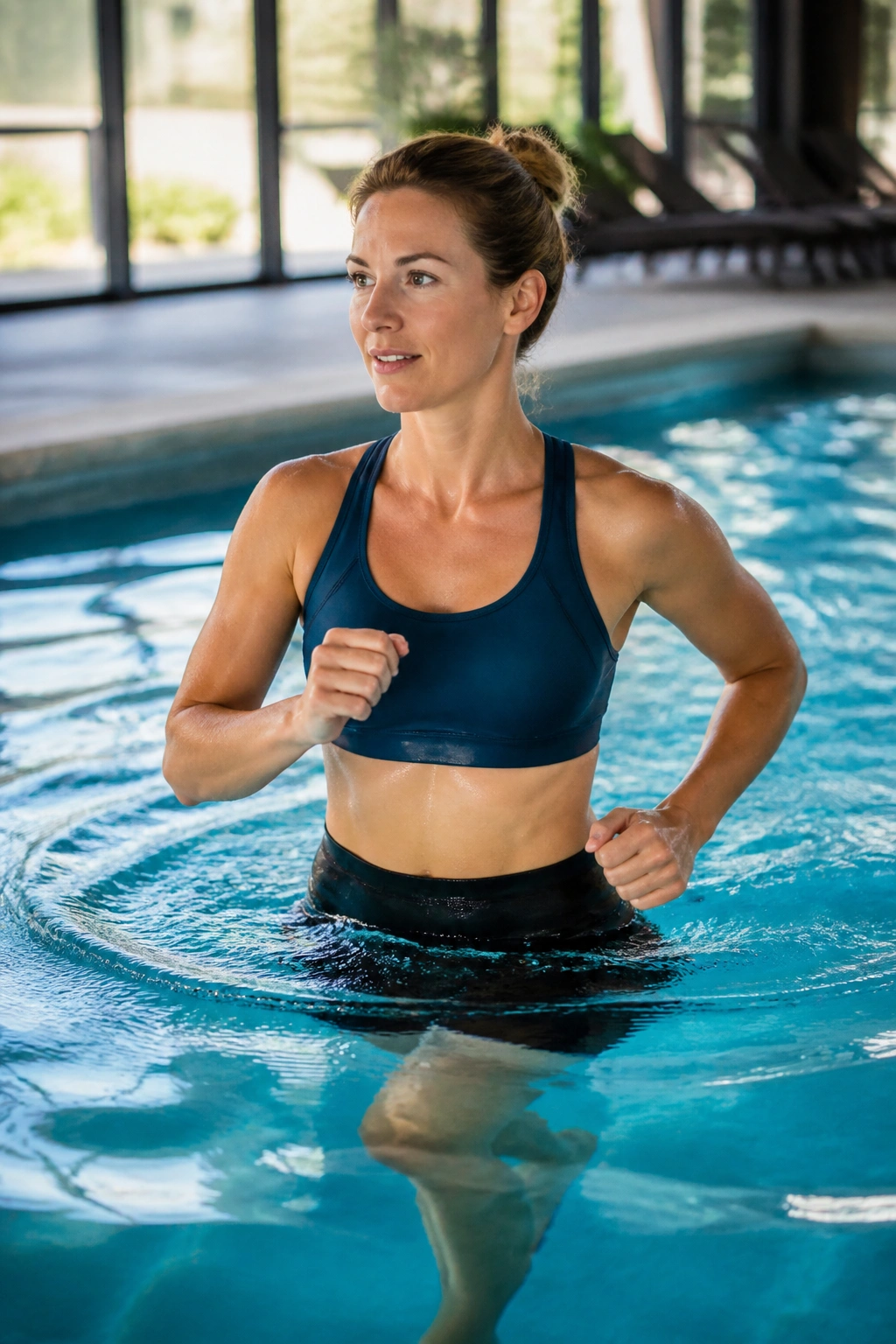
A hotel pool can be a gift, especially if your legs are tired but you still want to move. Water gives resistance without the pounding, and that makes it useful for recovery days or post-flight stiffness.
Try 20 to 30 minutes of one of these setups:
- 10 easy lengths, resting 20 to 30 seconds between each
- 8 rounds of 25 meters hard, 25 meters easy
- 10 minutes of water jogging, then 5 minutes of easy kicking
- 5 rounds of wall push-offs and streamlined glides if you’re working on body position
How to keep it useful without turning it into a splashy mess
Stay relaxed in the shoulders. If you’re swimming, reach long but don’t overreach so much that your back arches. In water jogging, keep the steps quick and the torso tall. A kickboard helps, but it isn’t required.
The pool is also a good place to train when your joints feel cranky from a lot of walking. The resistance is smooth, and the recovery between efforts comes built in. That’s a nice trade on a day when your body wants movement without impact.
This one is underrated because it doesn’t feel like standard gym work. That’s precisely why it saves some travel days.
15. Carry and Hold Workouts With Suitcases or Bags
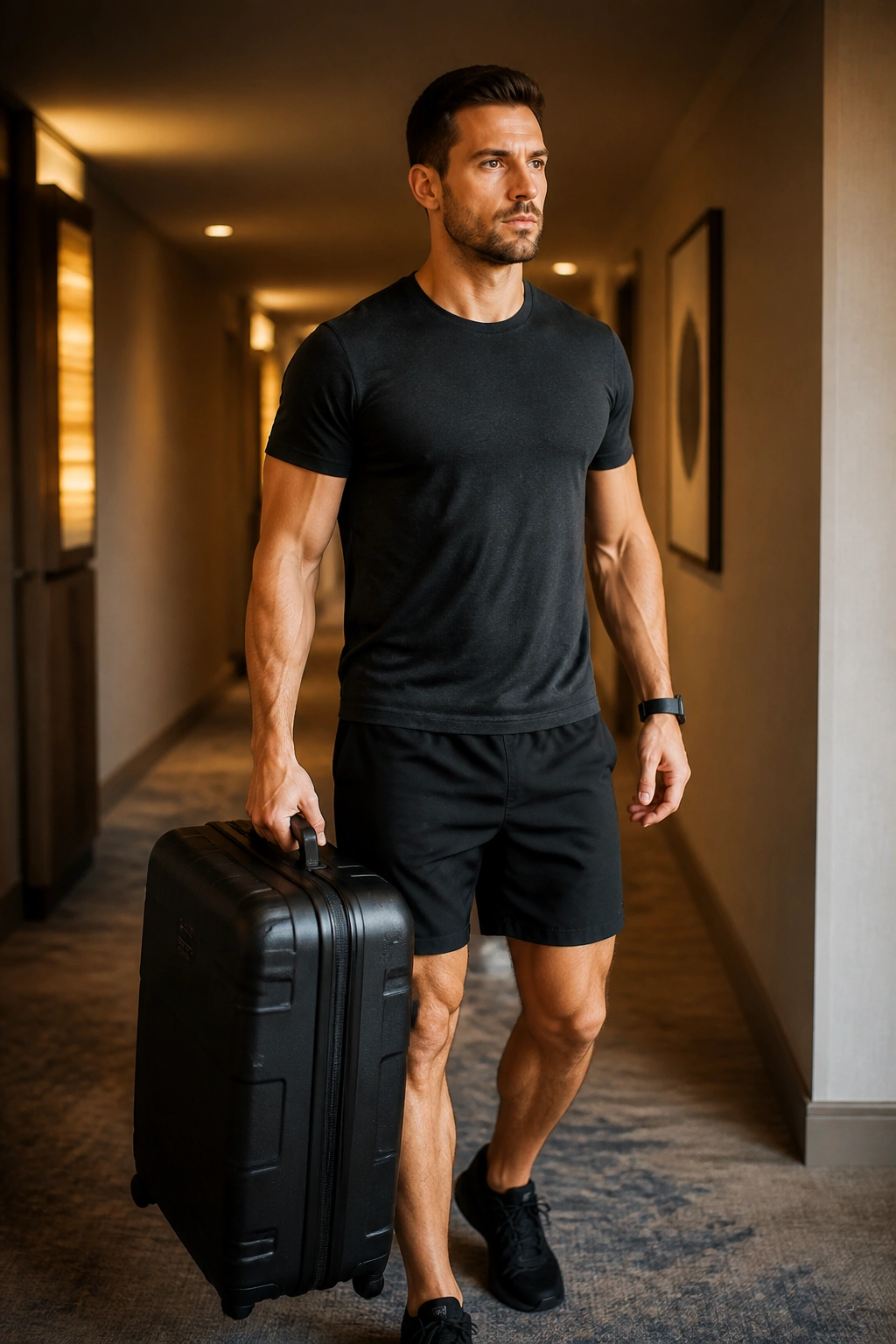
Heavy things walk well. Suitcases, duffels, and packed bags make that obvious once you stop seeing luggage as dead weight and start seeing it as training.
Use your bag and run 3 to 4 rounds of:
- 30-second suitcase carry on the right
- 30-second suitcase carry on the left
- 20-second front hold
- 20-second overhead hold
- 30-second wall sit with the bag hugged to your chest
Three carry patterns that matter
- Suitcase carry: one bag at your side, tall posture, ribs stacked over hips
- Front hold: bag hugged to the chest, elbows down, abs braced
- Overhead hold: only if the bag is stable and not too heavy
The suitcase carry is the one I’d keep if I had to choose only one. It teaches the core to stop leaning. The front hold makes the trunk work hard without moving much. The overhead hold asks for shoulder control, which is useful after a day of lifting and shoving luggage into overhead bins.
One warning: don’t use a wobbly bag with loose contents. That’s annoying and not worth the risk. Pack it tightly, test the weight, and keep the movement clean.
16. Tiny Gate-Delay Circuit for Airports and Check-Ins
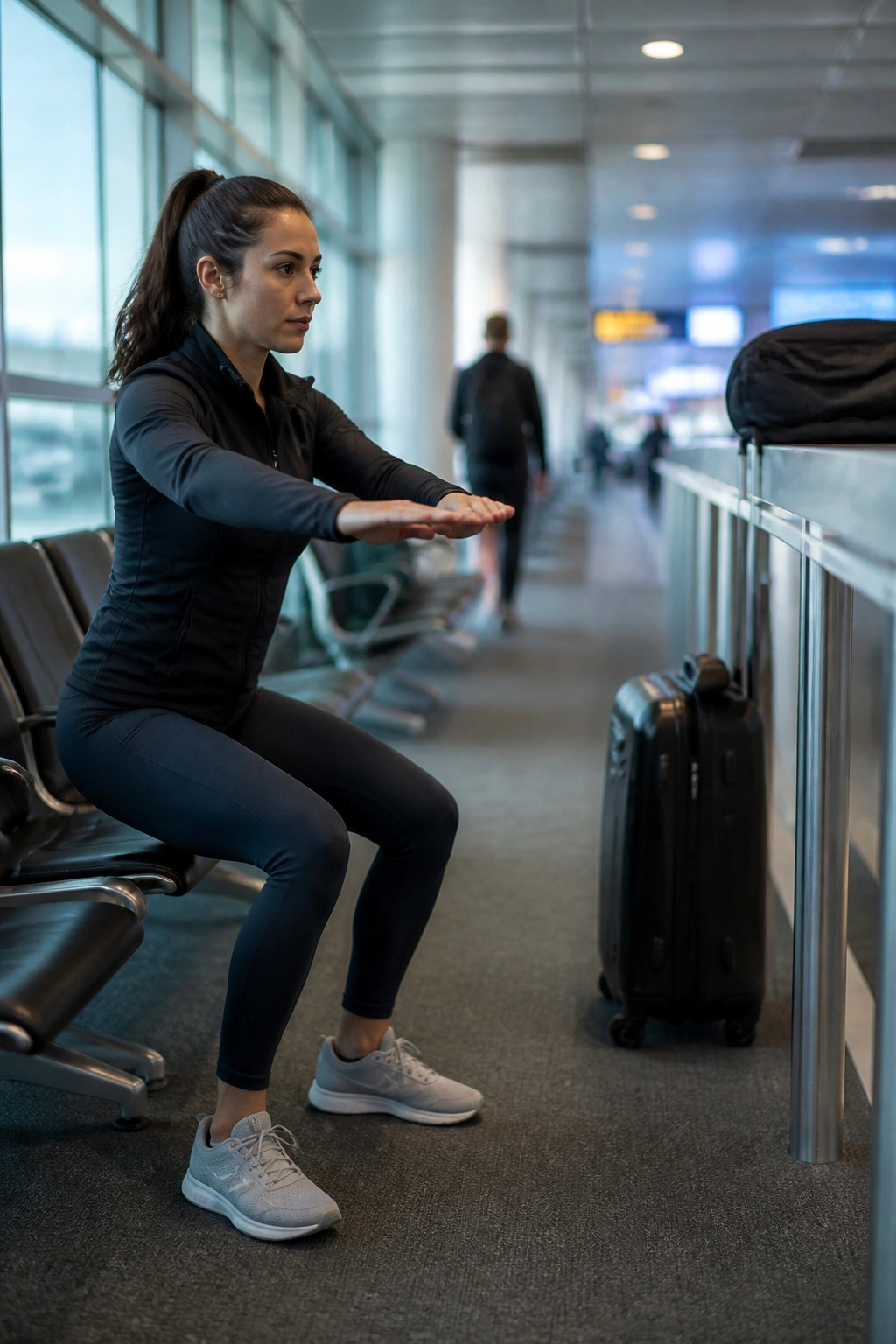
Five minutes. That’s enough.
If you’re stuck at a gate, waiting for a room, or killing time before dinner, you can still sneak in a small session without changing clothes or drawing attention. Do 2 to 3 rounds of:
- 12 chair squats
- 15 calf raises
- 8 desk or wall pushups
- 10 standing knee drives per side
- 10 glute squeezes with a 3-second hold
- 5 slow neck rolls each direction
The pushups can be done against a wall or the edge of a sturdy counter. The chair squats should stay controlled, not rushed. Calf raises matter more than people think when you’ve been seated for hours; they wake the lower leg up and help with that dead, heavy feeling.
Keep this one quiet and tidy. No jumping. No stomping. No weird floor acrobatics. You’re just clearing stiffness from the joints and giving yourself a small dose of movement before the next block of sitting.
This is the workout I’d use when the day is packed and the options are thin. It doesn’t need a room, and it still breaks up the damage.
17. Hotel Gym Dumbbell Workouts That Get You In and Out Fast
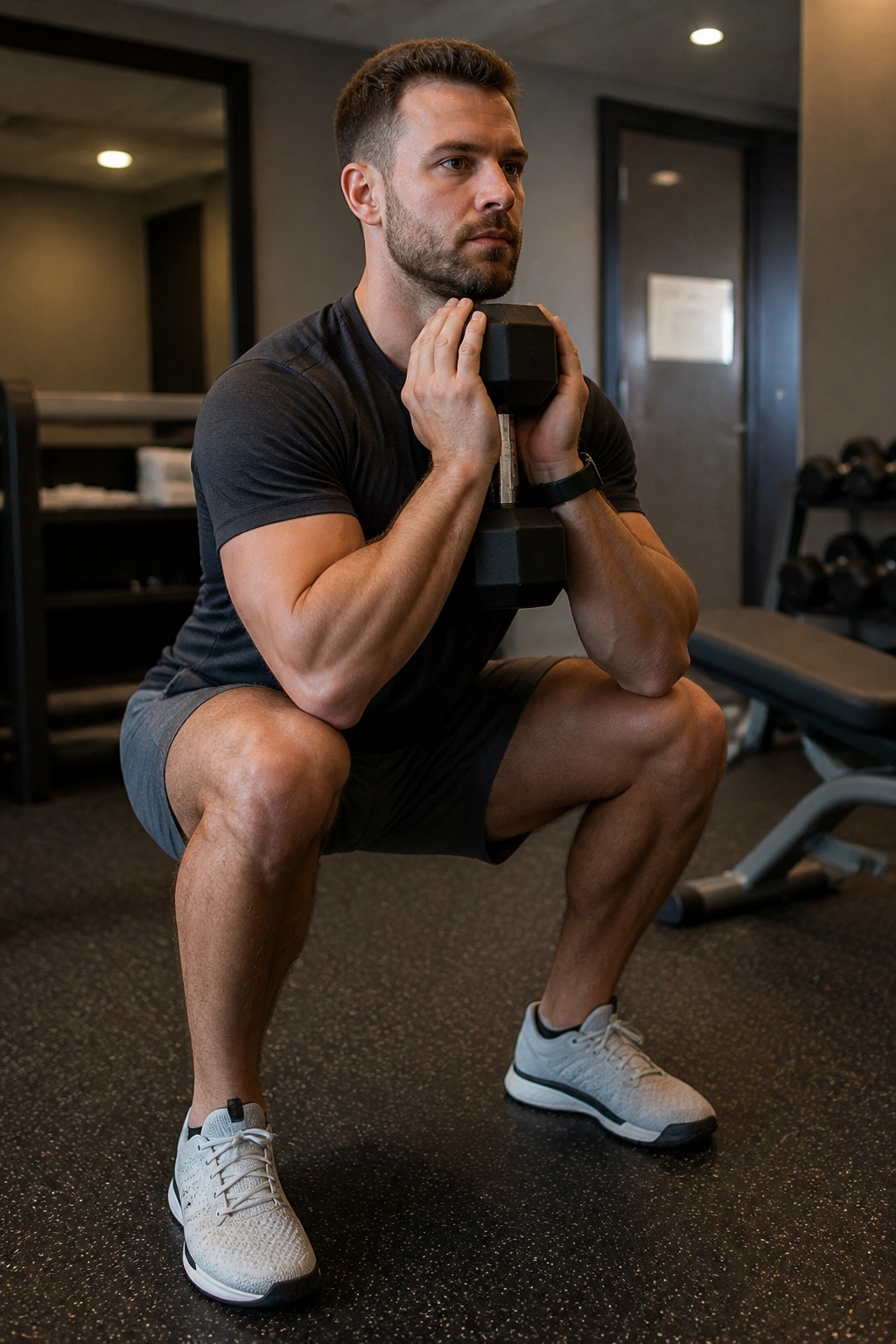
If the hotel gym has two dumbbells, a bench, and maybe a treadmill that sounds like it’s been through a war, that’s enough. You do not need to spend 15 minutes staring at the equipment wondering what the “right” exercise is.
Pick 4 moves and run 3 to 5 rounds:
- 10 goblet squats
- 10 one-arm rows per side
- 10 dumbbell floor presses
- 12 Romanian deadlifts
- Optional: 200-meter brisk treadmill walk between rounds
What to do if the gym is half broken
- Use one dumbbell if that’s all there is.
- Skip the machine circuits if they’re taken.
- Slow the lowering phase to 3 seconds if the weights are light.
- Swap floor presses for pushups if the bench is occupied.
A dumbbell workout becomes much more useful when you stop chasing variety and start chasing clean reps. The squat, hinge, push, and pull pattern covers a lot. Add a carry if you have time, and you’ve got a full session without turning your morning into a project.
I’ve always liked hotel gym work for one reason: it ends before you have time to overthink it. That matters when the rest of the day is already full.
18. The Reset Walk and Stretch Finish for Jet-Lagged Legs
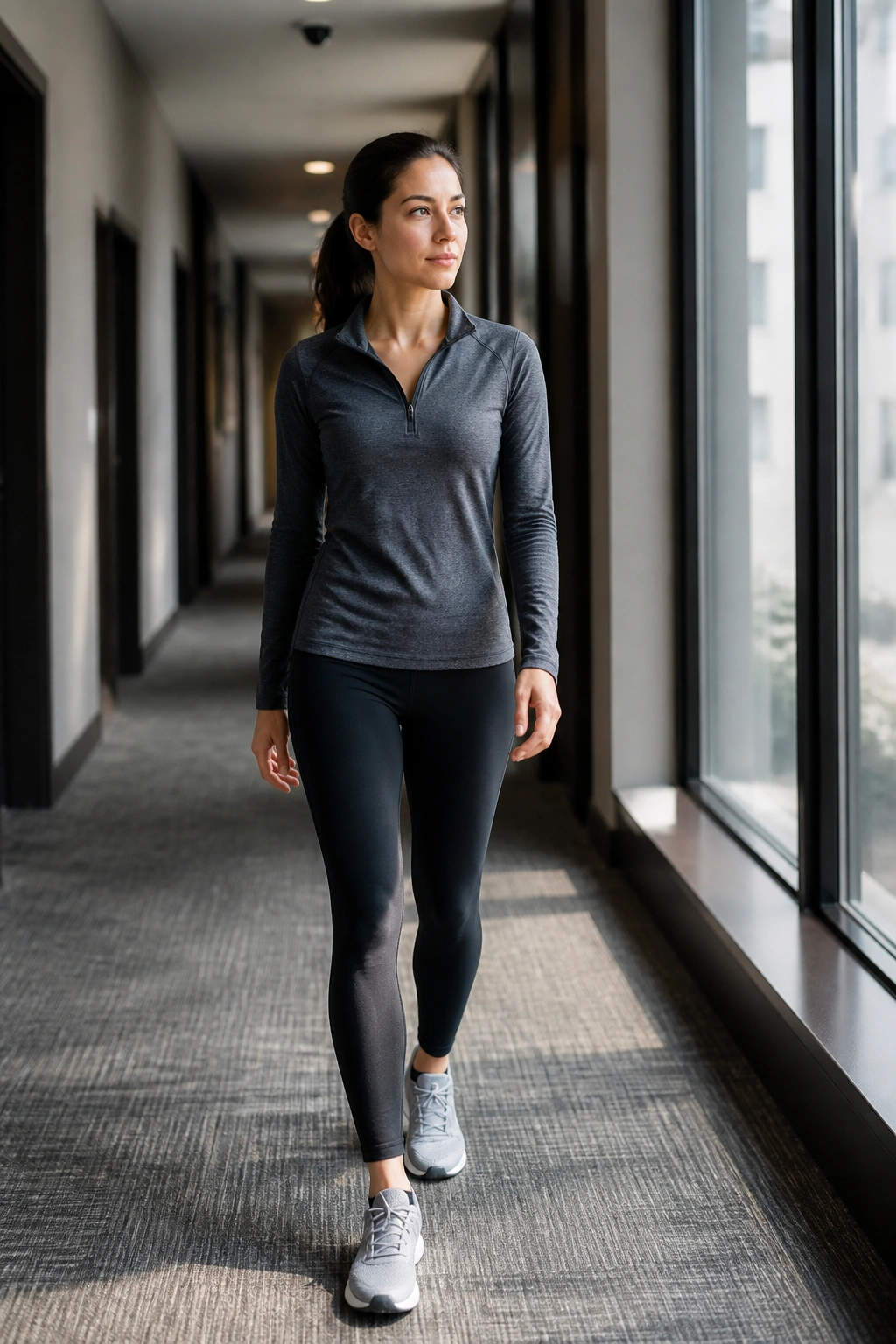
Not every travel workout needs to leave you sweaty. Sometimes the best move is the one that makes tomorrow less annoying.
Take a 10 to 15 minute easy walk, then spend 5 to 8 minutes on a simple stretch list:
- Calf stretch, 30 seconds per side
- Hip flexor stretch, 30 seconds per side
- Hamstring fold, 30 seconds per side
- Chest opener against a wall, 30 seconds per side
- Gentle neck side bend, 20 seconds per side
- Child’s pose or a long forward fold, 5 slow breaths
Keep the walk loose. No race pace. Let your stride open up a little and let your arms swing. The goal is to get blood moving after a day of sitting, not to chase pace or steps.
This is the workout I’d put at the end of a travel day, especially if the day has already been loud, long, and a little irritating. It’s not flashy, and that’s why it works. You get out of the chair, unwind the hips, and give your body a softer landing before sleep.
Travel fitness does not have to be dramatic to matter. If you can stack a few of these workouts over the course of a trip, you’ll feel the difference in your legs, your back, and the way you wake up the next morning.
