



There is something brutally honest about a flight of stairs. It doesn’t care about your gym membership, your fancy carbon-fiber shoes, or how many supplements you took before leaving the house. Gravity is a constant, unyielding opponent. When you decide to turn a staircase into a gym, you aren’t just burning calories; you are forcing your muscles to work through a full range of motion that flat-ground running simply cannot replicate.
Most people treat stairs as a way to get from the first floor to the second. They are missing out on one of the most effective tools for building explosive leg strength and rock-solid endurance. You do not need expensive machines to build powerful quads, glutes, and hamstrings. You just need a stable set of steps, a little bit of sweat equity, and a willingness to embrace the burn.
1. The Steady-State Climb
This is your baseline. It isn’t about setting speed records; it is about building aerobic capacity and muscular endurance. Find a flight of stairs that takes you at least 30 to 45 seconds to ascend at a moderate, rhythmic pace. Your goal here is to maintain a consistent cadence for the entire duration of your workout session.
Why It Works for Endurance
Steady-state stair climbing keeps your heart rate elevated in that “sweet spot” where you are working hard but not gasping for air every five seconds. It trains your calves and quads to handle repetitive stress without failing.
- Keep your posture upright: Do not lean excessively on the handrails; use them only for balance if you absolutely must.
- Focus on the full foot: Land with your entire foot on the step. If you only land on your toes, your calves will tire out long before your lungs do.
- Rhythm is key: Find a beat in your head and stick to it. Don’t speed up and slow down.
Pro tip: Aim for 20 minutes of continuous climbing. If you reach the top, walk back down slowly to recover, then immediately turn around and go back up.
2. High-Intensity Interval Sprints

If steady-state is the foundation, this is the sledgehammer. You are going to attack the stairs at maximum effort for short bursts, followed by a period of complete or near-complete recovery. This workout is specifically designed to recruit fast-twitch muscle fibers, which are essential for explosive power.
How to Structure Your Intervals
You want to push your body to the limit during the work phase. If you aren’t breathless by the end of the sprint, you aren’t going hard enough.
- Work Phase: Sprint up the stairs as fast as you can safely manage. Aim for 15 to 30 seconds of pure, unadulterated effort.
- Rest Phase: Walk down the stairs slowly. Take an extra 30 seconds at the bottom if your heart rate is still hammering against your ribs.
- Volume: Start with 6 to 8 rounds. As you get stronger, increase the number of rounds, not the length of the sprint.
Safety note: Watch your step on the way down. Your legs will be shaky after a maximal effort, and the descent is where most people trip.
3. The Weighted Vest Grind

Adding external load to stair climbing changes the physics of the movement. By wearing a weighted vest, you increase the force your legs have to generate with every single step. This is essentially a moving squat session.
The Impact of Added Load
You do not need to go heavy. Even a 10-pound vest will make a standard flight of stairs feel significantly steeper and more demanding on your glutes.
- Core Engagement: The added weight pulls you forward. You must engage your abdominals and lower back to stay upright.
- Reduced Speed: Your pace will naturally drop. Embrace it. Focus on driving through your heels.
- Focus on Depth: Because you are moving slower, ensure you are fully extending the knee and hip at the top of every step.
Reality check: If you do not have a weighted vest, a backpack with a few books or water bottles works just as well. Just make sure it is tight against your back so it doesn’t shift around while you move.
4. Lateral Step-Ups
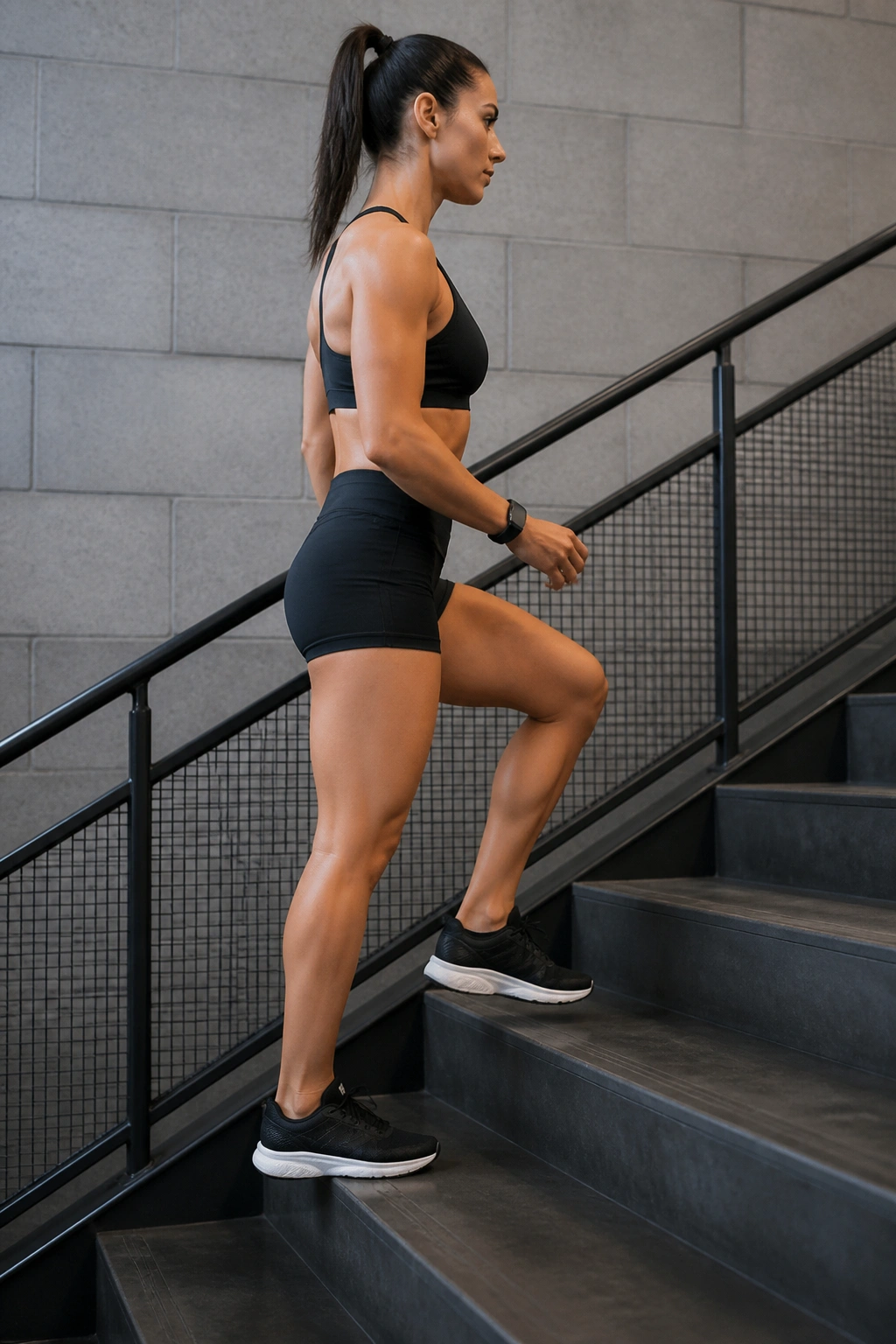
Most stair work is sagittal—meaning you move forward. Lateral training forces your body to move in the frontal plane, which is where the stabilizer muscles like your abductors and glutes medius live. These muscles are often neglected in traditional strength training.
Technique for Maximum Activation
Stand sideways to the stairs. Step up with your lead leg, bringing your trailing leg up to meet it, then step back down in the same pattern.
- The Pivot: Keep your hips square to the wall or railing you are facing. Do not rotate your torso as you step.
- The Drive: Push off the heel of the lead foot. You should feel this in the outside of your hip and thigh.
- The Switch: Complete your set on one side before turning around to lead with the other leg.
Warning: Go slow. The coordination required for lateral movement is higher than forward climbing. You don’t want to lose your balance and twist an ankle.
5. Glute-Focused Skip-Stepping

If you have ever felt like your quads do all the work while your glutes just watch, this is your fix. By skipping a step—taking two steps at once—you increase the hip flexion required, which forces the glutes to do a significantly larger share of the lifting.
Why This Is Different
When you take one step at a time, your quads dominate the movement. When you take two, the glutes are recruited to help extend the hip through a larger range of motion.
- The Reach: Plant your foot firmly on the second step up.
- The Drive: Drive your hips forward as you stand. Imagine you are trying to push the stairs away from you.
- The Reset: Step back down one step at a time to reset. Do not try to skip steps on the way down; it is terrible for your knees.
Pro tip: This is technically demanding. Start on a shorter flight of stairs to get the movement pattern dialed in before tackling a massive stadium staircase.
6. The “Slow-Burn” Recovery Walk

Sometimes, you need to work your legs without destroying your central nervous system. The slow-burn walk is about maximizing time under tension. You move so slowly that your muscles never get a chance to relax until the set is over.
Execution
Set a pace that feels ridiculously slow. Take 3 to 4 seconds to complete a single step.
- Control the Ascent: Do not let momentum carry you. Push slowly.
- Focus on the Muscle: Feel the contraction in your quads and glutes with every single inch you gain.
- No Resting: Keep moving. Even at this slow speed, the cumulative effect of constant tension will make your legs feel like lead by the end of 5 minutes.
This is a mental challenge as much as a physical one. It is tempting to speed up when it gets hard, but resist that urge. The benefit comes from the deliberate, slow-motion effort.
7. Unilateral Single-Leg Jumps
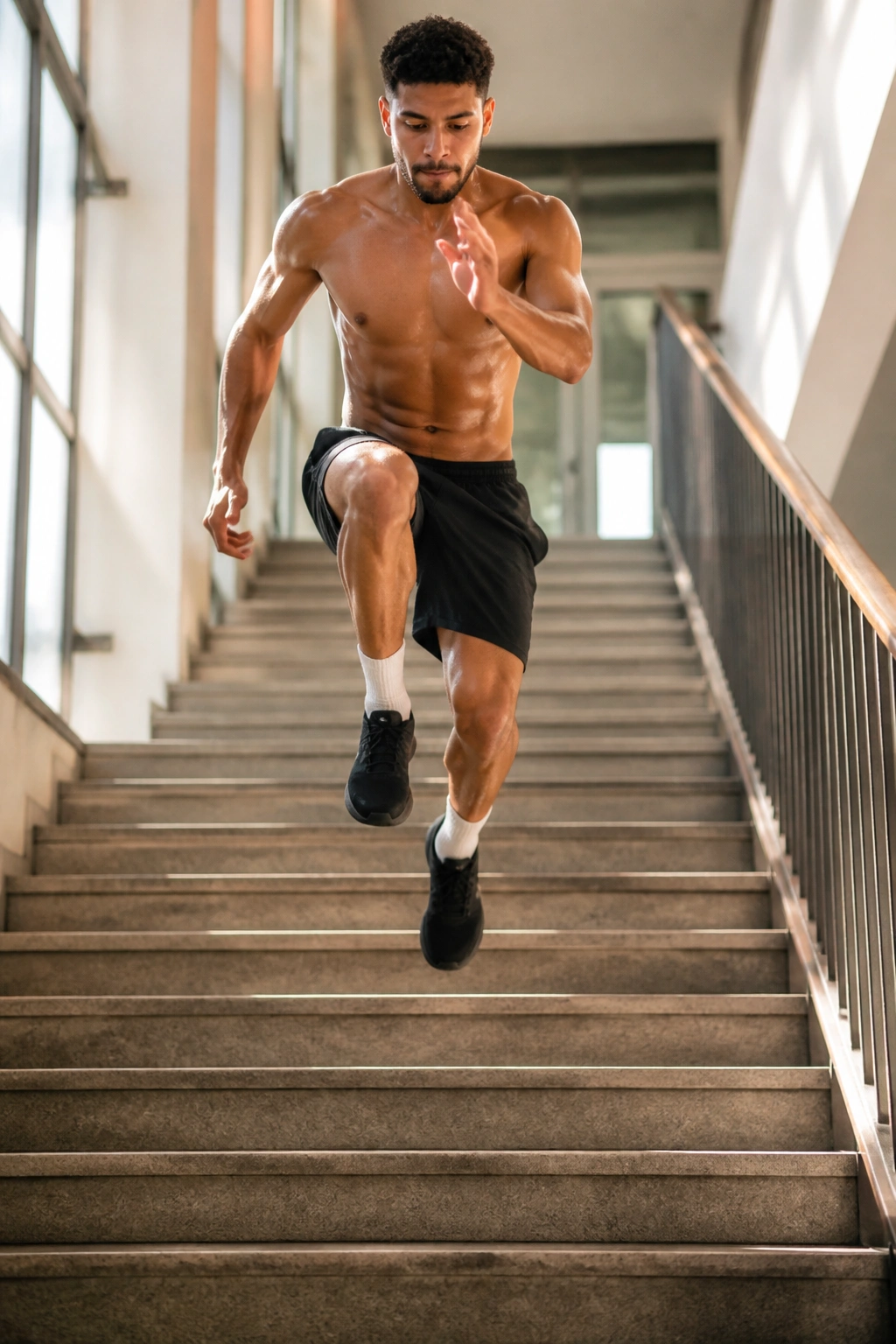
This is an advanced move. Do not attempt this unless you have a solid foundation of leg strength and balance. You are effectively performing a series of single-leg box jumps, but on a staircase.
Building Power
Stand at the bottom of the stairs on one leg. Hop up to the first step, landing softly. Pause for a second to regain your balance, then hop to the next.
- The Landing: The landing is the most important part. Aim for a soft, quiet landing. If you are slamming your foot down, you are putting too much stress on your joints.
- The Push: Use your arms to generate momentum.
- The Limitation: Keep the flight count low. Five to six steps is plenty for a set.
Safety: If your balance feels “off” or if you feel any pain in your knee, stop immediately. This move requires excellent proprioception.
8. Ankle Weight Endurance
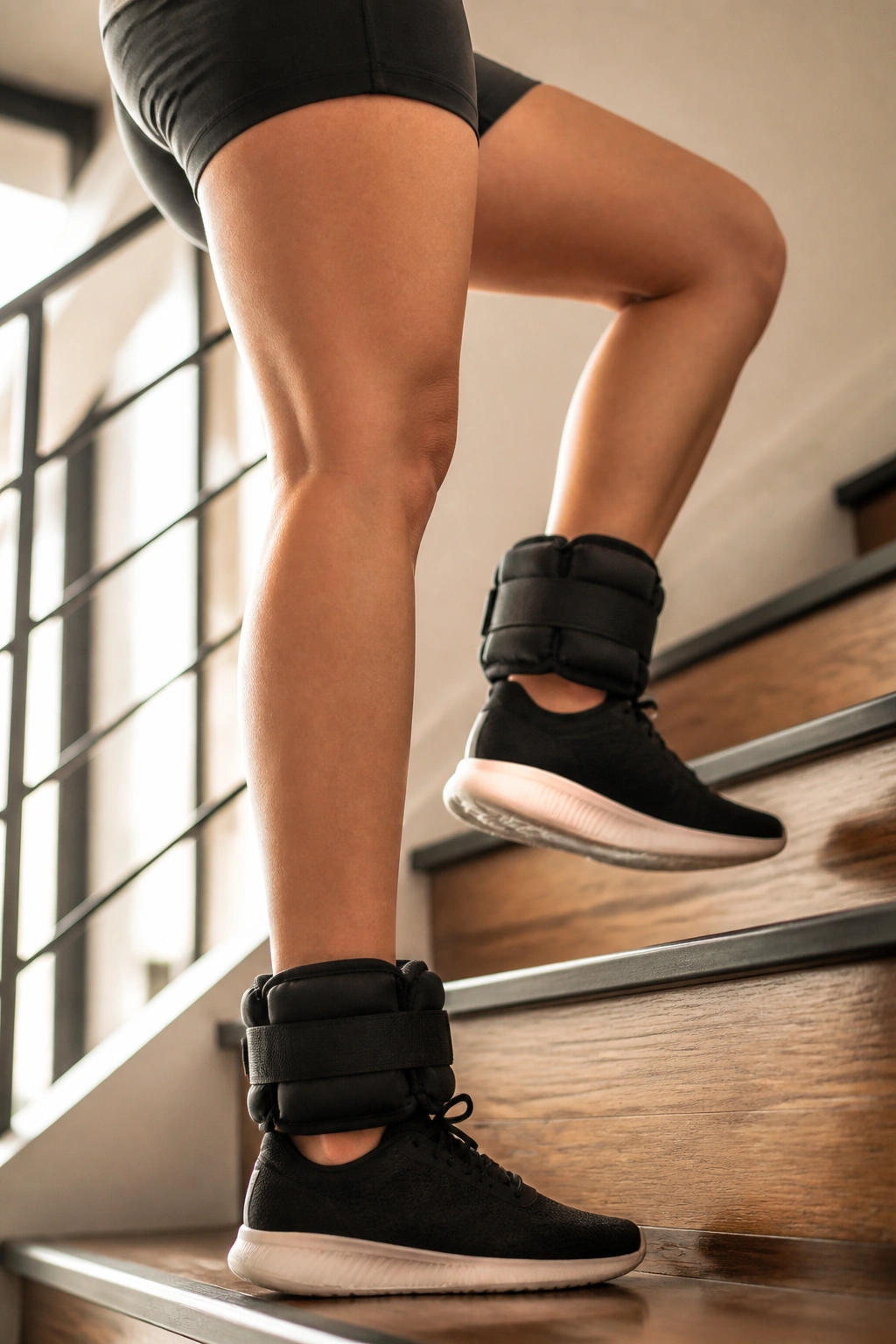
If you want to build endurance in your lower legs and hips without adding a bulky vest, ankle weights are a fantastic, low-profile alternative. They add just enough resistance to change the feeling of the movement without altering your gait significantly.
Setting the Weights
Do not go for the heavy 10-pounders. Start with 1 to 2 pounds per ankle. You aren’t trying to bulk up here; you are trying to add a “drag” factor to your climb.
- The Swing: Because of the weights, you will notice a heavier drag during the swing phase of your step.
- Hip Flexors: You will feel this in your hip flexors within a few minutes. That is normal.
- The Burn: The added weight will make your quads and glutes work harder to maintain your normal speed.
Usage: Keep the weights light. If they are too heavy, you will alter your natural walking form, which can lead to hip strain over time.
9. Bulgarian Split Squat Stair Transition
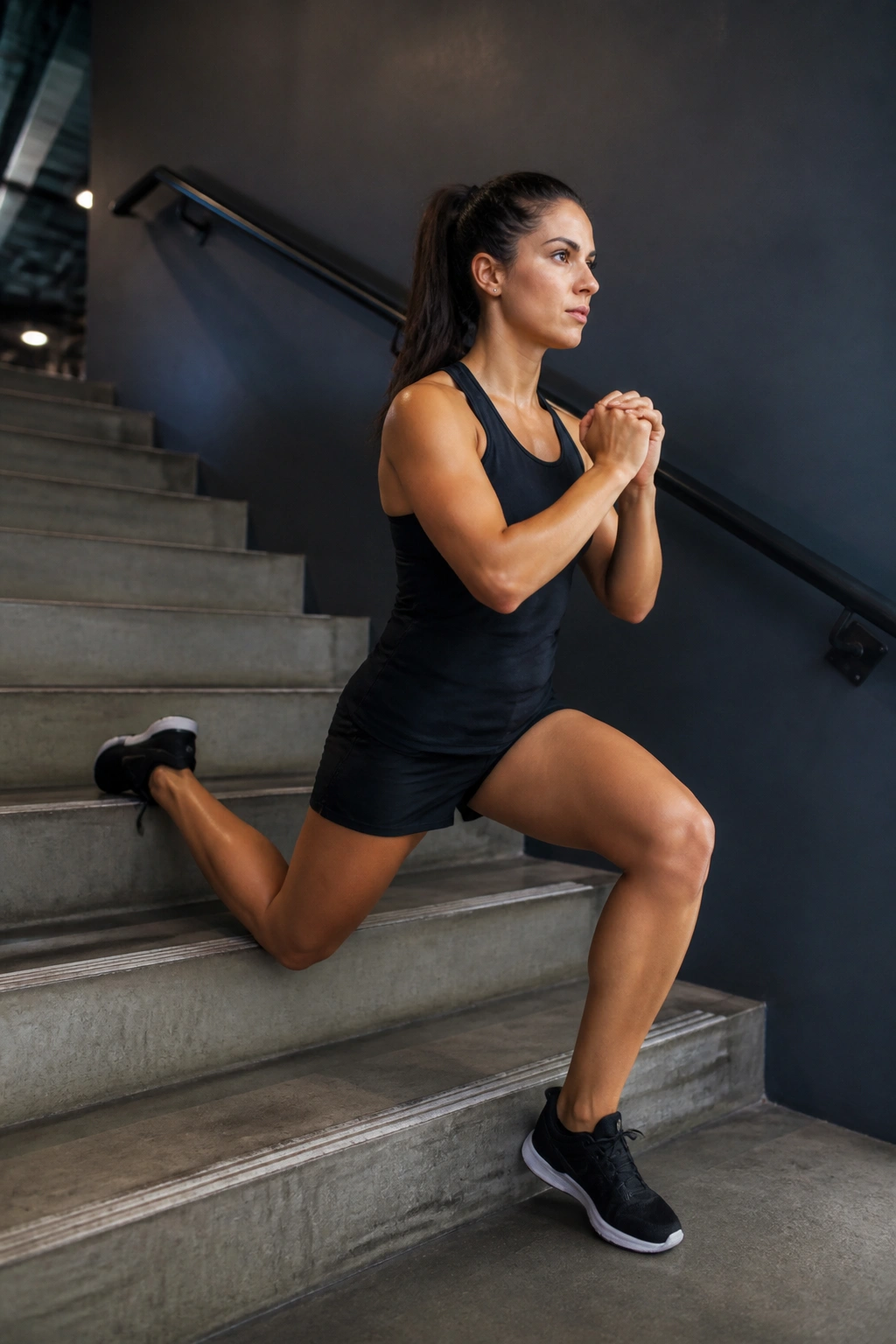
This combines a classic strength training move with the elevation of stairs. It is one of the best ways to isolate one leg at a time.
How to Set Up
Face away from the stairs. Place your back foot on the first or second step. Lunge forward with your front leg.
- The Depth: Lower your back knee toward the ground. Your front thigh should be parallel to the floor.
- The Ascent: Drive through your front heel to stand up.
- The Reps: Perform all reps on one leg before switching.
Why this matters: Because your back foot is elevated, you are forced to stabilize your pelvis. This builds unilateral leg strength that carries over directly to your ability to run, jump, and climb more efficiently.
10. Stair-Based Walking Lunges
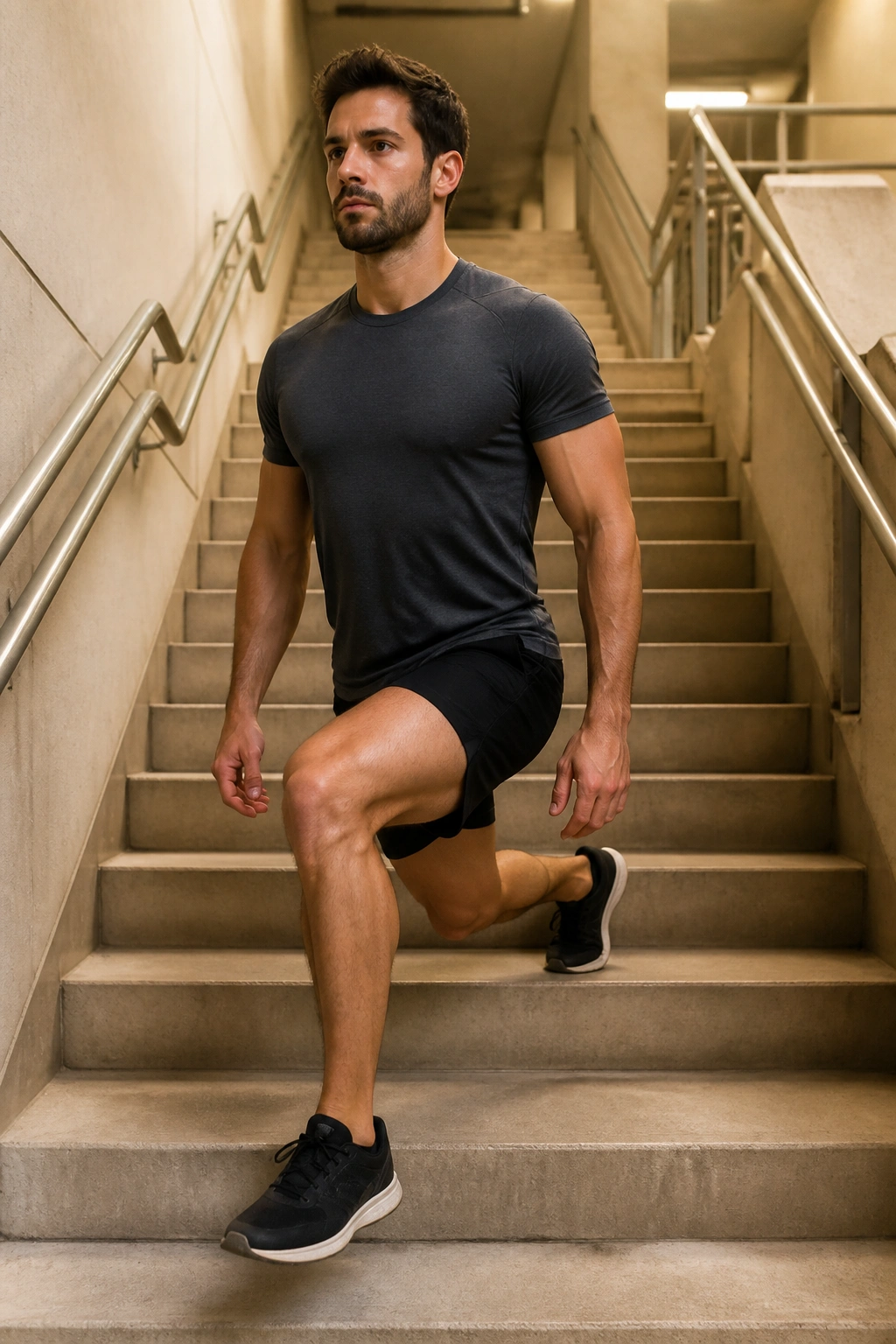
Walking lunges are hard enough on flat ground. Doing them on a staircase requires a level of control that will test even the most experienced athletes.
The Movement Pattern
Start at the bottom. Step up with one foot, lunging deep, then bring the back foot up to the next step.
- The Alignment: Keep your front knee in line with your toes. Do not let it cave inward.
- The Torso: Stay upright. If you lean too far forward, you will lose your center of gravity.
- The Depth: This is not a race. You need to sink deep into each lunge to actually work the muscle.
Pro tip: This can be rough on the knees. If you feel any sharp pain, switch to a shallower lunge or skip this exercise entirely until your connective tissue is stronger.
11. The “1-2-3” Cadence Drill
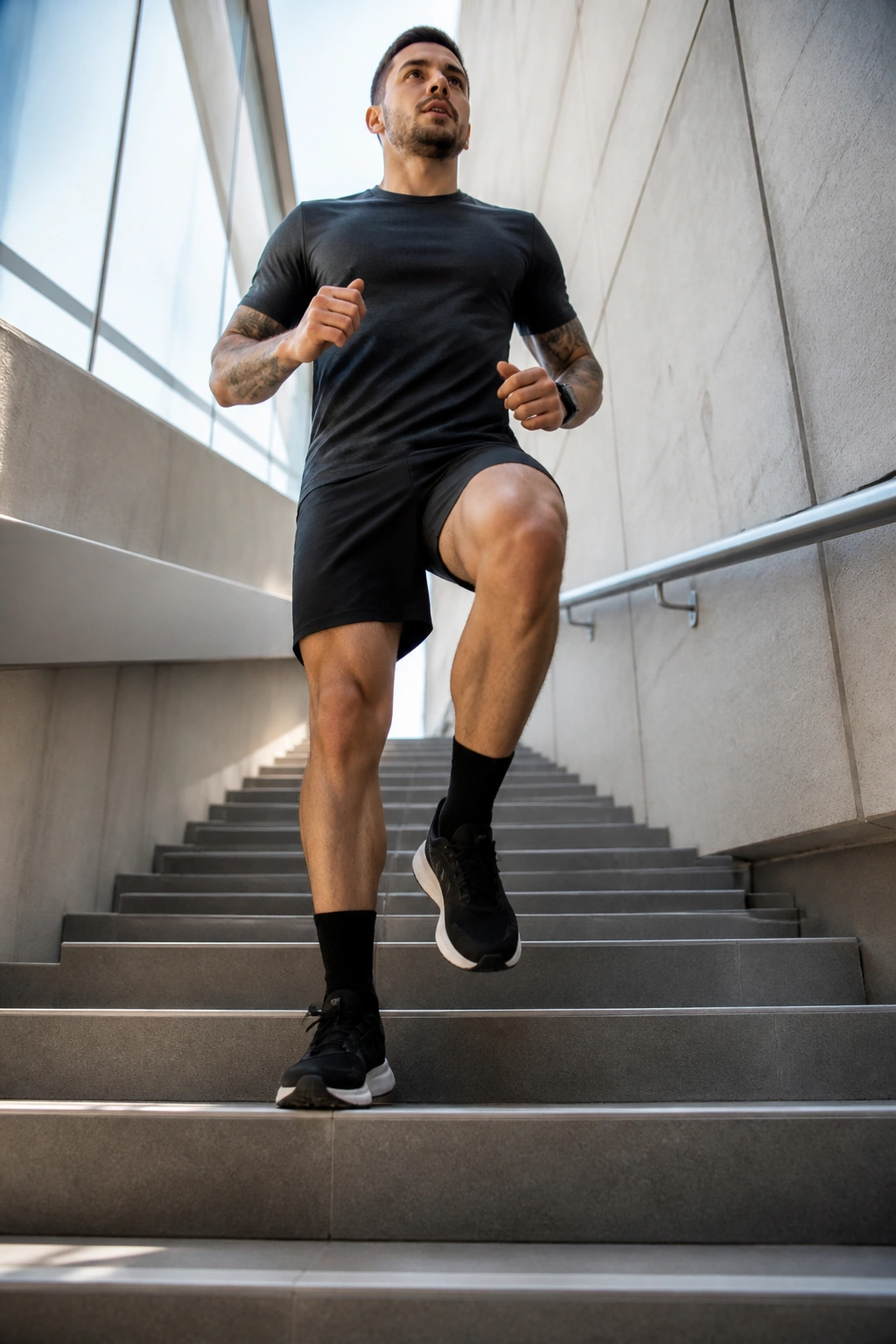
This is a rhythm-based workout that keeps your brain engaged and forces your legs to adapt to changing tempos. It is excellent for neuromuscular coordination.
Understanding the Rhythm
You will change your speed every few steps.
- 1-2-3 (Fast): Sprint for three steps.
- 1-2-3 (Slow): Take the next three steps in slow motion, focusing on deep, deliberate contraction.
- Repeat: Cycle this fast-slow pattern until you reach the top.
By constantly switching between explosive speed and slow, controlled tension, you train your muscles to handle different types of stress in a single workout. It is exhausting, but it prevents the “mindless” slog of steady-state climbing.
12. Eccentric Descend Control
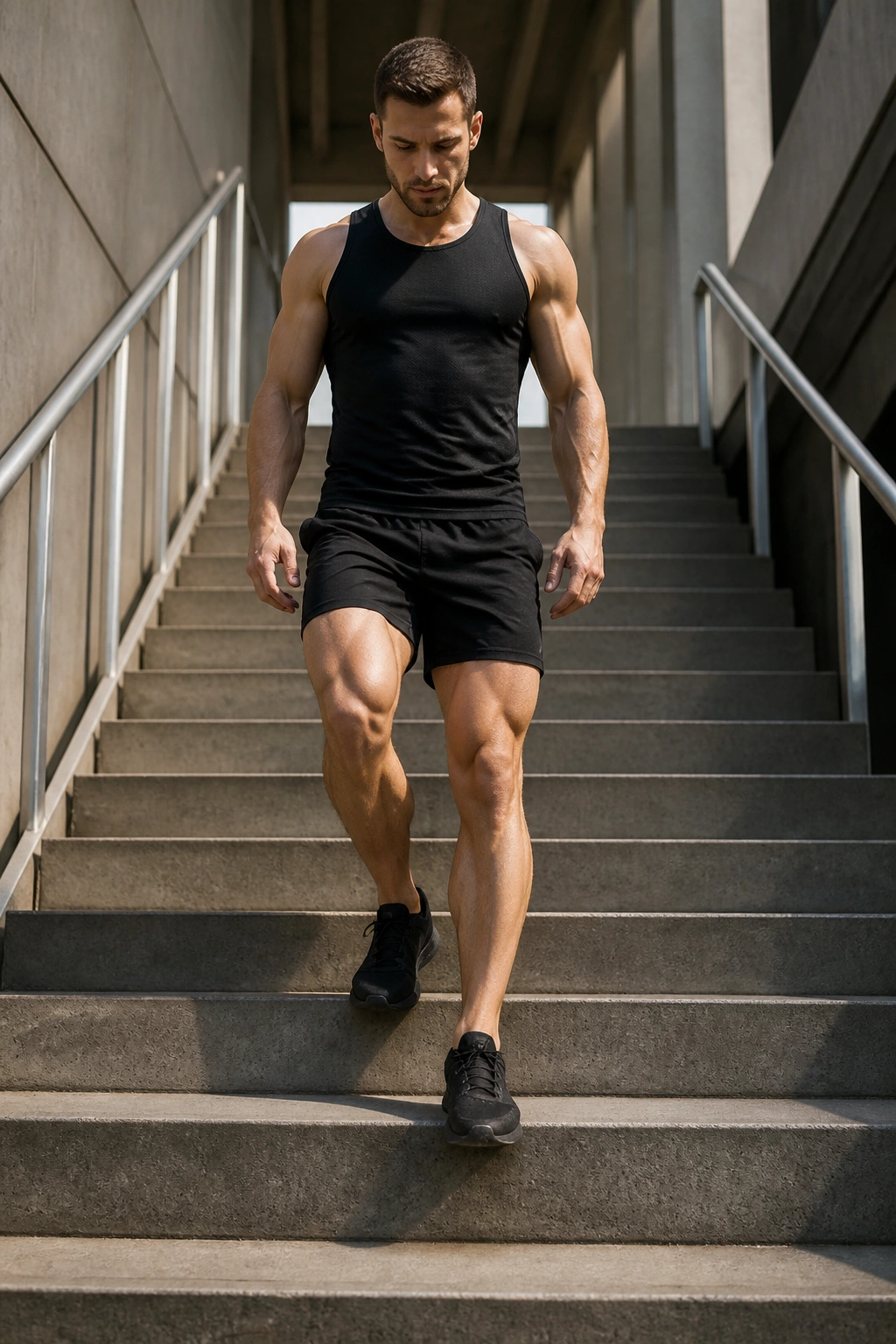
Most people focus on the way up. However, the way down is where you can build significant strength through eccentric loading—the phase where the muscle lengthens under tension.
Maximizing the Downward Phase
Turn around and face the bottom of the stairs. Walk down—or rather, climb down—as slowly as possible.
- The Focus: Your quads act as the brakes here. Control your descent so that your foot makes the lightest contact possible with the step.
- The Duration: Spend at least 3 seconds on each step.
- The Benefit: Eccentric strength is a massive predictor of injury resilience. If you can control your body weight on the way down, your joints will be much healthier in the long run.
Caution: If you have known knee issues, be very careful with this. Eccentric work is demanding on the patellar tendon.
13. Double-Step Power Climb

This is similar to skip-stepping, but with a focus on speed and power rather than just glute isolation. You are not pausing to reset; you are moving as fast as you can while skipping every other step.
The Power Output
You need to be aggressive. This is an explosive movement.
- Drive: Push forcefully through the balls of your feet.
- Arm Swing: Use your arms to pump and generate upward momentum.
- Posture: Keep a slight forward lean. It helps you stay balanced as you drive your legs upward.
Why it’s different: Skip-stepping (#5) is about controlled strength. This is about power. Your heart rate will spike almost immediately. Limit these sets to shorter flights of stairs to maintain technique quality.
14. Plank-Stair Crawl
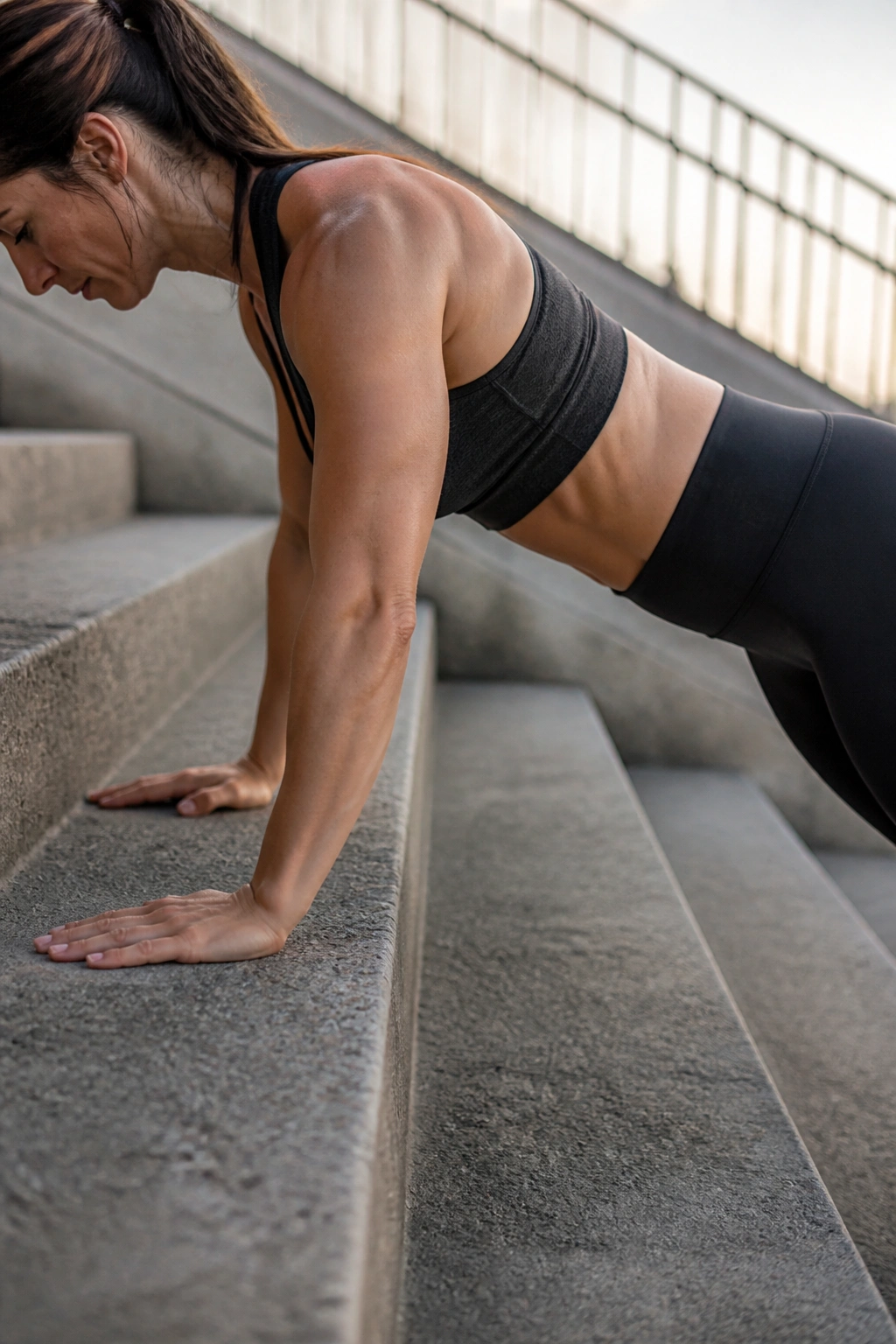
This is a full-body movement that happens to target the legs. By getting into a crawling position on the stairs, you turn every step into a mini-mountain climber.
The Setup
Get into a push-up position at the bottom of the stairs. Place your hands on the first step.
- The Movement: Crawl your hands up the stairs, one step at a time, keeping your body in a straight plank line.
- The Legs: Because your hands are higher than your feet, your core and hips are under constant tension. Your legs have to work to keep you stable and propel your lower body up the steps.
- The Finish: Walk your hands back down slowly.
Why it’s unique: It takes the pressure off the knees while keeping the quads and glutes fully engaged. It’s a great way to mix up a leg-focused session.
15. High-Knee Power Marches

This is about hip flexor strength and explosive knee drive. By exaggerating the knee lift, you force your hip flexors to work harder, which actually improves your stride efficiency for running and walking.
Execution
Instead of just walking up the stairs, lift your knee until your thigh is parallel to the floor with every step.
- The Lift: Drive the knee up sharply.
- The Landing: Place the foot firmly on the next step.
- The Pace: Do not rush. This is not a sprint. The focus is on the height of the knee lift.
Pro tip: Do this for a short flight. It gets tiring quickly because the hip flexors are relatively small muscles. Quality of the lift matters more than quantity of steps.
16. Stair Burpee-Climbs
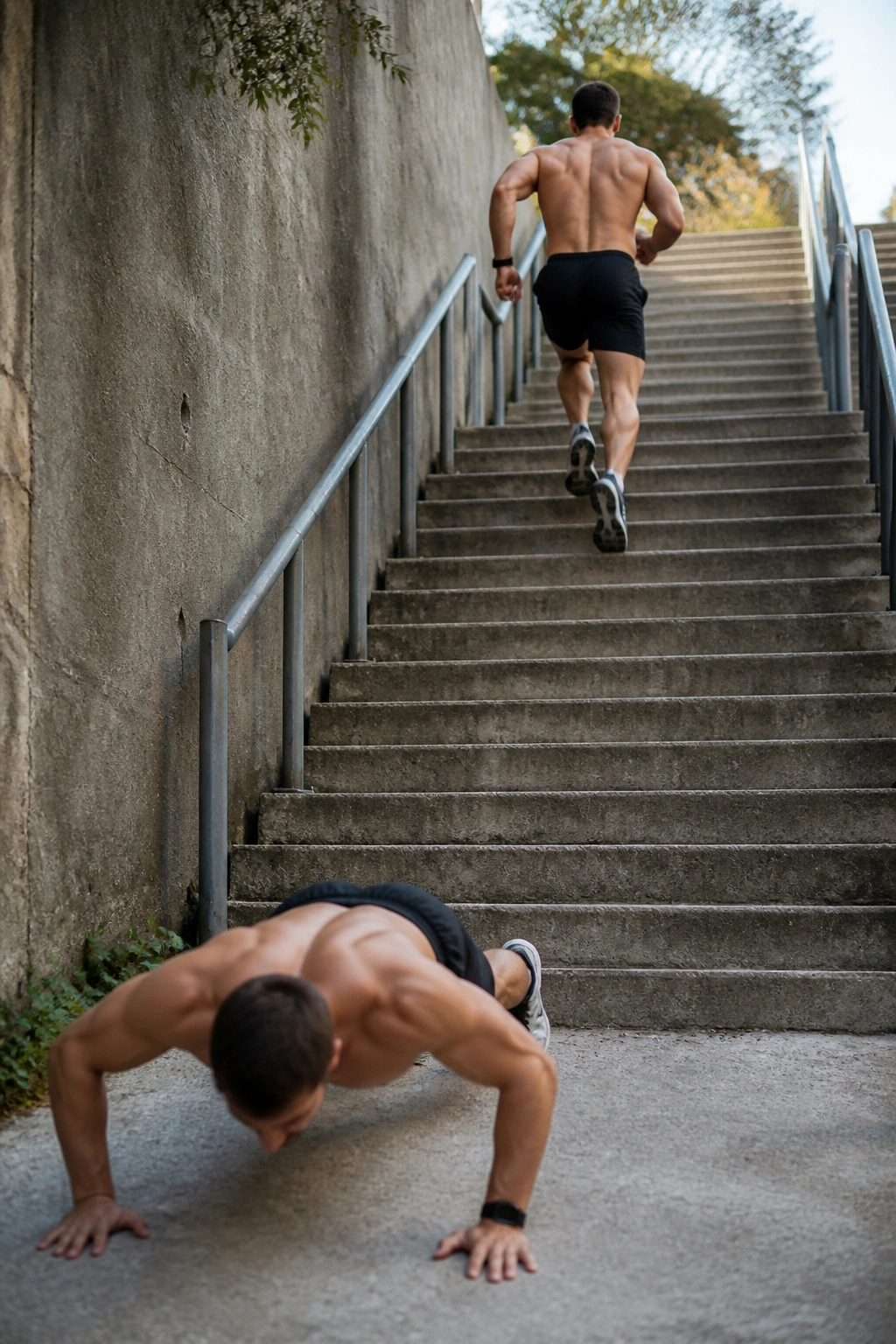
If you want a hybrid workout that fuses metabolic conditioning with lower body strength, this is it. It’s grueling, but effective.
How to Execute
- Burpee: Perform a full burpee at the bottom of the stairs.
- Climb: Jump up or sprint up 5 to 10 stairs.
- Repeat: Turn around, walk back down, and perform another burpee.
Why it works: You are forcing your legs to switch from the horizontal explosion of a burpee to the vertical drive of a climb. It’s a fantastic way to train your legs to perform under fatigue.
17. Sumo Stair Walks
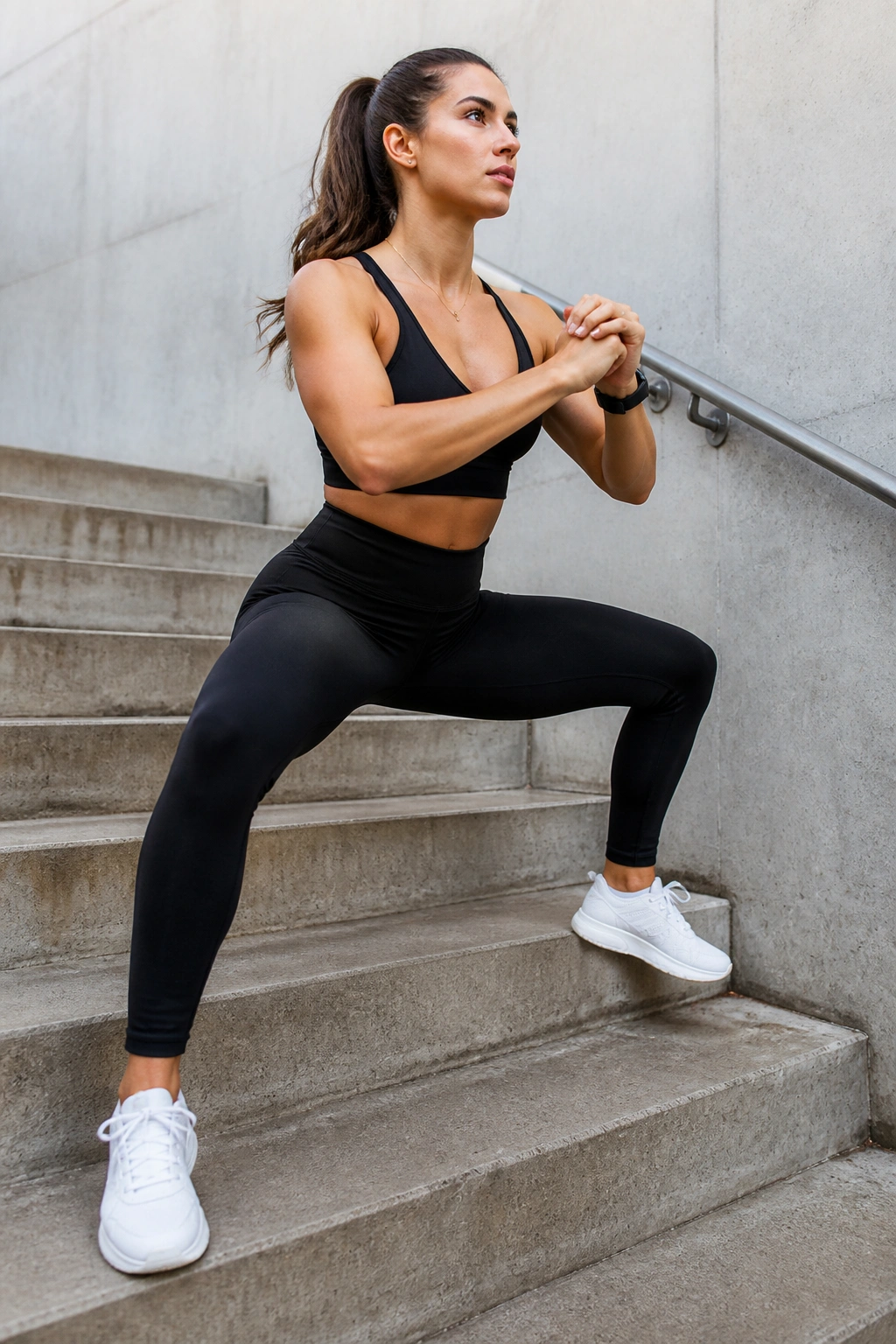
This variation hits the inner thighs (adductors) harder than any other stair exercise. By taking a wider stance, you change the leverage and force your inner thighs to stabilize your hips.
The Technique
Stand with your feet wider than shoulder-width apart, toes pointed slightly outward.
- The Stance: Keep this wide stance as you climb up.
- The Squeeze: Focus on squeezing your inner thighs as you push up to the next step.
- The Posture: Keep your chest up. Don’t hunch over.
Warning: This will feel awkward. Start slow. You need to be able to place your feet securely on the steps, so this works best on stairs that are relatively wide.
18. The “Ladder” Finisher

This is a classic conditioning tool used by athletes to empty the tank. You build up intensity, hold it, and then bring it back down.
The Structure
You are going to climb the stairs in a ladder format:
- 1st Round: Climb 1 flight.
- 2nd Round: Climb 2 flights.
- 3rd Round: Climb 3 flights.
- Peak: Continue until you hit a pre-determined limit (e.g., 5 or 6 flights).
- The Descent: Then, work your way back down (e.g., 4 flights, 3 flights, 2 flights).
Why it’s the perfect finisher: It forces you to mentally prepare for longer and longer efforts, and then gives you the psychological relief of the “descending” ladder. It builds incredible mental toughness alongside leg endurance.
Wrapping Up
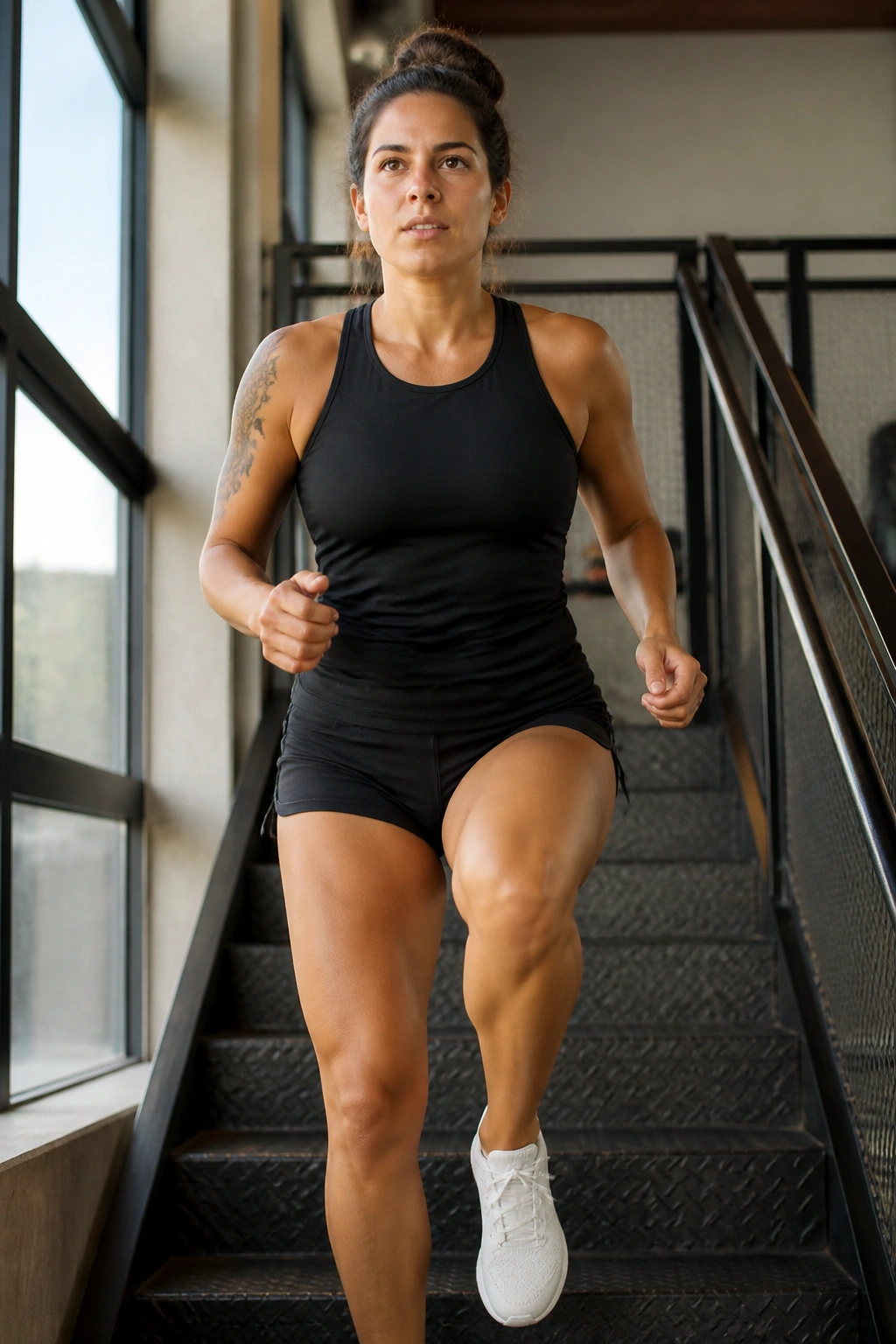
Stair climbing is one of the few exercises that remains brutally effective regardless of how “in shape” you are. If you are a beginner, the stairs will humble you within a single floor. If you are an elite athlete, a weighted vest and a long staircase will still leave you breathless.
The key to progress isn’t finding more equipment or a bigger stadium. It is about consistency and variety. Your legs are adaptable. If you do the same steady-state climb every single time, your body will eventually figure out how to do it efficiently—meaning you stop making gains. Mix these workouts up. Combine the explosive power of the double-step climb with the muscular endurance of the steady-state walk.
Listen to your body. Stair climbing is demanding on the joints, specifically the knees and ankles. If you feel sharp pain, stop. Back off, prioritize recovery, and come back when your body feels ready. Treat the stairs with respect, and they will eventually give you the strength and stability you are working toward. You don’t need a gym to build strong legs; you just need to start climbing.
