



Ten minutes into a hard reformer session, the carriage has a way of telling on you. If your ribs flare, it slides. If you stop using your glutes, your hips wobble. And if you try to fake reformer Pilates moves with momentum, the machine calls you out right away.
That’s why the reformer works so well for a full body burn. The springs load the movement on the way out and on the way back, the carriage adds instability, and the straps turn small positions into serious work. You feel it in obvious places like your abs and thighs, sure, but also in the muscles that usually hide in the background—your deep core, your inner thighs, the back of your shoulders, even the arches of your feet.
A strong reformer workout also doesn’t need circus tricks. Some of the hardest moves look almost plain from the outside. Footwork can light up your legs if you stop rushing it. Elephant can make your hamstrings shake in a range of motion that barely looks like movement. Long Stretch is a plank, yes, but one that asks your shoulders and trunk to control a moving platform instead of the floor.
The 18 exercises below are the ones I’d pick when I want the session to feel balanced, athletic, and honest. A few are friendly to newer students, a few are advanced, and all of them earn their place when you want your legs, core, back, and arms to leave the studio knowing they did actual work.
Before You Start These Reformer Pilates Moves
Spring settings trip people up more than the movement itself.
One studio’s one red spring can feel different from another studio’s red. Home reformers often run lighter and shorter than commercial ones too. Treat any spring suggestion as a starting point, not a law carved into stone. The better test is this: the carriage should move smoothly, never slam into the stopper, and never feel so heavy that your shape falls apart halfway through the rep.
Breath matters more than most people think. Exhale on the part where you press, pull, lift, or close the carriage. Inhale on the return or the setup. That rhythm helps you organize your ribs and pelvis, which matters a lot once the springs start trying to pull you out of position.
A few quick rules make every move better:
- Move slower on the return than you want to. That’s where the machine usually exposes cheating.
- Use the full foot or full hand when the exercise asks for it. Gripping with your toes or collapsing into your wrists wastes effort.
- Stop at muscle work, not joint pain. Neck pinch, sharp low-back pain, or wrist pain that keeps climbing is your sign to change the spring, reduce the range, or swap the move.
- Six clean reps beat 15 sloppy ones. Every time.
All right. Carriage set. Let’s get into the good stuff.
1. Reformer Footwork
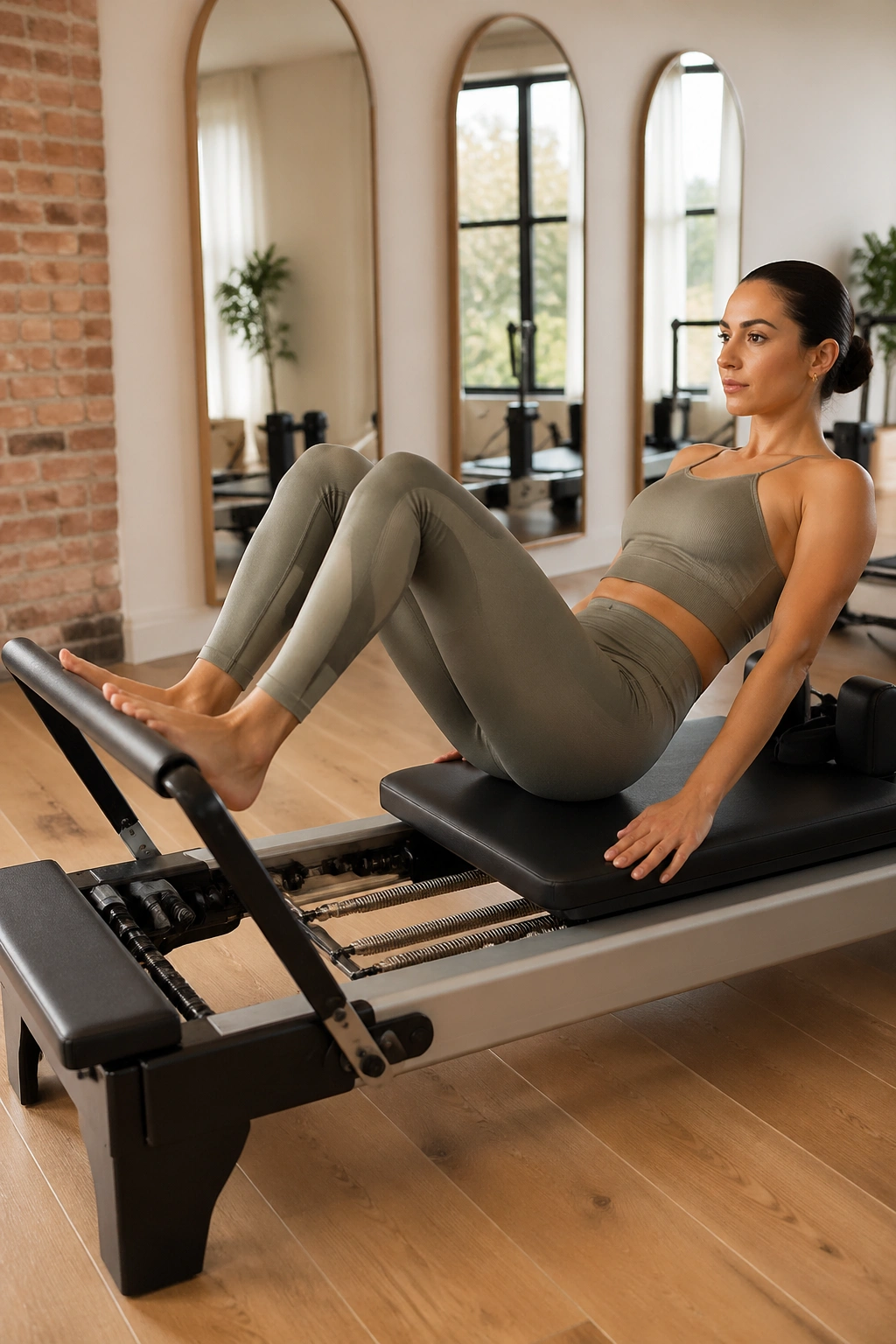
Footwork looks like a warm-up. It isn’t. Done with control, it’s one of the best ways to wake up your quads, glutes, calves, hamstrings, and deep core before the flashier moves begin.
Lie on your back with your headrest set the way your neck likes it, heels or toes on the footbar, pelvis neutral, and ribs heavy. Choose a spring load that feels supportive—often on the heavier side—so you can press the carriage out without wobbling, then pull it back in with the same control. The big cue here is to press through the entire foot, not just your toes or heels.
Where the burn shows up
Most people notice the front of the thighs first. Stay with it. If you keep your pelvis still and resist the return, you’ll start feeling the backs of the legs and seat too. That’s the piece newer students miss: Footwork is not about kicking the carriage away. It’s about organizing the whole lower body while your trunk stays quiet.
Try 8 to 10 reps each in a few positions—heels parallel, toes parallel, small Pilates V, and wide on the bar if your hips allow it.
Quick form checks
- Keep your knees tracking over the second and third toes.
- Straighten the legs fully, but do not snap the knees back.
- Let the carriage return because you control it, not because the springs yank you home.
- If your toes claw the bar, back off and spread the work through your whole foot.
My favorite tweak: pause for one second at full extension. That tiny hold tells you whether you’re hanging in your knees or actually using your legs.
2. The Hundred
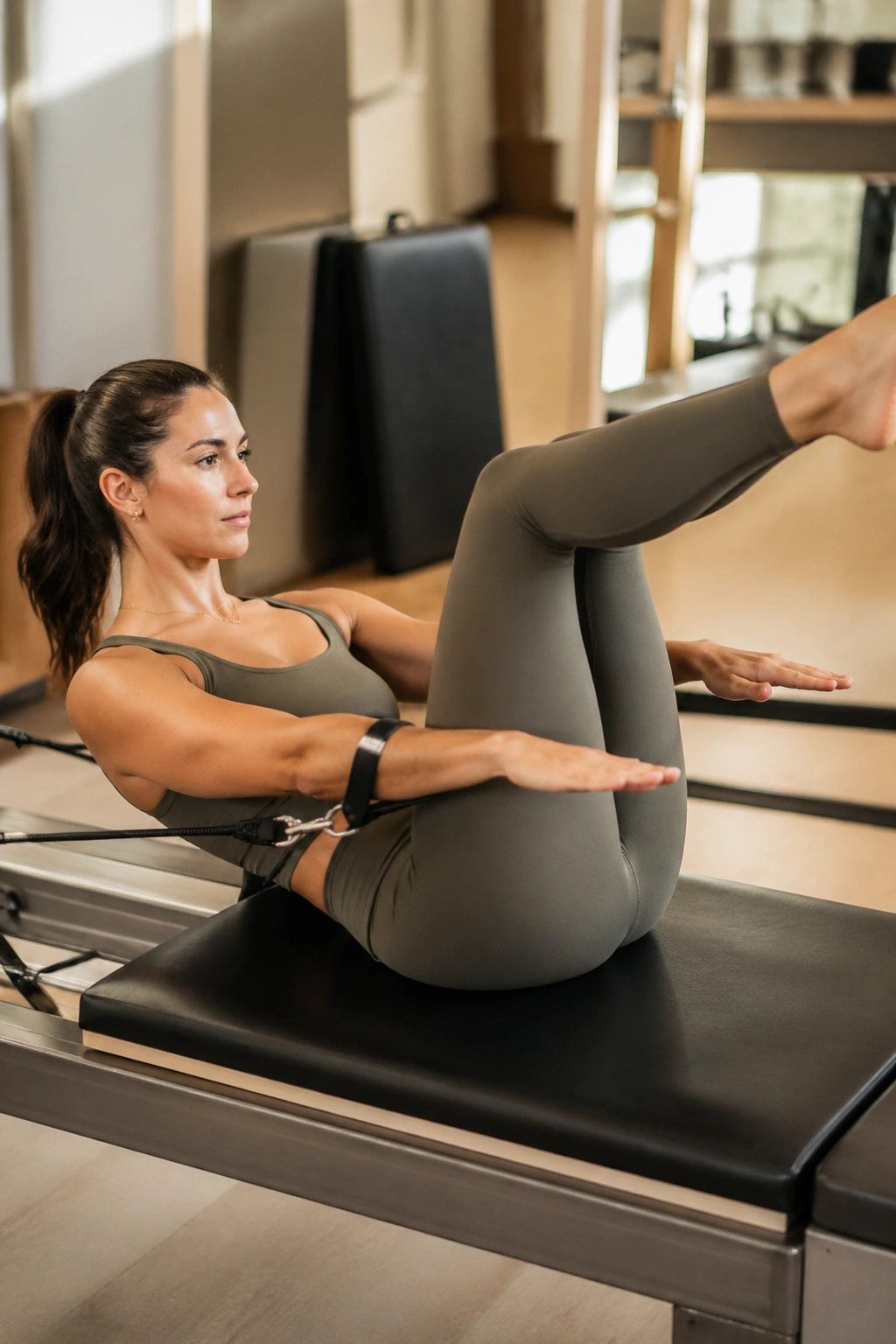
Why does a move with arm pumps and breath count leave people shaking so fast?
Because the Hundred asks your abs to brace while your arms keep moving against spring tension, and that combination gets spicy in a hurry. On the reformer, you’ll usually lie on your back holding the straps, curl your head and chest up, float the legs to tabletop or extend them on a diagonal, then pump the arms while breathing in for five counts and out for five counts until you reach 100 pumps.
The spring should be light enough that your shoulders stay broad and your neck stays quiet. Too heavy, and you’ll shrug the straps instead of pumping from the back of the arms. Too light, and you may lose feedback. There’s a sweet spot there, and once you find it, you’ll know.
Leg position changes the difficulty fast. Bent knees are not a cop-out. They’re smart. Straight legs lower on the diagonal create a longer lever, which means more load on the trunk. If your low back bulges away from the carriage or your ribs pop up, bring the legs higher or bend them again.
One more thing. Keep the arm pumps small and sharp. Wild flapping doesn’t make the Hundred harder; it makes it messy.
3. Frog in Straps
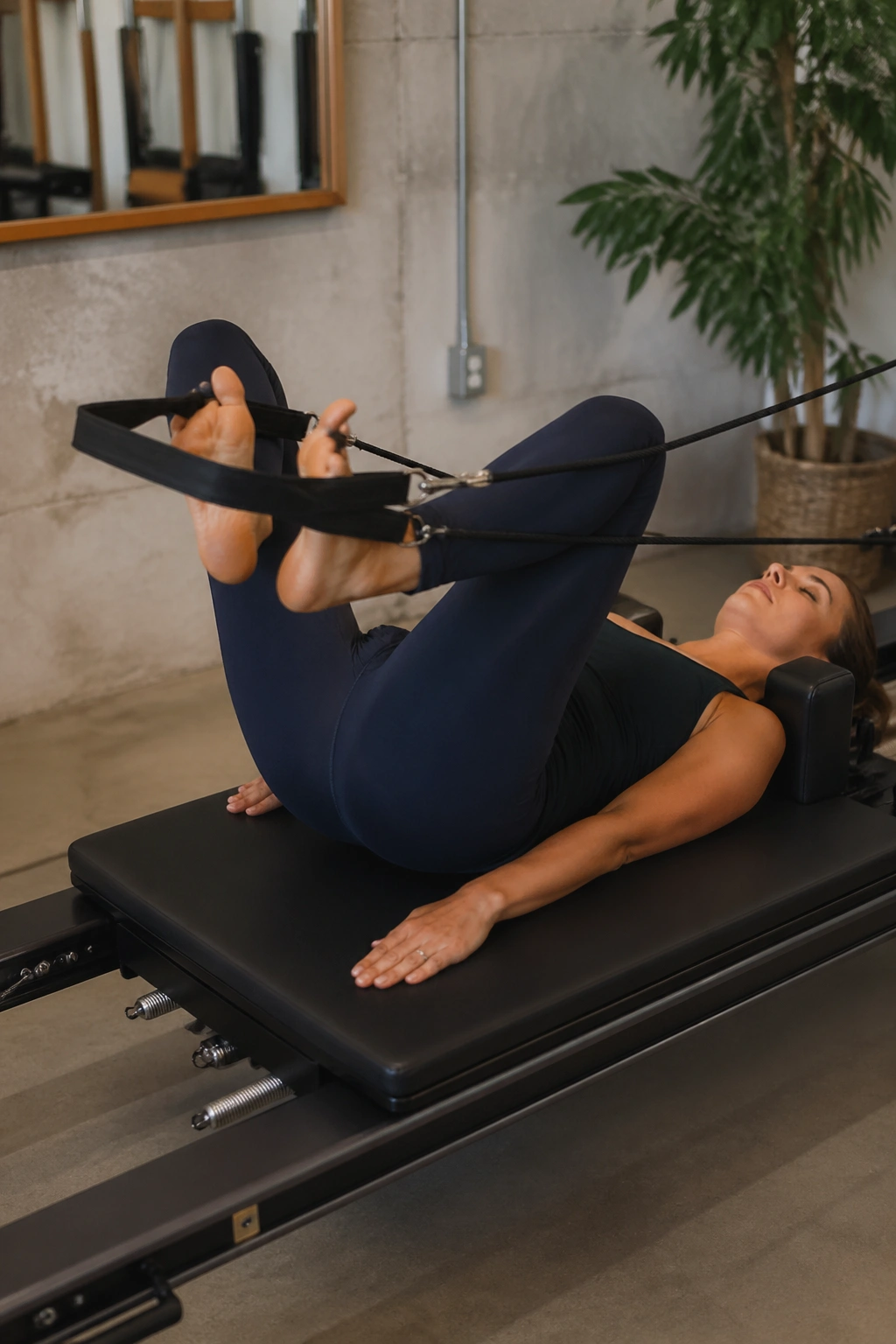
The first time Frog is done well, it surprises people. It looks soft. Then your inner thighs and low abs start talking.
Place both feet in the straps, heels together, toes apart, knees bent wide enough that you can keep the pelvis steady. From there, press the legs out on a diagonal, zip the inner thighs together, and bend back in with control. The temptation is to go huge. Don’t. A smaller, cleaner Frog is tougher than a loose one with extra range.
What to focus on
- Press out in one smooth line rather than kicking from the knees.
- Keep the sacrum heavy on the carriage.
- Think of narrowing the front of the hips as the legs extend.
- Use 8 to 12 reps, slow enough that the straps stay even.
This move earns its place because it trains adductors, hamstrings, and pelvic stability at once. If one strap goes slack before the other, that’s useful information. One side is usually taking over, and Frog is a polite way of exposing it.
Best cue: imagine you’re squeezing a sheet of paper between your heels the whole time.
4. Leg Circles in Straps
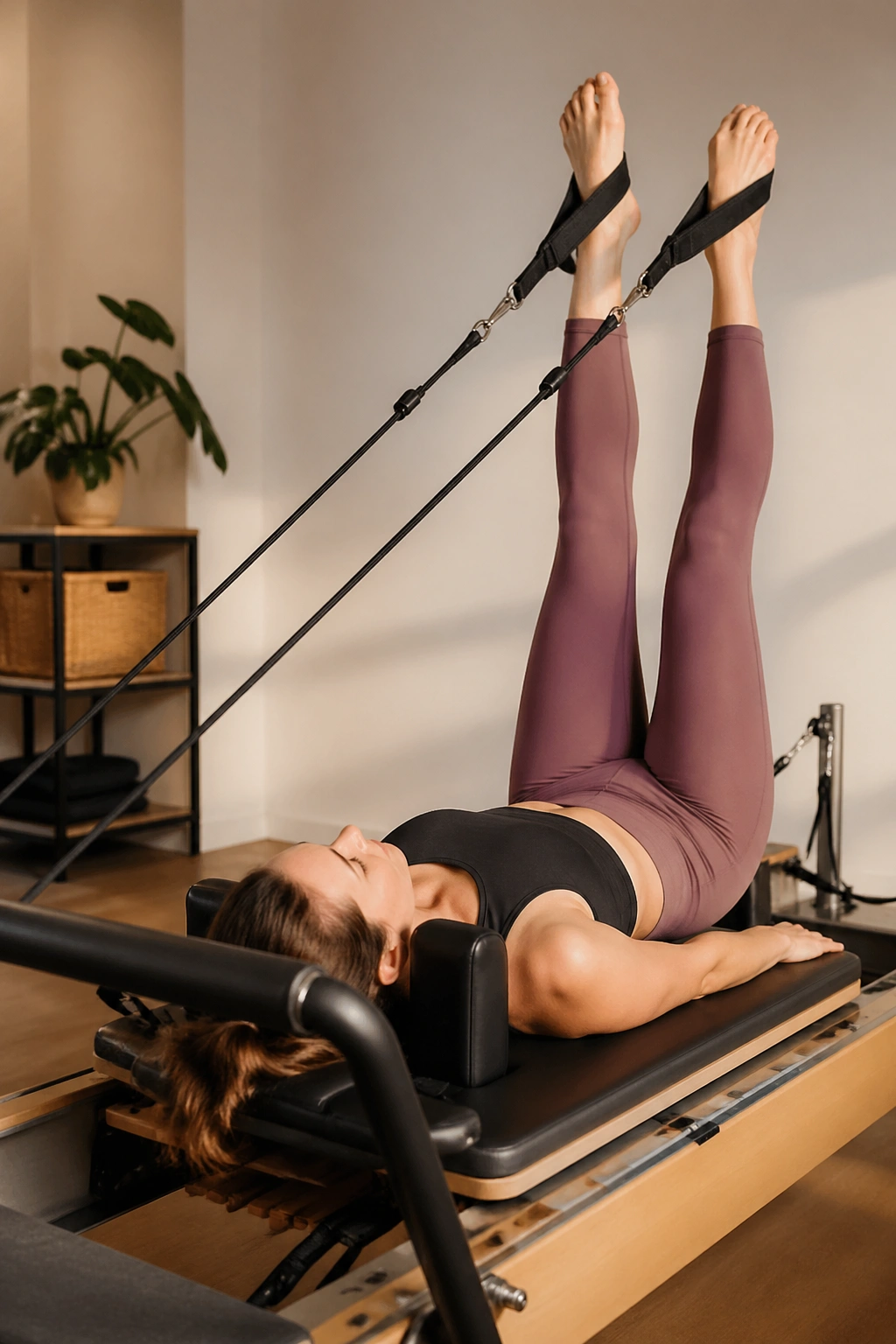
Unlike mat leg circles, reformer leg circles give you both resistance and feedback. The straps tell you right away when the hips start rocking, the knees soften, or one side grabs more than the other.
Set up in feet-in-straps with your legs extended toward the ceiling or slightly forward, depending on your hamstring length and the spring tension. Start the circles small. That part matters. Lower the legs a bit, open them only as wide as you can without shifting the pelvis, then sweep them around and back up. Reverse after 6 to 8 reps.
The trick is keeping the movement in the hip joints instead of letting the lower back join the party. If your tail starts tucking under or your ribs lift as the legs descend, the circle is too big. Pull it in. The burn should land in the lower abs, inner thighs, and outer hips, not in the front of your spine.
I like circles after Frog because the body is already warm and organized. The sequence also makes sense mechanically: Frog teaches the line of the legs, then circles ask you to keep that line while the limbs travel through space.
Small circles aren’t easier here. They’re cleaner, and cleaner is tougher.
5. Short Spine Massage
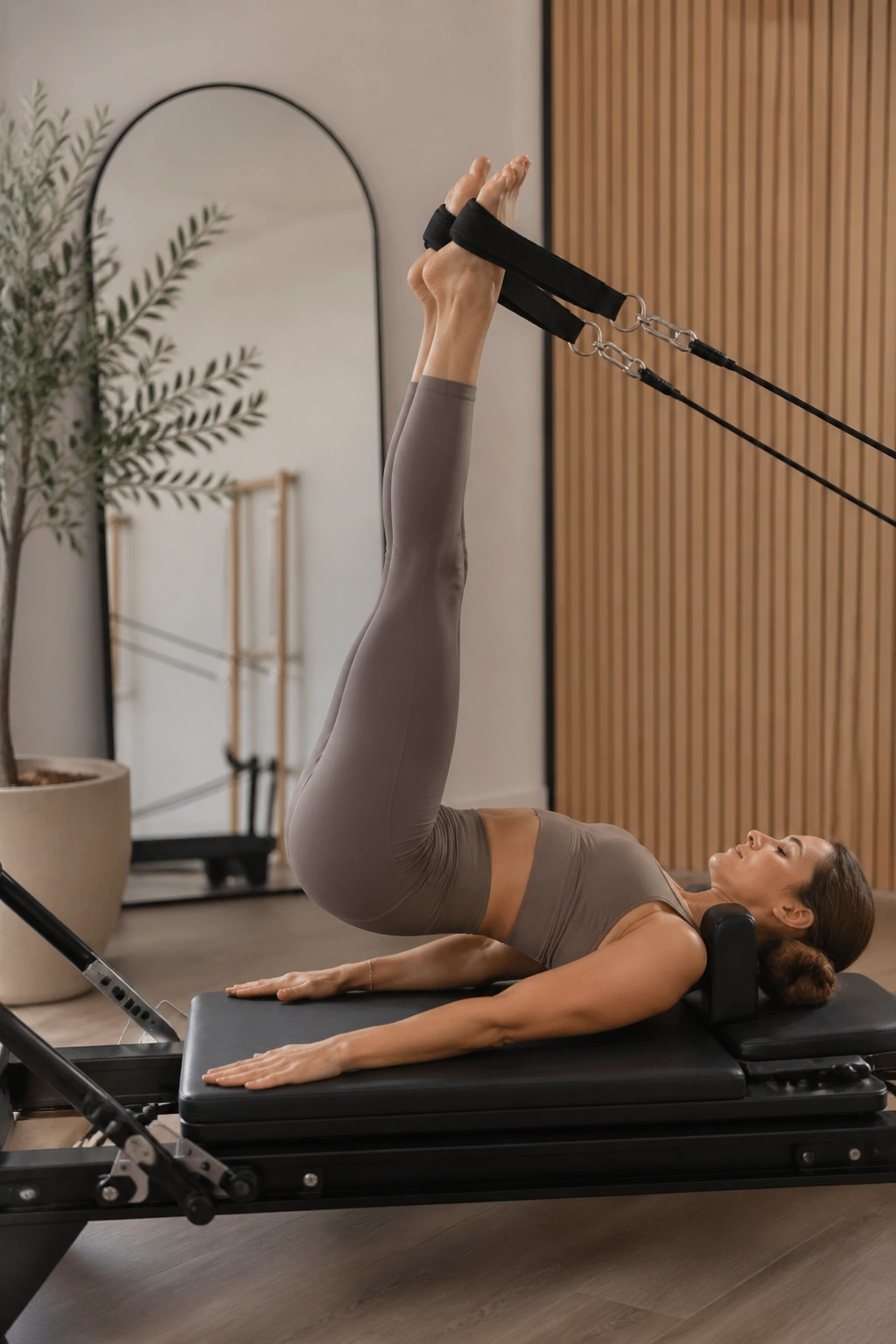
When Short Spine clicks, it feels smooth, almost floating. When it doesn’t, it turns into a scramble with straps.
This move blends hamstring work, spinal articulation, and control under spring tension. Start with feet in straps, legs extended on a diagonal. Press the legs down a little, fold the hips to bring the carriage in, roll the pelvis up off the carriage, bend the knees toward the shoulder blocks, then articulate back down through the spine before extending the legs out again.
Why it feels so good
The shape gives you traction through the lower body while asking the spine to move one segment at a time. People who spend long hours sitting often love that decompressed feeling—provided they are not jamming into the neck or shoving the hips overhead.
Use a light to medium spring load. Heavy springs can make the rollover portion clunky. Too light, though, and the straps may feel loose and unhelpful.
Where people rush
The descent.
That slow roll down is the whole point. If you drop from the ribs to the pelvis in one piece, you skip the hardest part and lose the massage effect. Picture the breastbone softening, then the upper back, then the middle back, then the sacrum settling last.
A few people should skip this move or get direct coaching first: anyone with neck trouble, osteoporosis, uncontrolled high blood pressure, or a back history that does not like loaded spinal flexion. There is no prize for forcing Short Spine on a bad day.
Quality marker: the straps stay even, the throat stays soft, and the carriage stays quiet.
6. Elephant
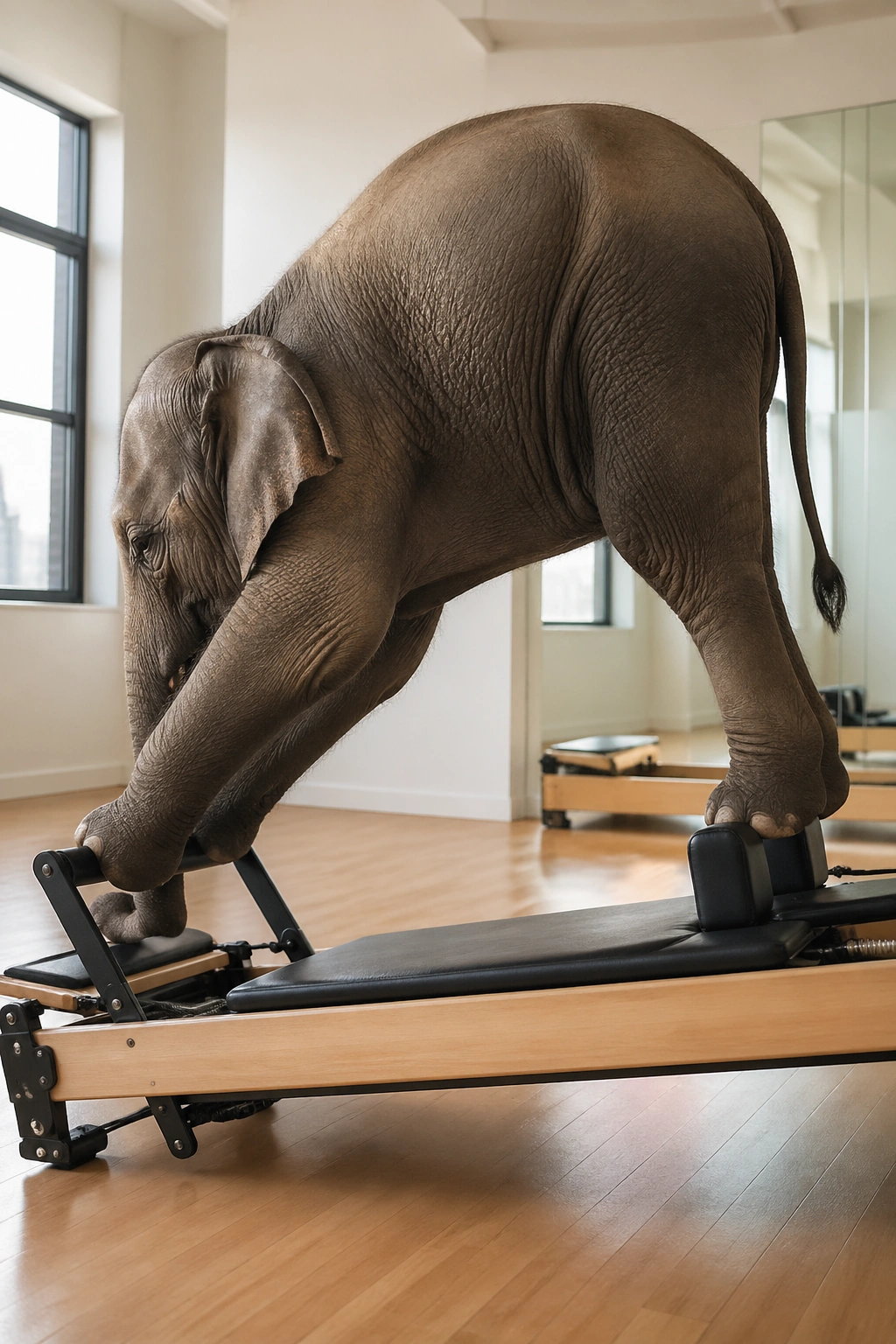
Small move. Brutal payoff.
Stand on the carriage with your hands on the footbar and your heels pressed against the shoulder blocks. Depending on the style you’ve learned, the spine may be rounded into a deep scoop or lengthened into a flatter hinge. Either version can work. What matters is that your hamstrings and abdominals pull the carriage in, not a bend-and-straighten of the knees.
Because the range is short, people often rush Elephant. Big mistake. Push the carriage out a few inches, maybe a foot, then exhale and draw it home by lifting through the low belly and dragging the heels down and back. You should feel the back of the legs almost immediately. By rep six or eight, that feeling often turns into a clean, sharp hamstring burn.
Wrist comfort matters here. If your wrists complain, try a different footbar height, use a fist or wedge if your studio allows it, or shorten the range. No need to grit your teeth through hand pain.
Elephant is also sneaky core training. The carriage wants to move because of the spring. Your trunk has to decide how much it moves and when. That’s why the exercise feels harder than it looks—and why it transfers so well to stronger plank work later in the session.
7. Long Stretch
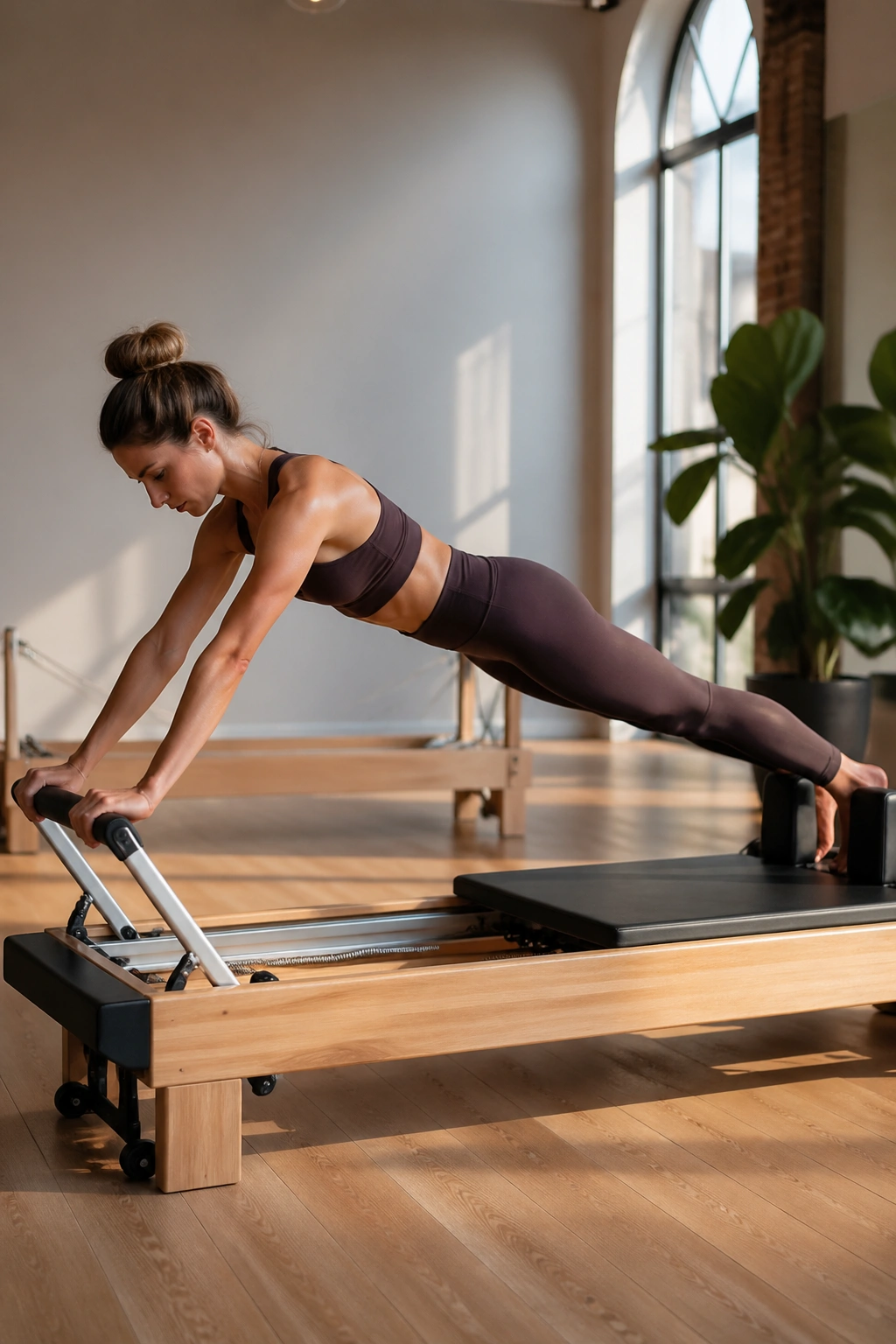
Say you took a solid plank, put it on a moving carriage, and asked your shoulders, lats, glutes, and abs to stay organized while the platform glides back and forth. That’s Long Stretch.
Hands go on the footbar, feet settle against the shoulder blocks, and the body forms one line from head to heels. From there, you push the carriage back by moving the whole body as one piece, then pull it forward without letting the shoulders dump or the lower back sag. One medium spring often works well, though the right load depends on the machine and the person.
What makes it harder than a floor plank
The floor never moves. The reformer does.
That means your serratus anterior, chest, lats, and trunk stabilizers all have to manage shifting force while you stay long through the back body. If your shoulder blades pinch together or your head drops, the move falls apart fast.
Cues that clean it up
- Push the bar away as you move, even though your hands stay on it.
- Keep the heels reaching back.
- Think “breastbone forward, ribs knitted.”
- Take 5 to 8 crisp reps. More than that often turns into survival mode.
Long Stretch is one of those moves that can humble strong people from other training backgrounds. Plenty of lifters can hold a plank. Fewer can hold one while a carriage slides under them.
8. Knee Stretches
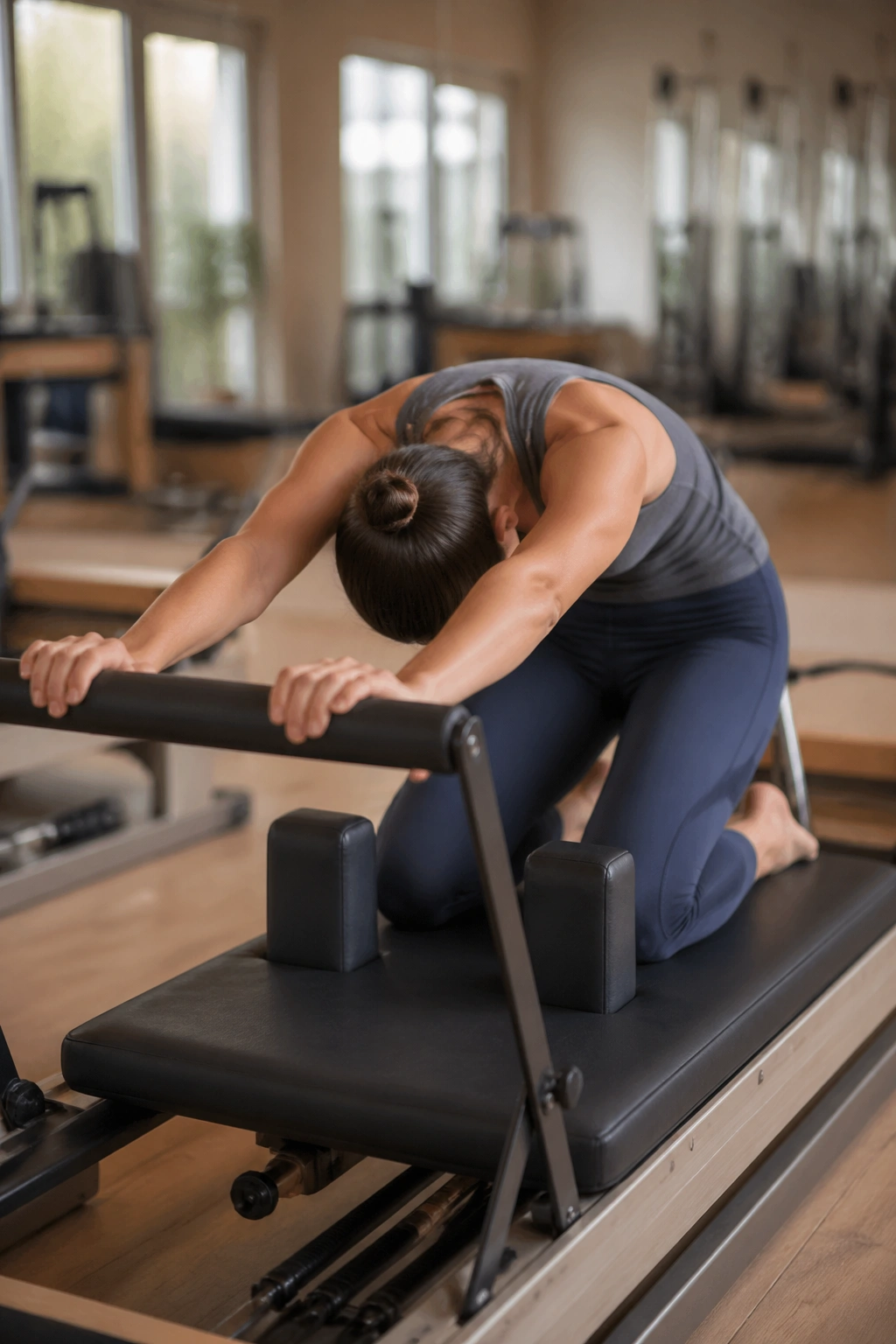
Your thighs will start negotiating during Knee Stretches. Ignore them.
Kneel on the carriage with your hands on the footbar and your feet tucked against the shoulder blocks. In the round-back version, scoop the abs deeply and hover the seat over the heels. Then pump the carriage back and in with small, quick strokes, keeping the trunk shape almost frozen. Flat-back and knees-off variations raise the demand even more.
This is one of the best examples of how reformer Pilates turns a small range into a huge training effect. The movement lives at the hip joint, but the burn spreads everywhere: quads, hip flexors, low abs, shoulders, and even the back of the arms once fatigue sets in. If your shoulders creep toward your ears, slow down. If the carriage bangs the stopper, slow down again.
A heavier spring often helps here because it gives you something to work against. Too light, and the carriage gets slippery. Too heavy, and you’ll lose the scooped trunk. There’s a middle ground where the rhythm feels sharp but controlled.
Round back first. Flat back next. Knees-off last, if it belongs in your body that day. That progression builds heat fast and doesn’t waste a minute.
9. Scooter
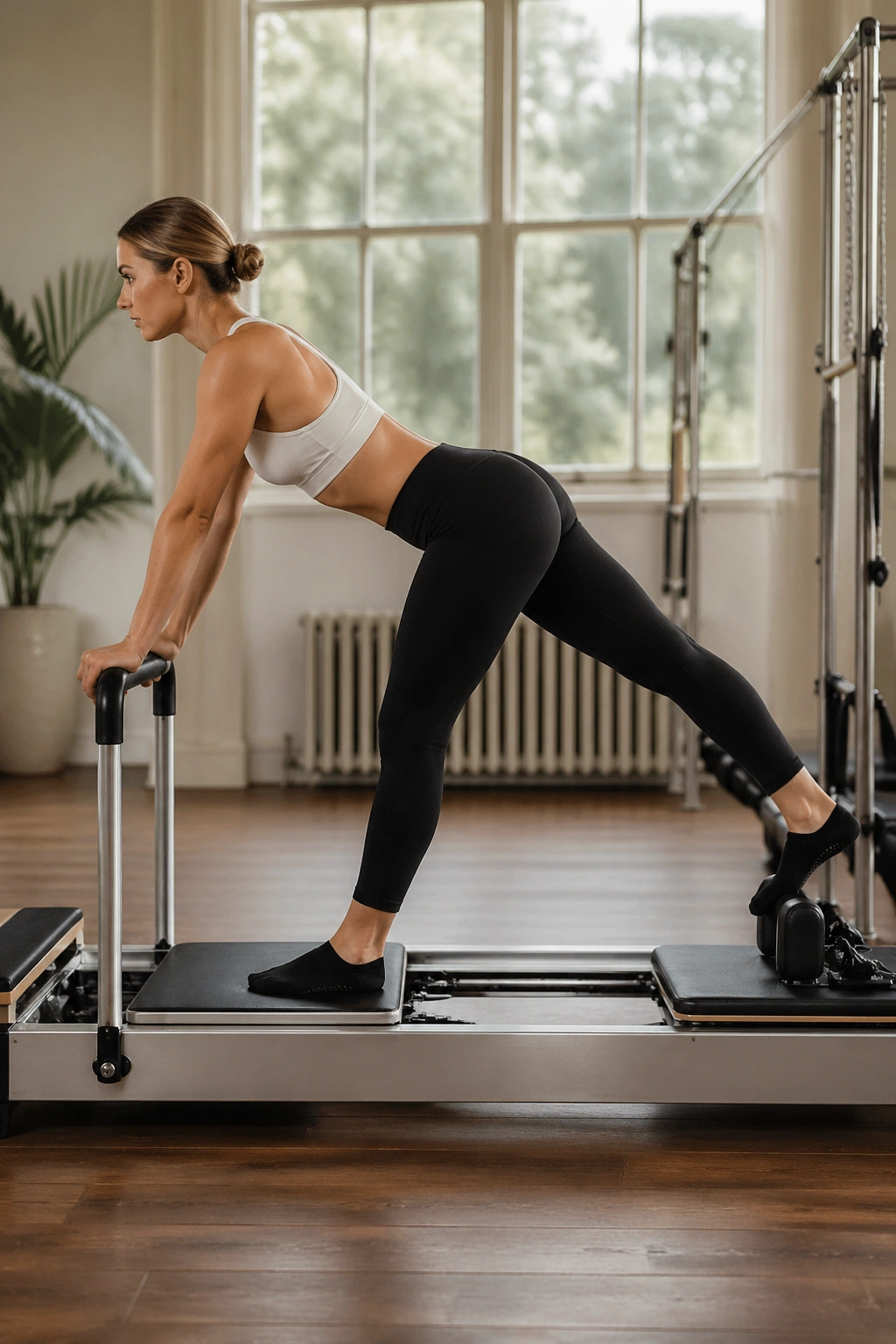
Need a unilateral move that lights up the standing hip? Scooter is the one.
Stand with one foot planted on the stable platform and the other foot on the carriage, usually with the ball of the moving foot pressing into the carriage near the shoulder block. Hinge slightly forward from the hips, keep your pelvis level, and press the carriage back with the moving leg while the standing leg does the hard stabilizing work.
Where the work should land
Most people expect to feel the moving leg. You will. The surprise is how much the standing glute medius and outer hip have to fire to stop the pelvis from dropping or swiveling. That’s what makes Scooter so useful for runners, walkers, and anyone who feels wobbly on one leg.
Use a light spring so the carriage can move without jerking. Then think of the standing leg as the anchor and the moving leg as the brushstroke.
Common mistake? Pushing from the toes and arching the lower back. Keep the spine long, ribs steady, and foot tripod grounded on the standing side. Six to 10 reps per leg is usually enough when you’re doing them well.
This move looks modest. Your side glute will disagree.
10. Side Splits
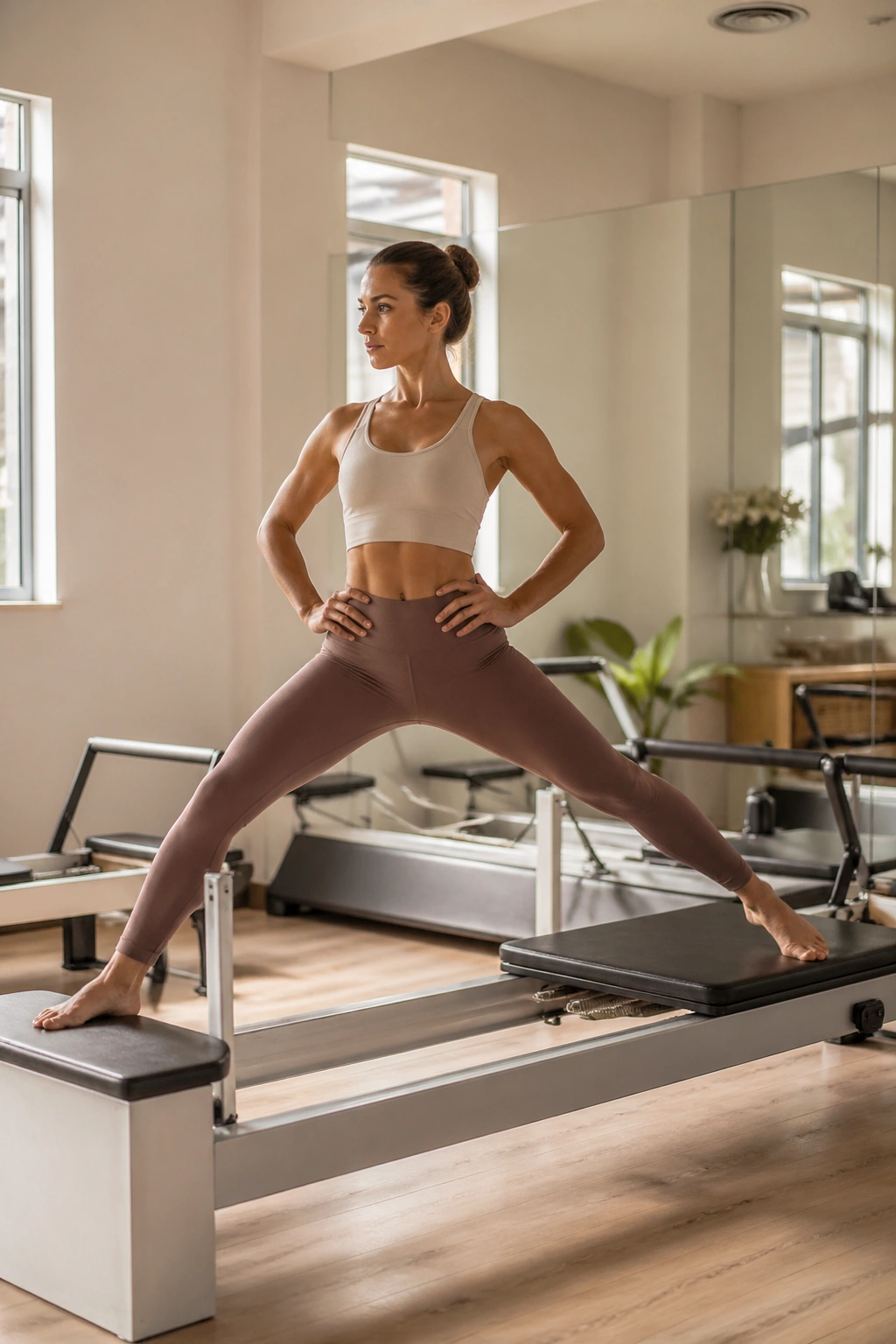
Side Splits are not a flexibility stunt. They are standing strength and control, and they can expose weak adductors faster than almost anything else on the reformer.
Stand sideways with one foot on the stable platform and one foot on the carriage. The feet can be parallel, and the hands may stay at your hips, out to the sides, or lightly on the footbar if you need support while learning. Press the carriage open only as far as you can keep both legs active, then pull it closed with the inner thighs and hips rather than falling inward.
Because the spring is usually light here, every inch matters. You cannot hide behind load. Your feet have to grip the ground in a smart way, your knees need to track cleanly, and your pelvis has to stay centered over both legs.
A few checks keep the move honest:
- Do not lock the knees back.
- Open only to the point where you still own the return.
- Keep weight spread through heel, base of big toe, and base of little toe.
- Start with 6 slow reps before chasing range.
The carriage drifting home too fast is the classic tell. Pull it in with intention. That return phase is where the adductors earn their keep.
11. Front Splits
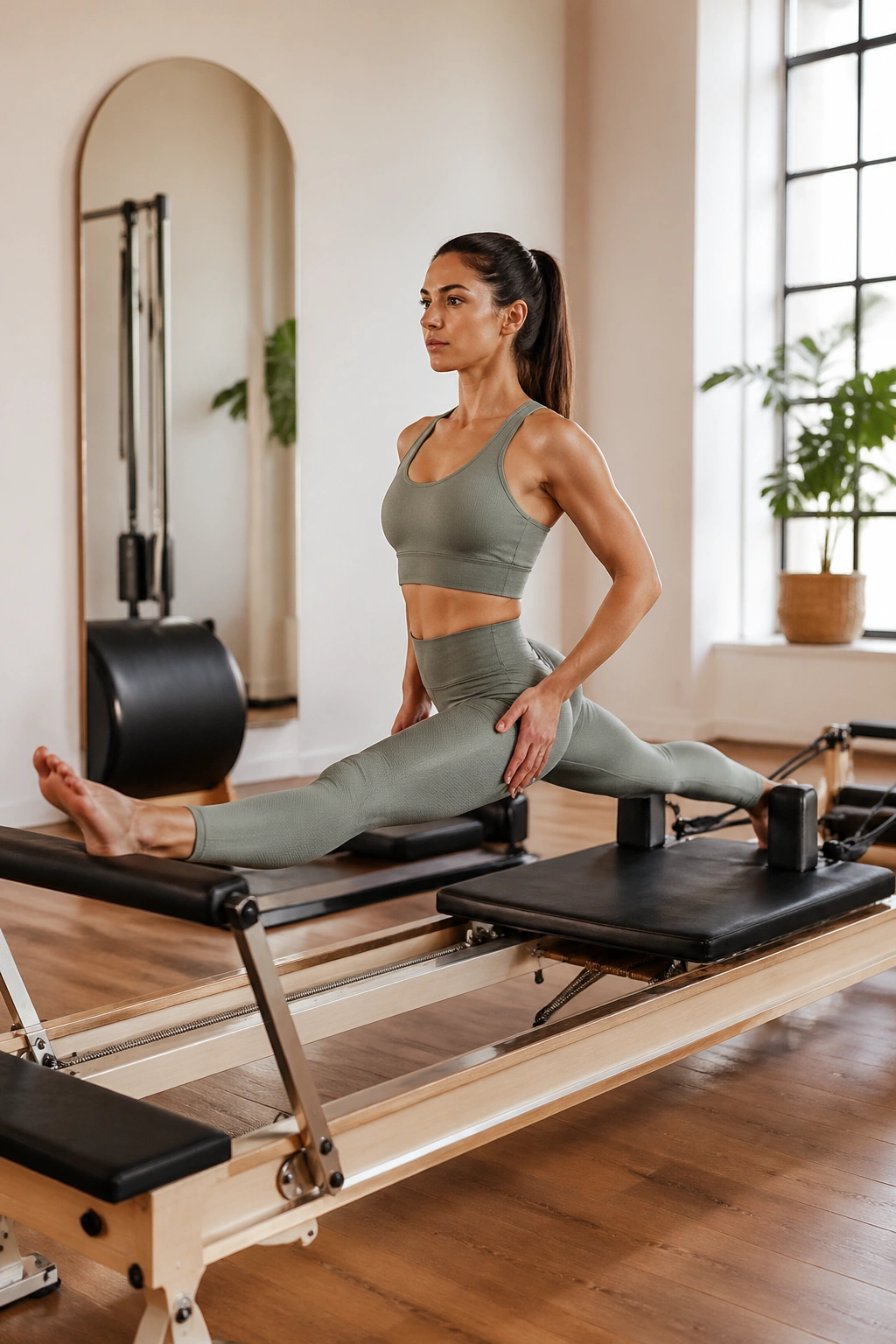
There’s a moment in Front Splits when the back leg reaches away, the front leg bends or straightens depending on the version, and your glutes have to decide whether they’re awake. If they are, the move feels powerful. If they are not, it turns into a hip-flexor complaint session.
One foot stands on the stable platform or footbar area, the other stands on the carriage against the shoulder block. From there, you glide the carriage back into a split-like stance and return with control. Some versions keep the trunk upright. Others hinge forward. Both can build heat in the legs and challenge balance.
I like Front Splits because it trains length under load. The front leg often gets a strong glute and hamstring demand, while the back leg opens through the hip flexor and thigh. Add the unstable carriage and your core has to stay online the whole time.
Short range is fine here. Better than fine, actually. Many people go too wide, lose pelvic control, and stop getting anything useful from the move. Keep the pelvis squared as much as your structure allows, let the spring support you rather than drag you, and take 5 to 8 steady reps each side.
If the knees feel cranky, narrow the stance and use the footbar or frame for help. No drama needed.
12. Rowing Front
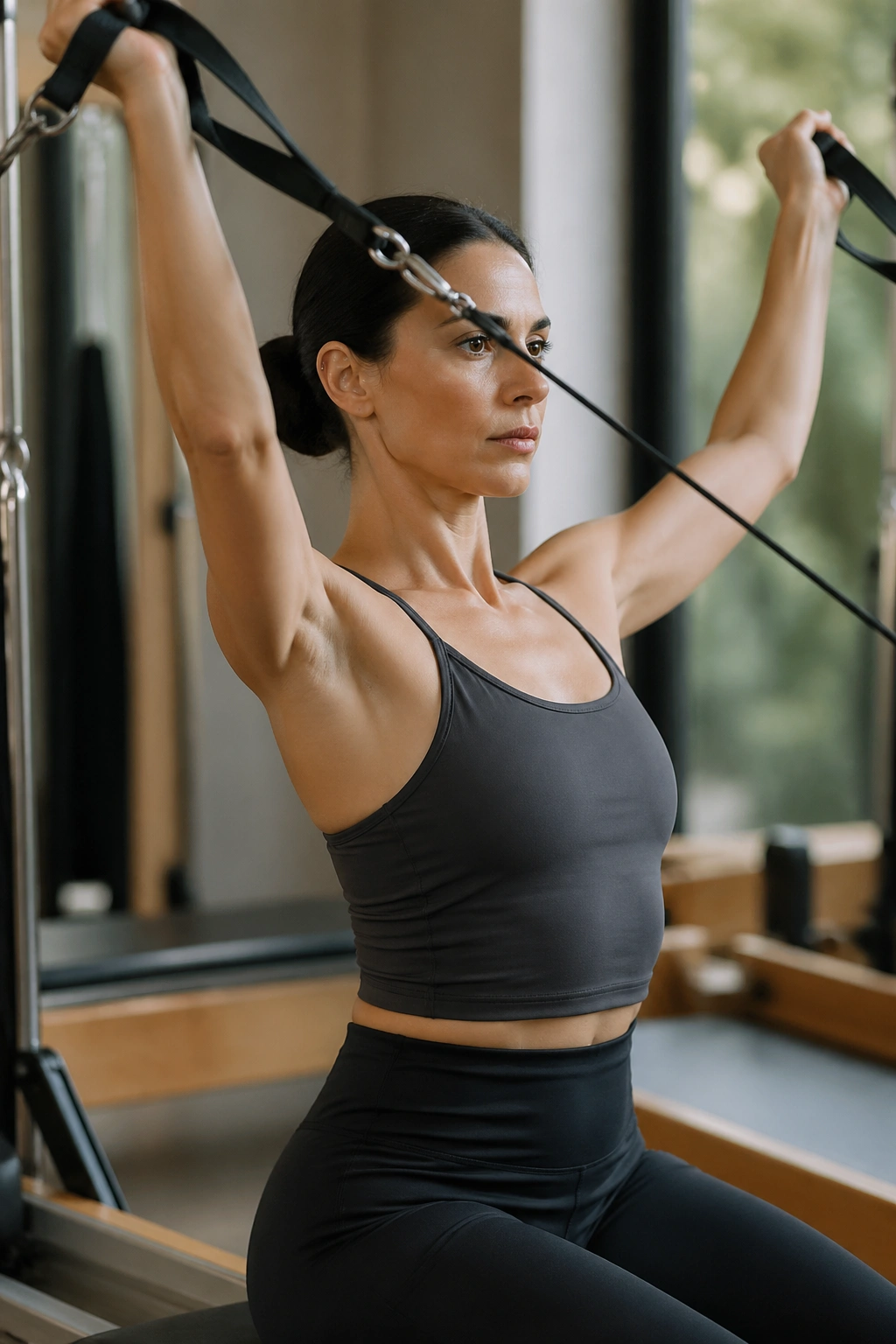
Three things happen in Rowing Front: spinal control, shoulder organization, and arm work. Miss one, and the exercise starts looking decorative instead of demanding.
Sit facing the back of the reformer with the straps in your hands. Depending on the version, you may begin tall or with a rounded spine and arms pulled toward the chest. Then you sequence through a curl or hinge, reach the arms forward, continue the arc overhead, and circle them around with control. Light springs are usually the right call. Heavy springs ruin the shape.
Why Rowing Front matters
A lot of people train pushing and pulling in a straight line. Rowing Front asks for something less common: control through a changing torso position while the arms travel through space. Your abs have to manage the ribcage, your upper back has to support the shoulder blades, and your triceps finish the job as the arms sweep long.
A clean rep looks like this
- The neck stays long.
- The shoulders stay low and wide.
- The ribs do not pop when the arms go overhead.
- The carriage stays quiet because the movement is organized, not rushed.
Take 6 to 8 reps and pay more attention to the shape than the size. If you feel lost, slow the sequence down and separate each phase. Rowing gets better once you stop trying to make it pretty.
13. Pulling Straps on the Long Box
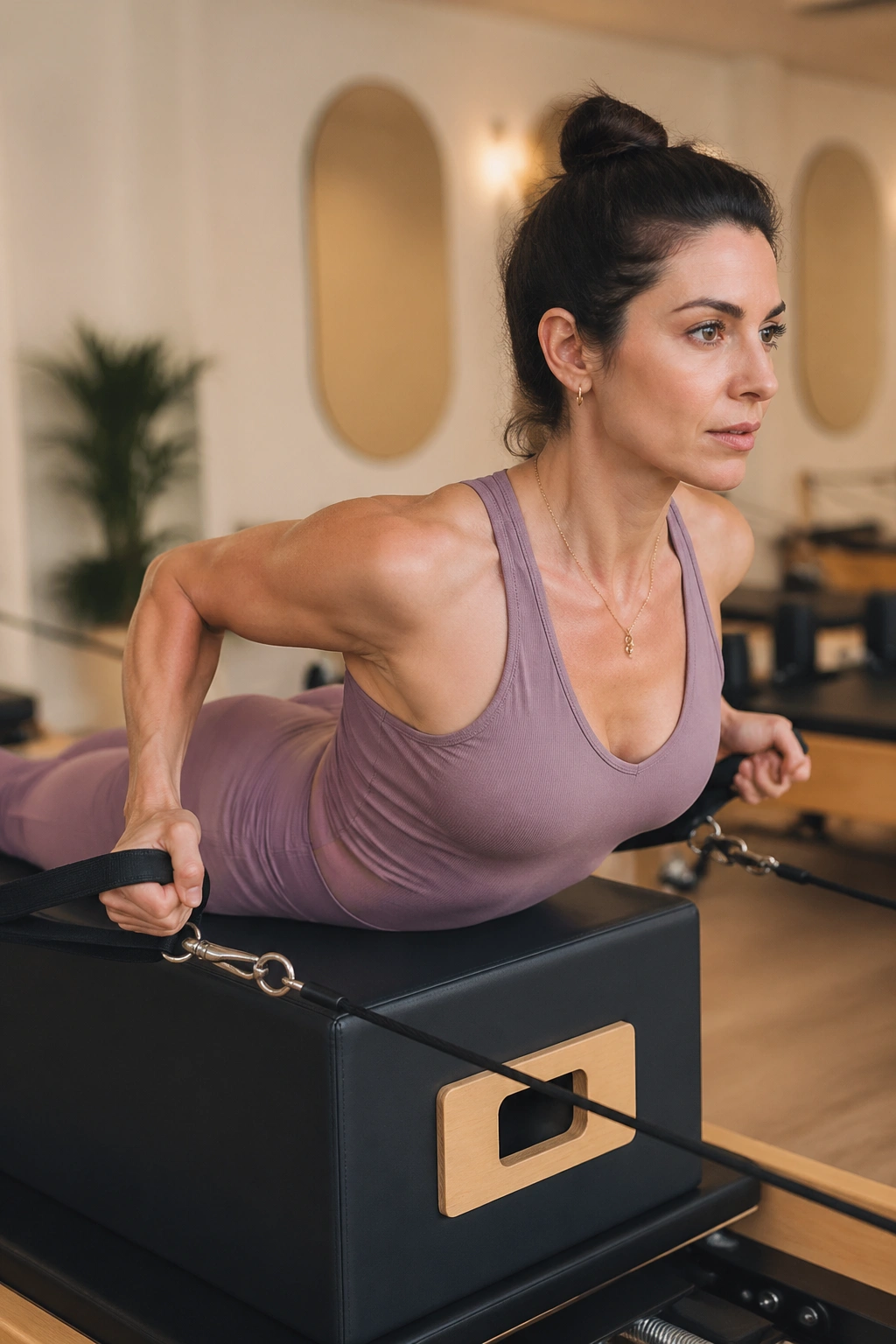
I have a soft spot for Pulling Straps because desk-bound bodies need it, and because it’s one of the clearest ways to train the back side of the body without brute force.
Lie prone on the long box facing the pulleys, chest near the front edge, legs long and active behind you. Hold the straps, let the arms start forward, then pull them back alongside your hips as the chest lifts into a gentle extension. The key word is gentle. You’re reaching long through the crown of the head, not cranking the chin up to the ceiling.
What makes the move work is the connection from the hands into the lats and lower trapezius. If you yank with the wrists or shrug the shoulders, you miss the point. Think of the collarbones widening as the arms sweep back. That cue often changes the whole exercise.
You’ll feel upper back, rear shoulders, triceps, glutes, and spinal extensors when it’s done well. Take 8 to 10 reps with a breathy pace—inhale to prepare, exhale to pull, inhale to return. There’s no rush.
One caution: if the box feels like it’s jamming into your ribs or pelvis, scoot your body a little until the support makes sense. Tiny setup changes matter a lot when you’re lying face-down on equipment.
14. Swan on the Reformer
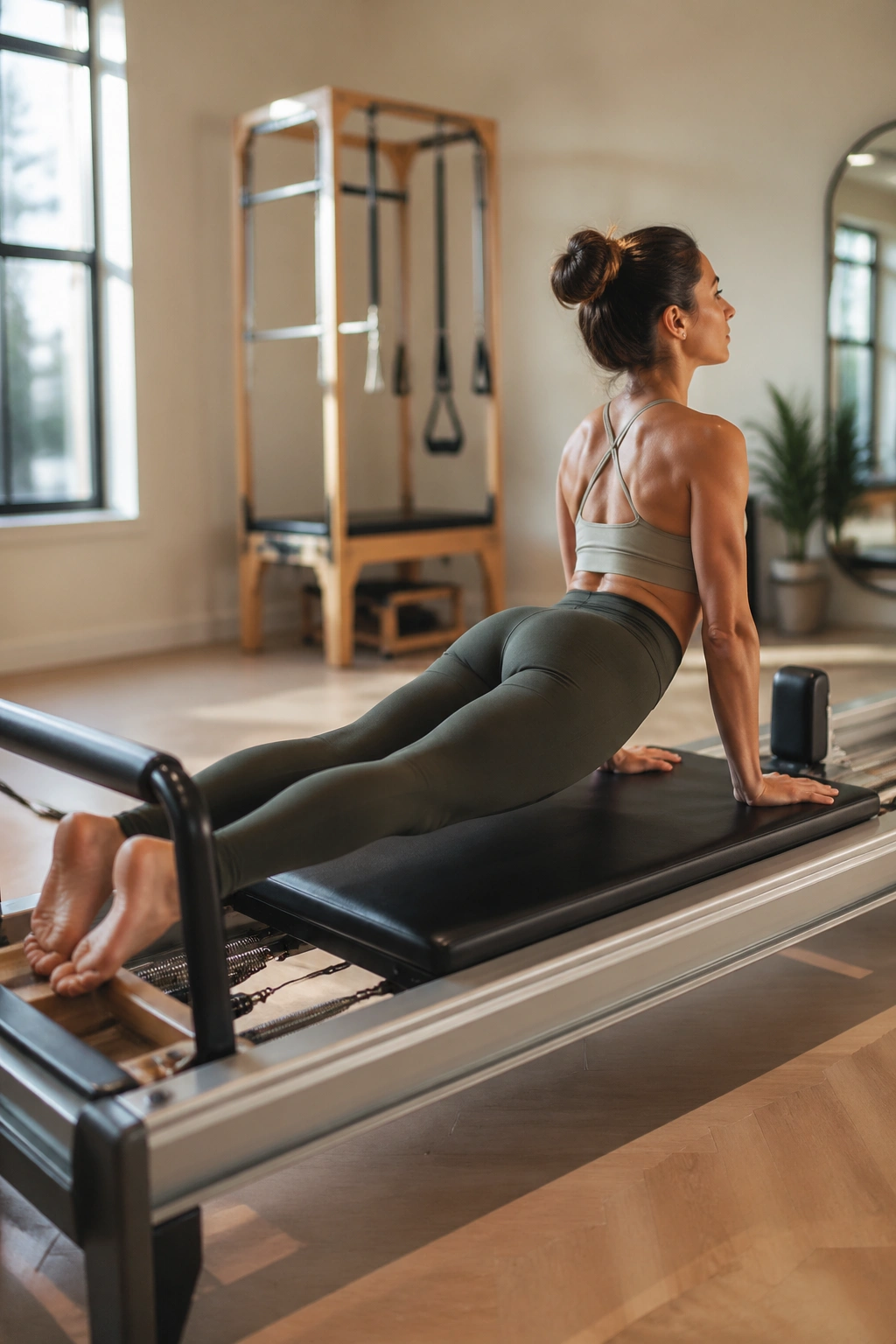
Back extension on the reformer gets a bad reputation because people throw themselves into it and blame the exercise. Swan is not the problem. Bad setup is.
On the reformer, Swan is often done on the long box with the hands on the footbar. You begin long through the legs, pubic bone anchored, shoulders away from the ears, then press the carriage and lift the spine into extension before returning with control. The sensation should be length first, lift second. If you start by crunching the lower back, you’re already off track.
What to feel
You want the work spread through the whole back body—glutes, hamstrings, mid-back, rear shoulders—not dumped into one angry spot above the waistband. Press the tops of the feet or the legs long behind you, widen the chest, and let the sternum travel forward as much as up.
Good Swan cues
- Keep the elbows soft at the beginning rather than locked.
- Think of your spine as a wave, not a hinge.
- Lift only to the height where you still feel your abs supporting you.
- Five controlled reps can be plenty.
This move has real value. It balances all the rounded, flexion-heavy work that shows up in life and in many Pilates sessions. You do not need a giant backbend to get that payoff.
15. Short Box Round Back
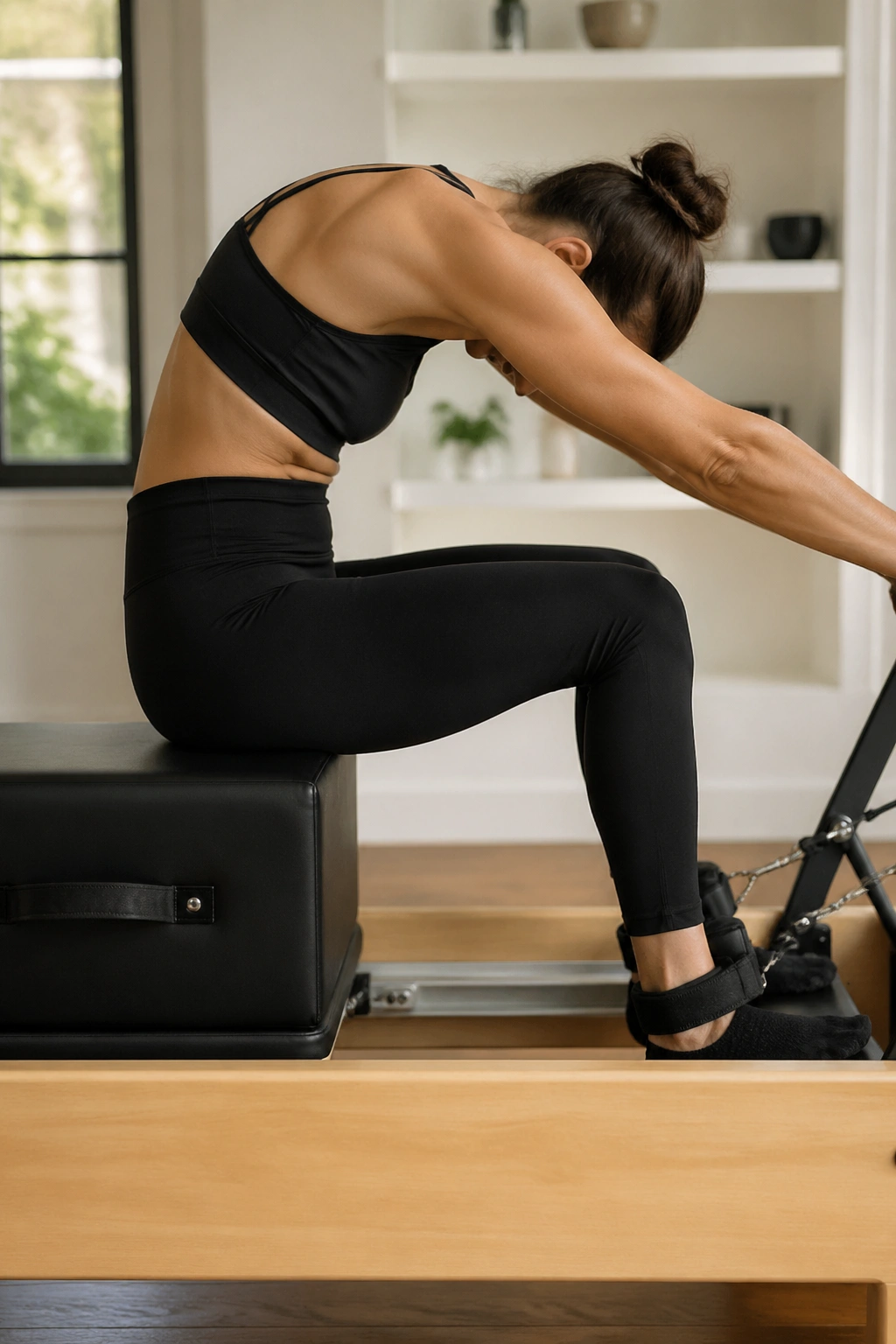
Round Back on the Short Box is one of the most honest core moves in Pilates. No straps in your hands. No carriage to blame. You either control your torso against gravity, or you don’t.
Sit on the short box with your feet anchored under the strap, arms wrapped around the waist or holding a pole depending on the version. Round the spine into a deep C-curve, hinge back as one long scoop without collapsing the chest, then return to upright by pulling the abdominal wall in and up. The pelvis and ribs have to cooperate here. If they separate, the move turns into a hip-flexor tug.
Tempo changes everything. Go back for a count of three, pause, then come up for three. That slower speed is where the shaking starts. And yes, it often starts early.
This exercise trains more than the front of the abs. Your deep core has to manage the relationship between ribcage, pelvis, and thighs while the feet stay anchored. Add a pole and you introduce shoulder stability too, because the arms have to stay quiet while the trunk moves.
If your hamstrings or hip flexors dominate, sit on a pad or bend the knees a touch if your setup allows it. Then work the shape you can control.
16. Tree on the Short Box
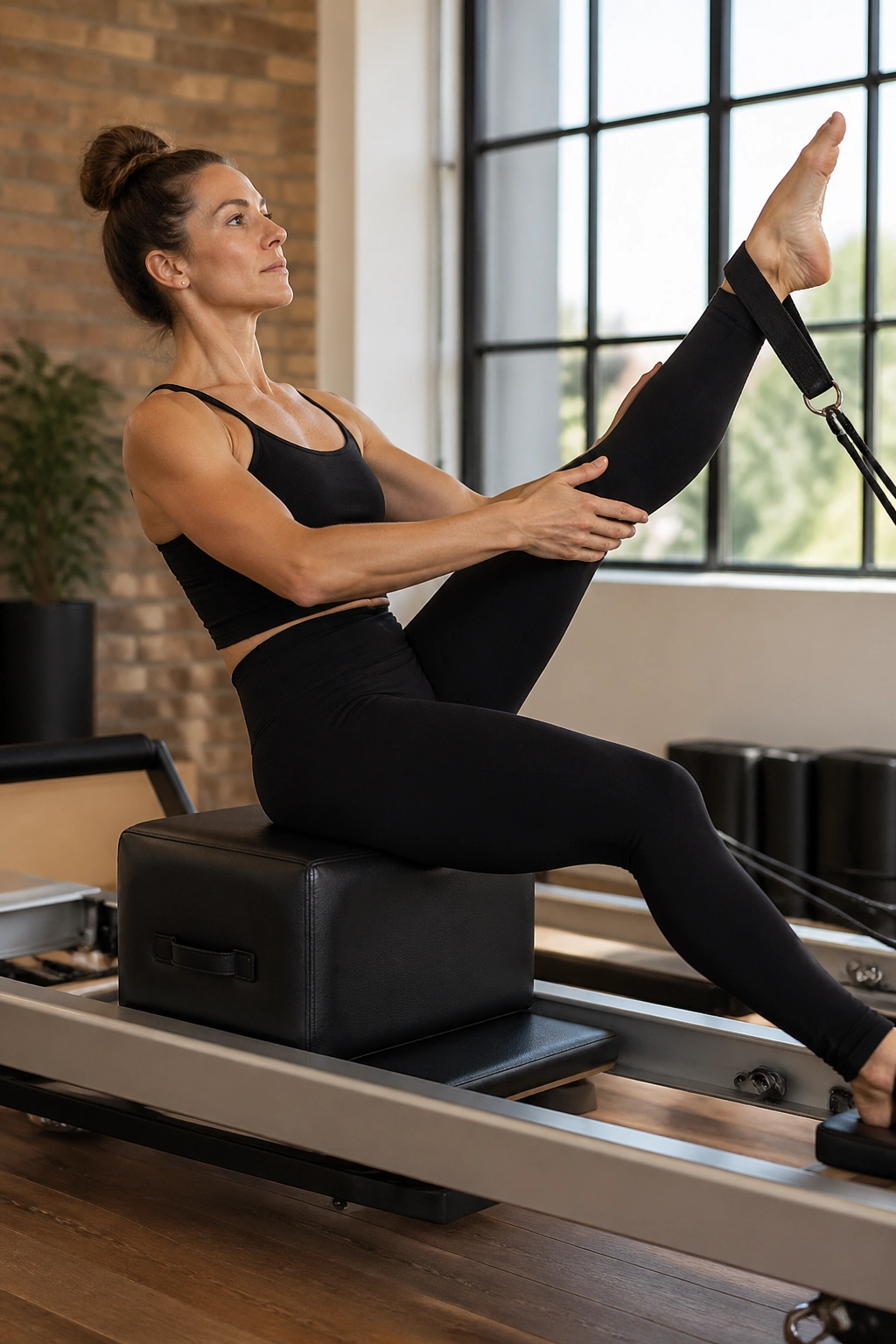
Tree looks part stretch, part balance drill, part ab exercise. That mash-up is exactly why it’s useful.
Sit tall on the short box with one foot under the strap and the other leg lifted. Hold behind the raised thigh or calf, extend the knee as much as you can without losing your posture, then walk your hands up the leg, roll back through the spine, and climb back up. The move asks for hamstring length, yes, but the bigger challenge is often keeping the pelvis steady while one leg tries to take over the whole show.
What makes Tree tougher than it looks
The lifted leg acts like a long lever. The farther it reaches, the more your trunk has to organize around it. If the shoulders tense or the standing foot yanks on the strap, you’ve gone past the range you own.
A few fixes help fast:
- Bend the lifted knee a little if the hamstring is screaming.
- Keep the supporting foot active under the strap instead of curling the toes.
- Roll down one section at a time rather than dropping back.
Tree is also a sneaky way to compare sides. One hip usually feels smoother, one hamstring shorter, one side of the waist slower to wake up. Useful information, not bad news.
Take 3 to 5 reps each side. Clean ones. That’s enough.
17. Teaser on the Reformer
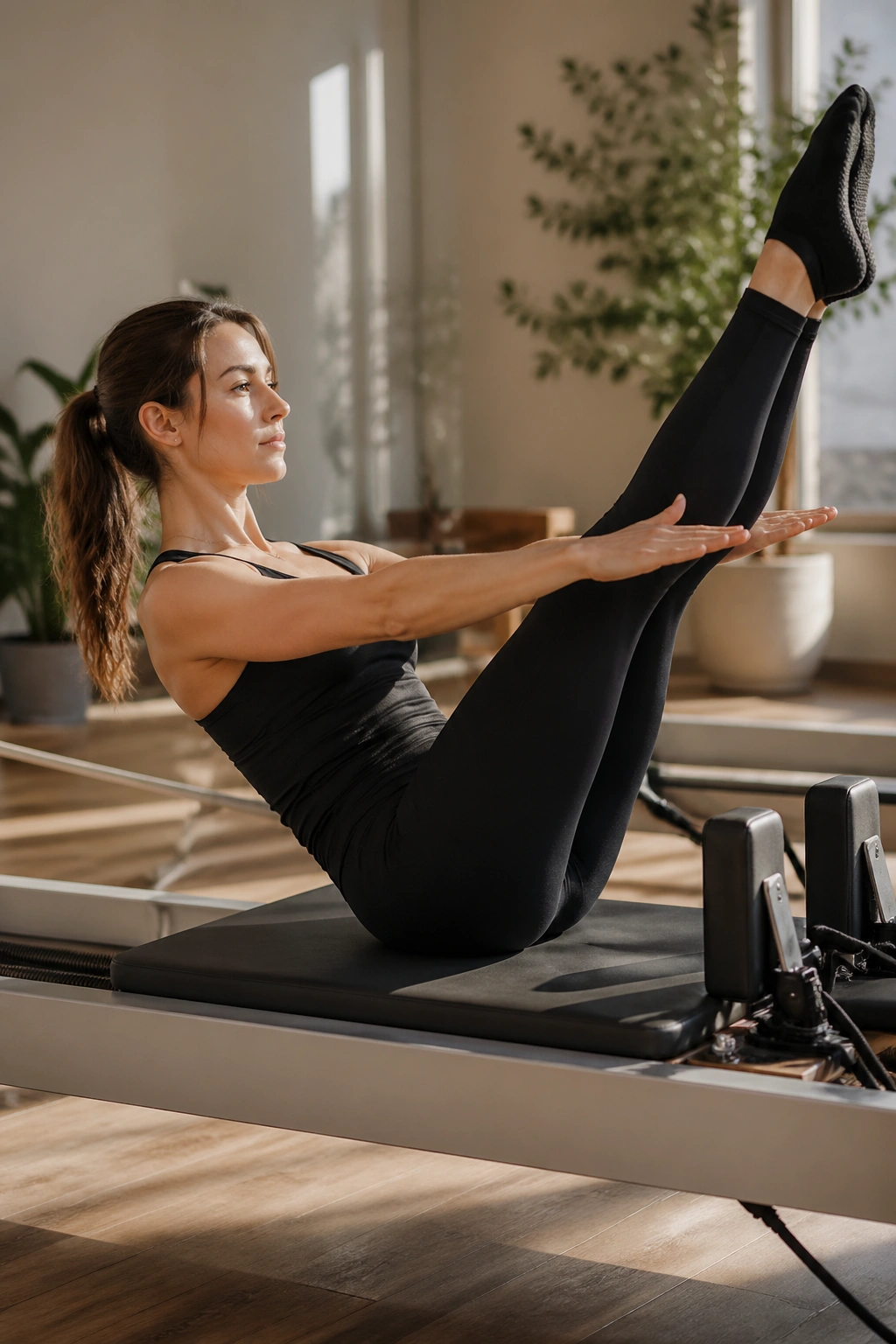
Teaser will expose every shortcut you’ve got.
On the reformer, that’s part of its charm and part of its cruelty. The moving carriage, the straps, or the box setup—depending on the version—make balance less forgiving than on the mat. If you throw yourself into the position, the machine will tell on you fast.
A solid Teaser starts with sequence, not ambition. Roll down with control, keep the legs connected to the center, then rise back up without yanking through the neck or hip flexors. Light springs often make the move harder because you have less support. That surprises people. More spring is not always more challenge on the reformer; sometimes less support means more work from the trunk.
Bent knees are fair game here too. I’d rather see a bent-knee Teaser with a smooth spine and steady carriage than a straight-leg version that turns into a leg throw. The point is not the shape on a poster. The point is control through transition.
If you’re coaching yourself through it, watch these signs: straps moving unevenly, shoulders hiking, feet drifting lower than your abs can support, or the carriage clunking. Any one of those means reduce the lever, slow the pace, or split the exercise into parts.
A good Teaser feels sharp, clean, and almost quiet. A bad one feels frantic.
18. Snake and Twist
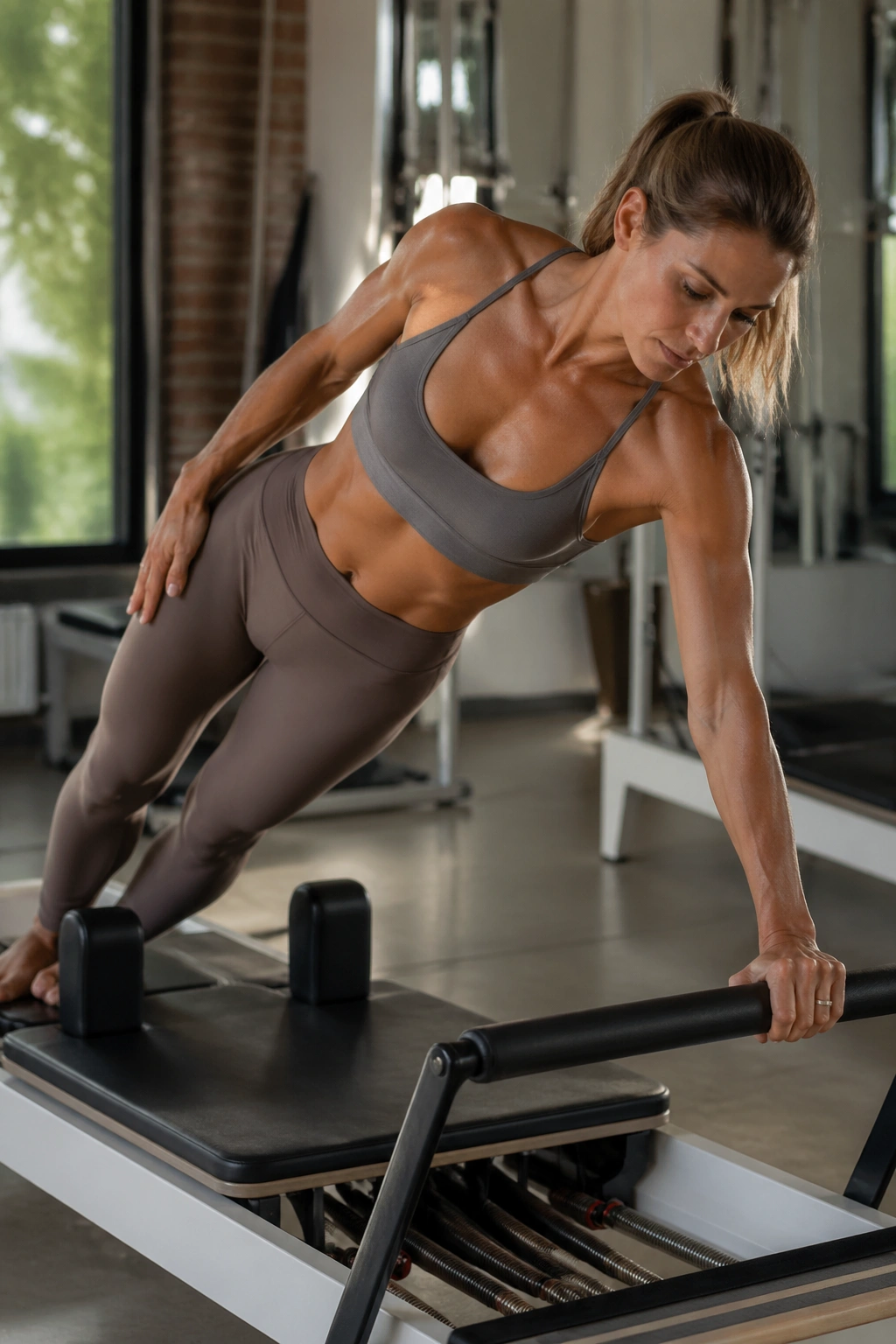
This is the spicy one.
Snake and Twist are advanced reformer moves that combine side-body strength, shoulder stability, spinal mobility, and carriage control in one demanding package. You set up in a side-plank-like position with one hand on the footbar and the feet braced near the shoulder blocks, then move the carriage while folding and rotating through the trunk before returning to the start.
There is no hiding in Snake. Your obliques, serratus, glutes, wrists, and shoulders all have jobs, and if one area checks out, the whole thing gets sketchy fast.
Who should use it
Save this move for the point where you already own Long Stretch, side plank variations, and spinal rotation without pain. If your wrists, shoulders, or lower back are touchy, skip it and use a side-plank series or Mermaid variation instead. That is not backing down. That is good judgment.
What makes it worth learning
- It trains integrated control, not isolated muscle action.
- The side body has to lift while the carriage moves underneath you.
- Rotation adds complexity without needing heavy springs.
- A few strong reps per side are plenty.
Think about lifting the waist away from the carriage before you even start moving. Then keep the shoulder packed and the neck long. Three to 5 reps each side can feel like a full set for the whole body.
Snake is one of those exercises that looks elegant from across the room and feels like hard labor when you’re inside it.
How to Build a Reformer Pilates Workout for a Full Body Burn
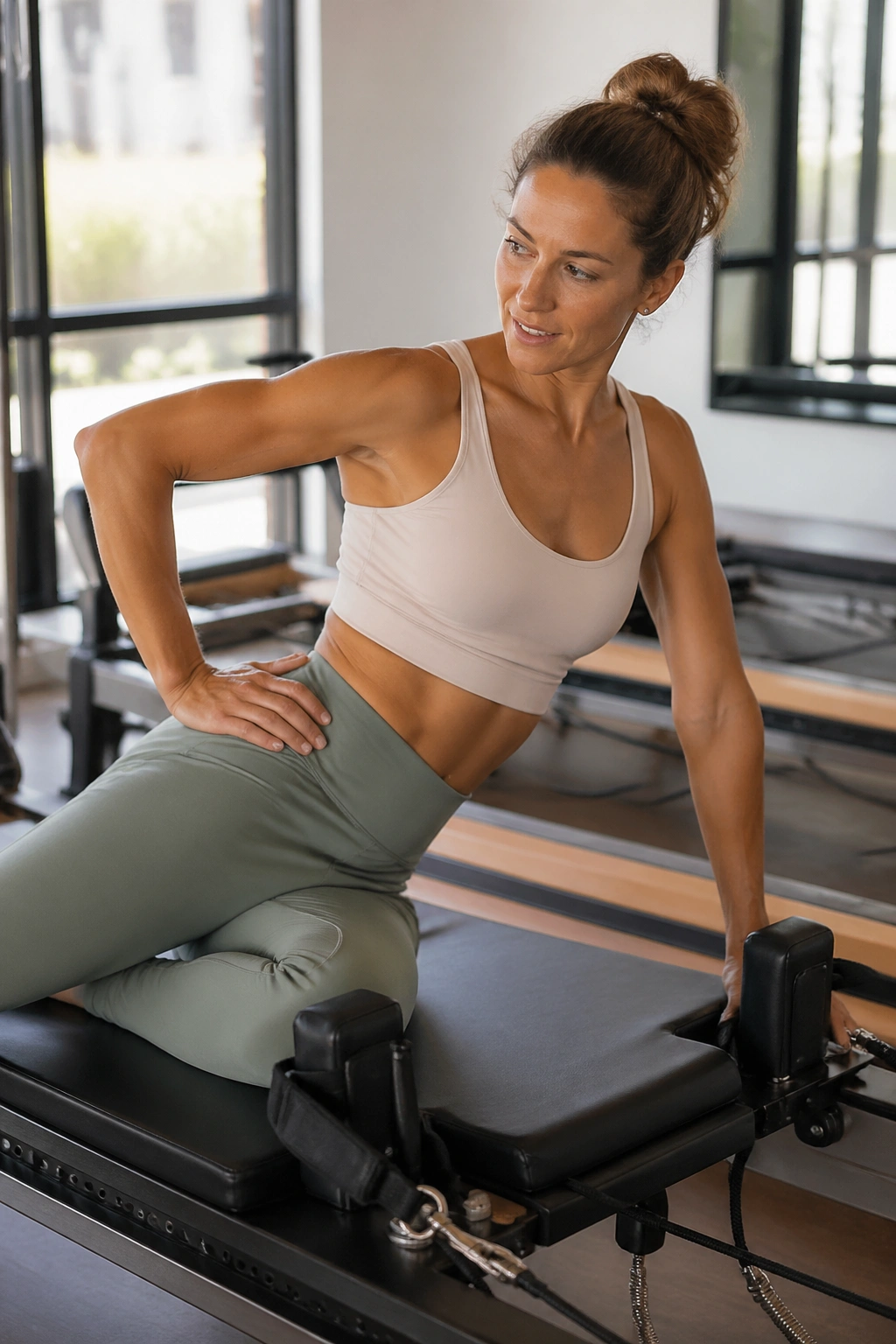
If you throw these moves together at random, the session can feel scattered. The reformer rewards good sequencing.
A smart flow usually starts with supine work to organize the pelvis and wake up the legs, moves into core and strap work, then shifts to kneeling or standing patterns before finishing with box work and a harder integrated move. That order lets you build heat without frying one area too early.
Here’s a session structure I like when I want balance and a lot of mileage from 45 to 60 minutes:
- Warm and organize: Footwork, The Hundred, Frog, Leg Circles
- Control the carriage: Short Spine, Elephant, Long Stretch, Knee Stretches
- Single-leg and standing strength: Scooter, Side Splits, Front Splits
- Upper body and extension: Rowing Front, Pulling Straps, Swan
- Deep core finisher: Short Box Round Back, Tree, Teaser
- Advanced closer if it fits: Snake and Twist
Rep ranges do not need to be huge. Six to 10 reps per move works well for most of these exercises, with fewer on the advanced pieces. What matters is keeping one or two clean reps in reserve instead of practicing the sloppy version after fatigue takes over.
You can also trim the list into a shorter burner. Pick one move from each category—legs, core, standing balance, pulling, extension, finisher—and you’ll still get a session that feels complete. The reformer does not need endless volume. It needs attention.
Final Thoughts
The best reformer sessions are not the ones with the fanciest choreography. They’re the ones where the springs, carriage, and body all line up, and every rep asks for strength on the way out and control on the way back.
If I had to underline two things, it would be these: slow down the return and pick the hardest version you can still do cleanly. Those two choices change almost every move on this list.
And if one of the advanced exercises is not there yet, good. That gives you somewhere to go. The reformer is honest equipment, which is a polite way of saying it never lets you fake the work for long.
