



Most people assume that building a pair of strong, powerful legs requires an expensive gym membership, heavy barbell racks, and a whole lot of wasted time waiting for squat stations. That is simply not true. If you have a single, decent-quality kettlebell, you already have everything you need to build significant lower body strength, stability, and muscle. The beauty of the kettlebell lies in its offset center of gravity. Unlike a dumbbell or a barbell, the weight sits away from your hand, which forces your muscles to stabilize in ways that standard weights simply cannot replicate.
This shift in mass changes the physics of every movement. It forces you to engage your core deeper, recruit more stabilizing muscles in your hips, and pay closer attention to your movement patterns. You cannot just mindlessly move weight from point A to point B. You have to control the bell. That level of focus is exactly what separates average results from the kind of structural development that makes you more athletic and durable in your daily life.
You do not need a massive garage gym to transform your lower body. You need a program that understands how to manipulate gravity, leverage, and time under tension. The following movements are the pillars of kettlebell leg training. Each one serves a distinct purpose, from building explosive power to correcting muscle imbalances that have likely been hiding for years.
1. The Kettlebell Goblet Squat
This is the non-negotiable foundation of any kettlebell program. When you hold a kettlebell against your chest, the weight acts as a counter-balance. It allows you to sit deeper into your squat while keeping your torso upright, which is a common struggle for people who have limited ankle mobility or a history of lower back pain.
Why It Works for Your Quads
The placement of the weight forces your center of gravity forward, meaning your quads have to work harder to keep you from falling. It is an excellent way to teach your body proper squat mechanics without the spinal compression that often comes with a heavy barbell on your back.
The Execution
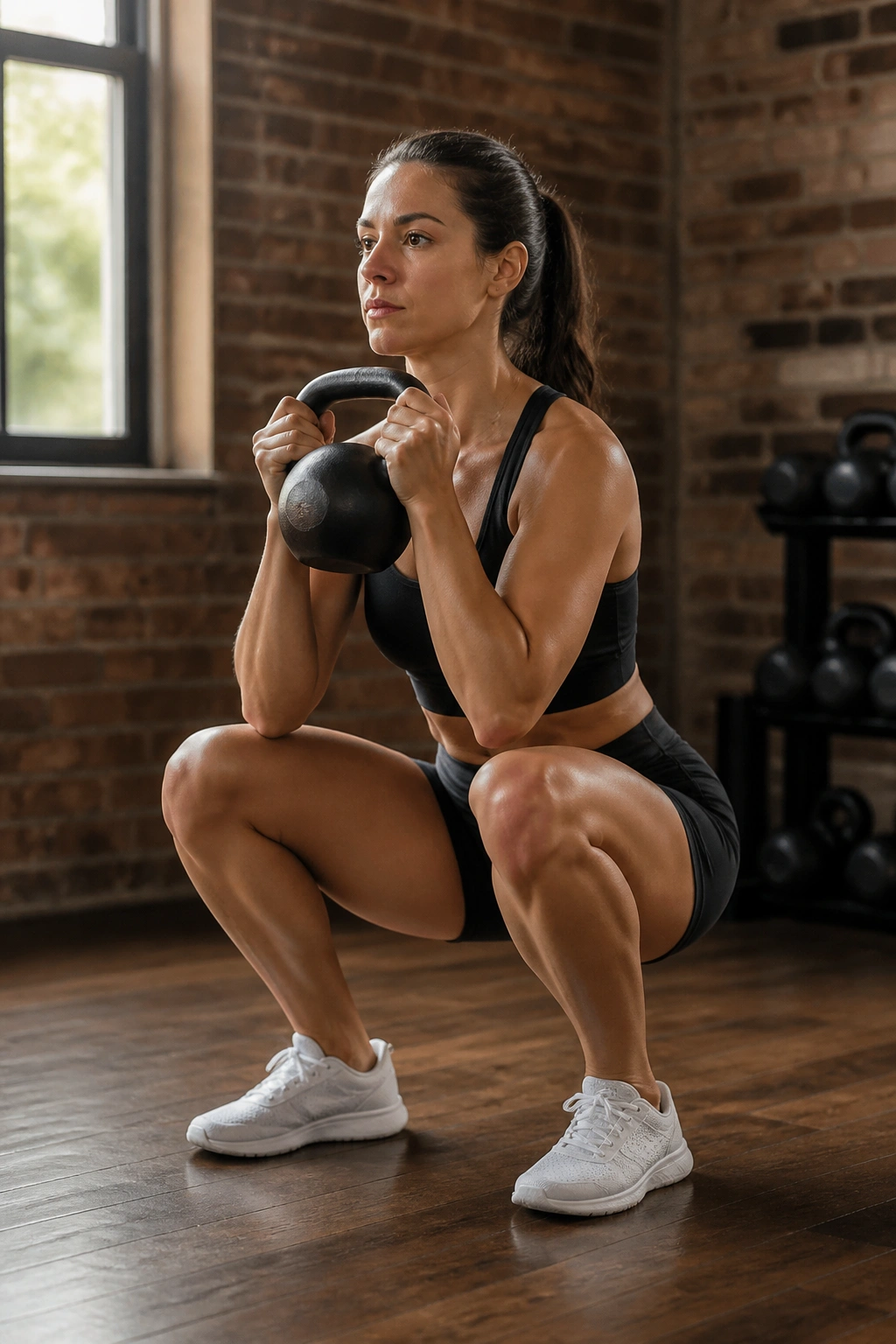
Hold the kettlebell by the horns (the side handles) close to your sternum. Stand with your feet slightly wider than shoulder-width apart, toes turned slightly out. Initiate the movement by pushing your hips back and down, as if you are trying to sit in a chair behind you. Keep your elbows tucked in; ideally, they should track inside your knees at the bottom of the movement. Drive through your mid-foot to stand back up, ensuring you squeeze your glutes at the top.
Pro tip: Do not let the kettlebell drift away from your chest. If it pulls forward, your spine will round, and you will lose the benefits of the exercise. Keep it glued to your body.
2. Kettlebell Romanian Deadlift
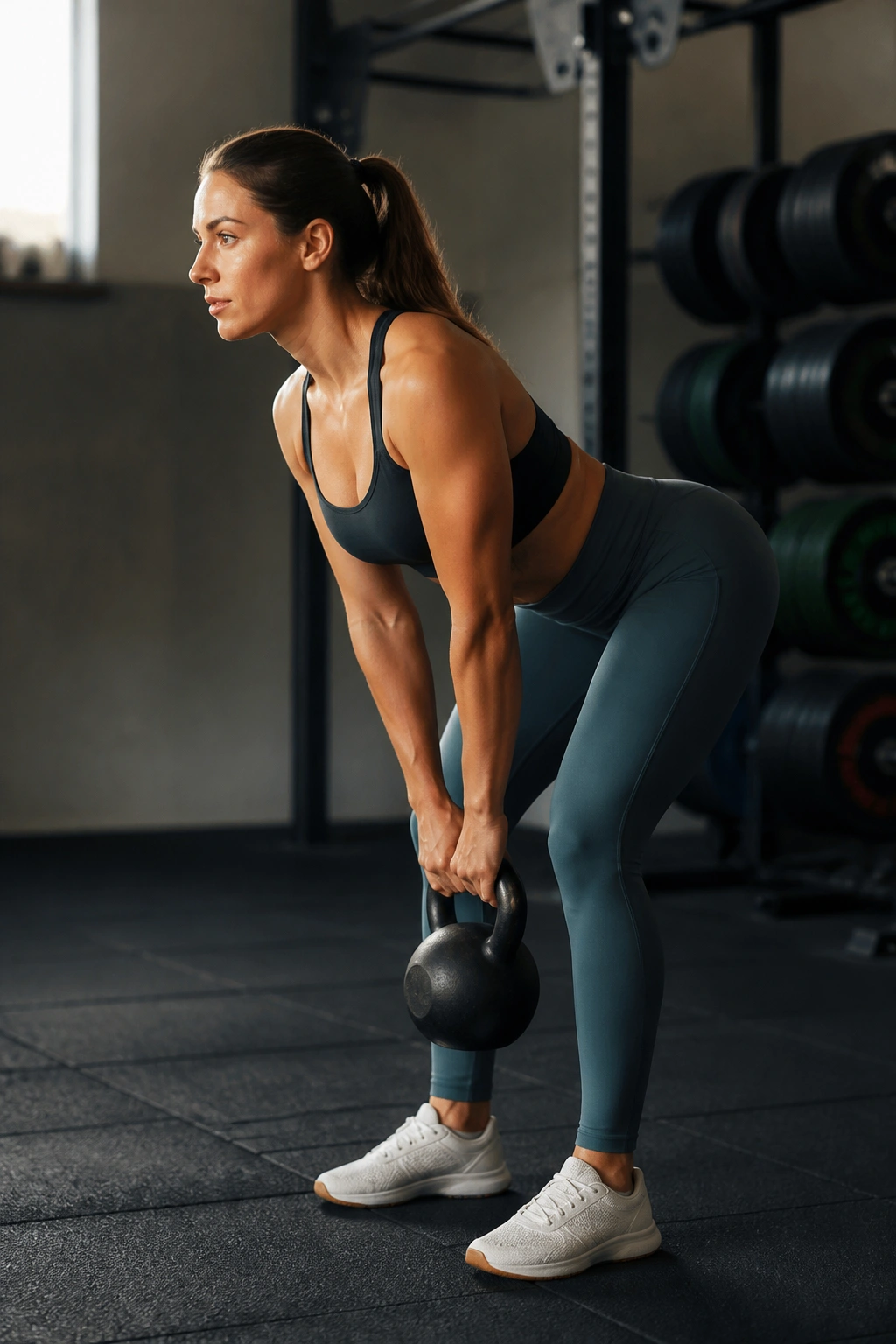
Most people think of deadlifts as a back exercise, but if you do them correctly, they are a masterclass in hamstring and glute development. The Romanian Deadlift (RDL) is about the hinge—the movement of the hips moving backward while keeping the shins vertical.
Mastering the Hinge
The key here is not how low the kettlebell goes, but how far back you can push your hips. Start with the bell held in both hands, arms straight. Soften your knees just enough to unlock them—do not squat. Hinge at your hips, sending them backward as if you are trying to touch your glutes to a wall behind you. You should feel a significant stretch in your hamstrings.
Common Mistakes to Avoid
- Rounding the back: This is a major no-go. Keep your spine neutral. If you cannot reach the floor without rounding, stop the movement just below your knees.
- Bending the knees too much: This turns the move into a squat. Your knees should stay mostly static once you have unlocked them.
- Lifting with the back: Your lower back should be doing nothing but holding your spine rigid. The movement is driven by your hamstrings and glutes pulling your torso back to the vertical position.
3. Kettlebell Reverse Lunge
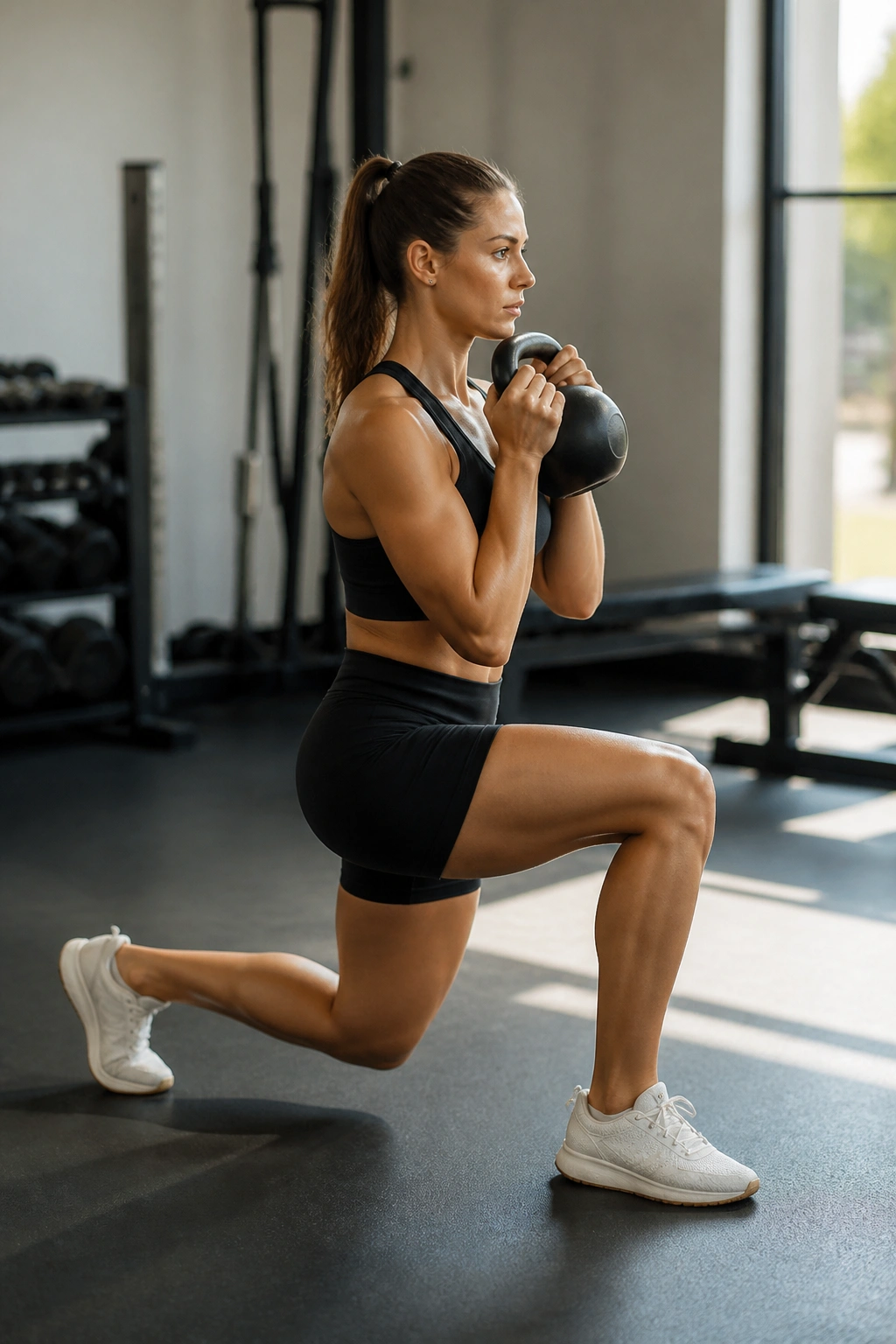
The reverse lunge is often superior to the forward lunge because it is easier on the knees and places a greater emphasis on the glute of the lead leg. When you step backward, your weight shifts naturally into the heel of the front foot, which creates a more stable, powerful base.
Why You Should Start Here
If you have ever felt sharp knee pain during forward lunges, switch to the reverse variation. The backward momentum allows you to maintain a vertical shin angle, which significantly reduces the shear force on the knee joint. This allows you to load the movement heavier with the kettlebell without risking injury.
Adding the Kettlebell
You can hold the kettlebell in three positions: a goblet hold (chest), a suitcase hold (in one hand at your side), or a racked position (one bell resting on your forearm). Each provides a different stimulus. Holding the bell in one hand (suitcase style) forces your core to work overtime to prevent your torso from twisting, adding an incredible stability component to an already effective leg builder.
4. Kettlebell Swing
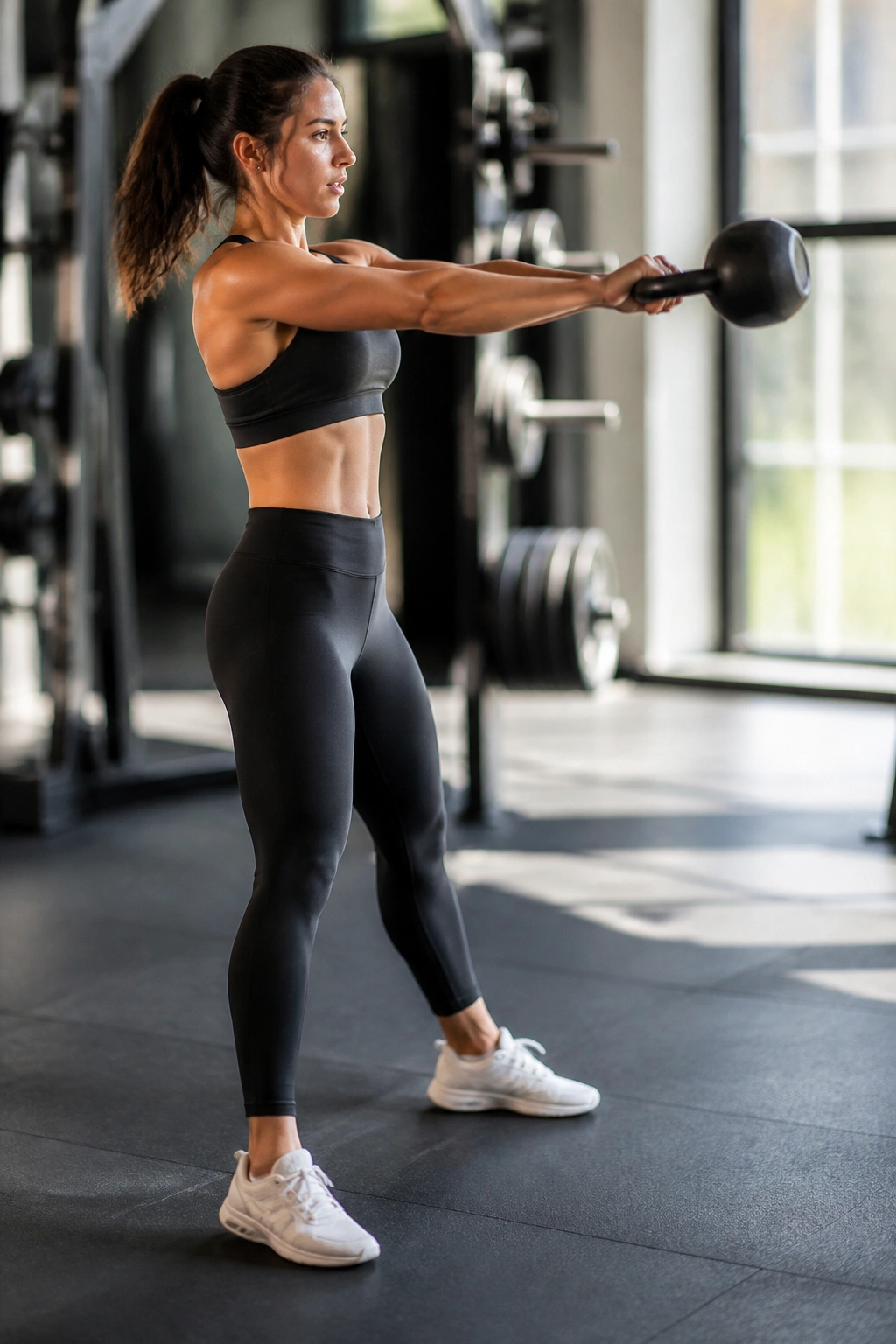
While often categorized as a conditioning tool, the kettlebell swing is a hinge-based movement that generates more posterior chain power than almost any other exercise. It is not a squat; it is a rapid, explosive hip extension.
The Physics of the Swing
The swing relies on the “pendulum” effect. You are not lifting the bell with your shoulders. You are using your hips to drive the bell forward. When you master the swing, you are essentially training your glutes and hamstrings to snap with force. That “snap” translates directly to better speed and strength in your deadlift, squat, and running gait.
Key Cues
- Hike it: Start the swing by hiking the bell back between your legs, like a football center.
- Snap the hips: Thrust your hips forward with intention. Imagine you are jumping, but your feet never leave the ground.
- Brace the core: Your abs should be rock hard at the top of the swing to stop the bell from pulling you over.
- Arms are ropes: Keep them loose. They are only there to hold onto the handle.
5. Kettlebell Sumo Squat
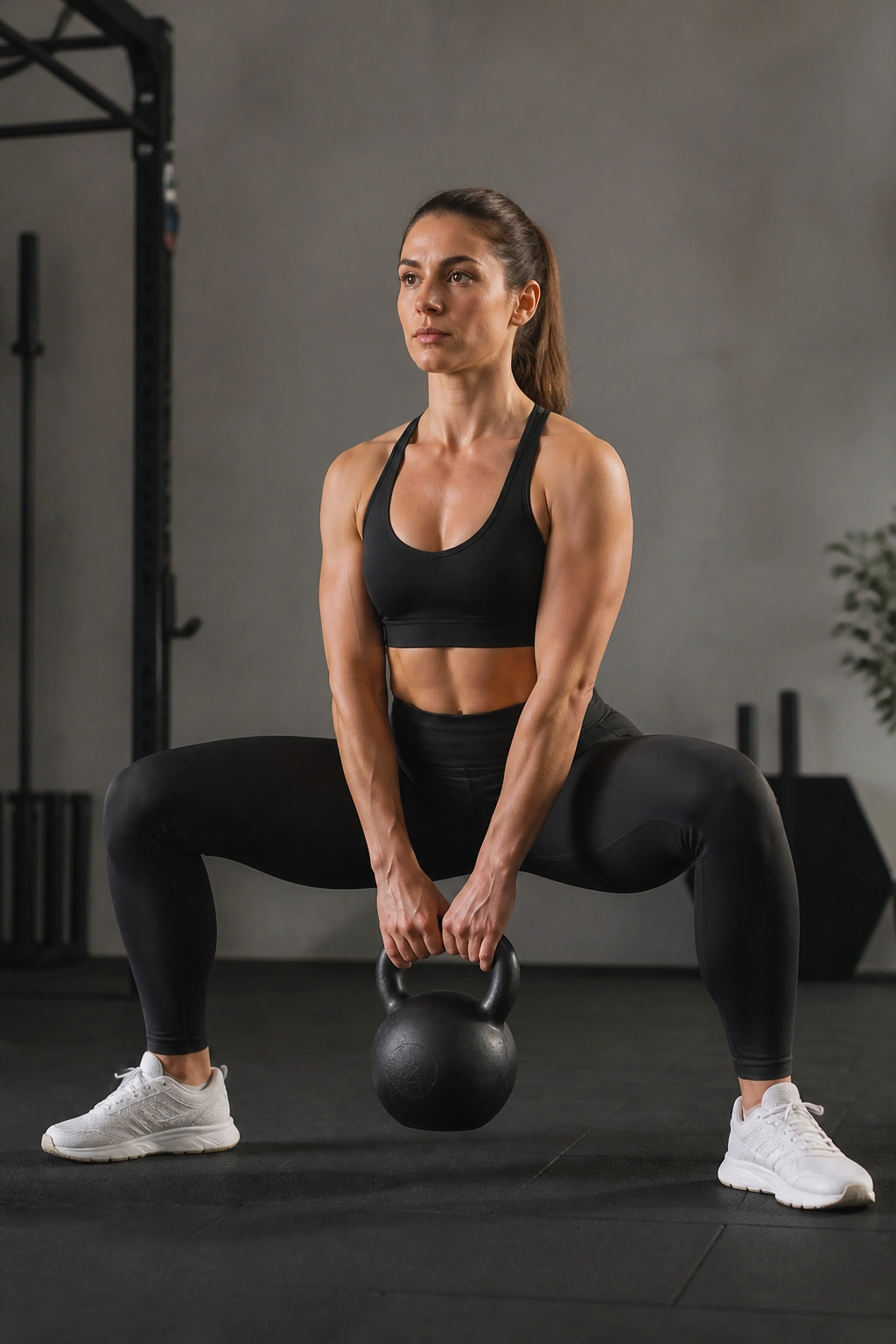
The sumo squat widens your stance significantly, which shifts the emphasis of the lift toward the inner thighs (adductors) and the glutes. This is a fantastic movement if you are looking to build thickness in the legs and improve your hip mobility.
Why a Wider Stance Matters
By taking a wider stance, you shorten the range of motion slightly, which often allows people to handle heavier kettlebells than they could in a traditional squat. The increased width also challenges your hip external rotators to keep your knees tracking outward, which prevents them from caving in—a common issue in squatting.
How to Get the Most Out of It
Hold the kettlebell by the handle, letting it hang between your legs. Point your toes out at a 45-degree angle. As you descend, drive your knees out so they align with your toes. If your knees collapse inward, you are losing the benefit for your inner thighs and putting your joints at risk. Keep the chest proud and maintain tension in your lats throughout the entire rep.
6. Kettlebell Bulgarian Split Squat
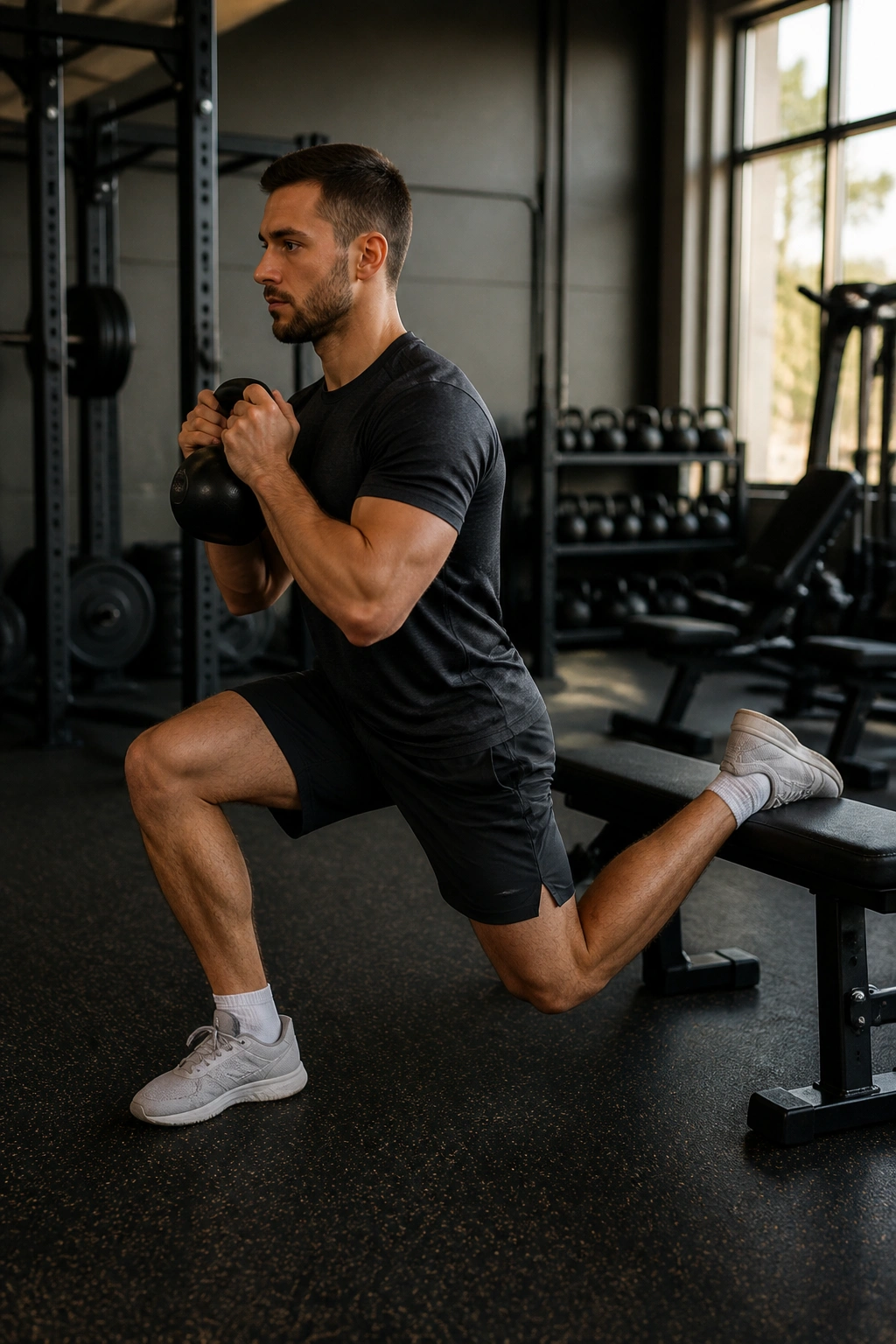
This is arguably the most humbling exercise on this list. It is a single-leg movement where your back foot is elevated on a bench or chair, forcing your front leg to do almost all of the work. It is brutal, effective, and guaranteed to leave you sore.
Why It’s the King of Leg Builders
Because you are loading one leg at a time, you effectively double the intensity of the weight you are using. If you hold a 35-pound kettlebell, you are essentially squatting 70 pounds of relative force on one leg. It is one of the fastest ways to fix asymmetries where one leg is stronger than the other.
Managing Your Balance
Balance is the biggest hurdle for beginners. To stabilize, focus your gaze on a single point on the wall in front of you. Do not look down at your feet. Hold the kettlebell in the goblet position for a core challenge, or hold it in the hand opposite the working leg to increase the glute demand. Go slow on the way down; three seconds down, one second up is the gold standard for this movement.
7. Kettlebell Single-Leg Deadlift
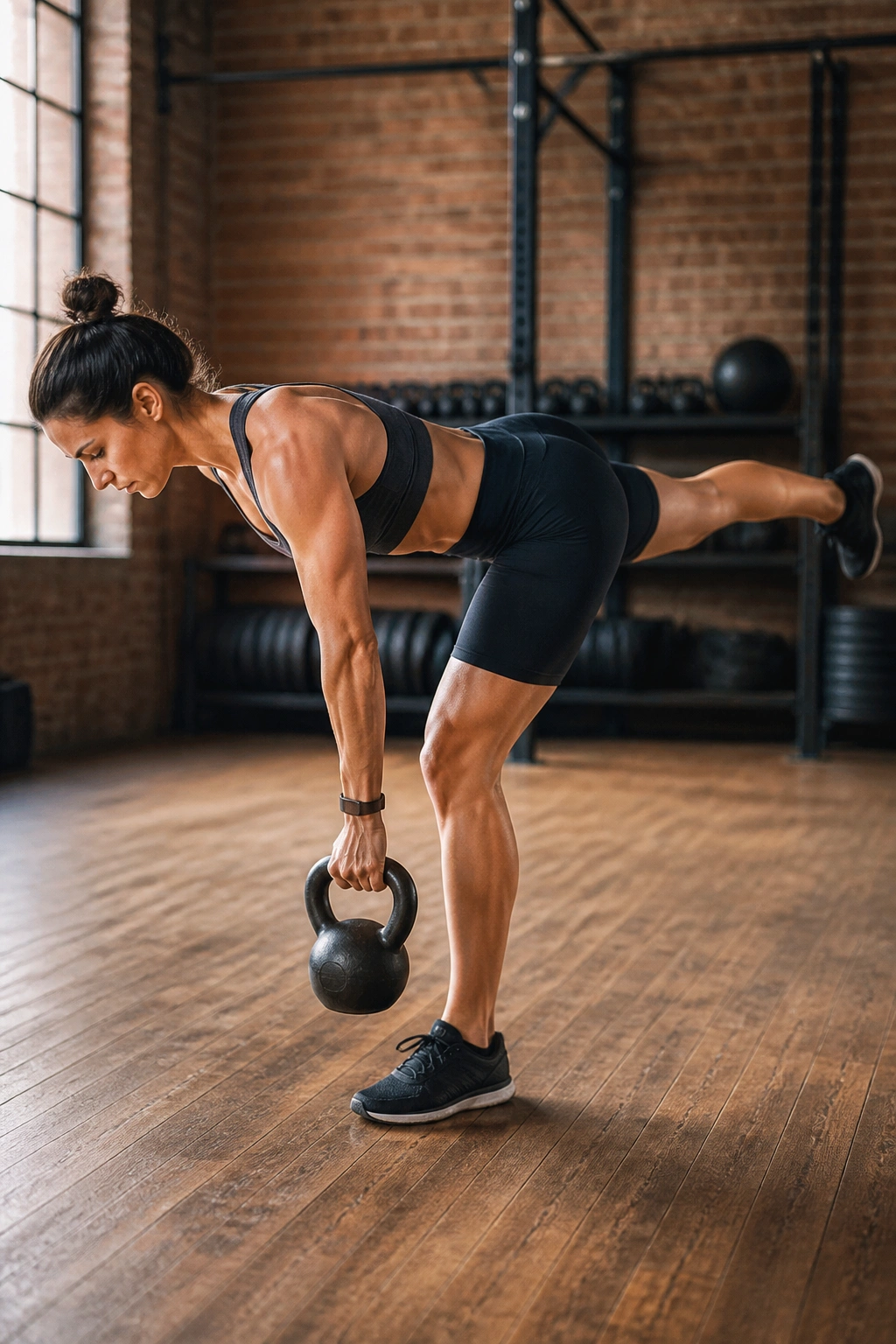
If you want to test your coordination, strength, and stability simultaneously, this is the movement. It is a hinge pattern, but because you are on one leg, you have to engage your entire lateral stabilization system to keep from tipping over.
The Mechanism
Stand on your right leg. Hold the kettlebell in your left hand. As you hinge at the hips, extend your left leg straight back behind you. Your body should form a “T” shape at the bottom of the movement. If you find your hips opening up to the side, close them down—keep your left hip pointed toward the floor the entire time.
Why It Builds Strong Legs
This exercise forces the small stabilizer muscles in your ankles, knees, and hips to fire in sync. It is not about how much weight you can lift; it is about how much control you have. A heavy kettlebell on this move is impressive, but a controlled, shaky-free rep with a lighter bell is actually more valuable for your long-term joint health.
8. Kettlebell Side Lunge
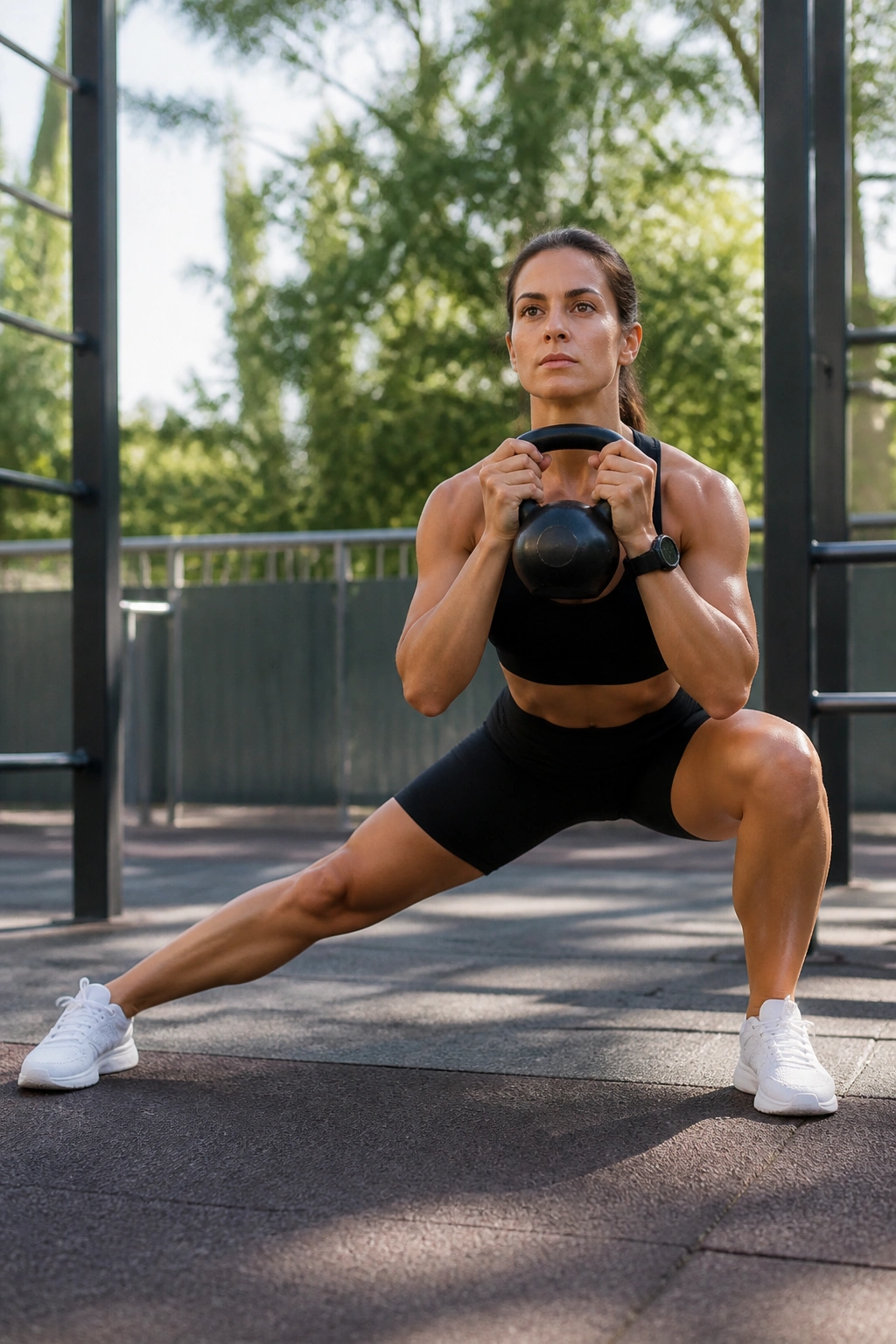
Most workouts focus on moving forward and backward. Life, however, happens in all directions. The side lunge (or lateral lunge) develops strength in the frontal plane, which is essential for healthy hips and knees.
Developing Lateral Power
When you step out to the side, you stretch the adductors (inner thighs) and the glutes while simultaneously strengthening them. This is vital for athletes and anyone who wants to prevent common knee injuries. The ability to load the hips laterally provides a level of durability that forward-only training misses.
Execution Tips
Step out to the side, keep your trailing leg straight, and sit your hips back into the lunging leg. Keep your chest up and the kettlebell held at your chest in the goblet position. Drive through the heel of the lunging foot to return to the starting position. Make sure your foot is flat on the ground the entire time; if your heel is popping up, you are taking your stance too wide.
9. Kettlebell Step-Ups
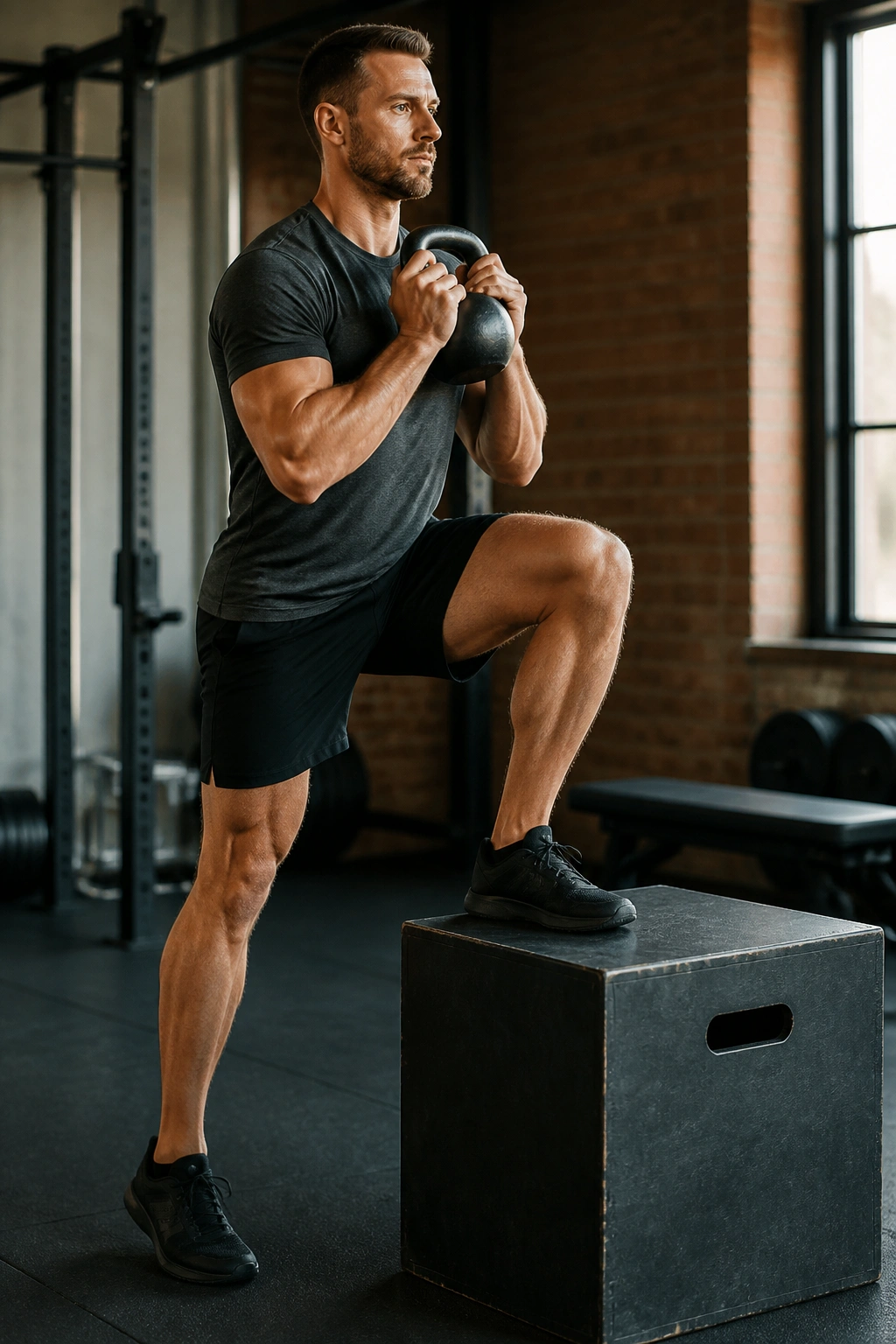
Step-ups are a simple movement, but when you add a kettlebell, they become a high-tension exercise that builds quad dominance and knee stability. The secret to a good step-up is to remove the “cheat” factor—don’t push off the floor with your bottom foot.
The “No-Cheat” Rule
Find a sturdy box or bench. Place your right foot on the box. Perform the entire ascent using only the right leg. Do not tap your left toe on the box, and do not use the left foot to push off the floor. The left leg should simply hang or be brought up to meet the right at the top.
Why They Work
The concentric (upward) portion of the step-up is pure quad isolation, while the eccentric (downward) portion is an incredible test of stability. Lower yourself back to the floor slowly—taking 3 to 4 seconds for the descent is a game-changer for building control and preventing knee injuries.
10. Kettlebell Curtsey Lunge
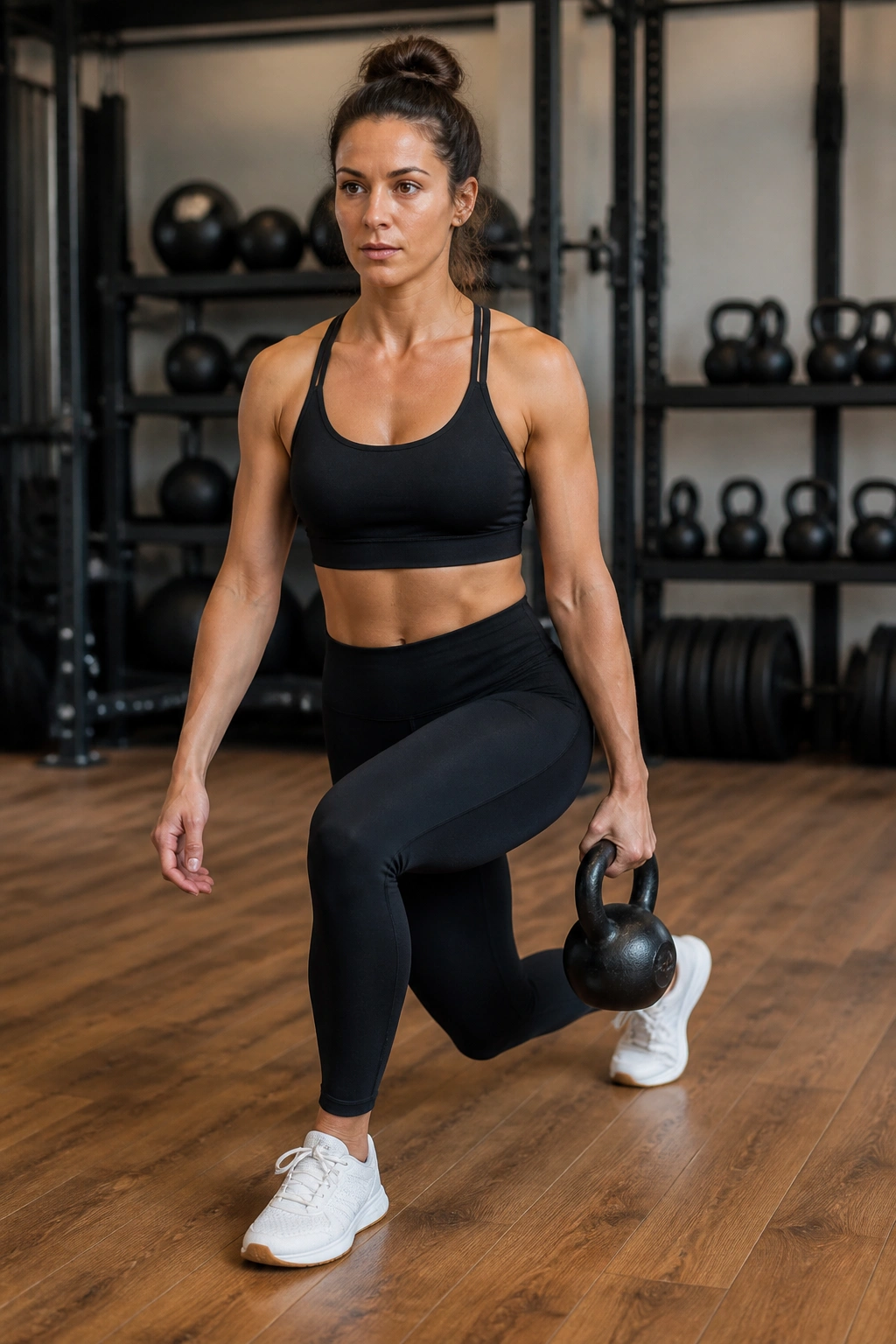
The curtsey lunge is often dismissed as a “glute exercise” or a niche movement, but it is actually one of the best ways to target the gluteus medius—the muscle responsible for hip stability. If you suffer from hip pain or lower back aches, your gluteus medius might be weak.
Targeting the Gluteus Medius
To perform a curtsey lunge, step your working leg back and across your body, as if you are doing a bow or a curtsey. This cross-body angle changes the line of pull on your hip muscles, forcing them to work in a range of motion that standard squats completely ignore.
Loading the Movement
Hold a kettlebell in the hand opposite the working leg. This creates a diagonal load across your hips, which is an excellent way to train your body to handle forces in different planes. Keep your torso upright and focus on the glute of the front leg doing the work. You will feel a deep stretch in the hip of the front leg—that is exactly what you are aiming for.
11. Kettlebell Deficit Reverse Lunge
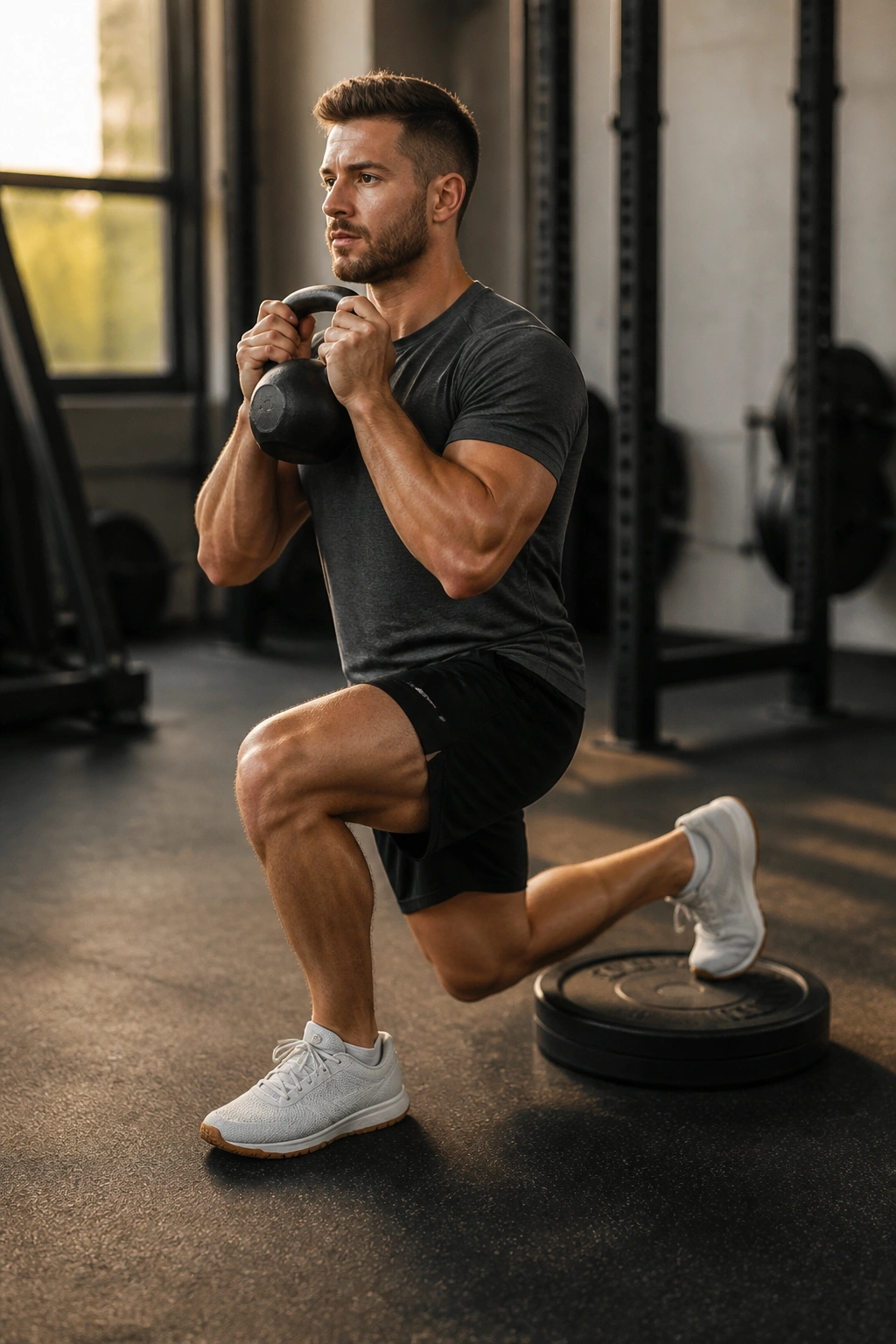
A deficit movement simply means you are standing on an elevated surface. By standing on a plate or a small step, you increase the range of motion of your reverse lunge, which allows you to get a deeper stretch in the glutes and quads.
Why It’s More Challenging
Increasing the range of motion means you have to work harder to get out of the “hole.” This forces more muscle recruitment. It also requires better balance and more control, as you have to step down and then drive back up from a deeper starting position.
Safety Considerations
Do not start this with a high deficit. Use a small weight plate (maybe 1-2 inches) to start. If you go too deep too soon, your form will break down, and you will find it difficult to keep your shin vertical. Focus on the control of the negative (downward) portion of the lunge; that is where the muscle building happens.
12. Kettlebell Cossack Squat
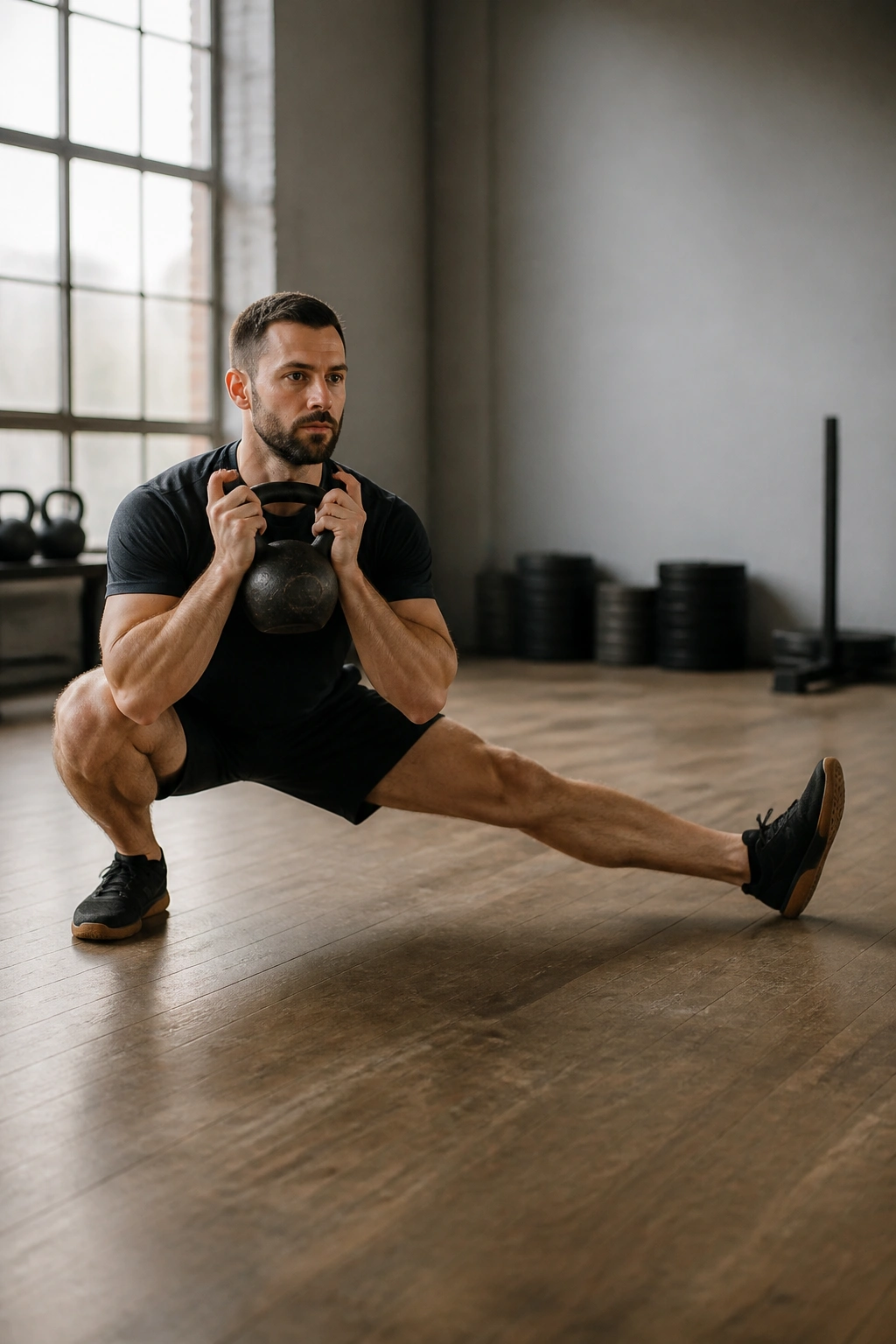
If the side lunge is the baseline, the Cossack squat is the advanced version. It takes the lateral lunge and drops it down into a deep, full-range squat, with one leg staying straight and the other bending fully.
The Mobility-Strength Hybrid
This is a mobility drill and a strength move rolled into one. It requires significant ankle mobility, hip mobility, and core control. If you have tight hips, this will be your best friend. It forces you to get comfortable in deep hip flexion while loading the muscles under tension.
Technical Cues
Start with a very wide stance. Hold the kettlebell at your chest. Shift all your weight to one side, bending that knee as deep as you can, while keeping the other leg completely straight and the heel planted. If the straight leg’s heel comes up, your mobility is not quite ready for the full depth—stop at the point where you can maintain a flat foot.
13. Double Kettlebell Front Squat
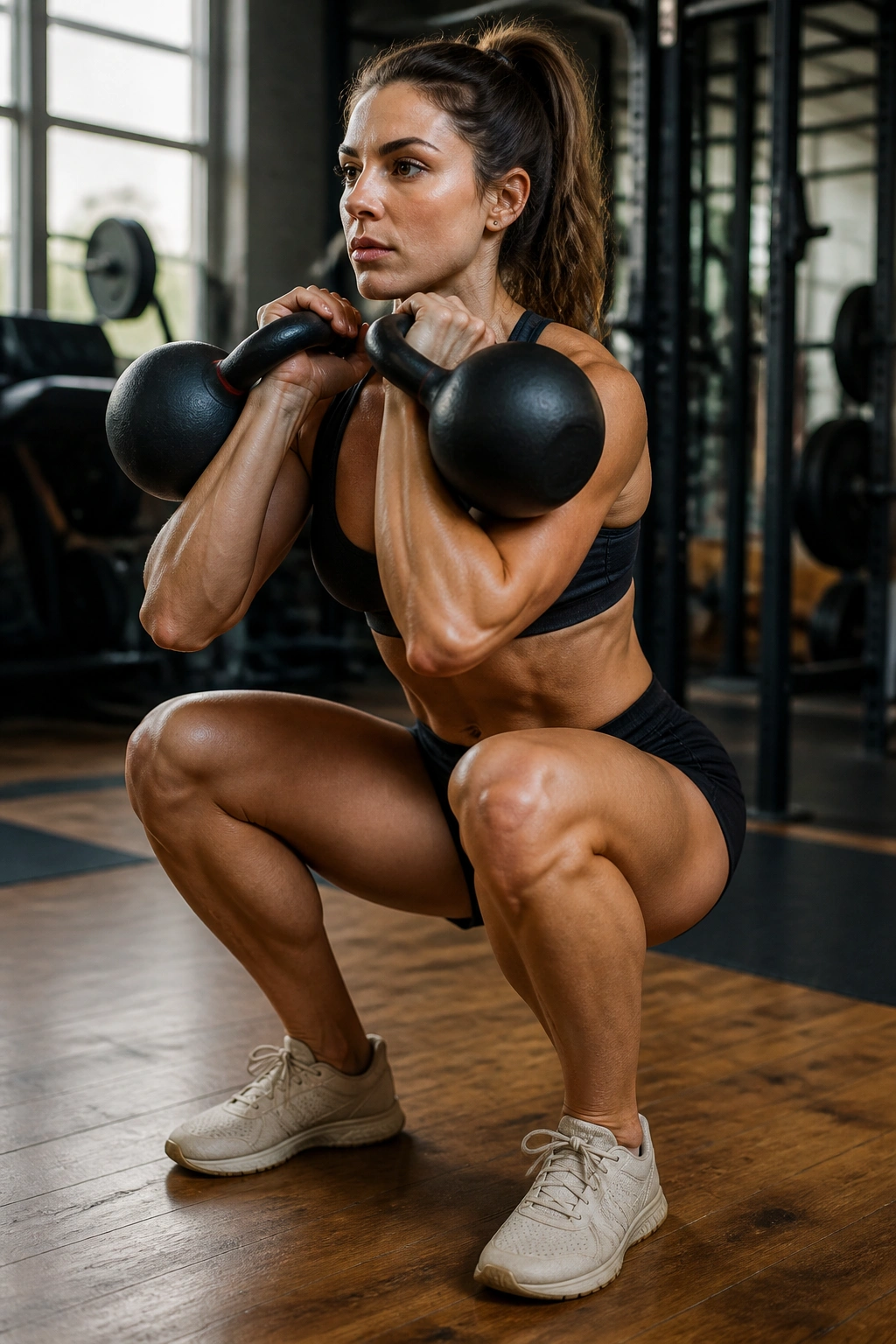
Once you have mastered the single-kettlebell goblet squat, you need a new challenge. The double kettlebell front squat involves racking two bells, one on each forearm. This significantly increases the load and challenges your core stability immensely.
Why You Should Use Two Bells
The double front squat forces you to keep a perfectly upright torso. If you lean forward even an inch, the weight of the two bells will pull you down. This makes it an incredible builder for your quads and your upper back muscles, which have to work to keep the bells from sliding off your shoulders.
The Rack Position
Getting the bells into the rack position is half the battle. They should rest on your forearms, with the handle close to the wrist and the bell resting on the muscle of your forearm. Do not let the bell bang against your bicep. Once in the rack, keep your elbows tucked in and your fists near your collarbones.
14. Kettlebell Glute Bridge
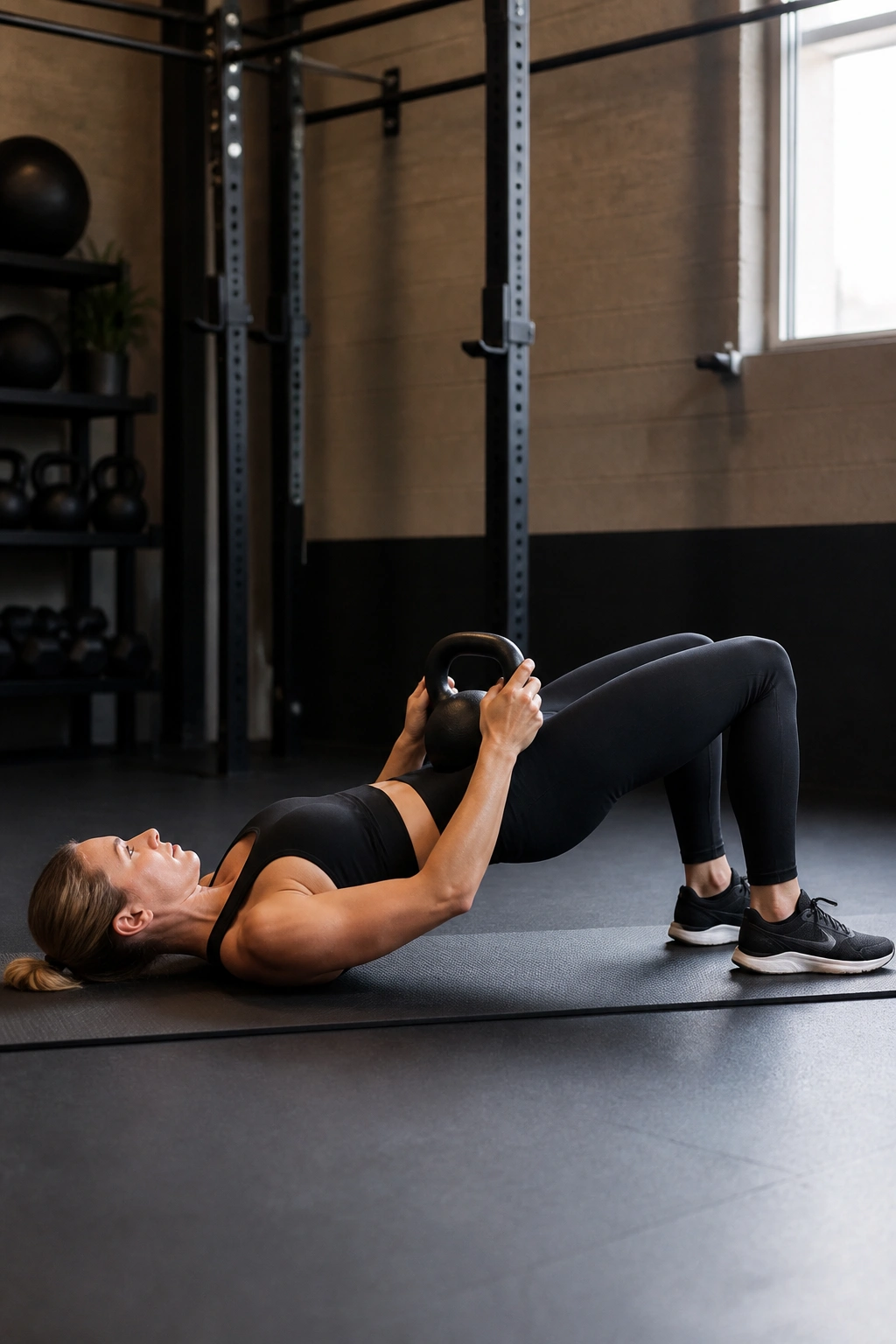
We spend too much time sitting, which causes our glutes to become lazy or “inactive.” The glute bridge is the corrective exercise of choice to fix that. Adding a kettlebell to the mix adds the resistance needed to actually grow the glutes.
How to Isolate the Glutes
Lie on your back, knees bent, feet flat. Place the kettlebell across your hips. Hold it with both hands to keep it from rolling. Drive through your heels to lift your hips toward the ceiling. Squeeze your glutes at the very top for a full second.
Why It’s Better Than Other Movements
Because your back is supported on the floor, this movement removes any lower back involvement. You can focus purely on glute contraction. If you want to increase the intensity, perform these on one leg at a time (single-leg glute bridge) with the kettlebell across the working hip. It is a fantastic way to finish a leg workout.
15. Kettlebell Pistol Squat
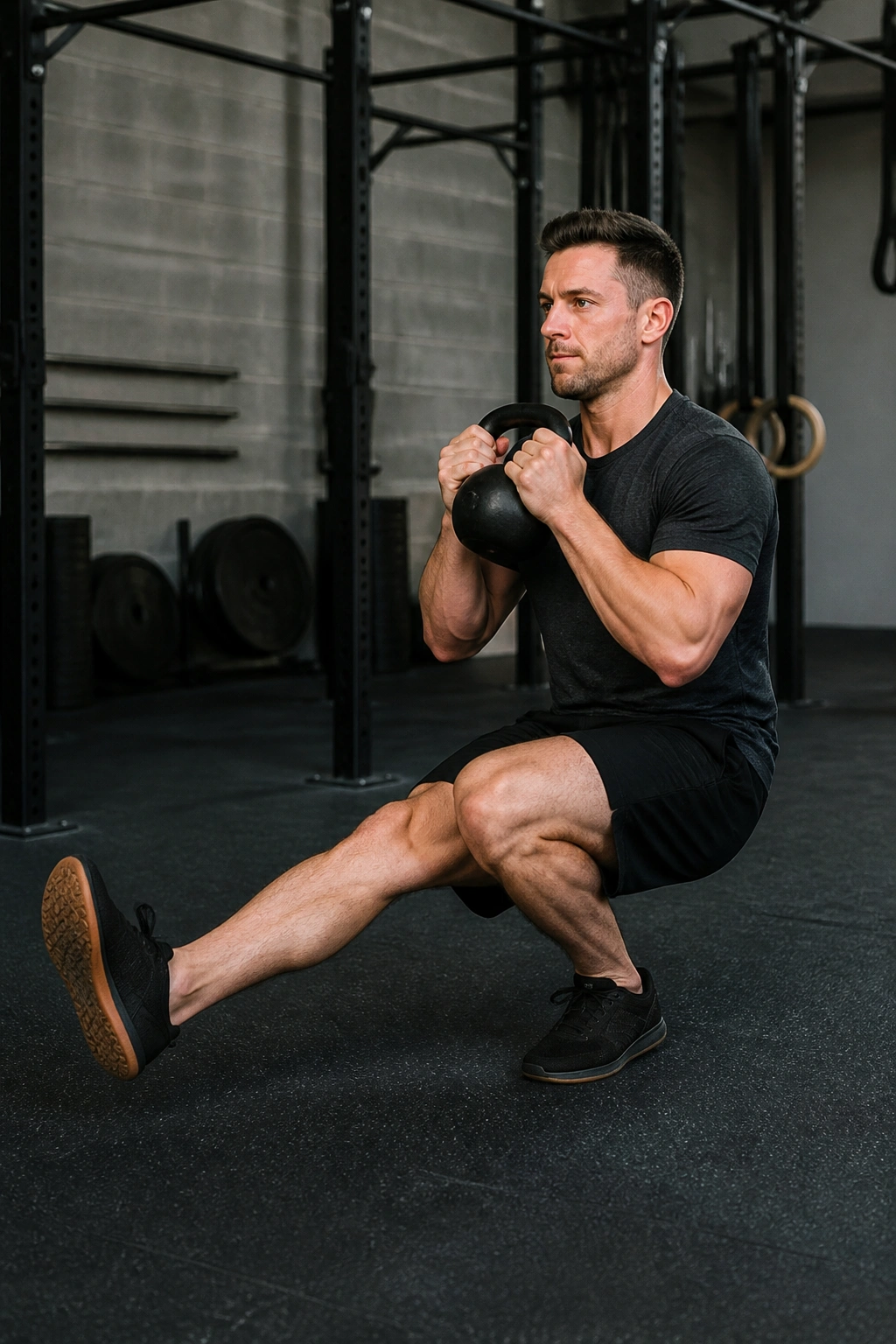
The pistol squat is the gold standard of single-leg bodyweight strength, and adding a light kettlebell makes it even more effective. This is an advanced movement; do not attempt this if you have not mastered the Bulgarian split squat and regular goblet squats.
The Progression
Hold a light kettlebell in the goblet position. This actually acts as a counterbalance, helping you sit back into the squat without falling backward. Extend one leg out in front of you. Sit your hips back, keeping the weight in the heel of the standing foot.
What It Teaches You
The pistol squat is not just about leg strength—it is about knee stability and ankle mobility. It demands that your nervous system fires every single stabilizer in your lower body. If you can perform a clean pistol squat with a 15-pound kettlebell, your relative strength is in the top percentile of gym-goers.
16. Kettlebell Box Squat
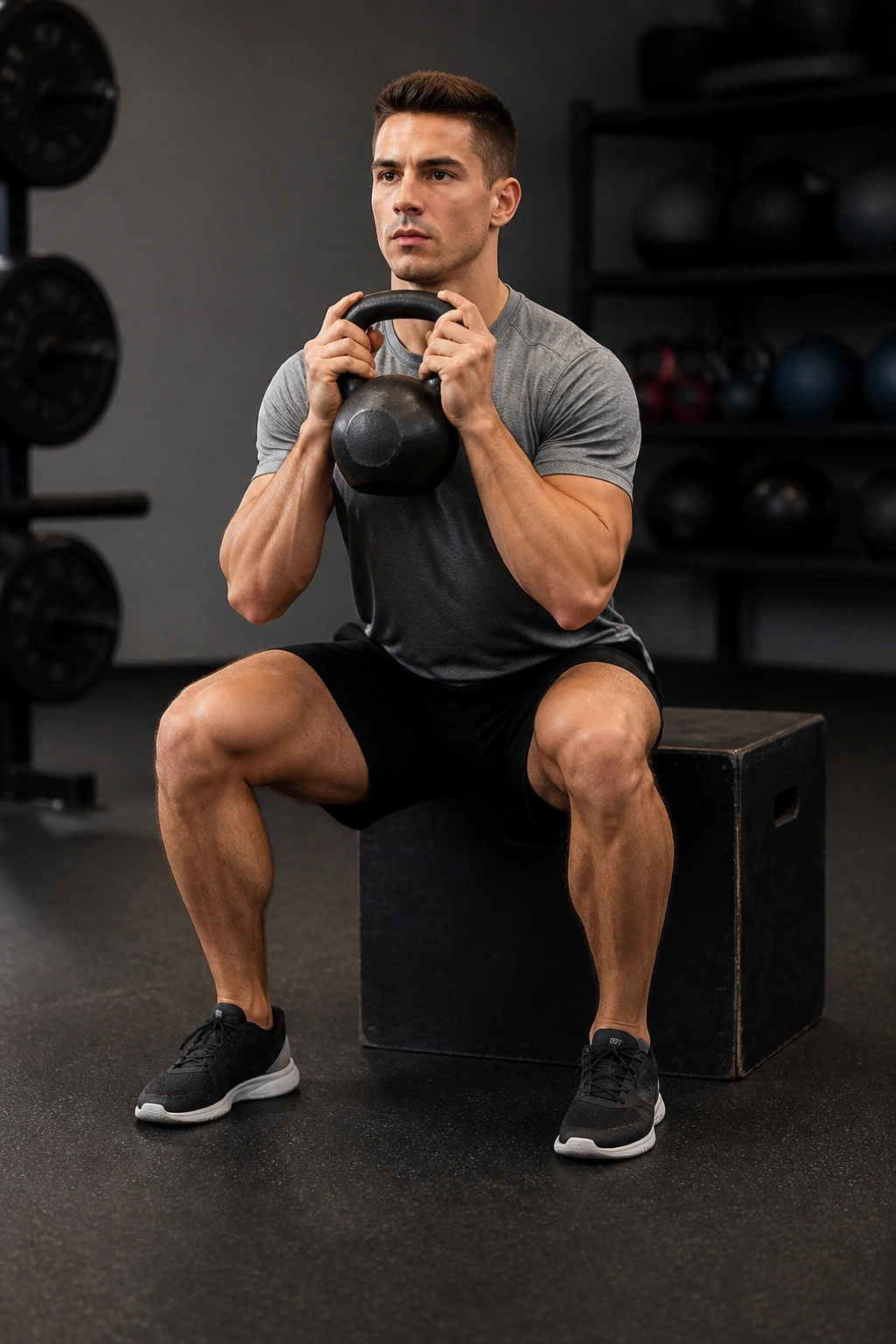
The box squat is a powerlifting staple that we can adapt perfectly for kettlebells. By sitting back onto a box or a bench, you break the eccentric-concentric chain. This means you have to generate power from a dead stop, which is much harder than using momentum.
Why It Breaks Plateaus
The box forces you to sit back properly—it prevents you from cheating by just dropping your knees forward. It also ensures you hit the exact same depth on every single rep. You are not guessing; you know exactly where the bottom of the squat is.
Technique for Success
Stand in front of a box, feet wider than shoulder-width. Hold the kettlebell at your chest. Push your hips back until you lightly touch the box. Do not collapse onto it; keep your weight controlled. Pause for one second on the box, then explode upward, driving through your heels.
17. Kettlebell Suitcase Deadlift
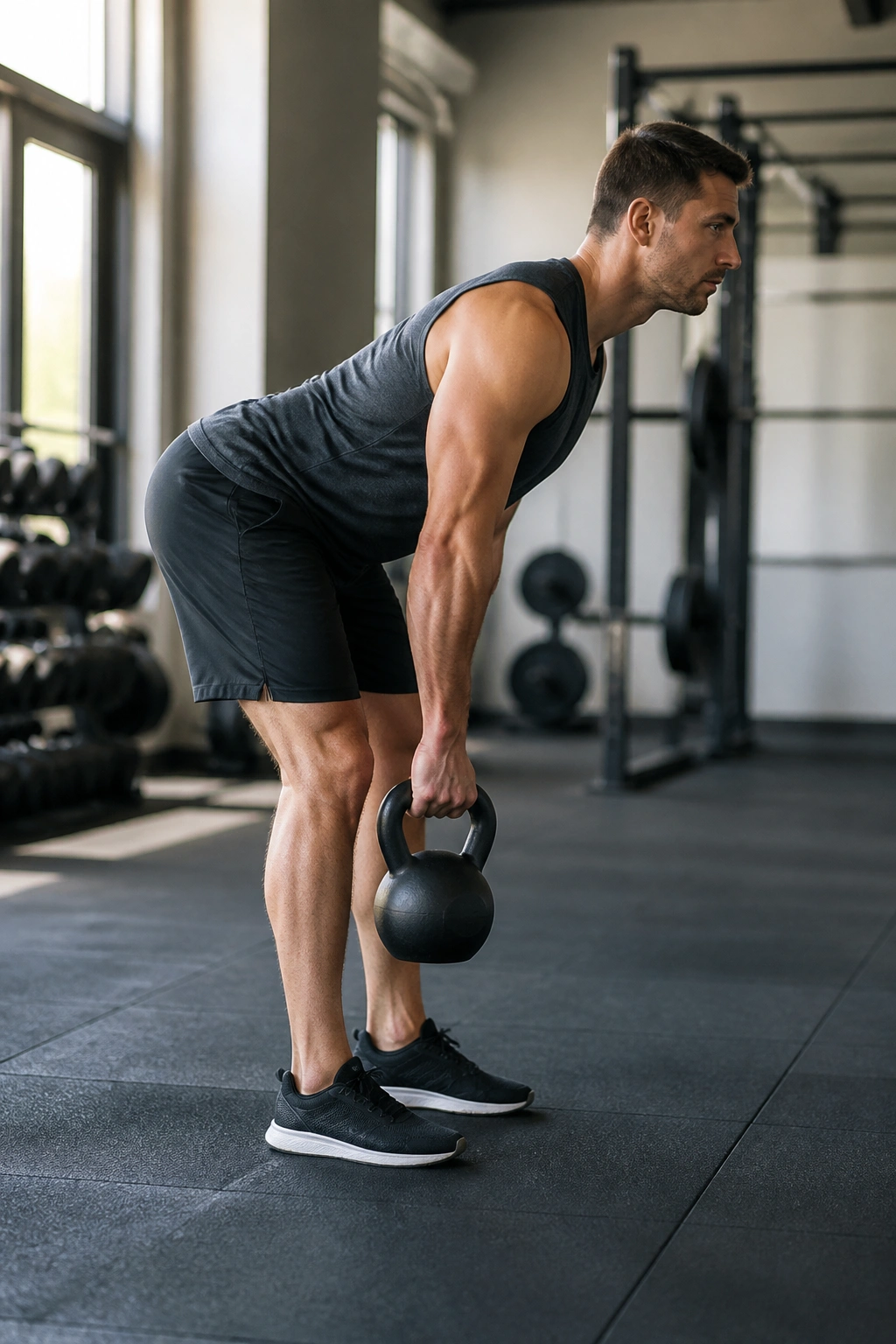
The suitcase deadlift is named after the action of picking up a suitcase. It is a deadlift performed with the kettlebell at your side, in one hand. Because the weight is only on one side, your body wants to tilt. You have to fight that tilt using your obliques and your deep core.
The Offset Load
This creates an asymmetrical load that is incredibly functional. In real life, we rarely carry two equal weights. We carry groceries, kids, luggage, and tools in one hand. This exercise trains your body to handle those uneven loads without sacrificing your spinal alignment.
Execution
Stand next to the kettlebell. Keep your back flat and engage your lats. Hinge at the hips to grab the bell. Stand up, keeping your shoulders level. Do not let the weight pull you to the side. At the top of the lift, squeeze your glutes and brace your core to ensure you remain perfectly vertical.
18. Kettlebell Clean-to-Squat
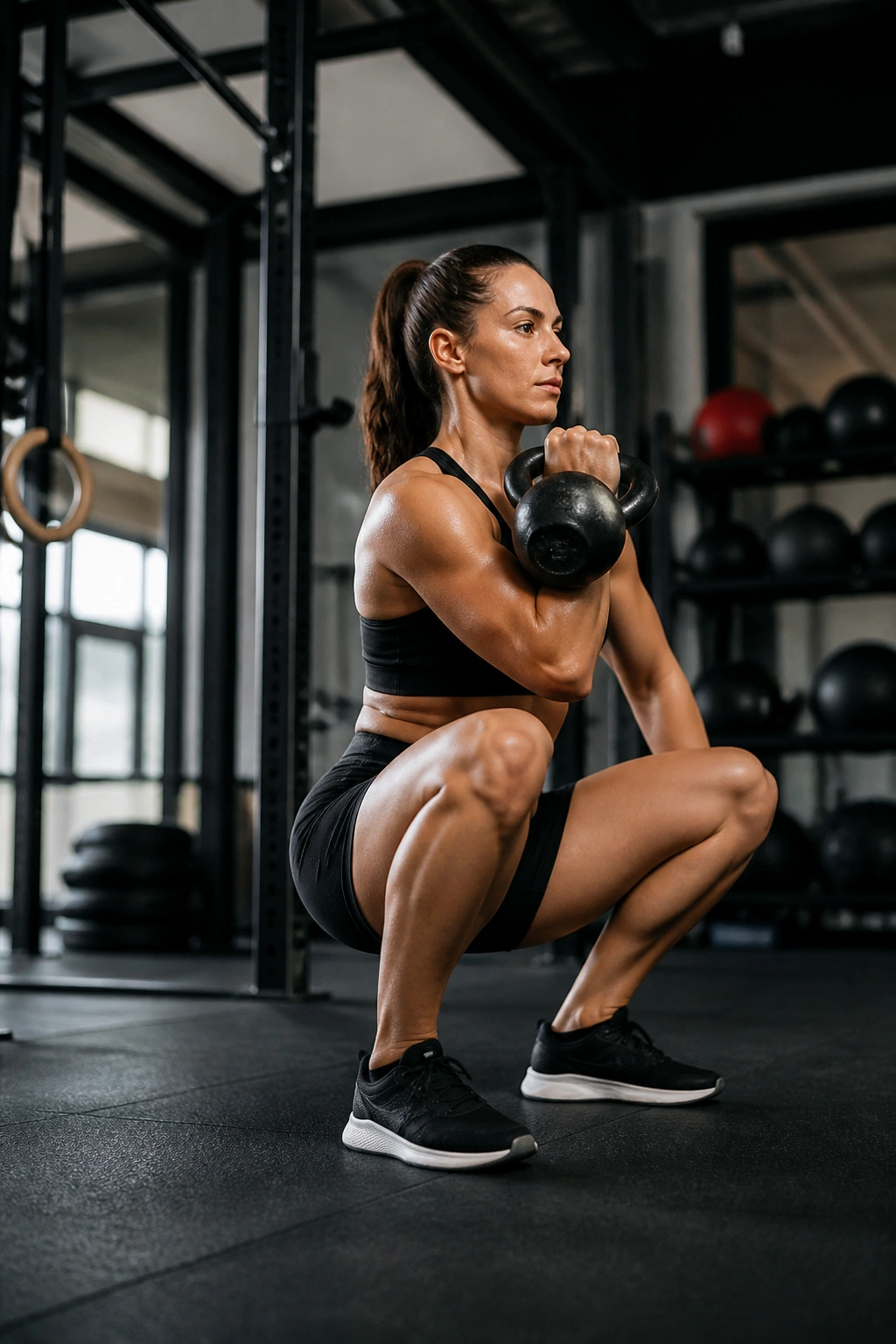
This is a compound movement that combines an explosive pull with a deep squat. It is a full-body burner, but the legs take the brunt of the work. This is the movement to choose when you are short on time and want to hit everything at once.
The Flow
Start with the kettlebell between your feet. Perform a clean—an explosive hinge pull that brings the bell to your shoulder. As the bell lands in the rack position, immediately sink into a squat. Stand back up, drop the bell, and repeat.
Why It’s Effective
This adds a layer of explosive power to your leg training. The clean requires speed and hip snap, and the squat requires strength and control. Linking them together teaches your body to generate force from the ground up, which is the definition of functional leg power.
Final Thoughts on Lower Body Strength
Building a strong lower body with kettlebells is not about how much weight you can stack on a bar—it is about the quality of the movement. You have 18 distinct ways to challenge your legs here, ranging from mobility-focused movements like the Cossack squat to explosive power builders like the swing and the clean-to-squat.
The most effective approach is not to try to do all of these in one session. Pick three or four, pair them up, and focus on form. If you feel your form breaking down, the weight is too heavy or you are too fatigued. Adjust accordingly. Remember that your legs are designed to handle heavy loads, but they are also designed for complex, multi-planar movement. Give them the variety they need, train with intention, and you will see the results in your strength, your stability, and your overall athletic performance.
