



A good interval training workout should leave you breathing hard, but still able to walk to the car without negotiating with your own legs. That sounds obvious. It isn’t.
A lot of people treat intervals like one giant red line: sprint, collapse, repeat. That’s not how smart conditioning works, and it’s not how people stick with it. The better version gives you a sharp effort, a clear recovery, and a format that matches the day you’re having — whether that’s a treadmill, a bike, a track, a pool, or a patch of floor with one kettlebell and a stubborn attitude.
I’ve always liked interval work because it’s honest. A 30-second burst tells you exactly where your fitness is, and the recovery tells you whether you can come back and do it again without turning the session into a mess. The trick is not “go harder.” The trick is to shape the hard parts so they are repeatable. Short sprints are one thing. Controlled threshold repeats are another. And a walk-jog ladder is its own animal entirely.
So start simple if you need to. Or start aggressive if you already have a base. Either way, the best session is the one that fits your lungs, your joints, and your calendar without asking for a motivational speech first.
1. The 30-Second Walk, 30-Second Jog Ladder

If you’re new to interval training workouts, this is the cleanest place to begin. Half a minute of easy jogging, half a minute of walking, repeated long enough to feel your breathing change but not long enough to make the whole thing feel like punishment.
Why It Works
The short work interval keeps the effort approachable. You never have to brace yourself for a huge block of suffering, which is half the battle for beginners and returners. The walking recovery is short enough to keep your heart rate up, but long enough that you can keep your form tidy.
A good target is 10 to 20 rounds after a 5-minute warm-up. Keep the jog at a pace where you can still say a few words, even if you don’t want to. That’s the sweet spot. Too easy, and it turns into a stroll. Too hard, and your second or third round starts to wobble.
- Work: 30 seconds easy jog
- Recovery: 30 seconds walk
- Rounds: 10 to 20
- Good for: Beginners, runners coming back after time off, anyone who hates all-out sprints
- Cue: You should feel warm and a little breathless, not panicked
Pro tip: If 30 seconds of jogging feels rough, keep the same timer and use a brisk power walk instead. The structure matters more than the speed.
2. The One-Minute Run, One-Minute Walk Repeat

One minute changes the feel of the workout in a big way. You’re still working in short chunks, but now you have enough time to find a rhythm, settle your breathing, and stay in the effort long enough for it to matter.
This format sits right in the middle of the road. It’s beginner-friendly if you keep the pace sane, and it’s also useful for experienced runners who want a simple aerobic session without dragging out a long steady run. I like it because it’s brutally straightforward. No tricks. No guesswork.
Run at a pace that feels like 6 or 7 out of 10. That means strong, controlled, and a little uncomfortable, not lung-searing and sloppy. Then walk for a full minute and let your breathing come back under you. If your first two repeats feel amazing and the rest feel like a disaster, you started too fast.
No hero pace.
A solid session is 8 to 15 rounds, depending on your base. Keep your stride compact, shoulders loose, and eyes forward. When people overstride here, they waste energy and complain that intervals “don’t work.” Usually, the issue is the pace, not the plan.
3. Hill Repeats on a Short, Steady Slope

Hills punish poor form in a useful way. They make you honest about posture, knee drive, and how much junk is in your stride when fatigue shows up.
Find a hill that takes 20 to 45 seconds to climb at a hard but controlled effort. It does not need to be steep enough to feel dramatic. In fact, a moderate incline usually works better because you can keep moving fast without turning the session into a scramble. Walk back down for recovery, or rest for 60 to 90 seconds if the hill is short.
Form Cues That Matter
Stay tall. Lean slightly from the ankles, not the waist. Pump the arms with purpose, and keep the steps short enough that you’re driving up the hill instead of reaching for it.
- Hill grade: Roughly 4% to 8% for most people
- Work: 20 to 45 seconds uphill
- Recovery: Walk back down or rest 60 to 90 seconds
- Rounds: 6 to 10
- Best for: Runners, hikers, field athletes, anyone who wants more leg strength without a heavy lifting day
A good hill repeat should leave your calves awake and your lungs doing most of the talking. If your lower back starts taking over, the slope is probably too steep or your pace is too wild.
4. Stationary Bike Sprint Intervals

The bike is a gift. Low impact, easy to control, and unforgiving in the best possible way. You can push hard without hammering your joints, which is why bike intervals show up in so many smart conditioning plans.
I like 20 seconds hard / 100 seconds easy for a clean sprint session, or 30 seconds hard / 60 seconds easy if you already have a decent base. “Hard” on the bike means your legs are turning over fast and the resistance is enough to make the effort real, but not so heavy that your hips rock side to side like a bad dance move.
Keep the saddle high enough that your knee stays slightly bent at the bottom of the pedal stroke. If you mash with too much resistance, your knees and lower back will complain. Fast legs, steady torso. That’s the look.
- Rounds: 8 to 12
- Resistance: Moderate to heavy, but still smooth
- Recovery: Easy spin at a relaxed pace
- Good for: People with cranky knees, runners cross-training, busy days when you want a hard session in under 25 minutes
The bike is not glamorous. It works anyway.
5. Jump Rope Bursts With Easy Marching Recovery
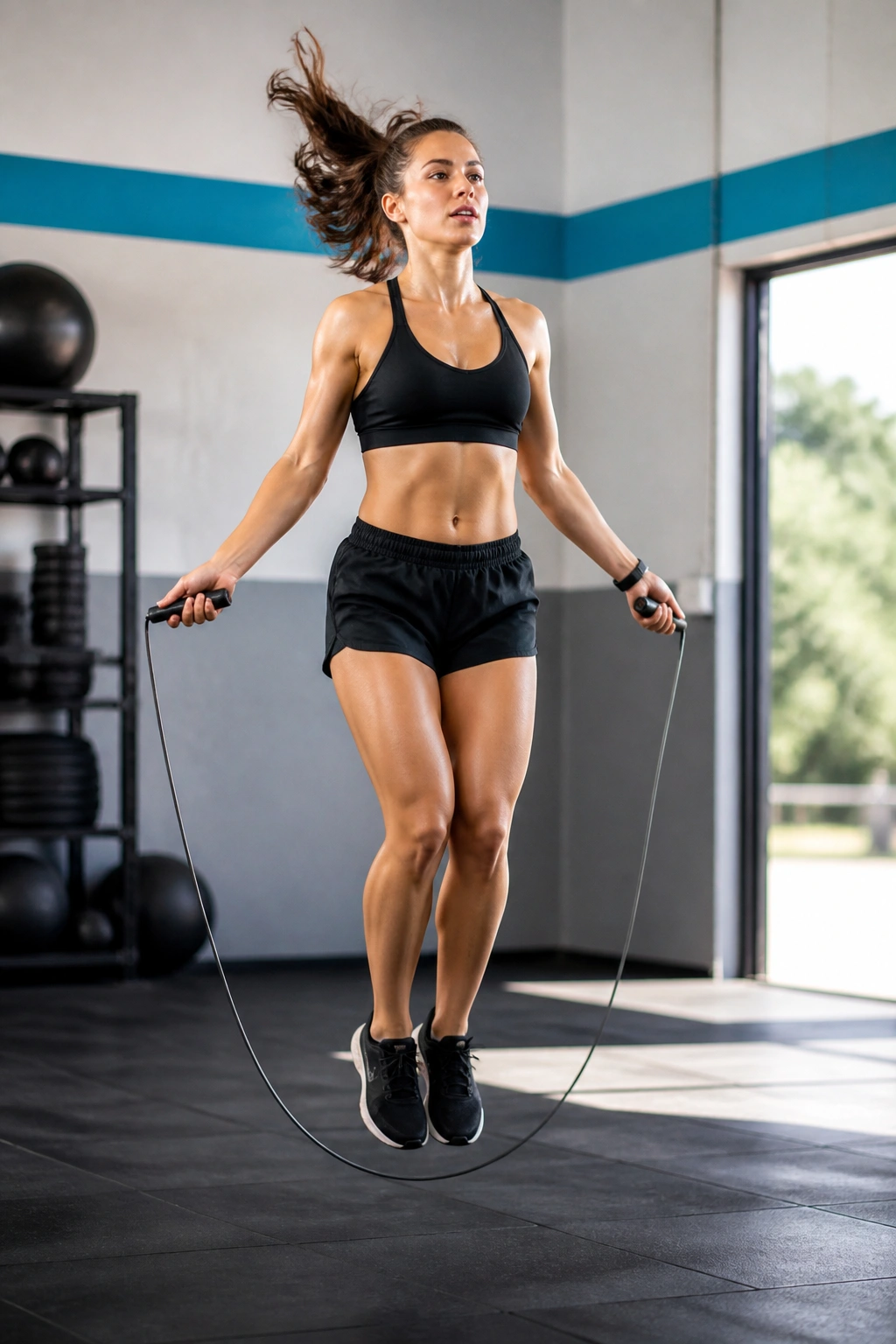
Can you get a real cardio hit from a rope, a timer, and a few square feet of floor? Absolutely. Jump rope intervals are compact, cheap, and sneaky-hard if you stay light on your feet.
Start with 20 seconds of jumping and 40 seconds of marching or stepping in place. If that feels too easy, move to 30 seconds on / 30 seconds off. The jumping itself does not need to be fancy. Two-foot hops, alternating feet, boxer step — pick the one that keeps your shoulders relaxed and your ankles happy.
How to Scale It
If you’re new, use a “ghost rope” for a few rounds first. That’s just the hand motion without the rope catching your feet every third rep. It sounds silly. It works.
- Work: 20 to 30 seconds
- Recovery: 30 to 40 seconds easy marching
- Rounds: 10 to 15
- Best for: Beginners through intermediate exercisers
- Watch for: Stiff landings and tight shoulders
The rope should feel springy, not punishing. If your calves are cooked in the first three minutes, shorten the work interval before you blame the format.
6. Bodyweight Circuits With Built-In Recovery

You do not need a treadmill or a spin bike to do interval training. A floor and a clock are enough.
A simple bodyweight circuit can look like 40 seconds of work, 20 seconds of rest for four moves, then 90 seconds between rounds. That gives you both cardio and muscular fatigue, which is a very different feel from pure running intervals. It’s also a useful option when the weather is bad, the gym is packed, or you just want to train without leaving the room.
A Simple Four-Move Round
- Squats
- Push-ups
- Reverse lunges
- Mountain climbers
Keep the moves basic. Fancy isn’t the point. The point is to stay moving while your heart rate stays up and your form stays mostly intact. If push-ups turn ugly after round one, switch to incline push-ups on a bench or wall. If lunges start wobbling, reduce the pace.
A strong circuit should leave your breathing hard and your legs a little shaky, but not so trashed that the rest of your day falls apart. That balance matters more than people admit.
7. Treadmill Incline Climbs for a Low-Impact Burn

A treadmill incline session feels different from a flat run. More glutes. More calves. Less pounding. And if you manage the speed correctly, it can be one of the cleanest interval training workouts for people who want hard work without sprint mechanics.
Set the incline to 4% to 6% if you’re new to this, or 6% to 10% if you’re comfortable walking or jogging uphill. Work for 2 minutes at a brisk pace, then come back to flat or drop the incline and recover for 2 minutes. Repeat that 6 to 8 times.
Set the Hill
Keep your chest open and your stride short. Gripping the handrails turns the workout into something else entirely, and not in a good way. If you have to hold on, the speed is too high or the incline is too aggressive.
Stay Tall
Your body should look like it’s climbing, not folding. That one change makes a huge difference in how the glutes and hamstrings take over.
This is one of my favorite treadmill options for people who want to avoid the hard shock of sprinting but still want to finish feeling worked. It’s honest cardio, just with a friendlier landing.
8. Rowing Machine 250-Meter Repeats

Rowing is one of those things that looks smooth when someone else does it. Then you get on the machine and realize your legs, lungs, and timing all have opinions.
A strong rower interval session often works well as 250 meters hard, 250 meters easy for 6 to 10 rounds, or 500 meters hard with 1 to 2 minutes of easy paddling if you’re more advanced. The screen makes it easy to track, which is one reason I like the rower so much. Numbers keep the ego in check.
Pace Cues
Hard strokes should start with the legs, not the arms. Push the footplates away, then swing the torso, then pull. If your stroke rate creeps into frantic territory, you’re probably yanking instead of rowing.
- Stroke rate: Around 24 to 28 strokes per minute on the hard pieces
- Recovery: Easy row or full rest for the same amount of time
- Best for: Full-body conditioning, runners, people who want low-impact work
- Common mistake: Pulling too early with the arms
The rower is sneaky. One minute you feel controlled, and the next minute your breathing is loud enough to annoy anyone within ten feet. That’s usually a sign the session is doing its job.
9. Tabata-Style 20/10 Bodyweight Sprints

Short, sharp, and rude in the best way. Tabata intervals are famous for a reason: 20 seconds on, 10 seconds off, eight rounds. Four minutes sounds tiny until you’re in the sixth round and bargaining with the floor.
Use movements that stay clean under fatigue. Air squats, step-ups, mountain climbers, high knees, fast punches, or incline push-ups all work better here than anything technical. I would skip burpees if your landing mechanics get sloppy, because sloppy burpees are just a fast way to annoy your back.
Keep the Rounds Honest
- Work: 20 seconds
- Rest: 10 seconds
- Rounds: 8 per exercise
- Rest between exercises: 2 to 3 minutes
- Good choices: Squats, step-ups, climbers, punch-outs
Do not turn every 20-second burst into a max-effort sprint. Tabata is harsh even when it’s done right. The goal is to hold a high output across all eight rounds, not to win the first round and implode halfway through the second.
This format is best for intermediate and advanced exercisers who already know how to move well when they’re tired. It’s tiny on paper. It is not tiny in real life.
10. Fartlek Runs That Follow the Road Instead of the Clock

Fartlek means “speed play,” and that name makes sense the first time you stop treating every run like a spreadsheet. Instead of fixed intervals on a stopwatch, you change pace based on landmarks, songs, trees, intersections, hills, or whatever your route gives you.
That looseness is the point.
Run easy, then surge to the next mailbox. Ease off, then push hard to the end of the block. Float a hill, recover on the flat, then open up for the last stretch of a trail straightaway. The work bouts can be 20 seconds, 45 seconds, 90 seconds, or a full 2 minutes. You decide in the moment.
I like fartlek sessions for runners who get stale with rigid plans. They build pace awareness without making the workout feel boxed in. They also teach you to change gears without panicking, which matters more than people think.
No two fartlek runs need to look the same. That’s part of the charm. If one day the surges are short and punchy, fine. If another day they’re longer and controlled, also fine. The route gets a vote.
11. Kettlebell Swing Intervals for the Posterior Chain

Kettlebell swings give you a fast heart-rate spike and a strong hinge pattern in the same package. That makes them one of the more efficient interval training workouts if you know how to swing properly.
A simple setup is 15 swings every 45 seconds for 10 rounds, or 30 seconds of swings / 30 seconds of rest if you like a cleaner timer. The bell should float. You are not lifting it with your shoulders; you’re snapping your hips and letting the weight travel because of that snap.
Hinge, Don’t Squat
Your hips move back first. Then they drive forward. The bell should feel like it is being projected, not muscled. If your lower back feels more involved than your glutes and hamstrings, stop and fix the hinge before you add more rounds.
- Work: 15 swings or 30 seconds
- Rest: 30 to 45 seconds
- Rounds: 8 to 12
- Load: Light to moderate enough to move fast with control
- Best for: Intermediate exercisers, athletes, anyone who likes fast strength work
I’m picky about swings because bad ones look busy and do very little for you. Good ones are crisp. Clean. A little violent, if I’m being honest.
12. Boxing Bag Rounds That Feel Like Real Work

A heavy bag timer has a way of making a session feel like a real event. You start with a minute or two of easy footwork, then the round begins and suddenly every jab, cross, hook, and body shot matters.
Use 2-minute or 3-minute rounds with 1 minute of rest. Four rounds is a solid start. Six or eight rounds is more serious. Keep your hands up between combinations, breathe through your nose when you can, and reset your feet instead of standing there admiring your own power.
The bag doesn’t care if you had a stressful day. It will sit there and accept your straight punches without comment.
If you want a simple pattern, try jab-jab-cross, then a reset step, then jab-cross-hook. If your shoulders gas out early, shorten the combinations and move your feet more. That keeps the work honest without turning the whole thing into arm flailing.
This is one of the best cardio choices for people who get bored fast. There’s enough skill involved to keep your mind busy, which is often the difference between finishing and quitting halfway through.
13. Stair Intervals for Small-Space Cardio

Stairs are rude. That’s also why they’re useful.
Find a flight of stairs, a stadium, or a sturdy set of steps and work in 20 to 60 second bursts going up. Walk down for recovery, usually 60 to 90 seconds, and repeat for 8 to 12 rounds. If you’re outside, keep your attention on the surface. If you’re inside, use the handrail lightly and don’t charge the descent like a movie stunt.
Stair Setup
- Work: 20 to 60 seconds up
- Recovery: Walk down slowly
- Rounds: 8 to 12
- Best for: Runners, field athletes, busy people who need a short session
- Watch for: Knee collapse, sloppy feet, rushing the downhill
What Makes It Hard
The climb taxes your glutes and calves fast, but the descent is where people get careless. Don’t. That’s where twisted ankles and bad landings show up.
Stairs are especially good when you want a hard workout without a lot of equipment. They also have a nice practical side: you can find them almost anywhere, and the timer does most of the coaching for you.
14. Threshold Intervals for Runners Who Want More Speed

Threshold work is the grown-up cousin of sprinting. You’re not redlining. You’re not cruising. You’re holding a pace that feels hard, controlled, and sustainable for a meaningful chunk of time.
Try 4 to 6 repeats of 3 to 5 minutes at threshold pace with 1 to 2 minutes of easy recovery. The pace should feel like you could hang on if you had to, but you would not want to chat about your weekend while doing it. That’s a useful line to learn. Short phrases only.
I like this session when I want to feel sharp without getting flattened. It works on roads, tracks, treadmills, bikes, and rowers. The exact machine matters less than the feeling: strong, steady pressure, no wild surges, no sloppy fade at the end.
A lot of people skip threshold work because it doesn’t look dramatic. That’s a mistake. It builds a different kind of fitness — one that helps you hold pace when the race or workout stops being fun.
15. Swimming Intervals That Protect the Joints

The pool gives you the same heart-pumping rhythm with almost none of the impact. That alone makes swimming intervals worth knowing, especially if your knees, ankles, or lower back need a friendlier option.
A practical session might be 10 x 50 meters with 20 to 30 seconds of rest, or 6 x 100 meters with 30 to 45 seconds of rest. If you’re not a strong lap swimmer, water jogging, kickboard intervals, or short freestyle repeats work too. The point is not style points. The point is controlled effort.
Pool Options
- Short repeats: 25m or 50m for speed and form
- Middle repeats: 100m for steady hard work
- Recovery: Short rest, enough to settle the breathing
- Best for: Joint-friendly conditioning, cross-training, recovery weeks
Keep your stroke smooth. If your arms are windmilling and your breathing is a mess, shorten the repeat length and clean up the form. Water punishes panic in a weirdly quiet way. It feels gentle until it doesn’t.
Swimming intervals are one of those workouts that pay you back without asking your joints to pay the price.
16. Mixed-Modality Gym Circuits That Never Get Boring

If you hate doing the same thing twice, mixed-modality intervals are your friend. Use 4 or 5 stations, keep the work bouts short, and move from one tool to the next before boredom gets a vote.
A round might look like 300 meters on the rower, 10 goblet squats, 30 seconds on the bike, 8 push-ups, and 40 meters of farmer carries, then 2 minutes of rest before the next round. That’s enough variety to keep your mind occupied while your heart rate climbs and stays there.
A Sample Round
- Rower: 300 meters
- Goblet squat: 10 reps
- Bike: 30 seconds hard
- Push-ups: 8 to 12 reps
- Farmer carry: 40 meters
The smart move here is to alternate lower-body and upper-body stress so one movement gives the next one a little breathing room. Don’t turn every station into a death match. Save something for the last station, because the goal is repeatable output, not one heroic minute followed by three grumpy ones.
These sessions suit people who train in gyms and want conditioning without staring at a single machine for half an hour.
17. Sprint-Walk Progressions for Advanced Runners

Sprint-walk work is not casual running with a few fast moments sprinkled in. Done well, it’s a sharp tool that belongs in the hands of runners who already have a decent base and know how to recover.
Start with 8 rounds of 10 seconds sprint / 50 seconds walk. Once that feels controlled, move to 20 seconds fast / 100 seconds walk. Later, try 30 seconds fast / 90 seconds walk. The recovery is long on purpose. You want enough time to bring the speed back without dragging fatigue into the next burst.
Choose a safe surface. Track, smooth path, flat grass, or treadmill with room to spare. Full sprinting on tired legs and rough pavement is asking for trouble, and there’s no prize for making the session look tougher than it needs to be.
The pace should be fast enough that you have to focus, but not so wild that your form falls apart in the first three steps. Clean mechanics matter more than drama here.
18. The Choose-Your-Own Interval Template You Can Repeat Anywhere
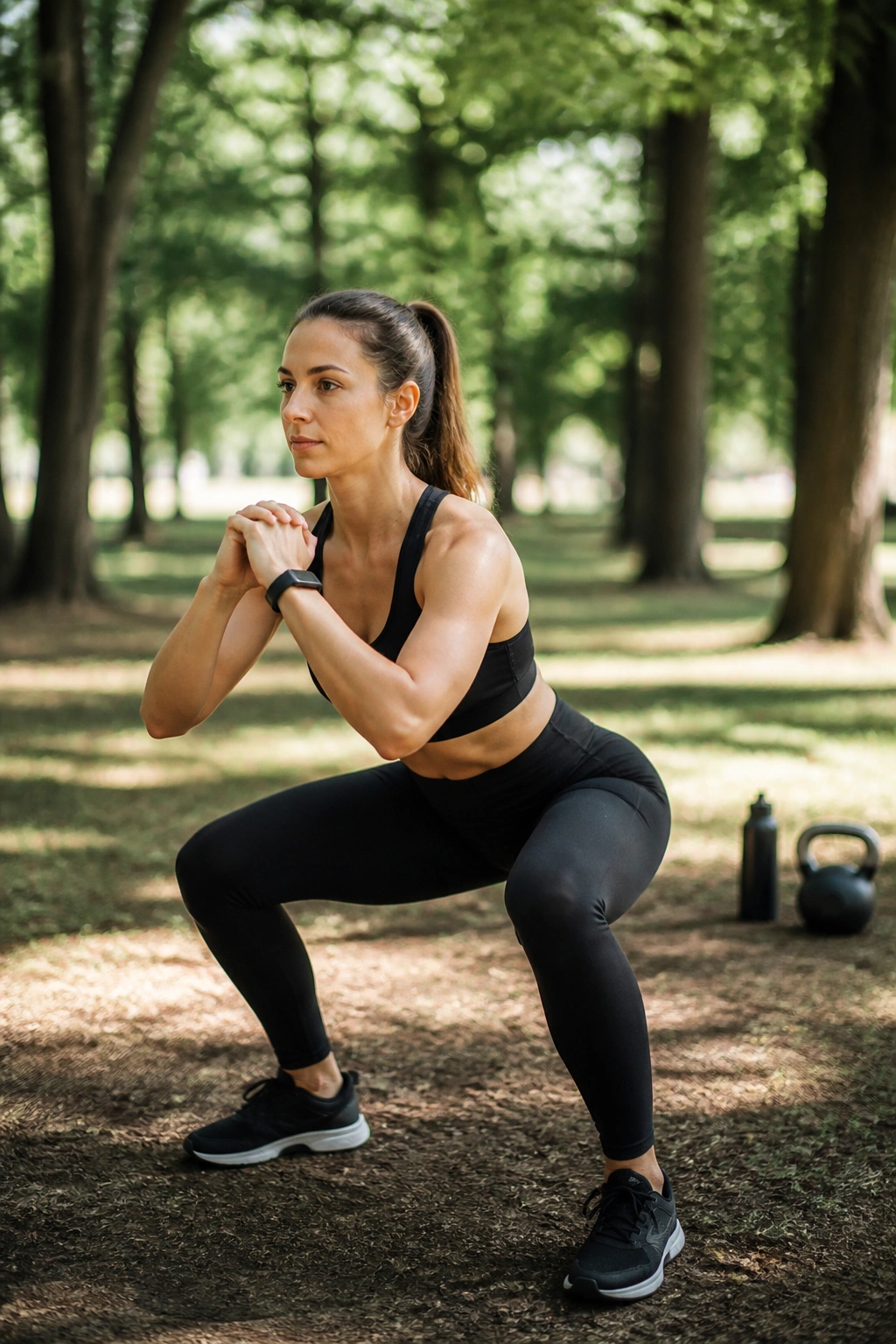
Some days call for a set workout. Other days need something looser, simpler, and easier to fit into a full life. This is the template I keep coming back to when I want a session that works in a gym, at home, on a trail, or on a half-empty afternoon with a stubborn clock.
Pick one work interval, one recovery interval, and one movement. Then repeat it long enough to feel like a real session. That’s the whole idea. It can be a bike, a run, a rope, a rower, a kettlebell, stairs, or even a bodyweight move you already know.
Build Your Version
- Beginner option: 30 seconds hard / 30 seconds easy x 12
- Middle option: 45 seconds hard / 75 seconds easy x 8
- Stronger option: 1 minute hard / 1 minute easy x 6
- Advanced option: 2 minutes hard / 2 minutes easy x 5
You can use the same format with different tools from week to week. That keeps the workout fresh without making it complicated. I like this approach because it removes the excuse of needing the “perfect” program before you start. You need a timer, a plan, and enough honesty to stop before your form goes sideways.
The best interval training workout is the one you’ll repeat without talking yourself out of it. Fancy helps less than people think. Consistency helps more.
