



Fitness challenges work best when they’re boring enough to repeat and hard enough to matter. That sounds unglamorous, and it is. Also useful.
Steady body progress usually doesn’t come from one heroic week. It comes from stacking small wins that don’t wreck your joints, your schedule, or your appetite for the rest of the day. A stronger set of squats, a longer walk, a cleaner push-up, a more honest recovery day — those things add up in a way flashy all-out plans rarely do.
My bias is simple: the best challenge is the one you can still do when sleep was short, work ran late, and your motivation showed up wearing flip-flops. Pick the right kind of pressure, and your body starts changing without turning every session into a war.
1. Build a Daily Step Floor
Walking is the least dramatic challenge on this list, and that’s exactly why it works. A daily step floor gives your body a baseline of movement that doesn’t beat you up, which makes it easier to recover from harder training and easier to keep body fat in check without living on a treadmill.
I like this one because it fixes a lot of invisible problems at once. People who lift but barely move often feel stiff, flat, and weirdly tired. A steady step count helps circulation, keeps your hips from turning into bricks, and gives you an easy way to raise daily energy use without another punishing workout.
Set a floor you can defend on your worst normal day. For some people that’s 7,000 steps. For others, 10,000 is fine. The number matters less than the habit of not letting the floor collapse.
- Take a 10-minute walk after one meal.
- Park farther away than you want to.
- Use a phone timer and move for 5 minutes every hour.
- Keep one “no excuses” walking route for busy days.
Not optional: if your schedule is messy, split the steps into chunks. Three short walks beat one fantasy walk you never take.
2. Run Three Full-Body Strength Days

Can three strength sessions a week do more than five random workouts? Yes. Usually more, and with less friction. A full-body split gives you enough practice to get better at the basics while leaving room for recovery, which is where body progress quietly happens.
Each session should touch a squat pattern, a push, a pull, and some kind of hinge or carry. That sounds like a lot, but it doesn’t need to be long. Forty-five minutes done well beats ninety minutes of wandering around the gym and calling it dedication.
How I’d structure it
- 1 lower-body move: squat, split squat, leg press
- 1 upper push: bench press, push-up, overhead press
- 1 upper pull: row, pull-down, assisted pull-up
- 1 finisher: carry, plank, bike, sled, or dead bug
Keep most sets in the 6-12 rep range. Leave 1-3 reps in reserve on the main lifts so you can show up again without limping into Thursday. That little bit of restraint is not lazy. It’s smart. And smart training tends to look better on the body than chaotic training does.
3. Stack a Push-Up Ladder

Day one, five clean push-ups feels easy. Day eight, eight reps starts to bite. That’s the point. A push-up ladder is a simple way to grow strength, chest endurance, and shoulder control without needing a fancy setup or a gym membership.
The trick is to stop treating push-ups like an ego test. If your lower back sags or your elbows flare like a chicken trying to take off, the set is too big. Start with a number you can repeat for several sets with clean form, then climb slowly.
A ladder that actually works
- Set 1: 4 reps
- Set 2: 5 reps
- Set 3: 6 reps
- Set 4: 5 reps
- Set 5: 4 reps
That’s one version. Another is to add one rep every session until form gets sloppy, then hold that number for a week. If standard push-ups are too hard, use an incline on a bench or sturdy counter. If they’re too easy, slow the lowering phase to 3 seconds or pause at the bottom.
Rule of thumb: quit each set before your body starts bargaining with gravity.
4. Use a Squat Density Block

If you want your legs to change, make them work without long rest. A squat density block is a short window — usually 8 to 12 minutes — where you collect a target number of reps with brief rests. It builds leg endurance, work capacity, and a bit of mental grit without needing a marathon session.
Here’s why I like it more than random high-rep leg day nonsense: density keeps the work honest. You know the clock is ticking. You’re not drifting through set after set while scrolling between rounds. You’re trying to get quality reps done inside a fixed box.
A simple version is 50 bodyweight squats in 10 minutes. Another is 5 rounds of 10 goblet squats with 30 to 45 seconds of rest. Keep your heels down, knees tracking over your toes, and torso braced. If your depth starts to collapse, reduce the rep count and make the reps cleaner.
How to keep the knees happy
- Use a box or bench as a depth target if needed.
- Slow the lowering phase to 2 or 3 seconds.
- Stop a rep short of ugly.
- Add load only after bodyweight feels smooth.
5. Hold a Plank and Upgrade It

Why does a plank look so simple and still expose weak spots fast? Because the core’s job isn’t to do a cute little crunch. It’s to keep your ribs, pelvis, and spine from drifting all over the place while the rest of you moves. A plank challenge teaches that in plain language.
The basic front plank is fine, but don’t stay married to it. If you can hold 60 seconds with clean form, the next step is usually not a longer hold. It’s a harder variation, a cleaner brace, or less rest between sets. That’s where the progress lives.
Three upgrades worth using
- RKC plank: short, hard, 10 to 20 seconds at a time.
- Side plank: great for obliques and hip stability.
- Dead bug: not a plank, but a better test of control than endless floor holds.
Try 4 rounds of 20-second hard planks with 20 seconds of rest. Your midsection should feel braced, not just tired. If your lower back starts taking over, the set is over. No cheating there. The floor always knows.
6. Stay in Zone 2 Long Enough to Matter

Your breathing settles before your legs do. That’s the feeling I trust for Zone 2 cardio — easy enough that you can talk in short sentences, steady enough that you stay there for 20 to 40 minutes without turning it into a gasping contest.
This is the kind of work people skip because it doesn’t feel dramatic. Big mistake. Zone 2 builds a base that helps everything else: lifting recovery, longer workouts, easier walks upstairs, better stamina when you’re carrying groceries or chasing a bus. It’s the training equivalent of putting solid tires on a car.
Brisk incline walking, steady cycling, rowing at a mellow pace, and easy jogging can all fit. The exact machine does not matter much. What matters is that you don’t drift into hard effort too soon.
Harder is not better here. If you finish wrecked, you went too hard. If you finish feeling like you could keep going for another 10 minutes, you probably nailed it.
7. Earn Your Hills and Stairs

Flat ground is friendly. It also lies to you. Hills and stairs make your glutes, calves, and lungs tell the truth fast, which is why I like them as a body-progress challenge when you want conditioning without the pounding of all-out sprint work.
A hill repeat session can be tiny and still useful. Warm up for 5 to 10 minutes, then walk or jog uphill for 20 to 40 seconds, recover on the way back down, and repeat 6 to 10 times. Stairs work the same way. The hard part is usually the first three repeats. After that, your pacing either gets smarter or the workout starts running you.
What to watch for
- Keep your stride short on steep climbs.
- Don’t throw your shoulders around.
- Let the recovery be easy.
- Stop before your form turns into flailing.
This kind of work is sneaky. It doesn’t always leave you crushed, but it often leaves your legs awake in a good way. And that little burn in the calves? It’s earned.
8. Carry Heavy Things on Purpose

A pair of dumbbells in each hand can teach more torso control than a room full of machines. That’s why loaded carries deserve a place in almost every steady-progress plan. They train grip, posture, core tension, and work capacity at the same time, which is an unusually efficient deal.
Farmer’s carries are the obvious start. Suitcase carries — one heavy weight in one hand — are even better for fighting side-to-side collapse. Front rack carries are a little nastier because they force your upper back to stay honest. Pick one and walk with purpose.
Best carry variations
- Farmer’s carry: 30 to 60 seconds
- Suitcase carry: 20 to 40 seconds per side
- Front rack carry: 15 to 30 seconds
- Overhead carry: only if your shoulders already like it
Use distances if that’s easier: 20 to 40 meters is enough for most people. The goal is not to stagger around like you lost a fight with a suitcase. The goal is to walk tall, breathe under tension, and stop when your posture starts leaking.
9. Train the Hip Hinge
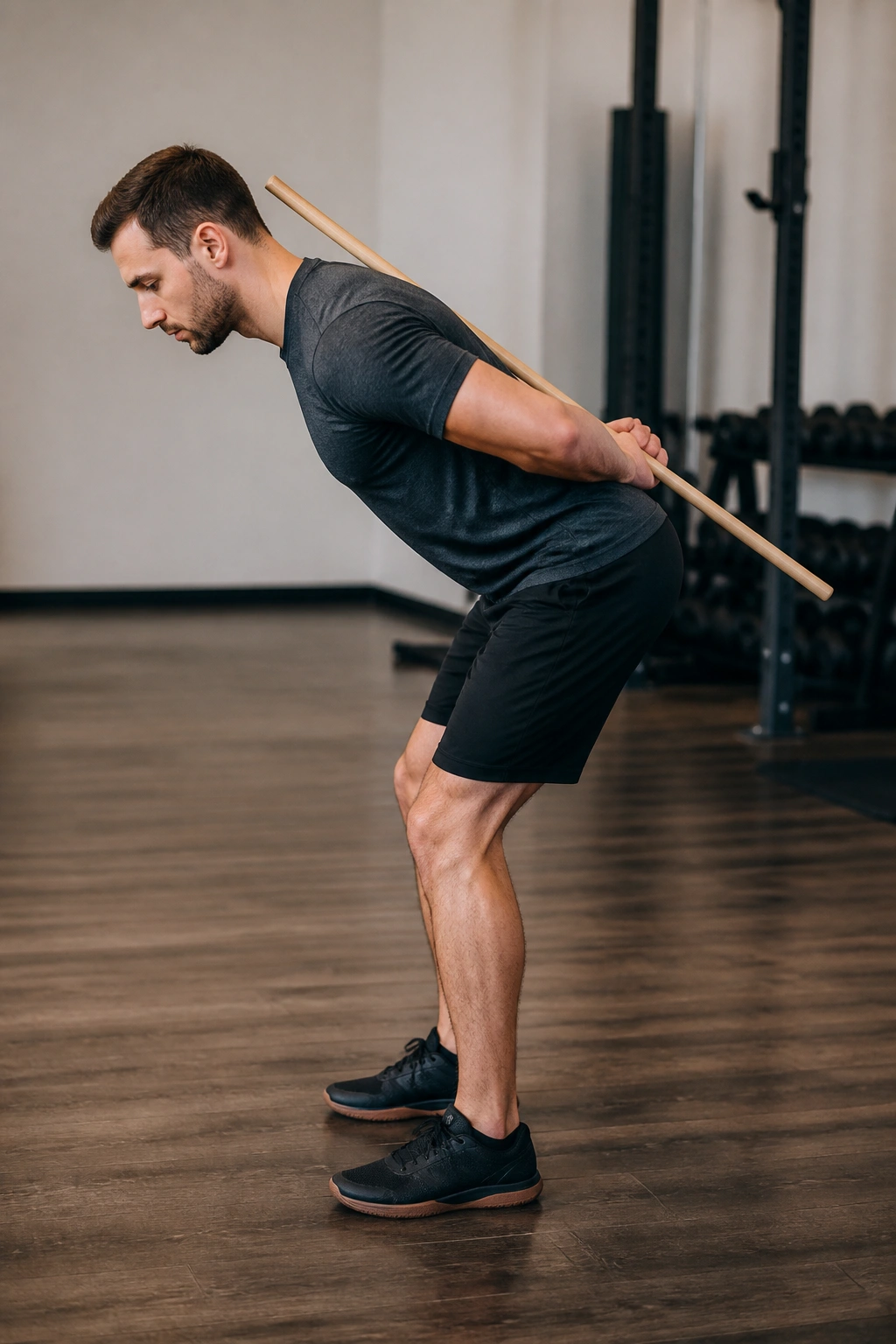
If your lower back does all the complaining and your glutes do all the sleeping, the hip hinge needs attention. This is the movement pattern behind Romanian deadlifts, kettlebell deadlifts, good mornings, and the kind of bending that keeps your spine from doing a bad job of being hips.
I’m a fan of hinge work because it pays rent in real life. Picking something up from the floor should not feel like a puzzle. Stronger hamstrings and glutes help with that, but they also show up in running, jumping, climbing stairs, and just not looking like you hate standing up from a chair.
Start with a dowel, a light kettlebell, or dumbbells. Push your hips back, keep a soft knee bend, and stop when your hamstrings say “enough.” If you round your back on every rep, the load is too heavy or the pattern is too rushed.
A clean hinge usually feels boring for the first few reps. Good. Boring is often where the progress is hiding.
10. Chase Pulling Volume

Most bodies look better when the upper back gets more attention. That’s not a compliment to aesthetics alone. More pulling volume usually means better posture under load, stronger shoulders, and a back that can handle the push work you keep throwing at it.
Rows, pull-downs, assisted pull-ups, band rows, and face pulls all count. You do not need to marry one movement. You need enough total pulling to balance the rest of your training. A simple target is 50 to 100 quality pulling reps per week, depending on load and recovery.
A practical pulling mix
- Chest-supported row: 3 sets of 8-12
- Lat pull-down: 3 sets of 8-10
- Band face pull: 2 sets of 15-20
- Assisted pull-up: 3 sets near technical failure
That’s a lot of shoulder-friendly work in not much time. If you sit a lot, pull more. If you press a lot, pull more. If your shoulder blades don’t move well, pull with control and stop yanking the handle like you’re starting a lawn mower.
11. Work One Leg at a Time

Split squats make honest people out of gym-goers. So do step-ups and single-leg Romanian deadlifts. Once you stop letting the stronger side do half the work, you notice how much imbalance was hiding inside your “normal” squat pattern.
Single-leg training is awkward at first. Fine. Awkward is useful. It tells you where your balance, ankle control, and hip stability need help. It also tends to smoke the legs with lighter loads than bilateral work, which is a nice bonus when you want growth without beating up your spine.
Try 2 to 4 sets of 6 to 10 reps per leg. Use a box height that lets you keep the working foot flat and the knee stable. If one side is clearly weaker, don’t panic and don’t immediately double the load on the strong side. Clean reps are the win.
My favorite part is how fast you feel the difference in day-to-day movement. Stairs feel tidier. Walking feels smoother. That’s not magic. It’s just better mechanics.
12. Slow Your Reps Down

Slower hurts — in a useful way. A tempo challenge forces you to own the whole rep instead of bouncing through the easy parts and pretending that counts as training. Three seconds down, one second pause, controlled up. That’s enough to expose weak points fast.
Tempo work is especially good when your form gets sloppy under speed. Squats turn into dips. Push-ups turn into half-reps. Rows turn into jerks. Slowing the movement strips away that nonsense and makes the muscle do the job.
A tempo that works
- Lower for 3 seconds
- Pause for 1 second
- Lift in 1 to 2 seconds
- Rest 45 to 90 seconds between sets
Use it on goblet squats, push-ups, split squats, or dumbbell presses. Don’t turn every exercise into a grind. One or two tempo lifts per workout is enough to change the feel of the whole session. More than that can get annoying fast, and yes, annoying is a real training problem.
13. Keep a Mobility Minimum
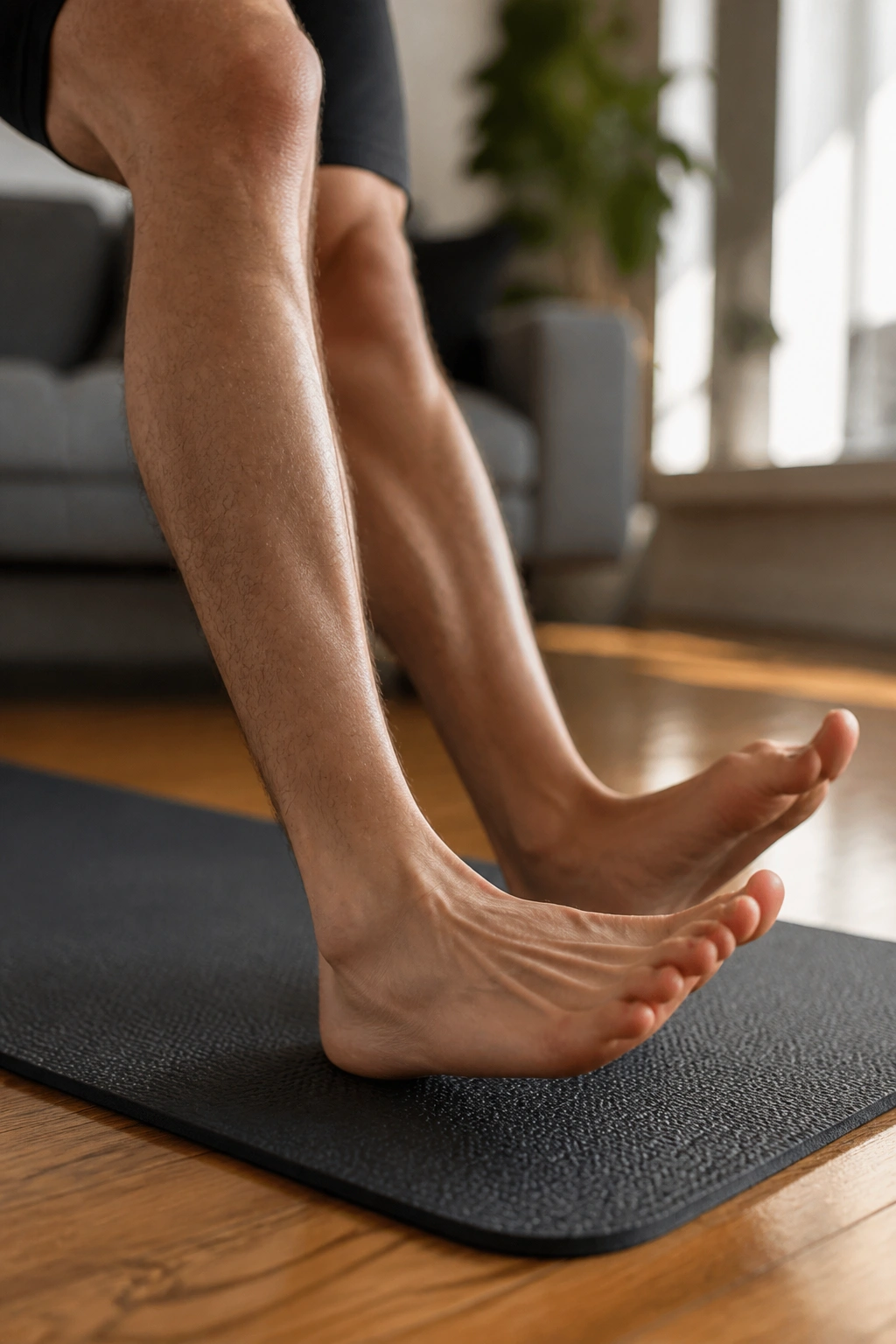
Do you need a 45-minute stretching ritual to move well? No. Usually not. An 8- to 12-minute mobility minimum done most days beats one heroic stretch session you abandon after a week.
I like this challenge because it keeps the joints from getting rusty without making your life weird. Ankles, hips, thoracic spine, and shoulders tend to be the usual suspects. Give each area a little attention and you’ll notice that squats feel less stiff, overhead work feels less cranky, and walking down stairs stops feeling like a negotiation.
A simple daily sequence
- 30 seconds of ankle rocks per side
- 60 seconds of hip flexor stretch per side
- 6 slow thoracic rotations per side
- 10 band pull-aparts or wall slides
You don’t need to worship the stretch. You need to move through usable ranges without fighting your own body. That difference matters more than people like to admit.
14. Run an EMOM Conditioning Block

Put a timer on for 12 minutes and let each minute force the pace. That’s an EMOM — every minute on the minute — and it’s one of the cleanest ways to build conditioning without getting lost in sloppy cardio.
The structure is simple. Do a small amount of work at the start of each minute, then rest until the next minute begins. If you choose the right number of reps, you’ll keep moving without collapsing. If you choose too many, the workout turns into panic. So start modest.
Good EMOM options
- 6 air squats every minute
- 5 push-ups every minute
- 8 kettlebell swings every minute
- 10 mountain climbers per side every minute
Mix two or three movements across 12 to 16 minutes. Keep the pace honest and the reps crisp. What I like most here is the built-in discipline. The clock removes the guesswork. It tells you when to work, when to breathe, and when to stop overthinking the whole thing.
15. Build a Core Rotation Circuit

Endless crunches are a boring use of floor space. Your core does more than bend your spine. It resists twisting, transfers force, and keeps you from folding in half when life gets awkward. A rotation-and-resistance circuit trains that better than mindless burn work.
Think Pallof presses, cable chops, side plank reaches, and slow medicine-ball rotations. These moves teach your torso to stay stable while your arms and legs do something useful. That is far closer to real movement than trying to torch your abs into submission.
What to do instead
- Pallof press: 8 to 12 reps per side
- Side plank reach-through: 6 to 8 reps per side
- Cable or band chop: 8 to 10 reps per side
- Dead bug with exhale: 6 to 8 reps per side
Use controlled breathing. Brace before the rep starts. If your lower back twists like a towel, lighten the load or shorten the range. Strong cores are usually quiet cores.
16. Protect a Real Recovery Day

The day you skip a hard workout can be the day you keep making progress. That sounds backward until you’ve spent enough time training to know how easy it is to confuse soreness with work. A real recovery day is not laziness. It is part of the plan.
Keep the movement light. Walk for 20 to 40 minutes, do a few mobility drills, and maybe add easy cycling or an unhurried stretch session if it feels good. No heavy loading. No “I’ll just test one thing” nonsense. That’s how recovery days get hijacked.
Your body tells on you here. Sleep gets weird, appetite can swing, and the warm-up starts feeling longer than the workout. Those are signals to back off a little, not proof that you need to punish yourself harder. More people need that sentence on a wall somewhere.
Recovery day rules
- No lifting to failure
- No hard intervals
- No extra challenge “just because”
- Keep the effort at a pace you could repeat tomorrow
17. Hit a Protein Floor

A workout plan can be sharp and still miss the mark if every meal is random. The protein floor challenge keeps that from happening. Aim for a meaningful dose of protein at each meal so your body has what it needs to repair tissue, hold onto muscle, and keep you full enough to avoid snack chaos.
A practical floor is 25 to 35 grams per meal for many adults, repeated across 3 or 4 meals. Bigger, stronger, or very active people may need more. The exact number matters less than the habit of not showing up to lunch with a sad little string cheese and calling it recovery.
Easy ways to hit it
- Greek yogurt with berries and nuts
- Eggs plus cottage cheese on the side
- Chicken, tofu, or salmon with rice and vegetables
- Protein shake after training when food is awkward
I’m not interested in fake purity here. If protein powder helps you get the job done, use it. If you’d rather eat food, great. The win is consistency, not culinary theater.
18. Run a Weekly Progress Check

How do you know a challenge is working if the mirror plays tricks on you? You check something measurable. A weekly progress audit keeps you from guessing, and guessing is where a lot of training plans start to drift.
Pick 3 to 5 things and track them the same way each week. That could be body weight, waist measurement, reps on a lift, walk time, sleep hours, or how your clothes fit. Don’t track twelve things unless you enjoy turning training into paperwork.
What to track
- Waist at the navel
- Morning body weight
- Reps on one key lift
- Total steps
- Sleep length and quality
You’re looking for trend lines, not dramatic single-day drama. One heavier morning means nothing. Three weeks of stronger lifts and a steadier waistline mean something. Keep the check-in short, honest, and unemotional. That last part is harder than it sounds, which is probably why it works.
The Bottom Line
The best fitness challenges for steady body progress are the ones that create repeatable stress, then let you recover from it. Steps, strength work, Zone 2, carries, tempo reps, mobility, and recovery days all pull in the same direction when you stop treating them like separate hobbies.
Pick three or four to start. One should push strength, one should improve conditioning, one should clean up movement, and one should protect recovery. That mix usually beats a random pile of hard workouts, and it’s a lot easier to live with.
If you want steady change, don’t chase the loudest challenge in the room. Chase the one you can still do next week.
