



A baby who falls asleep in your arms, wakes ten minutes later, and cries the instant the crib mattress touches their back can make a house feel upside down. It is exhausting. It is also more ordinary than most tired parents realize.
Most baby sleep problems are not proof that something is wrong with your baby or your routine. They usually come from small stomachs, immature sleep cycles, a body clock that has not settled yet, or a habit that worked fine for a tiny newborn and starts to cause trouble a few months later. That is why so many of the worst early sleep headaches change shape before the first birthday.
By the time the first year has passed, a lot of those early battles have softened. Night feeds usually space out. Naps often stop being such a wild guess. The swaddle drops out of the picture, and some babies begin to settle with less drama. Not every problem disappears cleanly, and some need medical attention, but the overall night usually gets easier to read.
If your baby snores loudly, seems to struggle to breathe, spits up with real pain, or has poor weight gain, that is a different conversation. For the everyday mess — the short naps, the 5 a.m. wakeups, the rocking marathon, the sudden midnight party — the first year usually brings real relief, and there are specific reasons it happens.
1. Day-Night Confusion, the First Baby Sleep Problem
Newborns are not born knowing the difference between lunch and 2 a.m. Their brains are still wiring up the sleep-wake system, so the first stretch of life can feel completely scrambled. A baby may nap hard in the afternoon, wake wide-eyed at midnight, then act offended by dawn.
That does not mean you are doing anything wrong. It means the body clock is still catching up.
The fix is not about forcing a tight schedule. It is about giving the brain better signals. Bright light in the morning helps, and so does normal daytime activity. At night, keep things dim, quiet, and boring. Feed, change, settle, and return to sleep mode without turning the room into a social event.
Boring at night is the point.
By the first year, many babies have a clearer sense of day and night because the circadian rhythm has had months of practice. Sleep is still messy, because babies are babies, but the all-over-the-map feeling usually fades.
2. Short Naps Usually Grow Into Real Naps

Why does a 25-minute nap feel like a personal insult? Because it often is the first sleep cycle ending before the baby knows how to link into the next one.
Young babies wake at the end of a cycle and stop there. Later, as the nervous system matures, they get better at rolling from one cycle into the next without fully coming up for air. That shift is a big deal. It turns a string of tiny naps into something closer to a real rest period.
How to Stretch a Nap
A few small changes usually help more than one big overhaul.
- Put the baby down for the first nap of the day after the shortest wake window.
- Keep the room dark and boring, not dim and interesting.
- Use the same little pre-nap routine every time: diaper, sleep sack, short song, crib.
- Give a fussing baby 10 to 15 minutes before rushing in, unless something feels off.
- Rescue one nap a day if needed. A stroller nap or contact nap can protect total sleep while everything else is still settling.
Short naps are frustrating, but they are not rare. They are a phase. And by the first year, many babies start stringing sleep together better simply because their sleep cycles have grown up a bit.
3. Night Feeds Start Spacing Out as the Stomach Grows

The baby who wakes every two hours to eat can make the whole night feel like a long hallway with no doors. Hunger is real in the early months. Tiny stomachs empty fast, and growth spurts do not care about your bedtime.
Still, the pattern often changes over time. As babies take in more milk during the day and their bodies get better at handling longer stretches, those night feeds usually begin to space out. Not always fast. Not always cleanly. But the shape changes.
The trick is to pay attention to whether the baby is truly hungry or mostly waking out of habit. A baby who feeds hard, settles quickly, and grows well may still need night calories for a while. A baby who takes a small snack, falls asleep on the bottle or breast, and wakes again an hour later may be asking for comfort as much as food.
- Feed well during the day, especially in the late afternoon and evening.
- Watch the diaper output and weight gain if you are wondering whether night feeds are still needed.
- Keep nighttime feeds calm and low-key so the baby does not start treating them like a party.
- If your pediatrician wants night calories preserved, do not rush to cut them out.
By the first year, many babies can manage longer night stretches because the stomach is bigger, the feeding rhythm is more efficient, and sleep pressure has started to carry more of the load.
4. Feeding and Rocking to Sleep Stop Being the Only Answer

Unlike a baby who can drift off anywhere, a baby who only falls asleep while eating or being bounced has tied sleep to one very specific cue. That works fine for a while. Then it gets sticky.
Sleep associations are one of those baby sleep problems that seem harmless until the baby wakes between sleep cycles and notices the cue is gone. If the bottle, breast, rocking chair, or bounce ball was the thing that launched sleep, the baby may want that same thing again at 1:40 a.m. and 3:10 a.m. and 5:00 a.m. The math gets ugly fast.
I am not anti-rocking. Rocking is soothing. Feeding is soothing. Human contact is soothing. The problem is not comfort itself. The problem is when comfort becomes the only bridge into sleep.
The easiest fix is usually to move the feeding a little earlier in the routine and give the baby a short gap before the final put-down. Not a giant gap. Ten minutes can matter. A diaper change, a book, a song, then the crib is enough for a lot of families.
A baby who starts learning to settle with less help often sleeps longer stretches before the first birthday. Not because you trained them into perfection. Because they stopped depending on one exact event to fall asleep every single time.
5. Contact Naps and Chest-Sleeping Fade Into Crib Sleep

A baby who only sleeps on your chest is not being dramatic. They are doing what their nervous system likes. Warmth, movement, smell, heartbeat — it is a very convincing package.
The trouble is that contact-only sleep can trap the whole house. You cannot put the baby down, finish lunch, or sit on the couch without becoming a human mattress. That is where the first year changes the picture. Many babies get more comfortable with a flat, safe sleep surface as their body control and sleep rhythm improve.
The transition usually goes better if you start small. One crib nap. The first nap of the day. A short transfer after the baby is heavy-eyed but not fully limp. Then leave the room boring and quiet.
The crib itself should stay empty and safe. Firm mattress. Fitted sheet. No loose blankets, pillows, or stuffed toys. Room-sharing is fine. Chest-sleeping all night is not safe sleep, even when it feels easier in the moment.
My honest take? Some contact sleep is fine if it helps everyone survive a rough patch. But if every nap and every night depends on your body, it is worth nudging things toward the crib. By the first year, a lot of babies can handle that shift much better than they could at six weeks.
6. False Starts After Bedtime Usually Mean Timing Is Off

You know the move. The baby goes down at 7:15, looks promising, and then wakes again at 7:50 like the whole thing was a prank.
That is a false start, and it usually points to timing. Too much wake time before bed can leave a baby overtired and wired. Too little wake time can leave them under-slept and half-ready to party. Both cases can produce the same miserable little wakeup, which is why parents get so annoyed by it.
What to Adjust First
- Shift bedtime 15 to 30 minutes earlier for three nights and watch what happens.
- Pull the last nap earlier or cap it if it runs too late.
- Cut back on bright lights, rough play, and noisy visitors in the final hour before bed.
- Check for hunger, gas, or discomfort if the pattern starts suddenly.
False starts often ease as wake windows lengthen and bedtime gets more predictable. By the first year, many babies have a better sense of how much awake time they can handle before sleep without tipping into that frantic second wind.
7. Early Morning Wake-Ups Get Better When Light and Hunger Stop Steering the Clock

A 5 a.m. wakeup is not always a sleep problem. Sometimes it is a light problem wearing a sleep mask. A thin curtain, a bright hallway, or dawn light sneaking through the blinds can be enough to tell a baby’s body that morning has arrived.
Hunger can do it too. Some babies learn that the first stirrings of light come with a feed, which makes early waking feel even more locked in. The fix is part environment, part habit. Keep the room dark. Treat any wake before your target morning time as night. Do not turn the first chirp into a full start to the day.
A lot of families accidentally reward the early wake by making the room brighter, more interesting, or more social than it needs to be. That is understandable. It is also a fast way to cement the habit.
I like a simple rule: if you would not serve breakfast in the dark at 5 a.m., do not act like it is breakfast time.
By the first year, early wakes often improve because the body clock is clearer and the baby can go longer without needing that first morning feed. Sometimes the fix is as plain as better blackout curtains. Sometimes it is an earlier bedtime. Usually it is both.
8. Split Nights Fade When Sleep Pressure Is Balanced

Why does a baby sometimes wake in the middle of the night and act like it is playtime? Because the body has a little too much awake energy left in the tank, or too much sleep was packed into the day.
Split nights are strange. The baby is awake for an hour or two in the middle of the night, but not always upset. They may babble, roll around, practice sitting, or stare at the ceiling with a level of calm that is deeply offensive to the adults involved.
That pattern often points to a daytime schedule issue. A late nap that goes too long. A bedtime that is too early for the amount of sleep pressure built up. Too much daytime sleep overall. Or a mix of all three.
How to Shut Down the Midnight Play Shift
- Shorten the last nap if it is dragging too close to bedtime.
- Keep night waking dark, quiet, and dull.
- Push bedtime a little later if the baby seems under-tired.
- Protect a steady morning wake time so the whole day does not drift.
By the first year, split nights often disappear because nap structure gets firmer and the baby’s sleep drive becomes easier to predict. Not glamorous. Very useful.
9. Overtired Bedtime Meltdowns Calm Down Once Wake Windows Make Sense

A baby rubbing eyes, arching their back, and screaming the second pajamas appear is usually not being difficult for the sake of it. They may be overtired. There is a difference, and it matters.
When babies stay up too long, they can swing past sleepy into wired. Parents call it a second wind because that is what it looks like. The baby is exhausted, but the nervous system is pumping anyway. Bedtime becomes a battle because the body is past the point where sleep feels easy.
What helps is matching bedtime to the baby’s actual wake window, not the clock you wish they could follow. Some days that means a nap was too short. Some days it means dinner and bath need to move earlier. Some days it means the afternoon got away from you and the baby paid for it.
Watch for the signs before the meltdown starts.
- Eye rubbing
- Yawning that keeps happening over and over
- Red eyebrows or a glazed look
- Fussing that ramps up fast
- Arching away from your arms
These are boring signals, which is exactly why they matter. By the first year, many babies do better once wake windows are a little longer and a little more predictable, because bedtime stops arriving late to the party.
10. Swaddle Transition Drama Ends When Rolling Takes Over

The swaddle is a beautiful trick for the early weeks. Then rolling shows up, and the trick stops being a trick and starts being a problem.
Once a baby shows signs of rolling, swaddling has to stop for safety. That can create a rough patch. Suddenly the baby has arms again, startles more easily, and looks personally betrayed by the whole arrangement. It is a loud few nights.
The fix is to move toward an arms-free sleep sack and give the baby a little time to adjust. Some families do one arm out for a night or two. Others go straight to both arms free. Either way, the point is the same: less containment, more safe movement.
Do not keep the swaddle around because it seems to “work.” Rolling wins. Safety wins. Full stop.
A lot of babies settle into the new setup faster than parents expect. They were never attached to the swaddle as much as they were attached to the feeling of falling asleep. Once that feeling becomes familiar in a sleep sack, the drama drops.
By the first year, this problem is usually gone because the swaddle is gone. That alone can make nights feel different.
11. Reflux and Spit-Up Discomfort Usually Ease With Maturity

Unlike sleep associations, reflux is not mostly a habit. It is physical. The digestive system is still maturing, the valve at the top of the stomach is still learning its job, and milk can come back up with embarrassing ease.
That is why some babies seem to hate lying flat after feeds. They squirm. They grunt. They wake soon after being laid down. Others spit up plenty and sleep fine. Same symptom, different baby.
A few practical things help without turning bedtime into a medical project. Keep feeds calm. Pause for burps during and after the feed. Hold the baby upright for a short stretch afterward if that seems to help. Avoid tight waistbands or pressure on the stomach. And if you are worried about larger symptoms, get medical advice instead of trying to guess.
Red flags deserve attention:
- poor weight gain
- forceful vomiting
- blood in spit-up or stool
- breathing trouble
- clear pain that keeps happening
By the first year, many babies outgrow the worst of the reflux discomfort as the digestive tract matures. Sleep is often part of that improvement, because lying flat stops feeling like such a gamble.
12. Teething Wake-Ups Are Loud, Short, and Usually Temporary

Teething can make a baby miserable for a few nights, and then vanish like it never happened. That is part of why it confuses parents. One week the baby is fine. The next week there is drool on everything, a swollen gum line, and a 2 a.m. protest over nothing obvious.
What Helps Most
- Offer a chilled teether, not a frozen rock-hard one.
- Rub the gums with a clean finger for a minute or two.
- Keep the bedtime routine steady so teething does not become a new sleep association.
- Ask your pediatrician about pain relief if the baby seems truly uncomfortable.
Teething usually produces short, noisy wakeups rather than a total collapse of sleep for weeks on end. That is a useful distinction. If the baby is miserable every night for a long stretch, look beyond teething and check for another cause.
Do not build a whole new bedtime system around teething. That is how a temporary ache turns into a long-term pattern.
By the first year, many babies have already pushed through some of the first teeth, so this problem often becomes easier to understand and easier to ride out.
13. Separation Anxiety at Bedtime Softens With Short, Predictable Goodbyes
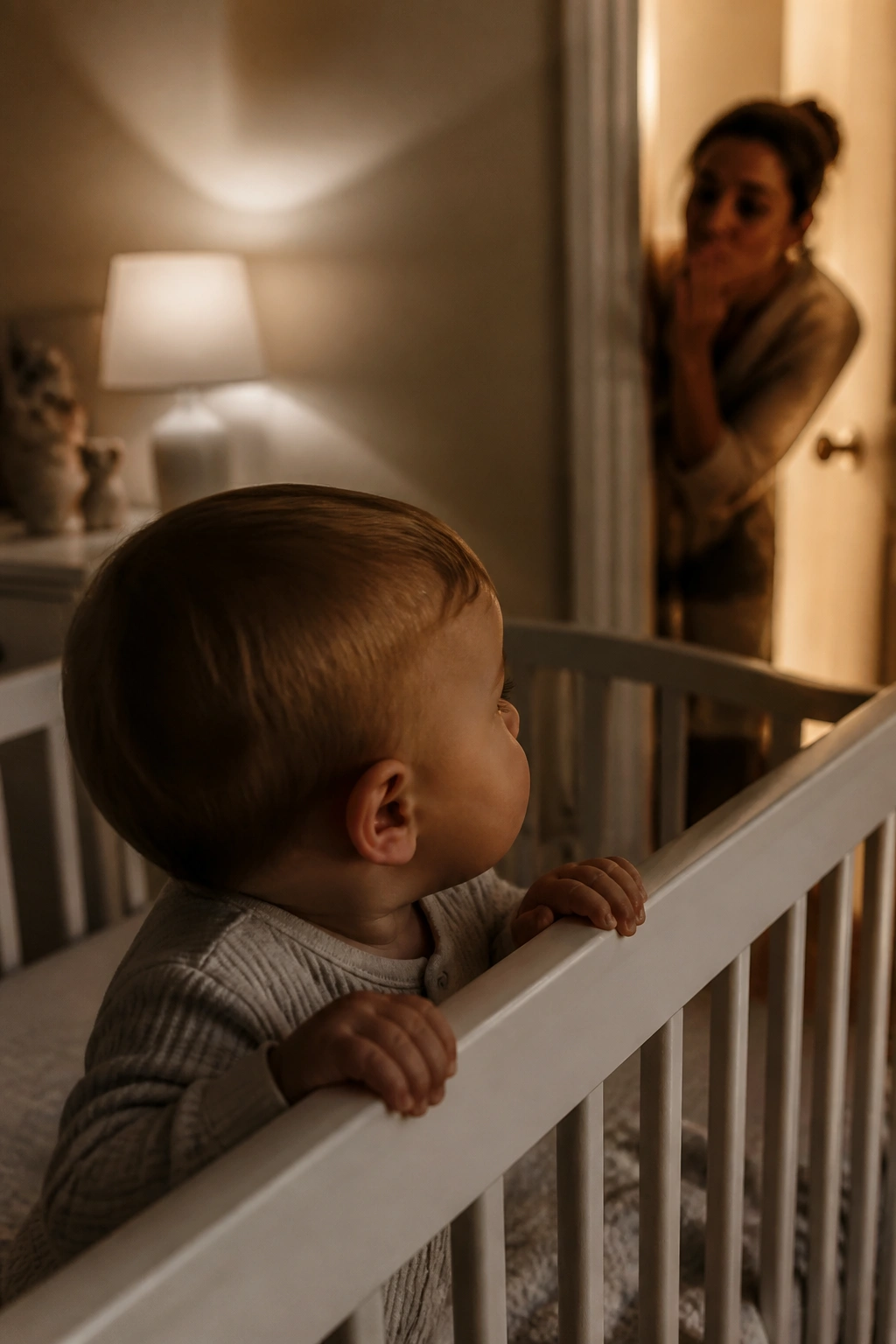
Around the second half of the first year, some babies get very interested in where you went. That is separation anxiety doing its thing. The baby has learned that you can leave, and that discovery can make bedtime feel personal.
The answer is not a dramatic farewell. It is the opposite. Keep the goodbye short, calm, and repeatable. Same phrase. Same tone. Same basic routine. Long emotional exits often make the baby more alert, not less.
Sneaking out usually backfires too. Babies are excellent at noticing when the pattern changes. If you disappear without a clean cue, they may get even more suspicious next time.
A small, steady bedtime routine helps here because it tells the baby what comes next. Bath, pajamas, feed, book, crib. Nothing elaborate. Nothing theatrical.
One clean sentence, one kiss, done.
By the first year, many babies begin to tolerate brief separations better because they have more memory of what happens next and more trust in the repeat pattern. That does not mean they love bedtime. It means the panic starts to ease.
14. Nap Transitions Stop Wrecking the Day Once the Schedule Fits

Why does one skipped nap throw the whole house off? Because nap transitions are hard. Babies move from three naps to two, then from two to one, and each shift can make sleep look broken for a while.
The weird part is that the baby may seem tired but refuse sleep, or happy but melt down ten minutes later. That is not a character flaw. It is a schedule mismatch. The wake windows are changing faster than the family can keep up.
How to Handle the Switch
- Shorten the last nap before it starts pushing bedtime too late.
- Move bedtime earlier for a few days if naps fall apart.
- Keep the morning nap consistent while the schedule settles.
- Watch the baby’s sleepy cues instead of forcing the clock to do all the work.
Nap transitions can be messy for a couple of weeks, sometimes longer if the baby is in the middle of a developmental leap. Still, they often stabilize before the first birthday or shortly after because the baby simply does not need the old nap pattern anymore.
I find this one easier to manage when parents stop trying to save every nap. Sometimes the right move is an early bedtime and a fresh day.
15. Rolling, Sitting, and Standing Practice Stays Out of the Crib After Plenty of Daytime Reps

A baby who rolls to the stomach, sits up, or pulls to standing in the crib may look like they are staging a midnight gym session. They are mostly practicing skills.
The brain loves rehearsal. If a baby has just learned to roll or stand, bedtime is often when those new moves get tried over and over again. The crib becomes interesting for the exact wrong reason. That can interrupt sleep for a while, especially in the middle and later parts of the first year.
What helps is plain old daytime practice. Give the baby lots of floor time. Practice rolling both ways. Let them work on sitting and standing when they are awake and supported. Then make the crib boring again.
- Lower the crib mattress once standing starts.
- Keep the crib empty except for the fitted sheet and sleep sack.
- Pause for a moment before rushing in if the baby is safe and only fussing.
- If the baby can roll both ways, let them find a comfortable position and settle.
This one usually calms down after the new skill stops feeling novel. By the first year, the body has rehearsed enough that the crib is less exciting and sleep has a better shot at staying asleep.
Final Thoughts

The first year does not erase every sleep problem. It changes the terms of the problem. Tiny stomachs get bigger. Sleep cycles lengthen. Light starts to matter less at 2 a.m. and more at 6 a.m. The night still has rough patches, but the rough patches usually make more sense.
Some fixes are annoyingly plain: earlier bedtime, darker room, shorter goodbye, fewer accidental crutches at sleep onset. Those boring fixes are often the ones that work. Not because they are clever, but because they match how a baby’s body actually matures.
If your baby seems in pain, struggles to breathe, or is not growing the way they should, stop guessing and get medical advice. For the everyday sleep chaos, though, the first year usually brings a real shift. Small change by small change, the night gets less wild.
