



There is a specific kind of dread that sets in when you walk into a gym and see every single squat rack occupied. It is a familiar sight for anyone who trains seriously. You have your programming ready, your headphones are charged, and your mindset is locked in, only to be thwarted by a crowded room. Most people take this as a sign to settle for a mediocre workout or wait indefinitely for a barbell.
Don’t be that person.
The truth is that you can build a massive, functional, and powerful lower body without ever touching a barbell. In fact, if you spend your entire training career solely relying on the squat rack, you are likely leaving massive gaps in your development. Dumbbells offer something a barbell cannot: independent loading. When you hold a weight in each hand, your body has to work overtime just to keep the weights balanced. Your stabilizer muscles, which are often ignored during heavy barbell movements, suddenly find themselves under intense pressure.
This shift in training isn’t just about convenience. It is about longevity and structural balance. When you force your left leg to work just as hard as your right, you eliminate the imbalances that lead to injury down the road. You also gain freedom. You can train anywhere, with minimal equipment, and still hit your quads, hamstrings, glutes, and calves with enough intensity to trigger hypertrophy.
Let’s tear down the reliance on the rack and look at the exercises that will actually force your legs to grow. These are not filler movements. These are foundational lifts that demand precision, effort, and a high level of mental engagement.
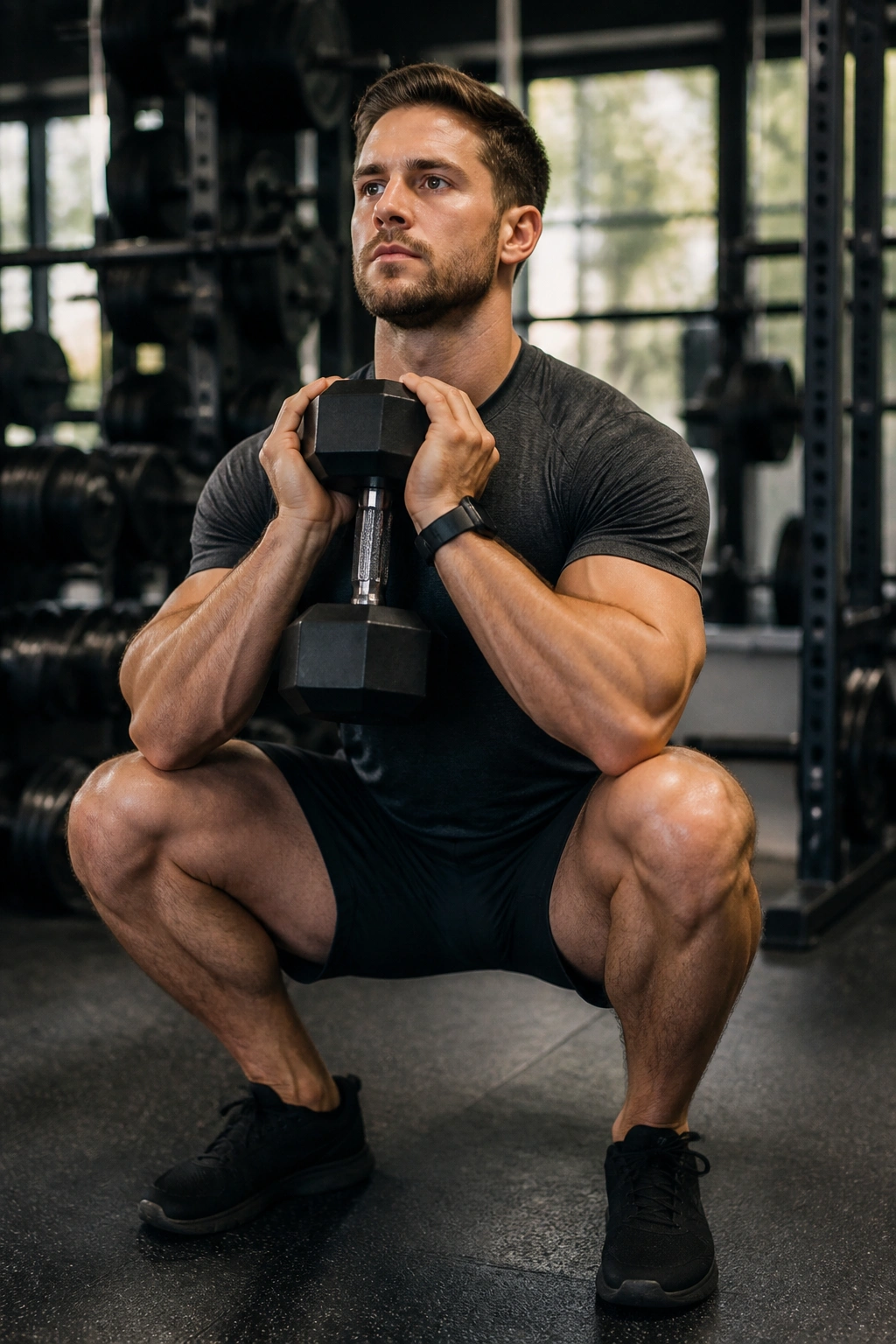
1. Goblet Squats
The goblet squat is the gold standard for teaching proper squat mechanics. It is simple to execute but ruthlessly effective when you go heavy. By holding a single dumbbell vertically against your chest, you create a counterbalance that forces your torso to stay upright. If you lean forward, you will lose the weight. It is that simple.
Why It Works for Your Quads
Because the weight is in front of you, your center of mass shifts. This allows you to squat deeper than you might with a back-loaded barbell, which increases the range of motion for your quads. You are not just going through the motions; you are hitting a deep stretch in the bottom position.
- Keep your elbows tucked in tight to your ribcage.
- Drive your knees out as you descend; do not let them cave inward.
- Pause for a full second at the bottom to kill all momentum.
Pro tip: Think about “tearing the floor apart” with your feet as you stand up. This cue engages your glutes immediately, preventing your hips from shooting up too fast and putting unnecessary strain on your lower back.
2. Dumbbell Romanian Deadlifts (RDLs)
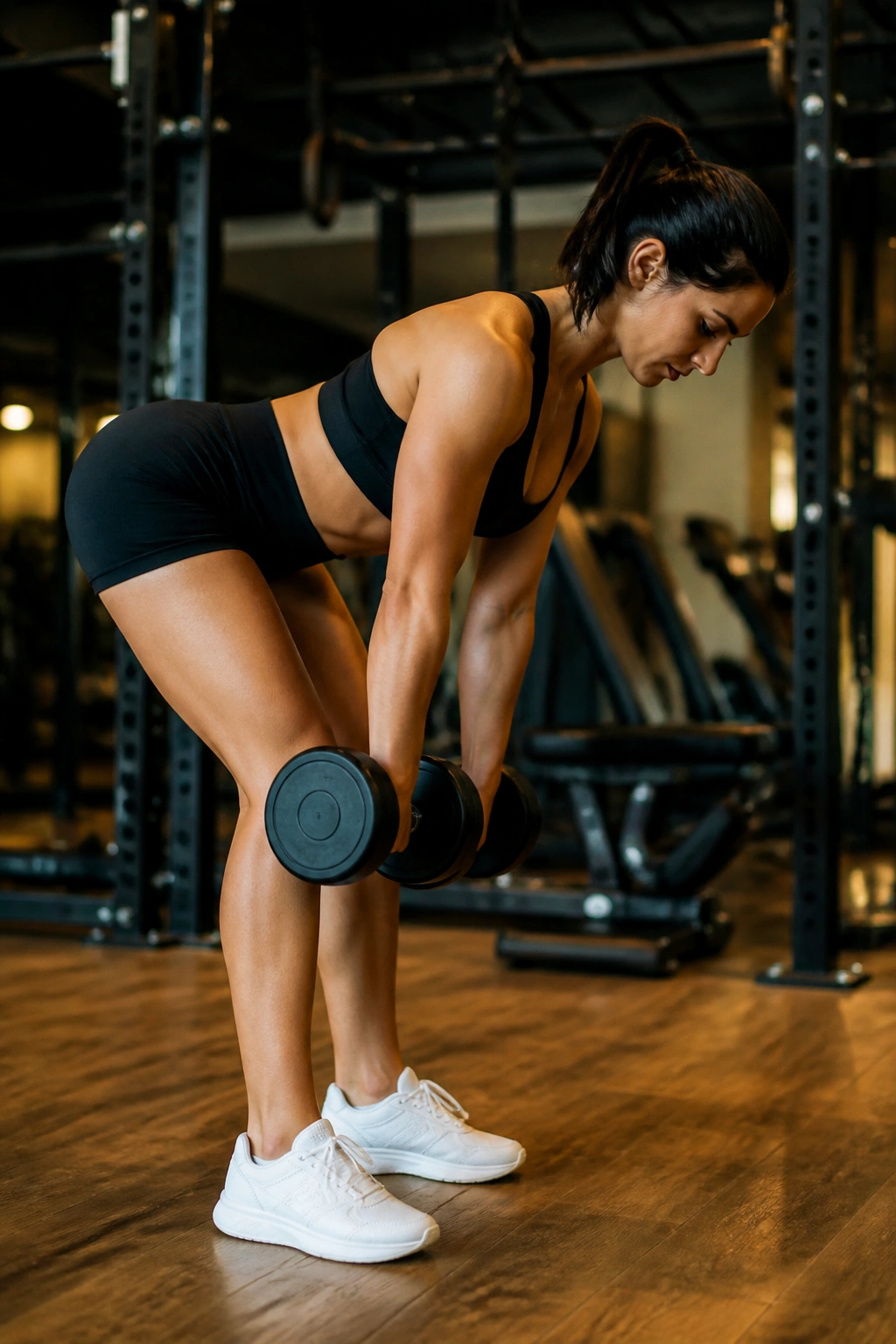
If you want hamstrings that look like steel cables, you have to master the hinge. The Romanian deadlift is not a squat. It is a hip-dominant movement that requires you to push your hips back while keeping your shins nearly vertical. If your knees are bending excessively, you are doing a squat, not an RDL.
Finding the Rhythm
The secret to a good RDL is the stretch. You should feel an intense, almost uncomfortable pull in your hamstrings as you lower the dumbbells. Do not lower them all the way to the floor unless your mobility allows you to keep your back perfectly flat. Stop when your hips stop moving backward.
- Start with a slight knee bend, then lock that angle.
- Slide the dumbbells down your legs; keep them as close to your shins as possible.
- Squeeze your lats as if you are crushing an orange in your armpits to keep your spine neutral.
If you are not feeling this in your hamstrings, check your hip position. If your hips are not traveling backward, you are just bending over at the waist. Push your glutes toward the wall behind you.
3. Bulgarian Split Squats
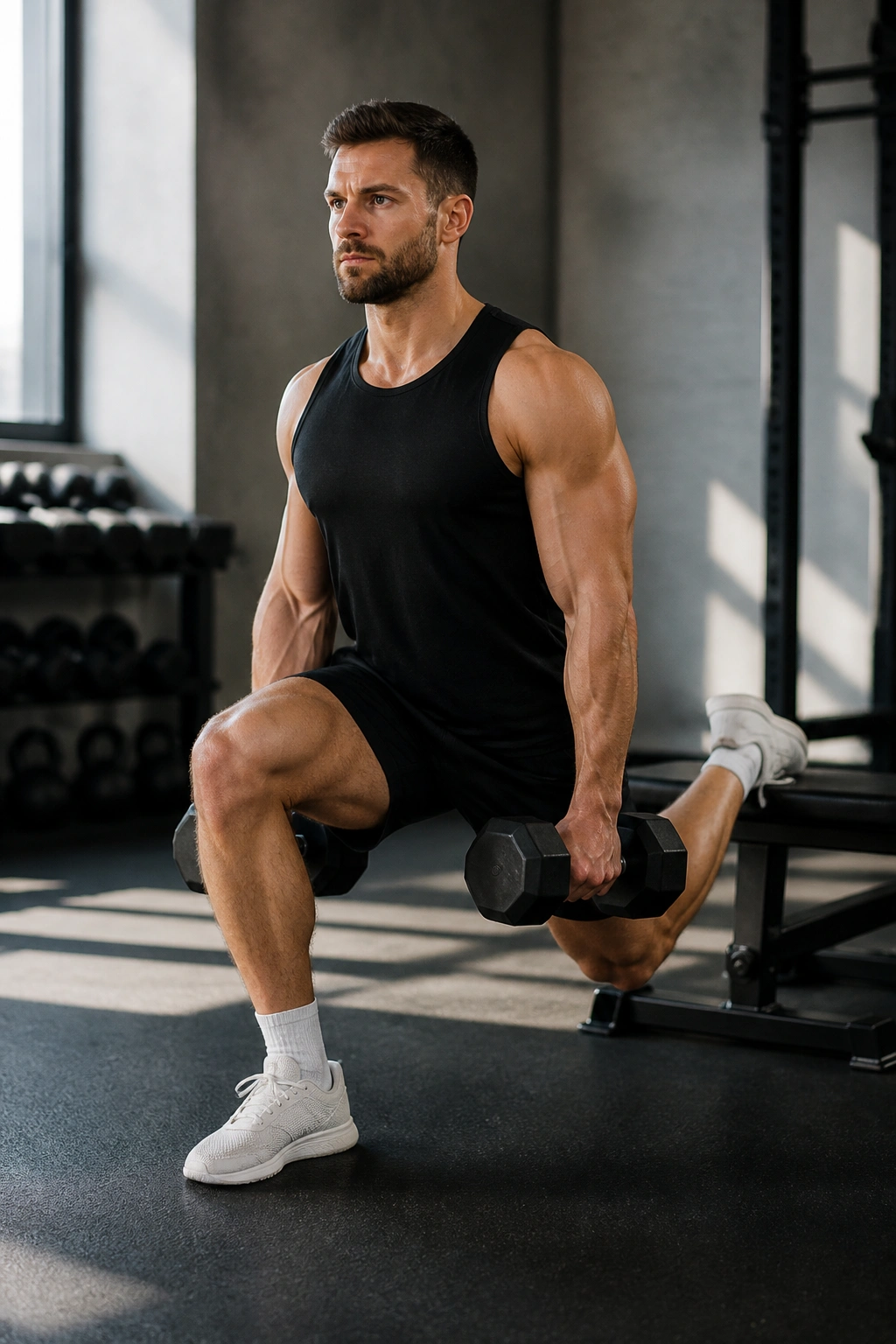
Let’s be honest: everybody hates Bulgarian split squats. There is a reason for that. They are incredibly difficult. Elevating your rear foot forces your front leg to carry almost the entire load, and it exposes every ounce of weakness in your balance and hip stability.
The Anatomy of the Pain
When you perform this movement, your front leg becomes a single-limb squat machine. The depth you can achieve is usually much greater than a standard squat, which puts the gluteus medius and the quads under immense stress. It is a love-hate relationship, but the results are undeniable.
- Do not stand too close to the bench. If you are too close, you will cramp your hip flexors.
- Keep your torso upright. Leaning forward too much turns this into a hinge movement, which shifts the emphasis away from the quads.
- Hold the dumbbells at your sides, or if your grip is the limiting factor, use a weight vest or hold a single weight in the goblet position.
If you find yourself wobbling, do not drop the weight immediately. Use the stability challenge to your advantage. Those micro-adjustments you are making to stay upright are building strength in the small muscles around your ankle and knee.
4. Dumbbell Walking Lunges
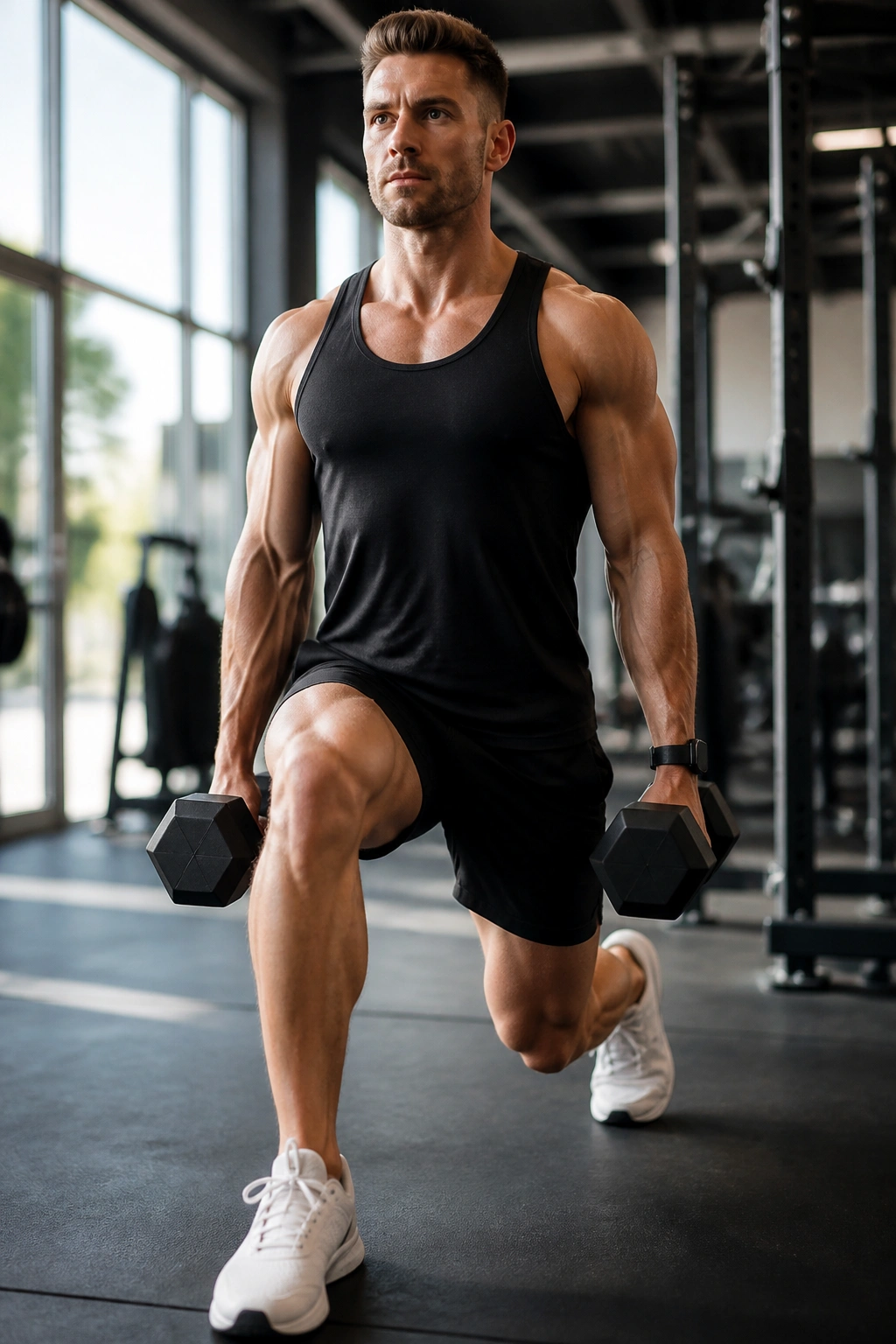
Walking lunges are a test of endurance as much as they are a test of strength. Most people perform these too quickly, treating them like a cardio sprint. Slow down. Control the descent. Treat each stride like a standalone rep of a split squat.
Building Dynamic Stability
Unlike a static lunge, the walking variation forces you to decelerate your body weight every single step. This puts a massive amount of tension on your quads and glutes as they act as a brake for your momentum. It is a fantastic way to develop functional strength that translates directly to sprinting or field sports.
- Take a large enough step so that your front knee is over your ankle, not your toes.
- Make sure your hips stay square to the front. Don’t let your torso rotate as you step.
- If you find yourself losing balance, focus on a spot on the wall directly in front of you.
Do not worry about covering distance. Perform these in a confined space if you have to, by lunging forward and then bringing your back leg up to meet the front before the next rep. It keeps the tension constant.
5. Sumo Squats
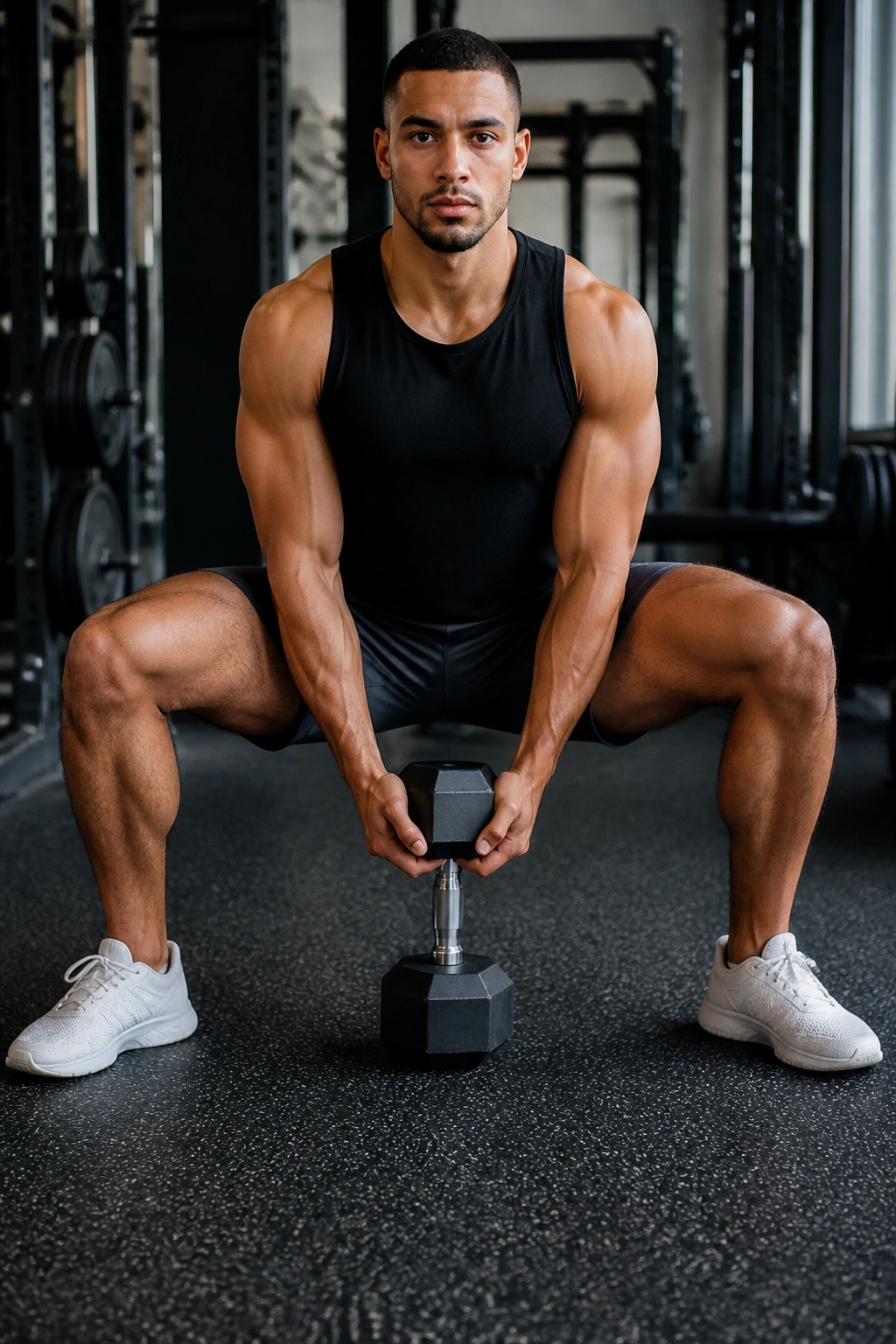
The sumo squat is often misunderstood as a “glute exercise,” but it is arguably one of the best ways to target the adductors—the inner thighs. By taking a wide stance and pointing your toes outward, you force your hips to open up, which changes the leverage on your lower body significantly.
Mastering the Wide Stance
You don’t need a heavy barbell to make these work. Holding a heavy dumbbell between your legs (or two in your hands) forces your torso to stay upright, emphasizing the inner quads and adductors. This is a crucial movement for anyone looking to build “thick” legs rather than just “defined” legs.
- Maintain a wide stance with your toes pointed at roughly a 45-degree angle.
- Drop your hips straight down, not backward.
- Focus on driving your knees out in the same direction as your toes.
If your knees start to collapse inward, your stance is too wide for your current hip mobility. Narrow it just an inch or two. It is better to have a slightly narrower stance and perfect form than a wide stance that causes knee pain.
6. Dumbbell Step-Ups
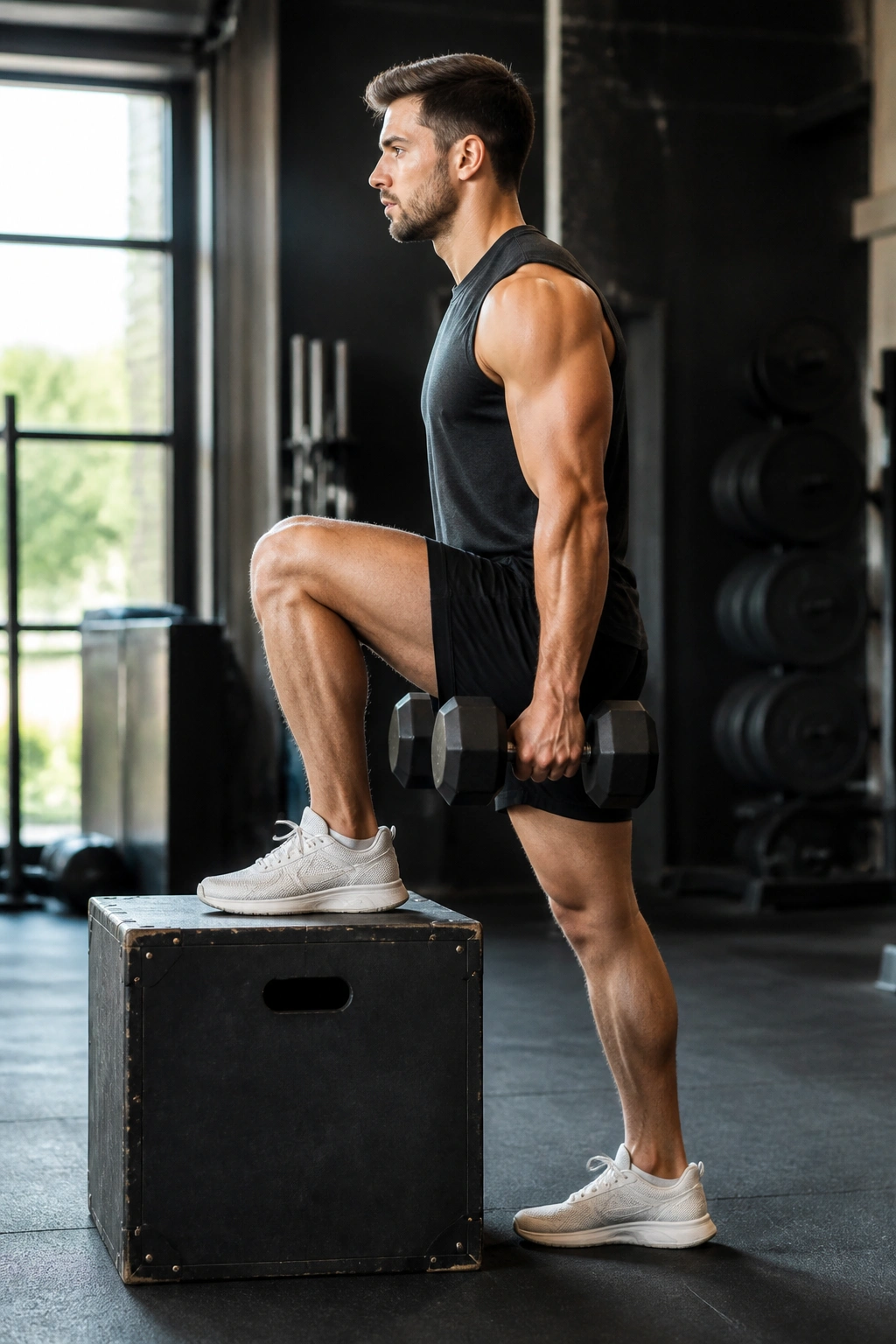
Step-ups are the most overlooked leg exercise in the gym. They are functional, they build glute strength, and they are incredibly difficult if you use a high enough box. The key here is the “drive.” You must push off the elevated leg without using the floor leg for momentum.
Developing Unilateral Power
This is a pure strength move. If you are using a bench that is too low, you are just doing a cardio move. Find a box or bench that puts your knee at about 90 degrees or slightly higher when your foot is planted. This forces your glutes to do the heavy lifting from a dead stop.
- Plant your entire foot on the box; do not let your heel hang off.
- Drive through the mid-foot of the elevated leg.
- Try to stand up without “popping” off the floor with your rear foot.
If you struggle with balance, find a wall to place one hand against for support. Do not let the lack of balance prevent you from loading this movement heavily.
7. Dumbbell Glute Bridges
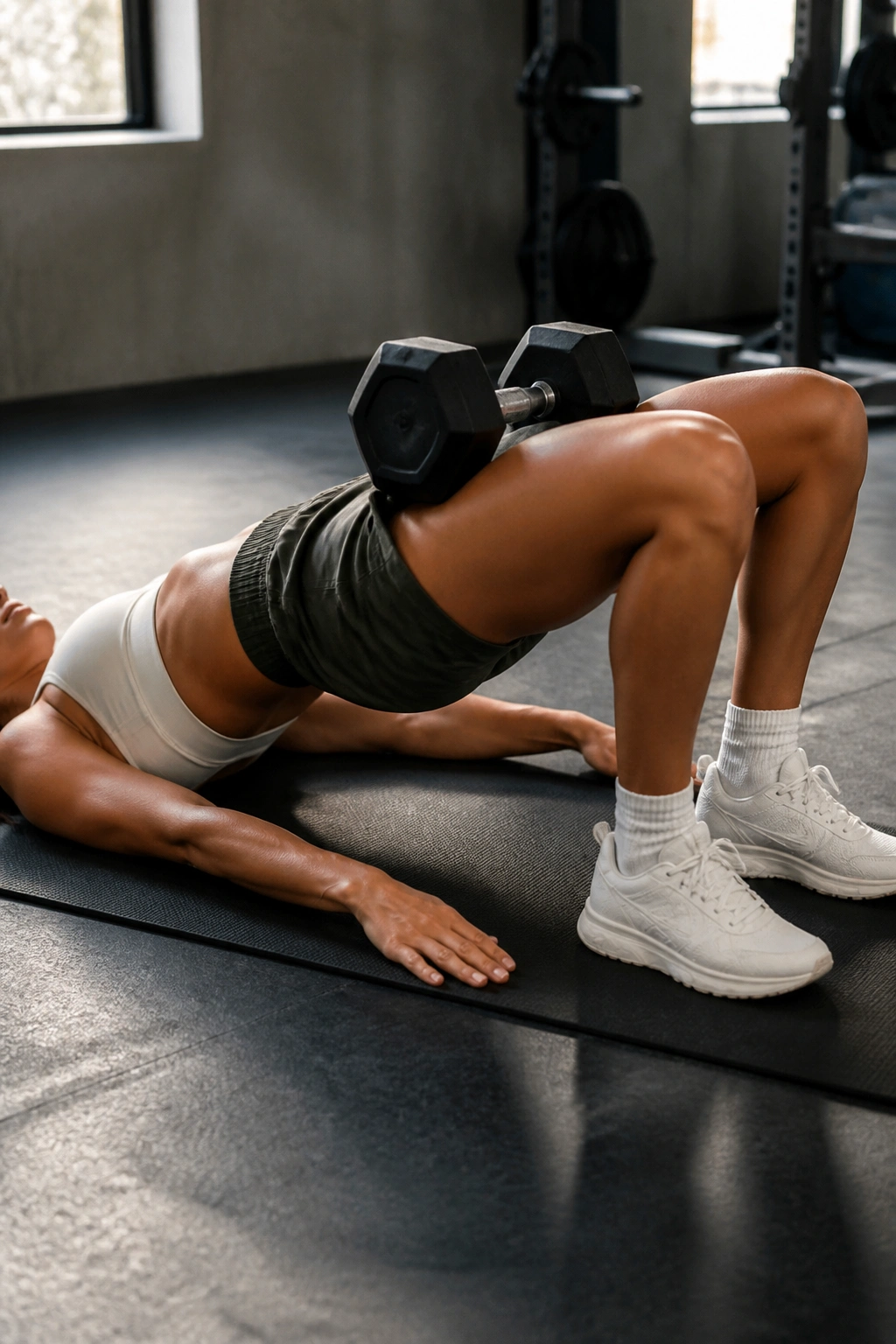
Floor work is rarely viewed as “hardcore,” but the glute bridge is the exception. When you add a heavy dumbbell across your hips, you isolate the glutes in a way that squats simply cannot. This is about total isolation and the mind-muscle connection.
Isolating the Glutes
The goal here is not to lift the weight as high as possible. The goal is to maximize the contraction at the top. You want to feel your glutes trying to rip through your skin. If you are feeling this in your lower back, you are likely overextending your spine instead of squeezing your glutes.
- Drive through your heels, not your toes.
- At the top of the movement, tuck your pelvis slightly—imagine you are trying to pull your belly button toward your chin.
- Hold the top position for two seconds, squeezing as hard as you can.
Ensure your feet are close enough to your butt that your shins are vertical at the top of the movement. If your feet are too far away, you will feel it in your hamstrings instead of your glutes.
8. Curtsy Lunges
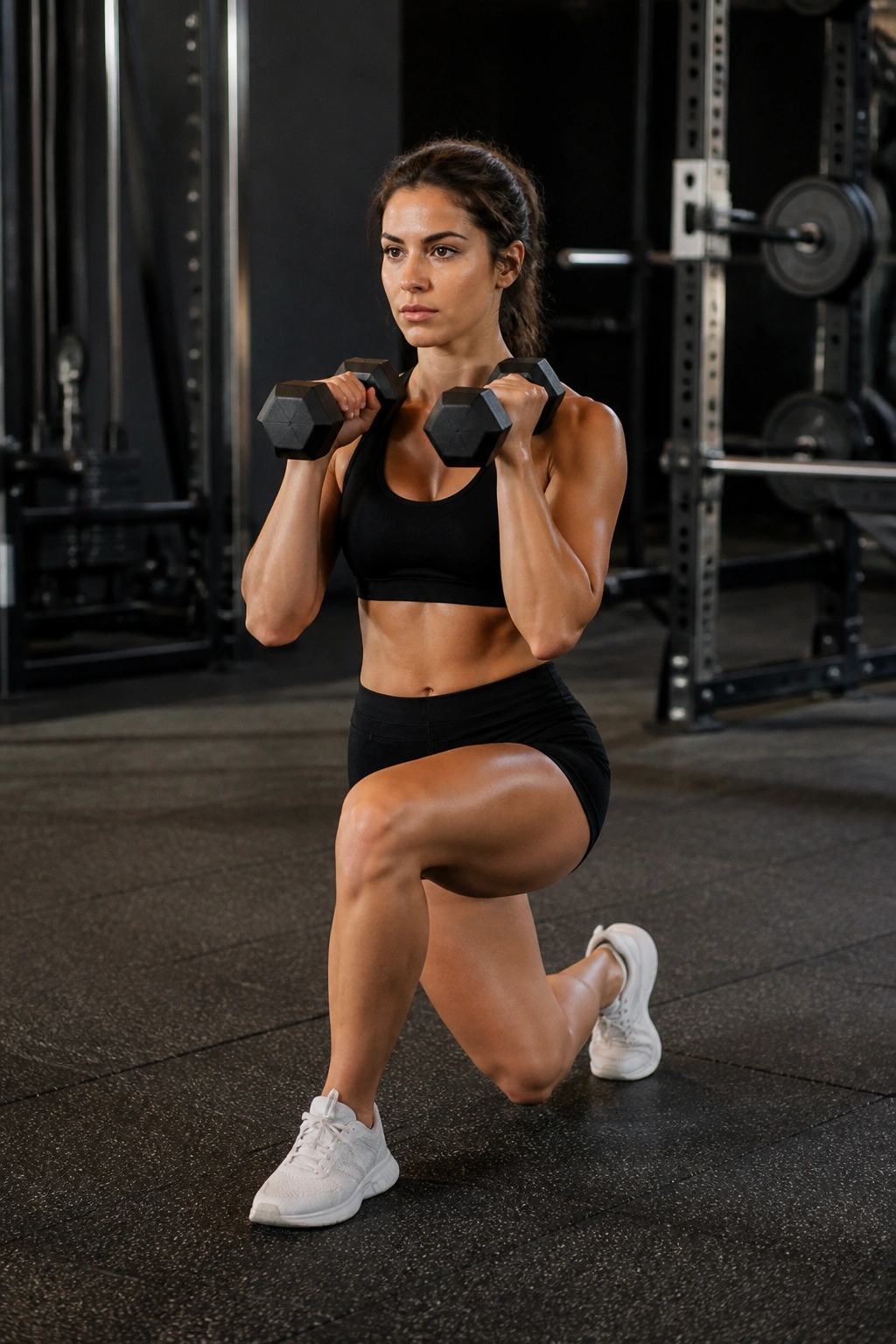
The curtsy lunge is an underrated tool for targeting the gluteus medius, the muscle on the side of your hip that gives your glutes that “shelf” look. By stepping behind and across your midline, you put your hip into a position that forces the side glute to work harder than in a standard lunge.
Understanding the Mechanics
This movement is all about stability. Because you are crossing your leg behind, you are naturally going to feel unstable. That is the point. Embrace the wobble. The muscles that stop you from falling over are the same ones that build a wider, stronger hip structure.
- Keep your torso upright; don’t lean forward.
- Make sure your front foot is planted firmly and doesn’t rotate as you step.
- Lower your back knee until it almost touches the ground.
If you have tight hips, this might feel awkward the first few times. Start with just your body weight to get the movement pattern down before adding the dumbbells.
9. Dumbbell Lateral Lunges
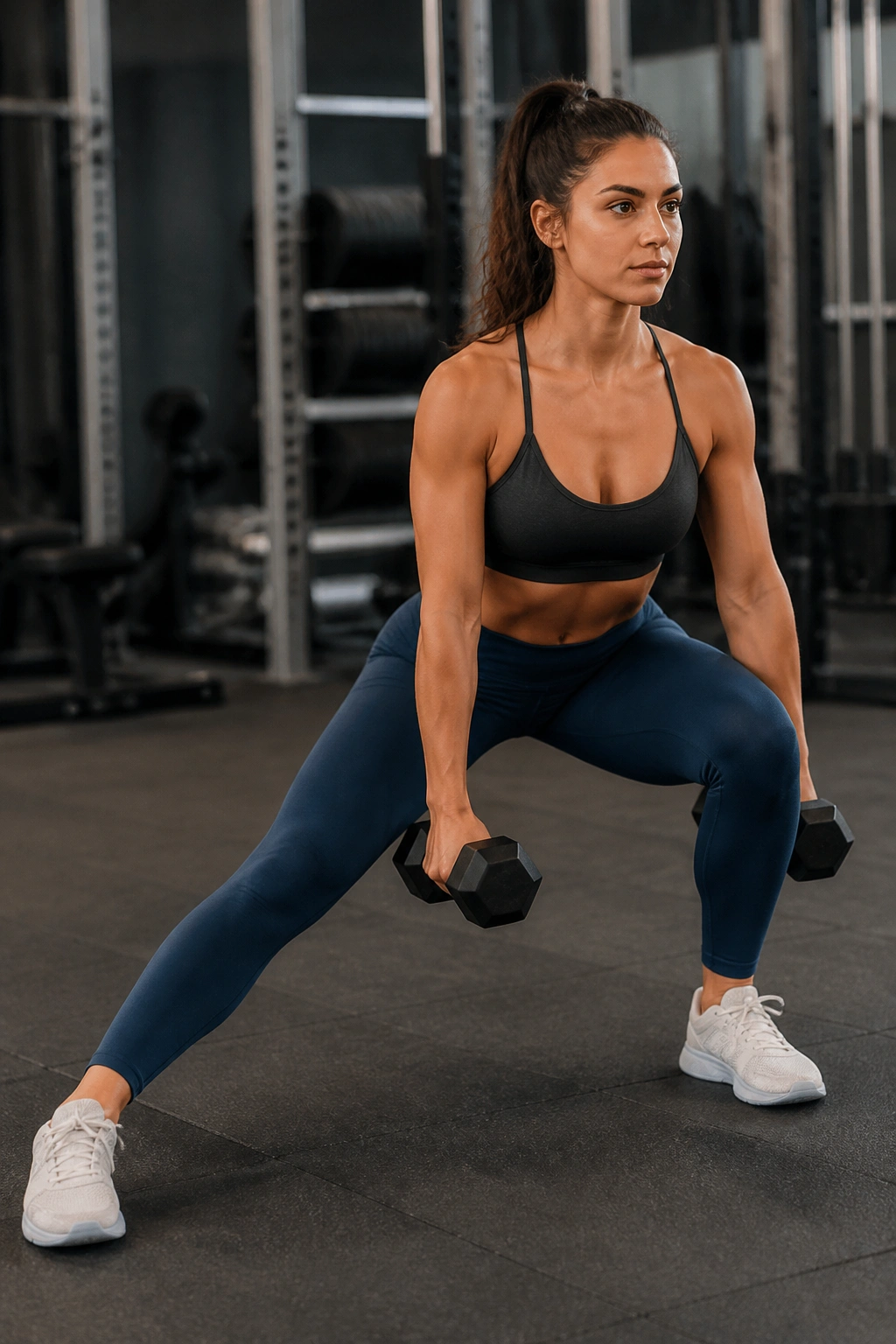
We spend our entire lives moving forward and backward. When was the last time you moved side-to-side with a heavy weight? Lateral lunges train your legs in the frontal plane, which is essential for joint health and athletic performance.
Opening the Hips
This exercise stretches the groin while simultaneously strengthening the quads and glutes. It is a fantastic remedy for anyone who feels “stiff” after traditional squatting. By loading it with dumbbells, you force your legs to handle a lateral load, which significantly builds stability.
- Keep your trail leg completely straight.
- Push your hips back as if you are trying to sit into a chair placed to your side.
- Keep your chest up. Looking down at the floor will cause your back to round.
You will feel a deep stretch in the inner thigh of the straight leg. Use that stretch to propel yourself back to the starting position.
10. Stiff-Legged Deadlifts
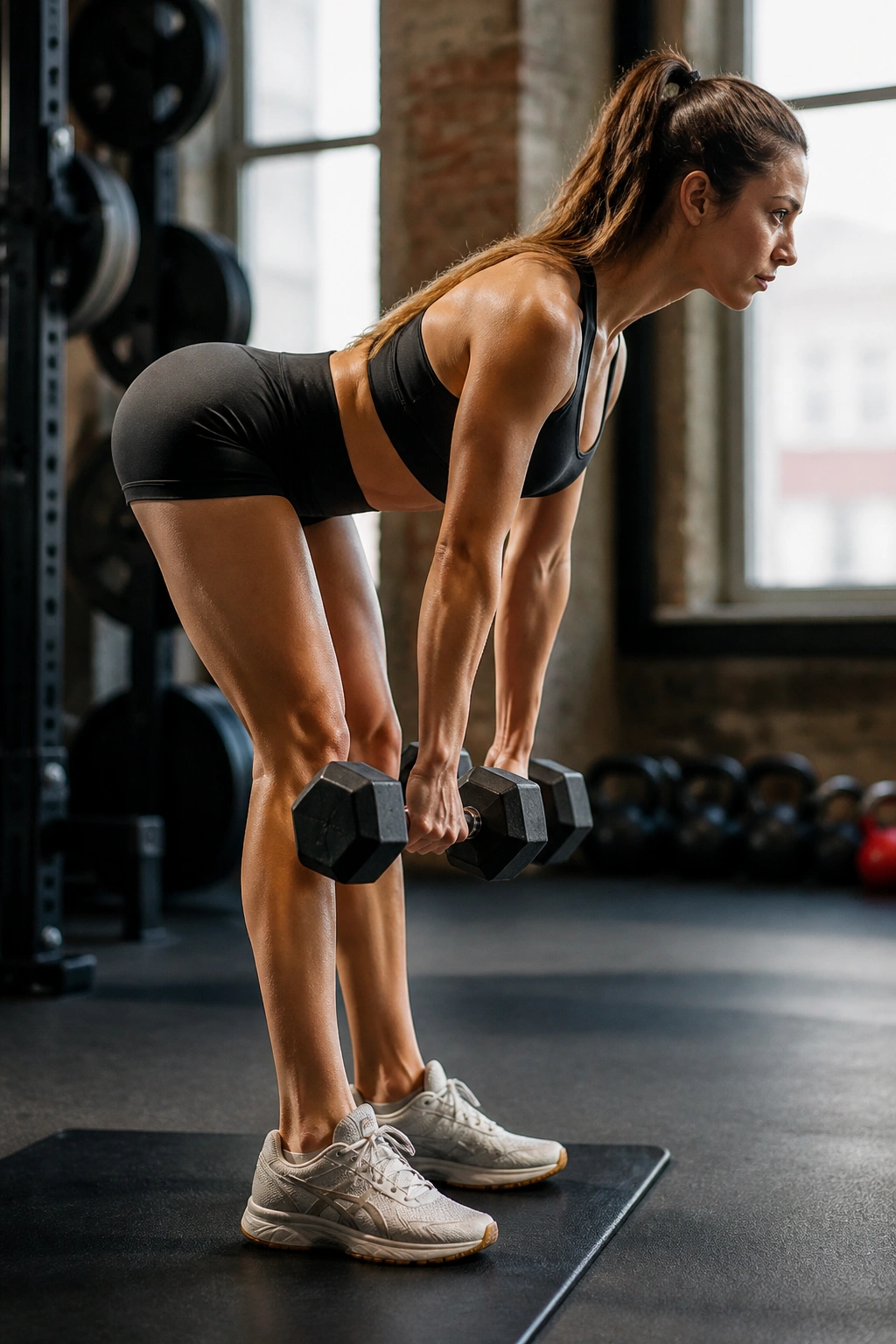
Do not confuse these with RDLs. While they look similar, the stiff-legged deadlift typically starts from the floor or involves a slightly different hip position, and the goal is to keep the legs as straight as possible (though not locked) to maximize hamstring tension.
Pure Hamstring Isolation
This is a movement for people who have the mobility to handle it. You are effectively removing the knees from the equation to turn your hamstrings into a giant lever. If your hamstrings are lagging, this is the remedy. It is not about how much weight you can move; it is about how much you can isolate the target muscle.
- Keep your legs straight, but keep a tiny “micro-bend” in the knees to avoid hyperextension.
- Lower the dumbbells slowly. The eccentric (lowering) phase should take at least three seconds.
- Stop as soon as you feel your lower back start to round.
Once you hit that point where your back rounds, you have gone too far. For some people, that might be mid-shin. For others, it might be right below the knees. Honor your own anatomy.
11. Dumbbell Single-Leg RDLs
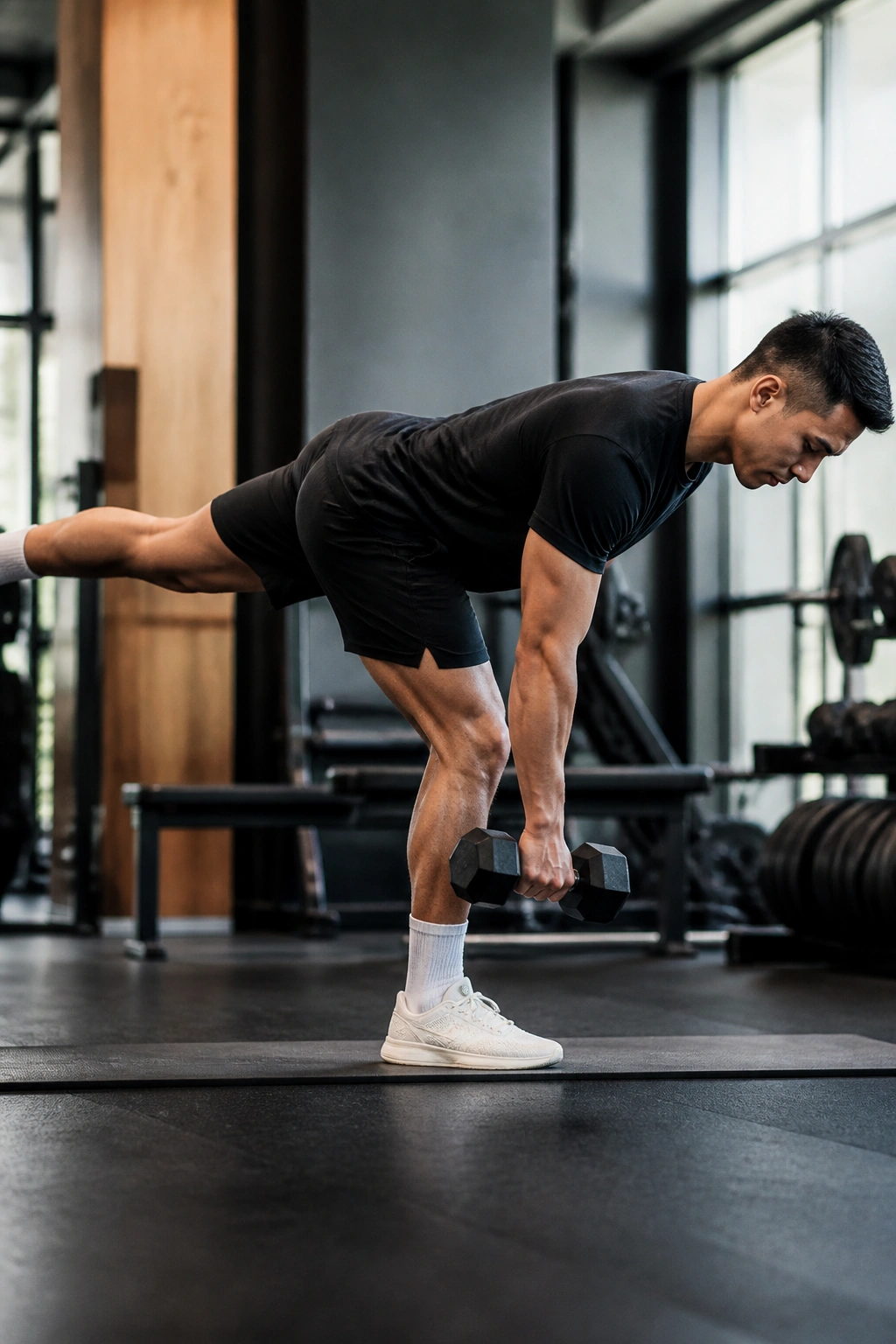
If you want to test your mettle, try this one. The single-leg RDL is the ultimate test of balance and hamstring strength. Because you are on one leg, your glutes and hamstrings have to fire constantly just to keep you upright. It is a humbling movement.
The Balancing Act
The biggest mistake people make is rushing through the reps. You cannot rush a single-leg movement. If you go too fast, you lose your center of gravity. Each rep should be slow, controlled, and deliberate. You are training your nervous system to stabilize your body under load.
- Focus on a stationary point on the floor.
- Kick your non-working leg straight back behind you as you hinge.
- Keep the dumbbell in the hand opposite to your working leg—this creates a cross-body stabilization pattern that makes the move more effective.
If you are struggling to keep your balance, do not be afraid to use a light weight or even just your body weight until your nervous system adapts.
12. Dumbbell Cossack Squats
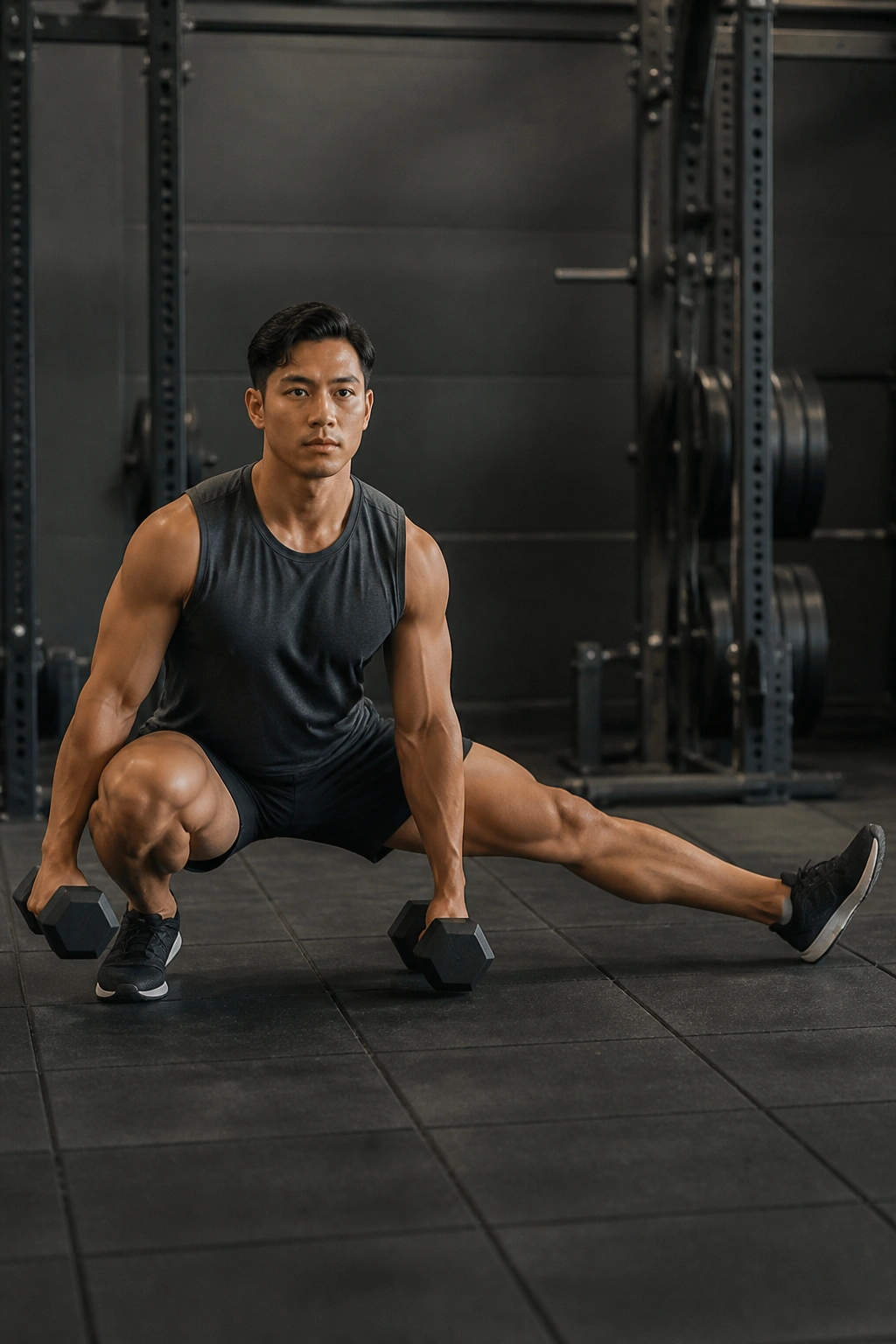
Cossack squats are a deep, lateral movement that takes a regular side lunge to the extreme. You drop your hips all the way down to your heel. This requires a significant amount of ankle and hip mobility, but the payoff is incredible strength in the bottom position of the squat.
Extreme Mobility
This is not for the faint of heart. If you lack the ankle mobility to keep your heel flat on the floor, put a small plate under your heel. This movement will build quads that have endurance and strength at the absolute deepest range of motion.
- Start with a wide stance, wider than a normal squat.
- Shift your weight entirely to one side, dropping your hip toward your ankle.
- Keep the non-working leg completely straight with the toes pointed toward the ceiling.
This is arguably the best “leg finisher” in the gym. It destroys your quads and opens up your hips simultaneously.
13. Dumbbell Calf Raises
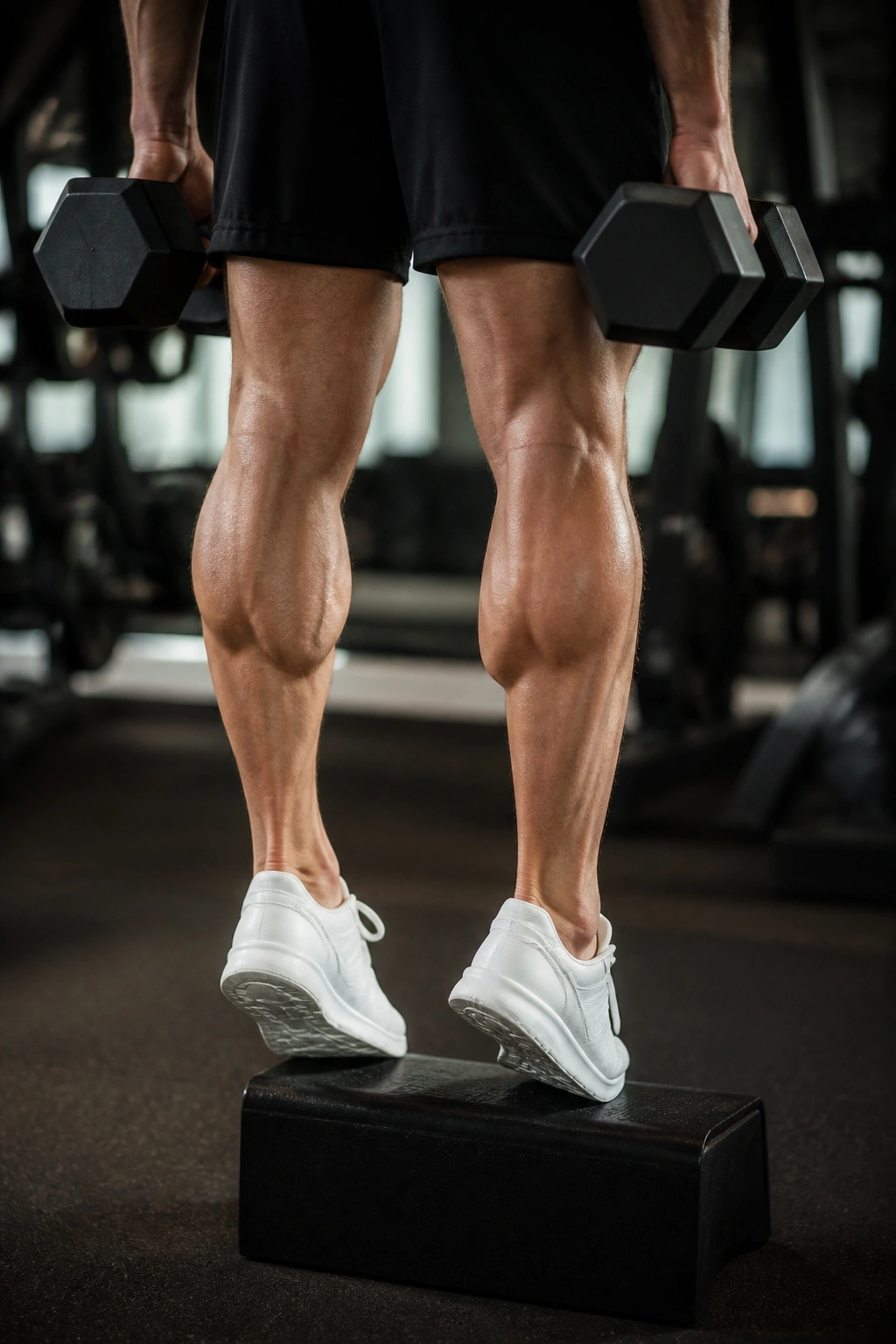
Never skip the calves. They are the shock absorbers of your lower body, and they are notoriously stubborn. The issue with most calf training is that people bounce through the reps using their Achilles tendon rather than the muscle.
Controlling the Tempo
To grow your calves, you must control the tempo. You need a slow descent (the eccentric phase) and a powerful pause at the top (the concentric phase). If you are just bouncing, you aren’t training your muscles; you are training your tendons.
- Find a small step or block to increase the range of motion.
- Lower your heels until you feel a deep stretch in your calf.
- Hold the top contraction for a full second, squeezing hard.
Use heavy dumbbells. People often treat calf training like a cardio exercise. It is a muscle like any other. If you want it to grow, you have to load it with enough resistance to force adaptation.
14. Dumbbell Box Squats
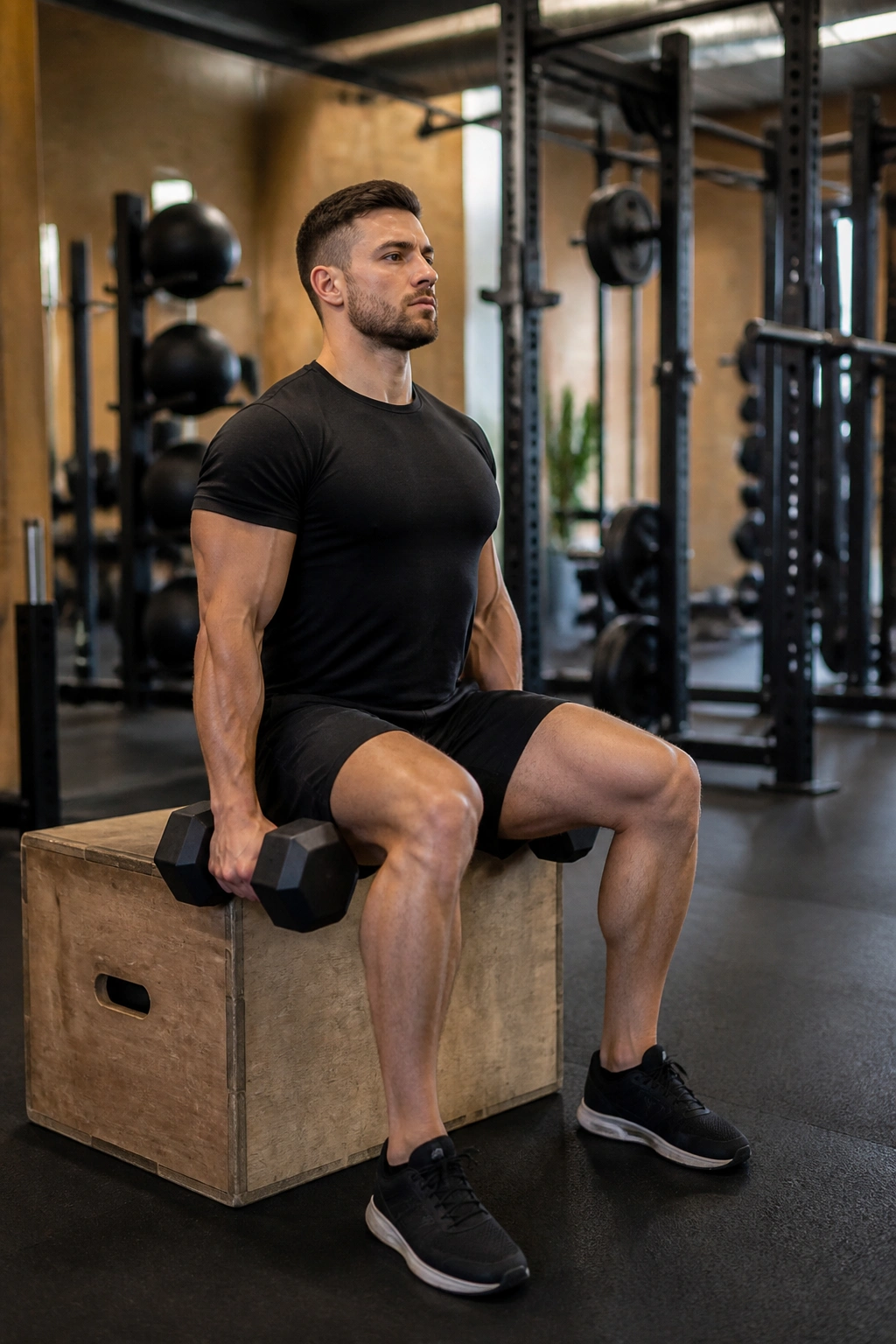
Box squats with dumbbells allow you to sit back and drive up without the danger of collapsing under a heavy barbell. By sitting onto a box, you break the eccentric-concentric chain—meaning you stop the momentum completely at the bottom.
Eliminating Momentum
This forces your hips and glutes to restart the movement from a dead stop. It is a fantastic way to develop raw power out of the hole of a squat. You can’t use a bounce to get out of the bottom position, which makes every rep much harder than a standard air squat.
- Lower yourself onto the box with control—don’t just flop down.
- Once you touch the box, pause for a second, then explode upward.
- Keep your chest up throughout the entire movement.
The height of the box matters. A lower box is harder; a higher box is easier. Adjust accordingly to fit your strength level.
15. Dumbbell Glute Kickbacks
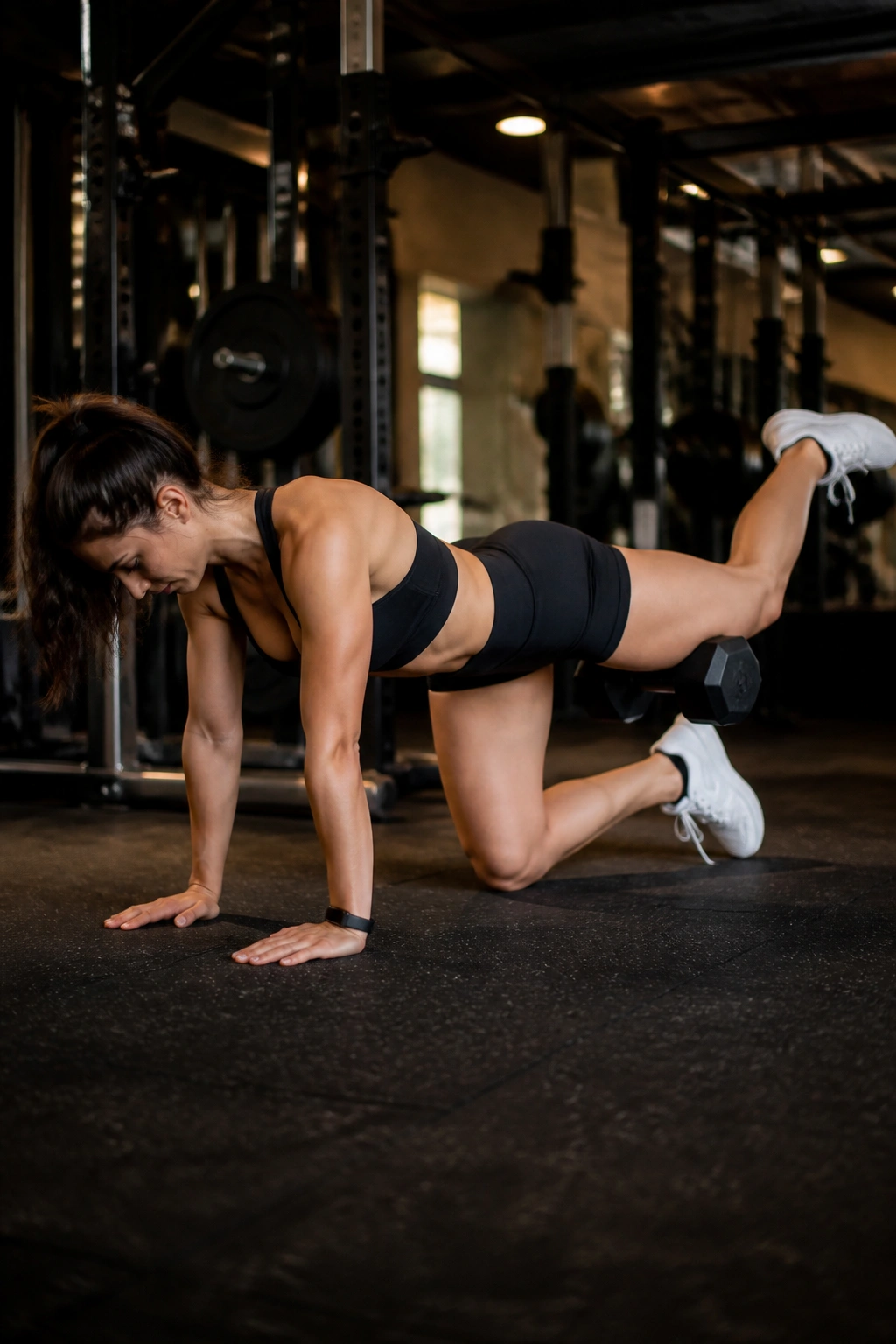
This is a pure accessory movement. Don’t expect to build massive quads with this, but if you want to isolate the glutes and work on that mind-muscle connection, the kickback is unbeatable. It targets the gluteus maximus through extension.
The Mind-Muscle Connection
This movement is all about feel. You don’t need heavy weights. You need tension. Keep the movement slow and focus entirely on squeezing the glute at the apex of the kickback. If you swing your leg, you miss the point entirely.
- Get on all fours or use a bench for support.
- Keep your knee bent at 90 degrees.
- Drive your heel toward the ceiling.
Avoid arching your lower back. If you feel this in your lumbar spine, you are kicking too high or not engaging your core tight enough to protect your back.
16. Dumbbell Split Squats (Static)
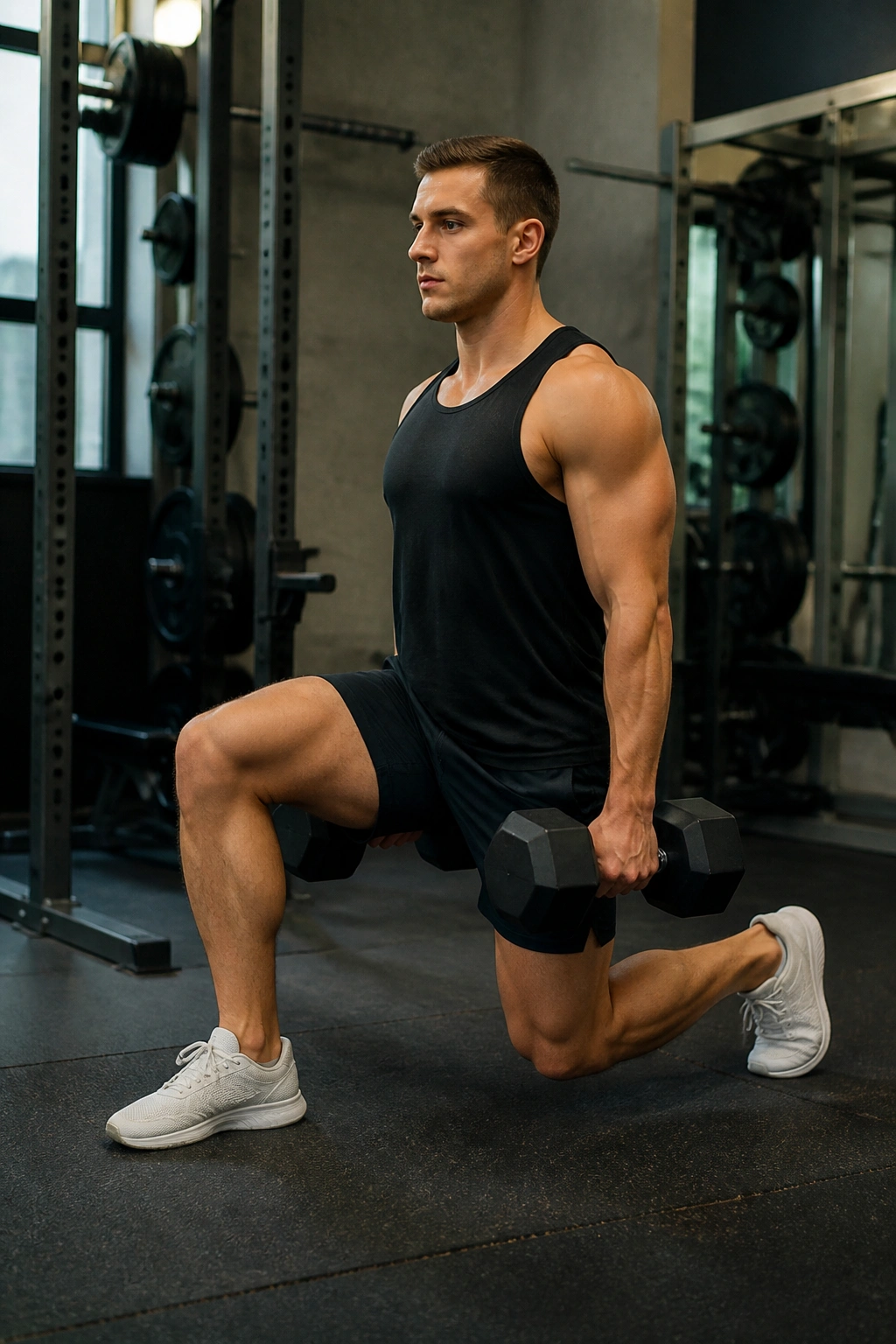
The static split squat is the “cleaner” version of the Bulgarian split squat. By keeping both feet on the floor, you eliminate the balance requirement, which allows you to focus purely on muscular failure. You can often go heavier here than in any other unilateral movement.
Pushing to Failure
Because you aren’t fighting to stay balanced on a bench, you can really push the intensity. Keep the dumbbells heavy. This is a great movement to use for drop sets—start heavy, then drop the weight and keep going until your legs are literally shaking.
- Set your feet in a lunge position and don’t move them.
- Lower your back knee until it’s an inch from the floor.
- Drive straight up through the front heel.
Focus on staying vertical. If you lean forward, you turn this into a glute-focused lunge. If you stay upright, you destroy the quads. Choose the version that aligns with your goals.
17. Dumbbell Reverse Lunges
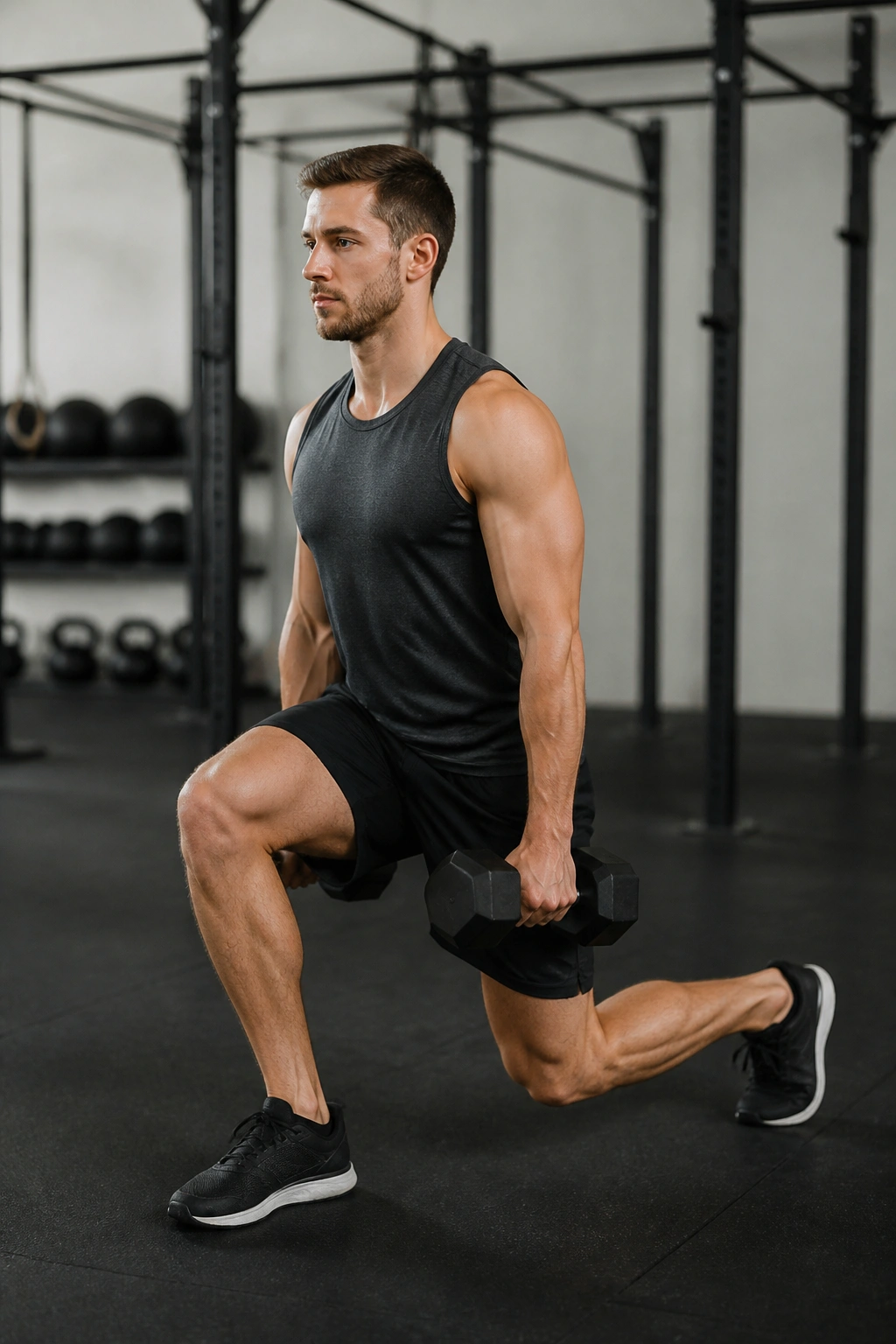
Reverse lunges are often easier on the knees than forward lunges because your shin remains more vertical. As you step backward, your weight stays centered, which makes this a much safer option for anyone with a history of knee discomfort.
Joint-Friendly Intensity
This movement allows you to load up quite heavily while maintaining good form. It is less taxing on your nervous system than a heavy back squat, making it a perfect exercise to include in high-volume training days.
- Step back with control, landing on the ball of your foot.
- Keep your torso upright.
- Push off the front foot to return to the starting position.
You can hold dumbbells at your sides, in a suitcase carry, or up at your shoulders in a front-rack position. Each variation changes the core engagement, so play with all of them to see what works for your training style.
18. Dumbbell Hip Thrusts
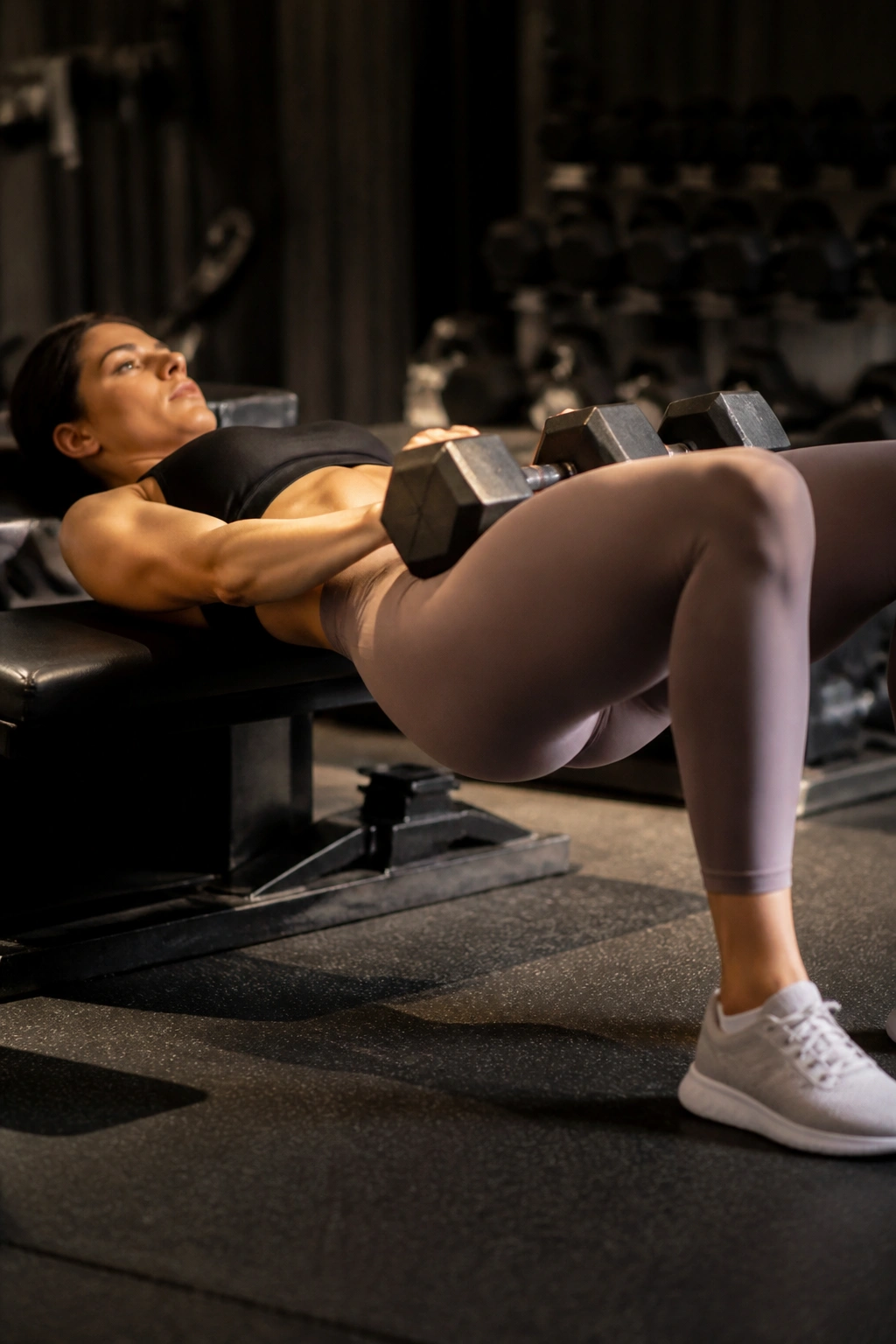
The hip thrust is the undisputed king of glute isolation. It is awkward to set up, it looks strange, and it is absolutely the most effective way to load the glutes in a shortened, contracted position. If you want glute development, this must be in your rotation.
Maximum Hypertrophy
When you thrust the weight up, the leverage is highest on the glutes. This is why you can often hip thrust much more weight than you can squat. Don’t be afraid to go heavy. Your glutes are one of the strongest muscles in your body—treat them that way.
- Rest your upper back against a bench.
- Place the dumbbell (or dumbbells) across your hips. Use a pad if it’s uncomfortable.
- Tuck your chin to your chest and look forward.
At the top of the movement, your shins should be vertical. If they aren’t, adjust your foot placement until they are. If you aren’t doing these, you are missing out on significant glute potential.
Final Thoughts
The path to a stronger lower body isn’t paved with complex machinery or proprietary gym gear. It is paved with the basics, executed with intensity. You have 18 movements here that, when utilized correctly, cover every single muscle fiber in your legs. You don’t need a squat rack to build impressive strength; you just need to be willing to do the hard work that others avoid.
Remember that leg training is demanding on the central nervous system. Do not try to do all 18 of these in one session—you will not walk for a week. Pick three or four, focus on perfect form, and add load over time. Consistency is what builds results, not doing every exercise in existence once.
Your legs are capable of incredible things. They carry you through life, handle your heavy lifting, and serve as the foundation for everything else you do in the gym. Treat them with the respect they deserve by challenging them with these movements, and they will adapt, grow, and support you in return. Stop looking for excuses, pick up the dumbbells, and get to work.
