



The reality of building leg strength is often obscured by the sheer size of the equipment in commercial gyms. You see rows of massive leg presses and squat racks, and it is easy to assume that unless you have access to a heavy barbell and 500 pounds of plates, you cannot build truly powerful legs. This is a myth. Dumbbells, when used with precision and intensity, provide a level of unilateral stimulus that many machine-based exercises simply cannot replicate.
When you move away from fixed-path machines, you are forced to stabilize the weight yourself. This requires constant recruitment of the smaller, stabilizing muscles in your hips, ankles, and core—the very muscles that often get ignored when you are strapped into a leg extension chair. Strength is about more than just moving a heavy object; it is about controlling your body through a full range of motion.
The workouts that follow are designed to strip away the noise. You do not need to overcomplicate your training. You need to focus on mechanical tension, controlled eccentrics, and the ability to maintain tension throughout the entire movement. Whether you are working in a home gym with limited space or navigating a crowded public gym, these movements will build the kind of functional, durable lower body strength that actually translates to better performance in everyday life and more demanding athletic pursuits.
1. Goblet Squats
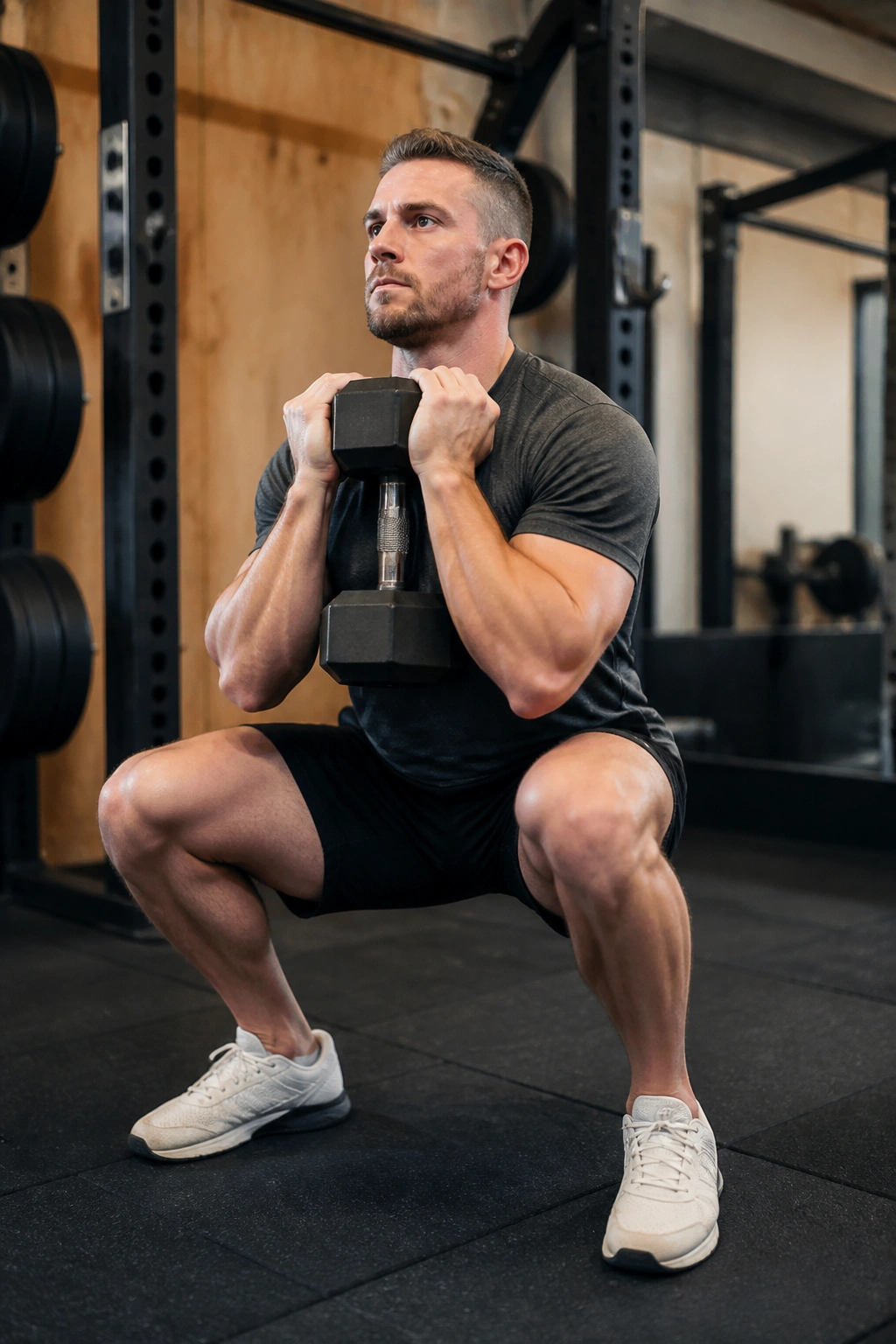
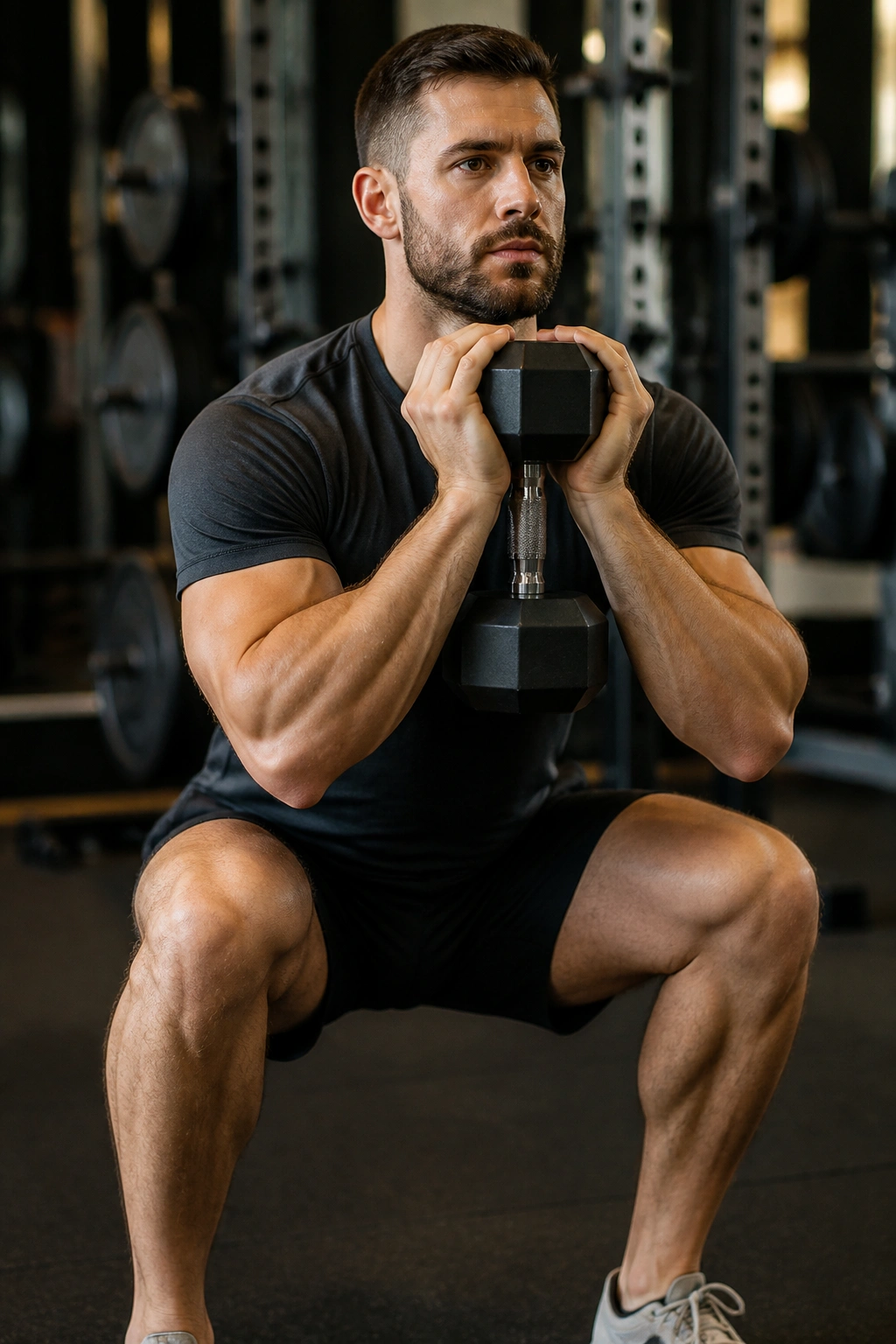
The goblet squat is the gold standard for learning how to move well under a load. By holding a single, heavy dumbbell at chest height, you are physically forced to keep your torso upright. If you hunch forward, the weight will pull you off balance, which acts as an immediate corrective signal for your posture. This movement emphasizes quad engagement and forces you to sink deep into the squat, which is where the real muscle-building magic happens.
Why It Works for Lower Body Strength
The anterior loading—meaning the weight is in front of your body—requires significant core engagement to prevent your upper back from rounding. This mimics the mechanics of a front squat, allowing you to achieve a deeper depth than you might with a weight on your back, particularly if you have limited ankle mobility. You are essentially using the dumbbell as a counterbalance.
Execution Details
- Keep your feet shoulder-width apart, toes pointed slightly outward.
- Hold the dumbbell vertically against your sternum with both hands cupping the top head.
- Initiate the movement by breaking at the hips and knees simultaneously.
- Lower yourself until your elbows graze the insides of your knees.
- Drive through the heels to return to a standing position, squeezing the glutes at the top.
Pro Tip: If your heels start to lift off the floor at the bottom, your stance might be too narrow, or your ankle mobility needs attention. Try widening your stance by an inch or two.
2. Dumbbell Romanian Deadlifts (RDLs)
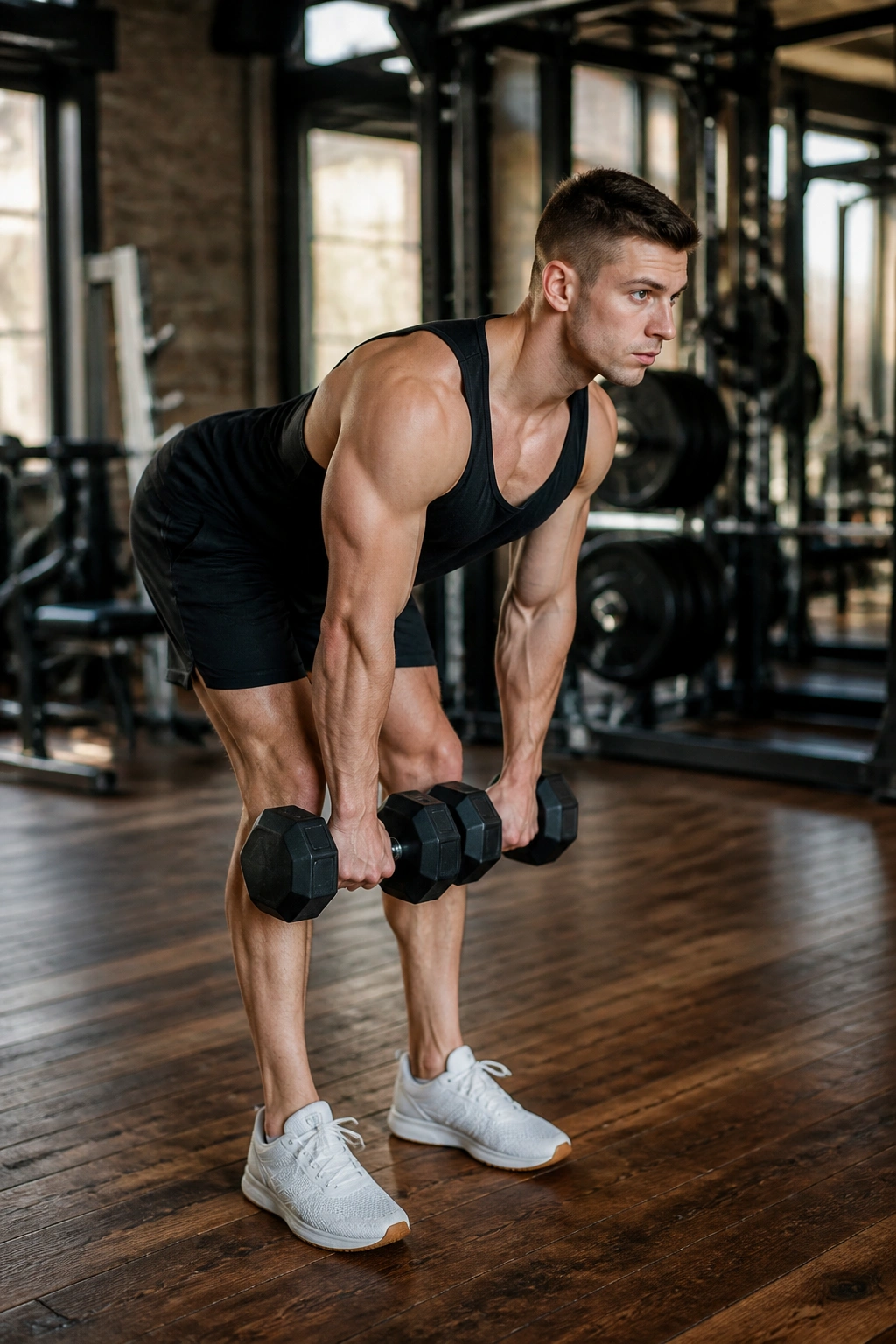
If your goal is to build a massive posterior chain, you have to master the hinge. The Romanian deadlift is arguably the most effective way to isolate the hamstrings and glutes without the lower back fatigue often associated with conventional deadlifts. Because you are using dumbbells, you can track the weights closer to your shins, which puts the tension exactly where it belongs: on the back of your legs.
The Mechanics of the Hinge
This is not a squat. It is a hip-dominant movement. Your knees should have a soft bend, but they should not be moving excessively. The goal is to push your hips back as far as possible, as if you are trying to close a heavy door with your butt. You should feel a deep, intense stretch in your hamstrings as you lower the weights to about mid-shin level.
Critical Safety Notes
- Never round your spine; keep your chest proud and your shoulders retracted throughout the entire range of motion.
- Look at a fixed point on the floor about three feet in front of you to keep your neck neutral.
- If you feel this in your lower back instead of your hamstrings, stop immediately. Reset your position, ensure your lats are engaged (imagine squeezing oranges in your armpits), and try again with a lighter weight.
3. Bulgarian Split Squats
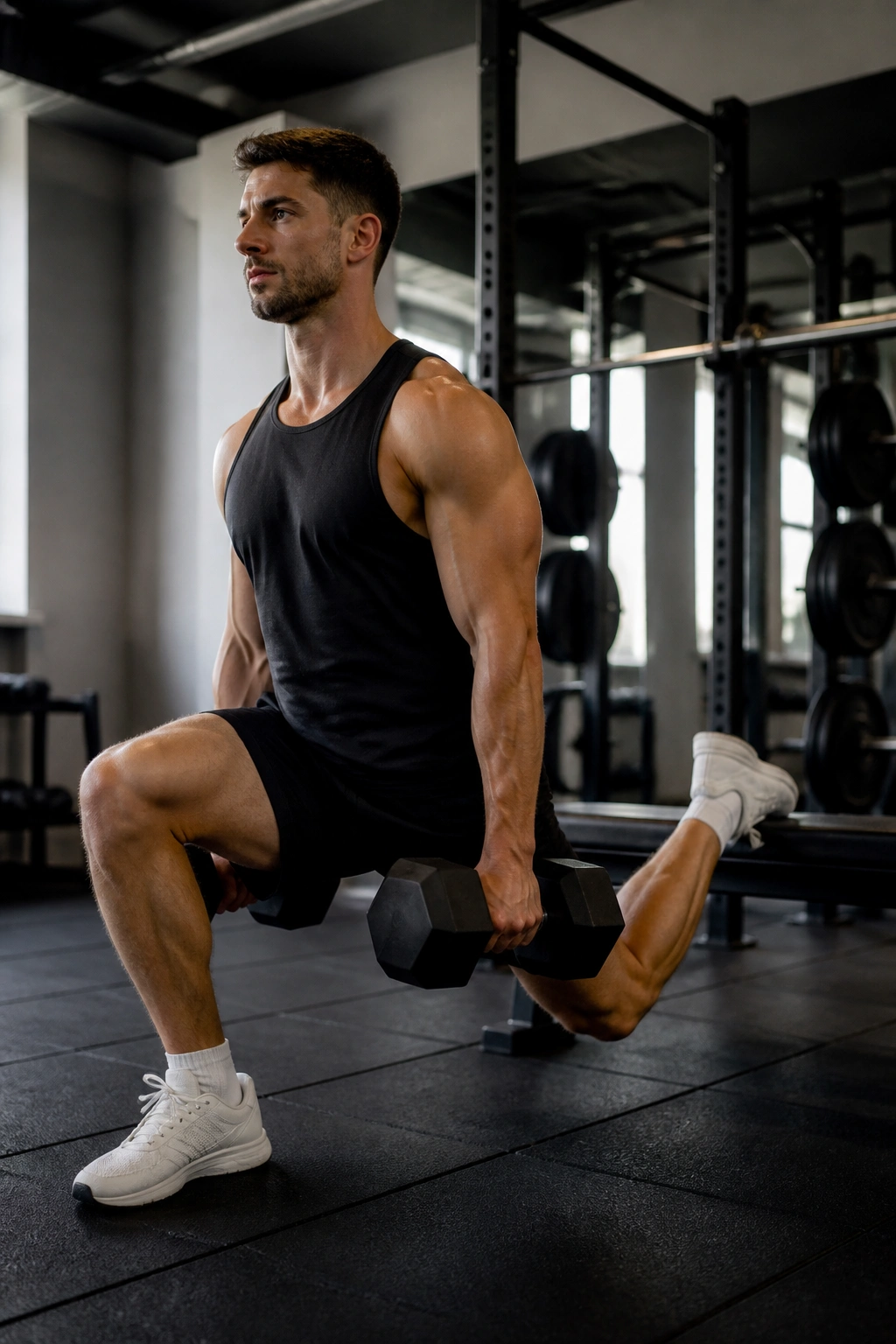
There is a reason these are often cited as the most difficult leg exercise in existence. By elevating your rear foot, you place almost the entire load on the front leg. This eliminates the “help” your trailing leg might provide, effectively forcing your single-leg strength to skyrocket. You are essentially performing a one-legged squat, which is the ultimate test of balance, stability, and quad recruitment.
Why This Is Different From a Standard Lunge
In a lunge, you have a split-second of transition where your weight shifts. In a split squat, the position is static. You are under constant tension. This removes the momentum factor, which is exactly why it is so effective for hypertrophy. You cannot cheat your way through these if you want to complete the set.
How to Maximize the Output
- Do not make the stance too long or too short. Your front shin should remain relatively vertical at the bottom of the movement.
- Keep your torso upright if you want to bias the quads, or lean forward slightly to engage the glutes more heavily.
- Take your time on the way down; a three-second eccentric phase will make these infinitely harder and more effective.
4. Walking Lunges
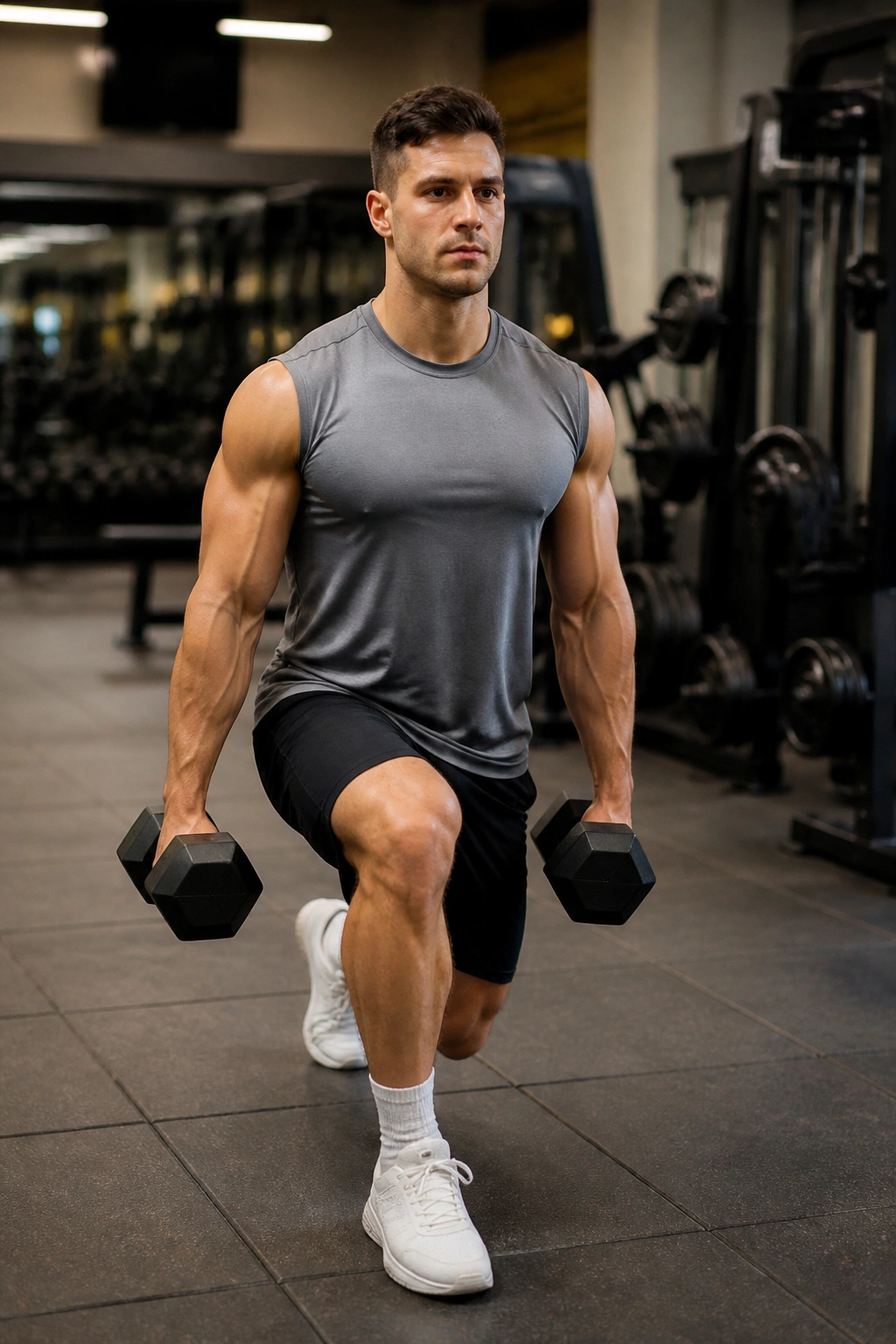
Walking lunges turn your lower body into a machine. This exercise is unique because it forces you to stabilize your body in motion while under a load. It is not just about strength; it is about dynamic control. As you step forward, your core and hips have to work overtime to prevent your torso from wobbling, which makes this an excellent movement for core and lower body integration.
The Problem With Rushing
A common mistake is treating walking lunges as a race. People lunge forward, lose their balance, and try to recover mid-step. This is inefficient. Instead, think of every step as a deliberate squat. Control the descent, ensure your knee tracks over your toe, and stabilize your upper body before you push off to take the next step.
Technique Nuance
- Take long enough strides so that both your front and back knees form 90-degree angles at the bottom.
- If your back knee is hitting the ground hard, you are not controlling the descent—soften the landing.
- Hold the dumbbells at your sides with a firm grip; do not let them swing, as this disrupts your center of gravity.
5. Dumbbell Sumo Squats
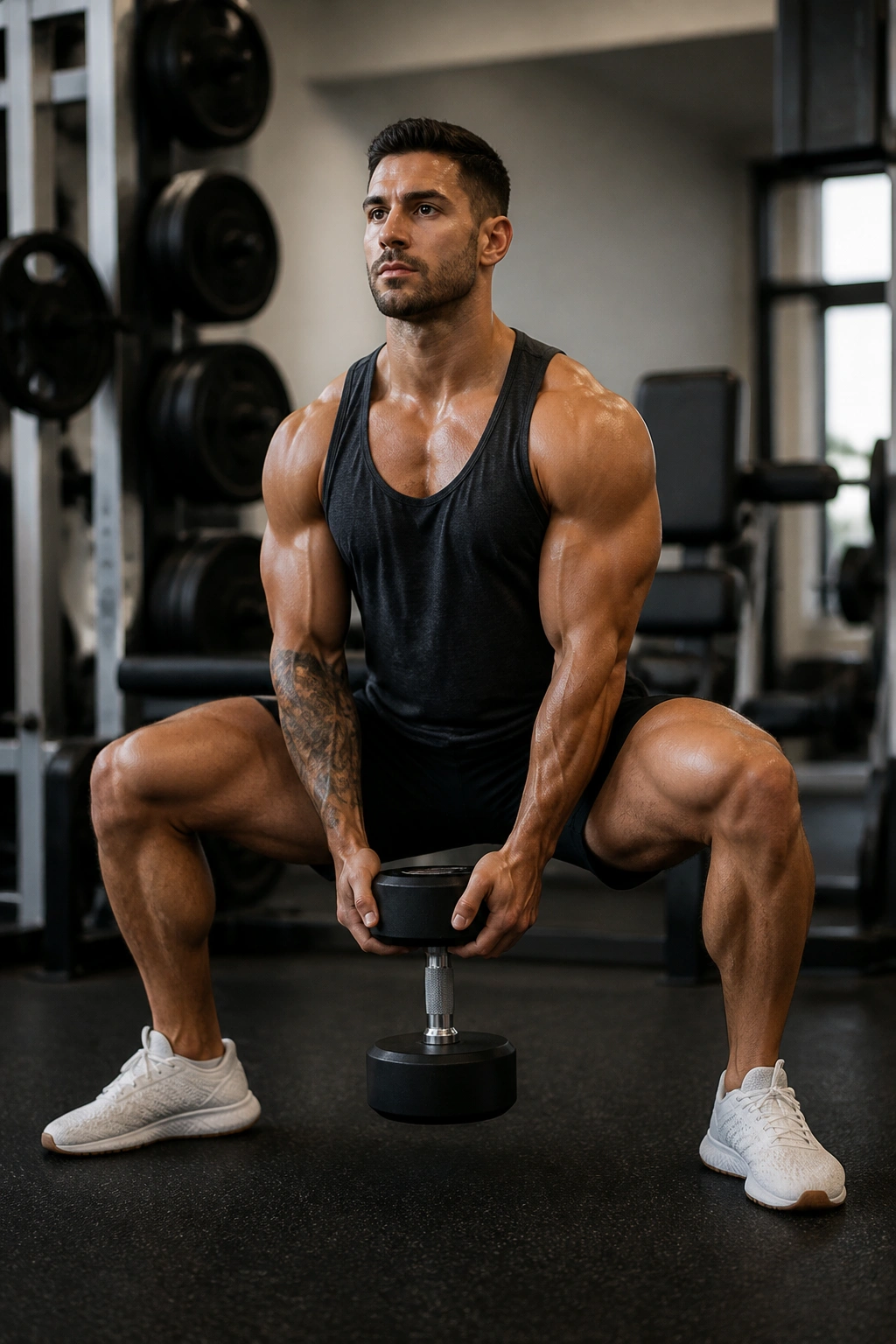
Widening your stance changes the physics of the squat. By moving your feet outside shoulder-width and turning your toes outward, you shift the focus toward the adductors (the inner thigh muscles) and the glutes. The dumbbell is held between your legs, which creates a natural, vertical path for the weight and prevents it from interfering with your knees or shins.
Why It’s a Different Kind of Burn
Most people find they can handle slightly more weight in a sumo stance than in a traditional goblet squat. This allows for more progressive overload. Because the weight stays between your legs, it also allows you to focus on sitting between your hips, which can be very comfortable for those who struggle with deep-knee flexion in traditional narrow-stance squats.
Key Considerations
- Squeeze your glutes hard at the top of the movement; this is the finish point where you gain the most benefit.
- Ensure your knees are tracking in the same direction as your toes. If your knees collapse inward, you are compromising joint health.
- Keep your spine neutral. It is tempting to lean forward, but keep your chest up as much as possible.
6. Dumbbell Step-Ups
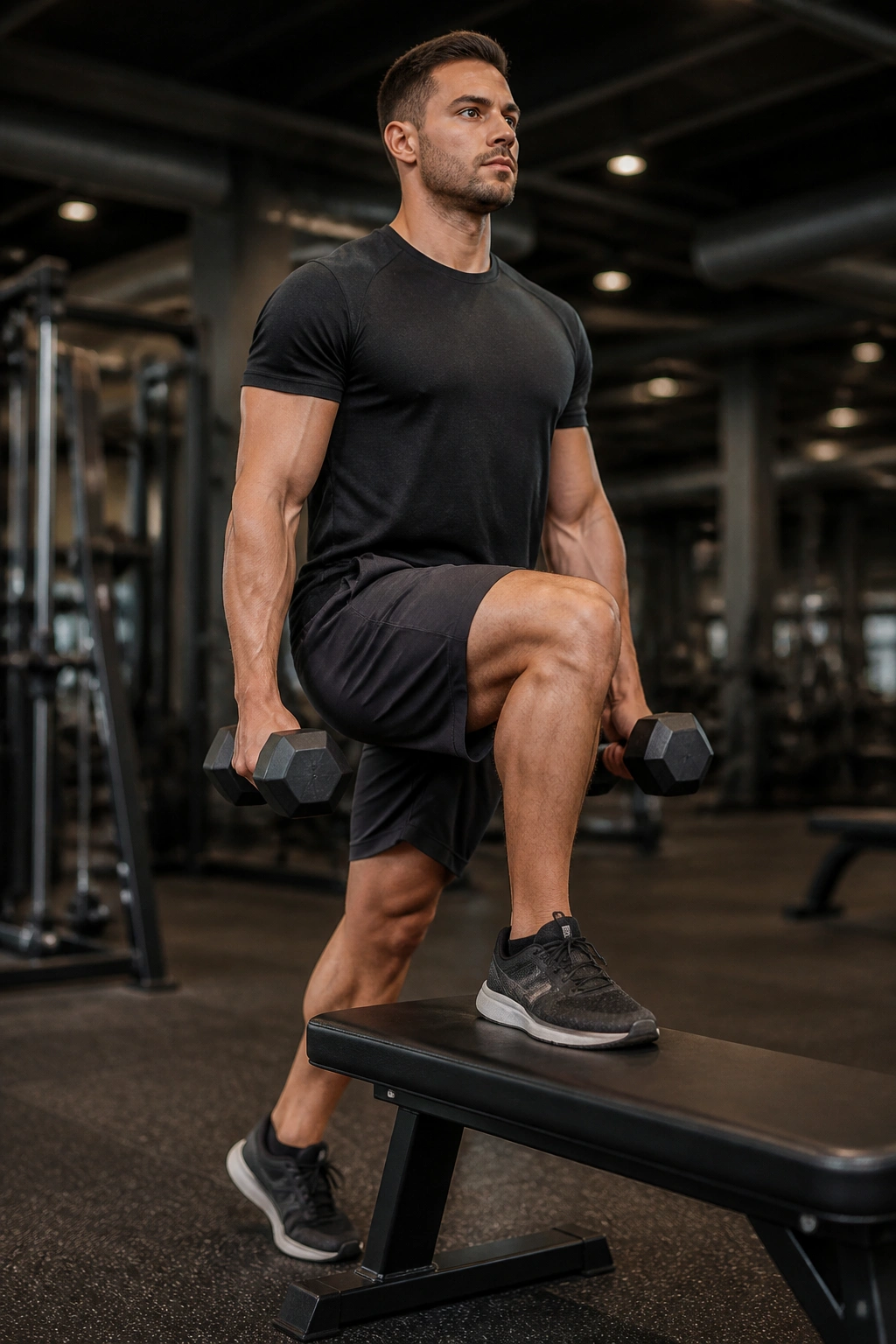
Step-ups are the most overlooked exercise for athletic power. Whether you are stepping onto a plyometric box, a sturdy bench, or a stair, this move isolates each leg completely. It mimics the mechanics of climbing or jumping, which makes it a fantastic movement for building explosive, real-world leg strength.
The Eccentric Advantage
The way down is just as important as the way up. Many people jump off the box, effectively skipping the eccentric portion of the lift. Don’t do this. Step up with power, hold for a split second, and then control your descent back to the floor over the course of two full seconds. This is where you build the stability and strength that protects your knees.
Avoiding “Spring”
- Do not push off your trailing foot to get up. The trailing leg should be just a guide; the front leg does 95% of the work.
- If you find yourself using your back leg to “spring” up, use a lower platform. The goal is to challenge the leading leg, not to see how high you can jump.
7. Dumbbell Glute Bridges
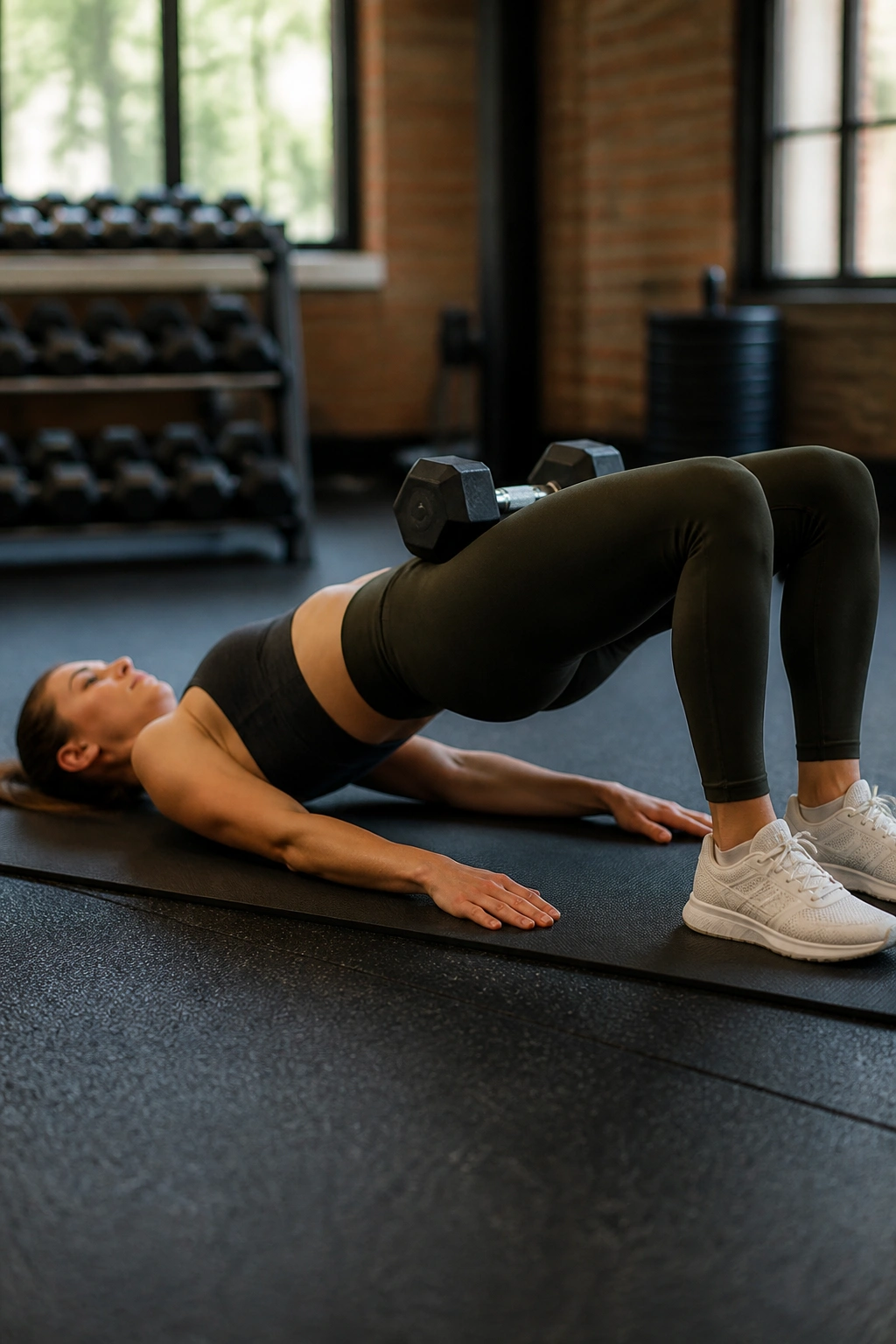
If you want to isolate the posterior chain without the complexity of a deadlift, this is your go-to. By placing a heavy dumbbell on your hips while lying on your back, you create a direct line of resistance that forces the glutes to work at their shortened, most powerful position. It is simple, effective, and nearly impossible to mess up.
How to Get the Most Out of It
- Place the dumbbell across your hip creases, not your stomach. Hold it with both hands to keep it stable.
- Drive through your heels, not your toes. If you feel it in your hamstrings, move your feet closer to your glutes.
- Pause at the top and squeeze as hard as you can for two seconds. This “mind-muscle connection” is critical for glute development.
A Common Mistake
Don’t hyperextend your lower back at the top. Your ribcage should stay tucked. If you arch your back to get higher, you are just using your lumbar spine, not your glutes. Aim for a straight line from your knees to your shoulders.
8. Lateral Lunges
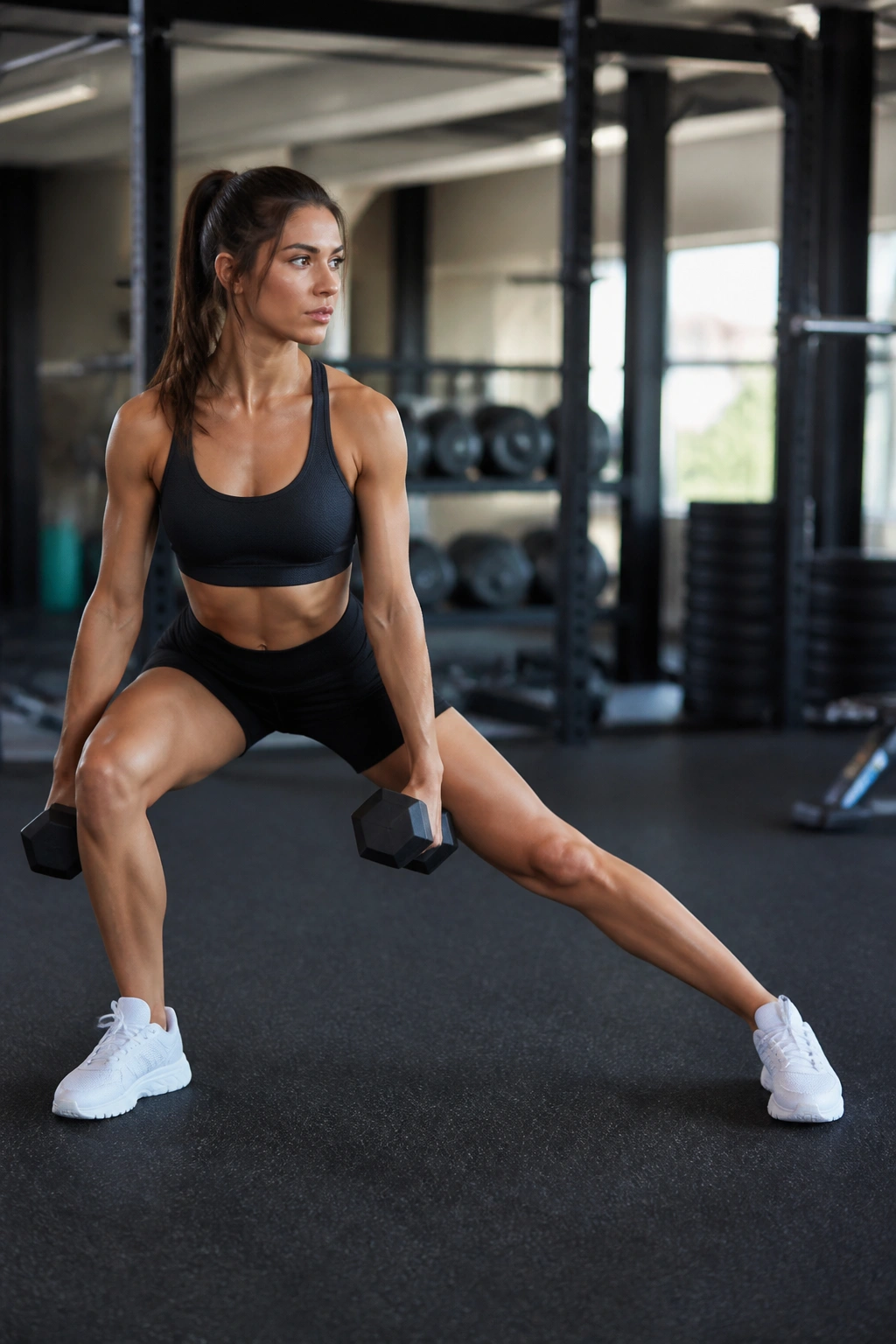
We spend most of our lives moving forward and backward. Lateral lunges force you to move in the frontal plane, which is essential for hip health and side-to-side agility. This movement hits the glute medius and the inner thighs, areas that are notoriously weak in most people because they rarely get trained.
Why This Is Non-Negotiable
Strong glutes require strength in all directions. If you only squat and lunge forward, you are neglecting the lateral stabilizers of your hip. These are the muscles that prevent knee pain and improve your overall balance. Integrating lateral work is one of the fastest ways to feel “stronger” in your daily movements.
Execution Tips
- Step out wide to the side, keeping the trailing leg straight.
- Push your hips back as if you are sitting into a chair that is placed to your side.
- Keep the foot of the lunging leg flat on the ground; if your heel pops up, you are likely taking too long a stride for your current mobility levels.
9. Dumbbell Curtsy Lunges
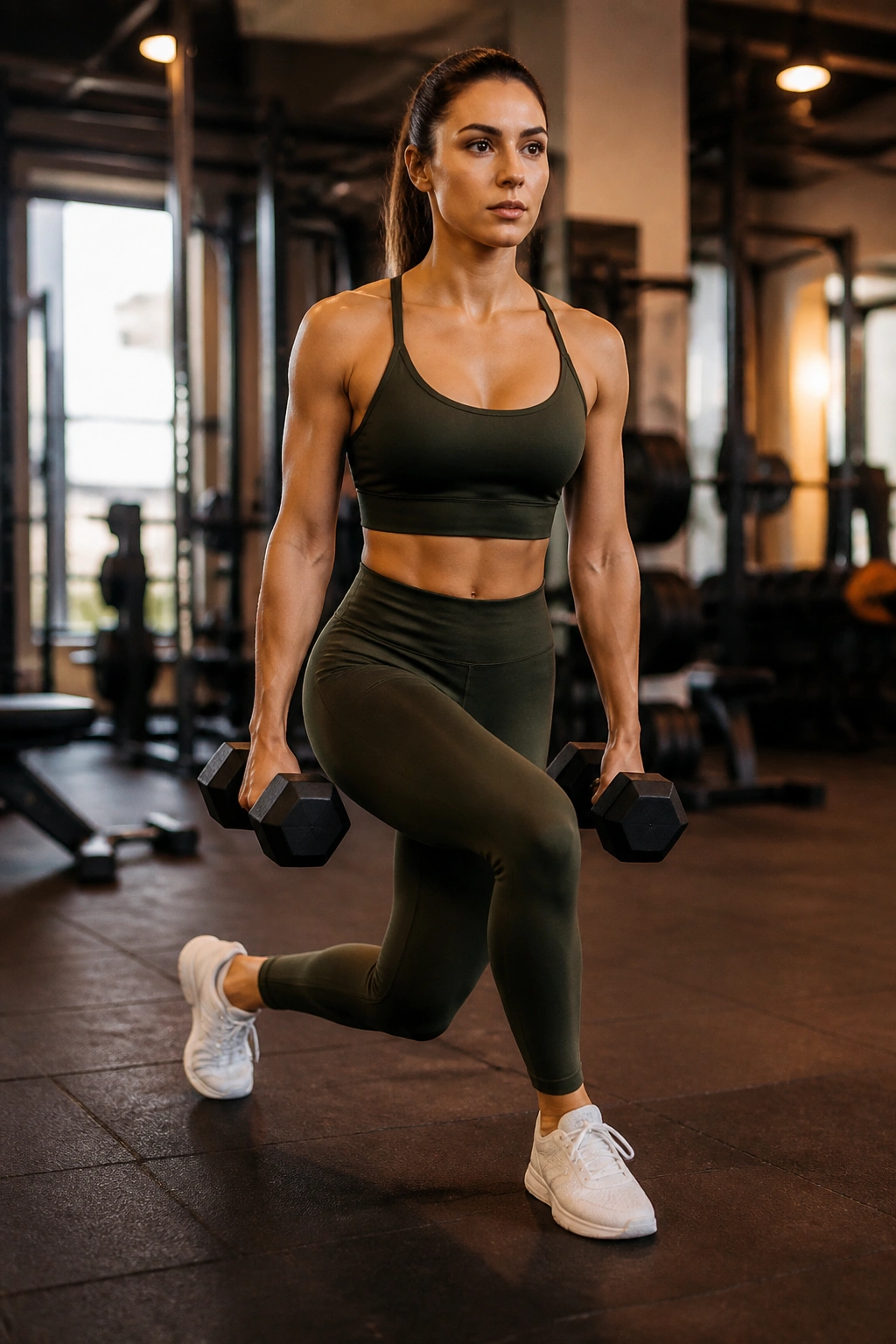
The curtsy lunge is a variation of the reverse lunge that targets the outer glutes in a way very few movements can. By crossing your trailing leg behind the front leg, you place the hip in a position of adduction and internal rotation. This fires the glute medius and minimus, providing that stability that keeps your pelvis balanced and your stride strong.
Why This Movement Matters
Many people suffer from “glute amnesia” or weak lateral stability, which often manifests as knee pain. Curtsy lunges address this by putting the glutes into a deep stretch under tension. It is a subtle move, but if you do it slowly, you will feel the burn in the sides of your hips almost immediately.
Doing It Right
- As you cross your leg behind, think about sitting your weight down into the front heel.
- Do not twist your hips excessively. Your hips should remain as square to the front as possible throughout the movement.
- Start with lighter weights than you think you need. Balance is the primary limiting factor here, not raw strength.
10. Stiff-Legged Deadlifts
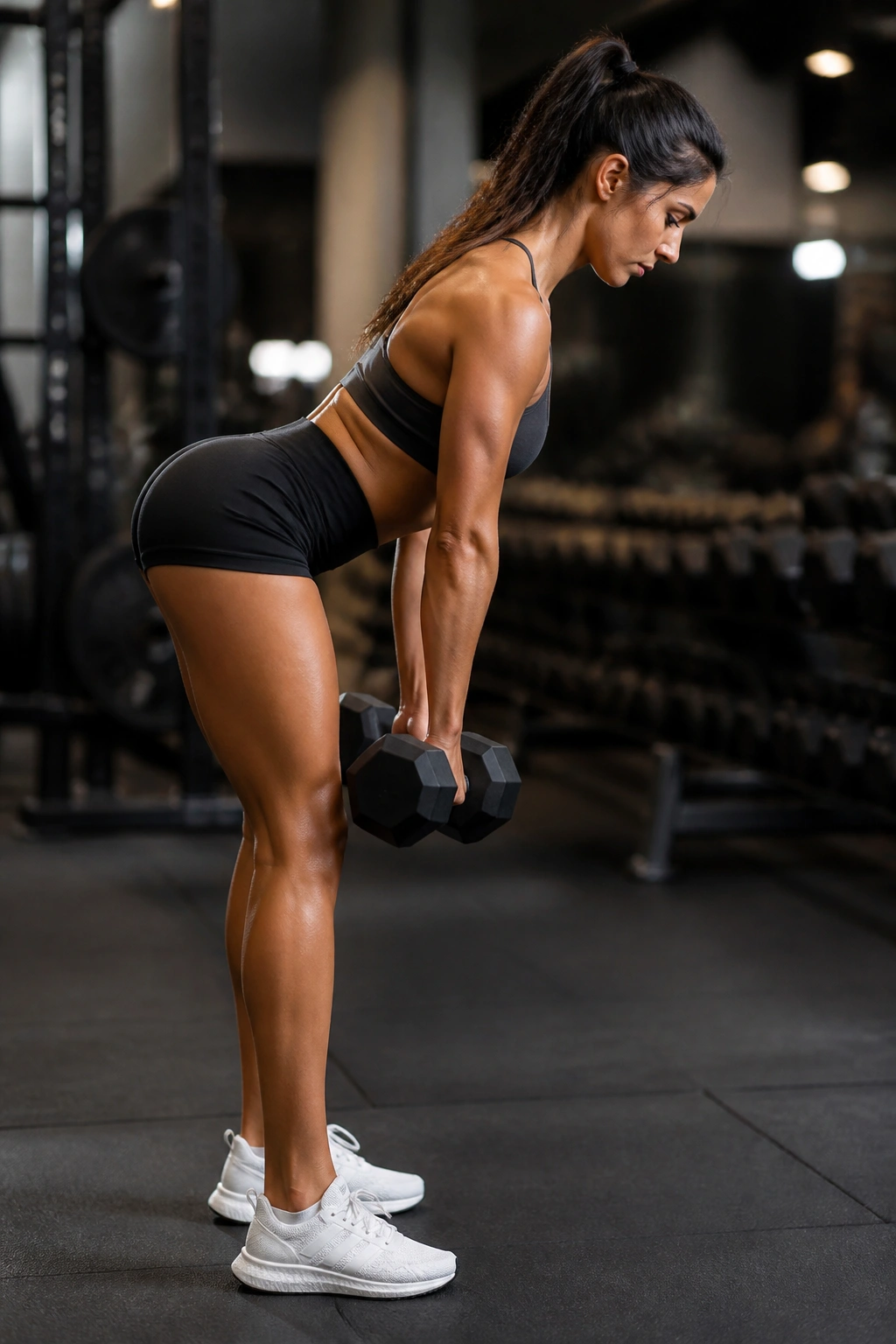
Do not confuse these with RDLs. While they look similar, the stiff-legged deadlift typically allows for less knee bend, placing a greater emphasis on the hamstrings’ deep stretch. This is a classic bodybuilding staple for a reason: it creates a tension profile that is brutal on the hamstrings, often leading to significant growth.
The Tension Difference
In a stiff-legged deadlift, you start with the weights on the floor and bring them up. This means you aren’t fighting the eccentric descent as much as you are fighting the initial lift from the bottom. It is a fantastic way to develop “starting strength” in your posterior chain.
Technical Precision
- Keep the dumbbells extremely close to your body. If they drift even two inches forward, the load on your lower back increases exponentially.
- If your hamstrings feel tight, don’t force a deeper range of motion at the expense of your spine. Go only as low as your flexibility allows while maintaining a neutral back.
11. Dumbbell Thrusters
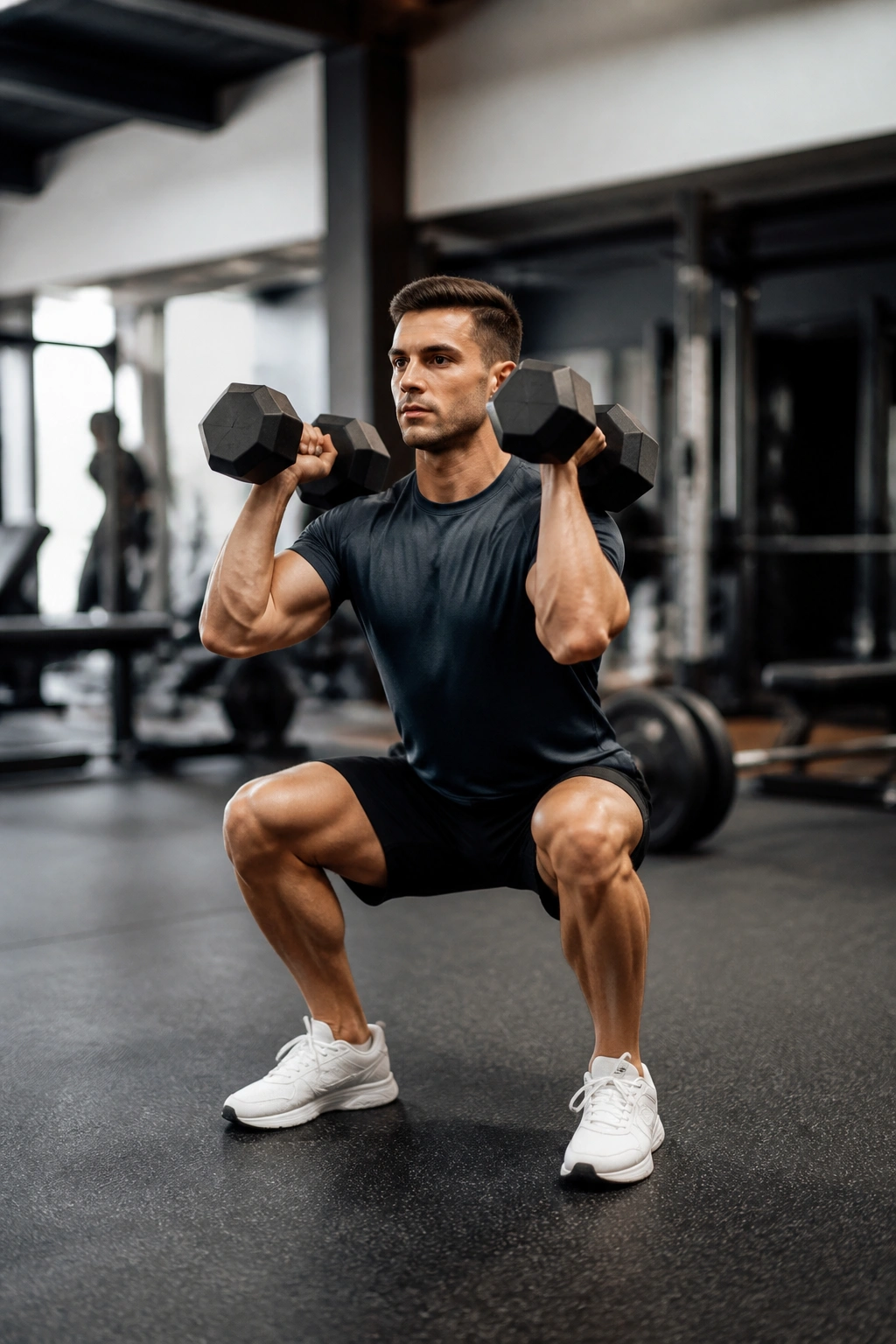
If you want a leg workout that also doubles as cardiovascular conditioning, thrusters are the answer. This is a full-body movement that combines a front squat with an overhead press. Your legs provide the power to push the weight up, and your core keeps everything together during the transition. It is intense, efficient, and great for building “engine” along with strength.
The Flow State
Thrusters require rhythm. You should start the press the second your hips begin to rise from the squat. Do not pause at the bottom, and do not pause at the top. The goal is one fluid, explosive motion.
Managing Intensity
- Use a weight that allows you to maintain consistent form for the entire set. If you are struggling to lock out your arms at the top, the weight is too heavy for a thruster.
- Maintain a braced core throughout the entire squat. If you lose your core tension, the transition to the press will feel shaky.
12. Dumbbell Box Squats
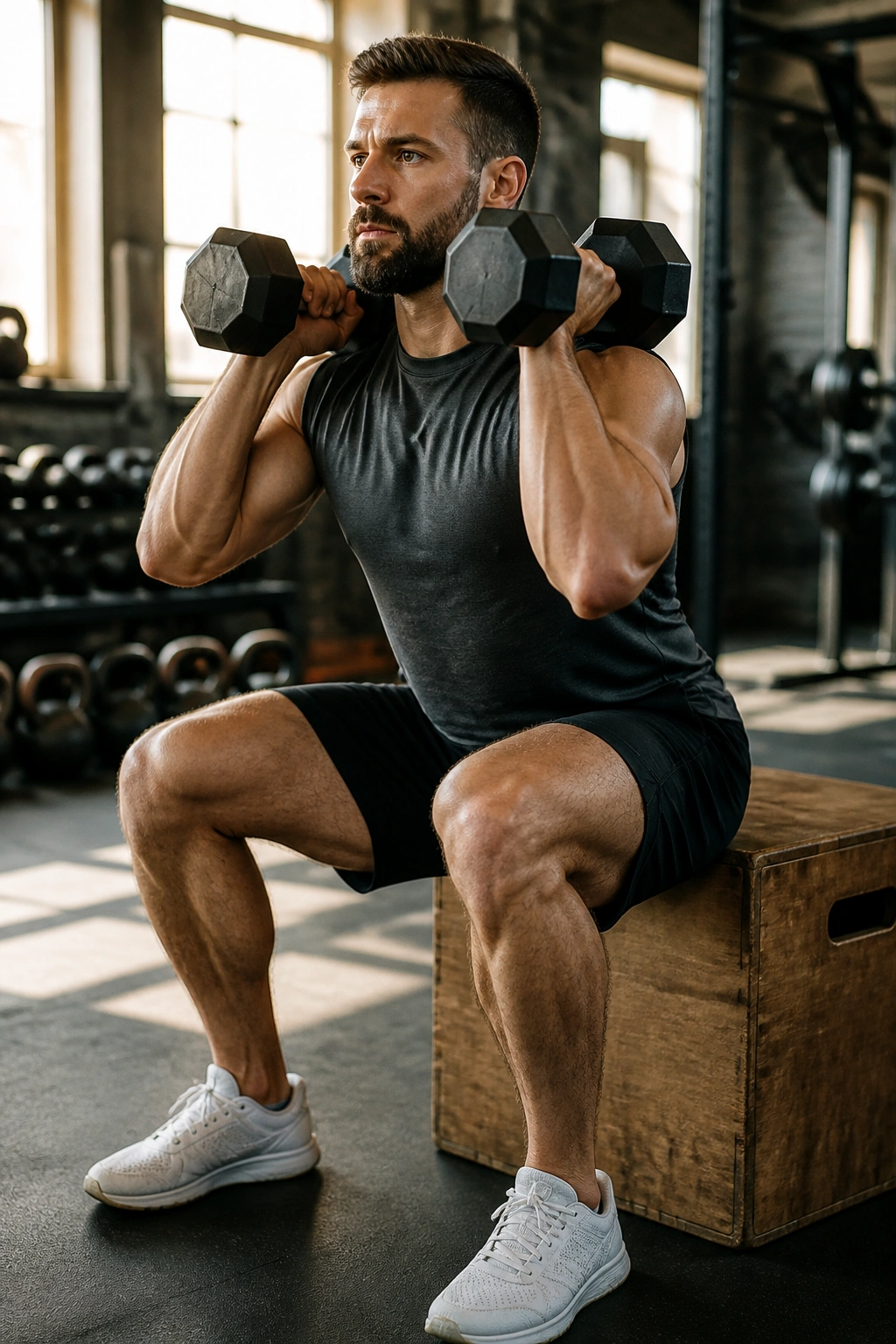
Box squats teach you how to sit back, not down. By using a box (or a chair or bench), you create a target that ensures you are hitting a consistent depth every single time. It also forces you to pause at the bottom, which eliminates the “bounce” or momentum you might otherwise rely on to get out of the hole.
Why It Builds Massive Strength
The pause at the bottom breaks your eccentric-concentric chain. You have to generate force from a dead stop, which is the hardest way to build strength. You will find that after a few weeks of box squats, your regular squats feel much more powerful and controlled because you have trained your body to initiate movement from the bottom position.
Proportionality
- Ensure the box height is appropriate. If you are too low, you may struggle to stand up safely with heavy dumbbells.
- Always perform a controlled descent. Don’t “flop” onto the box. You should touch it lightly, pause for one second, and then drive up.
13. Single-Leg RDLs
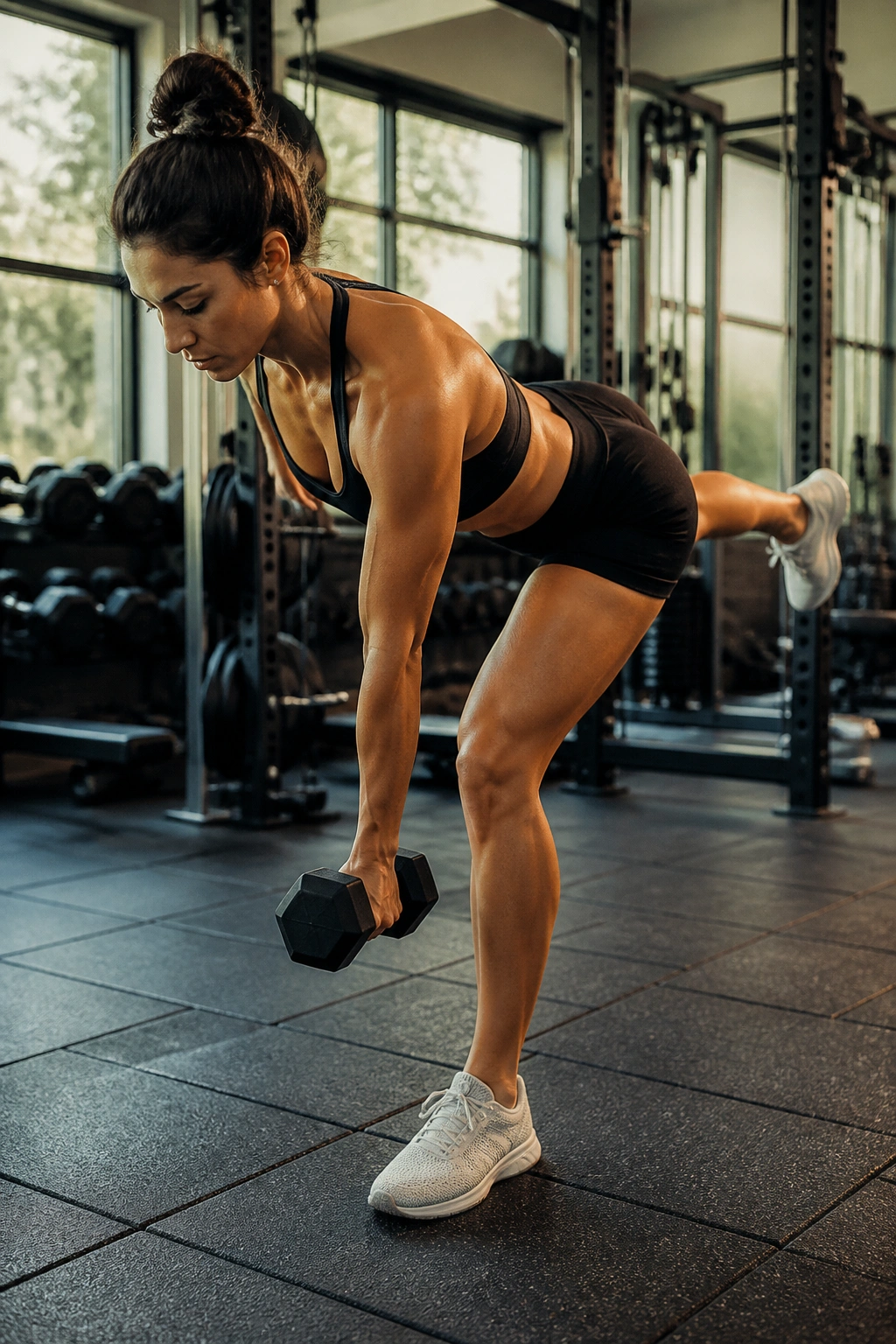
This is the ultimate test of unilateral stability. Standing on one leg while hinging at the hips requires intense focus from your core, your ankle stabilizers, and your glutes. It is common to feel wobbly at first, but that wobbliness is exactly what you need to train out of your system.
Why It’s Superior for Symmetry
We all have a dominant side. If you only train with two legs, your strong side will continue to do most of the work. The single-leg RDL exposes these imbalances immediately. If you can do 10 reps on your right side but only 6 on your left, you have found a major area for improvement.
Technique Cue
- Think about driving your back heel toward the wall behind you.
- Don’t rotate your hips. Keep your hips level with the ground.
- If balance is too difficult, use your free hand to hold onto a sturdy object, but only for the minimal amount of support needed.
14. Dumbbell Calf Raises
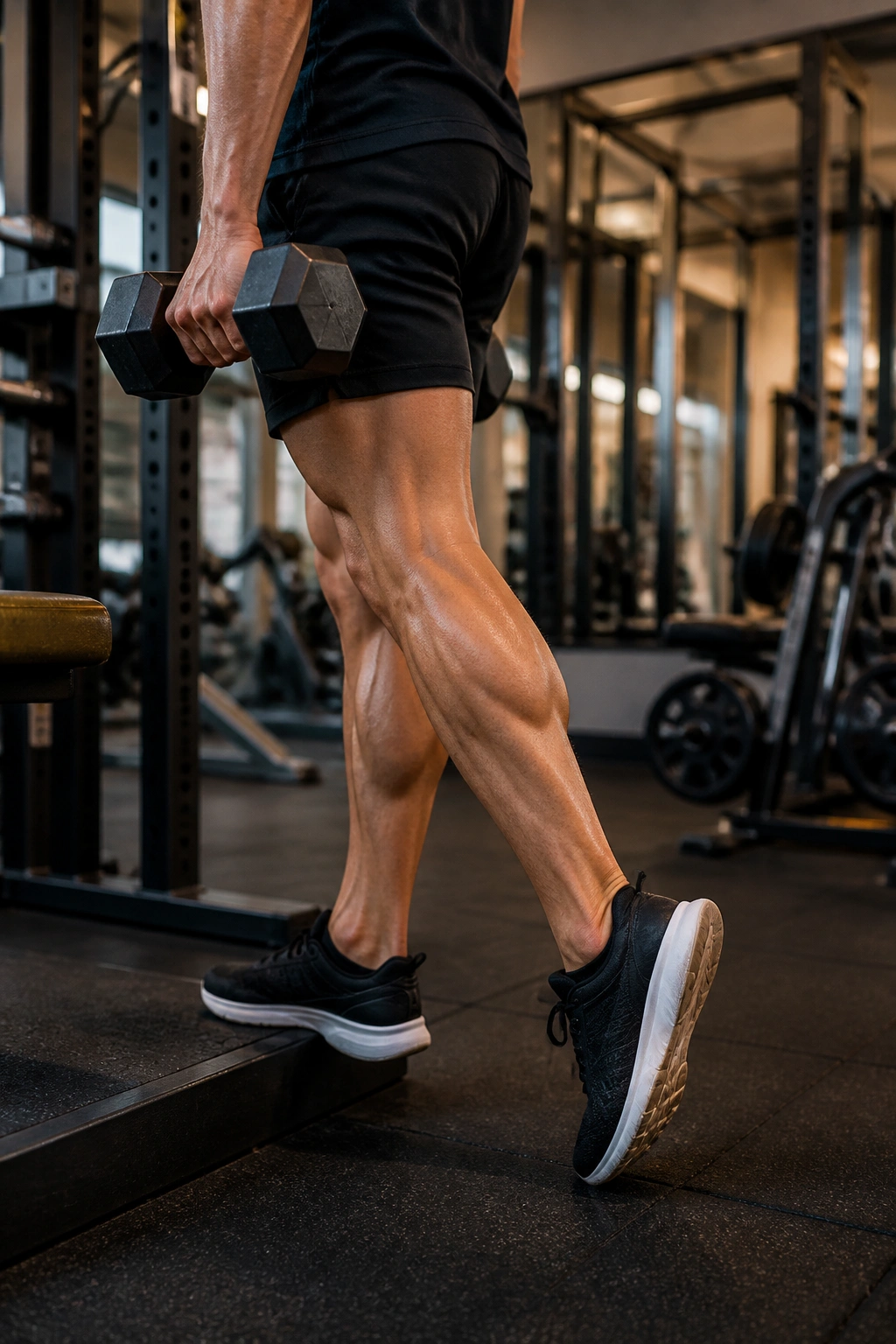
You cannot have a strong lower body if you neglect the calves. While they are often dismissed as “genetics,” the calves are a muscle group that responds very well to high-volume, controlled training. Holding a dumbbell in one hand while performing a calf raise on the opposite leg turns this into a surprisingly effective unilateral exercise.
The Full Range
The biggest mistake people make with calf raises is doing them too fast. You need to focus on the deep stretch at the bottom and the peak contraction at the top. Don’t bounce. Your Achilles tendon is very elastic; if you bounce, you are using the tendon to do the work instead of the muscle.
Maximizing Growth
- Aim for a two-second lift, a one-second pause at the peak, and a three-second lowering phase.
- Perform these at the end of your leg workout when your legs are already fatigued to ensure you are hitting the muscle fibers completely.
15. Dumbbell Cossack Squats
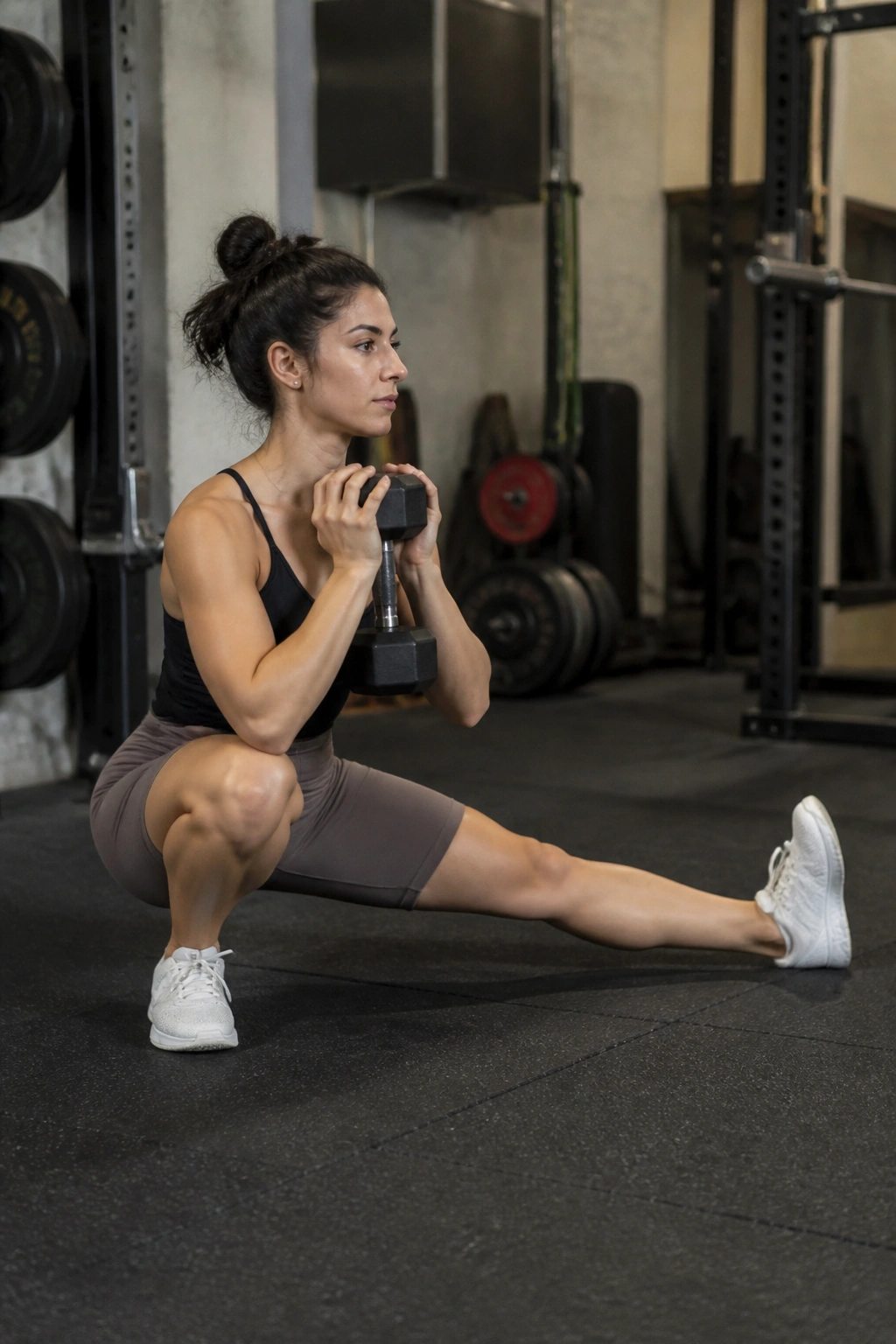
Cossack squats are a dynamic stretch and a strength movement rolled into one. You perform a lateral lunge, but you take it much deeper, often turning the toe of the straight leg toward the ceiling. This requires significant hip mobility and adductor strength. It is an advanced move, but it is incredibly effective for opening up tight hips while building leg strength.
Functional Benefits
This exercise replicates the kind of movement you might use in sports or martial arts, where you have to shift your weight rapidly from one side to the other. It builds “supple” strength—the ability to be strong at the very bottom of a deep, awkward position.
Cautionary Note
- If you have knee issues, move cautiously with this one.
- Keep your chest up. It is tempting to collapse forward, but you want to maintain as much posture as possible to ensure your glutes and quads are doing the work, not just your back.
16. Dumbbell Pistol Squat Progressions
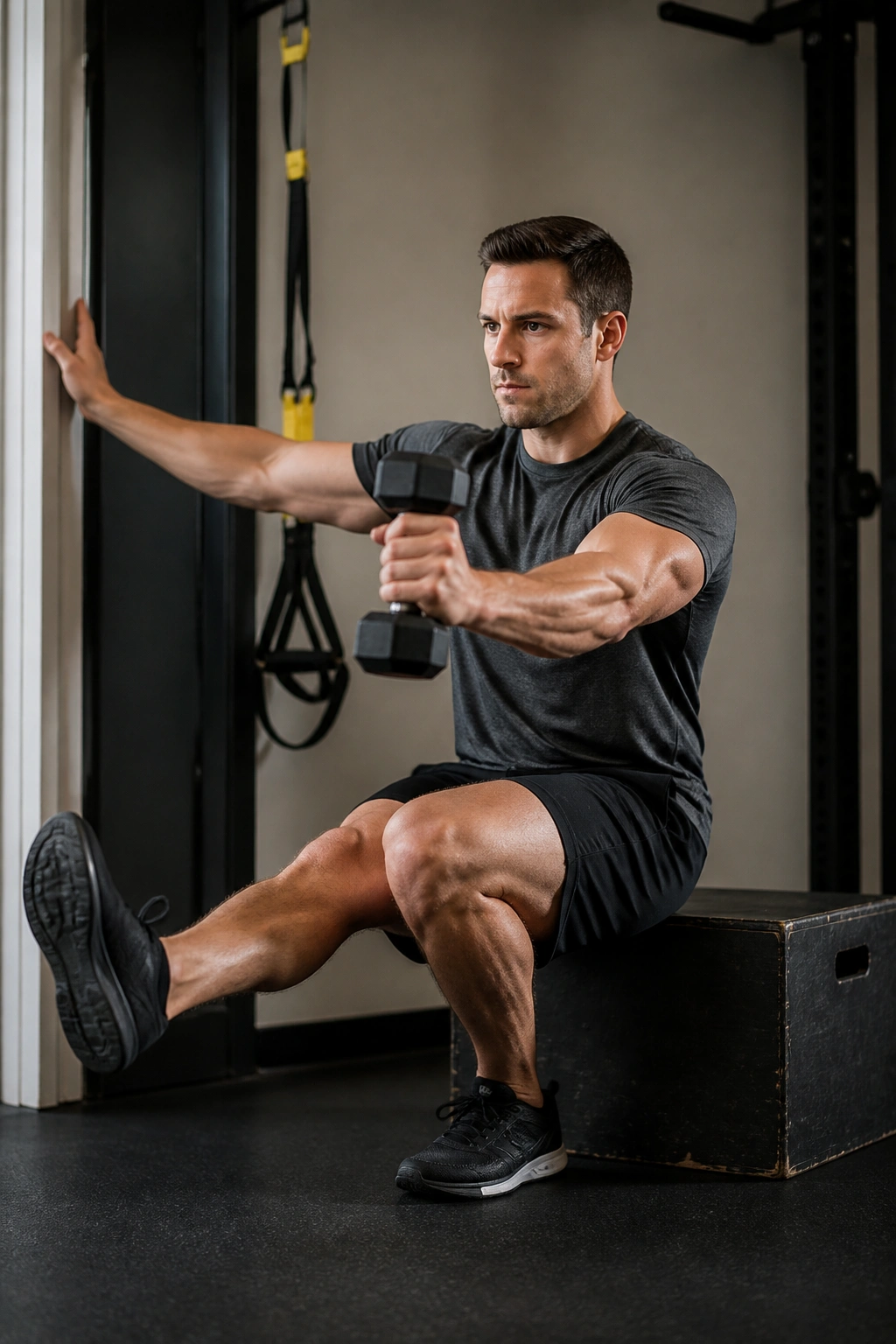
The pistol squat (a one-legged squat) is a milestone in bodyweight and light-weight training. Using a light dumbbell as a counterweight held in front of you can actually make the pistol squat easier to balance. It helps shift your center of gravity so you can sit down into the squat without falling backward.
Why Aim for This?
It is the pinnacle of single-leg strength. If you can perform a clean, controlled pistol squat, your legs are functionally balanced, strong, and mobile. It is also an incredibly convenient exercise; you need zero equipment (or just one light dumbbell) to get a world-class leg workout.
How to Progress
- Start by sitting down onto a high box, then work your way down to lower surfaces.
- Use a TRX strap or a door frame for balance if needed, but strive to rely on it less over time.
- Focus on keeping the non-working leg straight and engaged; it should be an active part of the movement, not just dead weight hanging there.
17. Dumbbell Swing
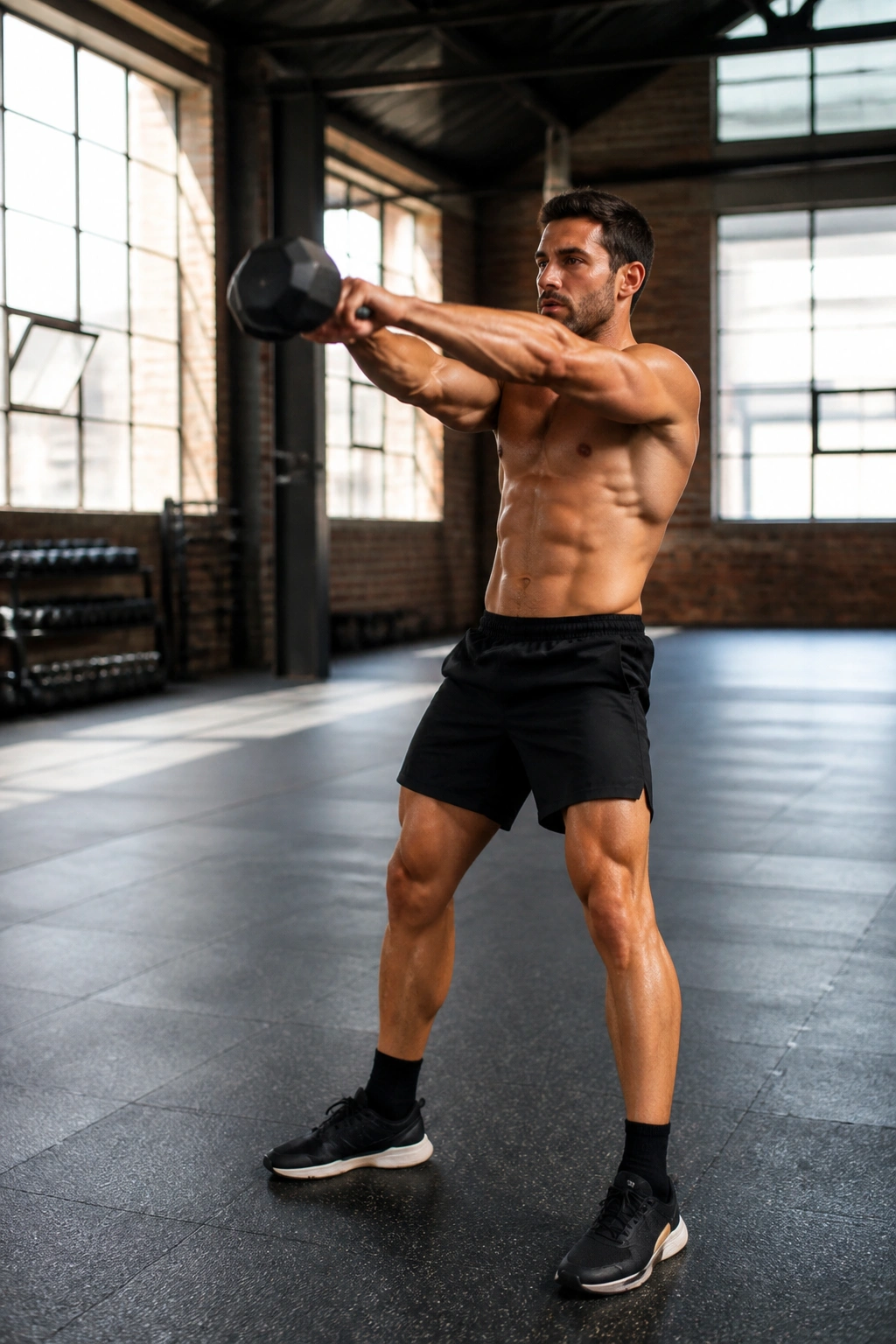
While often associated with kettlebells, the dumbbell swing is a potent tool for posterior chain power. It is an explosive hip hinge movement that forces your hamstrings and glutes to contract rapidly. This builds explosive power, which is the “missing link” in many strength training programs that focus only on slow, grinding reps.
The Power Hinge
This is not a squat. Do not squat the weight. Think of your arms as ropes and your body as a pendulum. The power comes from the snap of your hips, not the lift of your arms. Your glutes should contract so hard at the top that they propel the weight forward.
Safety First
- Only use a weight you can handle safely. If the weight feels too heavy to control on the descent, lower it immediately.
- Never round your back at the bottom. The dumbbell should be between your legs, not hitting the floor.
- Keep your grip firm but not suffocating; let the momentum do the work.
18. Dumbbell Zercher Squats
The Zercher squat is one of the most grueling leg exercises you will ever perform. Holding a heavy dumbbell in the crook of your elbows forces your core to work in ways that almost no other leg exercise demands. It shifts the center of mass forward, forcing your quads to work harder to keep you upright.
The Core Challenge
Your core will likely fail before your legs do. That is the beauty of it. You are training your entire anterior chain—from your calves to your quads to your abs—in one go. It is a fantastic movement for building a “solid” feeling in your lower body and midsection.
Tips for Success
- Wrap a towel around the dumbbell handle if it digs into your arms; the discomfort is part of the move, but you don’t need bruises to build muscle.
- Keep your elbows close to your body.
- Take a deep breath into your belly before you descend; bracing is non-negotiable here.
Final Thoughts
Building real, lasting lower body strength does not require an endless array of expensive machines. It requires a consistent, disciplined approach to movement. By rotating these 18 variations into your routine, you can ensure that you are hitting your quads, hamstrings, glutes, and stabilizers from every conceivable angle.
The goal is to focus on quality, not just the numbers on the dumbbells. If you can perform a movement with perfect control, you are already ahead of the curve. Consistency in these foundational patterns will yield results that far outlast any quick-fix training method. Keep the movements clean, challenge your stability, and let your body adapt to the increased demands you are placing upon it.
