



Belly fat exercises for office workers have to live in the real world: tight calendars, stiff hips, conference calls, and the deeply annoying fact that a lot of people spend most of the day parked in a chair. A move can be excellent on paper and still fail if it needs a mat, a locker room, or a level of enthusiasm you do not have after lunch.
No exercise burns fat from only the waist. That part matters. What shrinks the midsection is a mix of more total movement, stronger muscles, and a calorie balance that trends the right way over time. The exercises that work best for busy desk-bound people are the ones you can repeat without drama.
Sitting all day also changes the way your body feels and moves. Hip flexors get tight, glutes go quiet, the lower back starts doing too much, and the core loses some of its job description. That is why the smartest routines mix standing drills, floor work, and a few short bursts that make breathing a little harder.
The list below leans on moves you can do in regular clothes, in small spaces, and without fancy gear. Some raise your heart rate. Some train your trunk to stay firm. A few do both, which is the sweet spot if you want your waistline to change in a way that lasts.
1. Seated Knee Lifts for a Desk Workout
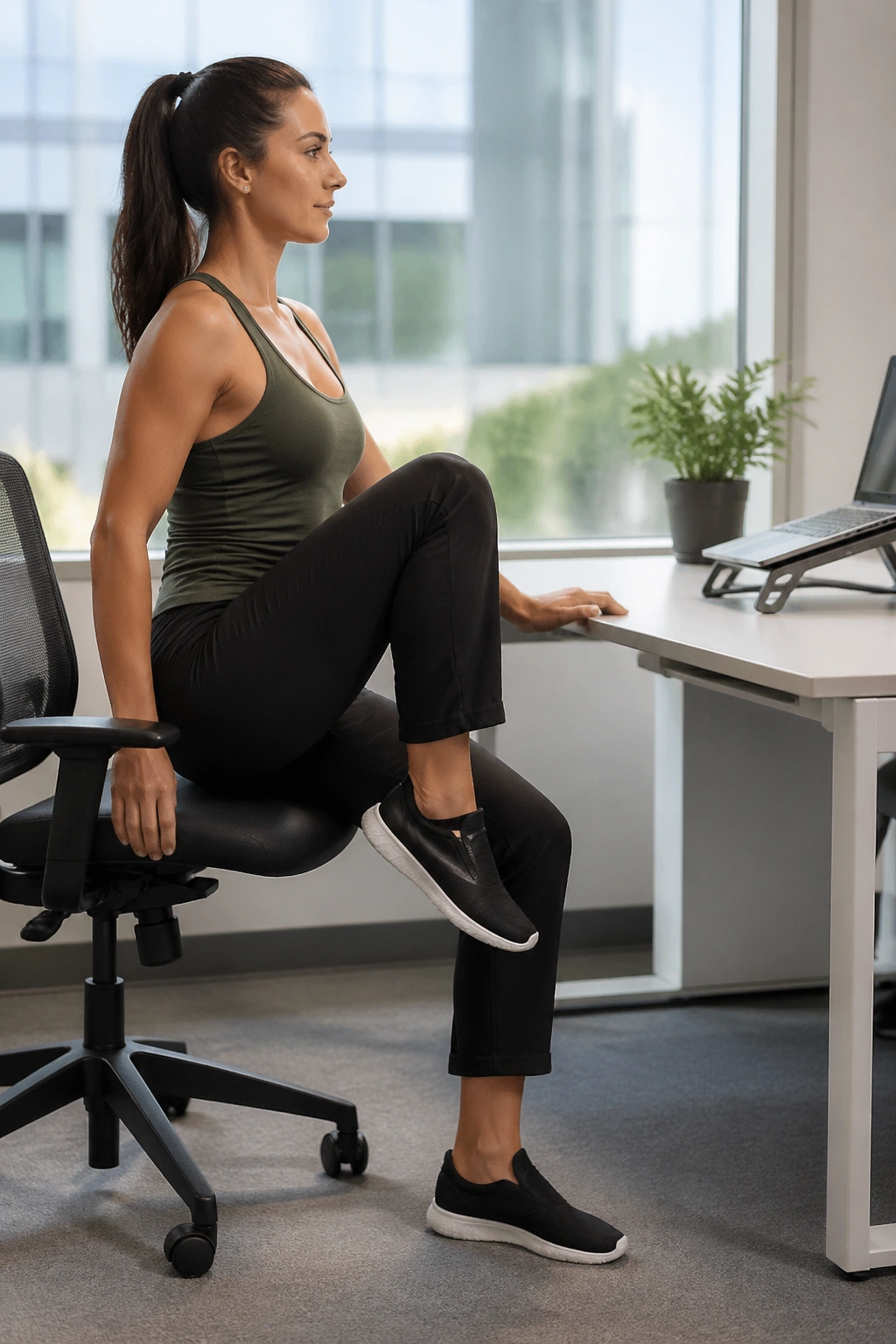
Seated knee lifts are the sneaky little move I like for the first hour of a long workday. You stay tall in your chair, brace lightly through your middle, and lift one knee at a time without leaning back or collapsing into the seat. It looks almost too small to matter. It isn’t.
Why It Helps
The point here is not to perform some heroic ab burn. The point is to keep the hip flexors working, wake up the lower abs, and interrupt the long, stale pressure of sitting. A few controlled reps can also make your torso feel more upright, which helps more than people think.
Try 10 to 15 lifts per side with a slow exhale as the knee comes up. Keep the foot of the lifted leg off the floor for a second if you can. That tiny pause turns the drill from lazy to useful.
- Sit near the front edge of a sturdy chair.
- Place one hand on the desk only if you need balance.
- Lift the knee to hip height, or as close as your chair allows.
- Lower with control, not a drop.
- Switch sides without rushing.
Pro tip: if you can do these during a phone call, you will do them more often. And frequency matters more than looking fancy.
2. Standing Marches With Arm Drive
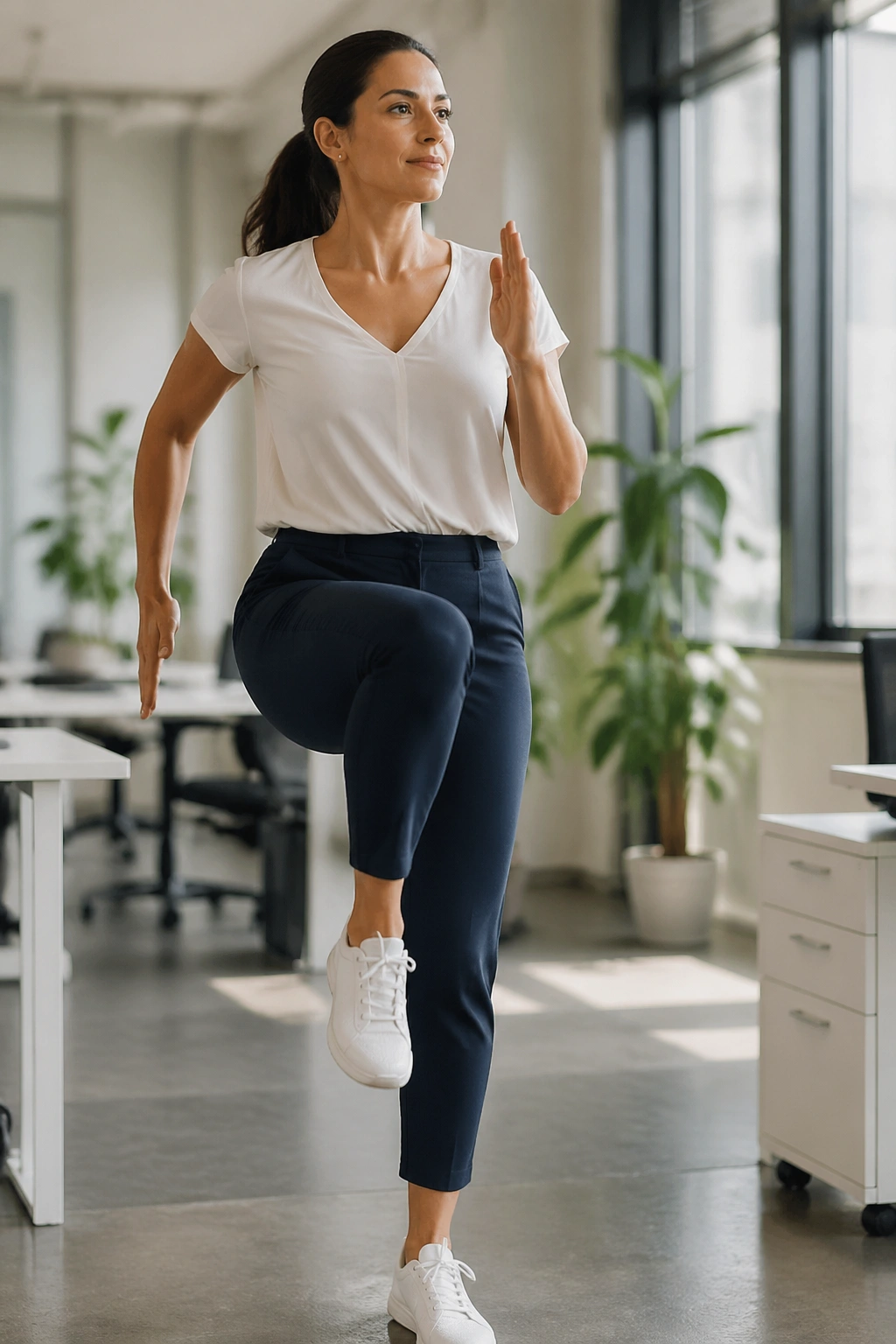
If you can stand and swing your arms with purpose, you can get your heart rate up faster than you expect. Standing marches are plain, which is why they work so well. No setup. No floor. No excuses.
The trick is to drive the opposite arm and knee together, like you are marching for real, only quicker and with more intent. Keep your ribs stacked over your hips. If your lower back starts arching, slow down and bring the range back to earth.
A good starting dose is 45 seconds on, 15 seconds off, for 4 rounds. That is enough to warm the whole body without turning your office into a gym class. If you want a harder hit, add a little speed at the end of each round, not wild bouncing.
Standing marches are useful because they combine light cardio with trunk control. You are not just moving the legs around. You are training the middle to stay organized while the limbs do more work.
3. Desk Plank Against a Sturdy Surface
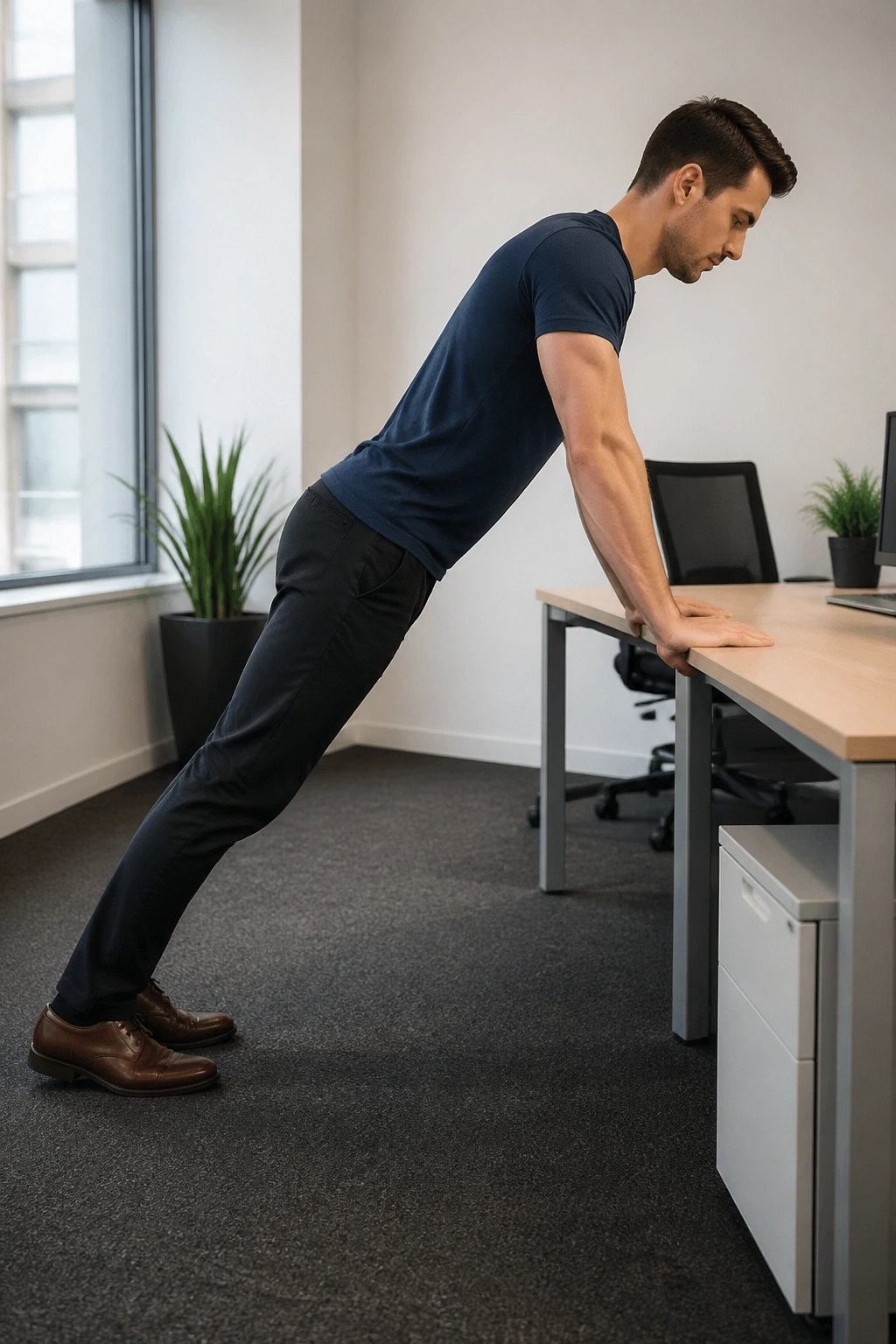
Can a desk plank count if your hands never touch the floor? Yes — if you do it properly. An incline plank against a sturdy desk or countertop is one of the most sensible office-worker core moves because it saves the wrists, eases the load on the shoulders, and still asks the abdomen to do its job.
Set your hands a little wider than shoulder width. Step your feet back until your body forms one long line from head to heels. Then squeeze your glutes gently, pull your ribs down, and resist the urge to sag through the lower back.
How to Get the Most From It
Hold for 20 to 40 seconds at first. That is plenty if you are honest about form. If the desk shakes, the elbows lock hard, or your neck juts forward, the plank has stopped being helpful.
- Keep your neck long and your gaze a few inches ahead of your hands.
- Press the floor away through the palms.
- Imagine zipping your lower ribs toward your hips.
- Stop before your low back starts to dip.
One hard rule: do not use a rolling chair or a flimsy table. That is a bad trade.
4. Chair Mountain Climbers for Belly Fat
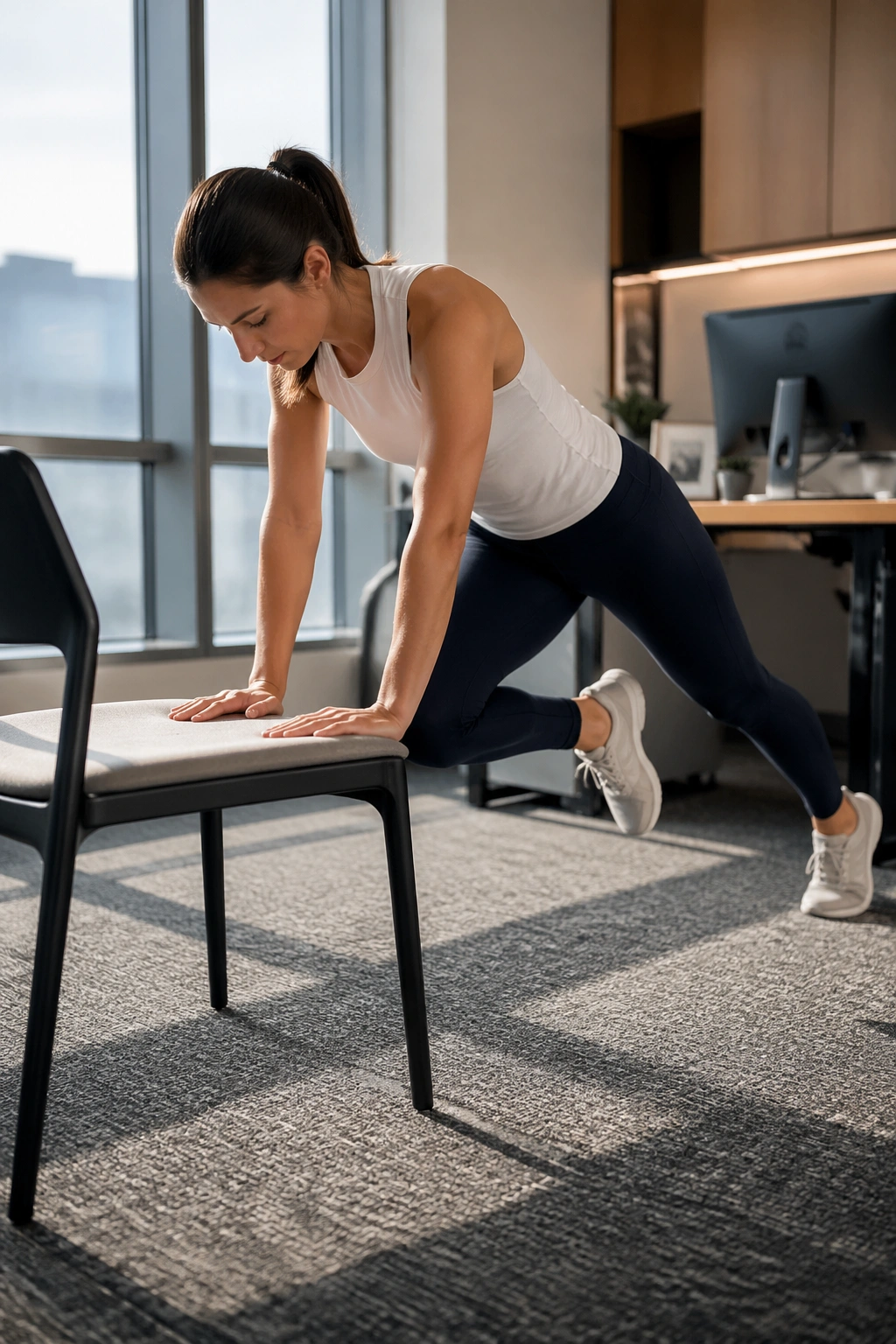
A sturdy chair, a short timer, and enough room for your hands. That is all this needs. Chair mountain climbers are a cleaner option than many floor versions because the incline takes pressure off the wrists and lets you move faster without feeling like your shoulders are about to file a complaint.
Start with both hands on the seat, shoulders over wrists, and feet back in a short plank. Then drive one knee toward your chest, switch sides, and keep the hips as steady as possible. The faster you go, the more this becomes a cardio drill. The cleaner you go, the more your core gets involved.
- Use a chair that does not slide.
- Keep your shoulders away from your ears.
- Bring the knees in under control, not with a snap.
- Breathe out on each drive.
- Do 20 to 30 seconds for a burst, then rest.
The best part is the simplicity. No one needs to stare at you. It just looks like you are very committed to standing near a chair, which is true enough.
5. Standing Torso Twists That Spare Your Neck
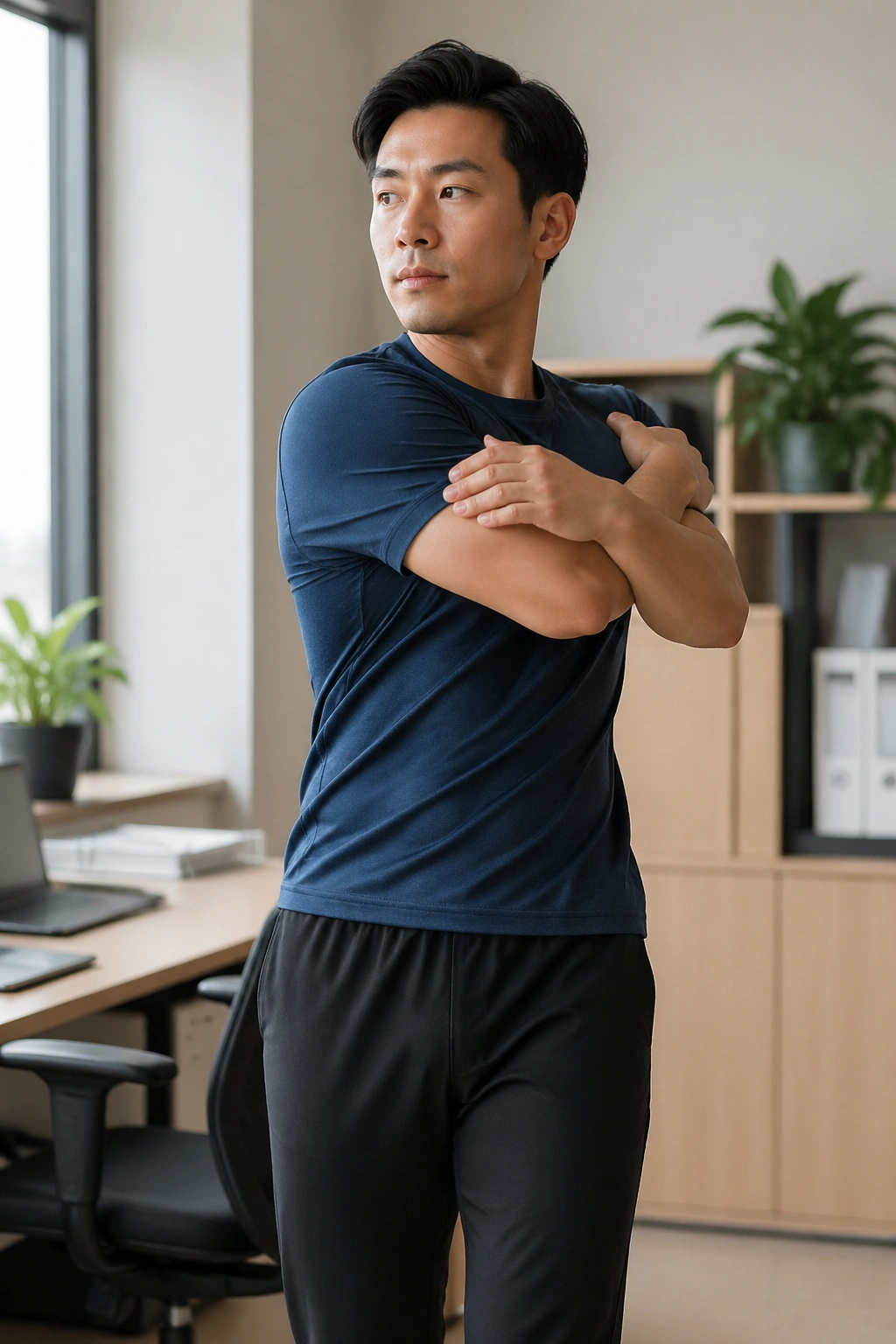
Unlike the frantic crunching people do when they are trying to “feel” their abs, standing torso twists keep you upright and let the trunk work without floor time. That matters for office workers, because your body already spends enough hours folded forward.
Cross your arms over your chest or hold a light water bottle at chest height. Rotate from the ribs and waist, not from the shoulders alone. Your hips should stay mostly forward. If your feet spin all over the place, the move has become a sloppy dance instead of a core drill.
The range should be moderate. You are not trying to crank your lower back. You are trying to teach your torso to rotate with control while your legs stay grounded. That is a different thing.
A sensible dose is 20 controlled twists per side or 30 seconds at a steady pace. People who sit a lot often feel this one in the sides of the waist almost immediately. Good. That feedback can be useful, as long as it never turns into pain.
6. Dead Bug Core Holds on the Floor
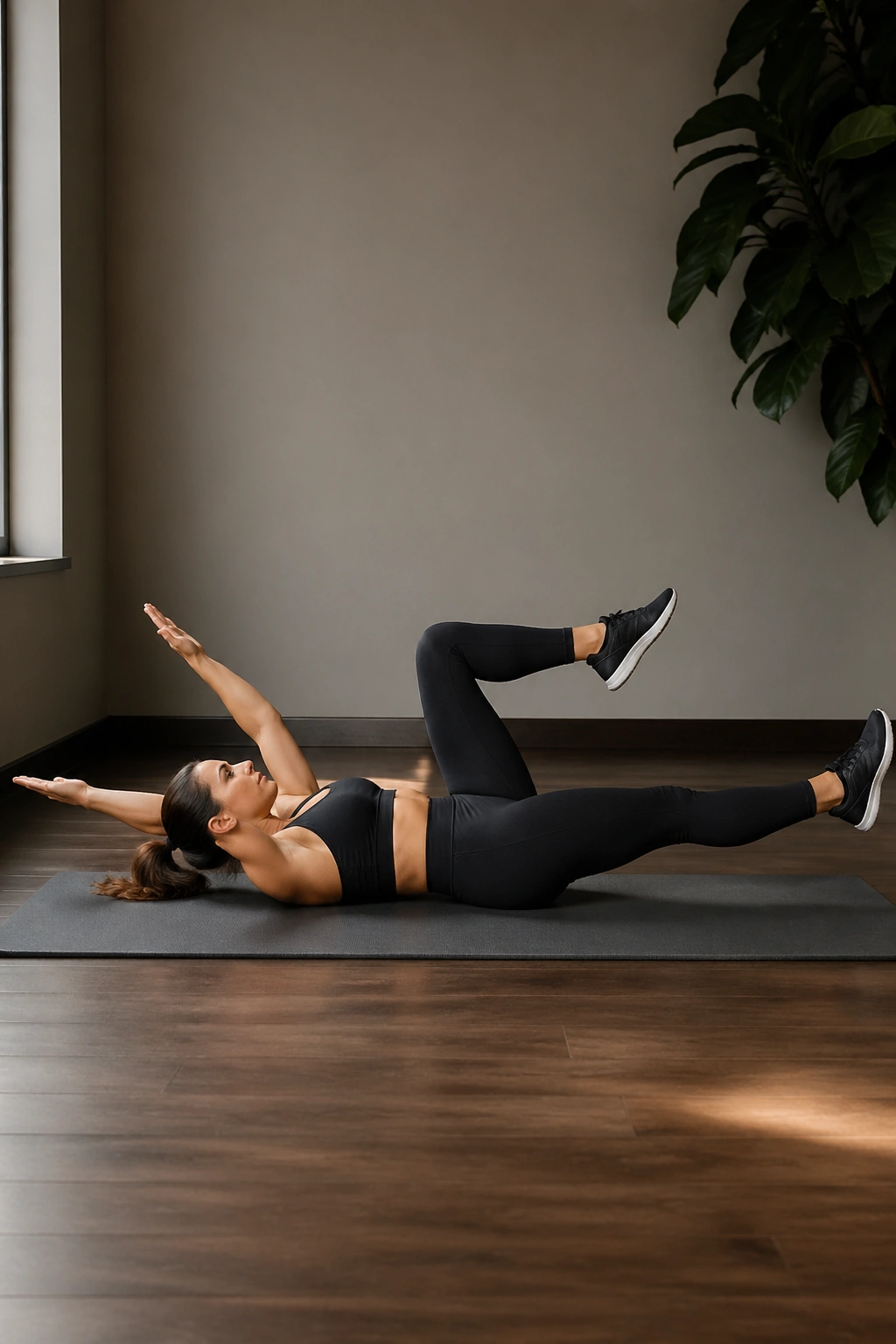
On the floor, dead bug looks almost too calm. That is part of the charm. You lie on your back, lift your legs into a tabletop position, and reach one arm and the opposite leg away from the center without letting the lower back pop off the ground. It is quiet, but it asks for serious control.
The dead bug is one of the best choices for office workers because it trains the core to resist arching. Sitting all day encourages a lazy, open front side. This move does the opposite. It teaches the body to stay stacked while the limbs move.
Breathe out as you extend. That exhale helps the ribs settle and keeps the belly from flaring. If the low back lifts, shorten the reach. If the neck gets tense, relax your face and slow down. You do not get extra credit for going fast.
Try 6 to 8 reps per side with a 3-second reach and return. Slow is the whole point here. No rushing. That is how this exercise earns its place.
7. Bird Dog Reaches for Better Back Support
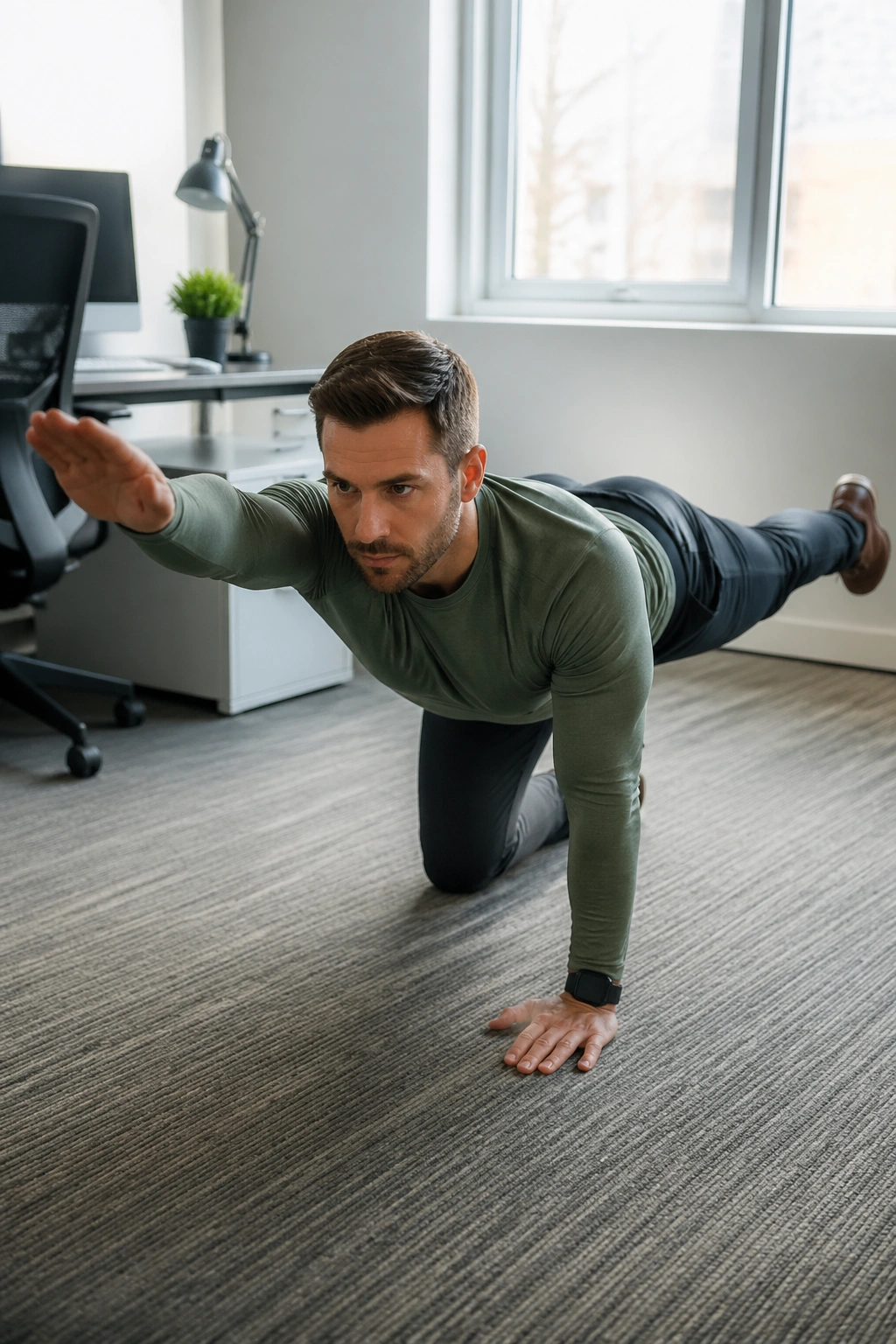
Every office worker who sits too much knows the lower-back wobble. Bird dog is a clean answer to that problem because it trains the body to resist twisting while one arm and the opposite leg move away from center.
The Cleanest Version
Start on hands and knees with your wrists under your shoulders and your knees under your hips. Reach one arm forward and the opposite leg back until both are long, not high. Keep the hips level. A lot of people lift the leg too far and turn the whole thing into a back squeeze. Don’t.
Hold for a second, then return with control. The goal is balance and tension, not speed. If you want a harder version, pause for two breaths before lowering.
- Keep the neck in line with the spine.
- Press through the supporting hand.
- Reach long through heel and fingertips.
- Exhale as the limbs extend.
Best use: a set of 5 to 8 reps per side after a walk or between meetings. Bird dog feels small, but it tends to clean up sloppy posture fast.
8. Glute Bridges That Wake Up a Slumped Seat
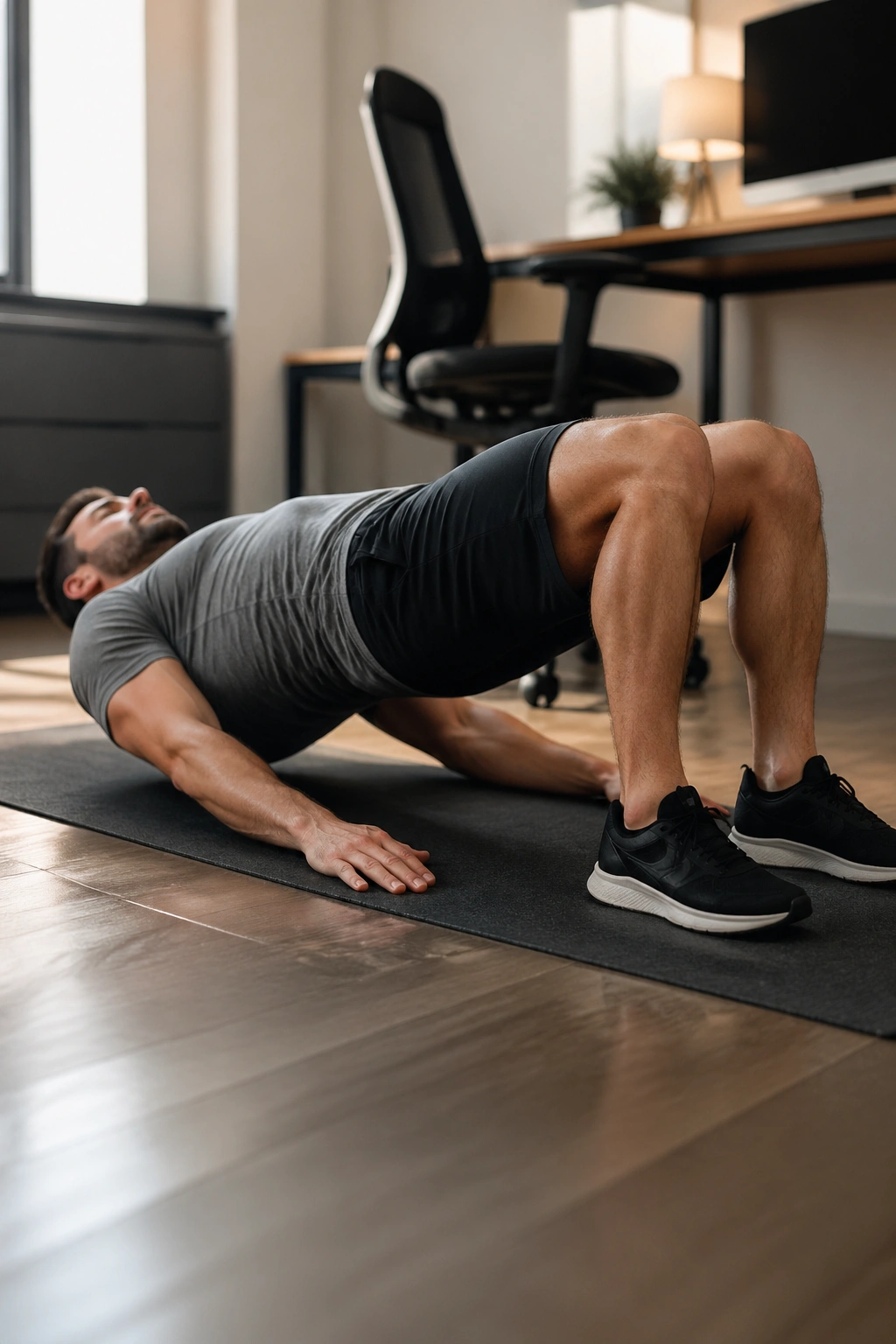
Weak glutes make the lower back work overtime. That is the simple version, and it is worth saying plainly. Glute bridges help because they bring the hips back into the job instead of letting sitting turn the back into the default mover.
Lie on your back with your knees bent and feet flat, about hip-width apart. Press through the heels, lift the hips, and squeeze the glutes at the top for a second or two. You should feel the work in the backside, not the lower back. If the low back is stealing the show, bring the feet a little closer and lower the lift.
This move pairs well with desk life because it does the opposite of slouching. The pelvis gets to extend, the front of the hips opens a bit, and the trunk has to hold a cleaner shape. That combination is useful even if you never think about “core strength” again.
Try 12 to 15 reps with a 2-second pause at the top. If that feels easy, place a dumbbell or loaded backpack across the hips. Not on the belly. That would be annoying and pointless.
9. Bicycle Crunches Done Slowly and Cleanly
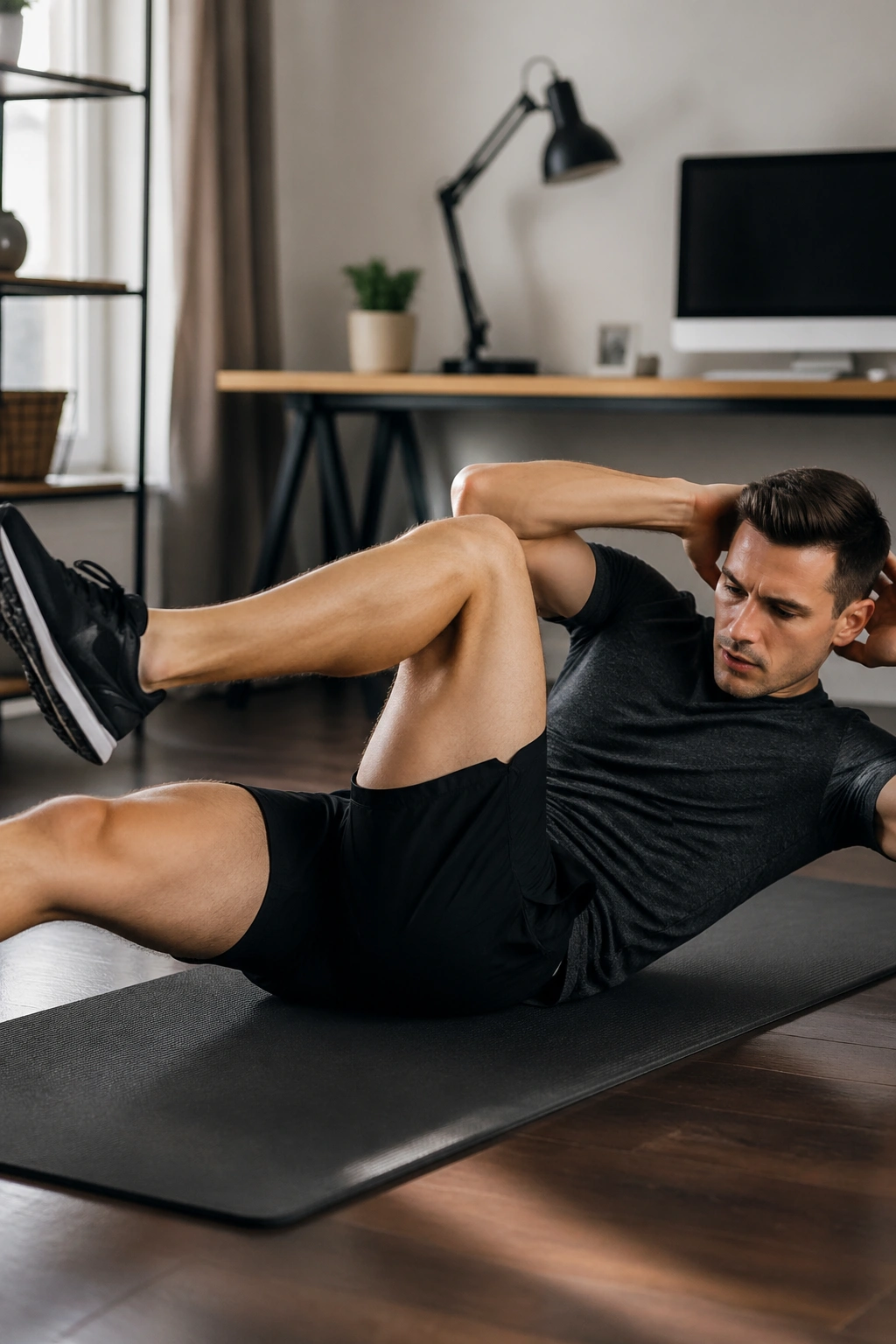
Why keep bicycle crunches in the mix when so many people butcher them? Because done slowly, they train the obliques, the front abs, and coordination at the same time. Done fast, they turn into neck pulling and useless flailing. So the tempo matters. A lot.
Lie on your back, hands lightly behind the head, elbows open. Bring one knee in as the opposite shoulder lifts toward it. Then switch sides in a controlled rhythm. The “bike” part is not about speed. It is about alternating tension across the trunk while the legs stay active.
How to Make Each Rep Count
Keep your lower back as close to the floor as possible. Do not yank the head forward. Do not force the elbow to slam into the knee; they do not have to meet. A shorter, cleaner range is better than a dramatic one.
- Work at 8 to 12 reps per side.
- Exhale as each shoulder comes up.
- Keep the opposite leg long but not locked hard.
- Move like you mean it, then stop before form gets sloppy.
A useful rule: if your neck hurts, slow down and reduce the range. Pain there usually means the abs have stopped doing enough.
10. Side Plank Holds That Train the Waist
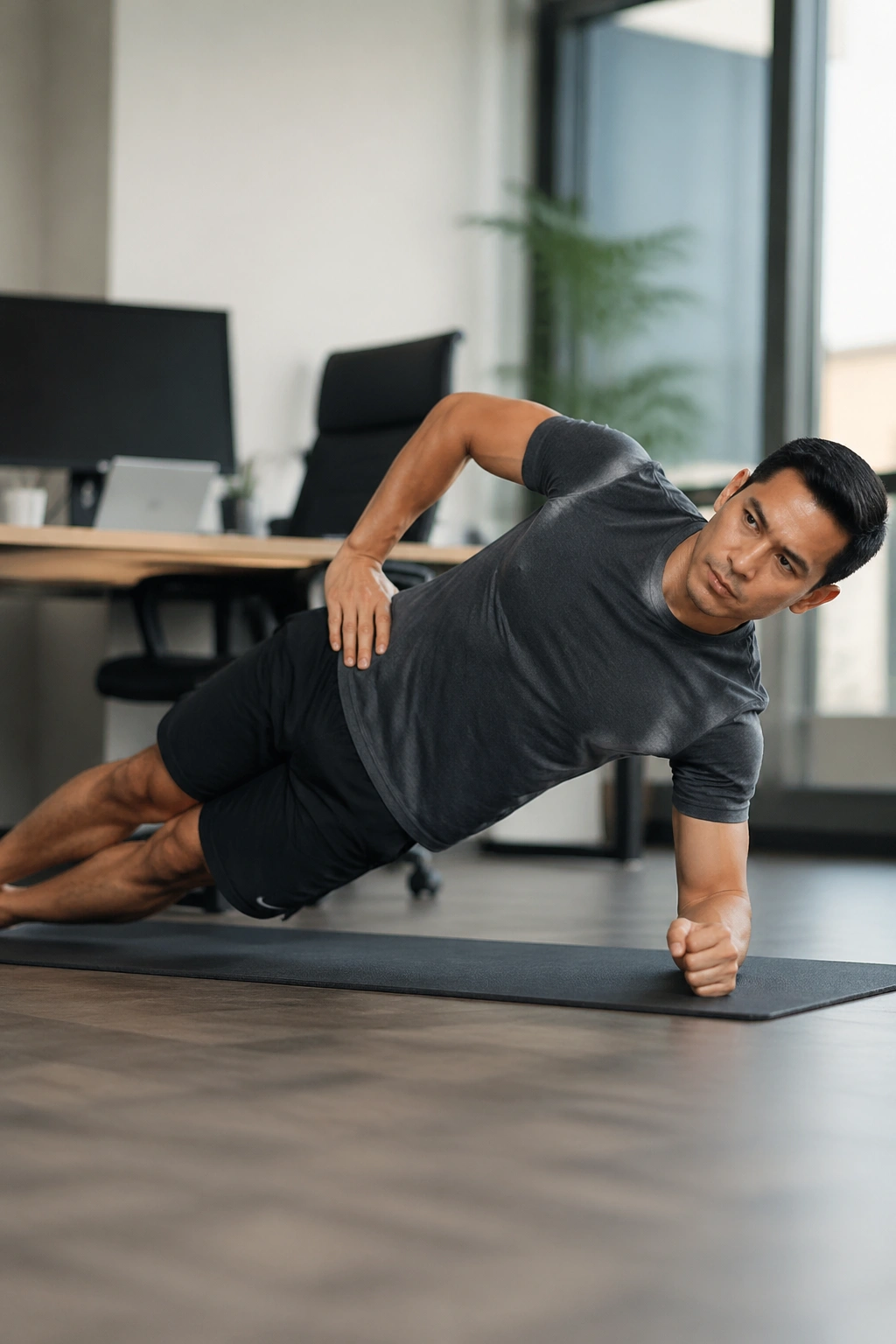
One side of the waist gets ignored in too many desk routines. Side planks fix that by asking the obliques and the small stabilizers around the ribs and hips to hold the body in a straight line while gravity tries to bend you sideways.
Start on one elbow, stack the feet, and lift the hips until the body looks long and tidy. If that is too much, drop the bottom knee to the floor and keep the top leg bent. The easier version still works. That is not a consolation prize.
The exercise is less about endurance theater and more about staying square. If the shoulders roll forward or the hips drift back, reset. Hold the line. Breathe through the ribs instead of bracing so hard you stop breathing altogether.
A smart starting point is 15 to 30 seconds per side for 2 to 4 rounds. Increase the hold only when the shape stays clean. A shaky 45-second plank is worth less than a sharp 20-second one.
11. Squat to Overhead Reach for a Faster Pulse
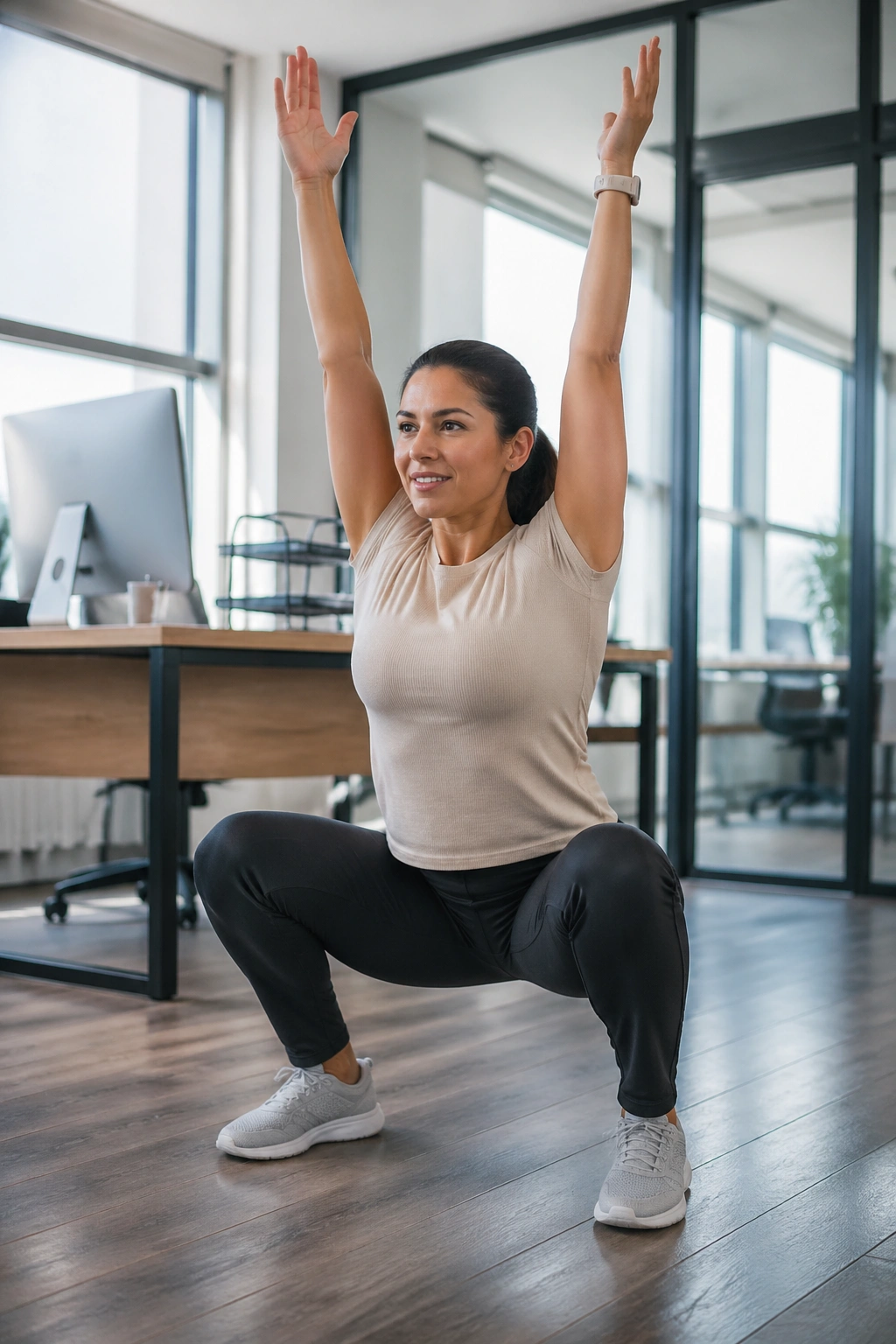
A plain squat builds legs. A squat with an overhead reach turns the same pattern into a mild cardio drill and a trunk-bracing challenge. That is why it fits office workers so well. You do not need a mat, and you do not need to lie down on the floor between tasks.
Stand with your feet about shoulder-width apart. Lower into a squat by sending the hips back and keeping the chest tall. As you stand, reach both arms overhead and squeeze the glutes lightly. The reach should feel long, not sloppy. If the knees cave inward, slow down and fix the feet first.
This move also reminds your torso to stay stacked while the arms move. That sounds small, but it matters. Sitting all day tends to flatten your posture; this drill opens it back up a little while using more muscle than a casual stretch.
Try 10 to 15 reps for 2 to 3 rounds. Hold light bottles or just use body weight. I prefer body weight first. It keeps the pattern cleaner, and clean patterns are what you want before chasing speed.
12. Shadow Boxing in a Small Office Space
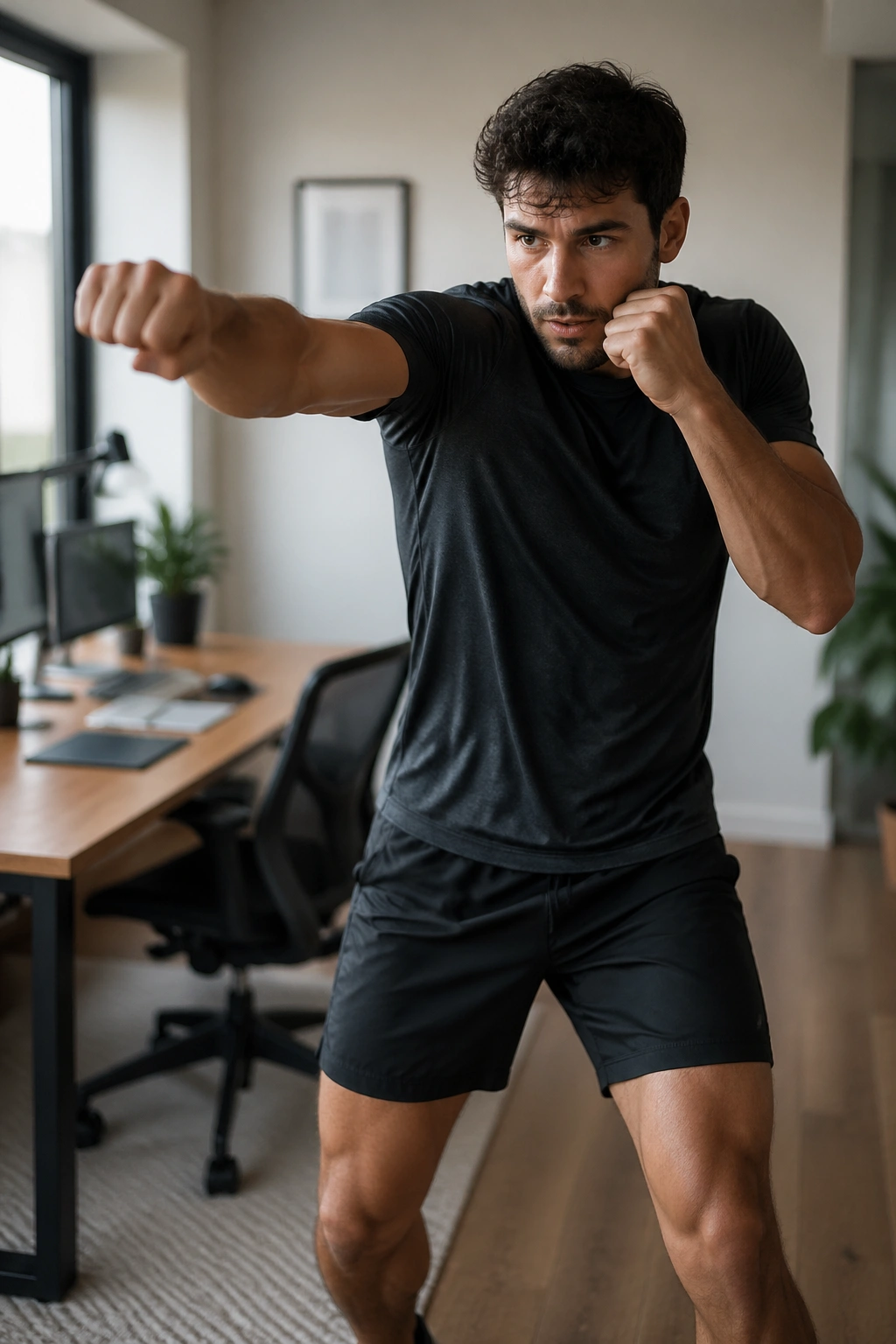
Shadow boxing is one of the most underrated desk-worker options because it blends heart rate, rotation, balance, and coordination in a tiny footprint. No equipment. No floor work. Just you, a little space, and enough intent to keep your fists moving.
Start with soft knees and hands near the cheeks. Throw a jab, then a cross. Rotate the torso a bit, let the rear heel pivot, and keep the shoulders loose. If you want more work, add hooks or uppercuts, but keep the spine tall and the chin tucked.
Two minutes can feel like a long time if you actually punch with rhythm. Good. That is the point. The trunk has to stabilize every strike, and the legs keep taking little hits of work each time you shift your weight.
Short bursts work best here. Three rounds of 90 seconds with 30 to 45 seconds of rest is enough to turn a sleepy afternoon around. Also, it is hard to feel bored while throwing punches at invisible targets. That helps.
13. High Knees in Place Without the Bounce
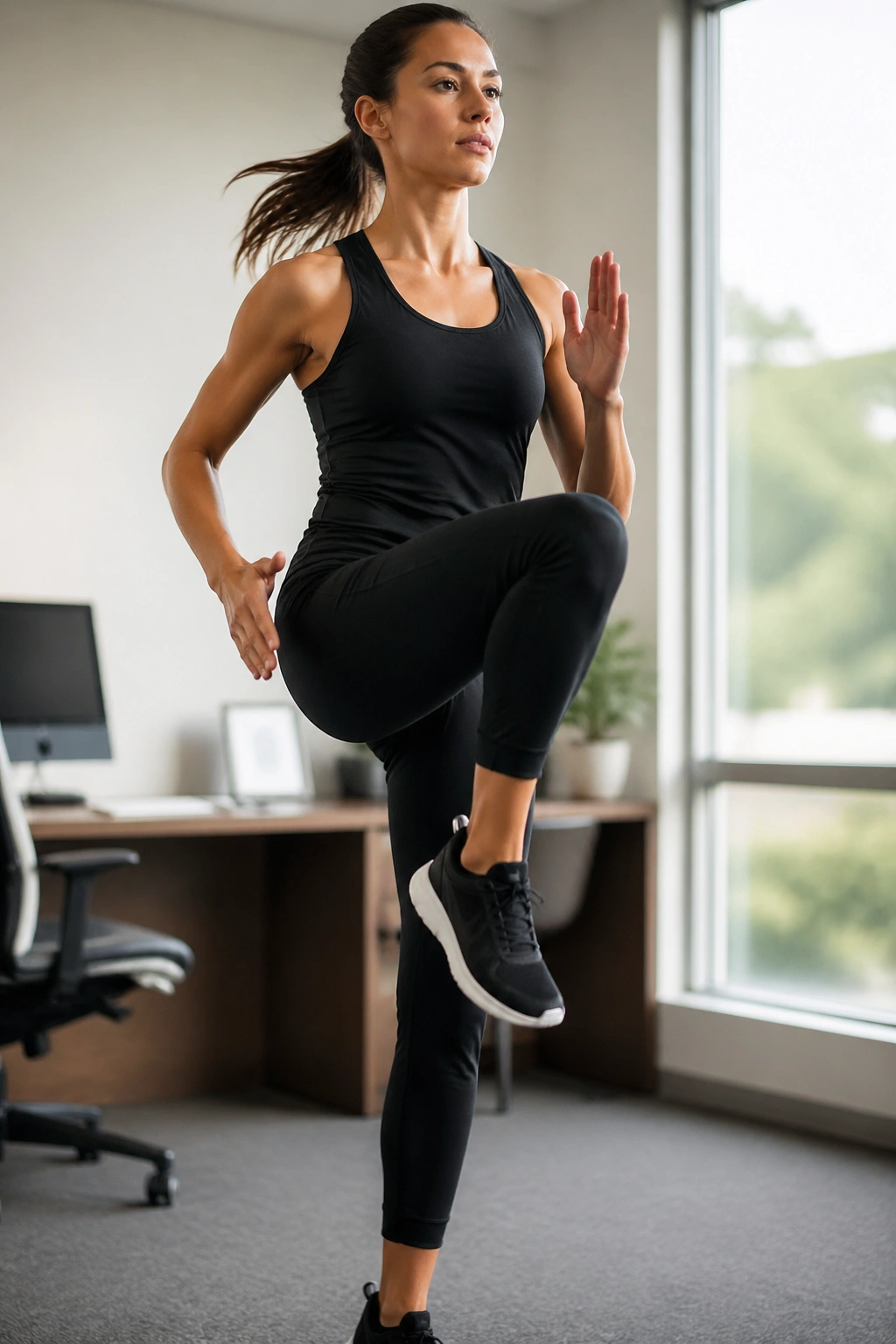
High knees are loud if you let them be. The office-safe version is smaller, quicker, and easier on the joints. You still drive the knees up, but the feet land softly and the torso stays tall instead of flopping around like a bad jump rope routine.
How to Keep It Quiet
Stand with your feet under your hips and run in place with a compact stride. Pump the arms. Lift the knees to a comfortable height. If jumping bothers your shins or knees, keep one foot close to the floor at all times and make the movement more like a fast march.
- Keep your rib cage stacked over your pelvis.
- Land softly through the balls of the feet.
- Stay light through the shoulders.
- Use 20-second bursts if you are new to it.
- Rest 40 to 60 seconds between rounds.
The best part is how fast it gets the blood moving. High knees are not subtle. They wake up the lungs, the hips, and the midsection all at once. And on a day when your energy is buried under emails, that can be enough.
14. Stair Intervals for Belly Fat
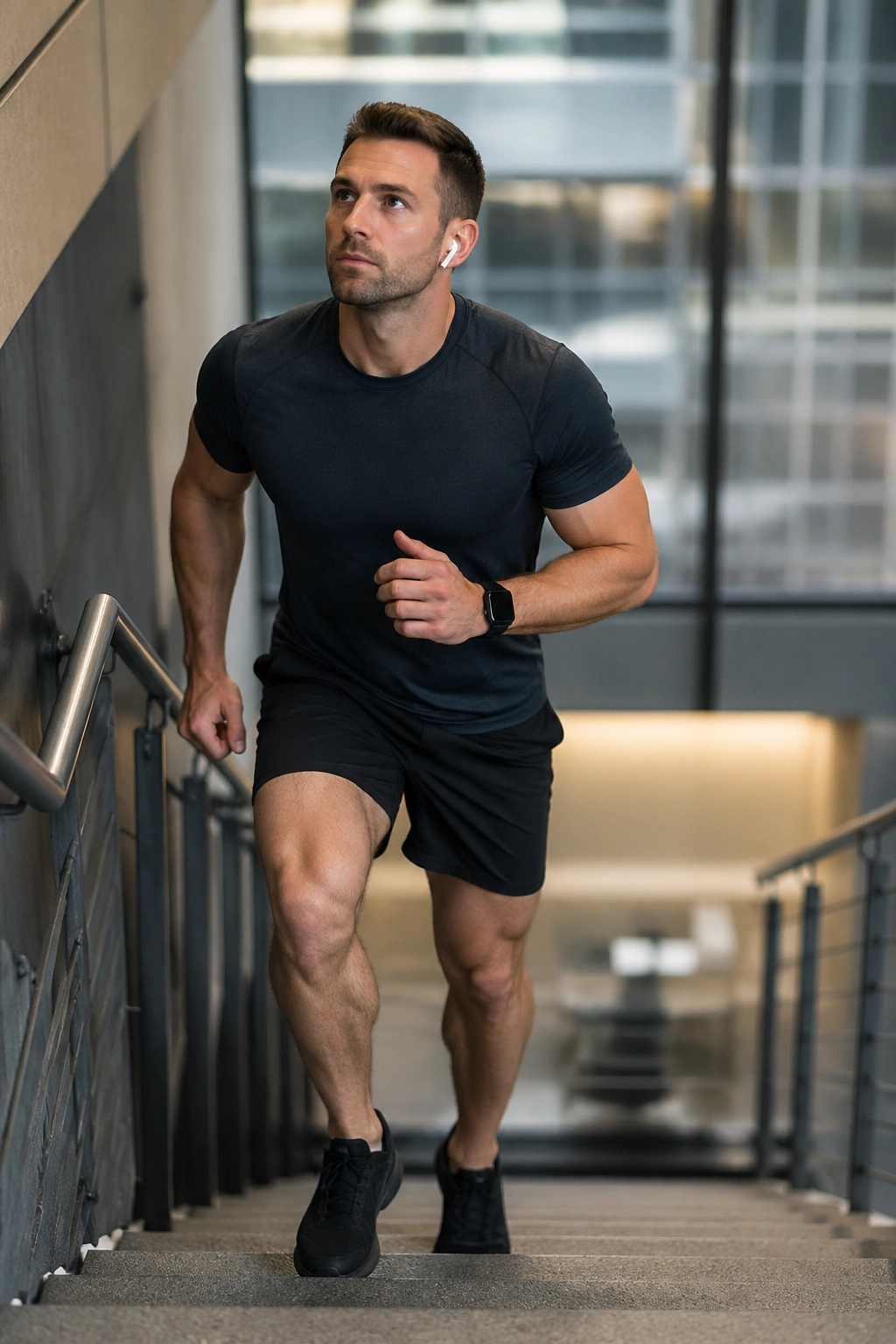
Got a staircase in the building? Use it. Stair intervals are one of the best belly fat exercises for office workers because they raise demand without needing a gym, a mat, or a long block of uninterrupted time. You can do them in work clothes if you move with a little care.
Walk up at a strong pace for 30 to 60 seconds, then recover on the way down. If the building is crowded, keep the climb steady instead of fast. Speed is not the only variable. A controlled climb still taxes the heart, the legs, and the trunk in a way that flat walking cannot match.
The real win is repeatability. Ten minutes of stair work spread across a break can change the shape of a day. That is more useful than promising yourself a huge session later and then sitting through another meeting.
How to Pace It
Use the first flight as a warm-up. Keep the torso upright, the foot fully on each step, and the breathing even enough that you can say a short sentence at the top. If your knees complain, shorten the stride and drop the speed.
A simple pattern is 6 to 10 climbs with short rests. It is plain, but plain gets done.
15. Wall Sit With a Core Brace
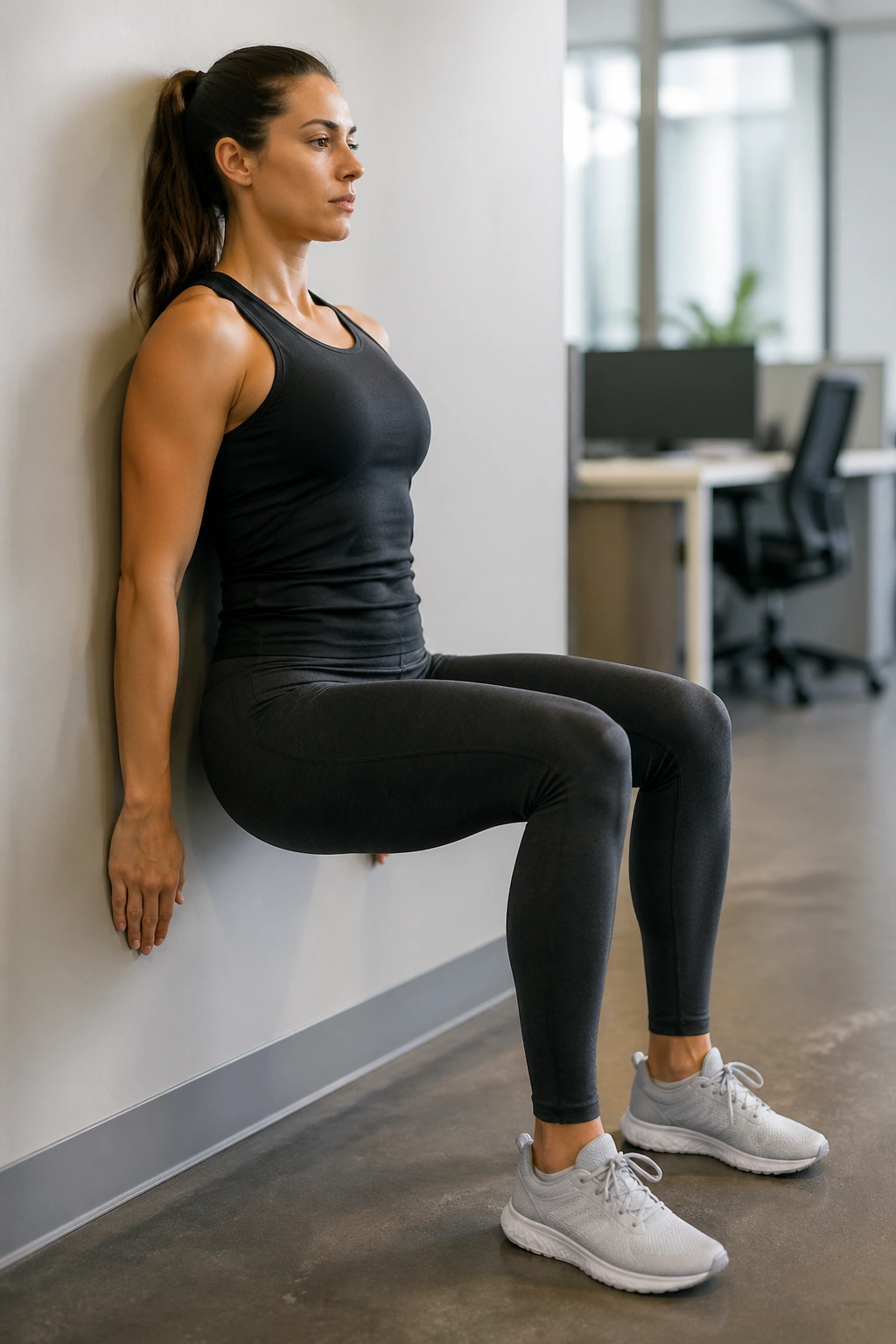
A wall sit looks like punishment if you stare at the timer long enough, but it is a clean way to train the legs and the trunk together without taking up space. Office workers tend to like it after they hate it for ten seconds. Then it starts to make sense.
Place your back against a wall, walk your feet forward, and slide down until your knees are near a right angle or a little higher if needed. Press the lower back gently into the wall and brace the middle as if you are about to zip up a tight jacket. That tiny brace changes the exercise a lot.
No, your thighs do not need to touch fire. They just need to work.
Hold for 20 to 45 seconds to start. If your feet slide forward or your knees drift inward, adjust. The core cue matters here because it stops the wall sit from becoming only a leg burn. You want the trunk involved too.
A few rounds here can make stairs and standing tasks feel easier later in the day. That is the quiet value of the move. It transfers.
16. Brisk Walking Intervals for Office Workers
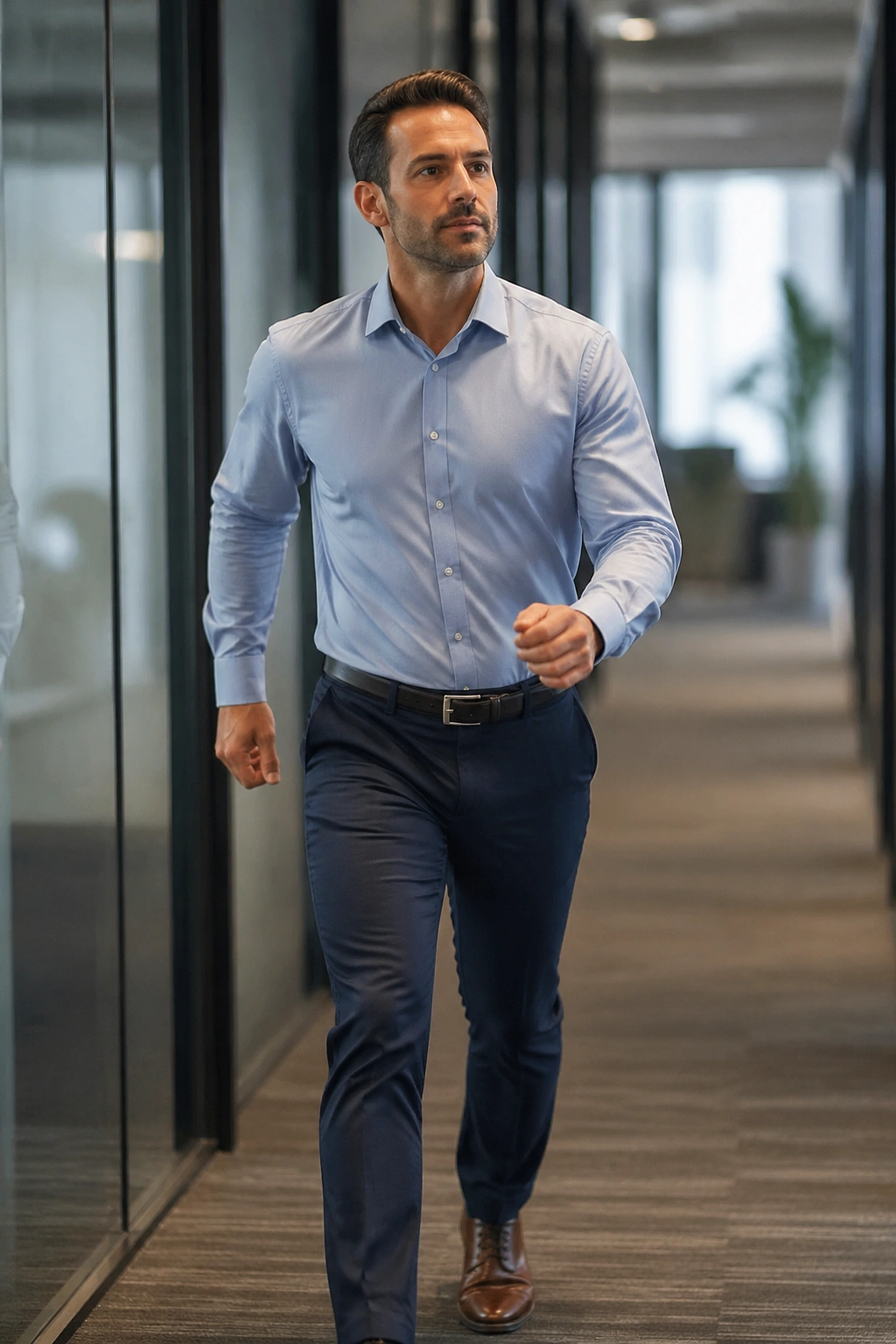
A steady stroll is fine. Brisk walking intervals do more with the same time. That is why they fit so well into a workday, especially if you can carve out a loop around the building, a corridor, or a nearby block.
The structure is simple: walk briskly for 2 minutes, then ease off for 1 minute, and repeat for 4 to 6 rounds. If you only have a short gap, do shorter rounds. The point is to bring the pace up enough that breathing deepens and the torso has to stay organized while the legs keep turning over.
Walking looks mild, and sometimes that is what makes people underrate it. But a brisk pace repeated often adds up. It also tends to be kinder to knees and feet than a lot of high-impact drills, which matters when you plan to do this more than once a week.
A public-health baseline often points adults toward around 150 minutes of moderate activity a week, plus strength work on a couple of days. Brisk walking fits that structure neatly. It is not flashy. It just works.
17. Standing Cross-Body Knee Drives
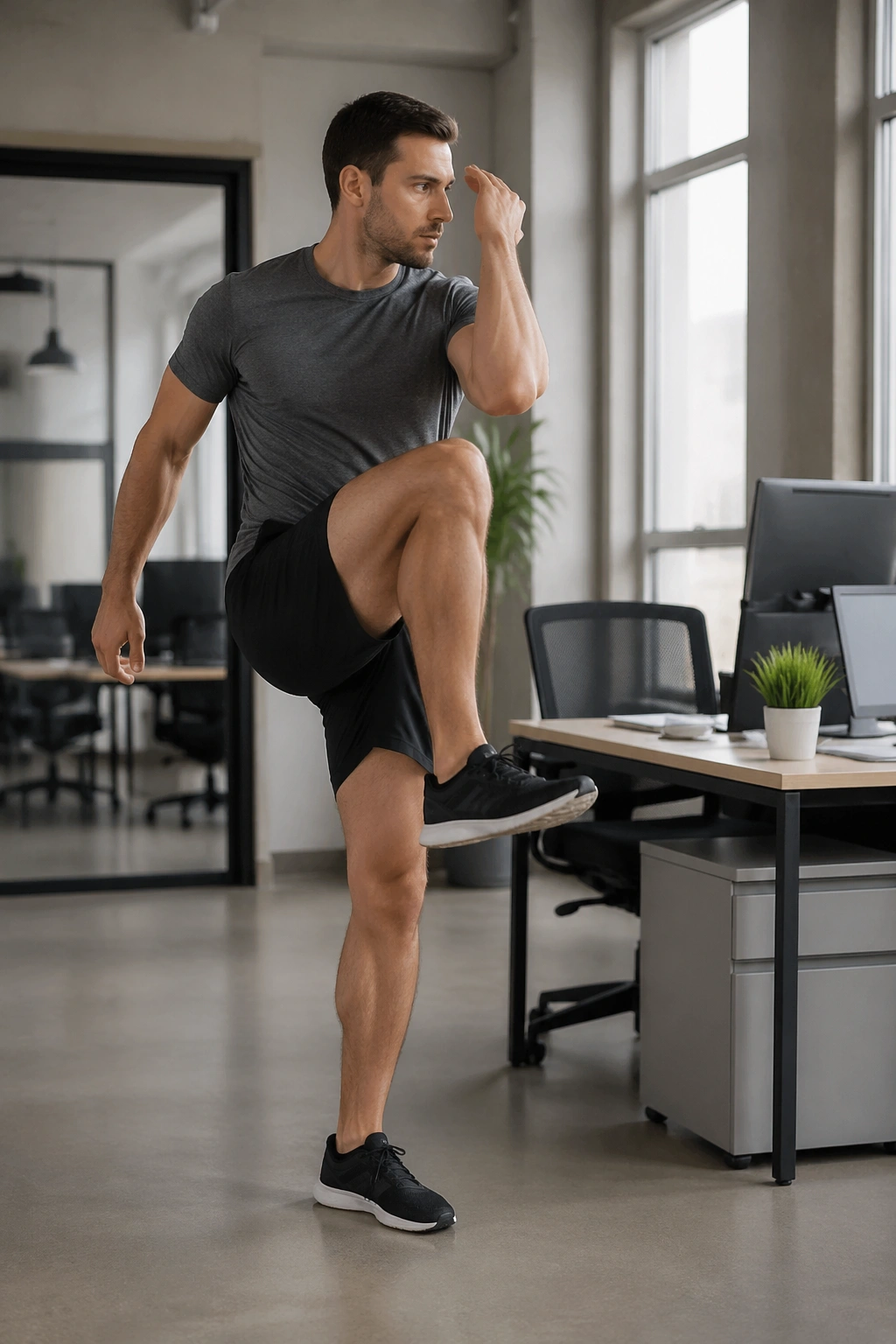
Standing cross-body knee drives feel like a standing crunch with a little twist, and that is why they earn a spot here. They are compact, fast, and useful when you need something you can do beside a desk without going to the floor.
Lift one knee and angle it toward the opposite elbow while staying tall through the spine. Then step down and switch sides. The movement should come from the trunk and hips, not from hunching the shoulders or collapsing the chest. If you crunch forward too much, the exercise loses its shape.
This one is good for coordination too. The core has to steady the body while the hips switch sides, which keeps things interesting. Boring exercise is easy to skip. Slightly demanding exercise gets a chance.
Try 20 to 30 seconds of steady drives, then rest for a short beat. A few rounds can wake up your abs, your hip flexors, and your breathing without making your coworkers think you have lost your mind. Mostly.
18. Suitcase Carry Finish
A single heavy bag can do more for a tired core than five sloppy crunches. That is the beauty of the suitcase carry. Hold weight in one hand only — a dumbbell, kettlebell, loaded tote, or even a full water jug — and walk with the torso tall while refusing to lean toward the load.
The side of the body opposite the weight has to work hard to keep you upright. That is the whole game. It trains the obliques, the deep trunk muscles, and the small stabilizers around the hips in a way that feels very real. You are not pretending to work. You are actually doing it.
Walk 20 to 40 meters per side or hold for 30 to 45 seconds if space is tight. Switch hands and repeat. Keep the shoulders level, the ribs down, and the steps smooth. If you start tilting, the load is too heavy.
Use this one at the end of a short routine or as a final office break before heading out. It has a calm, almost stubborn quality to it. Not flashy. Not noisy. Just the kind of work that slowly changes how your middle holds itself up through the day.
