



Building a strong, capable lower body without a commercial gym membership does not require complicated machinery. In fact, some of the most effective glute development comes from simple, bodyweight-focused movements that prioritize tension and time-under-tension over heavy iron plates. If you feel like your home workouts are lacking that deep “burn” or you are struggling to engage your posterior chain, the problem is rarely the lack of equipment. It is almost always a lack of mechanical focus.
The gluteus maximus, medius, and minimus are the largest and most powerful muscles in your body, but they are also experts at letting other, smaller muscles do the work. When you squat or lunge, your quads and lower back are eager to take over, leaving your glutes under-stimulated. Learning to isolate these muscles—to force them to do the heavy lifting—changes everything. It turns a standard living room routine into a genuine strength session.
You do not need to turn your garage into a fitness center to see results. You just need a bit of floor space, a sturdy chair, and an honest understanding of how to position your body. The following movements are designed to wake up sleeping glutes, improve your hip stability, and build functional strength that carries over into everyday life, all while keeping your lower back safe and supported.
1. Bodyweight Glute Bridge
The bridge is the gold standard for teaching your brain how to recruit your glutes. Most people perform these too quickly, using momentum rather than muscle contraction. When done correctly, this move creates an incredible amount of tension in the posterior chain without putting any strain on your spine.
The Mechanics of the Bridge
Lie flat on your back with your feet planted firmly on the floor, about hip-width apart. Your heels should be close enough to your glutes that you can almost touch them with your fingertips. Before you move, think about tucking your pelvis. Imagine trying to crush a grape between your lower back and the floor. This simple adjustment protects your lumbar spine and shifts the load directly onto the glutes.
How to Execute for Maximum Gain
- Drive through your heels, not your toes. If you push through the toes, you turn this into a calf and quad exercise.
- Squeeze your glutes at the very top of the movement for a full two seconds.
- Lower your hips back down slowly, taking three seconds to descend.
- Never let your glutes fully relax on the floor between repetitions; tap the ground lightly and go straight back up.
Pro tip: If you want to increase the intensity without adding weight, pause at the top and pulse your hips up an inch and down an inch for ten reps before finishing your set.
2. Single-Leg Glute Bridge
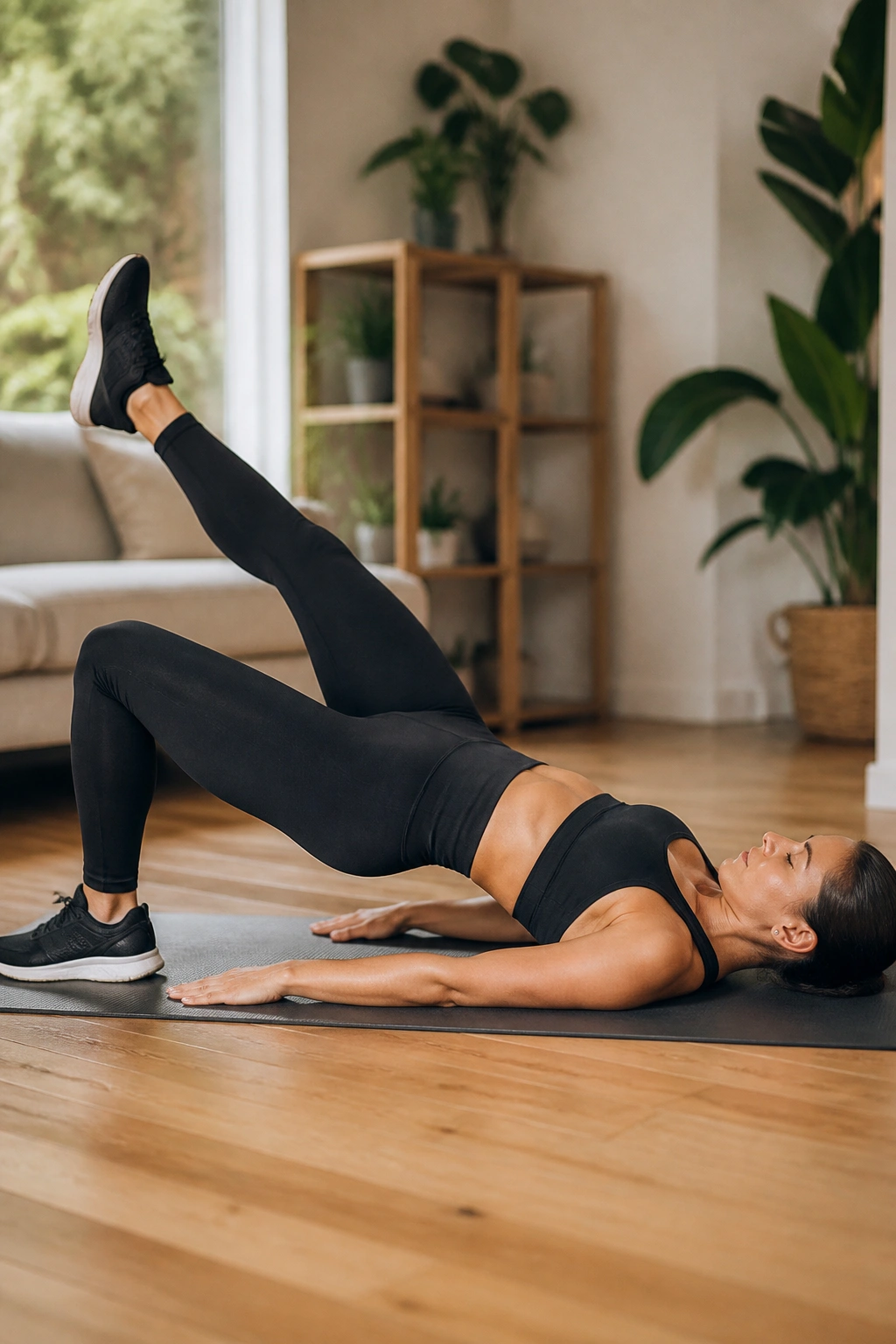
Once you have mastered the standard bridge, you will likely find that it becomes too easy. That is where single-leg variations come in. This move exposes imbalances between your left and right side, which is something a standard two-legged bridge often hides. It also forces your core to work harder to stabilize your pelvis as it tilts toward the side of the lifted leg.
Start in the same position as the standard bridge, but lift one leg into the air. You can keep this leg straight or bent at a 90-degree angle—whatever feels more stable. The key here is to keep your hips level. If you feel your pelvis rotating toward the ceiling on the side of the lifted leg, you have lost your form.
Why This Is Essential for Home Workouts
- Unilateral Focus: It forces the glute of the planted leg to stabilize your entire lower body.
- Back Safety: By removing one point of contact, you cannot rely on arching your lower back to get height.
- Hip Stability: This movement directly strengthens the muscles that prevent your hips from dropping when you walk or run.
Perform 12 to 15 controlled repetitions on one side before switching. You will notice that one side is likely stronger than the other. This is completely normal, but you should always start with your weaker leg and perform the same number of reps on your stronger side to let it catch up.
3. Walking Lunges
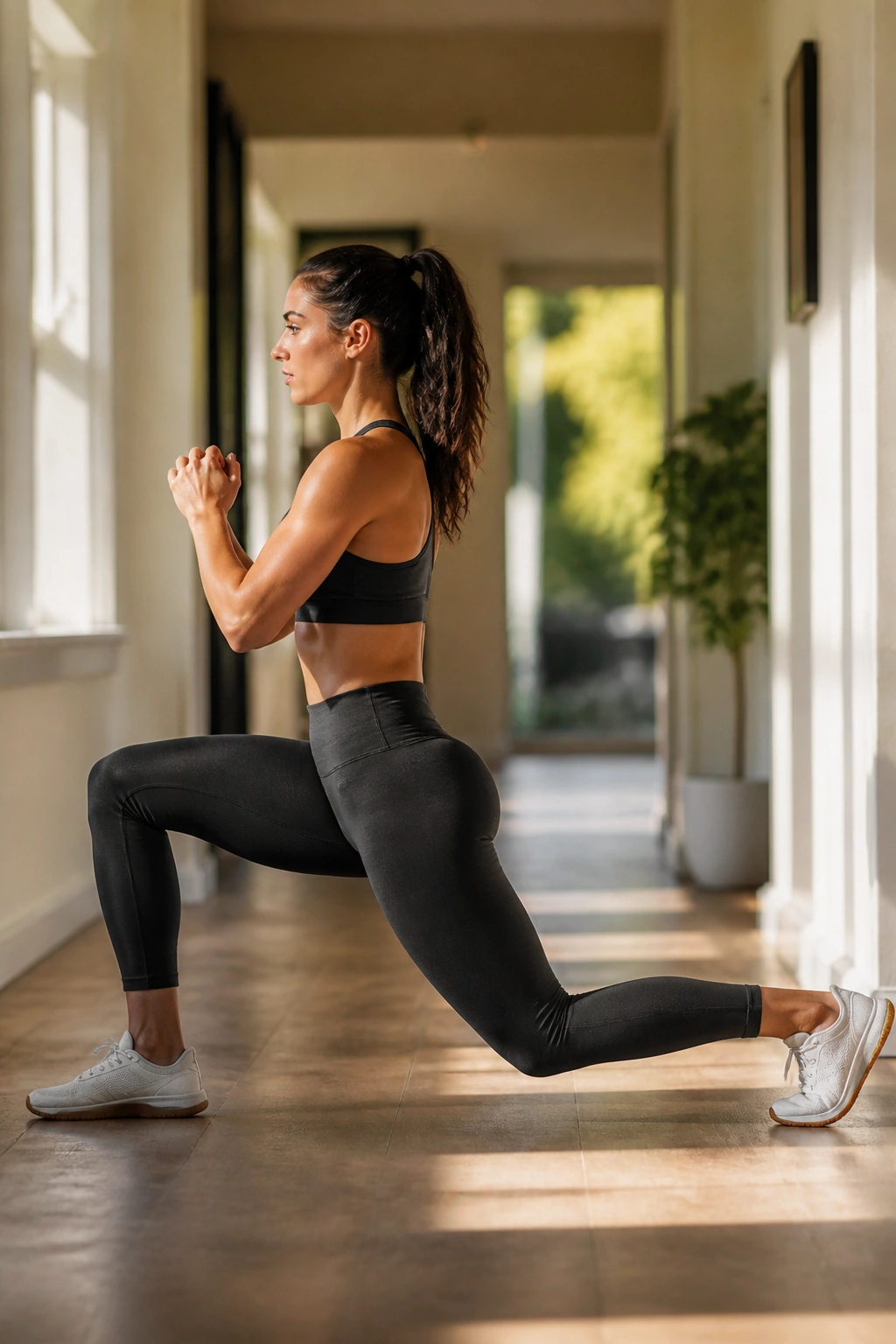
Walking lunges are functional, dynamic, and brutal if you take them seriously. While people often think of lunges as a leg-day staple, they are actually a powerhouse for the glutes if you adjust your stride length and torso angle.
If you take short, choppy steps, you will mostly feel this in your quads. To target your glutes, take a longer stride. When you step forward, your front shin should be nearly vertical, and your torso should have a slight forward lean. This hinge at the hips puts the glutes in a stretched position, which is exactly where they can generate the most force.
Common Mistakes That Limit Results
- Collapsing Knees: As you step, make sure your knee stays aligned over your second toe. If it caves inward, you lose all the glute engagement and put your knee joint at risk.
- Rushing the Reps: Many people treat lunges like a race. Slow down. Control your descent so that your back knee gently brushes the floor, then drive explosively through the front heel to stand up.
- The “Railroad Track” Rule: Visualize walking on two parallel railroad tracks rather than a single tightrope. Keep your feet hip-width apart to maintain balance and prevent your hips from wobbling.
Aim for 20 to 30 steps total. If you have limited space, you can do stationary reverse lunges, which are arguably even better for glute isolation because they prevent the tendency to “push off” the floor, forcing the front glute to pull you back to the starting position.
4. Bulgarian Split Squats
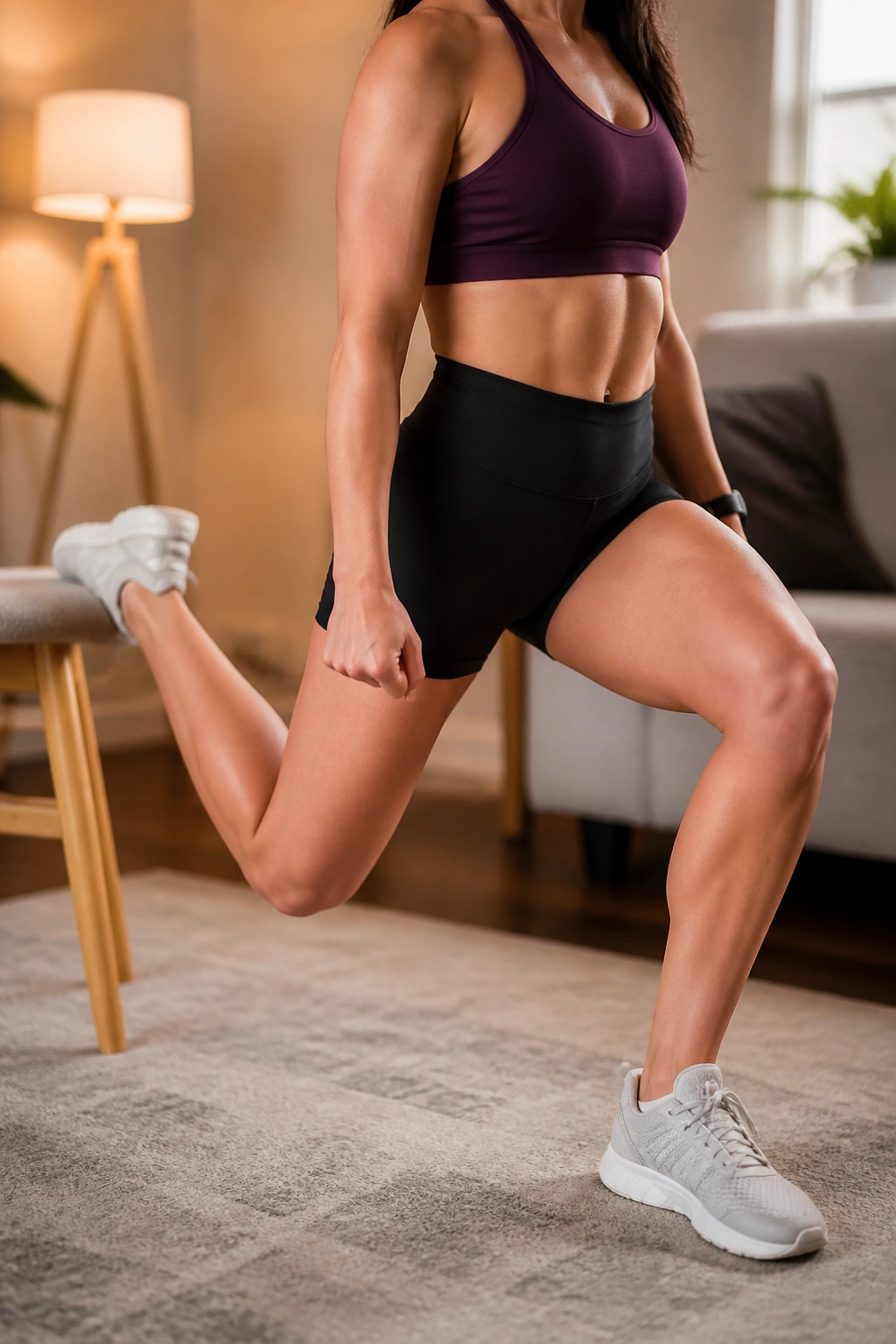
There is a reason this exercise is feared. It is arguably the single most effective lower-body movement you can do at home. By elevating your rear foot, you effectively remove your back leg from the equation, placing almost all of your body weight on the front glute and quad.
Place a sturdy chair, sofa, or ottoman behind you. Rest the top of your back foot on the elevated surface. Hop your front foot forward until you can descend comfortably into a deep squat without your front knee going excessively past your toes. Keep your chest up, brace your core, and drop your hips straight down.
Why the Bulgarian Split Squat Works
- Deep Stretch: The elevated back leg forces the front glute to stretch significantly further than a standard squat, which triggers muscle growth.
- Balance Demands: Even without weights, the sheer stability required makes this a high-effort move.
- Scalability: If you run out of bodyweight capacity, you can hold a gallon water jug or a backpack filled with books to add instant load.
Important Note: It usually takes a few tries to find the right distance for your front foot. If you feel too much tension in your back hip flexor, scoot your front foot slightly further forward. If you feel only in your back leg, you need to check your setup.
5. Lateral Band Walks
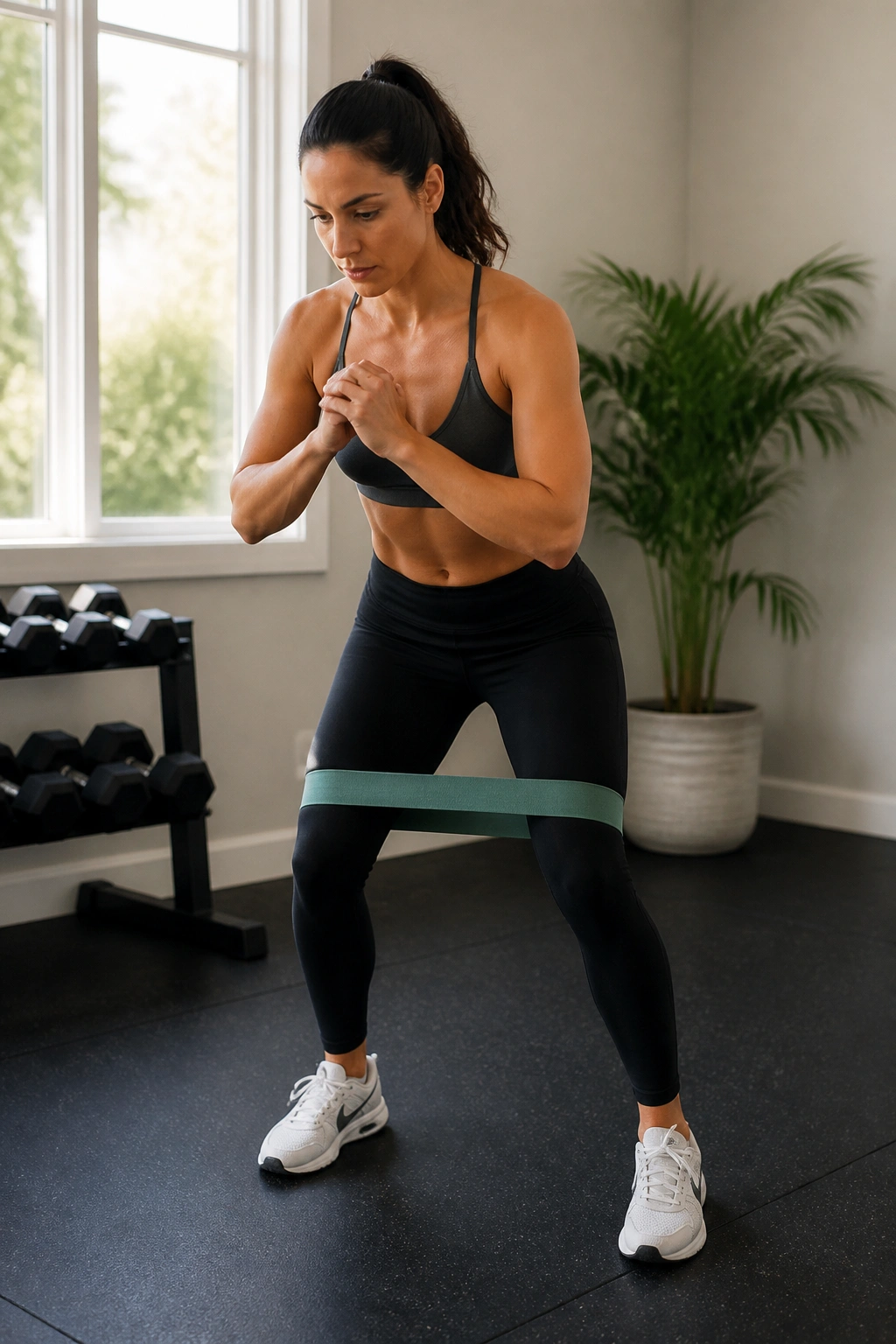
If you want to build the “shelf” or the outer glute muscle (the gluteus medius), you need to move in the frontal plane. Most home workouts focus entirely on forward and backward movements, leaving the sides of your hips undeveloped. Lateral band walks fix this gap.
You will need a resistance band for this one. Place the band just above your knees or around your ankles. The lower the band, the harder the move. Start in a quarter-squat position—hips back, chest slightly forward—and take small, controlled steps to the side.
The Science Behind the Walk
- Glute Medius Activation: This muscle is responsible for hip abduction (moving your leg away from your body). It is often weak in people who sit for long periods.
- Constant Tension: Unlike lunges where you get a momentary rest, the band keeps your muscles firing the entire time.
- Controlled Eccentric: Don’t just step and drag your foot. Lift your foot, place it down, and control the band’s resistance as you bring your trailing leg in.
Do not rush. Take 15 steps to the left, then 15 steps to the right. Keep your knees pushed out against the band—if your knees collapse inward, you have wasted the effort.
6. Fire Hydrants
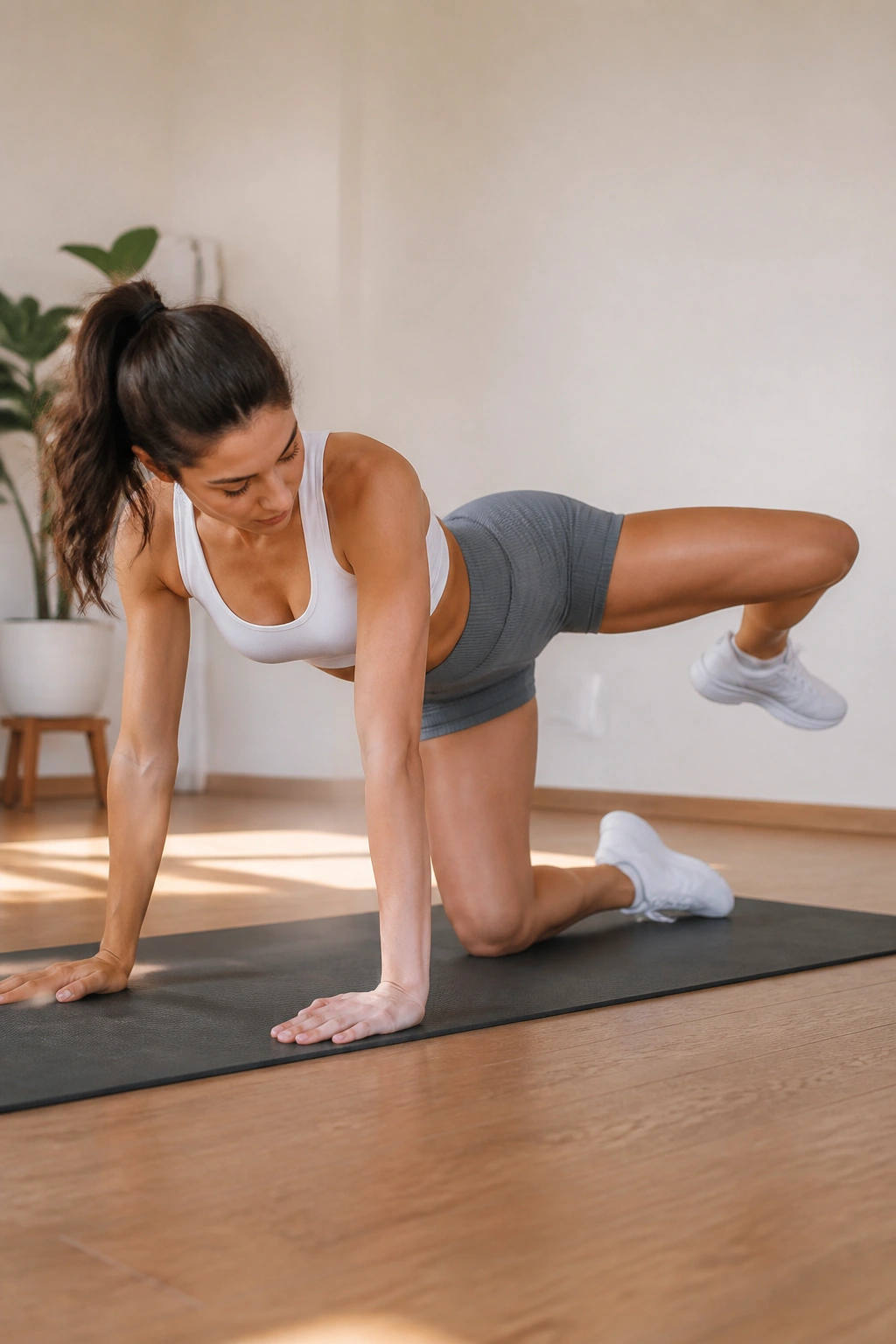
This exercise looks a bit silly, but it is highly effective for isolating the gluteus medius and minimus. It forces these muscles to work without the help of the larger gluteus maximus or the quads.
Get on your hands and knees in a tabletop position. Keep your back flat—do not let it arch or round. Keeping your knee bent at a 90-degree angle, lift your right leg out to the side like a dog at a fire hydrant. The goal is to lift the knee as high as you can without rotating your hips.
Focusing on Quality
- Avoid Rotating: The biggest mistake is tilting your entire body to get the leg higher. If you tilt your torso to the left to lift your right leg, you are using your core and lower back, not your glute.
- Small Range of Motion: It is better to have a 30-degree lift with perfect form than a 60-degree lift with bad form.
- The Squeeze: Pause at the peak of the movement for one second. You should feel a distinct contraction in the side of your hip.
Try 15 repetitions per side. If you need to make it harder, you can perform this move wearing a resistance band around your knees.
7. Donkey Kicks
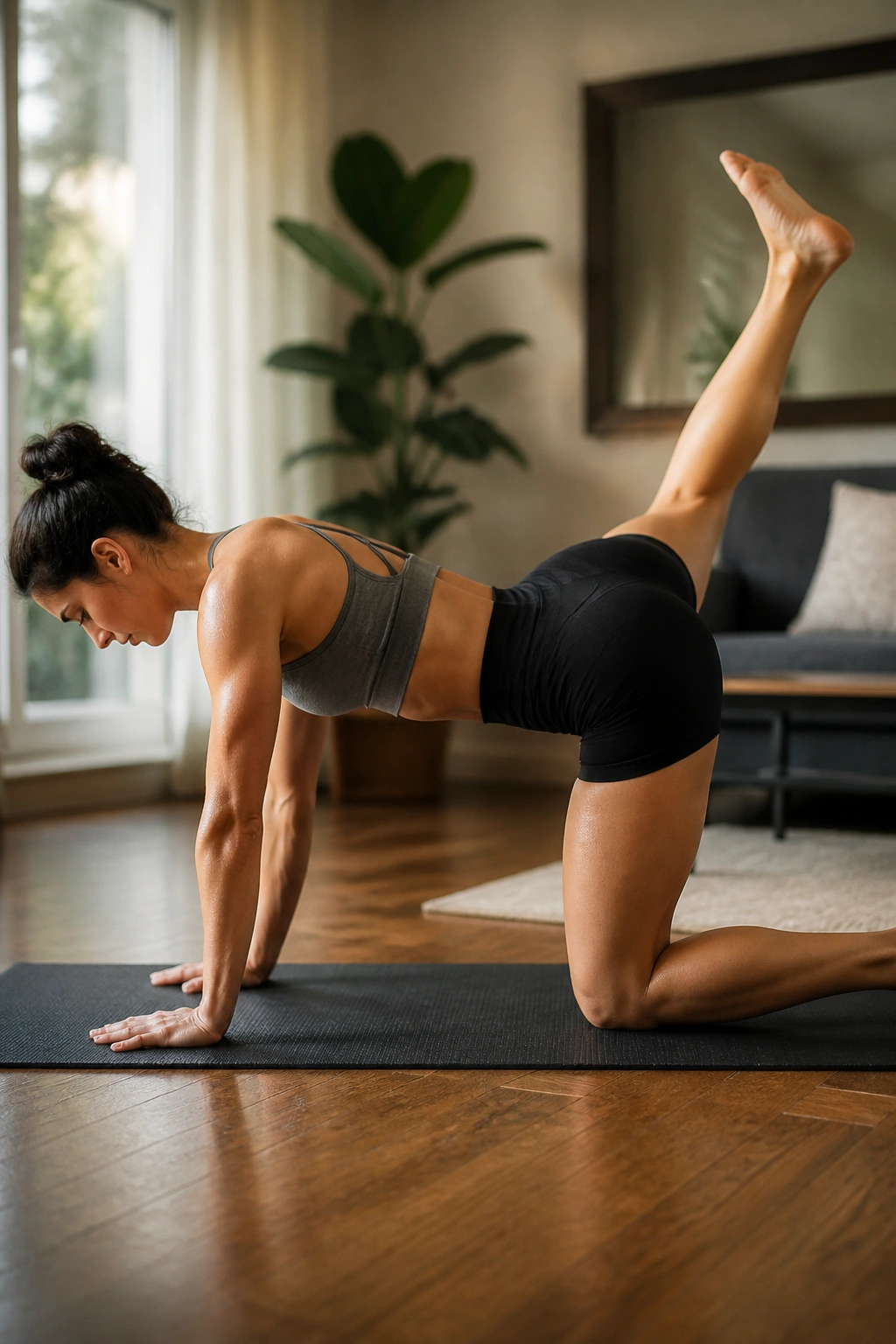
Donkey kicks are the classic move for targeting the gluteus maximus—the primary muscle responsible for the shape and power of your glutes. This is an isolation movement, so focus on the contraction rather than how much weight you can move.
Start in the same tabletop position as the fire hydrants. Keeping your right knee bent at 90 degrees, kick your foot toward the ceiling. Your sole should face the sky at the top of the move. Drive the motion with your heel.
Techniques to Enhance the Move
- Brace Your Core: This is crucial. If you don’t brace, your lower back will arch as you kick, which can lead to discomfort.
- Foot Position: Always keep your foot flexed (toes pointing toward your shin). This helps recruit the hamstring as well, which supports the glute.
- Linear Motion: Make sure you are kicking directly up, not out to the side. Your hip should stay square to the floor the entire time.
Do 20 repetitions on each side. If you find your lower back hurting, your range of motion is likely too large—shorten the kick and focus on squeezing the glute at the apex.
8. Curtsy Lunges
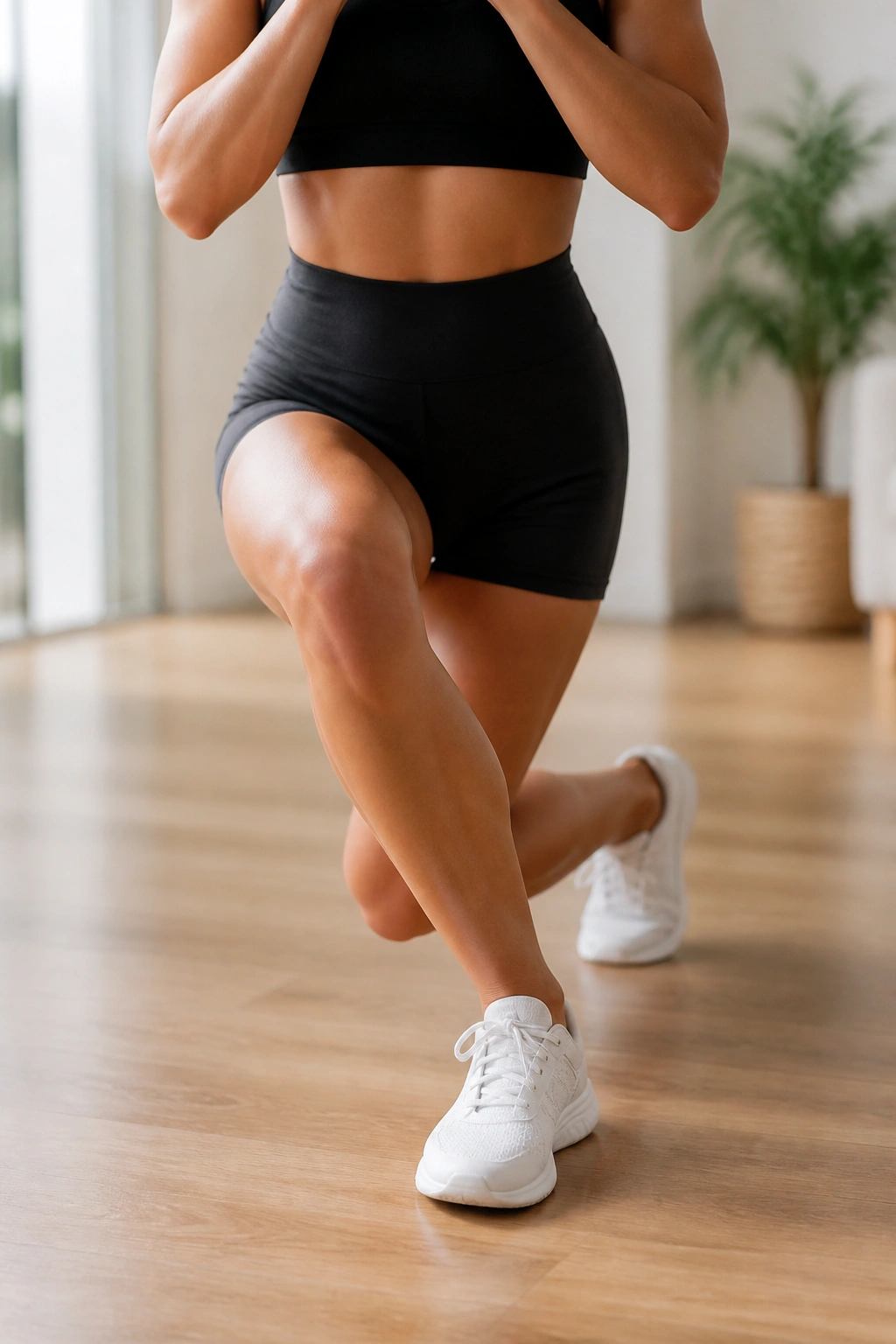
Curtsy lunges are an excellent variation on the standard lunge because they change the angle of the load. By stepping back and across, you place the gluteus medius in a mechanically advantageous position to fire, which helps with hip stability and side-glute engagement.
Stand with feet hip-width apart. Take a large step back with your right leg, crossing it behind your left leg. Your right knee should lower toward the floor behind your left heel. Keep your front foot planted firmly, and ensure your front knee is not caving inward.
Why This Variation Works
- Lateral Tension: The crossing motion forces the outside of the glute to stabilize your body against the rotational force.
- Functional Stability: We rarely move in a perfectly straight line in real life. This trains your hips to handle diagonal forces.
- Glute Stretch: The crossed position creates a deeper stretch in the outer hip than a normal lunge.
Maintain an upright torso. If you lean too far forward, you lose the glute engagement. Aim for 12 to 15 reps on each side. This is one move where going slow is more important than going fast.
9. Sumo Squats
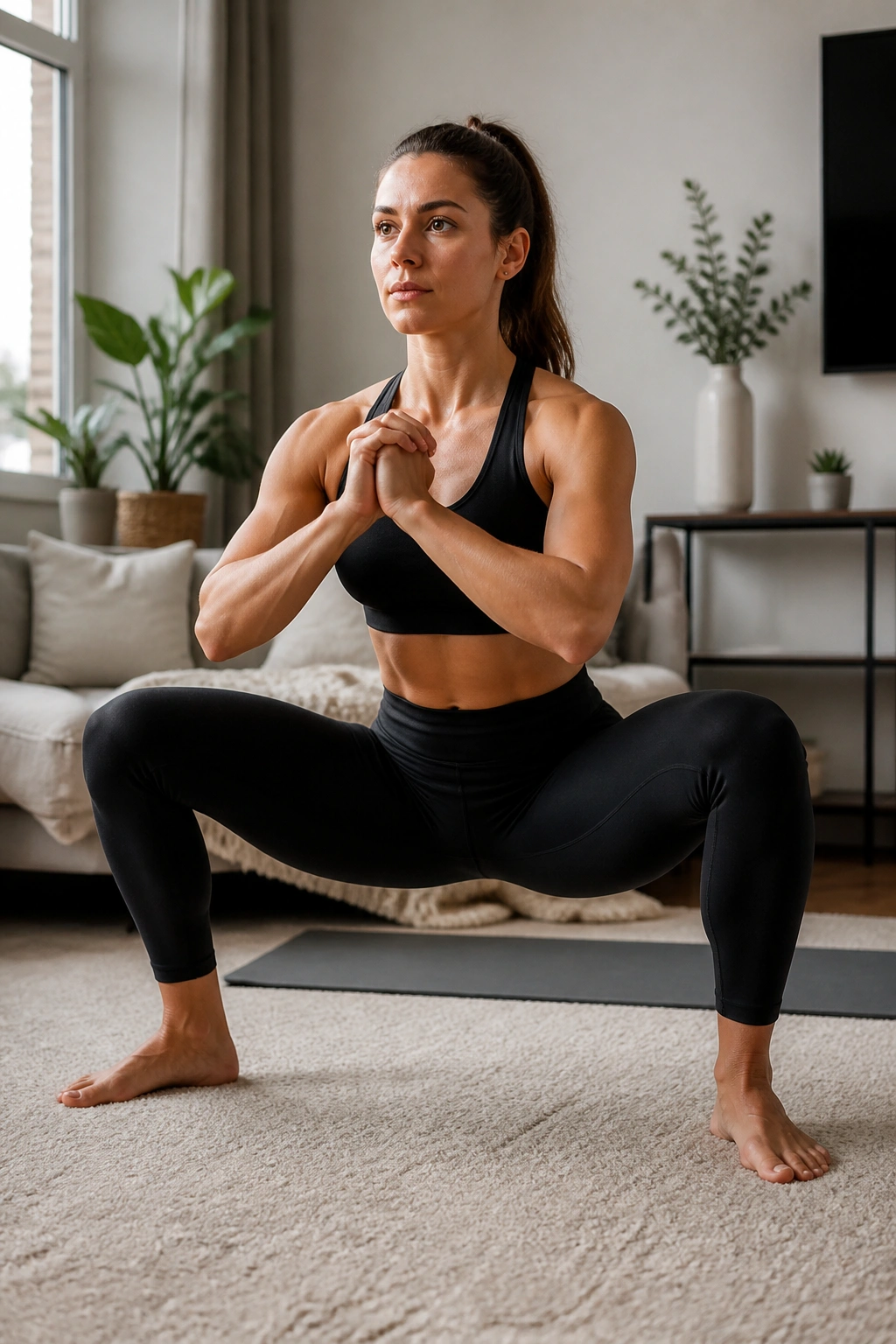
The sumo squat is the wider-stance cousin of the traditional squat. By widening your feet and pointing your toes outward, you reduce the work performed by your quads and place a greater emphasis on your glutes and adductors (inner thighs).
Stand with your feet wider than shoulder-width, toes turned out at about a 45-degree angle. As you descend, push your knees outward in line with your toes. Do not let them cave in. Drop your hips straight down, keeping your chest tall.
Tips for Success
- Depth Matters: Go as low as your mobility allows. The deeper you sit, the more glute recruitment you get.
- The Drive: On the way up, drive through the mid-foot and heel. Imagine you are trying to tear the floor apart with your feet.
- Adding Weight: Because you are in a stronger position than a regular squat, you can hold a heavy object between your legs to increase the intensity easily.
This is a great movement to superset with lateral band walks. The combination of the two hits the glutes from different angles—one for strength, one for endurance.
10. Step-Ups
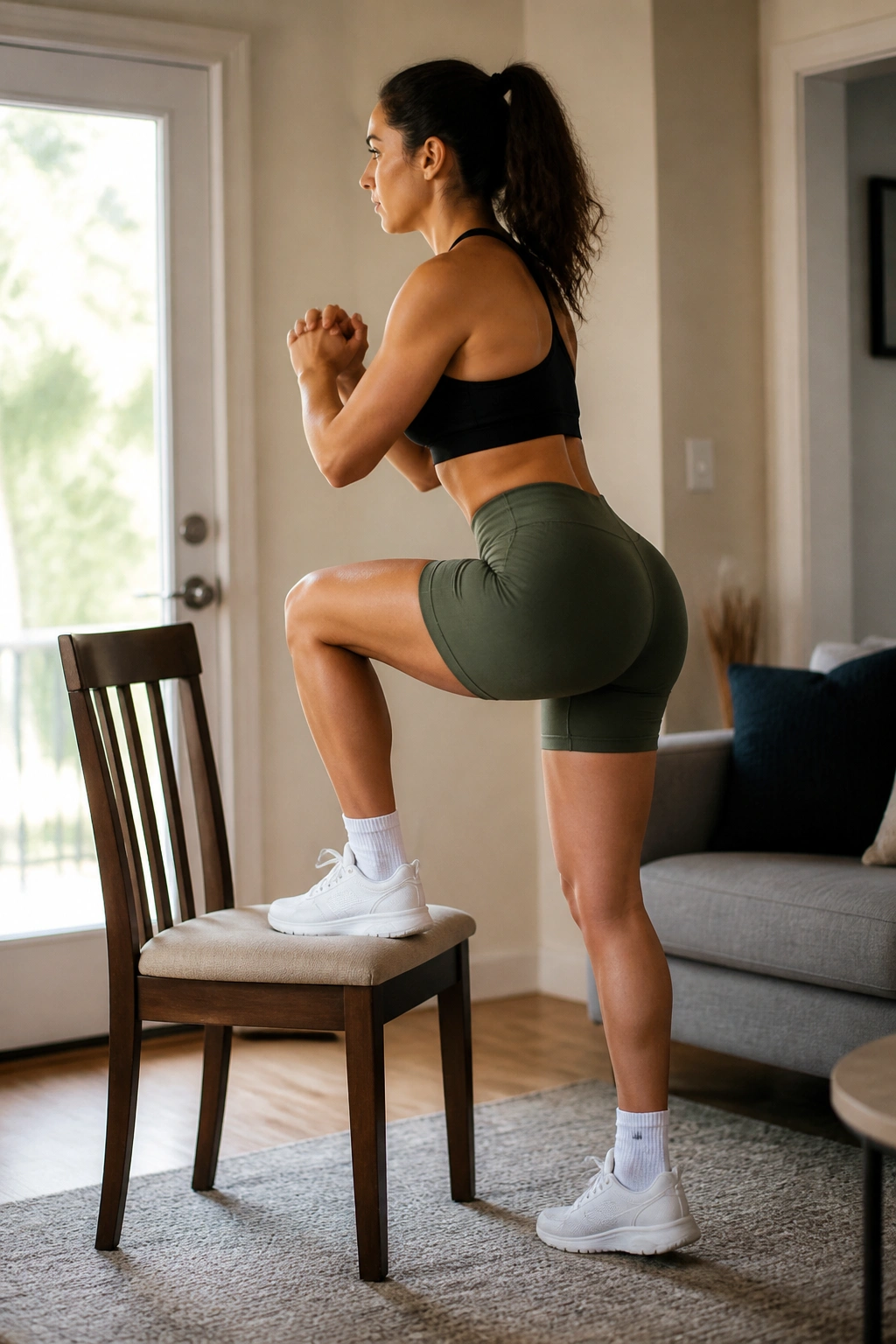
Step-ups are one of the most underrated glute exercises. They are purely functional—you are literally lifting your body weight up onto an object. To make these work for your glutes, you need to change how you use your legs.
Find a chair or step that is at a height where your knee is roughly at a 90-degree angle when your foot is on it. Place your whole foot on the step. Lean your torso slightly forward—this is the secret. If you stay completely upright, the move becomes a quad burner.
Mastering the Eccentric
- Don’t Push Off the Back Foot: The back leg should be a passenger. If you jump off your back foot to help yourself up, you have defeated the purpose.
- Controlled Descent: The lowering phase is where the magic happens. Take three seconds to return your back foot to the floor. This “eccentric” phase is where the most muscle breakdown (and therefore, the most growth) occurs.
- Full Extension: At the top of the step, stand fully upright and squeeze your glute hard.
Do 12 reps on each leg. If you have the space, try to find a step that is slightly lower rather than higher, as it allows for a more glute-dominant range of motion.
11. Hip Thrusts with Improvised Weight
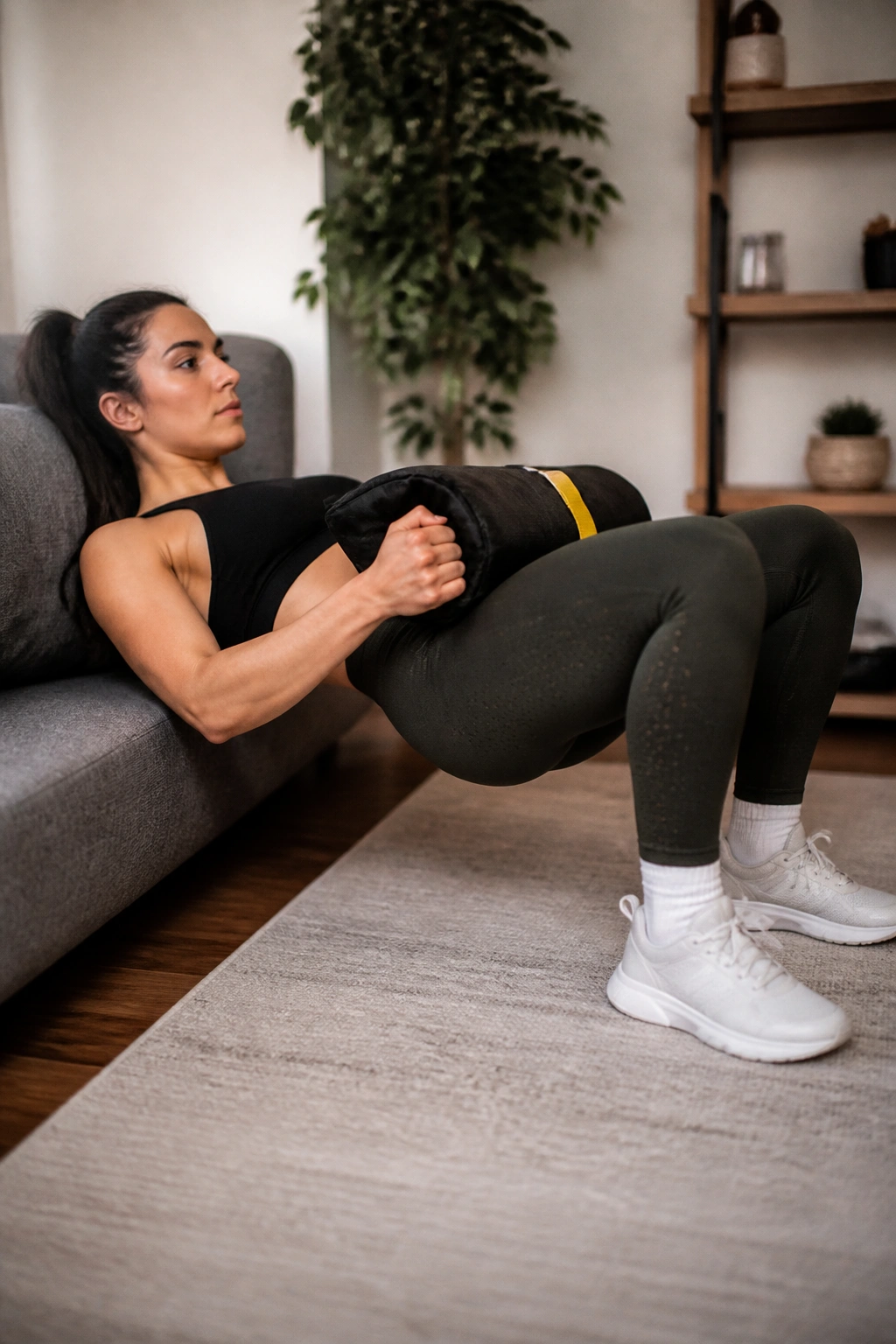
If you have watched any athletic training videos, you have seen the hip thrust. It is the gold standard for glute hypertrophy. Because it requires a heavy load to be truly effective, doing it at home requires a bit of creativity with how you “load” your hips.
Sit on the floor with your upper back resting against a sturdy couch or chair. Place a heavy laundry bag filled with towels, books, or water jugs across your hips. Roll your shoulders back, tuck your chin, and drive your hips upward until your knees, hips, and shoulders form a straight line.
Execution Essentials
- Neck Position: Keep your chin tucked to your chest. Do not look up at the ceiling, as this will force you to arch your back.
- Squeeze: The top position is everything. Hold it, squeeze, and make sure your glutes are doing the work—not your lower back.
- Glute Bridge Comparison: Unlike a standard bridge, your upper body is elevated. This allows for a greater range of motion and more room to load weight.
Aim for 3 sets of 15 to 20 reps. If you cannot get heavy weight, slow down your tempo significantly (4 seconds down, 1 second up) to make the weight you have feel much heavier.
12. Glute Kickbacks
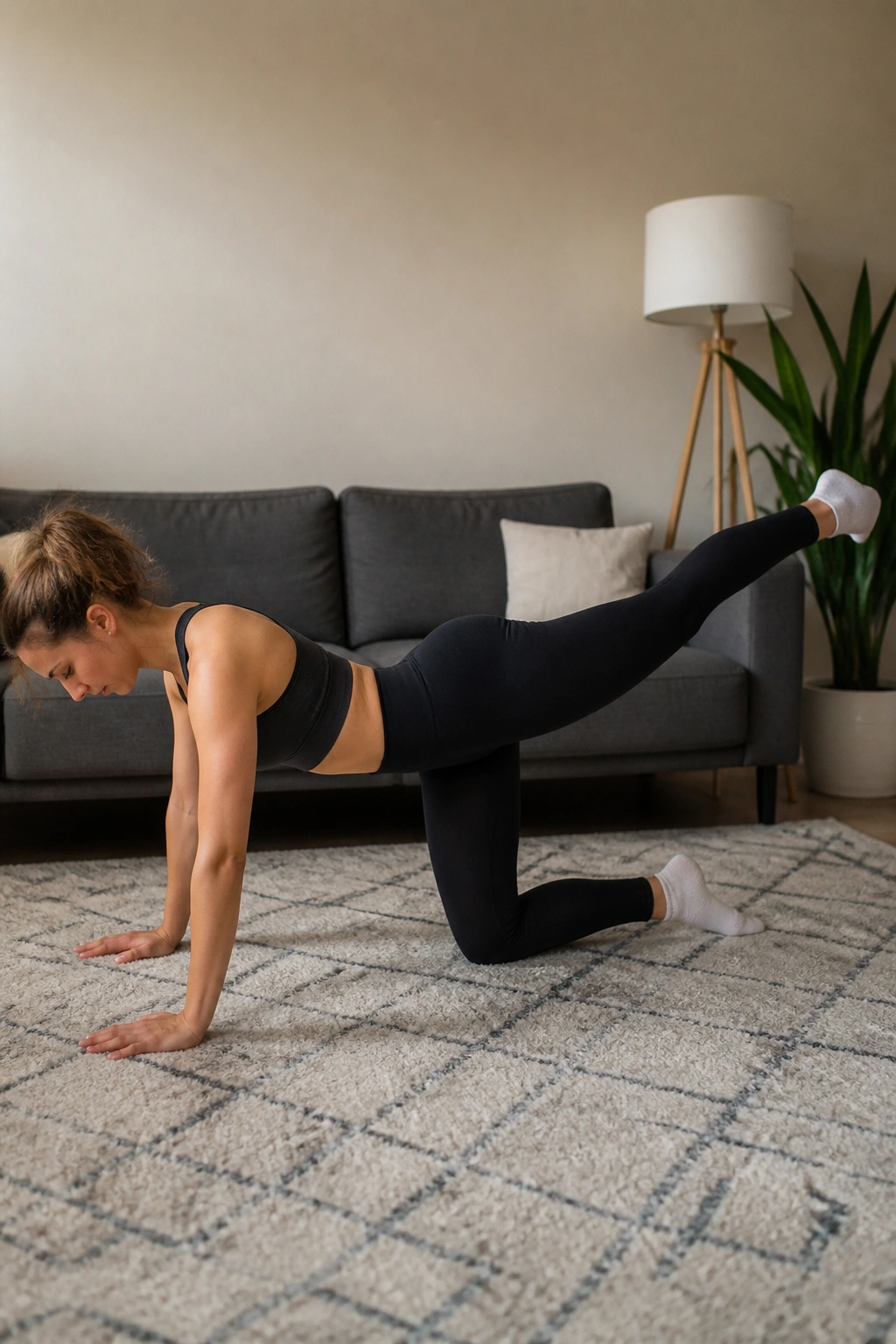
Kickbacks can be done in two ways: on all fours or standing. The standing version is often more effective because it requires balance, which engages the stabilizing muscles of the standing leg, but the floor version is better for isolating the gluteus maximus without worrying about balance.
For the floor version, get on your hands and knees. Keep your core tight. Lift one leg and extend it straight back, squeezing the glute at the end of the range. Do not kick up toward the ceiling; kick straight back toward the wall behind you.
Why This Works
- Full Extension: By extending the leg fully, you are hitting the glute in its shortened position.
- Isolated Tension: This is purely an isolation move, meaning you won’t get much quad or hamstring help.
- Versatility: You can easily add an ankle weight or a resistance band to make this significantly harder as you progress.
Do 15 to 20 reps per side. Focus on the feeling of the glute muscle bunching up at the top of the motion. If you don’t feel it, you are likely using too much momentum.
13. Romanian Deadlifts (RDLs)
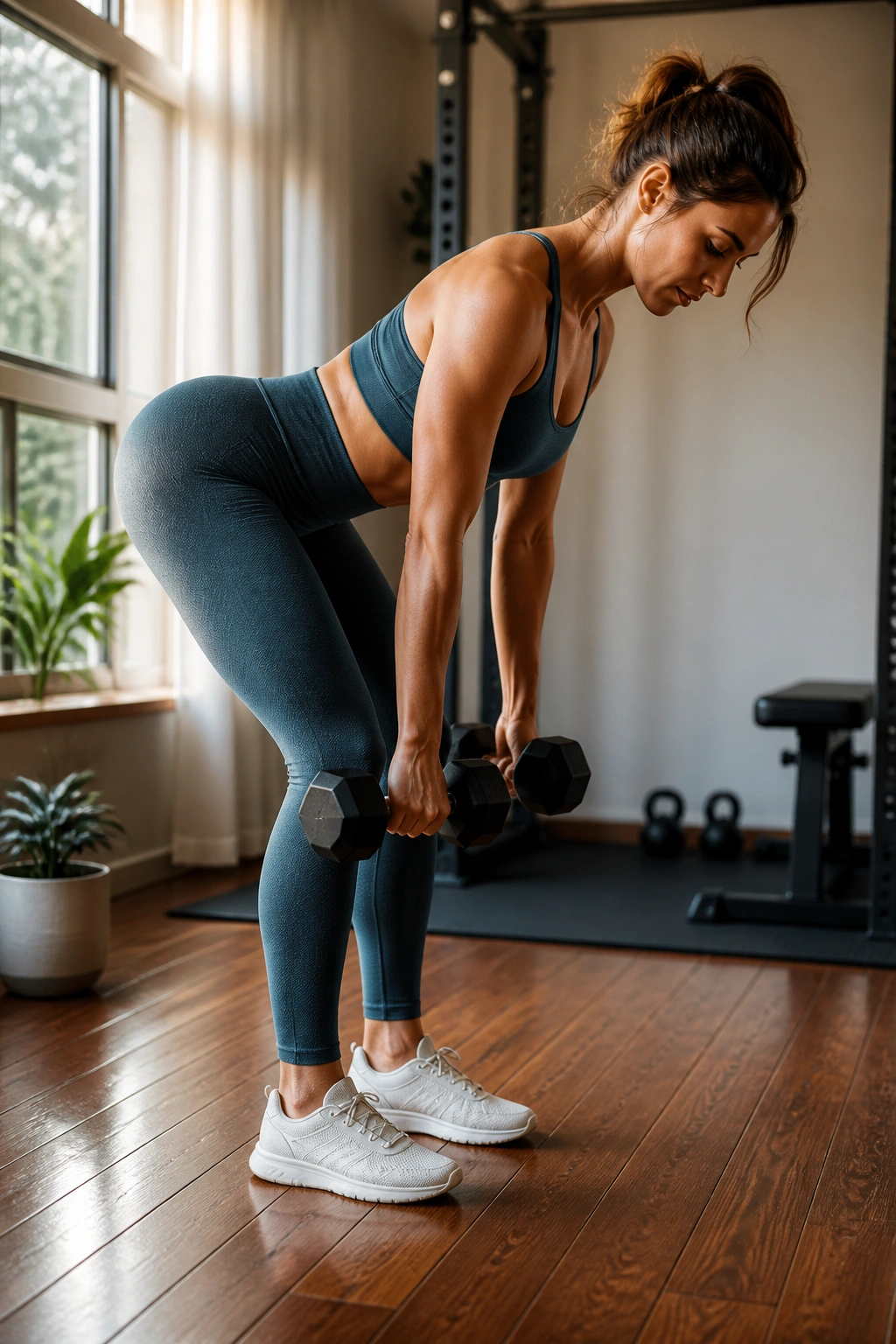
The Romanian Deadlift is the king of the “hinge” movement. Unlike a squat, which involves bending the knees, an RDL is all about pushing your hips back. This stretches the hamstrings and glutes under load, which is a massive stimulus for growth.
Stand with feet hip-width apart. Hold two heavy water jugs or a backpack in your hands in front of your thighs. With a slight bend in your knees, push your hips backward as if you are trying to close a door with your glutes. Keep the weight close to your legs as you descend. Go down until you feel a deep stretch in your hamstrings, then squeeze your glutes to return to standing.
The Hinge Mechanic
- Flat Back: Your back must remain neutral. If you round your back to get the weight lower, stop immediately.
- Don’t Squat: This is not a squat. Your knees should stay at a constant, slight bend throughout the movement.
- Glute Pull: When you come up, think about pulling yourself up with your glutes, not lifting with your back.
Perform 12 to 15 slow, controlled reps. If you are struggling to feel this in your glutes, practice against a wall: stand a few inches away from a wall, push your hips back until they tap the wall, then stand up.
14. Cossack Squats
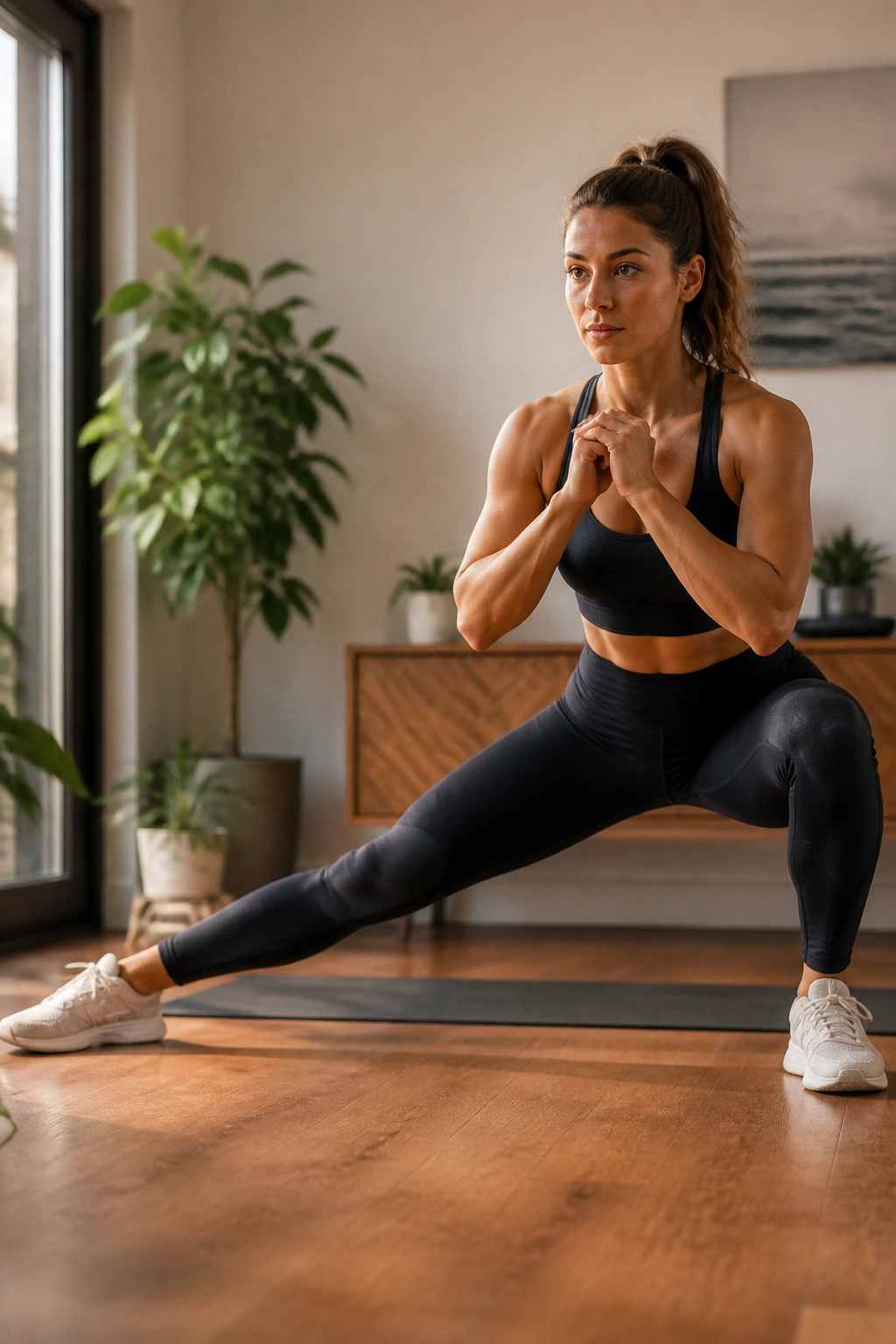
Cossack squats are a dynamic movement that hits the glutes, hamstrings, and the often-neglected inner thigh muscles. This is a lateral (side-to-side) lunge variation that requires significant mobility and strength.
Stand with your feet very wide apart. Shift your weight to your right side, bending your right knee and keeping your left leg perfectly straight. Keep your chest up. Push through your right heel to return to the center, then shift to the left side.
Why You Should Include Them
- Lateral Mobility: Most of our movement is forward, but our hips need to be strong in all directions.
- Deep Stretch: This puts the adductors and glutes into a deep stretch under tension.
- Balance and Coordination: This move challenges your stability, forcing the glutes to fire to keep you from toppling over.
Start with your feet wide and move slowly. If you cannot get low, don’t worry. Focus on the stretch and the strength required to pull yourself back to center. 10 reps per side is a solid target.
15. Glute Bridges with Abduction
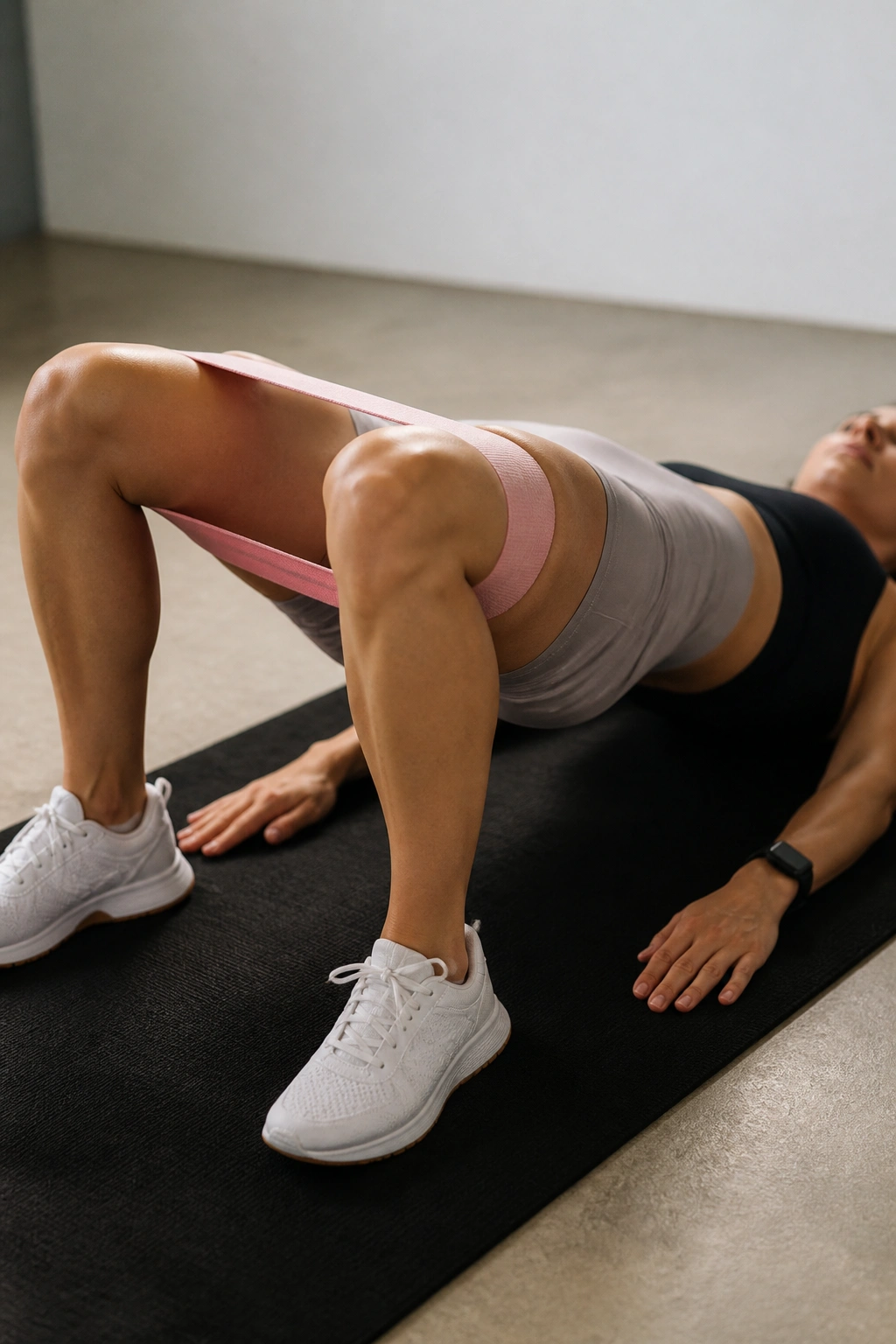
This is a fantastic “finisher” exercise. By adding abduction (opening the knees) to the standard bridge, you recruit the gluteus medius while simultaneously tiring out the gluteus maximus. It is a dual-attack on your posterior chain that will leave you feeling the burn.
Perform a standard glute bridge. Once your hips are at the top and your glutes are squeezed, push your knees outward against each other for a second, then bring them back to center, then lower your hips.
The Burnout Strategy
- Continuous Tension: Do not stop between reps.
- Max Squeeze: Every time you reach the top, the glute squeeze is mandatory.
- Abduction: Think about pushing your knees into a resistance band, even if you are not using one. That internal cue creates muscle activation.
Do this for 30 to 60 seconds non-stop. Your glutes will be burning by the end. This is a perfect final move to ensure you have completely fatigued the muscles before you finish your workout.
Wrapping Up
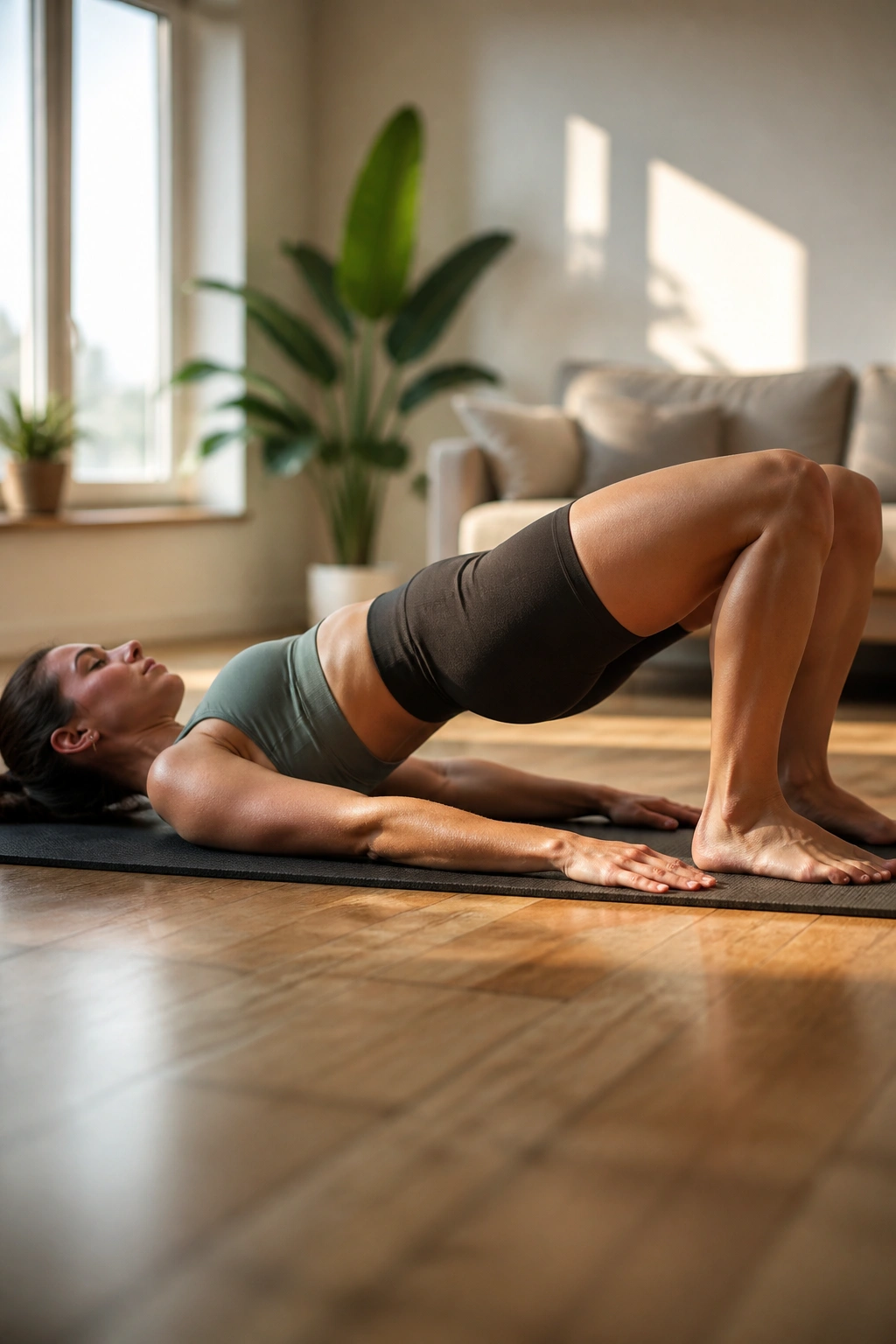
Building a stronger, more resilient posterior chain at home is less about the equipment you possess and more about the precision you bring to every single repetition. Most people spend their workouts rushing through movements, relying on momentum and the dominant muscles of their thighs to do the heavy lifting, only to wonder why their glutes don’t respond.
By focusing on the mind-muscle connection—specifically the act of squeezing and isolating the glutes during the bridge, lunge, or hinge patterns—you transform these exercises from simple movements into tools for physical change. Consistency matters more than finding the “perfect” complex routine. If you rotate these fifteen movements into your weekly schedule, focusing on slow, controlled tempos and perfect form, the results will follow. Listen to your body, prioritize the quality of your movement over the number of repetitions, and you will build a foundation of strength that serves you for years to come.
