



If you spend most of the day in a chair, eat lunch at your desk, and hope a few crunches will flatten your stomach, the plan is upside down. Losing belly fat while working a desk job is mostly about lowering overall body fat, and the biggest levers are the boring ones: daily movement, protein, sleep, stress control, and fewer calories slipping in without you noticing.
Belly fat is stubborn, but it is not magical.
A desk job works against you in quiet ways. You sit more, you take fewer steps, your hips get stiff, and the easiest calories in the room are often the ones you can reach without standing up. Then the afternoon drags, your brain feels cooked, and the snack drawer starts looking like a solution instead of a problem. I have seen that pattern over and over. It’s almost never about one big bad meal.
Crunches can strengthen your abs. They do not pull fat off your stomach on command. That part matters, because a lot of people waste weeks chasing the wrong fix when a few steady habits would move the waistline faster — a short walk after meals, a better lunch, a few strength sessions, and less grazing on autopilot. Start with the easiest habit to keep. The first win is usually the one that happens after lunch.
1. Take a 10-Minute Walk After Lunch
A post-meal walk is boring in the best possible way. Ten minutes after lunch can do more for your waistline than an all-or-nothing workout you dread and skip three times a week. The reason is simple: you are using the part of the day when your body would otherwise settle into a slump.
Why the post-meal walk works
A short walk after eating helps you avoid the sleepy, snack-hunting crash that shows up around midafternoon. It also adds steps without asking much from your willpower. If you eat at 12:30, walk by 12:45. Keep the pace easy enough that you can talk in full sentences. You are not training for a race.
- Aim for 10 to 15 minutes.
- Start within 15 to 20 minutes after eating.
- Keep your shoulders relaxed and your breathing steady.
- A parking lot loop, hallway loop, or a few laps around the building all count.
A lot of people want a harsher answer. They want a brutal finisher, a sweat-soaked fix, something that feels like punishment. I like this better. It is easier to repeat, and repeatable beats dramatic every time.
My rule: if you have time to scroll on your phone after lunch, you have time to walk.
2. Stand Up Every Time You Refill Your Water

Standing up for a water refill sounds almost too small to matter. That’s exactly why it works. You do not need a perfect fitness plan to stop sitting for six straight hours. You need a few tiny triggers that force your body to move before your brain starts negotiating.
Keep the bottle a little farther away than your mouse. Not across the room, because that becomes annoying fast, but far enough that you have to stand and take a few steps. A 20- or 24-ounce bottle is useful because it creates a repeatable rhythm. Empty it, get up, refill it, and you’ve broken the spell.
Tiny? Yes. Useless? No.
If you refill twice before lunch and twice after, that is four built-in stand-up breaks. Add bathroom trips, printer runs, and a quick stretch while the kettle heats, and your day looks different without turning into a gym class. This matters more than people think, because the body often responds to the pattern of movement, not just the big workout.
One clean habit is enough here. Stand up first, then drink.
3. Build a Protein-Heavy Breakfast That Lasts to Noon

Protein at breakfast is not a gym-bro obsession. It is a practical way to stop the midmorning snack spiral before it starts. A breakfast with 25 to 35 grams of protein tends to hold better than toast alone, cereal alone, or a pastry eaten in the car while thinking about email.
What a better breakfast looks like
You do not need a giant meal. You need one that keeps hunger quieter. Eggs, Greek yogurt, cottage cheese, turkey sausage, tofu scramble, or a protein smoothie all work if the rest of the meal is sensible. The sweet spot is a mix of protein, fiber, and a little fat so you are not hungry again at 10:15.
- 3 eggs plus fruit and whole-grain toast.
- Greek yogurt with berries, oats, and chia seeds.
- Cottage cheese with pineapple and a handful of walnuts.
- Oatmeal mixed with protein powder and cinnamon.
- A smoothie with milk, protein powder, frozen berries, and peanut butter.
I’m picky about this one because I’ve watched too many desk workers start the day with a sugar spike, then blame themselves for being ravenous later. The breakfast did that, not a lack of discipline.
If mornings are chaotic, make breakfast the night before. A jar of yogurt, oats, and berries is not glamorous. It does work.
4. Eat Lunch Away From Your Keyboard

Eating lunch over the keyboard is how a 600-calorie meal turns into a 900-calorie afternoon. When you keep working while you eat, you miss the signals that tell you you’ve had enough. You also tend to eat faster, and fast eating makes it easier to overshoot without noticing.
What the pause changes
A proper lunch break does not need to be long. Ten quiet minutes in another room is enough. Sit somewhere else, shut the laptop, and chew without reading a spreadsheet at the same time. That little bit of separation matters because your brain gets one task at a time instead of two.
A plate helps more than a box. Build lunch around a clear structure: half vegetables, a quarter protein, a quarter starch. Chicken salad, tuna wraps, lentil bowls, leftover turkey with rice and roasted vegetables — all fine. The exact food matters less than the shape of the meal.
The other piece is speed. Slow down enough to notice when the meal starts feeling finished. You do not need to eat like a monk. You just should not inhale lunch while approving documents.
If your workday is hectic, protect lunch like a meeting. It’s one of the easiest ways to keep desk-job calories from creeping up.
5. Keep High-Protein Snacks Within Reach
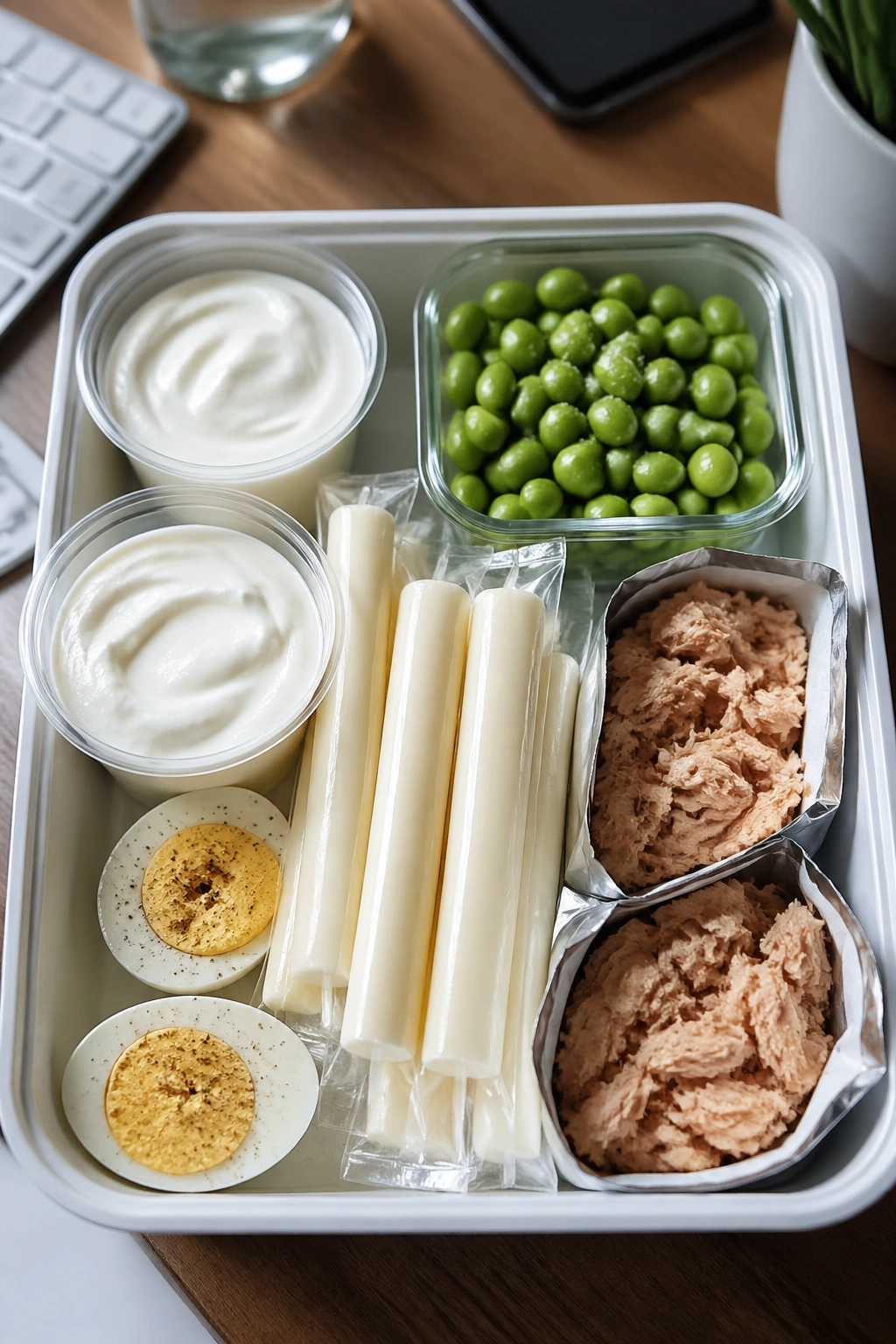
Your snack drawer can either help or sabotage you. If the closest thing to you is crackers, candy, and office pastries, the afternoon gets expensive fast. If you keep protein-rich snacks nearby, you give yourself a better choice before hunger turns into a scavenger hunt.
The trick is to make the good option the easy option. Pre-portion snacks into small containers or bags so you are not eating straight from a giant package while answering email. I like snacks that give you at least 10 grams of protein, and 15 to 20 grams is even better if lunch was light.
Good desk-friendly choices:
- Greek yogurt cups.
- String cheese plus an apple.
- Tuna packets with whole-grain crackers.
- Roasted edamame.
- Beef jerky with a low-sugar label.
- Cottage cheese cups.
- A hard-boiled egg with carrots.
- Protein shakes that are not loaded with sugar.
This is one of those areas where people overcomplicate things. They look for the perfect snack instead of the snack they will actually eat. Pick three options you do not mind repeating. Keep them visible. Hide the candy. That part matters.
A snack should calm hunger, not start a second meal.
6. Turn One Call a Day Into a Walking Meeting

Not every meeting needs a chair. Some calls are audio-only, low-stakes, and perfect for a loop around the block or even a walk down a quiet hallway. If your job chains you to the desk, this is one of the best ways to reclaim steps without adding a formal workout.
One walking call a day adds movement in a place where most people would otherwise stay frozen. It also changes the mood of the afternoon. A stiff back, a tight neck, and a bad coffee habit make a weirdly annoying trio. A 15- or 20-minute walk breaks that up.
Keep the call simple. Audio only works best. If you need to take notes, use your phone’s voice memo app or stop briefly at the end and write down the key points. Don’t force every call into a walk. That gets clumsy fast. Use the ones that fit.
A little rhythm helps here. Same route, same time, same shoes by the door. Less friction means more consistency, and consistency is the part most people are missing.
One walk a day. That’s enough to matter.
7. Do Two-Minute Movement Snacks Each Hour
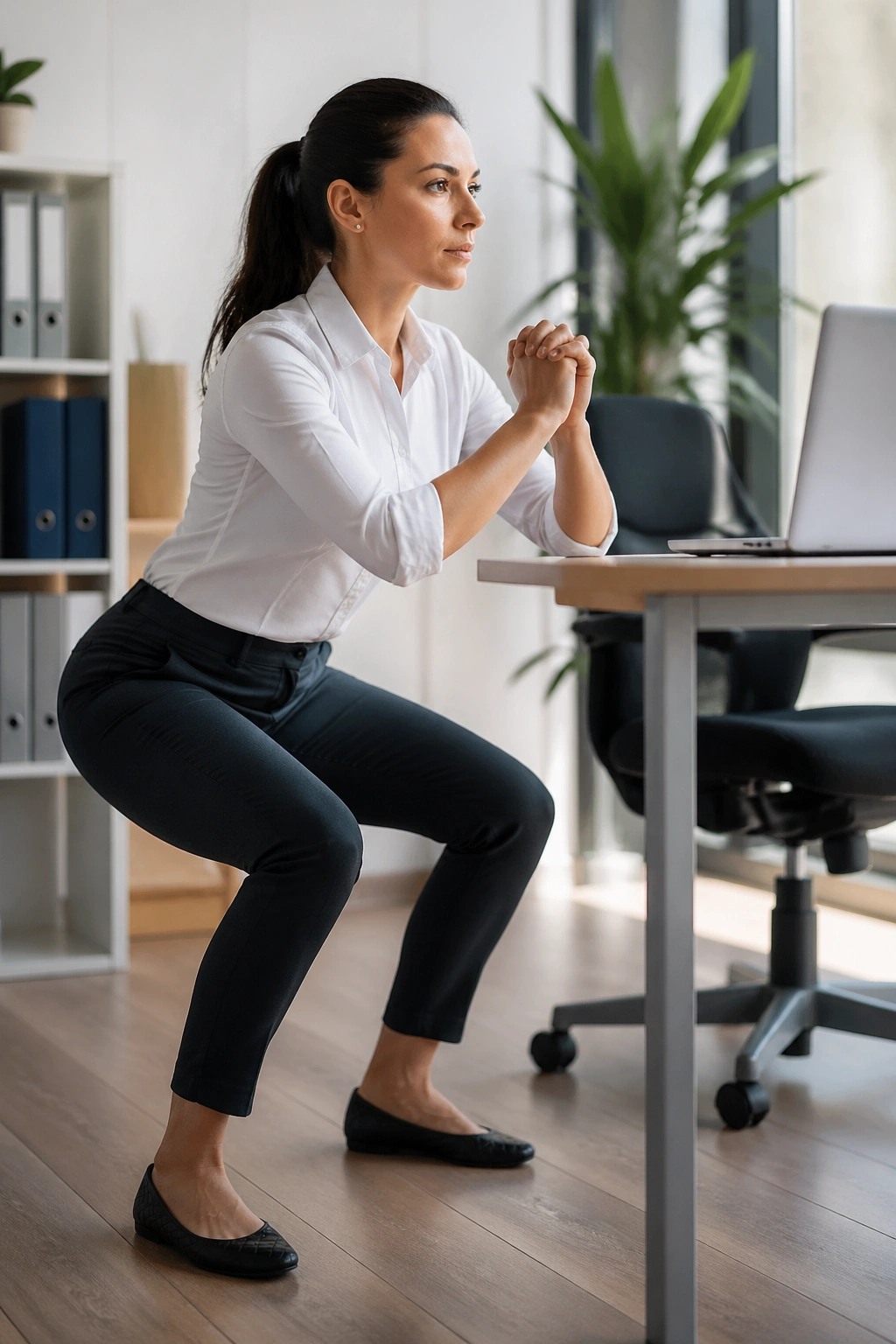
Two-minute movement snacks work because they are hard to ignore. A full workout can be delayed. Two minutes between tasks is harder to talk yourself out of. That makes it useful for desk workers who sit down to “just finish one thing” and look up an hour later with a stiff lower back.
A desk-side circuit that does not need a mat
You do not need to sweat. You need to interrupt the sitting spell. Pick four moves and run through them once every hour or two.
- 10 chair squats.
- 8 desk push-ups.
- 20 calf raises.
- 20 seconds of hip flexor stretching per side.
If your knees dislike chair squats, shorten the range. If desk push-ups feel awkward, put your hands on a counter. The point is not to impress anyone. The point is to wake your body up.
I like this approach because it feels almost too small to fail. That matters on workdays when your calendar is ugly and your energy is patchy. Two minutes is a low bar, and low bars get cleared more often.
A little movement every hour beats one heroic burst at 7 p.m. that never happens.
8. Stop Drinking Calories at Your Desk

Liquid calories are sneaky. A sweet coffee drink, juice, soda, or “healthy” beverage can add up fast, and drinks do a poor job of keeping you full. That’s a bad combination when your workday is long and your hands keep wandering toward the cup.
Coffee itself is not the problem. Sugar, syrup, whipped toppings, and careless pour-after-pour are the problem. A black coffee with a splash of milk is a different animal from a large flavored drink that eats up a big chunk of your day’s intake before lunch.
Water is not exciting. It does its job.
If plain water bores you, use sparkling water, unsweetened tea, or water with lemon. I would rather see someone drink three boring glasses of water than one “fat-burning” drink with a label that sounds clever. That stuff usually sells hope, not results.
A useful check: if your drink tastes like dessert, treat it like dessert. Not every time, but often enough to keep the numbers honest.
9. Lift Weights Three Times a Week

Strength training changes the shape of your body while the scale is busy misbehaving. When you build and keep muscle, you give your body a better look as body fat comes down. You also make daily life easier — stairs feel less annoying, your back usually complains less, and your posture stops collapsing into the chair like wet laundry.
A desk job does not cancel strength work. It makes it more useful. The U.S. physical activity guidelines generally point adults toward muscle work on 2 days a week, and three short sessions is a solid target if your schedule allows it. You do not need a bodybuilder split. You need a few compound lifts that cover the big patterns.
A simple full-body session
- Squat pattern: goblet squat or bodyweight squat.
- Hinge pattern: Romanian deadlift or hip hinge.
- Push pattern: push-up or dumbbell press.
- Pull pattern: row or band pull-apart.
- Carry: farmer’s carry or loaded suitcase carry.
Keep sessions around 30 to 45 minutes. Start with 2 or 3 sets of each move. When the last rep stops feeling hard, add a little weight or one extra rep next time. That’s the whole game.
I like strength work for desk workers because it does not just burn calories during the session. It changes what your body does with the rest of the day.
10. Put a Hard Stop on Late-Night Snacking

Night snacking is rarely about hunger alone. Sometimes it is stress. Sometimes it is habit. Sometimes it is a long, awkward gap between dinner and bed. If you’re eating chips at 10:30 because the day felt long, the answer is not a lecture. It is a better system.
Pick a cutoff time that makes sense for your routine, usually a couple of hours before bed. After that, the kitchen is closed unless you are genuinely hungry. Brush your teeth, make herbal tea, and move the snack food out of sight. That last part matters more than people want to admit.
If you truly are hungry, fix the day rather than white-knuckling the night. A small protein snack — plain Greek yogurt, cottage cheese, or a hard-boiled egg — is a better answer than pretending willpower is a food group. If dinner was tiny and you go to bed hungry every night, the day is too restricted.
A hard stop works best when it is paired with enough food earlier. Otherwise it turns into a grudge.
11. Chase More Steps Before and After Work

Steps pile up in boring places. The parking lot, the stairs, the walk from the train, the route to the printer on the other side of the floor — none of that looks like exercise, but all of it counts. For desk-job fat loss, those quiet steps matter a lot.
If your daily step count is low, adding 2,000 or 3,000 steps a day can make a real difference over time. That might be a 20-minute walk in the morning and a little more pacing in the evening. It might be taking the long way to coffee instead of cutting across the lobby.
Easy step boosts that do not wreck your schedule
- Park one row farther away.
- Take the stairs for one or two floors.
- Walk while you take phone calls.
- Get off the bus a stop earlier if that fits your commute.
- Pace while you wait for a file to load or a meeting to start.
Don’t turn this into a noble quest. It doesn’t need to be. It just needs to make sitting less total. That alone can change how your waist responds.
I’d rather see a person take 3,000 extra steps most days than promise themselves a perfect workout they never touch.
12. Handle Stress Without Raiding the Snack Drawer

Stress has a snack drawer of its own. When your brain is fried, chips and candy feel like a quick reset, and they are easy to reach after a long stretch of sitting and solving other people’s problems. The fix is not “be more disciplined.” That’s lazy advice. The fix is giving your nervous system a different off-ramp.
A five-minute reset that beats mindless eating
Step away from the desk. Walk outside if you can. Take six slow breaths, longer on the exhale than the inhale. Roll your shoulders. Drink water. Write down the next one task you need to do. That is enough to break the stress loop for a lot of people.
Stress does not burn belly fat. It usually makes portion control worse. That’s the part worth remembering. A calmer afternoon often means fewer snack attacks at 4 p.m., and fewer snack attacks mean fewer calories that never felt like calories when you were eating them.
If you know a certain task or meeting turns you into a vending-machine tourist, plan ahead. Keep a protein snack handy, set a short walk as your reset, and make the first response movement instead of food.
Boredom and stress look similar when you are tired. Both can be handled without a bag of chips.
13. Sleep Like Your Waist Depends on It

Sleep loss changes appetite faster than most people expect. Short nights make hunger louder, cravings sharper, and fast food look weirdly reasonable. The next day usually brings more sitting, less patience, and a stronger pull toward whatever is salty, sweet, or both.
You do not need a perfect sleep routine. You do need enough hours that your brain stops acting feral. Most adults do better with about 7 to 9 hours. A steady bedtime helps more than a random early night once in a while, because your body likes routine more than drama.
A simple sleep setup
- Keep the room dark.
- Keep it cool enough to sleep.
- Put the phone away before bed.
- Cut caffeine later in the day.
- Stop eating heavy meals right before lying down.
I’ve always thought sleep advice sounds dull until you miss enough of it. Then it gets loud. Your workout feels harder, your choices get sloppier, and the desk chair wins the day because your body is too wiped out to push back.
If belly fat loss stalls, sleep is one of the first places I’d look. It is not glamorous. It is often the missing piece.
14. Measure Your Waist, Not Only the Scale

The scale lies by omission. It tells you one number and leaves out water, sodium, sore muscles, food in the system, and the fact that body weight can bounce around without much meaning. For desk-job fat loss, the waist measurement is often more useful.
Use a soft tape measure at the level of your navel, or just above the hip bones if that feels more consistent for your body. Measure first thing in the morning, relaxed, not sucking in. Do it every 1 to 2 weeks, not every hour like a nervous referee.
A front photo and side photo help too. Same lighting, same clothes, same stance. Boring setup. Good data.
Why bother? Because the waist often changes before the scale makes a clean move. You might be holding water from a strength workout, or extra sodium from lunch, or just a week that looks messy on paper. The tape gives you a better read on what is actually happening.
If the waist is shrinking, the plan is working. Simple as that.
15. Build a Desk-Job Routine You Can Repeat

A desk-job fat-loss plan works only when it feels ordinary. If it takes heroic effort every day, it will fall apart the first time your calendar gets ugly. I would rather see someone do five boring things all week than chase fifteen perfect things for nine days and quit.
A sane workday template
- Morning: protein breakfast and a short walk if time allows.
- Midmorning: stand up for water, bathroom, or a quick stretch.
- Lunch: eat away from the keyboard, then walk for 10 minutes.
- Afternoon: one movement snack, like squats, push-ups, or calf raises.
- After work: steps, walking meeting, or a 30- to 45-minute strength session.
- Evening: dinner, then a hard stop on random snacking.
That is enough structure to move a waistline without making your life miserable. If you do only two things at first, make them the post-meal walk and the protein-heavy breakfast. Those two habits tend to pull the rest of the day in a better direction.
And keep the standard honest. You are not trying to become a different person at lunch. You are trying to sit a little less, eat a little smarter, and stop making your chair do all the work. Do that long enough, and the waist usually follows.
