



There is something profoundly humbling about a staircase. You walk past them every single day—in office buildings, subway stations, apartment complexes—and rarely give them a second thought. But when you treat a staircase as a piece of training equipment, that mundane architectural feature transforms into a brutal, efficient tool for building leg strength and spiking your heart rate. It is gravity fighting you, and for once, you are choosing to fight back.
Most people rely on treadmills or stationary bikes when they need cardio. Those machines are fine, but they tend to be forgiving. A machine might coast if you lose your rhythm; a staircase does not. Every single step requires you to physically lift your body weight against gravity, recruiting your glutes, hamstrings, and quads in a way that flat-ground running simply cannot replicate. If you want to tone your lower body while stripping away fat, you do not need an expensive gym membership or fancy gear. You just need a flight of stairs and the willingness to let your lungs burn a little.
The beauty of stair training lies in the sheer versatility of the movement. You are not just limited to walking up and down. By changing your angle, your speed, and your foot placement, you can target specific muscle groups and shift the focus from pure cardio endurance to explosive power or stabilization. Whether you are dealing with a public stadium, a quiet office stairwell, or the steps in your own home, these workouts provide a framework to turn a mindless climb into a calculated session of physical exertion.
1. The Classic Stair Climb
The most fundamental way to use stairs is also the one most people get wrong. Speed is the enemy of form when you are just starting out. You want to focus on the tripod of the foot—the heel, the big toe mound, and the little toe mound—making contact with the stair tread before you push off. If you are only hitting the front half of your foot, you are overloading your calves and neglecting the glute engagement that makes this movement so effective for shaping your lower body.
Why It Builds Endurance
This is your base-building workout. You are training your cardiovascular system to handle sustained effort, similar to a long run but with significantly more vertical resistance. When you perform a steady-state climb, your heart rate enters a moderate zone where fat oxidation is high.
How to Execute for Maximum Impact
- Keep your chest upright and your gaze fixed forward, not down at your feet.
- Engage your core as if you are bracing for a punch; this protects your lower back.
- Use your arms to create momentum, pumping them in rhythm with your legs.
- Focus on a controlled descent, putting weight into the ball of the foot to avoid jarring the knees.
Pro tip: Wear a weighted vest if you reach a point where you can climb for 20 minutes without significant fatigue. It forces the glutes to work harder on every single step.
2. Double-Step Glute Power
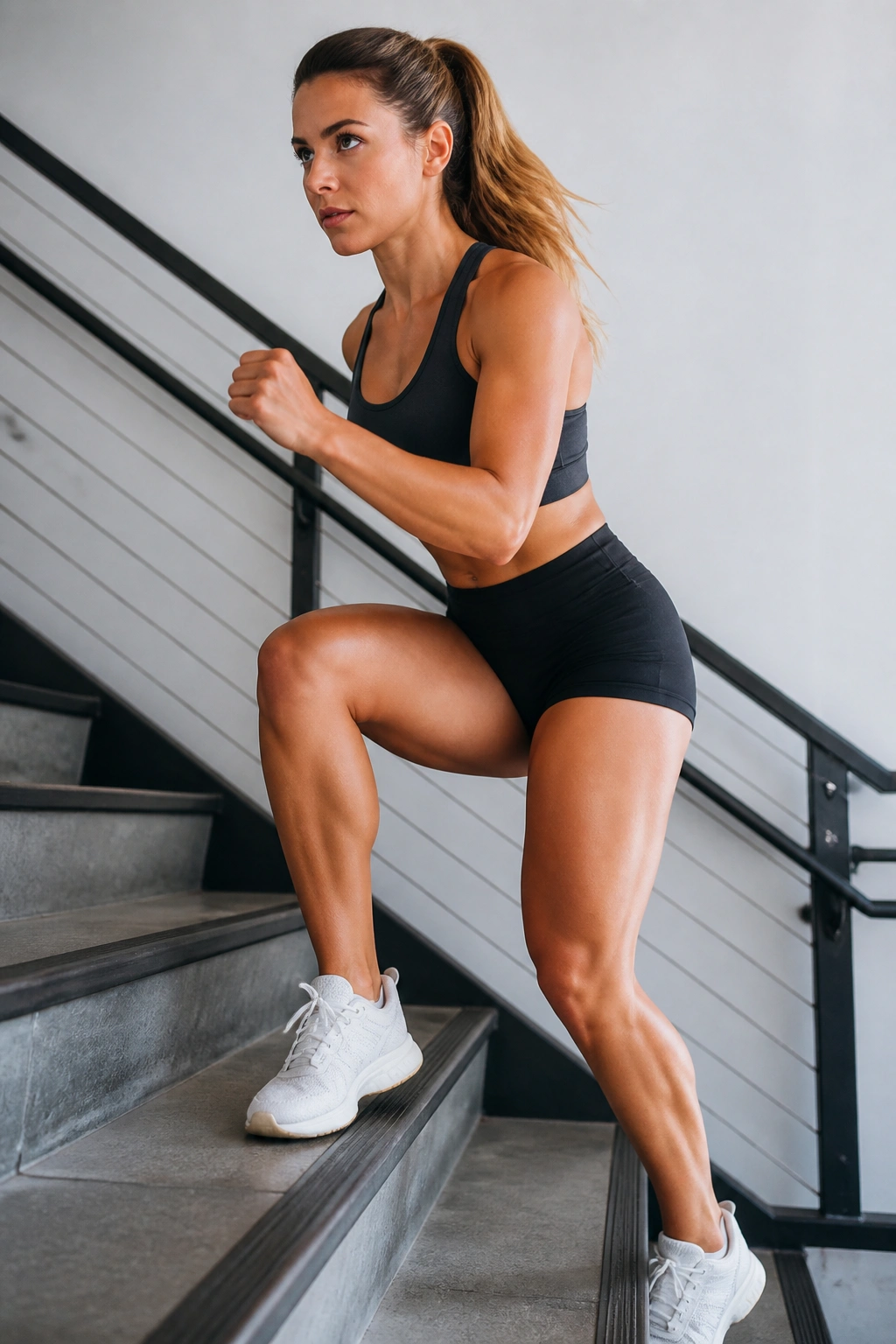
If your goal is glute development, skipping steps is your new best friend. By taking two steps at a time, you are forced into a deeper hip flexion and a more aggressive hip extension. This increased range of motion is exactly what wakes up the gluteus maximus, pulling it out of the background and making it do the heavy lifting that usually defaults to the quads.
The Mechanics of the Move
When you bridge that wider gap, you are essentially performing a high-intensity step-up. Your lead leg must generate enough force to propel your entire body weight upward through a longer distance. This requires a significant drive from the heel. If you push off your toes, you will likely feel this in your shins rather than your glutes.
Focusing on Tension
- Start slow. This is not about speed; it is about feeling the muscle fibers in your glutes contract.
- Pause for a split second at the top of the step to ensure you are fully extending the hip.
- Keep your torso slightly leaned forward to optimize the gluteal stretch, but do not hunch your shoulders.
Note: If you feel this exclusively in your lower back, your core is not engaged, or you are taking the steps too wide for your current hip mobility. Narrow the gap and master the single step before pushing your range of motion.
3. The Stair Sprints Interval

High-Intensity Interval Training (HIIT) on stairs is arguably the most effective way to burn calories in a short window. The concept is simple: maximize your heart rate for a short burst, then let it come down just enough to do it again. You are not training for a marathon; you are training to make your body metabolically demanding for the next few hours.
Why This Triggers Results
Studies have consistently shown that short, explosive bursts of exercise create an “afterburn” effect, where your metabolic rate remains elevated long after you have stopped moving. Stair sprints are the ultimate expression of this. You hit your anaerobic threshold quickly, pushing your lungs and legs to the absolute limit.
How to Structure Your Sprint
- Sprint: Charge up the stairs as fast as you safely can for 30 seconds.
- Recover: Walk down the stairs slowly, taking deep, belly-filling breaths for 60 seconds.
- Repeat: Do this for 10 rounds. If 10 feels impossible, start with 5.
Warning: Do not compromise form for speed. If you feel like you are going to trip, slow down immediately. The risk of rolling an ankle on a staircase is real, and it will end your training cycle faster than any amount of fatigue will.
4. Lateral Step-Ups
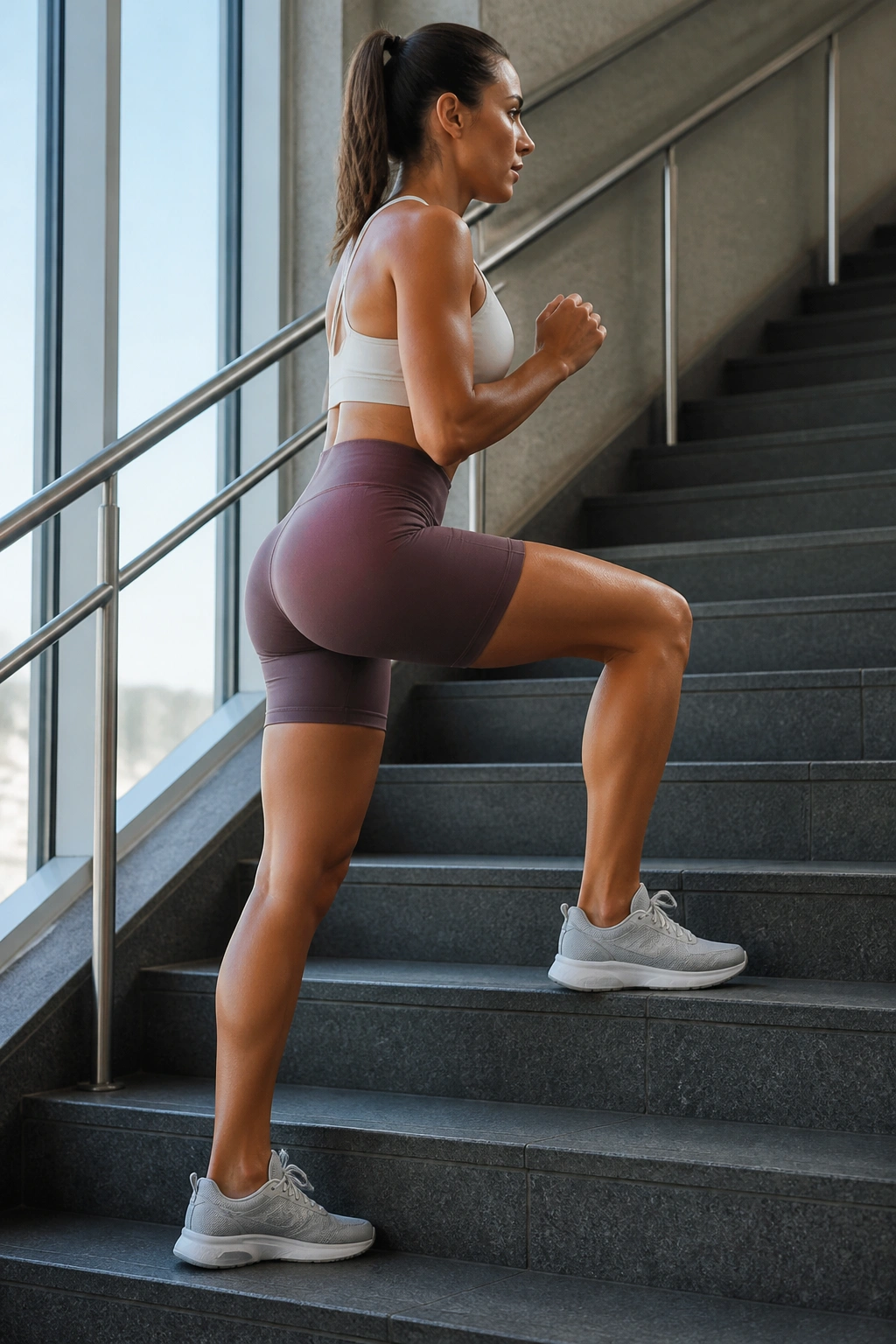
Most stair workouts focus on forward motion, but the body moves in multiple planes. Lateral step-ups—stepping onto the stairs sideways—specifically target the gluteus medius, the muscle on the side of your hip responsible for pelvic stability and that desirable sculpted look on the outer hip.
What Makes This Different
Standard climbing works the sagittal plane (forward/backward). By turning sideways, you enter the frontal plane. This creates a different kind of burn. You will notice that your balance is tested much more here than in a forward climb. It feels awkward at first, and that is exactly why it works.
Execution Details
- Stand with your right side facing the stairs.
- Step up with your right foot onto the first or second step, driving through the heel.
- Bring your left foot to meet it, or perform a controlled tap.
- Do not let your knee cave inward toward the stairs; keep it tracking over your second toe.
- Complete 15 reps on the right, then switch and face the other direction for 15 reps on the left.
Pro tip: Hold a light dumbbell in the hand furthest from the stairs. This creates a counterbalance challenge, forcing your core to work twice as hard to keep you upright.
5. Reverse Stair Lunges
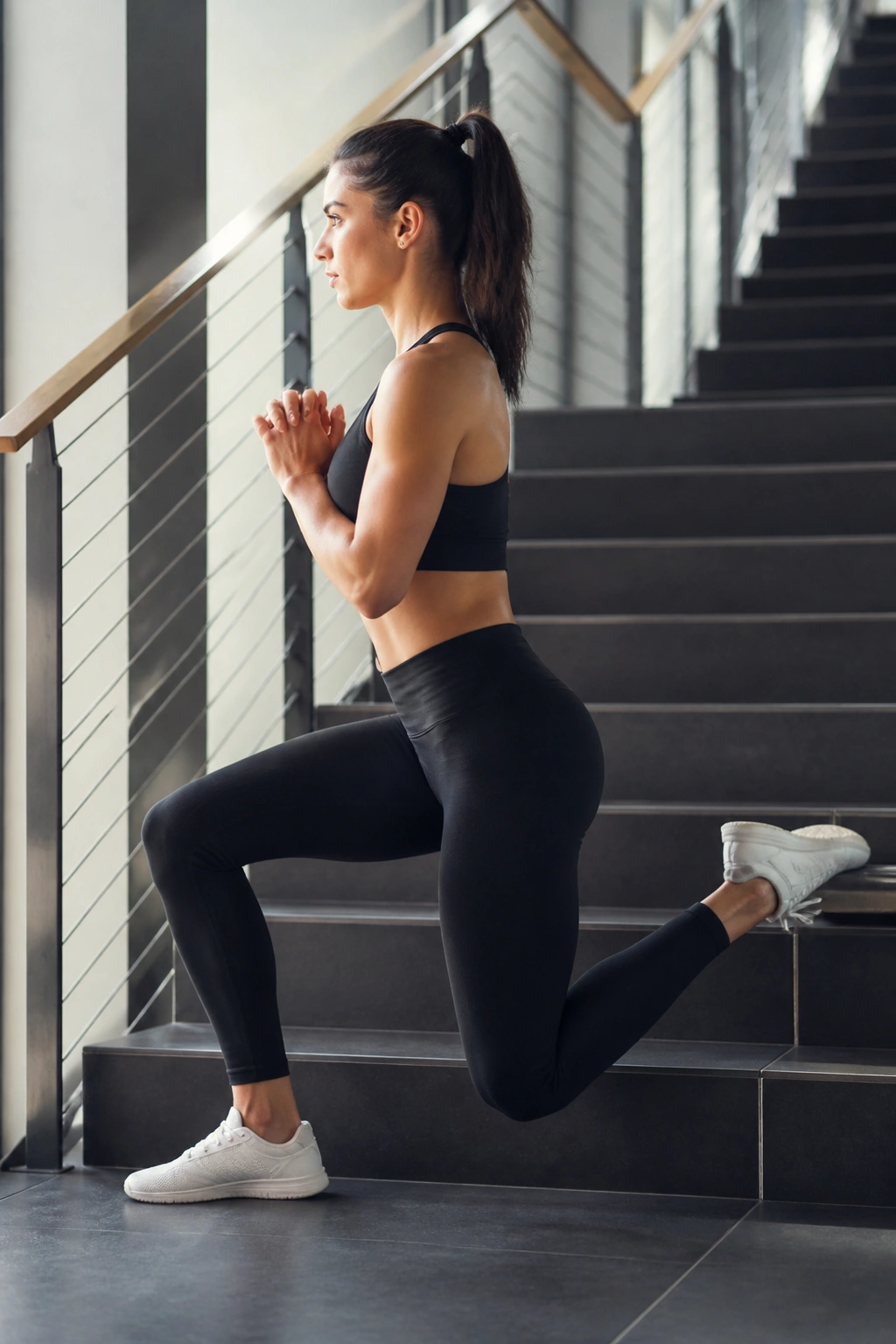
Reverse lunges are generally safer for the knees than forward lunges because the weight remains in the front heel rather than shifting onto the ball of the foot. Doing them on a staircase adds a massive stability challenge. You are essentially doing a deficit lunge, which stretches the glute of the front leg and forces deeper engagement.
Stability and Control
When you lunge backward, you are relying on your front leg to control the descent. This eccentric loading—the lowering phase—is vital for muscle growth. It builds strength through the entire range of motion, not just the lift.
Proper Form
- Stand at the base of the stairs, facing away from them.
- Take a large step backward, placing the ball of your foot firmly on the first step (or second, for more intensity).
- Lower your hips until both knees are bent at roughly 90-degree angles.
- Press firmly through the front heel to return to the starting position.
Mistake to avoid: Do not let your front knee collapse inward. Imagine you are trying to spread the floor apart with your feet; this cues the glutes to fire and stabilizes the knee joint.
6. The Two-Up, One-Down Recovery Method

This workout is about volume management. The goal is to accumulate time under tension for the glutes while allowing the heart rate to stay in a manageable, aerobic zone. By taking two steps up, you maintain the high-intensity glute work, but walking down one step at a time provides a specific recovery rhythm.
Understanding the Volume
You are effectively doubling the work on the ascent and halving the intensity on the descent. This creates a “see-saw” effect in your heart rate. It keeps you moving for longer periods without hitting the wall as quickly as a full-out sprint would.
How to Use This Method
- Establish a consistent rhythm.
- On the way up, focus on a powerful drive through the heel.
- On the way down, do not rush. Use this time to regulate your breathing.
- If you find your heart rate spiking too high, slow the pace of your ascent rather than stopping.
Why this works: It is excellent for beginners who want to build the habit of stair climbing without feeling destroyed after two minutes. It emphasizes endurance over raw power.
7. Stair Burpees

If you want to combine total-body conditioning with stair work, this is the gold standard. A standard burpee is tough, but doing it on a staircase changes the leverage. You use the steps as a platform to elevate your upper body, which makes the jump portion feel more controlled and the push-up portion more accessible.
Combining Cardio and Strength
This is a full-body movement. The push-up targets the chest and shoulders, the jump recruits the glutes and core, and the stair-climb component forces the heart rate to stay sky-high. You are engaging every major muscle group in one fluid, rhythmic sequence.
Step-by-Step Flow
- Stand at the base of the stairs.
- Place your hands on the second or third step.
- Kick your feet back into a plank position.
- Perform one push-up.
- Jump your feet back toward your hands.
- Stand up and perform a squat jump onto the next step or simply step up quickly to the next level.
- Repeat.
Safety note: Ensure the stair surface is non-slip. Burpees involve rapid movement, and the last thing you want is for your hands to slide out from under you while in a plank.
8. Sumo Squat Stair Hops

This is an explosive movement. By adopting a wide, “sumo” stance—feet wider than shoulder-width, toes pointed slightly outward—you shift the focus away from the quads and directly onto the inner thighs and glutes. Adding the hop makes it plyometric, which builds fast-twitch muscle fibers.
Why Explosive Power Matters
Plyometric moves train your nervous system to fire muscles quickly. This increases your overall power output, which carries over to every other aspect of your fitness, from running speed to lifting heavier weights.
Execution Strategy
- Stand at the base with a wide stance.
- Sink into a deep squat, keeping your chest up and weight in your heels.
- Explode upward, hopping onto the first step.
- Land softly. If you hear a loud “thud,” you are landing too heavily; focus on using your muscles to absorb the impact like a shock absorber.
- Reset your stance at the top of the step before the next rep.
Caution: If you have any history of knee or ankle issues, skip the hop and perform sumo squats without the jump. You still get excellent glute engagement without the joint impact.
9. The Crab-Walk Stair Ascent
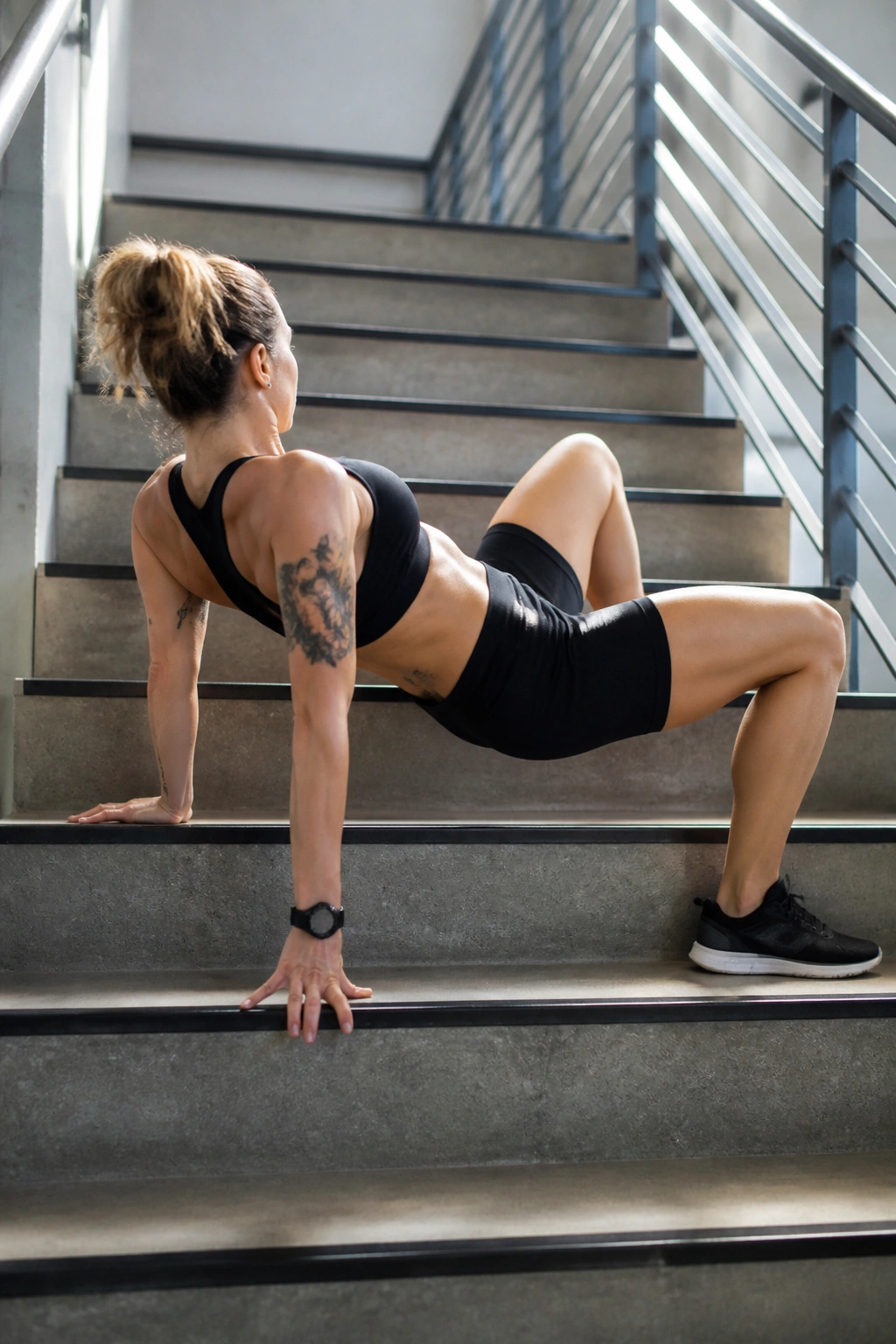
This looks strange, but it is one of the most effective ways to build posterior chain strength and core stability simultaneously. By crawling up the stairs on your hands and feet (facing up or down), you are essentially forcing your body to act as a bridge.
Engaging the Posterior Chain
The “crab walk” forces the hamstrings and glutes to engage to keep your hips off the ground. Your triceps and shoulders also get a massive workout. This is functional movement at its finest, teaching you to coordinate upper and lower body limbs.
How to Perform
- Sit on the bottom step.
- Place your hands on the step behind you and your feet on the step below.
- Lift your hips, engage your glutes, and “walk” your way up the stairs.
- Keep your hips elevated; the moment they sag, you lose the glute activation.
Tip: If this feels too difficult, start on a flat surface to get the coordination down before attempting it on stairs. The incline adds a significant resistance factor.
10. Stair Plank Climbs
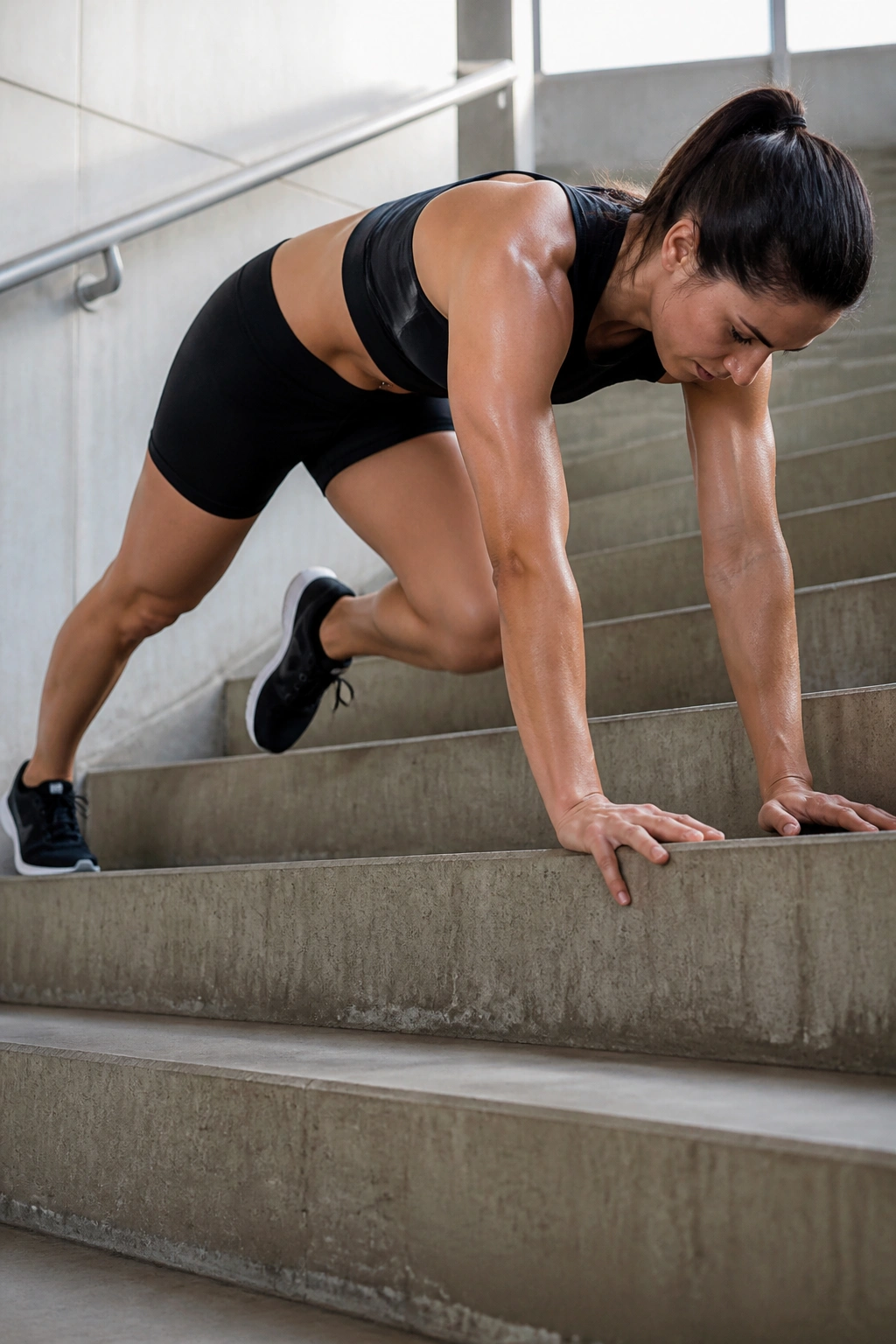
This is essentially a mountain climber done on an incline. By elevating your hands, you change the angle of the plank, which makes it slightly easier on the shoulders but more demanding on the lower abs and hip flexors. It is a fantastic core burner that forces you to hold a stable position while your legs do the work.
Core-Centric Cardio
Most people think of abs as crunches. But the real work of the core is stability—keeping your torso from moving while your limbs are in motion. This movement demands that you remain rock-solid through the torso while driving your knees toward your chest.
Form Checklist
- Hands on a step at a height that allows you to maintain a straight line from heels to head.
- Drive your right knee toward your chest, then return to plank.
- Drive your left knee toward your chest, then return.
- Move with intent, not speed. Every rep should feel like a dedicated abdominal contraction.
Pro tip: Do not let your hips pike up into the air. If you feel your butt rising, move your hands to a lower step to flatten your back.
11. The 10-Minute EMOM Challenge

EMOM stands for “Every Minute on the Minute.” It is a classic CrossFit-style format that keeps you honest. You set a specific amount of work to do within 60 seconds. Whatever time is left in that minute is your rest. If you finish your work in 40 seconds, you get 20 seconds to breathe before the next minute starts.
Efficiency in Action
This is the ultimate time-management workout. You can get an incredible amount of volume done in just 10 minutes because the structure prevents you from slacking off. It forces you to pace yourself—if you go too hard in minute one, you will have no rest by minute six.
The Protocol
- Pick a set number of repetitions. For example: 10 double-step ascents and 10 bodyweight squats.
- Start your timer.
- Complete the reps as fast as safely possible.
- Rest for the remainder of the minute.
- Begin the next set at the start of the next minute.
Why this works: It introduces a mental game. You are racing the clock, which distracts you from the burning sensation in your legs.
12. Single-Leg Stair Hops
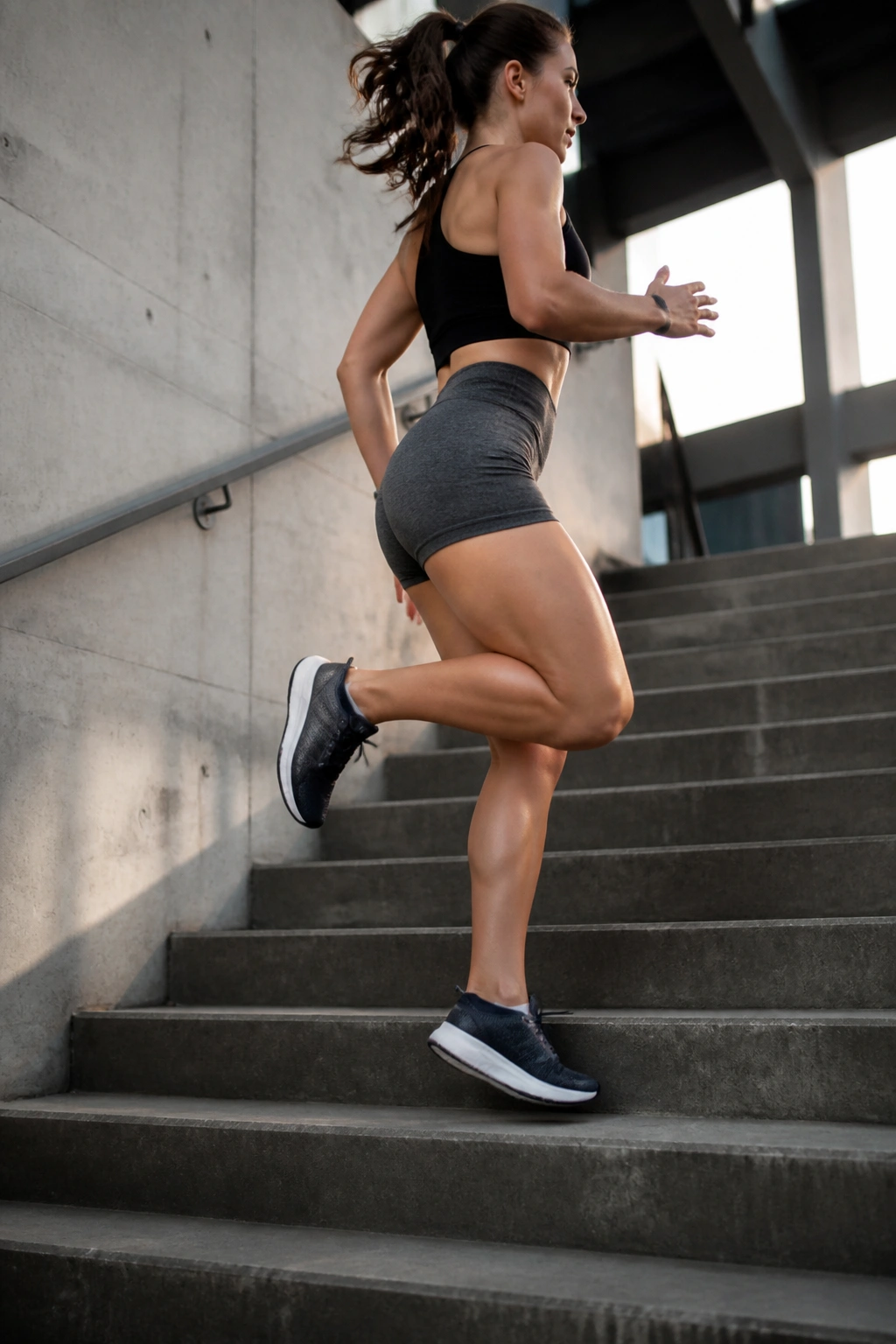
Unilateral training (working one side at a time) is essential for correcting muscle imbalances. Most of us have one leg that is naturally stronger or more dominant. Single-leg hops expose these weaknesses and force the stabilizer muscles around the knee and ankle to strengthen themselves.
Targeting Imbalances
If your left glute is weaker than your right, you will notice it immediately when you try to hop on your left leg. That instability is a signal that you need to work that side harder. Over time, this builds a symmetrical physique and reduces the risk of injury.
Execution Notes
- Start at the bottom of the stairs on one leg.
- Hop up to the first step.
- Keep the non-working leg bent behind you.
- Land with a soft knee. Do not lock your knee out on landing.
- Do 10 reps on the left, then switch to the right.
Safety note: This is a high-impact move. If you have any history of ankle instability or patellar tendonitis, stick to single-leg step-ups instead of hops. You still get all the strength benefits without the jarring impact.
13. High-Knee Stair March
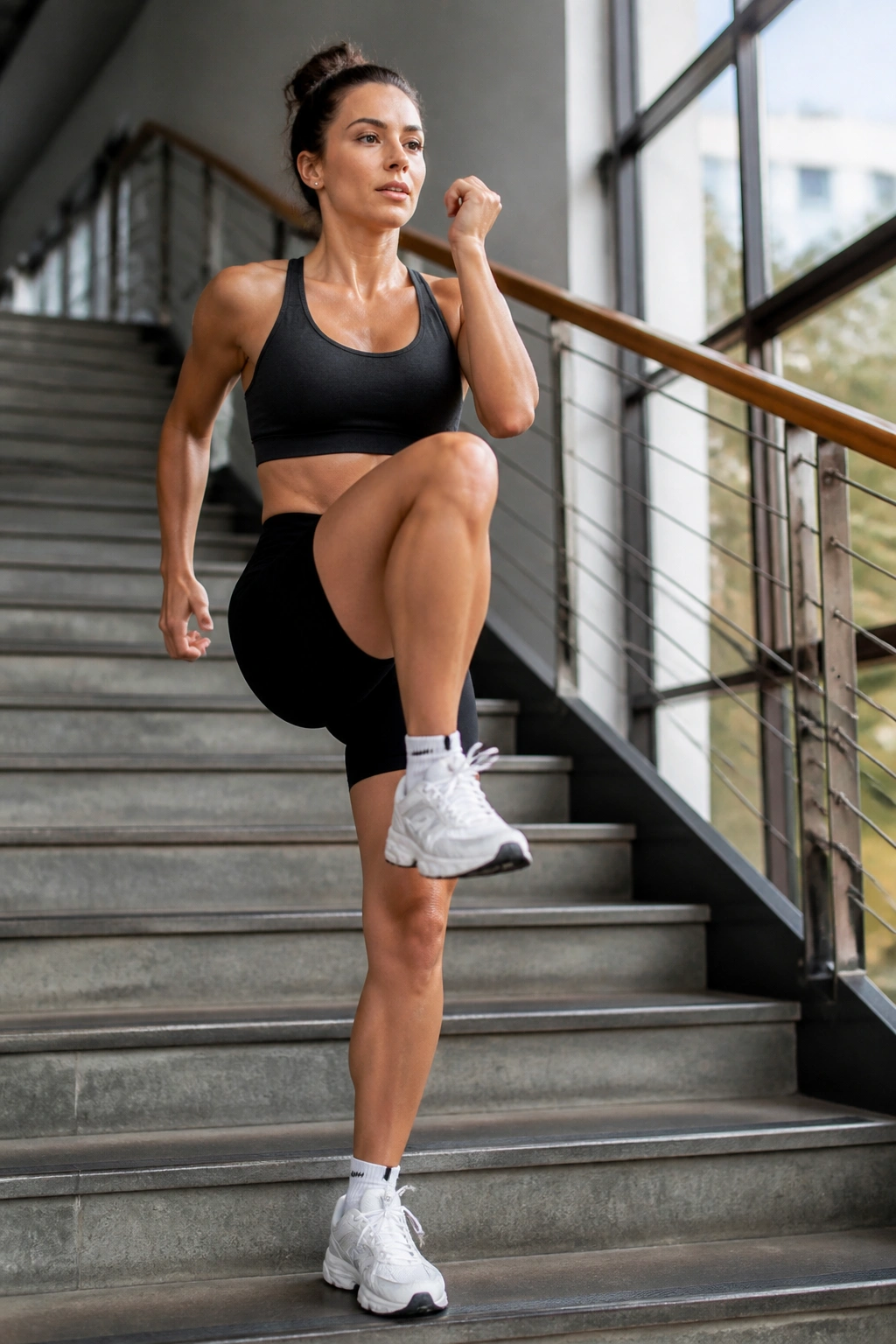
This is a dynamic warm-up or active recovery move that targets the hip flexors and deep core while simultaneously keeping the heart rate elevated. It’s a rhythmic, marching motion that forces you to pull your knee up to hip height with every single step.
Activation Focus
This move is excellent for “waking up” the glutes before a heavier lifting session. By driving the knee high, you are putting the standing glute into a position of full extension and the lifted leg into deep flexion. It’s a full range-of-motion drill for the hip joint.
How to Do It
- Walk up the stairs, but exaggerate the movement.
- Drive your knee up toward your chest with every step.
- Use your opposite arm to “punch” the air, matching the rhythm of your legs.
- Keep the upper body tall; do not lean into the step.
Why include this: It is much harder than it looks. If you do it with enough intention, you will find your glutes and abs firing rapidly within just a few flights.
14. Stair Push-Up Complex
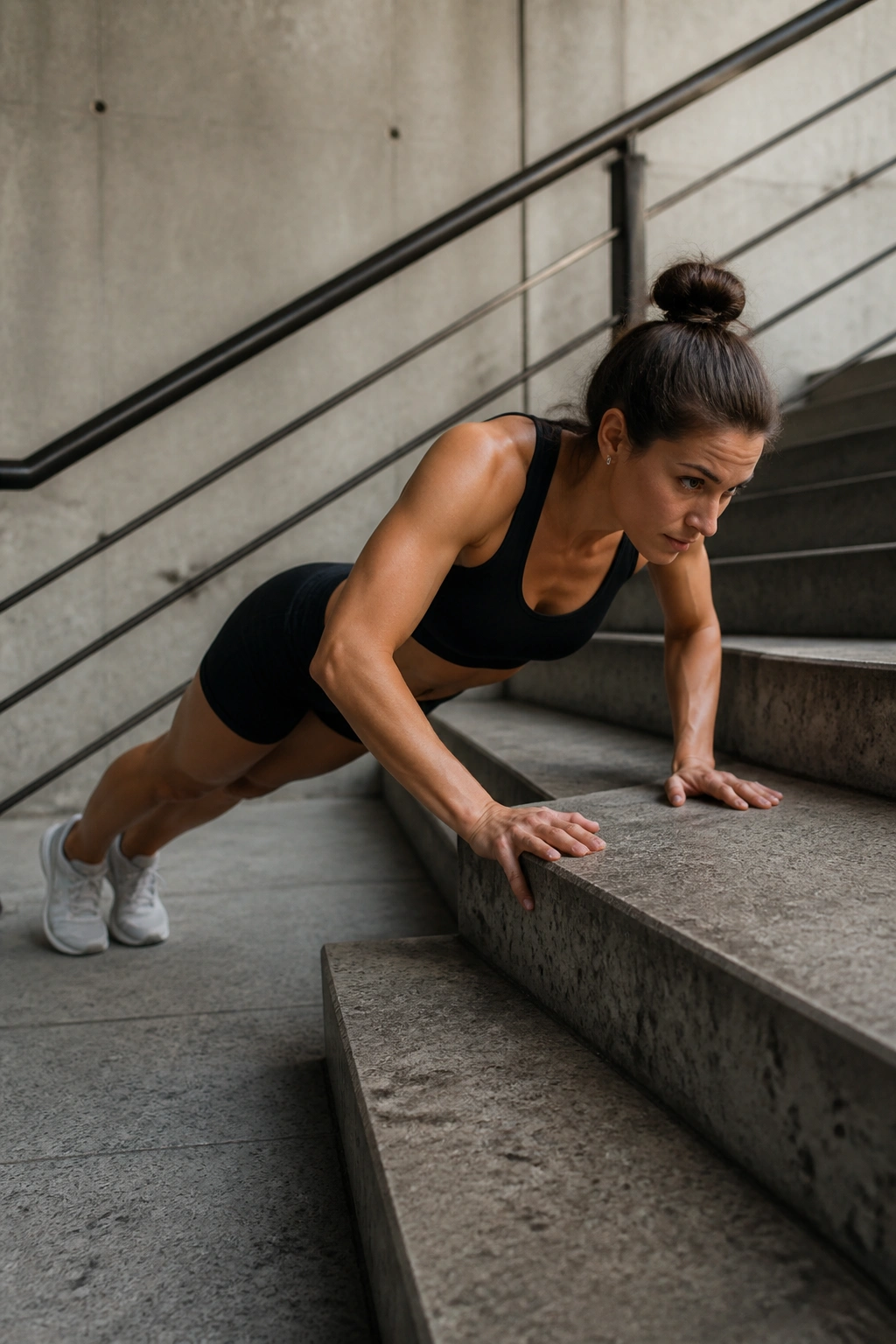
This is a unique hybrid move. You are doing a set of push-ups, then immediately standing up to climb a flight of stairs, then dropping back down for another set of push-ups. It integrates the upper body strength required for push-ups with the lower body endurance of climbing.
Total-Body Integration
By constantly switching between horizontal (push-ups) and vertical (climbing) positions, you are forcing your heart to work harder to pump blood to different muscle groups. This rapid change in posture is a fantastic conditioning tool that leaves you feeling breathless and fully taxed.
The Flow
- Find a wide stair landing.
- Perform 10 push-ups with your hands on the step.
- Jog up the stairs for 30 seconds.
- Find the next landing and repeat the push-ups.
- Continue until you have hit 50 push-ups total.
Pro tip: Use the stairs to scale the difficulty. If your shoulders are fatiguing, move your hands to a higher step, which puts you at a better angle. If you want to make it harder, place your feet on the step and your hands on the floor (decline push-ups).
15. The Descending Pyramid
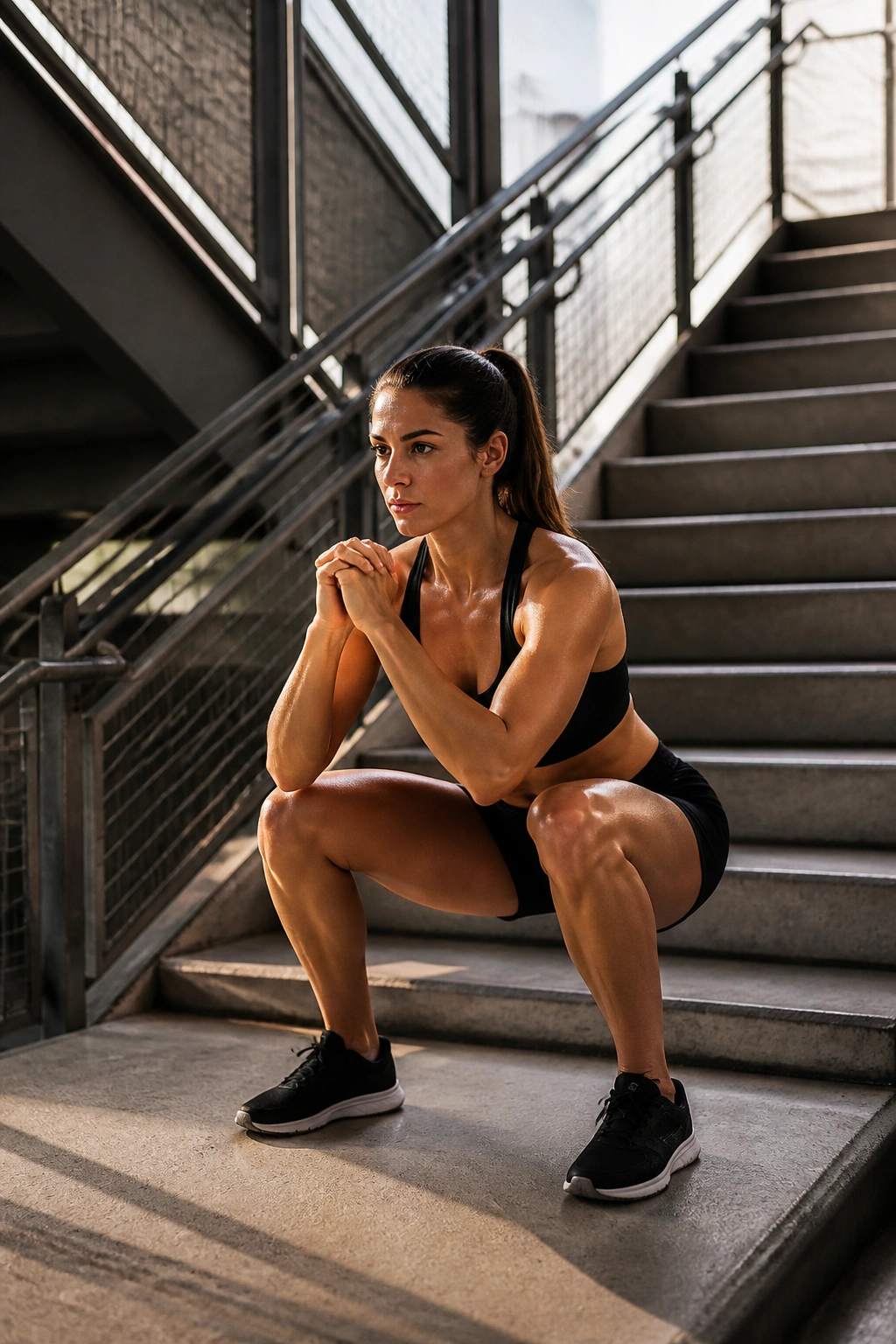
This is a mental toughness workout. You start at the top of a flight of stairs and perform a series of reps. Then you go down, perform the same series, but you add a challenge—perhaps an extra rep or a different movement. It keeps the workout changing, which prevents the monotony that often plagues steady-state cardio.
Building Resilience
The pyramid structure is psychologically challenging because the work feels like it is never-ending. By the time you get to the bottom of the pyramid, you have accumulated significant volume. It trains you to keep going even when your legs are shaking.
Sample Structure
- Set 1: Climb 10 steps, do 10 squats. Walk down.
- Set 2: Climb 10 steps, do 8 squats. Walk down.
- Set 3: Climb 10 steps, do 6 squats. Walk down.
- Set 4: Climb 10 steps, do 4 squats. Walk down.
- Set 5: Climb 10 steps, do 2 squats. Walk down.
Variations: You can change the exercise for each level of the pyramid—for example, lunges, then side steps, then sprints. The key is the descending rep count, which gives you the feeling of “being almost done” even as the cumulative fatigue sets in.
Final Thoughts
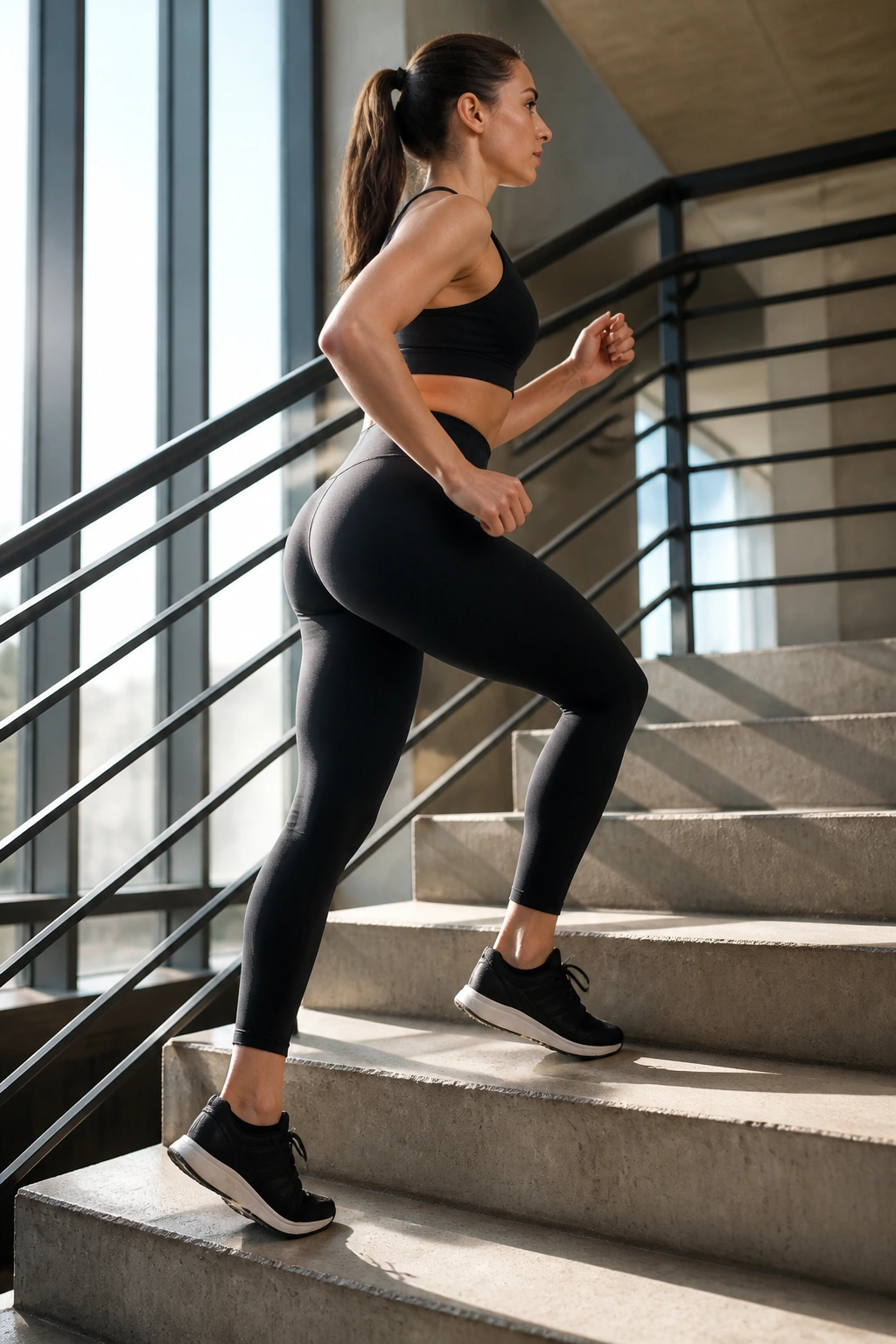
Training on stairs is simple, but simple does not mean easy. It is a raw, honest form of exercise. There are no settings to adjust, no weight stacks to pin, and no screens to watch. There is only the incline and your own resolve. When you strip away all the complexity of the modern gym environment, you are left with the most fundamental thing: moving your body through space.
The real value of these workouts is consistency. A flight of stairs is always there, waiting for you. You don’t have to plan for traffic to the gym or wait for a machine to open up. You can fit these movements into a lunch break, a morning routine, or a weekend park trip. Your glutes will benefit from the consistent vertical resistance, and your cardiovascular system will adapt to the challenge, becoming more efficient with every climb.
Do not worry about being perfect on day one. Your legs will burn, you will get winded, and you might feel uncoordinated. Embrace that. That feeling is the exact sensation of your body adapting to new demands. Pick one of these workouts, commit to the technique, and see where it takes you. The stairs are always there. Start climbing.
