



Most people treat the elliptical machine like a coat rack at the gym or, at best, a way to zone out while watching the news on the wall-mounted television. This is a massive mistake. If you actually put in the work, the elliptical is a precision instrument for cardiovascular conditioning. It allows you to replicate the physiological stress of running—the elevated heart rate, the oxygen debt, the muscle fatigue—without the jarring impact that wrecks your knees, shins, and ankles over time. You are not “taking it easy” by choosing this machine. You are simply choosing a different tool to achieve the same, if not better, metabolic results.
The key to making the elliptical work as a true replacement for running is intensity. If you move at the same, sluggish pace for forty minutes, your body adapts, your heart rate plateaus, and you stop seeing changes. To get the benefits of a grueling run, you have to treat the elliptical with the same respect you would a track. That means changing your cadence, your resistance, and your incline regularly. You need to manipulate the variables to keep your body guessing. When you do that, you stop being a casual user and start being an athlete.
1. The Steady State Endurance Protocol
This workout is designed to replace your “long, slow distance” run—the kind of session that builds your aerobic base and teaches your body to burn fuel efficiently. You are aiming for a consistent, moderate effort that feels slightly uncomfortable but sustainable for a long duration.
Why This Works
The goal here isn’t to spike your heart rate into the red zone but to keep it firmly in that aerobic “sweet spot” where you are training your mitochondria to handle oxygen delivery more effectively. It mimics the physiological strain of a 5-to-8-mile jog.
The Protocol
- Duration: 45 to 60 minutes.
- Resistance: Moderate (level 5-7 on most standard machines).
- Incline: Low to moderate (keep it flat or at a slight 2-degree angle).
- Cadence: Maintain 140-150 steps per minute (SPM).
- The Rule: If you can easily carry on a full conversation, you aren’t working hard enough; if you can’t speak at all, you’re going too fast.
Pro tip: Use the handlebars for the first half, then let go for the second half to engage your core muscles, as they have to work harder to stabilize your torso without the arm support.
2. The Interval Sprint Session

Runners head to the track for speed work; you head to the elliptical for this interval protocol. This is about teaching your cardiovascular system to recover quickly between bouts of near-maximal effort. It is brutal, effective, and efficient.
You want to alternate between a pace that makes you feel like you’re running a 400-meter dash and a pace that feels like a slow, recovery walk.
The Setup
- Warm-up: 5 minutes at a light, easy effort.
- The Work: 60 seconds at 90-95% of your max effort (high resistance, fast cadence).
- The Recovery: 60 seconds at 40-50% effort (very slow, light resistance).
- Repeat: Cycle this 10 to 12 times.
- Cool-down: 5 minutes.
Doing this properly requires you to actually “sprint.” Don’t just increase your cadence; crank the resistance up until it feels like you are pushing through mud. Your legs should feel heavy, and your lungs should be screaming for air by the end of each work interval.
3. The Hill Climb Simulation

Trail runners know that hills are where the real work happens. On an elliptical, you can replicate this by aggressively manipulating the incline feature. This workout builds massive strength in your glutes, hamstrings, and calves, which are often underdeveloped in runners who only stick to flat pavement.
Start with the incline low. Every five minutes, increase the incline level by two or three notches. You are building a “hill” that gets steeper and steeper. When you reach the peak, reverse the process, decreasing the incline every few minutes until you are back on flat ground.
The resistance should remain constant throughout the climb, but because the incline is changing, the effort required to keep that same cadence will increase dramatically. You will feel the burn in your quads and glutes long before your heart rate spikes, which is exactly the point. It’s strength training disguised as cardio.
4. The Power Resistance Pyramid

This workout focuses on force production rather than just speed. By slowly increasing the resistance over time, you build the kind of leg power that sprinters need. It’s less about how fast you pedal and more about how much force you put into every single push-down.
How to Build the Pyramid
- Minutes 0-5: Resistance Level 4.
- Minutes 5-10: Resistance Level 6.
- Minutes 10-15: Resistance Level 8.
- Minutes 15-20: Resistance Level 10 (or as high as you can handle).
- Minutes 20-25: Back down to Level 6.
- Minutes 25-30: Level 4 recovery.
Focus on the downward phase of the pedal stroke. Drive your heel down as if you are trying to crush something beneath your foot. This recruits the posterior chain—your hamstrings and glutes—much more effectively than a light, bouncy stride.
5. The Tabata-Style Anaerobic Burn

Tabata is a specific protocol of 20 seconds of all-out effort followed by 10 seconds of complete rest. It is arguably the most efficient way to maximize calorie burn and improve anaerobic capacity in a very short window of time.
You need a timer for this. Do not rely on the machine’s internal clock, as it is usually too slow to adjust between intervals.
The Mechanics
- Work: 20 seconds at maximum intensity.
- Rest: 10 seconds of absolute stillness (or very, very slow movement).
- Repeat: 8 rounds total.
This will take you exactly four minutes. If you feel like you could do another round easily, you didn’t go hard enough. The 20 seconds should be a blur of motion, your heart rate should skyrocket, and the 10 seconds of rest should feel like they aren’t long enough.
6. Reverse Stride Pedaling
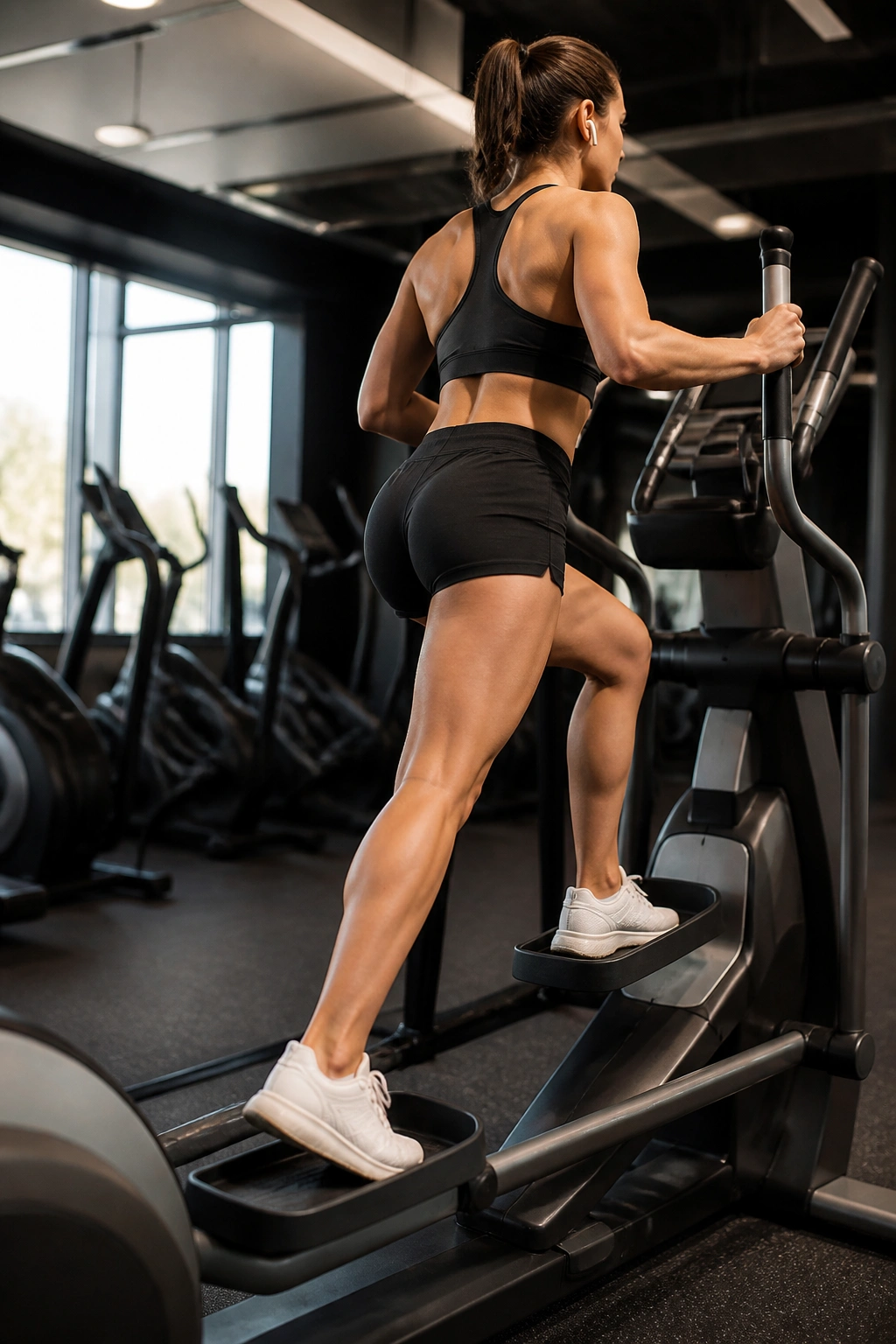
Most of us only pedal forward, effectively ignoring the back half of our leg muscles. By pedaling in reverse, you shift the load from your quads to your hamstrings and glutes. This is essential for preventing the muscle imbalances that often plague distance runners.
Incorporate reverse pedaling into any of your standard workouts. I suggest doing two-minute intervals in reverse for every ten minutes of forward pedaling. It feels awkward at first, almost like you’re slipping, but you will feel the targeted muscle activation within seconds.
Make sure to hold the stationary handles when you do this. Your balance will be slightly off, and the movement pattern is unnatural. It forces your stabilizer muscles to fire, which is a hidden benefit that forward pedaling just doesn’t provide.
7. The 30-Second Sprint Ladder

This is a game of mental endurance. You start with a short sprint, take a rest, then double the length of the sprint, then rest, and continue climbing until you reach a peak, then climb back down the ladder.
- Sprint 1: 30 seconds hard.
- Rest: 30 seconds easy.
- Sprint 2: 60 seconds hard.
- Rest: 60 seconds easy.
- Sprint 3: 90 seconds hard.
- Rest: 90 seconds easy.
Go up to 120 seconds, then work your way back down to 30. By the time you reach the 120-second mark, your legs will be burning, and the idea of working your way back down the ladder will feel like a mental battle. Win the battle.
8. The Upper Body Emphasis Workout

Many people treat the elliptical handles like luggage—they just hold on. If you want a full-body workout that replaces a run and a lifting session, you have to actively push and pull those handles.
Do not just let your arms swing with the momentum of the pedals. You need to consciously drive the handle forward with your chest and triceps, then pull it back with your lats and biceps.
If you focus on this, you will find you can’t maintain the same speed as you would if you were just focusing on your legs. That is fine. The trade-off is a much higher total caloric burn and a feeling of full-body exhaustion that you simply don’t get from running.
9. Lower Body Isolation (Arms Off)

Conversely, there are days when you want to make the workout purely about leg strength and core stabilization. For this session, do not touch the handles at all. Keep your hands on your hips or hold them at chest height.
Why This Is Crucial
Without the handles, your center of gravity shifts. You are forced to engage your deep core muscles to stay balanced as you pedal. This turns a simple cardio session into a continuous, low-level core workout.
It is harder than it sounds. You will naturally want to reach for the handles to help you maintain speed. Fight that urge. Keep your torso upright and your core braced. Your stability will improve, and your legs will take 100% of the load.
10. The Resistance Drop-Set

This is borrowed from bodybuilding, and it works surprisingly well for metabolic conditioning. You pick a high resistance level that is difficult to sustain and work until you can no longer keep your cadence up. Then, immediately lower the resistance by one notch and keep going.
You repeat this drop until you reach a very low resistance, effectively flushing the lactate out of your muscles.
- Step 1: High resistance (e.g., Level 12) for 60 seconds.
- Step 2: Immediately drop to Level 10 for 60 seconds.
- Step 3: Continue dropping by 2 levels every minute.
You are effectively “burning out” the legs, forcing them to work through deep fatigue. It is a fantastic way to finish a session when you feel like you have nothing left in the tank.
11. The “Fat-Burn” Heart Rate Zone

If your goal is purely weight loss, this is your bread and butter. The “fat-burn zone” is typically defined as 60-70% of your maximum heart rate. At this intensity, your body is incredibly efficient at using stored fat as fuel.
You will need a heart rate monitor—either a chest strap or a high-quality watch—to make this work. You cannot guess this intensity.
Stay in this zone for 45 to 60 minutes. It will feel almost too easy, and you will be tempted to go faster. Don’t. Speeding up pushes you into a higher intensity zone where your body prefers to burn glycogen (stored carbohydrates) instead of fat. Stay in the zone. Patience is the secret ingredient here.
12. Cadence Variation Training

In running, changing your cadence is a great way to improve efficiency. Do the same on the elliptical. This workout is all about rhythm changes.
- Interval 1: 2 minutes at 120 SPM (slow and steady).
- Interval 2: 1 minute at 160 SPM (fast and light).
- Interval 3: 2 minutes at 130 SPM.
- Interval 4: 1 minute at 170 SPM (as fast as you can control).
This “fartlek” style of training—a Swedish term meaning “speed play”—keeps the workout from becoming monotonous. It requires you to stay mentally engaged with the machine, which prevents the “zone out” factor that makes cardio sessions feel like a chore.
13. The “EMOM” Challenge

EMOM stands for “Every Minute On the Minute.” This is a classic CrossFit staple that translates perfectly to the elliptical. You set a specific goal for each minute, and whatever time remains in that minute after you hit your goal is your rest period.
- Example: Your goal is to cover a specific number of “strides” or “calories” in one minute. Let’s say 60 calories.
- If you hit 60 calories in 45 seconds, you get 15 seconds of rest before the next minute begins.
- If it takes you 55 seconds, you only get 5 seconds of rest.
This forces you to manage your own pace. If you start too slow, you get no rest. If you start too fast, you might burn out before the end of the session. It teaches you pacing—a vital skill for any runner.
14. The Constant Resistance Endurance Test

This is the “mental toughness” workout. You set the resistance to a challenging level—something that feels like running up a slight incline—and you do not change it for the entire duration of the workout.
Most people instinctively adjust their speed or resistance when the workout gets hard. This protocol forbids it. You are locked in. If you want to go faster, you have to push harder. If you are tired, you have to maintain the resistance regardless.
It forces you to confront the point of fatigue and push through it without the machine helping you. It is simple, boring, and highly effective for building the mental fortitude needed to replace long, difficult runs.
15. The “Finisher” Sprint Session

This isn’t a standalone workout, but a bolt-on at the end of a strength training session. You have five minutes. That’s it.
You spend those five minutes on the elliptical at max effort. No warm-up, no cool-down. Just pure, unadulterated output. You want to see how much distance or how many calories you can rack up in exactly 300 seconds.
This spikes your metabolism post-workout and provides that final, sharp cardiovascular hit that completes a good training cycle. It’s an effective way to squeeze in cardio on days when you are pressed for time.
16. Unilateral Leg Focus (Switching Weights)

This is an advanced technique that requires some coordination. You essentially put 80% of your weight on one leg and 20% on the other for an interval, then switch.
It’s not about lifting the foot off the pedal, but rather leaning slightly to one side and driving down through that single leg, while the other leg just goes along for the ride.
Switch every 60 seconds. This is excellent for identifying leg-strength imbalances. You will immediately notice that one leg feels much stronger or more coordinated than the other. This workout helps you level out those discrepancies, which is critical for injury prevention.
17. The Tempo Run Simulation
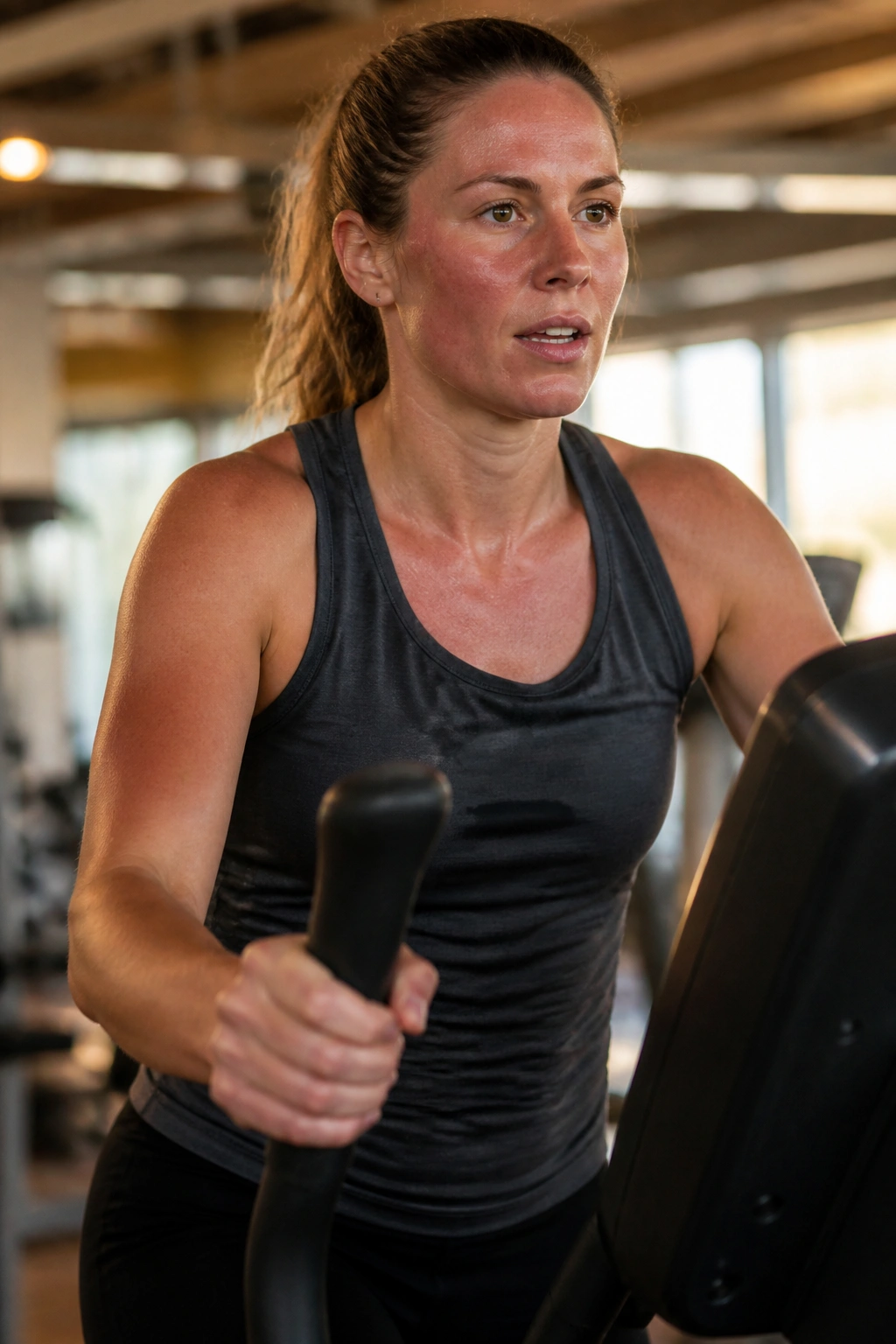
A tempo run is a sustained effort at a “comfortably hard” pace. It’s the pace you could hold for an hour if you were racing. On the elliptical, this means finding a resistance and cadence combination that makes you breathe heavily but allows you to maintain a consistent output for 20 to 30 minutes straight.
Do not sprint. Do not walk. Stay in that “uncomfortable” middle ground. This is the pace that builds your lactate threshold—the point at which your body stops clearing lactic acid as fast as it’s being produced. Raising this threshold is the single most important thing you can do to improve your endurance.
18. The “Mystery” Varied Workout

If you find yourself getting bored, stop planning. Let the machine do the work, or just change variables randomly every two minutes.
- Change resistance level.
- Switch from forward to reverse.
- Take your hands off the handles.
- Crank the incline to the max.
The goal here is unpredictability. By forcing your body to constantly adapt to new stresses, you prevent the adaptation plateau. It keeps the workout fresh and ensures that you aren’t just coasting. Some of the best elliptical sessions are the ones where you didn’t have a plan at all—you just went in and attacked the machine from every possible angle until you were exhausted.
The Bottom Line

Replacing running with the elliptical doesn’t mean you are compromising your fitness. It means you are being smarter about your training. The impact forces of running are unavoidable, but the cardiovascular benefits of running are easily matched by a well-structured elliptical routine.
Stop coasting. If you approach these sessions with the same intensity you would bring to a track workout, you will find that you aren’t just maintaining your fitness—you are building a stronger, more resilient engine. Choose one of these protocols, set your timer, and hold yourself to the work. The machine won’t do it for you, but it will certainly handle the weight if you are willing to push.
