



Ten spare minutes can disappear before breakfast if you let them. That’s exactly why quick workout routines for busy beginners matter: they fit into the messy, half-planned parts of the day that usually get wasted scrolling, waiting, or bargaining with yourself.
A beginner does not need a perfect program. That’s the trap. Most people need something small enough to start on a tired Tuesday, simple enough to repeat without thinking, and short enough that it doesn’t turn into a whole event. A 10-minute circuit, a brisk walk loop, or a chair-based strength session can do more for consistency than a heroic hour you never actually do.
There’s also a very practical truth here: when a workout is short, you can focus on form. Your body learns the squat pattern, the push pattern, the hinge, the brace. That matters more than sweating buckets. And if you’re new to exercise, the win is not annihilation. It’s building a habit that survives real life.
So let’s keep this grounded, useful, and doable. These routines are built for small windows of time, low equipment needs, and beginner energy levels — the kind of workouts you can finish, recover from, and come back to tomorrow.
1. The 10-Minute Full-Body Wake-Up
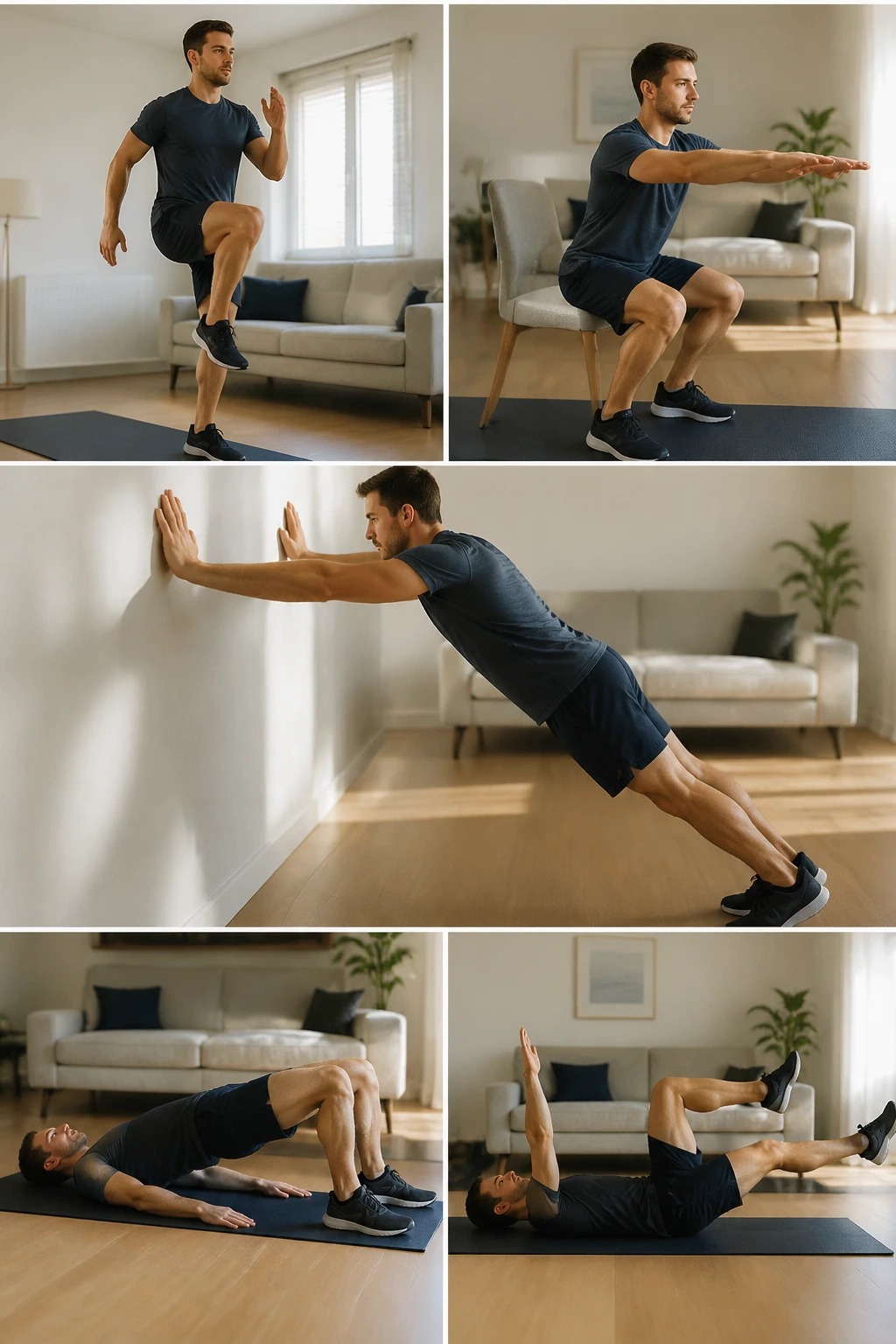
If you only have one timer to set, make it 10 minutes.
This routine is the one I’d hand to someone who wants a true full-body beginner workout without any drama. You move the legs, the chest, the core, and the hips in one short block, and nothing here asks for fancy gear. A mat helps, but a carpet or even a clean floor works fine.
How to run it
Do each move for 40 seconds, then rest for 20 seconds. Complete 2 rounds.
- March in place with big arm swings
- Chair squats
- Incline push-ups on a wall, counter, or sturdy table
- Glute bridges
- Dead bugs
The first round should feel almost too easy. Good. That’s what you want. If you gas out halfway through, you started too hard and turned a beginner routine into a punishment. Keep your breathing steady, and use the rest periods. People skip those and then wonder why they hate working out.
Form cue: on the squats, sit back as if you’re aiming for a chair behind you. On the push-ups, keep your body in one line instead of folding at the hips. Tiny details. Big difference.
If you’ve had a long stretch of inactivity, this is the kind of routine that wakes up your joints without beating them up.
2. The Chair-and-Wall Strength Reset
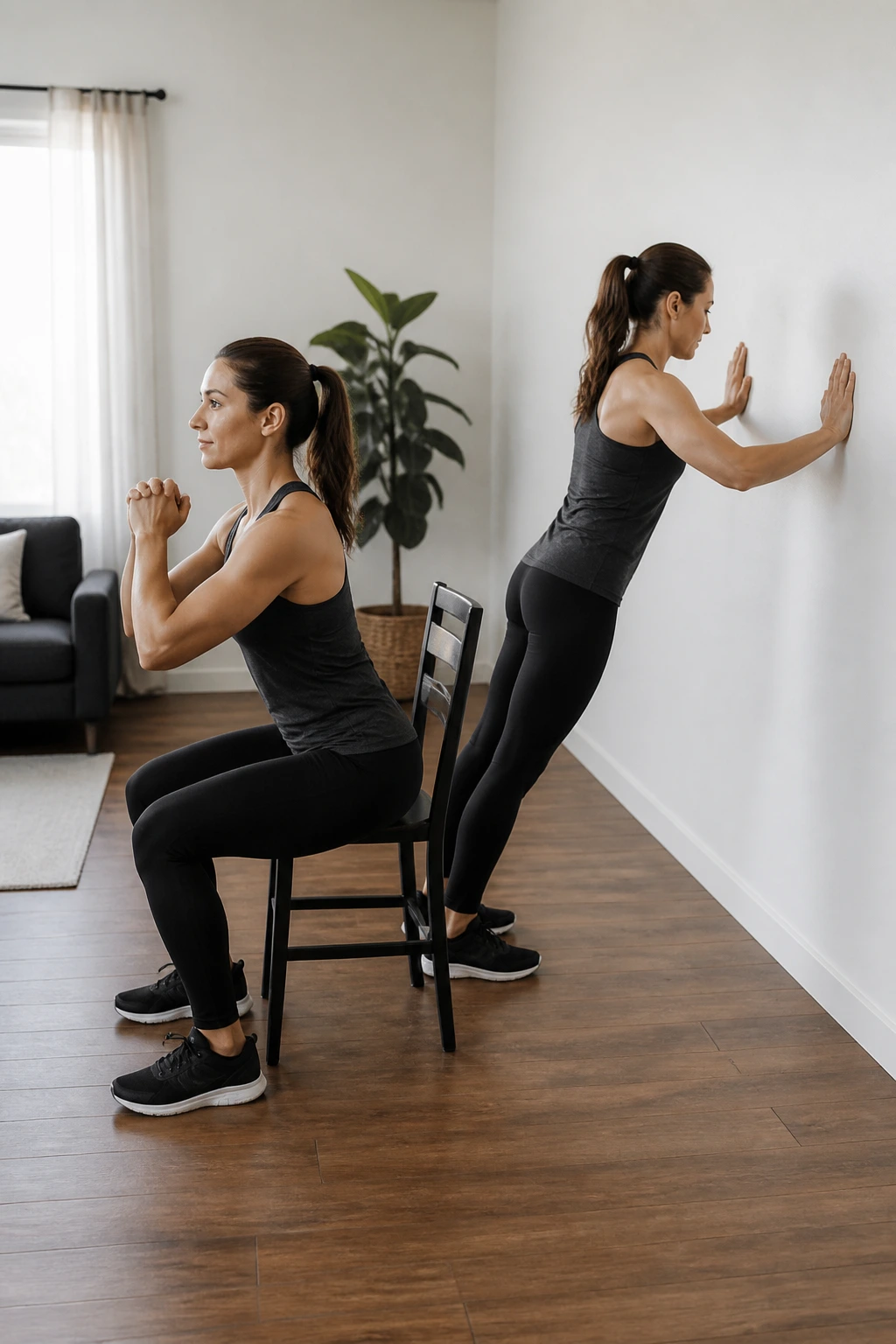
A chair changes everything for a beginner workout.
That sounds small, but it’s huge. A chair gives you a target for squats, a place to steady yourself, and a way to make strength work feel less intimidating. Pair it with a wall and you’ve got a simple home workout that covers the basics without forcing you onto the floor.
Do 8 to 12 reps of each exercise, rest for 30 to 45 seconds, then repeat the whole sequence for 2 rounds.
- Chair squats
- Wall push-ups
- Seated knee lifts
- Standing calf raises
- Supported split squats, holding the chair back lightly
Use the chair squat as your anchor. Tap the seat gently, then stand up with your weight in your heels. No plopping. No collapsing. If your knees get cranky, shorten the range of motion and sit a little higher. That is not cheating. That is smart scaling.
Wall push-ups are boring in the best way. They teach the push pattern without making your shoulders or wrists scream. Keep your hands about chest height and step your feet farther back if you want more challenge. Closer to the wall is easier; farther away makes it harder.
This routine works well on days when you feel stiff, low on energy, or a little suspicious of exercise. Fair enough. The chair helps you trust the movement again.
3. The Brisk Walk Interval Loop

Can a walk count as a workout? Absolutely.
A brisk walk interval loop is one of the easiest ways to build fitness when you’re busy and just starting out. It’s low-cost, low-fuss, and a lot more effective than people give it credit for. You can do it outside, in a hallway, around a block, or even on a treadmill if that’s what you have.
The simple format
Walk for 1 minute at an easy pace, then 2 minutes briskly, then 1 minute a little faster. Repeat that cycle 3 to 4 times for a total of 12 to 16 minutes.
The “brisk” part should feel like you can talk, but you wouldn’t want to sing. That’s a useful test. If you can belt out a song, you’re strolling. If you’re gasping, you pushed too hard for a beginner routine.
How to get the most from it
Keep your shoulders loose and your arms swinging naturally. Aim for a taller posture than you think you need. A lot of new walkers stare down at the ground and fold through the chest; that makes the walk feel harder than it needs to.
A few practical details help:
- Wear shoes that don’t pinch.
- Start with flat ground.
- Keep your pace steady, not jerky.
- Stop if you feel dizzy or unusually out of breath.
This one is sneaky. It looks easy, and that’s exactly why it works. It’s the kind of session you can do before work, after dinner, or while the rest of the house is still waking up.
4. The Five-Move Bodyweight Ladder
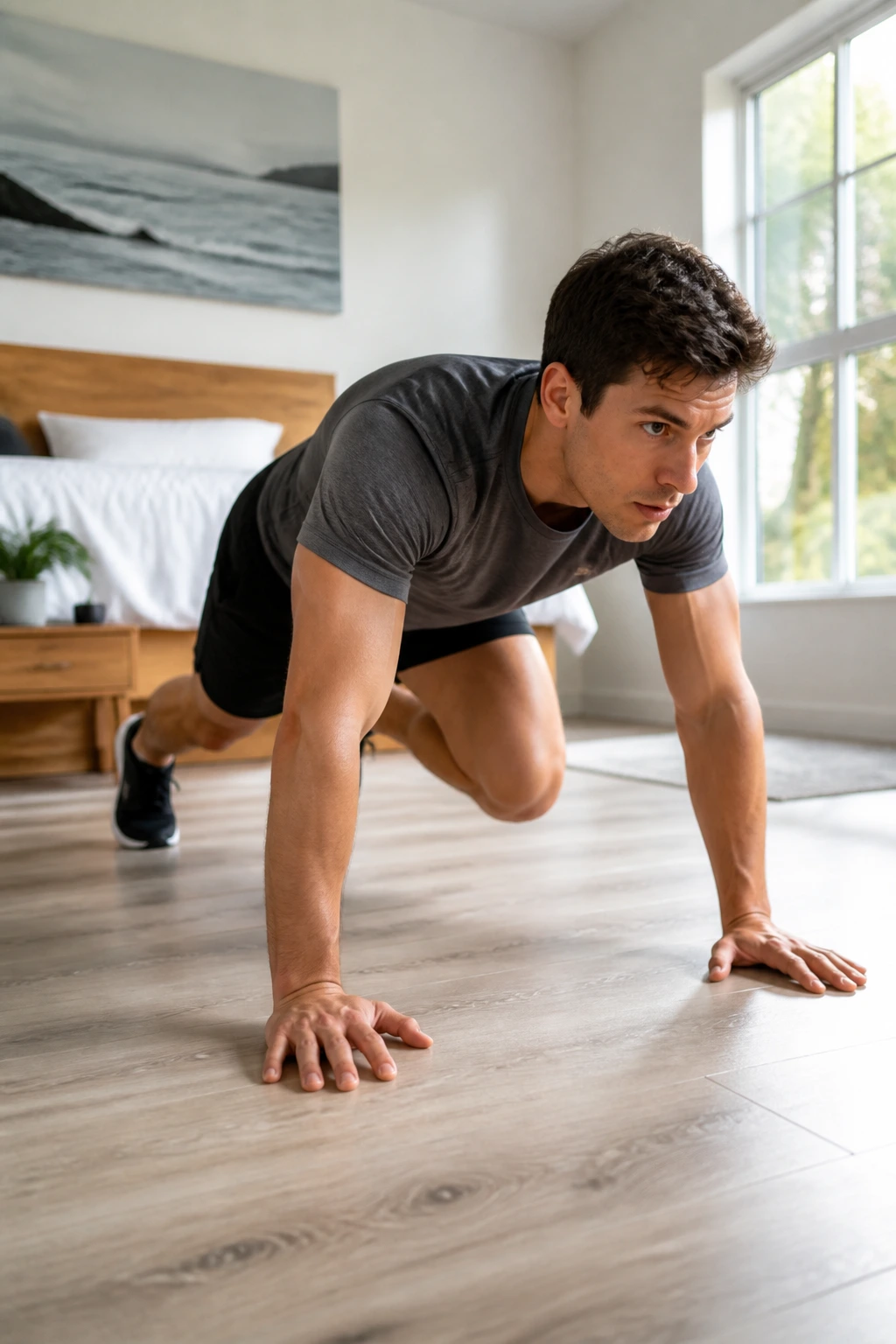
Picture a bedroom floor, a timer, and no appetite for nonsense.
That’s the mood for the bodyweight ladder. You start with one rep of each move, then two, then three, and so on until five. If you want a slightly longer session, go back down from five to one. It sounds simple because it is. Simple is good when the goal is consistency.
Here’s the ladder:
- Squats
- Incline push-ups
- Glute bridges
- Bird-dogs
- Reverse lunges
Do 1 rep of each move in order, then 2 reps of each, all the way up to 5 reps. Rest for 30 to 60 seconds between rounds if needed. That makes the whole thing fall somewhere around 10 to 15 minutes, depending on how fast you move.
The ladder format is nice because it gives you a built-in warm-up. One rep doesn’t feel like much. By the time you get to four and five, your body has caught on. No long setup. No complicated counting.
A small warning: beginners often rush the lunges and wobble all over the place. Keep the step back short, land softly, and hold onto a wall or chair if balance is shaky. You’re training movement quality here, not proving anything.
5. The Low-Impact Cardio Box
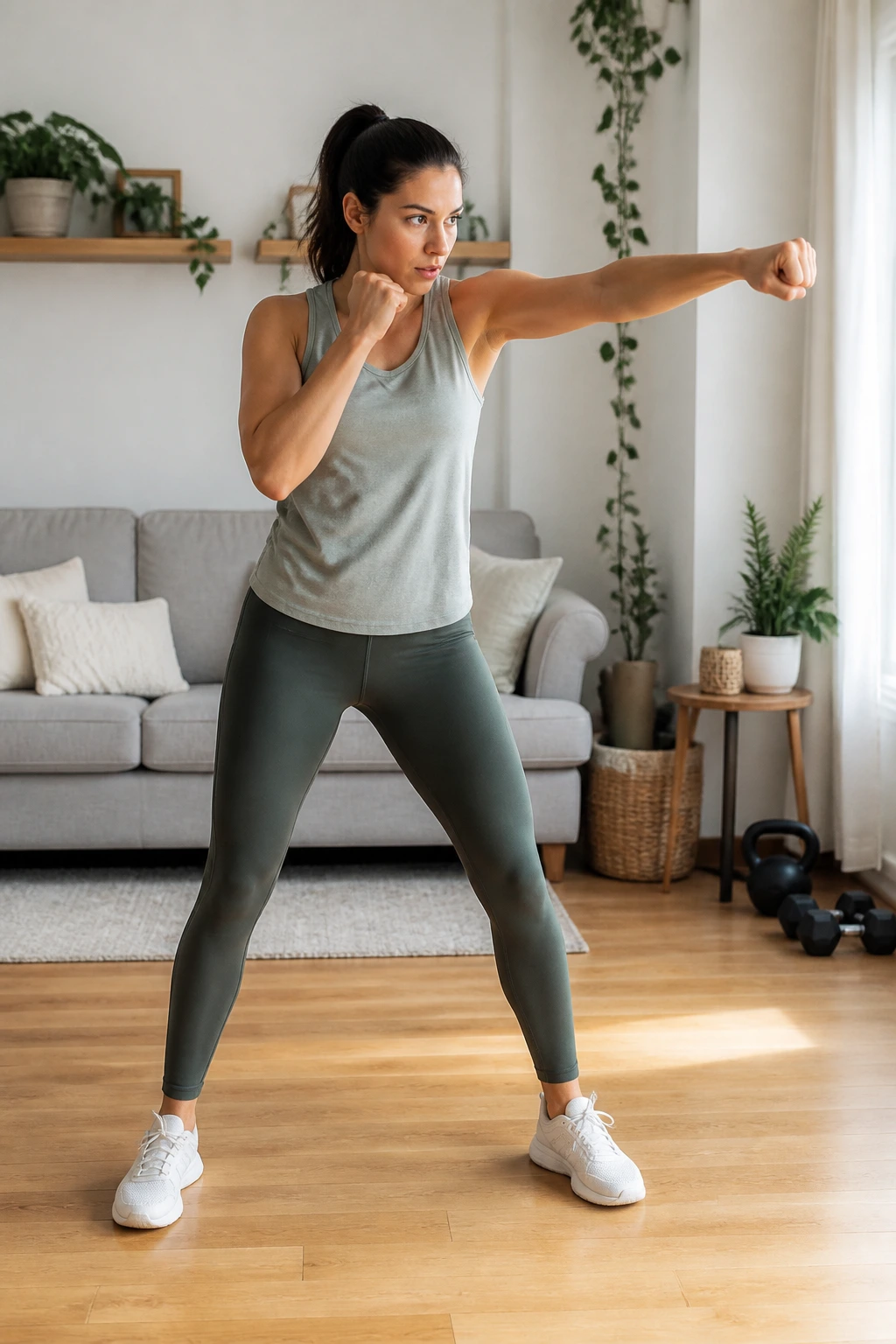
Not every workout needs jumps to raise your heart rate.
This is one of my favorites for beginners who want cardio but hate the sound of stomping, banging, or jumping around a tiny space. Think of it like a box of moves you can rotate through without hitting the floor too hard or stressing your joints.
Use 30 seconds of work and 15 seconds of rest. Complete 2 to 3 rounds.
- Step-touch side to side
- March with high knees
- Shadow boxing
- Heel taps forward
- Side steps with a light squat
Keep the movement light and continuous. The goal is to stay moving, not to turn every step into a fitness performance. Shadow boxing works especially well here because it wakes up your upper body and core while the legs keep the rhythm underneath. Throw straight punches, not wild flailing hooks that yank your shoulders around.
If you want a little more challenge, speed up the footwork before you speed up the punches. That keeps things controlled. And if you’re out of breath after the first round, shorten the work intervals to 20 seconds. That’s still a real workout.
This routine is ideal when you want sweat without impact. It’s also a good one to keep in your back pocket for days when your brain feels fried and you don’t want to think.
6. The Core-and-Posture Reset
Your abs are not the whole story. Your back matters too.
A lot of beginners jump straight to crunches, then wonder why their lower back feels awkward or their neck gets tight. A better move is to train the core the way it actually works in daily life: bracing, stabilizing, and helping you stand and move without folding like a lawn chair.
The sequence
Do 30 to 40 seconds of each move, then rest 15 to 20 seconds. Run 2 rounds.
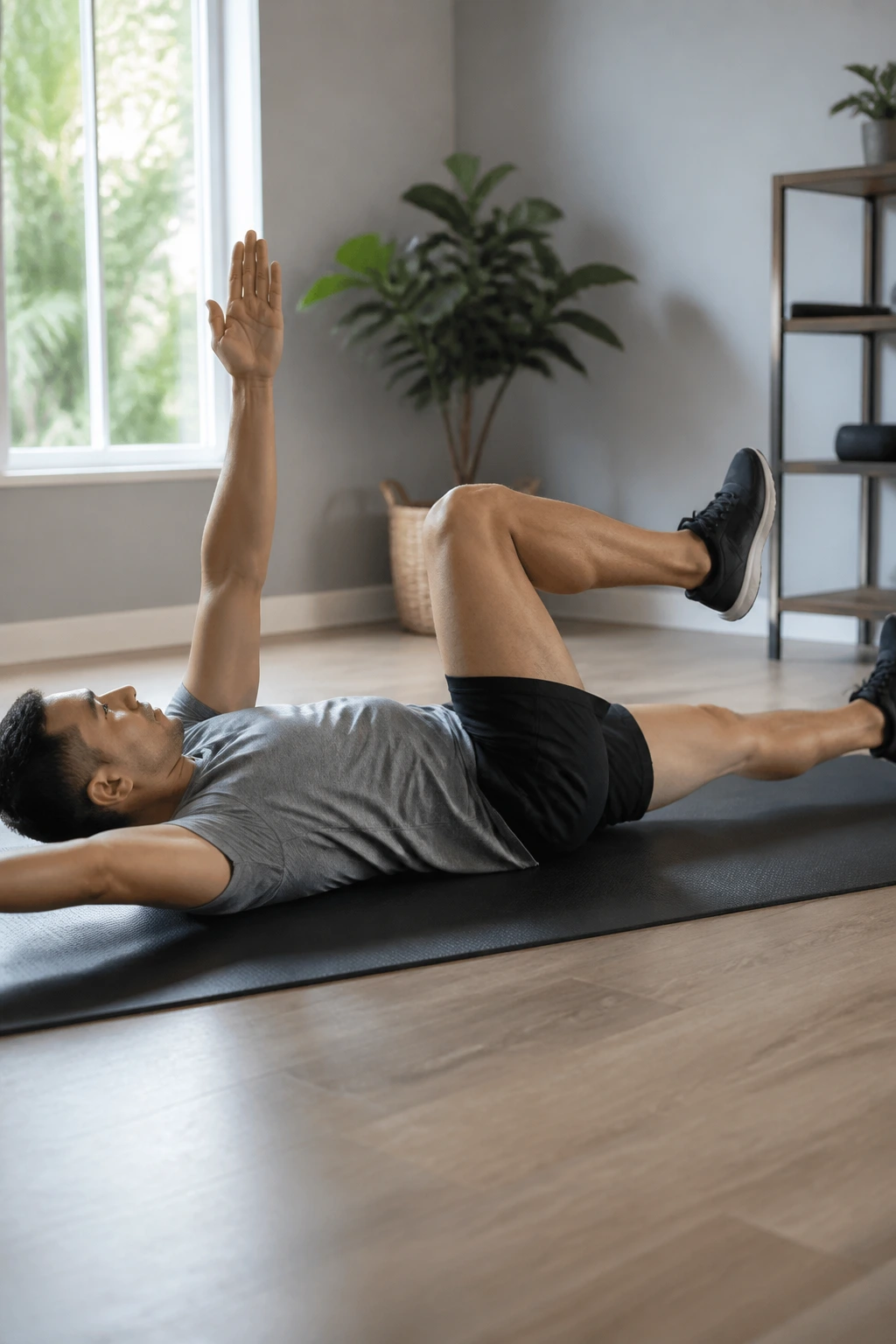
Move 1: Dead bug
Lie on your back, arms up, knees bent. Lower one arm and the opposite leg slowly, then switch. Keep your lower back from arching off the floor.
Move 2: Bird-dog
From hands and knees, extend one arm and the opposite leg. Pause for a beat. Hips stay level. No swinging.
Move 3: Glute bridge hold
Lift your hips, squeeze your glutes, and hold for 20 to 30 seconds. You should feel the back of your legs and your glutes, not your lower back.
Move 4: Wall plank or incline plank
Use a wall or a counter if a floor plank feels too hard. Brace your stomach as if someone is about to poke it.
This routine feels quieter than cardio, but don’t mistake quiet for easy. If you do it with control, your midsection will work. Hard. It’s a solid choice on days when you want to leave the workout feeling more upright than wrecked.
7. The Lower-Body Desk Break
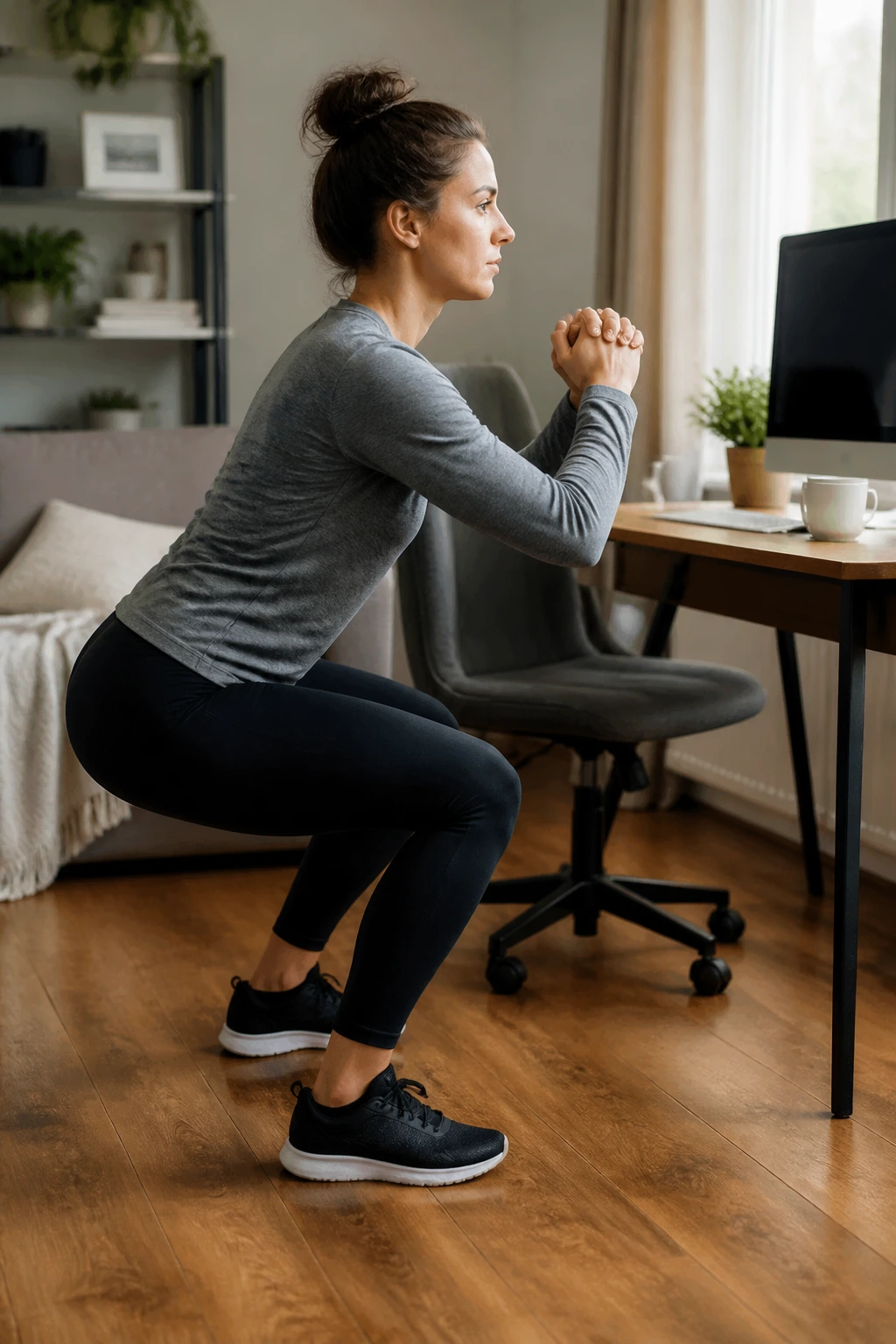
After a long sit, your legs can feel like they’ve been wrapped in cardboard.
That’s when a lower-body desk break saves the day. It’s short, direct, and built from movements that wake up your hips, quads, and calves without needing a change of clothes. I like this one because it feels practical, not theatrical. You can do it in a living room, office corner, or next to a desk without making a scene.
Do 2 rounds of this circuit:
- 10 bodyweight squats
- 8 reverse lunges per side
- 15 calf raises
- 20-second wall sit
- 10 standing hip hinges
Reverse lunges are kinder to many beginners than forward lunges because they feel more controlled. Step back softly, keep most of your weight in the front foot, and use a chair or wall if balance is shaky. The wall sit is the sneaky hard part. Keep your back flat against the wall and stop when your thighs start burning in a way that feels productive, not ugly.
If your knees don’t love deep lunges, shorten the range and focus on sitting back into the squat. You can get a lot done with small, clean movement. You do not need to sink as low as possible for the workout to count.
This is a good routine for the middle of the day. It shakes off stiffness fast.
8. The Upper-Body Band Circuit
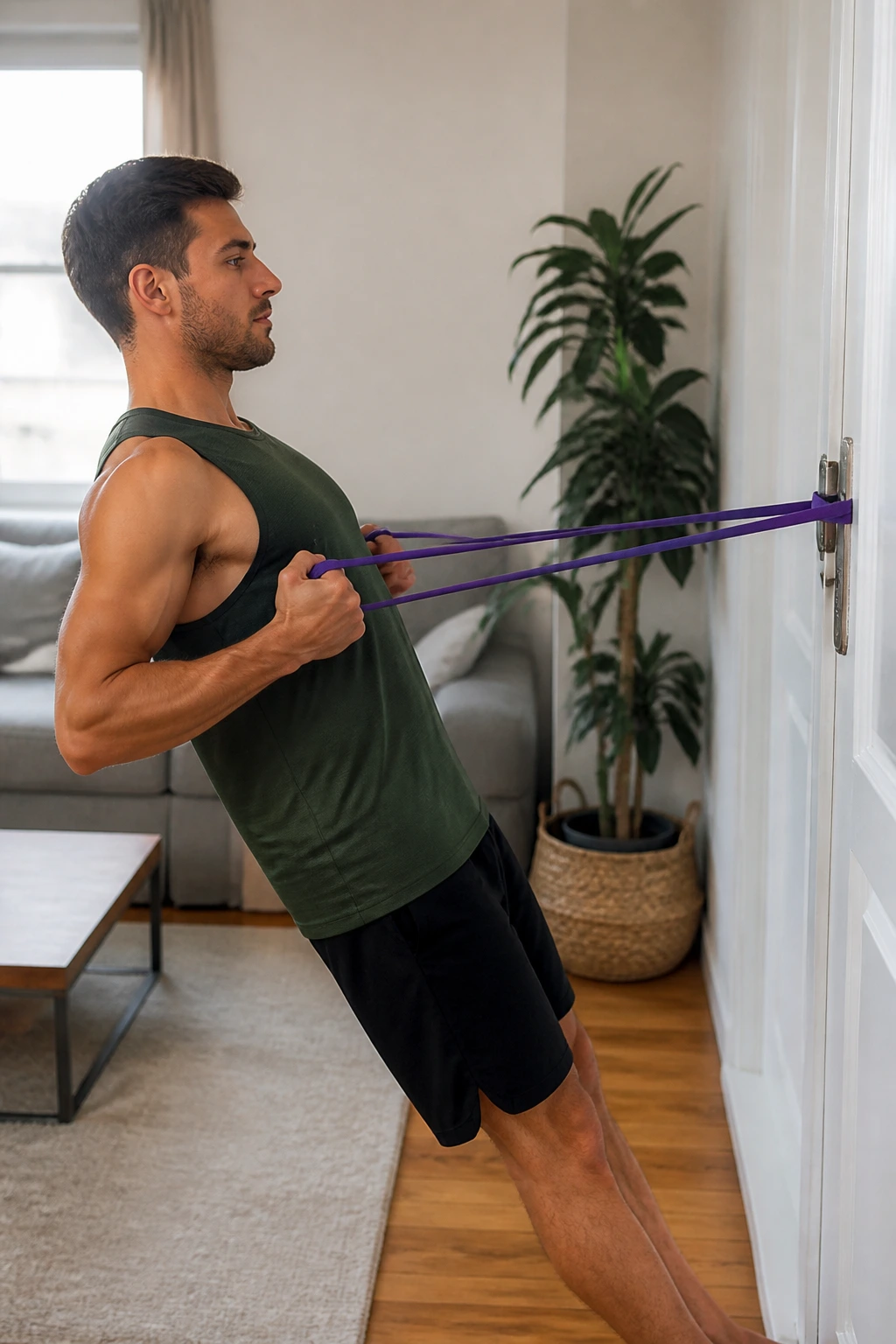
A light resistance band gives a beginner enough challenge without beating up the joints.
That’s the appeal here. You get real pulling and pressing work, which bodyweight-only routines sometimes miss, and the band stays cheap, portable, and easy to stash in a drawer. If you’ve never used one, start lighter than you think. Bands can get sneaky when they stretch.
Do 10 to 12 reps of each exercise, then rest 30 to 45 seconds between moves. Complete 2 rounds.
- Band rows
- Band chest press
- Band pull-aparts
- Overhead press with a light band
- Biceps curl, if you want a little extra arm work
For rows, anchor the band around a sturdy post or hold it around your feet. Pull your elbows back and squeeze your shoulder blades together for one second. That pause matters. It keeps the move from turning into a rushed tug-of-war.
Pull-aparts are small but useful. Keep your arms at chest height and separate the band until it touches your upper chest. If your shoulders creep up toward your ears, reset and try again. That habit shows up a lot in beginners, and it’s worth cleaning up early.
No band? A backpack with a few books can stand in for some of this, though it won’t replace the pull-apart pattern. Still, the point is to build a routine you can actually do, not to wait around for perfect equipment.
9. The Standing No-Floor Routine
Not everyone wants to get down on the floor.
Fair. Maybe the room is small. Maybe your knees complain. Maybe you just don’t want to drop to the ground and crawl back up. A standing routine solves that problem cleanly, and it still gives you a real workout.
Try this for 8 to 10 minutes
Perform each move for 40 seconds, rest 20 seconds, and repeat the sequence 2 times.
- March with cross-body reaches
- Standing side crunches
- Standing hip hinges
- Mini squats
- Overhead reaches with a calf raise
The standing hip hinge is the move people skip, which is a shame. Push your hips back, keep your spine long, and feel the back of your legs load up. It teaches a very useful pattern for picking things up safely. Mini squats keep the legs honest without asking for a deep bend.
This routine is also nice for people who work at a desk. You can slip it into the day without laying a mat down or changing into workout clothes. That makes a difference. If a workout is too much of a production, most busy beginners will talk themselves out of it before they start.
A small, direct routine beats a perfect one you never do.
10. The Every-Minute-on-the-Minute Circuit
What if the timer does the coaching for you?
That’s the beauty of an every-minute-on-the-minute, or EMOM, workout. You start a set at the top of each minute, finish before the minute ends, then rest for the leftover time. Beginners like this because the structure is simple. No guessing. No staring at the clock.
Set the minute, not the mood
Try 4 exercises for 4 rounds. Each round takes 4 minutes, so the full workout lasts 16 minutes.
- Minute 1: 8 squats
- Minute 2: 6 incline push-ups
- Minute 3: 10 glute bridges
- Minute 4: 20-second plank on the wall, counter, or floor
If 8 squats feels easy, make them slower. A three-second lower on the squat adds work without adding chaos. If incline push-ups feel too hard, use a higher surface. The countertop is fine. A sturdy wall is fine too.
The EMOM setup gives you a clean start and stop, which is underrated. Busy people often waste more energy deciding what to do than actually doing it. Here, the choices are already made. You just show up and follow the minute.
And if you finish a set with 25 seconds left, stay calm. Breathe, shake out your arms, sip water if you need it. That rest is part of the workout, not a mistake.
11. The Mobility-Strength Combo
Stiff first thing in the morning? This one’s for that.
A mobility-strength combo is a smart beginner choice because it loosens the joints first, then asks the muscles to do some real work. That order matters. It’s easier to squat with good form after you’ve opened up the hips, and easier to push when your shoulders don’t feel welded to your ears.
Start with 4 minutes of mobility:
- 1 minute cat-cow
- 1 minute squat-to-stand
- 1 minute world’s greatest stretch, alternating sides
- 1 minute wall angels
Then move into 2 rounds of:
- 8 sit-to-stands
- 8 incline push-ups
- 10 glute bridges
- 20-second side plank on knees or against a wall
World’s greatest stretch sounds dramatic. The movement is simple. Step one foot forward into a lunge, place the opposite hand down, then rotate your chest toward the front leg. Keep it slow. No yanking.
This is a nice bridge between stretching and training. Pure stretching can leave you feeling loose but not stronger. Pure strength work can feel abrupt when your body is still groggy. Together, they make a session that wakes you up without smashing you with intensity.
Use this one on mornings when you feel creaky. Or after long travel. Or on any day when your body says, “please be reasonable.”
12. The Apartment-Friendly Silent Cardio
Jumping isn’t mandatory.
That’s the whole point here. Silent cardio keeps the heart rate up while staying light on the floor, the knees, and the neighbors below you. If you live in a small space or just hate the sound of impact exercise, this is the kind of routine that keeps you consistent.
Do 20 seconds on, 10 seconds off for 8 to 12 minutes.
- Fast march in place
- Squat to calf raise
- Skater step without the jump
- Standing punches
- Mountain climber hands on the wall or counter
The squat to calf raise is a nice one because it layers two lower-body actions into one move. Drop into a shallow squat, then rise onto your toes as you stand. Smooth, not bouncy. The skater step stays quiet if you keep your feet gliding rather than landing hard.
Standing punches add a bit of upper-body snap, which makes the routine feel more complete. Twist through the torso a little, but don’t yank through your lower back. Keep the motion controlled and sharp.
This routine is a quiet problem-solver. Tiny apartment? Early morning? Shared walls? No issue. You still get a useful session without turning your home into a gym floor full of noise.
13. The Stair or Step Builder
If you have a staircase, use it carefully.
Stairs can be a beginner’s best friend, but they deserve respect. You do not need to run them. You do not need to attack them. A steady step workout can build leg strength and cardio at the same time, and it’s especially handy when you want something short and direct.
Use 30 to 45 seconds per drill, then rest 30 seconds. Repeat the circuit 2 to 3 times.
- Step up and down at a steady pace
- Side step onto the bottom step
- Alternate toe taps on the step
- Slow march up one stair, then back down
- Hold the railing and perform calf raises on the bottom step
Keep your whole foot on the step when you climb. Half-footing it is a fast way to feel unstable. The railing is not a sign of weakness; it’s a safety tool. Use it, especially if you’re new to step work or feeling a little off balance.
A sturdy aerobic step or a single bottom stair works too. Don’t improvise with a wobbly ottoman or a chair. That’s not a workout hack. That’s a trip to the floor.
This one gives you more intensity than it looks like on paper. The trick is to stay smooth. Once your steps get sloppy, the benefit drops and the risk climbs.
14. The Travel-Room Hotel Workout
Tiny room. Limited time. No gear. No excuses required.
A hotel-room workout is one of the most useful routines a beginner can learn, because the rules are simple and the space demands it. You don’t need much room, and you don’t need to sweat the details. You just need a few strong basics that work anywhere.
A clean 12-minute format
Do 40 seconds of work and 20 seconds of rest. Complete 2 rounds.
- Sit-to-stand from a bed or sturdy chair
- Incline push-ups using the desk or wall
- Glute bridges on the floor or bed edge
- March in place with strong arm drive
- Wall sit
A bed is fine for sit-to-stands if it’s stable. If it’s too soft, use a chair. The point is to keep the move controlled, not squishy. For push-ups, the desk usually gives a better angle than the wall if you want a bit more challenge. If your shoulders get tired early, raise the surface.
Wall sits are one of those quiet little burners that look easier than they feel. Keep your feet far enough forward that your knees stack roughly over your ankles, not jammed way ahead of them. Hold your chest up. Breathe.
This routine travels well because it doesn’t rely on anything outside the room. That makes it easier to keep moving when your schedule gets strange, which, for most people, is half the battle.
15. The Weekend Reset Circuit
A slightly longer session can still stay beginner-friendly.
This is the one I’d use when you have a little more room in the day and want a workout that feels like a reset instead of a scramble. You get movement prep, strength work, a little cardio, and a short cooldown. Nothing wild. Just enough structure to make the session feel complete.
Start with a 3-minute warm-up:
- 1 minute easy march
- 1 minute arm circles and shoulder rolls
- 1 minute hip circles and ankle rolls
Then do 3 rounds of:
- 10 squats
- 8 incline push-ups
- 10 glute bridges
- 20-second plank or wall plank
- 30 seconds of brisk marching
Finish with 2 to 3 minutes of easy stretching. A gentle quad stretch, chest opener, and child’s pose or seated forward fold are plenty. Don’t chase deep flexibility here. You’re just giving your body a chance to come down.
The nice part about this routine is the rhythm. Warm up, work, cool down. Clean lines. It feels more satisfying than a random mash-up of exercises because your body gets a clear signal at each stage. That helps beginners trust the process.
If you only do one somewhat longer workout each week, this is a solid choice. It still fits busy life, but it gives you a little more room to move than the ultra-short sessions.
Final Thoughts
The best beginner workout is the one you’ll repeat without dreading it. Short routines win for that reason. They lower the stakes, make form easier to manage, and fit into real schedules instead of fantasy ones.
Pick two or three of these and rotate them. A walk interval on one day, a chair circuit on another, maybe a band session when you want a little more upper-body work. That mix keeps things interesting without turning your week into a spreadsheet.
And if a workout feels too big, shrink it. Ten minutes is enough. Eight minutes is enough. Even five honest minutes beats waiting for the perfect window to appear.
