



The hardest part of starting a full body dumbbell workout for women over 50 is not the workout itself. It’s the noise around it. Lift heavy, but not too heavy. Do more cardio. Protect your joints. Fix your hormones. Work your core. Stretch more. Somehow all of that advice shows up at once, and a lot of smart women end up doing nothing because the whole thing feels needlessly complicated.
What your body usually needs here is structure, not confusion. Muscle can slip faster with age if you stop asking it to work. Bone likes load. Balance likes practice. Daily life keeps score in quiet ways too: getting up from the floor, carrying two grocery bags at once, pulling luggage, reaching overhead, walking up stairs without that extra little shove from the banister.
I’m a big fan of dumbbells for this stage of life because they make strength training honest. Each side has to do its share. You do not need a packed gym. You do not need a fancy machine circuit. A pair of dumbbells, a sturdy chair, and enough room to stretch your arms can cover nearly every movement that matters.
And the goal is not punishment. It’s stronger legs, steadier balance, better posture, and enough muscle that your body feels capable again.
Why a Full Body Dumbbell Workout for Women Over 50 Beats Random Exercise
Three solid sessions a week will outwork five scattered ones.
That’s one reason a full-body setup works so well. Instead of splitting your body into little categories—arms one day, legs another, core somewhere off in the distance—you train the patterns your body actually uses. Squat. Hinge. Push. Pull. Carry. Brace. If life gets busy and you miss a day, you still hit the whole body when you come back.
There’s a recovery angle too. Women over 50 often tell me the same thing: they can work hard, but they do not bounce back from junk volume the way they used to. A full-body dumbbell routine keeps the exercise menu tight and the signal clear. Fewer fluff exercises. More work that gives you a return.
The federal physical activity guidelines call for muscle-strengthening work on two or more days each week. Full-body training makes that easy. Two sessions is enough to start building strength. Three can work well if your sleep, schedule, and joints are cooperating.
Dumbbells also beat random online workouts because they’re measurable. If you goblet squat 12 pounds for 8 reps this week and 15 pounds for 8 reps a few weeks later, that is progress. If you can carry two dumbbells across the room without leaning or holding your breath, that counts too.
A lot of women have spent years being told to “tone” with tiny weights and high reps. I’ll be blunt: that plan leaves muscle on the table. Your body needs enough resistance to notice.
What Changes in Strength, Balance, and Recovery After 50
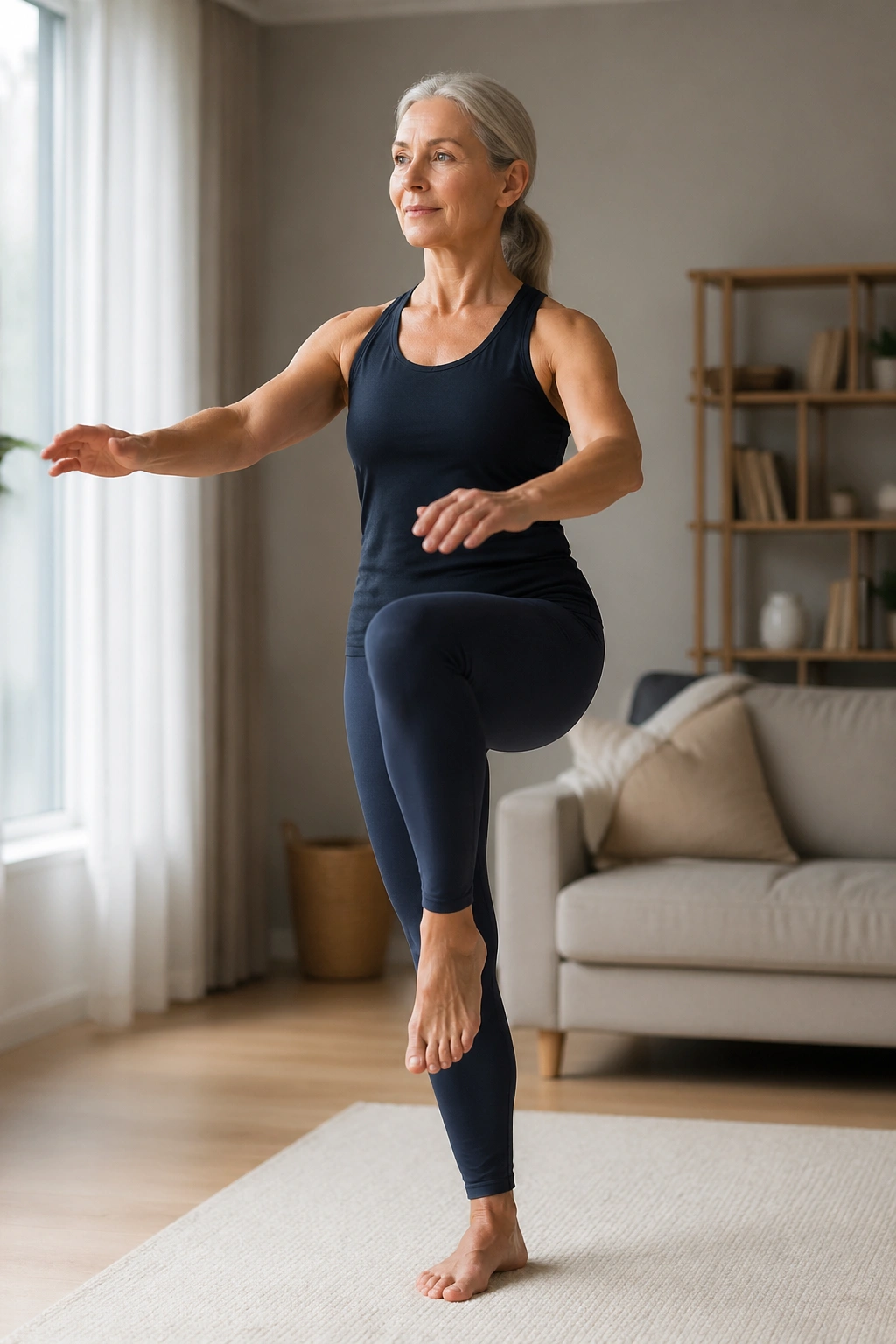
Stand up after sitting in a low chair for a while and your body will tell you what it needs.
The shifts that show up after 50 are not imaginary, and they’re not a personal failure either. Lean muscle mass tends to drop if you don’t train it. Power—the ability to produce force quickly—also slips, which is part of why stairs, uneven ground, and fast direction changes can feel less friendly than they once did.
Muscle loss hits daily life first
You usually feel strength loss in ordinary tasks before you see it anywhere else. Carrying a laundry basket gets awkward. Opening a heavy window becomes a two-hand project. A long day of yard work leaves your back and hips crankier than it should.
Resistance training helps because it gives the body a reason to hold onto muscle. When the load is challenging enough, your muscles adapt. That adaptation can show up as a smoother sit-to-stand, stronger grip, easier stair climbing, and better walking speed.
Bone needs load, not endless caution
Loss of estrogen can speed the drop in bone mineral density, especially around the hips and spine. That’s one reason strength work matters. Bones respond to mechanical load. They do not care how sweaty your workout photo looks.
No, dumbbells are not a magic shield against osteoporosis. But regular loading through the legs, hips, and upper body is one of the smartest things you can do if bone health is on your radar.
Balance starts lower than most people think
People hear “balance” and picture standing on one leg with a hand on the wall. That can help. Still, better balance often starts with stronger feet, calves, hips, and trunk control. If your legs can absorb force and your torso can stay stable, your body handles little stumbles better.
Recovery changes too. Hard sessions may leave you sore longer. Sleep becomes a bigger piece of the puzzle. So does protein. So does walking, oddly enough. Gentle movement the day after lifting often helps more than collapsing on the couch and hoping for the best.
Picking the Right Dumbbells for Your Home Setup
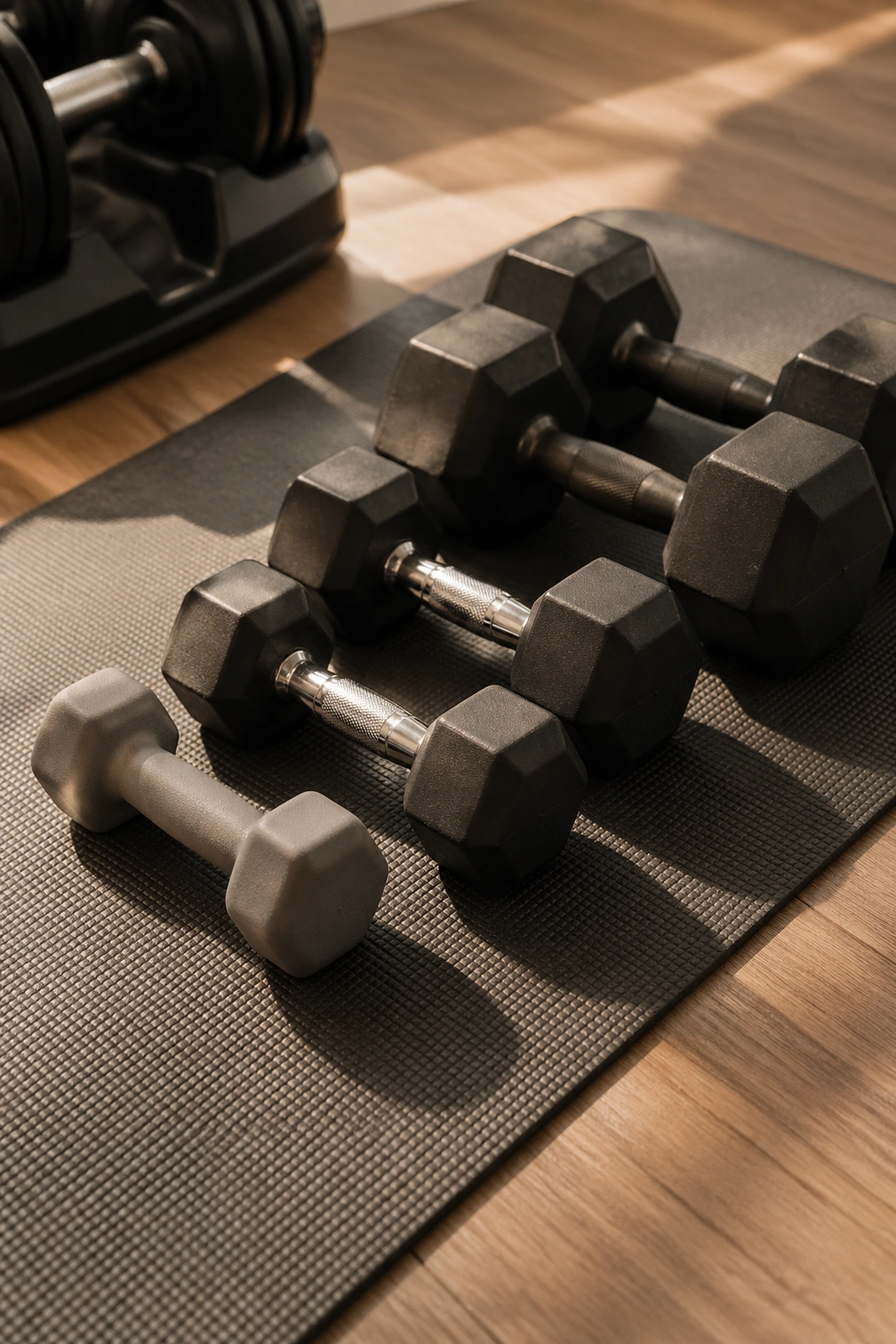
What should you buy first?
Most women do not need a full rack. You need enough range to make lower-body work challenging without forcing upper-body exercises into ugly, shoulder-y messes.
A practical starter setup looks like this:
- One lighter pair: 5 to 8 pounds for presses, raises, and learning new patterns
- One medium pair: 10 to 15 pounds for rows, squats, carries, and floor presses
- One heavier pair: 15 to 25 pounds for goblet squats, Romanian deadlifts, and farmer carries
If you already walk a lot, garden, carry grandkids, or have some training history, your lower body may handle more than you expect. Your shoulders may not. That mismatch is normal.
Adjustable dumbbells vs fixed pairs
Adjustable dumbbells save space. They also slow things down a bit when you switch weights between exercises. If you train in a small room, that trade-off is often worth it.
Fixed dumbbells are faster. Pick them up and go. If you have arthritis in your hands, try a pair with a grip that feels secure without being slick. Thick handles can feel better for some women, though not all.
You do not need much else, but these help:
- A sturdy chair or bench for support and box squats
- A mat or folded towel for kneeling and floor work
- Flat shoes or bare feet for better stability on squats and deadlifts
- A notebook or phone log to track reps and weight
Write the weights down. Memory gets fuzzy after a few sessions, and progress likes proof.
The 8-Minute Warm-Up That Loosens Hips, Ankles, and Shoulders
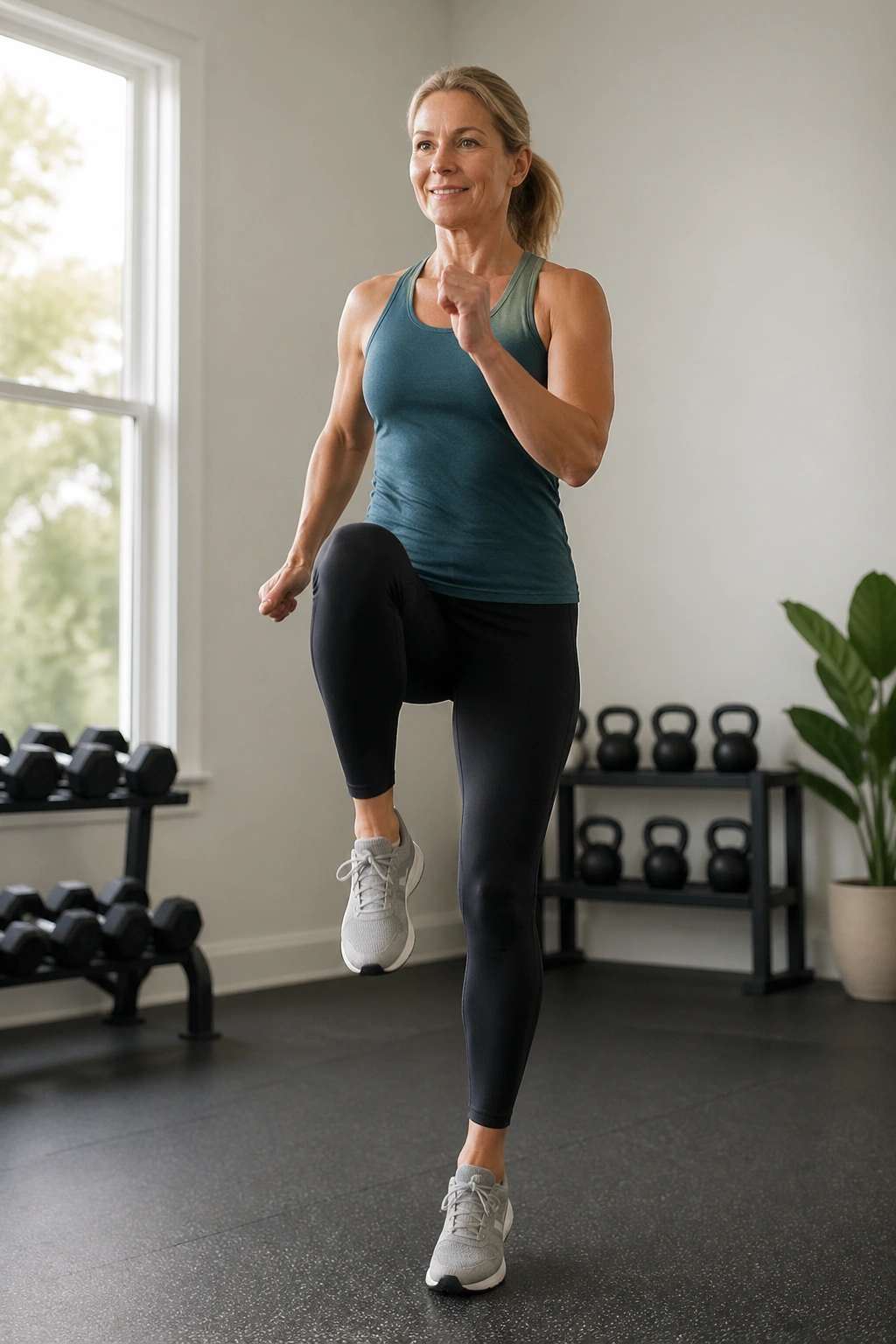
Skip the long, sleepy warm-up.
What you want is a short ramp-up that raises body temperature, opens the joints you’re about to use, and practices the patterns you’ll train. By the end, your breathing should be a little higher, your hips should feel less sticky, and your shoulders should move without that first-rep stiffness.
Use this sequence before each workout
- March in place for 60 seconds, swinging your arms naturally and lifting your knees to a comfortable height.
- Do 10 heel raises and 10 toe raises, holding a wall or chair if needed. This wakes up the calves and front of the shins.
- Sit to stand from a chair for 8 reps, using bodyweight only. Move with control and stand tall at the top.
- Practice 8 wall hip hinges, standing about 8 to 10 inches from a wall and pushing your hips back until they tap it.
- Do 6 open-book thoracic rotations per side, lying on your side with knees bent and rotating the top arm open.
- Perform 8 wall slides, keeping your ribs down and sliding your forearms upward without shrugging.
- Walk 20 slow steps with one light dumbbell in one hand, then switch sides. This wakes up your core and grip.
- Take 5 bodyweight squat pulses to your planned depth, then stand and reach overhead between reps.
If your knees run stiff, add another round of chair sit-to-stands. If your shoulders complain, stay longer on the wall slides and thoracic rotation. You should feel more mobile, not tired.
That’s enough.
Goblet Squat to a Box for Stronger Legs and Safer Depth
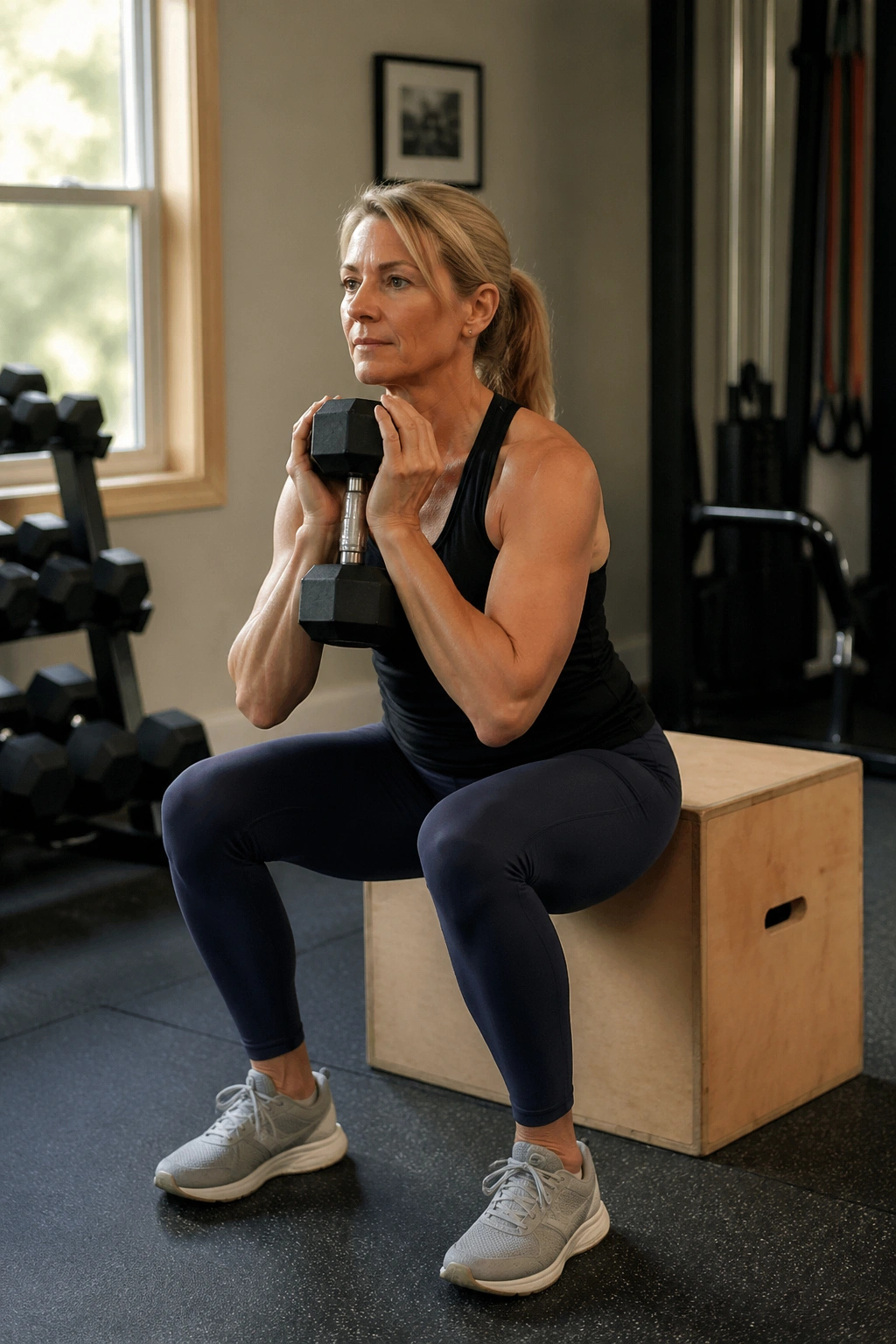
Picture the movement you do every day without thinking: sit down and stand up.
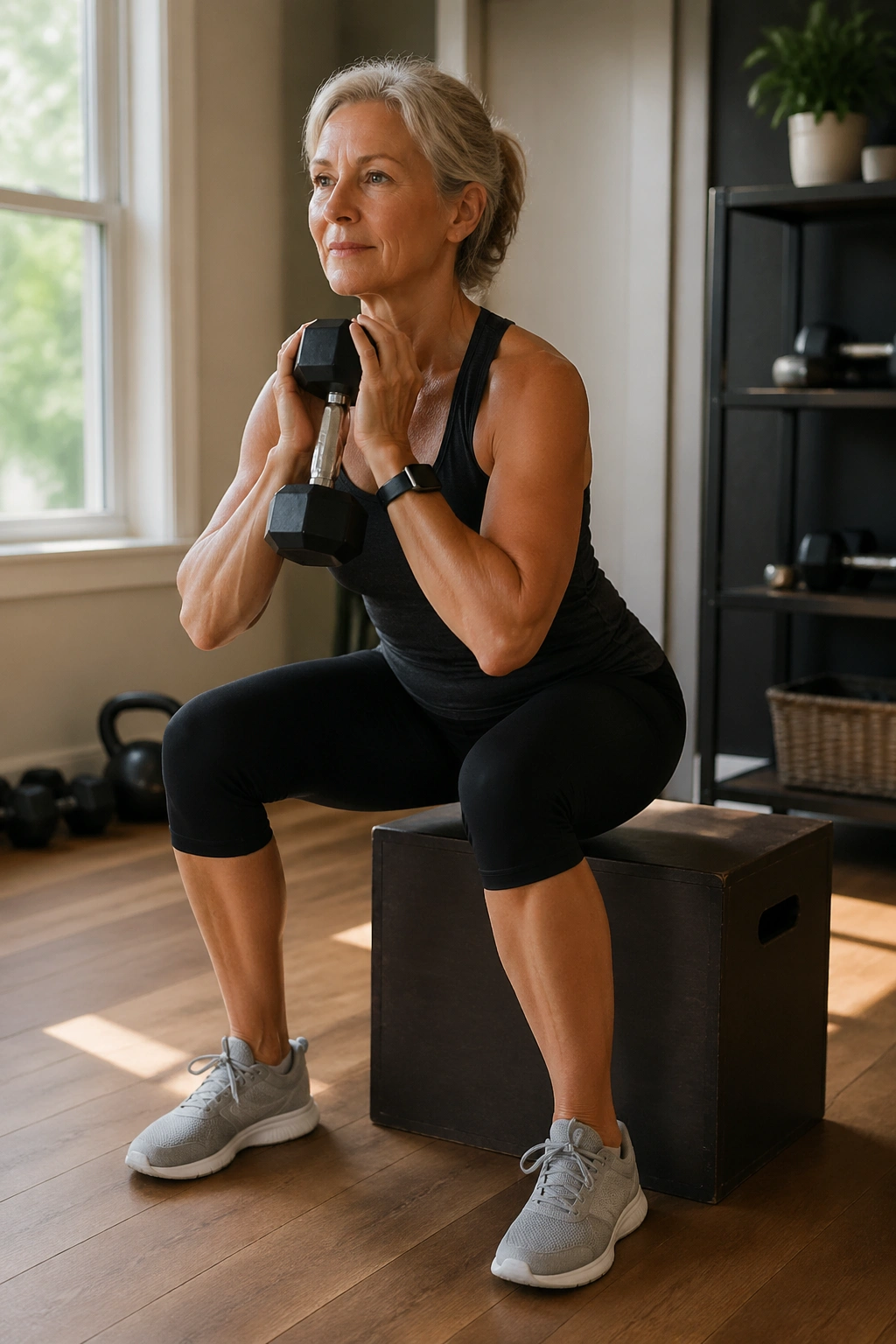
That’s why I like the goblet squat to a box for women over 50. It trains the quads, glutes, upper back, and core in one shot, and the box gives you a depth target so you don’t guess your way through the rep.
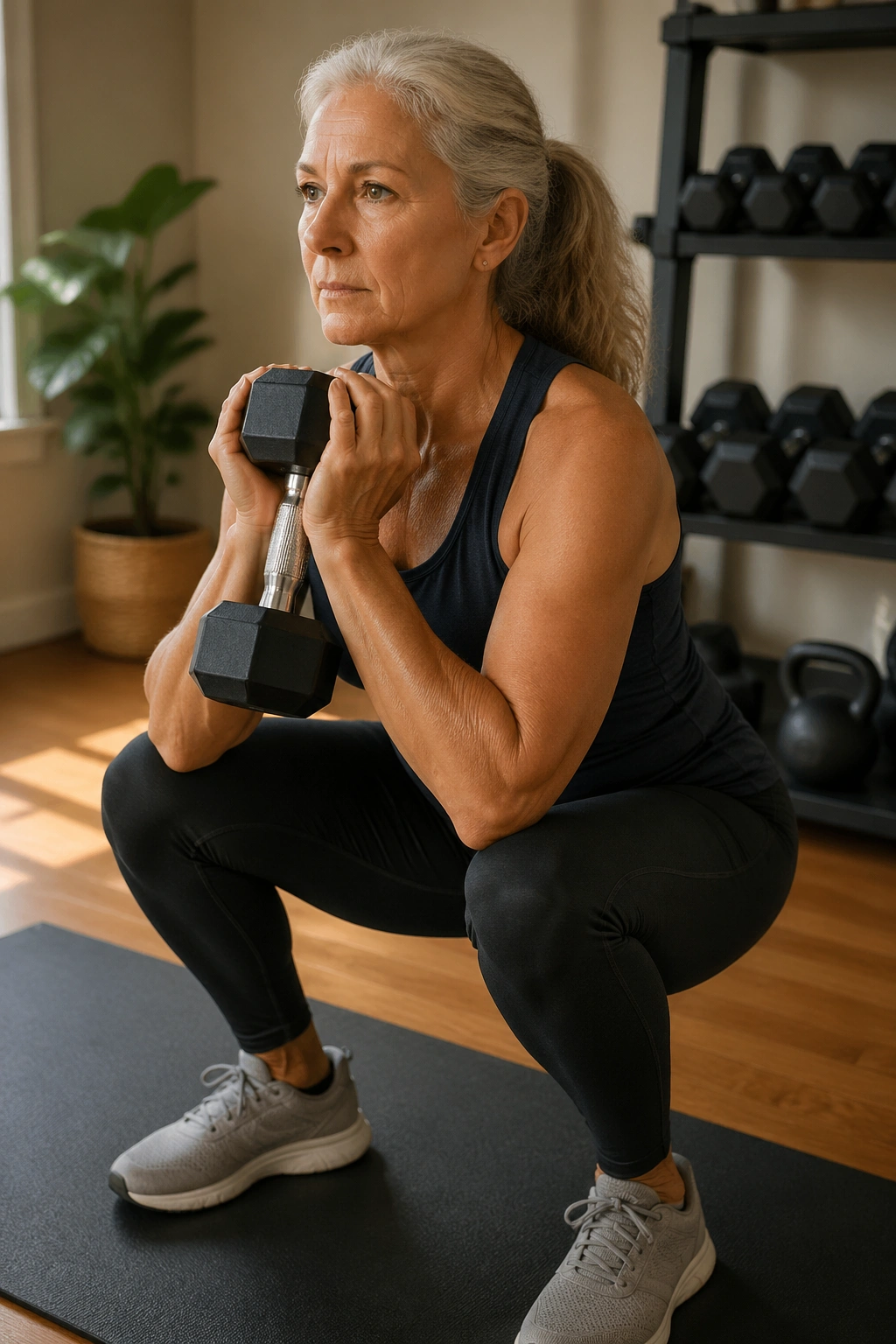
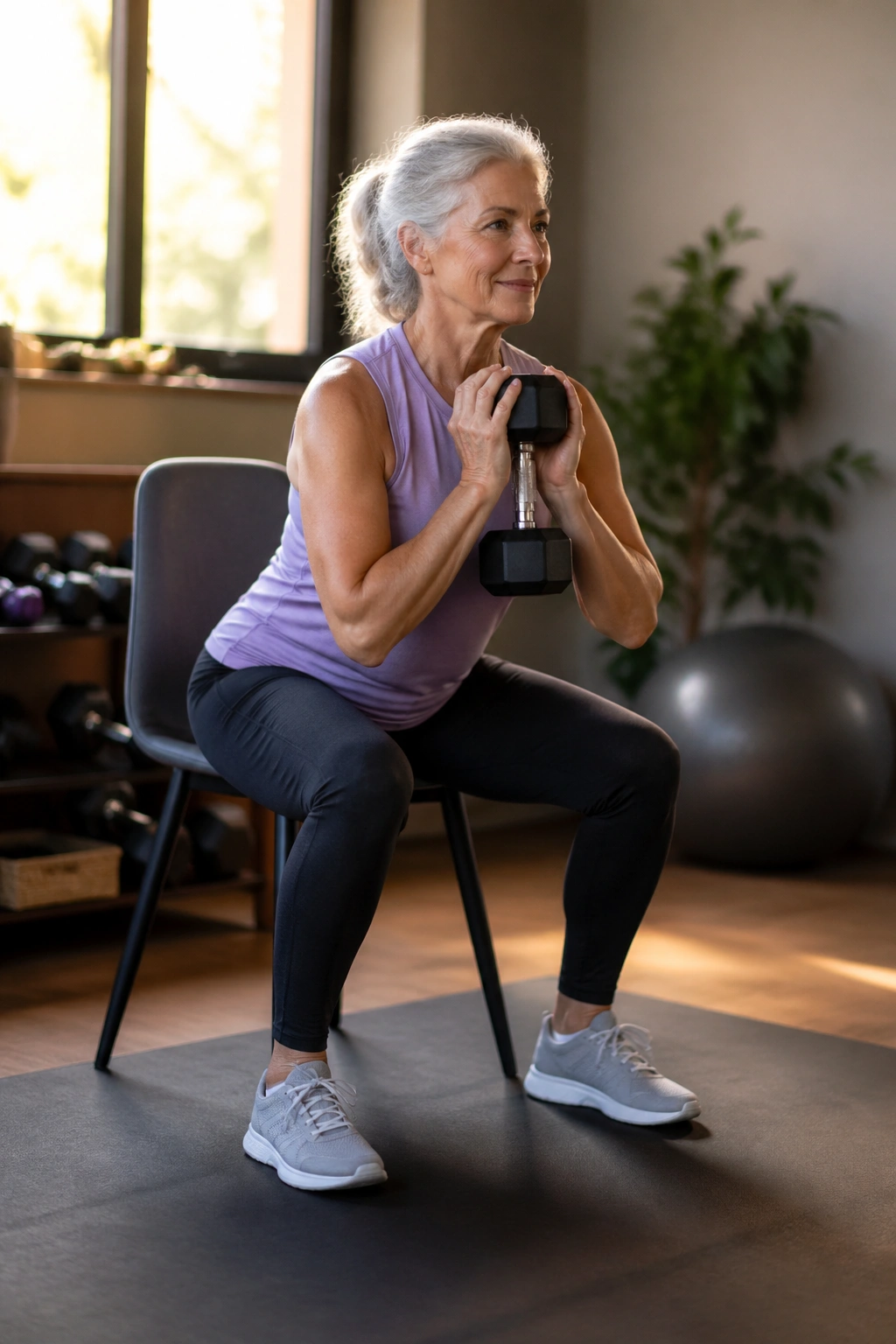
Hold one dumbbell vertically at your chest, elbows angled down. Stand with your feet about hip- to shoulder-width apart. Sit back toward a chair or bench, touch lightly, then stand. The touch is a guide, not a collapse.
Why the box works so well
The box does two useful things. First, it gives nervous beginners confidence. Second, it keeps mobility limitations from turning every squat into a debate about how low you “should” go.
If your hips are tight or your knees are irritated, use a higher box at first. A dining chair often works. Over time, you can lower the target by an inch or two if your form stays clean.
Cues that help more than “chest up”
Try these instead:
- Spread the floor with your feet as you descend
- Keep the dumbbell close to your sternum
- Sit between your hips, not onto your toes
- Drive through mid-foot as you stand
- Exhale near the top instead of clamping your breath for the whole set
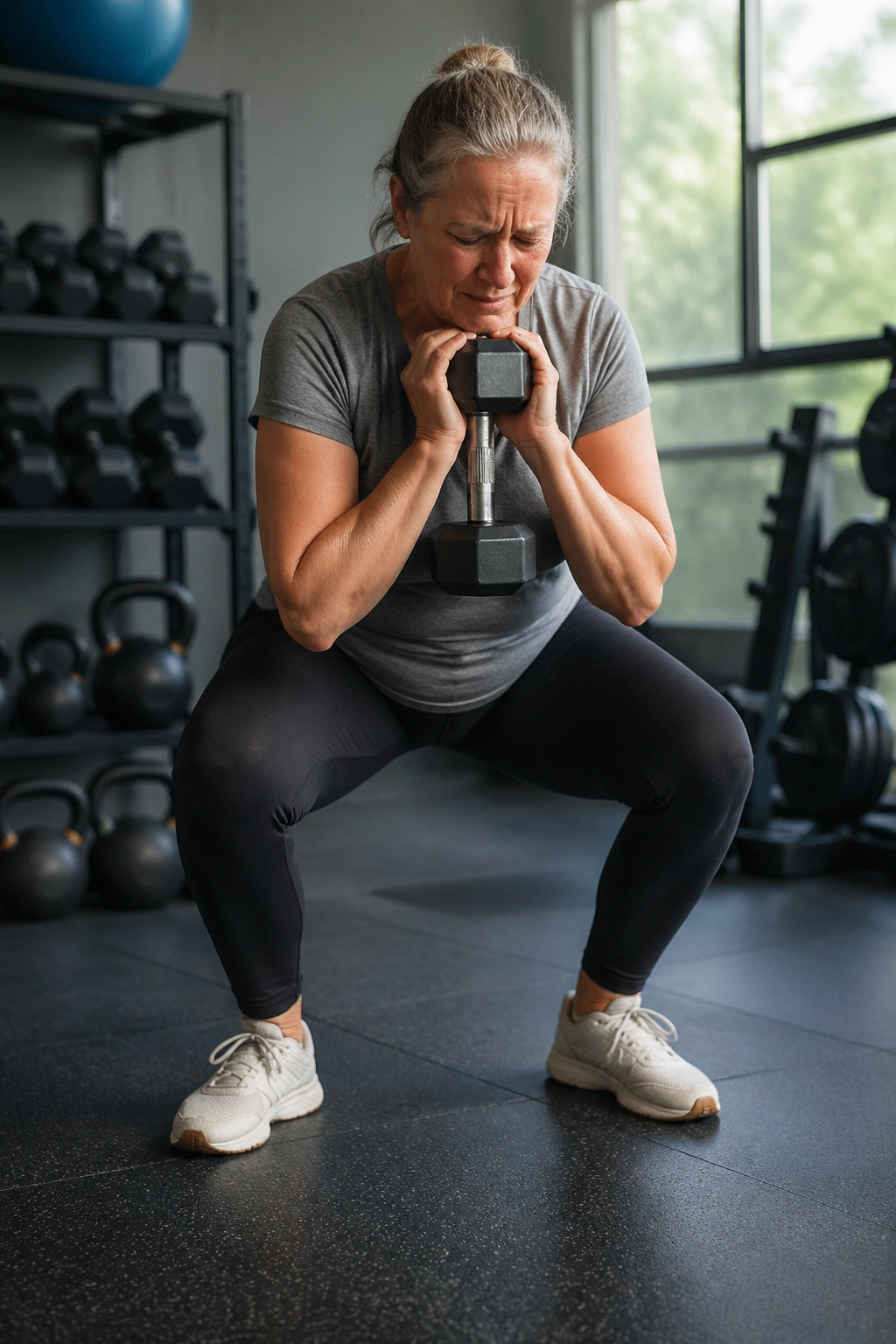
You want to feel the work in your thighs and glutes. A little core effort is good too. Sharp knee pain is not part of the deal. If that shows up, shorten the range, check stance width, and slow the lowering phase to 3 seconds.
Start with 2 to 3 sets of 6 to 10 reps.
The Dumbbell Romanian Deadlift That Wakes Up Glutes and Hamstrings
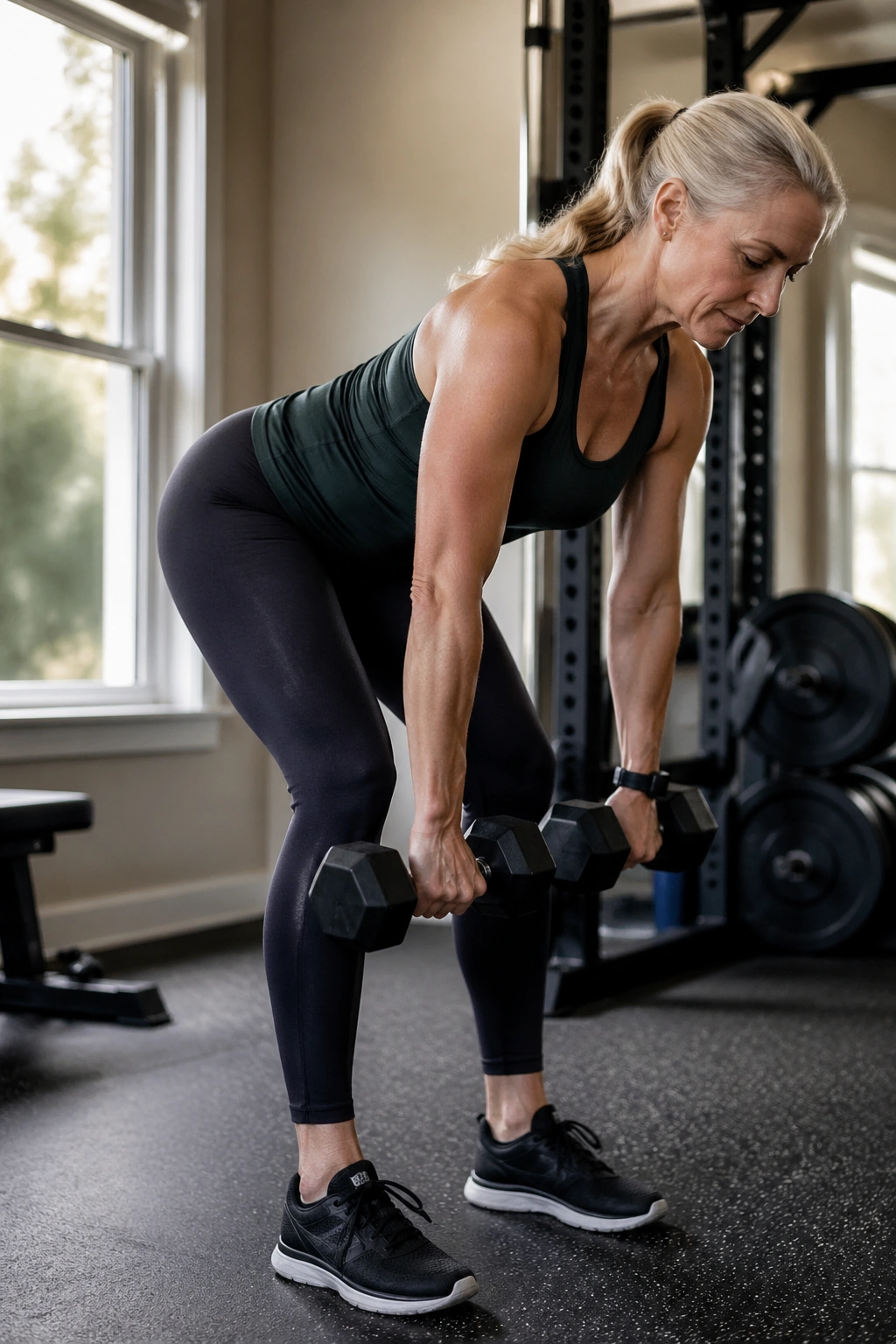
If I could keep one lower-body dumbbell lift for nearly every woman over 50, it would be the Romanian deadlift.
Why? Because the back side of the body gets neglected. A lot of women are quad-dominant from walking, cycling, classes with endless mini-squats, or years of bending from the knees without learning a true hip hinge. The Romanian deadlift teaches your glutes and hamstrings to do their job.
Stand tall with a dumbbell in each hand, palms facing your thighs. Soften your knees a little. Push your hips back as though you’re trying to close a car door with them. The weights slide down the front of your legs. Stop when you feel a stretch in the hamstrings and your back still feels flat. Then stand by driving the floor away.
That last part matters. You are not yanking the weights up. You are standing through the hips.
Common misses show up fast here. One is turning the hinge into a squat by bending the knees too much. Another is chasing the floor with the dumbbells even after your back starts rounding. Skip both. Shin height is plenty for many women, especially early on.
If you have osteoporosis or a history of vertebral fractures, pay extra attention to spinal position. Keep the range shorter, brace before each rep, and stop well before your torso folds into flexion under load.
A good set feels like hamstrings, glutes, and deep trunk tension. If you only feel your lower back, shorten the range and bring the weights closer to your legs.
Use 2 to 3 sets of 8 to 10 reps with 75 to 90 seconds of rest.
One-Arm Rows for Posture, Grip, and Upper-Back Strength
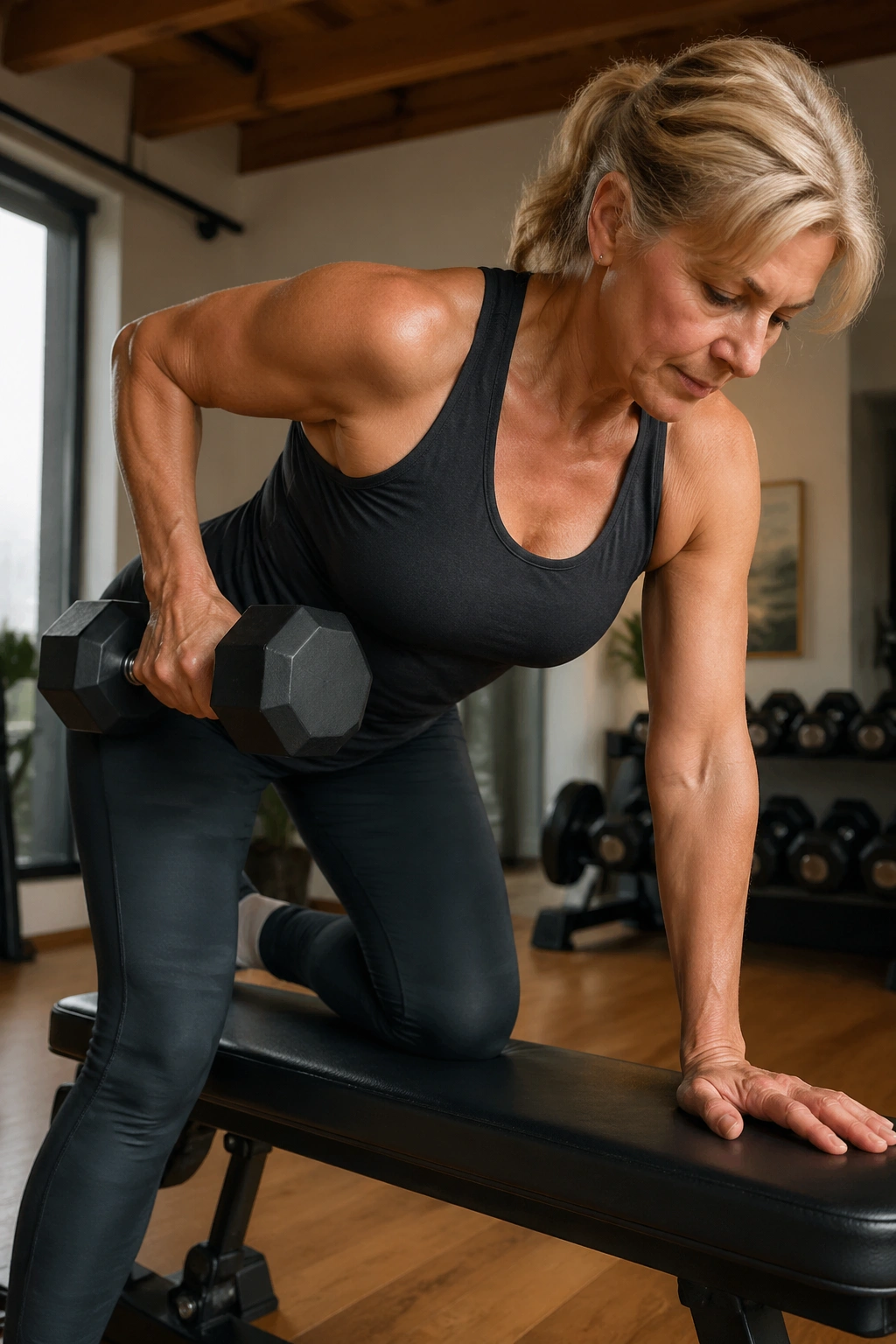
Rows fix more than posture photos ever will.
A one-arm dumbbell row strengthens the upper back, lats, rear shoulder, biceps, and grip. It also helps counter the rounded-shoulder position that creeps in from desk work, driving, scrolling, and plain old fatigue.
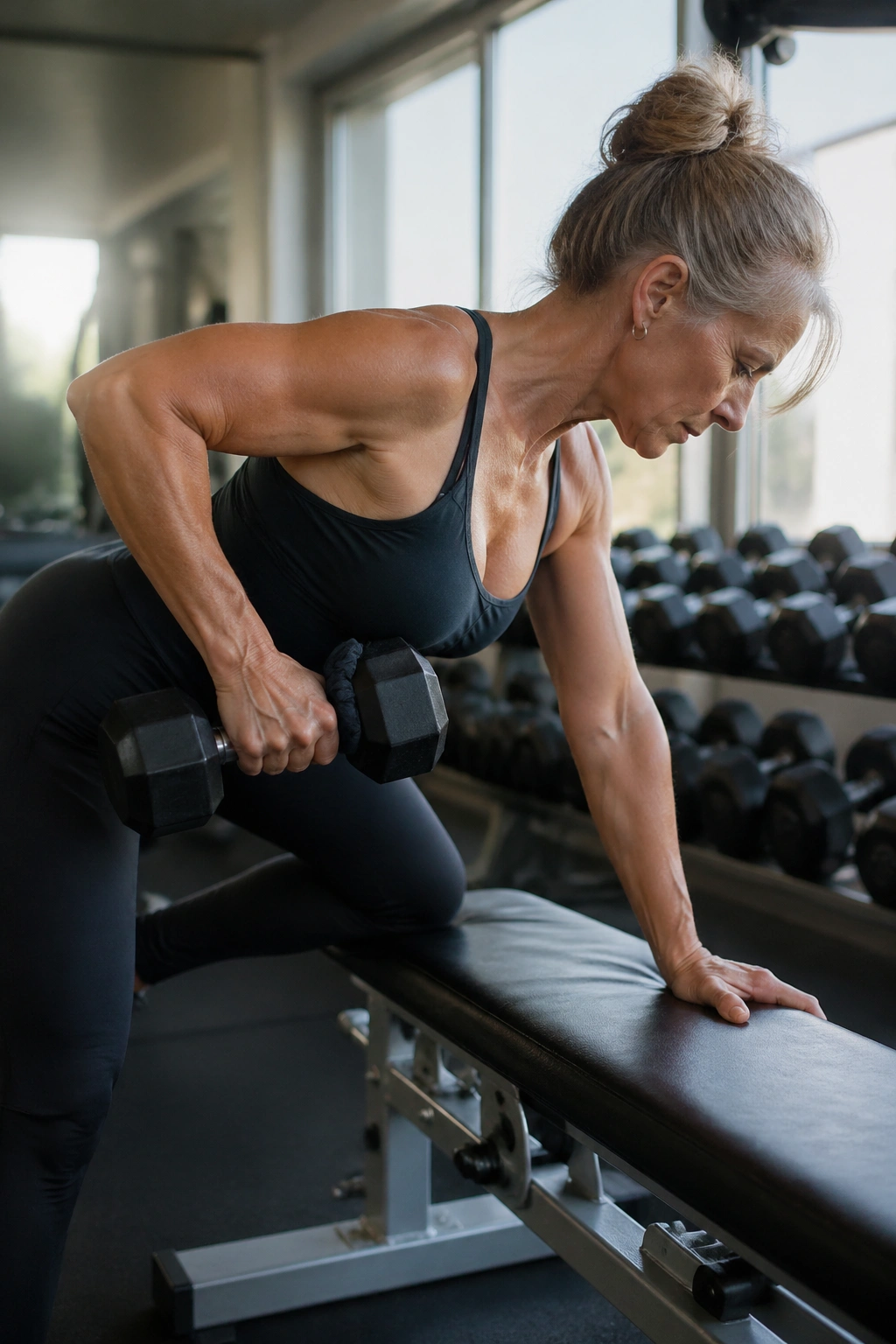
Set one hand and one knee on a bench or chair, or place one hand on the seat and keep both feet on the floor in a staggered stance. Let the working arm hang straight. Pull the elbow toward your hip, pause for a beat, then lower the weight under control.
The pause is where the row gets honest. Swing the dumbbell and you’ll miss half the point.
Quick form checks that clean up the movement
- Keep your neck long and eyes pointed a few feet in front of you
- Pull from the elbow, not the hand
- Let the shoulder blade move instead of pinning it rigidly
- Lower for 2 to 3 seconds
- Brace your ribs so your torso does not twist open
A good row should make the side of your back work hard. You may feel the back of the shoulder too. If your biceps burn first, the weight may be too heavy, or you may be curling the rep instead of rowing it.
I like 2 to 4 sets of 8 to 12 reps per side here. If grip is the weak link, that’s not wasted effort. Grip strength matters more than many people realize, and it tracks with all sorts of practical daily tasks.
Floor Press and Neutral-Grip Overhead Press for Safer Pushing Strength
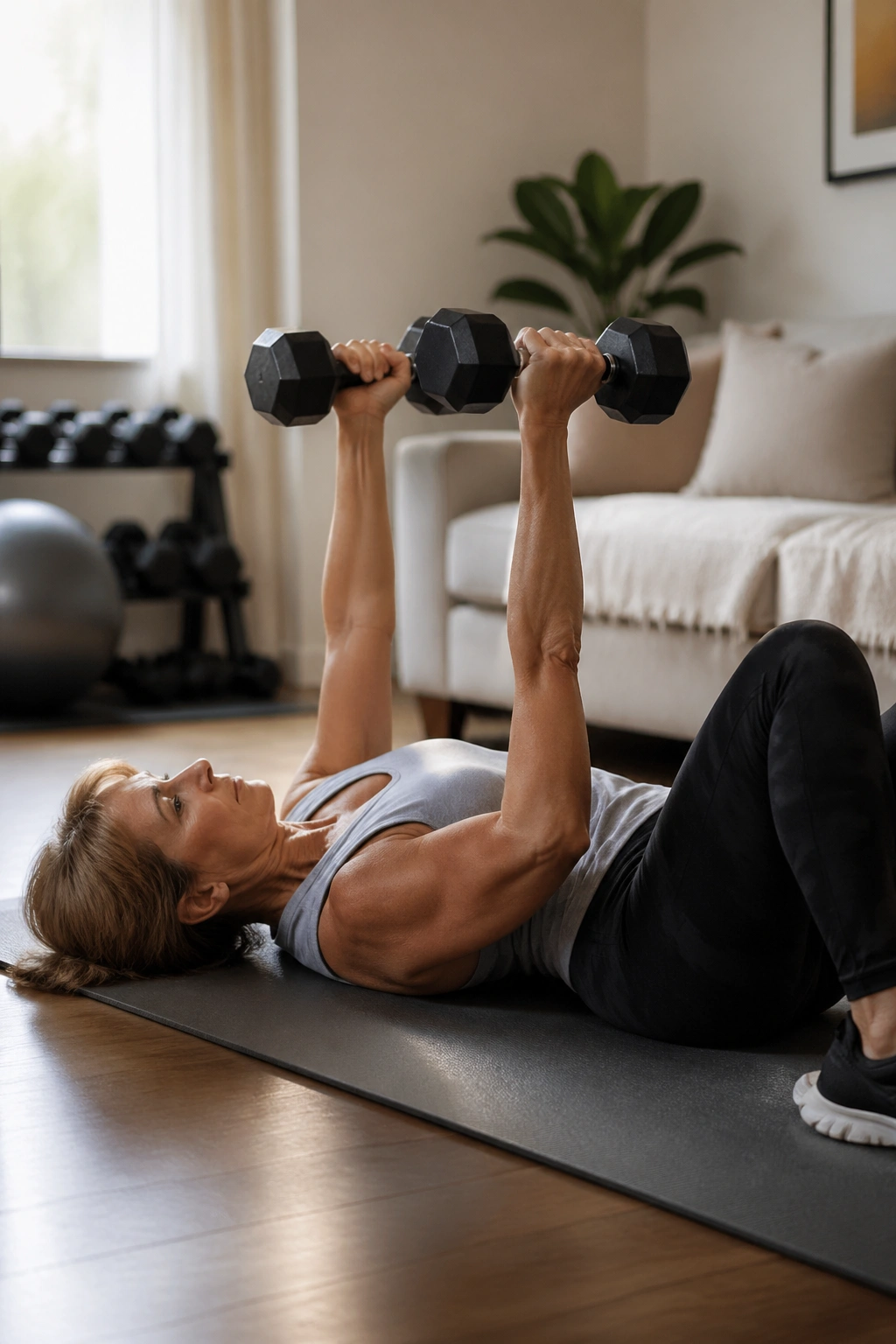
Do you need to press overhead? Maybe. Do you need pushing strength? Yes.
For many women over 50, the dumbbell floor press is the smartest first pressing move. You lie on your back with knees bent, one dumbbell in each hand, upper arms resting on the floor. Press the weights up, lower until the triceps touch down, then repeat. The floor limits the bottom range, which keeps the shoulder in a friendlier position than a deep bench press for a lot of people.
Why I like the floor press first
The setup is stable. The range is controlled. You get chest, shoulders, and triceps without asking a stiff shoulder to travel somewhere it does not want to go.
That makes it a good fit for women who feel pinchy at the front of the shoulder, women who are rebuilding confidence with weights, and women who train at home without a bench.
When the overhead press earns its place
A neutral-grip dumbbell overhead press—palms facing each other—can be a good addition if your shoulders tolerate it and you can keep your ribs down. Seated versions often feel steadier. Standing versions train more trunk control but ask more from balance.
Here’s my preference order:
- Start with floor press
- Add seated neutral-grip overhead press if pain-free
- Use one arm at a time if both arms overhead feels awkward
- Skip overhead pressing during a flare-up and keep your floor press work
For both lifts, aim for 2 to 3 sets of 8 to 10 reps. If you hold your breath hard during every rep, lower the load. Exhale through the sticking point. That little change can make pressing feel smoother and friendlier on the pelvic floor too.
Supported Split Squats That Build Balance Without Scaring You Off
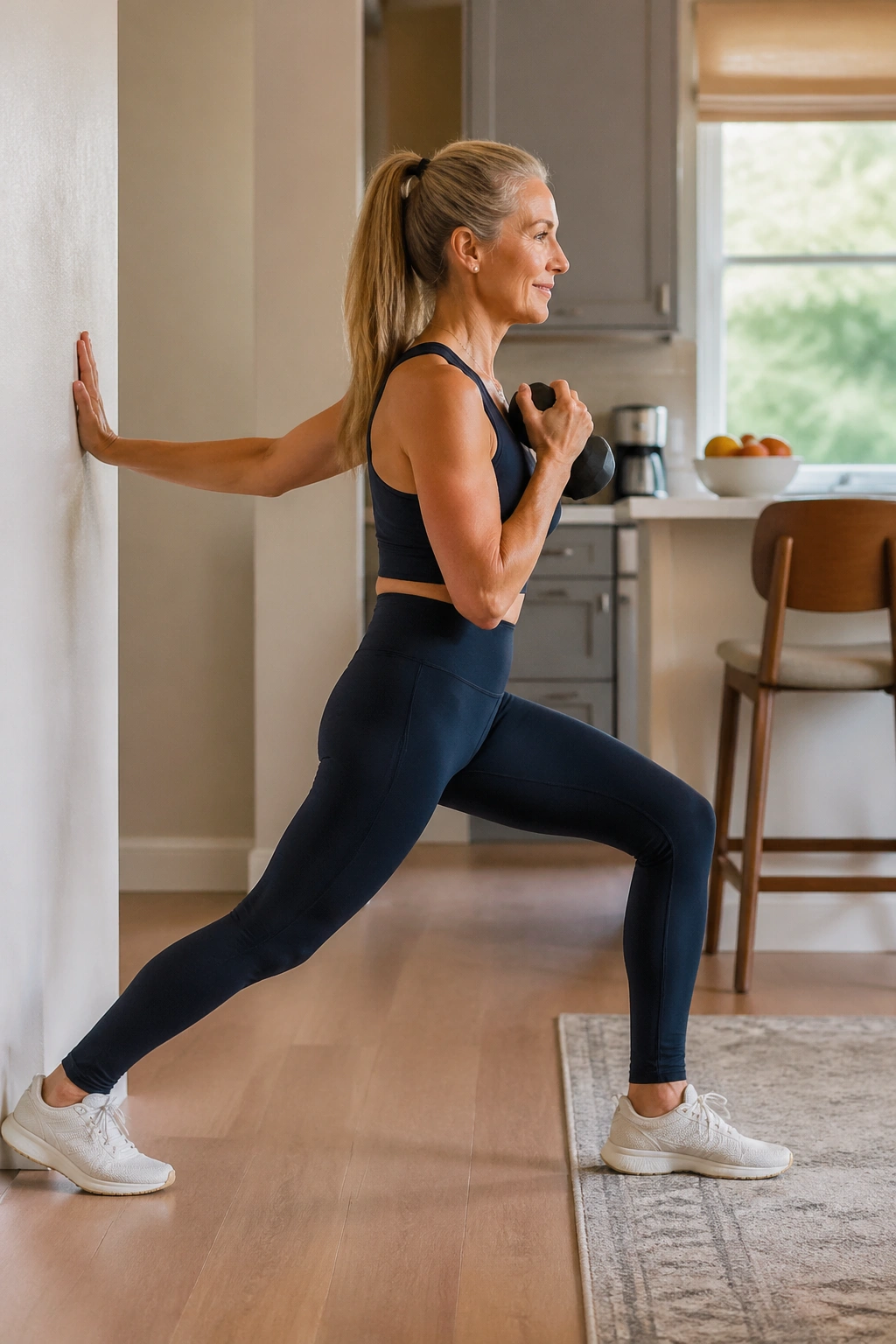
Balance work does not need to look fancy.
A supported split squat is one of my favorite lower-body drills for women over 50 because it trains leg strength, hip stability, and balance at the same time. It also tells the truth about side-to-side differences. One leg almost always feels steadier. Good. Now you know.
Stand in a split stance near a wall, countertop, or chair. Hold on lightly with one hand. Lower straight down until the back knee moves toward the floor and the front leg does most of the work. Then stand back up. You can start with bodyweight, hold one dumbbell goblet-style, or carry one dumbbell at your side on the same side as the back leg.
Start with a shorter stance than you think
Too long a stance turns the move into a wobble test. Too short and it feels cramped. A solid starting point is a split stance where you can lower down and keep the front heel rooted without the back foot cramping.
Watch your front knee. It can travel forward a bit—that is fine—but it should track over the middle toes instead of diving inward.
What you should feel
You want the front glute and front thigh doing most of the work. The back leg is support, not the star. If you feel pressure deep in the back knee, place a folded towel under it as a depth target or reduce the range.
Start with 2 sets of 6 to 8 reps per side. These are humbling. That is part of their charm.
Farmer Carries and Dead Bugs for the Kind of Core Strength You Can Use
Crunches are overrated here.
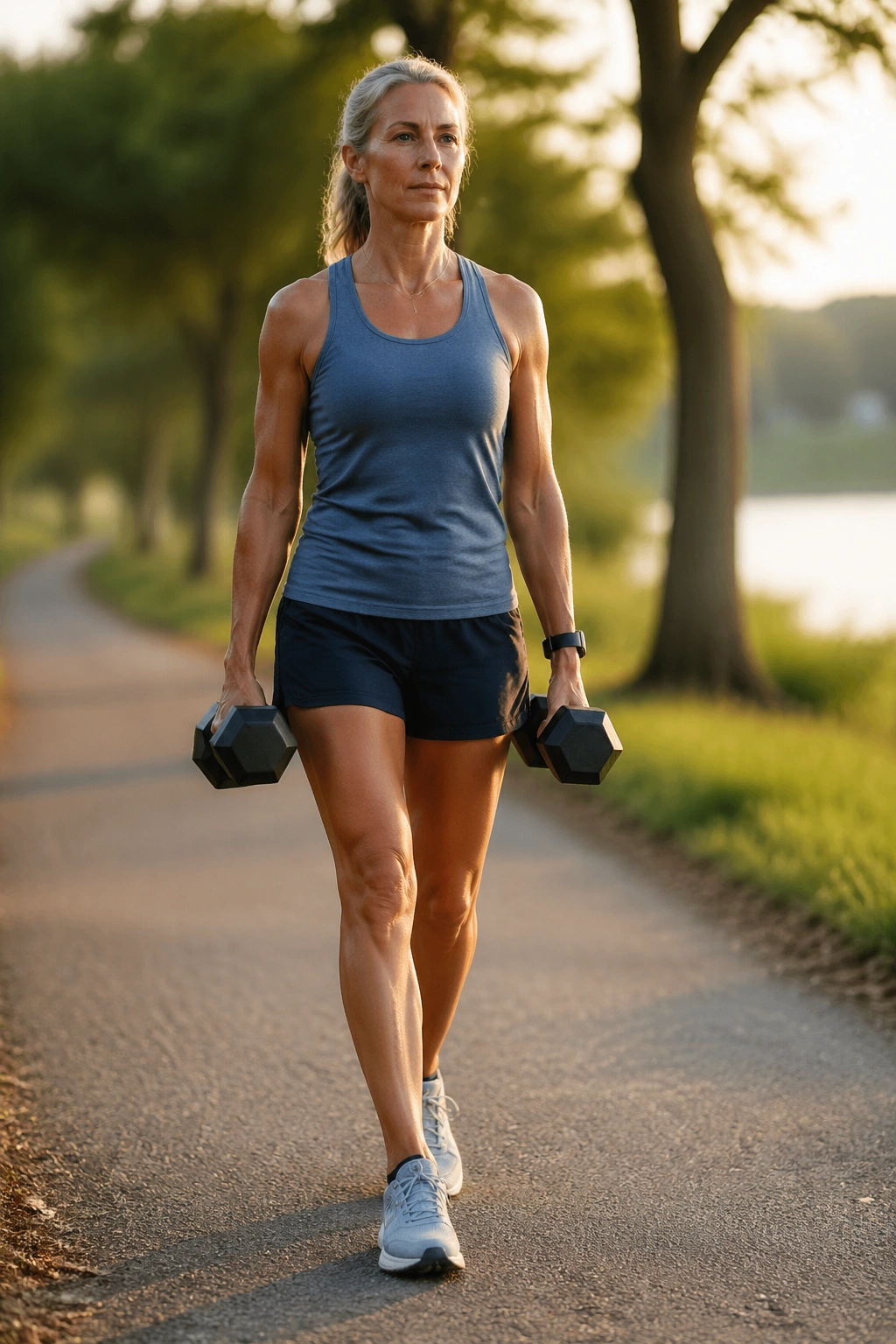
The kind of core strength that helps you carry groceries, hold posture on a walk, lift a suitcase into the car, and stay steady when you trip over a dog toy is mostly about resisting motion, not folding your spine over and over. That’s why farmer carries and dead bugs earn a spot in this plan.
Grab a dumbbell in each hand and walk 30 to 40 steps with tall posture. Keep your ribs stacked over your hips. Do not let the weights drag you into a slump. If you only have one suitable dumbbell, use a suitcase carry on one side and fight the urge to lean.
Short walks with good posture beat long sloppy ones.
The dead bug looks tame until you do it well. Lie on your back with hips and knees bent to 90 degrees, arms toward the ceiling. Brace lightly, flattening your lower back only enough to feel supported—not crushed into the floor. Slowly lower one heel and the opposite arm while exhaling for 3 to 4 seconds. Return and switch sides.
That long exhale matters. It turns the exercise into a trunk-and-breath drill instead of a flailing ab move.
A few cues help:
- Move slowly enough that your ribs stay down
- Stop the leg sooner if your back starts arching
- Exhale through pursed lips
- Keep the neck relaxed
- Choose fewer reps and better control
Use 3 rounds of 30 to 40 steps for carries and 2 sets of 5 to 8 reps per side for dead bugs.
A Sample Full Body Dumbbell Workout for Women Over 50
Here’s a session I’d happily hand to most healthy beginners and intermediates. It hits the whole body, keeps the exercise list sensible, and leaves room to progress without grinding your joints into dust.
Workout A
- Goblet squat to box: 3 sets of 8 reps
- Dumbbell Romanian deadlift: 3 sets of 8 reps
- One-arm dumbbell row: 3 sets of 10 reps per side
- Dumbbell floor press: 3 sets of 8 to 10 reps
- Supported split squat: 2 sets of 6 reps per side
- Farmer carry: 3 rounds of 30 to 40 steps
- Dead bug: 2 sets of 6 reps per side
Workout B
- Goblet squat to box: 3 sets of 10 reps
- Romanian deadlift: 3 sets of 10 reps
- One-arm row: 3 sets of 8 reps per side, slightly heavier
- Seated neutral-grip overhead press: 2 sets of 8 reps
- Supported split squat: 2 sets of 8 reps per side
- Suitcase carry: 3 rounds of 20 to 30 steps per side
- Dead bug: 2 sets of 5 slow reps per side with a 4-second exhale
Run these on nonconsecutive days—Monday and Thursday, or Monday, Wednesday, and Friday if recovery is good. Rest 60 to 90 seconds after most sets. Give the carries enough rest that your posture stays clean on the next round.
A good effort level is about a 7 or 8 out of 10 by the final rep of each set. That means you could maybe do 2 more reps with good form, but not 6 more. If every set feels easy, the weights are too light. If your form breaks down by rep 5, the weights are too heavy.
You do not need to turn this into a breathless circuit. Lift, rest, reset, repeat. Strength likes patience.
How to Progress Your Full Body Dumbbell Workout Without Beating Up Your Joints
Add reps before you add ego.
The easiest progression method for dumbbell training is called double progression. Pick a rep range—say 8 to 10 reps. Start with a weight you can lift for 8 clean reps on all sets. Over the next few sessions, work toward 9 reps, then 10, while keeping form tight. Once you can hit the top of the range on every set, increase the weight and drop back to 8 reps.
A clean way to progress
Take goblet squats as an example:
- Session 1: 15 pounds for 3 sets of 8
- Session 2: 15 pounds for 3 sets of 9
- Session 3: 15 pounds for 3 sets of 10
- Session 4: 20 pounds for 3 sets of 8
That is enough. You do not need a new trick every week.
When dumbbell jumps are too big
Home dumbbells sometimes jump 5 pounds at a time, and that can feel steep on upper-body work. When that happens, use one of these fixes:
- Add 1 extra rep per set
- Add 1 extra set
- Slow the lowering phase to 3 seconds
- Pause for 1 second in the hardest position
- Alternate heavy and light days between Workout A and Workout B
How to know you need a lighter week
If your joints feel achy for more than 48 to 72 hours, your sleep is poor, your motivation tanks, and the weights feel glued to the floor, back off for one week. Cut one set from each exercise or use weights about 10 to 15 percent lighter.
That is not losing ground. That is how people stay in the game long enough to get strong.
Common Mistakes That Stall Results or Irritate Joints
Most stalls are boring.
They are not caused by a missing “hack” or the wrong playlist. They usually come from a short list of habits that sneak in when people are eager, impatient, or copying workouts meant for someone else.
Using weights that never challenge you
If you finish every set and feel like you could have done 10 more reps, the weight is not asking your body to adapt. Light weights have a place in rehab, warm-ups, and some shoulder work. They are not enough for your legs and back forever.
Turning every workout into cardio
Circuits look efficient on paper. For beginners over 50, they often turn strength training into rushed breathing practice. You end up too winded to use a useful load, and technique gets sloppy fast.
Changing exercises every week
Your body needs repetition to learn a movement and load it better. If you swap squats for lunges for step-ups for band work every other session, you never spend enough time with one lift to progress it.
Ignoring pain signals and calling it grit
Muscle burn is fine. Working hard is fine. Sharp joint pain, tingling, numbness, or pain that changes the way you move is a different story. Stop, adjust, or get it checked.
Holding your breath through everything
A brief brace is useful on tough reps. A full breath-hold on every single rep can spike pressure and make you feel headachy or strained. Exhale through the hard part, then reset.
Skipping the logbook
What gets measured improves. Scribble the date, weight, reps, and how the set felt. Two lines in a notebook beat guessing for three months.
A Weekly Schedule That Leaves Room for Walking, Recovery, and Real Life
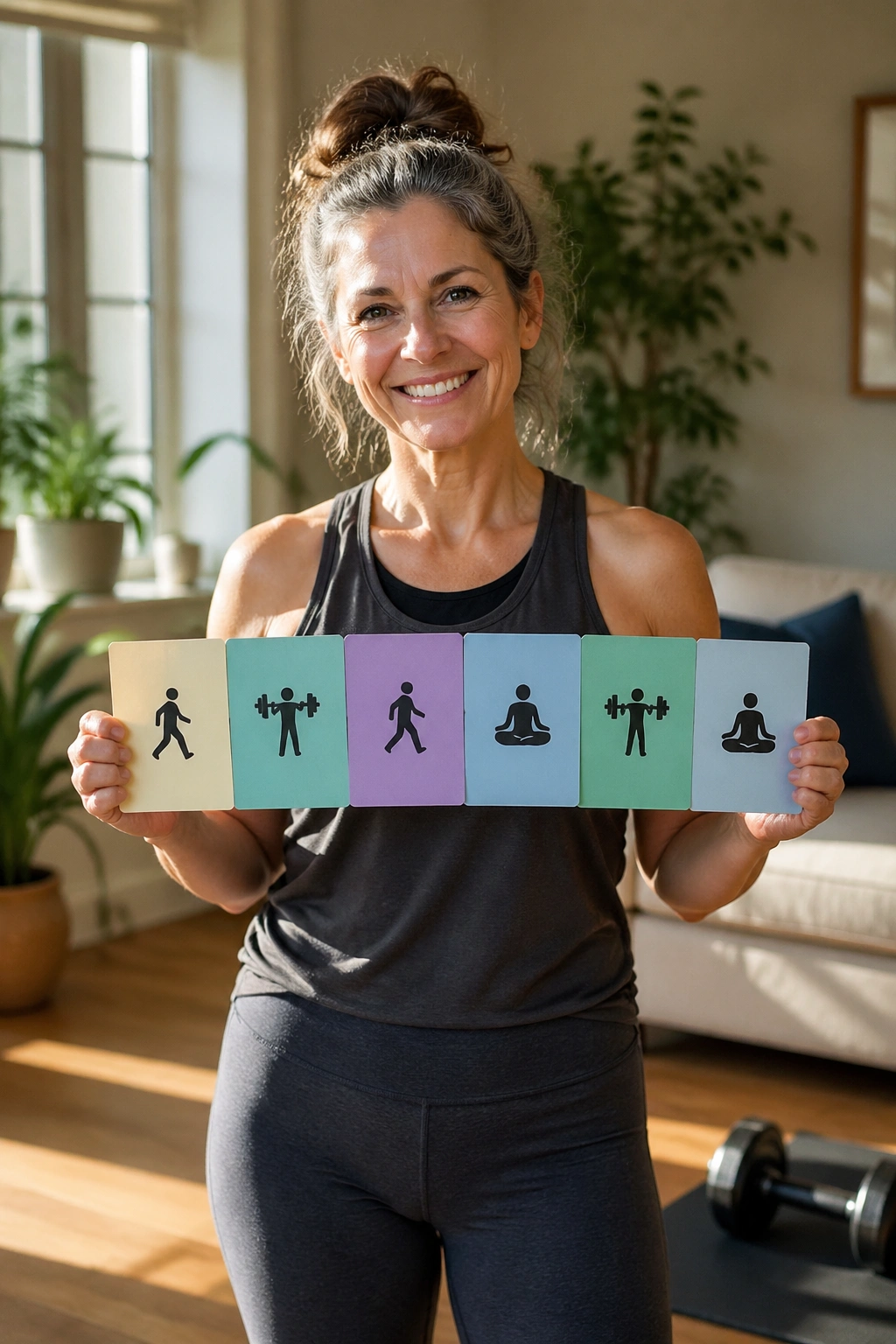
Strength work does not need to swallow your week.
A good schedule for many women over 50 is two or three lifting days, plus walking and short mobility work on the in-between days. Walking keeps blood moving, helps recovery, supports heart health, and pairs well with strength training without stealing much from it.
Here’s a simple two-day setup:
- Monday: Workout A
- Tuesday: 20 to 30 minute walk + 5 minutes of calf, hip, and chest mobility
- Wednesday: Easy day or another 20-minute walk
- Thursday: Workout B
- Friday: 20 to 30 minute walk
- Weekend: One longer walk, light hike, gardening, or full rest
If you want a three-day schedule, use A / B / A one week and B / A / B the next. That evens out the volume over time.
Recovery habits that pull more weight than people think
Protein matters here. A lot. Aim for 25 to 35 grams of protein in meals that follow lifting, whether that comes from Greek yogurt, eggs, cottage cheese, tofu, fish, chicken, or a shake if that is easier. Your muscles need raw material.
Sleep matters too, which is annoying because it sounds boring and because nobody wants another lecture about bedtime. Still, strength gains are harder to hang onto when sleep is chopped up night after night.
Hydration helps more than many people expect. So does a 5-minute cool-down walk after lifting. Small stuff, yes. Small stuff adds up.
Joint-Friendly Swaps for Knees, Shoulders, Wrists, and Lower Back
Bodies over 50 are not broken. They are often a little more opinionated.
That means your program should have room for swaps. Not because you’re fragile, but because the “best” exercise is the one you can do well, load gradually, and repeat next week without dreading it.
If your knees complain
Try these changes first:
- Use a higher box on goblet squats
- Slow the lowering phase to 3 seconds
- Use a slightly wider stance
- Choose supported split squats over free-standing lunges
- Reduce range for a week, then build it back
A knee that feels warm and worked after training is one thing. A knee that feels sharp, unstable, or swollen later is asking for a change.
If your shoulders feel pinchy
Shoulders often like a neutral grip, shorter pressing range, and better upper-back work. Swap deep presses for floor presses. Press one arm at a time. Use rows with a pause. Add wall slides to the warm-up.
If your wrists or hands are cranky
Hex dumbbells with a grippy handle often feel better than slick chrome. Wrist-neutral positions help too. Carries can be kept shorter with more rounds. You can also hold one dumbbell goblet-style instead of two dumbbells by your sides if grip is limiting a squat pattern.
If your lower back steals the show
Shorten the hinge range. Raise the box on squats. Brace before the rep starts. If the back still dominates, swap Romanian deadlifts for dumbbell glute bridges for two to three weeks and rebuild the hinge pattern with wall taps.
Pain that shoots, tingles, or lingers into the night deserves more than internet troubleshooting.
What Good Form Actually Feels Like During a Dumbbell Workout
“Use good form” is one of the least useful phrases in fitness.
What you need is something you can feel. On squats, your feet should feel rooted and the dumbbell should stay close to your chest without pulling you forward. On Romanian deadlifts, the stretch should live in the hamstrings, not as a tugging ache in the lower back. On rows, you should feel the side of your back and the back of the shoulder. On carries, your torso should feel tall and steady, like you’re trying not to spill a glass of water balanced on your head.
Listen for clues too. A clean dumbbell workout is quieter. Less crashing. Less wobbling. Less furniture rescue.
Breathing gives you feedback. If you’re gasping after a set of 8 rows, the pace is off or you turned it into cardio. If you feel pressure bearing down through the pelvis on every rep, soften the brace a bit and exhale through effort.
One more thing. Form is not a frozen statue. You do not need textbook perfection. You need repeatable reps that look controlled and feel like the right muscles are doing the work.
That standard is high enough.
Final Thoughts
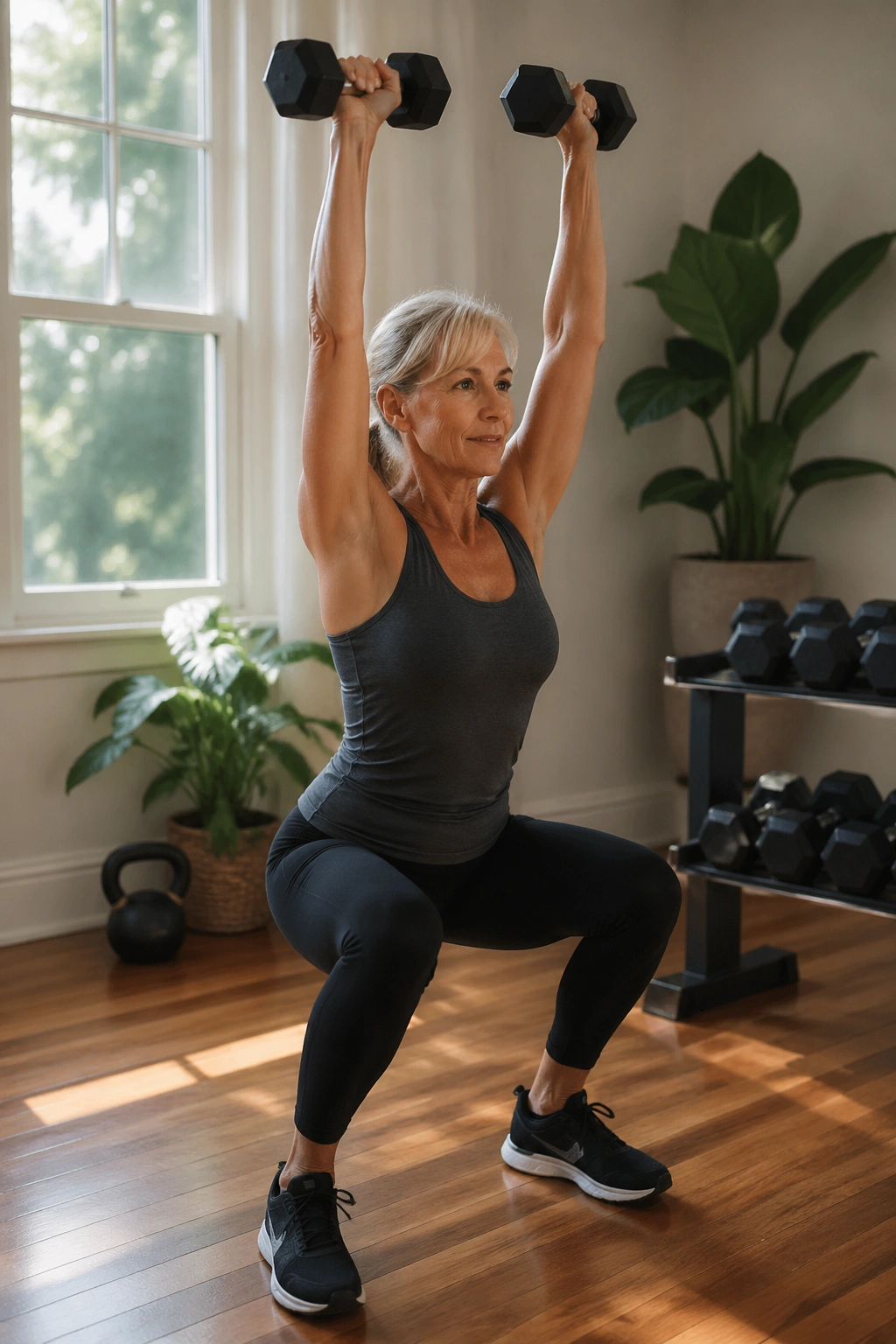
A good dumbbell plan after 50 is not about proving toughness. It’s about building a body that handles life with more ease and less hesitation. Strong legs, a solid hinge, better pulling strength, steadier carries, cleaner pushing mechanics—that combination covers far more ground than random “toning” workouts ever will.
If you start with two sessions a week, track your weights, and keep one or two reps in reserve on most sets, you will have enough structure to make progress. Boring? A little. Effective? Yes.
Start lighter than your ego wants, move with intent, and keep showing up. Strength has a way of changing how the rest of the day feels.
