



The best printable workout plans are boring in the right way. They cut out the guessing, tell you what to do next, and keep you from turning every gym visit into a little improvisation show.
That matters more than people admit. A sheet with exercises, sets, reps, rest times, and a place to write the load gives your training a memory. A week without a plan turns into random effort, and random effort feels busy without building much of anything.
Steady progress usually comes from tiny, repeatable wins: one more rep, a small weight jump, cleaner form, or one extra set done with control. Leave 1 to 2 reps in reserve on most sets, write the numbers down, and the plan starts doing some of the work for you.
Some of the plans below are built for barbells, some for dumbbells, some for a hotel room floor, and some for the days when your energy is low but you still want to keep the habit alive. Pick the one that matches your gear, your time, and your recovery. Then print it and stop overthinking it.
1. Three-Day Full-Body Beginner Plan
This is the plan I hand to people who want a clean start. Three full-body sessions a week give you enough practice with the main movement patterns without turning the gym into a second job.
What to put on the page
- Day 1: Squat, push, pull, core.
- Day 2: Hinge, push, pull, carry.
- Day 3: Squat variation, upper-body press, row, core.
Keep most lifts in the 2-3 sets of 6-10 reps range. That is enough volume to learn the lifts, feel the work, and recover before the next session.
The beauty here is repetition. You see the same patterns often enough to improve fast, but not so often that every workout feels like punishment. Write the exercise, sets, reps, and the weight used in one box for each move. That simple layout makes the printout worth using.
A one-sentence rule keeps beginners from messing this up: add one rep first, then add a little weight.
2. Upper/Lower Split

What if three days feels too sparse? A four-day upper/lower split gives you more weekly work without making any single session drag on forever.
You train upper body twice and lower body twice. That means your bench, rows, squats, lunges, and hinges show up often enough to improve, but you still get a recovery day between hard lower sessions. I like this setup for people who recover decently and enjoy seeing the same lift twice in a week.
Why it works so well
Upper days usually hold your presses, pulls, and arm work. Lower days cover squats, deadlifts, split squats, and calves. Most sessions need only 4 to 6 exercises, and the whole thing fits on one printed page if you keep the notes tight.
A good printable version has one line for the main lift, one line for the secondary lift, and two or three smaller lines for accessories. That layout keeps the important work in front of you. No clutter. No guesswork.
The sweet spot is simple: two big lifts, two support moves, and one thing for your trunk or grip.
3. Push/Pull/Legs Plan

A lot of people love push/pull/legs because it feels organized without being fussy. Chest, shoulders, and triceps live together. Back and biceps live together. Legs get their own day and do not have to share space with anything else.
That split works best when you want a higher training frequency and you can realistically make it to the gym five or six times a week. Miss one session, though, and don’t panic. Just run the next workout in sequence. The plan is meant to be a loop, not a test of moral character.
A clean weekly shape
- Push: Bench press, incline press, overhead press, triceps
- Pull: Row, pulldown or pull-up, rear delt work, curls
- Legs: Squat, hinge, lunge, calves, core
The printout should leave room for two heavy compounds and two or three smaller exercises. That keeps the session honest. If you cram in too much, your last few movements turn into rushed filler, and nobody gets stronger from rushed filler.
4. Twenty-Minute Bodyweight Plan

Short workouts are not weak workouts. They are the reason many people keep training when life gets crowded.
A 20-minute bodyweight plan works because it removes the two biggest excuses: no time and no equipment. Set a timer, move through a simple circuit, and stop trying to make every session feel epic. A clean half hour done three times a week beats a perfect plan you never start.
Keep the format tight. Five minutes to warm up. Twelve minutes for the main circuit. Three minutes to finish with planks, squats, or mountain climbers if you still have gas.
Tempo matters here. Slow the lowering phase on push-ups and squats, pause at the bottom, and you make the work harder without needing more gear. That one change keeps a bodyweight plan useful long after the novelty fades.
5. Dumbbell Home Plan

Only have dumbbells? Good. That is enough.
Dumbbells are one of the easiest ways to build a printable home routine because they cover almost everything you need: pressing, rowing, hinging, squatting, carrying, and single-leg work. The plan is especially good for people who want training without the travel time, the wait for equipment, or the noise of a crowded gym.
Best moves to print
- Goblet squat
- Dumbbell Romanian deadlift
- Floor press
- One-arm row
- Split squat
- Overhead press
- Suitcase carry
I like dumbbell plans built around 3 to 4 sessions per week, each with 4 to 6 exercises. Use one heavier pair for the main lifts and a lighter pair for shoulder and arm work if you have them. If not, one adjustable set still does the job.
Progress gets simple fast: add reps until you hit the top of your target range, then add a small amount of weight. Slow reps, pauses, and single-arm work can carry you for a long time before you need new equipment.
6. Barbell Strength Plan

Barbells reward patience. They also punish sloppy planning.
This kind of printable workout plan is built for the big lifts: squat, bench press, deadlift, and overhead press. You do not need a dozen exercises. You need a few lifts you can repeat, track, and load carefully. That is the whole point.
The best barbell sheets usually use lower rep ranges, longer rests, and clear top sets. Think 3 to 5 reps on the main lift, then 2 to 4 back-off sets with a lighter load. Rest 2 to 4 minutes between hard sets. If you rush barbell work, your form falls apart and the printout starts lying to you.
This style suits people who like numbers and want strength to move up in visible steps. It is less flashy than a circuit plan, and I mean that as praise. Heavy lifting should feel deliberate. One clean set with honest loading beats five sloppy ones.
7. Fat-Loss Circuit Plan

If you want sweat, structure, and a plan that keeps moving, circuits make sense.
A fat-loss workout plan should still include strength work. That part gets skipped too often. The goal is not to turn every session into a breathless scramble. The goal is to keep muscle, burn more energy during the workout, and build a routine you can repeat without dreading it.
A clean circuit printout usually gives you 4 to 6 exercises, 30 to 45 seconds of work, and 15 to 30 seconds of rest. Kettlebell swings, goblet squats, push-ups, rows, step-ups, and planks all fit nicely here. Use a timer and write down the round count.
One blunt note: fat loss still depends on food. Training helps a lot, but no circuit plan can outwork a chaotic kitchen. Keep the workouts honest and the eating reasonable, and the plan starts paying off.
8. Walking Plus Strength Hybrid

Daily walking sounds too easy to matter. It matters.
A walking plus strength plan is one of the most livable printable workout plans you can use, especially if hard training tends to make you feel beat up. Two or three strength sessions keep your muscle and strength moving forward. Daily walks keep your body moving, your recovery cleaner, and your schedule less dramatic.
I like this setup for people who sit a lot, sleep unevenly, or hate the feeling of being crushed by their own routine. The walks do not need to be intense. Thirty to forty-five minutes at an easy pace is plenty. The lifts can stay short and focused.
Boring works. That sentence is not sexy, but it is honest.
Print the week with your lift days marked clearly and your walks written as checkboxes. That little visual cue matters more than it should. Humans like to complete boxes.
9. Core and Mobility Reset Plan

What do you print on the days your back feels tight and your hips feel stuck? A core and mobility reset.
This is not a vanity routine and it is not a fancy stretch class in disguise. It is a practical plan for keeping your trunk strong and your joints honest. If you sit a lot, lift a lot, or run a lot, this kind of session makes the rest of your training feel less clunky.
A simple reset flow
- Dead bug
- Bird dog
- Side plank
- 90/90 hip switches
- Thoracic rotations
- Hip flexor stretch
- Deep squat hold
Keep each drill for 20 to 40 seconds or 6 to 10 controlled reps. None of it should feel rushed. If your breathing is smooth and your lower back stops barking, you are doing it right.
The printable page should look calm, not aggressive. This is the day you restore range, clean up your movement, and give the next workout a better starting point.
10. Joint-Friendly Low-Impact Plan

Low impact does not mean low effort.
A joint-friendly workout plan is a smart choice for anyone with cranky knees, sore shoulders, or a history of getting carried away with impact work. The fix is not to stop training. The fix is to use tools that load the body without beating it up.
Bike intervals, rowing, sled pushes, incline walking, cable work, and machine exercises all fit beautifully here. Keep the sessions smooth and deliberate. Avoid jump-heavy work if your joints complain about it later. There is no prize for being the person who proves they can tolerate pain.
This printable plan works best when each day has a clear purpose: one day for legs, one day for upper body, one day for conditioning. Clean reps and controlled speed matter more than heroics. That makes the whole week easier to repeat, which is where the real progress lives.
11. Kettlebell Plan

A kettlebell can do more than people give it credit for.
The reason kettlebell plans stick is simple: one bell can cover strength, power, conditioning, and grip without much setup. You can print a full week with swings, cleans, presses, goblet squats, and carries, then move through it in a small space with very little fuss.
I like this style for people who want hard work without a ton of decision-making. A session might start with swings for power, then move to presses and squats, then finish with loaded carries. That mix keeps the work interesting without turning it into a circus.
How to keep it useful
- Use 10 to 20 reps for swings and carries.
- Keep presses and squats in the 5 to 8 rep range.
- Rest long enough that your form stays crisp.
One kettlebell can feel limited for a day. Over weeks, it gets sneaky. The body learns to make more from less, and that is a good trade.
12. Machine-Based Gym Plan

Machines are not a lesser option. They are a simpler one.
A machine-based gym plan is ideal when you want less setup, less balance drama, and more direct muscle work. Pin-loaded machines make progress easy to track because the numbers jump in neat little steps. That is useful when you are trying to stay consistent and not reinvent your workout every time you walk into the room.
Use leg press, chest press, seated row, pulldown, hamstring curl, leg extension, and cable work to build a solid week. The printout should feel tidy. Machines do the stabilizing for you, so you can focus on moving well and matching the listed rep range.
This plan is especially friendly for beginners and for anyone coming back after a layoff. It removes friction. That’s the real win. Less fiddling, fewer setup mistakes, and a higher chance that the workout actually gets done.
13. Run and Lift Plan

Can you run and still get stronger? Yes, if you stop making both goals fight each other.
A run and lift plan works when the week gives each type of work its own lane. Keep the hard run away from the heaviest leg day, and don’t stack a long run right before you need to squat with any seriousness. That small bit of planning saves a lot of tired legs.
A practical weekly shape
- Run 1: Easy pace, 20 to 40 minutes
- Run 2: Intervals or hill repeats
- Run 3: Long easy run
- Lift 1: Lower body and core
- Lift 2: Upper body and posterior chain
The printed page should make the order obvious. If you know your next hard run is tomorrow, your leg work should reflect that. No need to turn every session into a max-effort event.
This is one of those plans that rewards restraint. Keep the easy days easy. That line matters more than the workout itself.
14. Glute-Focused Lower-Body Plan

If you want stronger hips and better lower-body shape, start with the right lifts.
A glute-focused plan is not about endless kickbacks. It is about loading hip extension, building stability in one leg at a time, and giving the glutes enough work to actually respond. Hip thrusts, Romanian deadlifts, split squats, step-ups, and cable abductions do the heavy lifting here.
The printable version should be organized around one heavy thrust or hinge, one unilateral squat pattern, and one isolation or abduction movement. That keeps the session focused without becoming repetitive. The glutes tend to like a mix of tension, range, and a brief pause at the top.
A small detail matters: slow down the lowering phase on split squats and RDLs. That extra control changes the feel of the exercise fast. It also keeps people from just bouncing through the reps and calling it training.
15. Pull-Up Progression Plan

Can’t do a pull-up yet? Print a ladder, not a wish list.
Pull-up progress happens in stages, and the stages matter. Dead hangs teach your grip and shoulders to settle. Scapular pulls show you how to start the movement. Assisted reps give you practice with the full path. Negatives build strength in the hardest part. Full reps show up last, and that is fine.
The ladder
- Dead hang: 10 to 30 seconds
- Scap pull: 5 to 8 reps
- Band-assisted pull-up: 3 to 6 reps
- Negative: 3 to 5 slow descents
- Full pull-up: as many clean reps as you have
The printout should show the level you are on, not just the final goal. That keeps the workout honest and helps you see progress even before the first unassisted rep arrives.
Short sentence. Track the band thickness. If you do not, the numbers become slippery fast.
16. At-Home No-Equipment Plan

You do not need a gym floor to get stronger.
A no-equipment plan is built on smart exercise choices and enough effort to make the reps count. Push-ups, split squats, pike push-ups, glute bridges, plank variations, and slow air squats can take you farther than most people expect. The trick is to make the movements harder with tempo, pauses, and single-leg work.
Print the workouts as short circuits or straight sets. A home plan usually works best when the exercises stay obvious and the order stays fixed. Too much variety turns into clutter. Too little challenge turns into a warm-up.
If regular push-ups are easy, elevate your feet. If squats are easy, slow the lowering phase to 3 seconds. If planks are easy, make them longer or move to harder shapes. Harder does not always mean more complicated.
17. Cardio Base Plan

Want better endurance without living on sprints? Build the base first.
A cardio base plan focuses on easy, steady work where you can still talk in short sentences. That pace is useful because it builds aerobic capacity without wrecking your legs for the rest of the week. Walks, easy jogs, biking, rowing, swimming — all of them count if the effort stays controlled.
What it should feel like
You should finish feeling worked, not smoked.
That matters. If every cardio session turns into a race, you end up tired, sore, and weirdly unfit for the next workout. A printable base plan usually has 3 to 5 sessions per week, with one longer session and the rest kept modest. Twenty to forty-five minutes is enough for most days.
The sheet should note pace in plain language: easy, moderate, or hard. That is more useful than pretending every minute needs a fancy label. Easy miles add up.
18. Athletic Power Plan

Power training should look sharp, not sloppy.
A good athletic plan uses low reps, full recovery, and fast intent. Think jumps, sprints, medicine-ball throws, kettlebell swings, sled pushes, or explosive push-ups. The work ends when speed drops. That is the rule most people ignore.
This format is for people who want to move better, jump higher, or feel more explosive in sports and real life. It is not the place to chase fatigue. A powerful rep done well matters much more than fifteen tired ones done badly.
The right session shape
- 3 to 5 exercises
- 2 to 5 reps on explosive lifts
- 60 to 120 seconds of rest
- Stop before quality falls off
The printable page should feel spare. That is on purpose. Power is about output, not clutter. A clean plan keeps the nervous system fresh enough to actually move fast.
19. Desk-Job Posture Plan

Sitting all day gives your body a narrow menu. This plan gives it a better one.
A desk-job posture routine is not a magical fix for every ache, and I do not trust anyone who sells it that way. Still, a few well-chosen lifts and mobility drills can make your upper back, hips, and neck feel less locked up. Rows, face pulls, carries, split squats, chin tucks, and thoracic extensions earn their place here.
I like this plan as a short add-on after work or between longer training days. Ten to twenty minutes is enough. The point is to counter the same shapes you sit in all day, not to turn the session into a full second workout.
Good posture training is boring and useful. That’s usually a sign you’re on the right track.
Print it with a checkbox next to each drill. That tiny bit of structure keeps the session from disappearing when you’re tired and tempted to skip the unglamorous stuff.
20. Short-On-Time Three-Day Plan

A 30-minute workout can beat a 90-minute plan you keep postponing.
That sounds blunt because it is. If your week is crowded, the best printable workout plan is the one that fits inside the space you actually have. Three short full-body sessions can hold your strength, your muscle, and your habit together without asking for a perfect schedule.
Keep each day to one lower-body lift, one push, one pull, and one small finisher. Supersets help. So does a timer. What you want is a page that tells you exactly what matters and cuts the rest.
Easy rules to follow
- Main lift first
- Pair push with pull
- Keep accessories brief
- Stop the session while you still feel decent
The whole idea is to leave the gym with energy left, not crawl out of it. Consistency beats drama every time.
21. Recovery Week Deload

A deload is a planned easier week. It is not laziness.
If your joints feel cranky, your sleep is off, or your lifts have started moving like wet cement, a recovery week can help. The best printable version keeps the same movement patterns but drops the volume and load. You still squat, hinge, press, and row. You just do less of it.
A practical deload often means cutting load by 10 to 20 percent and reducing total sets by 30 to 50 percent. Keep the movement clean. Keep the rest unhurried. Walk away from the session feeling better than when you walked in.
This is one of the most underrated workout plans on the list because it protects the rest of the month. People love adding work. Fewer people enjoy removing some. The body usually prefers the second option.
22. Plateau-Busting Progression Plan

What if you keep showing up and the numbers refuse to budge? Change the lever, not the whole program.
Three ways to restart progress
1. Double progression
Keep the exercise, stay in the same rep range, and add reps until you hit the top end. Then add a small amount of weight.
2. Tempo changes
Slow the lowering phase to 3 seconds, or pause for 1 second at the hardest point. That makes the lift harder without changing the exercise.
3. Rest and density tweaks
Keep the same work, but shorten rest a little or fit the same volume into a shorter block of time.
This printable plan is less about the exercise list and more about the rules printed beside it. When people stall, they usually need a clearer progression path, not a random new split. Your body adapts. Annoyingly, it does that fast.
23. Travel Hotel Room Plan
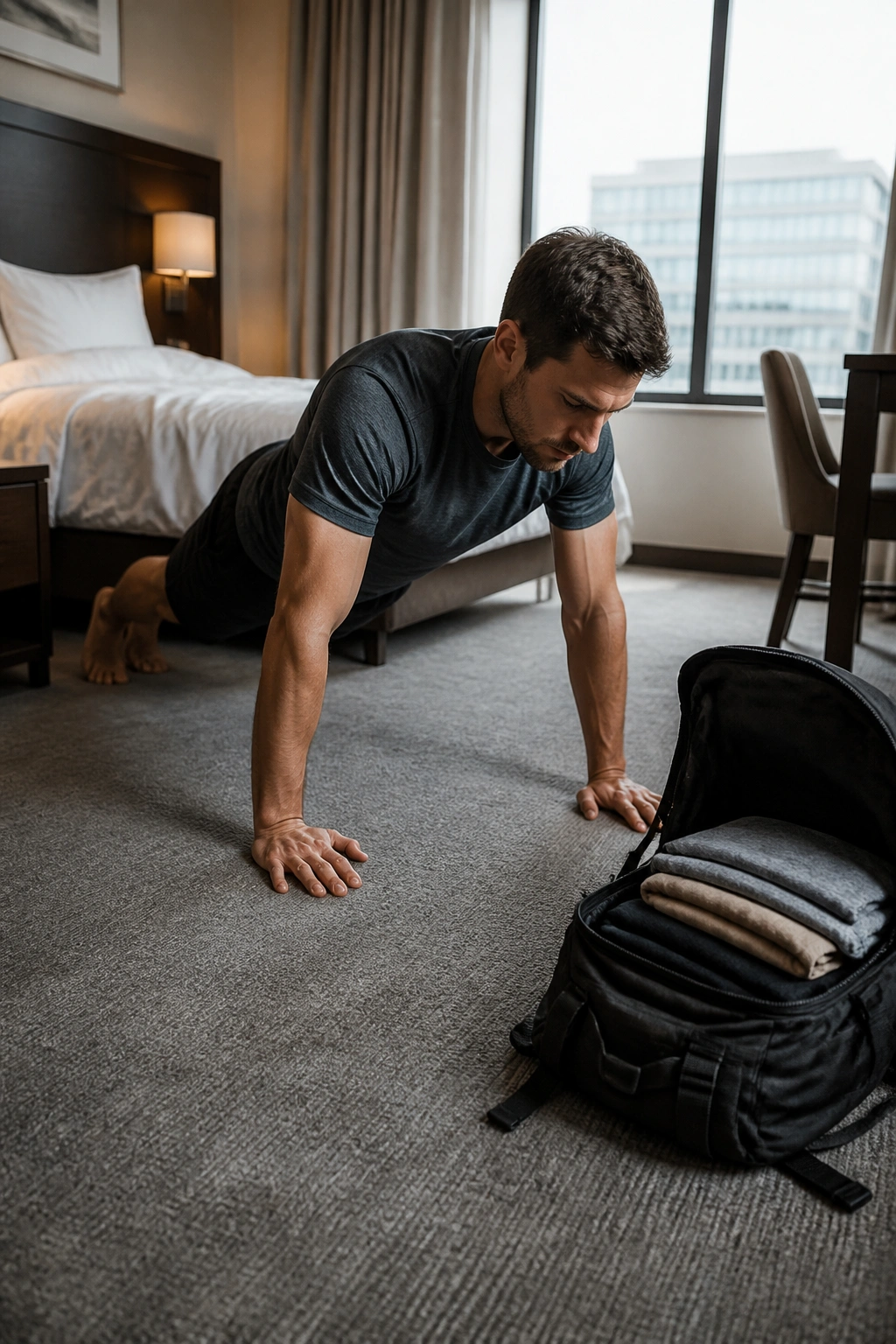
A hotel room and a suitcase are enough to keep the habit alive.
Travel usually breaks training because people think the workout has to look the same as it does at home. It does not. A travel plan uses bodyweight, bands, a backpack, or a suitcase for load. Push-ups, split squats, planks, glute bridges, band rows, and calf raises all fit into a small space.
What to pack for the page
- Mini band or long resistance band
- One loop to anchor safely
- A folded workout sheet or notes app
- One backpack you can load with clothes or books
Keep the sessions short: 15 to 25 minutes is enough. Travel workouts are about preserving rhythm, not proving toughness in a room with thin walls and a questionable carpet.
The best part? You can print the same template every trip and barely think about it. That saves a surprising amount of mental energy.
24. Minimalist Two-Day Maintenance Plan

Sometimes the week falls apart. Two days still work.
A minimalist maintenance plan is for busy spells, rough schedules, or anyone who wants the least amount of training that still keeps the machine running. Two full-body sessions a week can hold on to strength and muscle better than doing nothing, and for some people that is the exact win they need.
Each day should hit squat or hinge, push, pull, and carry or core. Keep it to 4 to 5 moves. Keep the reps in a sane range. Do not turn the session into a scavenger hunt for extra exercises.
This is not the flashy choice. I like it because it respects reality. If two strong sessions keep you on track, that is better than a grand plan you never finish.
25. Repeat and Track

The cleanest printable workout plan is the one that survives four weeks without getting messy.
I like this final template because it turns all the other ideas into one simple habit: repeat the same structure, write the numbers, and chase a tiny improvement next time. That might mean one more rep on the last set, 2.5 to 5 pounds more on a barbell lift, or one extra round on a circuit. Small wins are not glamorous. They are also how progress actually happens.
What to write in the margin
- Date
- Exercise
- Sets and reps
- Load used
- Rest time
- One note about form or energy
Keep the plan on a single page if you can. If the sheet gets too crowded, people stop using it. Then the workout becomes guesswork again, and guesswork is expensive in effort.
Print one plan. Run it for a few weeks. Mark the boxes. Then run it again with a little more on the bar, one cleaner rep, or one less excuse. That is usually enough.
