



Stubborn adipose tissue, particularly around the midsection, has frustrated human beings for as long as we have been conscious of our silhouettes. The truth is simple, though often unwelcome: you cannot spot-reduce fat. Doing a thousand crunches will build abdominal muscle, but it will not magically incinerate the layer of fat sitting on top of those muscles. The only way to lose visceral fat is to create a sustained caloric deficit and drive your metabolic rate high enough that your body is forced to mobilize stored energy.
High-Intensity Interval Training, commonly known as HIIT, is the most effective tool in the kit for achieving this. Unlike steady-state cardio, which trains the body to be efficient at burning calories, HIIT trains the body to be inefficient—in a good way. By pushing your heart rate to near-maximal levels for short bursts, followed by brief recovery periods, you trigger a physiological state known as Excess Post-exercise Oxygen Consumption, or EPOC. Your body continues to burn calories at an elevated rate for hours after the workout ends, effectively turning you into a metabolic furnace.
The key to HIIT success is not just effort, but structure. If you are training at 60 percent of your maximum heart rate, you are not doing HIIT; you are doing cardio. You need to be pushing into that uncomfortable 85-to-95 percent range. This intensity is physically taxing, which is why HIIT sessions are—and should be—short. If you can sustain the workout for 45 minutes, you are not working hard enough. The following protocols are designed to be efficient, brutal, and effective. Choose one, execute it with everything you have, and move on with your day.
1. The Classic Tabata Sprint Protocol

The Tabata method is the gold standard of interval training because it is mathematically rigid. It leaves zero room for slacking. You work for 20 seconds, you rest for 10 seconds, and you repeat that cycle eight times. That is it. The entire workout takes exactly four minutes. If you do it correctly, you will be unable to speak by the end of it.
How to Execute This Properly
- Warm-up: Do not skip this. Spend five minutes jogging or doing dynamic stretches before starting the clock.
- The Sprint: During the 20-second work phase, move as fast as you physically can. If you are running, it should be a near-maximal sprint. If you are on a bike, your RPMs should be skyrocketing.
- The Rest: During the 10-second rest, do not sit down. Keep moving slowly. You need to keep the blood flowing to prevent dizziness.
Pro tip: Use a dedicated timer app that beeps loudly. Do not look at your watch. Focus entirely on the movement. If you have the energy to check the time, your intensity is too low.
2. The EMOM Burpee Challenge
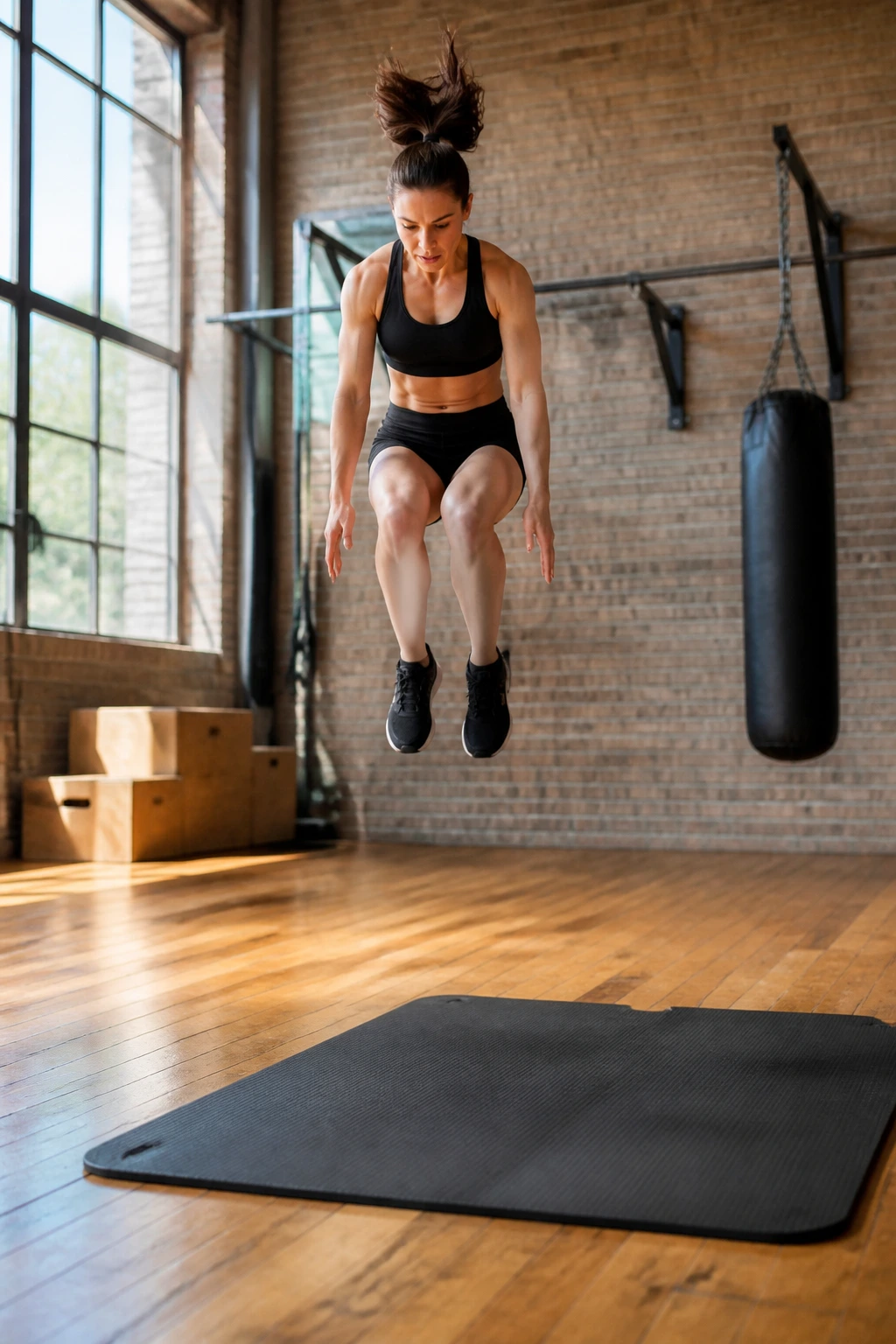
EMOM stands for “Every Minute on the Minute.” It is a beautiful way to enforce pacing while keeping the intensity high. You set a timer for 10 to 15 minutes. At the start of every minute, you perform a set number of burpees. Whatever time is left in that minute serves as your rest.
If you choose a target of 10 burpees per minute, and it takes you 40 seconds to finish them, you earn 20 seconds of rest. If you are too slow and it takes 55 seconds, you only get 5 seconds of rest. The fatigue accumulates, and the recovery window shrinks. It is a self-regulating workout that forces you to confront your own pacing capabilities. By the end of the 15th minute, you will likely be staring at the floor, wondering why you chose such a difficult number. Start with 8 to 10 burpees and adjust based on your fitness level.
3. High-Speed Jump Rope Intervals

Skipping rope is not just a playground activity; it is one of the most efficient tools for burning calories per minute. The coordination required engages your core, shoulders, and calves simultaneously. When you layer intervals on top of this, it becomes a devastating fat-burning machine.
The Protocol
- Interval 1: 45 seconds of max-effort jump rope (try double-unders if you are skilled).
- Interval 2: 15 seconds of rest.
- Repeat: Cycle this for 10 rounds.
The benefit here is the proprioception. Because you have to stay light on your feet, your core is constantly braced to stabilize your landing. If you trip, do not get frustrated—that is wasted time. Reset immediately and jump back into the rhythm. Over time, your efficiency will improve, which means you can jump faster and burn more energy.
4. The Kettlebell Swing Ladder

Kettlebell swings are a hinge movement, not a squat. When done correctly, they target the posterior chain—your hamstrings, glutes, and lower back—which are the largest muscle groups in your body. Working these large muscles spikes your heart rate almost instantly.
The ladder format keeps the workout mentally engaging. Start with 10 swings, rest for 30 seconds. Then 15 swings, rest for 30 seconds. Then 20 swings, rest for 30 seconds. Then 25 swings. Once you hit the peak of the ladder, work your way back down (25, 20, 15, 10). Because the volume changes, you cannot get comfortable with a specific pace. You are forced to adjust your breathing and effort level as the work capacity demands fluctuate. If the 25-swing set feels too easy, you are likely using a weight that is too light. Go heavier.
5. Battle Rope Power Sprints

Battle ropes are deceptive. They look like arm exercises, but the sheer metabolic demand of moving those thick, heavy ropes creates a full-body fatigue that is hard to replicate. You are essentially using your core to anchor your body while your arms and shoulders oscillate the rope.
Try 30 seconds of high-intensity waves, followed by 30 seconds of active recovery—perhaps light jogging or marching in place. Aim for 10 rounds. The trick is to keep your core engaged the entire time. If you allow your back to round, you lose the power transfer from your hips to your arms, and the movement becomes inefficient. Keep a tight, athletic stance with your knees slightly bent. This anchors you and ensures the energy is directed into moving the ropes, not compensating for poor balance.
6. The Mountain Climber and Plank Complex

This protocol targets the midsection directly while keeping the heart rate elevated. It is a brutal way to tax the core muscles while forcing the cardiovascular system to keep up.
The Breakdown
- Move 1: 40 seconds of high-speed mountain climbers, driving your knees toward your chest as if you are trying to touch your elbows.
- Move 2: 20 seconds of a static high plank hold. Focus on squeezing your glutes and abs, not just holding your body weight.
- Cycle: Perform this for 8 rounds without stopping.
The secret to this workout is the transition. There is no rest between the mountain climbers and the plank. The muscle tension switches from dynamic movement to static holding, which causes a buildup of lactic acid. Embrace that burn; it is a sign that you are pushing into the necessary intensity to trigger metabolic changes.
7. Medicine Ball Slam Intervals

Slamming a medicine ball is a primal movement. It allows you to exert maximum force into the ground, which is surprisingly therapeutic and incredibly effective for burning calories. This is a full-body power movement—you use your legs, core, and lats to bring the ball overhead and slam it down with explosive force.
For this HIIT session, perform 20 slams as fast as you can. Your rest is the time it takes to walk across the room and retrieve the ball, or 30 seconds, whichever is shorter. Aim for 10 to 12 sets. The intensity here comes from the speed of the slam and the height of the lift. Do not just drop the ball; throw it. The harder you throw, the more work your muscles have to do to decelerate the ball and pick it back up.
8. The Rowing Machine 500-Meter Sprint

If you have access to a rowing machine, you have the ultimate HIIT tool. Rowing is low impact but extremely high demand. It engages roughly 86 percent of the muscles in your body, from your quads to your deltoids.
The workout is simple: row 500 meters at your absolute maximum capacity. Note the time it takes you to finish. Rest for two minutes, then repeat. Aim for 4 to 5 rounds. The goal is to keep your split times consistent across every single round. If your first round takes 1:45 and your final round takes 2:15, you paced the first round too conservatively. You want to be on the verge of total exhaustion by the time you reach the 400-meter mark of each set.
9. Box Jump and High-Knee Circuit

Explosive movements are excellent for burning through glycogen stores and spiking the heart rate. This circuit combines a jump with a sustained cardiovascular movement. It is a fantastic way to improve athletic conditioning.
Start by performing 10 box jumps. As soon as your feet touch the floor on the last jump, immediately transition into 30 seconds of high knees. Rest for 45 seconds. Perform 6 to 8 rounds of this. The box jumps demand focus and power, while the high knees demand endurance. If you find the box jumps too intimidating, step up instead of jumping, but ensure you are moving quickly and driving through your heels. Always prioritize a soft landing.
10. The Dumbbell Thruster Burnout

The thruster is a combination of a front squat and an overhead press. It is arguably the most demanding single movement in strength training because it forces blood to travel from your legs to your shoulders and back down again constantly.
Choose a pair of moderate-weight dumbbells—something you can press overhead 15 times but would struggle to do for 30. Perform 15 thrusters, then rest for 30 seconds. Repeat this for 10 sets. Because the thruster forces your heart to work against gravity in both directions, your heart rate will skyrocket. Keep your core braced during the entire overhead portion to protect your lower back. If your form starts to break down, drop to a lighter weight rather than risking an injury.
11. The Assault Bike Pyramid

The assault bike, often called the “air bike,” is arguably the most punishing machine in the gym. The harder you pedal, the more resistance the fan provides. There is no way to cheat the resistance.
Try a pyramid scheme:
- Pedal for 15 seconds, rest for 15 seconds.
- Pedal for 30 seconds, rest for 30 seconds.
- Pedal for 45 seconds, rest for 45 seconds.
- Pedal for 60 seconds, rest for 60 seconds.
- Work your way back down the pyramid (45, 30, 15).
You will reach a point in the 60-second round where your lungs feel like they are on fire. That is the point where the physiological change happens. Stay seated, keep your back straight, and keep pushing.
12. Plyometric Lunge Sequence

Lunges are great for leg strength, but jump lunges (plyometric lunges) are a cardiovascular nightmare—in the best way possible. By adding the jump, you force your body to decelerate and accelerate under tension, which is a potent trigger for calorie expenditure.
Perform 20 jump lunges (10 per leg). Rest for 30 seconds. Perform 10 rounds. Because this is a high-impact movement, ensure you are landing on a surface that has some cushion, like a gym mat or turf. If your knees bother you, skip the jump and perform rapid, explosive standard lunges instead. The intensity should come from the speed of the switch, not the height of the jump.
13. The Sandbag Carry and Squat Combo

Sandbags are “live” weight. Unlike a barbell, which is balanced, sand shifts inside the bag, forcing your stabilizer muscles to work overtime to keep you upright. This turns a simple squat into a core-stability exercise.
Shoulder a sandbag and perform 15 squats. Immediately drop the bag and carry it in your arms (like a bear hug) for a 30-second brisk walk. Rest for 30 seconds. Repeat 8 times. The instability of the bag will force you to brace your abdominal wall much harder than you would with iron weights. This is not just about your legs; it is a full-torso integration workout.
14. The Deck of Cards Bodyweight Workout

This is the ultimate “no equipment” HIIT protocol. Take a standard deck of playing cards. Assign an exercise to each suit. For example:
- Hearts: Push-ups
- Diamonds: Squats
- Clubs: Mountain climbers
- Spades: Burpees
Flip the top card. The number on the card is the number of reps you perform. If it is a face card, do 10. If it is an Ace, do 15. Flip through the entire deck. The lack of a set timer makes this unpredictable, which keeps your brain engaged and prevents you from mentally checking out. The rest time is strictly the time it takes you to flip the next card and get into position.
15. Renegade Row and Push-Up Superset

The renegade row is a plank position exercise where you hold dumbbells and alternate rowing them to your hip. It is a fantastic anti-rotational core movement. Pairing it with a push-up creates a comprehensive upper-body and core blaster.
Perform 10 renegade rows (5 per arm), then drop the weights and perform 10 push-ups. Rest for 45 seconds. Perform 8 sets. Because you are maintaining a plank position for both movements, your core is under constant isometric tension. This is one of the best ways to train the abdominal muscles for functional stability rather than just aesthetic vanity.
16. The Speed Skater Plyo Circuit

Speed skaters involve leaping laterally from one leg to the other, mimicking the movement of a speed skater. This plane of movement—lateral motion—is often neglected in standard workouts, yet it is vital for hip health and explosive power.
Perform 45 seconds of continuous lateral jumps, staying low to the ground and pushing off your outside leg with power. Rest for 15 seconds. Perform 10 rounds. The focus should be on distance and stability. Do not just hop; jump wide and land softly. You should feel your glutes working overtime to stop your momentum before you jump back the other way.
17. Outdoor Sprint-Walk Intervals

Sometimes the best equipment is just the sidewalk or a track. Sprint-walk intervals are the purest form of HIIT. Go to a track or a long stretch of flat road. Sprint at 90 percent effort for 100 meters, then walk for 100 meters. Repeat for 20 minutes.
The simplicity is the point. You do not need a gym or a fancy machine. You just need to be honest about your speed. If your “sprint” feels like a jog, you are not engaging the fast-twitch muscle fibers required for the EPOC effect. Force yourself to run until you feel like you are going to fall over, then walk just long enough to catch your breath before sprinting again.
18. Shadow Boxing HIIT

Shadow boxing is a favorite of professional fighters because it forces you to move your feet, rotate your core, and keep your hands up simultaneously. You are creating a “ghost” opponent.
Throw combinations for 60 seconds straight. Ensure you are punching with intent—snap your punches and retract them quickly. Then, rest for 30 seconds. Repeat 10 rounds. To make it harder, hold very light (1 or 2-pound) dumbbells. The added weight will fatigue your shoulders quickly, and the constant rotation required to punch will fire up your obliques and deep abdominal muscles.
19. The L-Sit Hold and Crawl Complex

This is an isometric and dynamic core workout that is exceptionally difficult. An L-sit (where you support your body on your hands with legs straight out) is a pure core-compression move.
Perform a 20-second L-sit (or tuck sit if you are a beginner), then immediately perform 30 seconds of bear crawls. Rest for 30 seconds. Perform 6 rounds. The L-sit requires significant abdominal strength, and the bear crawl forces you to coordinate your limbs while keeping your core perfectly still. If you cannot do a full L-sit, use parallel bars and keep your knees tucked to your chest.
20. Tire Flip and Hammer Slam

If you have access to a gym with strongman equipment, this is the ultimate test of power. Flipping a tire requires a deadlift, a clean, and a press all in one motion. It is an incredibly demanding full-body exercise.
Flip a tire 5 times, then grab a sledgehammer and slam a different tire 10 times. Rest for 60 seconds. Repeat 5 rounds. This is a high-intensity protocol that will test your grip strength, back endurance, and cardiovascular capacity. Always lift with your legs, not your lower back. If the tire is too heavy to flip with proper form, find a smaller tire. It is about the movement, not the weight.
21. Lateral Shuffle and Touchdown Drills

Athletic agility drills are fantastic for fat loss because they require constant directional changes, which forces the body to burn through energy reserves rapidly to fuel the braking and acceleration phases.
Shuffle laterally for 10 feet, touch the ground, shuffle back to the start, and touch the ground. Keep this up for 45 seconds. Rest for 15 seconds. Perform 10 rounds. The key is to stay low in a defensive crouch position. The lower you stay, the more your quads and glutes have to work. You are essentially doing a squat hold while moving laterally.
22. The 30-20-10 Running Protocol

This is a running technique developed by elite coaches to improve aerobic capacity quickly. It is essentially a warm-up, a work phase, and a sprint phase.
For every lap of a track or every minute of running:
- Run at a slow, comfortable jog for 30 seconds.
- Run at a moderate, “tempo” pace for 20 seconds.
- Sprint at 90 percent effort for 10 seconds.
- Repeat without stopping for 15 to 20 minutes.
The rapid change in pace prevents your body from settling into a steady rhythm. Your heart rate will spike during the 10-second sprint, and the 30-second slow jog won’t be enough to fully recover, meaning the fatigue builds up throughout the entire session.
23. TRX Suspension Trainer HIIT

TRX straps are excellent for HIIT because they allow you to modify the resistance instantly by changing the angle of your body. You do not need to drop weights or change machines; you just move your feet.
Create a circuit: 30 seconds of TRX rows, 30 seconds of TRX atomic push-ups (feet in the straps, knees to chest), 30 seconds of TRX lunges. Rest for 30 seconds. Repeat 5 rounds. The instability of the straps means your core is engaged in every single movement. You are fighting for balance while you are fighting for breath. That combination is a rapid-fire way to increase caloric burn.
24. The Battle Rope and Plank Hybrid

Combining the high-intensity oscillation of battle ropes with the static stability of a plank forces your core to work in two different ways—dynamic stabilization and static bracing.
Perform 30 seconds of alternating waves with the battle ropes, then immediately drop to the floor and hold a plank for 30 seconds. Rest for 30 seconds. Repeat 8 rounds. This is a brutal combination because your heart rate is already redlining from the ropes, and then you have to force your muscles to stabilize under that high-stress cardiovascular load. It will teach you how to remain calm and controlled while your heart is pounding.
25. The Final Finisher

This is not a single movement; it is a cumulative burnout designed to ensure you leave the gym having emptied the tank. It combines several movements into one continuous block.
Set a timer for 5 minutes. You must perform:
- 10 Burpees
- 20 Mountain Climbers
- 30 Jumping Jacks
- 40 High Knees
Cycle through these as many times as you can in the 5-minute window. Do not stop. Do not slow down. This is the ultimate “empty the tank” workout. The structure is simple, but the intensity is entirely up to you. If you finish this and you are not gasping for air, you cheated the intensity.
Final Thoughts
Burning belly fat is rarely about finding the “perfect” exercise; it is about finding the willingness to work hard enough to trigger a physiological response. HIIT works because it is inefficient, exhausting, and demanding. It forces your body to adapt by becoming stronger and more metabolically active.
Remember that movement is only half the equation. You cannot out-train a diet that consistently puts you in a caloric surplus. If you are doing these workouts at 100 percent intensity but eating in a way that negates the deficit, the stubborn fat around your midsection will stay exactly where it is. Treat these workouts as the engine, but remember that nutrition is the fuel. Stay consistent, stay intense, and give your body the proper recovery time it needs to rebuild.
