



The alarm clock rings, and the mental calculation begins. You have thirty minutes—maybe forty, if you skip breakfast—before the day demands your full attention. Most people assume that such a narrow window makes a productive workout impossible. They settle for a lackluster stretch or a sluggish walk, convinced that unless they spend an hour at the gym, the effort won’t count. High-Intensity Interval Training, or HIIT, shatters that misconception entirely. It isn’t about how much time you clock in; it is about the intensity you bring to every second of that clock.
When you push your heart rate into those anaerobic zones for short, controlled bursts, you trigger a metabolic response that keeps working long after you finish. This process, often referred to as the afterburn effect or excess post-exercise oxygen consumption (EPOC), means your body continues to burn calories as it repairs and replenishes its systems. It is essentially forcing your metabolism to run a marathon while you are already back at your desk.
The beauty of these protocols lies in their brutal efficiency. You do not need expensive machines or a sprawling fitness center. You need floor space, a timer, and the willingness to be uncomfortable for short intervals. Whether you are recovering from a long layoff or you are an athlete looking to break through a performance plateau, there is a specific intensity profile that fits your needs. The following workouts provide the structure; your job is to provide the grit.
1. 15-Minute Bodyweight Basics
Time is the most common excuse for missing a workout, but fifteen minutes is enough to completely exhaust your glycogen stores if you move with purpose. This routine focuses on fundamental human movements—squats, lunges, and pushes—that engage the largest muscle groups. When you use your legs, glutes, and core, you demand more oxygen and force your heart to beat faster than it would with isolated bicep curls.
How to execute the protocol
- Squats: Perform for 40 seconds at a steady, controlled pace.
- Push-ups: 40 seconds, focusing on full range of motion.
- Reverse Lunges: 40 seconds, alternating legs.
- Plank Hold: 40 seconds, keeping the core braced.
- Rest: 20 seconds between movements.
Repeat this entire circuit three times. By the end of the third round, your legs should feel heavy, and your breath should be short. That is the point. Do not rush the form just to finish the interval; sloppy form is a one-way ticket to injury.
2. Low-Impact Walking HIIT
Joint pain often keeps people away from high-intensity training, but HIIT does not require jumping or sprinting. Walking, when done with aggressive intent and incline, can elevate your heart rate significantly without the jarring impact of plyometrics. This is an excellent entry point for anyone with sensitive knees or lower back issues.
Why this works
You are trading explosive power for sustained resistance. Find a treadmill or a steep outdoor hill. Walk at a brisk pace that makes holding a conversation difficult, but not impossible. The “work” interval comes from cranking the incline to the maximum setting you can handle safely. Keep your posture tall. Do not hold onto the handrails, as that shifts the workload away from your glutes and core. If you find yourself needing to grip the rails, the incline is too steep for your current ability.
3. The 20-Minute Stationary Bike Protocol

Cycling is arguably one of the most effective ways to drive heart rate up while keeping impact low. The stationary bike allows you to dump energy into the pedals without worrying about balance or coordination. This session uses a 1:2 work-to-rest ratio, which is ideal for building aerobic capacity while introducing your body to high-effort output.
The sequence
Spend five minutes warming up at a moderate, easy-breathing pace. Then, transition into the work intervals. Pedal as hard as you can for 30 seconds—aim for high resistance or high cadence—then pedal at a very slow, recovery pace for 60 seconds. Repeat this cycle ten times. Finish with a five-minute cool-down. The key here is the drop-off in intensity during the 60-second recovery. If you do not go truly slow, you will not be fresh enough to hit maximum power during the next 30-second burst.
4. EMOM Strength Intro

EMOM stands for “Every Minute on the Minute.” It is a deceptively simple way to track volume. You start a timer, perform a set number of repetitions, and then rest for the remainder of that minute. If your work takes 30 seconds, you get 30 seconds of rest. If it takes 45 seconds, you get only 15. This structure forces you to manage your pace.
The workout structure
Set your timer for 12 minutes. For the first minute, perform 12 bodyweight squats. For the second minute, perform 8 push-ups. For the third minute, perform 20 mountain climbers. Repeat this sequence four times. The danger in an EMOM is starting too fast. If you crush the first two minutes, you will find yourself unable to finish the reps in the later minutes. Pace yourself as if you have to complete the final round exactly like the first.
5. Seated HIIT for Mobility

Not all HIIT requires standing or running. If you are rehabbing an injury or lack mobility, seated HIIT on a bench or sturdy chair can still provide a massive cardiovascular stimulus. This style of training targets the core and upper body while maintaining a high heart rate through rapid, rhythmic movement.
Movements to include
Focus on seated torso twists, chair leg extensions, and rapid seated boxing punches. The secret is the speed of execution. Because you are seated, you must compensate for the lack of lower-body engagement by moving your arms and core with explosive speed. Keep the transitions between exercises minimal. You should be dripping sweat within the first ten minutes. It is humbling work, but it is highly effective for maintaining fitness when your lower body is sidelined.
6. Tabata Bodyweight Circuit

Tabata is the gold standard of high-intensity training protocols. The math is rigid: 20 seconds of all-out effort followed by 10 seconds of rest, repeated eight times for a total of four minutes per block. It sounds easy on paper, but four minutes of true Tabata is incredibly taxing.
Building your block
Choose one move, such as jumping jacks or burpees. Perform it for 20 seconds, rest 10, and repeat eight times. After the four minutes, rest for two minutes, then start a new four-minute block with a different movement, like mountain climbers. Your muscles will scream, and your lungs will burn. Do not underestimate the ten seconds of rest. It is just enough to catch a single breath—use it wisely.
7. Kettlebell Swing Intervals

The kettlebell swing is a full-body powerhouse. It builds posterior chain strength—glutes, hamstrings, and lower back—while providing a massive cardiovascular spike. Because you are using a weight to generate momentum, the metabolic demand is significantly higher than bodyweight movements alone.
Tips for form
Your back must remain neutral throughout the movement. The power comes from the hips snapping forward, not from pulling the bell up with your arms. If you feel the strain in your lower back rather than your glutes, you are using a weight that is too heavy or your hinge is incorrect. Aim for 45 seconds of swinging, followed by 15 seconds of rest. Perform this for ten rounds. It is simple, minimalist, and punishingly effective.
8. Ladder Workout

Ladder workouts add a layer of mental fatigue to the physical challenge. You start with a high number of repetitions, decrease by one or two each round, and finish at the bottom. This structure is great because the work intervals get shorter as you get tired.
The sequence
Start with 10 repetitions of each exercise: burpees, squats, and push-ups. Do 10 of each. Then do 9 of each. Then 8. Continue all the way down to 1. By the time you reach the final rounds, you will be moving fast. This creates a sprint-finish feel that helps maintain high intensity even when your muscles are screaming for a break.
9. Battle Rope Cardio Surge

Battle ropes are fantastic because they isolate the upper body while driving the heart rate to near-maximum levels. Unlike weightlifting, where you have a lifting and lowering phase, ropes keep the tension constant. This continuous tension is what creates the “burn” that HIIT enthusiasts crave.
How to use them
Do not just flail the ropes around. Use your core. Create waves with controlled, forceful arm movements. A classic HIIT interval with ropes is 30 seconds of work and 30 seconds of rest. For the work phase, alternate between double-arm slams, alternating waves, and lateral whips. If you go for 30 seconds without stopping, your grip strength will fail long before your lungs do. This is normal. Push through the forearm fatigue.
10. Plyometric Power Builder

Plyometrics—jumping and explosive movements—are the quickest way to increase your vertical power and metabolic rate. This plan is not for beginners, but if you have a solid foundation, it will produce rapid changes in body composition.
Exercise selection
- Box Jumps: Focus on a soft landing.
- Broad Jumps: Focus on distance and explosive takeoff.
- Split Squat Jumps: Focus on the transition between legs.
Because these moves are high-impact, limit your work intervals to 20 seconds. Take 40 seconds of rest between each set. You need that extra rest to ensure every rep is as explosive as possible. If you are slow or sluggish, you aren’t doing plyometrics; you are just jumping. Power requires maximum effort on every single rep.
11. AMRAP Challenge

AMRAP stands for “As Many Rounds As Possible.” This is the ultimate test of self-regulation. You set a timer for 20 minutes, and your goal is to finish as many circuits of a specific list of exercises as you can. Unlike an EMOM, there is no forced rest. You rest only when you need to.
The strategy
The trap in AMRAP is starting too quickly. If you sprint through the first two rounds, you will hit a wall at the 10-minute mark. Instead, find a pace that is “comfortably uncomfortable.” Move steadily. Do not stop to check your phone or drink water for long periods. Your transitions between exercises should be seamless. If you finish a set of squats, go directly to the push-ups without standing around.
12. Rowing Machine Endurance Intervals

The rower engages the entire body—legs, back, shoulders, and core. It is the perfect tool for long, grinding HIIT sessions. Because you can track your “split time” (pace per 500 meters) on the monitor, it is easy to see exactly when your intensity is dropping.
Managing the interval
Try a 500-meter sprint interval. Row 500 meters as fast as you can, then row at a light, easy pace for 90 seconds. Repeat this five times. If your first 500 meters is significantly faster than your last, you started too aggressively. Aim to keep your split times within 3-5 seconds of each other across all five intervals. That consistency is what builds true athletic engine capacity.
13. The 40/20 Full-Body Burner

Most people default to 30/30 or 45/15 intervals. The 40/20 split is a middle ground that challenges your endurance for a slightly longer work duration while keeping the rest short enough that your heart rate never fully returns to baseline. It is a grueling, effective middle ground for intermediate athletes.
The protocol
Choose four compound exercises: thrusters (squat to overhead press), kettlebell swings, plank-to-push-up, and lateral lunges. Perform the first exercise for 40 seconds, rest 20. Then move to the second. Do all four exercises for 40/20 to complete one round. Repeat the round four times. By the time you reach the thrusters in the fourth round, your shoulders will be burning. Keep moving.
14. Burpee-Heavy Metabolic Conditioning

Burpees are the love-it-or-hate-it king of HIIT. They require no equipment, they work every muscle, and they get your heart rate up faster than almost anything else. If you want to melt fat, this is your primary tool.
Scaling the burpee
If a full chest-to-floor burpee is too difficult, start with a “no-push-up” burpee or an “up-down.” The key is the transition from standing to the floor and back to standing. Perform 10 burpees every 90 seconds. If it takes you 30 seconds to finish, you get 60 seconds of rest. If it takes 45 seconds, you get 45 seconds of rest. This is a self-pacing drill that forces you to work harder to earn your rest time.
15. Hill Sprints and Recovery Intervals

There is something primal about running up a hill. It removes the ability to overstride and forces you into a strong, leaning posture. Hill sprints are much easier on the joints than sprinting on flat pavement because your foot strikes the ground earlier, reducing the impact.
How to do it right
Find a hill that takes about 15-20 seconds to sprint up. Run up at 90-95% effort. Do not sprint at 100% on the first rep; you will pull a hamstring. Once you reach the top, walk back down slowly. That walk down is your recovery. Repeat this 8 to 12 times. This workout will leave you more exhausted than a long, slow 5-mile run, but it will take a fraction of the time.
16. The “Death by” Reps Protocol

This is a variation of the EMOM but with an increasing rep count. You start at one repetition and add one rep every minute. It is called “Death by” because, eventually, the workload will exceed the time you have in the minute.
The execution
Start with burpees. Minute 1: 1 burpee. Minute 2: 2 burpees. Minute 3: 3 burpees. Keep adding one rep each minute until you cannot finish the required number of reps before the clock strikes the next minute. It is a simple, effective way to find your current fitness limit. If you fail at minute 10, you know exactly where your current baseline sits. Next time, try to push to minute 11.
17. Partner-Assisted HIIT Drills

Training with a partner adds a layer of accountability that you cannot replicate on your own. When you know someone is waiting for you to finish your set so they can start theirs, you don’t slack off.
The “I-Go, You-Go” style
One partner performs the work interval while the other rests. For example, use a heavy bag or jump rope. Person A works for 45 seconds. As soon as Person A stops, Person B starts. This creates a relentless cycle with zero downtime for the group. It also adds a competitive element, as partners tend to match or try to beat each other’s intensity.
18. Sandbag Explosive Movements

Sandbags are “live” weights. Unlike a dumbbell, which is stable, the sand shifts inside the bag. This forces your stabilizing muscles to work overtime. Sandbag training feels heavier than it looks because of this shifting center of gravity.
Recommended exercises
- Sandbag Cleans: Pulling the bag from the floor to your shoulders.
- Sandbag Bear Hug Squats: Holding the bag against your chest while you squat.
- Rotational Lunges: Carrying the bag and twisting as you step.
Perform these for 40 seconds on, 20 seconds off. The instability of the sandbag will challenge your grip and core in a way that traditional gym equipment never can.
19. Jump Rope Speed Work
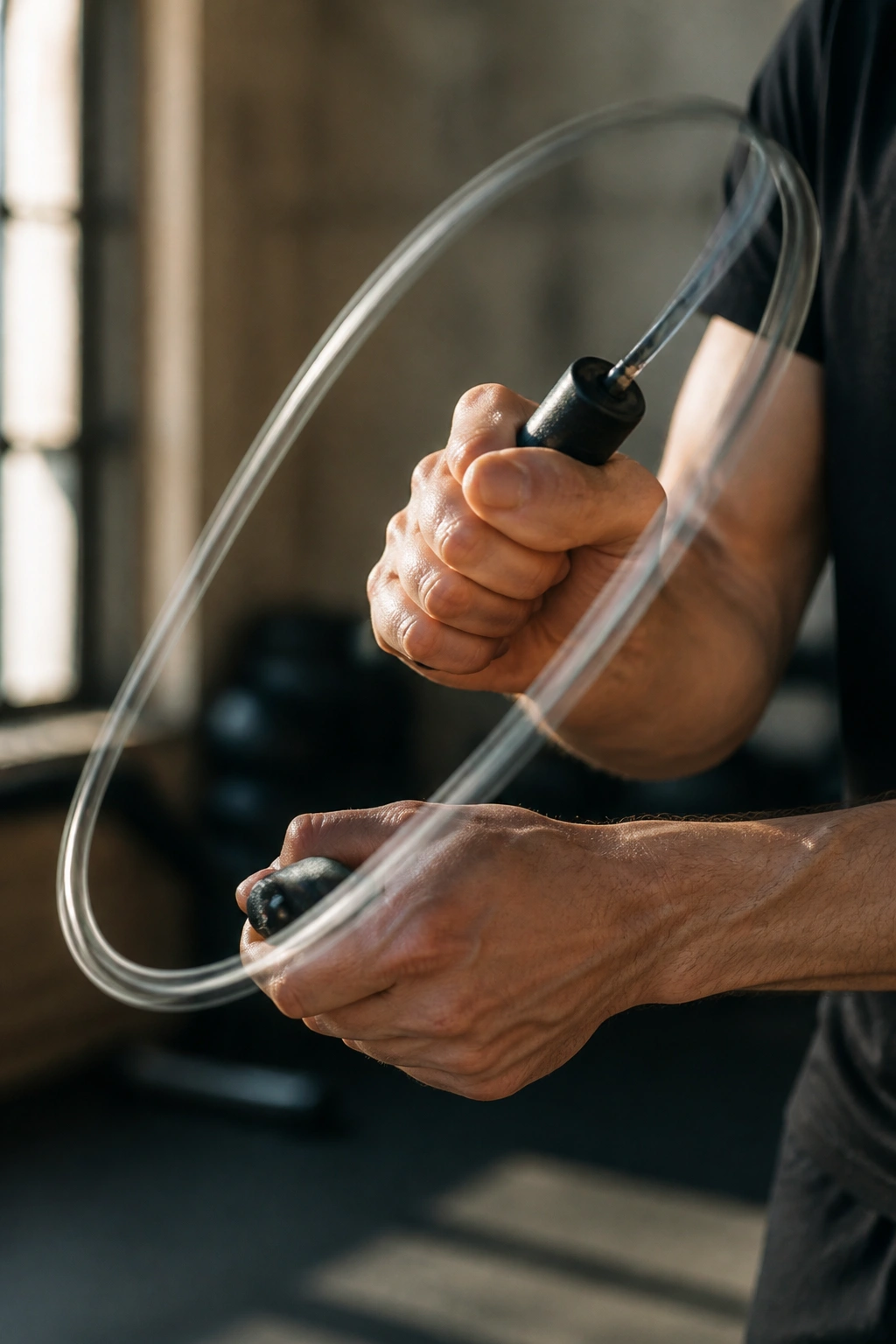
The jump rope is a tool often dismissed as a playground toy, but professional boxers have used it for decades for a reason. It builds coordination, calf endurance, and rapid-fire cardiovascular conditioning. It is also an excellent tool for training “light feet.”
Progression
Do not worry about double-unders right away. Start with basic bouncing. Focus on keeping your hands close to your waist and using your wrists to turn the rope, not your shoulders. If you trip, don’t worry about it. Just keep moving. A great interval is 60 seconds of jumping, followed by 30 seconds of rest. Repeat for 15 minutes. It will do wonders for your conditioning.
20. Dumbbell Thruster Complex

The thruster is a combination of a front squat and an overhead press. It is a full-body movement that is incredibly demanding on the cardiovascular system. By keeping the dumbbells at shoulder height, you create a massive demand on the core to keep you upright.
Keeping intensity high
Use moderate weights. You are not trying for a one-rep max; you are trying to keep the movement fluid for 45 seconds. If the weight is too heavy, your form will break down. If it is too light, you won’t get the stimulus. Aim for a weight you can press for 15 solid reps when fresh. Then, perform them in a 45-on, 15-off format for 10 minutes.
21. Medicine Ball Slam HIIT

Medicine ball slams are pure aggression. They work the lats, shoulders, and core while allowing you to dissipate frustration. Because you are throwing the ball down, the eccentric phase (the lowering) is mostly gravity, meaning you can put 100% effort into the slamming phase.
Technical note
Don’t just round your back and drop the ball. Squat down with a straight back, pick it up, extend fully overhead, and then throw it into the ground with your entire core. The slam should be a “total body crunch.” Do this for 30 seconds, followed by 30 seconds of active recovery, like walking or light jogging in place.
22. Box Jump and Agility Drill

This session combines explosive power with lateral movement. Agility is often neglected in standard HIIT, but it is crucial for real-world functionality and coordination.
The setup
Place a box or a bench in the center of the room. You will jump onto the box, step down, and then perform lateral shuffles or “skater” hops for 30 seconds. The box jump provides the vertical explosive power, while the skater hops provide lateral plane movement. This combination works the legs from multiple angles, preventing the repetitive-motion fatigue that often sets in during long cardio sessions.
23. TRX Suspension Trainer HIIT

Suspension trainers use your own body weight and gravity to create resistance. Because the handles are unstable, you are forced to engage your deep core muscles throughout the entire set. It is arguably the best tool for functional core training.
How to use it
- Rows: Lean back and pull yourself up.
- Chest Press: Lean forward and push yourself away.
- Hamstring Curls: Lie on your back and pull your heels toward your glutes.
Perform these three exercises back-to-back without stopping. Then take a 60-second rest. The TRX allows for instant adjustments—if a move feels too hard, just walk your feet back to decrease the angle. If it feels too easy, walk them forward. This makes it an ideal tool for circuit-style HIIT.
24. The 30-Second Treadmill Dash

This is pure speed work. It is designed to get you comfortable with running at a pace that feels “too fast.” Most people jog at a moderate pace for too long. This protocol flips that by making the work interval so short that you have to sprint.
The numbers
Set the treadmill to a speed you can only sustain for 30-40 seconds. Perform a 30-second sprint, then hop off the sides (be careful, hold the rails) or slow the belt down to a walk for 60 seconds. Repeat 10 times. You aren’t building long-distance endurance here; you are building explosive speed and the ability to recover from high-effort bursts.
25. The “All-Out” Calisthenic Finisher

Sometimes you just want to empty the tank. This final workout is designed to be a finisher—something you do at the very end of a regular lifting session, or as a standalone blitz if you have limited time.
The sequence
- 10 Burpees
- 20 Air Squats
- 30 Mountain Climbers
- 40 Jumping Jacks
- 50-second Plank
Complete this list once, as fast as you possibly can, with perfect form. Do not stop. Do not pause. This is a linear progression of effort that tests your ability to maintain focus while your body is screaming for oxygen. When you finish, record your time. The next time you attempt this, try to beat it by five seconds. That is the essence of training—incremental, measured, and relentless improvement.
Final Thoughts

HIIT is not about finding the most complicated exercises or the fanciest equipment. It is about understanding the relationship between effort and recovery. Whether you are using a basic jump rope or a full rack of weights, the principle remains identical: raise the intensity to a level that forces your body to adapt, and then allow it the space to recover.
Consistency will always outperform intensity. A moderate HIIT session that you can perform three times a week is infinitely more valuable than an extreme, all-out session that leaves you too sore to move for five days. Listen to your body. Adjust the rest intervals as needed, especially in the beginning. You are the architect of your own progress—treat your training with that level of respect.
