



A pair of dumbbells can cover more ground than most people expect. If your goal is at-home strength training with dumbbells, the trick is not collecting random moves off a screen; it’s choosing the lifts that make your legs, hips, back, chest, shoulders, arms, and core work like they mean it.
The CDC and the American College of Sports Medicine both point toward regular muscle-strengthening work for the major muscle groups at least twice a week. That does not require a fancy rack or a room full of machines. It does require honest loading, clean reps, and a little discipline about what actually matters.
Dumbbells have one major advantage that people overlook. They expose weak links fast. One side drifts, the other side wobbles, and your body basically sends you a note: fix this. That feedback is useful. A little annoying, sure. Useful, absolutely.
The 25 moves below are built around squat, hinge, push, pull, carry, and core patterns, which is the boring answer that works better than all the clever stuff. Start with the first one, and the rest starts to make sense.
1. At-Home Dumbbell Goblet Squat
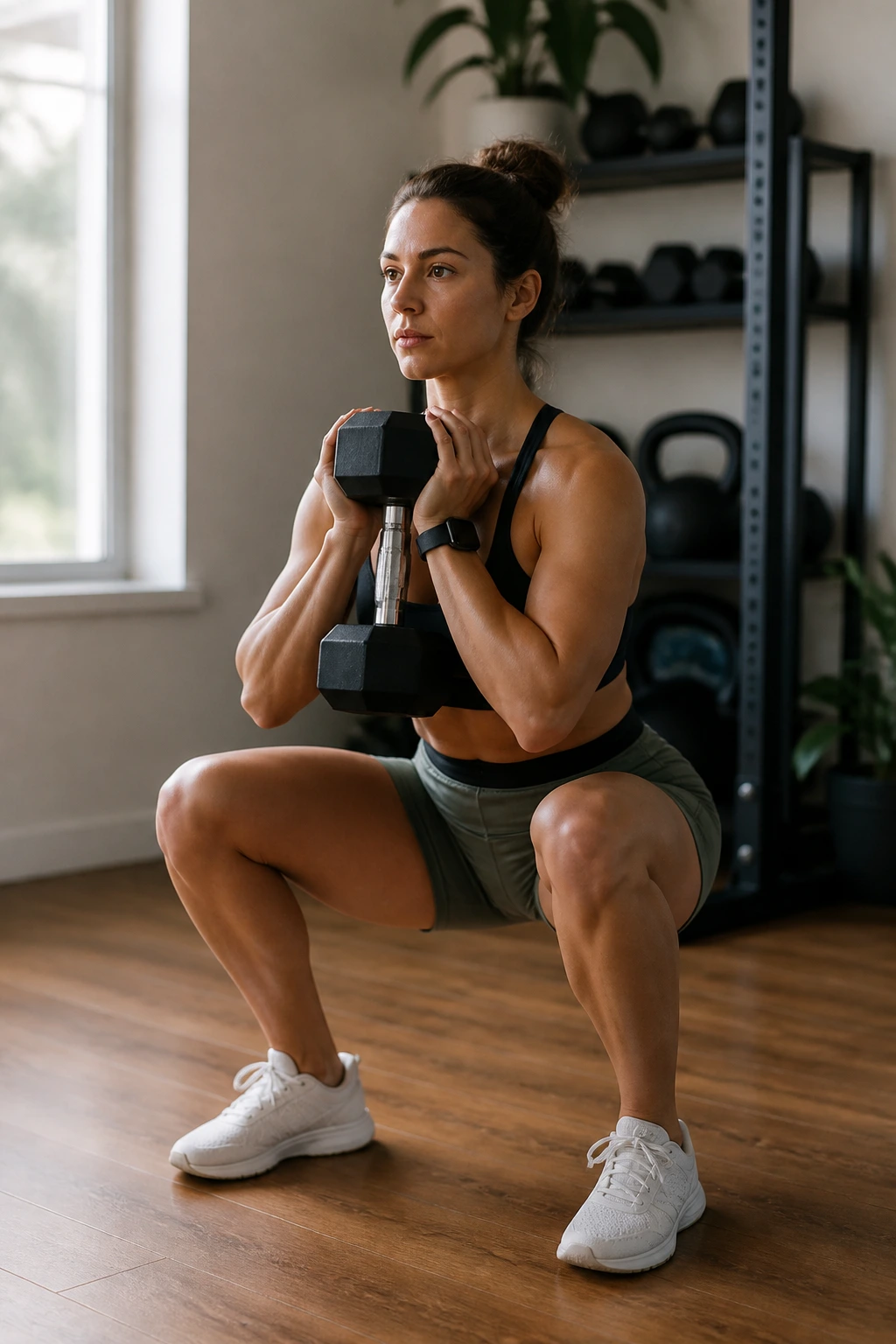
A goblet squat is one of the cleanest ways to teach your body how to squat without turning the movement into a forward fold. Holding one dumbbell tight against your chest keeps your torso more upright, which makes depth easier to find and easier to repeat.
Set your feet about shoulder-width apart, turn your toes out a little, and keep the dumbbell close to your sternum. Sit down between your hips, not straight down onto your knees, and let your elbows travel inside your thighs as you descend.
Three sets of 8 to 12 reps works well for most people. If your last few reps look like a slow collapse, slow the lowering phase to 3 seconds and pause for 1 count at the bottom. That pause tells you exactly where your real bottom position is.
2. Dumbbell Romanian Deadlift
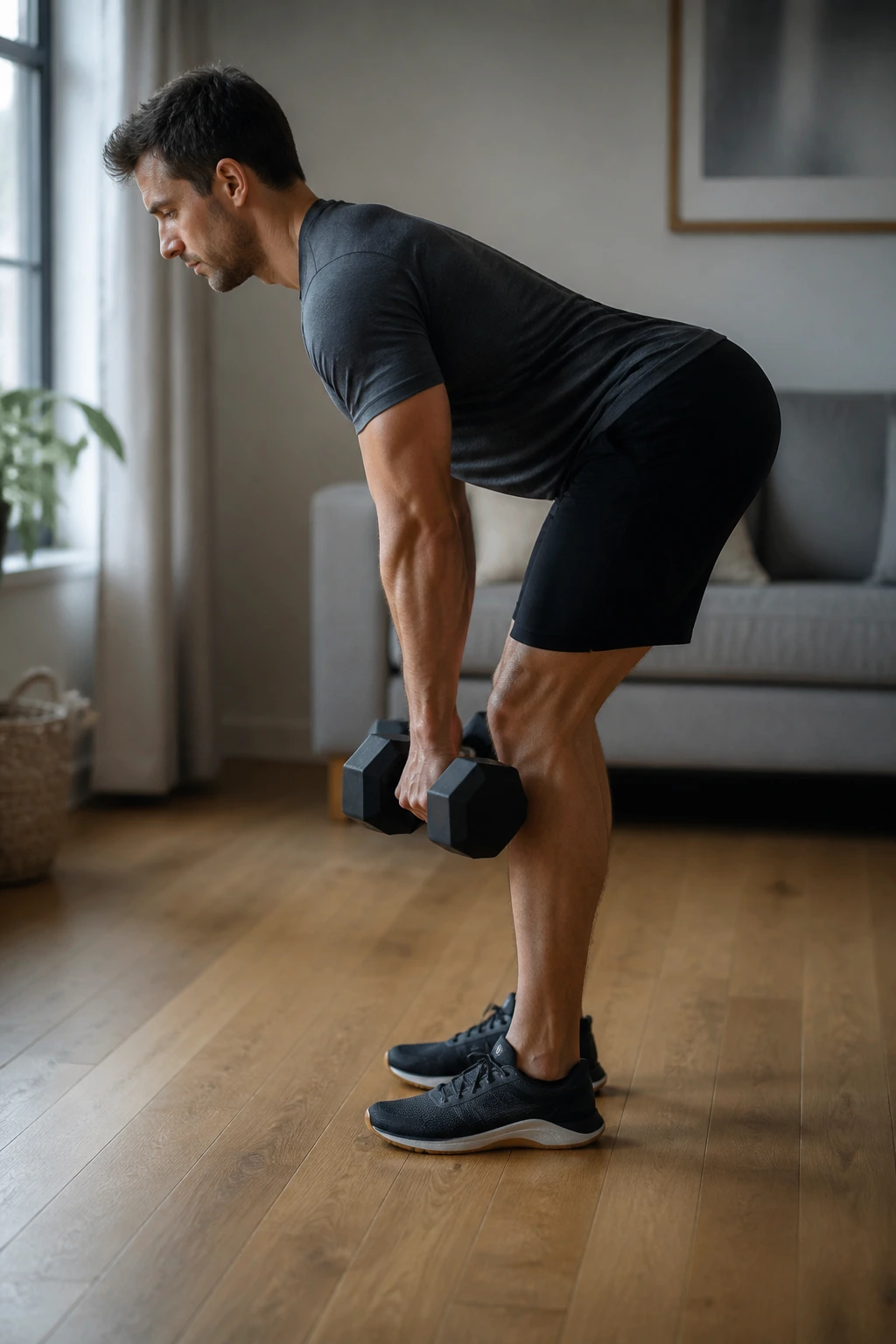
The Romanian deadlift is the move I’d keep if I had to build a home program around one lower-body hinge. It loads the hamstrings and glutes hard, and it does it without needing a barbell or much space.
How to hinge without rounding
Stand tall with the dumbbells in front of your thighs. Unlock your knees, then send your hips back like you’re trying to close a car door with your backside. The bells should stay close to your legs the whole time.
Stop when you feel a strong stretch through the back of the thighs and your back still feels long. Your lower back should not be the thing doing the work. If the dumbbells drift away from your legs, the hinge gets sloppy fast.
Use 2 to 4 sets of 6 to 10 reps, and keep the lowering phase slow enough to feel in control. If your hamstrings are tight, a smaller range of motion is fine. Depth is not a prize if shape falls apart.
3. Dumbbell Floor Press
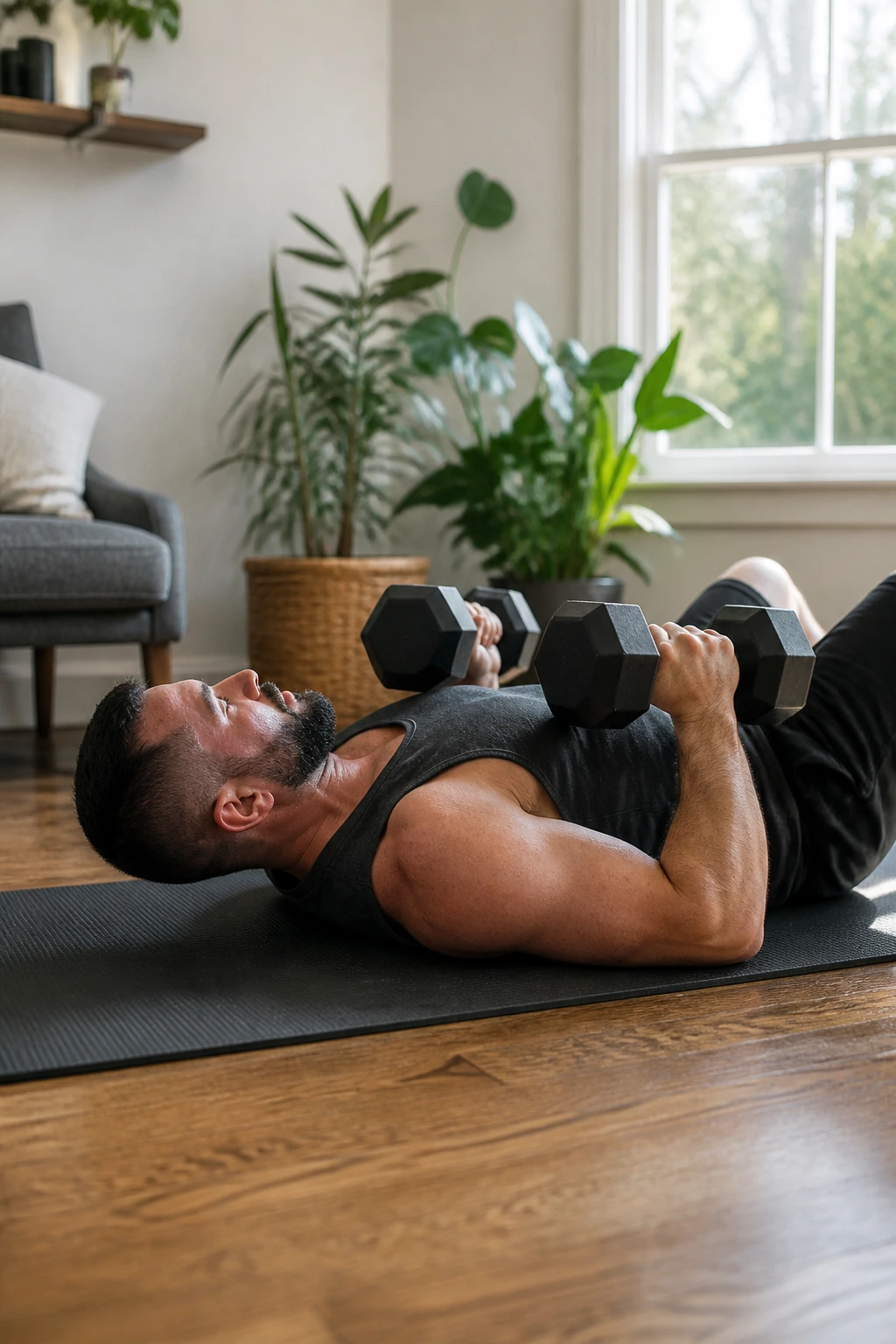
Why use the floor press instead of chasing a bench setup? Because the floor gives you a built-in stop. That makes it easier on the shoulders, and it gives you a clean pause where your chest, triceps, and upper back have to do the real work.
Lie on the floor, knees bent, and hold the dumbbells with your elbows about 30 to 45 degrees from your sides. Lower until your upper arms touch the floor lightly, then press straight up until the bells stack over your shoulders.
Why the pause matters
That floor touch removes bouncing. Nice and simple.
- Keep your wrists stacked over your elbows.
- Pause for a split second on the floor.
- Press evenly with both arms.
- Stop if your shoulders shrug up toward your ears.
Three or four sets of 8 to 12 reps usually hits the sweet spot. If the bells are light, slow the lowering phase and hold the bottom for a count. That tiny pause is where the press gets honest.
4. One-Arm Dumbbell Row
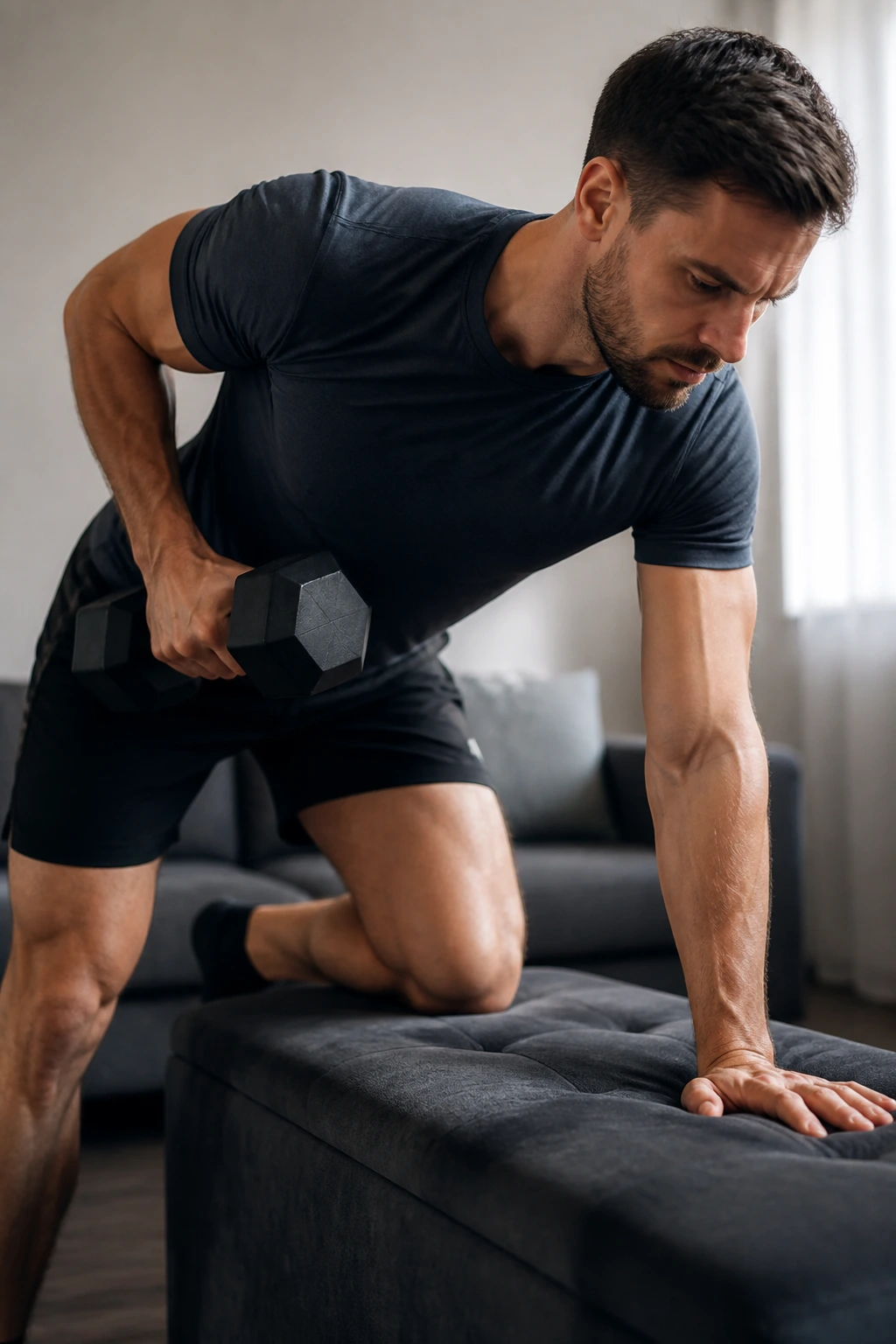
One dumbbell, one chair, one flat back. That is enough.
A one-arm row is the kind of home move that looks plain until you do it well. Then you feel your lats, your mid-back, and the back of the shoulder light up in a way that makes perfect sense. Support your free hand on a sturdy couch, table, or chair, and keep your torso quiet while the working elbow drives back.
Quick setup
- Put one knee and one hand on a stable surface.
- Let the dumbbell hang under the shoulder.
- Pull the elbow toward your back pocket.
- Lower slowly until the arm fully straightens.
A lot of people yank the weight up with momentum. Don’t. The best row is the one where your torso barely moves and the pause at the top lasts a beat. Two to four sets of 8 to 12 per side is plenty if the reps stay strict.
5. Standing Dumbbell Overhead Press
Standing overhead pressing tells on your core fast. If your ribs flare, your lower back arches, and your butt squeezes for dear life, the weight is too heavy or the setup is off.
Hold the dumbbells at shoulder height with your elbows slightly in front of your body. Brace your midsection, squeeze your glutes, and press the bells overhead in a straight path that finishes over the middle of your foot.
Rib flare is the enemy.
If standing strict presses feel shaky, a half-kneeling version is a good fix. One knee down, one foot planted, and the core has to work harder to keep you from twisting. That setup also stops people from stealing the rep with a lean-back move.
Use 3 sets of 6 to 10 reps. When the last rep gets ugly, the answer is usually not more speed. It’s better stacking of ribs, pelvis, and wrist under the load.
6. Reverse Lunge With Dumbbells
Unlike a forward lunge, the reverse lunge is usually easier on the knees and easier to control when your balance is still a little shaky. You step back, land softly, and let the front leg do most of the work.
Hold a dumbbell in each hand and step one foot back into a long lunge. The front heel stays down, the front shin stays fairly vertical, and the torso stays tall instead of pitched forward like you’re chasing the floor.
A lot of people take too short a step and end up jamming the front knee. Take a longer step back than you think you need, then sink down with control.
Two to three sets of 8 to 10 reps per side is a solid start. If you want more challenge without adding weight, add a 2-second pause near the bottom. That pause makes the front leg earn the stand back up.
7. Bulgarian Split Squat
Why do people hate this one? Because it removes the easy cheats. Your back foot is elevated, your front leg is stranded on its own, and the whole thing gets honest very fast.
What to feel in the front leg
Set the back foot on a couch, low chair, or sturdy step. The front foot should be far enough forward that you can drop straight down without the knee jamming too far over the toes. Hold the dumbbells at your sides and keep most of the pressure through the front heel and midfoot.
A slight forward torso lean is fine. In fact, it often helps the glutes work harder and keeps the movement from feeling like a knee-only drill. Do not use a wobbly chair. That turns a good exercise into a balance problem nobody asked for.
Try 2 to 4 sets of 6 to 10 reps per side. If full depth feels brutal, shorten the range and own the top half first. Bulgarian split squats reward patience more than bravado.
8. Dumbbell Glute Bridge
Lie on your back, plant your feet, and put a dumbbell across your hip crease. That’s the whole setup, and somehow it still exposes weak glutes, lazy hamstrings, and lower backs that try to help too much.
Push through your heels, lift your hips, and stop when your knees, hips, and shoulders form a straight line. At the top, squeeze the glutes for a count before you lower back down with control.
Three small fixes that help
- Move your feet closer if you feel it mostly in your hamstrings.
- Move them a little farther away if your quads take over.
- Keep your chin tucked so you do not crank your neck.
A glute bridge is not flashy. It is useful. Three sets of 10 to 15 reps with a pause at the top can wake up the backside before bigger lifts, or it can stand on its own when your lower back needs a break from heavier work.
9. Dumbbell Sumo Squat
A wider stance changes the whole feel of a squat. With a sumo setup, the toes point out, the knees track out with them, and the inner thigh gets more work than it would in a narrow stance.
Hold one dumbbell vertically between your legs or two dumbbells at your sides. Sit down between your hips, keep the chest proud, and let the knees open as you descend. The torso usually stays a little more upright here, which is handy if regular squats feel awkward on your ankles.
This is one of those movements that looks mild until the last few reps. Then the adductors start talking. Loudly.
Use 3 sets of 8 to 12 reps. If you want extra control, pause for a count at the bottom before standing. That pause keeps the movement from turning into a bounce and helps you own the position rather than sprint through it.
10. Dumbbell Bent-Over Reverse Fly
Light bells are the point here. Heavy weight turns a reverse fly into a shrugging contest, and that misses the whole job.
Hinge at the hips, keep a soft bend in the elbows, and let the dumbbells hang under your shoulders. Open the arms out in a wide arc until they line up with your torso, then lower them slowly. The rear delts and upper back should do the work, not the traps taking over.
What makes it work
A small range of motion is fine. A sloppy swing is not.
- Keep the neck long.
- Move from the shoulders, not the hands.
- Stop around shoulder height.
- Use a 2-second lower.
This is a good choice after rows or presses because it balances all the front-side work. Two or three sets of 12 to 15 reps is usually enough. If your lower back tires first, support your chest on the edge of a couch or stack your torso over a sturdy bench alternative.
11. Dumbbell Push Press
The push press is a strict press with a little leg drive, and that is not cheating. It’s a useful way to move heavier dumbbells overhead when you want power, not just shoulder isolation.
Dip a few inches by bending the knees, then drive hard through the floor and transfer that force into the press. The arms finish the lift; they do not start it. That’s the difference.
Use the push press when your strict press has stalled or when you want a more explosive overhead pattern. It also pairs well with heavier dumbbells that would be awkward for slow, clean pressing. The dip should be short. If it turns into a squat, you’ve gone too far.
Three sets of 5 to 8 reps is a smart range. Keep the reps crisp. Once the drive starts to look mushy, stop the set. Power work falls apart fast when fatigue gets sloppy.
12. Dumbbell Step-Up
A sturdy step, a stair, or a solid platform turns this into a brutally useful leg exercise. Step-ups train one side at a time, and they make it obvious whether your balance, hip control, or leg strength is the weak link.
Place your whole foot on the step, lean forward a little, and drive through the working leg to stand tall. The back leg should help as little as possible. If you push off the floor hard with the trailing foot, you’re stealing from the working leg.
The easy way to control the box
Keep the step low at first. Knee-height boxes are not required.
A clean step-up feels smooth on the way up and controlled on the way down. Do not drop off the platform. Lower yourself with the same care you used to stand.
Use 2 to 3 sets of 8 to 10 reps per side. If the dumbbells make the movement too clumsy, go lighter and own the balance first. A shaky step-up teaches very little.
13. Dumbbell Thruster
Is the thruster a squat or a press? It’s both, and that is why it works so hard.
Hold the dumbbells at shoulder height, drop into a squat, and stand up fast enough that the upward drive carries the bells into an overhead press. The squat and press should feel like one linked motion, not two separate chores stitched together poorly.
How to keep your pace sane
- Keep the dumbbells racked near the shoulders.
- Exhale as you drive up.
- Do not pause at the top unless your form starts to drift.
- Stop the set before your front rack collapses.
Thrusters are useful when you want strength with a dose of conditioning, but they punish lazy posture. If the overhead portion feels rough, break the movement into separate squats and presses for a while, then reconnect them later.
A good starting point is 3 sets of 6 to 10 reps. Choose a load you can move cleanly on the last rep, not one that turns every repetition into a wrestling match.
14. Single-Leg Dumbbell Romanian Deadlift
Can one leg really matter that much? Yes. A single-leg RDL exposes hip stability and balance in a way a two-leg hinge never will.
Hold one or two dumbbells and shift your weight onto one foot. Hinge at the hip while the free leg reaches back like a counterweight, keeping the hips square to the floor. The standing leg should feel loaded in the hamstrings and glute, not crushed in the low back.
A fingertip on the wall is fine if balance keeps stealing the rep. I’d rather see a clean hinge with a light touch than a wobbly circus act with perfect bragging rights.
Use 2 to 3 sets of 6 to 10 reps per side. Go slow on the way down. The slow descent is where you learn whether your hip is stable or just pretending to be.
15. Dumbbell Pullover
This one sits in a weird place between a chest move and a back move, and that is what makes it interesting. You’ll feel the lats, the chest, and the rib cage working to keep everything under control.
Lie on the floor or across a sturdy bench, hold one dumbbell with both hands, and lower it behind your head with a small bend in the elbows. Stop when you feel a stretch through the lats and the ribs want to pop up. Then pull the bell back over the chest.
The rib-cage cue
Keep your lower back from arching hard.
If the ribs flare, the load shifts away from the lats and into a back bend nobody asked for. Think about keeping the front of your body heavy against the floor or bench. That cue alone cleans up a lot.
Try 2 to 4 sets of 8 to 12 reps. A moderate dumbbell works better than a heavy one here. Long range plus sloppy control is a bad mix, and the pullover punishes it fast.
16. Alternating Dumbbell Curl
The alternating curl looks basic, which is probably why people rush it. That’s a mistake. A clean curl teaches the biceps to do their job without the shoulders jumping in to help.
Stand tall, keep the elbows near your ribs, and turn the palm up as the dumbbell rises. The upper arm should stay quiet. The body should stay quiet too, unless the weight is too heavy and you’re doing a small back sway to cheat the final inch.
Use a slow lower. That’s where a lot of the useful work lives.
If you can curl and carry on a full conversation without a hitch, the bells may be too light for strength work. Two to three sets of 8 to 12 reps per arm is a sensible range. Keep it tidy, and the arms will get the message.
17. Hammer Curl
If regular curls bug your wrists or elbows, hammer curls are the first swap I make. The neutral grip is easier on the joints, and it hits the brachialis and forearms in a way that helps the upper arm look thicker from the side.
Hold the dumbbells with palms facing in and curl them without rotating the wrist. Keep the elbows close, lift under control, and lower the bells all the way down before starting the next rep. No swing. No shoulder shrug. No weird back lean.
This is also a sneaky grip exercise. Heavy hammer curls make the forearms work harder than people expect.
Use 2 to 4 sets of 10 to 12 reps. If the grip starts to fail before the biceps do, that’s a useful sign. It usually means the load is honest.
18. Overhead Dumbbell Triceps Extension
Where do the triceps get their hardest work? Often at the top of the arm, when the long head is stretched overhead. That’s why this exercise earns a spot in a home dumbbell program.
Hold one dumbbell with both hands above your head, or use a single dumbbell in one hand at a time. Lower it behind your head by bending the elbows, then extend back up until the arms are straight again. Keep the elbows pointed forward instead of flaring wildly out to the sides.
How to keep the elbows honest
The movement should feel like a hinge at the elbow, not a shoulder press in disguise.
- Stand or sit tall.
- Brace your ribs down.
- Keep your upper arms close to your head.
- Lower until you feel a real triceps stretch.
Two to three sets of 8 to 12 reps is plenty. If your shoulders get cranky, switch to a seated position and reduce the range a little. The triceps do not need drama to grow stronger.
19. Dumbbell Lateral Raise
Stop chasing heavy dumbbells here. That habit ruins the movement.
A lateral raise is about controlled shoulder work, not heaving the bells into the air with traps and momentum. Hold light dumbbells at your sides, lean forward just a touch, and raise the arms until they line up with shoulder height. Think elbows leading, hands following.
A tiny bend in the elbows is fine. A full-body heave is not. If you feel your neck tightening before your side delts burn, the weights are too much or the range is too high.
This move usually earns its keep late in a session when the shoulders are warm but not fried. Two to four sets of 12 to 20 reps works well. Yes, that sounds high. It should. Light control beats ugly heavy reps here.
20. Dumbbell Suitcase Carry
A suitcase carry looks almost too easy until you try walking straight with one heavy dumbbell pulling you sideways. That pull is the whole point. Your obliques, glutes, and deep core muscles have to stop you from leaning.
Hold one dumbbell at your side, stand tall, and walk slowly for a set distance or for time. Keep the shoulder packed down, the ribs stacked over the pelvis, and the steps smooth. If you sway, slow down. If you lean, the load is too heavy or your trunk has checked out.
What to feel when you walk
Your body should fight the tilt without making the movement stiff.
Use 20 to 40 steps per side or 30 to 45 seconds per side. That’s enough to light up the core without turning the drill into a cardio mess. Suitcase carries are one of those annoying little moves that pay off more than they look like they should.
21. Dumbbell Farmer’s Carry
Unlike the suitcase carry, the farmer’s carry loads both sides equally, so the goal shifts from side-bending control to total-body stiffness and grip. It is simple. It is also ruthless when the dumbbells get heavy enough.
Grab a pair of dumbbells, stand tall, and walk with short, controlled steps. The shoulders stay down, the neck stays long, and the hands hang on without death-gripping so hard that your forearms cramp before the set is half over.
I like farmer’s carries as a finisher because they make posture obvious. If you start slumping, the load is telling the truth. If you can keep the torso tall under fatigue, that carries over into almost everything else.
Go for 30 to 60 seconds or a set distance that takes you around the room and back with good shape. Heavy is good here, but only as long as the walk stays clean.
22. Dumbbell Renegade Row
A renegade row is basically a row inside a plank, which is why it feels so blunt. Your back has to pull, your core has to resist twisting, and your shoulders have to keep you from folding.
Scaling the plank
Set the dumbbells a little wider than shoulder width and plant your feet wide too. That wider base matters. It keeps the hips from spinning around every time you row. Pull one dumbbell toward your ribs, set it down without rocking, then row the other side.
If the full plank version is too much, elevate your hands on a couch or sturdy bench. Knees down is another clean option. What matters is that the row stays controlled and the torso stays quiet.
This is a high-skill move compared with a curl or goblet squat. Do not race the reps. Two to three sets of 6 to 8 per side is plenty. The payoff comes from resisting rotation, not from cranking out a giant rep count.
23. Dumbbell Front Rack March
A front rack march is one of those exercises that feels almost too plain on paper and then surprises you in the middle of a set. Holding the dumbbells at shoulder height forces the upper back and core to stay stacked while you lift one knee at a time.
Stand tall with the bells racked near your shoulders, elbows slightly forward, and ribs pulled down. March in place slowly, lifting one knee to about hip height before switching sides. The movement should look calm, not frantic.
Why marching beats holding still
Marching adds a balance challenge without needing more space.
- Keep the torso level.
- Avoid leaning back.
- Breathe behind the brace.
- Move one knee at a time, not both.
Use 20 to 40 total steps or 30 to 45 seconds. If the dumbbells pull you into a back arch, lighten the load and try again. The posture matters more than the ego part.
24. Dumbbell Dead Bug
If crunches bother your neck or lower back, the dead bug is a much smarter core drill. Adding a dumbbell makes the front of the body work harder to resist extension, which is the real job anyway.
Lie on your back with one dumbbell held over your chest in both hands. Bring your knees up so your hips and knees are both bent at 90 degrees, then slowly lower one leg toward the floor while the low back stays pressed down. Switch sides with control.
The back-pressure cue
Your lower back should feel like it is glued to the mat.
If the back arches, the range is too deep or the load is too much. Shorten the leg reach before you make the exercise harder.
A good dose is 2 to 4 sets of 6 to 10 reps per side. Move slowly enough that you can feel the trunk working every inch of the way. The dead bug looks gentle. It isn’t.
25. Dumbbell Clean and Press
A clean and press ties a lot of the other work together: hinge, pull, rack, brace, press. That makes it a strong final move for a home dumbbell session when you want one exercise to feel like a full-body finish.
Start with the dumbbells near your thighs, hinge slightly, then snap the hips and pull the bells into a front rack position. From there, press them overhead with a tight core and locked-in ribs. If the clean feels messy, do a single clean, reset, and then press. There is no prize for forcing speed before the path is clean.
How to fit it into a session
Use it after your main lower-body lift or as a stand-alone power piece for 3 to 5 sets of 4 to 6 reps. Keep the reps low enough that technique stays sharp. Once the rack gets sloppy or the press starts turning into a lean-back circus, stop the set.
A clean and press is the kind of move that makes a small dumbbell setup feel serious. And that’s the point.
