



The best workout routines for men who train at home are rarely the flashy ones. A pair of dumbbells, a pull-up bar, or even a loaded backpack can do real work when the plan is tight.
Random pushups until your shoulders ache is not training. It’s a warm-up with poor branding.
Home training rewards the boring stuff: progression, rest control, unilateral work, and exercises that make a small room feel smaller. You can build size, strength, and conditioning without a rack full of metal if you keep the standards high.
The routines below are built for different situations—tight schedules, limited gear, noisy floors, stubborn bellies, weak backs, and days when you just want to get in, sweat hard, and get back out. Pick one, run it honestly, and make it harder before you make it fancier.
1. The No-Equipment Starter Circuit

No equipment at all? Good. That forces you to use tempo and honest effort.
How to run it
- 3 rounds
- 12 push-ups
- 15 air squats
- 8 reverse lunges per leg
- 20-second plank
- 10 glute bridges
- Rest 45 to 60 seconds between rounds
Start with clean reps and stop two reps before failure on the first two rounds. That keeps the pace steady and saves your joints from the ugly, flailing version of exhaustion.
Push-ups can be done from the floor, from a couch, or with your hands on a sturdy table. Air squats should go all the way down only if your knees and hips feel good there. If they don’t, cut the depth a little and keep your chest tall.
Best tip: make the last round look as controlled as the first. That’s the whole game.
2. The Dumbbell Strength Day

Two dumbbells can cover a lot of ground. If you own a pair that you can load, this is one of the cleanest home routines you can run.
Use five big moves: goblet squats, dumbbell floor press, one-arm rows, Romanian deadlifts, and standing overhead presses. Put the heavy work first while your grip and focus are fresh. Four sets of 6 to 8 reps on each lift is a good place to live if strength is the goal.
Heavy enough matters. If the last two reps don’t ask a question, the weight is too light for this day.
Rest about 90 seconds between sets. On rows and presses, keep your torso tight instead of twisting around to cheat the rep. On Romanian deadlifts, push your hips back and let the dumbbells travel close to your legs; if you feel it only in your lower back, the pattern is off.
This day works because it feels simple. No fluff. No circus. Just a few hard sets that leave you a little slower when you stand up.
3. The Upper-Body Push and Pull Superset

Need one upper-body day that doesn’t waste your afternoon? Supersets solve that problem fast.
How to use it
Pair a push move with a pull move and keep moving for 4 rounds.
- A1: Push-ups or dumbbell floor press — 10 to 12 reps
- A2: One-arm dumbbell row or band row — 10 to 12 reps per side
- B1: Pike push-ups — 8 to 10 reps
- B2: Band pull-aparts — 15 to 20 reps
- C1: Close-grip push-ups — 8 to 15 reps
- C2: Dumbbell curls — 10 to 12 reps
Rest only after each push-and-pull pair. That keeps your heart rate up without turning the workout into sloppy cardio.
The balance matters. A lot of home routines hammer chest and triceps and then forget the back. Shoulders usually complain later. This layout fixes that without needing a bench, a cable machine, or a lot of room.
You’ll feel the shoulders burn early. Good. That’s supposed to happen.
4. The Leg Day That Leaves Your Quads Talking

A lot of home leg workouts are too polite. They leave you breathing a little harder, but your thighs never really get the message.
Bulgarian split squats change that fast. Put your back foot on a couch or chair, keep your front foot flat, and lower under control for 8 to 10 reps per side. Add goblet squats for 4 sets of 10, then Romanian deadlifts for 3 sets of 8 to 10. Finish with standing calf raises and a wall sit if you still have a pulse left.
What to watch for
- Front knee tracking over the toes
- A slight forward lean on split squats
- Slow lowering on every rep
- Full foot pressure, not just the toes
Split squats are ugly in the best way. They expose weak hips, weak ankles, and sloppy balance faster than almost anything else you can do at home.
If you want the day to hit harder, pause for one full second at the bottom of each split squat. That tiny pause turns a decent set into a rude one.
5. The Ten-Minute EMOM Builder

Ten minutes can be enough if every minute has a job.
EMOM means “every minute on the minute.” Start a movement at the top of each minute, finish the reps, then rest with whatever time is left. If you finish too early, you’re pacing too easy. If you keep missing the minute mark, the reps are too high.
Try this pattern for 10 minutes:
Minute 1: 8 push-ups
Minute 2: 12 air squats
Minute 3: 8 dumbbell rows per side
Minute 4: 10 hip hinges or dumbbell Romanian deadlifts
Minute 5: 20 mountain climbers
Repeat once
You can also stretch it to 20 minutes if the load is light and the form stays clean. The trick is not to sprint the first two minutes like a fool. EMOM training punishes bad pacing. It’s honest that way.
A good EMOM leaves you breathing harder, but not wrecked. If your last round looks like a bar fight, the volume is too high.
6. The Backpack Overload Session

A backpack full of books is awkward on purpose. That awkwardness makes your torso brace harder, which is why this routine works better than people expect.
Use a sturdy backpack and pack it tight with books, water bottles, or bags of rice. You want the load to sit high and close to your back, not bounce around like laundry in a dryer. From there, use backpack front squats, push-ups with the pack on, bent-over rows, step-ups, and loaded marches.
Simple structure
- Backpack front squat — 4 sets of 10
- Backpack push-up — 4 sets of 8 to 12
- Backpack row — 4 sets of 10 per side
- Backpack step-up — 3 sets of 8 per leg
- Loaded march — 3 rounds of 30 to 45 seconds
Unlike dumbbells, a backpack can’t hide bad posture. If you lean too far forward or rush the reps, the load shifts and the set gets messy fast. That makes it a good tool for men training at home who want cheap, repeatable overload without buying another piece of gear.
The ugly truth? It can feel a little silly. Then the set starts.
7. The Pull-Day Built on a Doorway Bar or Bands
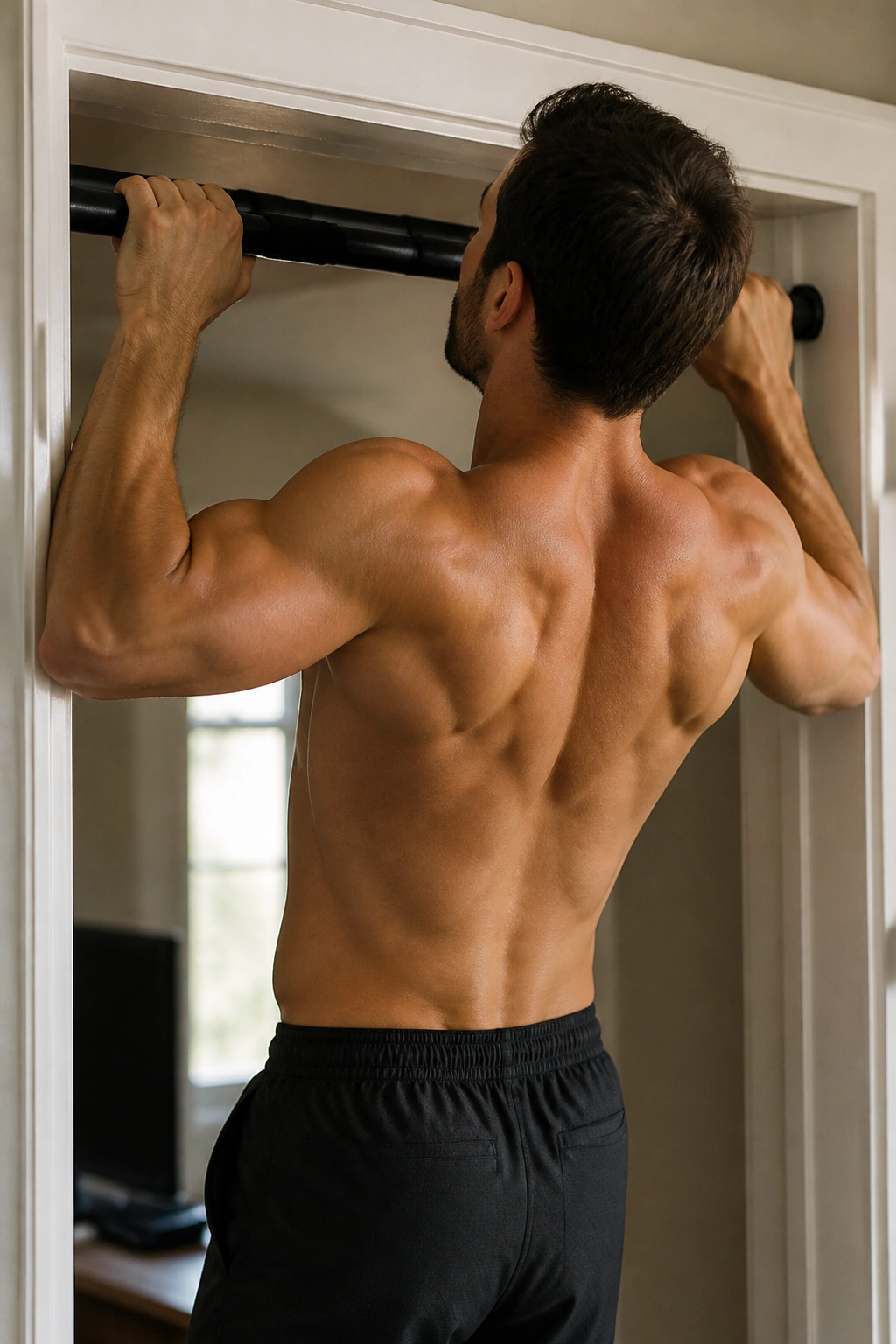
A pull day at home needs one thing: something to pull against. A doorway bar is ideal. Bands are the backup plan. A sturdy table row can work too, but only if the setup is actually solid.
Start with dead hangs or scapular hangs if you have a bar. Then move into pull-ups or chin-ups for 4 sets of as many clean reps as you can manage. After that, add band rows, face pulls, and curls. Keep the elbows driving back and down, not flaring out.
A clean pull-day structure
- Pull-ups or chin-ups — 4 sets
- Band rows — 4 sets of 12 to 15
- Band face pulls — 3 sets of 15 to 20
- Dumbbell or band curls — 3 sets of 10 to 15
- Dead hang — 2 rounds of 20 to 30 seconds
Your back will know the difference between pulling with the lats and yanking with the arms. Aim for the first one.
One useful cue: think about bringing your chest to the bar instead of just dragging your chin upward. It usually cleans up the rep right away.
8. The Kettlebell Complex for Hard Breathing and Strong Hips
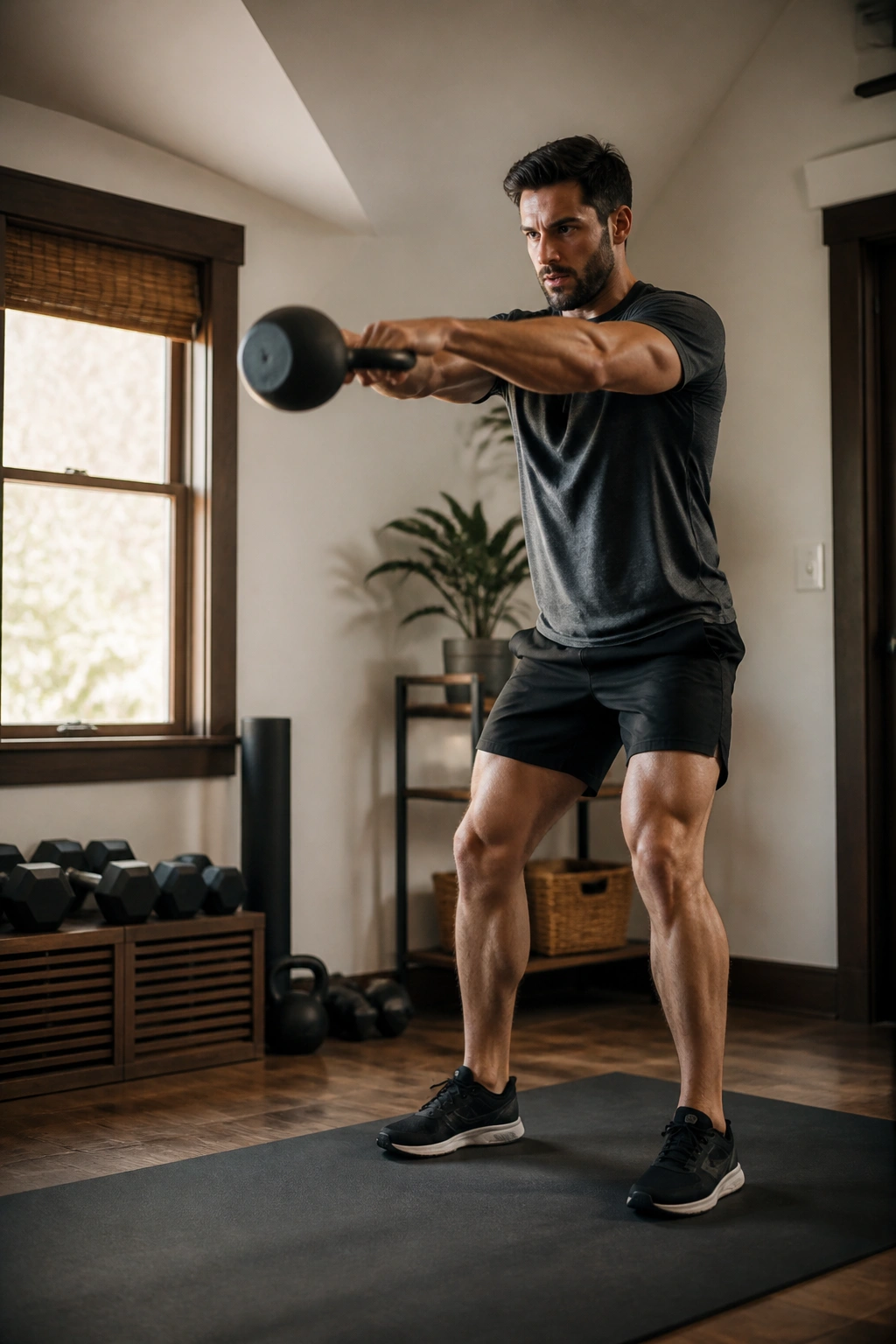
One kettlebell can be a whole workout. Not a cute workout. A proper one.
A kettlebell complex keeps the bell moving through several exercises without being set down. That creates grip fatigue, trunk tension, and a very specific kind of hard breathing that lingers for a minute or two after the set ends.
Try 4 to 6 rounds of this sequence:
- 6 kettlebell swings
- 5 cleans per side
- 5 front squats
- 5 presses per side
- 5 reverse lunges per side
Rest 90 seconds between rounds. Keep the bell close to your body on the clean, and do not overreach the swing with your lower back. The hips start the swing. The arms are along for the ride.
This routine is a favorite when you want strength and conditioning in the same session without spending all day there. It also teaches a kind of calm under fatigue that carries over to the rest of home training.
If the presses get ugly, drop the reps before you drop the form.
9. The AMRAP Fat-Loss Grinder
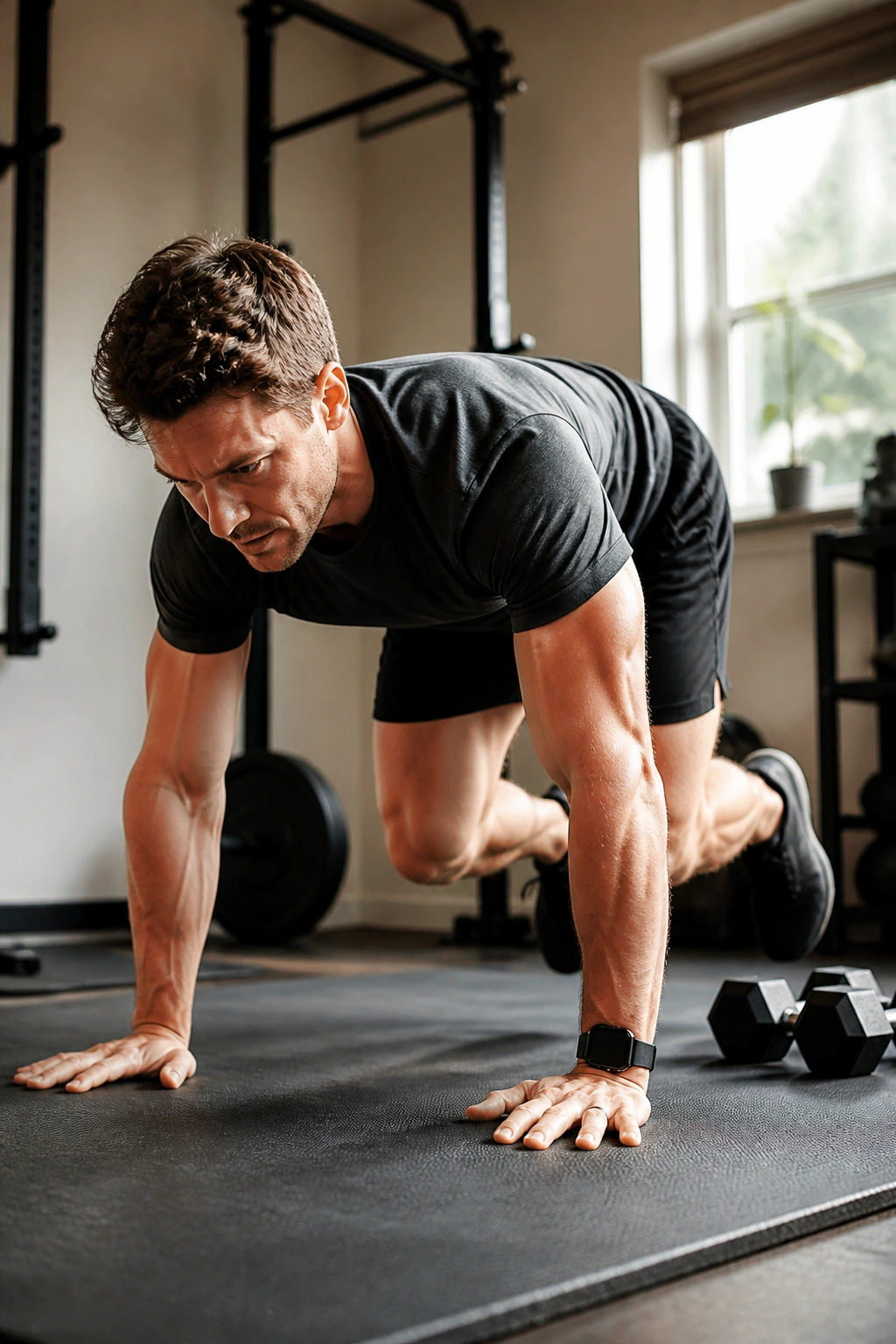
Want a session that burns hard without turning into a treadmill story? AMRAP is the blunt instrument.
AMRAP means “as many rounds as possible” in a fixed time. Pick 15 or 20 minutes and cycle through a short list of movements at a pace you can actually hold. The goal is steady pressure, not a heroic first five minutes followed by a collapse on the floor.
A clean setup looks like this:
- 8 burpees or squat thrusts
- 10 goblet squats
- 12 push-ups
- 16 alternating lunges
- 10 dumbbell rows per side
Move with purpose, but don’t race the clock like it owes you money. If your breathing gets so ugly that your reps fall apart, slow down for one round and recover your shape.
This kind of workout fits men who want conditioning, sweat, and a time cap that keeps excuses small. It also works well when you only have 20 minutes and a bad attitude.
No drama. Just the clock.
10. The Ladder Workout for Busy Afternoons
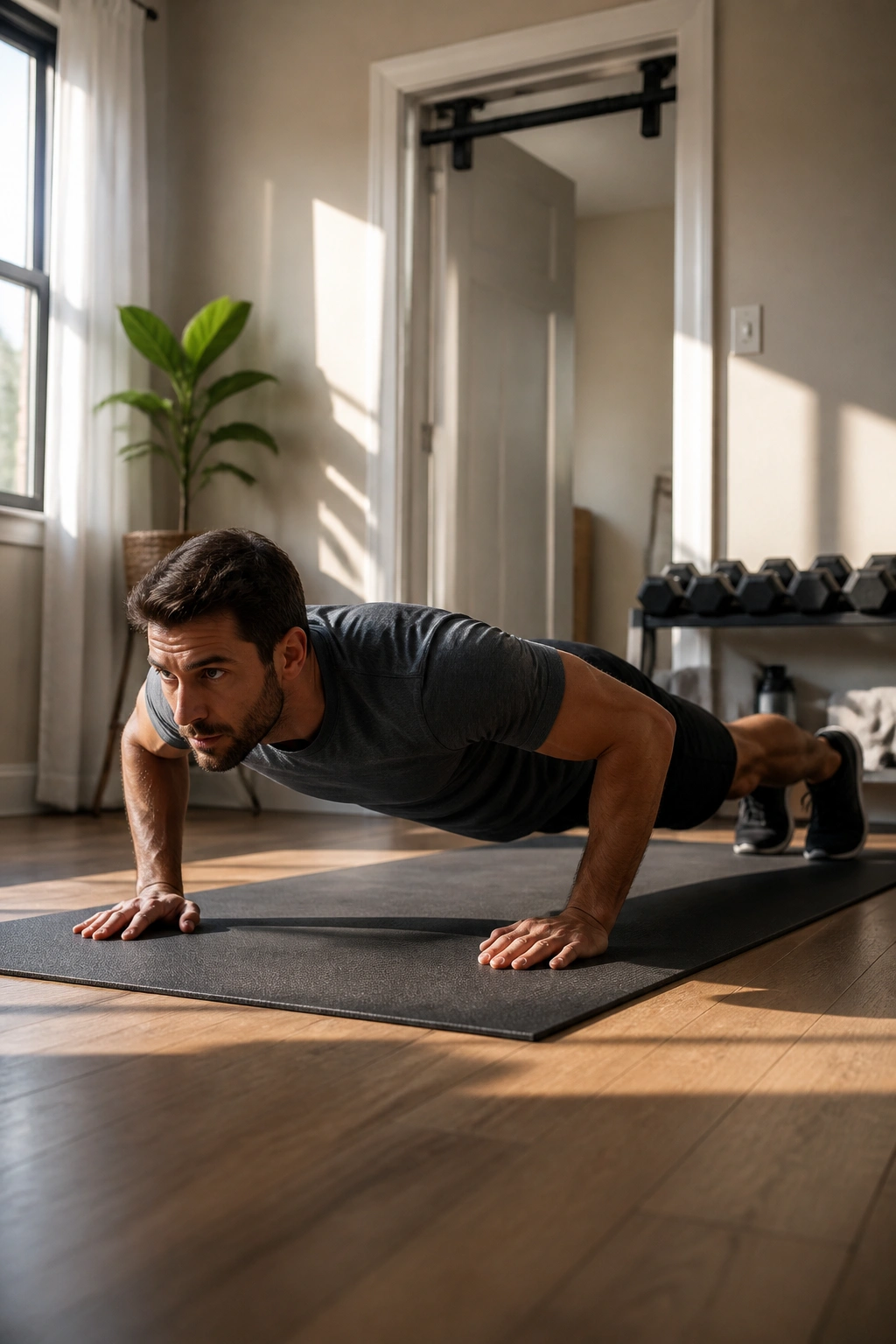
You have 18 minutes and no patience. Use a ladder.
Ladder workouts are nice because they keep the mind busy while the body keeps working. Start with a low number of reps, climb up, then come back down. The changing rep count makes the session feel shorter than it is, which is a useful trick on busy days.
How to climb it
- Push-ups: 2, 4, 6, 8, 10, then back down
- Dumbbell rows: 2, 4, 6, 8, 10 per side, then back down
- Air squats: 5, 10, 15, 20, then reverse the ladder
Rest only as needed to keep form clean. If you’re using one movement, pick a rep ladder that ends before your technique gets sloppy. If you’re using two or three movements, keep the reps lower and the transitions fast.
Ladders are good when you want volume without the dead time of long rests. They also expose ego fast. A man who starts too high usually learns that lesson by rung three.
11. The Tempo Training Session for Small Dumbbells
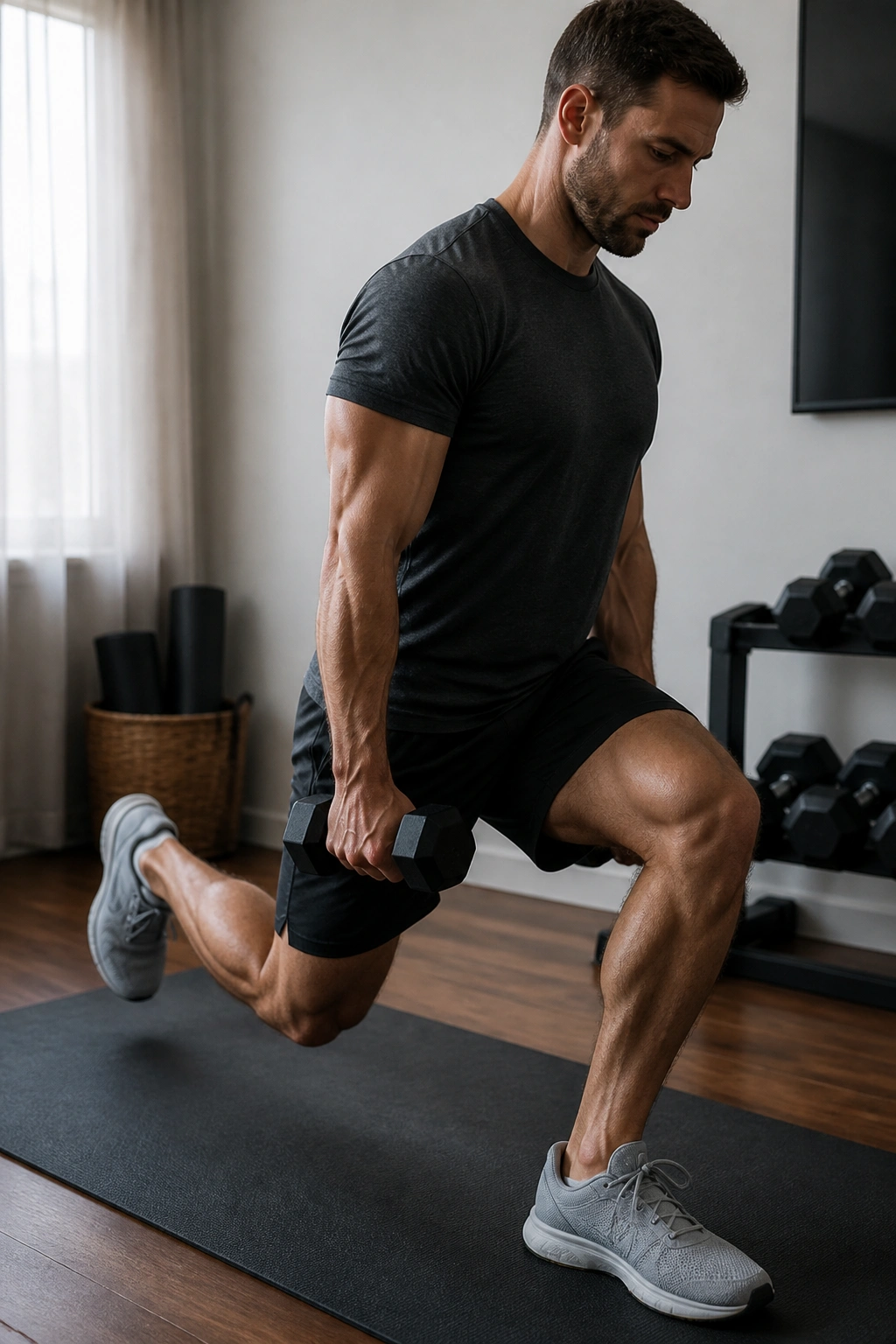
Light weights become rude when you slow the rep down. That’s why tempo training works so well at home.
Use a simple tempo like 4 seconds down, 1 second pause, and a controlled drive up. On split squats, floor press, rows, curls, and Romanian deadlifts, that pause and slow lower make a moderate dumbbell feel much heavier. Three sets of 8 to 12 reps is enough when the timing is strict.
The point is not to suffer for its own sake. It’s to make the muscle work through the whole rep instead of letting momentum steal the job.
This style shines when your dumbbells are light or your joints prefer cleaner reps. It’s also sneaky good for men who have rushed through lifting for years and never realized how much load they were wasting.
The burn shows up fast. So does better control.
Try counting the lowering phase out loud for the first set. It feels annoying. That’s usually a sign it’s doing something useful.
12. The Resistance Band Pump Day
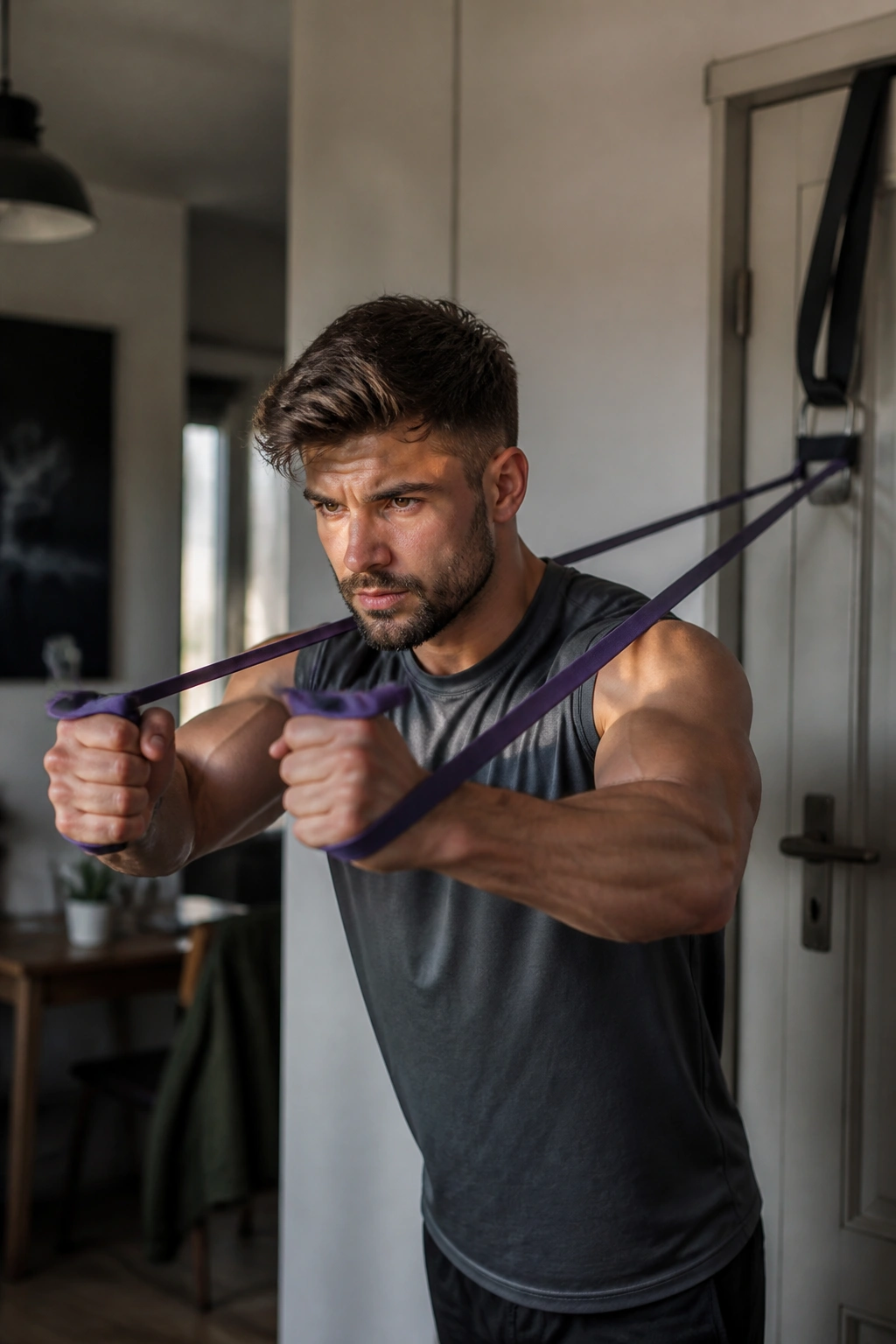
Bands are ugly in photos and useful in real life. That’s the honest truth.
Unlike dumbbells, bands keep tension on the muscle through a bigger part of the movement. They’re also easy on the joints, light to store, and useful in apartments where dropping weights is a bad idea. That makes them a smart tool for high-rep work and shoulder-friendly sessions.
Good band exercises
- Band chest press
- Seated or standing band row
- Face pull
- Pull-apart
- Triceps pressdown
- Biceps curl
- Band squat
Use 12 to 25 reps per set and chase a deep squeeze at the end range. If the band feels too easy, step farther from the anchor or shorten the rest. Do not yank through the set. Bands punish sloppy setup with weird resistance and noisy form.
This is the day for a pump, not a personal record. Arms swell. Shoulders burn. The session ends with your shirt sticking to your back a little more than you’d like.
That’s the point.
13. The Core and Carry Session
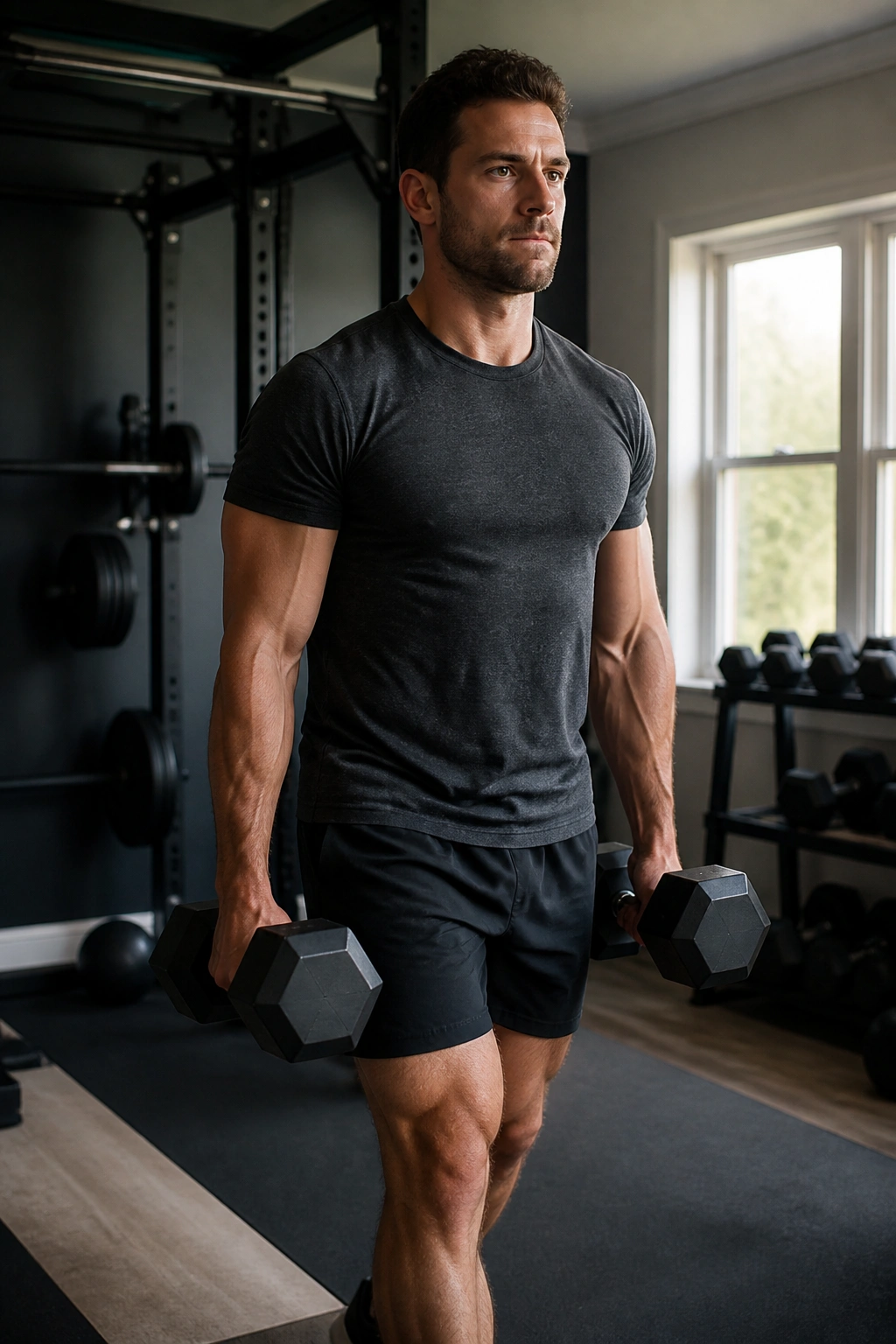
Your torso gets strong by resisting movement, not just bending a hundred times.
Why carries matter
Suitcase carries and farmer’s carries force your trunk to stay tall while your grip, obliques, and upper back all work together. They’re simple, but they show up everywhere else: deadlifts, rows, presses, and even the way you walk with groceries after a hard workout.
Build this session around six moves:
- Suitcase carry — 3 rounds of 30 to 45 seconds per side
- Farmer’s carry — 3 rounds of 30 to 60 seconds
- Dead bug — 3 sets of 8 per side
- Side plank — 2 to 3 holds of 20 to 40 seconds
- Hollow hold — 3 holds of 15 to 25 seconds
- Bear crawl or slow march — 2 rounds of 30 seconds
Keep the ribs down and breathe behind a tight brace. If your lower back arches during dead bugs or hollow holds, shorten the lever and reset. That small correction matters more than squeezing out another sloppy rep.
This is one of those home routines that feels almost too plain until your midsection stops folding over in everything else.
14. The Mobility Reset That Still Feels Like Training
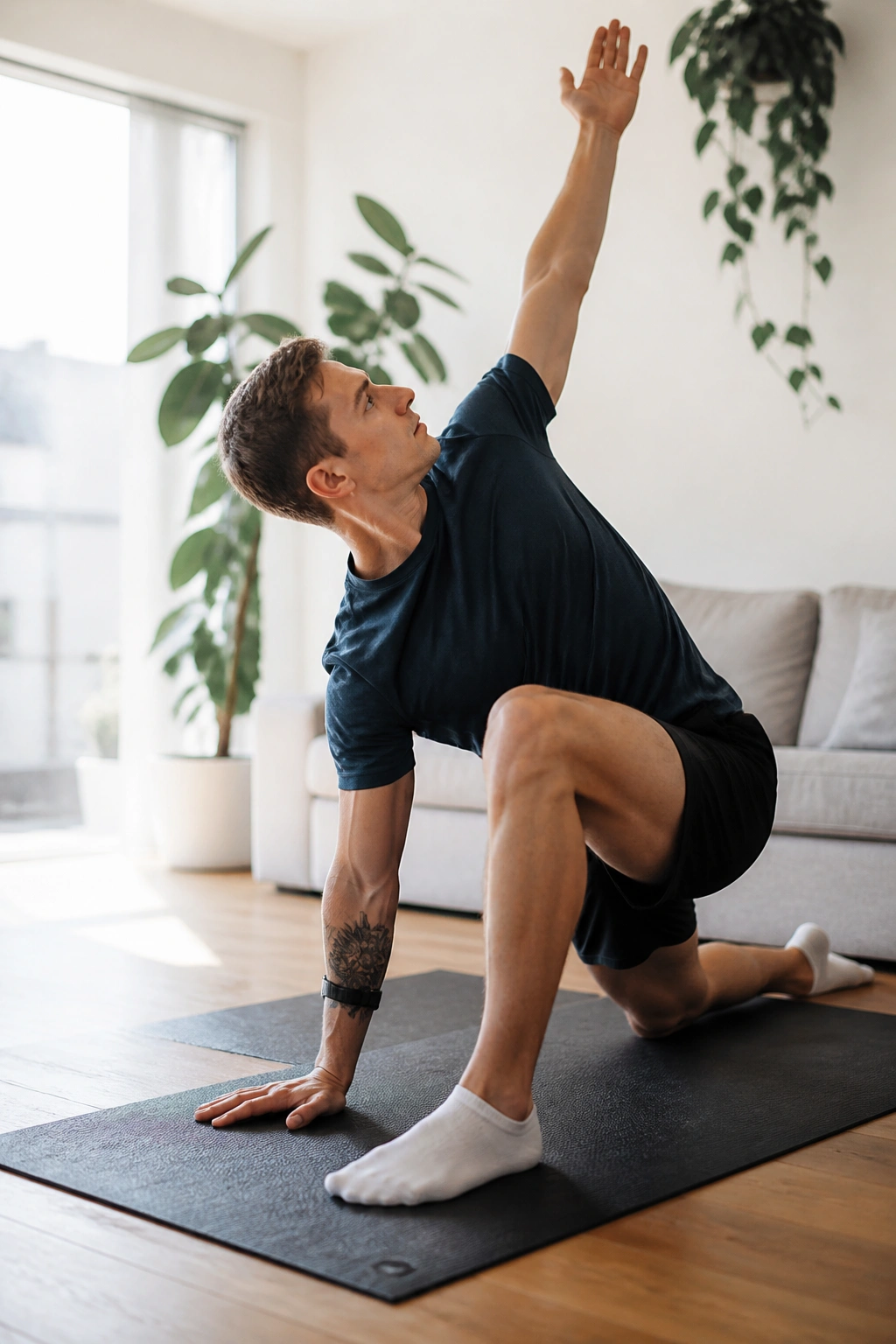
Back tight from sitting? Fine. Train the parts that keep getting ignored.
A mobility day does not have to be a lazy stretch session on the floor. It can still feel like training if you move with control and keep the flow honest. Start with cat-cow, then move into thoracic rotations, hip flexor stretches, ankle rocks, scap push-ups, glute bridges, and 90/90 hip switches.
You only need 12 to 20 minutes. That’s enough to loosen up a stiff lower back, open the hips, and get the shoulders moving again after a heavy week.
Good signs
- Breathing slows down
- Hips feel less pinched
- Overhead reach gets smoother
- Squats feel less blocked at the bottom
Don’t chase pain here. Chase range that you can actually own. A stretch that feels dramatic and useless is not the prize. A clean, repeatable position is.
Not every training day needs to be a war. Some days should end with you standing up straighter.
15. The Chest and Arms Hypertrophy Day
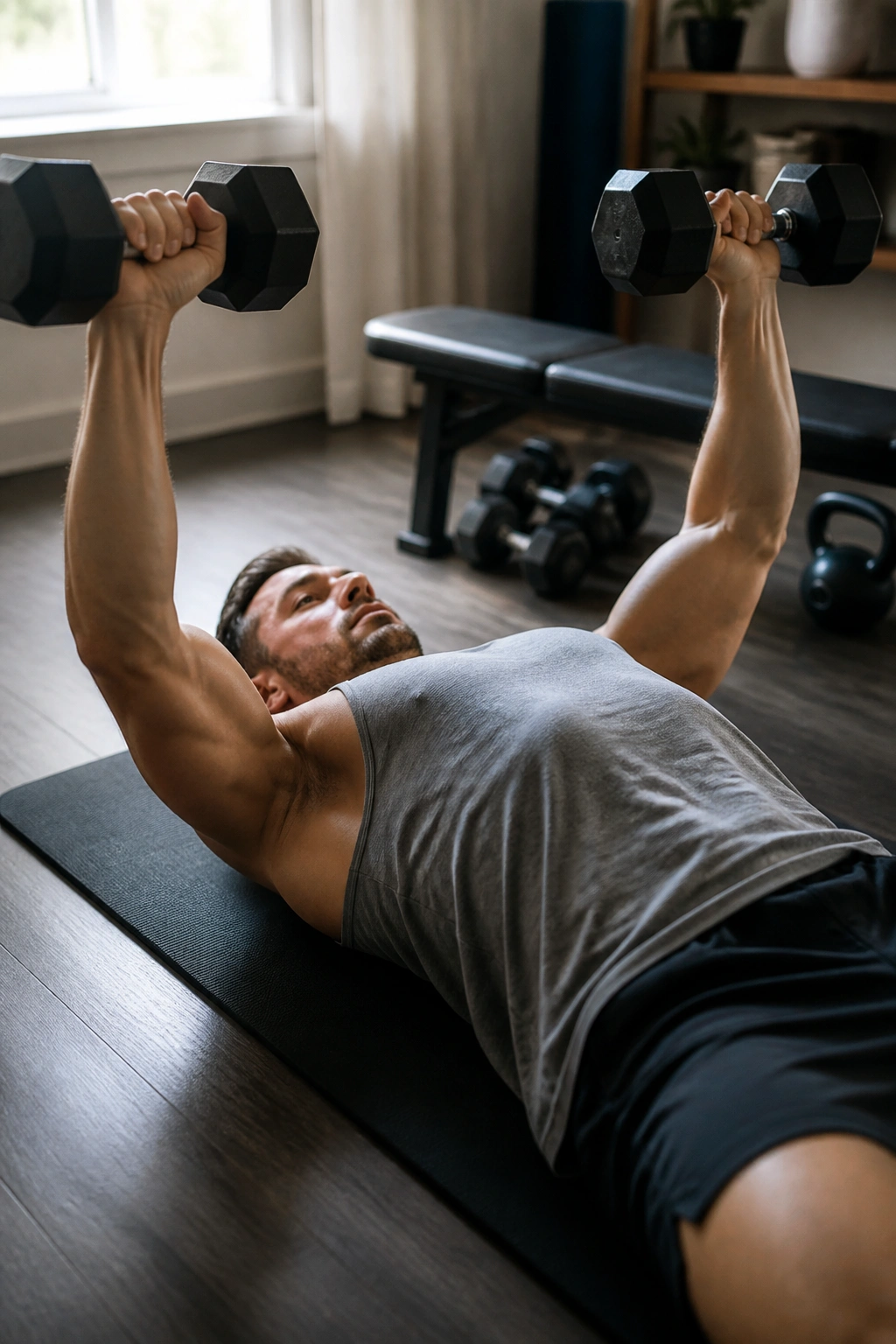
If you want a bigger upper torso, this is money. Wide chest, fuller triceps, more arm work, less wandering.
Use floor press or dumbbell bench press if you have a bench, then move into close-grip push-ups, dumbbell flyes, curls, and overhead triceps extensions. Three or four sets in the 8 to 15 rep range keeps the volume high enough for growth without turning the workout into a marathon.
A solid setup
- Dumbbell floor press — 4 sets of 8 to 12
- Close-grip push-ups — 3 sets to near failure
- Dumbbell flyes — 3 sets of 10 to 15
- Standing curls — 4 sets of 10 to 12
- Overhead triceps extension — 3 sets of 12 to 15
On flyes, stop the range before your shoulders feel like they’re being pulled apart. That move gets sloppy fast if you chase depth. On curls, keep your elbow from drifting all over the room. On triceps work, own the top half of the rep and don’t fling the weight.
This is a pump day, but it still needs discipline. A good chest-and-arms session feels tight, controlled, and a little vain. That’s fine. Sometimes that’s exactly what the day should be.
16. The Back and Shoulder Builder

Can you build a bigger back without a cable stack? Yes. Just be more deliberate about the angles.
A home back-and-shoulder day should hit horizontal rows, rear delts, lateral delts, and overhead pressing. One-arm dumbbell rows do a lot of the heavy lifting here. Add rear-delt flyes, standing presses, and band face pulls to round out the upper back. If you have a bench, chest-supported rows are a nice bonus.
What makes it different
The shoulders need both motion and control. If you press a lot but never train the rear delts, the whole shoulder area starts to feel uneven. Rows and face pulls help keep that honest.
Try this structure:
- One-arm row — 4 sets of 8 to 12
- Standing dumbbell press — 4 sets of 6 to 10
- Rear-delt fly — 3 sets of 12 to 15
- Lateral raise — 3 sets of 12 to 20
- Band face pull — 3 sets of 15 to 20
Keep the neck relaxed. A lot of men shrug their shoulders into their ears on raises and presses, then wonder why the top of the neck feels cooked the next day. Lower the weight and clean up the movement.
Strong backs look good. More important, they make everything else feel more stable.
17. The Posterior Chain and Glute Session

A quad-heavy leg day is one thing. This is the one that hits the backside.
The posterior chain includes your hamstrings, glutes, and lower back. At home, Romanian deadlifts, hip thrusts, hamstring slider curls, and single-leg hinges are the money moves. They work because they force the hips to do their share instead of letting the quads hog the whole job.
A useful sequence
- Romanian deadlift — 4 sets of 8
- Hip thrust on couch or bench — 4 sets of 10 to 12
- Hamstring slider curl with socks or towels — 3 sets of 8 to 12
- Single-leg RDL — 3 sets of 8 per leg
- Glute bridge march — 2 sets of 20 total steps
If your lower back takes over, the load is too heavy or the hinge pattern is off. Reset by pushing the hips back first and keeping the ribs stacked over the pelvis. That one cue saves a lot of bad reps.
This session is useful for men who sit too much, run too much, or just want stronger hips for the rest of their training. It also tends to make stairs feel a little annoying the next day. Fair trade.
18. The Density Block That Cuts Down Dead Time
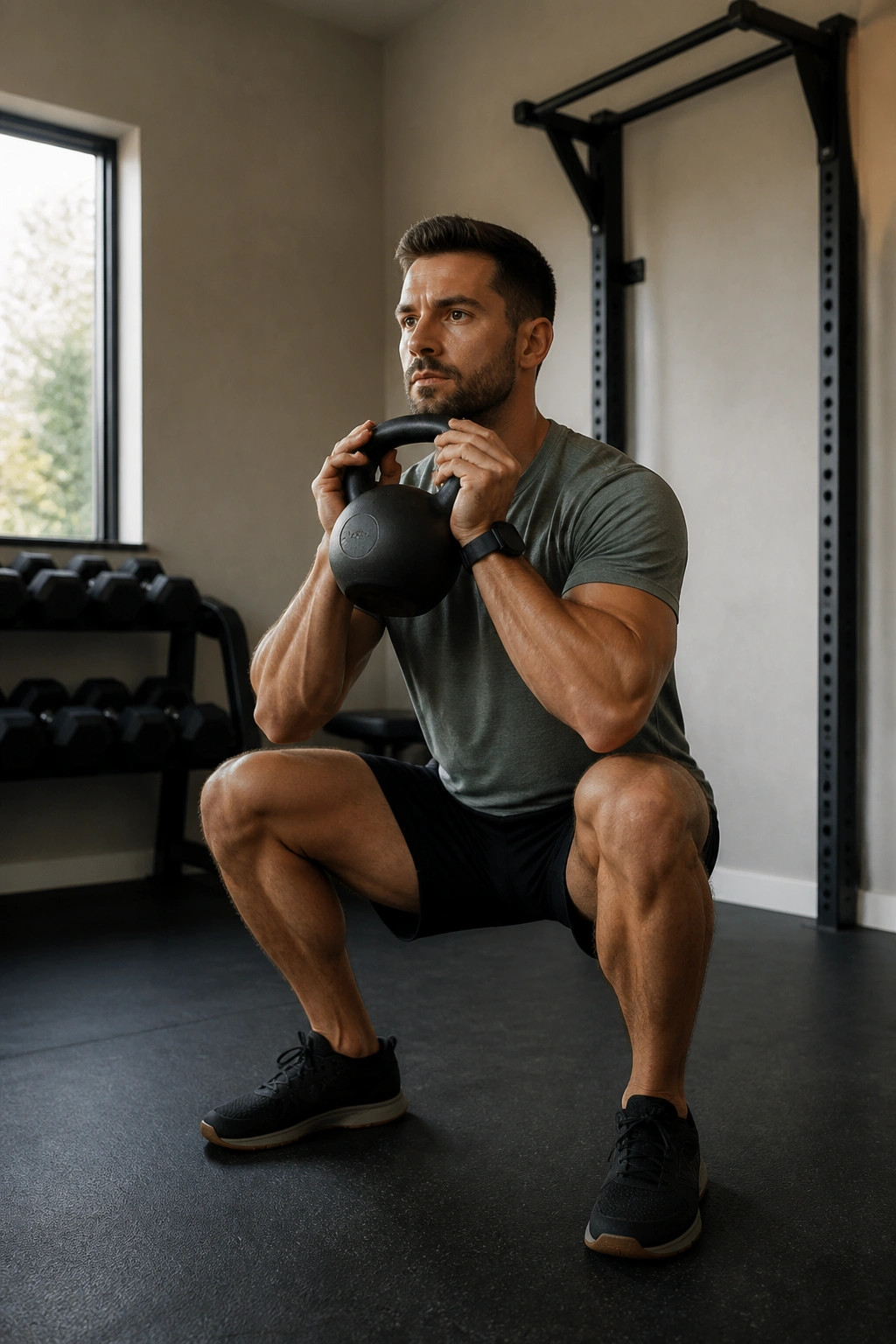
Twelve minutes on the clock. Four exercises. No wandering.
Density training means doing a lot of useful work in a short window, either by finishing more rounds or by covering the same work faster over time. It’s a smart fit for home training because it keeps the room small and the standards high.
Use a block like this:
- 8 goblet squats
- 8 push-ups
- 10 one-arm rows per side
- 12 kettlebell swings or dumbbell hinges
Repeat for 12 minutes. Track how many clean rounds you finish, then beat that number next time by one round, a few reps, or a shorter rest gap.
This style is excellent for men who hate long sessions but still want real work. It’s also easy to scale. Heavy weight? Fewer rounds. Light weight? More rounds. That flexibility is one reason density work shows up so often in home programs that actually stick.
The room doesn’t matter much here. The clock does.
19. The No-Noise Apartment Routine

If the floor is thin and the downstairs neighbor has opinions, you need a quiet routine.
Keep it silent
- Split squats instead of jumping lunges
- Slow push-ups instead of clapping push-ups
- Band rows instead of swinging dumbbells
- Glute bridges instead of explosive hip thrusts
- Dead bugs instead of mountain climbers
- Standing calf raises instead of jump rope
Work through 3 to 4 rounds with 8 to 15 reps on each movement. Move slowly on the lowering phase and place your feet down like you’re trying not to wake a baby. That sounds fussy, but it works.
The nice thing about quiet training is that it forces cleaner reps. No dropping weights. No stomping. No cheating with bounce. You end up using more muscle and less noise, which is a surprisingly decent deal.
Apartment training has a reputation for being limited. It isn’t. It just asks for more control and a little manners.
20. The Three-Day Weekly Rotation for Steady Progress
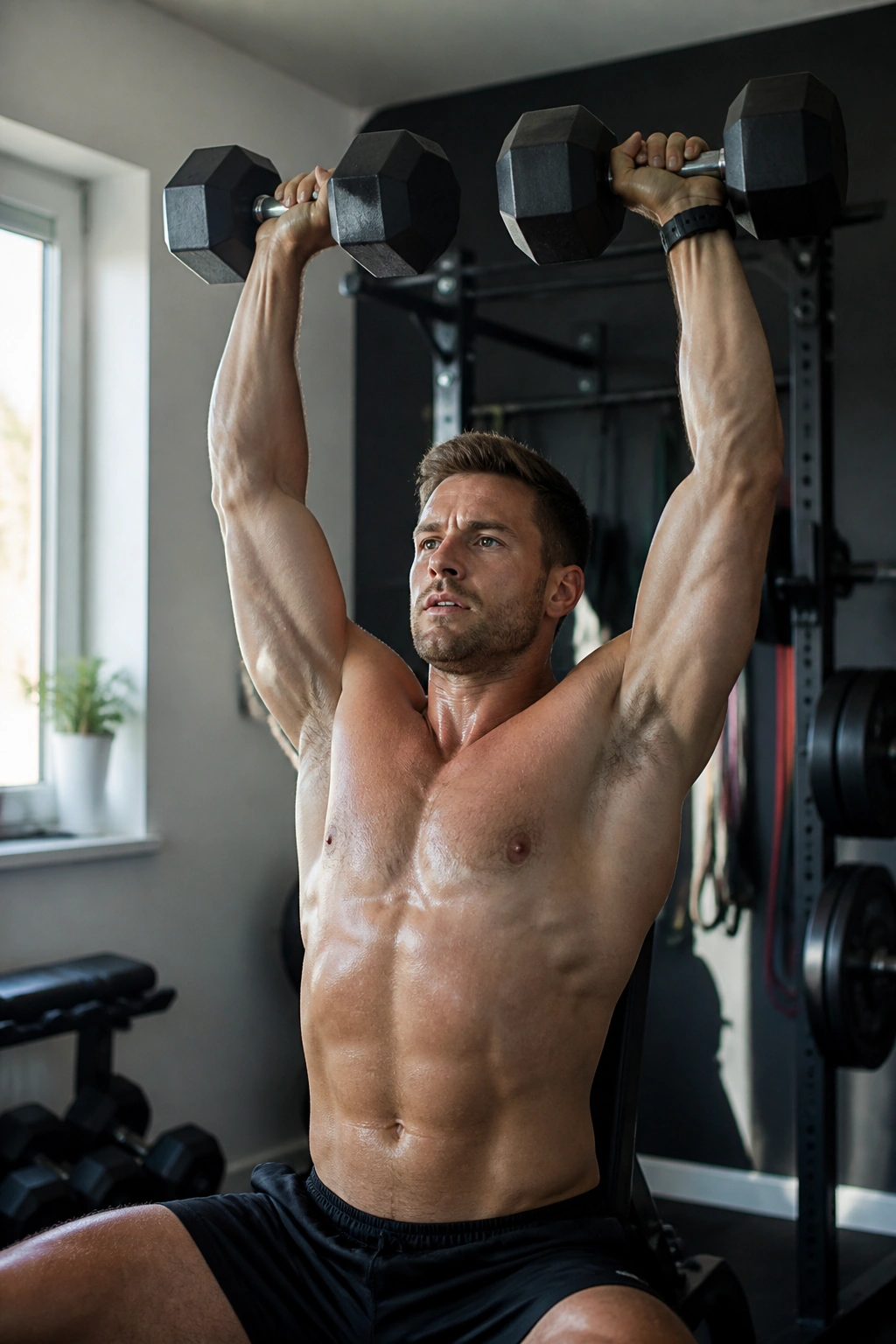
A clean weekly schedule beats random effort. If you want these workout routines for men who train at home to actually add up to something, stop treating each session like a separate event.
A simple three-day rotation works well:
- Day 1: Dumbbell Strength Day or No-Equipment Starter Circuit
- Day 2: Pull-Day Built on a Doorway Bar or Bands, then Core and Carries
- Day 3: Leg Day That Leaves Your Quads Talking or Posterior Chain Session
- Optional Day 4: Mobility Reset or EMOM Builder
How to pick your mix
- Want size? Use the chest, back, shoulder, and arm days more often.
- Want conditioning? Rotate EMOM, AMRAP, kettlebell complexes, and density blocks.
- Want a simple start? Stick with the no-equipment circuit, the dumbbell strength day, and the leg day.
- Want quieter sessions? Use band work, mobility, and tempo training.
Run the same two or three routines for a month before changing the menu. That gives you a chance to add a rep, tighten your form, or shorten your rest. Those small wins matter more than hopping to a new plan every week.
Keep one rule in mind: make the workout harder before you make it more complicated. That’s where home training usually starts working for real.
