



A workout can happen between the first spilled cereal bowl and the third request for a snack.
The best workout plans for busy moms at home are the ones that still work when the day gets messy, which is most days. If a plan needs silence, 60 uninterrupted minutes, and a spotless floor, it is not a plan. It is a fantasy dressed up like fitness.
The routines that actually stick are short, repeatable, and forgiving. A pair of dumbbells, a resistance band, a chair, and a timer can carry a surprising amount of the load. Public-health exercise targets usually land around 150 minutes of moderate activity a week plus a couple of strength sessions, but that sounds far bigger than it feels when you break it into 10- or 20-minute blocks.
If you’re postpartum, dealing with pelvic floor symptoms, or coming back from a long break, choose the gentler plans first. Your body does not need punishment. It needs clear movements, decent recovery, and a little consistency. Start with the routine that matches your energy, not the one that looks toughest on paper.
1. The 10-Minute Morning Wake-Up Circuit
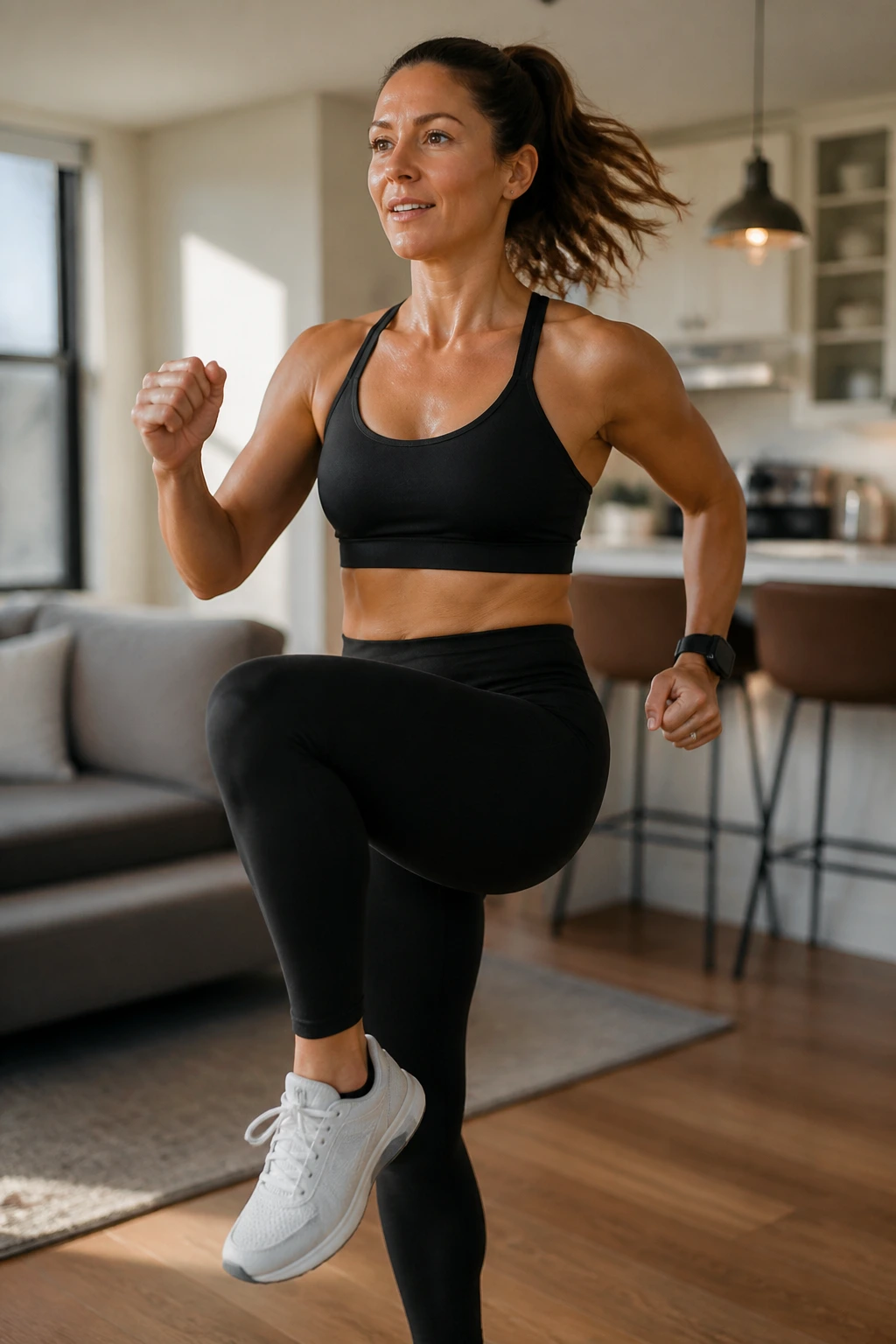
Ten minutes is enough when every move earns its place. This is the kind of routine that gets your joints moving, your breathing up, and your brain a little more awake before the house starts asking for things.
Set a timer for 40 seconds of work and 20 seconds of rest. Go through the circuit twice if you have the time, once if you do not. Keep it simple: marching in place, chair squats, wall push-ups, hip hinges, and a short plank hold on the counter or floor.
What makes it work
The point is not to crush yourself before breakfast. It is to flip the switch from sleepy to usable. After a round or two, your legs should feel warm and your shoulders less glued to your ears.
- March in place with strong arm swings
- 10 to 12 chair squats
- 8 to 10 wall or counter push-ups
- 10 hip hinges with hands on thighs
- 20-second plank or countertop hold
Best move for consistency: leave your shoes beside the mat so there is one less decision to make.
2. Staircase Cardio in the Hallway

What if the best cardio in the house is the staircase you already ignore? That is the whole appeal here. No equipment, no special setup, and no need to leave the house when the weather is rude.
Use the stairs for 8 to 12 minutes. Walk up at a brisk pace, come down slowly, and repeat. If your knees like it, add side steps, single-step marches, or a gentle power walk on the landing. The idea is to keep your heart rate up without turning the session into a wipeout.
How to keep it knee-friendly
Shorten your stride and use the rail. You want clean foot placement, not drama. If stairs bother you, swap in hallway laps or step-ups on the bottom stair.
- 30 seconds brisk stair climbing
- 30 seconds easy recovery walk
- 5 rounds, then a 2-minute easy cool-down
- Optional: 10 calf raises at the bottom stair
Use this on days when you want sweat without jumping. It’s straightforward, a little old-school, and far more useful than people give it credit for.
3. One Dumbbell, Full-Body Strength

One dumbbell can do more than you think. If you are the sort of person who likes a clean, no-fuss workout, this one has your name on it.
Pick a dumbbell you can lift for 8 to 12 controlled reps without twisting your torso. Do goblet squats, single-arm rows, overhead presses, Romanian deadlifts, and suitcase carries. Three rounds is plenty for most busy days, though two rounds still count as a real session.
Why this plan earns its keep
Single-side work is useful when life has you carrying kids, laundry, and groceries on one hip all week. It helps expose strength gaps without making the workout complicated. You also get a lot of mileage out of a small amount of gear, which matters when floor space is limited.
- Goblet squat: 8 to 10 reps
- Single-arm row: 8 to 10 reps per side
- Overhead press: 6 to 8 reps per side
- Romanian deadlift: 10 reps
- Suitcase carry: 30 to 45 seconds per side
Keep your ribs down on the press. If your lower back arches, the weight is too heavy for the day.
4. Quiet No-Jump Cardio for Sleeping Kids

You do not need jumping to get winded. That is one of the nicest little lies the fitness world keeps trying to sell, and it is mostly nonsense.
This plan uses 20 seconds hard, 10 seconds easy for four minutes at a time. Try shadow boxing, fast step-touches, standing knee drives, skater steps without the hop, and wall climbers. It gets your breathing up while keeping the floor, ceiling, and sleeping child situation intact.
What to watch for
Quiet cardio works best when you move with intent. Punch straighter. Drive your knees higher. Keep your feet light but not sloppy. If the movement gets tiny, your heart rate will follow it right down.
- Shadow boxing with full arm reach
- Fast step-touches with strong arm swings
- Standing mountain climbers against a wall
- Knee drives with a slight torso lean
- Low skater steps side to side
This one is gold for apartments. Also for homes where the baby finally fell asleep and you are not about to ruin that.
5. Naptime Core and Glute Reset
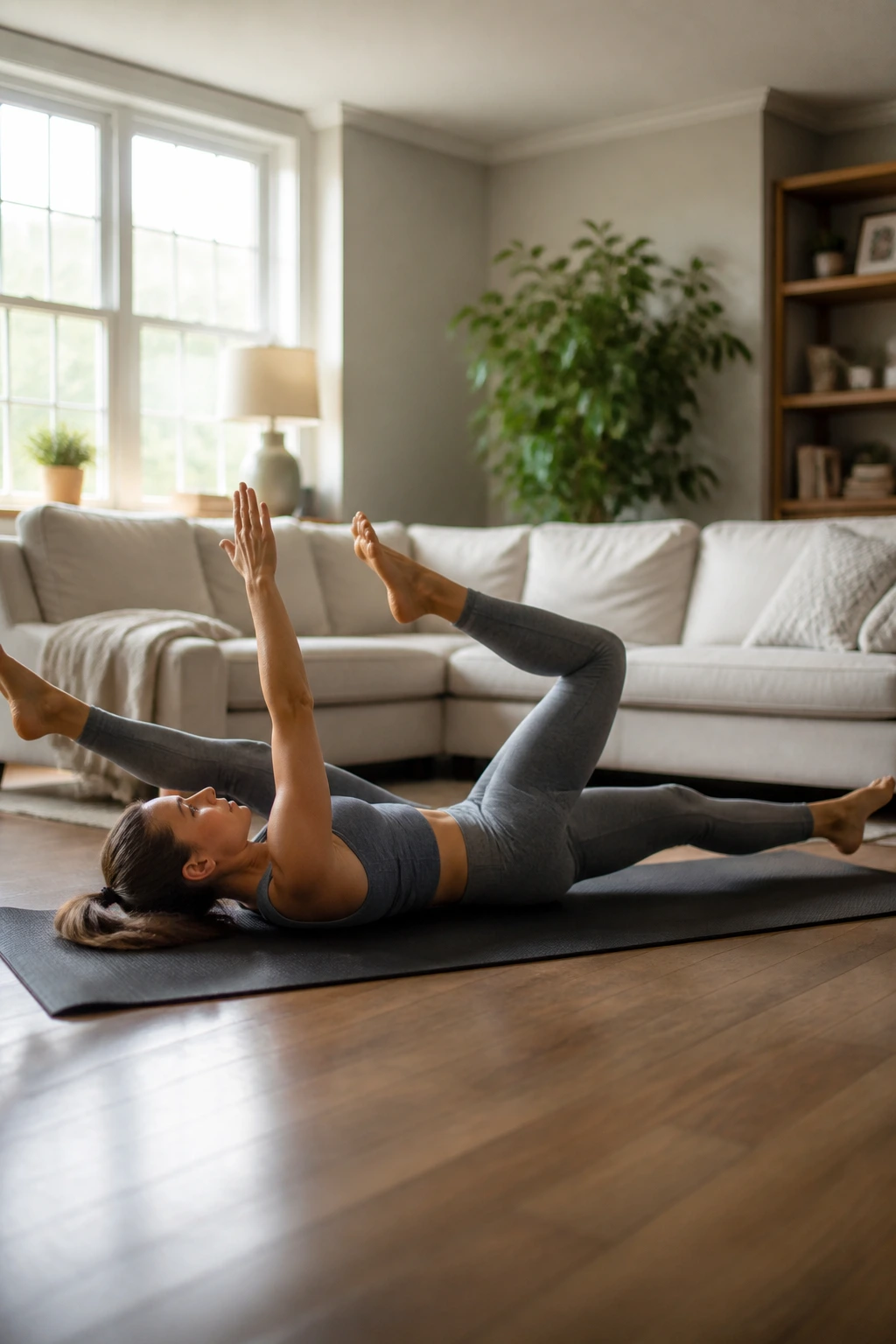
If your core feels weak, tired, or foggy, start here. This isn’t about flashy ab work. It’s about restoring some support where your body actually needs it.
Use slow, clean reps. Dead bugs, glute bridges, bird dogs, heel taps, and side-lying leg lifts are the backbone of this routine. Two or three rounds usually do the trick, with 6 to 10 reps per move and no rush between exercises.
Why the slow pace matters
Fast core work often turns into neck strain or hip flexor takeover. Slow work gives you a chance to feel the deep brace through your middle and the squeeze in your glutes. That matters when you spend half the day picking things up from the floor.
- Dead bug: 6 to 8 reps per side
- Glute bridge: 10 to 12 reps
- Bird dog: 6 reps per side, held 2 seconds
- Heel taps: 8 to 10 reps per side
- Side-lying leg lift: 10 reps per side
If your lower back takes over, shorten the range. Small, controlled reps beat big sloppy ones every time.
6. EMOM Training When You Want Structure
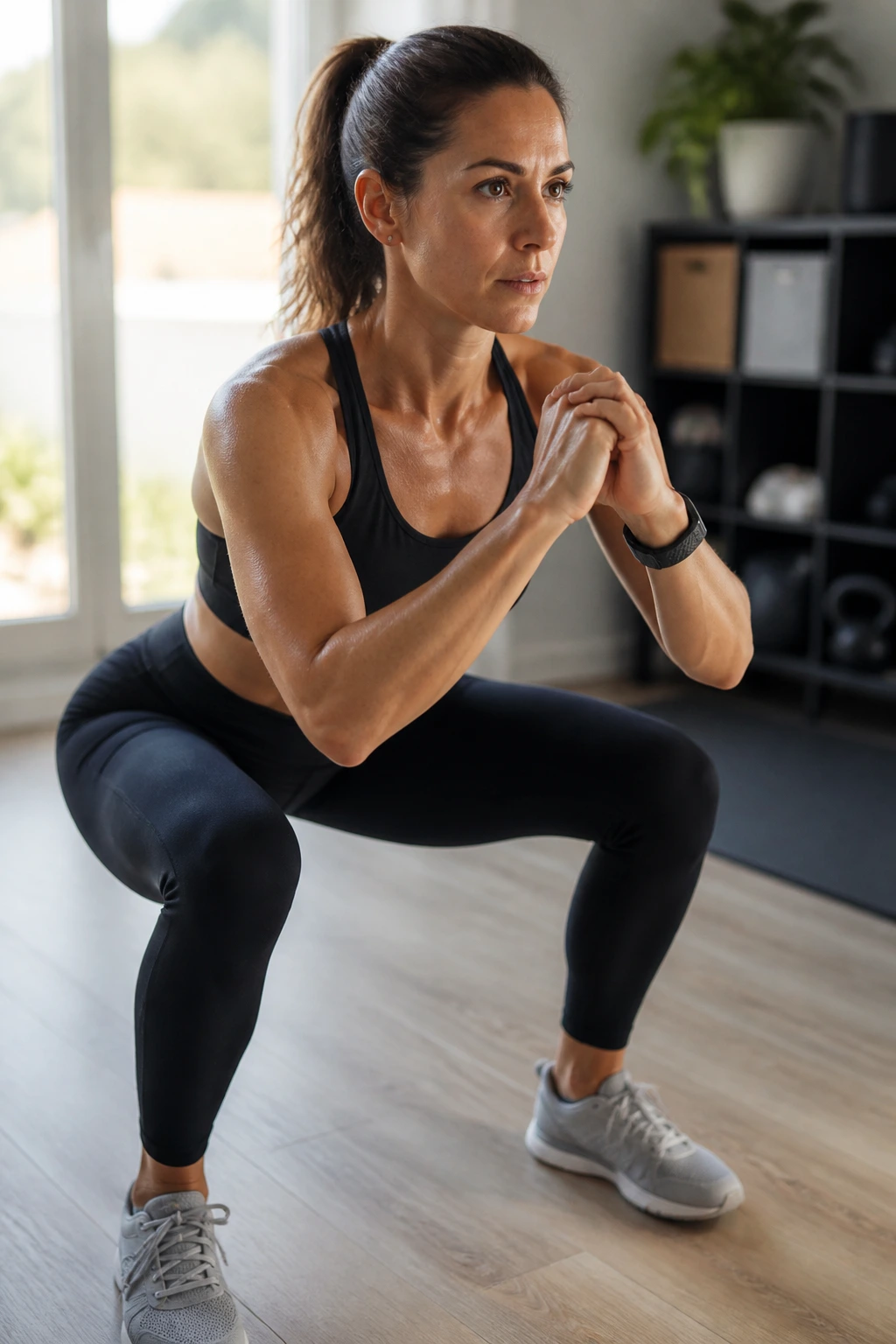
Need the clock to boss you around a little? EMOM stands for every minute on the minute, and it’s one of the easiest ways to make a short workout feel organized.
Set a timer for 12 minutes. At the start of each minute, do the listed work, then rest for whatever time remains. If you finish the reps in 25 to 35 seconds, you get a built-in break. That little gap is the whole trick.
Sample EMOM
- Minute 1: 10 squats
- Minute 2: 8 incline push-ups
- Minute 3: 12 reverse lunges, total
- Minute 4: 20-second plank
- Repeat three times
You can make it harder by adding reps or using a lower incline on the push-ups. You can make it gentler by cutting the reps or using bodyweight-only squats with a slower tempo.
The sweet spot is leaving 10 to 15 seconds on the clock. If you finish with no rest, the minute is too packed.
7. Resistance Band Total-Body Work
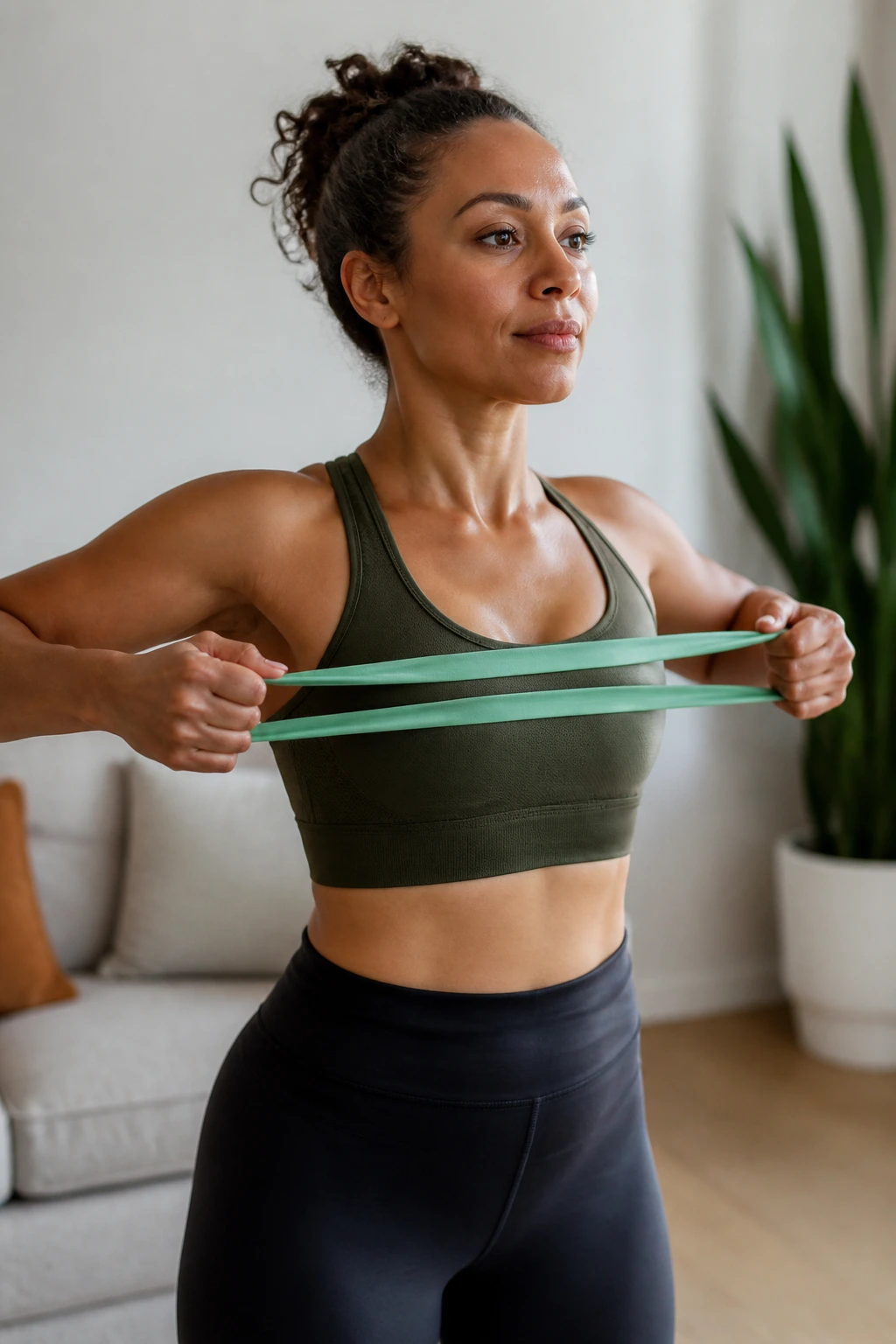
Bands are a tiny miracle for home workouts. They fit in a drawer, they do not clang on the floor, and they make ordinary exercises feel more serious without needing a full dumbbell rack.
Use a medium loop band or long band for 15 to 20 minutes. Squats, lateral walks, rows, pull-aparts, and overhead presses cover most of the body in a way that feels efficient instead of random. Keep tension on the band the whole time. Loose band work is lazy band work.
What this plan is good for
It is especially helpful if you want glutes, upper back, and shoulders to get attention without running around the house. Bands also make warm-ups better because they wake up muscles before a more intense session.
- 12 banded squats
- 10 rows per side
- 12 pull-aparts
- 10 overhead presses
- 10 steps each way for lateral walks
Choose a band that makes the last 3 reps honest. If you can cruise through the set, the band is too light.
8. A Gentle Postpartum Deep-Core Build
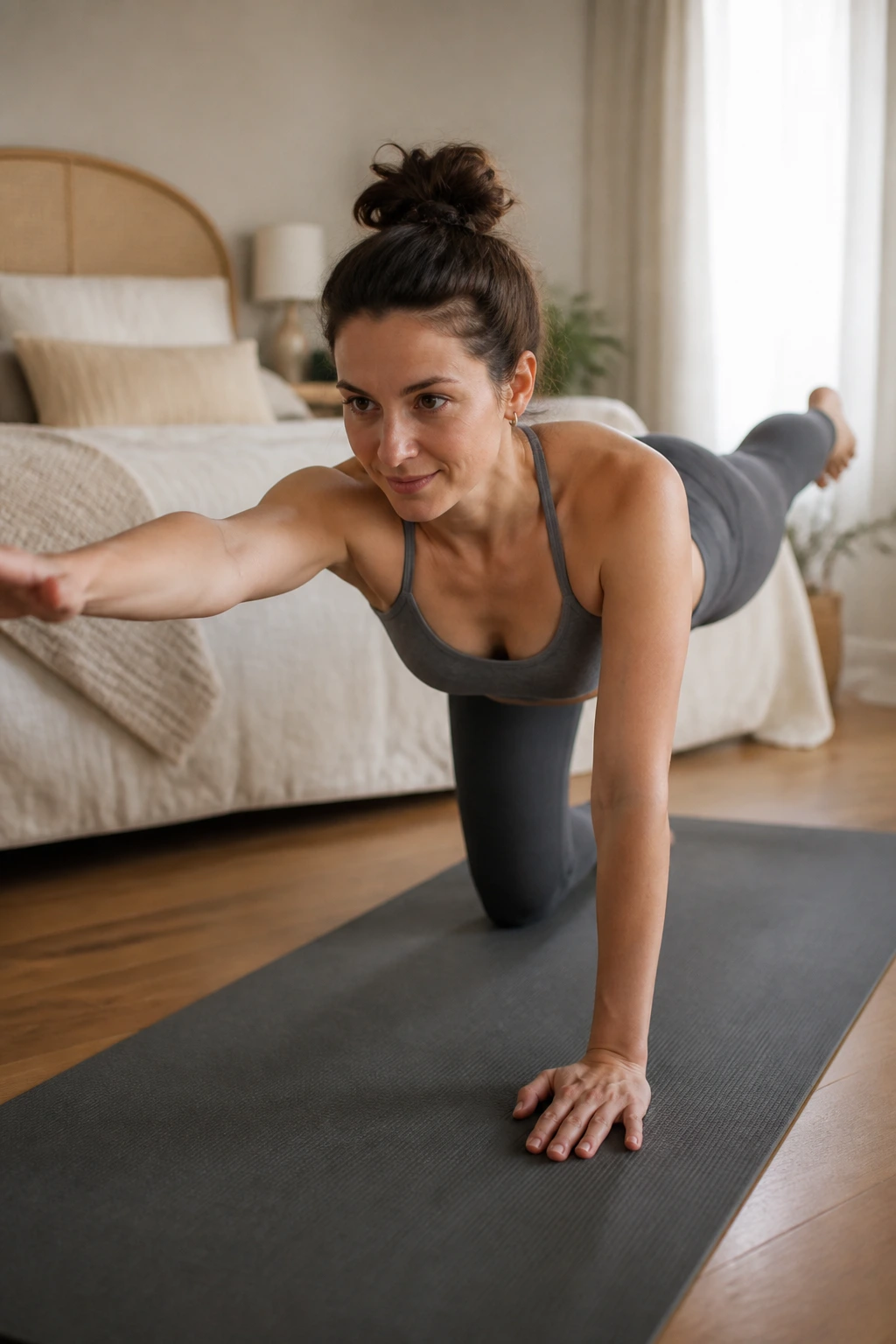
If your body feels tender, heavy, or a little off-center, this is the gentle lane. It is the one I would trust before anything bouncy, twisty, or aggressive.
Start with breathing, then add heel slides, marching, bird dogs, and very light glute work. Keep the sessions short. Eight to 12 minutes is more useful than forcing a long routine when your system is already asking for caution.
What to skip for now
Crunches, aggressive planks, and anything that makes you bear down are usually poor choices early on. If you notice doming along the midline, leaking, or pressure, back off and stay with the simpler movements. That is not failure. It is smart training.
A gentle sample sequence
- 5 slow breaths with ribs expanding
- 8 heel slides per side
- 6 marching reps per side
- 6 bird dogs per side
- 10 glute bridges
If something feels strained, stop there. Stronger work can wait. Support comes first.
9. Kitchen Dance Cardio in Three Songs

A kitchen dance workout sounds almost too easy, which is why it works. You do not have to love dance fitness. You just have to be willing to move like nobody is grading you.
Pick three songs. Use the first as a warm-up, the second as the hardest push, and the third to finish strong. March, side-step, reach overhead, twist through the torso, and let your arms do more work than they usually get. If the song ends and you are breathing harder, it counts.
How to shape the three songs
- Song 1: easy marching and big arm swings
- Song 2: faster side steps, knee lifts, and punches
- Song 3: lower the intensity, but keep moving
This one is sneaky. It does not feel like a formal workout, yet it can easily land you in a decent cardio zone. And if your kid wanders in and joins, fine. That’s almost part of the design.
Use music with a strong beat. You will move better than if you try to count beats in silence.
10. The Bodyweight Ladder Challenge
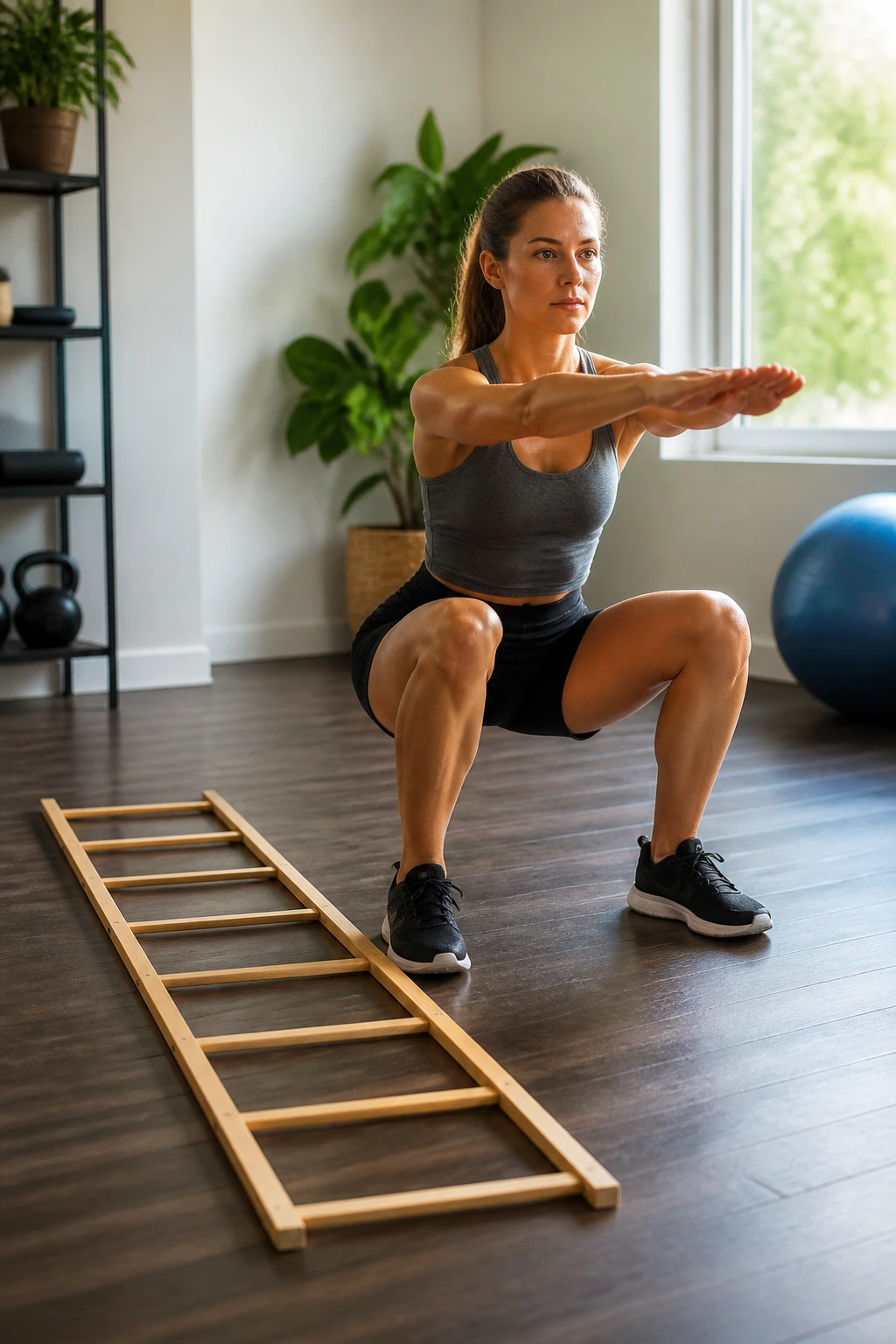
Want a workout that feels a little like a game? Use a ladder. It gives you enough structure to stay focused, but not so much that you feel trapped by the numbers.
Start with 2 reps, then 4, then 6, then 8, then back down if you still have gas. You can use squats, incline push-ups, glute bridges, and dead bugs. Keep the movements clean and stop before form gets muddy.
Why ladders are useful
They work well on days when motivation is spotty. The first round feels easy, the middle rounds wake you up, and the last round gives you a clear finish line. That is often enough to keep you from drifting away mid-workout.
- Squats: 2-4-6-8
- Incline push-ups: 2-4-6-8
- Glute bridges: 2-4-6-8
- Dead bugs: 2-4-6-8 per side
Do not chase fatigue at the expense of form. Clean reps matter more than dramatic suffering.
11. The Three-Day Push-Pull-Legs Split
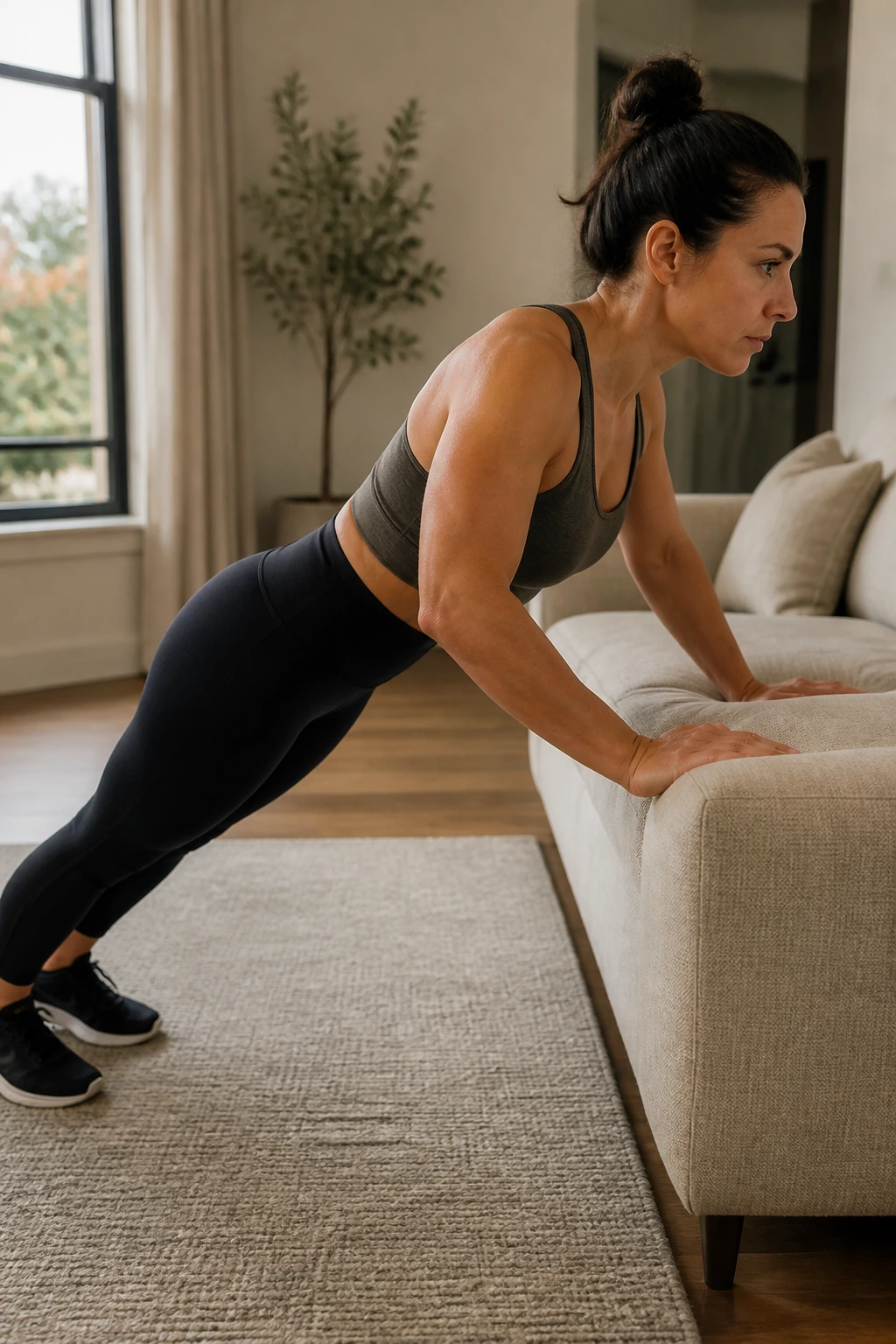
Unlike random “do everything” workouts, a split gives each session a job. That means less decision fatigue and more focused work, which is nice when your week already feels chopped into tiny pieces.
Use Monday, Wednesday, and Friday if that suits your life, or any three non-back-to-back days. Push day covers chest, shoulders, and triceps. Pull day hits back and biceps. Legs day takes care of glutes, quads, hamstrings, and core.
A simple weekly layout
- Push: incline push-ups, shoulder press, triceps dips on a chair
- Pull: rows, reverse flys, dead hangs if you have a bar
- Legs: squats, lunges, hip hinges, calf raises
Each session can stay around 20 minutes. That is enough to build real consistency without eating the whole morning. If a child interruption cuts the workout short, you still got one focused piece done.
This plan works best with dumbbells or bands. Bodyweight can still do it, but some resistance helps.
12. Toddler-Interrupted Micro-Sets
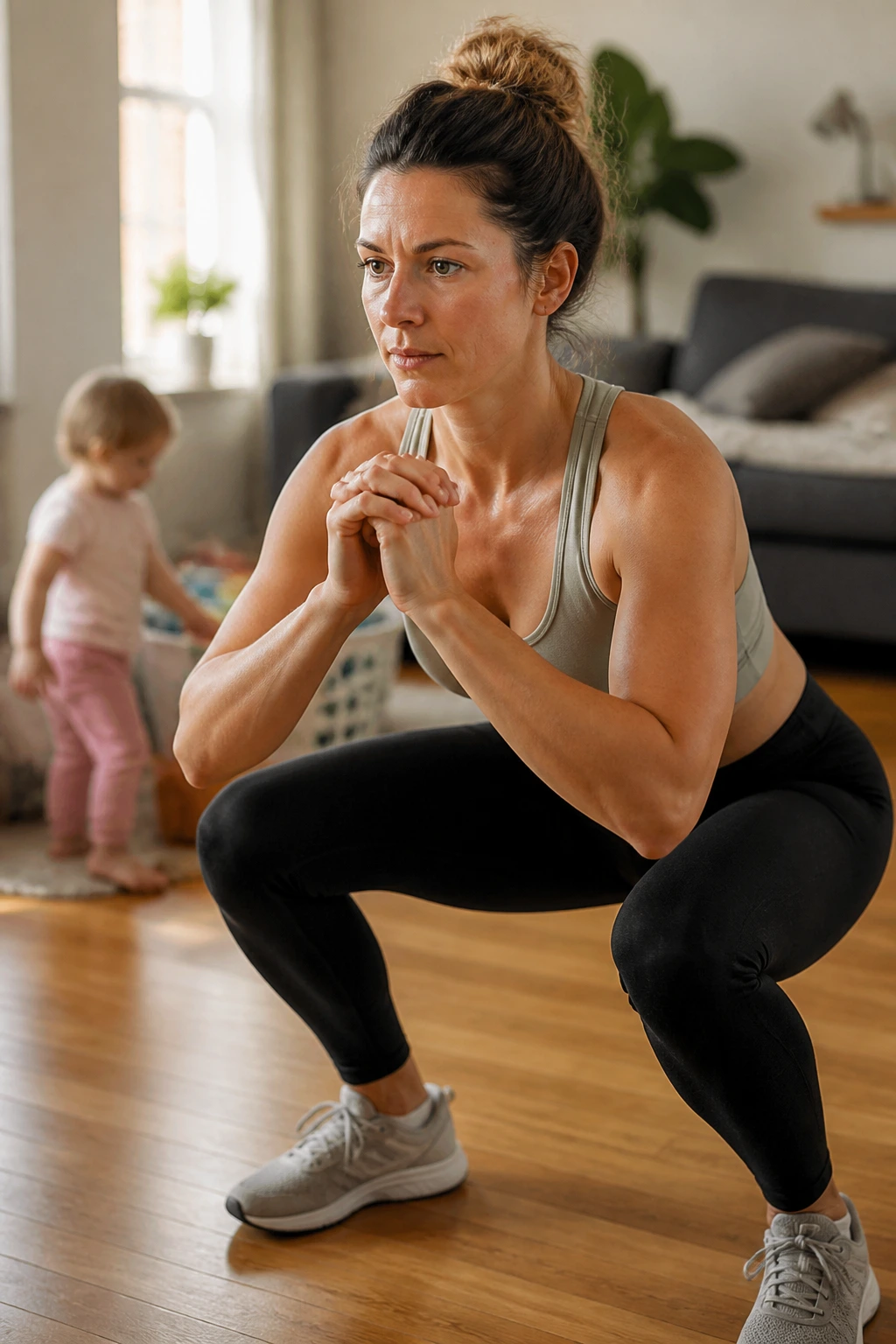
A lot of home workouts fail because they assume uninterrupted time. That is the part I never trust. Life with kids rarely delivers a clean 30-minute block on cue.
Micro-sets fix that by breaking movement into tiny chunks across the day. Do 2 to 3 minutes at a time: squats while the microwave runs, countertop push-ups after lunch, marching in place during screen time, glute bridges before the bath starts. It all adds up.
The upside
Your nervous system never has to gear up for a huge session, which can make this feel easier to start. And once you begin, there is a good chance you’ll do more than you expected. Human beings are funny that way.
- 10 squats before coffee
- 8 countertop push-ups after dishes
- 20 marching steps while waiting for water to boil
- 12 calf raises during teeth-brushing
- 10 glute bridges before bed
Tiny blocks count. If you did five of them, that is a workout day.
13. Yoga and Mobility for Stiff Mornings
Some mornings need movement, not sweat. If your hips feel glued, your back feels cranky, or your shoulders have that rounded, laptop-heavy look, a mobility flow is the better choice.
Move slowly through cat-cow, thoracic rotations, a low lunge with reach, hamstring folds, child’s pose, and figure-four stretches. Spend 20 to 40 seconds in each shape and breathe through the tight spots instead of forcing them open. That makes the session feel calmer and more useful.
A sequence that usually helps
- Cat-cow for spine warmth
- Thread-the-needle for upper back
- Low lunge for hip flexors
- Figure-four stretch for glutes
- Child’s pose for a final reset
This is the kind of routine that pays off more than it looks like it should. You finish feeling looser, which makes the next workout easier too. That is not glamorous, but it is real.
Choose this after a rough night or a long stretch of sitting. Your body will probably thank you by moving better all day.
14. Tabata Bursts for a Fast Sweat

Tabata is short, sharp, and not especially forgiving. That is exactly why people like it. You work for 20 seconds, rest for 10 seconds, and repeat for 8 rounds before moving on.
Pick only one or two moves per block. Squat to reach, mountain climbers on a couch or bench, alternating lunges, and plank shoulder taps all work well. Two blocks with a short rest in between can give you an 8- to 12-minute workout that feels much bigger than it sounds.
What to keep in mind
Tabata is best on days when your energy is decent and you want a fast hit of effort. It is not the routine I’d choose when sleep is poor and patience is thin. In those moments, something steadier tends to feel better.
- Block 1: squat to reach
- Block 2: mountain climbers on an elevated surface
- Block 3: alternating lunges
- Block 4: plank shoulder taps
Do fewer rounds if form starts to fall apart. Fast work should still look controlled.
15. Backpack and Water-Jug Strength Work
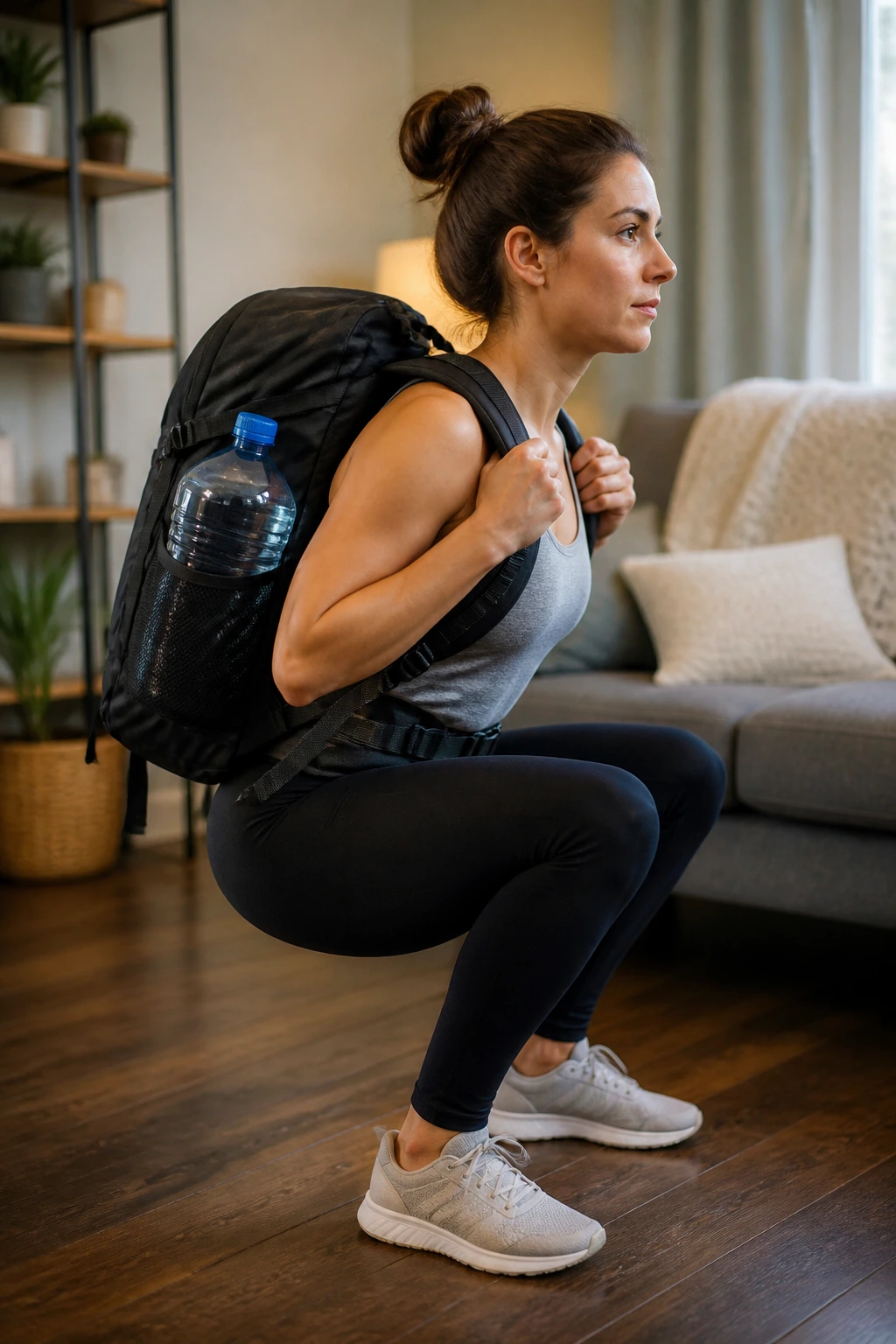
No dumbbells? Fine. Use what the house already gives you. A loaded backpack, two water jugs, or even a sturdy tote with books can work if you’re careful about grip and posture.
Backpack squats, bent-over rows, split squats, deadlifts, and carries are the main players here. Aim for 8 to 12 reps on the strength moves and 30 to 45 seconds on the carries. The goal is to create enough resistance that the session feels challenging, not to impress anyone with your plumbing supplies.
Simple gear swaps
- Backpack squat instead of goblet squat
- Water-jug carry instead of farmer carry
- Backpack row instead of dumbbell row
- Split squat with bodyweight or loaded tote
This plan feels practical because it is practical. You are not waiting for gear to show up. You are using what is already in the room, which is often the difference between working out and thinking about working out.
Make sure the backpack sits high and close to your body. A sloppy load can pull you forward fast.
16. Neck, Back, and Hip Relief After Long Sitting
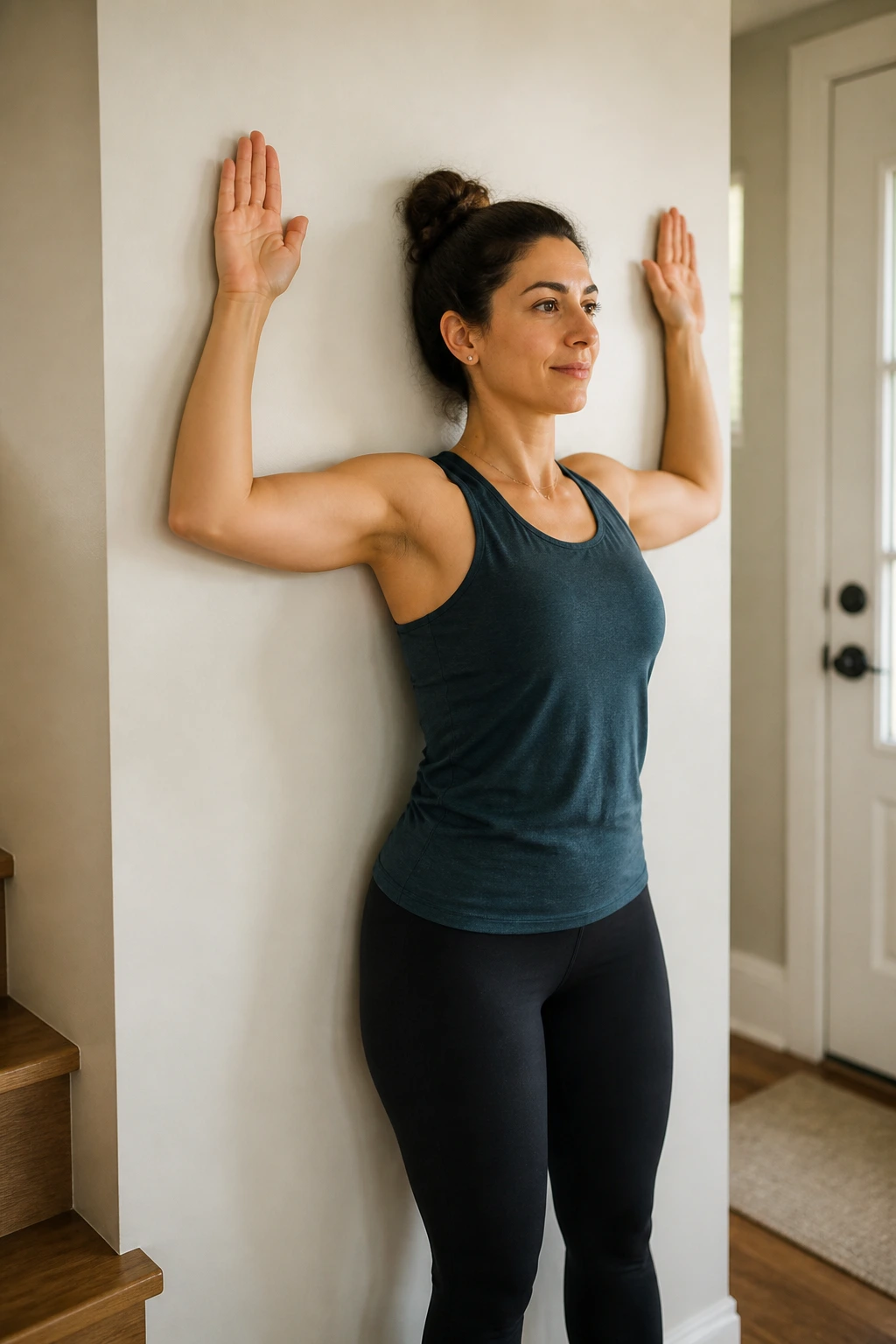
If you sit for work, feed a baby in awkward positions, or spend too much time bent over a phone, this one matters. The goal is not to build a six-pack. The goal is to feel less twisted by the end of the day.
Use wall angels, band pull-aparts, dead bugs, hip flexor stretches, and a light reverse plank or tabletop hold. Keep the whole thing around 10 to 15 minutes. The movements should feel precise and controlled, not like a contest.
Why this routine pays off
The upper back, hips, and deep core tend to get lazy when the day is all sitting and carrying. This plan reminds them to work again. If your shoulders drop a little and your chest opens up after the session, that’s the good sign.
- Wall angels: 6 to 8 slow reps
- Band pull-aparts: 10 to 12 reps
- Dead bugs: 6 reps per side
- Hip flexor stretch: 30 seconds per side
- Reverse tabletop hold: 15 to 20 seconds
Keep your chin tucked slightly on the wall work. Craning forward defeats the point.
17. The Weekend Longer Strength Session
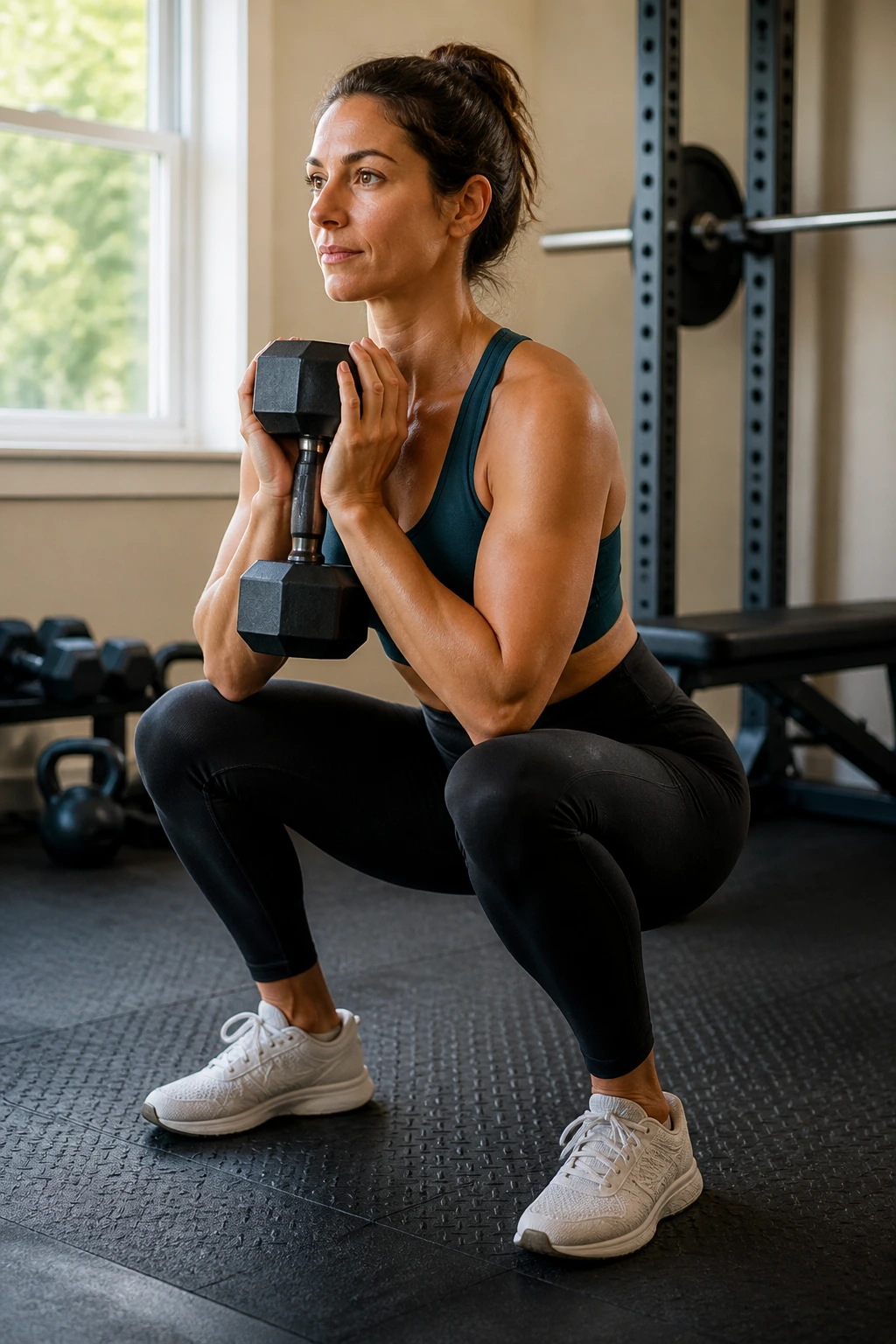
Short workouts keep the wheels on. A longer weekend session is where you build a little more muscle and practice a few heavier, more deliberate moves.
Set aside 30 to 40 minutes. Start with a 5-minute warm-up, then run three circuits of 4 to 5 exercises with 45 to 60 seconds of rest between sets. The pace should feel calm enough to keep form sharp, but not so slow that you start scrolling your phone between rounds.
A sample structure
Warm-up: marching, arm circles, hip hinges, bodyweight squats.
Circuit 1: goblet squat, row, push-up, glute bridge.
Circuit 2: reverse lunge, overhead press, dead bug, suitcase carry.
Cool-down: hamstring stretch, chest opener, slow breathing.
This is the session to save for a slightly more open window. It rewards concentration and gives you something a little meatier than a sprint workout. You do not need to go all-out. You do need to stay present.
Use a timer for rest periods. Otherwise, the workout tends to wander.
18. Indoor Walking Intervals Around the House
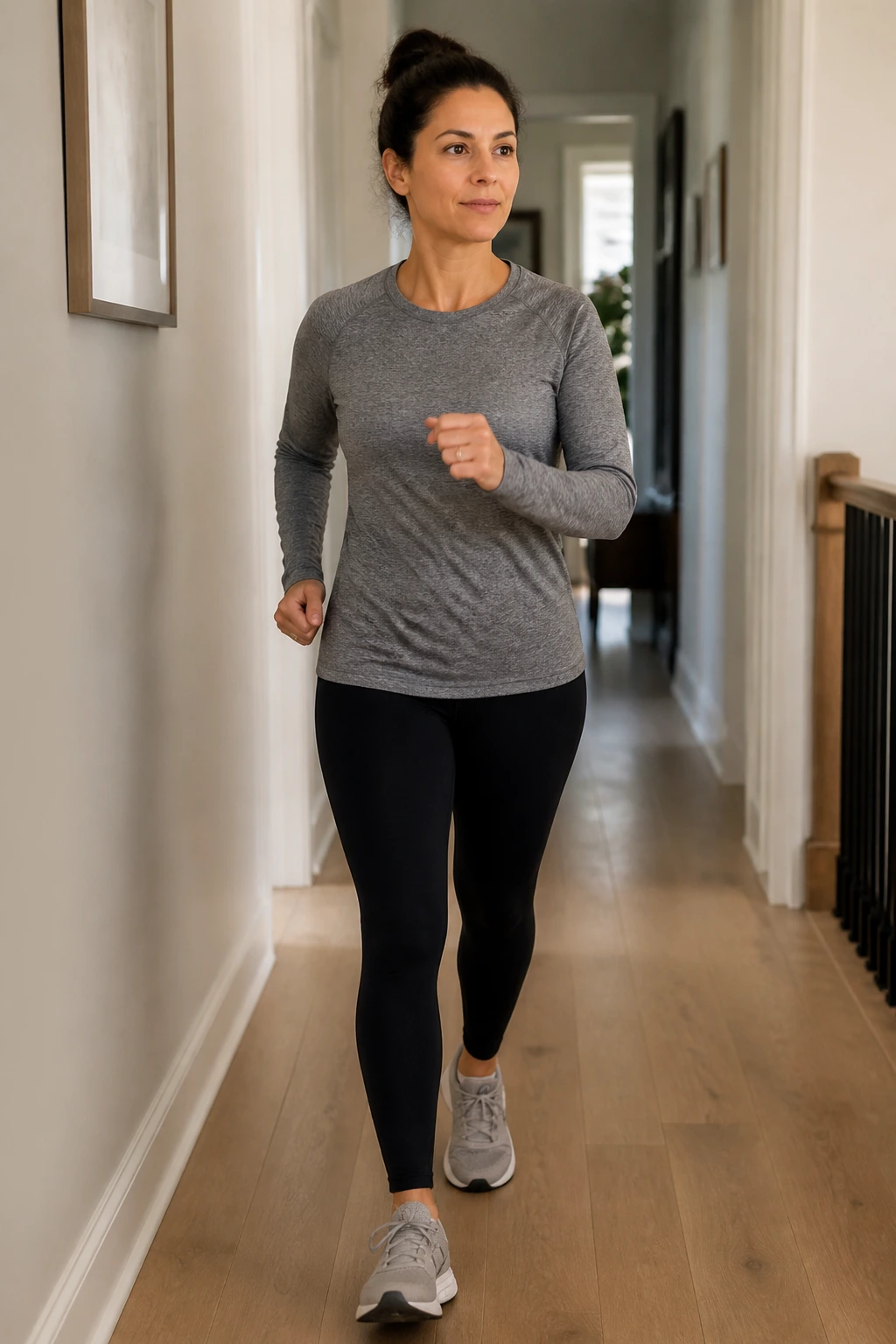
Not every cardio session has to feel athletic. Sometimes the smartest choice is just getting your steps in without leaving the house or dressing for a full outing.
March in place, walk hallway loops, step side to side, or pace while you take calls. Use 1 minute brisk and 1 minute easy for 10 rounds, or simply keep moving for 20 to 30 minutes while the room life happens around you. That lower-stakes rhythm is a lot easier to repeat than an intense session you dread.
What makes walking intervals useful
They are kind to tired legs, they do not wake sleeping kids, and they fit into awkward cracks of the day. You can stop and restart without the whole workout collapsing. That makes them easier to live with than more dramatic cardio plans.
- Brisk hallway walk
- High-knee march in place
- Step-touch with arm swings
- Light boxing while walking in place
- Easy recovery pace
Keep the brisk minutes honest. If you can sing, speed up a little.
19. Stair and Chair Lower-Body Circuit
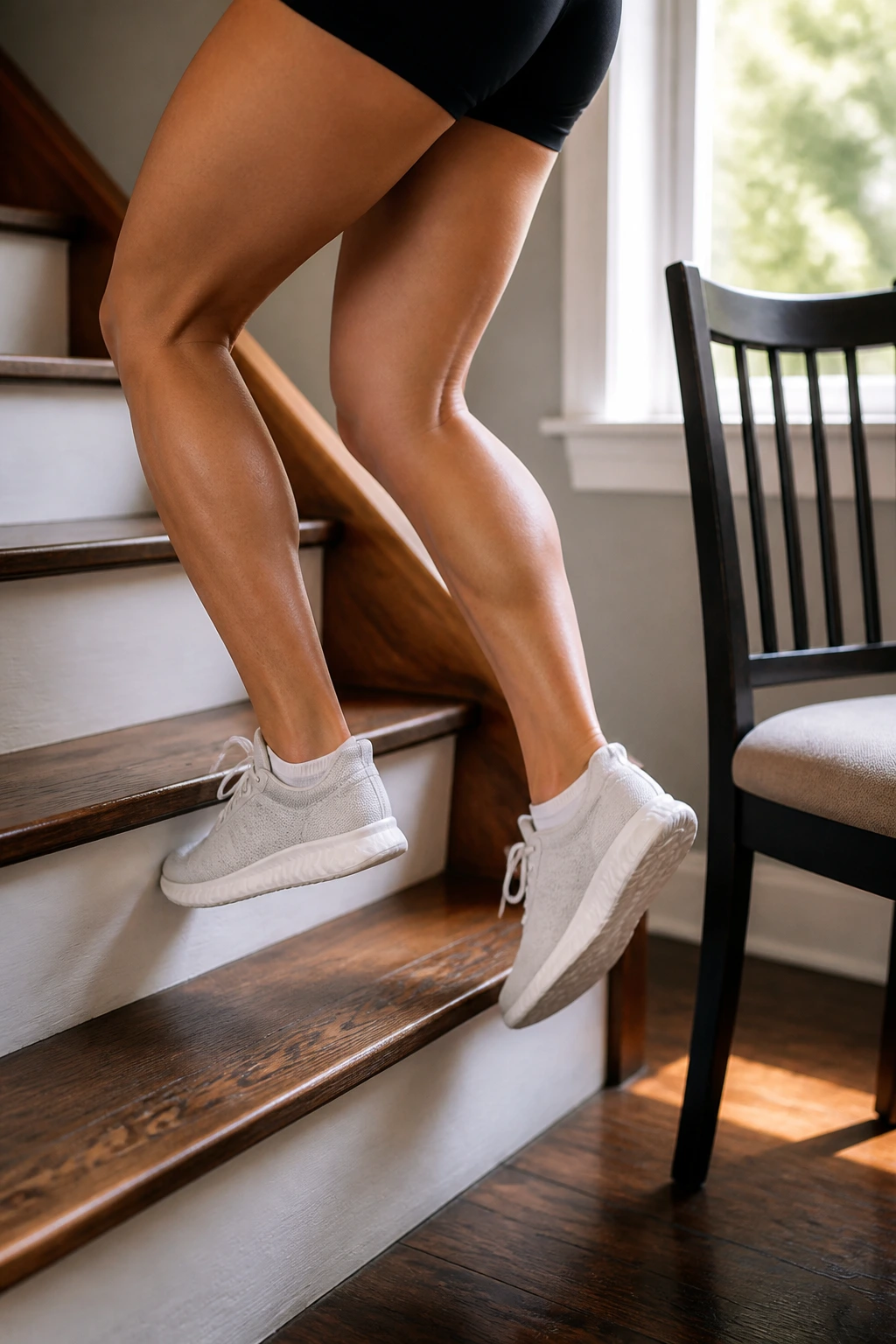
Unlike a pure cardio session, this one builds legs and glutes while your heart rate climbs. That is a nice two-for-one when time is tight and you want more than a sweat.
Use a chair, a stair, or both. Step-ups, chair squats, split squats, wall sits, and calf raises make a strong lower-body circuit. Two to four rounds usually works well, with 8 to 12 reps per move and a short rest when your breathing asks for it.
A practical version
- 10 chair squats
- 8 step-ups per side
- 8 split squats per side
- 20-second wall sit
- 12 calf raises
This kind of training is useful in a very unglamorous way. It makes stairs feel easier, carrying feel easier, and long days feel a little less heavy in the legs. That’s the point.
Use a sturdy chair that does not slide. A wobbly setup turns a smart workout into a dumb one.
20. The 20-Minute Full-Body Fallback Plan
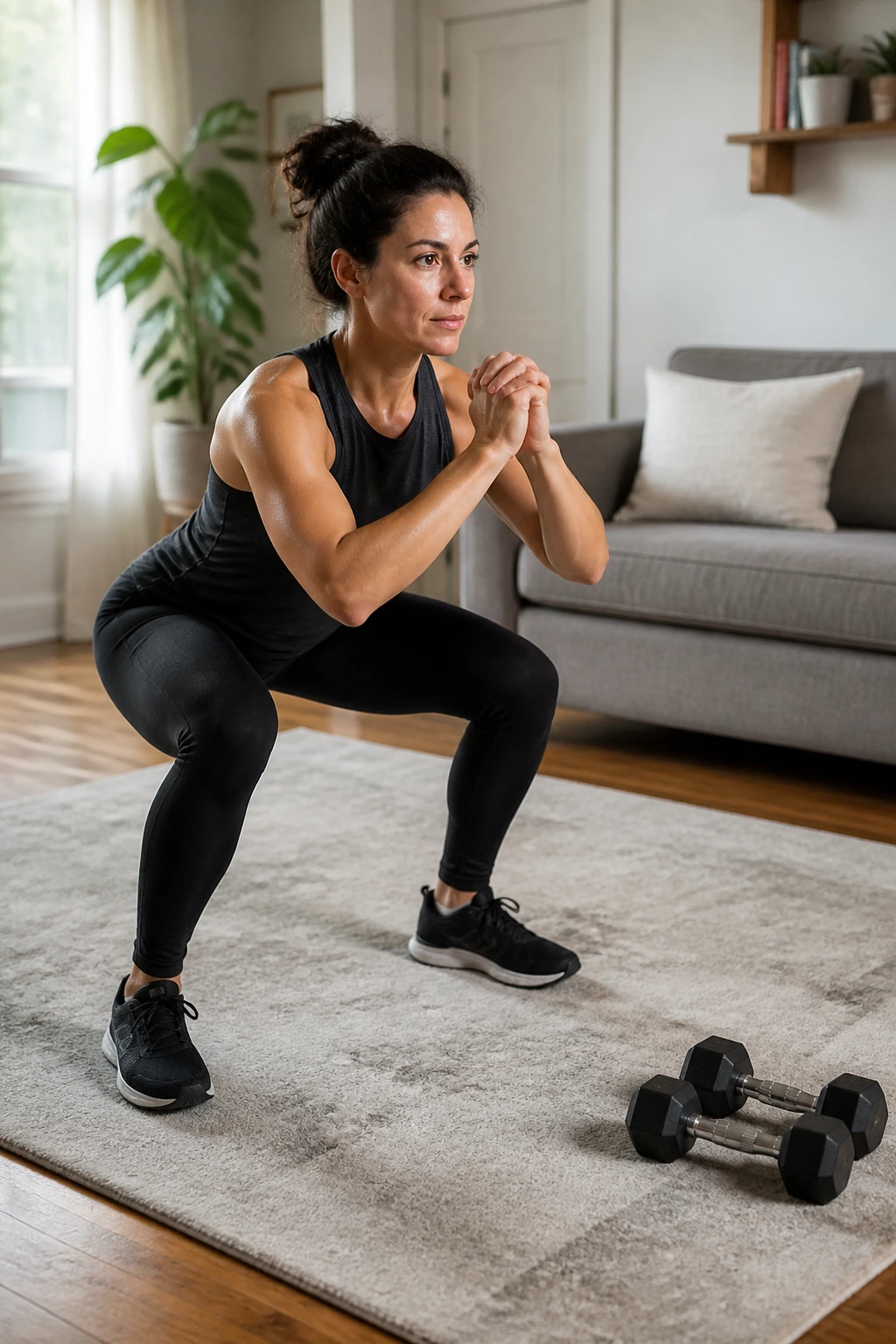
When you cannot decide, use the fallback. That is what this plan is for. It removes the mental debate and gives you a session you can repeat without thinking too hard.
Spend 5 minutes warming up, 10 minutes on a full-body circuit, 3 minutes on core, and 2 minutes cooling down. Use squats, rows, push-ups, hip hinges, and a short plank or dead bug sequence. If you have dumbbells, great. If not, bodyweight still gets the job done.
A simple version
Warm-up: march, arm circles, hip hinges, bodyweight squats.
Circuit: squats, incline push-ups, rows, reverse lunges.
Core: dead bug or plank hold.
Cool-down: calf stretch, chest opener, slow nasal breathing.
This is the plan I would keep near the front of the list because it solves the biggest problem: decision fatigue. You do not need to feel inspired. You just need a slot of time and a timer.
Save this one for the days that feel scattered. It works as a reset, not a performance.
Final Thoughts
A good home workout does not need to look impressive to work. It needs to fit your life, respect your energy, and give you a clear finish line before the day drifts away from you.
The smartest approach is usually a small rotation: one short cardio plan, one strength plan, and one gentle mobility option. That mix covers the days when you feel sharp, the days when you feel flat, and the days when your body wants a little kindness.
If you keep shoes, a mat, and one piece of equipment in sight, you remove half the friction. The rest is just showing up for 10 or 20 minutes and letting that count.
