



That sharp, electric jolt running down the back of your leg—the one that makes you freeze mid-step—is something you never truly get used to. Sciatica isn’t just “back pain.” It’s an aggressive, demanding sensation that seems to have a direct line to your nervous system. Whether it presents as a dull, throbbing ache or a stinging, burning fire, the sciatic nerve is clearly letting you know that something is wrong. Usually, that something is compression. Something in your lower back or hip is pressing against that long, thick nerve, and it’s reacting with irritation.
You might feel a desperate urge to lie down and stay there until the pain subsides. That is almost always the wrong move. When you immobilize a joint that is already tight, you often invite more stiffness, which only increases the pressure on the nerve. The goal here is gentle, controlled decompression. You are not trying to force your body into a pretzel; you are trying to create space. You want to coax the muscles surrounding the nerve to release their grip, allowing the nerve to slide and glide as it was designed to do.
This process requires a shift in mindset. Many people treat stretching like a race—how far can I reach? How deep can I go? With sciatica, that approach is dangerous. You are looking for a gentle tension, not an intense burn. If you feel that sharp, shooting pain during a movement, stop immediately. You have gone too far. The stretches below are designed to be therapeutic, intended to quiet the nerve down rather than provoke it. Take your time, breathe into the movements, and listen to the feedback your body provides.
The Mechanics of Sciatic Relief
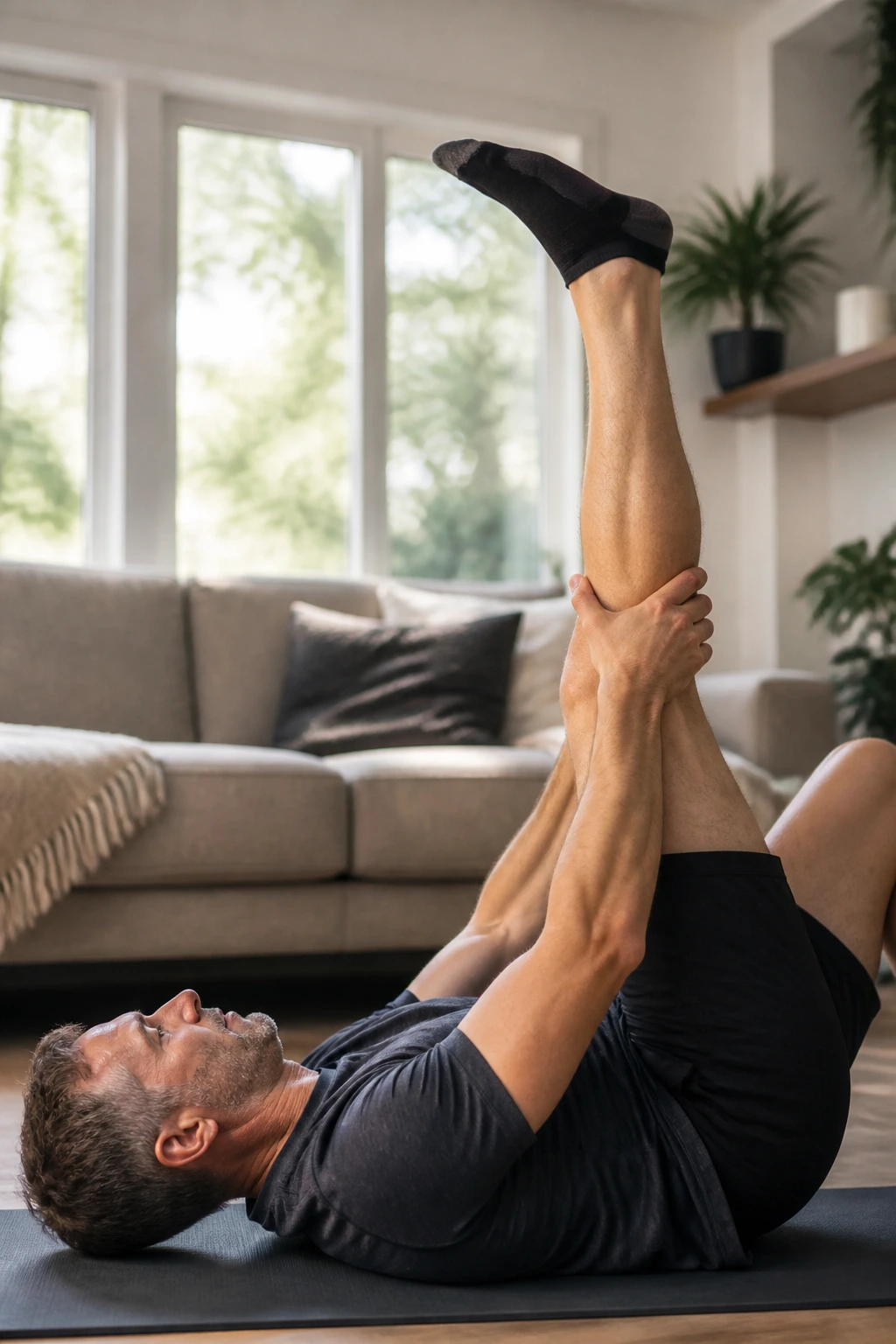
Before you begin, it helps to understand why the nerve acts out. Your sciatic nerve is the largest nerve in your body. It starts in your lower lumbar spine, travels through your gluteal muscles and deep hip rotators, and runs all the way down the back of your leg to your foot. Because of its massive path, it is vulnerable to compression from several different points. Tight hamstrings, a clenched piriformis muscle, or a bulging disc can all trigger that signature pain.
When you stretch, you aren’t actually “stretching” the nerve itself. Nerves don’t like to be stretched; they prefer to glide. When you move the surrounding tissues—the muscles, the fascia, and the connective tissues—you are essentially clearing the path for the nerve. Think of it like clearing a blocked hallway so someone can walk through comfortably. If the hallway is narrow, the nerve gets pinched. If you widen the hallway by lengthening the surrounding muscles, the pressure drops.
Consistency is more important than intensity here. One session of aggressive stretching will rarely solve a chronic issue. However, performing these movements daily, even in small, gentle bursts, changes the resting tension of your lower back and hips. Over time, this cumulative effect is what brings relief.
What to Do When Pain Flares
There will be days when the pain is simply too loud to perform full movements. On those days, do not push. If you attempt a stretch and your pain travels further down your leg—a phenomenon clinicians call “peripheralization”—you are aggravating the nerve. Back off. Your nervous system is highly sensitive right now, and it is protecting itself by tightening up.
Instead, prioritize gentle, supported movements. Use pillows or yoga blocks to support your body weight. The goal is to reach a position where you can relax completely. If you are holding your breath or gritting your teeth, your nervous system is on high alert, and your muscles will resist the stretch. If you cannot find a comfortable position, apply heat to the low back or ice to the hip, lie down in a neutral position, and try again tomorrow.
1. The Standing Hamstring Stretch
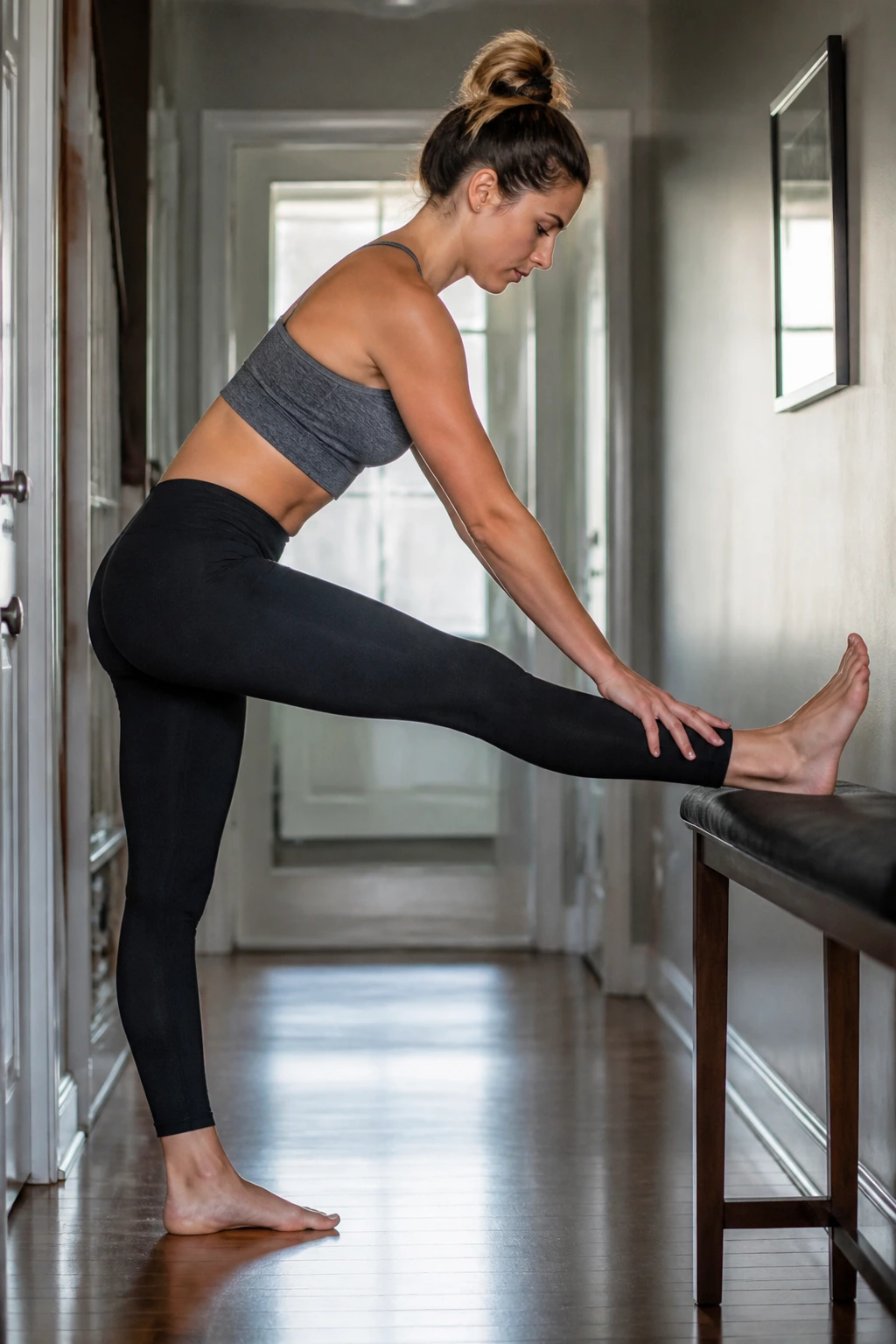
This is a classic for a reason. Often, tight hamstrings pull on the pelvis, tilting it forward and placing excessive stress on the lower lumbar spine where the sciatic nerve originates. By gently lengthening the back of your leg, you reduce that constant, subtle pull on the base of your spine.
How to Get It Right
Find a sturdy surface like a low step, a stool, or a bottom stair—about knee height is ideal. Stand facing it. Place one heel on the surface, keeping your leg straight but not locked. Your standing leg should be soft, with a slight bend at the knee. Slowly hinge at your hips, keeping your back straight. Do not collapse your chest toward your knee; think about pointing your belly button toward your thigh. You should feel a stretch down the back of the leg you have elevated. Hold for 30 seconds, then switch sides.
Pro Tip: If your back starts to round, stop. The moment your spine curves, you lose the stretch in the hamstring and shift the pressure back onto your lower back, which is exactly what we are trying to avoid.
2. The Seated Spinal Twist
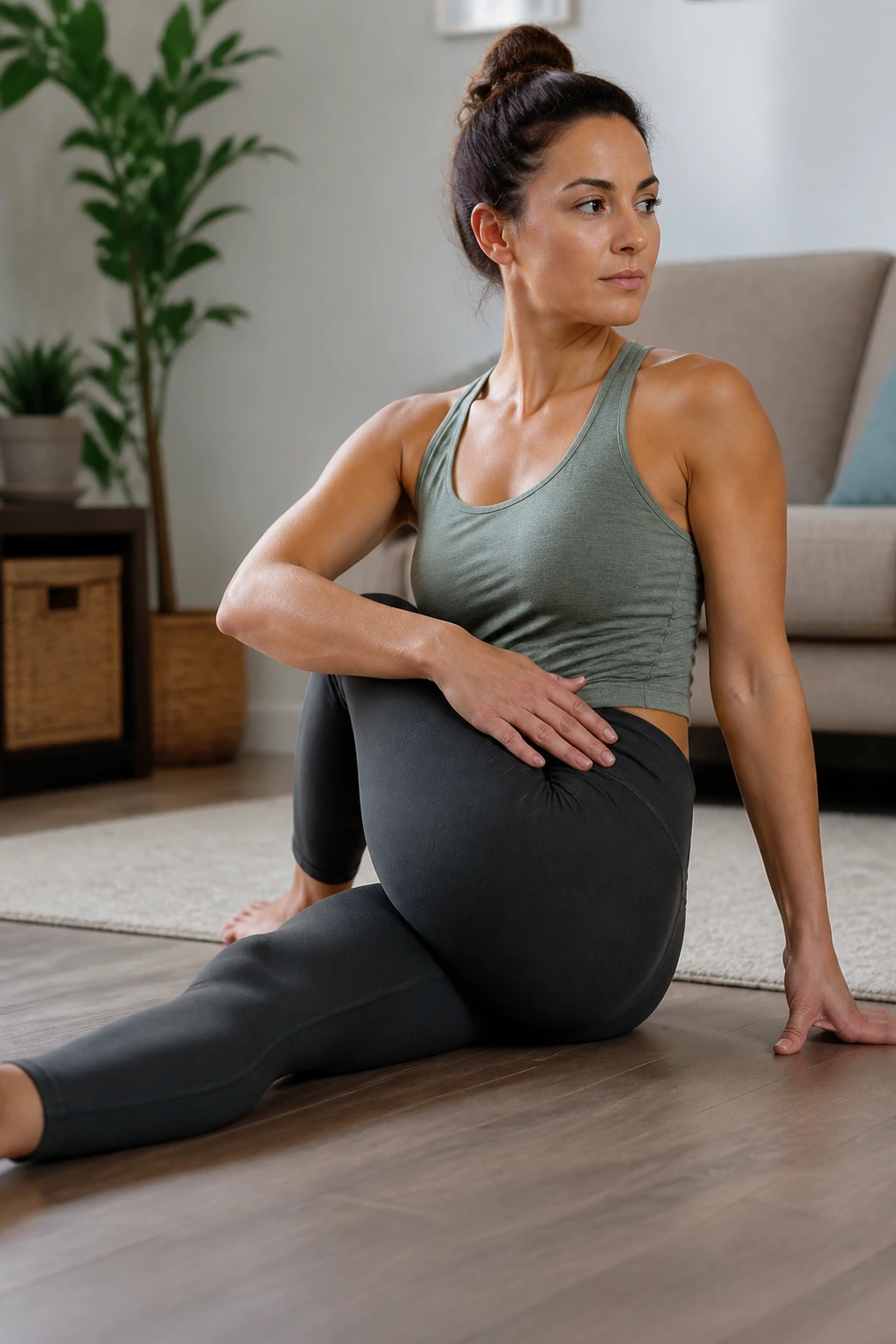
A gentle rotation can help mobilize the spine and ease tension in the lower back, provided it is done with control. This move targets the muscles that run alongside the spine and encourages a bit of rotational mobility, which is often severely restricted when you are dealing with sciatic pain.
Why It Works
When you are in pain, you tend to move like a statue, using your whole body to look left or right rather than just your neck or torso. This stiffening leads to locked-up spinal muscles. A gentle seated twist acts as a “reset” button for the musculature of the torso.
Execution
Sit on the floor with both legs extended straight out in front of you. Bend your right knee and place your right foot on the outside of your left knee. Hug your right knee with your left arm, or place your left elbow on the outside of your right knee for leverage. Gently turn your torso to the right, looking over your right shoulder. Keep your spine tall, as if a string is pulling the top of your head toward the ceiling. Hold for 20 to 30 seconds. Repeat on the other side. Do not force the rotation; let your breath carry you into the twist.
3. The Piriformis Figure-Four Stretch
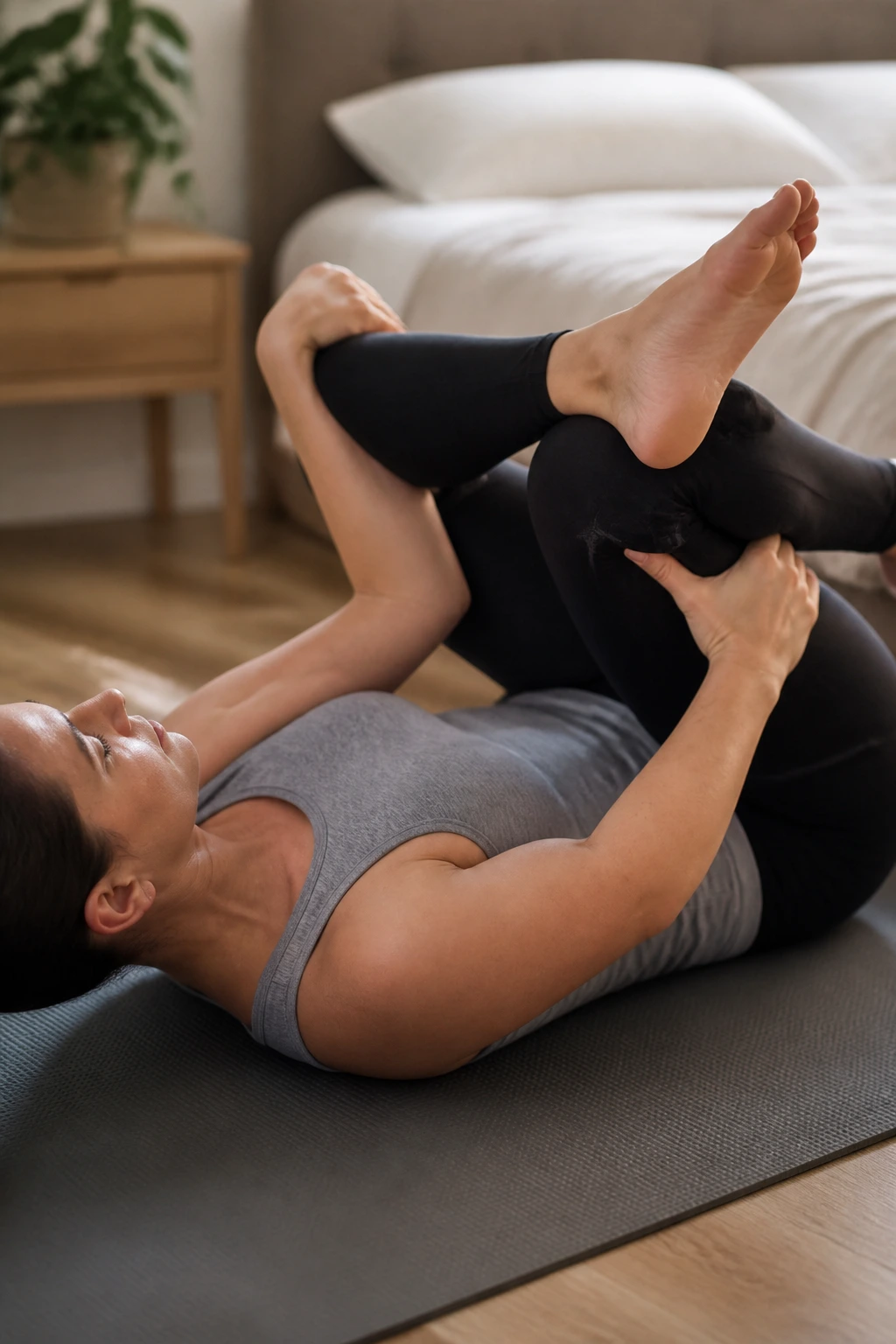
The piriformis is a small muscle deep in your glute, and it is a notorious culprit in sciatic pain. Because the sciatic nerve often runs directly underneath (or sometimes through) this muscle, when it tightens, it acts like a clamp on the nerve.
Relieving Deep Glute Tension
Lie on your back with your knees bent and feet flat on the floor. Cross your right ankle over your left knee, creating a “figure four” shape with your legs. Reach your hands through the space between your legs and clasp your hands behind your left thigh. Gently pull your left leg toward your chest. You will feel a deep stretch in the right glute. Keep your head and shoulders relaxed on the floor.
The Nuance
If you cannot reach your hands behind your thigh, use a towel or a yoga strap to loop around the left leg and pull it toward you. This allows you to keep your upper body relaxed, which is essential. If you pull your head and shoulders off the ground to reach, you are creating unnecessary tension in your neck and upper back.
4. Basic Knees-to-Chest
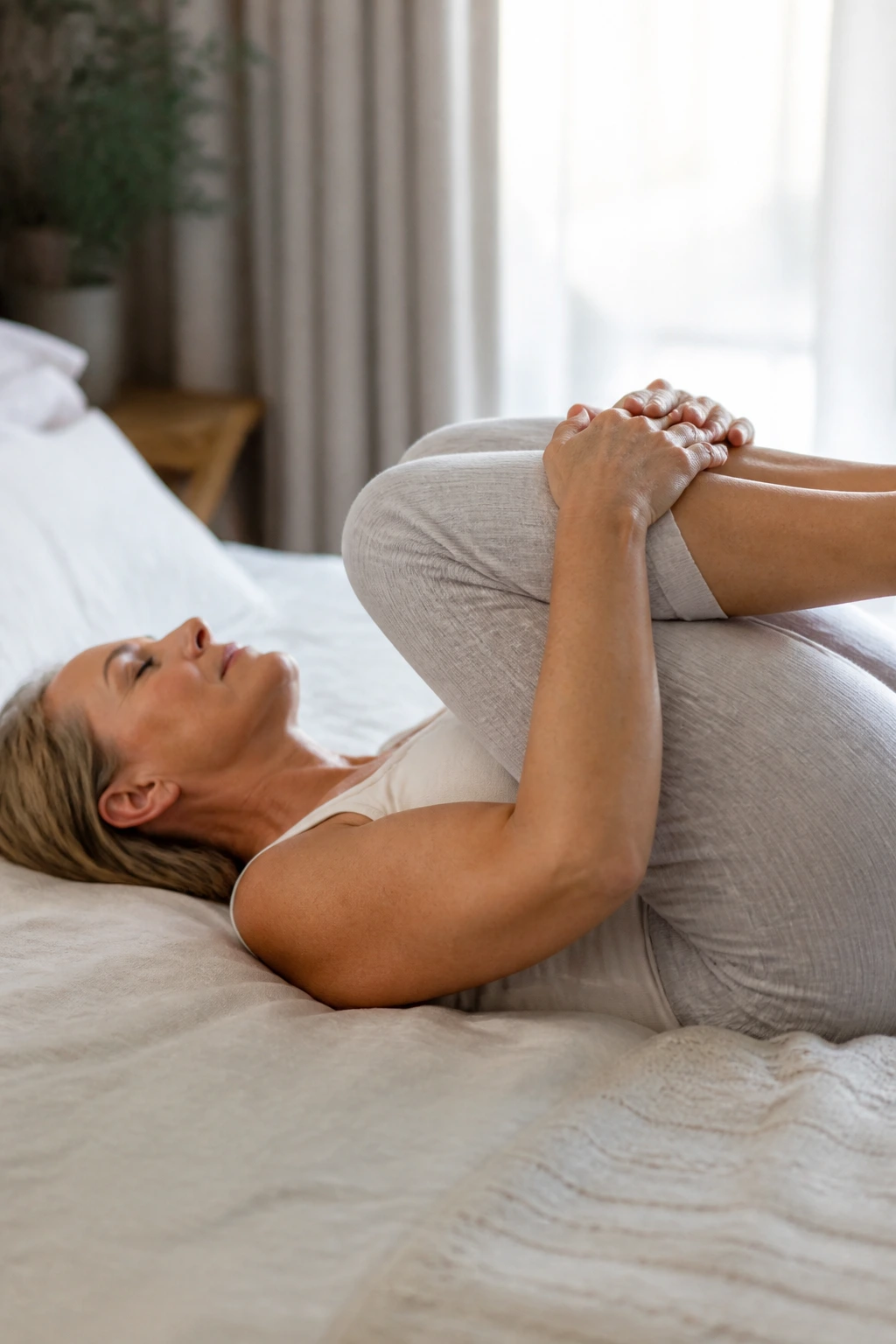
This is one of the most accessible stretches for anyone suffering from a flare-up. It is a passive release for the lower back that requires very little effort, making it ideal for days when your mobility is limited.
Getting Into the Pose
Lie flat on your back on a comfortable surface. Bring both knees toward your chest, one at a time. Wrap your arms around your shins or your hamstrings. Gently rock side to side if that feels good, or simply hold the knees steady. This movement naturally flattens the lumbar spine against the floor, providing a gentle stretch to the erector spinae muscles of the lower back.
Why This Is Essential
It counteracts the arching that often happens when we stand or sit for too long. By pulling the knees in, you are creating a “counter-pose” to the habitual tension that builds up during the day. Do not worry about how close your knees get to your chest; just focus on the sensation of your low back broadening against the floor.
5. Sciatic Nerve Gliding
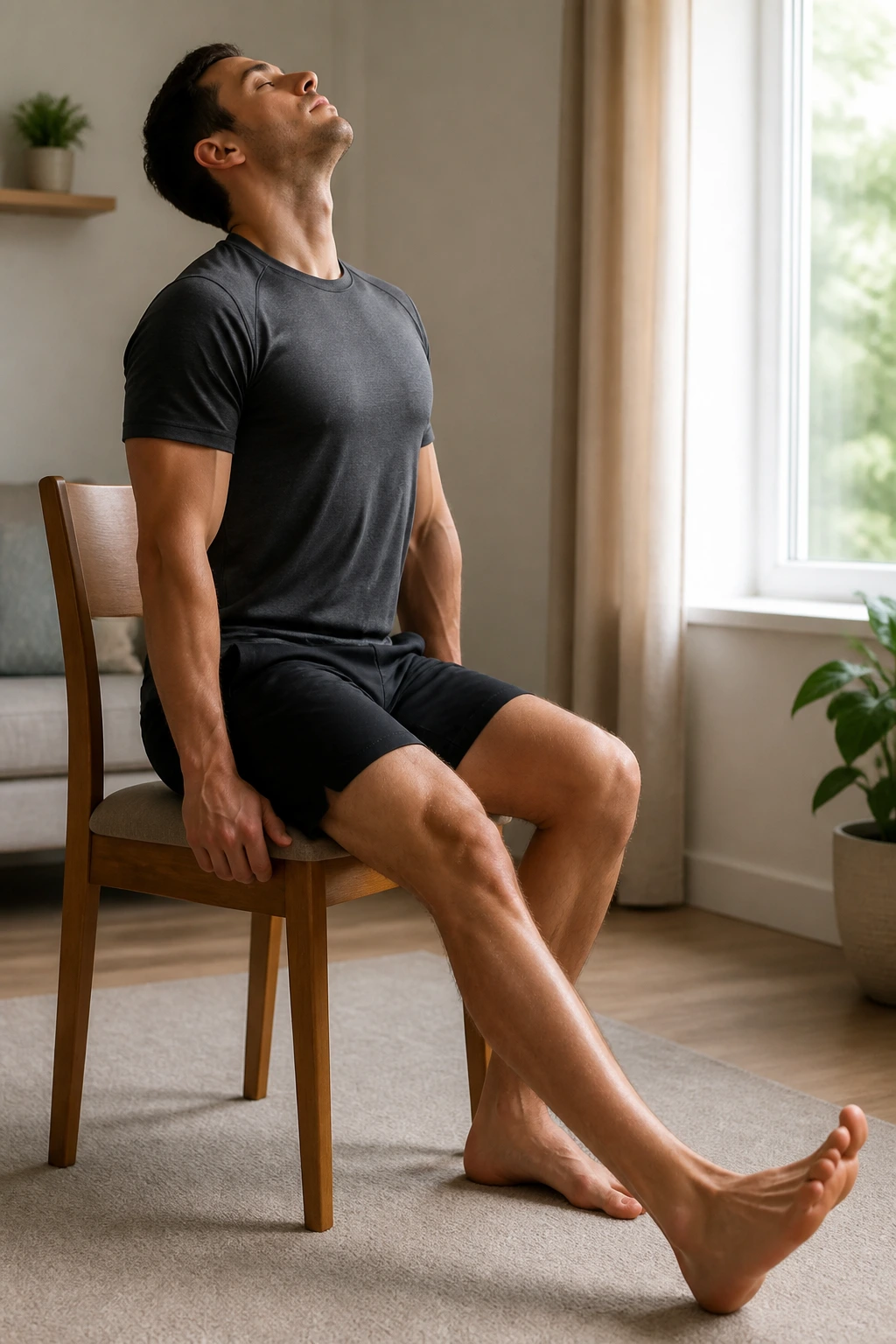
This is not a traditional stretch; it is a movement therapy technique known as nerve flossing. The goal isn’t to lengthen the muscle but to help the nerve move smoothly through the tissues that might be pinching it.
How to Perform the Glide
Sit on the edge of a chair with your back straight. Straighten your affected leg out in front of you, heel resting on the floor. Look up toward the ceiling while simultaneously pulling your toes toward your shin. As you bring your chin down toward your chest, relax your foot and let the toes point forward. You are creating a coordinated movement: head up/foot flexed, head down/foot relaxed.
The Rhythm
Do this rhythmically, like a slow seesaw. You are essentially sliding the nerve back and forth through the hip area. It should never be painful. If you feel a “twang” or increased pain, stop immediately—you are moving too fast or with too much range. This is about lubrication and movement, not intensity.
6. The Cat-Cow Pose
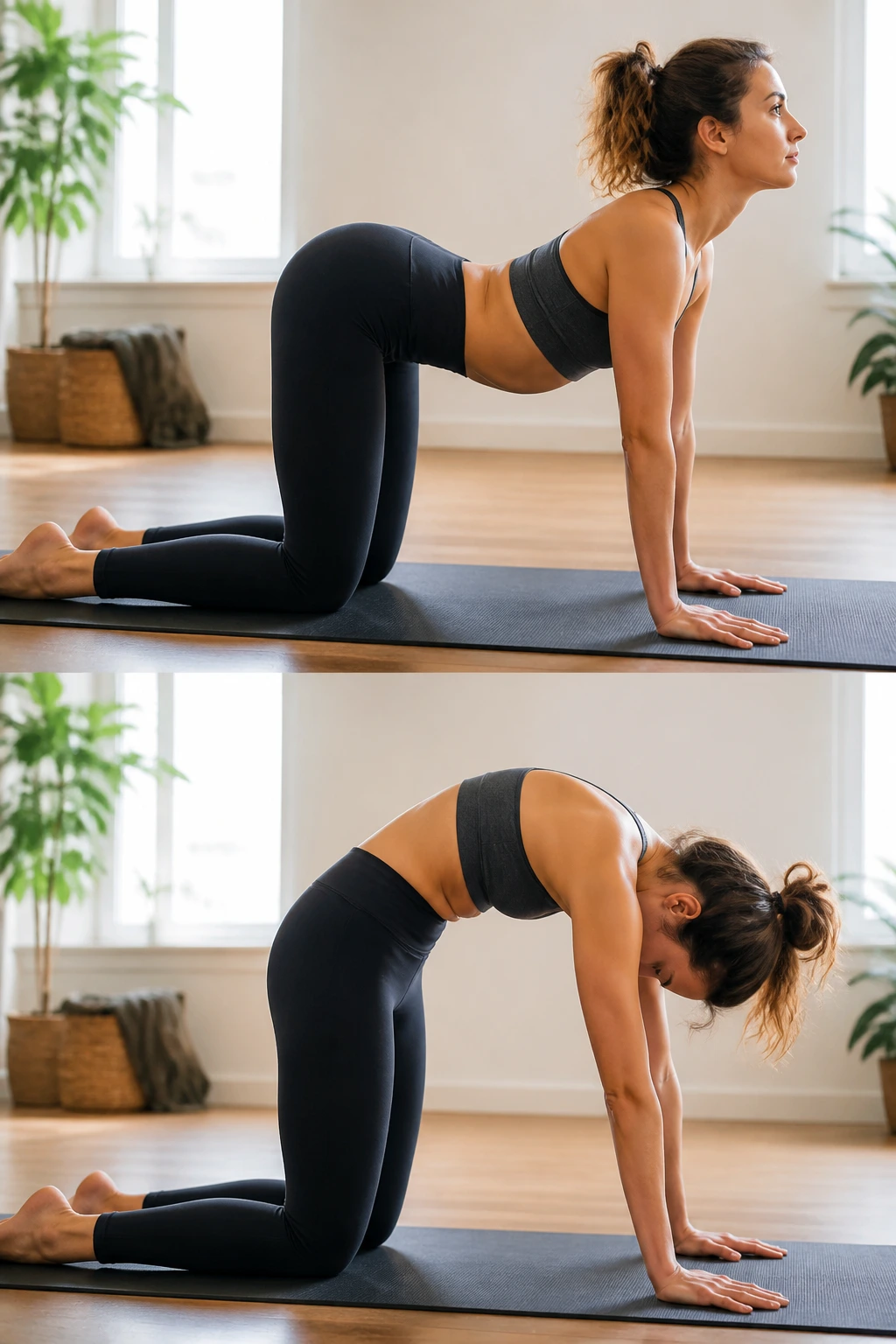
This dynamic movement is a staple for a reason: it encourages the entire length of the spine to move through its natural range. It is less of a stretch and more of a massage for the spinal discs and the surrounding muscles.
Finding the Rhythm
Start on all fours, with your hands directly under your shoulders and your knees under your hips. On an inhale, drop your belly toward the floor, lift your chin and chest, and gaze upward—this is the “cow.” On an exhale, arch your back toward the ceiling, tuck your chin, and let your head hang heavy—this is the “cat.” Move slowly, syncing your breath with the movement.
Why It Matters for Sciatica
The gentle pumping action of the spine helps circulate fluid around the discs. When you are stiff, your spine acts like a rigid rod. This movement reintroduces flexibility, which can help alleviate the pressure that builds up around the nerve roots.
7. The Bird-Dog
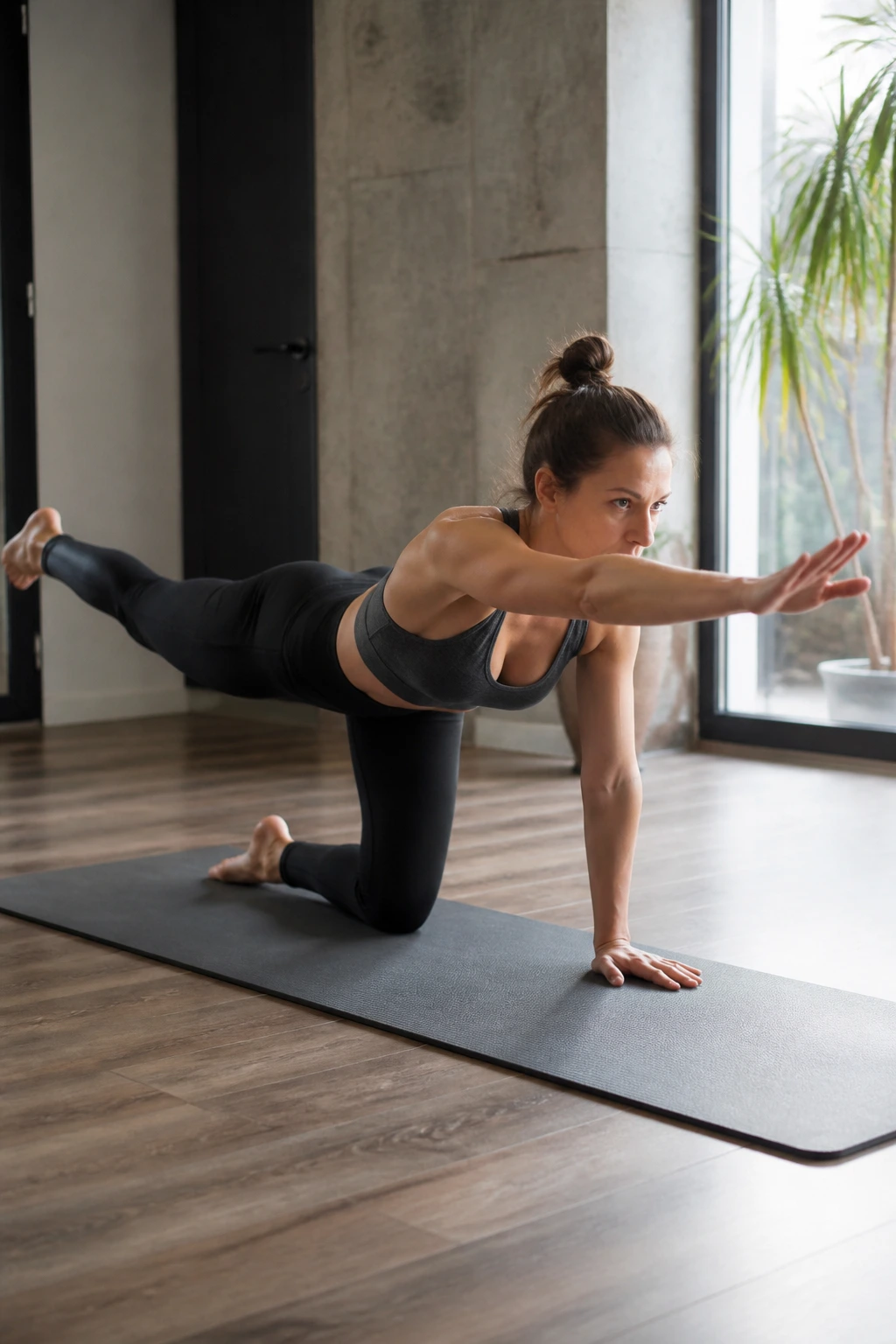
While this is often categorized as a core exercise, it is vital for sciatica because it teaches you how to stabilize your spine. When your deep core muscles are weak, your back muscles have to overwork to keep you upright, which eventually leads to tightening and compression.
The Mechanics of Stability
Start on all fours. Extend your right arm forward and your left leg backward simultaneously. Keep your back flat—imagine a glass of water resting on your lower back that you cannot spill. Hold for a few seconds, focusing on keeping your hips level. Lower back down and switch sides.
A Note on Performance
You do not need to lift your arm and leg incredibly high. In fact, if you lift too high, you will likely arch your back, which defeats the purpose. Focus on reaching long rather than high. Imagine you are trying to touch the wall in front of you and the wall behind you at the same time. This lengthens the torso without compressing the lower spine.
8. Child’s Pose
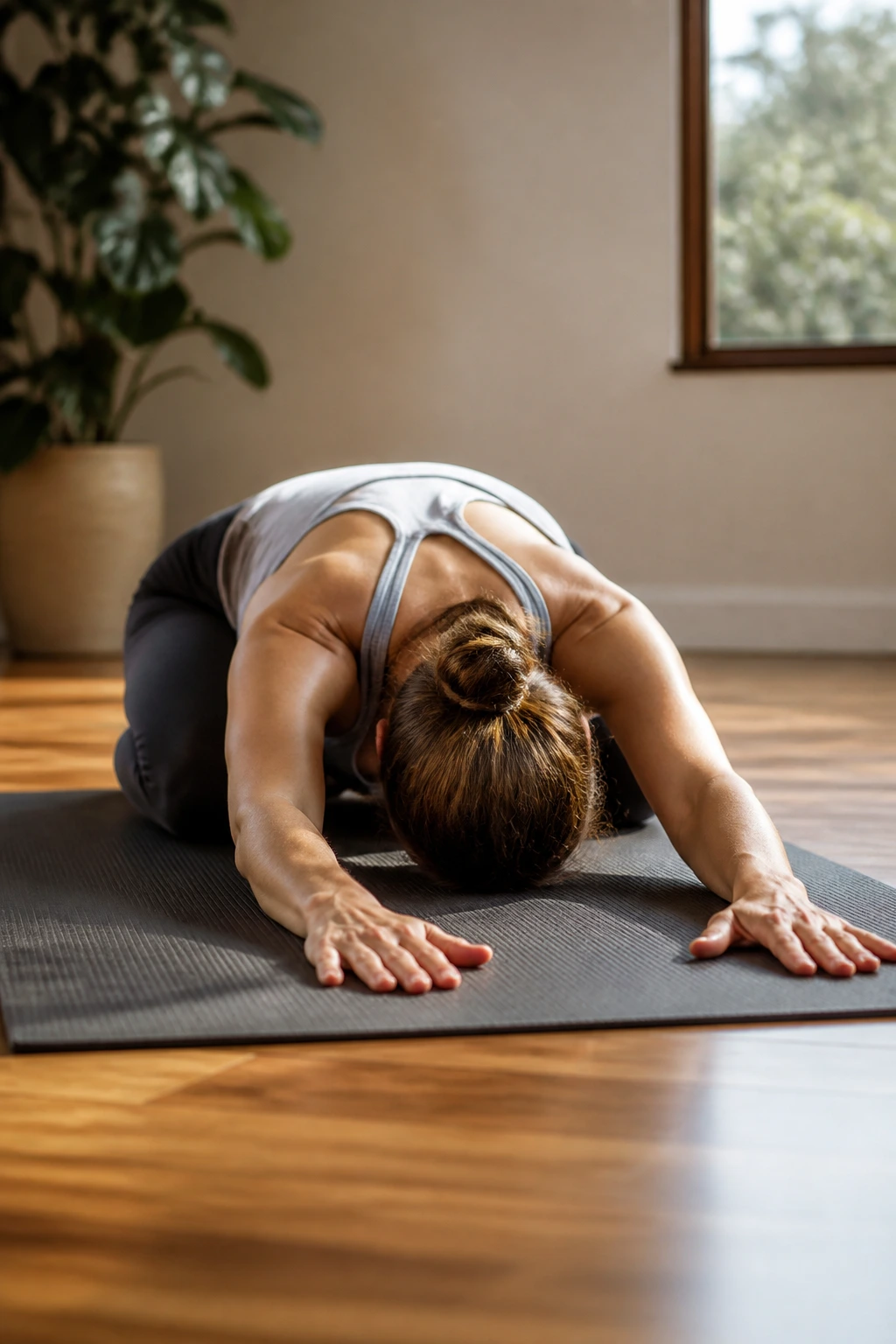
This is the ultimate resting position. It provides a gentle stretch for the entire back, from the neck down to the sacrum, and allows the muscles around the spine to release fully.
Setting Up the Pose
Kneel on the floor, bring your big toes together, and separate your knees as wide as you feel comfortable. Sit your hips back onto your heels. Walk your hands forward on the floor, letting your chest sink down toward the mat. Rest your forehead on the floor or on a block. If your hips don’t reach your heels, that is perfectly fine—just go as far as your body allows.
The Power of Stillness
In this position, you can consciously relax your lower back. Often, we hold subconscious tension in the lumbar region even when we think we are “relaxing.” Child’s pose forces your back muscles to widen and soften. Stay here for a minute or two, focusing on deep, slow breaths that expand the back of your ribcage.
9. The Sphinx Pose
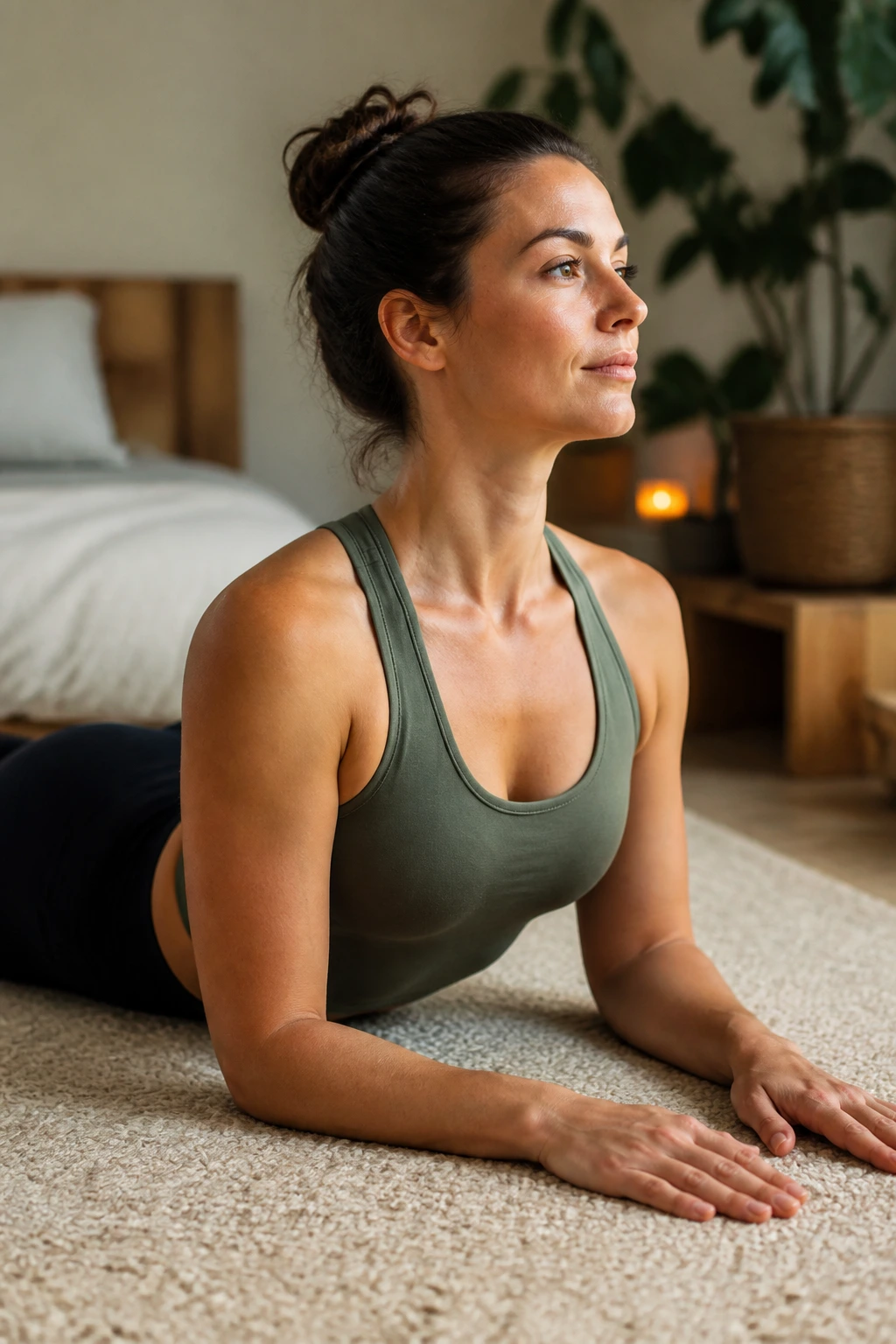
For those whose sciatica is triggered by a bulging disc or general spinal compression, moving into a gentle backbend can sometimes provide relief by opening up the front of the spine and shifting the pressure away from the nerves in the back.
Performing the Pose
Lie on your stomach. Place your forearms on the floor, elbows under your shoulders. Gently lift your chest, using your forearms to support your weight. Keep your shoulders relaxed away from your ears. You are looking for a very mild arch in your lower back. If you feel any sharp pain, lower yourself immediately and place your forehead on your hands instead.
Why This Works
The Sphinx pose is a gentle introduction to extension. It encourages the spine to move in the opposite direction of the slump we adopt when sitting, helping to rehydrate the discs and open up space in the lumbar region.
10. The Pelvic Tilt
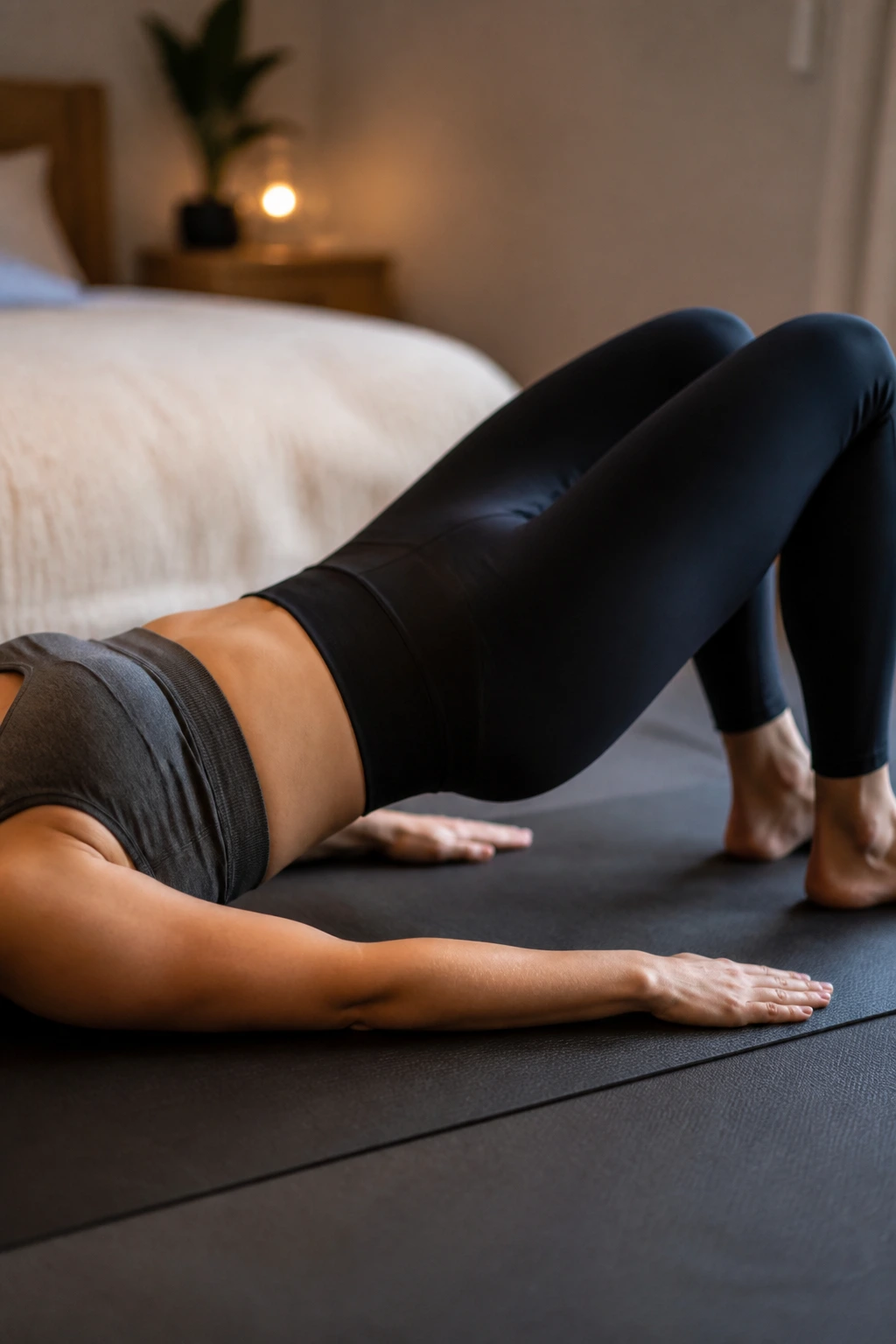
This is the smallest, most subtle movement on this list, but it is incredibly effective for anyone with lower back stiffness. It teaches you how to articulate your pelvis independently of your back muscles.
The Motion
Lie on your back with your knees bent and feet flat on the floor. There will be a natural, small curve in your lower back. Exhale, and use your core muscles to press your lower back firmly into the floor, tilting your pelvis upward. Hold for a second, then release and return to the starting position.
Integration
This is not about using your glutes or pushing with your legs; it is about engaging the deep abdominal muscles. It is an internal movement. Once you master the pelvic tilt, you can use it to maintain a stable spine while performing other, more challenging exercises.
11. Standing Hip Flexor Stretch
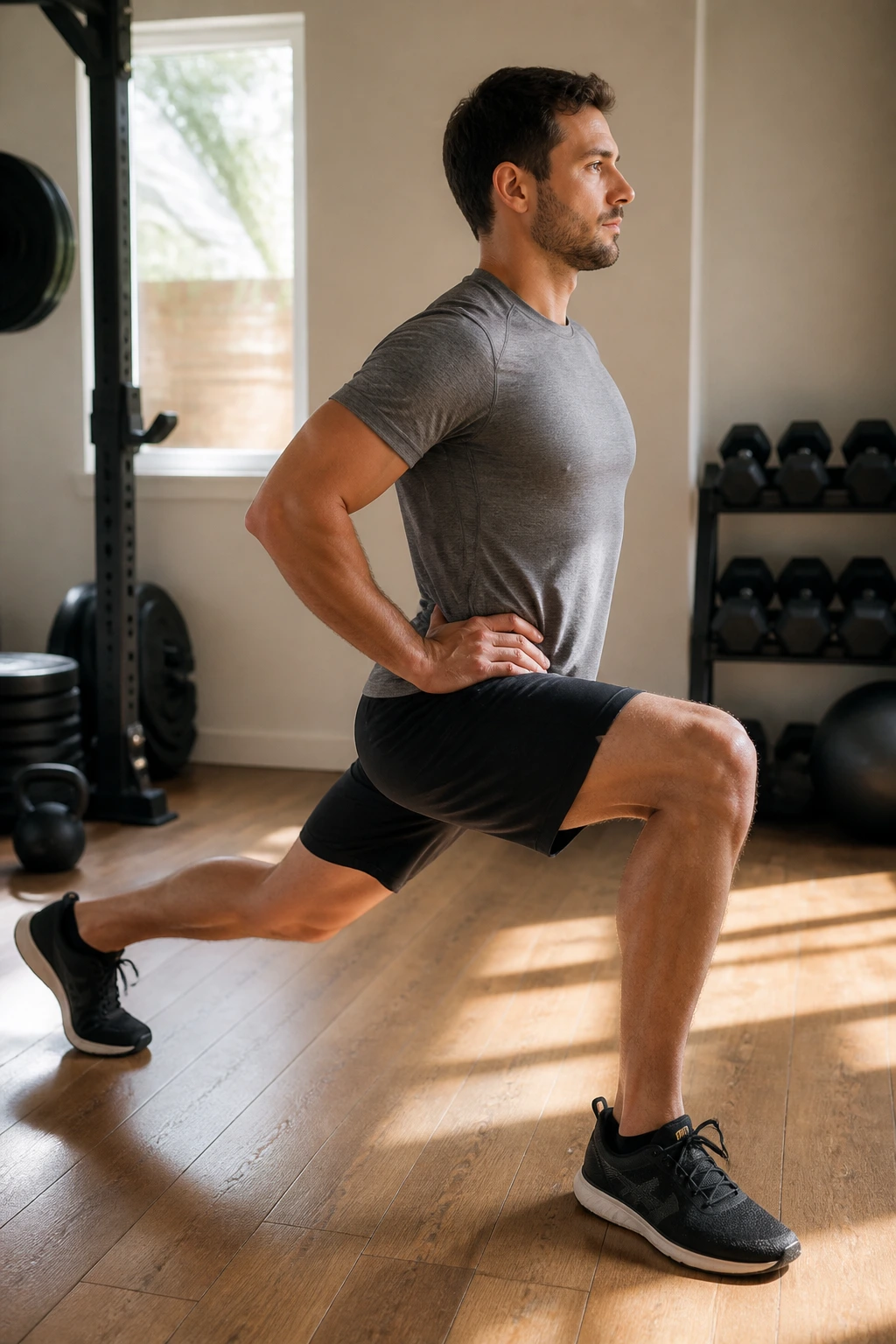
When you sit all day, your hip flexors—the muscles at the front of your hips—become chronically short and tight. These muscles attach to the lumbar spine, so when they are tight, they pull your pelvis into a forward tilt, which inevitably compresses the lower back and irritates the sciatic nerve.
Stretching the Front
Stand and take a comfortable step forward with your left foot. Keep your back leg straight. Sink your hips slightly forward while keeping your torso upright. You should feel a stretch in the front of your right hip. Tuck your tailbone slightly under to increase the stretch in the hip flexor. Hold for 30 seconds, then switch.
Why It’s Crucial
You cannot fix lower back pain without addressing the hips. If your hip flexors are tight, no amount of back stretching will provide long-term relief because your hips will continue to pull your spine out of alignment the moment you stand up.
12. Clamshells for Glute Support
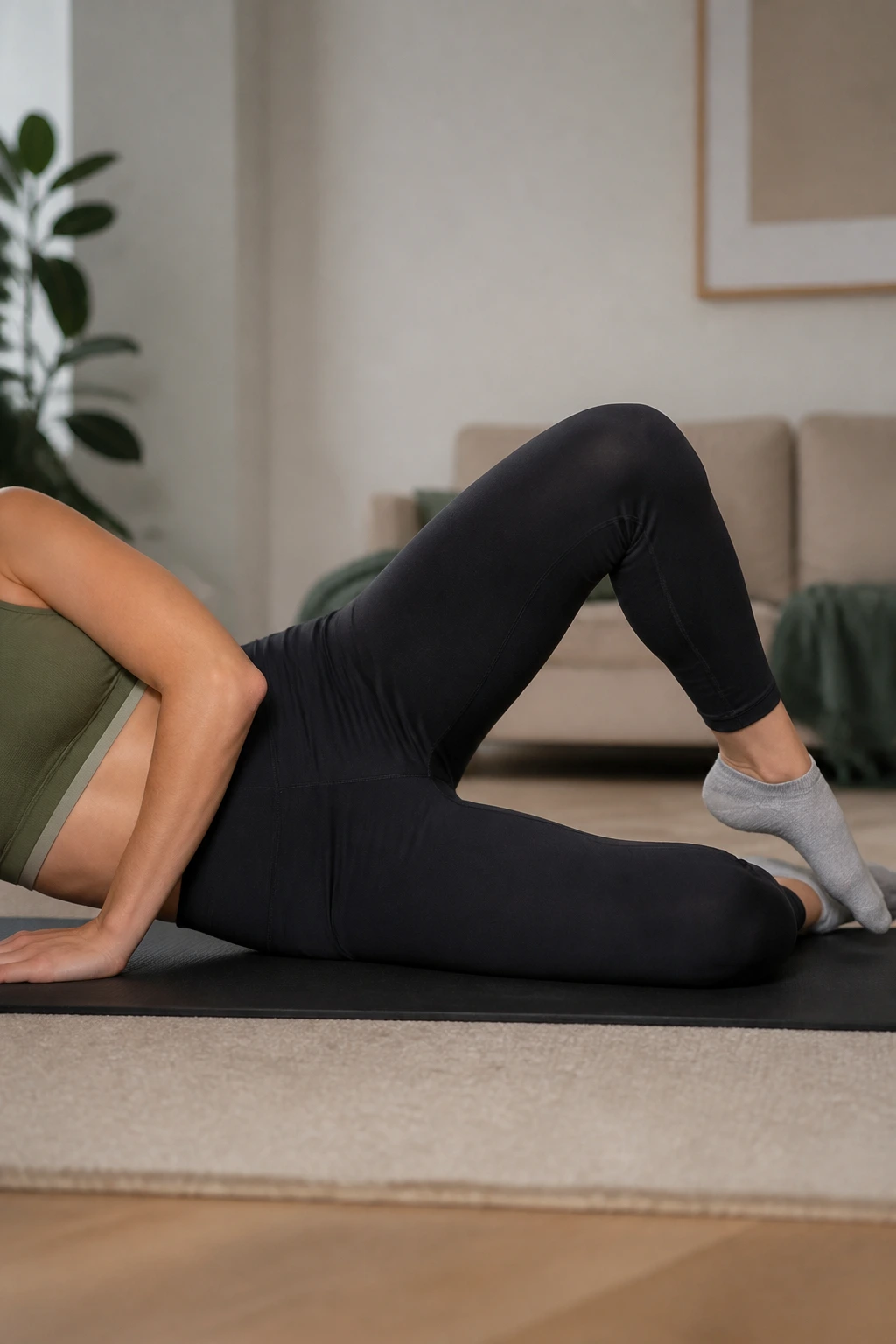
Weak glutes are a common contributor to sciatic pain. When the gluteus medius is weak, your pelvis becomes unstable, and your lower back has to pick up the slack. Clamshells target these stabilizer muscles without requiring heavy lifting.
Step-by-Step
Lie on your side with your legs stacked and knees bent at a 45-degree angle. Keep your feet touching. Open your top knee like a clamshell, while keeping your pelvis perfectly still—do not let your hips roll backward. Hold for a second at the top, then slowly lower.
Building Balance
This is a stability exercise, not a range-of-motion stretch. You should feel the burn in the side of your hip/buttock area. If you feel it in your lower back, your range of motion is too high, or your core is not engaged. Keep the movement small and controlled.
13. Glute Bridge
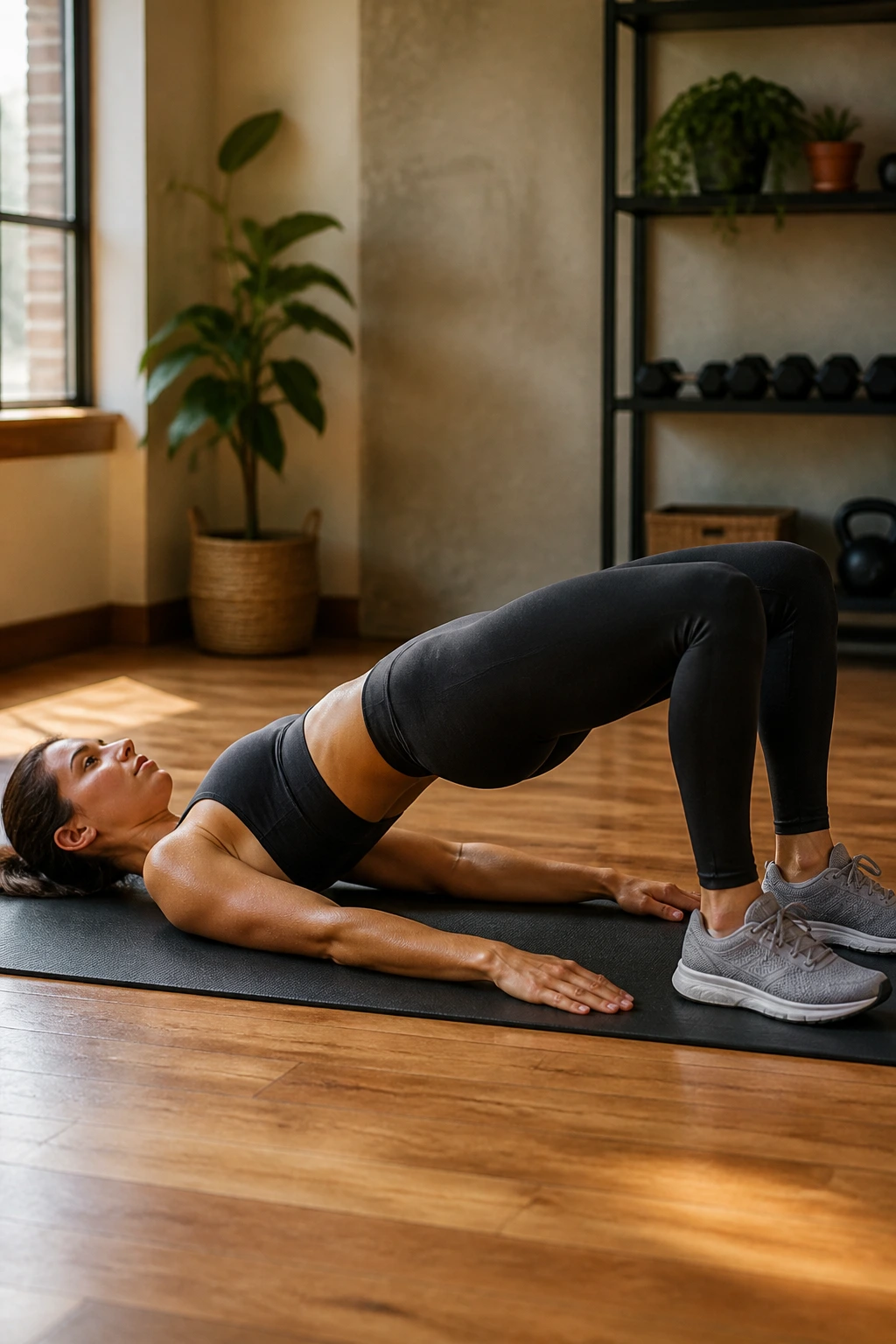
The bridge is one of the most effective ways to activate the glutes and hamstrings, which are often “asleep” in people who sit for long periods. By waking these muscles up, you help unload the pressure on the spine.
The Movement
Lie on your back, knees bent, feet flat on the floor about hip-width apart. Press through your heels to lift your hips toward the ceiling. Focus on squeezing your glutes at the top. Your body should form a straight line from your shoulders to your knees. Hold for 3 seconds, then lower with control.
Why It Works
It counteracts the “gluteal amnesia” caused by sedentary habits. By strengthening the glutes, you create a support system for the lower back. When your glutes do their job, your lower back doesn’t have to work as hard, which is a massive win for sciatic nerve health.
14. Reclining Pigeon Pose
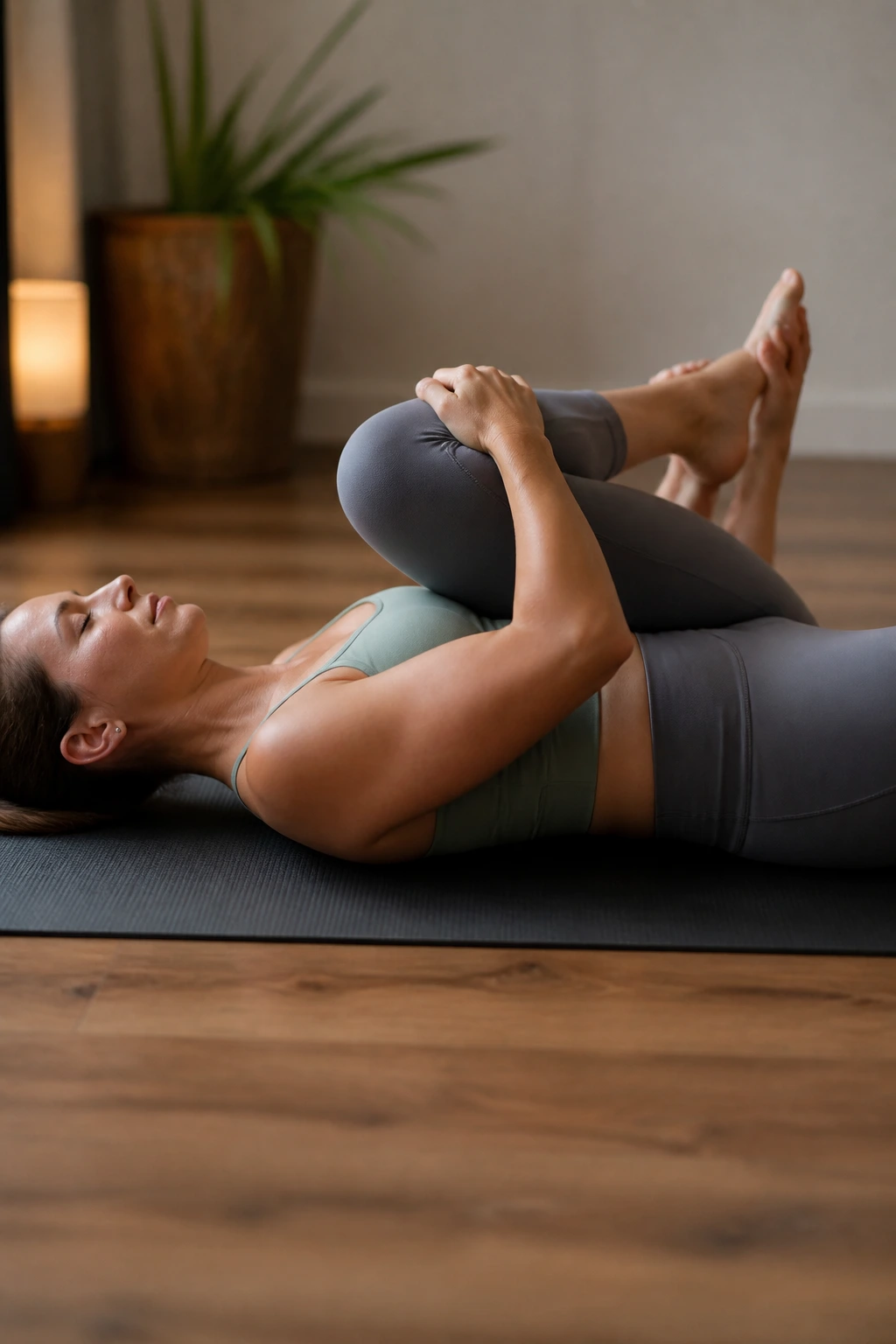
This is a variation of the figure-four stretch that provides a bit more intensity but keeps the spine fully supported by the floor. It is perfect for those who find the seated pigeon pose too intense or too difficult to balance.
Execution
Lie on your back. Bring your right knee toward your chest and hold the outside of your knee with your right hand. Simultaneously, take your right foot with your left hand. Gently pull the right shin toward your chest, keeping the knee bent at a 90-degree angle. You will feel a strong stretch in the right hip.
Caution
This move can be intense for the knee joint. If you feel any sharp pain in your knee, stop immediately. The stretch should be felt in the meaty part of your hip and glute, not the joint itself. Adjust the angle of your foot if necessary to protect your knee.
15. Reclining Hand-to-Big-Toe Stretch
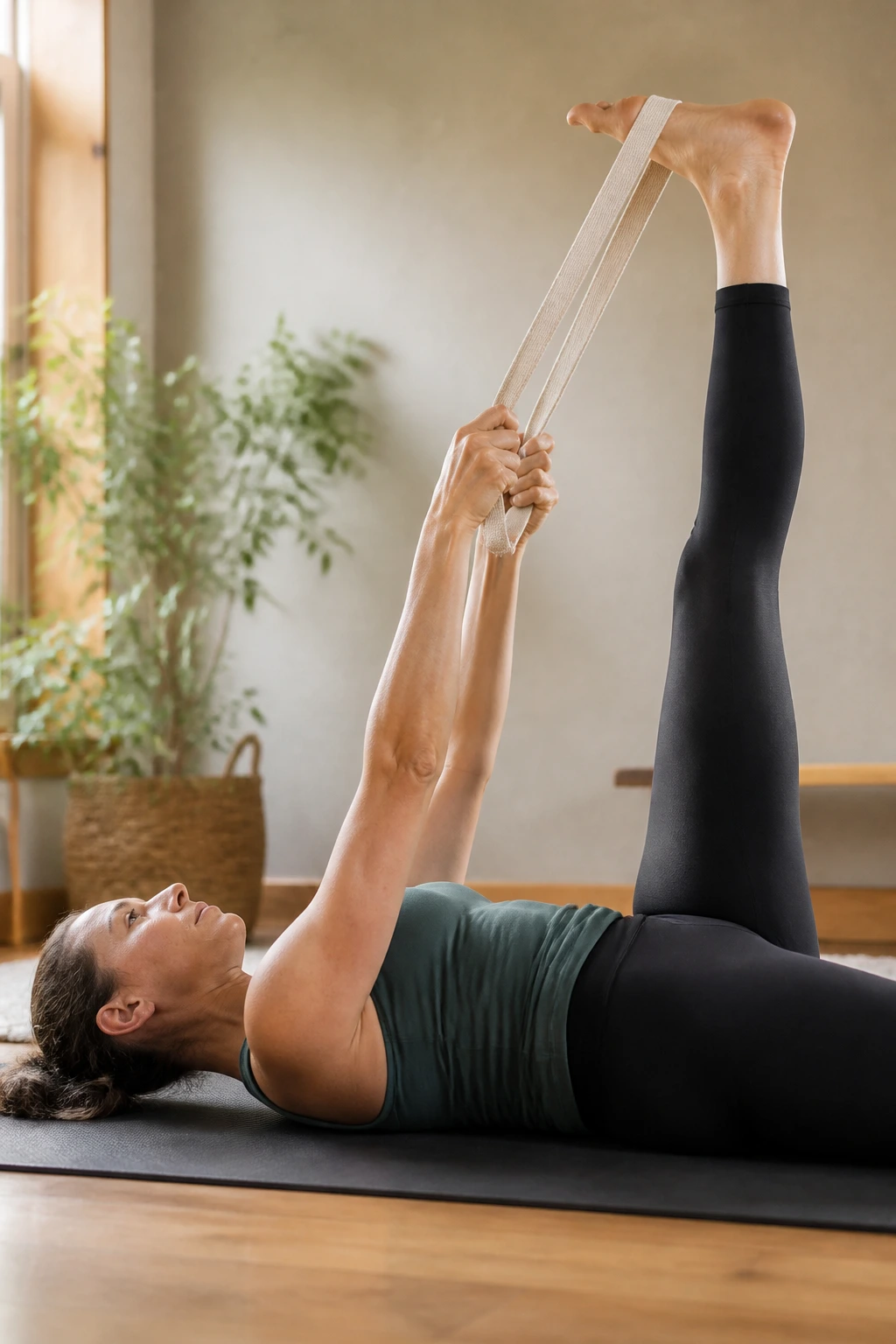
This is an excellent way to stretch the hamstrings while keeping your spine safe on the floor. It eliminates the risk of rounding your back, which is the primary danger when doing hamstring stretches in a standing position.
Using a Prop
Lie on your back. Lift your right leg and loop a strap, towel, or belt around the ball of your foot. Hold the ends of the strap with both hands. Gently pull your leg toward you, keeping the knee straight but not locked. Keep your left leg flat on the floor to stabilize your pelvis.
Why the Prop Matters
Using a strap allows you to keep your shoulders and neck relaxed on the floor. You aren’t straining to reach your foot; you are simply using the strap as an extension of your arm. This keeps the stretch focused entirely on the hamstring and prevents unwanted tension in the upper body.
16. Knee-to-Opposite-Shoulder
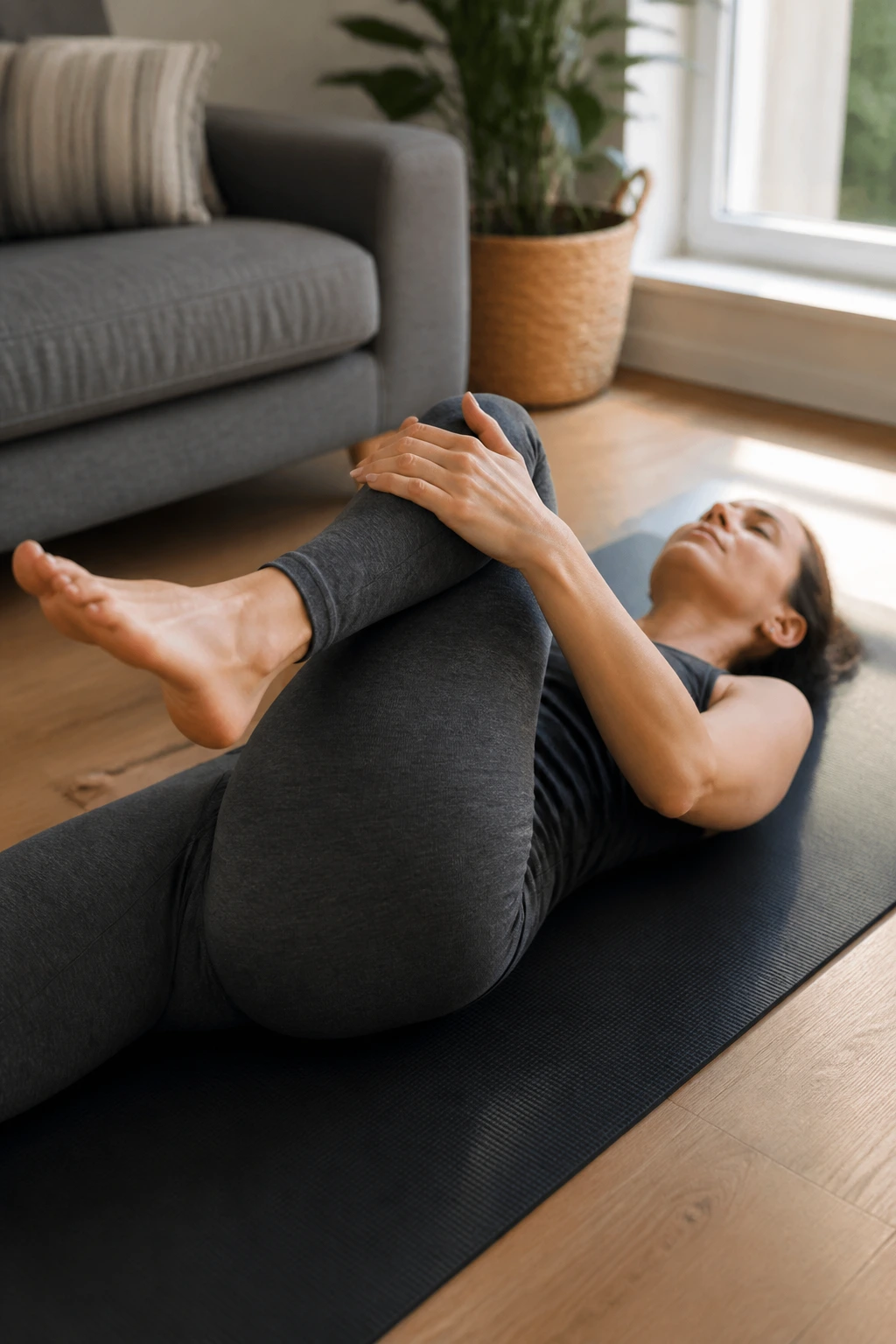
This is a specific stretch that targets the deep gluteal muscles and the piriformis, which, as we established, are often involved in sciatic compression.
How to Do It
Lie on your back with legs extended. Bring your right knee toward your chest. With your left hand, gently pull your right knee across your body toward your left shoulder. You should feel the stretch deep in the right hip/glute area. Keep your right shoulder pressed firmly into the floor.
Keep It Controlled
This is not a violent twist; it is a gentle pull. You are aiming to feel the stretch move through the hip. If you pull too hard, you’ll end up twisting your entire lumbar spine, which might aggravate the nerve. Keep the focus on moving the knee, not twisting the back.
17. Supine Twist
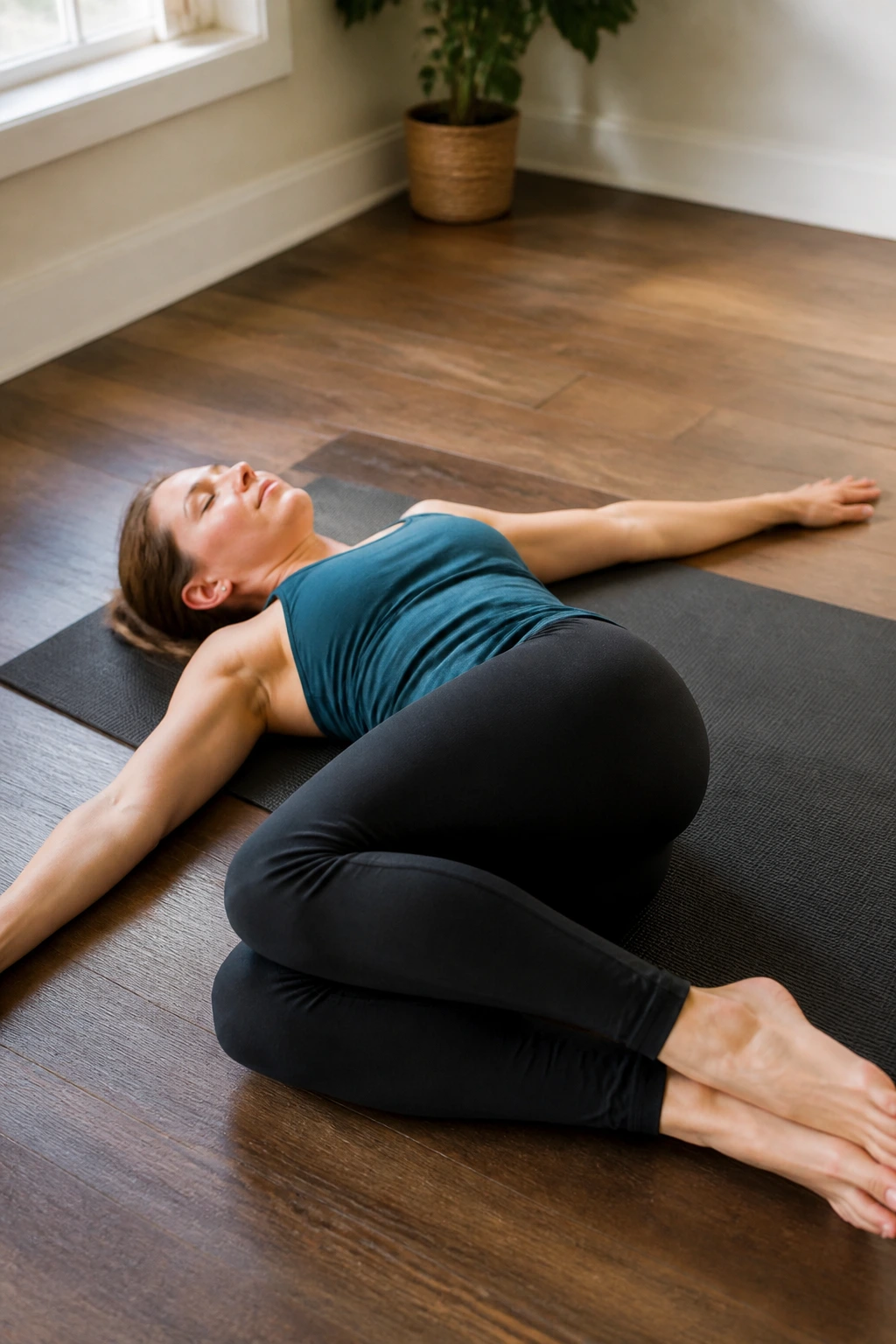
This is perhaps the most relaxing stretch for a tight lower back. It uses gravity to do the work, allowing the muscles to release slowly without you having to pull or strain.
The Setup
Lie on your back. Bring both knees to your chest. Extend your arms out to the sides like a “T.” Slowly lower both knees to the right side, trying to keep both shoulders flat on the floor. If your knees don’t touch the floor, place a pillow or yoga block under them.
The Benefit
The support under your knees is crucial. It stops your body from fighting to hold the position. By letting your knees rest on a block, you allow your muscles to truly “let go.” This is a fantastic way to end a stretching session, as it resets the spine before you go about your day.
18. Supported Forward Fold
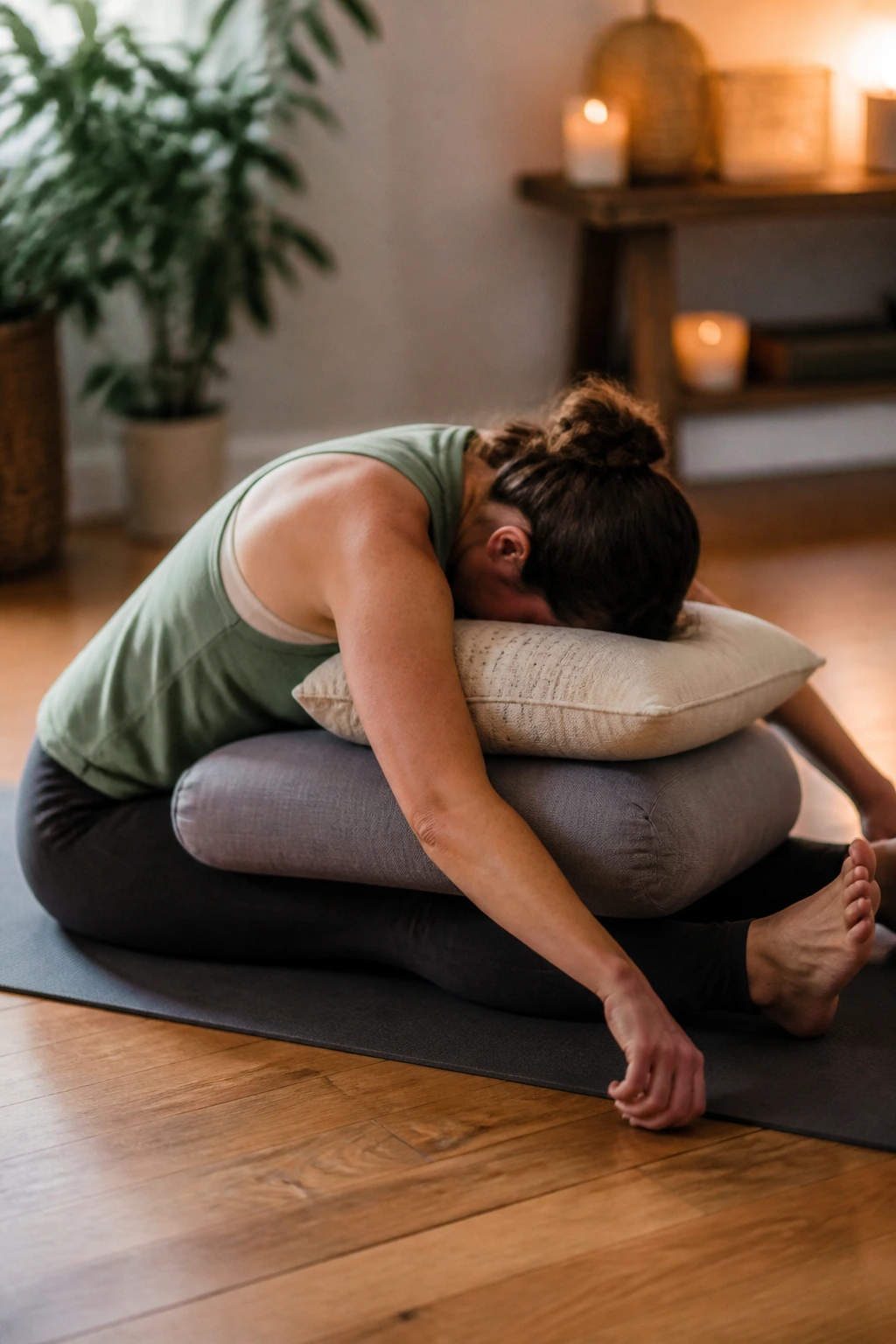
Standing forward folds can be risky for sciatica because they often encourage rounding the back. A supported forward fold, done while sitting, is much safer and just as effective for lengthening the posterior chain.
Execution
Sit on the floor with your legs straight out. Place a bolster or several firm pillows on your thighs. Hinge at the hips and fold forward, resting your chest and head on the pillows. Let your arms hang heavy. The pillows are there to support your torso so you don’t have to strain to reach forward.
Modification
If you cannot sit with straight legs, bend your knees slightly. The stretch is for your back and hamstrings, not for your ego. By supporting your torso, you turn a potentially stressful move into a restorative one.
19. Standing Quadriceps Stretch
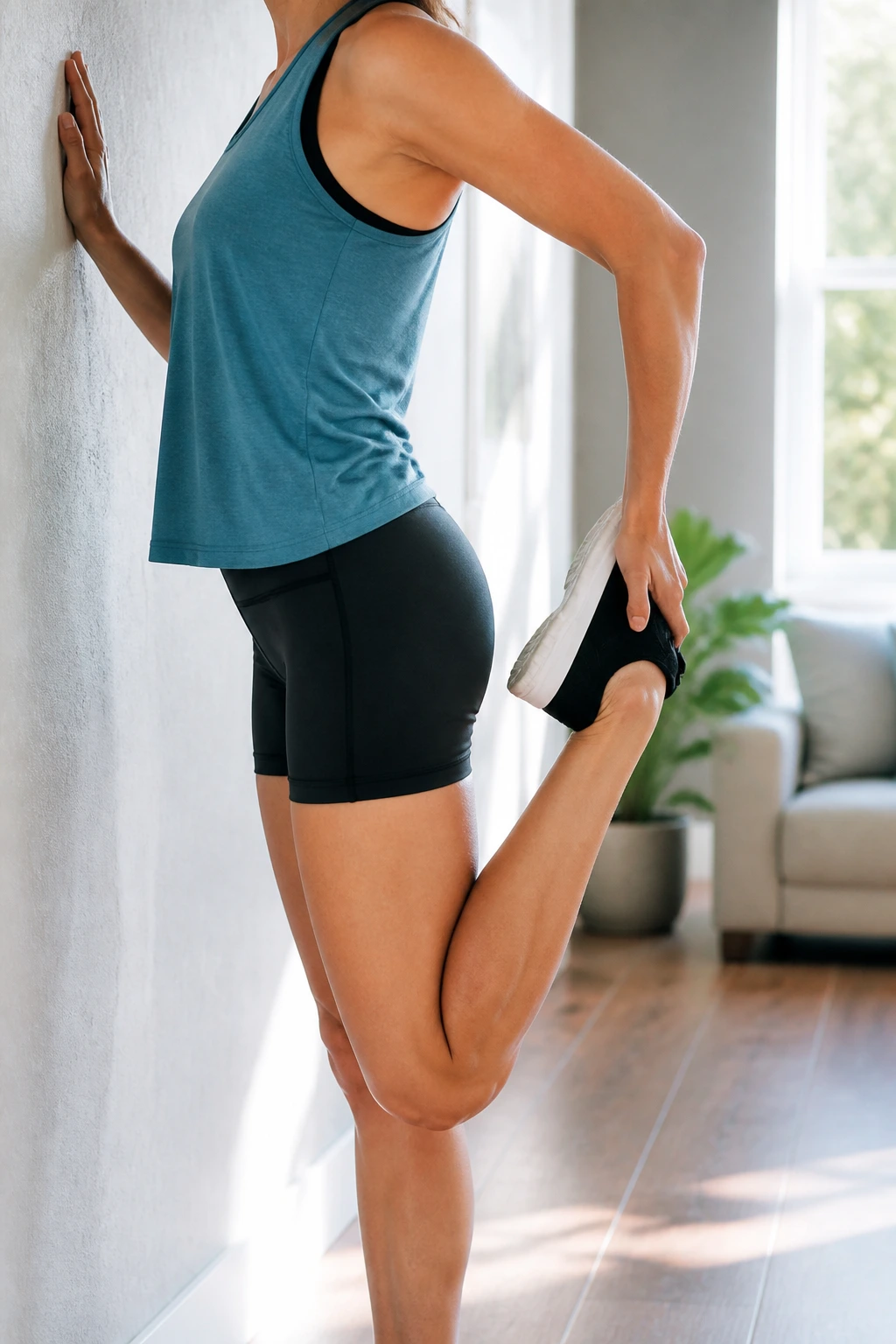
While the hamstrings get all the attention, tight quadriceps can also contribute to pelvic misalignment, which exacerbates sciatica. Keeping the quads supple is a necessary part of the puzzle.
The Balance
Stand near a wall for balance. Bend your right knee and grab your right foot or ankle behind you. Pull your heel gently toward your glute. Keep your knees together—do not let the bent knee splay out to the side. Tuck your tailbone slightly to feel the stretch move down the front of the thigh.
Why This Matters
If you are doing all these other stretches but ignoring your quadriceps, you are leaving an entire side of the hip joint tight. Think of your pelvis as a boat tied to a dock with ropes (muscles) on all sides. If the front ropes are too tight, the boat pulls forward. You have to loosen the front ropes to let the boat settle back into its neutral position.
20. Seated Toss-and-Turn

This is a final, fluid movement to mobilize the ribcage and mid-back, which can indirectly relieve pressure on the lumbar spine by improving overall spinal rotation.
The Movement
Sit comfortably in a chair. Place your hands on your shoulders, elbows pointing out. Gently rotate your torso to the right, then to the left, keeping your hips firmly planted in the chair. Do this 10 to 15 times, moving with your breath.
The Goal
This isn’t about deep stretching; it is about “oiling the gears.” A rigid mid-back often forces the lower back to compensate, leading to the kind of stiffness that triggers sciatic pain. By introducing rotation into the mid-back, you take the workload off the lumbar spine, allowing it to relax.
Final Thoughts
Sciatic nerve pain is undeniably frustrating, but it is rarely a permanent state. Your body is remarkably resilient, and it often just needs the right conditions to heal. The key is moving away from the idea that you have to “fix” it in one go. Instead, view these stretches as daily maintenance—a way of checking in with your body, creating space, and letting your nervous system know that it is safe to relax.
Start slow. You do not need to do all twenty of these every single day. Pick three or four that feel the best, the ones that seem to create the most relief, and make them a habit. As you get more comfortable, you can rotate in others. If you have good days and bad days, that is normal. The goal is to gradually increase the number of good days. Be patient with your process, listen to the cues your body sends, and remember that consistent, gentle movement is the most powerful tool you have for reclaiming your comfort.
