



Stair climbing workouts for cardio look harmless until your lungs start negotiating. A short flight feels easy for the first few trips, then your calves wake up, your breathing gets loud, and you realize this is not a cute little warm-up. It’s work.
Small space. Big burn.
That’s the reason stairs keep showing up in serious conditioning plans. You get a hard heart-rate spike, a strong dose of leg work, and very little need for equipment. A staircase in a building, a stadium, a porch with solid footing, even a short home stairwell can become a useful training tool if you treat it with a little respect.
The mistake I see most is ugly and common: people race up, slam down, and call it interval training. That’s not smart cardio. The better approach is to match the workout to the day — steady climbs when you want aerobic work, short sprints when you want intensity, and low-impact patterns when your joints need a break. Keep the steps clean. Keep the surface dry. Wear shoes with grip. The rest is just a matter of picking the right climb.
1. The Straight-Up Continuous Stair Climb for Cardio

This is the plainest version, and it’s still one of the best places to start. You climb at a steady pace for 8 to 15 minutes, using a pace that leaves you breathing hard but not gasping. One flight up, walk down slowly, repeat. Simple. Honest. Effective.
How to Pace It
Keep your shoulders loose and your hands quiet. If you’re gripping the rail like you’re on a ferry in rough water, you’re going too hard or stepping too fast. The goal is a smooth rhythm where your feet land softly and your breathing stays controlled for most of the climb.
Quick Rules That Matter
- Use a pace where you can say a short sentence.
- Take the stairs one step at a time.
- Walk down for recovery, not speed.
- Stop the set if your form gets sloppy or your knees start talking back.
Best tip: start with 6 to 8 minutes and build from there. People rush this one and blow up early. Don’t.
2. 30-Second Stair Sprints

Fast stair sprints are blunt. Good ones. Thirty seconds of hard climbing can spike your heart rate faster than a long, easy jog, and that is exactly why they work so well for cardio. You’re asking the body to produce force quickly while keeping the movement simple.
The trick is not to sprint like a maniac on round one. Use a pace you can repeat for 6 to 10 rounds, with 60 to 90 seconds of easy walking between efforts. If you can’t keep the same speed by the middle of the workout, the first few rounds were too hot.
Keep your stride short and quick. Heavy steps make your lungs work harder, but they also make your knees and Achilles tendons absorb more punishment than they need. Light feet win here.
Do this on a short, clean staircase. A long stairwell is fine, but the descent should feel controlled, not rushed. That little detail matters more than most people think.
3. Two-Step Power Repeats

Why does taking two steps at a time feel so different? Because now the stairs are asking for power, not just effort. Your glutes have to drive harder, your hip flexors have to lift more, and your calves lose the easy rhythm they get from single-step climbing.
Use this one when you want a cardio hit with a little more strength baked in. Take two steps at a time for 10 to 20 seconds, then recover for 60 to 90 seconds. Six to eight rounds is plenty. More than that and your form usually starts getting choppy.
How to Use It
Keep your chest tall and drive through the front leg. Don’t reach so far that you have to lunge up the stairs. That’s a fast way to turn a power drill into a clumsy scramble.
If two-step climbing feels too aggressive, alternate. Do one round with normal steps and the next with two-step drives. That keeps the workout honest without making it ugly. And ugly form is a bad trade on stairs.
4. Pyramid Up and Down

Picture a short stairwell and a timer you can trust. You climb hard for 10 seconds, then 20, then 30, and then back down again: 20, 10. That rising-and-falling shape keeps the workout interesting without needing fancy moves or equipment.
The pyramid works because the body never settles into one groove for long. Just when your breathing starts adapting, the interval changes. That little shift keeps your attention sharp, too. Nobody drifts off during a staircase pyramid.
- 10 seconds hard climb
- 20 seconds hard climb
- 30 seconds hard climb
- 20 seconds hard climb
- 10 seconds hard climb
Rest 45 to 60 seconds between efforts, or longer if your heart rate stays high. The pace should feel challenging, not reckless. On the longer reps, shorten your stride and keep your steps quick. That’s the part that saves the knees.
A pyramid is a nice middle ground when you want more variety than straight sprints but less math than a longer interval session.
5. The 10-Minute Time Ladder

A time ladder gives the workout a shape your brain can follow without a whiteboard. Start with 1 minute at a moderate climb, then 2 minutes a little harder, then 3 minutes steady, then work back down with 2 minutes and 1 minute. Ten minutes sounds almost too neat. It isn’t.
The best part is that the ladder makes you earn your higher gears gradually. Your legs warm up before the hardest push, and your breathing doesn’t jump straight from calm to panic. That makes it friendlier than all-out sprints, especially if you’re coming back after a break or you just want a cardio session that doesn’t feel punishing from the first minute.
Use the moderate section to find rhythm. The middle block should feel like sustained work, the kind that leaves your face warm and your calves a little tight. The final minute is where you press, but don’t stomp. Stairs punish sloppy footwork fast.
One clean ladder is enough for a short session. Two ladders with a few minutes of easy walking between them makes a solid workout on days when you’ve got a little more gas.
6. Lateral Side-Step Climbs
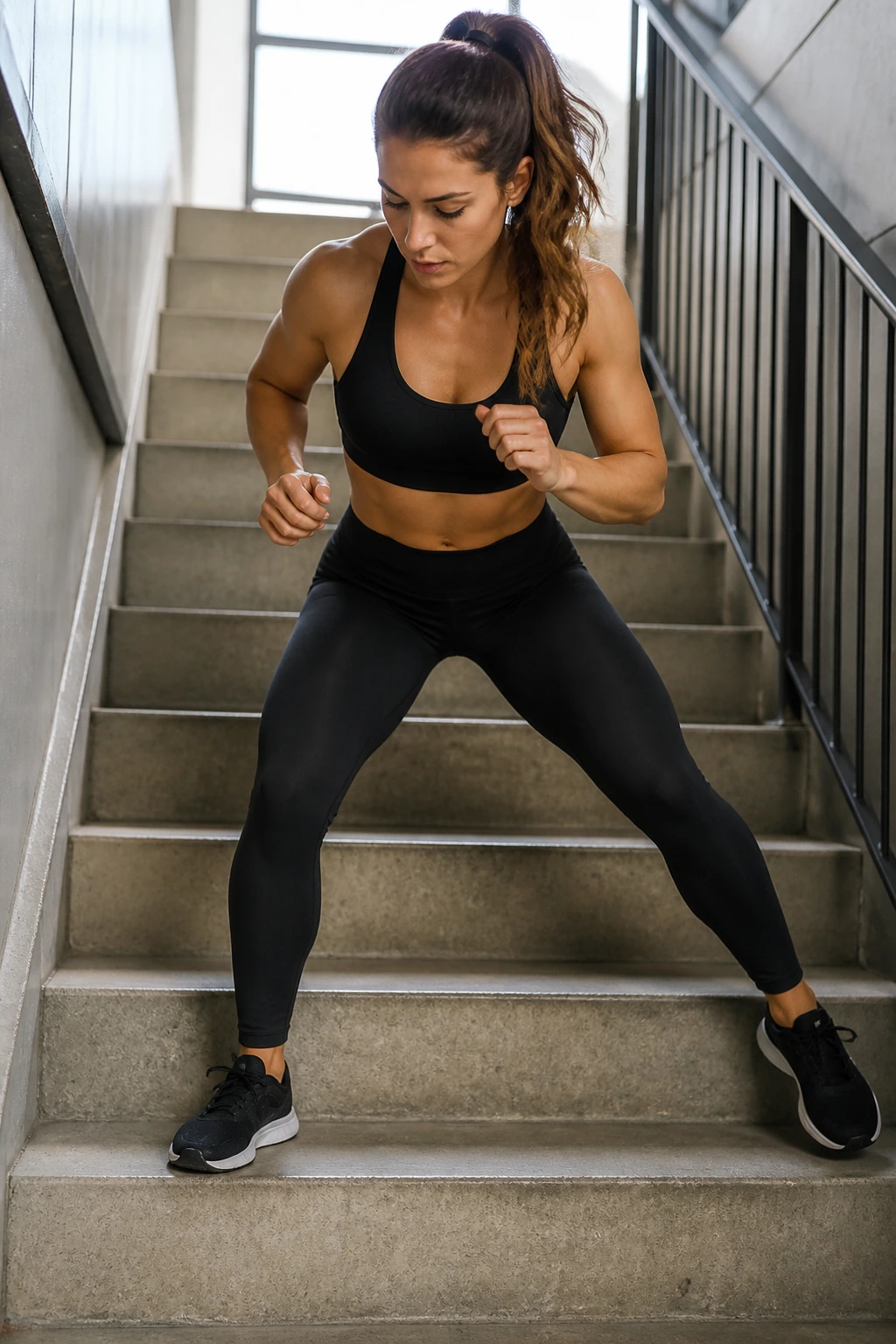
Side-step stair work looks odd for about ten seconds, then it starts making sense. Compared with straight-ahead climbing, it puts more attention on the hips, outer thighs, and stabilizers around the knee. The cardio hit is still there, but the movement feels different enough to wake up muscles that often get ignored.
This is a smart option if straight stair repeats make your knees feel beat up or if your hips get lazy during repetitive climbing. Face sideways, step up with the outside leg, and bring the trailing leg to meet it on the step above. Switch sides after one flight or after 30 to 45 seconds.
The pace should stay controlled. If you try to rush lateral steps, your feet start crossing weirdly and the whole thing gets awkward. Awkward is not the goal here.
Compared with front-facing climbs, lateral work usually feels less explosive and a little more balanced. It’s the kind of variation that keeps a stair plan from turning stale. A few rounds of this can make a plain cardio session feel fresh without making it complicated.
7. Weighted Stair Carries

Adding weight changes the whole mood of a stair workout. A backpack with 5 to 15 pounds, or a pair of light dumbbells if you have sturdy hands and a safe route, turns the climb into a loaded march. The heart rate climbs fast, but so do the demands on your grip, posture, and core.
Don’t get cute with the load. Start light. If your torso tips forward or your shoulders creep up toward your ears, the weight is too heavy. A good carry feels like a firm walk with purpose, not a desperate heave.
How to Keep It Safe
- Keep the load close to your body.
- Use a staircase with dry, even steps.
- Take normal steps, not two-step jumps.
- Put the weight down if your breathing gets ragged enough that you can’t stay tall.
Best tip: use a backpack before dumbbells if your balance is shaky. A load on your back is easier to manage than weight in your hands.
This workout pairs well with shorter stair flights because you can turn around, recover, and go again without your grip failing first.
8. Tabata Stair Blasts

Tabata is nasty in the best way if you keep the pace honest. The structure is simple: 20 seconds hard, 10 seconds rest, repeated for 8 rounds. On stairs, that format hits hard because the work intervals are so short that you keep pushing into fatigue before the body can settle.
The catch is that “hard” does not mean “wild.” Use a pace you can repeat eight times without your form falling apart by round four. That’s the difference between a useful session and a messy one. Your feet should stay quick, your landing should stay quiet, and your breathing will get loud fast.
This style works well on a short flight where you can climb, turn, and reset without wasting time. If you have a longer stairwell, even better, as long as the descent stays controlled.
Tabata is not the day for heavy weights or fancy foot patterns. It’s for clean, sharp cardio work. Short, sharp, and a little rude. That’s the whole point.
9. High-Knee Stair Drives

Why does a high-knee stair drill feel so much harder than plain climbing? Because you’re asking for more than forward movement. You’re asking the hip flexors to fire, the core to stay steady, and the legs to drive with a little snap instead of a lazy march.
Lift each knee with purpose as you move up, almost like a running drill on steps. Some people do it one step at a time. Others skip every other step and drive the knee up between contacts. Either way, the motion should stay crisp for 15 to 20 seconds per round.
How to Get the Most From It
Use 6 to 10 rounds with 45 to 60 seconds of easy walking or full rest. Keep the torso upright. If you fold forward, the knee lift gets sloppy and the hips stop doing their share of the work.
This one feels athletic without needing much space. It’s a good choice when you want a cardio drill that also sharpens coordination. And yes, it leaves the front of the hips talking afterward.
10. Tempo Climb With Short Recovery

I like this version when a hard workout sounds good but a sprint session sounds annoying. You climb at a firm, steady pace for 3 minutes, recover for 30 seconds, then repeat for 4 to 6 rounds. It’s not flashy. It’s effective.
The steady 3-minute blocks build a more durable kind of cardio than a quick burst does. Your breathing settles into a heavy rhythm, then the short recovery keeps you from fully cooling off. That back-and-forth keeps the session moving without turning it into a gut check every thirty seconds.
Key Details
- Work for 3 minutes at a strong, repeatable pace.
- Rest or walk for 30 seconds.
- Repeat 4 to 6 rounds.
- Keep the descent slow and smooth.
The best tempo climbs feel controlled from start to finish. You finish tired, but not wrecked. That matters if you want to train again in a day or two instead of limping around the house.
11. Mixed-Direction Stair Circuit

Straight climbing gets boring. There, I said it. A mixed-direction circuit solves that problem by changing the pattern before your brain starts checking out.
Run one flight forward, then the next with side steps, then a short section with quick marching steps on the landing, then another forward climb. Keep the total work around 12 to 18 minutes and move almost continuously. The point is not to be fast every second. The point is to keep the heart rate from dropping too far.
This style is good when you want a longer cardio session without repeating the exact same feeling over and over. Your hips work a little differently on the side steps, your calves load differently on the marches, and the forward climbs keep the workout anchored.
A mixed circuit is also nice for people who get mentally bored by repetitive intervals. The body notices the change, and so does the brain. That alone can make a session easier to finish.
12. Endurance Climb With Pace Changes

A stair session does not have to be a sprint contest. Some of the best cardio work lives in the middle gear, where you can stay on your feet for a long stretch without falling apart. That’s where pace changes earn their keep.
Use 15 to 25 minutes of climbing, shifting pace every 2 minutes. One block moderate, one block harder, then back to moderate. The changes are small enough to stay aerobic, but they keep the session from drifting into autopilot.
Compared with a treadmill, stairs demand more from the lower body with every step. You don’t get the same smooth belt helping you along. That makes the work feel more honest, and sometimes more annoying. Still, if you want a cardio session that also smokes the legs, stairs do that job cleanly.
This workout suits people who want stamina more than speed. It’s a good weekday session when your body can handle work but your mind doesn’t want a savage interval day. Add a few minutes of easy walking after, because your calves will want it.
13. One-Minute Hard, One-Minute Easy

The simplest interval format often works the best. One minute up the stairs at a hard but controlled pace, one minute of easy walking or standing recovery, repeated 8 to 12 times. No trickery. No weird counting. Just effort and recovery in equal pieces.
Why It Works
The work interval is long enough to make breathing matter, but short enough that you can keep the pace strong from the first rep to the last. That’s the sweet spot for a lot of people. The recovery minute keeps your form cleaner than a nonstop climb would.
If your heart rate is slow to settle, make the easy minute a true easy minute. Don’t turn recovery into a half-speed grind. That’s a common mistake, and it steals quality from the next hard rep.
How to Make It Count
- Use the same stair route each round.
- Keep the hard minute consistent.
- Walk down only if the descent is safe and controlled.
- Stop at 8 rounds if your legs are cooked.
Best tip: write your round count down. This workout gets better when you can beat your own number later.
14. Stair Push, Floor Push, Repeat

Pairing stairs with push-ups creates a cardio-strength circuit that feels far more complete than a plain climb. The stair section drives the heart rate up, then the push-up work keeps the upper body and core honest while the legs recover just enough to go again.
A clean version looks like this: 20 to 30 seconds of fast stair climbing, then 8 to 12 push-ups on the floor, a bench, or a sturdy wall if needed, then back to the stairs. Four to six rounds is a solid session. More is possible, but your form has to stay tight.
The stair climb should be the engine. The push-ups are not a rest break, even if they feel easier than the stairs. They’re part of the conditioning load, and they help keep the whole thing from becoming just a leg burn.
This setup works well when you want a short workout that feels full-body without needing any gear. It also gives you a natural place to recover your breathing between climbs, which is a nice little gift.
15. Descend-and-Recover Intervals

Should you ever use the descent as part of the workout? Yes, but carefully. Walking down stairs can serve as recovery, and if you control the speed, it also gives the legs a different kind of work without pounding them.
Use 20 to 30 seconds of hard climbing, then take 60 to 90 seconds to walk down slowly and reset. That pattern gives you a built-in recovery phase that feels more active than standing still. It’s useful when you want to keep moving without stacking too much strain into the climb itself.
How to Use It
If your knees get cranky on the way down, shorten the descent by using fewer steps or a shorter staircase. Do not rush the downhill phase. That’s when bad footing shows up fast.
The interesting part is that the descent keeps your heart rate from dropping too far while still giving your quads a chance to breathe. It’s a neat middle ground for people who want intervals but not constant all-out effort.
This is also one of the best choices for beginners, since the recovery is built into the pattern. The workout still matters. It just stops short of being cruel.
16. EMOM Stair Repeats

EMOM means “every minute on the minute,” and stairs fit that format nicely. At the top of each minute, you climb for 20 to 30 seconds, then rest for the remaining time until the next minute starts. Ten rounds is enough for a serious session.
The structure is sneaky because the rest never feels long, but it’s long enough to let you hit each round with decent shape. You’re not wandering through the workout. You’re hitting a mark, recovering, then going again. That regular rhythm works well for people who like clean rules.
A typical setup: climb hard for 25 seconds, then stand or walk easily for 35 seconds. If you’re faster, use 30 seconds of work and 30 seconds of rest. If that falls apart by round 5, shorten the work and keep the minute structure intact.
This is a good “no excuses” workout. You know exactly what the next minute asks for, and the stairs don’t care if you’re feeling philosophical.
17. Stair Bound Intervals

Bounding stairs is a more explosive version of stair climbing, and it should be treated that way. You drive one step at a time with a springier push, almost like a power run up the stairs. It’s fast, aggressive, and not something I’d hand to a beginner without a warning label.
The payoff is a big cardio hit plus a stronger demand on the glutes, calves, and upper legs. The downside is obvious too: more impact, more speed, more chance to get sloppy. That’s why the work intervals stay short. Ten to 15 seconds is enough. Six rounds is plenty for most people.
If your knees, ankles, or Achilles tendons are already irritated, skip this one. There are friendlier ways to get a heart-rate spike. If you do try it, keep the foot strike light and the landing quick. Bounding is about spring, not stomping.
This workout belongs on days when you feel fresh and your stairs are dry, clear, and wide enough for safe foot placement. Not every stair session should feel this sharp. This one earns its place by being a little rude.
18. Backward-Step Control Climb
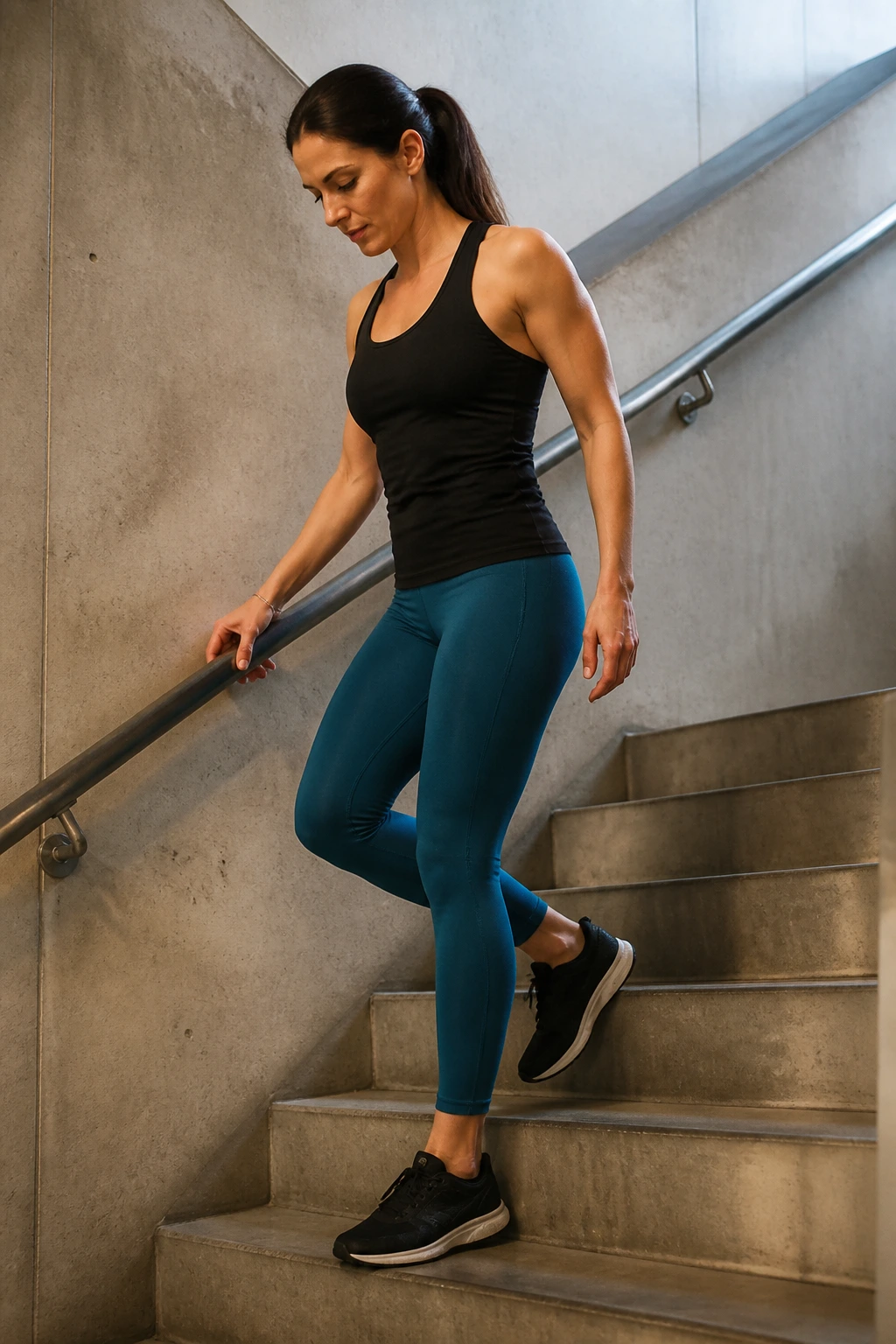
Backward stair work looks strange the first time you do it, and then you notice what it does to the legs. Stepping down backward, under control, changes the loading on the quads and forces more attention through the hips and balance muscles. It is not a trick. It’s a different tool.
Use a handrail lightly, face up the stairs when appropriate for your route, and step backward one stair at a time on the way down. Then climb forward on the way up. Keep the descent slow, almost cautious. Speed is the enemy here.
Compared with forward-only climbing, backward stepping can feel easier on some people’s knees and tougher on their balance. That combination makes it useful for variety, but not for reckless speed. The first round should feel almost too easy. Good. That means you’re being careful enough.
A short session of 4 to 6 climb-and-descend cycles is enough to get value from it. The heart rate still climbs, but the movement pattern keeps your legs from getting locked into one shape.
19. The Long Aerobic Stair Session for Cardio

Not every stair workout needs to leave you bent over with your hands on your knees. Sometimes the goal is a long, steady aerobic effort that trains your engine without turning the whole thing into a sprint festival.
Spend 20 to 40 minutes climbing at a moderate pace. You should be breathing harder than you would on a casual walk, but you should still have enough control to keep your posture clean. If the last 10 minutes turn into a sloppy shuffle, back off a little.
How to Pace It
- Keep the effort steady, not spiky.
- Use small, quiet steps.
- Walk down at an easy pace.
- Take a short break every 10 minutes if needed.
This session works well when you want endurance, calorie burn, and leg stamina without a brutal finish. It’s also a good way to build confidence on stairs before you try the harder interval styles.
Best tip: if your calves start cramping, cut the pace before they force the issue. Cramps do not make you tougher. They just make you sit down.
20. Final Finisher: Fast Stair Climbing for Cardio

This is the one I’d use when the day calls for a quick, sharp finish. Climb hard for 15 seconds, recover for 90 seconds, repeat 6 to 8 times. That’s it. Short, clean, and loud in all the right ways.
The hard part should feel fast but controlled. If you explode so hard that the next round falls apart, the workout loses its shape. Keep the effort repeatable. That matters more than trying to win every rep.
A good finisher leaves your breathing up, your legs warm, and your posture intact. It should not leave you careless on the way down. Walk back slowly, shake out the calves, and give yourself a minute before you do anything else.
Mix this into the end of a strength day, a run day, or a plain low-energy afternoon when you need a cardio hit and don’t want to fuss with gear. Pick one stair workout that matches your body and your schedule, then stay with it long enough to learn how it feels. Stairs reward patience. They also punish nonsense, which is part of their charm.
