



Spend a few minutes looking around a standard commercial gym, and you will notice a recurring pattern. You see people parked on elliptical machines for forty-five minutes, staring blankly at a wall, reading a magazine, or doom-scrolling on their phones. They are putting in the time, but they aren’t getting the physiological return on investment they expect. That type of steady-state, low-intensity movement has its place for active recovery, but if your goal is to change your body composition and strip away stubborn fat, it is likely the least efficient method available.
The human body is remarkably efficient at adapting to stress. When you perform the exact same repetitive motion for weeks on end, your heart rate barely spikes, your muscles stop receiving a stimulus for growth, and your caloric burn plateaus. You stop seeing progress because you stopped challenging your body to adapt. Fat loss, particularly when combined with muscle preservation, requires a shift in approach. It demands higher intensity, shorter work periods, and movements that engage multiple muscle groups simultaneously.
This is where short-duration, high-intensity workouts come into play. We are talking about taxing your metabolic system, forcing your heart rate into a zone where it has to work for recovery even after you leave the floor. This is not about spending three hours a day working out. It is about condensing the stimulus into fifteen or twenty minutes of high-quality, high-effort movement. When you push your muscles to the brink of failure and keep your heart rate elevated, you trigger an afterburn effect—scientifically known as excess post-exercise oxygen consumption (EPOC). This means you continue to oxidize fat and repair tissue long after you have finished your final rep.
1. Every-Minute-On-The-Minute (EMOM) Burpees

This is the ultimate test of cardiovascular capacity and mental grit. The concept is brutally simple: you set a timer for a specific number of minutes. At the start of every minute, you perform a set number of burpees. You have the remainder of that minute to rest before the next round begins. If you finish your reps in thirty seconds, you get thirty seconds of rest. If you are slow, you get less rest. This forces you to maintain intensity if you want any recovery time at all.
Why It Works for Fat Loss
The beauty of the EMOM format is that it regulates your pace. You cannot slack off, or you will find yourself in the next round with zero recovery time. It also forces you to manage your breathing under duress.
How to Execute Properly
- Choose a rep count that takes you no more than 40 seconds to complete (aim for 8–12 reps per minute).
- Set a timer for 10 or 15 minutes.
- Keep your chest to the floor and ensure your feet jump all the way up.
- Do not sacrifice form for speed. If your hips start sagging, drop your rep count rather than continuing with bad mechanics.
Pro tip: If you find you have too much rest time, increase your rep count by one or two per minute rather than rushing the movement, which often leads to sloppy technique.
2. Kettlebell Swings for Posterior Power
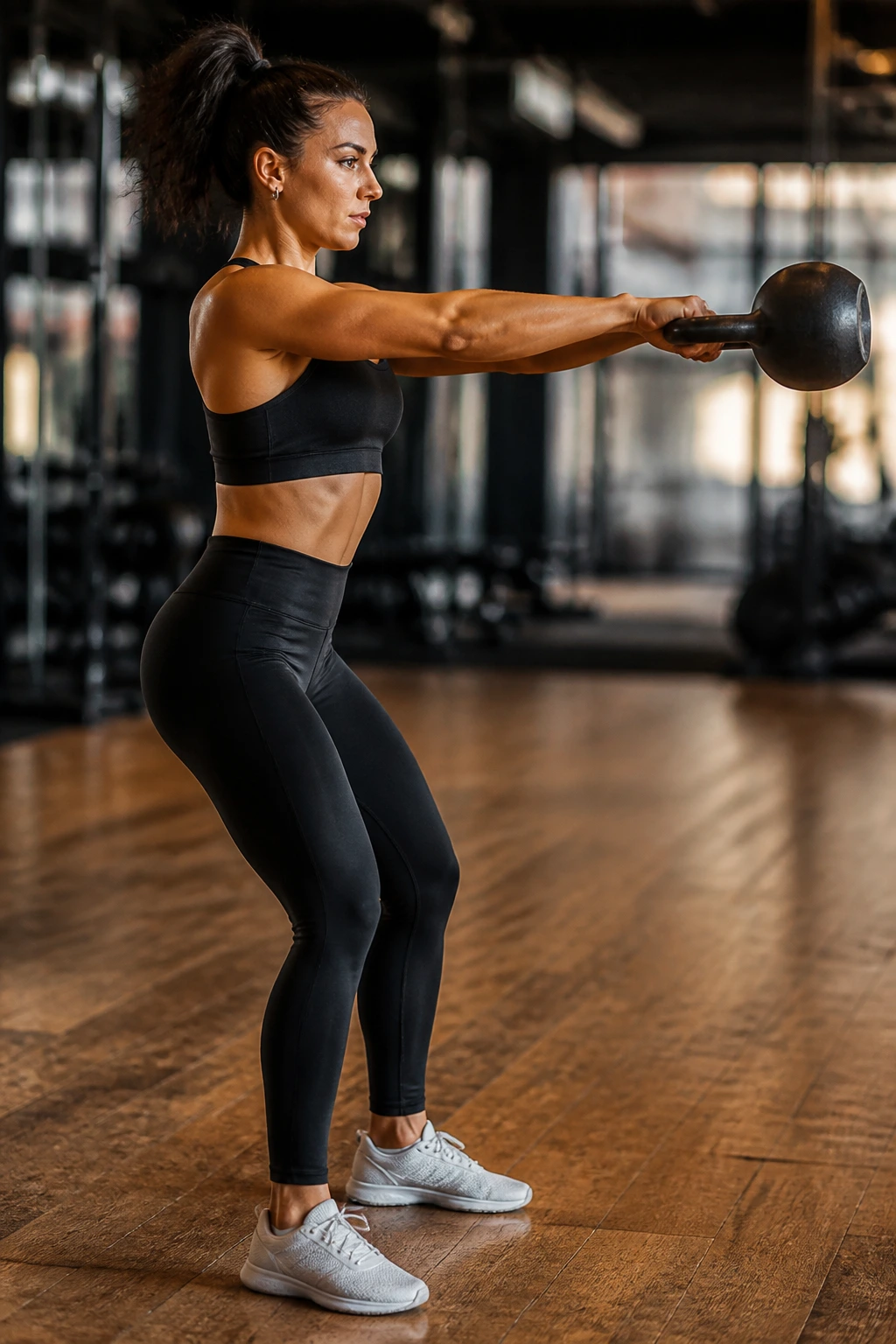
If you only have one piece of equipment to choose for fat loss, make it a kettlebell. The swing is not a squat; it is a violent hip hinge. You are using your hamstrings, glutes, and lower back to snap the bell upward. When done correctly, this movement is highly metabolic because it recruits the largest muscle groups in your body, all while keeping your heart rate pegged in the anaerobic zone.
The Mechanism of the Swing
Most people treat this like a squat. That is a mistake that robs the movement of its power. Think of your arms as ropes. They are only there to hold the handle. The energy comes from the snap of your hips. When your glutes contract, they propel the bell forward. Your quads should play a minimal role here.
Keys to a Perfect Hinge
- Stand with your feet slightly wider than shoulder-width.
- Keep your back flat and your shins vertical.
- Imagine you are trying to squeeze a walnut between your glutes at the top of the movement.
- If you feel this in your lower back, your hinge is off. Stop, reset, and focus on pushing your hips back behind you, not down toward the floor.
3. Tabata-Style Mountain Climbers

Tabata training is a specific protocol: 20 seconds of maximum effort, followed by 10 seconds of rest, repeated for 8 rounds. It lasts exactly four minutes. While that sounds short, I guarantee you that by the third round, your shoulders will be screaming, and your core will feel like it is on fire. Mountain climbers are excellent because they combine a plank hold with a dynamic running motion, forcing your core to stabilize while your legs move rapidly.
How to Get the Most Out of It
The mistake most people make is going too slow. These are not a leisurely walk in the park. Drive your knees toward your chest as fast as you can. Keep your hips level—do not let them bob up and down like a buoy in the ocean. If you can maintain the same speed on the first round and the eighth round, you aren’t pushing hard enough.
What to Watch For
If your lower back starts to ache, that is a clear sign your core is fatigued and failing to support your spine. Immediately drop to your knees or hold a static plank for the remainder of the 20 seconds. It is better to stop early than to reinforce bad movement patterns that will lead to injury later on.
4. Dumbbell Thrusters

The thruster is a combination move: a front squat followed immediately by an overhead press. It is a full-body movement that transitions weight from the floor to the ceiling. Because it uses the legs, core, back, and shoulders, the caloric expenditure is significantly higher than doing squats and presses separately. You are asking your body to move a weight over a massive range of motion, which is incredibly demanding.
Why It’s a Total Body Killer
There is nowhere to hide with a thruster. Your legs are doing the heavy lifting in the squat, and your shoulders and triceps are finishing the job overhead. It effectively taxes the largest muscle groups and the smallest accessory muscles simultaneously. This creates a massive metabolic demand that keeps your heart rate high for the duration of the set.
Scaling for Success
Start with lighter dumbbells than you think you need. The weight will feel manageable for the first five reps, but by rep fifteen, you will understand why this move is feared. Aim for 3 sets of 15 reps with 60 seconds of rest between sets. If you cannot finish the 15 reps without putting the weights down, lighten the load next time.
5. Jump Rope Intervals
Skipping rope is not just for boxers or grade school playgrounds. It is arguably the most efficient way to improve coordination, agility, and cardiovascular endurance in a very small amount of space. The key to turning it into a fat-burning workout is to move away from steady-state jumping and move toward high-intensity intervals.
Why Steady Jumping Isn’t Enough
If you just jump at a casual pace for 20 minutes, your body becomes efficient at it and the calorie burn drops significantly. Instead, perform 30 seconds of “max effort” jumping—try for double-unders or just a very high-speed sprint—followed by 30 seconds of slow, recovery jumping. Do this for 10 minutes.
Essential Form Cues
- Stay on the balls of your feet.
- Your heels should rarely touch the ground.
- Keep your elbows tucked in close to your ribs; the movement should come from your wrists, not your shoulders.
- If you trip, don’t stop. Just reset and restart immediately. The goal is to keep the heart rate up, not to have a perfect, flawless session.
6. Battle Rope Waves
Battle ropes are fantastic for one specific reason: they allow you to continue working even when your legs are absolutely fried. If you have done a leg-heavy workout earlier in the week and just need to incinerate some fat without taxing your lower body further, this is the tool. The explosive, repetitive movement of the ropes engages the entire upper body, including the core, which must fight to keep you stable against the inertia of the heavy ropes.
The “Double Wave” Method
Stand in a half-squat position, core tight. Grip the ends of the ropes firmly. Create large, oscillating waves by moving your arms up and down simultaneously. Do this for 30 seconds, then rest for 30. Repeat for 10 rounds. You will notice your heart rate spikes almost instantly.
Why This Trumps Cardio Machines
Machines don’t require you to stabilize your body. The machine does the work of keeping you upright. With battle ropes, your entire torso is working to prevent you from being pulled off balance. You get a muscle-building stimulus for your shoulders and lats while simultaneously doing intense cardio.
7. Box Jumps for Explosive Power
Box jumps develop explosive power, which is a trait that declines rapidly with age if you do not train for it. By jumping onto a box, you are forcing your body to recruit fast-twitch muscle fibers. These fibers are the ones that give you shape and tone, and they burn energy very effectively.
Safety First
Never jump backward off a box. This is a common mistake and a recipe for an Achilles tendon injury. Always step down, one foot at a time. Treat the descent with as much respect as the ascent.
How to Build Intensity
You don’t need a massive box to get the benefits. Even an 18-inch box is plenty for high-intensity work. The goal is not to see how high you can jump, but how many controlled, powerful reps you can perform in a set period. Aim for 4 rounds of 45 seconds of continuous jumping, stepping down each time.
8. Medicine Ball Slams
Sometimes you just need to release stress while you work out. The medicine ball slam is the perfect physical outlet. It requires you to reach high overhead, engage your lats, and then drive the ball into the floor with maximum force. It uses the entire anterior chain, particularly the core and shoulders.
The Physics of the Slam
Do not just drop the ball. You have to “throw” it into the floor. The force you generate must originate from your abs. As you slam, you should crunch down, engaging your core muscles to drive the ball down. If you do this correctly, you will feel it in your abs just as much as your shoulders.
Choosing the Right Weight
You want a ball that is heavy enough to be difficult, but light enough that you can still slam it with speed. A ball that is too heavy will slow you down, which reduces the metabolic impact. Go for a slam ball, not a bouncy one. A ball that bounces back is not a medicine ball; it is a nightmare waiting to happen.
9. Goblet Squat Holds
Isometrics—holding a position under tension—are an underrated tool for fat burning and muscle endurance. A goblet squat hold means you hold a dumbbell or kettlebell against your chest, sink into a squat, and hold that position for time. It forces your quads, glutes, and core to remain in a constant state of contraction.
Why Holds Are Effective
When your muscles are constantly contracting, they are not getting oxygenated blood flow. This creates a buildup of metabolic byproducts, which your body then has to work overtime to clear once you release the tension. It is a very uncomfortable sensation, but it creates a deep, burning stimulus that triggers hormonal responses conducive to fat loss.
The “Time Under Tension” Rule
Don’t count reps. Count seconds. Perform 4 rounds of 45-second holds. Between each hold, perform 10 explosive jump squats to flush the legs out. This contrast between the static hold and the explosive jump is a potent combination for fat loss.
10. Rowing Machine Sprints
The rowing machine is often the most underutilized piece of equipment in the gym. People sit on it and row at a steady, leisurely pace for twenty minutes. That is a waste of time. The rower is designed for power. If you want to burn fat, you need to treat the rower like a sprint track.
The 500-Meter Protocol
The standard test of rowing fitness is the 500-meter sprint. If you are a beginner, aim to cover 500 meters in under 2 minutes. For every 500 meters, rest for 90 seconds. Repeat this 5 times. It is a brutal, full-body anaerobic workout that will leave you gasping for air.
Form Check
Most people row with their arms. You should be rowing with your legs. About 60% of the power should come from your leg drive. 30% from your core/back, and only 10% from your arms. If your arms are tired before your legs, you are rowing incorrectly.
11. Bear Crawls
This movement is deceptively difficult. It is a full-body crawling exercise that requires incredible core stability and shoulder endurance. It forces you to coordinate opposite limbs, which is great for brain health and motor control, but it’s the metabolic tax that keeps it in this list.
Why Crawling Matters
It requires your core to remain locked tight while your limbs move. It is essentially a plank in motion. Because you are supporting your own body weight and moving it against gravity, your heart rate rises quickly.
How to Incorporate Them
Don’t just crawl for distance. Crawl for time. Set a timer for 30 seconds and crawl forward, then backward, then side to side. Keep your knees just an inch off the floor—do not let them scrape the ground. Your hips should stay level with your shoulders. If your butt pops up into the air, you are losing the core tension.
12. Dumbbell Deadlift-to-Row
This is a compound movement that targets the posterior chain (hamstrings and glutes) and the back (lats and rhomboids). By combining a deadlift with a row, you are essentially hitting two major muscle groups in one fluid motion.
The Execution
Start with two dumbbells on the floor. Hinge your hips back, grab the weights, and stand up (the deadlift). Once you are standing, hinge back down halfway and perform a row, pulling the weights to your hips, not your chest. Then stand up again.
Why This Works
The transition between the hinge (deadlift) and the row puts your core and stabilizing muscles under significant duress. You are essentially doing a “complex” movement where your heart rate does not drop between the deadlift and the row. This keeps the calorie burn high because the rest periods are non-existent.
13. Lateral Skater Jumps
Most of our movement patterns are linear—forward and backward. Lateral, or side-to-side movement, is often neglected. Skater jumps force you to stabilize on one leg while moving laterally, which engages the glute medius—the small muscle on the side of your hip—and improves balance.
Building Intensity
The wider your jump, the harder the movement. Try to jump as far as you can to the side, landing softly on one foot, and holding your balance for a split second before exploding back to the other side. This is plyometric training at its best.
The “Silent Landing” Rule
You should be able to land without making a sound. If you are thumping into the floor, you are not absorbing the impact with your muscles; you are absorbing it with your joints. Control the landing. That control is where the muscle building and fat burning happen.
14. Plank-to-Pushup Transitions
This is an upper-body and core staple. You start in a plank position on your forearms. You push up onto your hands (into a pushup position), then descend back to your forearms. This is a rhythmic, continuous movement that taxes the shoulders and the deep abdominal muscles.
Why This Is Different
It is not about the number of pushups. It is about the transition. The instability of the movement is what makes it difficult. Your core has to fight to keep your hips from rocking back and forth as you switch from forearm to hand.
Common Mistakes
Do not let your hips sag. Keep your belly button pulled in toward your spine. If you find your hips rocking excessively, spread your feet wider to create a more stable base. Once you get stronger, bring your feet closer together to make it harder.
15. High Knees with Resistance
High knees are a staple of track and field warmups, but when you add resistance—like holding a light set of dumbbells or wearing a weighted vest—they become a high-intensity cardio tool. The goal is to drive your knees up to waist height while moving your arms in a running motion.
The Pace
This is a sprint in place. You want to touch the ground as little as possible. Think of the floor as hot lava. Your feet should be moving so fast they barely have time to make contact.
Why It’s Great for Fat Loss
It is purely anaerobic. You are asking your heart to pump blood to your legs at a rapid rate while simultaneously engaging your core to stabilize your upper body. It is excellent for flushing out lactic acid and building leg stamina.
16. Step-Up to Jump-Up Combo
Step-ups are great for glute isolation, but they can be boring. By adding an explosive jump at the top of the movement, you turn it into a power exercise. Step onto a bench with your right foot, explode up, and drive your left knee toward your chest.
Balancing the Load
Do all reps on one leg before switching to the other. This creates a massive accumulation of fatigue in the glutes and quads. The “burn” you feel is the metabolic byproduct of your muscles working hard. That is exactly what you want.
Safety Check
Ensure the bench or box is stable. If you are using a gym bench, make sure it is against a wall so it doesn’t slide out from under you. Never risk a workout with unstable equipment.
17. Shadow Boxing with Light Weights

You do not need to be a fighter to use boxing drills for fat loss. Holding very light dumbbells—1 or 2 pounds—and throwing rapid-fire punches is exhausting. It forces your shoulders to stay under tension and demands rapid core rotation.
The Science of the Punch
Every punch starts at the feet. You twist your hips and your core to deliver the power. This rotational force is fantastic for toning the midsection. Keep your punches snappy—don’t throw lazy, slow punches. Retract your hand back to your face quickly to work the back of your shoulders.
The Duration
Go for rounds. 3 minutes of punching, 1 minute of rest. Do 5 rounds. You will be surprised at how quickly your shoulders fatigue. It is a fantastic way to build “shoulder caps” while burning calories.
18. The “Man-Maker” (Dumbbell Complex)
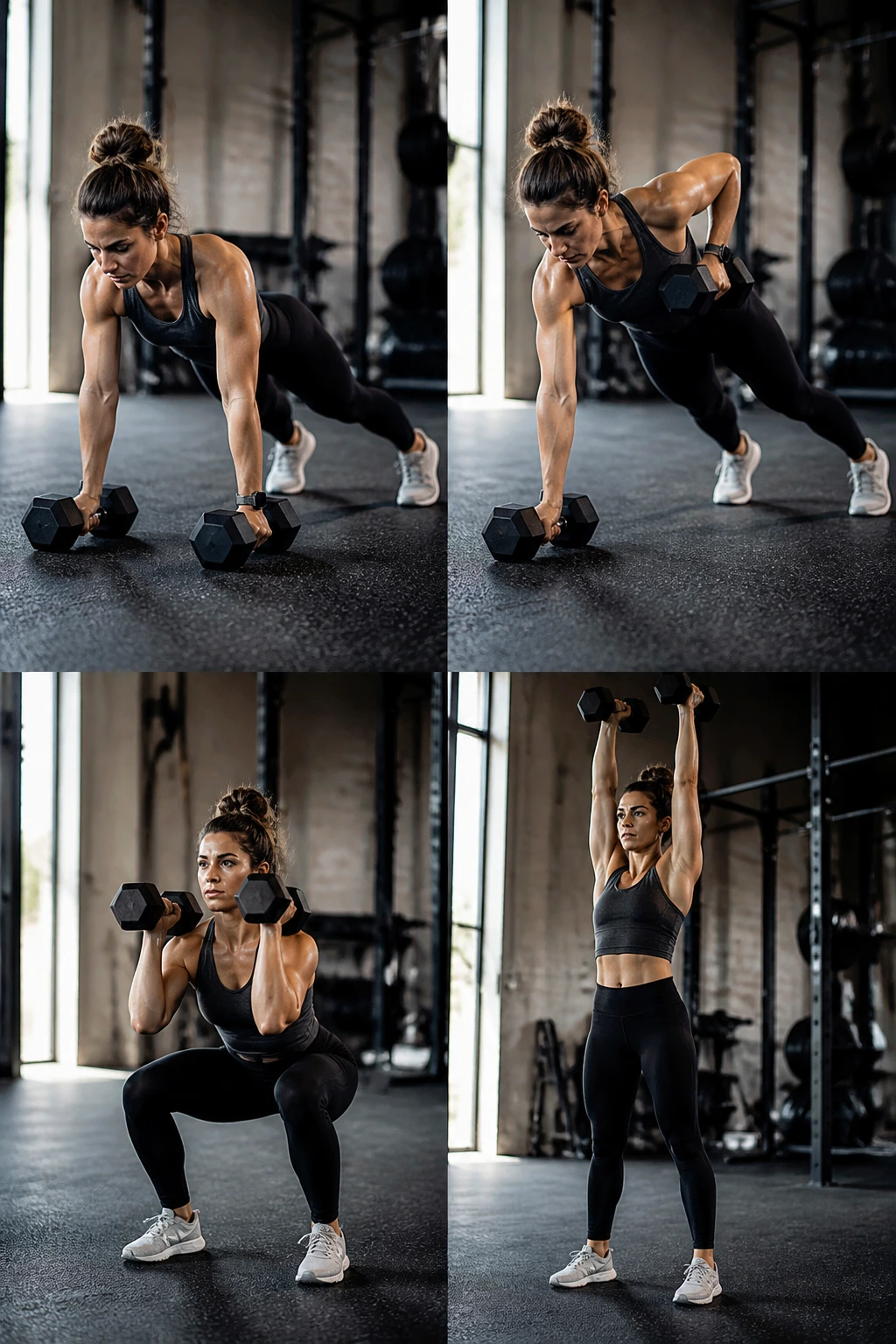
This is a legendary fat-loss exercise. It combines a pushup, a renegade row (rowing the dumbbell while in a pushup position), and a thruster into one fluid motion. It is the ultimate full-body complex.
Breaking Down the Move
- Hold the dumbbells on the floor in a pushup position.
- Perform a pushup.
- Row the right dumbbell, then the left dumbbell.
- Jump your feet up to your hands.
- Stand up, perform a squat, and press the dumbbells overhead (the thruster).
- Return to the floor.
Why This Is the Gold Standard
It hits everything. Chest, back, core, quads, glutes, shoulders. It is a metabolic powerhouse. If you only have time for one exercise, make it this one. It is brutal, it is hard, and it works.
19. Walking Lunges with a Twist

Lunges are the bread and butter of leg training, but the walking lunge adds a balance component that makes them significantly harder. By adding a torso twist—rotating toward the front leg—you engage the obliques and force the core to stabilize against the rotation.
Perfecting the Lunge
Step forward, land on your heel, and lower your back knee until it almost touches the ground. Keep your torso upright. Do not lean forward. If you lean forward, you are shifting the load to your lower back instead of your glutes and quads.
Tempo
Take your time on the way down—3 seconds to lower yourself—and explode up on the way up. This tempo change forces your muscles to work harder during the eccentric (lowering) phase, which is where a lot of muscle damage and metabolic work occurs.
20. Glute Bridges for Time
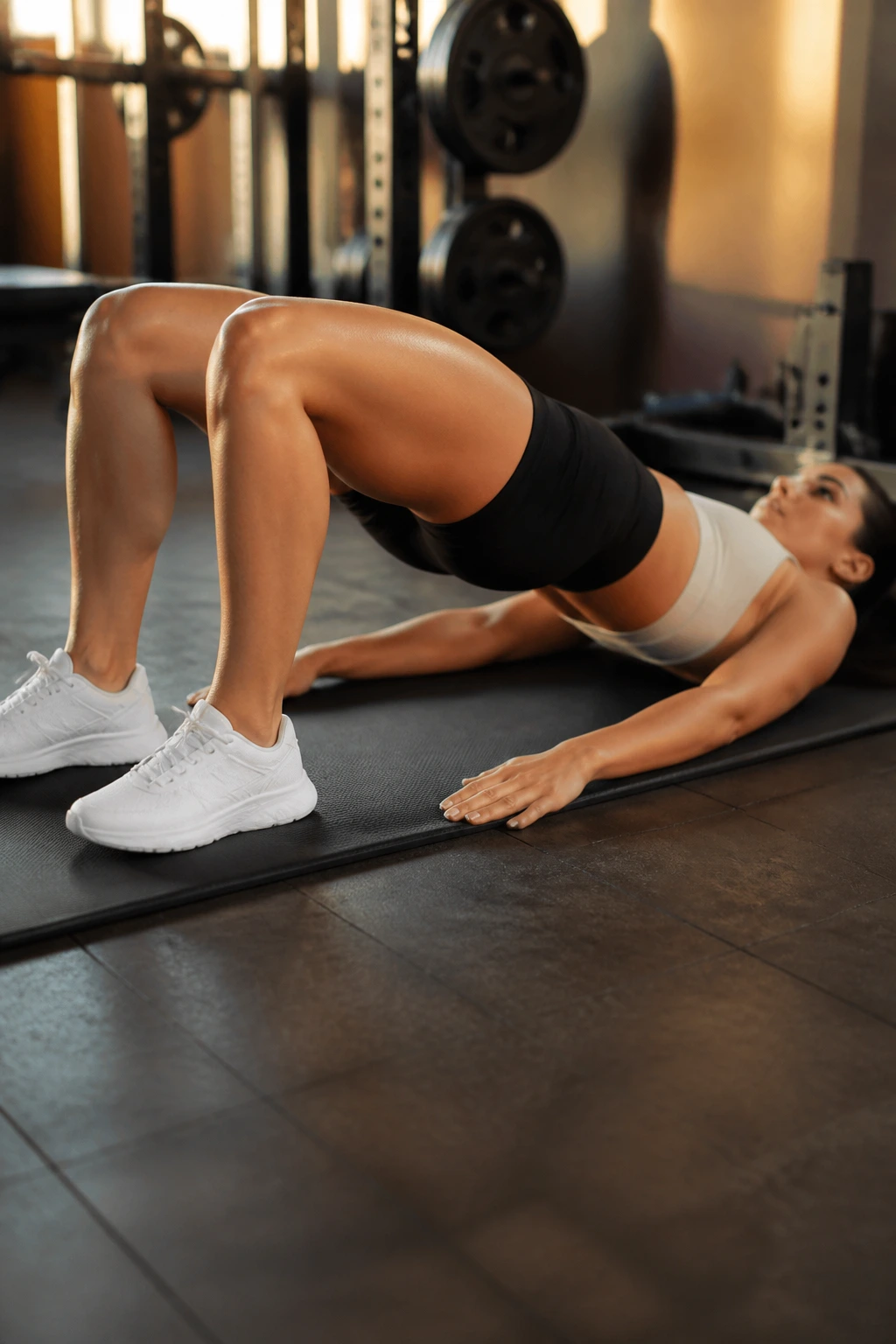
While lunges and squats are great, the glute bridge is the best move for isolation. By doing these for time—holding the bridge at the top for a two-second squeeze—you can create incredible metabolic stress in the glutes and hamstrings.
Why This Is Essential
Most of us spend the day sitting, which leads to “glute amnesia.” The muscles stop firing properly. Glute bridges wake them up. When your glutes are firing, they support your lower back and knees, preventing injury.
The Bridge Variation
For a bigger challenge, do these as single-leg glute bridges. Hold the top position, squeeze the glute hard, and drive your hips up. Keep your core tight. It is a small movement, but performed at high intensity, it is incredibly effective for shaping and metabolic burn.
Final Thoughts
The key to fat loss is not about finding the “perfect” movement, but about finding the intensity that your body is currently avoiding. Whether you choose the explosive nature of kettlebell swings or the grinding endurance of battle ropes, the goal remains the same: create a stimulus that forces your body to adapt.
Consistency matters more than intensity for one day, but intensity matters more for the results you actually want to see. Don’t worry about being perfect. Worry about moving with intent. Start with one or two of these workouts, master the form, and as your conditioning improves, stack them into circuits. Your body is ready to change; you just need to give it the right reason to do so.
