



Prenatal workouts in the first trimester can feel strangely unpredictable. One day your body wants movement; the next, a short walk leaves you staring longingly at the nearest couch. That swing is normal, and it’s exactly why the smartest first-trimester exercise choices are the ones that stay useful even when your energy, appetite, and patience all change by the hour.
The goal is not to “push through” like you’re training for a race nobody asked for. It’s to keep moving in ways that support circulation, mood, sleep, and strength without making nausea, dizziness, or fatigue worse. For many uncomplicated pregnancies, a moderate routine is still the right call, and the talk test is a simple way to judge it: you should be able to speak in full sentences, but not belt out a song.
Some days, that might mean a 20-minute walk. Other days, it might mean 10 minutes on a bike, five minutes of mobility work, and a nap you earn without apology. That’s not backing off. That’s good judgment.
1. Brisk Walking for Days When Nausea Keeps You Honest
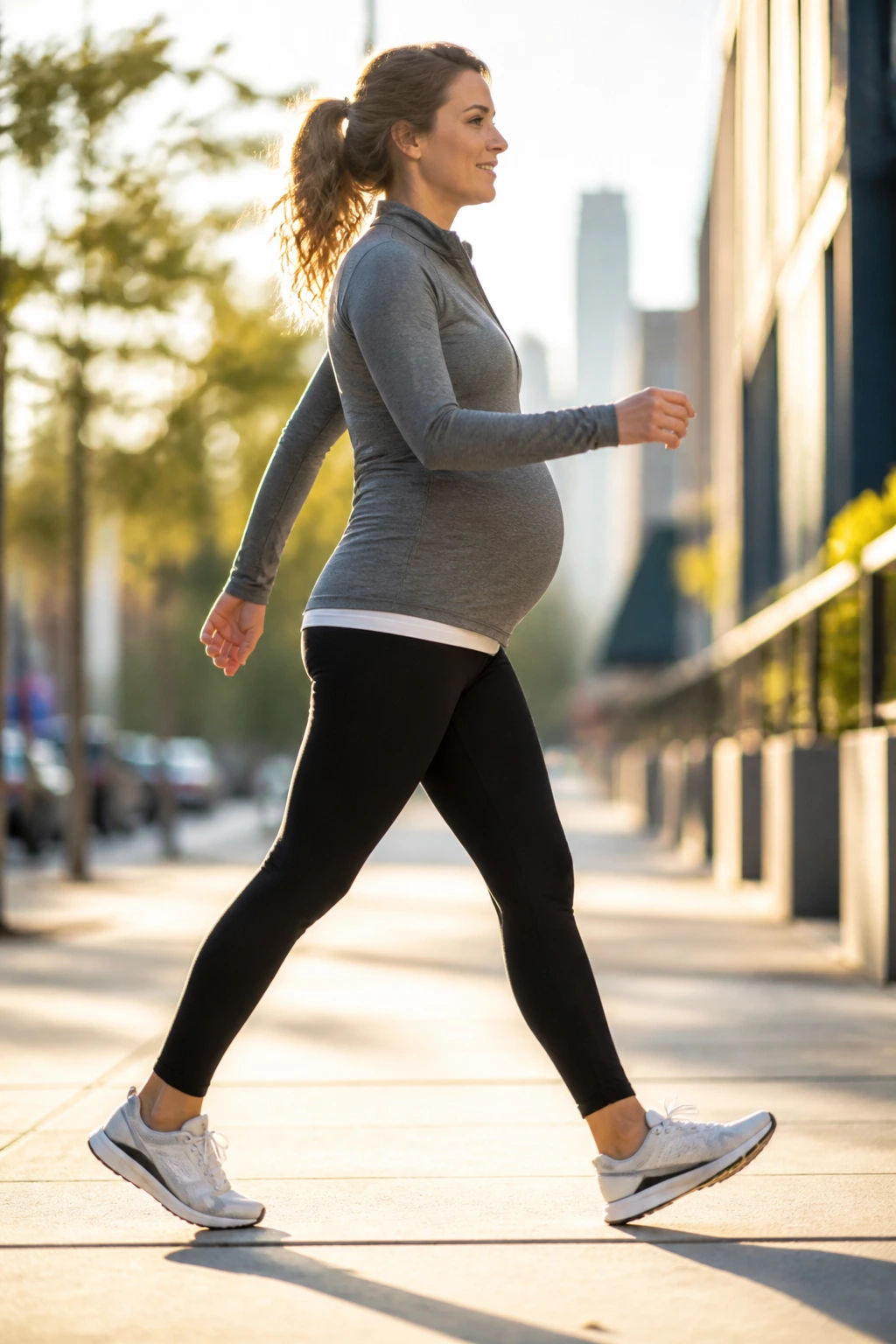
Walking is the old reliable. It doesn’t need a gym, it doesn’t need a long warm-up, and it usually feels better than it sounds when you’re sitting still with that slightly seasick first-trimester feeling.
A brisk walk is one of the easiest prenatal workouts for the first trimester because it gives you steady movement without bounce, impact, or complicated technique. I like it most on days when you want exercise to feel simple and quiet. No equipment drama. No decision fatigue. Just shoes, water, and a route that doesn’t smell weird.
How to keep the pace honest
- Start with 10 to 20 minutes on a flat route.
- Keep your shoulders loose and your stride natural.
- Use the talk test: you can talk, but you’re breathing a little harder than at rest.
- Pick early-morning or indoor walking if strong smells trigger nausea.
A loop around the block can be enough. So can a few laps through a mall, a track, or a treadmill at a pace that feels like you’re late for something but not panicked.
Tiny rule: if your belly feels jostled, shorten your stride and slow down. That almost always fixes the issue.
2. Stationary Cycling for a Smooth Cardio Session
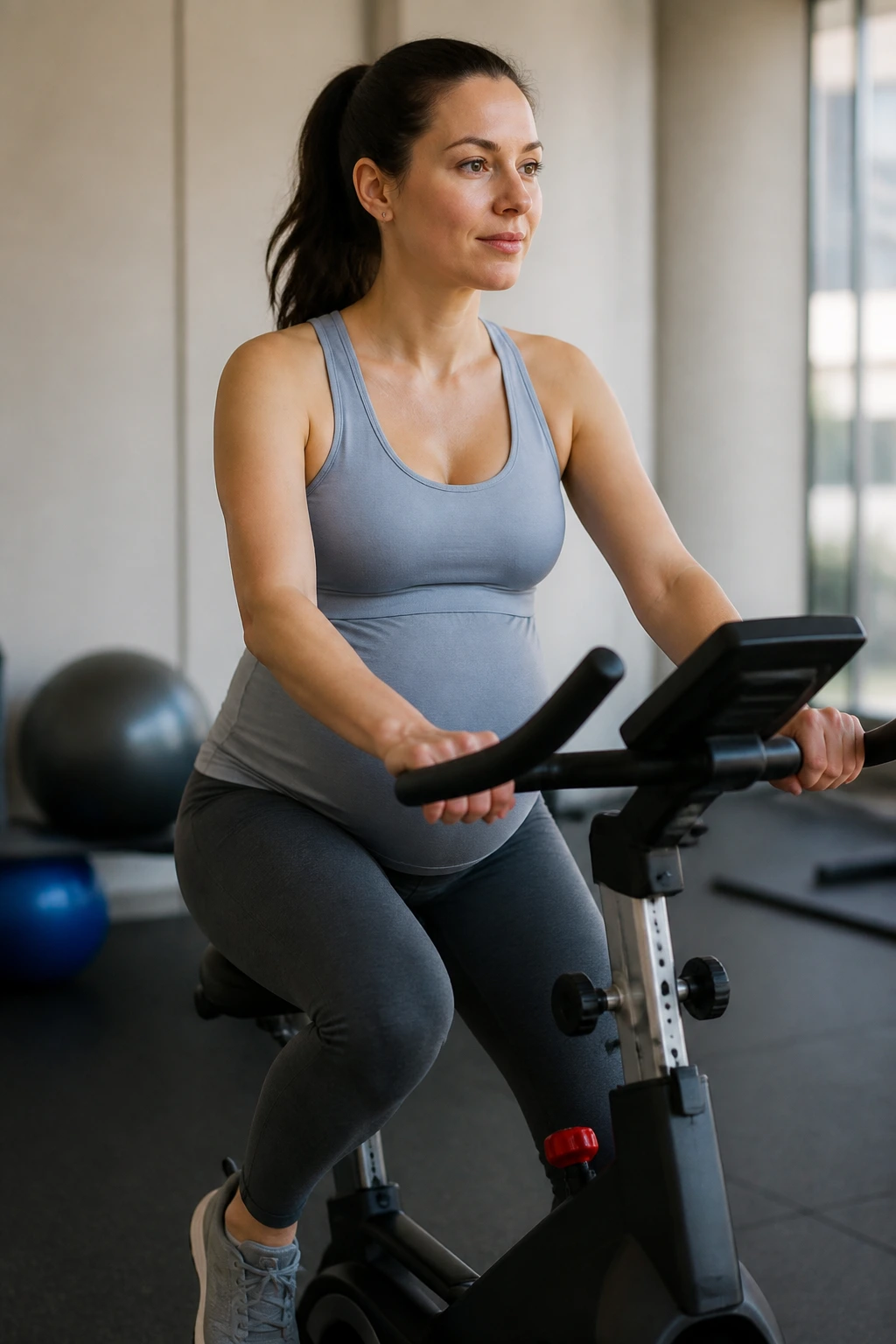
The stationary bike is one of the best low-drama cardio tools you can use in early pregnancy. It gives your heart a workout without asking your joints or balance to do extra work, and that matters more than people think.
The main advantage is control. You can set the resistance, adjust the seat, and keep the effort steady instead of getting jerked around by hills, traffic, or weather. Upright bikes tend to feel easier for most people, but a recumbent bike can be kinder if your lower back is grumpy or if sitting upright makes you feel a little off.
Seat height matters. Your knee should still have a soft bend at the bottom of the pedal stroke, not lock out. Keep resistance moderate, around the point where you can pedal smoothly for 15 to 25 minutes without gasping. If your cadence starts feeling choppy, the resistance is too high.
I’m not a fan of turning the first trimester into a sweaty test of toughness. The bike is better when it feels almost boring. That’s the point.
3. Swimming and Water Walking for Zero-Pound Pressure
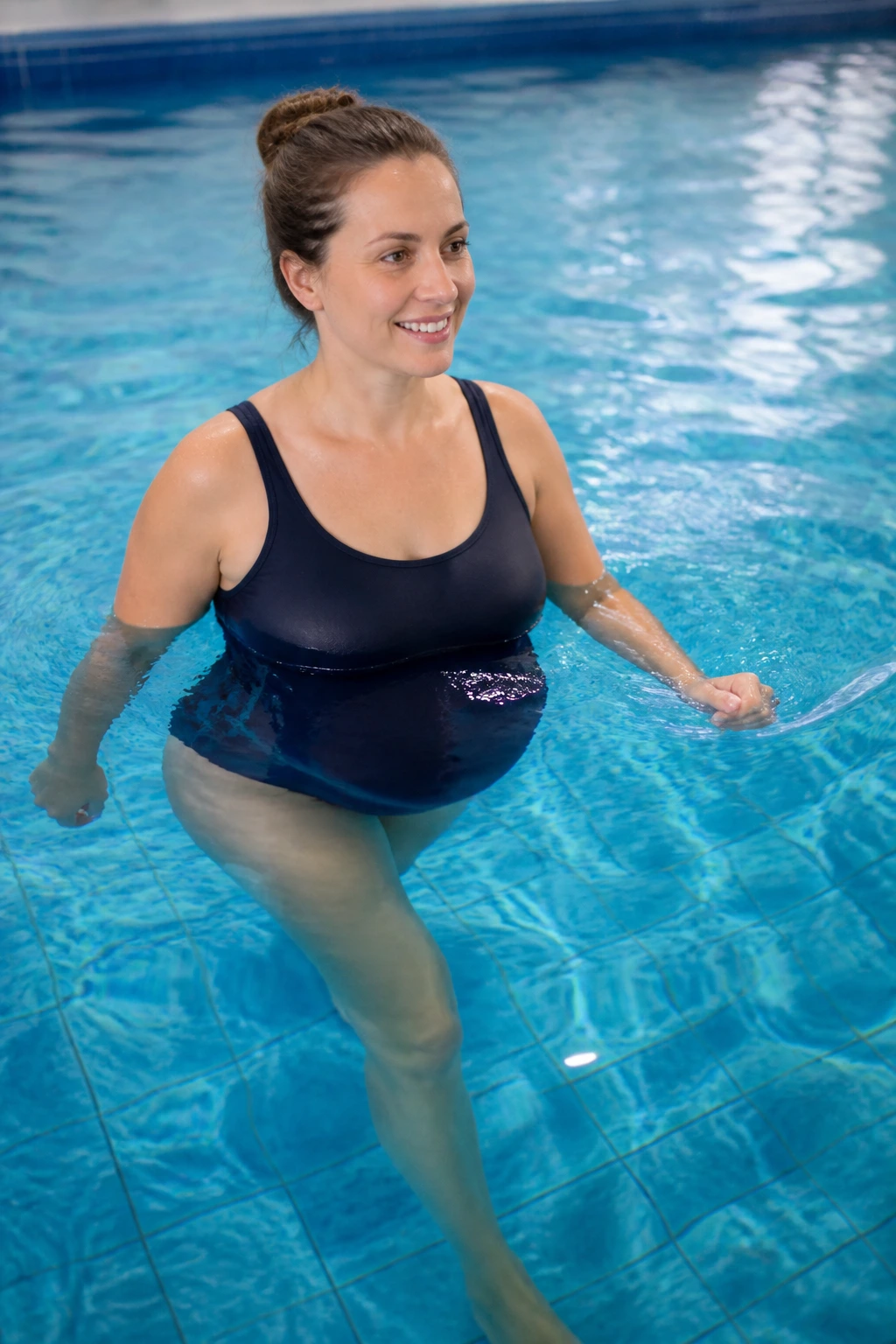
Why does water feel so good when everything else feels slightly off? Because it takes pressure off your joints, supports your weight, and cools you down without making you feel trapped in your own clothes.
Swimming and water walking work beautifully in the first trimester because the pool gives you movement without the usual pounding. That can be a relief if your breasts are tender, your hips are weirdly stiff, or your energy is hanging by a thread. A few easy laps, a water jog, or a steady aqua-walking session can all count.
What to do in the pool
- Swim easy freestyle or backstroke for 10 to 20 minutes.
- Walk laps in chest-deep water if you don’t feel like swimming.
- Keep your breathing calm and even.
- Drink water before and after; pool time still dehydrates you.
A lot of people underestimate how tiring pool exercise can be. Don’t. The resistance of water makes even gentle movement count.
How to use it
If you’re nauseated, stay upright and keep the session short. If you feel heavy or hot, take more breaks than you think you need. The water should leave you refreshed, not wrung out.
4. Prenatal Yoga Flow for Hips, Back, and Breath
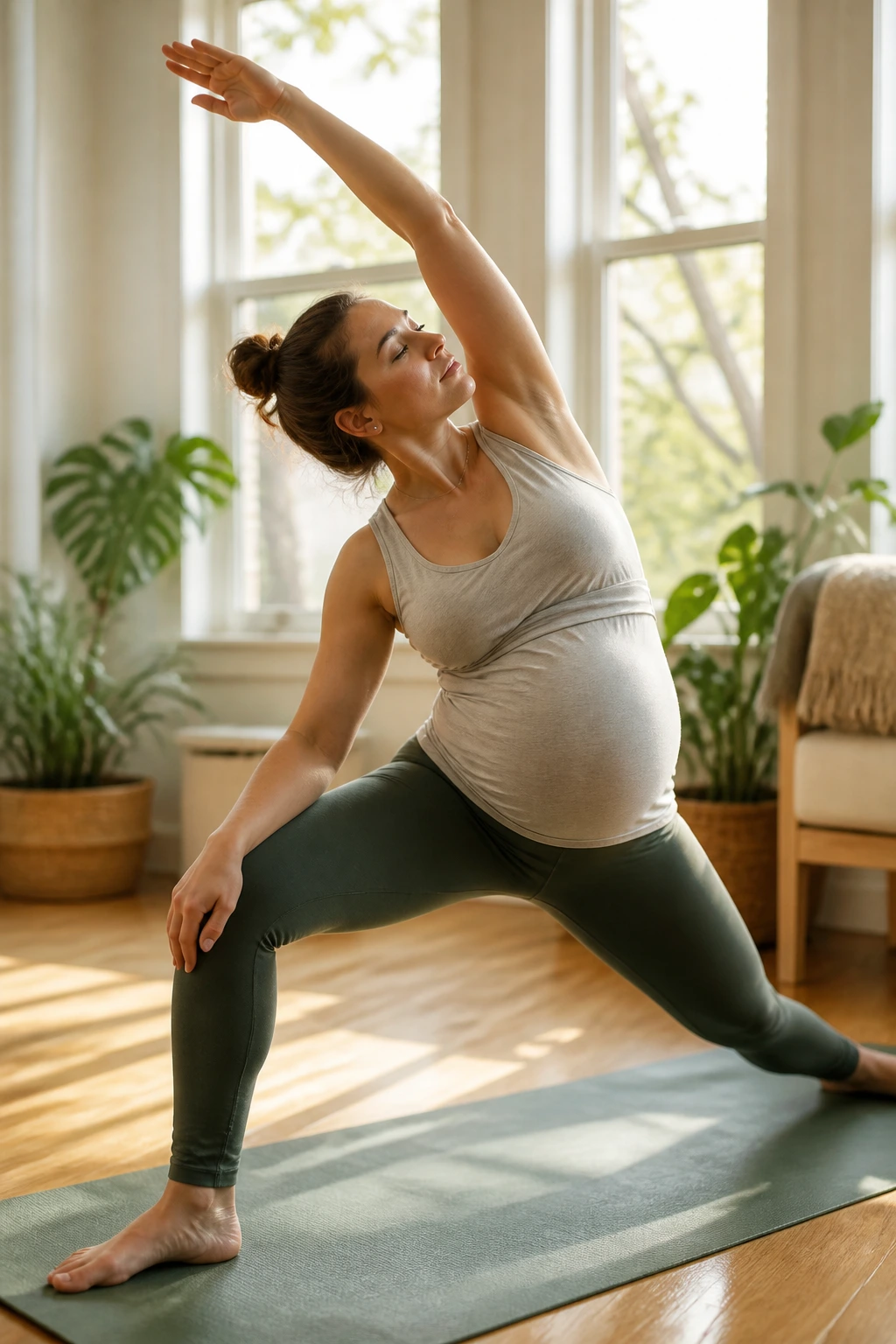
The best prenatal yoga in the first trimester is slow enough to feel like a reset, not a performance. You’re looking for room to breathe, room to move, and room to stop when a pose stops feeling good.
A good flow usually includes cat-cow, side-angle variations, supported warrior poses, and a wide-knee child’s pose if that’s comfortable. Gentle yoga can help with the tight lower back and the odd hip tension that shows up early, long before your bump is obvious. It can also be a sanity saver on days when your brain feels a little foggy.
Skip hot rooms. Skip long holds if they make you dizzy. And skip anything that asks you to twist hard through the belly or force your ribs into positions your body clearly dislikes. If a pose feels pinchy or causes pressure, that’s not a moral failure. It’s a cue.
I like yoga best as a low-stakes workout: 20 minutes, a mat, maybe a block, maybe a wall. No heroic posture. No need to nail anything. Just move, breathe, and leave the mat feeling a little more like yourself.
5. Sit-to-Stand Squats from a Chair
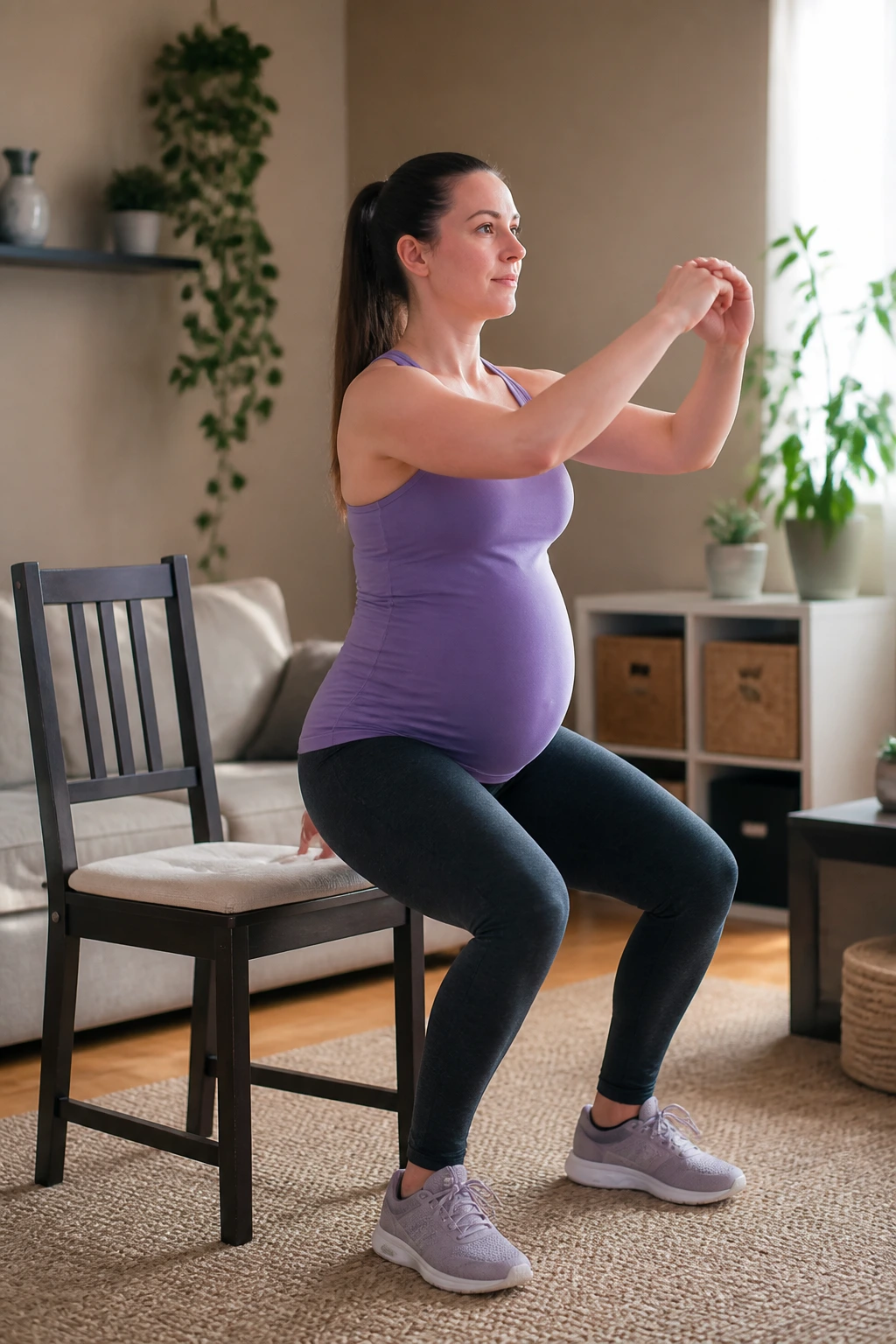
You know that moment when you stand up from a low chair and think, huh, my legs are not thrilled today? That is exactly when chair squats earn their keep.
Sit-to-stand squats are a simple strength move that trains your glutes, quads, and balance without needing a heavy load. They also mimic real life, which makes them sneaky useful. Getting off the couch, out of the car, up from a stool — all of that gets easier when you practice the motion on purpose.
A clean way to do them
- Stand in front of a sturdy chair with your feet about hip-width apart.
- Sit back slowly until you lightly touch the seat.
- Drive through your heels to stand back up.
- Stop if you feel pressure in your lower belly or if your knees cave inward.
Use 2 to 3 sets of 8 to 12 reps. If the full range feels too much, hover an inch above the chair and stand from there. That small change still counts.
Best cue: keep your chest proud, but not flared, and let your hips do the work.
6. Wall Push-Ups and Incline Presses for Upper-Body Strength
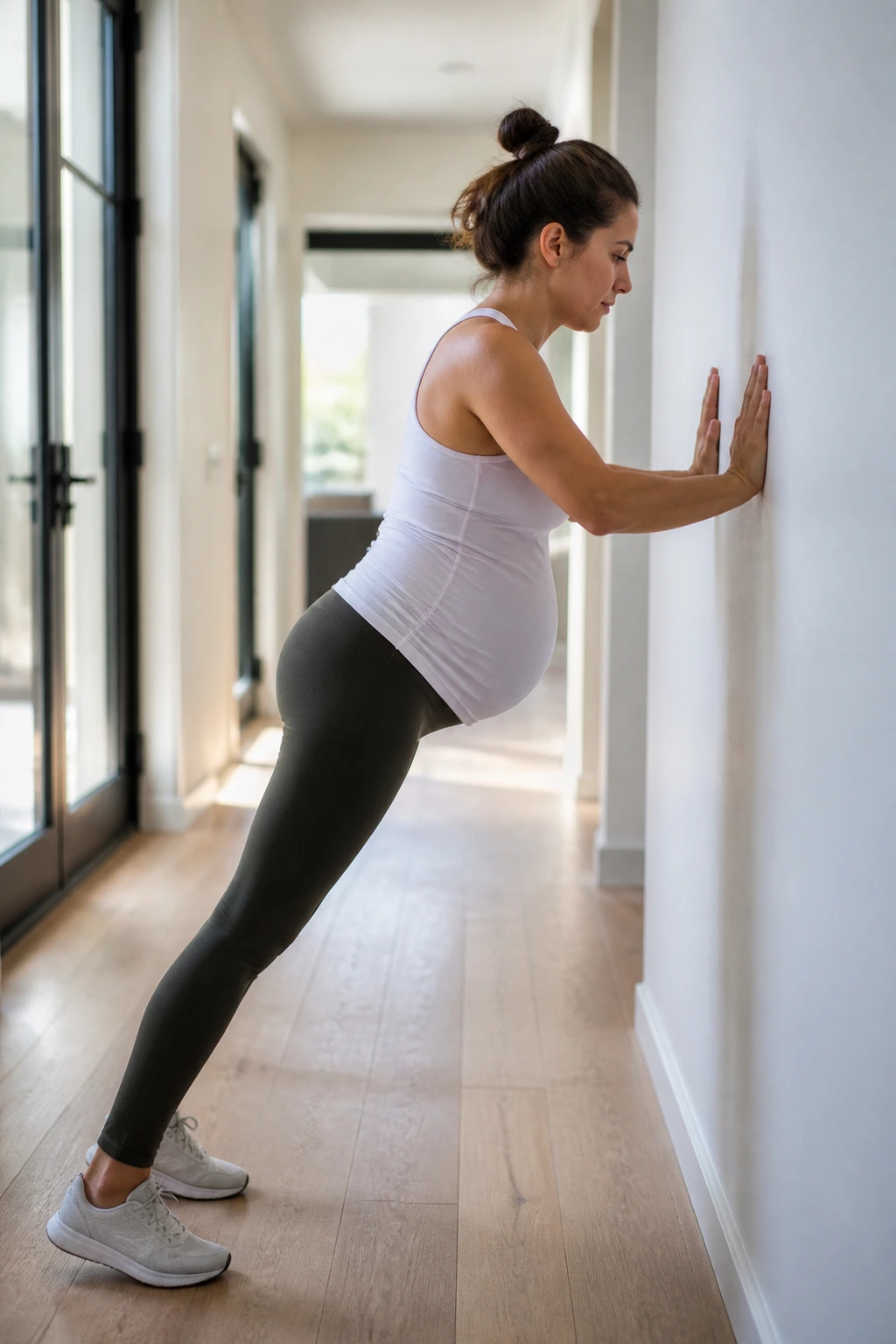
Floor push-ups are fine for some people, but in the first trimester I like the wall and the bench more. They let you train your chest, shoulders, and triceps without making the whole move feel like a contest.
The nice thing here is the angle. Wall push-ups are the easiest version, and incline push-ups on a counter or sturdy bench give you a little more load while still keeping the motion controlled. If your wrists are sensitive or your core feels extra guarded, the wall version often wins. If you want more challenge, step your feet farther back.
Try 2 sets of 6 to 12 reps, moving slowly enough that you feel control on the way down. Keep your elbows angled slightly back, not flared straight out. And don’t rush the return.
Unlike floor work, these versions are easy to stop and reset between reps. That matters on days when your breath feels short or your nausea shows up mid-session. A clean set of push-ups against a wall is better than a sloppy one on the floor. Every time.
7. Bird Dog Holds for Back Stability
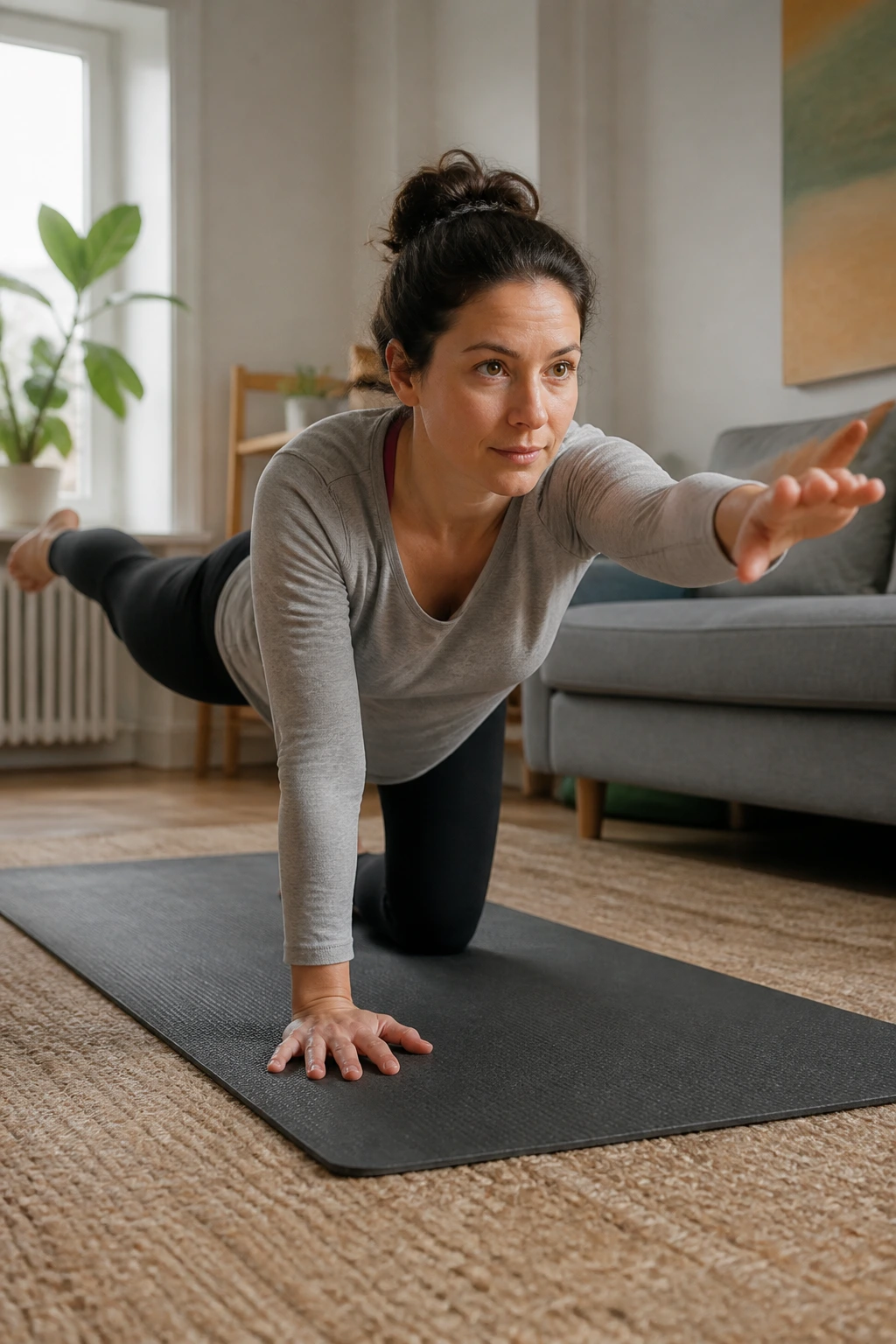
Bird dog looks small on paper. Then you try it, and your core suddenly has opinions.
This move is one of my favorite first-trimester stability drills because it trains the back of the body without crunching the abdomen or bouncing around. You’re working the glutes, spinal muscles, shoulders, and deep core at the same time, but the exercise still feels calm if you do it slowly. That calm matters.
What makes it work
- Get on hands and knees with wrists under shoulders and knees under hips.
- Extend one leg straight back while reaching the opposite arm forward.
- Hold for 3 to 5 seconds.
- Keep your hips level; do not let one side tip.
- Switch sides for 6 to 8 reps per side.
The trick is length, not height. Reach long, not high. If you lift the leg too much, you’ll arch your back and lose the point of the drill.
A soft mat helps, and so does moving on a slower exhale. If your wrists complain, put your hands on dumbbells or do the move from forearms. Small fixes. Big difference.
8. Low-Impact Dance Cardio in a Living Room Space
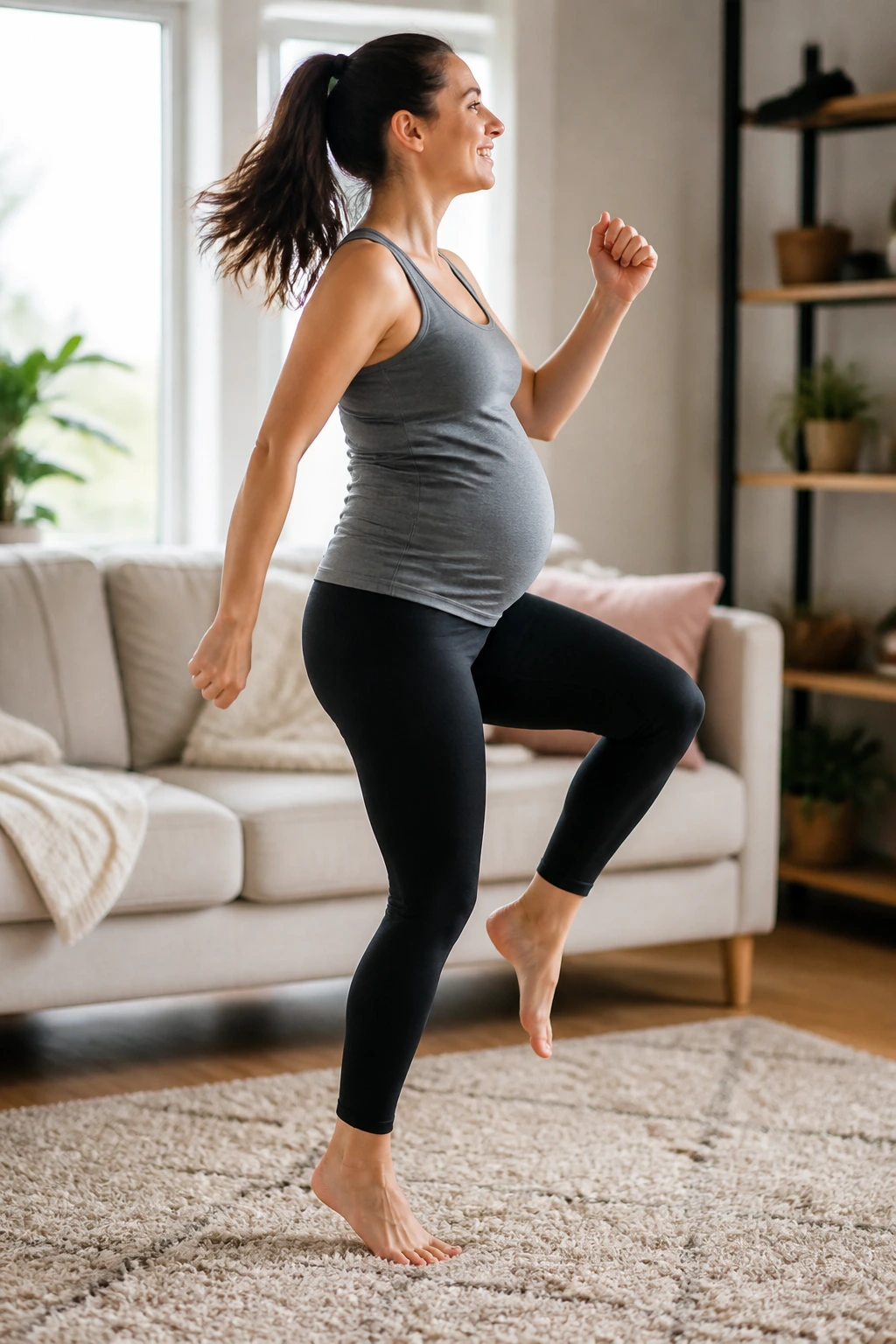
Dance cardio gets dismissed way too fast. If you keep the jumps out and the turns gentle, it’s one of the easiest ways to make cardio feel less like a chore and more like a decent song choice.
The best part is how adjustable it is. You can keep one foot on the floor at all times, trim the moves into side steps and marches, and stop between songs if you feel flushed. There’s no machine to set up and no one watching your face turn pink. That helps.
A solid session might be 15 to 20 minutes with a mix of marching, side steps, light arm reaches, and tiny knee lifts. Keep the room cool and wear a supportive bra. That sounds obvious, but a lot of first-trimester workouts become miserable because somebody ignored the bra issue. Don’t do that.
If you start feeling too bouncy, cut the range of motion in half. If you start getting breathless, move to a march in place until you’re back under control. The move is still working even when it looks modest.
9. Resistance Band Rows and Glute Work
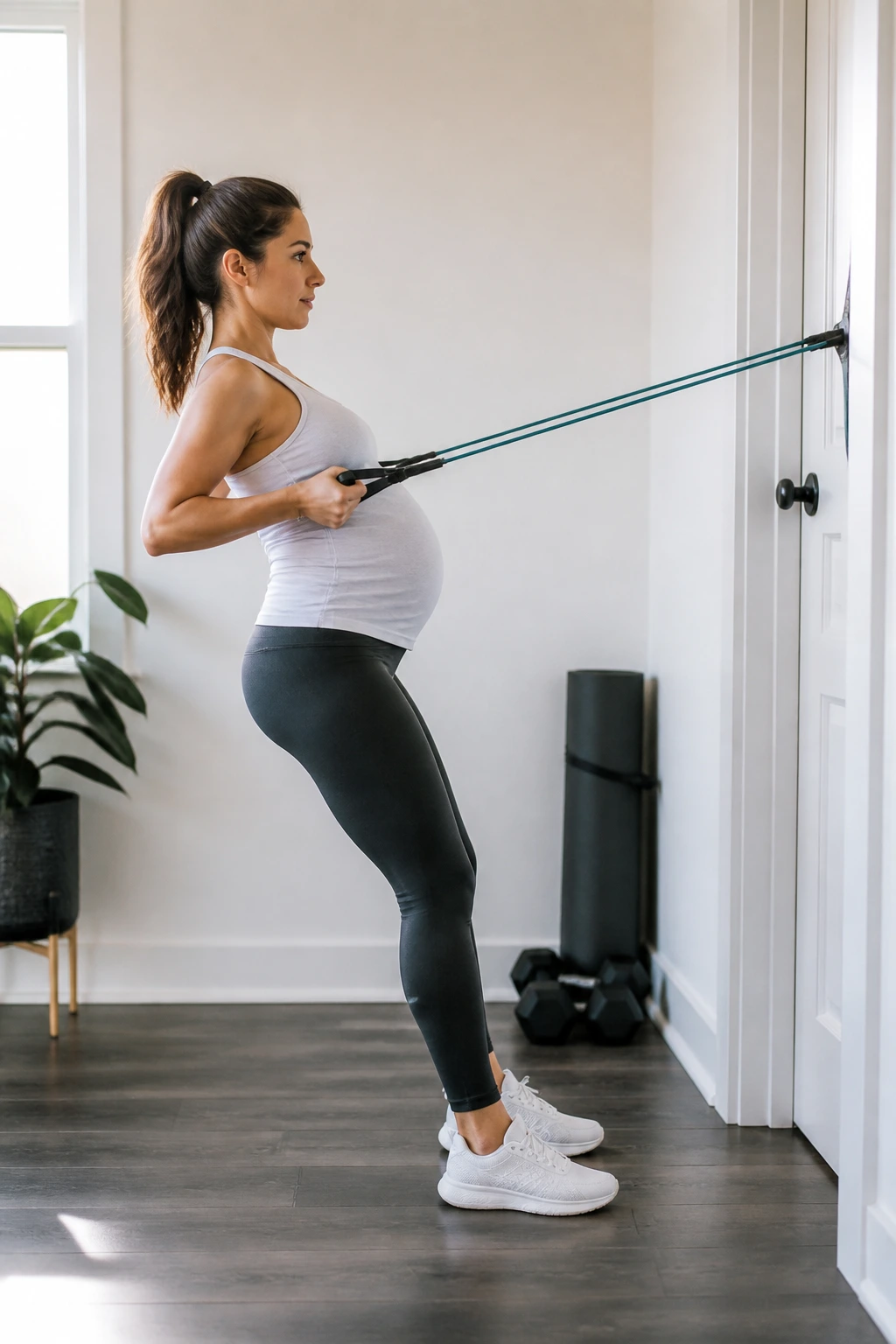
Bands are underrated. They’re cheap, quiet, easy to store, and they let you train without picking up weights that feel bigger than your energy level.
Rows are especially useful because posture changes fast in pregnancy. Even in the first trimester, some people notice a little more chest tightness or upper-back fatigue. Band rows help counter that. Add glute work — banded lateral steps, clamshells, or a light bridge if it feels good — and you’ve got a tidy lower-body session too.
A simple band setup
- Anchor the band at door height for rows.
- Pull elbows back until the band touches your ribs.
- Pause for 1 second at the back of each row.
- Try 2 to 3 sets of 10 to 15 reps.
- For lateral steps, keep the band above the knees and take 8 to 10 steps each way.
The thing to watch is sloppy tension. If the band is too loose, the exercise turns into a shrug. If it’s too tight, you’ll lean back and cheat. Aim for smooth resistance you can feel from the first rep to the last.
Good bands are boring in the best way. They work.
10. Pilates-Inspired Breathing and Core Control
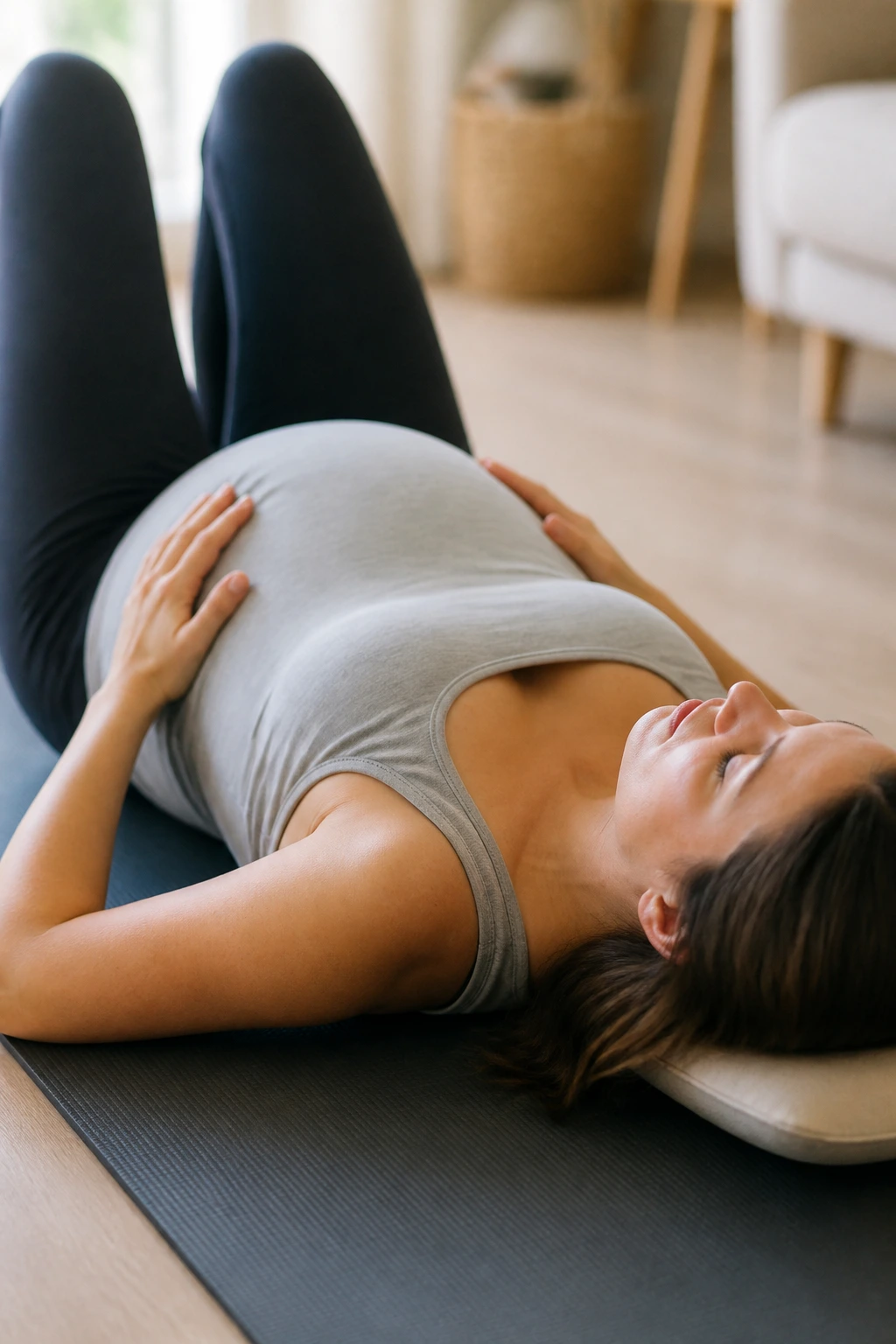
Can core work still belong in first trimester prenatal workouts? Yes — if you stop thinking about abs as something to punish and start treating them like support muscles.
Pilates-inspired work is about control, not strain. The best version here uses breathing, gentle spinal motion, and deep core engagement without crunching hard. Think heel slides, toe taps, pelvic tilts, and slow exhale work that lets the rib cage settle.
How to use it
Start on the floor or on a firm bed with knees bent. Inhale through the nose and let the belly and sides expand. Exhale and lightly draw the lower belly inward, as if you’re zipping up a jacket one notch at a time. That’s enough.
A few useful patterns:
- Pelvic tilts: 8 to 10 slow reps
- Heel slides: 6 to 8 per side
- Toe taps: 6 per side, only if they feel smooth
- Marching bridges: skip if they make you brace hard
The point is to teach your torso to organize itself under light load. If you feel doming, strain, or pressure, back off. Clean breathing beats fancy core moves every time.
11. Low Step-Ups on a Stable Platform
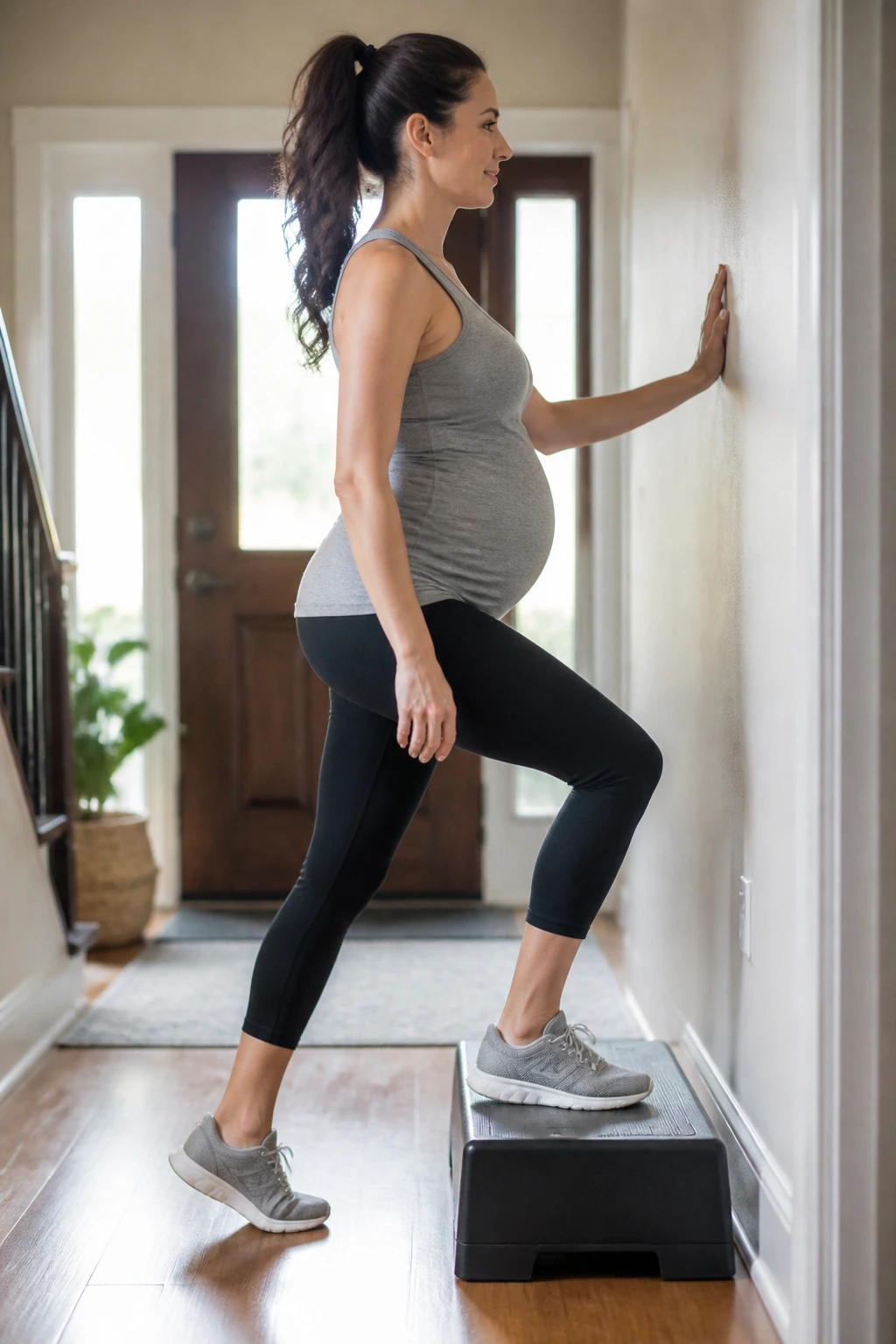
A low step-up looks almost too plain to matter. Then you do a few rounds and feel your thighs, glutes, and balance wake up in a very honest way.
The beauty of step-ups is that they mimic stairs without forcing you to climb a whole flight. That makes them a useful middle-ground workout for the first trimester, especially if walking alone no longer feels like enough. Use a step or sturdy platform around 4 to 8 inches high at first. Higher is not better here.
Keep one hand near a wall or rail if you’re even a little off-balance. Step up with control, stand tall on top, then lower with the same control. Try 2 sets of 8 to 10 reps per leg.
Don’t spring off the back leg. Let the front leg do the work. If you need to slow the whole thing down to a crawl, do it. That extra control makes the exercise safer and usually harder in the right way.
One clean step-up beats ten rushed ones.
12. Light Dumbbell Strength Circuit for Full-Body Maintenance
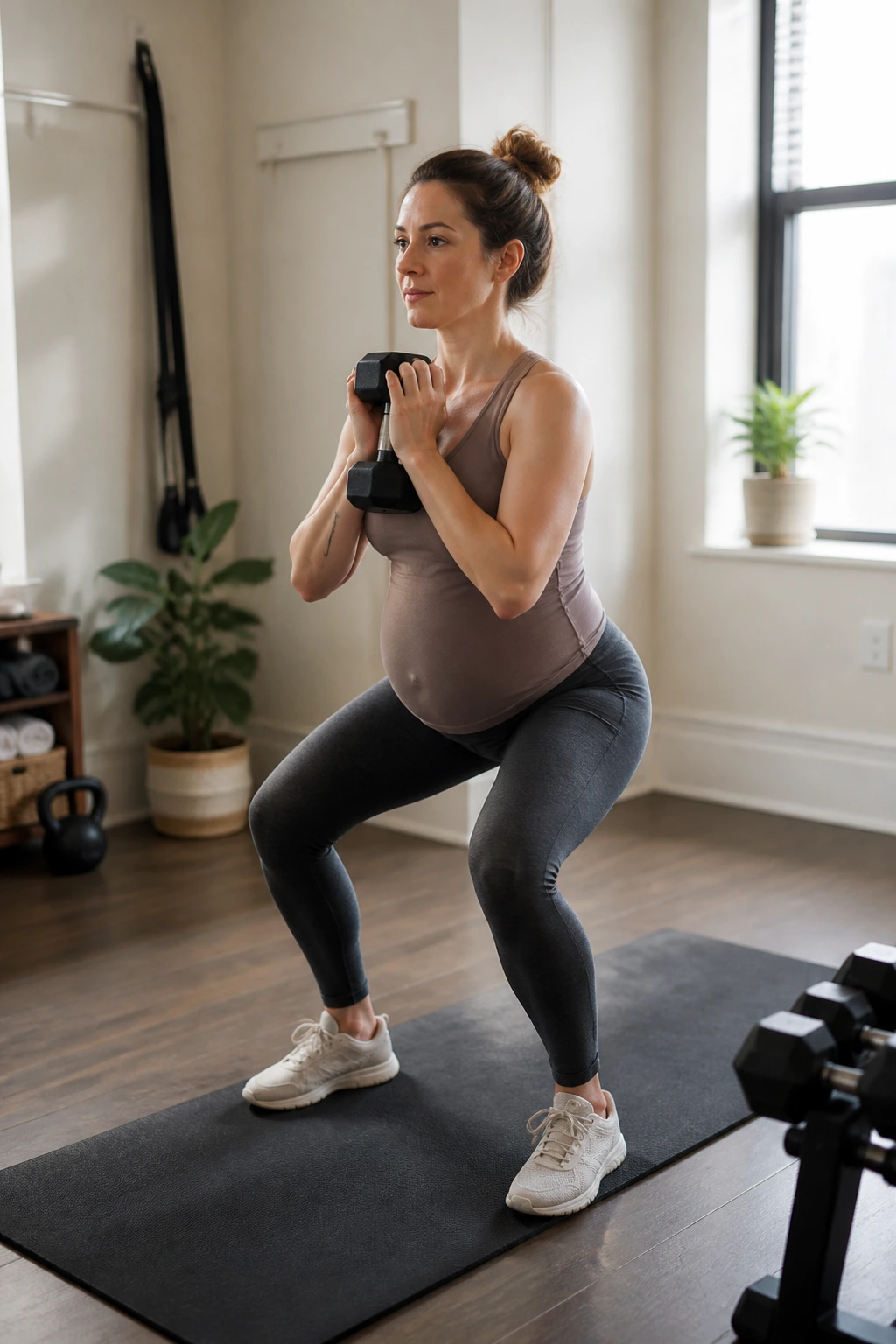
Strength training in the first trimester does not need to be dramatic. A couple of light dumbbells and a few sensible moves are enough to keep your muscles awake without turning the session into a grind.
What I like here is the balance. You can hit upper body, lower body, and posture in the same short circuit, which is useful on days when you want to get in and out. Think goblet squat to a box, one-arm row, overhead press with light weight, and a suitcase carry if your balance feels steady. Keep the load light enough that your face doesn’t turn into a grimace.
A practical setup
- Choose dumbbells you can lift for 8 to 10 controlled reps.
- Do 2 to 3 rounds.
- Rest 45 to 60 seconds between exercises.
- Stop before your form starts to wobble.
Unlike cardio, strength work gives you a different kind of payoff: posture, joint support, and an easier time carrying bags, laundry, or a toddler later on. Not glamorous. Very useful.
If overhead pressing makes you feel unstable, skip it and row again. There’s no prize for forcing a move that doesn’t suit the day.
13. Hip Mobility and Thoracic Rotation Flow
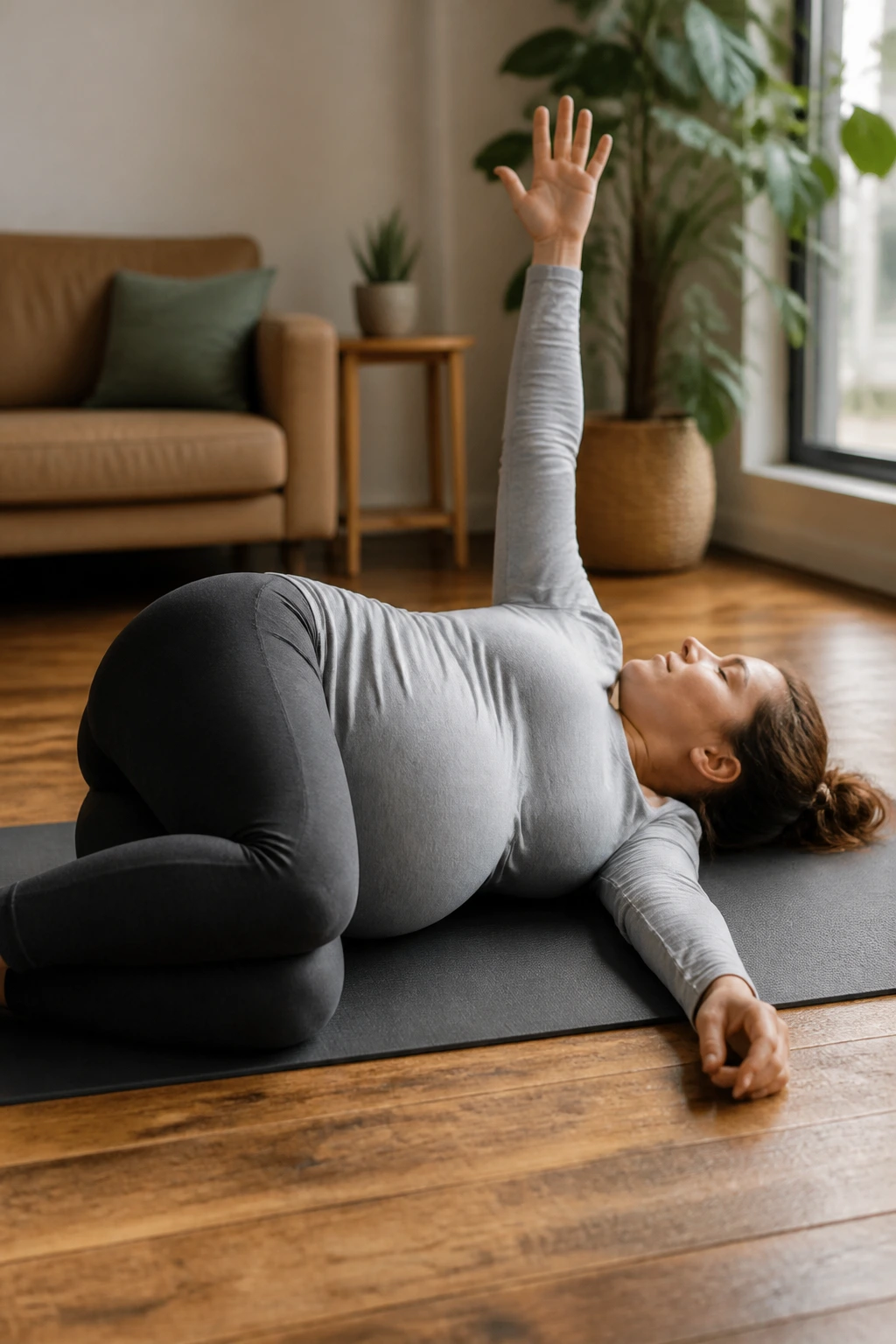
Your hips may not be carrying more weight yet, but they can still feel stubborn. Same for the upper back. Pregnancy changes your posture fast enough that mobility work is worth keeping close.
This is the section I’d hand to someone who wants a workout that feels like a clean reset. Keep the pace easy and move through 8 to 10 reps of each drill: cat-cow, open-book rotations, hip circles, and a gentle kneeling hip-flexor stretch. You don’t need to stretch to the edge of discomfort. In fact, you shouldn’t.
A few useful pieces
- Cat-cow: round and arch the spine slowly for 6 to 8 cycles.
- Open books: lie on your side and rotate your top arm open for 5 to 6 reps.
- Hip circles: hold a counter and circle one hip at a time.
- Half-kneeling stretch: keep it short, 20 to 30 seconds per side.
The goal is to feel looser when you stand up, not “fixed” forever. That’s fine. Mobility work behaves more like maintenance than magic, and maintenance has a place.
14. Elliptical Intervals for Easy Cardio Without Impact
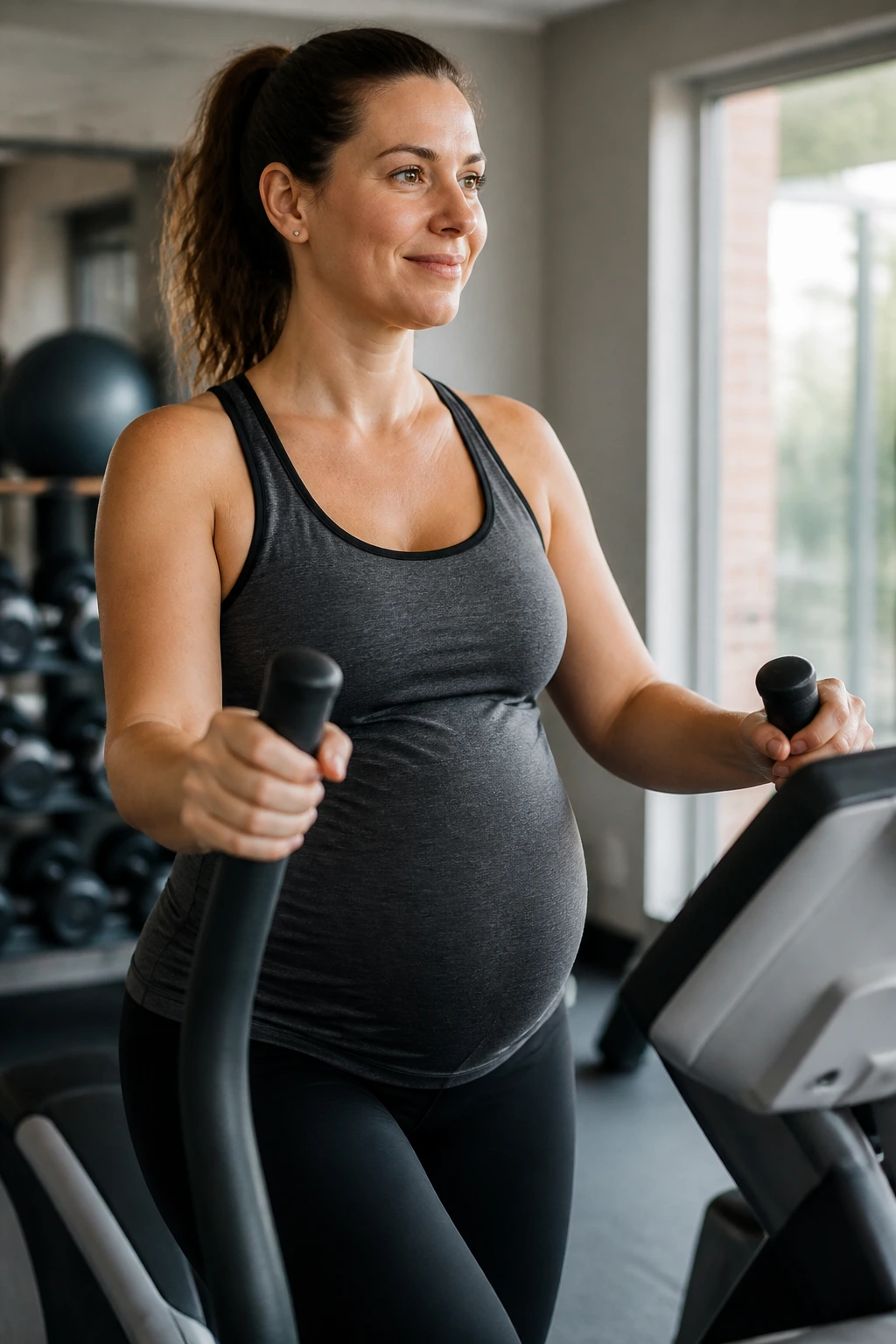
The elliptical is a funny machine. It looks plain, then it quietly hands you a decent cardio session without pounding your feet into the floor.
I like it for the first trimester because it gives a steady rhythm and lets you nudge the effort up or down fast. If you’re having a good energy day, intervals can keep the workout interesting. If you’re not, the machine still works at an easy pace. That flexibility is gold.
Try a simple pattern: 1 minute moderate, 2 minutes easy, repeated for 15 to 20 minutes. Keep your stride smooth and your shoulders relaxed. If you find yourself gripping the handles hard, you’re probably working a little too hard or hunching through fatigue.
A small resistance bump is enough. You do not need to turn this into a sweat bath. The sweet spot is finishing with a little more color in your cheeks and no urge to sit on the gym floor.
That’s the kind of cardio I trust.
15. Gentle Stair Climbing for a Short, Sharp Dose of Work
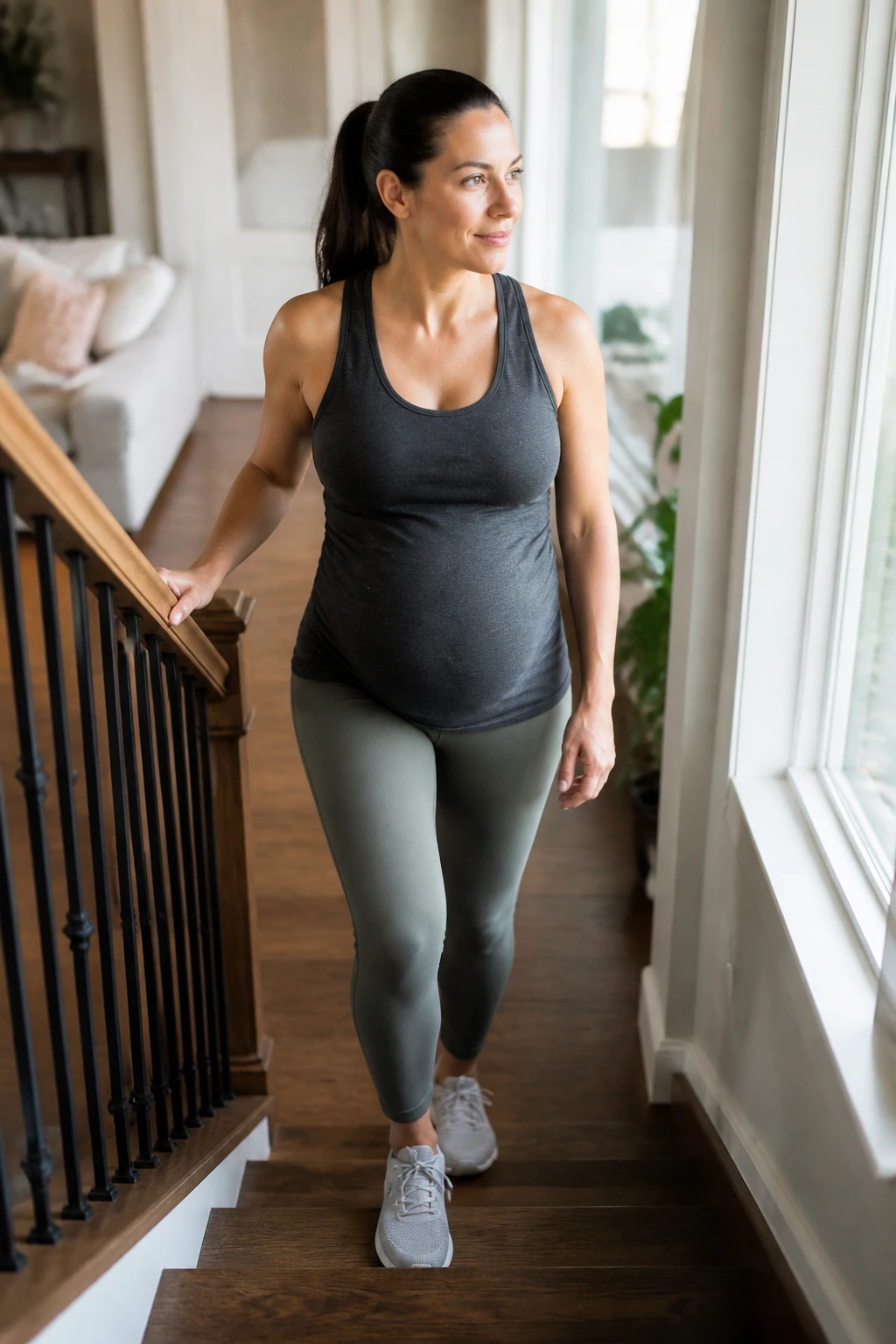
Do stairs count as a workout? Absolutely. But only when you treat them like a controlled drill, not a competition with your own legs.
Stair climbing is useful in the first trimester if you already handle it well and your balance feels steady. It gets your heart rate up faster than flat walking, and your glutes and calves will notice the change right away. The key is staying calm. Hold the rail lightly, keep your eyes on the steps, and climb at a pace where you could still answer a question without panting.
A few flights can be enough. So can a 5 to 10 minute stair session broken into short climbs with rest between rounds. If you feel dizzy at the top, stop and breathe. That’s your cue, not a challenge to “push past.”
I would not choose stair sprints here. They’re clunky, sharp, and more likely to spike breathlessness than deliver anything useful. Steady climbing is the better tool.
16. Pelvic Floor Contractions and Full Relaxation Drills

Pelvic floor work gets talked about as if it’s one tiny squeeze and done. That’s incomplete, and frankly annoying.
The pelvic floor is not only about tightening. It also needs to relax, lengthen, and coordinate with your breath. In the first trimester, that matters because your core system is already adjusting to hormonal changes, and a clamped-down pelvic floor can make everything feel tighter than it needs to.
A balanced way to practice
- Inhale and let the pelvic floor soften.
- Exhale and gently lift, as if stopping gas.
- Hold for 3 to 5 seconds.
- Relax completely for the same amount of time.
- Repeat 5 to 10 times.
Then add a few quick squeezes — not frantic, just crisp. Five is enough to start. If you’re tucking your butt, holding your breath, or tightening your thighs hard, you’re overdoing it.
The relaxation part matters as much as the contraction. Maybe more. A lot of people skip straight to endless Kegels and wonder why things feel tight. There’s your answer.
17. Easy Hiking on Flat, Stable Trails

A trail walk can feel like a real outing without becoming a real ordeal. That’s the sweet spot.
Hiking works well in the first trimester if you keep the route simple: packed dirt, modest hills, stable footing, and an exit plan. Fresh air helps some people with nausea, and a change of scenery can make movement feel less like exercise and more like a proper break. Just don’t let the pretty view trick you into a route that’s too remote, steep, or rocky.
Bring water, a snack, and shoes with actual grip. If you tend to get woozy, choose a trail with rest benches or a turn-around point every 10 to 15 minutes. A walk that ends with a headache is too much walk.
I’ve always thought hiking is best when it feels like a conversation, not a test. You should be able to slow down, take a sip, and keep going without drama. If the trail starts demanding more than that, pick a flatter one next time.
18. Rowing Machine Sessions at a Comfortable Stroke Rate
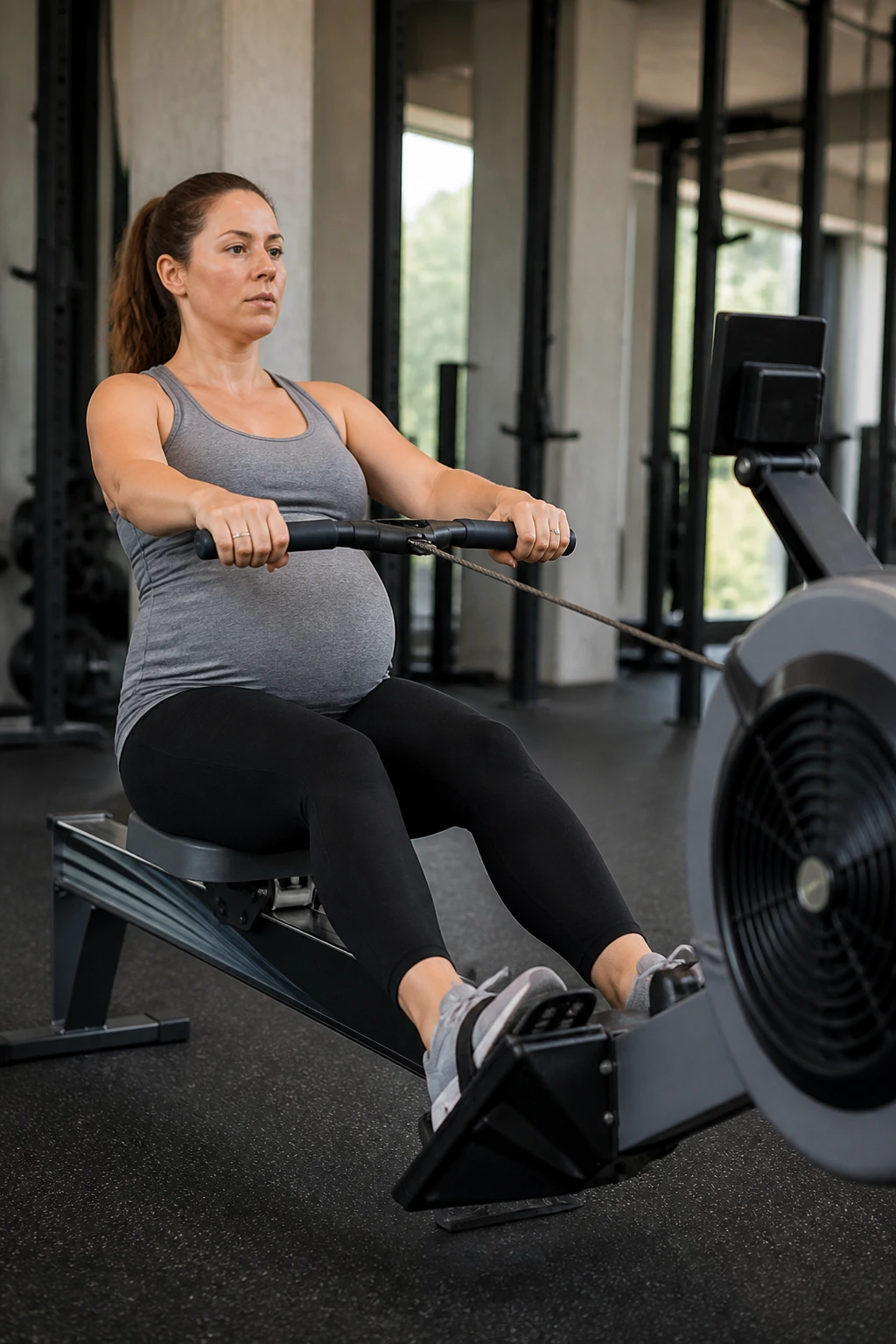
The rower is a bit divisive. Some people love it, some people never quite warm up to it, and some people discover it only works when they keep the resistance lower than their ego wants.
Used well, though, it can be a smart first-trimester workout. It gives you cardio, leg drive, and upper-back work in one machine. The catch is posture. If you slump or yank with the arms too early, the stroke gets sloppy fast. So keep the damper modest — around 3 to 5 for most people — and focus on smooth motion.
Aim for 18 to 22 strokes per minute for a steady session. Push through the legs first, then swing the torso, then finish with the arms. Reverse that on the way back. If the seated position starts feeling odd or your belly feels compressed, stop. No machine is worth fighting your body over.
Rowing is best for people who already know the machine and like a rhythm-based cardio session. If you’ve never used one before, this is not the moment for a technical deep dive.
19. Recovery Stretching and Down-Regulation on the Floor or Couch
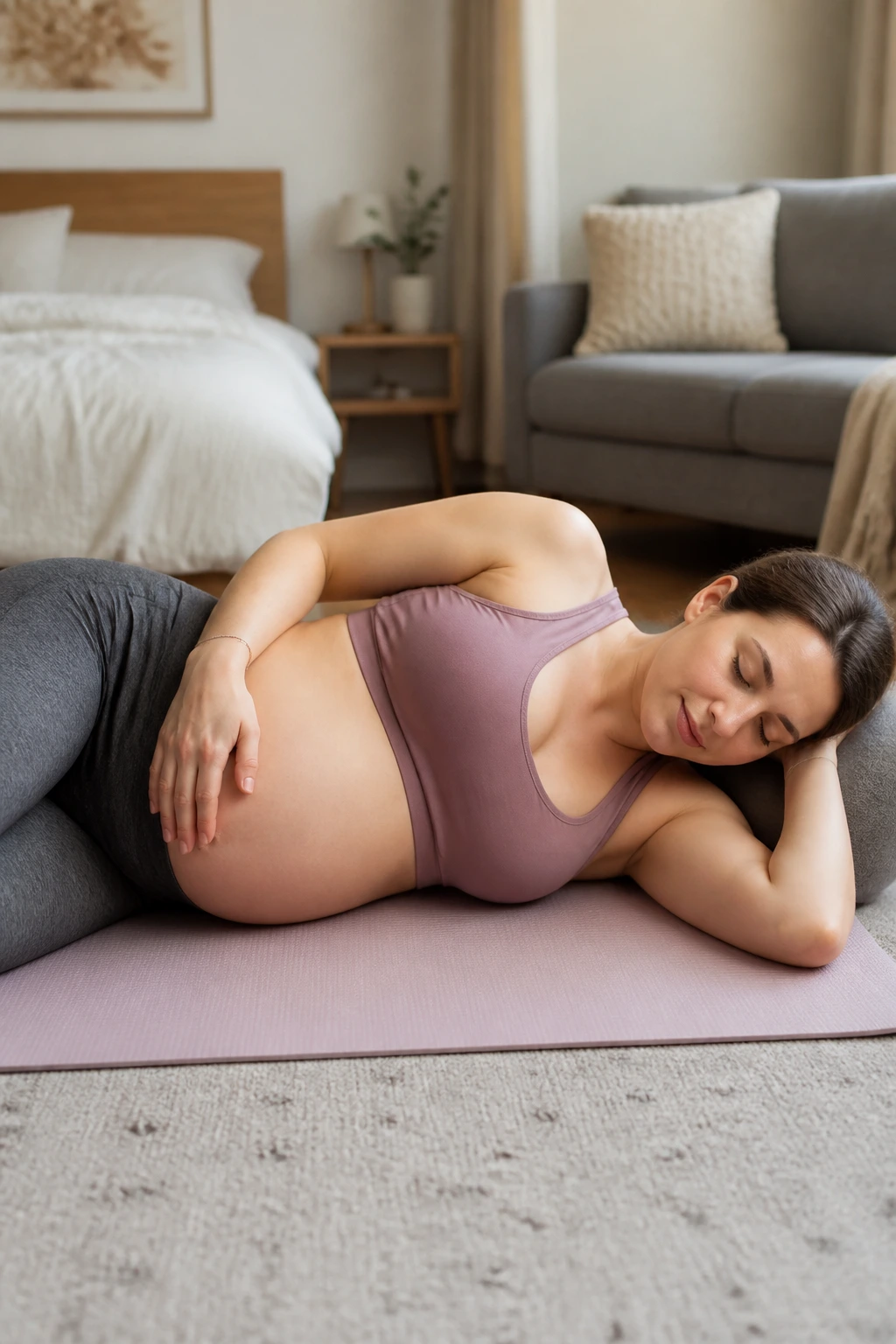
Recovery counts. I know that sounds soft, but it’s true.
A short stretching session can be a workout in the best sense: the kind that brings your nervous system down a notch and leaves your body feeling less knotted. First trimester fatigue can be sneaky, and sometimes the most useful thing you can do is slow the whole system down on purpose. Five to fifteen minutes is enough.
A simple recovery sequence
- Calf stretch at a wall, 20 seconds per side
- Chest stretch on a doorway, 20 seconds per side
- Seated figure-four stretch, if it feels good
- Side-lying breathing with one hand on the ribs
- Gentle neck rolls, tiny ones, not dramatic circles
I like this kind of session after a walk, after a swim, or right before bed. Keep the room cool, the lights low, and the stretch mild. You’re not trying to become flexible in one evening. You’re just telling your body it can unclench.
That message matters more than people admit.
20. The Mixed Mini-Circuit for Days You Want One Simple Plan
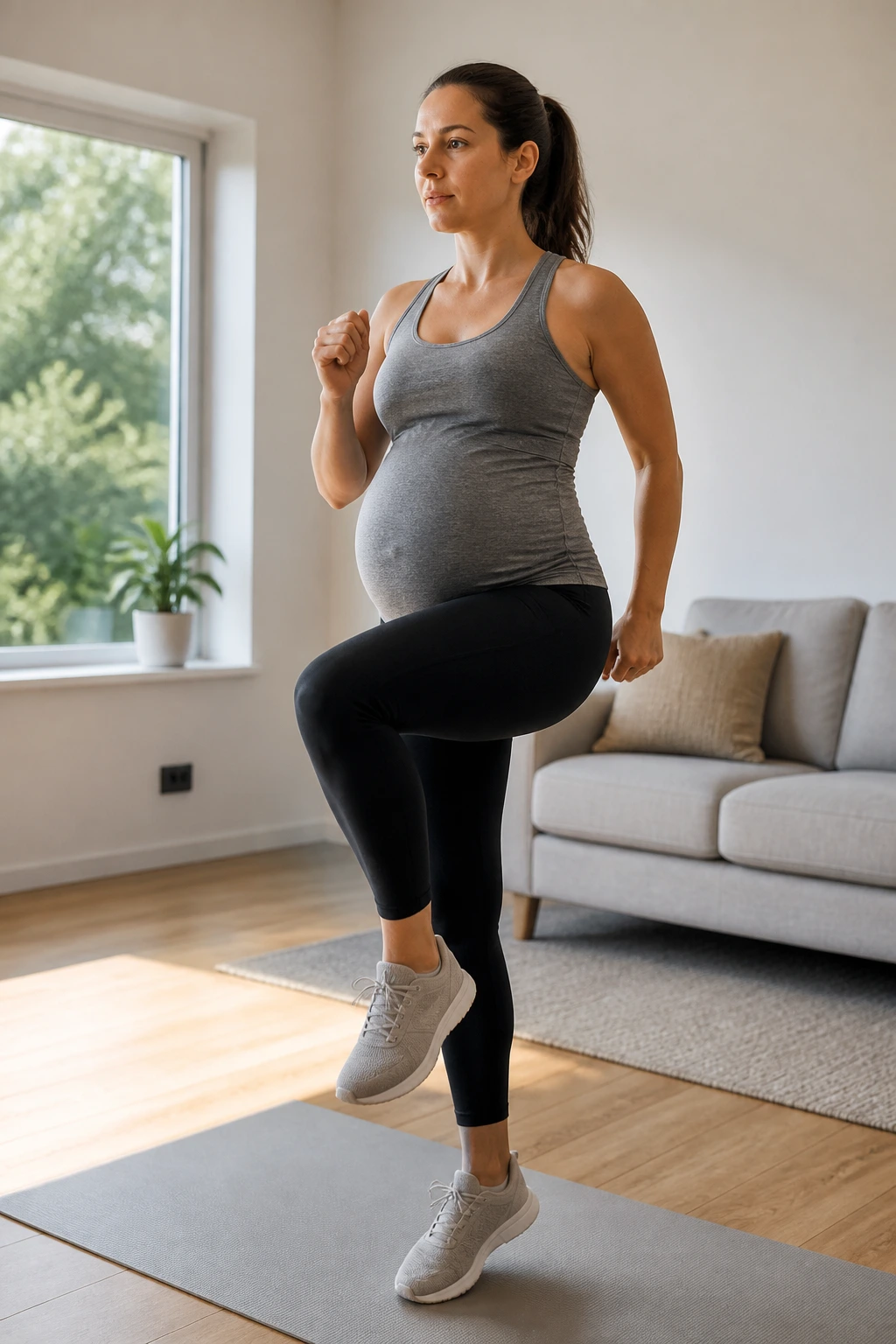
If you want one first-trimester routine that covers the basics without a lot of thinking, this is the one I’d keep handy. It’s short, balanced, and easy to scale up or down depending on whether you woke up human or a little wrecked.
Use 3 rounds of the following:
- 30 seconds marching in place
- 8 chair squats
- 10 band rows
- 6 wall push-ups
- 8 side steps each way
- 30 seconds of easy breathing
Rest for 30 to 60 seconds between rounds. If that feels like too much, cut it to 2 rounds. If it feels too easy and your clinician has said exercise is fine for you, add a round or lengthen the marching to 45 seconds. Keep the effort moderate, and keep the room cool.
This little circuit works because it doesn’t lean too hard on any one system. You get cardio, legs, posture, and core coordination without the workout becoming a circus. Nice and plain. The way first-trimester training often needs to be.
If you save one rule from all this, save this one: finish feeling steadier, not flattened. That’s the kind of training that tends to hold up across the whole first trimester, even on the messy days.
