



The easiest home cardio workouts for beginner women are the ones that do not look dramatic. No jumping. No complicated choreography. No floor work that leaves your wrists annoyed and your sweat dripping in places you did not plan for.
That matters more than people admit. A workout that fits your space, your knees, and your mood is the one you’ll actually repeat, and repetition is where cardio starts to change how stairs feel, how errands feel, and how your body feels halfway through a long day.
If you like a simple target, aim for a pace where you can speak in short sentences and feel your breathing working a little harder. A 4 to 6 out of 10 effort is plenty for most beginner sessions, and you can always build from there.
These 20 home cardio workouts for beginner women stay low on equipment and high on practicality. Some are quiet enough for an apartment, some get sweaty fast, and a few are perfect when you only have 5 minutes before the coffee gets cold. Start with the move that feels almost too easy. That’s usually the one that sticks.
1. March-and-Swing Warm-Up
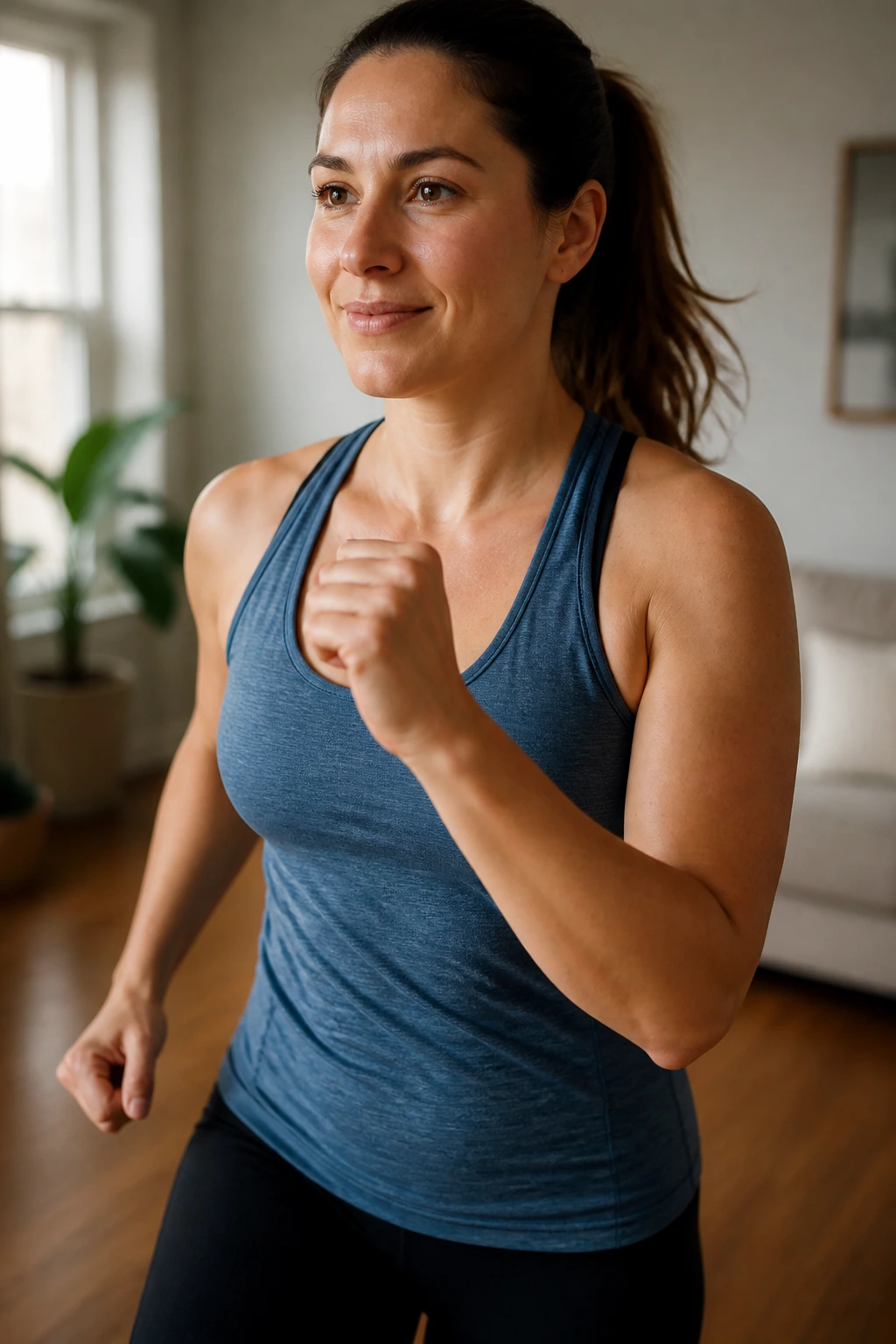
Marching looks plain. It isn’t wasted time.
A good cardio session often starts with a movement that wakes up ankles, hips, and shoulders together, and marching does that without asking much from your joints. Add a loose arm swing and the whole body starts to wake up.
How to keep it light
- March in place for 30 to 60 seconds.
- Swing both arms at hip height, then a little higher if your shoulders feel fine.
- Stay tall through the crown of your head.
- Breathe through your nose for the first 20 seconds if that feels natural.
Use it as a 3-minute warm-up or stretch it into 5 to 8 minutes when you want a quiet standalone session. Soft knees and relaxed shoulders matter more than speed here. If you rush this one, it stops feeling like a warm-up and starts feeling like a sloppy stomp.
2. Side-Step Reach Combo
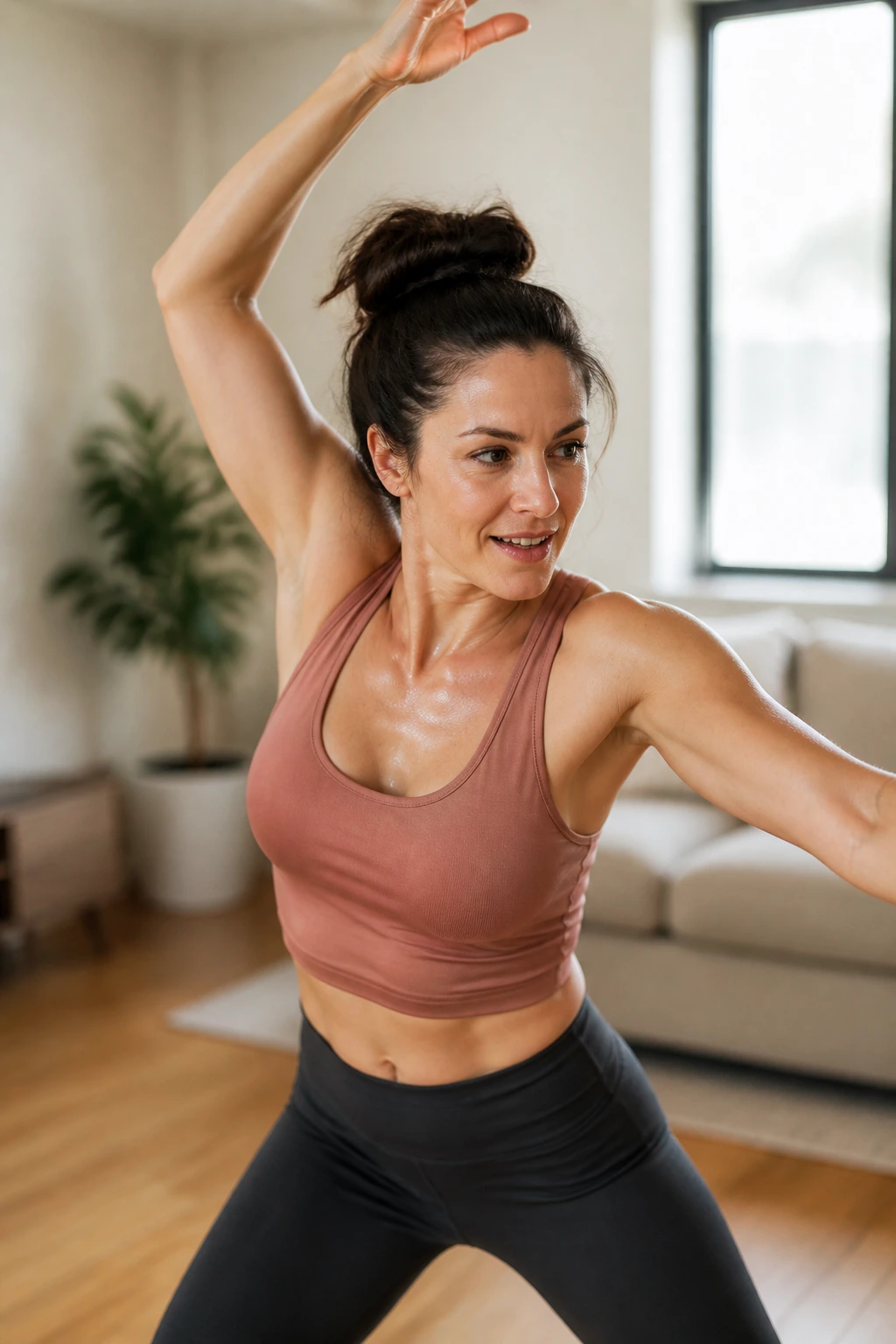
Why do side steps feel so manageable? Because your feet are moving in a pattern most people already know from everyday life.
Step right, bring the left foot in, and reach both hands overhead or out to the side. Then go left. That’s the whole idea, and it works because the body likes rhythm more than it likes punishment. Smooth beats fast.
A clean tempo here is 30 seconds on, 15 seconds easy, repeated for 6 to 8 rounds. Keep your feet a little wider than hip-width so the hips actually have room to move. If the step gets tiny, the workout turns into a shuffle and your heart rate barely budges.
The best version has a soft landing. You should hear your feet, not feel them slam the floor.
3. Low-Impact Jack Rounds
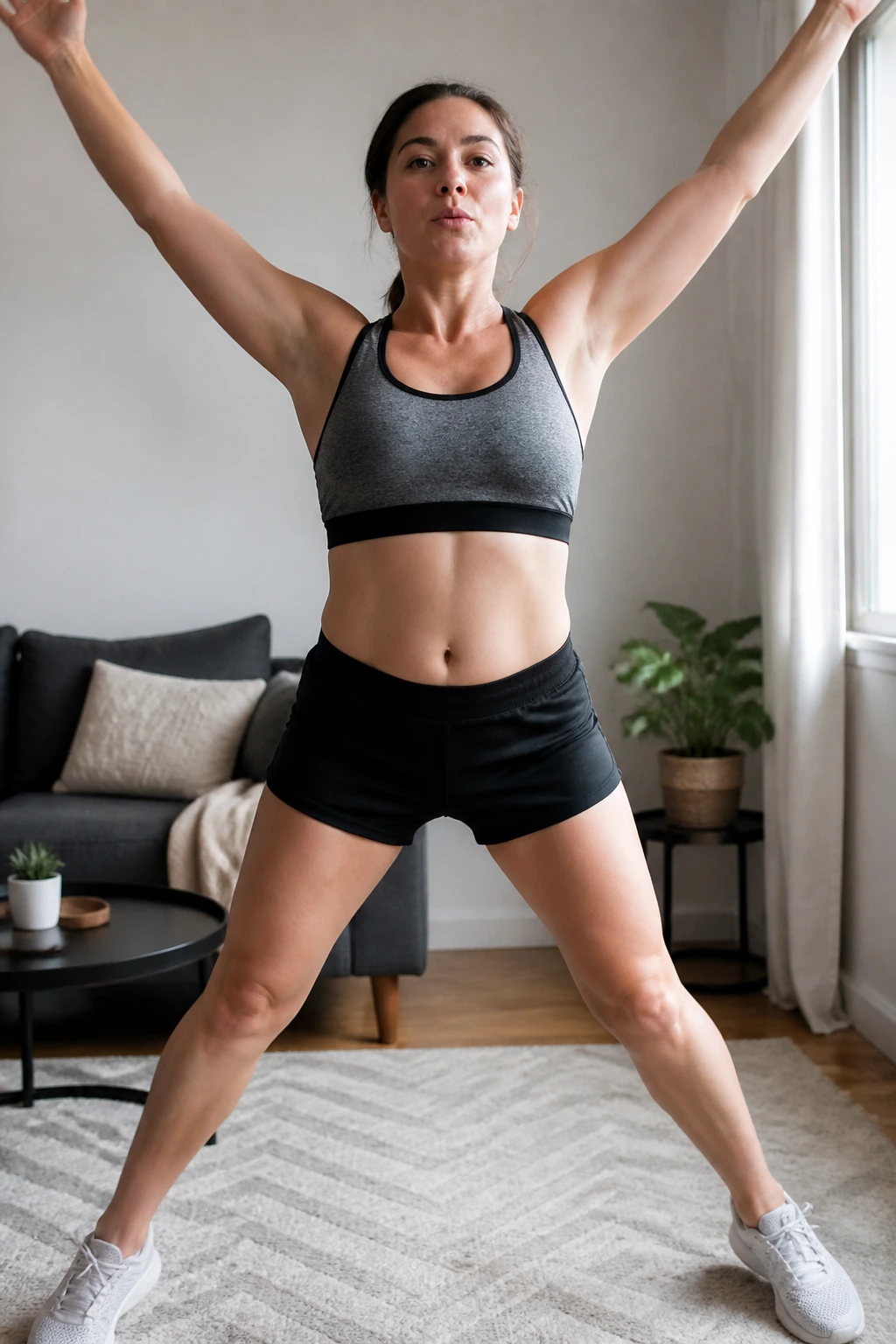
You do not need to jump to get a jack-style cardio burst.
Step one foot out at a time while your hands sweep overhead, then step back in. That single change — one foot at a time instead of both feet together — makes the move friendlier for beginners, apartment floors, and knees that prefer gentle work.
The quiet version
- Step right foot out as both hands rise.
- Step left foot out, then return right, then left.
- Keep your knees bent softly.
- Use 20 seconds on, 10 seconds off for 8 rounds.
This one feels almost too easy for the first 15 seconds, and then your breathing catches up. That’s normal. The arms do real work here, especially if you keep them moving all the way overhead instead of stopping at shoulder height.
If jumping jacks have always felt like a hard no, start here. It scratches the same itch without the noise.
4. Shadow Boxing Intervals

If you’ve ever thrown a few air punches after a stressful day, you already know the basic shape of this workout.
Shadow boxing is one of the best home cardio workouts for beginner women because it feels a little fierce without being complicated. You stand in place, keep your fists near your chin, and punch forward in short, snappy bursts. The trick is not swinging wildly. The trick is staying controlled.
Try 45 seconds of boxing, 30 seconds of easy marching, repeated for 4 to 6 rounds. Start with a jab-cross, then add a hook if your shoulders still feel loose. Keep your elbows bent and your chin tucked.
- Jab, cross, reset.
- Jab, cross, hook, reset.
- March lightly between rounds.
Your power should come from the rotation in your torso, not from flinging your shoulders around. That’s the part most beginners miss, and once you feel it, the whole move gets more satisfying.
5. Alternating Knee-Lift Marches
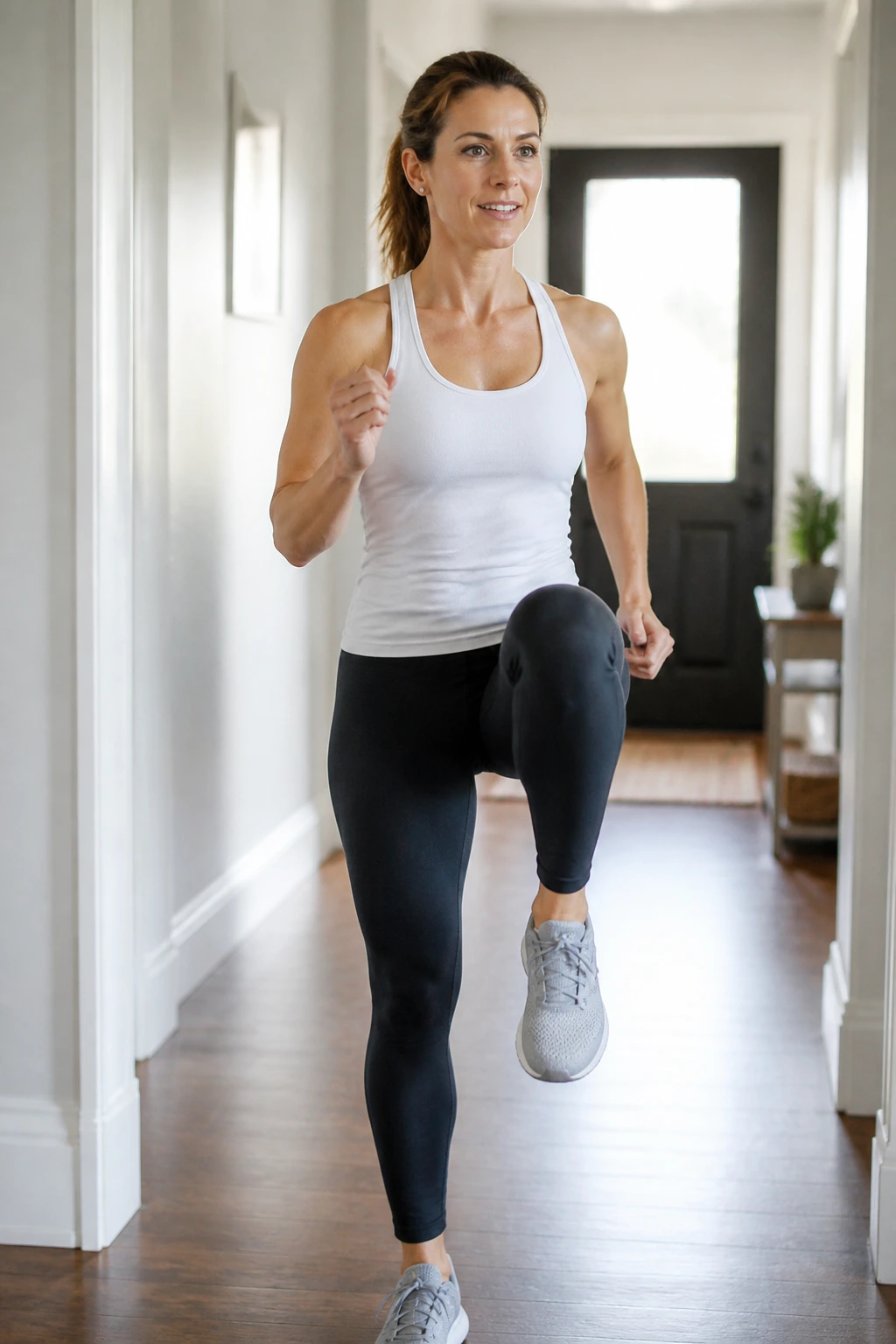
Unlike fast feet, knee lifts give you a clear target. That makes them a smart pick when balance feels a little shaky or you want cardio that stays neat and upright.
Lift one knee toward hip height, lower it, then switch sides while your arms pump naturally. You can make this as gentle or as lively as you want. A small knee lift still counts. A higher lift just asks more from your core and hip flexors.
A useful starting block is 30 seconds of knee lifts, 15 seconds of easy marching, repeated 6 times. Keep the standing leg soft so you are not locking the knee. If your lower back feels pinchy, lower the knee height and slow the pace.
Tall posture matters here. If you start leaning back to haul the knee up, the move loses its shape and your abs stop helping. Stay stacked, breathe steadily, and let the rhythm do the heavy lifting.
6. Stair Climb Bursts
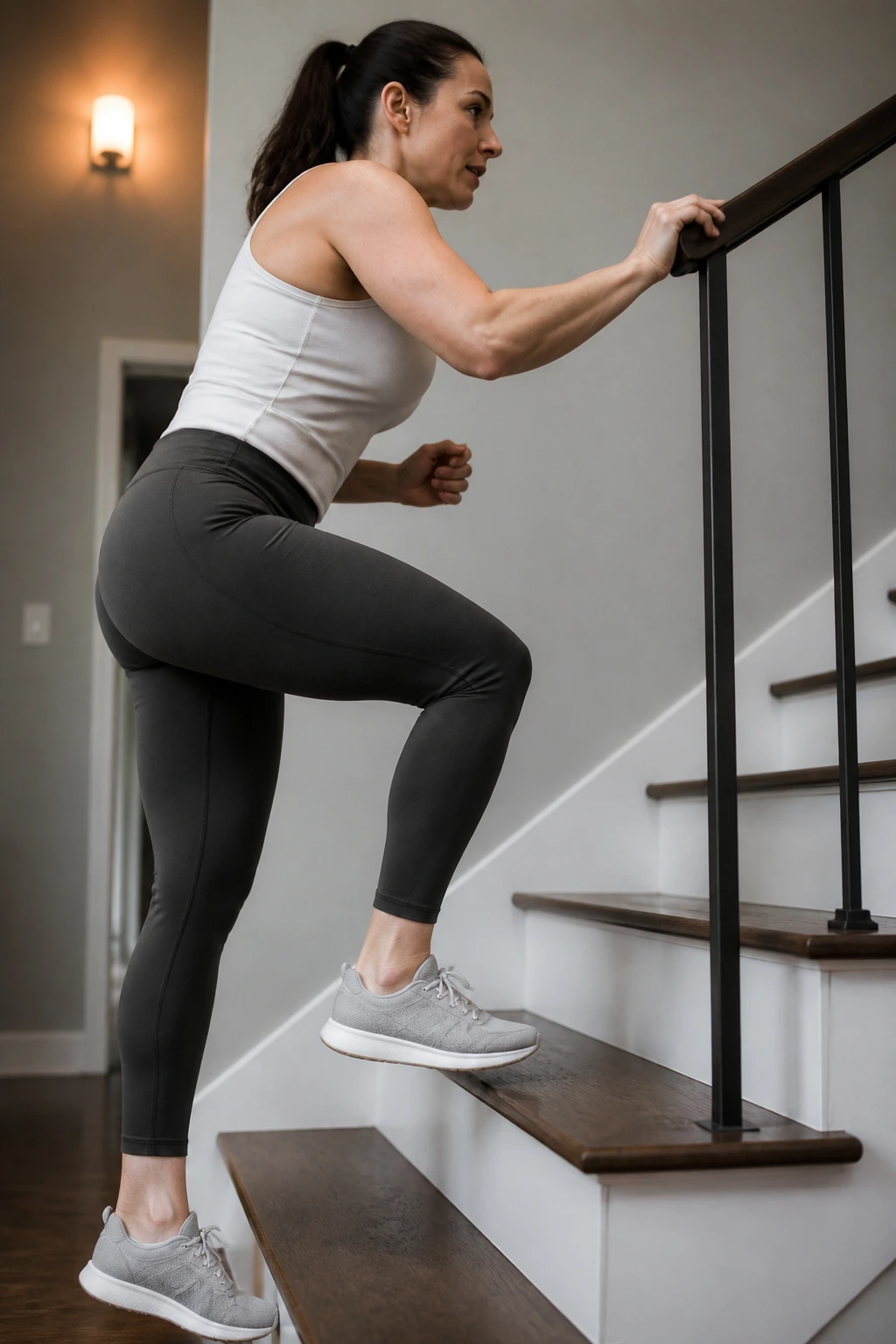
A staircase is cardio with a handrail.
If your home has a few steps, you have a built-in interval machine. Climbing stairs raises the heart rate quickly because it asks your legs to push against gravity, and that work shows up fast. The nice part is that you can control the dose with almost ridiculous precision.
Start with 20 to 30 seconds up, then walk down slowly and recover for 30 to 45 seconds. Repeat for 6 to 10 climbs, depending on how your legs feel. Hold the rail lightly if balance is even a little uncertain. One step at a time is perfectly fine.
What safe looks like
- Keep your whole foot on each step.
- Don’t rush the descent.
- Stop if your knees feel sharp, not just tired.
- Short climbs beat sloppy ones.
The first few times, it may feel like your thighs light on fire before you expect them to. That’s normal. It also means the workout is doing its job.
7. Chair-March Cardio
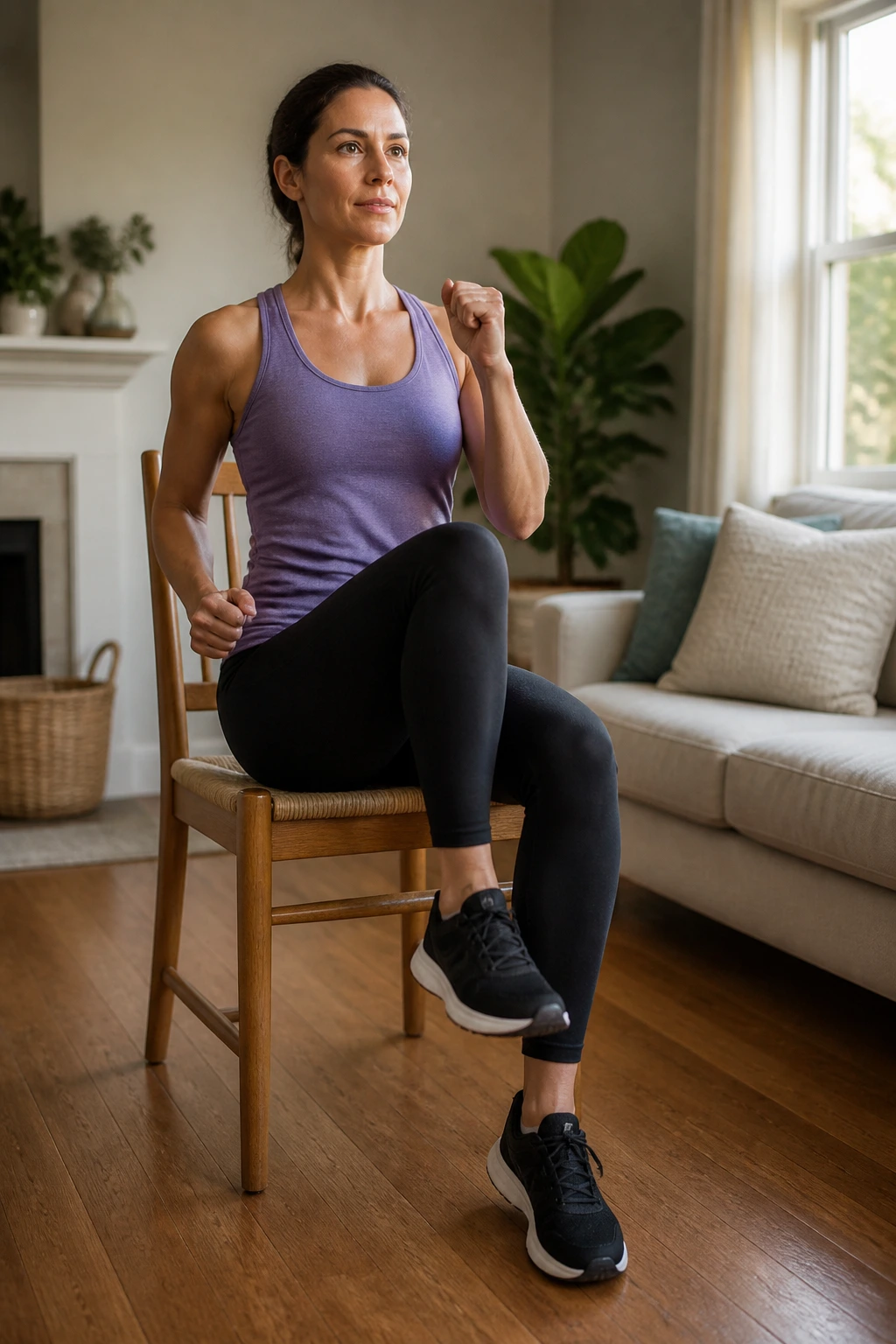
What if standing for long chunks feels like too much?
Use a chair. Seriously.
This is one of the most underrated beginner cardio options because it keeps the habit alive on tired days. Sit tall near the front edge of a sturdy chair and march your feet one at a time, then add light punches or overhead reaches if your shoulders cooperate. You can also stand up for 20 seconds and sit back down for 20 seconds if you want a little more challenge.
I like this one for mornings when your body feels stiff and the idea of bouncing around sounds irritating. It is not a lesser workout. It is a smart entry point.
Try 40 seconds seated marching, 20 seconds rest, for 5 to 8 rounds. Keep the chest open and the feet active. If you want more effort, make the knee lift a little bigger or speed up the arms.
8. Skater Steps Without the Jump
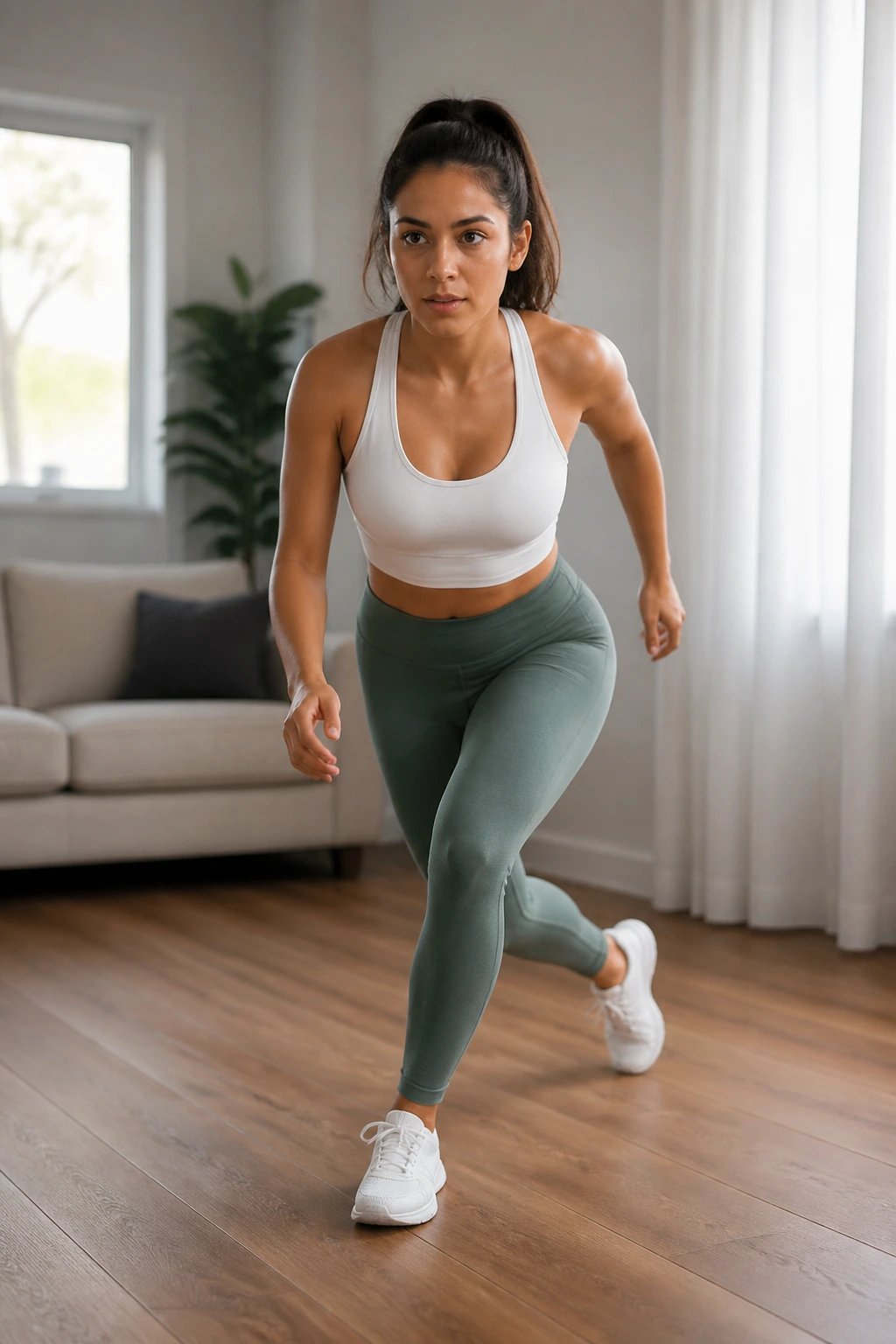
The first time I had someone try skater steps, they wanted to leap. They didn’t need to.
The beginner version is a side-to-side glide with one foot stepping back lightly behind you, almost like you’re crossing the room in a quiet hurry. No hop. No dramatic sweep. Just a lateral pattern that wakes up the outer hips and gets the heart rate moving.
What to watch for
- Keep your chest slightly forward.
- Land softly on the stepping foot.
- Don’t cross the back foot too far.
- Use 30 seconds on, 15 seconds off for 6 rounds.
This move works because it feels athletic without being fussy. The side-to-side rhythm also wakes up muscles many people forget about until the end of a long walk. Stay small at first. Bigger is not better if it throws off balance.
If your living room is narrow, that’s fine. Skater steps do not need much space. The edges of the room are enough.
9. Fast Feet in Place
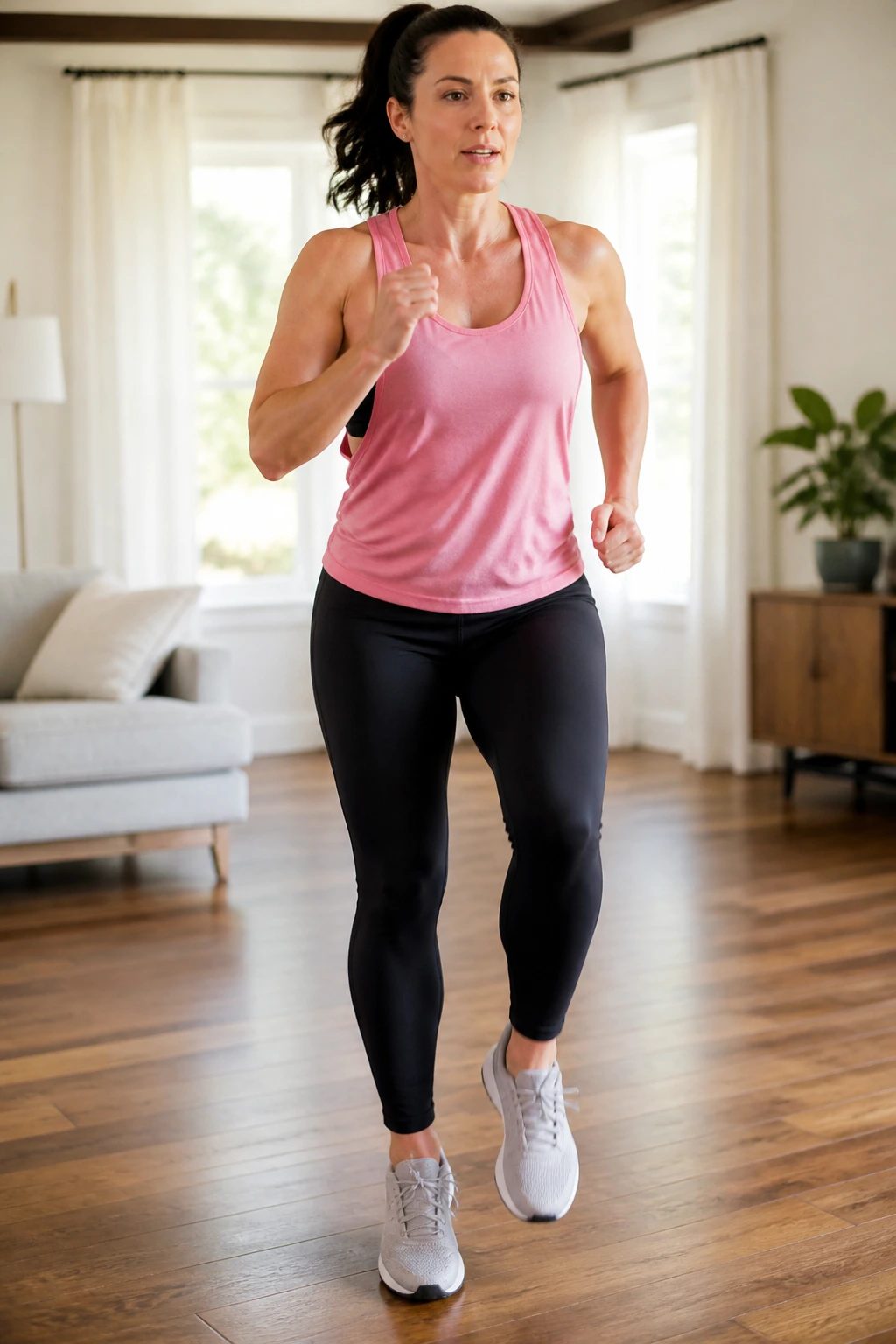
This one feels silly for about 10 seconds, then your heart rate changes its mind.
Fast feet means quick, tiny steps in place with soft knees and active arms. Think light and fast, not loud and frantic. The goal is to make the lower body move quickly enough that your breathing picks up, while staying stable through the trunk.
A beginner-friendly version is 10 to 15 seconds of fast feet, followed by 45 seconds of easy marching. Repeat that 6 times. If your calves start to feel cramped, shorten the burst and loosen the ankles between rounds.
Tiny steps. Big burn. That’s the whole point.
Because this move is so simple, beginners often overdo the speed and start bouncing all over the floor. Don’t. Keep the feet under the hips and the shoulders calm. If you want a cleaner challenge, pump the arms more forcefully. It looks small. It is not small.
10. Box-Step Travel Pattern
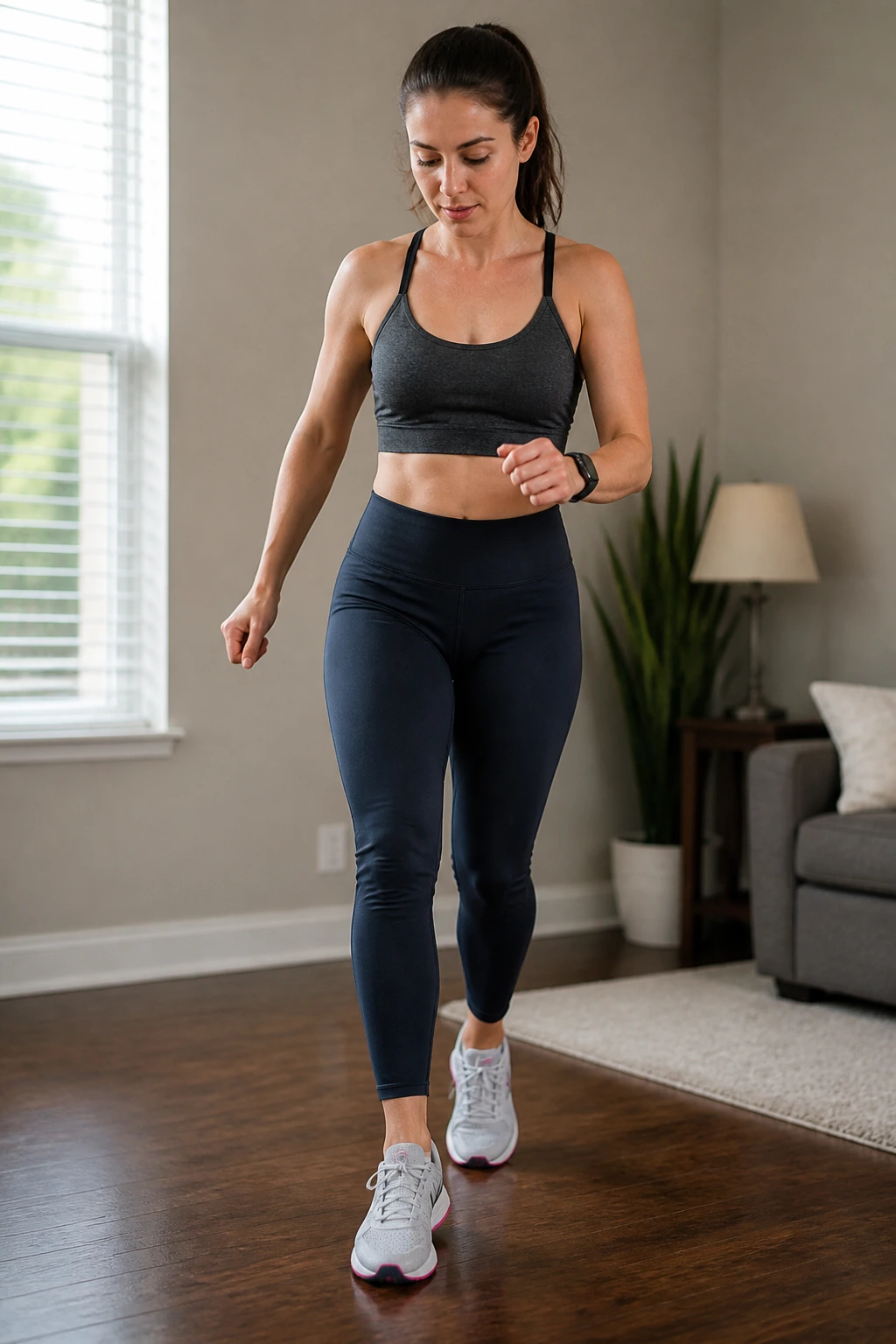
Think of this as choreographed walking.
A box-step pattern has you stepping forward, to the side, back, and together in a square shape. You can do it in a tiny patch of floor, and once you catch the rhythm, it feels almost like counting music in your head. That makes it a nice option for beginners who want structure without memorizing a full dance routine.
How to count it
- Step forward with the right foot.
- Bring the left foot in.
- Step back with the right foot.
- Bring the left foot in.
- Repeat to the other side.
Try 8 patterns on each side, then rest for 30 seconds. Keep the knees soft and the steps short enough that you never lose balance. The turn of the hips should feel smooth, not forced.
This workout quietly teaches coordination while the heart rate climbs. That combo is useful, and a little sneaky. You feel like you’re “just stepping,” then you notice you’re breathing harder than expected.
11. Wall Mountain Climber Sets
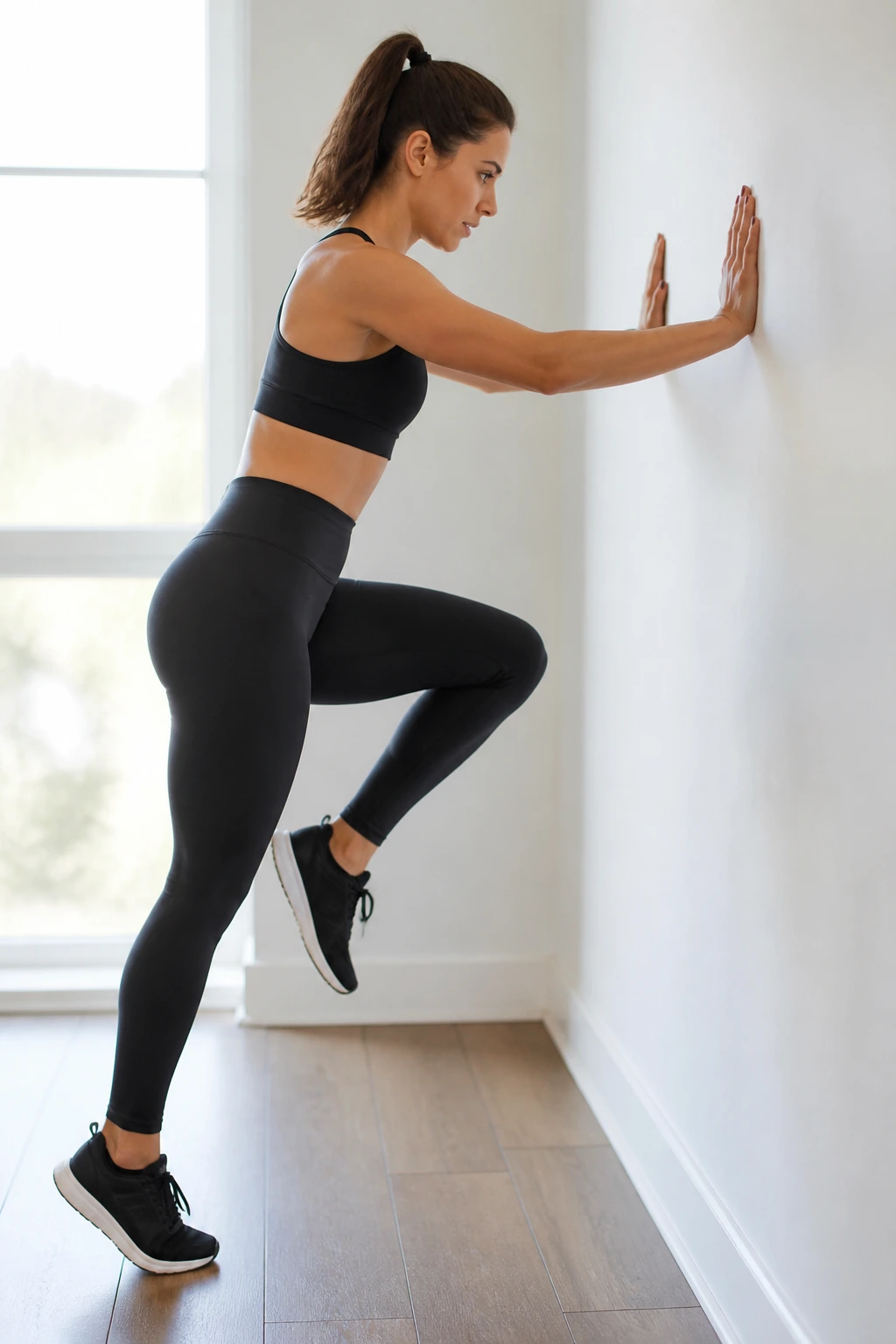
Need your upper body to join the party without dropping to the floor? Use a wall.
Wall mountain climbers are one of those beginner cardio exercises that looks almost too easy until you do a few sets with intent. Place your hands against a wall or a sturdy counter, walk your feet back, and drive one knee toward your chest at a steady pace. The steeper the angle, the easier it feels.
Try 20 seconds of knee drives, then 20 seconds of marching in place, repeated for 8 rounds. Keep your core lightly braced and your shoulders away from your ears. If your wrists get cranky, move your hands a little higher on the wall.
A counter-height version is a nice middle ground. A wall version is gentler. Both count.
The nicest part here is that the move gives your arms something to do without forcing a full plank. That makes it a smart bridge for women who want cardio but aren’t ready for floor-based work.
12. One-Song Dance Cardio
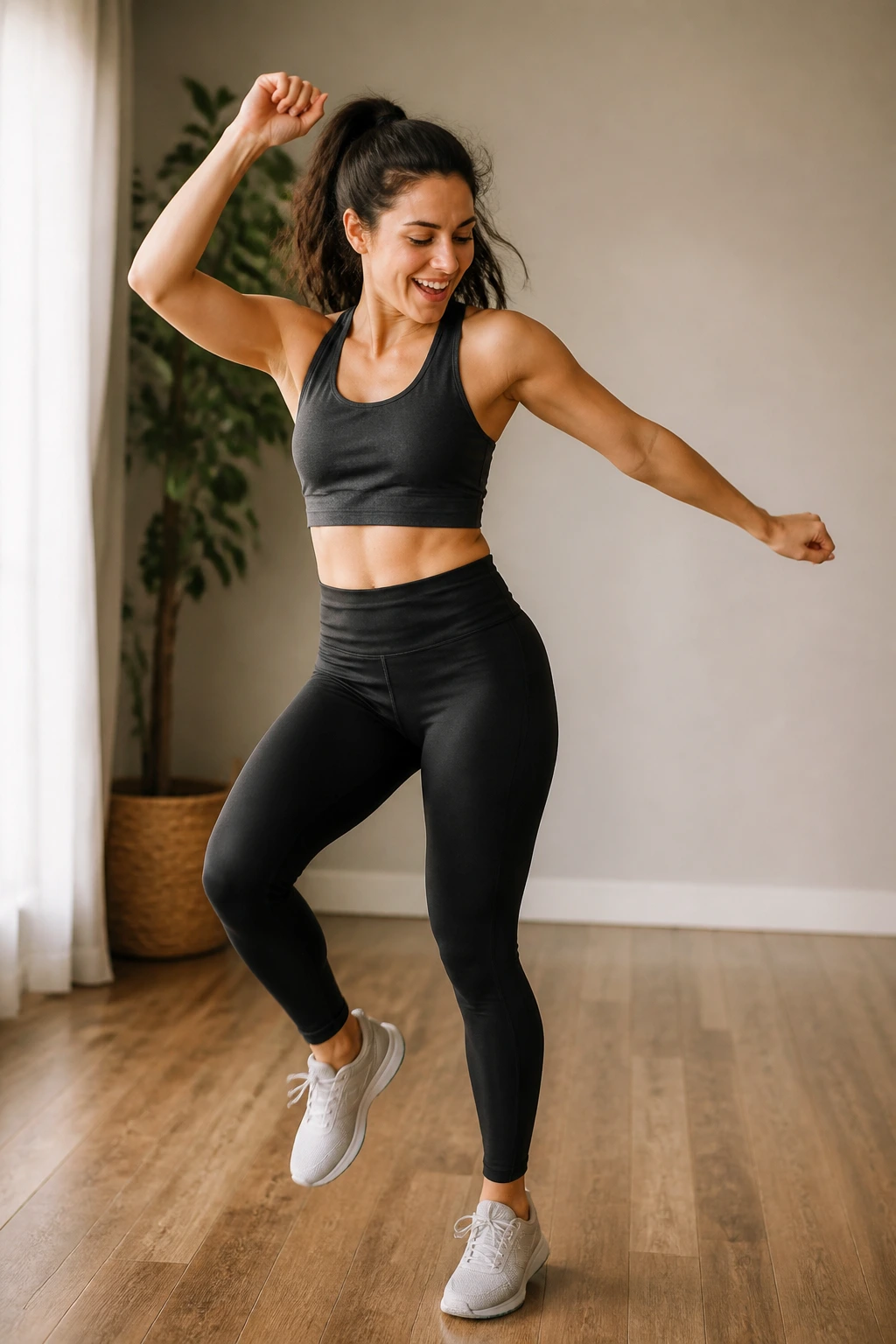
Put on a song you know well, and stop trying to look polished.
Dance cardio works because it lowers the mental barrier. You do not need a routine. You need a beat, a handful of repeatable moves, and a willingness to keep moving until the song ends. That’s it. A single 3- to 4-minute song can be enough for a quick burst, and two songs can turn into a legit session.
Pick 4 simple moves and repeat them in a loop: march, side-step, two arm reaches, and a little knee lift. Keep one move going for 8 counts before switching. If you miss a step, do not reset the whole thing. Keep moving.
Messy counts.
The point isn’t to perform. The point is to stay in motion long enough that your breathing changes and your mood shifts a little. That’s where dance cardio earns its keep. It often feels easier than “exercise” because it sounds like fun, and on some days, that little wording trick matters.
13. Heel Dig and Reach Flow
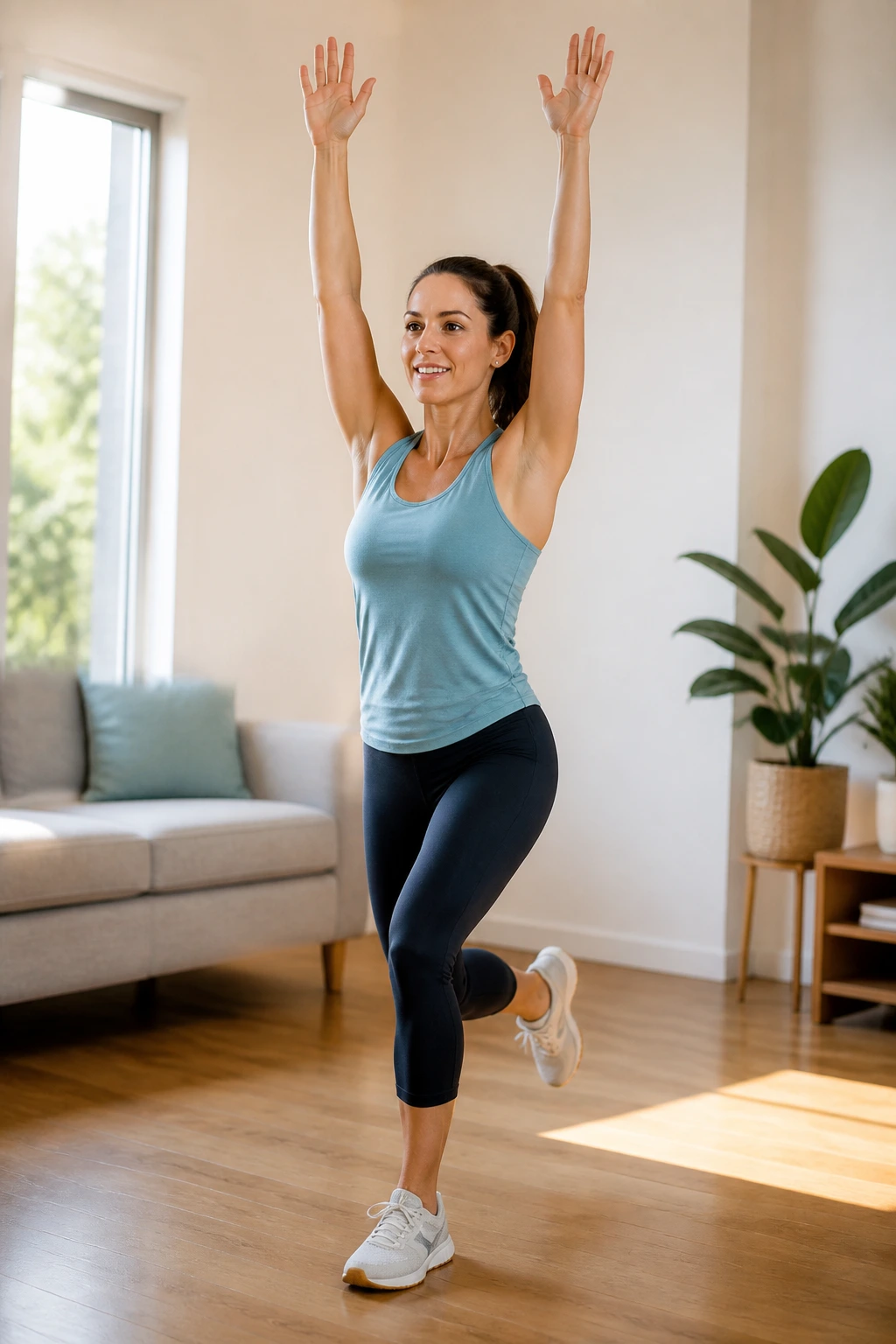
Heel digs are old-school for a reason.
You tap one heel forward, bring it back, then switch sides while your arms reach overhead, out front, or across the body. The movement is low impact, but it still creates a steady rhythm that works well for beginner women who want something smooth instead of bouncy.
A simple way to run it
- Heel dig right, reach left arm overhead.
- Heel dig left, reach right arm overhead.
- Keep the standing knee soft.
- Do 30 to 45 seconds per round for 5 rounds.
If you want the move to feel more like cardio, speed up the arm path before you speed up the feet. That tiny detail helps more than people expect. The arms are the engine here, and the feet just keep the rhythm honest.
Heel digs also work well between harder moves. They give you just enough recovery without letting the heart rate drop all the way back down.
14. Squat-to-Reach Rounds
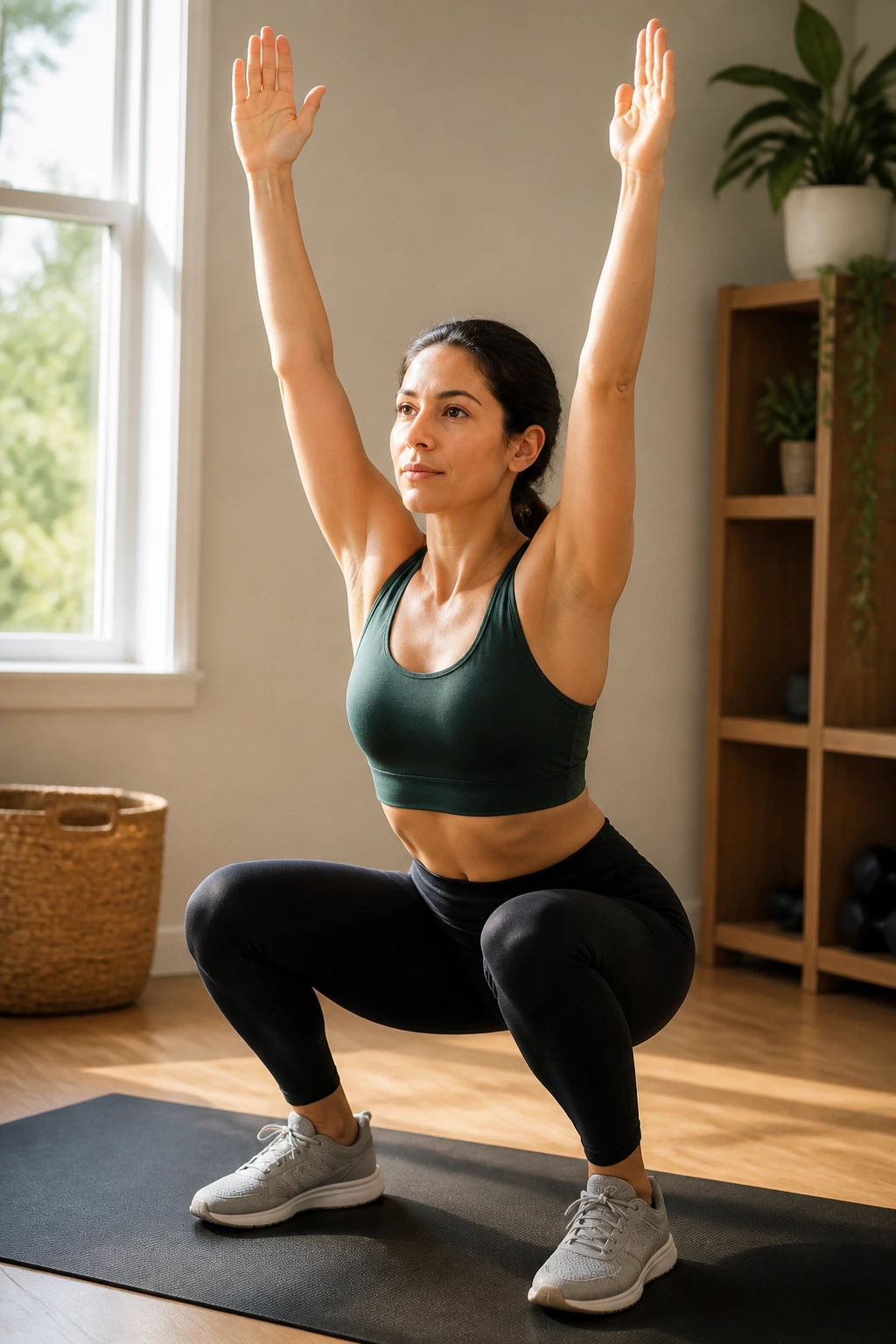
Squats are not only for strength days.
If you keep them shallow and move with a steady tempo, squat-to-reach rounds become a cardio pattern as much as a leg exercise. Drop into a comfortable squat, stand, and reach both arms overhead or forward at the top. The combination keeps the heart rate up because the legs and upper body are both involved.
A solid beginner dose is 8 to 12 reps, rest for 20 to 30 seconds, then repeat for 3 rounds. Don’t force depth. A quarter squat can be enough when you’re new. Knees should track in the same direction as your toes.
If your lower back feels loaded, keep the chest lifted and the ribs from flaring upward as you reach. That usually cleans up the form fast.
This move is useful because it blends work and recovery inside one pattern. You’re not stuck doing a separate strength exercise and then a separate cardio block. It’s one clean motion.
15. Hamstring Curl Punches
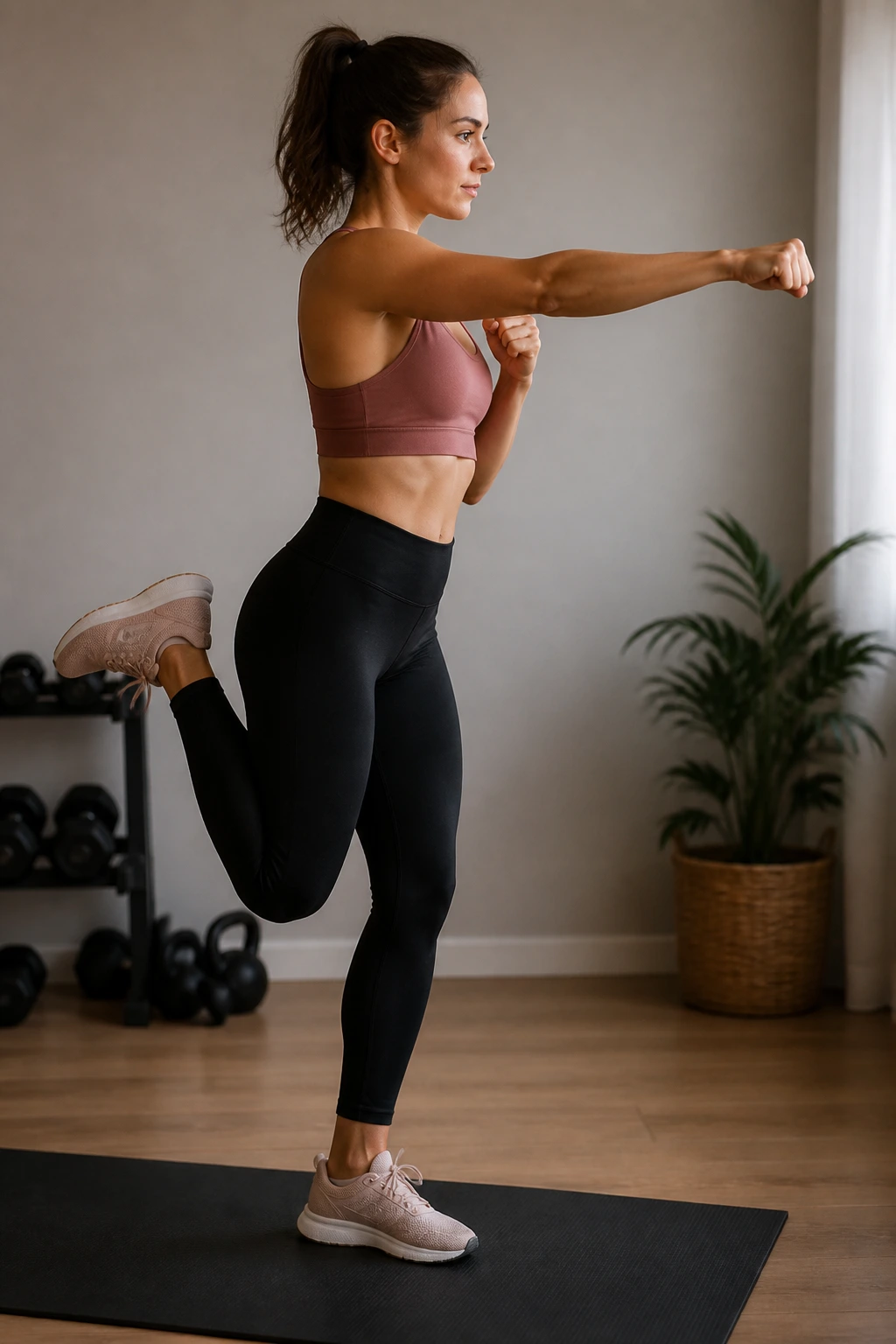
If you want something that feels dance-y without learning steps, this is a nice middle ground.
Curl one heel toward your glute while punching forward with the opposite hand or both hands. Switch sides and keep the rhythm steady. The leg action is simple, but the added arm work turns the move into a proper cardio drill instead of a casual stretch.
Try 45 seconds on, 15 seconds off, for 6 rounds. Keep the heel lift small at first so your balance stays calm. If your knees feel cranky, reduce the curl height and focus on the arm drive. Punch from the shoulders, not the elbows.
This workout also plays nicely with music because the beat gives you a count without feeling rigid. That matters on days when a strict timer makes the whole thing feel annoying.
A tiny detail helps here: keep the standing foot grounded through the big toe and heel. It makes the move feel steadier and a little less wobbly.
16. Cross-Body Knee Drives
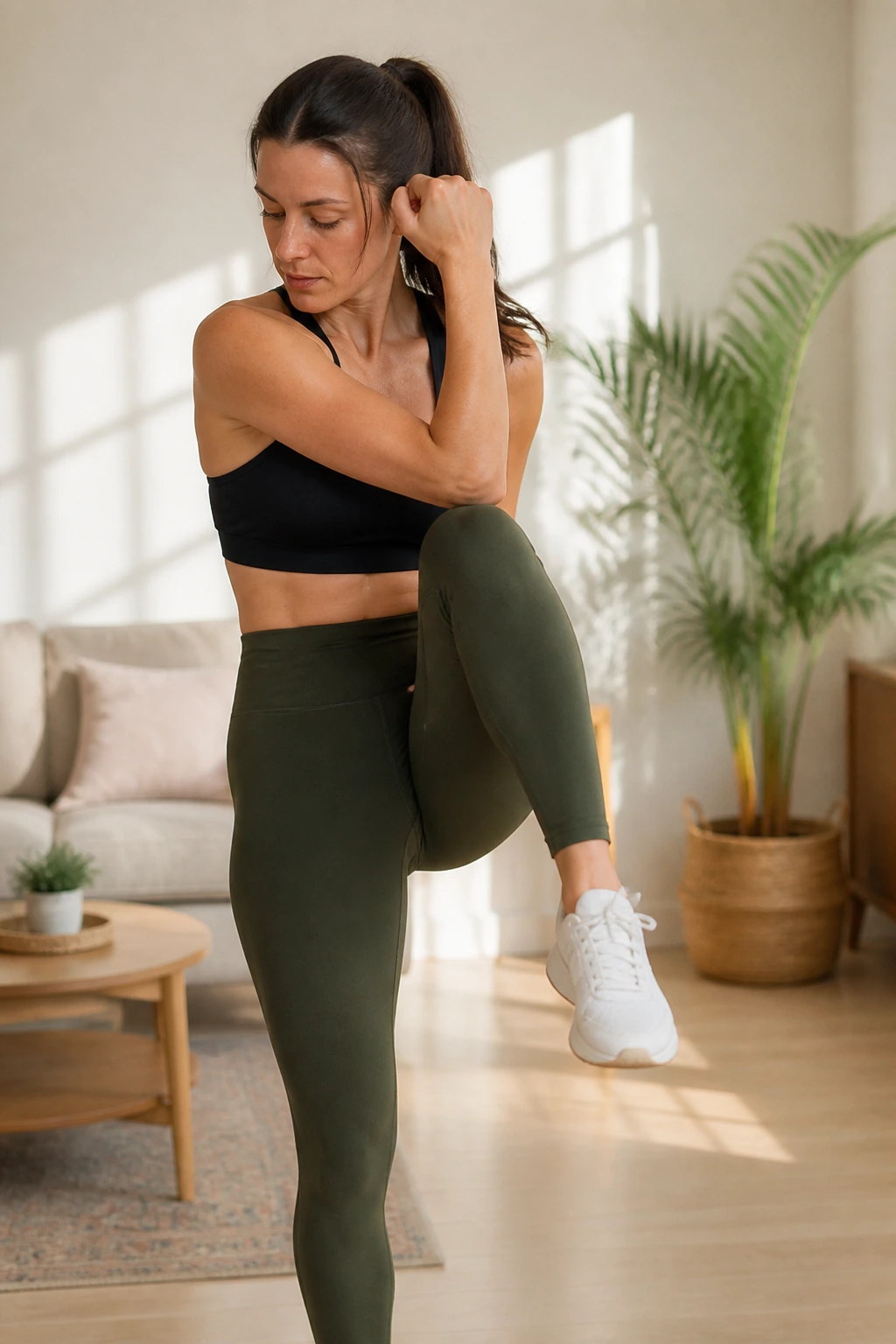
Why cross the body? Because your torso has to wake up and stay honest.
Cross-body knee drives ask you to bring one knee toward the opposite elbow or across the center line of the body. That crossing motion gets the obliques involved and turns a basic march into something with more shape. It also helps with balance, which is useful if you want cardio that teaches coordination at the same time.
Easy version
- Lift the knee straight ahead.
- Tap the opposite hand lightly down toward it.
- Keep the pace slow for 20 seconds.
Stronger version
- Drive the knee across the body.
- Add a small twist through the rib cage.
- Go for 30 seconds, then march easy for 30 seconds.
The one thing to avoid is jerking the knee up so hard that you lean back. That turns the move messy fast. Keep the chest stacked over the hips and let the twist stay small.
This is a good “middle effort” workout for days when you want more than marching but less than stairs.
17. Toe-Tap Ladder
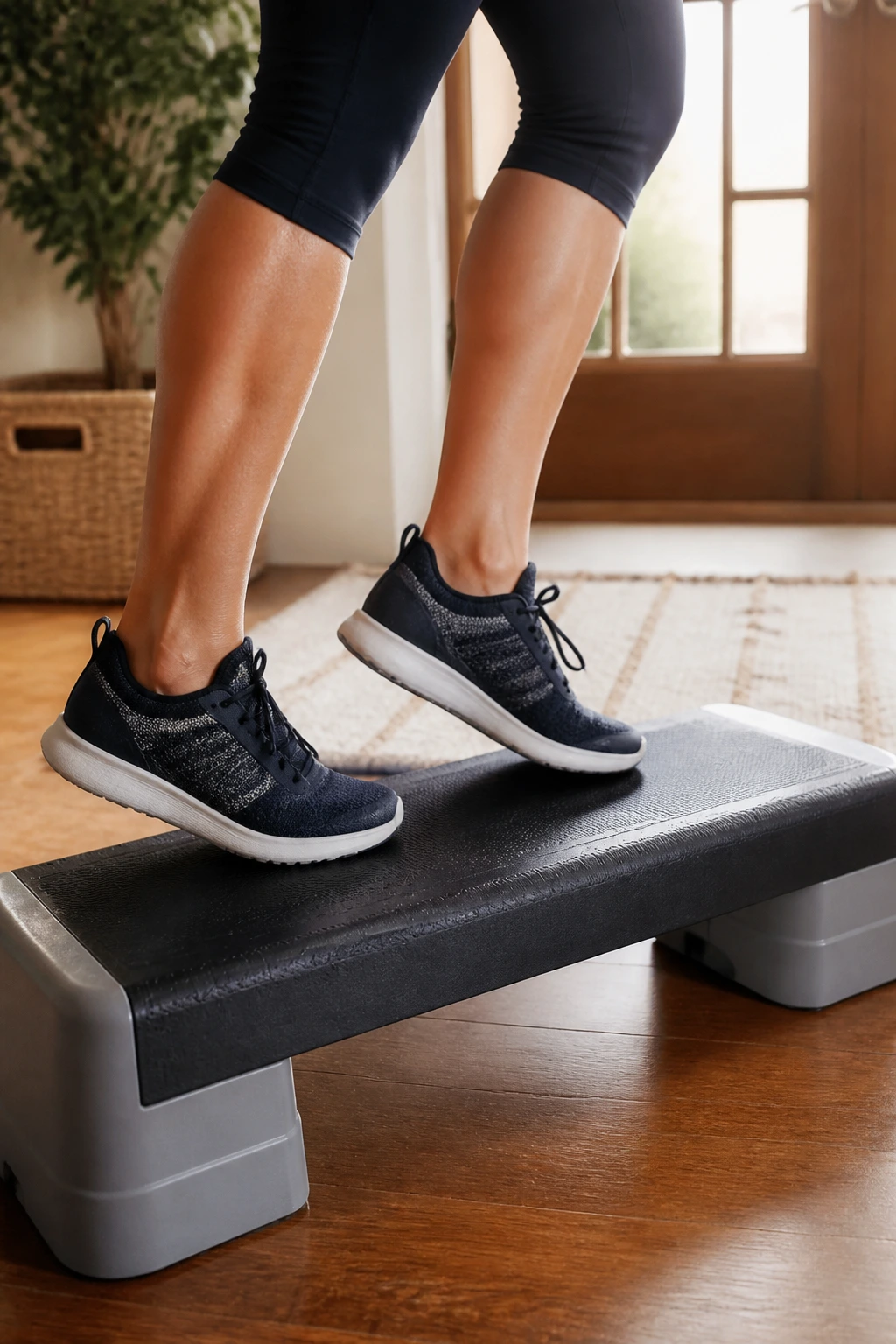
Small steps. Big payoff.
A toe-tap ladder uses a low, sturdy step — or even the bottom stair — and asks you to tap the top with one foot, then the other, in a pattern that keeps changing just enough to stay interesting. It is simple enough for beginners, but the repeated stepping makes the legs work faster than they expect.
Start with a basic 1-2 pattern: right toe tap, left toe tap. Then build to a 1-2-3-4 ladder by tapping forward, side, back, and side if you want more movement. Keep the taps light and the standing leg soft.
One clean round is 30 seconds on, 30 seconds off, repeated 5 times. If the step feels high, lower it. If your balance feels off, keep your eyes forward and slow the pace.
Toe taps are handy because they give you a lot of rhythm with very little impact. That makes them a good option when your joints want motion, not pounding.
18. Curtsy Step and Pull
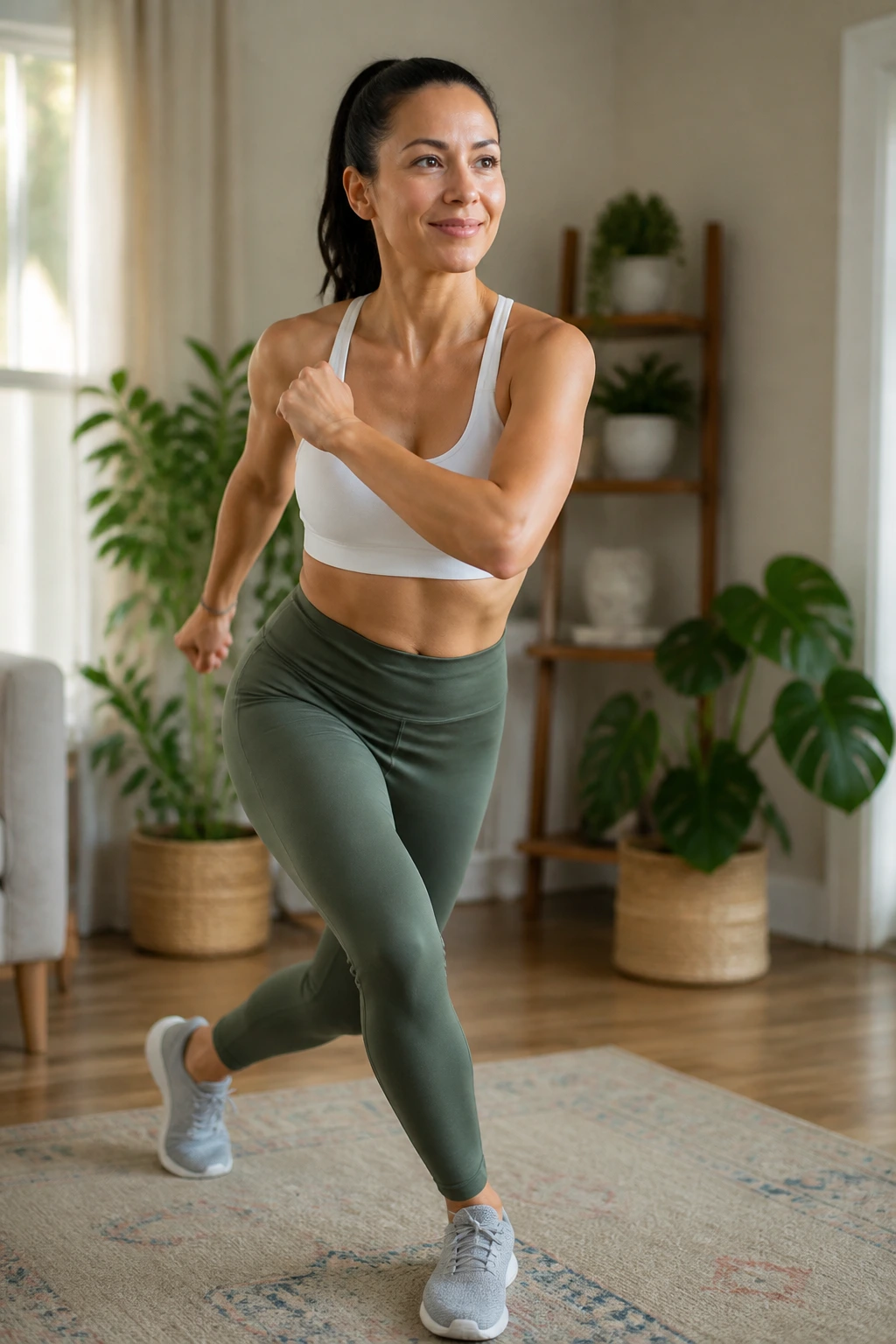
Curtsy moves get a bad reputation when people drop too deep.
The beginner version is a shallow cross-behind step with a light arm pull or reach, almost like you’re drawing a bowstring across your body. It brings in the outer hips, legs, and core while keeping the movement controlled. Done lightly, it feels athletic. Done too deep, it gets awkward fast.
Keep it friendly on the knees
- Step one leg behind and slightly across.
- Keep most of your weight on the front leg.
- Stay tall through the chest.
- Make the step smaller if your knees complain.
A good format is 8 to 10 reps per side, then 30 seconds of easy marching, repeated for 3 rounds. Depth is the first thing to reduce if the move feels uncomfortable. You do not need a big cross-over to get a cardio effect.
This workout works well when you want something a little more expressive than marching but not as jumpy as skater steps. It sits in that nice middle zone where beginners can learn control and still feel their heart rate climb.
19. Walk-and-Turn House Circuits
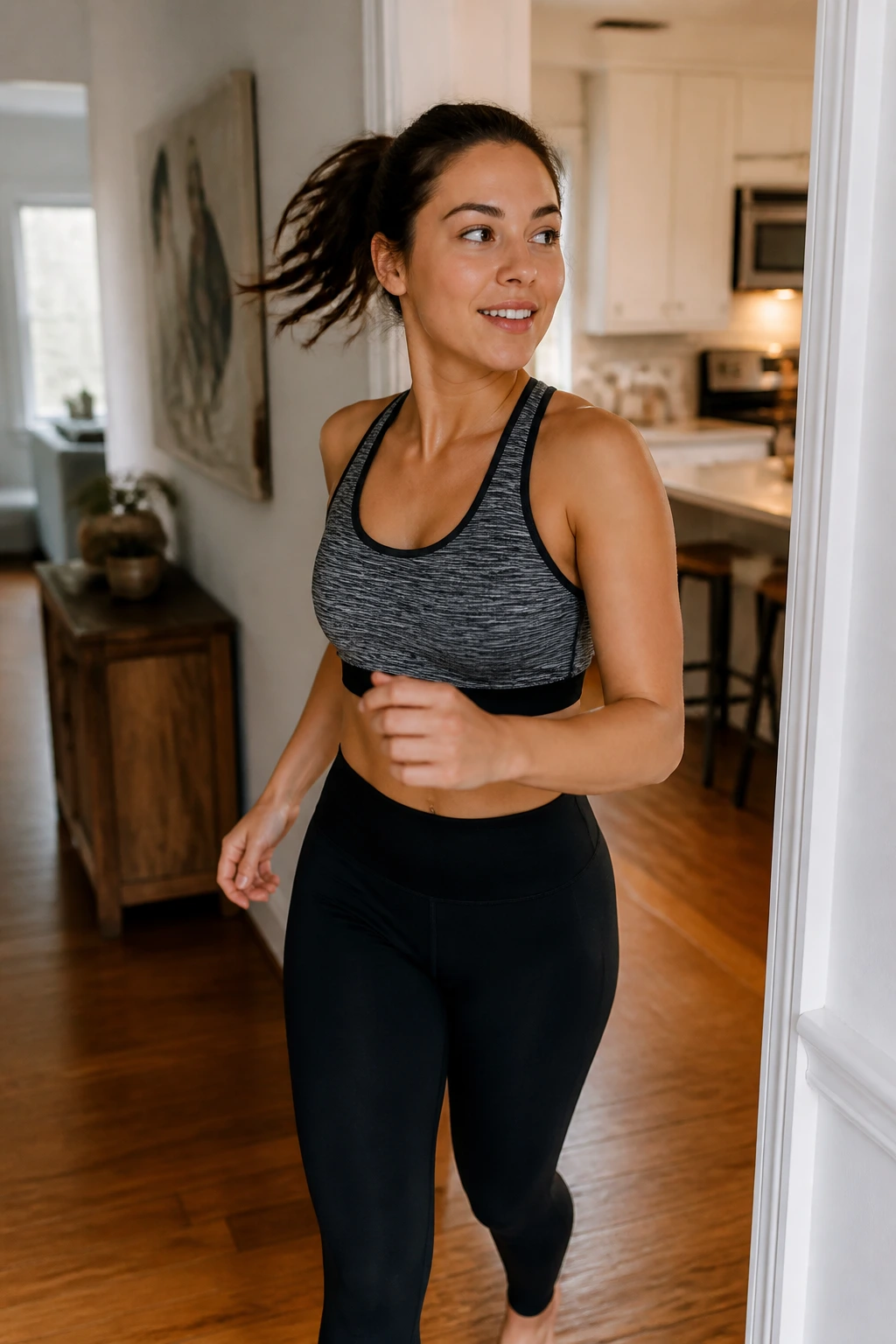
Some days the workout is three laps between the kitchen and the hallway, and that counts.
Walking in deliberate loops around your home sounds plain because it is plain. That’s also the point. You lower the friction, remove the need for equipment, and let simple movement do the job. Add a turn at each doorway, a few arm swings, and a change of pace every minute, and it becomes a real cardio session.
Try 5 minutes of continuous walking, then add 30 seconds of faster steps every minute if you want more intensity. If your space is small, walk a rectangle: living room, hall, kitchen, back again. Keep your arms active and your feet quick without stomping.
This is the move I’d pick for days when the goal is not to impress anybody. The goal is to move.
It also works well as a reset between harder rounds. A short house circuit can bring your breathing down without making you sit completely still, which is often the sweet spot for beginners building stamina.
20. Four-Move Mix for Low-Energy Days
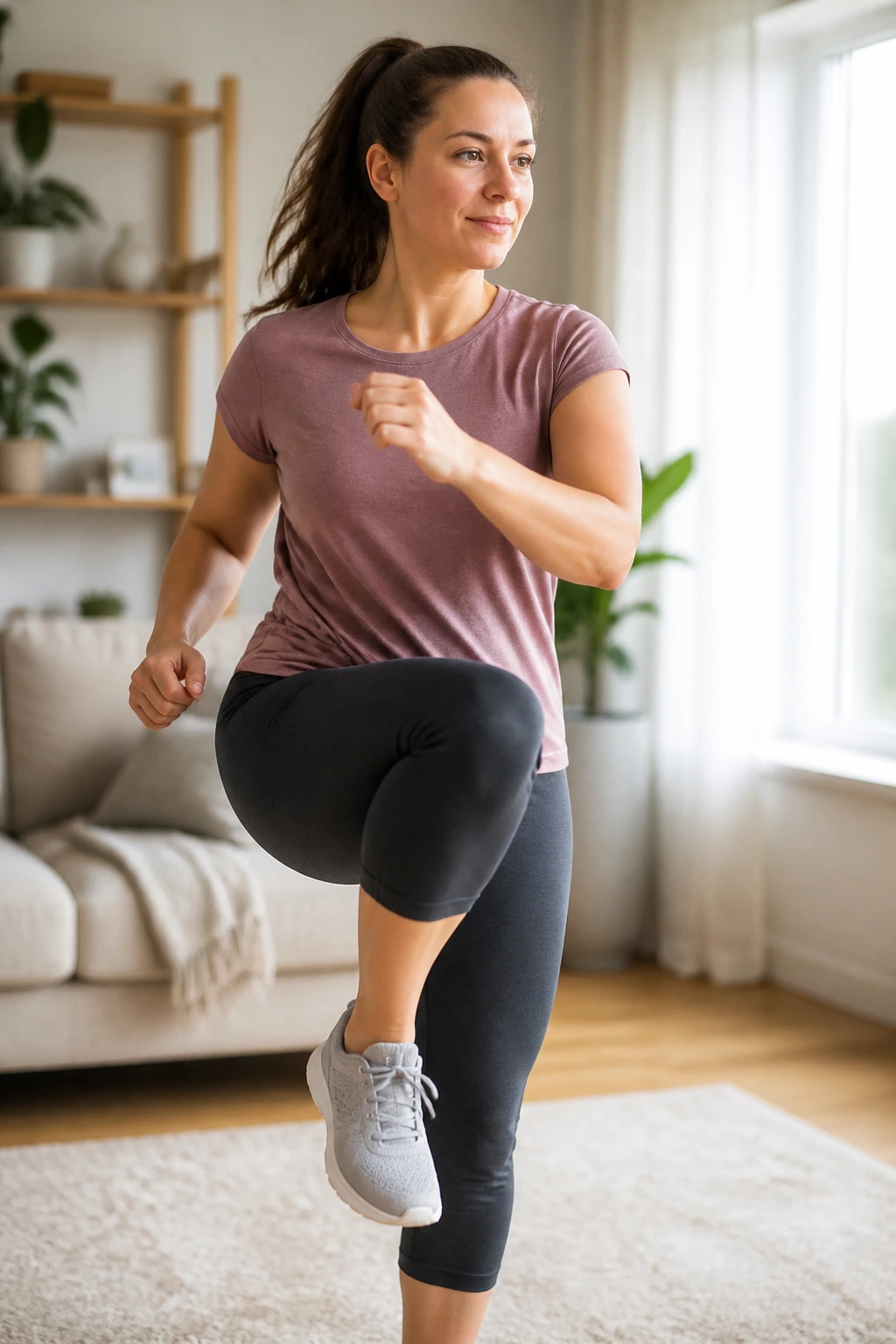
When motivation is thin, keep the plan tiny.
A four-move mix is the kind of workout that saves the habit when the day has already eaten your energy. Pick marching, shadow boxing, side-step reaches, and toe taps. Do each one for 30 seconds, then repeat the circuit for 2 rounds. If that feels like too much, cut it to 20 seconds each and stop there. That still counts.
The reason this works is simple: the workout removes decision fatigue. You do not have to choose from twenty ideas when you are tired. You already chose. You just start the timer and move from one pattern to the next.
The workout you repeat beats the workout that looks better on paper. That line matters more than the shiny stuff. A beginner cardio plan gets stronger when it’s easy to start on an ordinary Tuesday, not only on the rare day when you feel fully fired up.
Save this mix for the moments when you need something small, clean, and doable. Then do it again the next time.
