



Hill sprint workouts for faster running can feel unfair the first time you do them. The hill steals your excuses, cuts down on overstriding, and asks for real force from the first step. If your stride gets lazy on flat ground, a slope will expose it in about three seconds.
That’s the point.
A good incline session builds acceleration, leg stiffness, and running economy without the pounding that comes with repeated flat sprints. A 4- to 6-percent grade usually gives enough resistance to matter without turning the rep into a calf-stretching contest, and that balance matters more than people think. Too steep, and you’re climbing. Too shallow, and you’re basically doing fast jogging with a mood problem.
The 15 sessions below are not carbon copies. Some are short and sharp, some stretch the effort a little longer, and a few are the ugly-but-useful kind of work that teaches you to keep form when your legs want to fold. Start with the crisp stuff, keep the recovery honest, and cut a rep the second your posture turns sloppy.
1. 8-Second Hill Sprints for Pure Acceleration

Eight seconds is enough. Barely. That’s what makes this workout so good for runners who need more pop off the ground but do not need another long, draining interval day.
Use a hill that feels firm underfoot and sits around 4 to 6 percent. Start from a standing position, lean forward just enough to match the slope, and attack the first 3 steps like they matter more than the last three. They do. The whole rep should feel fast, snappy, and clean, not frantic.
How to run it
- Reps: 6 to 10
- Work interval: 8 seconds all-out
- Recovery: walk back down and rest until you feel ready, usually 90 to 120 seconds
- Surface: grass, packed dirt, or a smooth road shoulder
The short duration keeps the stress neural instead of metabolic. In plain English: you get faster feet, better force, and less of the heavy burning that shows up in longer hill work. That makes this session a strong choice before speed-focused blocks or during weeks when you want power without frying yourself.
Tip: if the hill makes your knees lift like you’re climbing stairs, it’s too steep for this workout.
2. 12-Second Hill Sprints With Full Recovery

Twelve seconds is a sweet spot. Long enough to matter, short enough to stay sharp.
The real value here is that the extra four seconds force you to keep mechanics together after the first burst of enthusiasm wears off. That’s usually where runners start reaching forward, dropping their hips, or chopping their arm swing. A slightly longer hill sprint exposes all of that fast, which is useful even when it stings a bit.
Run 6 to 8 reps on a moderate hill, then take a full walk-down and enough standing rest to feel like the next rep can be done well. I usually like a hill that is not too dramatic here—something that feels hard, but not like a mountain. You should finish each rep breathing hard, yet still able to keep the next one tidy.
The point is not survival. It’s repeatable power.
Use this workout when you want a little more stress than short sprints give you, but you do not want the sloppy grind of a longer interval session. If your speed drops sharply after rep four, stop there and call it a good day. For hill work, quality beats stubbornness every time.
3. Flying Hill Sprints
Why start every hill sprint from a dead stop if the first thing most runners need is rhythm?
Flying hill sprints fix that. You build into the rep for 10 to 20 meters, let your cadence settle, and then drive hard uphill for another 6 to 10 seconds. That tiny buildup changes the feel of the workout in a good way. The first step is smoother, the arms stop flailing, and the sprint starts from something closer to race movement instead of a jerky lunge.
How to use it
- Warm-up: 10 to 15 minutes of easy running plus leg swings or skips
- Build-in: 10 to 20 meters at relaxed-fast pace
- Sprint zone: 6 to 10 seconds hard uphill
- Recovery: walk back fully and wait until your breathing settles
This session works well for runners who can sprint, but tighten up when they have to explode from stillness. It also teaches you how to keep posture when the speed is already there. That matters in races more than people admit. Real race pace is rarely a perfect launch.
A small warning: don’t turn the build-in into a separate workout. Smooth is the goal. Fast happens after that.
4. Hill Sprint Ladders That Build and Unwind

Some days, one distance feels too easy and the next one feels too long. A ladder solves that problem without making the session fussy.
Run a set like 8-10-12-10-8 seconds, or stretch it to 6-8-10-12-10-8-6 if you’re feeling strong and the hill is not too steep. The idea is simple: each rep gets a little longer, then you work back down while keeping form intact. It sounds harmless on paper. It rarely feels harmless by the middle.
Session shape
- Rep 1: 8 seconds
- Rep 2: 10 seconds
- Rep 3: 12 seconds
- Rep 4: 10 seconds
- Rep 5: 8 seconds
- Recovery: full walk-down, plus enough extra rest to keep each rep sharp
The ladder format is useful because it shows you where your mechanics start to leak. If the 12-second rep looks fine but the 10-second return trip falls apart, your hill is probably a touch too steep or your recovery is too short. That feedback is worth keeping.
Watch for this: the fastest rep is not the one that feels wild. It’s the one that still looks controlled from the side.
5. 20-Second Power Hills

Twenty seconds is long enough to start burning, short enough to stay honest. That combination makes this one of the best hill sprint workouts for runners who want power without drifting into full interval misery.
Keep the hill moderate—usually 5 to 7 percent is enough—and run 5 to 6 reps at a hard, controlled effort. I would not call these all-out sprints. More like hard acceleration with discipline. The first half should feel smooth. The second half should feel like you are hanging onto good form by the skin of your teeth, but only just.
That tension matters. You are training force production while the body is asking for more oxygen and more control. The result is better posture under stress, which shows up later when races get ugly. It also makes this workout useful for 800-meter to 5K runners, though plenty of longer-distance runners borrow it too.
One sentence, because it matters: longer does not mean better here.
If your stride gets choppy, you are done. If your chest folds and your knees start swinging wide, you are done. The goal is a hard rep that still looks like running, not a desperate climb to nowhere.
6. Bounding Uphill for Raw Leg Power

Bounding is not the same thing as sprinting, and that’s why it earns a place on this list.
Unlike a straight hill sprint, bounding asks you to push off the ground with a little more exaggeration. The stride is bigger, the contact is more forceful, and the calf-Achilles complex gets much more of a say in the session. That makes this workout a strong choice for runners who already have decent speed but need more spring and push.
What makes it different
- Best terrain: a firm grass hill or a smooth dirt slope
- Rep length: 20 to 30 meters
- Sets: 4 to 6
- Recovery: walk back slowly and let the legs settle
- Effort: powerful, not frantic
I like this one for runners whose stride looks flat on video. Not weak. Just flat. Bounding forces the body to get off the ground with intent, which can improve the way your stride loads and unloads when you go back to normal running. It also exposes weakness fast, which is either useful or humbling, depending on the day.
Be careful with the first session. Calves can get cranky if you rush it. Start with fewer bounds than you think you need, keep the reps clean, and stop before the bounce turns into a stomp.
7. Hill Strides After an Easy Run

If your legs feel heavy after an easy run, a few short hill strides can wake them up without turning the day into a war.
This is not a max-effort session. It’s a sharp touch-up. You finish an easy run, find a moderate hill, and run 4 to 8 strides of 8 to 10 seconds with relaxed speed and full walk-back recovery. The work should feel quick, smooth, and a little playful. Not reckless.
Why it helps
Hill strides give you a little speed stimulus without much fatigue. That makes them handy for runners who want to stay sharp while keeping most of their week calm. Marathoners use them. Base-building runners use them. Anyone who hates the stiffness that creeps in from doing only easy mileage can use them.
A few rules keep the workout useful:
- Stay relaxed in the shoulders
- Keep the stride short and quick
- Stop before the effort turns choppy
- Leave one rep in the tank
The nice part is that hill strides fit almost anywhere. They can live after a recovery run, before a light workout, or on a day when your schedule is messy and you still want to do something worthwhile.
Finish each rep smooth. That’s the whole game.
8. 30/30 Uphill Intervals

Thirty-second hill repeats are not pure sprint work, and that is exactly why they belong in a hill speed plan.
A workout like 30 seconds hard, 30 seconds easy sits between speed and aerobic power. You get the leg drive and posture demands of climbing, but you also accumulate enough effort to stress your breathing and your rhythm. On a moderate hill or treadmill incline, that makes the session useful for 5K and 10K runners, or for anyone who falls apart when pace changes stack up.
The structure is simple: run 10 to 15 rounds of 30 seconds uphill at a hard but controlled pace, then recover for 30 seconds by walking or jogging lightly. The hard part should feel sharp, not like you’re chasing a max sprint. If you blow up by rep four, the pace was too hot.
It hurts in a useful way.
That’s the appeal here. You learn to keep your form tidy while the lungs complain and the legs start to bite back. It’s a good middle ground when pure sprints feel too short and longer hill repeats feel too draining.
On a treadmill, a 4 to 6 percent incline usually works well. Outdoors, find a hill that lets you keep your posture tall and your foot strike under you.
9. Crest-and-Go Repeats Over the Top
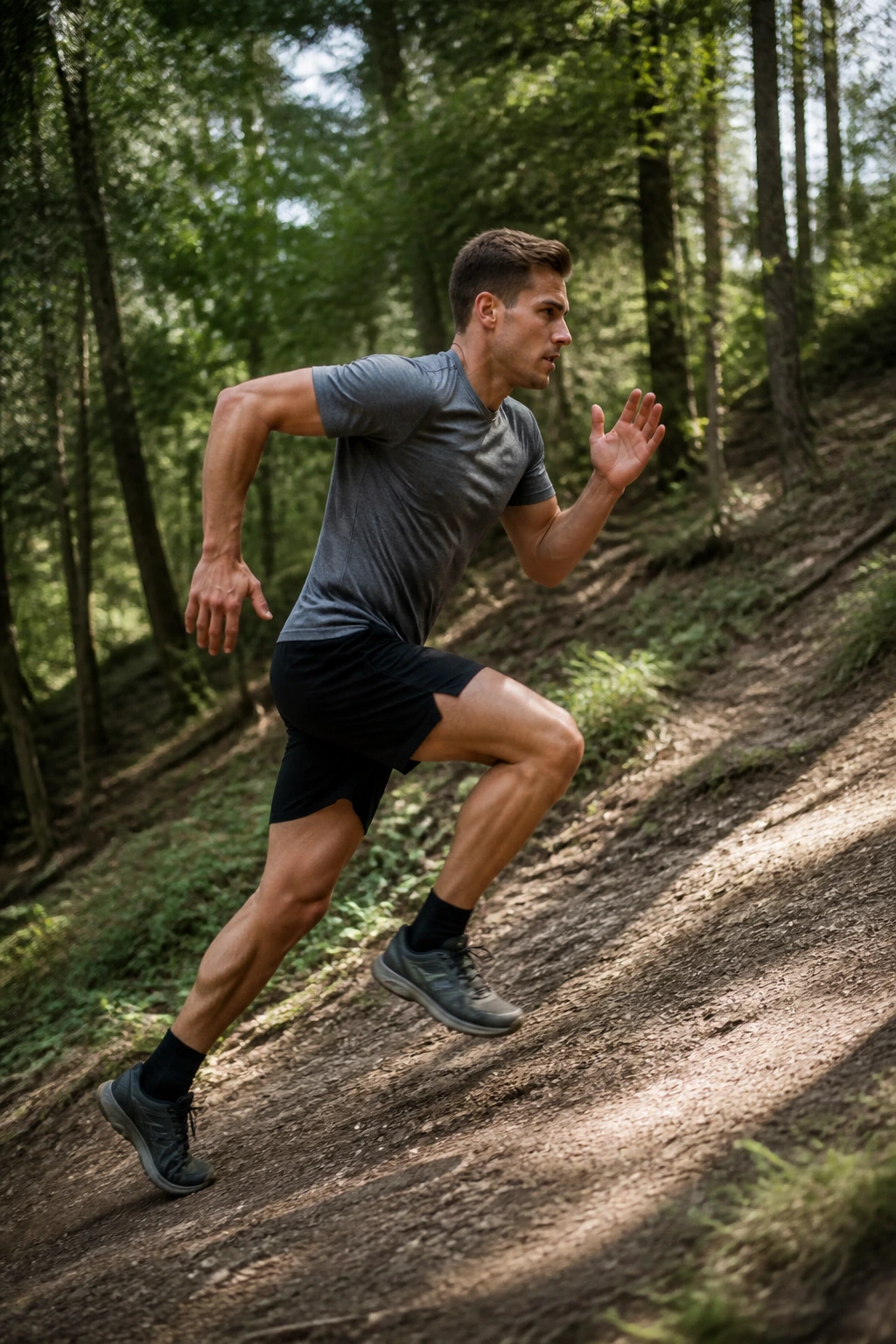
Why do runners ease off the moment they reach the top of a hill?
Because the summit looks like a finish line. This workout teaches the opposite habit. You sprint uphill, keep the pressure on as you crest, and carry the effort a few more seconds onto the flatter ground beyond. That little extension matters more than it sounds like it should.
The body tends to soften right at the top of a hill. Hips drop. Arms get lazy. Stride length dies. Crest-and-go repeats train you to stay organized through that awkward point, which is one of the reasons they work so well for races with late surges or fast finishes.
How to use it
- Reps: 4 to 6
- Effort: hard for 15 to 20 seconds total
- Recovery: 2 to 3 minutes of easy walking or jogging
- Terrain: a hill with a gentle flat or slight rise beyond the crest
Keep the surface beyond the hill safe and predictable. You do not want a sharp downhill immediately after the crest. The point is to keep driving, not to throw yourself downhill like a loose shopping cart.
This session is a nice fit for runners who race 1500 meters, 3K, or 5K, but it also helps anyone who fades when the route changes shape.
10. Rolling Hill Fartlek With Short Bursts
A hilly route can do half the planning for you if you let it.
Rolling hill fartlek is the workout I reach for when I want speed without staring at a stopwatch every two minutes. You run a loop with several hills, then pop off short surges on the uphills and recover on the descents or flats. It feels looser than a formal interval session, but the work can still be very hard.
Key details
- Surges: 6 to 10 hard efforts
- Length: 15 to 45 seconds each, depending on the hill
- Recovery: easy running downhill or on flatter stretches
- Effort: hard up the hill, controlled everywhere else
The real value here is rhythm. You are learning to change gears without panicking. That skill shows up in trail races, cross-country, and road races with little rises that steal your pace if you’re not paying attention.
This kind of session also helps if you’re bored with clean, measured repeats. There’s some freedom in it. You respond to the terrain instead of fighting it, which can make the work feel more natural and less mechanical.
Not every run needs a stopwatch glued to your wrist. Sometimes the hill is the cue.
11. Progressive Hill Sprints From Smooth to Fast
Start at 70 percent. Finish at 95 percent. That simple change makes the whole workout feel different.
Progressive hill sprints are built around control. Instead of blasting the first step, you build speed over the first few seconds, then finish hard once your body is set. A good rep lasts 12 to 15 seconds, and the effort rises in a clean line rather than in one wild lurch. That is useful for runners who tend to go out too hot and fall apart early.
The hill should be moderate, not brutal. Think enough resistance to matter, not enough incline to force a climb. Run 5 to 8 reps, with full walk-back recovery and an extra minute if your breathing is still ragged. The finish should feel faster than the start, but not messier.
Fast is not the same as frantic.
That sentence saves more workouts than people realize. If your opening steps feel rushed, shorten the first two seconds. If your shoulders climb toward your ears, you’re forcing the pace instead of building it. The best part of this session is that it keeps the nervous system active while sparing you from the sloppy power loss that can show up in pure all-out sprints.
It’s a smart choice for runners coming back from a layoff, too.
12. Treadmill Incline Power Session
Outdoor hills are great. Treadmills are tidy.
That’s the main difference, and it matters. A treadmill gives you a fixed incline, predictable footing, and no surprises from traffic, wind, or a hill that somehow gets steeper halfway up. For runners who want exact repeatability, that control is useful. It can also be the safer choice when the weather is grim or the roads are slick.
Set the incline around 8 to 10 percent for short power reps, then run 8 to 10 repeats of 15 seconds with 90 seconds to 2 minutes of easy walking or jogging between efforts. Keep your hands off the rails if you can do that safely. Hanging on changes the posture, reduces the load, and turns the rep into a weird half-version of the real thing.
What I like here is the consistency. You can feel whether rep six is better than rep two. You can also keep the rhythm tighter because the belt forces you to move.
This version is a good match for runners returning from injury, especially if they need a more controlled surface. It’s also handy for anyone whose local hills are either too steep or too crowded to use well. The machine is boring. That’s fine. Boring is useful when the goal is clean mechanics.
13. 60-Second Hill Grinds for Strength Under Fatigue

Sixty seconds is long enough to make your quads bark.
That’s why this session sits in the same family as hill sprint work even though it leans more toward power endurance than raw speed. You’re not trying to sprint the whole climb. You’re trying to keep form together while the effort stays high and the legs start to feel heavy. That skill matters in the middle and late parts of races, especially for runners who fade when the pace gets honest.
Why it belongs in a speed plan
- Reps: 4 to 6
- Duration: 45 to 60 seconds each
- Grade: moderate, usually around 3 to 5 percent
- Recovery: 3 to 4 minutes of easy walking or jogging
- Effort: strong and steady, not frantic
The pace should feel controlled from the first third of the rep. If you blast the opening 10 seconds, the rest of the repeat turns into survival, and the workout loses most of its value. Better to keep the chest up, drive the arms, and keep the stride compact enough that you don’t start swinging side to side.
This is a useful session for 800-meter, mile, and 5K runners, though it can help longer-distance runners who need more strength on rolling courses. It is not sexy. It works anyway.
14. Mixed-Recovery Hill Repeats

Fresh legs are a luxury.
Mixed-recovery hill repeats teach you to work with less of that luxury, which is part of why they feel so real. The idea is to alternate short hill sprints with different rest periods in the same session. You get a block of reps with short recovery, then a second block with full recovery. That contrast changes how the body handles speed while partially tired.
A simple version looks like this: 4 x 10 seconds uphill with 45 seconds rest, then after a longer reset, 4 more x 10 seconds with 2 minutes rest. The first block teaches you to keep moving when the legs are not fully ready. The second block lets you practice better mechanics once fatigue is already in the room.
That combination is sneaky. It feels manageable in the first half, then oddly revealing in the second. By the end, you know whether your sprinting is sturdy or fragile.
Use it when you want a session that feels a little chaotic without becoming sloppy. Trail runners, soccer players, and 5K runners often get a lot out of it because their races and efforts rarely happen in perfectly neat chunks.
If the short-rest block destroys your form, shorten it next time. No drama. Just adjust.
15. The Benchmark Hill Session You Can Repeat and Trust

How do you know whether hill power is actually improving?
Use the same hill, the same rep length, and the same recovery, then pay attention to how the reps feel and look from start to finish. A simple benchmark session is 6 x 10 seconds on a moderate hill with full walk-back recovery, or 5 x 12 seconds if you want a slightly harder read. The goal is not to smash yourself. The goal is to keep each rep cleaner, quicker, and more controlled than the last time you ran it.
That makes the workout useful in a way that goes beyond the day itself. If rep five looks as tidy as rep one, you’re in good shape. If rep three starts to wobble, you know the hill is exposing a weakness in either strength, recovery, or pacing. That feedback is honest, and honest is useful.
I like this session as a regular check because it stays simple. No fancy ladders. No tricks. Just a repeatable measure of whether your running power is getting sharper.
Start with the shortest and crispest workouts in this list if you’re new to hill sprints. Build toward the longer grinds and mixed-recovery sessions once the short reps feel smooth. One good hill workout a week is enough for most runners. Two can work if the rest of the training is calm, but stacking multiple hard hill sessions in the same week usually turns smart work into dead legs faster than people expect.
Pick one session, run it well, and keep notes on how your stride feels at the top of the hill. That is where the useful information lives.
