



A cross trainer can feel almost insultingly easy for the first three minutes, and then your legs start telling the truth. The pedals stay smooth, your feet never leave the machine, and the whole thing looks gentler than running — which is exactly why cross trainer workouts for beginners catch people off guard when the heart rate climbs faster than expected.
That surprise is part of the appeal. The machine gives you low-impact cardio, a place to build stamina without the hard thud of pavement, and enough moving parts to keep things interesting if you know how to use them. The catch is that a lot of beginners either crawl along too timidly or charge in like they’re chasing a finish line. Both approaches get old fast.
The sweet spot is somewhere in the middle. You want workouts that teach rhythm first, then add short bursts, small hills, and enough recovery to let you finish with energy left in the tank. Posture matters. So does breathing. So does not hanging off the handles like the machine owes you money.
Cross trainer workouts work best when they feel almost boring at the start and satisfyingly honest by the end. The first few here build that base, then the later ones layer in resistance, cadence changes, and a little more challenge without turning the session into a punishment.
1. Cross Trainer Walk Warm-Up

Start with the workout most people skip. A five-minute cross trainer walk warm-up sounds tiny, and that’s the point. You’re teaching your body to settle into the machine, not proving a point.
Why It Works
Begin at a resistance level where the pedals move smoothly and your hips don’t rock side to side. Keep your hands light on the handles, stand tall, and aim for a pace that feels almost too easy for the first two minutes. By minute four or five, your breathing should be deeper, your joints should feel loose, and the machine should no longer feel awkward.
- Time: 5 minutes
- Resistance: Low, around 2 to 4 out of 10 if your machine uses that scale
- Effort: RPE 2 to 3, which means you can talk without pausing
- Goal: Warm the ankles, knees, hips, and shoulders before the real work starts
Pro tip: If your feet keep slapping the pedals, slow down and lower the resistance. Smooth matters more than speed here.
2. The Easy-Pace Steady Ride

Steady beats heroic for almost every beginner. A 10- to 20-minute steady ride on the cross trainer builds confidence in a way that short hard efforts can’t, because you get to practice the same smooth rhythm long enough for it to feel normal.
Keep the pace at a level where you can still talk in short sentences. Not a chatty podcast pace. Not a gasping one either. Somewhere in the middle, where you notice your breathing but aren’t bargaining with the clock. That controlled effort teaches your body how to handle sustained cardio without the wobble that comes from going too hard too soon.
I like this workout for people who want a first real session after a few warm-up-only days. It feels honest. The sweat comes on, your legs start to work, and nothing about it feels dramatic. That’s useful. Drama is not fitness.
If you want a simple rule, use 15 minutes total with the first 3 minutes very easy, the middle 9 minutes steady, and the final 3 minutes easing back down. It’s plain, but it works.
3. 1-Minute Push, 2-Minute Recover

What happens if you make the hard part short and the recovery longer? You get a beginner interval workout that feels manageable instead of crushing.
How to Do It
Do a 5-minute warm-up first. Then repeat 1 minute at a strong but controlled pace followed by 2 minutes easy for 5 to 6 rounds. Finish with a 3-minute cool-down. During the push minute, increase the resistance just enough that you feel your breathing sharpen, but not enough that your shoulders crawl up toward your ears.
The longer recovery is not a cop-out. It’s the part that lets beginners actually repeat the hard effort with good form. If your second push looks like a mess, the workout is too hard. Lower the resistance before you lower your standards.
- Push effort: RPE 6 to 7
- Recovery effort: RPE 2 to 3
- Total work time: 15 to 20 minutes, depending on the number of rounds
- Best use: Building confidence with intervals without overcooking your legs
One minute can do plenty. So can two minutes of easy pedaling.
4. Low-Resistance Hill Climb

You come home with tight hips and a tired head, and the last thing you want is a workout that feels like a test. A low-resistance hill climb is a good answer because it gives you the feeling of moving uphill without turning the session into a grind.
Start with 4 minutes at an easy pace. Then raise the resistance one notch every 90 seconds for 4 to 6 minutes, staying smooth the whole time. Drop back to an easy level for a minute, then climb again in smaller steps if you have more energy. The point is not to max out the machine. The point is to let your legs feel the difference between flat work and a mild hill.
- Warm-up: 4 minutes easy
- Climb blocks: 90 seconds each
- Peak effort: RPE 5 to 6, never sloppy
- Cool-down: 3 minutes easy
Your knees should feel guided, not trapped. If the motion gets choppy, the resistance is too high.
5. The 1-2-3 Pyramid

Small ladder. Big payoff.
That’s the whole feel of a pyramid workout on a cross trainer. You go up in time, then back down, and the shape keeps the session from dragging. For beginners, it’s one of the nicest ways to touch a little intensity without getting stuck there too long.
The Shape of It
After a 5-minute warm-up, do 1 minute moderate, 2 minutes moderate, 3 minutes moderate, 2 minutes moderate, 1 minute moderate, with 90 seconds easy pedaling between each block. “Moderate” here means you’re working, but you could still say a few words if someone asked you a question.
The pyramid helps because the middle block feels like the toughest part, and by the time you reach it, you already know what the workout wants. That removes some of the nervous energy beginners carry around before an interval session. It also makes pacing easier. You don’t need to guess.
I prefer this for people who get bored quickly. The shape gives your brain something to follow, and the changing block lengths stop the workout from feeling mechanical. If you want a touch more challenge, raise the resistance by one level on the 3-minute section only. Keep the rest the same.
6. Talk-Test Tempo Blocks

Unlike treadmill tempo work, this version keeps the impact low while still asking for a steady effort. That makes it a smart pick for beginners who want to work harder without feeling every stride in the ankles.
Do 4 minutes easy, then 3 rounds of 4 minutes at a “can talk, but not comfortably” pace with 2 minutes easy between rounds. Tempo on a cross trainer should feel like controlled pressure, not a sprint. Your breath gets louder. Your form stays clean. Your face gets warm.
This workout is best for anyone who likes structure but hates feeling rushed. It also teaches a useful skill: holding a firm pace without creeping into frantic territory. That matters more than people admit. A beginner who can hold 4 strong minutes with good posture usually has a much better foundation than someone who starts fast and falls apart.
If you’re unsure, set the resistance low enough that your cadence stays even. Then let the breathing do the work. That’s the real test.
7. Cross Trainer Resistance Ladder

A resistance ladder is the cleanest way to learn the machine. You add a little load, stay there long enough to notice it, then back off before your form gets messy.
How to Build the Ladder
Warm up for 5 minutes. Then climb the resistance every 2 minutes for 4 steps, starting at easy and ending at a firm but controlled level. Drop back down the ladder in the same way. Rest 1 minute at the easiest setting between the up and down portions if you need it.
- Step 1: Easy, RPE 3
- Step 2: Light-moderate, RPE 4
- Step 3: Moderate, RPE 5
- Step 4: Firm, RPE 6
- Down ladder: Repeat each step in reverse
The reason this works so well is that beginners can feel the change. You’re not guessing whether the workout is doing anything. Your legs tell you. Your breathing tells you. Your posture tells you, if you’re paying attention.
Watch your grip. If your hands are locked white on the handles, the resistance is too high or you’re chasing the number instead of the feeling.
8. Cadence Switch Workout

Cadence is the hidden knob most beginners never touch. They get stuck thinking resistance is the only thing that matters, but the speed of your feet changes how the whole workout feels.
Try 30 seconds at a faster, lighter cadence, then 60 seconds at a slower, stronger cadence. Repeat that pattern for 10 to 12 minutes. The faster section should feel springy and controlled. The slower section should feel heavy enough to make you notice your quads, but not so heavy that you’re stomping.
This is a nice session if you’re bored by flat, steady work. It also teaches coordination. Some people discover they love the quick-feet parts more than the strong-push parts; others are the opposite. Either way, you learn something about how your body likes to move.
Keep the resistance modest. A cadence switch workout is about contrast, not brute force. If the pedals start jerking or your upper body starts bobbing, shorten the fast sections to 20 seconds and keep the slow sections at 40 or 50 seconds. Clean beats flashy.
9. Reverse Pedal Intervals

What if you pedaled backward on purpose? It sounds odd, but reverse pedaling on a cross trainer can wake up different parts of your legs and force you to pay attention to balance.
Start with 3 minutes forward at a gentle pace. Then switch to 20 to 30 seconds backward at very low resistance, followed by 90 seconds forward easy. Repeat that 4 to 6 times. The backward sections should feel awkward at first. That’s normal. The goal is not speed. The goal is control.
How to Use It
Keep your steps small and your torso upright. Don’t lean hard on the handles, because that makes the whole thing feel clumsy and takes the point away. If your machine has moving arms, keep them relaxed while you learn the rhythm.
Reverse pedaling is especially useful for beginners who get bored with straight-ahead work and want a session that feels a little different without being punishing. It can also help you notice whether one leg is doing more than the other.
Short version: start slow, stay smooth, and do not turn it into a stunt.
10. Fartlek-Style Random Bursts

The playlist ends, the gym lights are loud, and you still need a workout that keeps your brain busy. That’s where a fartlek-style cross trainer session earns its keep.
Fartlek is just a fancy word for changing pace when you feel like it. On the cross trainer, that means easy pedaling as your base, then random bursts of 20 seconds, 45 seconds, or 1 minute whenever a song changes or a timer beeps. You might raise the resistance for one burst, then keep the next burst fast instead. The variety is the point.
- Base pace: Comfortable, RPE 3
- Burst length: 20 to 60 seconds
- Burst effort: RPE 6, maybe 7 if your form stays clean
- Recovery: Go back to easy pedaling until your breath settles
I like this for people who hate rigid sets. It feels less like a drill and more like a conversation with the machine. Some bursts will feel sharp, some will feel tame, and that mix keeps beginners from mentally checking out.
Do not chase every burst like it owes you something. Pick a pace, recover fully, then hit the next one with good posture.
11. The Gentle Hill Sandwich

A gentle hill sandwich feels like the pedals are asking for a little more effort, then politely giving it back. That is a nice way to build leg strength without scaring off a beginner who still wants to finish standing tall.
Start with 4 minutes easy. Then do 3 minutes at a mild climb, 2 minutes easy, 3 minutes at the same climb again, and finish with 3 minutes easy. The “filling” is the hill, and the easy sections on both sides keep the session from feeling lopsided.
The best thing about this workout is how natural it feels once you get into it. You work a little, recover a little, work a little again. No drama. No circus. Just a steady rhythm that lets you notice how your legs respond to a touch more resistance.
If you want a small progression, raise the hill section by one notch on the second climb only. That gives you a tiny confidence test without changing the whole session. Tiny changes are often the ones beginners can repeat the next week.
12. Nasal-Breathing Control Set

Why chase distance when you can chase a calmer breath? A nasal-breathing cross trainer set is useful for beginners who get tense fast and start gripping the handles like they’re hanging off a cliff.
Do 10 to 15 minutes at an easy-to-moderate pace while trying to breathe through your nose for as long as comfortable. If your breathing gets too strained, switch back to mouth breathing and lower the resistance. There’s no prize for suffering through it. The value is in learning when your effort is still under control.
What to Watch For
- Shoulders: Keep them down, not shrugged
- Hands: Light touch, not a death grip
- Cadence: Smooth and even, no sudden lunges
- Breath: Steady, not panicked
This workout is a good fit for days when your nervous system feels noisy. It also helps you notice the difference between effort and panic, which is a skill that pays off in every kind of cardio. If you can stay calm on the cross trainer, you’ll usually pace other workouts better too.
13. Cross Trainer Upper-Body Focus Session

Upper-body work on a cross trainer only helps if you stop white-knuckling the handles. Use the moving arms to add a little push and pull, not to hang your body weight on them.
What to Watch
Keep your elbows soft and your chest open. As one foot drives down, let the opposite hand move naturally. The motion should feel connected, not forced. If the handles are distracting, lower the resistance and slow the pace until the arms and legs match up.
Here’s a straightforward version: 5 minutes easy, then 6 rounds of 1 minute at moderate effort with a gentle focus on the arm drive, followed by 90 seconds easy. The goal is coordination, not a chest workout. You should finish feeling more balanced through the whole body, not burned out in the shoulders.
This session works well for beginners who spend most of their day seated. The arm action wakes up the upper back and reminds you not to fold forward. Good posture looks boring. It also makes the workout feel better.
If your neck starts tightening, back off. That’s your cue, not a challenge.
14. After-Work Reset Ride

This is the workout I’d pick after a rough day. Not because it’s hard, but because it clears the static out of your head without demanding much from your willpower.
Set the machine to a light resistance and spend 15 to 20 minutes moving at a pace you can hold while thinking about dinner, a conversation, or nothing at all. Start easy for 4 minutes, settle into a comfortable middle for 10 minutes, then ease back down for the last few minutes. That’s enough to loosen the legs and bring the shoulders down from your ears.
The best part is how unflashy it is. There’s no need to chase numbers or add a burst just because you feel guilty for being tired. The job here is to move, breathe, and leave the machine in a better mood than you found it.
If you want a tiny upgrade, increase the resistance by one notch only during the middle 5 minutes. That’s plenty. This workout should feel like a reset button, not a second work shift.
15. Long Slow Builder

Can a beginner ride long enough to build stamina without staring at the console every ten seconds? Yes, if the pace is honest and the resistance stays tame.
Start with 20 minutes total and hold an effort where you could still speak in short sentences. If that feels comfortable, move to 25 minutes on a later day. The trick is not speed. The trick is staying smooth from minute 3 to minute 18, when most people start getting restless and changing things for no reason.
How to Pace It
- Minutes 1 to 5: Easy warm-up
- Minutes 6 to 15: Comfortable steady pace
- Minutes 16 to 20: Keep the same effort, do not chase fatigue
- Cool-down: 3 to 5 minutes at the lightest setting
This workout is plain, and I mean that as a compliment. Plain sessions are where beginner stamina gets built. If you keep making the same honest effort, the machine feels friendlier and the whole idea of cardio gets less annoying. That matters.
16. Over-Under Beginner Intervals

Most people think intervals have to feel scary; they do not. Over-under work just means you spend a little time slightly above your comfortable pace, then a little time just below it.
Try 2 minutes “over” at a firm but controlled effort, then 2 minutes “under” at a relaxed moderate effort. Repeat that 4 to 5 times after a 5-minute warm-up. The over sections should lift your breathing without wrecking your rhythm. The under sections should feel like an honest break, not a nap.
You can keep the resistance the same and change only your speed, or do the opposite. I prefer changing one thing at a time for beginners. Too many moving parts makes people lose track of how hard they’re actually working.
This session is useful because it teaches pacing in a way that straight steady rides cannot. You learn where the edge is, then you step back from it on purpose. That’s a skill, and a good one.
17. Music Cue Workout

A song is a useful timer. It’s also less annoying than watching a clock count down every 30 seconds.
Pick three tracks and use them as your structure: one easy warm-up song, one moderate song with short bursts during the chorus, and one steady song at a controlled pace. If you want a fourth track, make it the cool-down. Keep the resistance light enough that you can change effort without getting clumsy.
The nice thing about this setup is that beginners stop thinking in workout jargon and start reacting to something familiar. A chorus can mean a 20-second push. A verse can mean recovery. A bridge can mean a small hill. It feels loose, but it still gives shape to the session.
If you tend to quit early, this one helps. You already know how long a song lasts, so the finish line doesn’t feel abstract. And because the pacing changes with the music, the workout rarely feels stale.
Keep one rule: if a track makes you rush, lower the resistance during the next one. The music should drive the rhythm, not drag it out of control.
18. Short Burst Finisher

Unlike a full-blown sprint day, this finisher stays short enough to respect beginner legs. That makes it a good add-on after an easy ride or a brisk walk, not a standalone ego contest.
Do 5 minutes very easy, then 6 to 8 rounds of 10 to 15 seconds faster followed by 45 to 60 seconds easy. The fast bits should feel quick and crisp, not wild. You’re waking up the legs, not trying to win a race in the gym.
Short bursts are good for people who freeze when they see long intervals on the screen. Ten seconds is manageable. Fifteen is manageable. The recovery is long enough that you can repeat the burst with decent form instead of turning the whole thing into a stumble.
A tiny finisher like this can leave you feeling sharper without leaving you wrecked. If your breathing is still messy after the second or third burst, cut the round count in half. Beginners get more from a few clean reps than from a dozen ugly ones.
19. Cross Trainer Active Recovery Glide
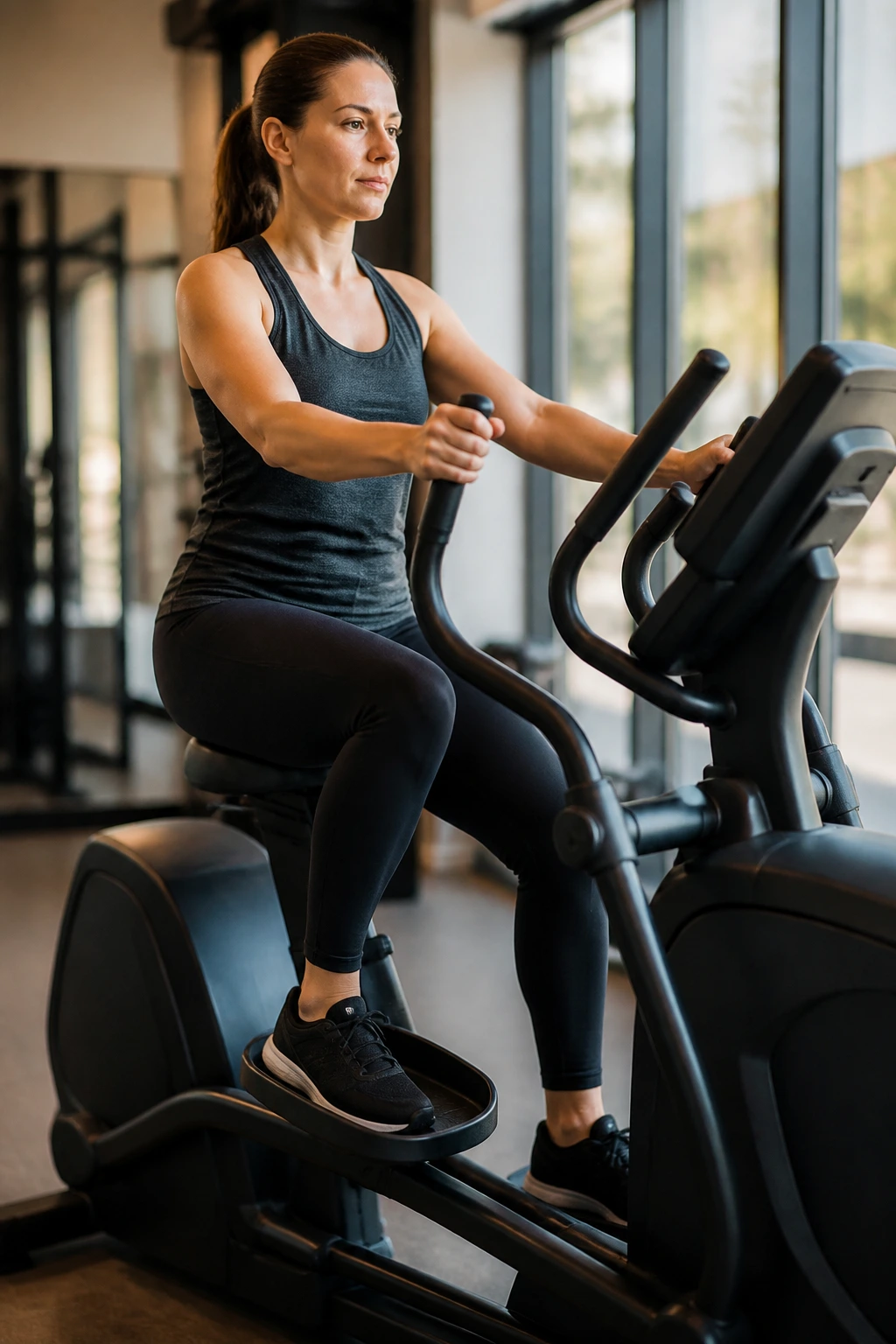
Recovery days still need a plan. Otherwise, “easy movement” turns into awkward half-commits where you never quite warm up and never quite relax.
The Easy Version
Keep the resistance at the very low end and move for 10 to 20 minutes at a pace that feels almost lazy. You should finish with warmer legs, looser hips, and a calmer breath, not a need to sit down immediately. If you’re using the handles, let them move naturally instead of trying to work hard with your arms.
- Effort: RPE 2 to 3
- Resistance: Lowest comfortable setting
- Goal: Circulation, not fatigue
- Good day for it: After strength training, a long walk, or a stiff morning
This is one of the few workouts where doing less really is the smart move. Beginners often think every session has to feel like a challenge. It doesn’t. Some sessions should feel like maintenance. This is one of them.
If you come off the machine feeling better than when you stepped on, you did it right. That’s the whole brief.
20. Final Confidence Check

The final check should feel a little easier than you expected. If it feels like a fight, you’re making it too hard for your current level.
Do 4 minutes easy, 4 minutes steady, 2 minutes with a small resistance bump, 2 minutes easy, then finish with 1 minute steady and 3 minutes cool-down. That gives you a short snapshot of how far you’ve come: can you settle in, can you hold pace, can you handle a little rise, and can you finish without falling apart?
The point is not to impress anyone. The point is to notice that the machine no longer feels strange. Your feet know where to land. Your breathing knows what to do. Your posture has probably improved more than you realized.
If you can finish this session and still want a bit more, that’s a good sign. If you finish it and feel calm, that’s better. Start there next time, then nudge one part — resistance, time, or cadence — a little higher. Small moves add up fast on a cross trainer, and they’re easier to keep showing up for.
