



Body composition changes are boring in the best possible way. They happen when your training gives the body a reason to keep muscle, spend energy, and recover well enough to repeat the process again next week.
That means the flashy stuff is usually the wrong place to put your attention. A workout that leaves you wrecked for three days is not automatically better than one that lets you come back strong two days later. Steady progress beats drama every time.
The best training for this kind of change tends to look a little plain from the outside: heavy lifts, repeatable conditioning, some harder intervals, and enough recovery to keep performance from sliding. Nothing mystical. A barbell, a treadmill, a rower, a sled, a set of dumbbells. The trick is putting them together in a way you can actually live with.
What follows is a set of workouts that do that job well, each one with a slightly different feel so you can build muscle, keep your engine working, and avoid the all-or-nothing trap that ruins more good plans than bad genetics ever will.
1. Heavy Lower-Body Strength Day

Heavy lower-body work is one of the cleanest ways to change body composition because it asks a lot from the biggest muscles you have. Squats, deadlifts, and split squats don’t just burn calories during the session; they also push your body to keep more lean mass around because it has to adapt to the load.
A solid session starts with 4 sets of 4 to 6 back squats, then moves into 3 sets of 6 to 8 Romanian deadlifts. After that, I like 3 sets of 8 Bulgarian split squats per leg and a short finisher such as plank variations or hanging knee raises. Rest 2 to 3 minutes on the squat work, and don’t rush the hinge.
The mistake I see most is people turning leg day into a test of suffering instead of a training session. Don’t grind every rep. Leave 1 to 2 reps in reserve on your main sets so the next week is still available to you. That one habit matters more than chasing one heroic workout. It keeps the work high and the damage low enough that you can keep showing up.
2. Upper-Body Push-Pull Hypertrophy Session

Upper body training often gets treated like an accessory, and that’s a shame. A good push-pull day adds muscle where it shows fast, but it also helps posture, shoulder health, and overall training volume without beating up your joints the way endless max-effort pressing can.
A simple structure that works
Start with a dumbbell bench press or barbell bench press for 4 sets of 8 to 10 reps. Pair that with a chest-supported row for 4 sets of 8 to 10 so your shoulders get balanced work instead of being dragged forward all week. Then add 3 sets of 6 to 8 overhead presses, 3 sets of 10 to 12 lat pulldowns, and finish with 2 sets each of lateral raises, curls, and triceps pressdowns.
The sweet spot here is moderate load, clean form, and enough total work to feel the muscle without turning every set into a fight. 45 to 75 seconds of rest on the accessory lifts is usually enough.
A lot of people overdo chest and underdo back. That gets ugly fast. If your shoulders feel cranky or your pressing stalls, add more rows before you add more pressing.
3. Kettlebell Complex Training
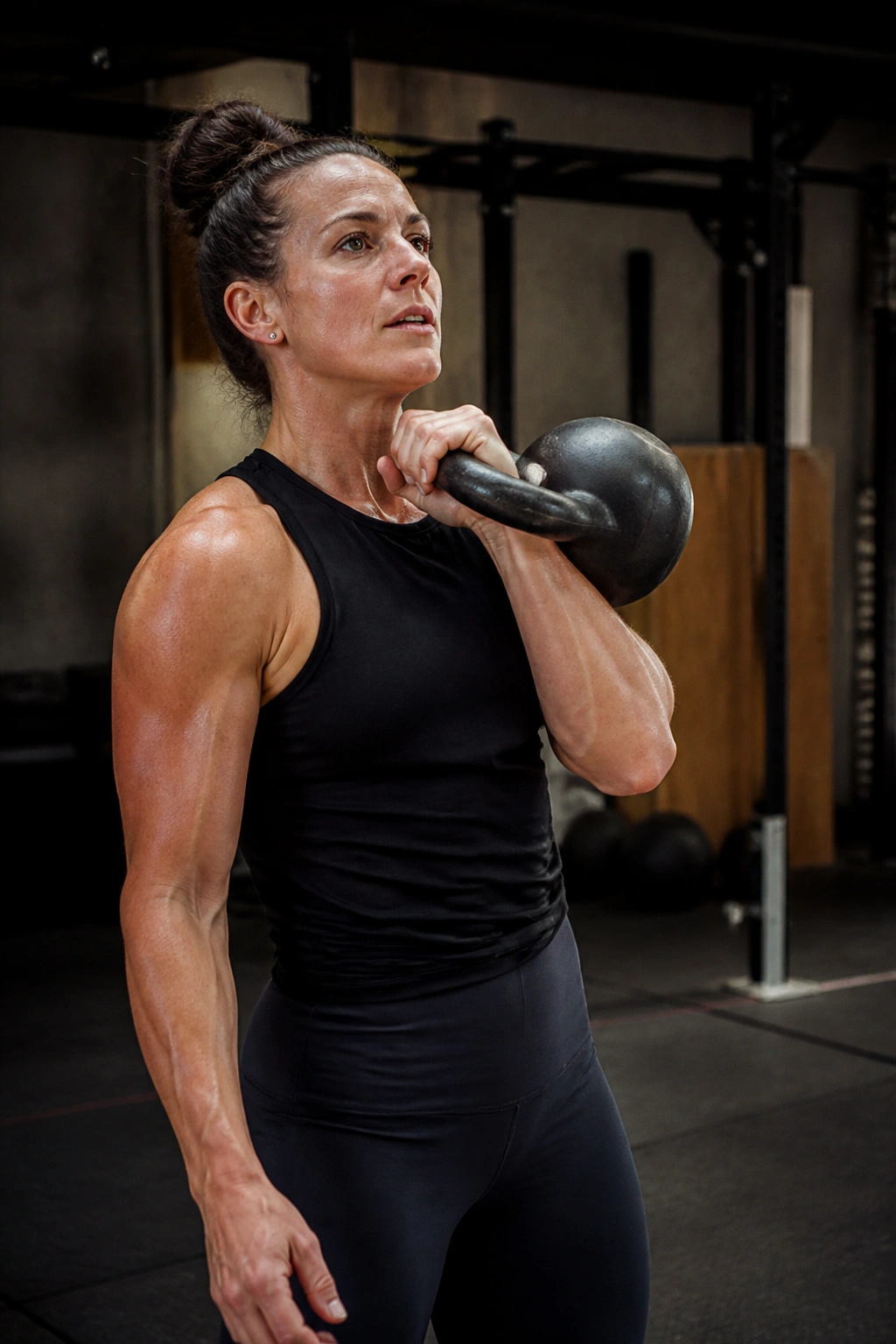
Kettlebell complexes are one of my favorite tools when someone wants conditioning without giving up strength work. You keep the same bell in your hands and move through a short sequence, which means the heart rate climbs while the muscles still have to behave.
Try 5 rounds of 5 cleans per side, 5 front squats, 5 presses per side, and 15 two-hand swings. Rest 90 seconds between rounds. Pick a bell that feels manageable on the press but still meaningful on the swing; if your form falls apart, the bell is too heavy for the sequence.
The point is not to gas out. The point is to create enough work density that the body has to adapt. That gives you a useful mix of strength, coordination, and calorie burn in a single session. It also tends to be easier to recover from than a long brutal circuit, which is part of why it sticks.
Use this on days when you want to train hard but don’t have the appetite for a barbell marathon.
4. Incline Treadmill Walk Intervals

Why does walking show up in body composition plans so often? Because it works without wrecking you. Incline walking builds a lot of weekly movement, drives up energy use, and usually leaves your legs fresher than running does.
Here’s the format: 5 minutes at a flat incline to warm up, then 10 rounds of 2 minutes at 8 to 12 percent incline at a brisk pace, followed by 1 minute easy at a lower incline or slower speed. If you prefer steady work, you can also walk 30 to 45 minutes at a consistent incline where you can still talk, just not sing.
Keep your posture tall and your hands off the rails. That matters more than people think. Hanging on turns a useful lower-body session into a fake one. You want your glutes, calves, and hamstrings doing some work.
This is one of the best options for people who want more calorie output without piling on joint stress. It also slots in well after lifting because it rarely destroys the rest of the day.
5. Zone 2 Cycling

Zone 2 is the workhorse nobody brags about, which is exactly why it belongs here. A bike ride at a steady conversational pace can add a lot of weekly energy expenditure without draining the kind of recovery you need for strength training.
Settle in for 40 to 60 minutes at a pace where you can speak in full sentences and keep your breathing under control. On many bikes, that lands around 60 to 70 percent of max effort, though the exact number matters less than the feel. Your legs should work, but you should not be cooking.
What to watch for
- Keep cadence around 80 to 90 rpm if that feels natural.
- Resist the urge to turn every ride into a race.
- Use a light resistance that lets your knees move smoothly.
- Finish with the feeling that you could do another 10 minutes if needed.
The beauty of this kind of ride is repeatability. You can stack it around lifting days, use it after a stressful week, or keep it as a recovery tool when heavier sessions start to feel sticky.
6. Rowing Machine Intervals

Rowing is honest work. It asks for legs, back, lungs, and timing, and it punishes sloppy technique fast enough that you learn something from it.
A simple interval set works well: 8 rounds of 500 meters, resting 90 seconds between rounds. If you want something less technical, go with 10 rounds of 1 minute hard and 1 minute easy. Either version should feel sharp, not sloppy.
Why it works
The rower lets you drive a lot of total effort into a short window. Your legs push first, your torso transfers force, and your arms finish the pull. If you do it right, it’s a full-body conditioning session rather than a back tug-of-war.
How to use it
- Warm up for 5 to 8 minutes with easy strokes.
- Keep the handle path close to the body.
- Start each drive with your legs, not your arms.
- Stop the set if your low back starts taking over.
That last part matters. A row workout is supposed to build capacity, not turn your spine into the weak link. Clean technique gives you a much better return than brute force.
7. Deadlift and Posterior Chain Day

The backside of the body does a lot of the quiet work in body composition changes. Glutes, hamstrings, spinal erectors, and upper back all need a reason to stay thick and strong, and deadlift-focused training gives them one.
Begin with 4 sets of 3 to 5 deadlifts at a load that looks heavy but stays tidy. Then move to 3 sets of 8 hip thrusts, 3 sets of 10 hamstring curls, and 3 sets of 12 back extensions. Rest 2 to 3 minutes on the deadlifts and a little less on the accessories.
There’s a temptation to max out here. Skip it. A near-limit deadlift once in a while has a place, but steady body composition work likes repeatable fatigue more than occasional chaos. If your technique changes on rep three, the load is too ambitious for the day.
This session usually pairs well with a lighter conditioning day later in the week. The posterior chain tends to respond nicely when you train it hard, then let it recover fully enough to actually adapt.
8. Unilateral Dumbbell Training

Unilateral work is one of the smartest ways to train when you want muscle gain without feeling crushed by the session. One side works at a time, which usually means better control, less cheating, and fewer places for weak links to hide.
A session might include 3 sets of 8 to 12 split squats per leg, 3 sets of 10 one-arm rows per side, 3 sets of 8 to 10 single-arm presses, and 2 to 3 sets of suitcase carries for 30 to 40 meters. Use a moderate load and keep the torso square.
What I like here is the practical value. One leg gets a clean rep. Then the other leg gets its own clean rep. Same with the arms. That makes the work feel honest, and honest work tends to pay off.
It also gives you a lot of training volume without the same systemic fatigue that heavy barbell work can bring. If you’re trying to keep muscle while trimming fat, that’s useful. You get enough stimulus to matter, but not so much exhaustion that you start skipping the next session.
9. Sled Push and Drag Work
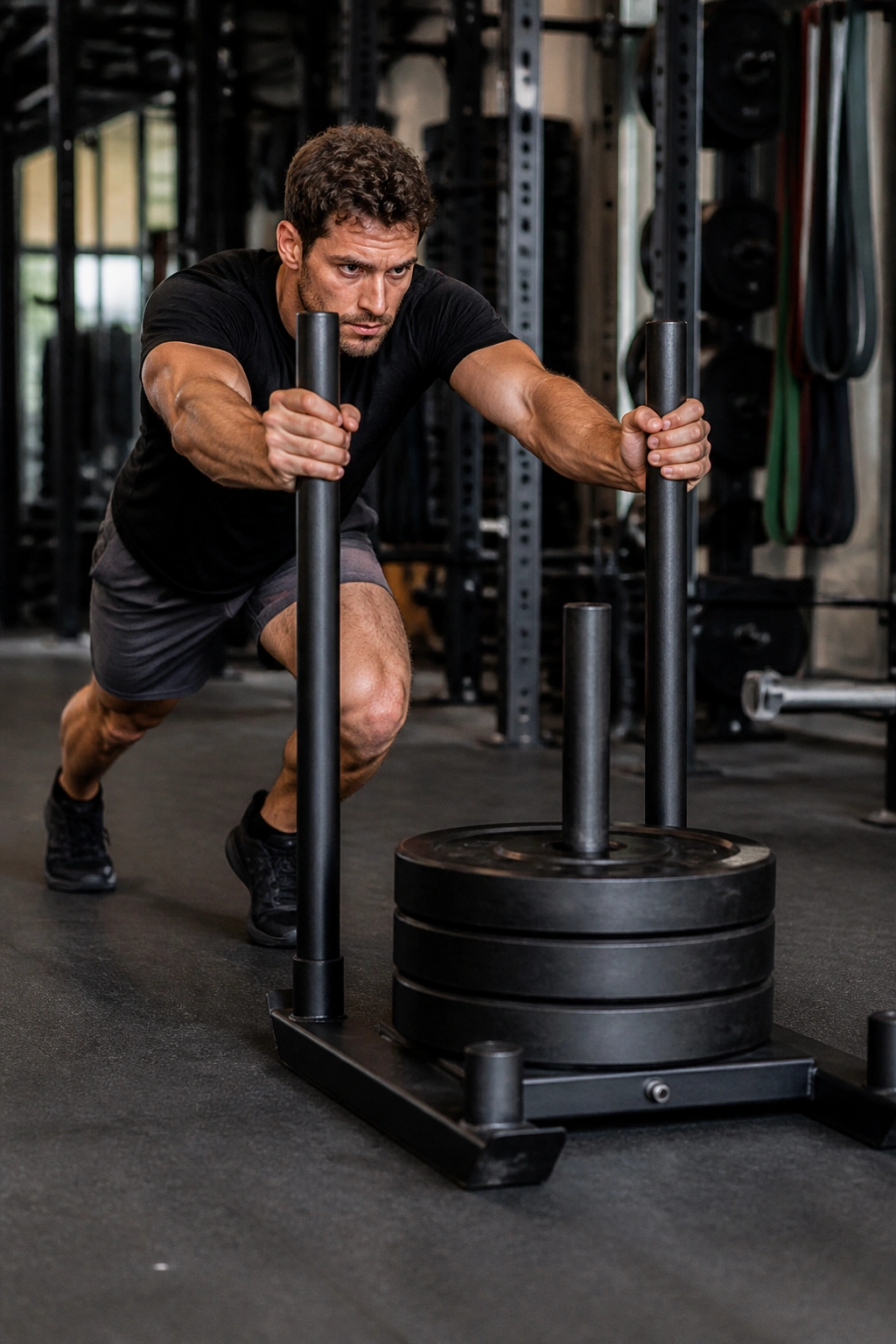
Sled work is brutally simple, and that’s part of why it’s so good. No eccentric lowering. No complicated setup. Just push, drag, recover, repeat.
Try 6 to 10 pushes of 20 to 30 meters, followed by 4 to 6 backward drags of the same distance. Use a load that makes the last third of each push feel demanding without turning into a crawl. Rest 60 to 90 seconds between efforts.
What makes sled work special
It loads the legs hard while keeping impact low. That’s a rare combo. You can challenge the quads, glutes, calves, and lungs without getting the same soreness that usually follows high-volume squats or lunges.
The backward drags are worth keeping. They light up the quads in a different way and are kinder on the knees than people expect. Not magic. Just useful.
Use sled work when you want hard training that doesn’t leave you limping around for two days. It also pairs nicely with a strength session because it adds work without stealing too much from recovery.
10. Bodyweight Density Workout

Bodyweight training gets dismissed too quickly. Sure, it won’t replace heavy lifting forever, but a good density session can keep your work capacity high and add useful volume when life is messy.
Set a timer for 20 minutes and cycle through 10 pushups, 12 air squats, 8 inverted rows or band rows, 10 walking lunges per leg, and a 20-second plank. Move at a steady pace and keep the repetitions crisp. If you finish a round early, use the leftover time to breathe and reset.
Why density matters
The goal is to do more quality work in the same amount of time. That’s the part people miss. Density training is not about reckless speed. It’s about keeping the rest periods honest and the movement clean.
How to scale it
- Use incline pushups if regular pushups break down.
- Swap rows for a pull-up bar if you have one.
- Cut the lunges to 6 per leg if your knees are irritated.
- Add a second round later in the week if the first one feels too easy.
This workout is especially useful when travel, home schedules, or a crowded gym make heavier lifting awkward.
11. Hill Sprint Intervals

Short hills are nasty in the right way. They build power, spike energy use, and usually feel kinder to the body than flat-out sprinting on level ground because the slope naturally shortens the stride.
Run 6 to 10 sprints of 10 to 20 seconds up a moderate hill, then walk back down and recover for 90 to 120 seconds. That’s enough. More is not automatically better here. Form matters, and the quality drops fast if you keep going after the legs start getting sloppy.
Keep the reps short. That’s the whole trick. Once a hill sprint turns into a long grind, you’re mostly training fatigue. The useful work is in the crisp, fast efforts.
I like these for people who want a hard conditioning dose without living on the treadmill. They can also help preserve speed and athletic feel when body composition work starts leaning too heavily toward slow cardio.
12. Machine Hypertrophy Workout

Machines are underrated because they’re boring. And boring is fine when the goal is adding muscle without spending half your session stabilizing a bar.
A good machine-based workout could look like this: 4 sets of 10 leg presses, 3 sets of 12 seated hamstring curls, 4 sets of 10 chest presses, 3 sets of 12 lat pulldowns, 3 sets of 12 seated shoulder presses, and 2 sets of calf raises for 15 to 20 reps. Rest 60 to 90 seconds and keep the last 2 reps challenging.
Why machines deserve a spot
They let you train close to failure with less setup and less technical noise. That means you can focus on the actual muscles instead of worrying about balance or bar path on every rep.
They’re also useful when you’re already fatigued from other training. Free weights are great. Machines are practical. Sometimes practical wins.
A machine day works well during phases when you want a lot of controlled volume and need your joints to stay calm. It’s not glamorous. It is effective.
13. Loaded Carry Sessions

Loaded carries look almost too simple to count, which is probably why people forget how useful they are. Walk with weight in your hands or on your shoulders, and the whole body has to organize itself around the load.
Use farmer carries, suitcase carries, front rack carries, or overhead carries. Do 4 to 6 rounds of 20 to 40 meters for each variation, resting 60 to 90 seconds between carries. Pick a weight that makes your torso work to stay square, not one that forces you to lean and wobble.
The carry drills the kind of strength you can feel in everyday life: grip, trunk stiffness, shoulder position, and posture. It also sneaks in conditioning because moving under load is not cheap for the body.
Suitcase carries are my favorite if someone sits a lot. They ask the obliques and glutes to keep the pelvis level. That sounds small until you realize how much of a mess the average trunk gets after a long week at a desk.
14. Power Complexes

Power complexes sit somewhere between strength work and athletic conditioning. You move a barbell or dumbbells through a sequence of lifts with little rest, and the session ends up feeling fast without turning chaotic.
A barbell version might be 5 rounds of 4 deadlifts, 3 hang cleans, 3 front squats, and 3 push presses. Use a load that you could deadlift for a few more reps if you had to. Rest 2 minutes between rounds. The bar should move crisply; if it turns into a hitchy mess, the load is too much.
What makes them different
Unlike a straight strength day, the complex keeps you under tension across multiple movement patterns. Unlike a long cardio circuit, it still asks for power. That combination is useful for body composition because it hits muscle and work capacity together.
Best use cases
- Short training sessions.
- Athletes who want conditioning without losing explosiveness.
- Lifters who get bored quickly.
- People who like barbell work but need more sweat per minute.
These are not beginner toys. Learn the movements first. Once the lifts are clean, the complex becomes a tidy way to get a lot done in 15 to 25 minutes.
15. EMOM Conditioning Workout

EMOM means “every minute on the minute,” and it’s one of the easiest ways to keep a conditioning workout from drifting into nonsense. You start each new minute with a set amount of work, then rest with whatever time is left.
A good 20-minute EMOM could be: Minute 1: 12 goblet squats, Minute 2: 10 pushups, Minute 3: 12 kettlebell swings, Minute 4: 10 ring rows or dumbbell rows, then repeat the cycle five times. Keep the weights moderate and the reps honest.
Why EMOM works so well
It gives you a built-in pace. That matters. People often train too hard at the beginning of a circuit and spend the rest of the session trying to survive. EMOMs tame that habit by forcing you to respect the clock.
How to scale it
- Cut reps if you’re finishing with less than 15 seconds left.
- Add reps only when you can keep the same pace for all rounds.
- Swap the exercises around, but keep the total work balanced between push, pull, and legs.
- Stop the set if form gets sloppy.
That last point saves sessions. The clock is there to organize the work, not to bully you into ugly reps.
16. Stair Climber Sessions

The stair climber is a simple machine with a nasty personality. It drives the heart rate up fast, loads the lower body in a way that feels familiar and annoying, and can be scaled from steady work to intervals without changing much.
You can use it two ways. For steady work, do 25 to 35 minutes at a pace that lets you keep talking in short bursts. For intervals, try 5 minutes easy, then 10 rounds of 1 minute hard and 1 minute easy, and finish with 3 to 5 minutes to cool down.
Don’t lean on the rails. That’s the biggest mistake. It takes work off the legs and makes the session easier in a way that isn’t helpful. Keep your torso tall and your foot placement deliberate.
This is a solid option when you want a lower-body conditioning hit that doesn’t require a track, road, or bike setup. It’s also easy to measure. Step rate, time, and effort are all right there in front of you.
17. Mobility and Core Work That Actually Supports Training

Mobility and core work do not burn a mountain of calories, and pretending otherwise is silly. Their value is different. They help you move better, recover better, and keep the harder sessions available.
A useful session might be 2 to 3 rounds of 90-second hip flexor stretches, 8 thoracic rotations per side, 10 dead bugs per side, 30-second side planks per side, 10 Pallof presses per side, and 15 ankle rocks per side. Move calmly and keep the positions clean.
Where this fits
If your squats feel stiff, your back feels cranky, or your running form turns ugly after ten minutes, this work matters more than another hard finisher. It keeps the joints from becoming the reason you stop training consistently.
A short checklist
- Breathe through the positions.
- Don’t rush the holds.
- Use a band or cable for anti-rotation work.
- Stop before you turn it into a sweat contest.
The best thing about this session is that it protects the rest of your plan. It isn’t flashy, but it buys you more usable training weeks, and that matters more than a dramatic one-off burn.
18. The Full-Body Density Circuit

This is the workout I’d keep if I had to choose one thing for a busy week and wanted the broadest return. It covers strength, conditioning, and muscle endurance in a way that feels honest without becoming impossible to recover from.
Set up 4 to 5 rounds of 8 goblet squats, 8 pushups, 10 dumbbell rows per side, 10 reverse lunges per leg, 15 kettlebell swings, and a 30-second plank. Rest 90 seconds between rounds. Use loads that keep the final round challenging but still neat. If your form starts getting weird in round two, the pace is wrong.
What makes this one work is the balance. You’re hitting legs, push, pull, hinge, and core in a tight package. That gives the body a clear reason to adapt without turning the session into a punishment ritual. I like it on weeks when training has to be efficient and the goal is to keep momentum, not chase a personal record.
If you build your week around three or four of the workouts above—one heavy lift day, one conditioning day, one hypertrophy day, and one lighter recovery or zone 2 session—you’ve got a very workable setup. Add protein, sleep, and enough consistency to let the plan breathe, and the changes come without the crash that ruins so many good starts.
The funny thing about body composition is that it rewards restraint. Train hard, yes. But train in a way you can repeat, because repeatable work is where the results live.
