



Seated belly fat exercises to do in a chair sound almost too convenient to matter. They matter more than people think—especially on the kind of day when the real choice is not chair workout vs full gym session, but chair workout vs no workout at all.
If your hips feel glued to the seat by midafternoon, your lower back gets cranky after long stretches at a desk, or high-impact moves make your knees complain, chair-based training gives you a way in. You can raise your heart rate, train your core, and break up long sitting spells without dropping to the floor or needing a single piece of equipment beyond a sturdy chair.
There is one catch, and I’d rather say it plainly than sell you nonsense: you cannot burn belly fat from one spot by exercising that spot alone. That old idea has been tested again and again, and it does not hold up. What these seated exercises can do is help you move more, build stronger abs and hip muscles, improve posture, and add enough activity across the day that fat loss around your waist becomes more likely.
And consistency loves convenience. A hard move you never do is useless; a solid 15-minute chair workout you repeat four times a week starts to change things fast.
Why Seated Belly Fat Exercises in a Chair Can Work
Crunches do not melt stomach fat by themselves. A chair workout still deserves a place in your week because fat loss comes from the full picture: how much you move, how much muscle you keep, how often you break long sitting periods, how you eat, and whether you can stick with the plan for more than six days.
Controlled spot-reduction studies keep landing in the same place. Training one body part makes those muscles stronger. Fat loss, though, happens across the body. So when you do seated core work, you are not “burning belly fat” in a direct, surgical way. You are adding calorie-burning movement, building muscle that helps you stay active, and making it easier to keep showing up.
Public-health exercise guidance has hovered around the same target for a long time: about 150 minutes of moderate aerobic activity each week, plus strength work twice weekly. Chair circuits can help you chip away at that total, especially if walking, floor work, or jumping is not practical.
Here’s where seated training earns its keep:
- It lowers the barrier to starting. No mat, no commute, no outfit change.
- It wakes up your core and hip muscles. That helps with posture and daily movement.
- It can push your heart rate up. Fast seated drills are no joke.
- It breaks up long stretches of sitting. That matters more than many desk workers realize.
Tiny sessions count. Stack three 10-minute blocks across a day and you have 30 minutes that did not exist before.
Setting Up a Stable Chair and Strong Sitting Position
Using a rolling office chair with free-spinning wheels? Fix that first.
A chair workout works best with a sturdy, flat chair that does not swivel, slide, or tip. Dining chairs are often better than office chairs for this reason. If a wheeled chair is all you have, push it against a wall and test it before the first rep. Armless is ideal, though low arms can still work if they do not block your elbows or knees.
Sit on the front third of the seat, not buried against the backrest. That small shift changes the whole move. Your feet should land about hip-width apart, flat on the floor, with your knees bent around 90 degrees. Stack your ribs over your hips, lift your chest without flaring it, and keep your chin level rather than poking forward toward a screen.
Breathing matters here—more than most people expect. Exhale as you crunch, twist, lift, or drive a knee up. Inhale as you reset. If you hold your breath, your neck tightens, your shoulders creep up, and the move starts to feel messy.
A few quick setup rules:
- Grip lightly if your hands hold the chair edges. White-knuckle tension travels straight into the neck.
- Keep your shoulders down instead of shrugging.
- Use a smaller lean-back angle if your lower back feels pinchy.
- Stop with sharp pain, numbness, or dizziness. Muscle burn is one thing. Joint pain is another.
Posture is half the exercise.
A 3-Minute Warm-Up for Hips, Ankles, and Rib Cage
Cold hips make seated ab work feel awkward. Stiff ankles make your feet slap around. A tight upper back turns every twist into a neck move, which is not the goal.
Use this quick warm-up before the 18 exercises below. Three minutes is enough.
- Sit tall and breathe for 30 seconds. Inhale through your nose, let your ribs expand, then exhale and lightly brace your stomach as if someone is about to poke it.
- March in place for 30 seconds. Lift one knee, then the other, at an easy pace.
- Roll through your ankles for 30 seconds. Pump your toes up and down, then circle each ankle a few times.
- Rotate your torso for 30 seconds. Hands across your chest, turn left and right without yanking.
- Reach side to side for 30 seconds. One arm up, lean slightly, switch sides.
- Do heel digs for 30 seconds. Extend one heel forward, pull it back, switch.
That’s it.
Your first few reps of the workout should feel smoother, and your lower back usually thanks you for the extra minute.
1. Seated Knee Lifts
Start with this one. It teaches the brace-and-lift pattern you’ll use in half the moves that follow.
Sit tall near the front edge of the chair with both feet flat. Place your hands lightly on the sides of the seat, brace your stomach, and lift one knee toward your chest without rounding your back. Lower it with control, reset your foot, then switch sides. Pause for one full second at the top of each rep.
How to Do It Well
The trick is keeping your torso quiet. If your shoulders rock backward every time the knee comes up, the hip flexors are doing all the work and your core is taking a nap.
Use this quick checklist:
- Lift the knee only as high as you can without collapsing your chest
- Exhale on the way up
- Lower the foot softly, not with a stomp
- Do 10 to 15 reps per side
Good starting point: 2 sets with 20 to 30 seconds of rest.
I like this move early in the workout because it is clean, controlled, and honest. There’s nowhere to hide.
2. Alternating Chair Marches
If one seated move had to carry the cardio side of this workout, chair marches would be high on my list. They look modest. Done with speed and good posture, they push your breathing faster than people expect.
Sit tall, scoot forward on the chair, and start marching briskly. Drive one knee up, then the other, while pumping your arms the way you would during a fast walk. Keep your feet light and quick. The goal is rhythm, not height.
Thirty seconds can feel long here. That’s a good sign.
Try 30 to 45 seconds of work, then rest 15 to 20 seconds. Repeat for 3 to 5 rounds. If you want more core demand, lean back a few inches and keep your hands off the chair. If you want a gentler version, stay upright and slow the pace.
Desk workers tend to like this move because it breaks up stiffness fast. Your hip joints move, your blood gets moving, and you can feel the whole body wake up—legs, abs, arms, lungs.
3. Seated Russian Twists
Need your obliques to wake up fast? This is one of the sharpest ways to do it without standing up.
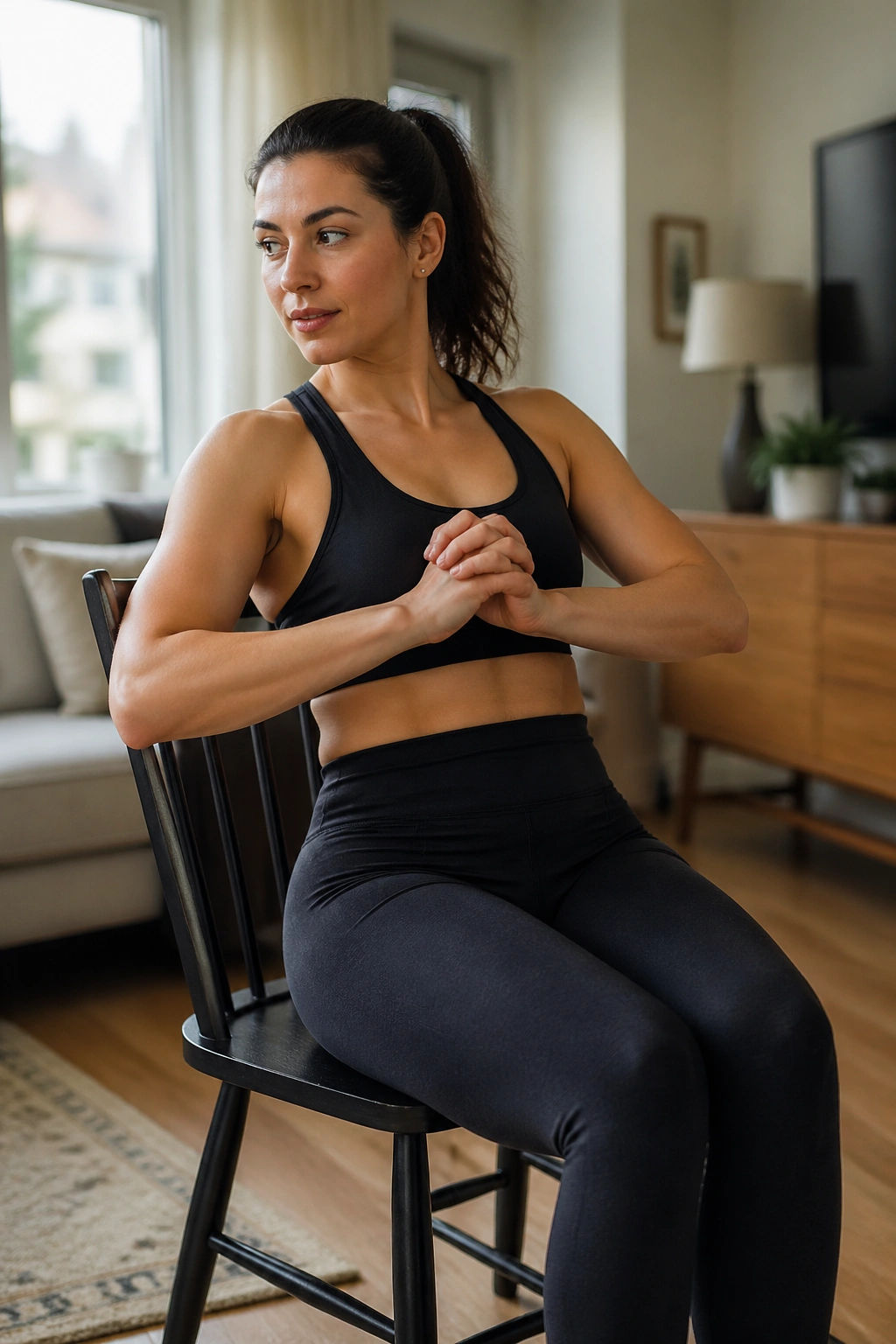
Sit near the chair edge, lean back slightly, and clasp your hands in front of your chest. Rotate your torso to the left, come through center, then rotate to the right. Keep the movement coming from your ribs and waist, not from your elbows swinging like windshield wipers.
Form Check
A common mistake is making the twist huge. Bigger is not better here. If your hips start rocking side to side, or your knees fling around, shrink the range and slow down.
Try 16 to 24 total twists. Count left-right as 2 reps if that helps you keep pace.
Another form fix: keep your chest lifted. Once the chest caves in, the move turns sloppy and your neck jumps in to help. No need for that. A small, crisp twist with a firm brace beats a giant swinging one every time.
4. Chair Toe Taps
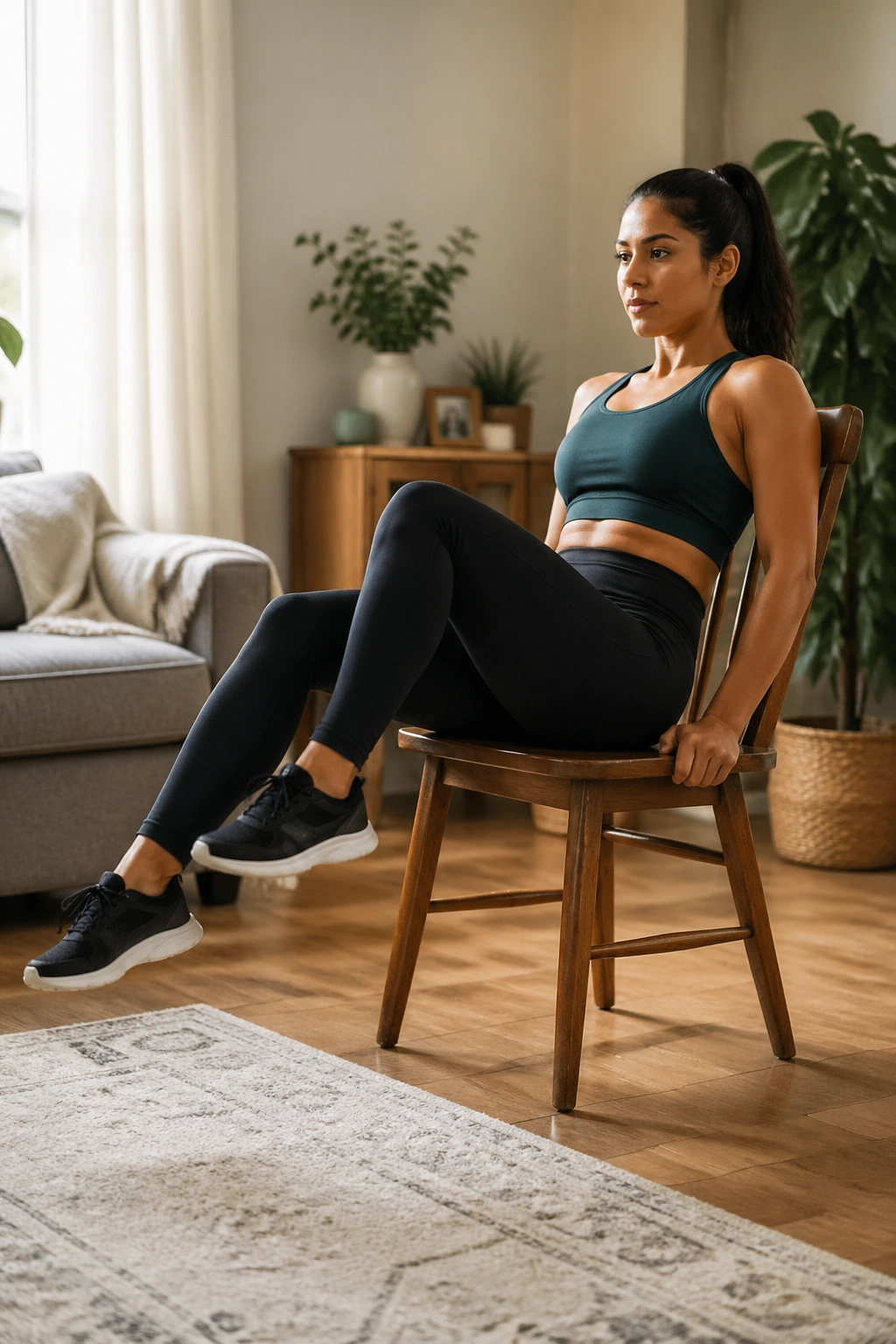
This one fools people. The first five seconds feel easy. Then the lower abs start burning, your thighs light up, and suddenly the chair seems a lot less friendly.
Lean back slightly with your hands holding the seat edges. Lift both feet a few inches off the floor so your knees stay bent. From there, alternate tapping one toe to the floor and then the other while keeping your chest up and your stomach braced.
A few details make a big difference:
- Keep your knees bent around 90 degrees
- Tap the floor lightly rather than dropping your whole leg
- Hold the lean-back angle steady
- Go for 20 to 40 seconds
If both feet off the floor feels like too much, start with one foot lightly planted and one foot tapping, then switch. If you want more burn, straighten the knees a little farther away from the chair.
This move is sneaky. I mean that as a compliment.
5. Seated Bicycle Crunches

A seated bicycle crunch gives you two jobs at once: rotation through the torso and extension through the opposite leg. That combo makes it more demanding than a plain knee lift, and you feel it across the front and sides of the waist when you do it right.
Sit tall with your hands lightly behind your head. Lift your right knee and rotate your left elbow toward it as you extend the other leg forward. Return to center, plant both feet for a beat if you need to, then switch sides. Think of the rib cage moving toward the hip, not the elbow yanking across space.
Go slow at first. Momentum ruins this move fast.
Neck strain is the usual problem. Keep your elbows wide, eyes forward, and fingertips light. If your hands are dragging your head around, put them across your chest instead. That version is still tough, just cleaner.
Aim for 8 to 12 reps per side. Exhale each time the knee and elbow come together. The squeeze should feel deep through the midsection, not jammed into the front of the neck.
6. Lean-Back Chair Hold
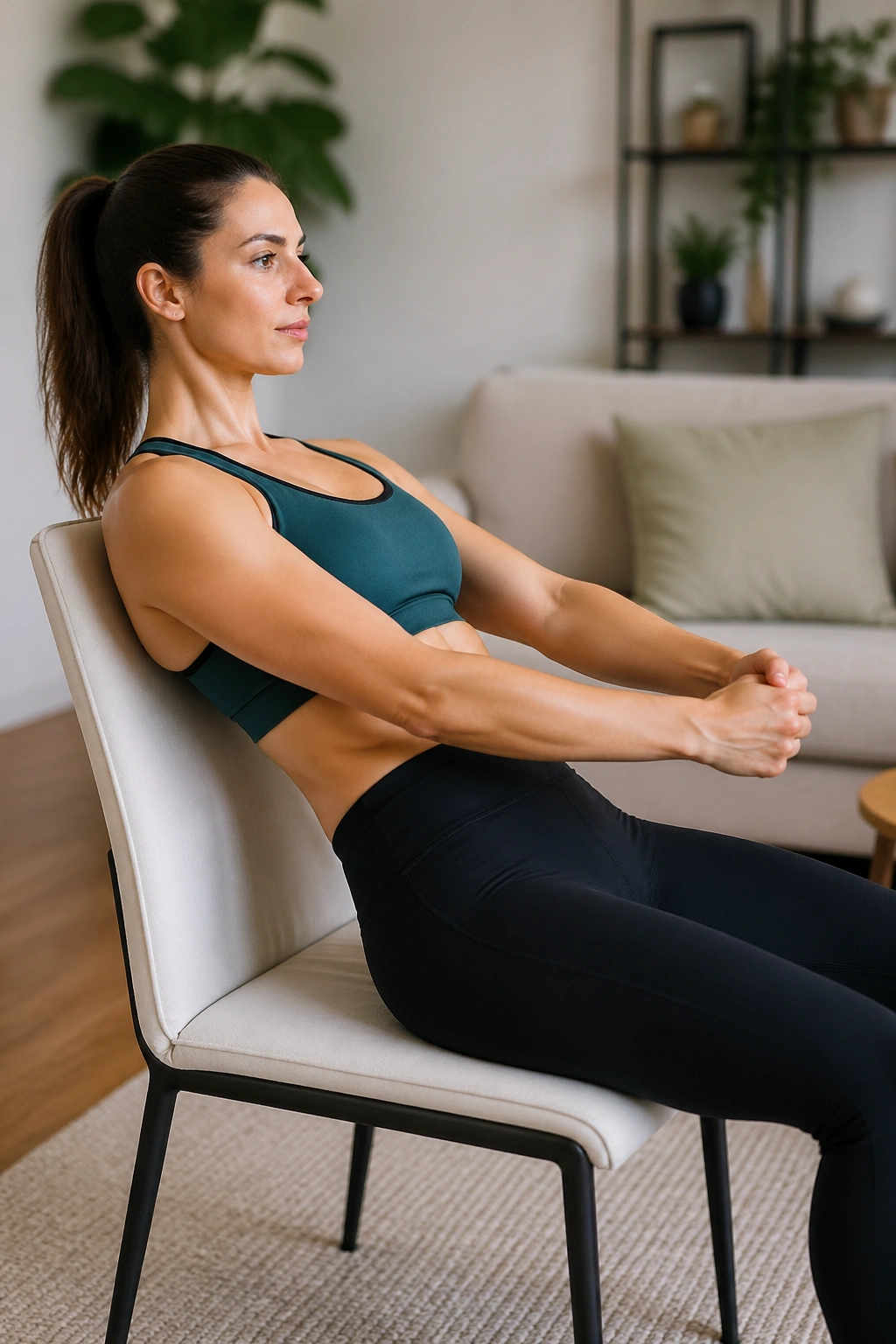
Unlike twists, marches, and punches, this one barely moves. That’s the point.
The lean-back chair hold is an isometric move, which means your muscles work without changing length much. Sit at the chair edge, place your hands beside your hips or cross them over your chest, then lean back 4 to 8 inches until your abs switch on. Hold that position while keeping your chest open and your lower back long, not collapsed.
You will know the right angle when your stomach tightens and your breathing gets harder, but your back still feels safe. If your low back pinches, come up a little.
Hold for 15 to 30 seconds, rest, and repeat 3 times. Want more? Lift one foot an inch off the floor for a few seconds, set it down, then lift the other. Tiny changes make this move bite harder.
I’m fond of this exercise because it teaches something people skip: bracing before motion. If you can hold tension here, your knee lifts, twists, and kicks usually look better afterward.
7. Seated Knee-to-Elbow Crunches
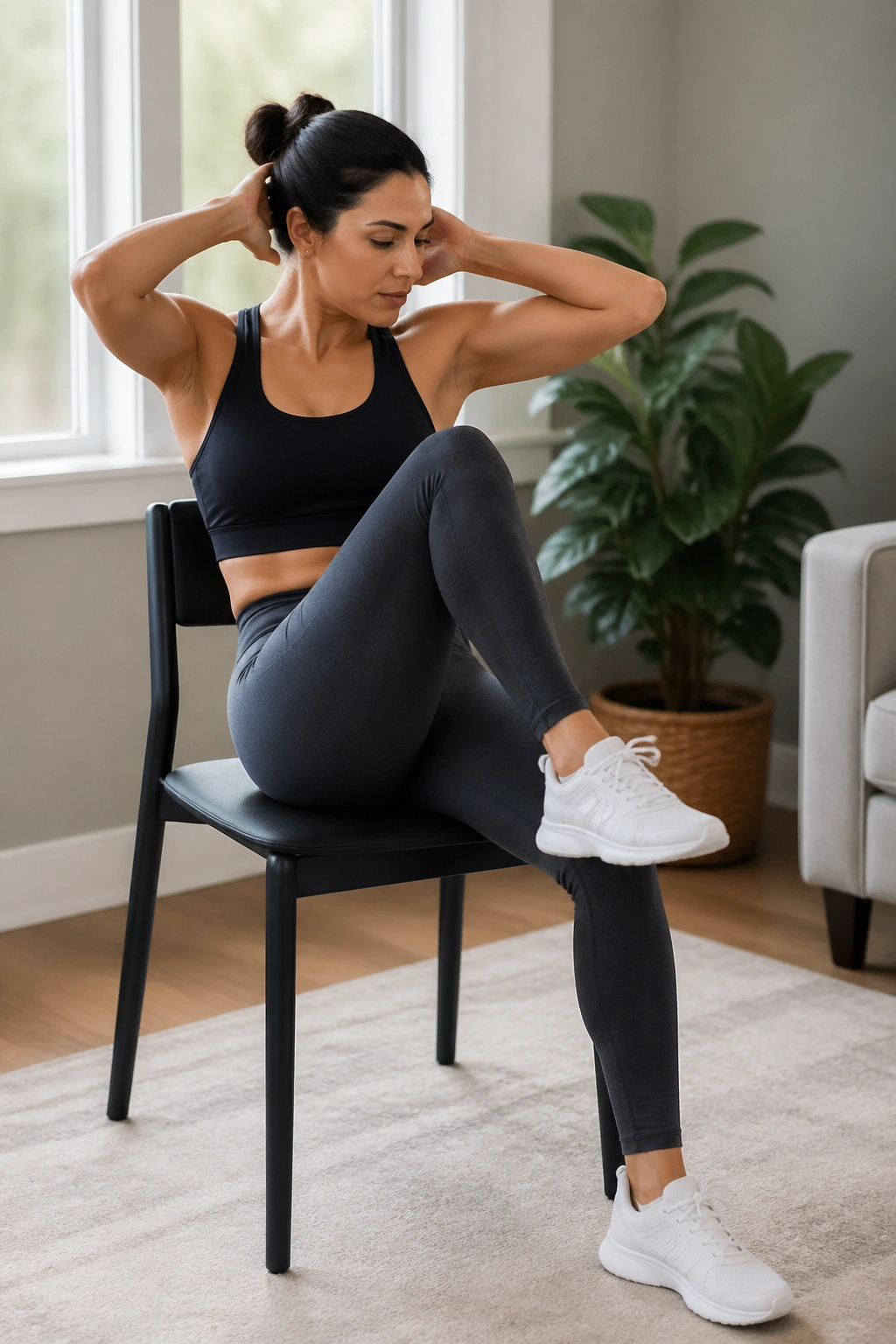
This is the upright cousin of the bicycle crunch. Less coordination. More control. On days when your brain is fried and you still want to train, that matters.
Sit tall and place your hands lightly behind your head or keep them at your temples. Lift your right knee as you rotate your left elbow toward it. Reset both sides fully. Then switch. Do not rush the return; the reset is where your posture comes back.
Make It Cleaner
Use these cues if the move feels awkward:
- Bring the ribs toward the hip, not only the elbow toward the knee
- Plant the down foot hard into the floor for stability
- Keep your chest broad
- Do 10 to 14 reps per side
A small pause at the top helps. So does exhaling sharply, almost like you’re fogging up a window. That breath cue tightens the stomach better than “squeeze your abs” ever does.
8. Straight-Leg Chair Raises
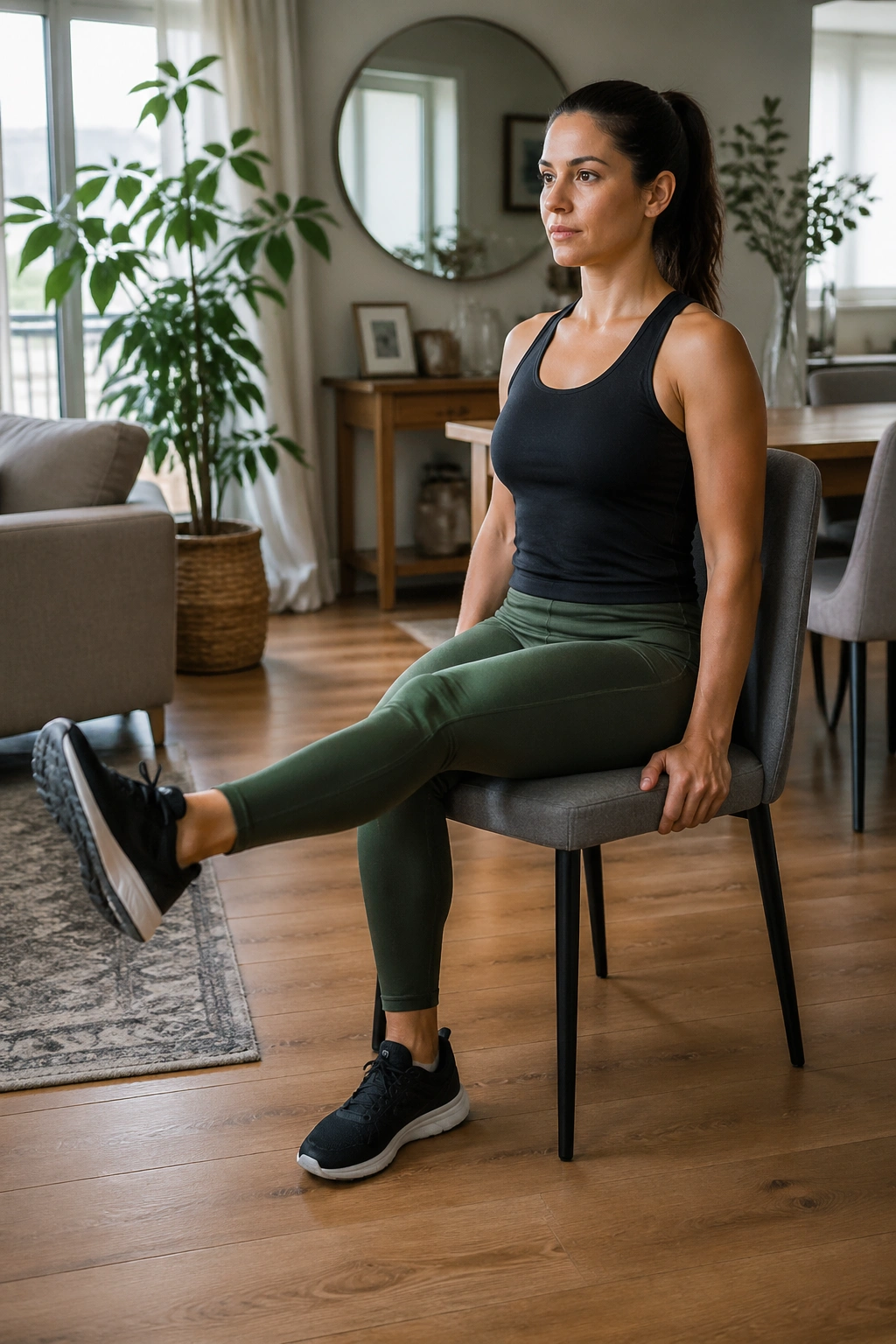
Straight legs change the difficulty in a hurry.
Sit near the front edge with your hands gripping the chair lightly. Extend one leg straight so the heel hovers off the floor, toes pulled toward your shin. Lift that leg 4 to 8 inches, lower it slowly, and repeat before switching sides. The higher you lift, the more people try to lean back and cheat, so keep the range modest and the torso tall.
This move hits the lower abs, hip flexors, and quads. You’ll feel it near the front crease of the hip too. That is normal. Sharp pinching inside the joint is not. If that shows up, bend the knee a little or switch to knee lifts.
Try 8 to 12 raises per side with a one-second pause at the top. The slower lowering phase matters. Count “up-one, down-two” if you need rhythm.
Advanced version? Lift both legs together for 5 to 8 reps. Fair warning: that version humbles people fast.
9. Seated Double-Knee Tucks
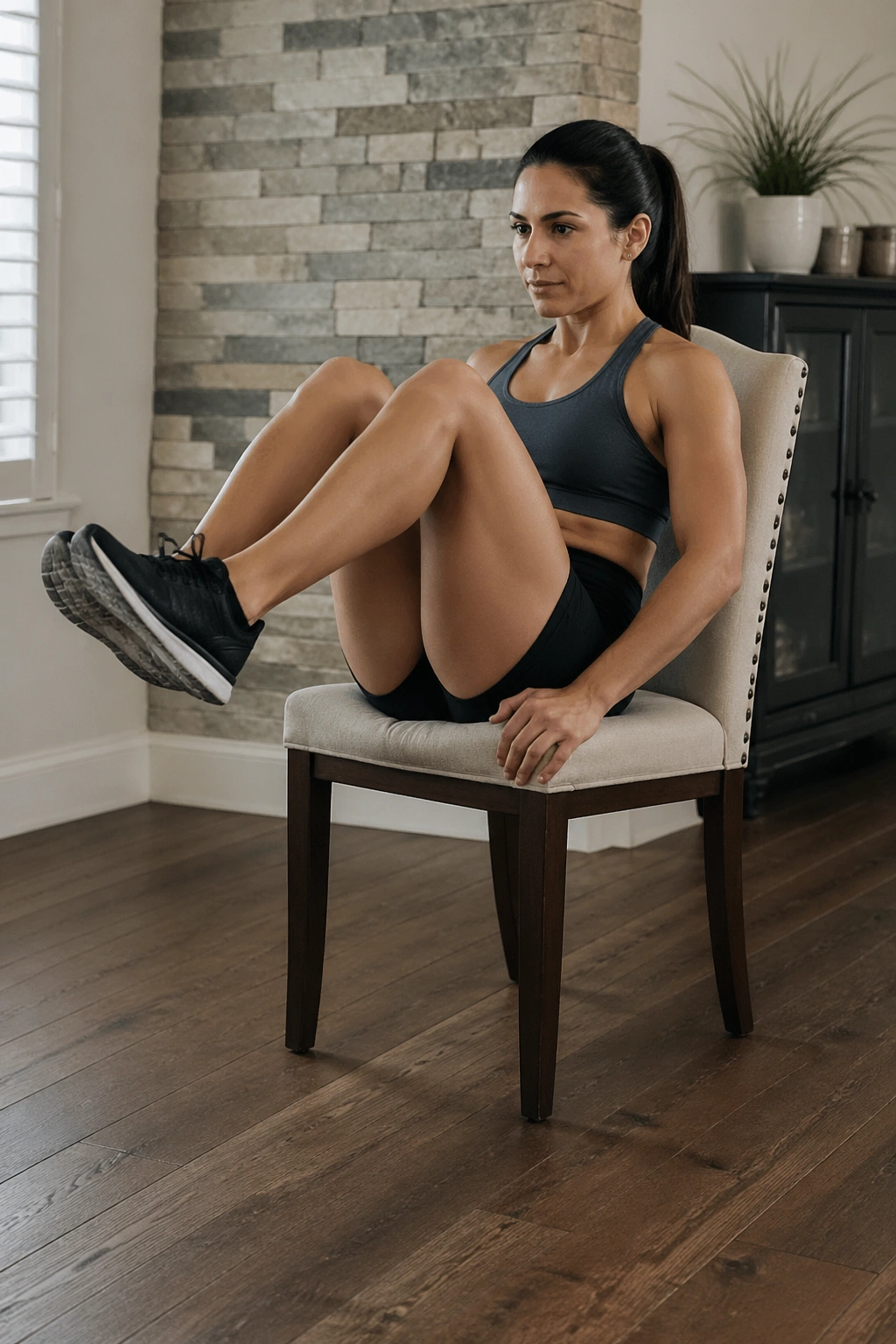
Want one of the best chair-based moves for the whole midsection? Here it is.
Sit at the chair edge, lean back slightly, and hold the seat sides. Start with both knees bent and feet on the floor. Lift both knees toward your chest while you lean back a touch more, then extend the legs away again without fully locking the knees. Think tuck and reach, not swing and collapse.
Start Small
The first few times, keep the leg extension short. You do not need to straighten out like a gymnast to make this work. A compact range often feels better on the back and keeps more tension where you want it.
Use 8 to 15 reps. Exhale during the tuck. Inhale during the reach.
If you lose posture halfway through, stop there. Sloppy extra reps do not buy much. Clean sets do.
10. Seated Scissor Kicks
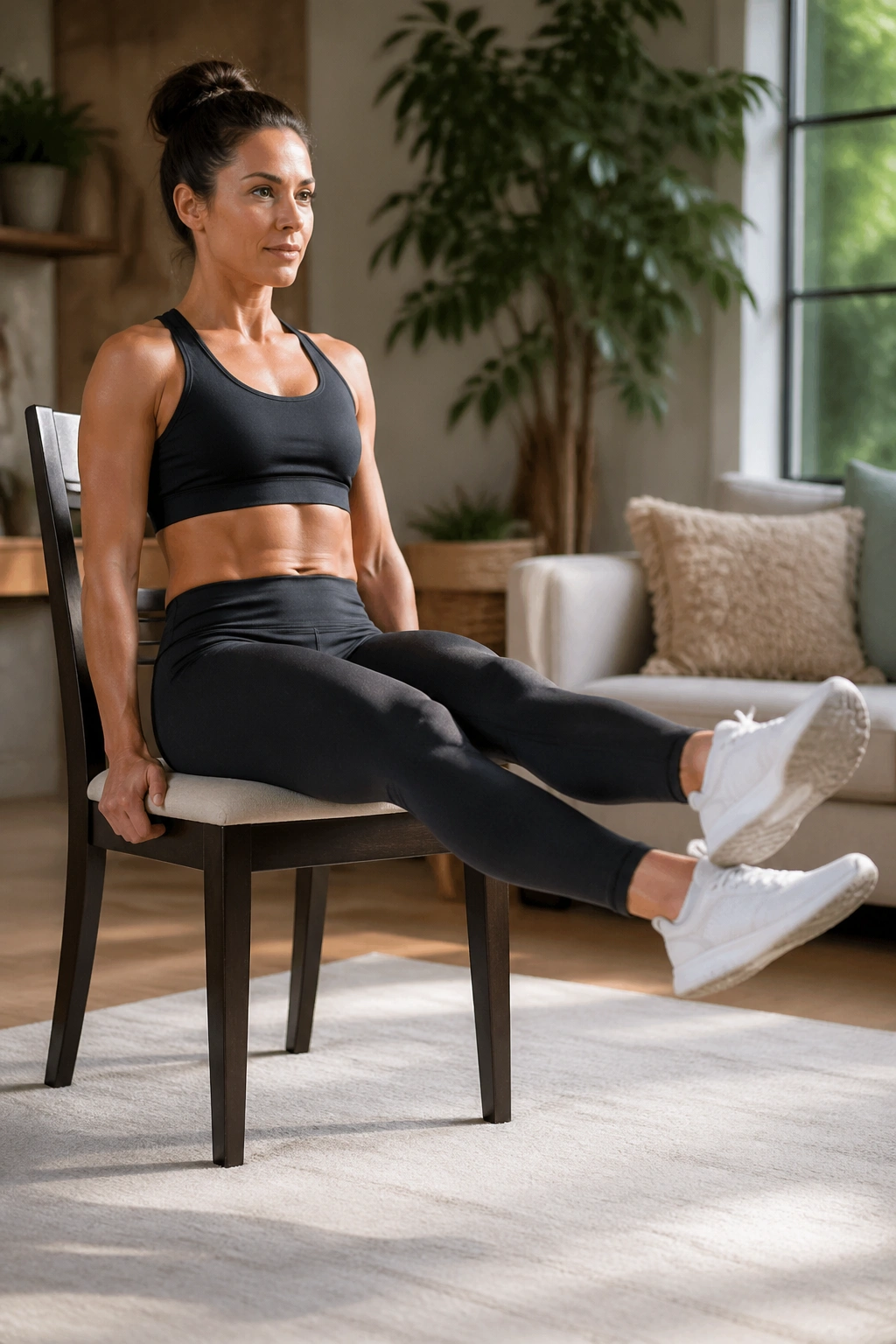
There’s a moment in this move—usually around the 15-second mark—when your abs start shaking and your brain tries to bargain with you. That means the set is doing its job.
Lean back a few inches with your hands holding the chair edges. Extend both legs in front of you and cross one leg over the other in a scissor pattern, then switch which leg is on top. Keep the kicks small and quick rather than wide and dramatic.
Quick pointers:
- Keep the legs about 6 to 12 inches off the floor
- Hold your chest up
- Cross from the hips, not the ankles
- Work for 15 to 30 seconds
If your lower back arches hard, bring the legs a little higher or bend the knees. People think lower is always better. Not if the form falls apart.
Small scissors. Tight stomach. Steady breath.
11. Cross-Body Chair Punches
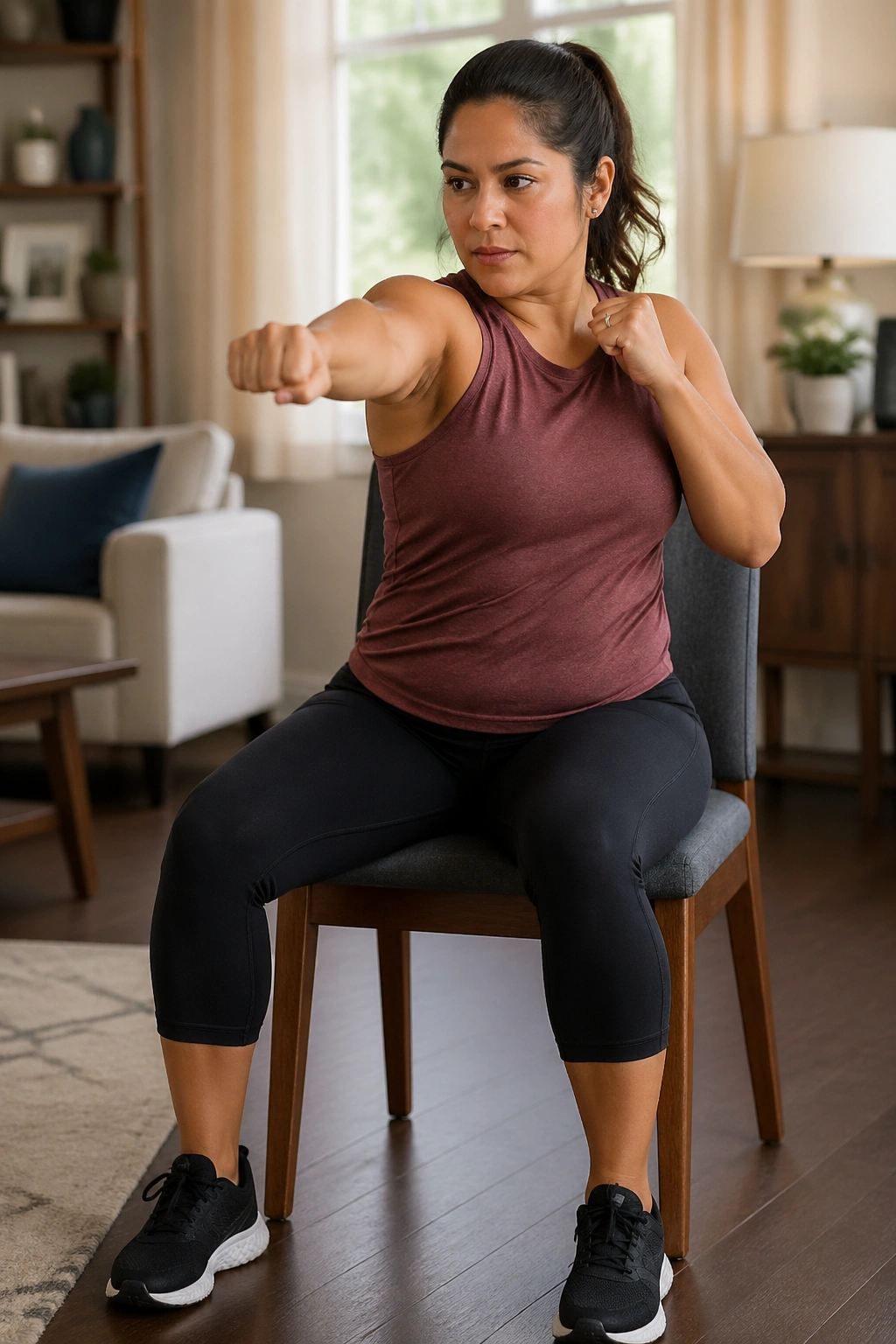
A good seated punch combo does more than train the arms. It turns your whole chair into a little cardio station.
Sit tall and plant your feet wide enough to feel stable. Bring your hands to chin height like a boxer’s guard. Punch one fist across your body, rotate through the rib cage, snap it back, then punch with the other hand. Add speed once the motion feels clean. For extra work, pair each punch with a small opposite knee lift.
This move shines when you want to lift the heart rate without loading the knees. Your obliques help brake and reverse the rotation, your shoulders work, and your breathing picks up in a hurry. Go for 30 to 45 seconds at a strong pace.
The trap here is punching from the elbow alone. Reach through the shoulder, rotate the torso, and pull the fist back fast. That return matters. Boxing trainers care about the recoil for a reason—it keeps tension on the body.
I like this one in the middle of a session, right when energy dips.
12. Chair Mountain Climbers
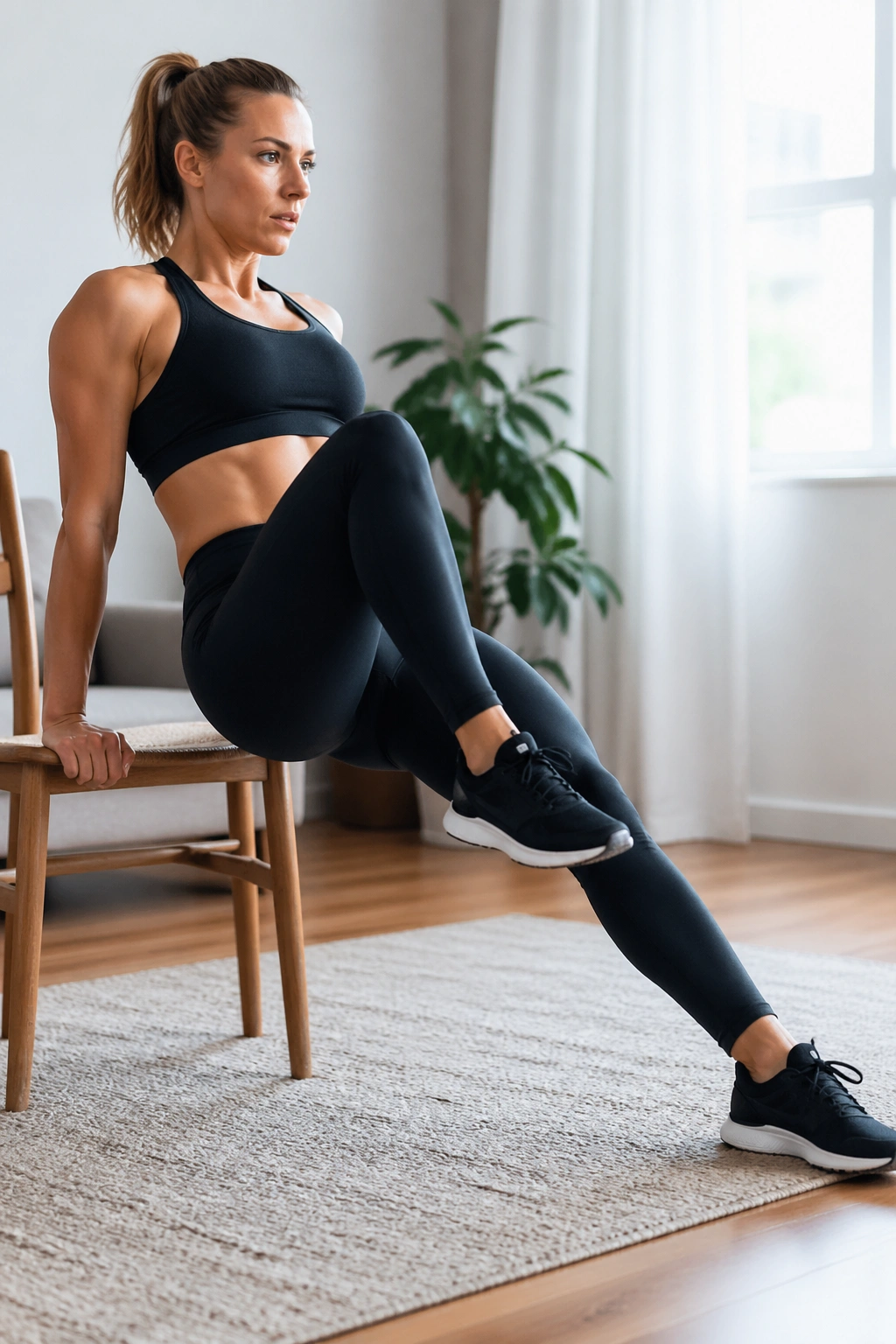
Floor mountain climbers are not friendly for everyone’s wrists, shoulders, or knees. Chair mountain climbers give you the same fast knee-drive feeling with less hassle and less time spent getting down and back up.
Sit near the edge, lean back, and grip the seat. Lift one knee toward your chest, switch in the air, then keep alternating at a brisk pace. The torso stays slightly reclined the whole time, which keeps the core switched on. Think of it as a harder, lower, faster chair march.
Who should use this? People who want a cardio-core hybrid without impact. Who should skip it? Anyone whose lower back gets cranky in a reclined position—at least until the basic march and knee lift feel solid.
Run this drill for 20 seconds hard, rest 10 seconds, and repeat 4 to 6 rounds. Short bursts work best. If you can chat comfortably through the whole thing, pick up the speed or lean back a little more.
13. Seated Side Bends
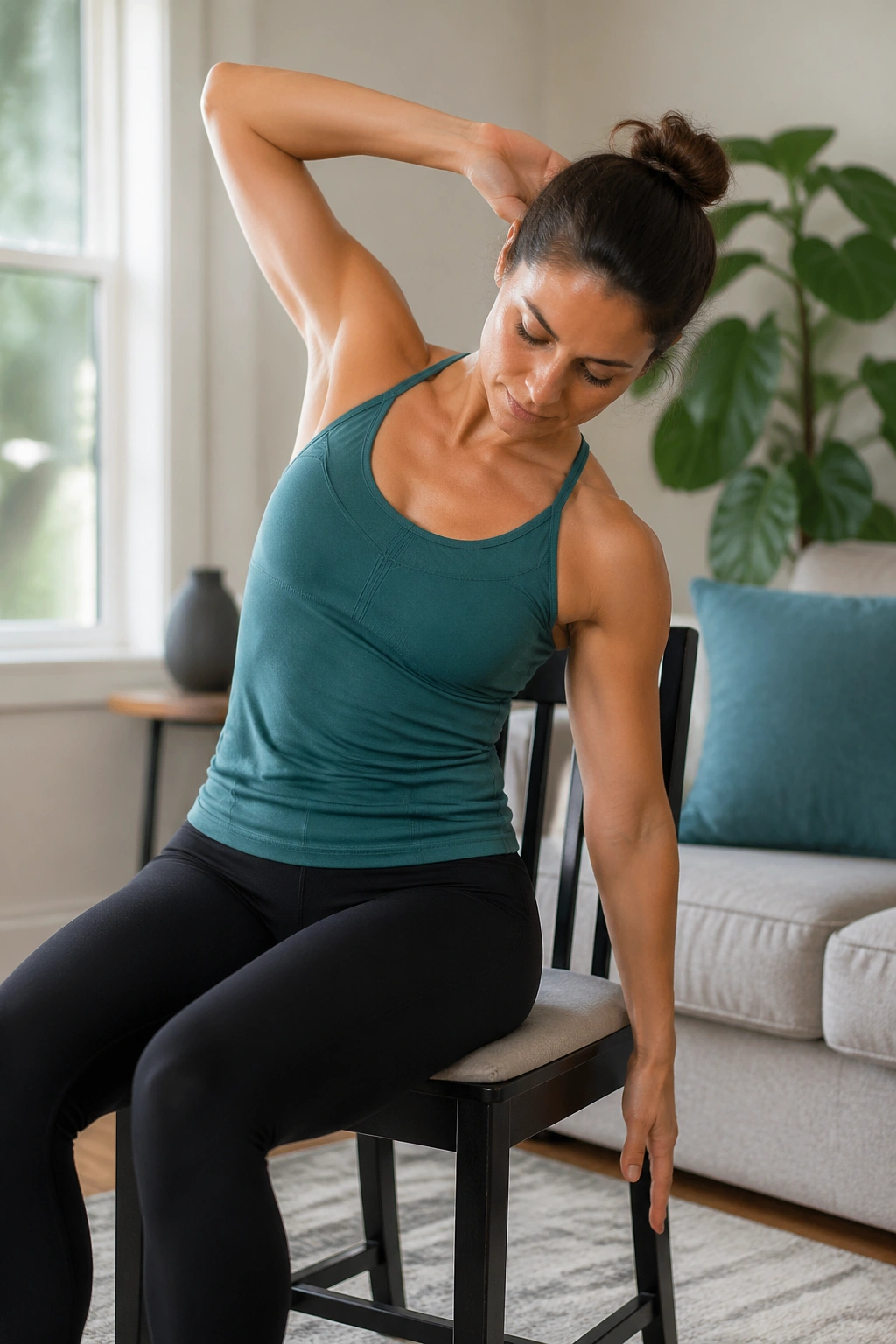
Not every core move needs to be frantic. Side bends slow things down and force you to control the rib cage, which many people lose the second a workout speeds up.
Sit tall with one hand behind your head and the other hand reaching down beside the chair leg. Bend gently to the side, then return to center using your obliques. Do all reps on one side before switching. You can also hold a light water bottle or dumbbell in the lowering hand if you want more load.
Where You Should Feel It
You’re aiming for the side of the waist, between the lower ribs and the top of the hip. The neck should stay long. If the head is dropping or the shoulders are shrugging, reset.
Try 10 to 15 reps per side with a two-second lowering phase. Slow side bends pair well with faster moves like punches or jumping jacks because they pull your form back together.
This one looks old-school. It still works.
14. Seated Jumping Jacks
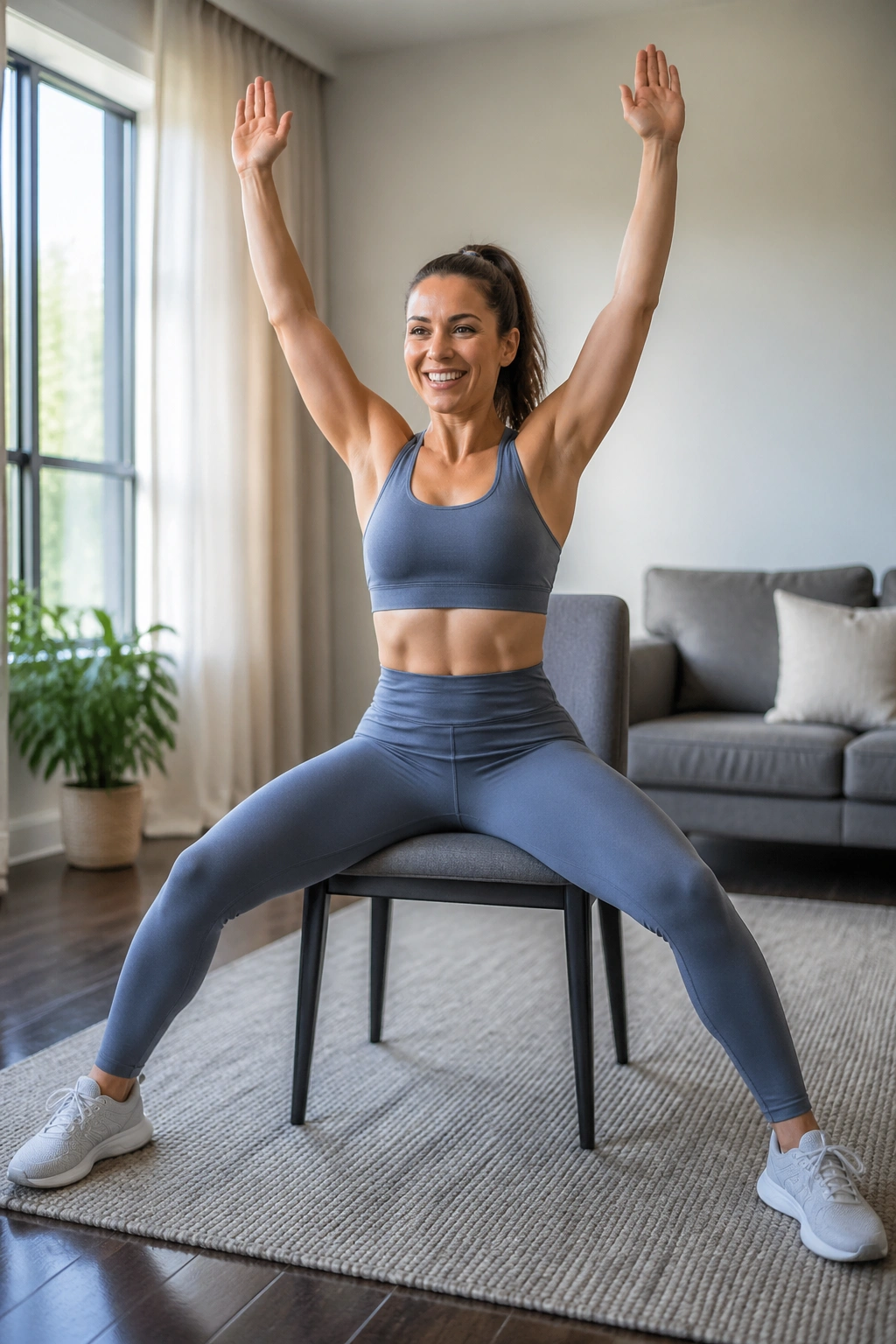
No jumping. Same basic pattern. Plenty of burn.
Sit upright on the chair edge with your feet together and arms at your sides. Open your legs wide while sweeping your arms overhead, then snap everything back to the start. Move with speed, but do not throw yourself around. The chest stays lifted and the belly stays lightly braced so the motion does not turn floppy.
Seated jacks are one of the best chair drills for raising heart rate fast. They also feel less monotonous than repeated marches, which matters when you’re trying to keep a workout habit alive. A move you hate tends to disappear from the schedule. A move with a bit of rhythm sticks around.
Use 30 to 60 seconds per round. Shorter rounds suit hard effort; longer rounds fit a steady cardio block. If shoulder mobility is limited, sweep the arms only to shoulder height and keep the same leg pattern.
This is a good one to play music for.
15. Seated Flutter Kicks
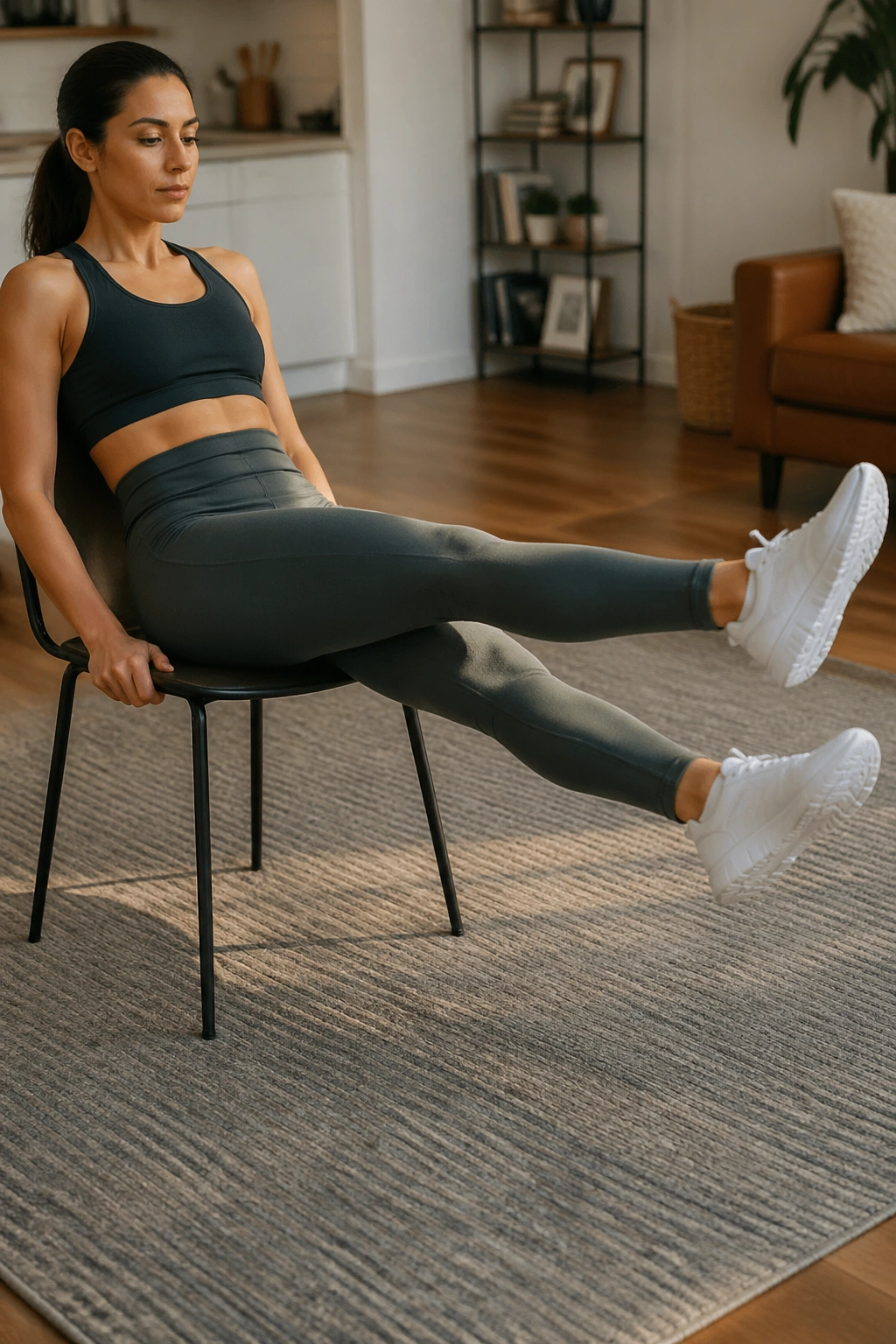
Why do small kicks feel so brutal? Because the legs act like long levers, and long levers make your core work overtime.
Lean back slightly, grip the chair sides, and extend both legs. Kick one foot up a few inches while the other drops a few inches, then switch in a fast flutter pattern. The movement is tiny. Your stomach should stay tight enough that the torso barely changes position.
Keep the Kicks Low Enough to Challenge You—But Not So Low That Your Back Arches
That sweet spot is different for everyone. Start with the heels around mid-shin height off the floor. If your back stays neutral, lower them a bit. If your abs lose tension, bring them up again.
Shoot for 15 to 30 seconds. Add 5 seconds at a time across sessions. That slow build works better than trying to gut out a minute on day one and wrecking your form halfway through.
16. Overhead Reach With Knee Drives
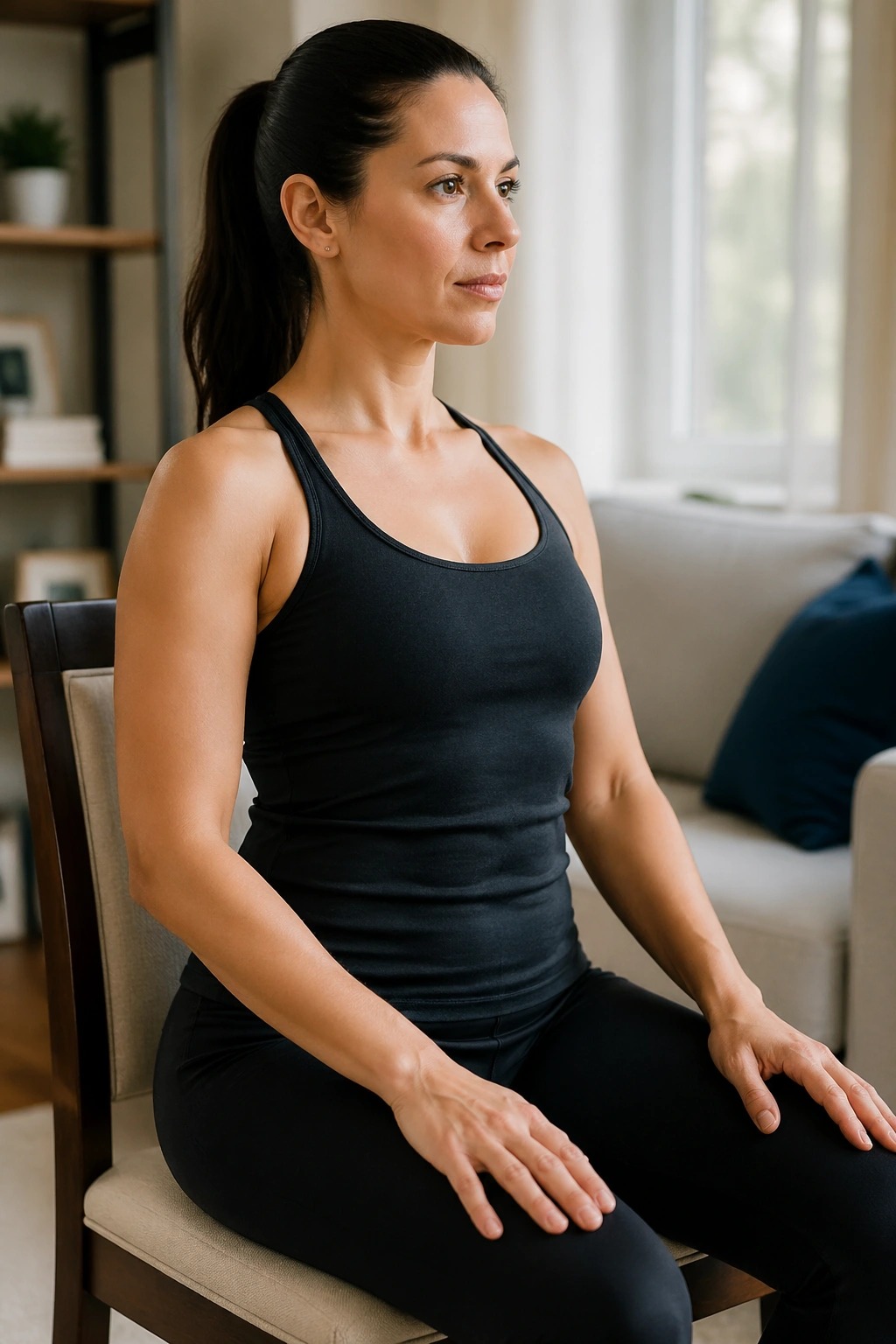
Picture a standing high-knee pull-down, then shrink it into a chair. Same idea. Good heart-rate bump. Nice full-body feel.
Sit tall and raise both arms overhead. Drive your right knee up as you pull both elbows down toward it, almost like you’re trying to crunch your rib cage toward your hip. Reach back up, reset tall, then switch sides. Once the rhythm clicks, move at a brisk pace.
A few details make this move better than it looks on paper:
- Start each rep from a long spine
- Pull the elbows down with intent, not lazily
- Land the working foot softly on the reset
- Do 12 to 20 reps per side or 30 to 40 seconds
This is one of my favorite “I only have 8 minutes” drills because it feels athletic without needing space. Arms, abs, hips, lungs—everyone has a job.
17. Figure-Eight Pass Under the Knee
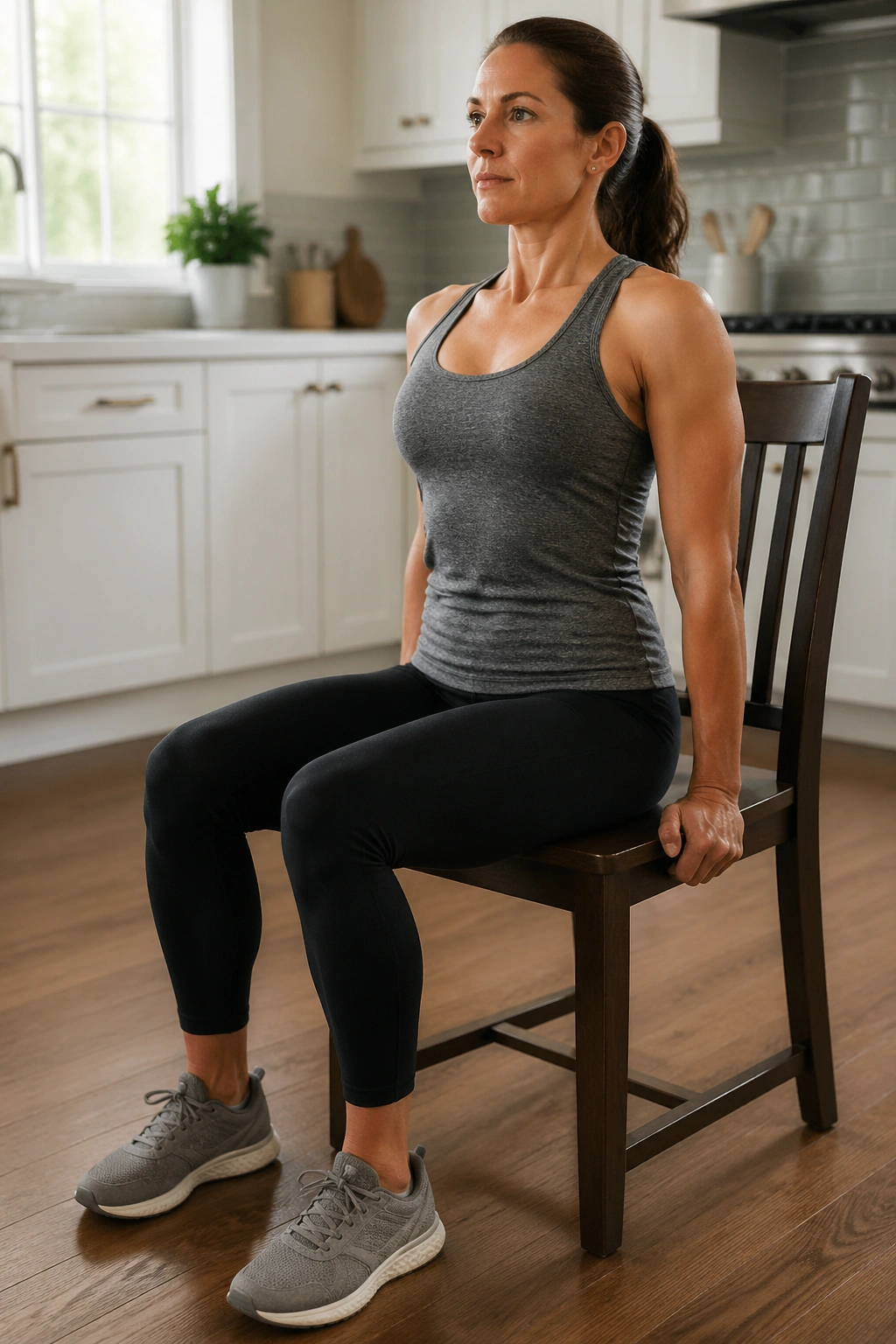
This move is a little odd at first. Good. Odd is useful when it wakes up coordination and makes your core work from angles your usual crunches miss.
Sit at the chair edge and lift one knee. Pass both hands under that knee, around the outside, and back to the front in a figure-eight path. Lower the foot, switch knees, and repeat. You can clasp your hands together or hold a small towel if that helps you feel the path of the movement.
Because the hands are weaving while the knee lifts, your torso has to resist tipping and twisting too much. That is the hidden challenge. Go slow enough to keep the path smooth. This is not a speed contest.
Try 8 to 10 figure-eight passes per side. If you want more burn, hold the knee higher and move the hands faster. If balance is shaky, touch the down foot firmly between reps and keep the lift compact.
It’s quirky. It earns its place.
18. Fast Feet at the Chair Edge
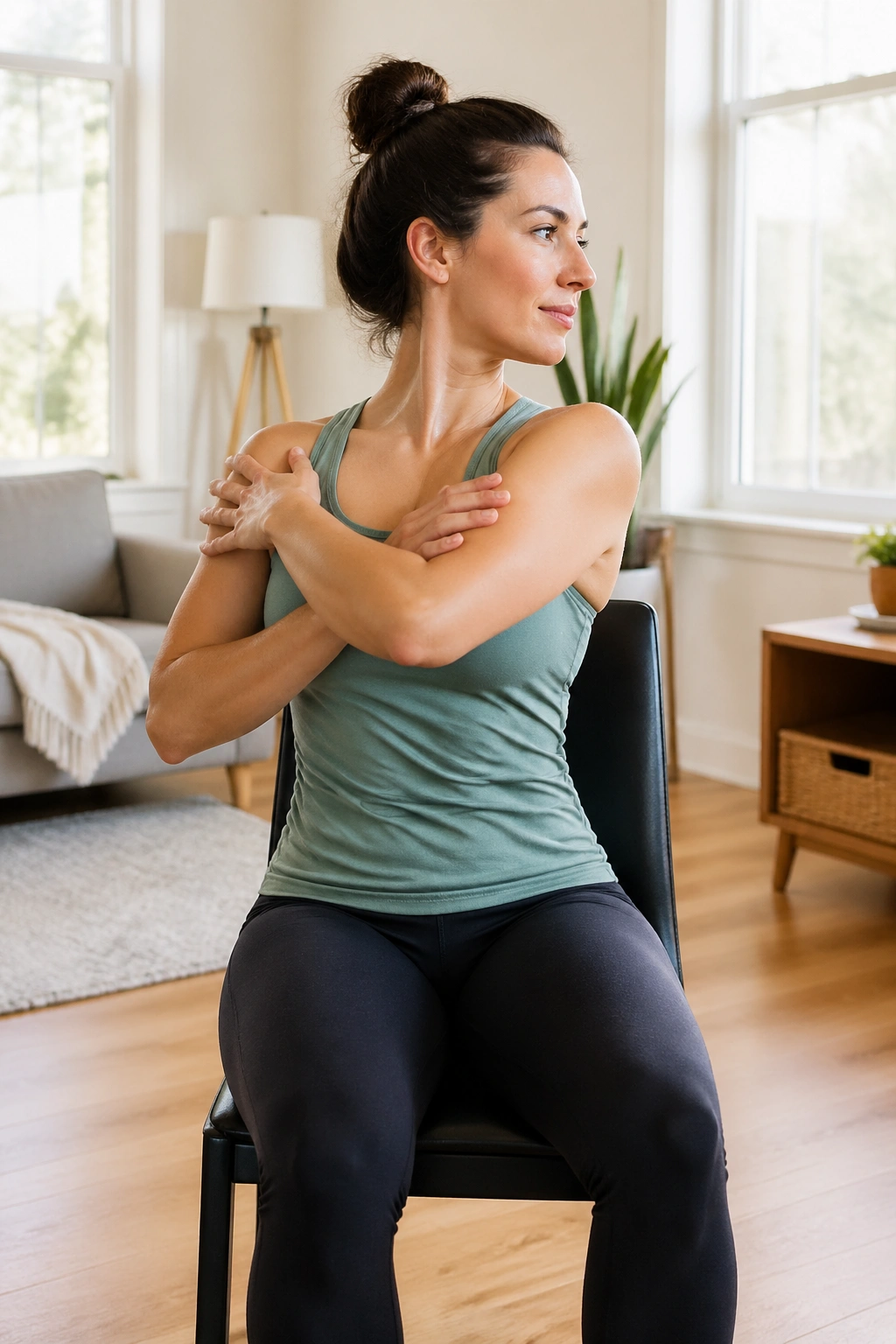
Short burst. Big finish.
Scoot to the front of the chair, lean forward a hair from the hips, and tap your feet on the floor as fast as you can while pumping your arms. Think of a sprinter’s feet—quick, light, noisy if they have to be. Your abs brace to keep the trunk from wobbling all over the place.
This move works best as a finisher or between slower strength-based drills. Go hard for 15 to 20 seconds, rest 10 to 15 seconds, then repeat for 4 to 8 rounds. The short work period lets you push the pace high enough to matter.
A few coaching notes:
- Keep the taps small and rapid
- Stay on the chair edge, not reclined
- Breathe in quick bursts instead of holding tension
- Stop when the feet slow down sharply
Fast feet are not fancy. They are effective.
A 20-Minute Plan Using Seated Belly Fat Exercises
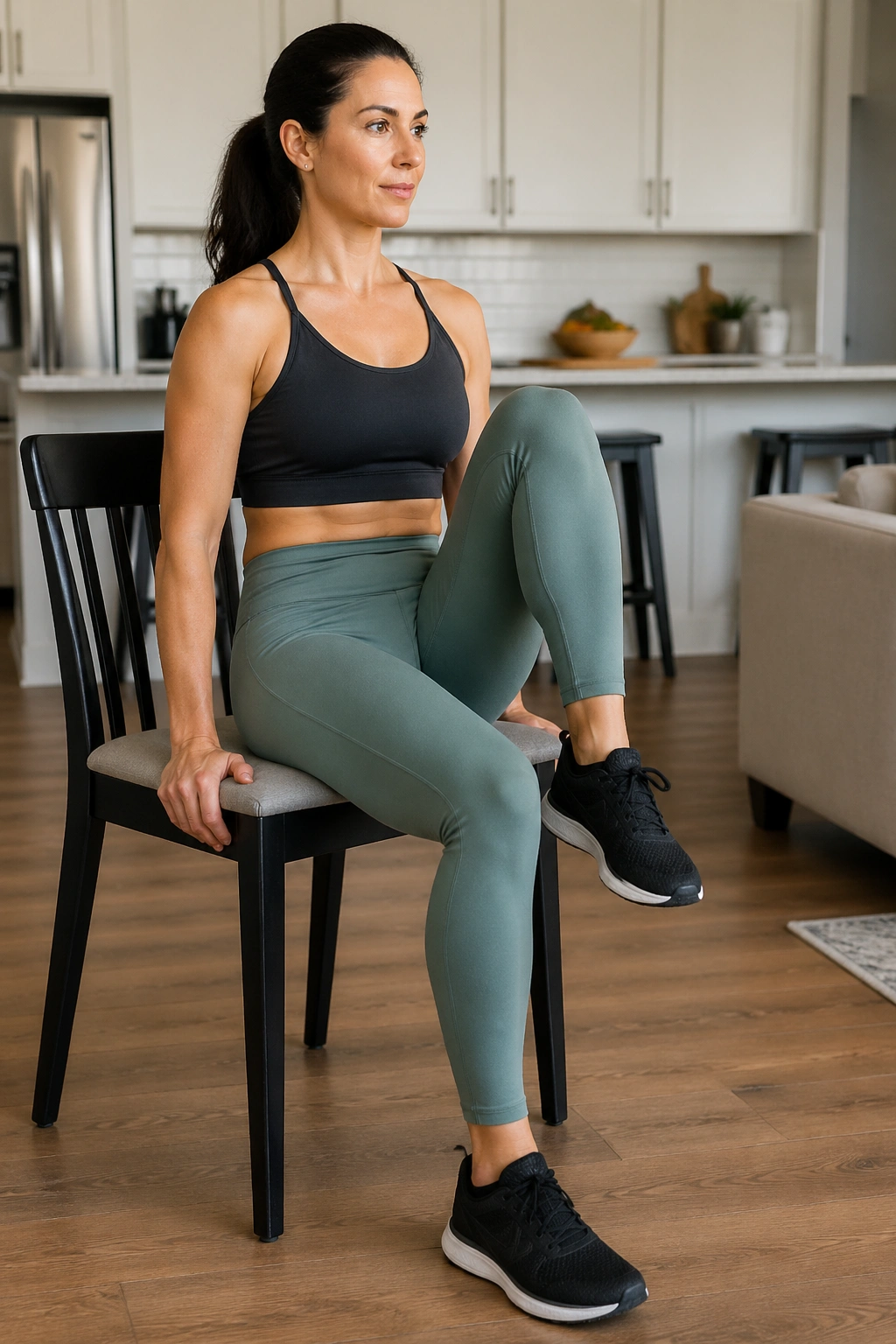
You do not need all 18 moves in one session. That turns a useful workout into a long scavenger hunt.
Pick 6 to 8 exercises and organize them so the pace rises and falls a bit. One simple setup is alternating a strength-focused move with a cardio-focused move. That keeps your core working while your breathing climbs.
Try this 20-minute chair circuit:
- Warm-up: 3 minutes
- Round 1
- Seated Knee Lifts — 12 per side
- Seated Jumping Jacks — 40 seconds
- Seated Russian Twists — 20 total
- Fast Feet at the Chair Edge — 20 seconds
- Round 2
- Seated Double-Knee Tucks — 12 reps
- Cross-Body Chair Punches — 40 seconds
- Seated Side Bends — 12 per side
- Chair Mountain Climbers — 20 seconds
- Rest: 20 to 30 seconds between moves, 60 seconds between rounds
- Repeat both rounds one more time
- Cool-down: 2 minutes of easy marching and deep breathing
Want a gentler version? Use knee lifts, marches, side bends, overhead knee drives, and lean-back holds. Want a harder one? Use scissor kicks, flutter kicks, mountain climbers, jumping jacks, fast feet, and punches with minimal rest.
If fat loss around the waist is the goal, pair these sessions with daily walking when you can. Ten extra minutes after meals adds up quietly.
Mistakes That Make Seated Belly Fat Exercises Too Easy
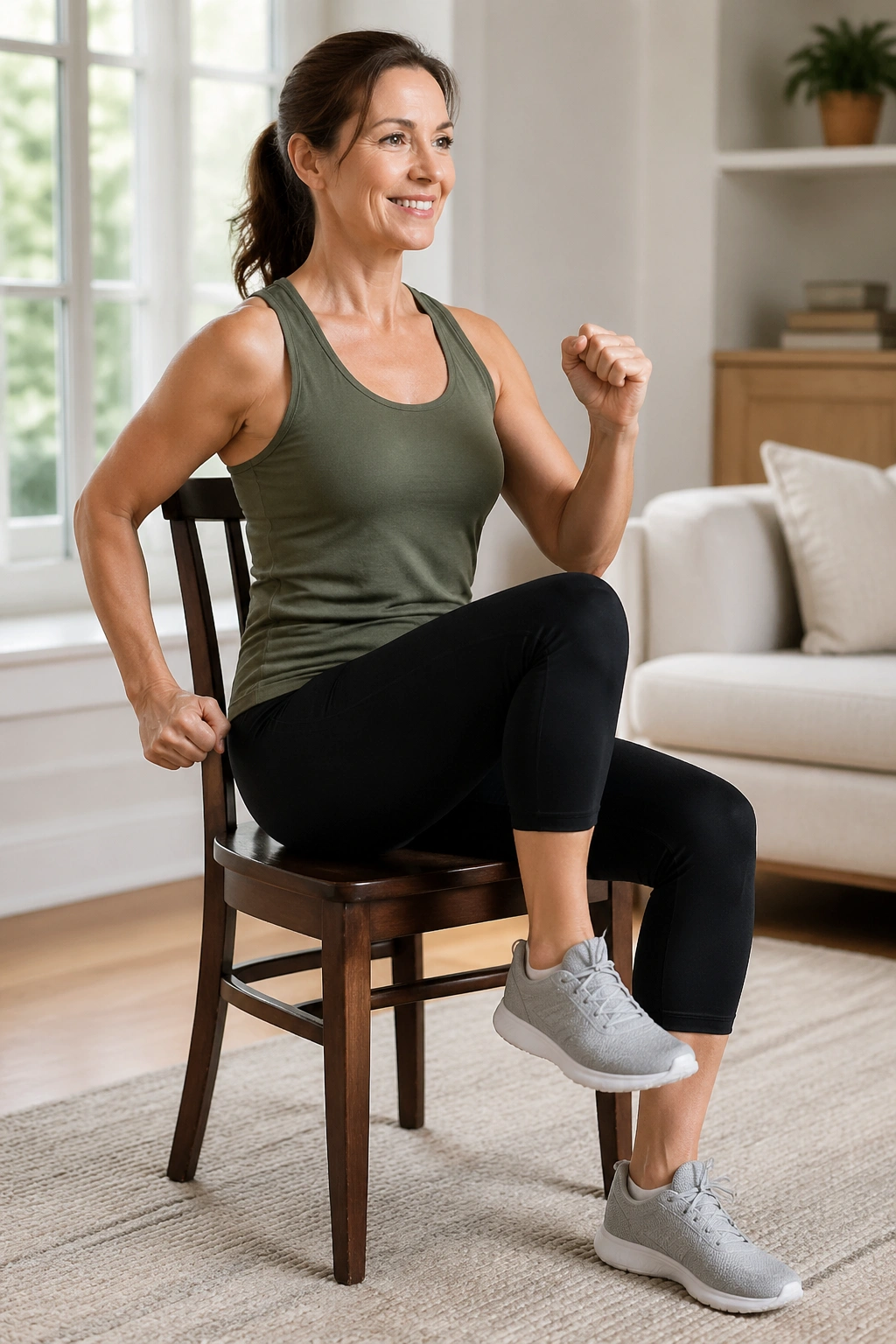
One sloppy habit can strip half the value out of a chair workout.
The first mistake is sinking into the backrest. Once you relax into the chair, your abs stop doing much and the move turns passive. Stay on the front edge unless the exercise tells you otherwise.
Second: rushing reps that should be controlled. Twists, side bends, straight-leg raises, and knee-to-elbow crunches all work better when the change of direction is sharp and clean. Swinging gets you motion. It does not get you much tension.
A few more form killers show up all the time:
- Holding your breath during the hardest part of the rep
- Shrugging the shoulders toward the ears
- Lifting the legs too high and yanking on the lower back
- Training only the abs while ignoring walking, food, and sleep
That last point matters most. If someone tells you a handful of chair crunches will flatten your stomach without any change in the rest of your routine, ignore them. The better plan is boring, which is probably why it works: move more, eat with some structure, sleep enough, repeat.
Boring beats magical.
Final Thoughts
Chair workouts are not a shortcut. They’re a low-friction way to train when the floor, the gym, or your joints are not cooperating.
Pick five or six of these seated belly fat exercises, run them three to four times a week, and keep the sessions honest. Sit on the edge. Brace before you move. Push the pace on the cardio drills. Slow down the strength ones. Add walks when you can.
That combination—small sessions done often—tends to do more for a waistline than one heroic workout followed by three silent days in a chair.
