



If your waistline has been hanging on for dear life, endless crunches are a waste of time. Belly fat exercises for men over 50 need to do more than make you sweat for a few minutes; they need to burn energy, build muscle, and stay kind to knees, hips, shoulders, and lower backs that have already logged a few decades of use.
That matters because the middle tends to be stubborn for a reason. Fat around the waist is often tied to total activity, muscle loss, stress, sleep, and food intake all at once, which is why one “magic” move never fixes it. A smarter plan uses large muscles, steady cardio, and enough core work to keep you moving without feeling wrecked the next day.
I like workouts that do three jobs at once. A good hinge, carry, squat, or interval should raise your heart rate, ask your trunk to stay solid, and leave enough in the tank that you’ll come back and do it again. That’s the boring answer. It also happens to be the one that works.
So the list below is built around that idea: simple movements, joint-friendly options, and enough detail to make them useful in a real gym, a garage, or a living room with a little floor space and some dumbbells. Start with four or five of them, not all seventeen. Consistency beats heroics every time.
1. Brisk Incline Walking for Belly Fat Loss
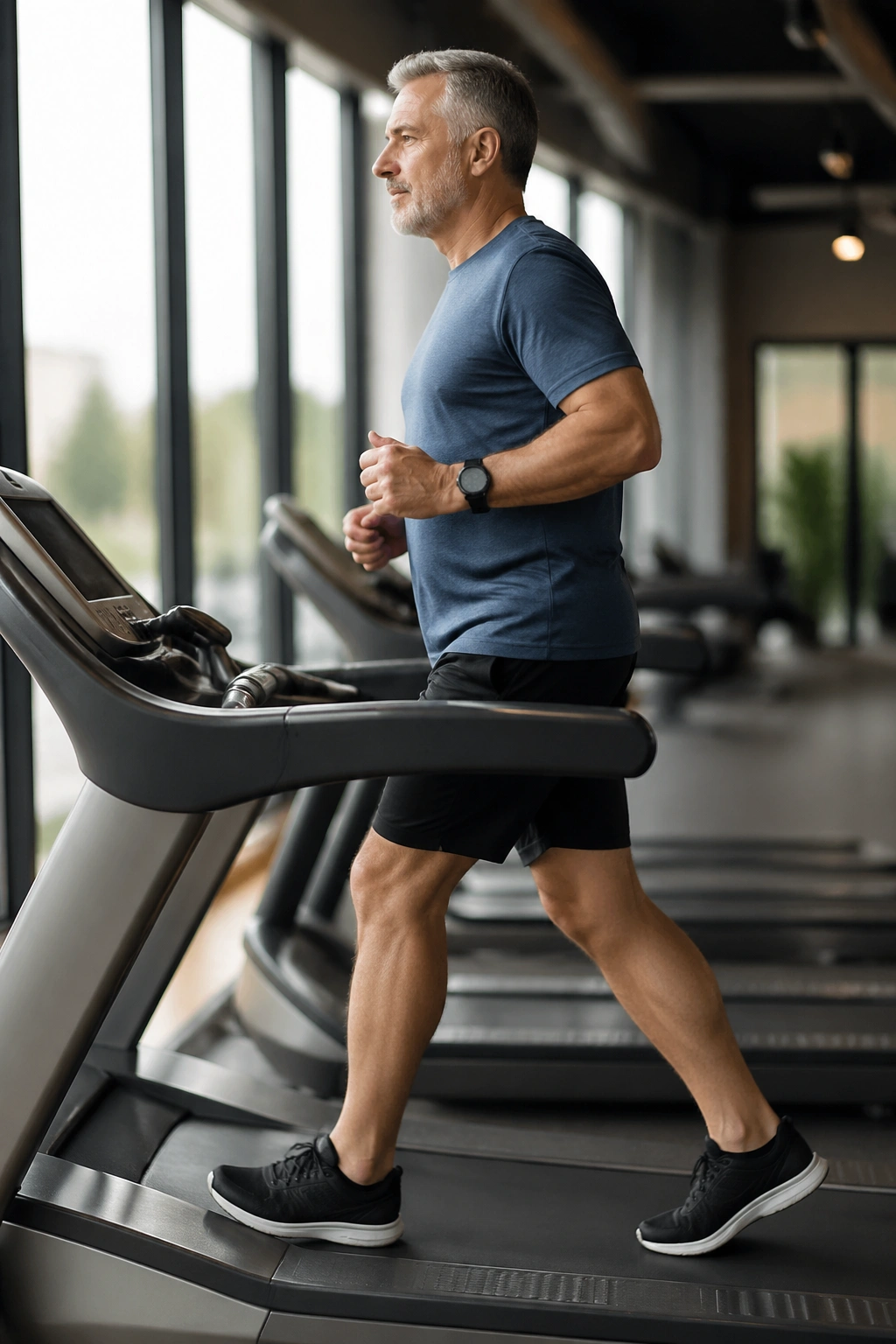
Walking is boring in the best possible way.
A brisk incline walk is one of the cleanest tools for men over 50 who want to shrink the waist without beating up the body. The incline wakes up the glutes and calves, the steady pace keeps the heart rate up, and the impact stays low enough that sore knees usually don’t protest much. If you’ve been looking for belly fat exercises for men over 50 that you can repeat three or four times a week, this is the one I’d trust first.
Why the incline matters
Flat walking is fine. Incline walking changes the work. Your hips have to produce more force, your trunk stays more engaged, and your stride usually gets a little shorter and cleaner, which is easier on the joints. A treadmill at 3% to 6% incline for 20 to 30 minutes can feel far harder than flat walking at the same speed.
- Start with a 3% incline and a pace that makes talking possible but not effortless.
- Build toward 20 to 30 minutes without holding the rails.
- Keep your chest tall and your ribs stacked over your hips.
- Use hills outside if a treadmill is boring. That works just fine.
Do not lean on the handrails. That turns the workout into a half-rep.
If you like numbers, aim for a pace that leaves you breathing harder by the end but not gasping. If you dislike numbers, use the simple test: you should feel warm, a little out of breath, and ready to do it again tomorrow. That is the sweet spot.
2. Kettlebell Deadlifts That Wake Up the Posterior Chain
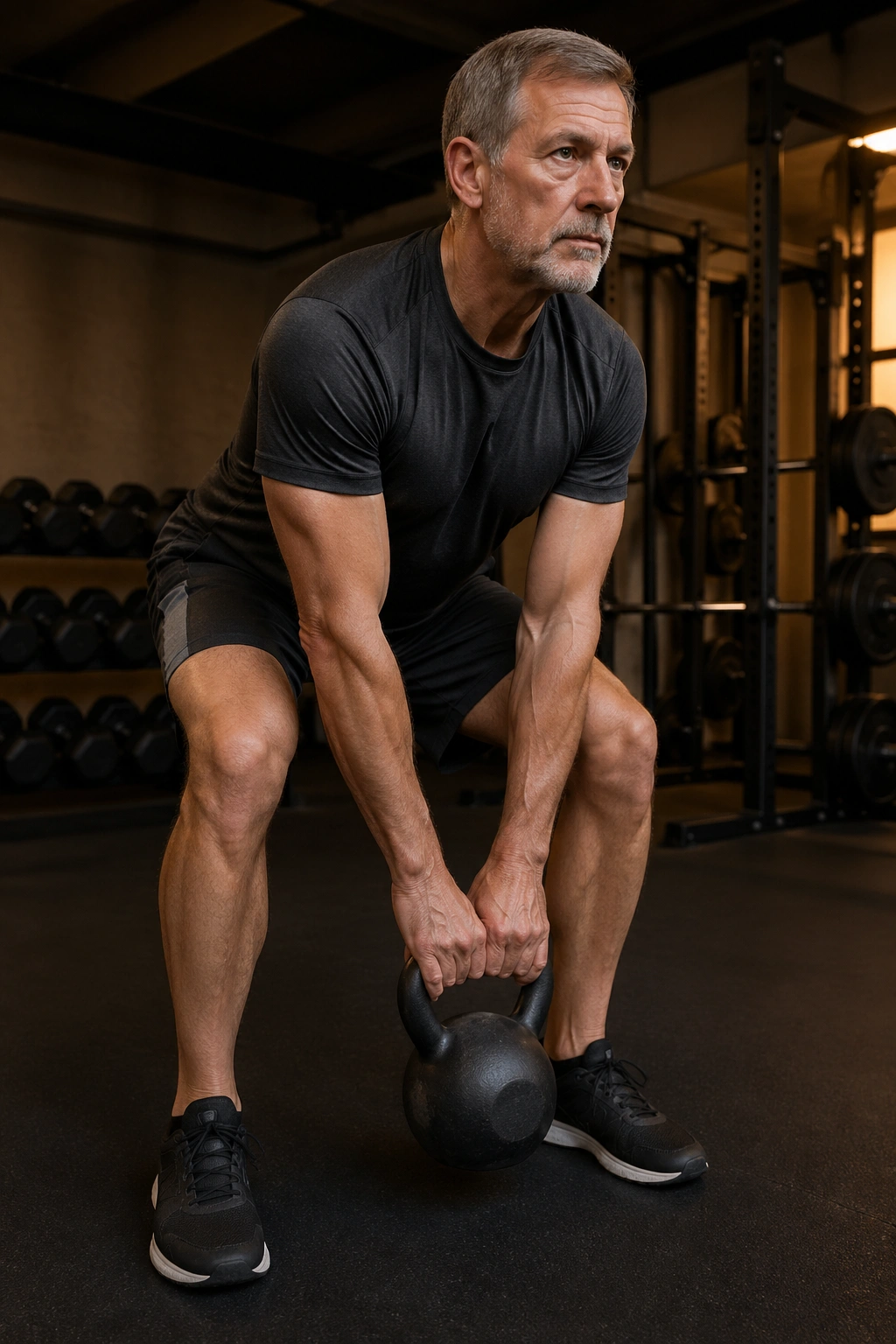
A deadlift is not a back exercise done badly. It’s a hip exercise done well.
The kettlebell deadlift gives men over 50 a strong return on a small amount of effort. It loads the glutes, hamstrings, upper back, and deep core at the same time, which is a useful combination when the goal is losing fat and keeping muscle. More muscle doing more work means more energy burned, and that matters more than people like to admit.
Stand with the bell between your feet, push your hips back, and keep your spine long as you grab the handle. The bell should stay close to your body the whole time. When you stand, think about driving the floor away with your feet and squeezing your glutes at the top, not leaning back like you’re showing off.
A good starting point is 3 sets of 8 to 10 reps with about 60 seconds of rest. Heavy enough to matter. Light enough that your form stays tidy. If your lower back feels it more than your hips, the weight is too far from your body or you’re bending into the lift instead of hinging.
This move works because it trains the body to move a load, not just survive it. That’s a useful distinction.
3. Goblet Squats to a Box for Safer Leg Work
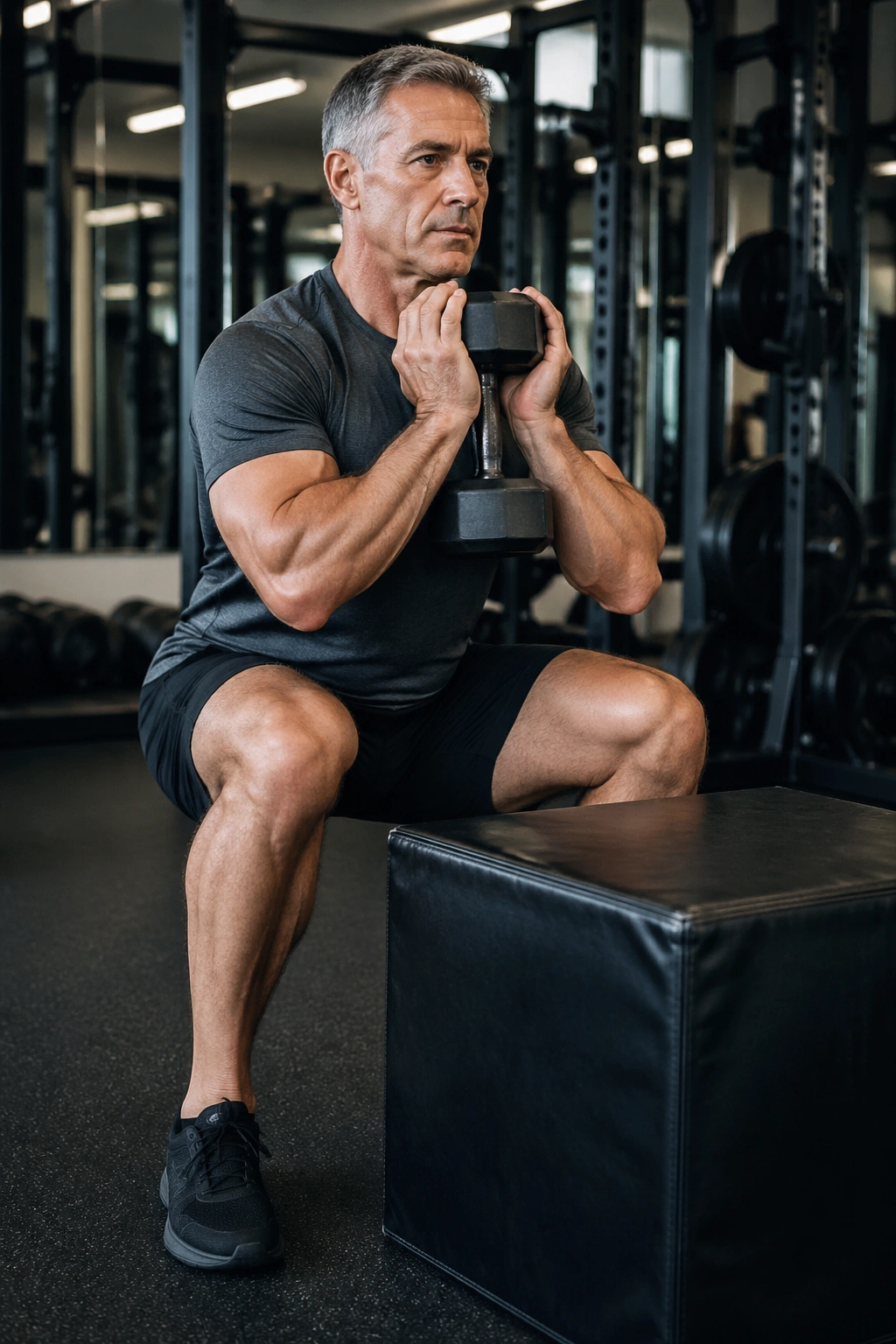
If free squats make your knees grumble, a box changes the whole conversation.
Goblet squats to a box are one of my favorite ways to build leg strength without asking for perfect mobility. You hold a dumbbell or kettlebell at chest height, sit back until you lightly touch a box or bench, then stand back up. The box gives you a target. The front-loaded weight keeps your torso honest. It’s a tidy little package.
Use a box or bench that puts your thighs close to parallel with the floor, or a little above it if your hips are tight. Keep your heels down, your feet about shoulder width apart, and your elbows pointed between your knees on the way down. The touch should be light. You’re not crashing into the seat.
- Hold the weight close to your chest.
- Lower under control for 2 to 3 seconds.
- Pause for a split second on the box.
- Stand by driving through the whole foot, not just the toes.
That little pause helps kill the sloppy bounce that ruins a lot of squats. It also makes the movement safer and more useful when you’re getting back into leg training after years away from it.
4. Rowing Machine Intervals for Full-Body Fat Burn
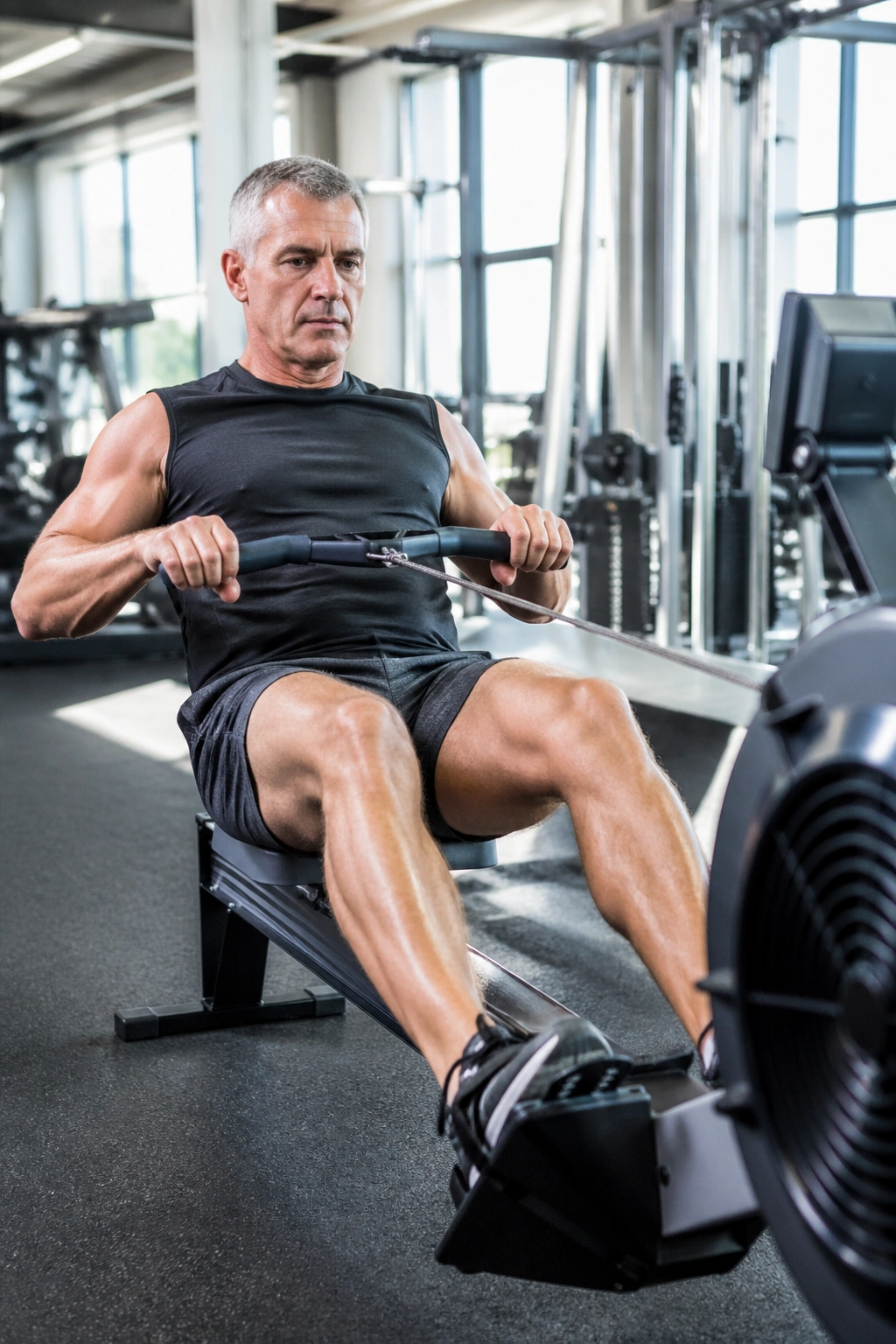
Rowing looks like an arm exercise. It isn’t.
A rowing machine hits the legs first, then the hips, then the back and arms, which makes it a brutal little calorie burner when you do it with some intention. It’s also kind to the joints compared with running, which is why it belongs on any short list of workouts for men over 50 who want to lose abdominal fat without feeling like their ankles are filing a complaint.
The stroke sequence
Push with the legs first. That’s the part most people mess up. Your arms should finish the pull, not start it. If you yank with the handle before the legs drive, the stroke gets messy and you lose a lot of the benefit.
A clean interval set is simple:
- 30 seconds hard
- 90 seconds easy
- Repeat 6 to 10 rounds
If that sounds brutal, start with 20 seconds hard and 100 seconds easy. No shame in that. The goal is repeatable work, not a dramatic faceplant on the floor.
What to watch for
Keep your shoulders relaxed and your back tall. The handle should come to the lower ribs, not your chin. At the catch, don’t collapse forward like a folding chair. A small hinge is enough.
The best part is how fast the session goes. Ten minutes on the rower can leave your shirt stuck to your back and your lungs working hard. That’s useful.
5. Incline Push-Ups That Build Muscle Without Beating Up the Shoulders
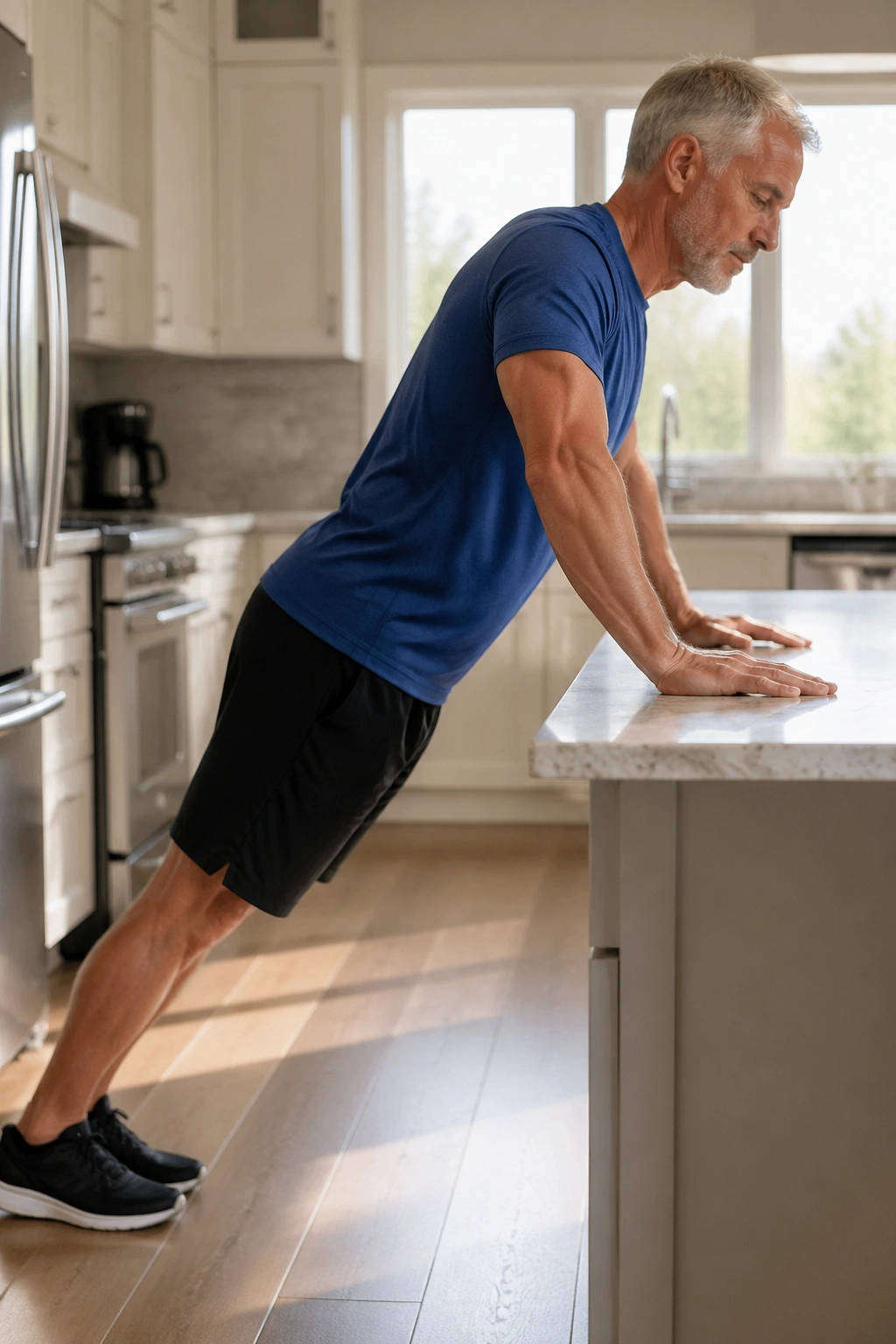
Your chest should feel warm, not pinched.
Incline push-ups are a smart strength move for men over 50 because they let you keep pressing volume high without demanding floor-level shoulder mobility right away. Put your hands on a counter, bench, smith bar, or sturdy table edge, and use a surface high enough that you can keep perfect form for 8 to 15 reps. The higher the surface, the easier the rep. Simple.
A good push-up starts with your hands under or just outside your shoulders, your body in one straight line, and your elbows angled about 30 to 45 degrees from your ribs. Lower under control until your chest gets close to the surface, then press back up without letting your hips sag. If the lower back arches, the set is already too hard.
A lot of men rush this move and turn it into a shrugging contest. Don’t. Keep your neck long, your hands planted, and your core firm. One clean set beats two ugly ones every time.
If you can do 15 easy reps on a counter, lower the angle a bit. If your wrists hurt, use dumbbells as handles or do them on a wall for a week and build from there. That little step back is not failure. It’s how you stay in the game.
6. Farmer’s Carries That Tighten the Midsection
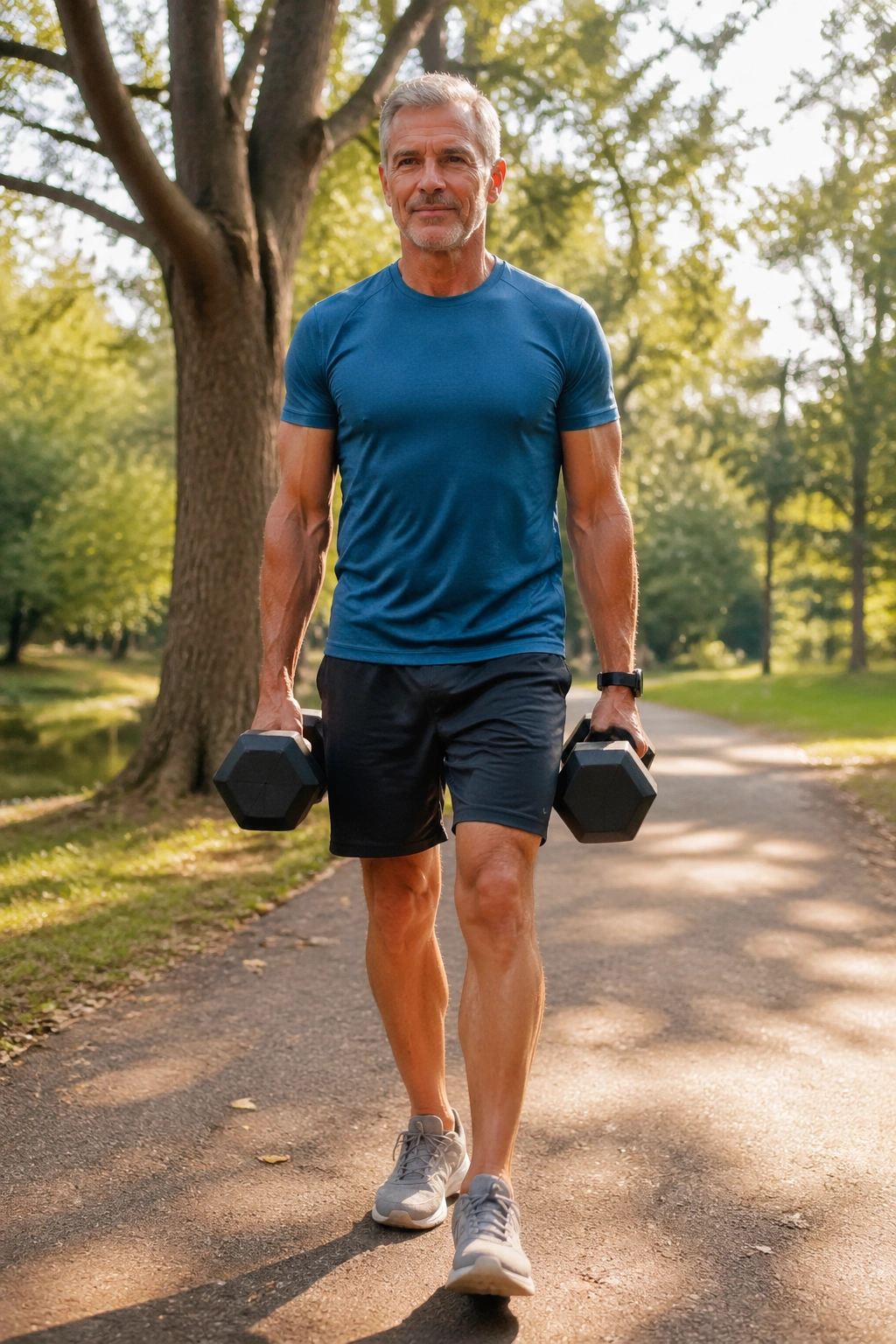
Unlike crunches, farmer’s carries make your waist work while your legs actually move.
That’s the trick. You pick up a pair of dumbbells or kettlebells, stand tall, and walk with them for distance or time. Your trunk has to resist side-to-side wobble, your grip has to stay on, and your breathing has to stay calm enough that the whole thing doesn’t turn into a mess. It’s brutally honest.
I like farmer’s carries for men over 50 because they are hard without being flashy. The carry trains posture, grip strength, core stiffness, and work capacity in one shot. If your shoulders are cranky, you can keep the loads moderate. If your back feels tight after sitting all day, a few good carries can wake you up in a way sit-ups never will.
- Walk 30 to 60 seconds per set.
- Use a weight that makes your grip work but doesn’t wreck your form.
- Keep your ribs down and your shoulders back and relaxed.
- Turn around under control; don’t wobble into the corner like you’re carrying groceries on ice.
Try suitcase carries too. That means one weight in one hand. They light up the obliques and the side of the trunk fast. It’s a small change with a big payoff.
7. Dead Bugs for a Stronger, Flatter-Looking Core
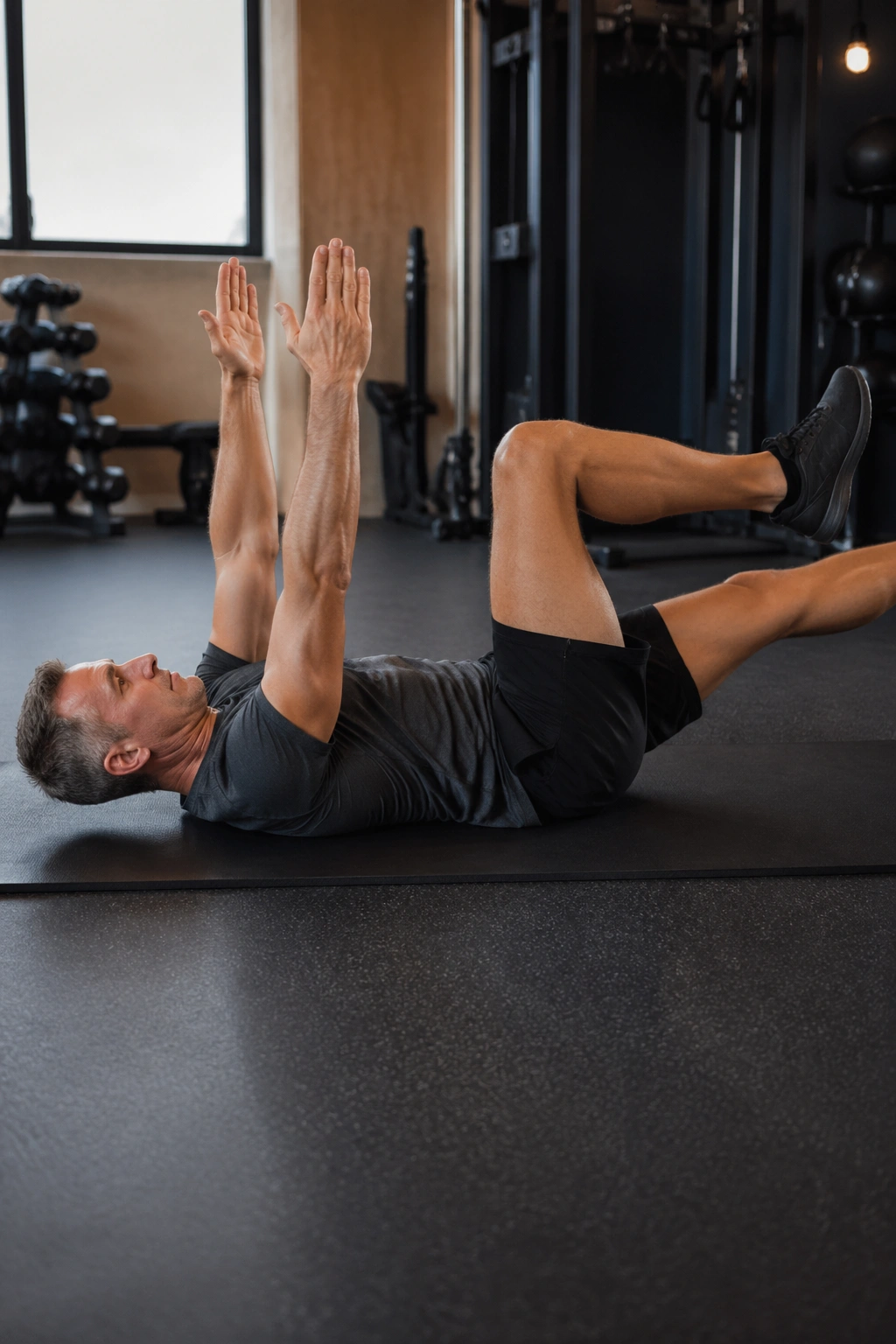
Why are dead bugs on a fat-loss list?
Because they teach the core to do its real job: keep the spine steady while the arms and legs move. That doesn’t burn the most calories in the room, and it won’t make you gasp like hill sprints. It does build the kind of trunk control that makes every other exercise cleaner. Cleaner reps usually mean better training volume. Better training volume tends to matter more than fancy moves.
Lie on your back with your knees bent at 90 degrees and your arms pointed toward the ceiling. Press your lower back gently into the floor. Then lower the opposite arm and leg at the same time, only as far as you can without losing that back contact. Return, switch sides, repeat.
How to use it
Start with 2 to 3 sets of 6 to 8 reps per side.
Move slowly. If you rush, the whole point disappears. If your lower back starts arching, shorten the range. Sometimes the best version of the exercise is the one that looks a little too easy from across the gym.
I like dead bugs as a warm-up before carries, squats, or deadlifts. They help the trunk wake up before the heavier work starts, and that makes the rest of the session feel tidier.
8. Step-Ups That Raise the Heart Rate Fast
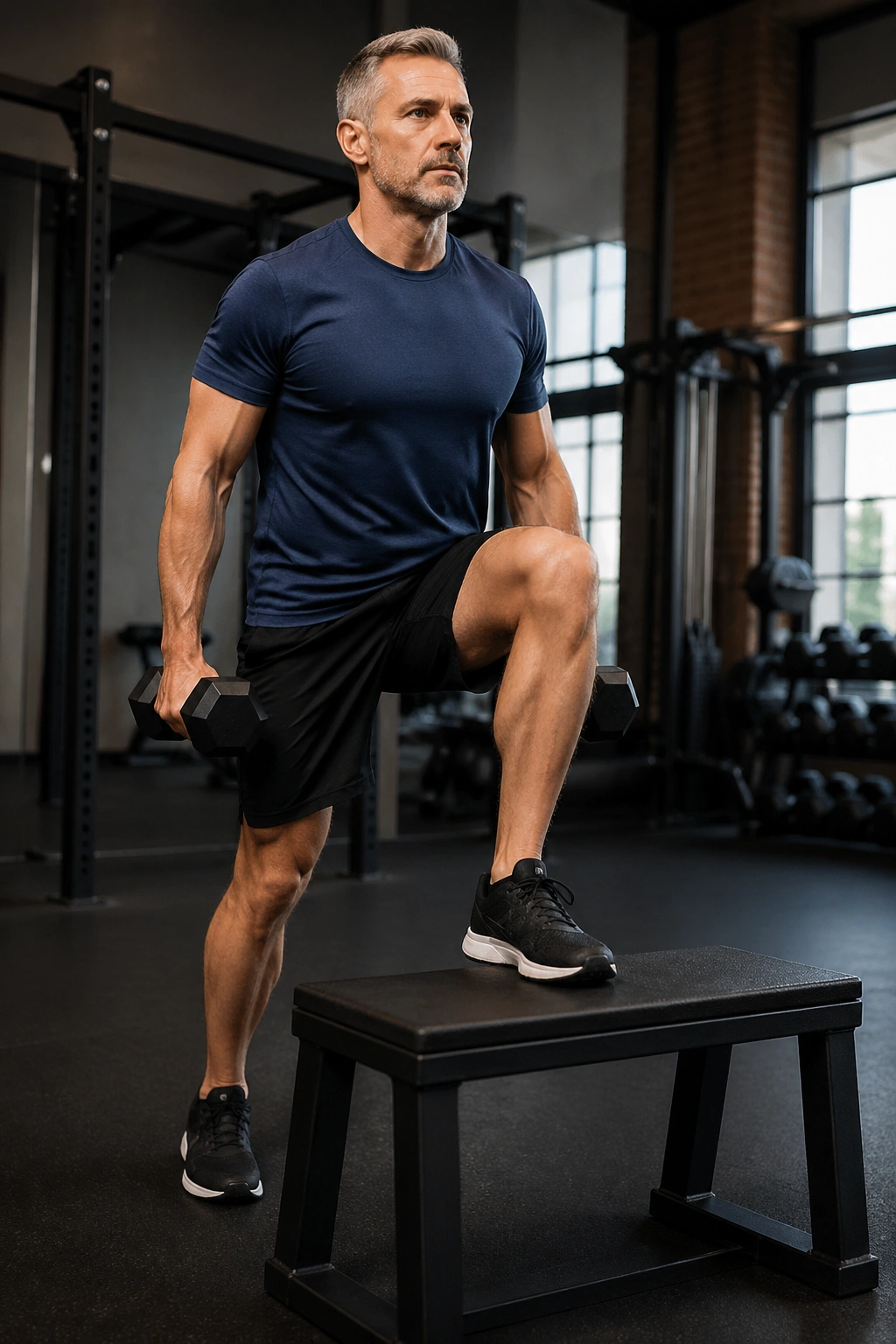
A staircase with intent is a sneaky little fat-loss tool.
Step-ups hit the quads, glutes, and balance system at the same time, which is useful when you want a workout that feels athletic without requiring jumps. Use a box or bench that lets your working thigh stay about parallel to the floor or a little higher. Too tall and the movement turns into a hip-flexor grind. Too low and it becomes a half-rep.
Hold dumbbells at your sides if bodyweight feels too easy. Plant the whole foot on the step, lean forward just enough to load the front leg, and stand up by driving through that planted foot. The back leg should help less than you think. On the way down, go slow. That eccentric lowering builds control and saves the knees from sloppy landings.
A lot of men over 50 underestimate step-ups because they look plain. Then they finish a few rounds and their breathing says otherwise. Good.
If balance is shaky, use a hand lightly on a wall or rail. That support is fine. What you do not want is a push-off from the back leg that turns the movement into a pogo stick routine.
9. Resistance Band Woodchops for Rotation and Waist Control
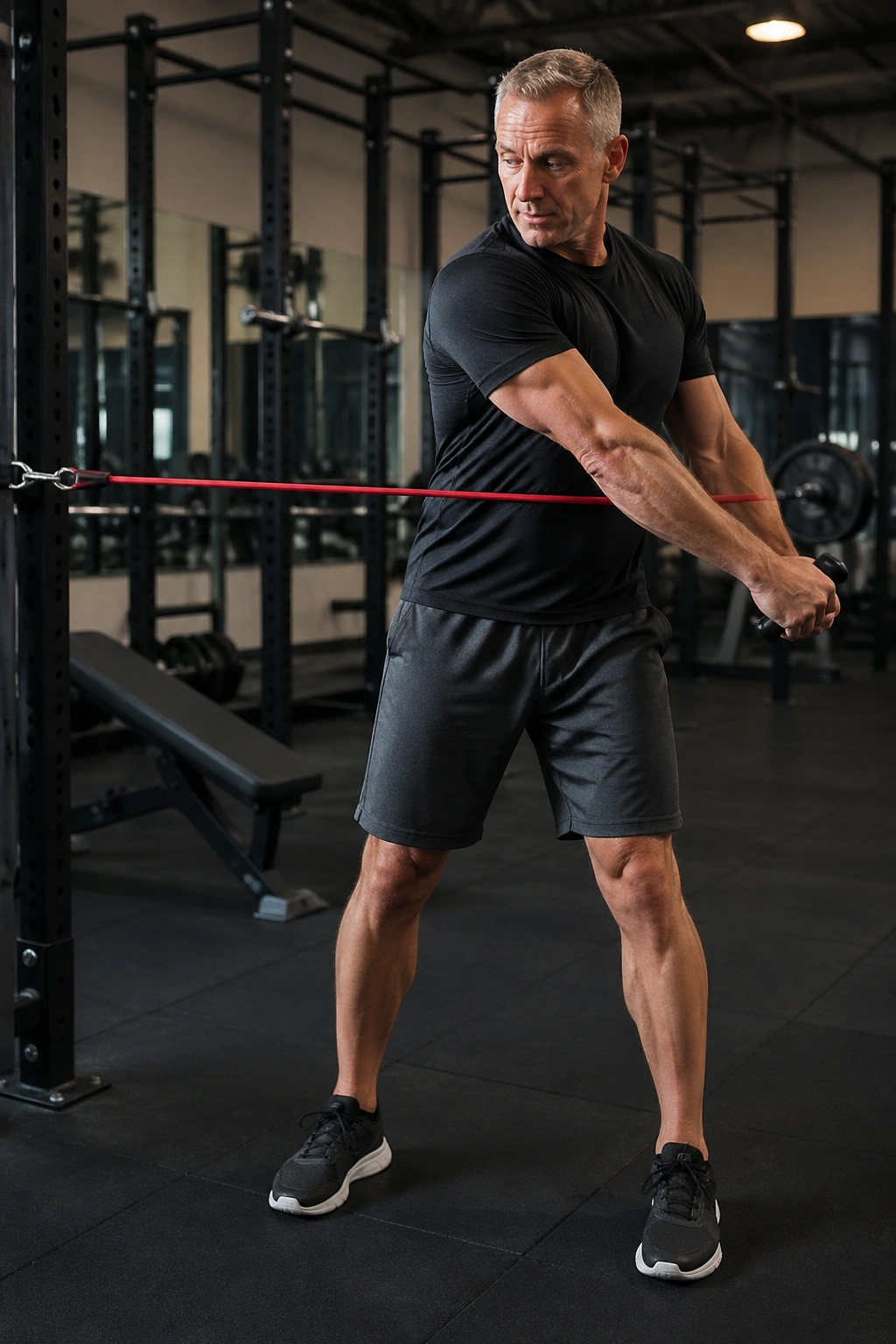
Can a twist help trim the middle? Not directly. But a strong, controlled twist helps you train the muscles that stabilize your waist while the rest of you moves.
Band woodchops do exactly that. Anchor a band at chest height or slightly above, stand sideways to the anchor point, and pull the band across your body in a smooth diagonal. The motion should come from the torso and hips, not just the arms. If you yank with your hands, you’re missing the point.
Set the band first
A band that’s too light turns the exercise into a shrug. One that’s too heavy pulls you off balance. You want enough tension that the first inch feels honest.
Try 2 to 3 sets of 10 to 15 reps per side. Keep your feet planted, your knees soft, and your ribs down. The finish should feel controlled, not wild.
Woodchops are especially useful if your lower back feels better with rotational work than with long planks. They also fit nicely between leg days, since they don’t crush the joints. If you’ve got a golf swing, tennis serve, or just a habit of twisting to grab things from the back seat, this one earns its place fast.
10. Stationary Bike Sprints That Spare the Joints
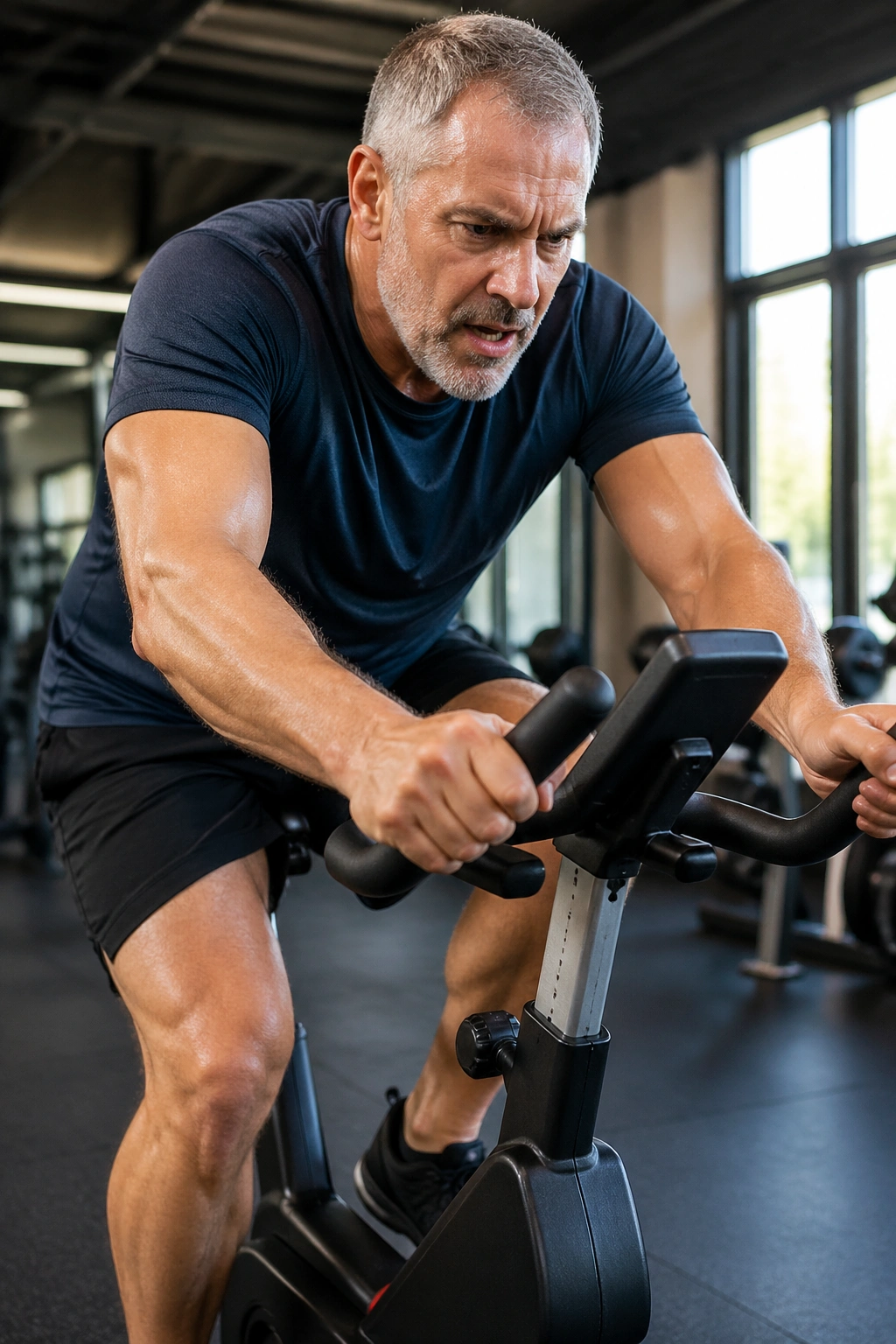
If running beats up your knees, the bike is the honest trade.
Stationary bike sprints can drive heart rate high without the landing impact that comes with jumping or pounding pavement. That makes them a strong choice for men over 50 who want a hard conditioning session but don’t want to spend the next day negotiating with their ankles. The seat keeps you stable. The pedals keep the motion smooth. The work still gets done.
A simple interval setup looks like this:
- 20 seconds hard
- 70 seconds easy
- Repeat 8 to 12 rounds
If you prefer a steadier feel, go 30 seconds hard and 90 seconds easy. The key is to push hard enough that the “hard” round feels honest by the halfway mark, then recover enough to hit the next one with good form.
Keep the seat high enough that your knee stays slightly bent at the bottom of the pedal stroke. If it’s too low, your hips rock and your knees pay for it. Resistance should be enough to make you work, but not so much that your hips bounce around.
A bike session is one of the fastest ways to get a sweaty, efficient workout when the weather is ugly or the joints feel stale.
11. Plank Shoulder Taps for Anti-Rotation Strength
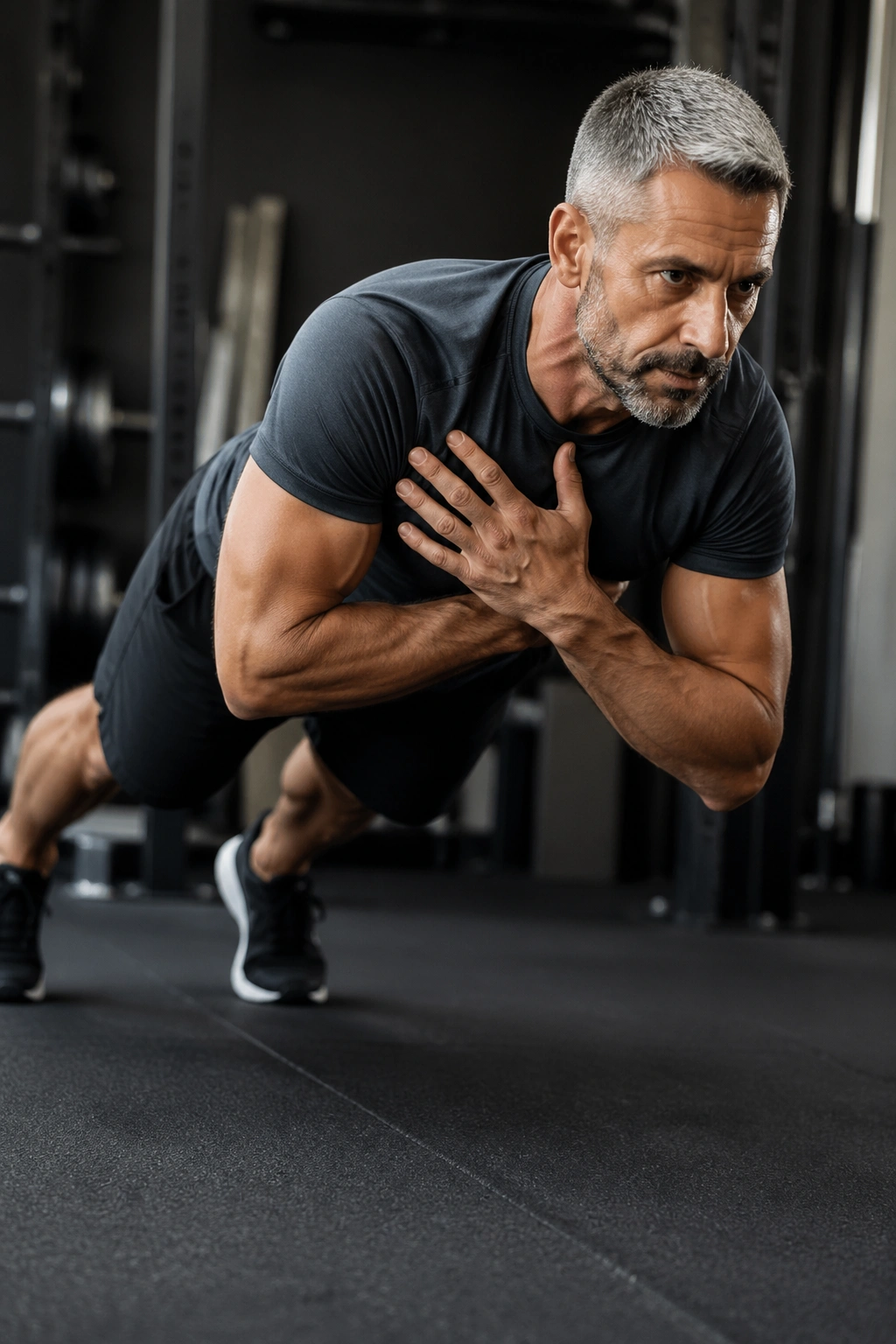
If your hips sway like a loose shopping cart, the taps are too fast.
Plank shoulder taps are simple on paper and annoyingly honest in practice. Start in a high plank with your feet a little wider than hip width. Tap one shoulder with the opposite hand, return it to the floor, then switch. The challenge is not the tap itself. The challenge is keeping your torso from twisting while the support arm and opposite leg do all the stabilizing work.
That anti-rotation demand is useful for belly fat workouts because it trains the core to hold steady under fatigue. Stronger core control helps your lifts stay cleaner, and cleaner lifts usually mean better training quality across the week.
A good starting dose is 2 to 3 sets of 10 to 20 taps total. Slow the pace enough that you can keep your hips almost level. If your wrists are irritated, use push-up handles or place your hands on dumbbells. If the floor version feels too hard, raise your hands on a bench and repeat the same pattern.
This one is a little boring. That’s fine. Boring often means effective.
12. Battle Rope Slams for Short, Hard Conditioning
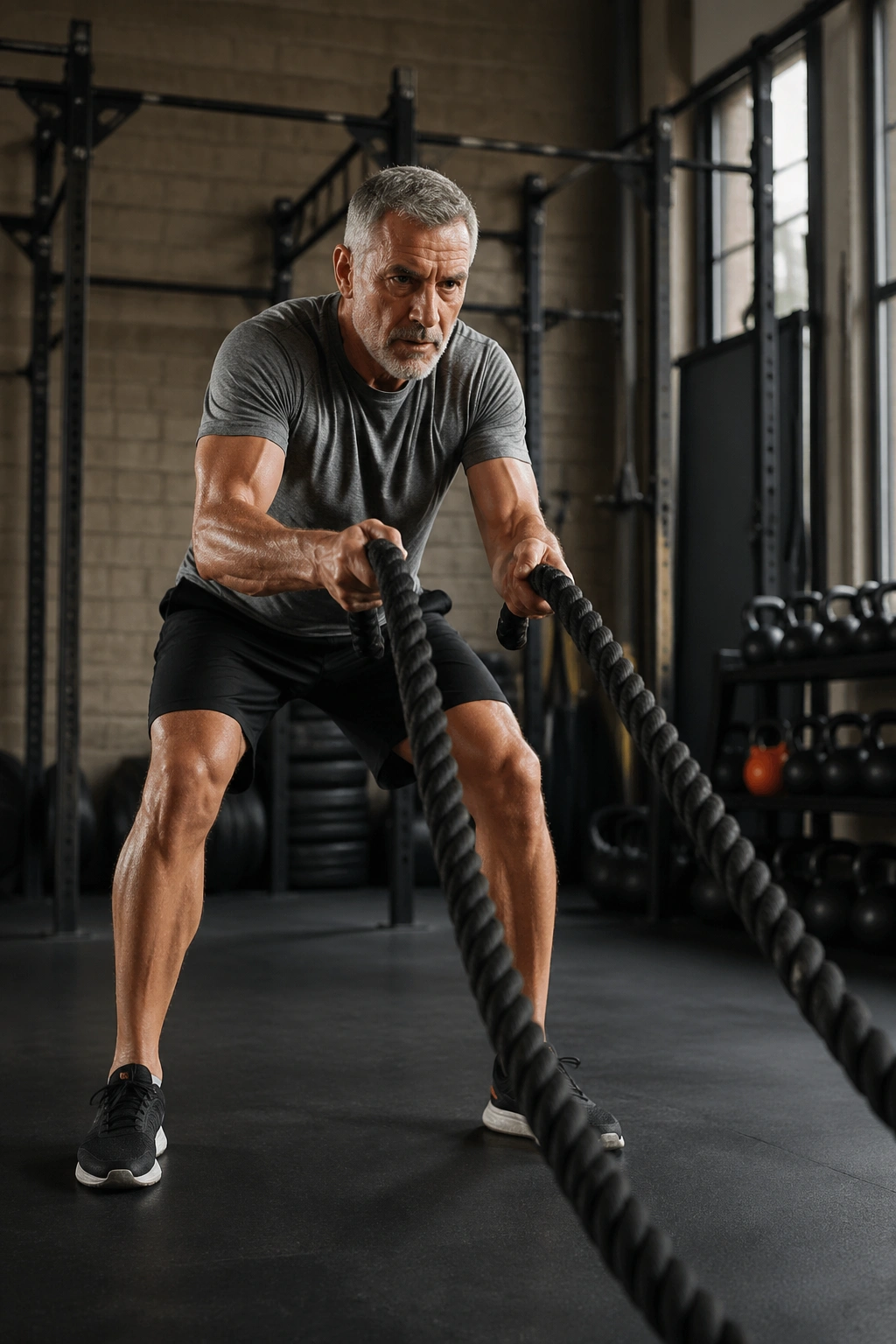
Battle ropes are noisy, sweaty, and useful.
They’re also kinder to the joints than a lot of people expect. The ropes let you drive the arms, core, and shoulders hard without needing to jump. That makes them a solid conditioning tool for men over 50 who want a fierce burst of work without the pounding that comes with burpees or sprint repeats on concrete.
Stand with soft knees, brace your trunk, and slam the ropes in strong waves or double-arm slams for 15 to 20 seconds. Rest for 40 to 60 seconds. Repeat 6 to 10 rounds. If your lower back starts doing the work, bend the knees a touch more and keep the ribs down.
A lot of people swing the ropes with their arms only and burn out the shoulders fast. Better to think of the whole body as the engine. The arms move, sure. The hips and core give the movement shape.
Battle ropes shine as a finisher after strength work. They’re short, loud, and efficient. There’s no pretending with them. Either the waves are moving or they aren’t.
13. Dumbbell Romanian Deadlifts for Glutes and Hamstrings
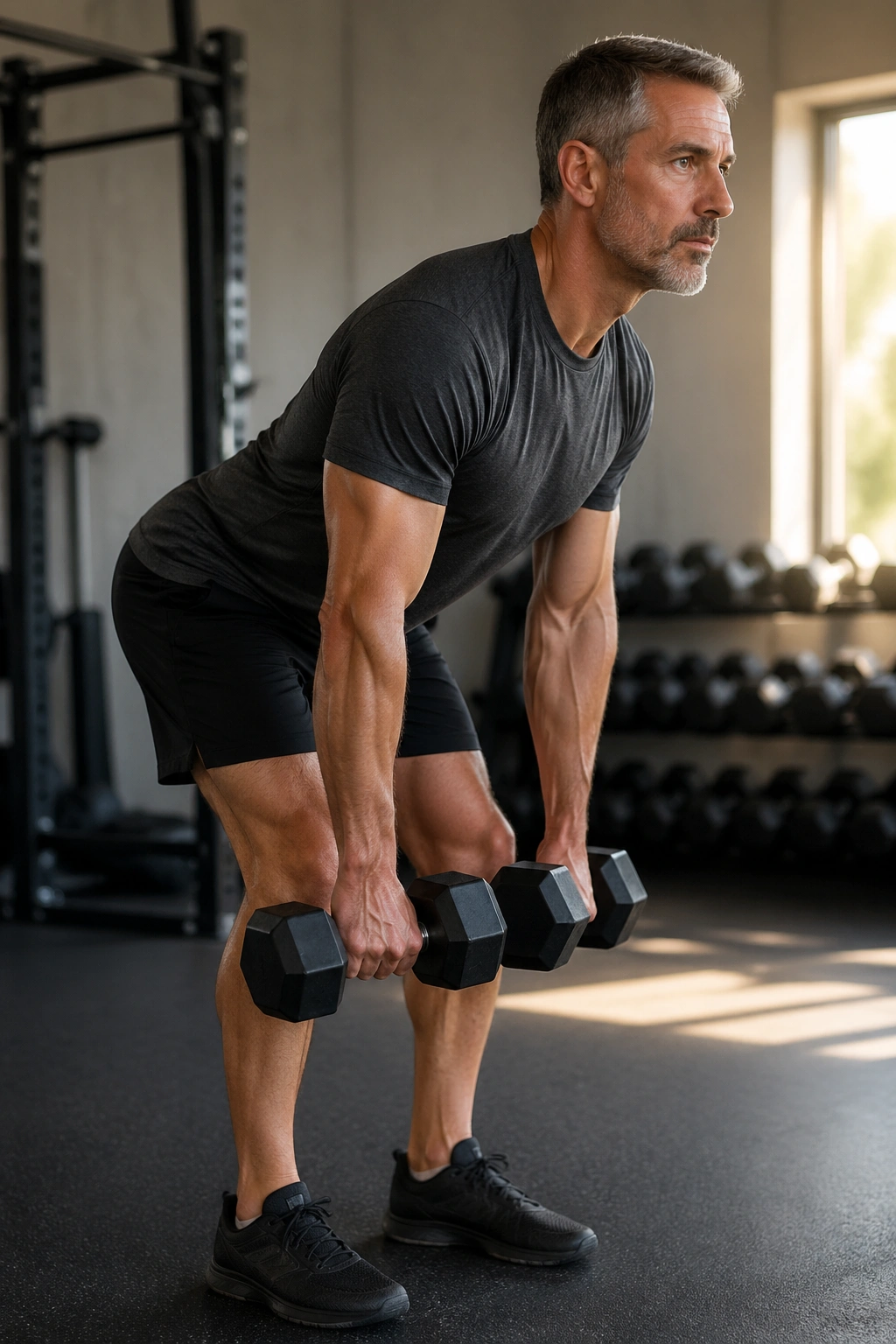
The back of the legs should feel loaded, not the lower back.
That’s the feeling to chase on a dumbbell Romanian deadlift. This hinge variation starts from standing, then sends the hips back while the knees stay slightly bent and the dumbbells slide close to the thighs. Lower only until you feel a strong stretch in the hamstrings and the spine still stays long. Then stand up by driving the hips forward.
What a good rep feels like
It feels like tension in the hamstrings, a firm brace through the midsection, and a smooth return to standing. It does not feel like a reach toward the floor.
A lot of men over 50 benefit from this movement because it builds the same posterior-chain strength that supports walking, lifting, climbing stairs, and even standing up from a low chair. Use 3 sets of 8 to 10 reps with a 2- to 3-second lowering phase. That slower lowering makes the exercise much more useful than a sloppy drop.
Keep the dumbbells close to the legs. If they drift away, the lower back has to take over, and the whole point gets muddy. A slight bend in the knees is fine. Locking them out makes the move feel awkward and can pull attention away from the hips.
This is one of those exercises that pays you back in posture.
14. Slow Mountain Climbers for Core and Cardio
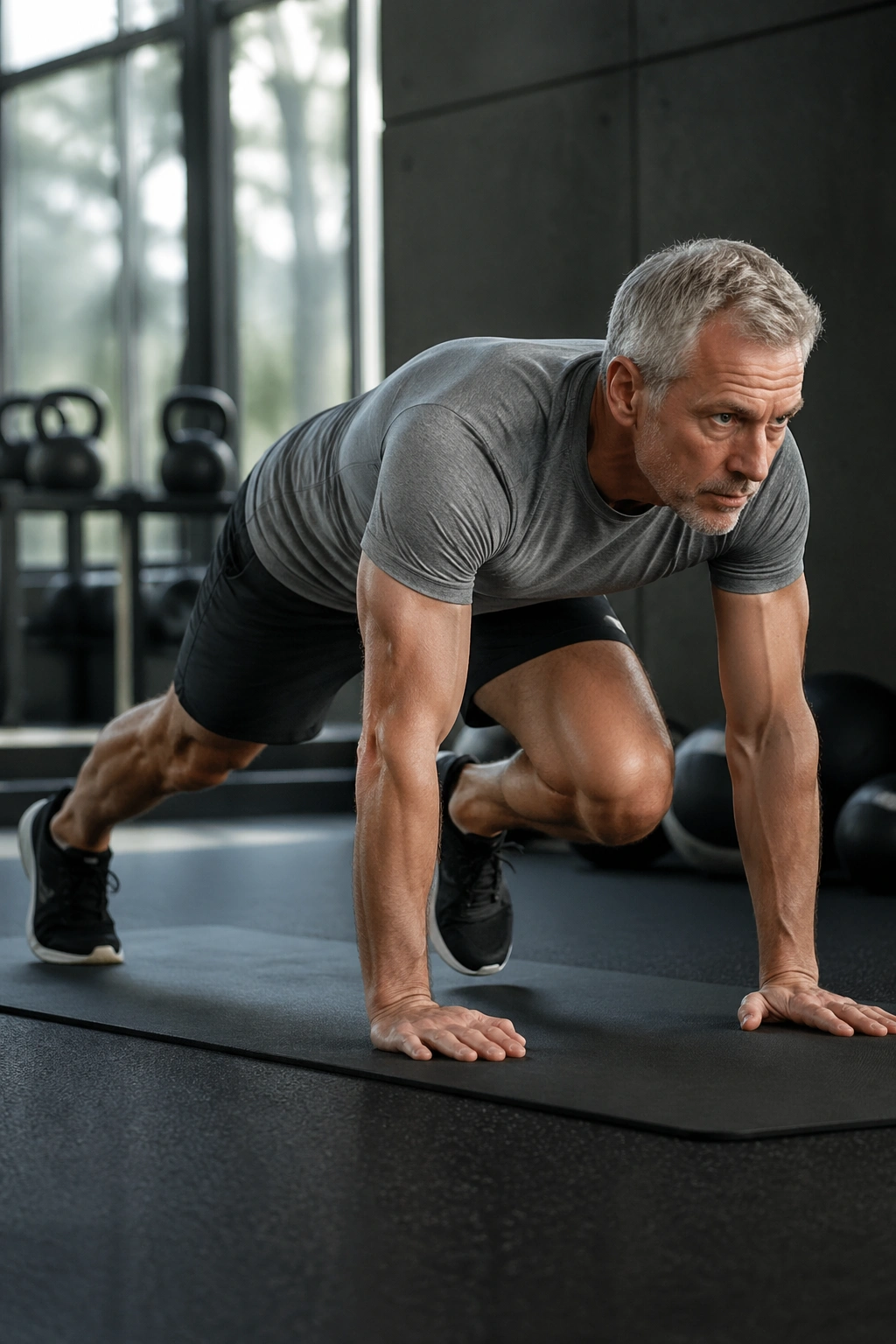
Not the frantic version.
Slow mountain climbers are better for older men than the rushed gym-class version that looks like a panic attack in sneakers. Start in a high plank with your hands under your shoulders, then bring one knee toward the opposite elbow under control. Return it, switch sides, and keep the pace slow enough that your trunk doesn’t ripple.
Why slow? Because the point is not to bounce. It’s to force the core to stay quiet while the legs move. That’s a useful skill for anyone chasing a smaller waist and better conditioning at the same time. You’ll still feel your heart rate rise, especially if you keep the set going for 30 to 45 seconds.
If the floor version bothers your wrists or shoulders, place your hands on a bench or sturdy counter. That small incline takes pressure off the joints and makes the movement easier to control.
A good set leaves you breathing harder, with the abs working and the hips steady. If your hips are rocking side to side, slow down. Or stop and reset. There’s no prize for speed here.
15. Swimming and Water Walking for Low-Impact Calorie Burn
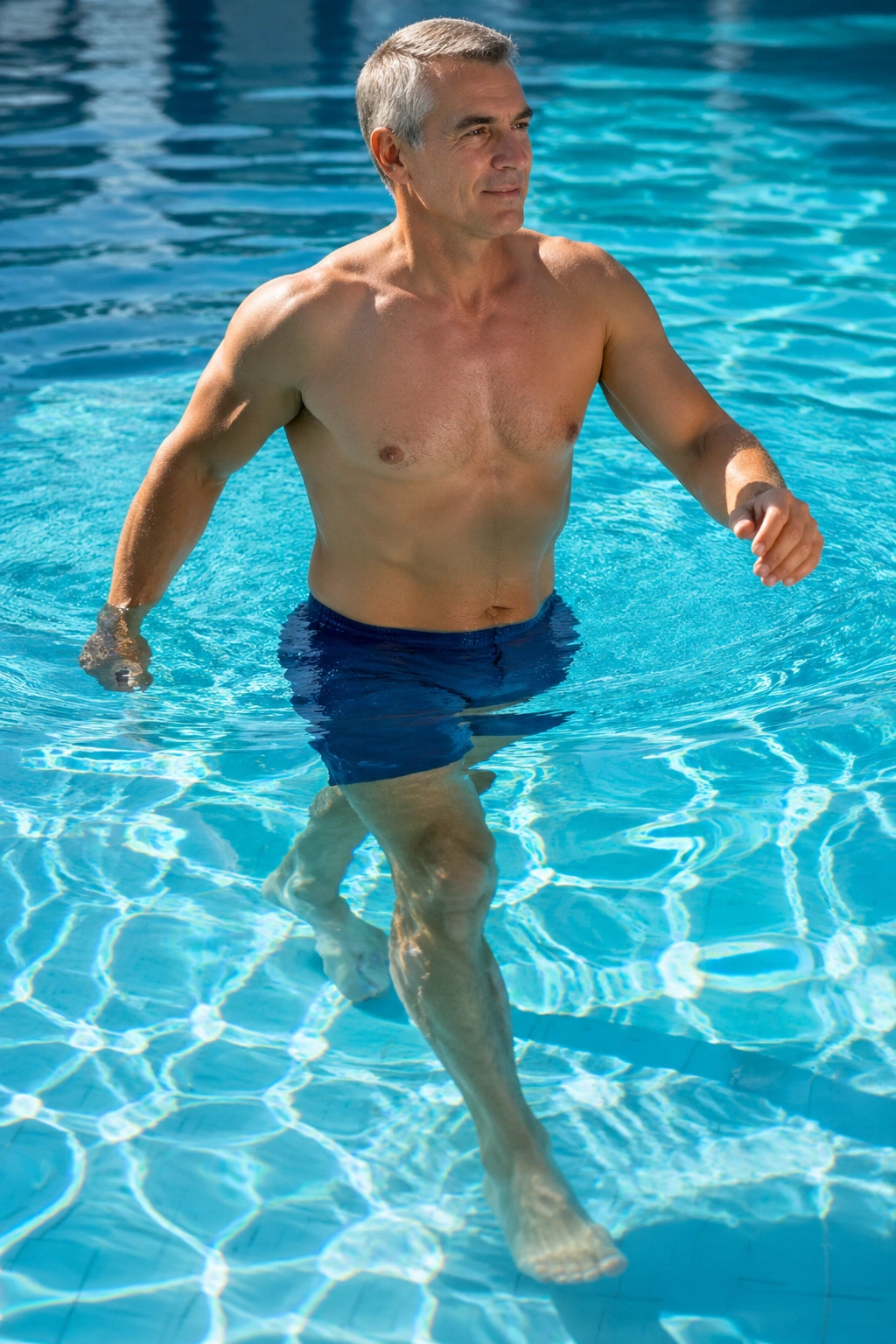
What happens when you want a hard workout and your joints want a quiet one?
The pool solves a lot of that tension. Swimming and water walking both burn calories, challenge the lungs, and take body weight off the knees and ankles. That’s a nice combination for men over 50, especially if land-based cardio has started to feel a little expensive on the joints.
Pool options that count
- Swim steady for 20 to 30 minutes at a pace you can hold.
- Water walk for 20 to 30 minutes with deliberate arm swings.
- Do 8 rounds of 1 minute moderate effort and 1 minute easy movement.
The water adds resistance in every direction, which is why even a simple walk across the pool can make your legs feel awake fast. You don’t need fancy strokes or perfect technique to get a benefit. You do need steady effort.
If you swim, keep the stroke smooth and avoid cranking your neck up every few seconds to breathe. If you water walk, drive the hands through the water instead of letting them drift lazily at your sides. Small changes matter.
This is a good choice on days when the body feels stiff but you still want to earn your dinner.
16. Turkish Get-Ups for Core, Shoulders, and Balance
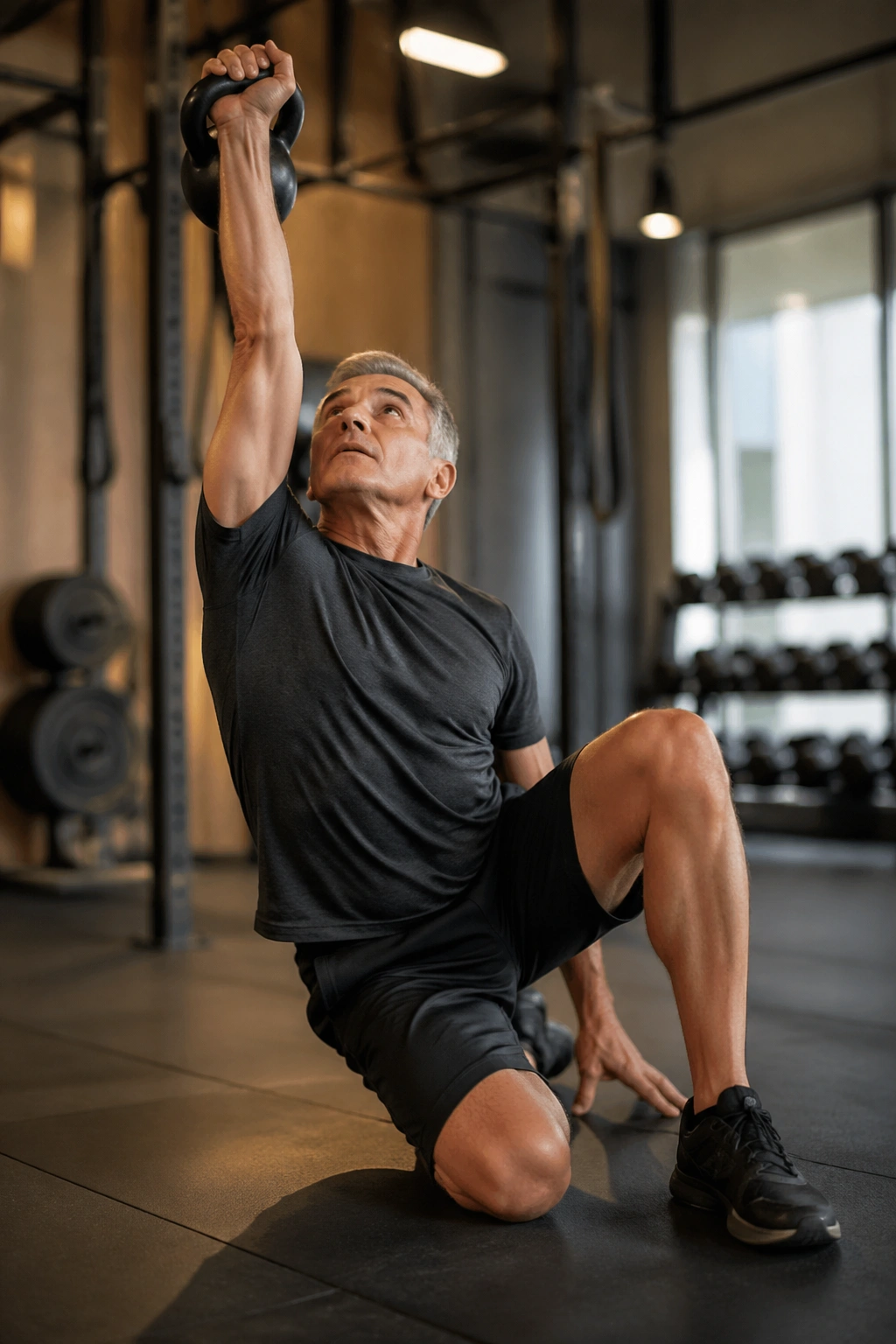
A Turkish get-up looks complicated because it is complicated.
That’s also why it’s useful. The movement teaches the body to stay organized while you roll, sit, kneel, stand, and reverse the whole thing with a weight overhead. For men over 50, that mix of core control, shoulder stability, and balance is gold. Start light. Lighter than you think.
Half get-up first
If the full version feels like too much, practice the first part only: roll to the elbow, then to the hand, then to the tall sit. That alone is worth doing.
Once that feels smooth, add the transition to the half-kneeling position. Keep your eyes on the weight, lock the wrist, and move slowly. The point is not speed. The point is crisp control at each position.
A common starting dose is 1 to 3 reps per side with a very light kettlebell. Rest between reps. Lots of rest. This is not a conditioning drill at first. It’s a skill drill that also happens to make your trunk work hard.
The get-up rewards patience. Rush it and the whole movement turns ugly. Take your time and it starts to feel like a moving checklist for strength and coordination.
17. Shadow Boxing Rounds That Finish a Workout Well
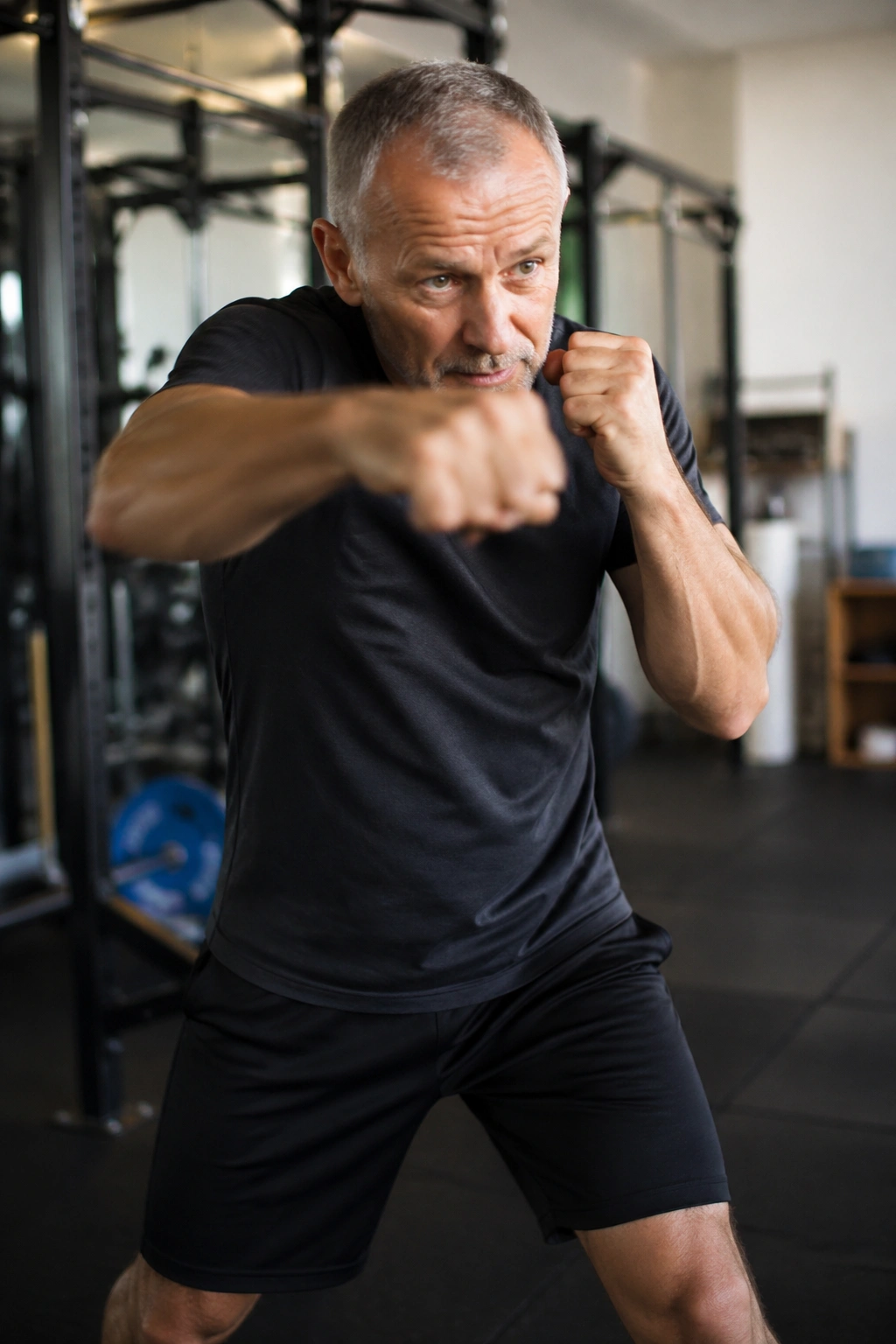
Shadow boxing is one of the few conditioning drills that can feel sharp without feeling punishing.
You’re punching air, yes, but the workout is real. Your shoulders stay active, your trunk rotates, your footwork gets a say, and your heart rate climbs fast when the rounds are honest. For men over 50, that matters. It gives you a fast finisher you can do at home, in a garage, or anywhere with a few feet of open space.
Start with 3 rounds of 1 minute on and 30 seconds off. Keep the knees soft, the chin tucked, and the hands moving back to guard after each punch. The punches do not need to be wild. Crisp straights, a few hooks, small pivots, and steady breathing are enough to make the work count.
If your shoulders tire before your lungs do, shorten the rounds to 40 seconds. If your feet feel clumsy, slow the pace and clean up the steps before you chase speed. Good shadow boxing looks tidy. Sloppy shadow boxing just looks windy.
A final thought worth keeping close: you do not need all seventeen of these every week. Pick a few that your joints tolerate, pair them with walking, and repeat the plan long enough for your waist to notice. That’s the part people skip. It’s also the part that changes things.
