



The sound of the alarm clock is rarely an invitation to greatness. More often, it is a rude reminder that the day has started and your to-do list is already piling up. Many people hit snooze, sacrifice their workout, and spend the rest of the day feeling sluggish. The idea that you need an hour in the gym to make progress is a myth that keeps people sedentary. You do not need an hour. You need fifteen minutes of focused, high-intensity movement that forces your heart rate up and keeps it there.
Efficiency is the only currency that matters in the morning. When your schedule is packed with meetings, childcare, or a long commute, the “perfect” workout is the enemy of the “done” workout. The following routines are designed to be brutal, effective, and finished before the coffee has even cooled down. They require minimal equipment and zero wasted motion. If you commit to the intensity, the duration becomes irrelevant.
1. High-Intensity Sprint Intervals
Most people treat running like a chore—a steady, mind-numbing plod around the block. That is not what we are doing here. Sprints are a completely different animal. They recruit fast-twitch muscle fibers, spike your metabolic rate for hours, and require a level of focus that leaves no room for boredom. You are not going for a jog; you are attacking the pavement.
Why Sprints Change the Morning Routine
When you sprint, your body undergoes a physiological shift that steady-state cardio simply cannot trigger. You are training your heart to recover faster. You are forcing your lungs to adapt to high-stress demand. This is not about distance; it is about output.
- Warm-up: Spend 3 minutes doing dynamic movements like high knees, butt kicks, and walking lunges. Never sprint cold.
- The Workout: Find a flat stretch of road or a track. Sprint at 90% effort for 30 seconds. Walk for 60 seconds to recover.
- The Goal: Complete 8 to 10 rounds of these intervals. If you can talk during the sprint, you are not running fast enough.
Pro tip: Focus on your arm swing. People often forget that driving the elbows back helps propel the legs forward. Keep your torso upright and your eyes on the horizon, not your feet.
2. The Jump Rope Circuit

A jump rope costs less than a fancy sandwich and takes up less space than a pair of shoes. It is the most portable piece of cardio equipment ever invented. Many adults avoid it because they think they have forgotten how, or they worry about tripping over the cord. Both are temporary problems. Ten minutes of jumping rope will leave you drenched in sweat and gasping for air more effectively than an hour on the treadmill.
Master the Rhythm
You do not need to perform triple-unders or complex gymnastics. The goal is consistent, steady rotation. If you trip, do not stop. Reset your feet, breathe, and start again immediately. That brief pause is your only rest.
- Phase 1: Basic bounce for 60 seconds.
- Phase 2: Alternating foot step (like a boxer) for 60 seconds.
- Phase 3: High knees (while jumping) for 30 seconds.
- The Cycle: Repeat this cycle five times with no rest between segments. If you finish in under 15 minutes, you have mastered the basics.
The beauty of the jump rope is the biofeedback. If your form breaks down, the rope hits your shins. It is an honest machine. Use that feedback to refine your posture. Keep your elbows tucked near your ribs and let your wrists do the work, not your entire arms.
3. The 10-Minute Burpee Ladder

Burpees are the exercise people love to hate, and for good reason. They are miserable, physically demanding, and efficient. A burpee works your chest, shoulders, legs, and core in one fluid motion. It is a full-body movement that demands total cooperation from every muscle group you own.
The Ladder Strategy
Do not just aimlessly flop around on the floor. Use a structure to keep the intensity high. A ladder workout prevents you from sandbagging your effort.
- Round 1: Do 1 burpee.
- Round 2: Do 2 burpees.
- Round 3: Do 3 burpees.
- Continue this pattern until the 10-minute timer goes off.
- If you reach 10, start counting back down to 1.
The critical warning here is form. When fatigue sets in—and it will—your lower back will want to sag as you push up from the floor. Fight that urge. Keep your core braced as if you are about to take a punch. If you cannot keep your form, perform a “sprawl” instead—jump your feet back into a plank, but skip the chest-to-floor push-up. It is better to move well than to move poorly and get injured.
4. Stair Climbing Sprints

If you live near a stadium, a public park with bleachers, or even just a long flight of stairs in your apartment building, you have a gym. Gravity is a relentless training partner. Climbing stairs engages the glutes, hamstrings, and calves in a way that flat-ground running never can. It is essentially uphill resistance training that doubles as intense cardio.
Why This Works
The act of lifting your body weight against gravity forces your heart to work overtime to deliver oxygen to your legs. It is brutal on the lungs, but the recovery is surprisingly fast if you keep the intervals short.
- Ascent: Run up the stairs as fast as you can safely manage. Do not skip steps; focus on quick turnover.
- Descent: Walk down carefully. This is your recovery period.
- Volume: Aim for 10 to 12 climbs.
- Variation: Try taking two steps at a time on the way up to target the glutes more aggressively.
Watch your ankles. People tend to turn their feet outward when they get tired, which puts unnecessary torque on the joints. Keep your feet pointing straight ahead. If the stairs are metal or wet, be extra cautious with your footing.
5. Bodyweight Mountain Climber Complexes

Mountain climbers are often dismissed as a core exercise, but if you speed them up, they are a legitimate cardiovascular drill. The key is in the transition between legs. You should feel like you are running horizontally. It is taxing on the shoulders and the heart simultaneously.
The Technique Breakdown
Most people perform these with their hips way too high in the air. That takes the tension off your core and turns it into a resting position. Your goal is to keep your back flat, parallel to the floor, like a plank.
- Position: Start in a strong push-up position.
- Motion: Drive one knee toward your chest, then snap it back while simultaneously driving the other knee in. It should look like a piston firing.
- Timing: Go for 45 seconds of max-effort climbing, followed by 15 seconds of active recovery (holding a plank).
- Total: 10 rounds.
This will burn your shoulders quickly. If your form starts to break, hold a standard plank for the remainder of the 45-second interval. It is about keeping the tension, not just flailing your legs beneath you.
6. Shadow Boxing Drills

You do not need a heavy bag or gloves to get the benefits of boxing. Shadow boxing forces you to move your feet, coordinate your upper body, and manage your breathing—all while rotating your torso against resistance. It is an excellent way to get the heart rate up without the jarring impact of running on pavement.
Creating the Flow
Don’t just throw arm punches. That is a waste of energy. The power comes from your legs and your hips. Rotate your back foot as you throw a cross, and keep your hands up.
- Minute 1-3: Light bouncing, establishing a rhythm. Jab-cross combinations.
- Minute 4-6: Incorporate hooks and uppercuts. Focus on the core rotation.
- Minute 7-10: Add footwork—move forward, backward, and side-to-side while maintaining your punches.
- Minute 11-15: All-out speed bursts. Throw as many punches as you can for 30 seconds, then recover for 30 seconds.
If you feel awkward, that is fine. Nobody looks like a professional fighter on their first day. Focus on the feeling of the muscles working and the breath coming in and out. If you get bored, watch a few videos on basic stance and footwork to give yourself something to focus on.
7. The Stationary Bike Tabata Protocol

Tabata is a specific type of interval training: 20 seconds of maximum effort followed by 10 seconds of rest. It was designed to push the anaerobic system to its absolute limit. If you have access to a stationary bike, this is the most efficient way to use it. You will be exhausted in four minutes, which is the beauty of the protocol.
Why The Math Matters
The 20-second burst must be all-out. It should feel like you are racing for your life. The 10-second rest is not a nap; it is just enough time to breathe before you go again.
- Warm-up: Spend 3 minutes pedaling at a moderate pace to get the blood flowing.
- The Protocol: Set a timer. Pedal as fast as you can with high resistance for 20 seconds. Slow down to a very light pedal for 10 seconds.
- Repetition: Do this 8 times.
- Finish: Cool down for 2-3 minutes.
This is not a long workout, but it is a difficult one. If you can pedal for more than 20 seconds at the end of the set, your resistance was too low. The resistance is your partner in this effort. Use it to make the work harder, not the speed.
8. Kettlebell Swing Intervals

The kettlebell swing is a hinge movement, not a squat. When done correctly, it is a metabolic powerhouse. It builds posterior chain strength (your glutes, hamstrings, and lower back) while keeping your heart rate in the stratosphere. It is arguably the best single-movement cardio exercise that uses resistance.
The Mechanics of the Hinge
If your back hurts, stop. You are likely squatting the weight instead of hinging at the hips. Imagine closing a car door with your glutes. That is the snap you want.
- The Drill: Perform 15 swings, then rest for 30 seconds.
- Volume: Repeat for 10 sets.
- Progression: As you get stronger, increase the weight of the kettlebell rather than the number of swings. This keeps the workout duration short and the intensity high.
Keep your weight in your heels. Your arms are just straps holding the bell; they should not be lifting it. The power comes from your hips snapping forward. If you feel like your arms are doing all the work, you are missing the point of the exercise.
9. Box Jump and Squat Super-Sets

Plyometrics are fantastic for building explosive power and getting the heart rate up instantly. Box jumps, specifically, force you to engage your entire body to overcome gravity. When paired with bodyweight squats, you get a combination of explosive intensity and sustained muscular endurance.
Safety First
Choose a box height that you can clear confidently. This is not the time to test your personal record. If you are nervous about jumping, step-ups are a perfectly viable alternative that will still get your heart rate up if you do them quickly enough.
- The Circuit: Perform 10 box jumps. Immediately drop into 15 air squats.
- Rest: Rest for 45 seconds.
- Rounds: Complete 5 to 6 rounds.
Focus on the landing. It should be silent. If you land with a loud “thud,” you are not absorbing the shock with your muscles. Bend your knees, stay on the balls of your feet, and land softly. This prevents joint strain and forces your muscles to do the work of deceleration.
10. The 15-Minute Jog-Walk Progression

Sometimes, your morning is just not suited for high-intensity, “puke in your mouth” types of workouts. Maybe you had a bad night’s sleep, or you just need to clear your head. The Jog-Walk progression is a classic for a reason: it builds endurance without requiring you to suffer for every single second.
Why This is Still Effective
Consistency beats intensity every single time. A 15-minute jog-walk that you actually do is infinitely better than the “perfect” HIIT workout that you skip because you are too tired.
- Structure: Jog for 2 minutes, walk for 1 minute.
- Cycle: Repeat this for 15 minutes total.
- The Intensity: The jog should be a “conversational pace”—you can talk, but you would rather not. The walk is recovery.
This is a great baseline. If you find this becoming too easy, shorten the walk to 30 seconds or lengthen the jog to 3 minutes. It is a simple, effective way to get your lungs working and your blood moving before you sit down for the day.
11. Battle Rope Waves

Battle ropes are intimidating, but they are incredibly forgiving. They are low-impact, meaning they do not hammer your joints, and they allow you to go as hard as you want. They also demand a surprising amount of core stability. You cannot wave the ropes without bracing your abs.
The Wave Technique
Do not just flail your arms. Create a wave that travels all the way down the rope to the anchor point. If the rope just slaps the floor, you are losing energy.
- The Drill: Alternate arm waves for 30 seconds.
- Rest: Rest for 30 seconds.
- Variation: Try “double slams” where both ropes go up and down together. Try side-to-side waves.
- Total: 10 minutes of active work.
Keep a slight bend in your knees and a hinge in your hips. If you stand straight up, you put unnecessary pressure on your lower back. You want to be in an athletic stance—ready to move, stable, and powerful.
12. Dynamic Lunge and Reach Flows
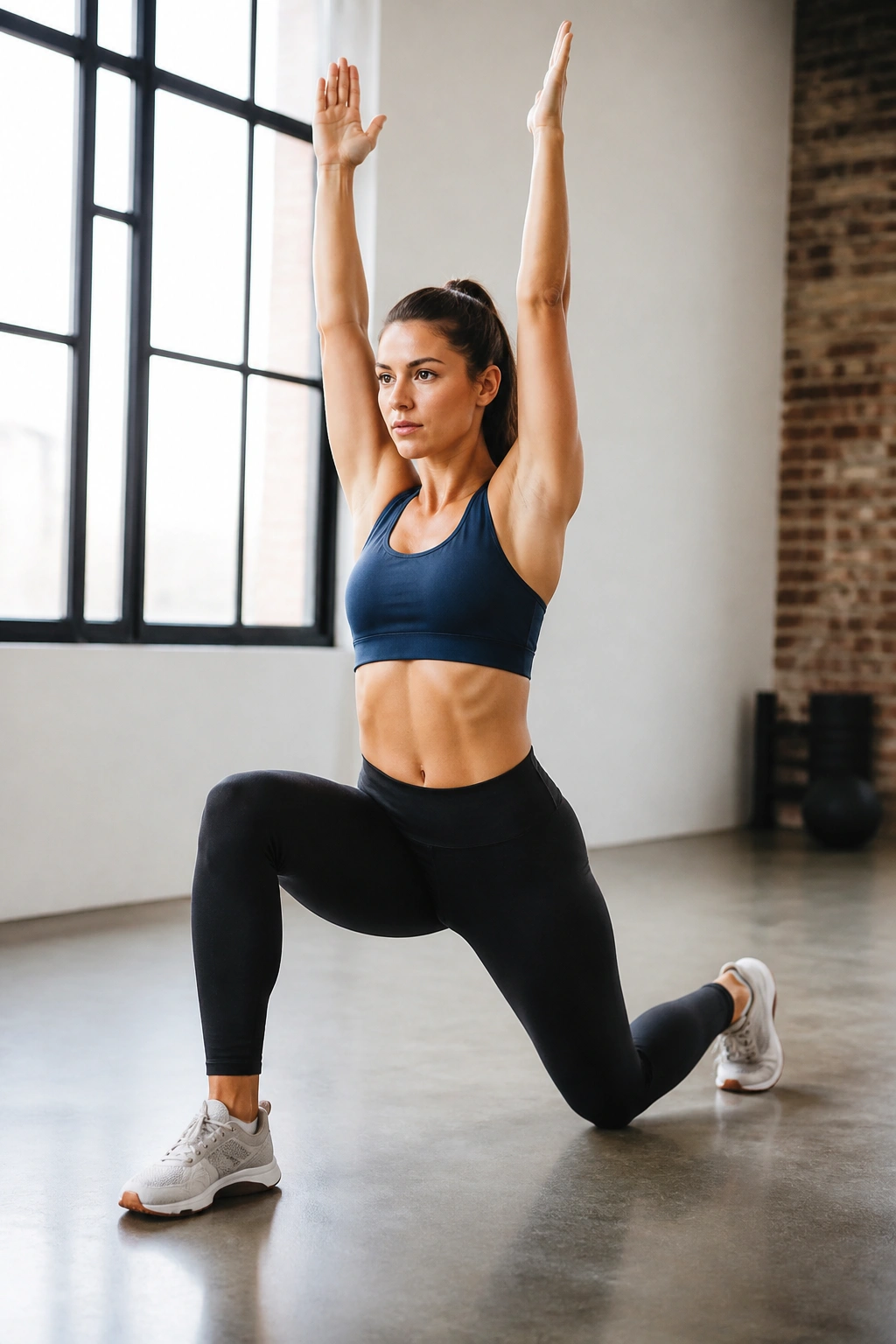
This is cardio that focuses on mobility. It sounds softer than sprinting, but if you keep moving continuously for 15 minutes, you will be sweating. This targets the legs, opens up the hips, and gets the heart rate elevated through constant motion.
How to Flow
Do not perform static lunges where you stop and reset. Make it a continuous motion.
- The Movement: Step forward into a lunge. As you sink into the lunge, reach both hands toward the ceiling. This stretches the hip flexor and adds an upper-body element.
- The Transition: Step back through the starting position and immediately switch to the other leg.
- Tempo: Keep moving the entire time. If 15 minutes is too long, go for 10.
This is particularly good for people who spend their days sitting at a desk. You are reversing the closed-off posture of sitting and forcing your hips to extend. It feels better the longer you do it.
13. High-Knee and Butt-Kick Drills

These are the bread and butter of track warm-ups, but they are also legitimate cardio drills. They mimic running mechanics but force you to exaggerate the motion, which increases the caloric burn and the intensity of the movement.
The Sprint Mechanics
To get the most out of these, you have to be snappy. Do not lazily trot through them.
- High Knees: Drive your knees up toward your chest. Pump your arms. It should be fast, like you are running on hot coals.
- Butt Kicks: Pull your heels toward your glutes. Keep your torso upright.
- The Routine: 30 seconds of high knees, 30 seconds of rest. 30 seconds of butt kicks, 30 seconds of rest.
- Volume: 10 minutes total.
If you have knee issues, high knees can be tough. Listen to your body. If it hurts, swap the high knees for “marching in place” with a faster tempo, driving your arms harder to keep the heart rate up.
14. Rowing Machine Sprints

The rowing machine is a deceptive piece of equipment. It looks like an upper-body exercise, but it is 60% legs. The secret to a good rowing workout is the “drive.” Push with your legs, lean back slightly, and then pull with your arms.
Finding the Power
Don’t worry about the split time or the fancy screen metrics initially. Focus on the feeling of being powerful.
- The Drill: Row 250 meters at a high intensity. Rest for 60 seconds.
- Repetition: Do this for 15 minutes.
- Focus: Think “legs, core, arms.” That is the sequence. Legs push, core engages, arms pull. Then reverse: arms extend, core releases, legs bend.
Rowing is low-impact, making it a great option if you have heavy legs from yesterday’s workout or if running hurts your feet. Just be careful not to pull the handle into your chest; keep it toward your lower ribs.
15. The EMOM Bodyweight Challenge

EMOM stands for “Every Minute on the Minute.” It is a beautiful way to structure a workout because it keeps you honest. You have a set task to complete within 60 seconds. Whatever time remains in that minute is your rest. If you are slow, you get less rest. If you are fast, you get more.
Example 15-Minute Workout
This keeps you moving for the entire duration, with built-in accountability.
- Minute 1: 15 Burpees.
- Minute 2: 20 Squat Jumps.
- Minute 3: 20 Push-ups.
- Repeat: Cycle through these three exercises five times.
If you finish the 15 burpees in 40 seconds, you get 20 seconds to breathe. If it takes you 55 seconds, you have 5 seconds of rest. This naturally pushes you to work faster to earn your recovery time. It is a simple, effective loop that ensures your 15 minutes are used perfectly.
Final Thoughts

The common denominator across all these workouts is not the specific movement; it is the intensity. You can spend 15 minutes walking slowly and achieve very little, or you can spend 15 minutes pushing your limits and change the trajectory of your entire day. Fitness is not about finding the perfect, long-form routine that you eventually abandon because it takes too much time. It is about building a system that fits into the gaps of your life.
Do not worry about being perfect on your first attempt. You might trip over the jump rope, or you might find that you can only do three burpees before your heart feels like it’s going to explode. That is not failure; that is the starting line. The only bad workout is the one you skip because you thought you needed more time than you actually had. Keep a timer handy, pick one of these routines, and get moving. Your morning routine is no longer an excuse; it is your new edge.
